For children, play comes so naturally. They don’t have to be encouraged to play. They don’t need equipment, or the latest graphics processors, or the perfect conditions—they just do it. What’s more, study after study has found that play has a crucial role in childhood growth and development. If you want to witness the absolute rapture of creative expression, just observe the unstructured play of children.
So what happens to us as we grow older? Children begin to compete with each other by age four or five. Play begins to transform from something we do purely for fun into something we use to achieve status and rank ourselves against other people. We play to score points. We play to win.
And with that, play starts to become something different. Not that it can’t still be fun and joyful! Even watching other people play will bring us joy. We enjoy watching other people play so much and get so much joy by proxy from watching their achievements that we spend massive amounts of money to do so. According to StubHub, the average price of a ticket to the Super Bowl this year was $8,600. The average price for a Super Bowl ad was a cool $7 million this year, according to Ad Age.
This kind of interest doesn’t just apply to physical games. Video-game streaming has long been a mainstay on YouTube, and entire industries have risen up around it. Top streamers on Twitch—Amazon’s livestreaming service, which is heavily gaming focused—earn upwards of $100,000 per month. And the global market for video games themselves is projected to bring in some $282 billion in revenue this year.
Simply put, play is serious business.
There are fortunes to be had in making our play more appealing, more accessible, more fun. All of the features in this issue dig in on the enormous amount of research and development that goes into making play “better.”
On our cover this month is executive editor Niall Firth’s feature on the ways AI is going to upend game development. As you will read, we are about to enter the Wild West—Red Dead or not—of game character development. How will games change when they become less predictable and more fully interactive, thanks to AI-driven nonplayer characters who can not only go off script but even continue to play with each other when we’re not there? Will these even be games anymore, or will we simply be playing around in experiences? What kinds of parasocial relationships will we develop in these new worlds? It’s a fascinating read.
There is no sport more intimately connected to the ocean, and to water, than surfing. It’s pure play on top of the waves. And when you hear surfers talk about entering the flow state, this is very much the same kind of state children experience at play—intensely focused, losing all sense of time and the world around them. Finding that flow no longer means living by the water’s edge, Eileen Guo reports. At surf pools all over the world, we’re piping water into (or out of) deserts to create perfect waves hundreds of miles from the ocean. How will that change the sport, and at what environmental cost?
Just as we can make games more interesting, or bring the ocean to the desert, we have long pushed the limits of how we can make our bodies better, faster, stronger. Among the most recent ways we have done this is with the advent of so-called supershoes—running shoes with rigid carbon-fiber plates and bouncy proprietary foams. The late Kelvin Kiptum utterly destroyed the men’s world record for the marathon last year wearing a pair of supershoes made by Nike, clocking in at a blisteringly hot 2:00:35. Jonathan W. Rosen explores the science and technology behind these shoes and how they are changing the sport, especially in Kenya.
There’s plenty more, too. So I hope you enjoy the Play issue. We certainly put a lot of work into it. But of course, what fun is play if you don’t put in the work?
This story first appeared in China Report, MIT Technology Review’s newsletter about technology in China. Sign up to receive it in your inbox every Tuesday.
Have you ever thought about the miraculous fact that despite the myriad differences between languages, virtually everyone uses the same QWERTY keyboards? Many languages have more or fewer than 26 letters in their alphabet—or no “alphabet” at all, like Chinese, which has tens of thousands of characters. Yet somehow everyone uses the same keyboard to communicate.
Last week, MIT Technology Review published an excerpt from a new book, The Chinese Computer, which talks about how this problem was solved in China. After generations of work to sort Chinese characters, modify computer parts, and create keyboard apps that automatically predict the next character, it is finally possible for any Chinese speaker to use a QWERTY keyboard.
But the book doesn’t stop there. It ends with a bigger question about what this all means: Why is it necessary for speakers of non-Latin languages to adapt modern technologies for their uses, and what do their efforts contribute to computing technologies?
I talked to the book’s author, Tom Mullaney, a professor of history at Stanford University. We ended up geeking out over keyboards, computers, the English-centric design that underlies everything about computing, and even how keyboards affect emerging technologies like virtual reality. Here are some of his most fascinating answers, lightly edited for clarity and brevity.
Mullaney’s book covers many experiments across multiple decades that ultimately made typing Chinese possible and efficient on a QWERTY keyboard, but a similar process has played out all around the world. Many countries with non-Latin languages had to work out how they could use a Western computer to input and process their own languages.
Mullaney: In the Chinese case—but also in Japanese, Korean, and many other non-Western writing systems—this wasn’t done for fun. It was done out of brute necessity because the dominant model of keyboard-based computing, born and raised in the English-speaking world, is not compatible with Chinese. It doesn’t work because the keyboard doesn’t have the necessary real estate. And the question became: I have a few dozen keys but 100,000 characters. How do I map one onto the other?
Simply put, half of the population on Earth uses the QWERTY keyboard in ways the QWERTY keyboard was never intended to be used, creating a radically different way of interacting with computers.
The root of all of these problems is that computers were designed with English as the default language. So the way English works is just the way computers work today.
M: Every writing system on the planet throughout history is modular, meaning it’s built out of smaller pieces. But computing carefully, brilliantly, and understandably worked on one very specific kind of modularity: modularity as it functions in English.
And then everybody else had to fit themselves into that modularity. Arabic letters connect, so you have to fix [the computer for it]; In South Asian scripts, the combination of a consonant and a vowel changes the shape of the letter overall—that’s not how modularity works in English.
The English modularity is so fundamental in computing that non-Latin speakers are still grappling with the impacts today despite decades of hard work to change things.
Mullaney shared a complaint that Arabic speakers made in 2022 about Adobe InDesign, the most popular publishing design software. As recently as two years ago, pasting a string of Arabic text into the software could cause the text to become messed up, misplacing its diacritic marks, which are crucial for indicating phonetic features of the text. It turns out you need to install a Middle East version of the software and apply some deliberate workarounds to avoid the problem.
M: Latin alphabetic dominance is still alive and well; it has not been overthrown. And there’s a troubling question as to whether it can ever be overthrown. Some turn was made, some path taken that advantaged certain writing systems at a deep structural level and disadvantaged others.
That deeply rooted English-centric design is why mainstream input methods never deviate too far from the keyboards that we all know and love/hate. In the English-speaking world, there have been numerous attempts to reimagine the way text input works. Technologies such as the T9 phone keyboard or the Palm Pilot handwriting alphabet briefly achieved some adoption. But they never stick for long because most developers snap back to QWERTY keyboards at the first opportunity.
M: T9 was born in the context of disability technology and was incorporated into the first mobile phones because button real estate was a major problem (prior to the BlackBerry reintroducing the QWERTY keyboard). It was a necessity; [developers] actually needed to think in a different way. But give me enough space, give me 12 inches by 14 inches, and I’ll default to a QWERTY keyboard.
Every 10 years or so, some Western tech company or inventor announces: “Everybody! I have finally figured out a more advanced way of inputting English at much higher speeds than the QWERTY keyboard.” And time and time again there is zero market appetite.
Will the QWERTY keyboard stick around forever? After this conversation, I’m secretly hoping it won’t. Maybe it’s time for a change. With new technologies like VR headsets, and other gadgets on the horizon, there may come a time when QWERTY keyboards are not the first preference, and non-Latin languages may finally have a chance in shaping the new norm of human-computer interactions.
M: It’s funny, because now as you go into augmented and virtual reality, Silicon Valley companies are like, “How do we overcome the interface problem?” Because you can shrink everything except the QWERTY keyboard. And what Western engineers fail to understand is that it’s not a tech problem—it’s a technological cultural problem. And they just don’t get it. They think that if they just invent the tech, it is going to take off. And thus far, it never has.
If I were a software or hardware developer, I would be hanging out in online role-playing games, just in the chat feature; I would be watching people use their TV remote controls to find the title of the film they’re looking for; I would look at how Roblox players chat with each other. It’s going to come from some arena outside the mainstream, because the mainstream is dominated by QWERTY.
What are other signs of the dominance of English in modern computing? I’d love to hear about the geeky details you’ve noticed. Send them to zeyi@technologyreview.com.
Now read the rest of China Report
Catch up with China
1. Today marks the 35th anniversary of the student protests and subsequent massacre in Tiananmen Square in Beijing.
For decades, Hong Kong was the hub for Tiananmen memorial events. That’s no longer the case, due to Beijing’s growing control over the city’s politics after the 2019 protests. (New Yorker $)
To preserve the legacy of the student protesters at Tiananmen, it’s also important to address ethical questions about how American universities and law enforcement have been treating college protesters this year. (The Nation)
2. A Chinese company that makes laser sensors was labeled by the US government as a security concern. A few months later, it discreetly rebranded as a Michigan-registered company called “American Lidar.” (Wall Street Journal $)
3. It’s a tough time to be a celebrity in China. An influencer dubbed “China’s Kim Kardashian” for his extravagant displays of wealth has just been banned by multiple social media platforms after the internet regulator announced an effort to clear out “ostentatious personas.” (Financial Times $)
Meanwhile, Taiwanese celebrities who also have large followings in China are increasingly finding themselves caught in political crossfires. (CNN)
4. Cases of Chinese students being rejected entry into the US reveals divisions within the Biden administration. Customs agents, who work for the Department of Homeland Security, have canceled an increasing number of student visas that had already been approved by the State Department. (Bloomberg $)
5. Palau, a small Pacific island nation that’s one of the few countries in the world that recognizes Taiwan as a sovereign country, says it is under cyberattack by China. (New York Times $)
6. After being the first space mission to collect samples from the moon’s far side, China’s Chang’e-6 lunar probe has begun its journey back to Earth. (BBC)
7. The Chinese government just set up the third and largest phase of its semiconductor investment fund to prop up its domestic chip industry. This one’s worth $47.5 billion. (Bloomberg $)
The Chinese generative AI community has been stirred up by the first discovery of a Western large language model plagiarizing a Chinese one, according to the Chinese publication PingWest.
Last week, two undergraduate computer science students at Stanford University released an open-source model called Llama 3-V that they claimed is more powerful than LLMs made by OpenAI and Google, while costing less. But Chinese AI researchers soon found out that Llama 3-V had copied the structure, configuration files, and code from MiniCPM-Llama3-V 2.5, another open-source LLM developed by China’s Tsinghua University and ModelBest Inc, a Chinese startup.
What proved the plagiarism was the fact that the Chinese team secretly trained the model on a collection of Chinese writings on bamboo slips from 2000 years ago, and no other LLMs can recognize the Chinese characters in this ancient writing style accurately. But Llama 3-V could recognize these characters as well as MiniCPM, while making the exact same mistakes as the Chinese model. The students who released Llama 3-V have removed the model and apologized to the Chinese team, but the incident is seen as proof of the rapidly improving capabilities of homegrown LLMs by the Chinese AI community.
One more thing
Hand-crafted squishy toys (or pressure balls) in the shape of cute animals or desserts have become the latest viral products on Chinese social media. Made in small quantities and sold in limited batches, some of them go for up to $200 per toy on secondhand marketplaces. I mean, they are cute for sure, but I’m afraid the idea of spending $200 on a pressure ball only increases my anxiety.
This is an excerpt from The Chinese Computer: A Global History of the Information Age by Thomas S. Mullaney, published on May 28 by The MIT Press. It has been lightly edited.
ymiw2
klt4
pwyy1
wdy6
o1
dfb2
wdv2
fypw3
uet5
dm2
dlu1 …
A young Chinese man sat down at his QWERTY keyboard and rattled off an enigmatic string of letters and numbers.
Was it code? Child’s play? Confusion? It was Chinese.
The beginning of Chinese, at least. These forty-four keystrokes marked the first steps in a process known as “input” or shuru: the act of getting Chinese characters to appear on a computer monitor or other digital device using a QWERTY keyboard or trackpad.
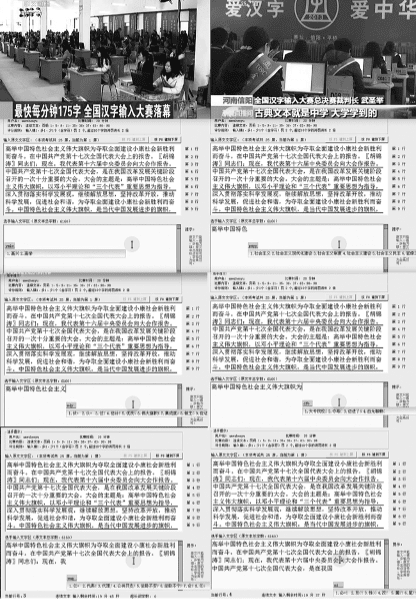
Stills taken from a 2013 Chinese input competition screencast.
COURTESY OF MIT PRESS
Across all computational and digital media, Chinese text entry relies on software programs known as “Input Method Editors”—better known as “IMEs” or simply “input methods” (shurufa). IMEs are a form of “middleware,” so-named because they operate in between the hardware of the user’s device and the software of its program or application. Whether a person is composing a Chinese document in Microsoft Word, searching the web, sending text messages, or otherwise, an IME is always at work, intercepting all of the user’s keystrokes and trying to figure out which Chinese characters the user wants to produce. Input, simply put, is the way ymiw2klt4pwyy … becomes a string of Chinese characters.
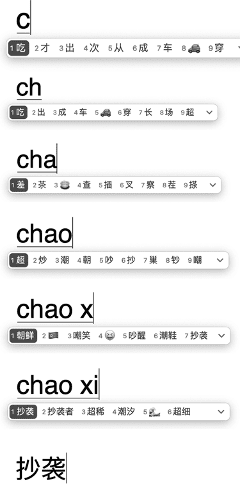
IMEs are restless creatures. From the moment a key is depressed, or a stroke swiped, they set off on a dynamic, iterative process, snatching up user-inputted data and searching computer memory for potential Chinese character matches. The most popular IMEs these days are based on Chinese phonetics—that is, they use the letters of the Latin alphabet to describe the sound of Chinese characters, with mainland Chinese operators using the country’s official Romanization system, Hanyu pinyin.
Example of Chinese Input Method Editor pop-up menu (抄袭 / “plagiarism”)
COURTESY OF MIT PRESS
This young man’s name was Huang Zhenyu (also known by his nom de guerre, Yu Shi). He was one of around sixty contestants that day, each wearing a bright red shoulder sash—like a tickertape parade of old, or a beauty pageant. “Love Chinese Characters” (Ai Hanzi) was emblazoned in vivid, golden yellow on a poster at the front of the hall. The contestants’ task was to transcribe a speech by outgoing Chinese president Hu Jintao, as quickly and as accurately as they could. “Hold High the Great Banner of Socialism with Chinese Characteristics,” it began, or in the original: 高举中国特色社会主义伟大旗帜为夺取全面建设小康社会新胜利而奋斗. Huang’s QWERTY keyboard did not permit him to enter these characters directly, however, and so he entered the quasi-gibberish string of letters and numbers instead: ymiw2klt4pwyy1wdy6…
With these four-dozen keystrokes, Huang was well on his way, not only to winning the 2013 National Chinese Characters Typing Competition, but also to clock one of the fastest typing speeds ever recorded, anywhere in the world.
ymiw2klt4pwyy1wdy6 … is not the same as 高举中国特色社会主义 … the keys that Huang actually depressed on his QWERTY keyboard—his “primary transcript,” as we could call it—were completely different than the symbols that ultimately appeared on his computer screen, namely the “secondary transcript” of Hu Jintao’s speech. This is true for every one of the world’s billion-plus Sinophone computer users. In Chinese computing, what you type is never what you get.
For readers accustomed to English-language word processing and computing, this should come as a surprise. For example, were you to compare the paragraph you’re reading right now against a key log showing exactly which buttons I depressed to produce it, the exercise would be unenlightening (to put it mildly). “F-o-r-_-r-e-a-d-e-r-s-_-a-c-c-u-s-t-o-m-e-d-_t-o-_-E-n-g-l-i-s-h … ” it would read (forgiving any typos or edits). In English-language typewriting and computer input, a typist’s primary and secondary transcripts are, in principle, identical. The symbols on the keys and the symbols on the screen are the same.
Not so for Chinese computing. When inputting Chinese, the symbols a person sees on their QWERTY keyboard are always different from the symbols that ultimately appear on the monitor or on paper. Every single computer and new media user in the Sinophone world—no matter if they are blazing-fast or molasses-slow—uses their device in exactly the same way as Huang Zhenyu, constantly engaged in this iterative process of criteria-candidacy-confirmation, using one IME or another. Not some Chinese-speaking users, mind you, but all. This is the first and most basic feature of Chinese computing: Chinese human-computer interaction (HCI) requires users to operate entirely in code all the time.
If Huang Zhenyu’s mastery of a complex alphanumeric code weren’t impressive enough, consider the staggering speed of his performance. He transcribed the first 31 Chinese characters of Hu Jintao’s speech in roughly 5 seconds, for an extrapolated speed of 372 Chinese characters per minute. By the close of the grueling 20-minute contest, one extending over thousands of characters, he crossed the finish line with an almost unbelievable speed of 221.9 characters per minute.
That’s 3.7 Chinese characters every second.
In the context of English, Huang’s opening 5 seconds would have been the equivalent of around 375 English words-per-minute, with his overall competition speed easily surpassing 200 WPM—a blistering pace unmatched by anyone in the Anglophone world (using QWERTY, at least). In 1985, Barbara Blackburn achieved a Guinness Book of World Records–verified performance of 170 English words-per-minute (on a typewriter, no less). Speed demon Sean Wrona later bested Blackburn’s score with a performance of 174 WPM (on a computer keyboard, it should be noted). As impressive as these milestones are, the fact remains: had Huang’s performance taken place in the Anglophone world, it would be his name enshrined in the Guinness Book of World Records as the new benchmark to beat.
Huang’s speed carried special historical significance as well.
For a person living between the years 1850 and 1950—the period examined in the book The Chinese Typewriter—the idea of producing Chinese by mechanical means at a rate of over two hundred characters per minute would have been virtually unimaginable. Throughout the history of Chinese telegraphy, dating back to the 1870s, operators maxed out at perhaps a few dozen characters per minute. In the heyday of mechanical Chinese typewriting, from the 1920s to the 1970s, the fastest speeds on record were just shy of eighty characters per minute (with the majority of typists operating at far slower rates). When it came to modern information technologies, that is to say, Chinese was consistently one of the slowest writing systems in the world.
What changed? How did a script so long disparaged as cumbersome and helplessly complex suddenly rival—exceed, even—computational typing speeds clocked in other parts of the world? Even if we accept that Chinese computer users are somehow able to engage in “real time” coding, shouldn’t Chinese IMEs result in a lower overall “ceiling” for Chinese text processing as compared to English? Chinese computer users have to jump through so many more hoops, after all, over the course of a cumbersome, multistep process: the IME has to intercept a user’s keystrokes, search in memory for a match, present potential candidates, and wait for the user’s confirmation. Meanwhile, English-language computer users need only depress whichever key they wish to see printed on screen. What could be simpler than the “immediacy” of “Q equals Q,” “W equals W,” and so on?
COURTESY OF TOM MULLANEY
To unravel this seeming paradox, we will examine the first Chinese computer ever designed: the Sinotype, also known as the Ideographic Composing Machine. Debuted in 1959 by MIT professor Samuel Hawks Caldwell and the Graphic Arts Research Foundation, this machine featured a QWERTY keyboard, which the operator used to input—not the phonetic values of Chinese characters—but the brushstrokes out of which Chinese characters are composed. The objective of Sinotype was not to “build up” Chinese characters on the page, though, the way a user builds up English words through the successive addition of letters. Instead, each stroke “spelling” served as an electronic address that Sinotype’s logical circuit used to retrieve a Chinese character from memory. In other words, the first Chinese computer in history was premised on the same kind of “additional steps” as seen in Huang Zhenyu’s prizewinning 2013 performance.
During Caldwell’s research, he discovered unexpected benefits of all these additional steps—benefits entirely unheard of in the context of Anglophone human-machine interaction at that time. The Sinotype, he found, needed far fewer keystrokes to find a Chinese character in memory than to compose one through conventional means of inscription. By way of analogy, to “spell” a nine-letter word like “crocodile” (c-r-o-c-o-d-i-l-e) took far more time than to retrieve that same word from memory (“c-r-o-c-o-d” would be enough for a computer to make an unambiguous match, after all, given the absence of other words with similar or identical spellings). Caldwell called his discovery “minimum spelling,” making it a core part of the first Chinese computer ever built.
Today, we know this technique by a different name: “autocompletion,” a strategy of human-computer interaction in which additional layers of mediation result in faster textual input than the “unmediated” act of typing. Decades before its rediscovery in the Anglophone world, then, autocompletion was first invented in the arena of Chinese computing.
Once a week, Sun Kai has a video call with his mother. He opens up about work, the pressures he faces as a middle-aged man, and thoughts that he doesn’t even discuss with his wife. His mother will occasionally make a comment, like telling him to take care of himself—he’s her only child. But mostly, she just listens.
That’s because Sun’s mother died five years ago. And the person he’s talking to isn’t actually a person, but a digital replica he made of her—a moving image that can conduct basic conversations. They’ve been talking for a few years now.
After she died of a sudden illness in 2019, Sun wanted to find a way to keep their connection alive. So he turned to a team at Silicon Intelligence, an AI company based in Nanjing, China, that he cofounded in 2017. He provided them with a photo of her and some audio clips from their WeChat conversations. While the company was mostly focused on audio generation, the staff spent four months researching synthetic tools and generated an avatar with the data Sun provided. Then he was able to see and talk to a digital version of his mom via an app on his phone.
“My mom didn’t seem very natural, but I still heard the words that she often said: ‘Have you eaten yet?’” Sun recalls of the first interaction. Because generative AI was a nascent technology at the time, the replica of his mom can say only a few pre-written lines. But Sun says that’s what she was like anyway. “She would always repeat those questions over and over again, and it made me very emotional when I heard it,” he says.
There are plenty of people like Sun who want to use AI to preserve, animate, and interact with lost loved ones as they mourn and try to heal. The market is particularly strong in China, where at least half a dozen companies are now offering such technologies and thousands of people have already paid for them. In fact, the avatars are the newest manifestation of a cultural tradition: Chinese people have always taken solace from confiding in the dead.
The technology isn’t perfect—avatars can still be stiff and robotic—but it’s maturing, and more tools are becoming available through more companies. In turn, the price of “resurrecting” someone—also called creating “digital immortality” in the Chinese industry—has dropped significantly. Now this technology is becoming accessible to the general public.
Some people question whether interacting with AI replicas of the dead is actually a healthy way to process grief, and it’s not entirely clear what the legal and ethical implications of this technology may be. For now, the idea still makes a lot of people uncomfortable. But as Silicon Intelligence’s other cofounder, CEO Sima Huapeng, says, “Even if only 1% of Chinese people can accept [AI cloning of the dead], that’s still a huge market.”
AI resurrection
Avatars of the dead are essentially deepfakes: the technologies used to replicate a living person and a dead person aren’t inherently different. Diffusion models generate a realistic avatar that can move and speak. Large language models can be attached to generate conversations. The more data these models ingest about someone’s life—including photos, videos, audio recordings, and texts—the more closely the result will mimic that person, whether dead or alive.
China has proved to be a ripe market for all kinds of digital doubles. For example, the country has a robust e-commerce sector, and consumer brands hire many livestreamers to sell products. Initially, these were real people—but as MIT Technology Reviewreported last fall—many brands are switching to AI-cloned influencers that can stream 24/7.
In just the past three years, the Chinese sector developing AI avatars has matured rapidly, says Shen Yang, a professor studying AI and media at Tsinghua University in Beijing, and replicas have improved from minutes-long rendered videos to 3D “live” avatars that can interact with people.
This year, Sima says, has seen a tipping point, with AI cloning becoming affordable for most individuals. “Last year, it cost about $2,000 to $3,000, but it now only costs a few hundred dollars,” he says. That’s thanks to a price war between Chinese AI companies, which are fighting to meet the thriving demand for digital avatars in other sectors like streaming.
In fact, demand for applications that re-create the dead has also boosted the capabilities of tools that digitally replicate the living.
Silicon Intelligence offers both services. When Sun and Sima launched the company, they were focused on using text-to-speech technologies to create audio and then using those AI-generated voices in applications such as robocalls.
But after the company replicated Sun’s mother, it pivoted to generating realistic avatars. That decision turned the company into one of the leading Chinese players creating AI-powered influencers.
Example of the tablet product by Silicon Intelligence. The avatar of the grandma can converse with the user.
SILICON INTELLIGENCE
Its technology has generated avatars for hundreds of thousands of TikTok-like videos and streaming channels, but Sima says more recently it’s seen around 1,000 clients use it to replicate someone who’s passed away. “We started our work on ‘resurrection’ in 2019 and 2020,” he says, but at first people were slow to accept it: “No one wanted to be the first adopters.”
The quality of the avatars has improved, he says, which has boosted adoption. When the avatar looks increasingly lifelike and gives fewer out-of-character answers, it’s easier for users to treat it as their deceased family member. Plus, the idea is getting popularized through more depictions on Chinese TV.
Now Silicon Intelligence offers the replication service for a price between several hundred and several thousand dollars. The most basic product comes as an interactive avatar in an app, and the options at the upper end of the range often involve more customization and better hardware components, such as a tablet or a display screen. There are at least a handful more Chinese companies working on the same technology.
A modern twist on tradition
The business in these deepfakes builds on China’s long cultural history of communicating with the dead.
In Chinese homes, it’s common to put up a portrait of a deceased relative for a few years after the death. Zhang Zewei, founder of a Shanghai-based company called Super Brain, says he and his team wanted to revamp that tradition with an “AI photo frame.” They create avatars of deceased loved ones that are pre-loaded onto an Android tablet, which looks like a photo frame when standing up. Clients can choose a moving image that speaks words drawn from an offline database or from an LLM.
“In its essence, it’s not much different from a traditional portrait, except that it’s interactive,” Zhang says.
Zhang says the company has made digital replicas for over 1,000 clients since March 2023 and charges $700 to $1,400, depending on the service purchased. The company plans to release an app-only product soon, so that users can access the avatars on their phones, and could further reduce the cost to around $140.
Super Brain demonstrates the app-only version with an avatar of Zhang Zewei answering his own questions.
SUPER BRAIN
The purpose of his products, Zhang says, is therapeutic. “When you really miss someone or need consolation during certain holidays, you can talk to the artificial living and heal your inner wounds,” he says.
And even if that conversation is largely one-sided, that’s in keeping with a strong cultural tradition. Every April during the Qingming festival, Chinese people sweep the tombs of their ancestors, burn joss sticks and fake paper money, and tell them what has happened in the past year. Of course, those conversations have always been one-way.
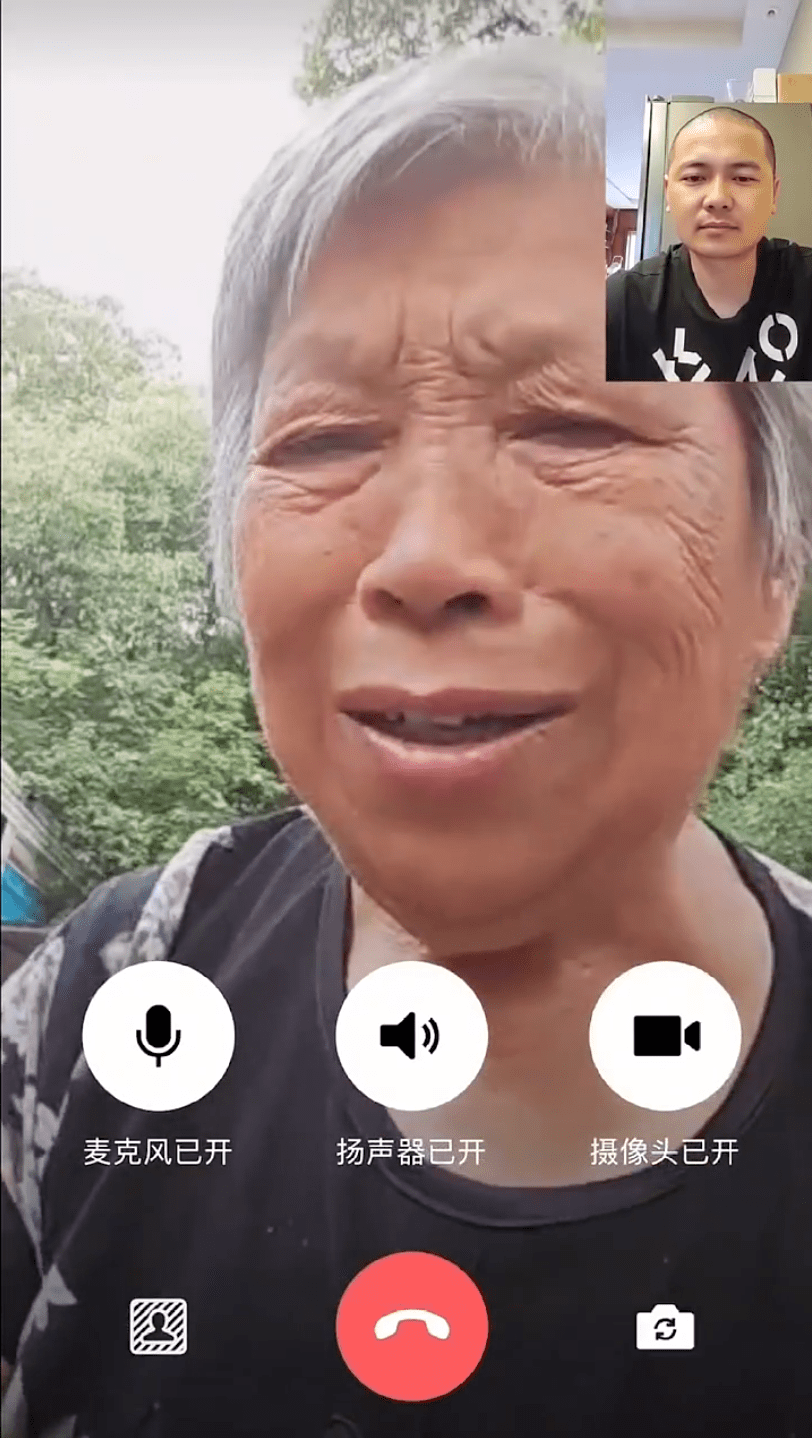
But that’s not the case for all Super Brain services. The company also offers deepfaked video calls in which a company employee or a contract therapist pretends to be the relative who passed away. Using DeepFace, an open-source tool that analyzes facial features, the deceased person’s face is reconstructed in 3D and swapped in for the live person’s face with a real-time filter.
Example of a deepfake video call Super Brain did in July 2023. The face in the top right corner is from the deceased son of the woman.
SUPER BRAIN
At the other end of the call is usually an elderly family member who may not know that the relative has died—and whose family has arranged the conversation as a ruse.
Jonathan Yang, a Nanjing resident who works in the tech industry, paid for this service in September 2023. His uncle died in a construction accident, but the family hesitated to tell Yang’s grandmother, who is 93 and in poor health. They worried that she wouldn’t survive the devastating news.
So Yang paid $1,350 to commission three deepfaked calls of his dead uncle. He gave Super Brain a handful of photos and videos of his uncle to train the model. Then, on three Chinese holidays, a Super Brain employee video-called Yang’s grandmother and told her, as his uncle, that he was busy working in a faraway city and wouldn’t be able to come back home, even during the Chinese New Year.
“The effect has met my expectations. My grandma didn’t suspect anything,” Yang says. His family did have mixed opinions about the idea, because some relatives thought maybe she would have wanted to see her son’s body before it was cremated. Still, the whole family got on board in the end, believing the ruse would be best for her health. After all, it’s pretty common for Chinese families to tell “necessary” lies to avoid overwhelming seniors, as depicted in the movie The Farewell.
To Yang, a close follower of the AI industry trends, creating replicas of the dead is one of the best applications of the technology. “It best represents the warmth [of AI],” he says. His grandmother’s health has improved, and there may come a day when they finally tell her the truth. By that time, Yang says, he may purchase a digital avatar of his uncle for his grandma to talk to whenever she misses him.
Is AI really good for grief?
Even as AI cloning technology improves, there are some significant barriers preventing more people from using it to speak with their dead relatives in China.
On the tech side, there are limitations to what AI models can generate. Most LLMs can handle dominant languages like Mandarin and Cantonese, but they aren’t able to replicate the many niche dialects in China. It’s also challenging—and therefore costly—to replicate body movements and complex facial expressions in 3D models.
Then there’s the issue of training data. Unlike cloning someone who’s still alive, which often involves asking the person to record body movements or say certain things, posthumous AI replications must rely on whatever videos or photos are already available. And many clients don’t have high-quality data, or enough of it, for the end result to be satisfactory.
Complicating these technical challenges are myriad ethical questions. Notably, how can someone who is already dead consent to being digitally replicated? For now, companies like Super Brain and Silicon Intelligence rely on the permission of direct family members. But what if family members disagree? And if a digital avatar generates inappropriate answers, who is responsible?
Similar technology caused controversy earlier this year. A company in Ningbo reportedly used AI tools to create videos of deceased celebrities and posted them on social media to speak to their fans. The videos were generated using public data, but without seeking any approval or permission. The result was intense criticism from the celebrities’ families and fans, and the videos were eventually taken down.
“It’s a new domain that only came about after the popularization of AI: the rights to digital eternity,” says Shen, the Tsinghua professor, who also runs a lab that creates digital replicas of people who have passed away. He believes it should be prohibited to use deepfake technology to replicate living people without their permission. For people who have passed away, all of their immediate living family members must agree beforehand, he says.
There could be negative effects on clients’ mental health, too. While some people, like Sun, find their conversations with avatars to be therapeutic, not everyone thinks it’s a healthy way to grieve. “The controversy lies in the fact that if we replicate our family members because we miss them, we may constantly stay in the state of mourning and can’t withdraw from it to accept that they have truly passed away,” says Shen. A widowed person who’s in constant conversation with the digital version of their partner might be held back from seeking a new relationship, for instance.
“When someone passes away, should we replace our real emotions with fictional ones and linger in that emotional state?” Shen asks. Psychologists and philosophers who talked to MIT Technology Review about the impact of grief tech have warned about the danger of doing so.
Sun Kai, at least, has found the digital avatar of his mom to be a comfort. She’s like a 24/7 confidante on his phone. Even though it’s possible to remake his mother’s avatar with the latest technology, he hasn’t yet done that. “I’m so used to what she looks like and sounds like now,” he says. As years have gone by, the boundary between her avatar and his memory of her has begun to blur. “Sometimes I couldn’t even tell which one is the real her,” he says.
And Sun is still okay with doing most of the talking. “When I’m confiding in her, I’m merely letting off steam. Sometimes you already know the answer to your question, but you still need to say it out loud,” he says. “My conversations with my mom have always been like this throughout the years.”
But now, unlike before, he gets to talk to her whenever he wants to.