Can Ecommerce Spur On-Demand Manufacturing?
On-demand manufacturing has taken much longer to mature than some would have wished. The idea is straightforward: Don’t build or complete a product until someone orders it.
The advantages are numerous, including enhanced customization, elevated sustainability, cross-border ecommerce, and lower inventory holding costs.
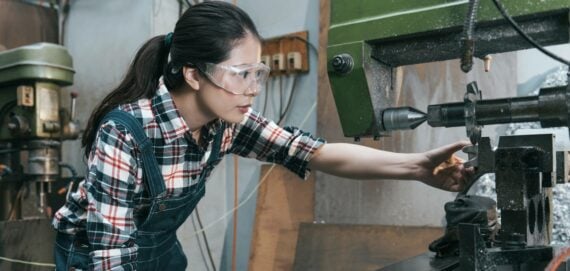
An on-demand manufacturing project starts only after a customer places an order.
Zero Inventory
Print-on-demand firms, a subset of on-demand manufacturing, have emphasized the advantages for years, often focusing on reduced inventory costs and borrowing the “zero inventory” moniker from the heavy manufacturing industry.
“Part of what makes the zero-inventory model interesting is that it can empower more people to start and scale their businesses globally, without the hassles of managing inventory, shipping, or making significant upfront investments — while reducing the impact on the environment through local production,” wrote Julie Ryland, vice president of public relations and communications at print-on-demand sourcing firm Gelato in an email message to Practical Ecommerce.
“Bigger picture, this model helps redefine global manufacturing and distribution — enabling small business owners and creators to start and grow a business in a way that is better for both people and the planet. The shift from mass production to mass customization on demand also presents a market opportunity for the print industry,” continued Ryland.
That opportunity has arrived. According to a July 2024 report from Precedence Research, a consultancy, the worldwide market for print-on-demand products will hit $10.2 billion in 2024, reaching $87 billion in a decade.
In the United States, Precedence projects the print-on-demand industry to reach $2 billion in 2024 and $22 billion in the next 10 years, roughly a 27.6% compound annual growth rate.
Meanwhile, the on-demand manufacturing industry is smaller. Various sources put the global market for on-demand manufacturing (ODM) using technologies such as 3D printing and computer numerical control machining at approximately $10 billion in 2024.
The segment becomes more or less nonexistent when isolated to products sold via ecommerce.
There are, however, rays of hope.
ODM Opportunity
Print-on-demand has demonstrated the potential. Many entrepreneurs run profitable businesses using Gelato or its competitors, such as Printful, Gooten, and Printify.
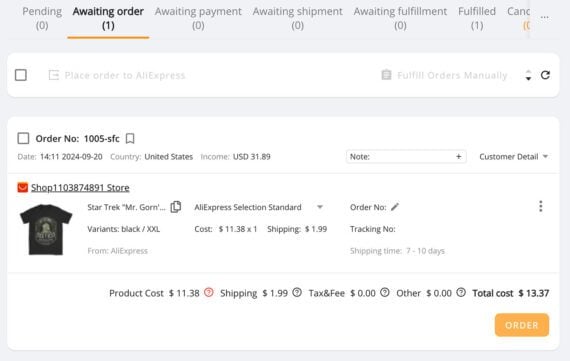
These printing solutions integrate with leading ecommerce platforms, and just like that, one has a global, zero-inventory drop-shipping business.
What if other products could do that? Even large items.
Here is an example. An Idaho-based manufacturer specializing in kayak trailers for the fishing industry plans to release an on-demand trailer system in 2025. When a customer orders, workers will pass metal sheets and tubes through a laser cleaning, cutting, and welding process, producing a ship-flat trailer kit, ready to package in a couple of hours.
This general idea applies to other products, such as furniture, antique auto parts, medical devices, and jewelry.
ODM for Ecommerce
To take off in ecommerce, on-demand manufacturing would need implementation, automation, and integration.
Implementation
Implementation in this context is having shops willing to manufacture a given product when an order comes in.
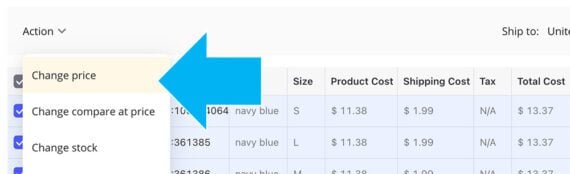
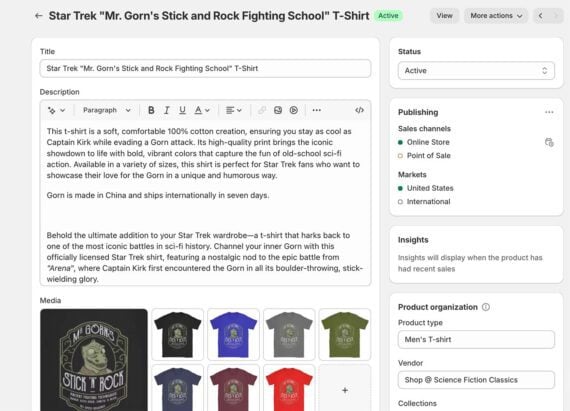
Hundreds of printing shops, for example, are connected to Gelato and Shopify and ready to take a standard blank t-shirt, print on it using standard methods, and ship it on behalf of the merchant.
The on-demand manufacturing industry needs this same level of shop implementation. The made-to-order fishing kayak example came from the brand actually producing the item. It had the specialized equipment and owned the raw materials. For on-demand manufacturing to work broadly with ecommerce, job shops must be able to pick up an order and manufacture it in a standard way.
Automation
Automation and even artificial intelligence could help manage shop capacity and handle technical files.
First, a network must instantly match orders with the best manufacturing facility. Print-on-demand services automatically route a t-shirt order to the closest available printer with the right equipment. Creating a similar system for complex manufacturing requires sophisticated automation and intelligence to assess shop capabilities, workload, and geographic location.
Second is the technical challenge of file preparation. Unlike standard product photos in print-on-demand, manufacturing requires precise technical specifications. Each facility might use different equipment requiring specific file formats for specialized machines and 3D printers. Enter AI, which could convert file formats.
For on-demand manufacturing to scale, these automation systems must work behind the scenes, making complex decisions instantly while keeping the process simple for merchants.
Integration
Integration could be the last step. It involves making it easy for small or mid-sized ecommerce shops to start an on-demand manufacturing business. The process could include adding an app to Shopify, installing a drag-and-drop product designer, and selling made-to-order items.
The company that solves these three hurdles could bring manufacturing on demand to ecommerce.