LinkedIn Reveals Data-Backed Formula For B2B Ad Success via @sejournal, @MattGSouthern

LinkedIn unveils research-backed creative principles to boost B2B ad performance, as 90% of CMOs seek bolder marketing approaches.

  • Vertical mobile ads drive 31% higher engagement than horizontal formats on LinkedIn.
  • 81% of B2B ad campaigns fail to achieve both attention capture and brand recall.
  • Humorous content generates 65% higher engagement rates on LinkedIn.
Meta Announces Updates To Business Tools Affecting Advertisers via @sejournal, @MattGSouthern

Meta is restricting data access in its Business Tools. Custom audiences and ad sets may be affected or paused. Advertisers need to adapt their tracking and reporting strategies.

Meta has informed businesses of upcoming changes to its Business Tools that may impact how you use the platforms for advertising.

Key Changes

According to an email sent to advertisers, Meta plans to automatically restrict certain data, including parts of URLs and custom parameters.

The company states this reduces the potential for sharing information prohibited by its Business Tools Terms.

Potential Effects On Advertisers

The email outlines several ways these changes may affect businesses:

  1. Custom audiences may require adjustments if they use rules that include data that will be restricted.
  2. Some ad sets may be paused if custom audiences decrease or can no longer be updated.
  3. Events Manager monitoring will change, with restricted data no longer being included in reports.

Meta’s Recommendations

For advertisers whose ads are paused, Meta recommends either switching the custom audience or creating a new one with standard parameters.

The company advises businesses to check their Events Manager Overview to see which data these changes will affect.

Industry Response

Navah Hopkins, Optmyzr Brand Evangelist, commented on LinkedIn about the announcement.

Hopkins noted that the update indicates Meta is prioritizing privacy and that the ability to report and target based on ad interactions may be affected.

She states:

“Really important update on Meta ads: not only will data be restricted, ads with hyper targeted UTMs might be paused!

This is a critical reminder that Meta (Facebook/Instagram/WhatsApp) is taking privacy very seriously and our ability to report and target based on seeing/clicking ads is no longer a guaranteed state.”

Hopkins advised advertisers using UTMs to monitor for paused ads and be prepared to adjust their inclusions. She also suggested informing clients or stakeholders who expect detailed reporting about these upcoming changes.

She added:

“If your ads use UTMs, keep an eye out for paused ads and be prepared to make some compromises on what you include.

Most of us have been moving away from the “perfect” targeting world, towards a privacy compliant one. However, if your clients/stakeholders still hold you accountable for that reporting, be sure to keep them in the know!”

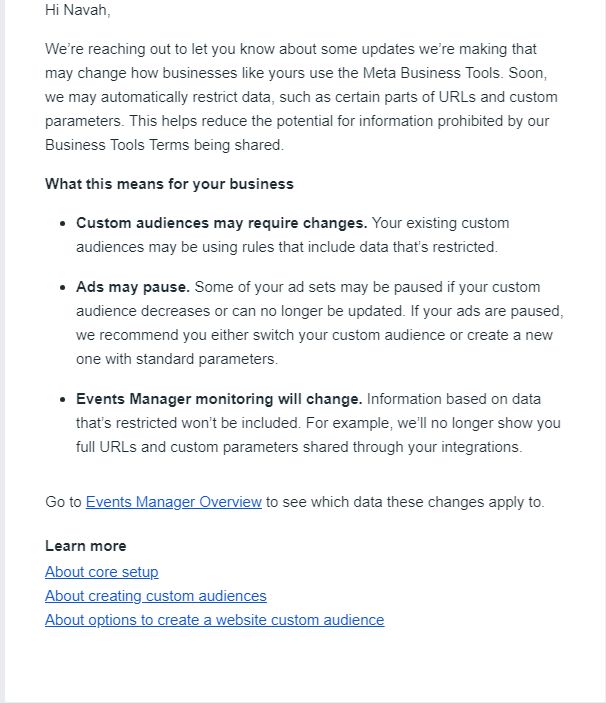
Hopkins shares a screenshot of the email she received from Meta:

Screenshot from: linkedin.com/in/navahhopkins/, September 2024.

Practical Steps For Businesses

In light of this change, and considering Hopkins’ advice, businesses can take several actions:

  • Audit UTMs: Review your tracking parameters for potentially restricted info.
  • Streamline tracking: Focus on core UTM elements like source, medium, and campaign name.
  • Set up ad pause alerts: Stay on top of affected campaigns.
  • Explore alternatives: Look into privacy-compliant analytics tools beyond Meta’s ecosystem.
  • Revamp reporting: Adjust your processes to account for limited data availability.
  • Communicate changes: Keep clients and teams informed about the impact on metrics and performance.
  • Develop privacy-friendly targeting: Test new strategies using broader audience segments.
  • Stay updated: Regularly check Meta’s policies to anticipate future changes.

Advertisers can adapt to Meta’s evolving privacy landscape by implementing these steps while minimizing campaign disruptions.

Context

These changes come amid a broader industry shift towards increased user privacy measures.

As digital platforms evolve their practices, advertisers may need to adapt their strategies to align with new data usage policies.

Meta hasn’t specified an exact date for implementing these changes. Advertisers are advised to stay informed and prepare for potential adjustments.


Featured Image: mundissima/Shutterstock

Meta’s New Ad Tools Promise More Precise Customer Targeting via @sejournal, @MattGSouthern

Meta is rolling out ad platform upgrades for Facebook and Instagram.

The updates, coming in the next few months, focus on boosting performance and customization through AI-powered campaign optimization.

New Features For Precise Value Definition

Meta is rolling out a new “Conversion Value Rules” tool to give advertisers more flexibility.

This feature lets you adjust the value of different customer actions or groups to your business within a single campaign.

Let’s say you know some customers tend to spend way more over time. Now, you can tell the system to bid higher for those folks without setting up a separate campaign.

Incremental Attribution Model

Meta plans to introduce a new optional attribution setting later this year. This feature will focus on what it terms “incremental conversions.”

Instead of maximizing the total number of attributed conversions, this new model aims to optimize ad delivery for conversions likely to occur only because of ad exposure.

In other words, the model identifies and targets potential customers who wouldn’t have converted without seeing the advertisement.

Initial tests of this feature have yielded positive results. Advertisers participating in these trials have observed an average increase of over 20% in incremental conversions.

Enhanced Analytics Integration

Meta is launching direct connections with external analytics platforms, starting now and continuing through 2025. They’re kicking off with Google Analytics and Northbeam and plan to add Triple Whale and Adobe later.

These connections let businesses share combined campaign data from different channels with Meta’s ad system. The goal is to give advertisers a complete picture of how their campaigns perform across various platforms.

By getting this broader data set, Meta expects to fine-tune its AI models and help advertisers run more effective campaigns.

Cross-Publisher Journey Optimization

Meta is using what it’s learned from its early connections with analytics tools to update its ad system. These changes consider how customers interact with ads across different platforms before purchasing.

Early tests of this update have been positive. On average, third-party analytics tools show a 30% increase in conversions attributed to Meta ads. However, advertisers might see higher costs per thousand impressions (CPMs).

Right now, this update is being applied to campaigns that aim to increase the number or value of conversions under the sales objective. Meta plans to extend this to other campaign objectives soon.

Google Analytics Integration: What It Means

The Google Analytics connection is big news for industry folks, as it could offer the following benefits:

  • Unified view of Meta ads and overall site performance
  • Better multi-touch attribution
  • Insights to refine SEO strategy based on paid social impact
  • Smarter budget decisions between paid social and SEO
  • Easier reporting
  • Cross-channel optimization opportunities

This integration blurs the lines between paid social, organic social, and SEO, offering a more holistic view of digital marketing efforts.

Why This Matters

As privacy changes shake up digital advertising, Meta’s updates address the need for more accurate, valuable insights.

The move towards AI-driven features and cross-channel integration marks a new era in ad sophistication.

To make the most of these updates, review your Meta ad strategy and clearly define your customer journey and value metrics.

Stay tuned for the rollout, and be ready to test these new features as they become available.


Featured Image: Cristian Valderas/Shutterstock