As healthcare faces mounting pressures, from rising costs and an aging population to widening disparities, forward thinking innovations are more essential than ever.
Accelerator programs have proven to be powerful launchpads for health tech companies, often combining resources, mentorship, and technology that startups otherwise would not have access to. By joining these fast-moving platforms, startups are better able to rapidly innovate, enhance, and scale their healthcare solutions, bringing transformative approaches to hospitals and patients faster.
So, why are healthcare accelerators becoming essential to the evolution of the industry? There are key reasons why these programs are reshaping health innovation and explanations how they are helping to make care more personalized, proactive, and accessible.
Empowering growth and scaling impact
Healthcare accelerator programs offer a powerful combination of guidance, resources, and connections to help early-stage startups grow, scale, and succeed in a complex industry.
Participants typically benefit from:
Expert mentorship from seasoned healthcare professionals, entrepreneurs, and industry leaders to navigate clinical, regulatory, and business challenges
Access to valuable resources such as clinical data, testing environments, and technical infrastructure to refine and validate health tech solutions
Strategic support for growth including investor introductions, partnership opportunities, and go-to-market guidance to expand reach and impact
Speeding up innovation
Accelerators help startups and early-stage companies bring their solutions to market faster by streamlining the path through one of the most complex industries: healthcare. Traditionally, innovation in this space is slowed by regulatory hurdles, extended sales cycles, clinical validation requirements, and fragmented data systems.
Through structured support, accelerators help companies refine their product market fit, navigate compliance and regulatory landscapes, integrate with healthcare systems, and gather the clinical evidence needed to build trust and credibility. They also open doors to early pilot opportunities, customer feedback, and strategic partnerships, compressing what could take years into just a few months.
By removing barriers and accelerating critical early steps, these programs enable digital health innovators to reach the market more efficiently, with stronger solutions and a clearer path to impact.
Connecting startups with key stakeholders
Today, many accelerator programs are developed by large healthcare organizations that are driving change from within. These accelerator programs are especially beneficial to startups since they have strong partnerships with hospitals, pharma companies, insurance providers, and regulators. This gives startups a chance to validate their ideas in real-world settings, gather clinical feedback early, and scale more effectively.
Many accelerators also bring together people from different fields; doctors, engineers, data scientists, and designers, encouraging fresh perspectives on persistent problems like chronic disease management, preventative care, data interoperability, and patient engagement.
Breaking barriers to global expansion
Healthcare accelerator programs act as gateways for international digital health companies looking to enter the U.S. market, often considered one of the most complex and highly regulated healthcare landscapes in the world. These programs provide tailored support to navigate U.S. compliance standards, understand payer and provider dynamics, and tailor offerings to meet the needs of U.S. patients and care delivery models.
Through market-specific mentorship, strategic introductions, and access to a robust health innovation ecosystem, accelerators help international startups overcome geographic and regulatory barriers, enabling global ideas to scale and make an impact where they’re needed most.
Building the future of healthcare
The role of healthcare accelerator programs extends far beyond startup support. They are helping to redefine how innovation happens, shifting it from isolated efforts to collaborative ecosystems of change. By bridging gaps between early-stage technology and real-world implementation, these programs play a critical role in making healthcare more personalized, preventative, and equitable.
As the digital transformation of healthcare continues, accelerator programs will remain indispensable in cultivating the next generation of breakthroughs, ensuring that bold ideas are not only born, but brought to life in meaningful, measurable ways.
Spotlight: Mayo Clinic Platform_Accelerate
One standout example of this innovation-forward approach is Mayo Clinic Platform_Accelerate, a 30-week accelerator program designed to help health tech startups reach market readiness. Participants gain access to de-identified clinical data, prototyping labs, and guidance from experts across clinical, regulatory, and business domains.
By combining Mayo Clinic’s legacy of clinical excellence with a forward-thinking innovation model, the Mayo Clinic Platform_Accelerate program helps promising startups to refine their solutions and prepare for meaningful scale, transforming how care is delivered across the continuum.
Finding value in accelerator programs
In a time when healthcare must evolve faster than ever, accelerator programs have become vital to the industry’s future. By supporting early-stage innovators with the tools, mentorship, and networks they need to succeed, these programs are paving the way for smarter, safer, and more connected care.
Whether tackling chronic disease, reimagining patient engagement, or unlocking the power of data, the startups nurtured in accelerator programs are helping to shape a more resilient and responsive health system, one innovation at a time.
This content was produced by Mayo Clinic Platform. It was not written by MIT Technology Review’s editorial staff.
This is today’s edition of The Download, our weekday newsletter that provides a daily dose of what’s going on in the world of technology.
Therapists are secretly using ChatGPT. Clients are triggered.
Declan would never have found out his therapist was using ChatGPT had it not been for a technical mishap. The connection was patchy during one of their online sessions, so Declan suggested they turn off their video feeds. Instead, his therapist began inadvertently sharing his screen.
For the rest of the session, Declan was privy to a real-time stream of ChatGPT analysis rippling across his therapist’s screen, who was taking what Declan was saying, putting it into ChatGPT, and then parroting its answers.
But Declan is not alone. In fact, a growing number of people are reporting receiving AI-generated communiqués from their therapists. Clients’ trust and privacy are being abandoned in the process. Read the full story.
—Laurie Clarke
Apple AirPods: a gateway hearing aid
—Ashley Shew
When the US Food and Drug Administration approved hearing-aid software for Apple’s AirPods Pro in September 2024, with a device price point around $200, I was excited.
I have hearing loss and tinnitus, and my everyday hearing aids cost just over $2,000. Ninety percent of the hearing-aid market is concentrated in the hands of a few companies, and there’s little competitive pricing. So I was thrilled that a major tech company has entered this field with the AirPods Pro 2. Here’s what I made of them.
This story is from our new print edition, which is all about the future of security. Subscribe here to catch future copies when they land.
The must-reads
I’ve combed the internet to find you today’s most fun/important/scary/fascinating stories about technology.
1 MAHA is in chaos RFK Jr’s movement is tearing itself apart over what it wants to achieve. (WSJ $) + Trying to pressure food companies to alter their products is unlikely to work. (The Atlantic $) + Ultra-processed food makes up a sizable proportion of the American diet. (Axios) + RFK Jr’s plan to improve America’s diet is missing the point. (MIT Technology Review)
2 DOGE is using AI to target SEC rules to ditch Experts fear its decisions won’t be checked by qualified humans. (The Information $) + Can AI help DOGE slash government budgets? It’s complex. (MIT Technology Review)
3 Salesforce has replaced around 4,000 jobs with AI agents It’s slashed its support staff team nearly in half. (SF Chronicle $) + Workers are trying to weather the AI-induced storm. (Vox) + AI is coming for the job market, security, and prosperity. (MIT Technology Review) 4 What’s up with China’s EV industry? Its cutthroat competitive practices are starting to grate on the government. (NYT $) + The country’s robotmakers are on the rise. (FT $) + China’s EV giants are betting big on humanoid robots. (MIT Technology Review)
5 A “nearly naked” black hole has been spotted The never-before-seen black hole may have been created moments after the big bang. (The Guardian)
6 How to make quantum computers useful Researchers have turned their attention towards making software for the machines. (FT $) + Why AI could eat quantum computing’s lunch. (MIT Technology Review)
7 OnlyFans has a piracy problem Adult creators’ content isn’t staying behind the paywall. (404 Media)
8 These humans are paid to fix AI slop Anyone can prompt AI, but the results aren’t always good. (NBC News)
9 The hottest gadget for kids is a landline phone And they’re learning phone etiquette for the first time. (Insider $)
10 Meet iTunes’ diehard fans They’re eschewing streaming platforms in favor of their digital libraries. (WP $) + How to break free of Spotify’s algorithm. (MIT Technology Review)
Quote of the day
“The calculator doesn’t construct facts about world knowledge and give them to you.”
—Elisha Roberts, assistant director at the nonprofit Colorado Education Initiative, tells Bloomberg she doesn’t buy the idea that AI is comparable to other classroom tools like the calculator.
One more thing
Supershoes are reshaping distance running
Since 2016, when Nike introduced the Vaporfly, a paradigm-shifting shoe that helped athletes run more efficiently (and therefore faster), the elite running world has muddled through a period of soul-searching over the impact of high-tech footwear on the sport.
“Supershoes” —which combine a lightweight, energy-returning foam with a carbon-fiber plate for stiffness—have been behind every broken world record in distances from 5,000 meters to the marathon since 2020.
To some, this is a sign of progress. In much of the world, elite running lacks a widespread following. Record-breaking adds a layer of excitement. And the shoes have benefits beyond the clock: most important, they help minimize wear on the body and enable faster recovery from hard workouts and races.
Still, some argue that they’ve changed the sport too quickly. Read the full story.
—Jonathan W. Rosen
We can still have nice things
A place for comfort, fun and distraction to brighten up your day. (Got any ideas? Drop me a line or skeet ’em at me.)
+ Happy birthday to Keanu Reeves, who turns 61 today! Here’s a compilation of his hilariously bad acting in Bram Stroker’s Dracula. + Why do some cats hate water, yet others love it? + If you fancy setting a Guinness World Record, there’s a few still up for grabs. + To mark world coconut day (what do you mean, you forgot?), check out these delicious-looking recipes
Relying on AI-generated software can make ecommerce operators nervous until they realize the process is a bit like using a spreadsheet.
The term “vibe coding” describes an AI-first approach to software development. Non-technical owners and managers can describe a desired software tool in natural language via a GPT-like chat and have AI produce it.
The approach has significant potential for ecommerce, allowing companies to quickly experiment with custom software tools at a very low cost, nearly zero in some cases.
Vibe coding will not replace platforms such as Shopify or even developers, but it can help teams prototype, automate, and test ideas quickly — much like Excel did for finance.
Vibe Coding
Andrej Karpathy, a prominent computer scientist and former AI director at Tesla, coined the phrase vibe coding in February 2025.
Karpathy suggested allowing AI to generate most of the code, while humans provide natural language goals, feedback, and corrections.
The idea rests on five pillars.
Natural language. Programming instructions are conversational, as in “make a pop-up modal with a discount banner for a WooCommerce store.” AI acts on human intent.
Prototyping. AI produces prototypes rapidly, providing a minimal version of the desired application in minutes.
Iteration. The AI will not get it right with the first or even second prototype. Rather, vibe coding tools receive human feedback with each iteration and try again.
No coding skills. Understanding the coding process of AI is helpful, but it requires no programming skills.
Limited scope. Vibe coding will not replace software engineers at scale. Mission-critical applications still require professionals, much like spreadsheet power-users eventually graduate to advanced systems or databases.
Like a Spreadsheet
For vibe coding, follow your instincts and instruct the AI on what the software should do.
Entrepreneur Joe Procopio likened vibe coding to the introduction of spreadsheets in a recent Inc. opinion article.
“In 1979, when Apple released VisiCalc, it was the killer app that made everyone’s job and life a lot easier. It was visual math in a box, unheard of at the time,” wrote Procopio.
Spreadsheets changed the world because they provided a visual layer over math and logic for non-programmers.
Folks using spreadsheets — then and now — did not need to know formulas or programming; instead, they typed values into cells, dragged across a table, and suddenly they had payroll models, inventory systems, and even entire annual budgets.
Vibe coding, Procopio argues, is a similar visual layer, but it abstracts software instead of math. An operator describes what the software should do in plain language, and the AI translates it into working code.
Applying the Analogy
Procopio’s analogy applies to ecommerce dashboards, automations, and even limitations.
Dashboards
Imagine an ecommerce shop wants to test whether adding social proof to a widget boosts conversions. The store owner might sign up for two or three apps — testing, upselling, social — to run the experiment for $150 per month in subscriptions, plus web development.
With vibe coding, it might take a few hours to describe and iterate a custom app that manages the testing, upselling, and social proof in one.
A spreadsheet enables a business to build its own reporting dashboard without hiring a data analyst. Vibe coding similarly creates a front-end experiment without subscribing to apps or hiring a developer.
Put another way, many early-stage ecommerce founders modeled business plans in Excel long before they had accountants. Likewise, ecommerce entrepreneurs can model new features via vibe coding before paying developers.
Automations
Spreadsheet macros are similar in concept to vibe coding automations.
For example, a marketing manager might download advertising performance reports from multiple sources, reformat them via macros, and upload the data into accounting software. With vibe coding, the manager can describe this workflow and generate a tool to automate it.
Other lightweight automations could include:
Converting supplier CSVs into Shopify’s import format.
Auto-generating invoices from order exports.
Flagging orders with mismatched billing and shipping addresses.
These are tedious, repetitive jobs that AI-generated scripts can handle much like a macro in Excel.
Limitations
My final comparison from Procopio’s spreadsheet analogy is knowing when to stop.
It’s a bad idea to run an entire ecommerce shop out of a few complicated Google Sheets, and vibe coding will not replace Shopify or any other software that solves robust problems or requires security and reliability.
Unlocking Vibe Coding
In short, vibe coding is a creative, iterative, AI-driven approach to building software where natural language replaces syntax, speed replaces polish, and experimentation replaces structure.
Making vibe coding as approachable as a spreadsheet means that just about any ecommerce operation can automate workflows, prototype features, and test ideas.
A federal judge outlined remedies in the U.S. search antitrust case that bar Google from using exclusive default search deals but stop short of forcing a breakup.
Reuters reports that Google won’t have to divest Chrome or Android, but it may have to share some search data with competitors under court-approved terms.
Google says it will appeal.
What The Judge Ordered
Judge Amit P. Mehta barred Google from entering or maintaining exclusive agreements that tie the distribution of Search, Chrome, Google Assistant, or the Gemini app to other apps, licenses, or revenue-share arrangements.
The ruling allows Google to continue paying for placement but prohibits exclusivity that could block rivals.
The order also envisions Google making certain search and search-ad syndication services available to competitors at standard rates, alongside limited data sharing for “qualified competitors.”
Mehta ordered Google to share some search data with competitors under specific protections to help them improve their relevance and revenue. Google argued this could expose its trade secrets and plans to appeal the decision.
The judge directed the parties to meet and submit a revised final judgment by September 10. Once entered, the remedies would take effect 60 days later, run for six years, and be overseen by a technical committee. Final language could change based on the parties’ filing.
Judge Amit P. Mehta wrote in his August 2024 opinion:
“Google is a monopolist, and it has acted as one to maintain its monopoly.”
This decision established the need for remedies. Today’s order focuses on distribution and data access, rather than breaking up the company.
What’s Going To Change
Ending exclusivity changes how contracts for default placements can be made across devices and browsers. Phone makers and carriers may need to update their agreements to follow the new rules.
However, the ruling doesn’t require any specific user experience change, like a choice screen. The results will depend on how new contracts are created and approved by the court.
Next Steps
Expect a gradual rollout if the final judgment follows today’s outline.
Here are the next steps to watch for:
The revised judgment that the parties will submit by September 10.
Changes to contracts between Google and distribution partners to meet the non-exclusivity requirement.
Any pilot programs or rules that specify who qualifies as a “qualified competitor” and what data they can access.
Separately, Google faces a remedies trial in the ad-tech case in late September. This trial could lead to changes that affect advertising and measurement.
Looking Ahead
If the parties submit a revised judgment by September 10, changes could start about 60 days after the court’s final order. This might shift if Google gets temporary relief during an appeal.
In the short term, expect contract changes rather than product updates.
The final judgment will determine who can access data and which types are included. If the program is limited, it may not significantly affect competition. If broader, competitors might enhance their relevance and profit over the six-year period.
Also watch the ad tech remedies trial this month. Its results, along with the search remedies, will shape how Google handles search and ads in the coming years.
Let’s reminisce for a moment. Do you remember how, back in 2020, we all obsessed over “link juice” and PageRank flow as far as internal links are concerned?
In 2025, what matters more is how your internal links define the entities and relationships on your site.
Internal linking is no longer just about distributing authority. It’s about:
Building your own semantic map that Google can trust.
Reinforcing your topical authority.
Earning a place in an AI-search-forward landscape.
And most internal linking guides treat links as simple “traffic routers,” ignoring their role in building entity context.
So today, yes, I’m revisiting some of the basic building blocks of SEO, but we’re going to expand how we think about internal linking.
If you’re already deep into entity-first SEO and apply it to your internal linking tactics, skip ahead to the action items to ensure you’re implementing it well.
For everyone else, I’ll explain why tightening up your internal linking structure isn’t just table stakes. It’s one of the simplest core levers to influence organic visibility.
Image Credit: Kevin Indig
Boost your skills with Growth Memo’s weekly expert insights. Subscribe for free!
Internal linking is the age-old SEO practice of connecting one page on your site to another page, all on the same domain.
These links act like the roads or highways that guide users through your content. But they also help search engines understand how your pages relate.
In the past, we thought about internal links as “pipes” for PageRank.
Add enough links from your homepage or other strong, well-ranking pages, and you’d push authority toward the URLs you wanted to rank.
That view isn’t wrong; it’s just incomplete.
Today, internal links aren’t just distributing authority. They’re defining the semantic structure of your site.
Internal linking isn’t simply a practice that routes people (and bots/crawlers) to the pages you want them to go to.
In fact, when we think about internal linking this way is exactly when we start to half-ass the practice or let it sit on the back burner.
The words you use in anchor text and the way you connect hubs of related content all signal to search engines: These are the entities your brand wants to be known for.
Strategic internal linking can do three critical things for your site:
Reinforce entity authority. You’re signaling to Google, and everyone else, which concepts you want associated with your brand.
Improve index stability. Pages that are well-linked internally are more likely to be crawled often – and that means they stay indexed and are likely to show up in AI-generated results. (This is especially for Bing optimization, which seems to struggle more with indexing than Google. Bing is often forgotten when it comes to AEO/GEO because everyone assumes ChatGPT only uses Google, but it doesn’t.)
Drive user engagement. Smart placement and descriptive anchors help users explore more of your related content, increasing engagement signals.
Put simply: Internal links aren’t just SEO plumbing. They’re how you build a discoverable, authoritative entity graph inside your own site.
Generative AI being infused into all modalities of search means Google and LLMs aren’t just hiking all over the web searching for crawlable/indexable pages — search engines and LLMs are mapping relationships between entities and judging your brand’s authority accordingly.
But currently, there’s some disagreement on whether or not LLMs can navigate your site through internal links.
My hypothesis? LLMs do form entity relationships via your strategic use of internal links. But probably not through traditionally “crawling” them like search engines do, and more purely based on text signals on the page.
And if that turns out to be true – keeping in mind that LLMs often use search engine results to ground themselves – internal linking also benefits LLM optimization/AEO/GEO mostly by improving Google/Bing ranks, which LLMs heavily rely on.
I dropped the question over on LinkedIn, you can check out the discussion there. But a few responses stood out. (Take a look at the full thread, but I also highly recommend following these pros to learn more from each of them.)
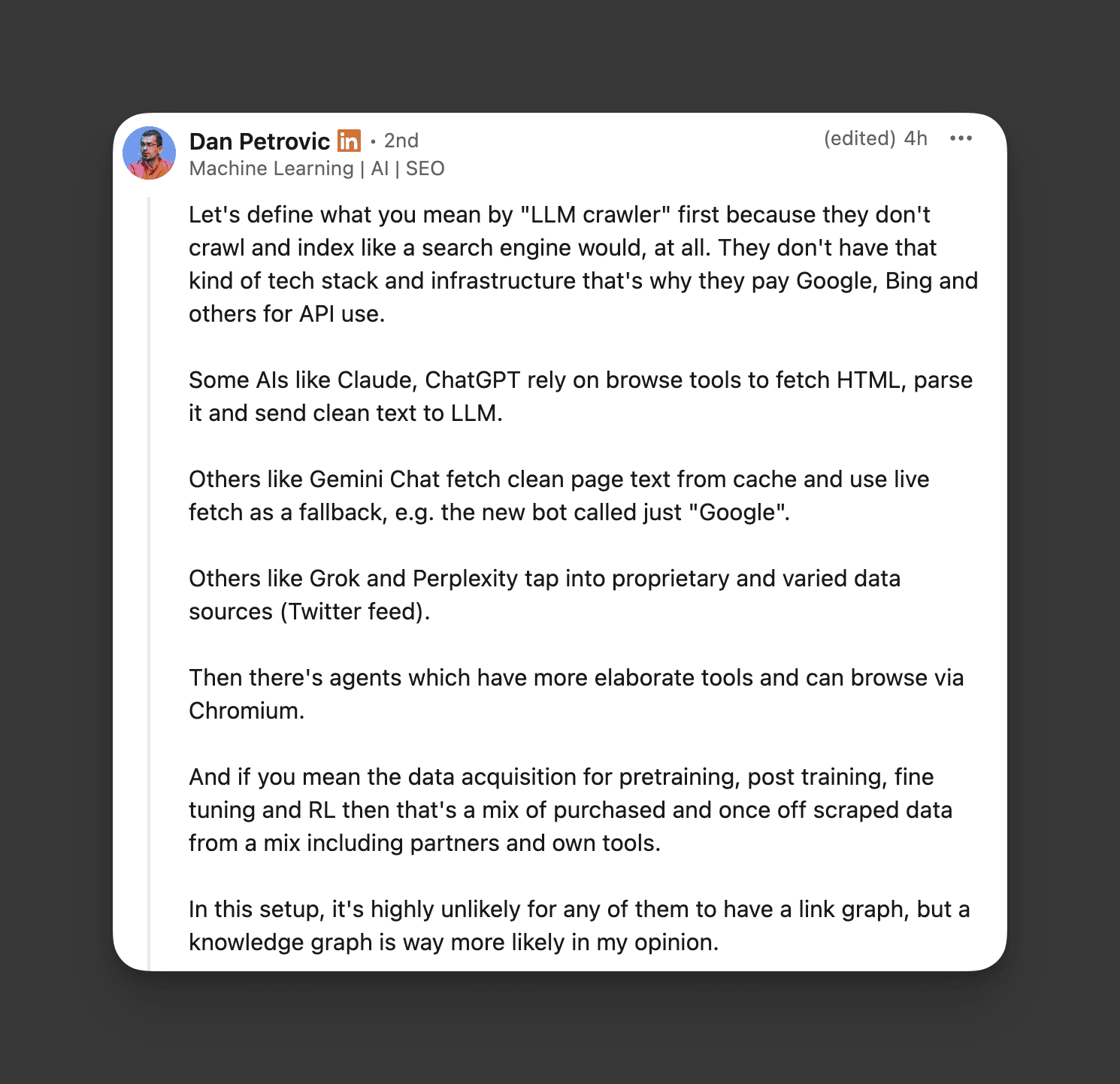
Dan Petrovic, founder and CEO of Dejan SEO, gave a detailed answer about the differences between a) the types of LLM crawlers and b) the different LLMs and how they behave.
Image Credit: Kevin Indig
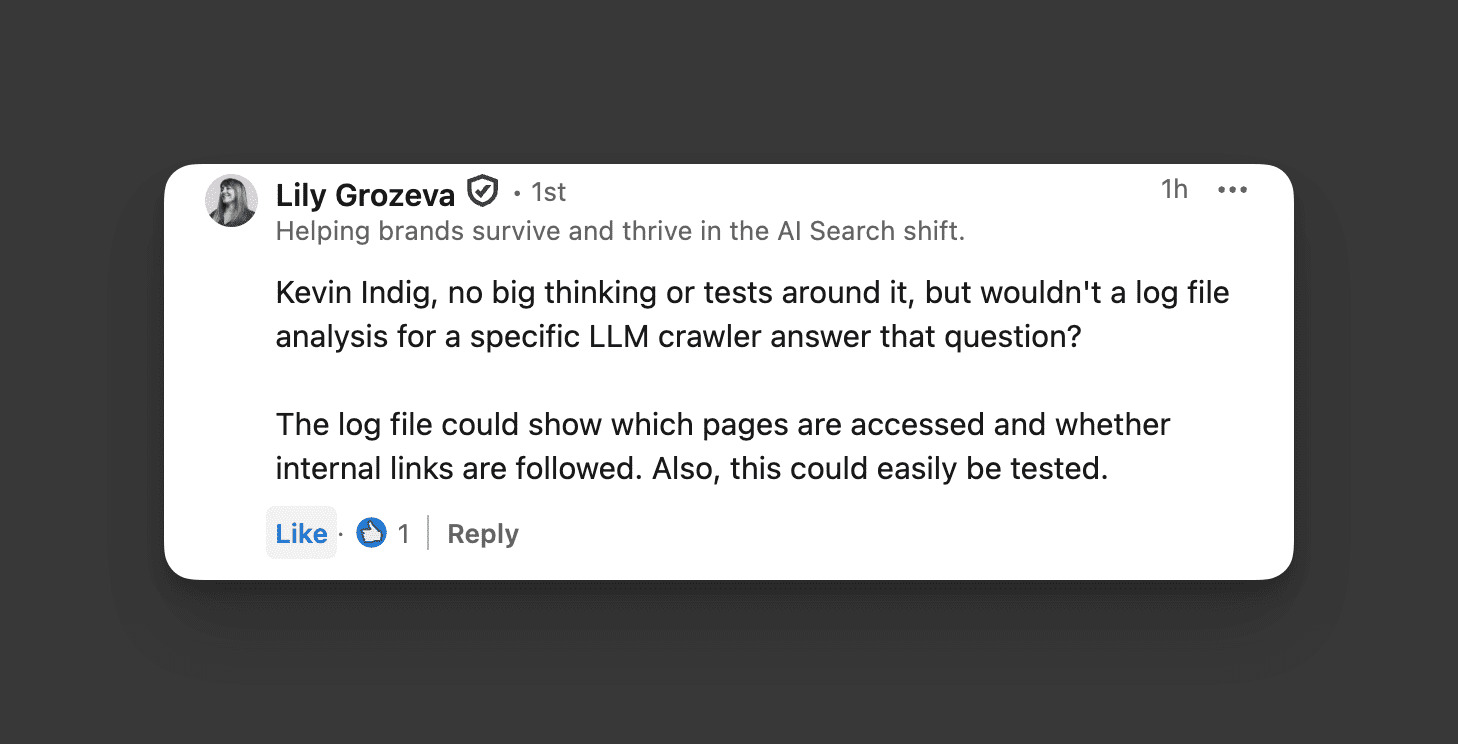
Lily Grozeva, head of SEO at Verto Digital, rightfully called out that we can all get the answer in our own logfiles.
Image Credit: Kevin Indig
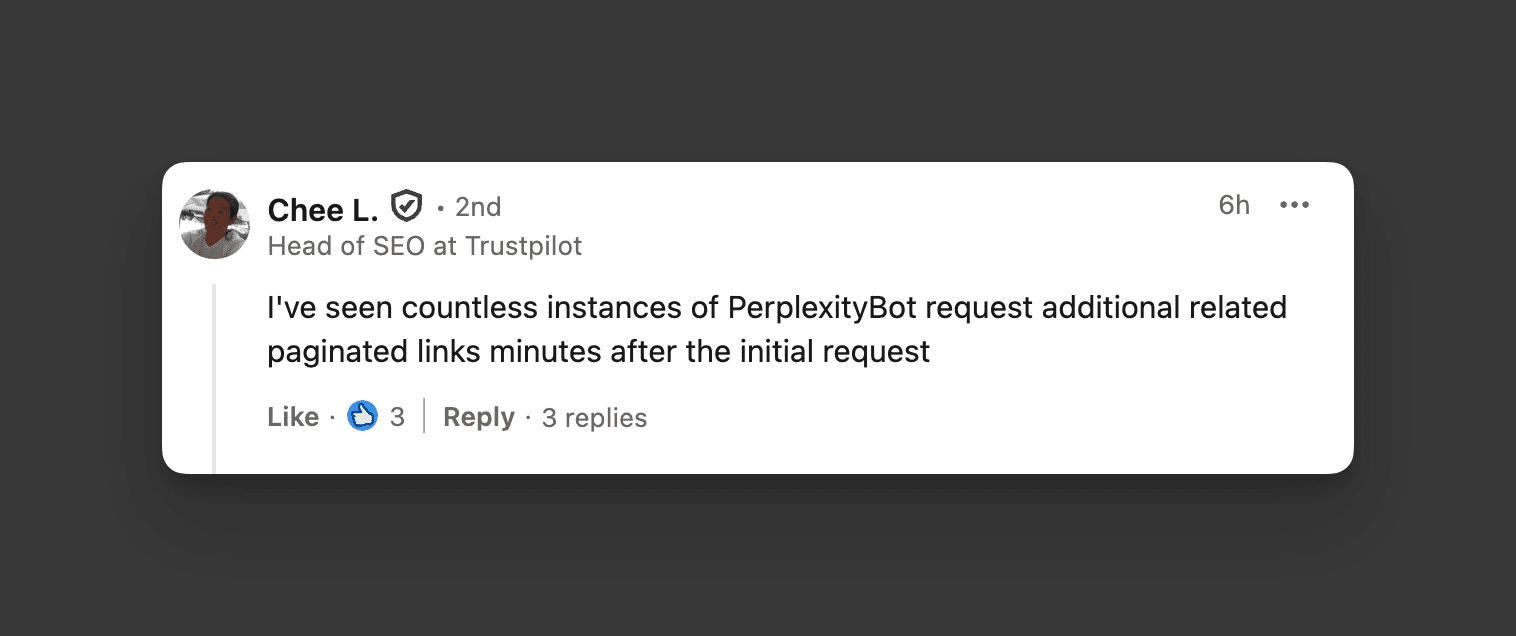
Chee Lo, head of SEO at Trustpilot, shared his experience with Perplexity, which seems to be a bit more aggressive than other bots.
Image Credit: Kevin Indig
Sites with clear internal linking patterns that mirror how humans connect concepts are (in theory, more data will tell over time) better positioned to be included in AI-generated answers and entity-rich snippets.
Entities are semantic, interconnected objects that help machines to understand explicit and implicit language. In simpler terms, they are words (nouns) that represent any type of object, concept, or subject … According to Cindy Krum and her fantastic entity series, Google seems to restructure its whole approach to indexing based on entities (while you’re at it, read AJ Kohn’s article about embeddings). Understanding entities and how Google uses them in search sharpens our standards for content creation, optimization, and the use of schema markup.
Entities are nouns like events, ideas, people, places, etc. They’re the building blocks of ideas and how those ideas relate to each other. (They’re not just “keywords.”)
Search engines and LLMS use semantic relationships between entities to (1) reduce ambiguity, (2) reinforce authority/canonical sources on your site, and (3) map out relationships between topics, features, services, and audiences across your site.
When you internally link pages together with strategically descriptive anchors, you’re telling search engines how your site fits together … and you’re training them on how entities across your site connect.
Therefore, by practicing internal linking through an entity-based lens, you’re creating stronger, clearer relationships and patterns for Google/search engines/LLMs to understand.
Entity-first SEO starts with defining the people, products, concepts, and places your brand “owns.”
If you’re a B2B SaaS company offering a CRM, those entities might include your:
Core product (CRM platform).
Features (pipeline management, email automation, reporting dashboards).
Use cases (sales enablement, customer support, marketing teams).
Personas/target ICPs (heads of sales at mid-market companies, startup founders scaling revenue teams, or enterprise IT buyers).
Taking this example, you’re going to think in terms of topic-first SEO:
Hub or pillar pages = parent entities. These are your central nodes – the definitive resource on a core concept. For a B2B SaaS CRM, it might be the CRM platform overview page.
Cluster pages = sub-entities. These are the supporting nodes that expand on the hub. For a CRM, the CRM hub branches into feature pages like pipeline management, email automation, and reporting dashboards.
Cross-link clusters to show relatedness. Don’t just point everything back to the hub – connect the clusters to each other to model real-world relationships. In the instance of the CRM, pipeline management integrates with email automation to shorten deal cycles.
Navigation and breadcrumbs reinforce hierarchy. The visible structure tells both users and Google how entities fit together. Example: Home → Products → CRM → Pipeline Management.
Include personas in the implementation. This reinforces the relationship: This persona → has this pain point → solved by this feature → within this product topic.
For example, look at this topic cluster map created with Screaming Frog:
Image Credit: Kevin Indig
It shows two clusters with nodes very close together (red and orange) and three other clusters that are spread apart (green, blue, and purple). Guess which clusters outperform the others in organic search? Red and orange!
Here’s how you connect those entities into a meaningful structure in the copy on the page:
1. Anchor text = entity disambiguation.
Instead of linking with vague text, use descriptive anchors that clarify which entity the link refers to. For example, if your CRM has a feature page about pipeline management, link to it with “sales pipeline management CRM feature” language.
2. Consistency matters.
If you always link to that pipeline management page with variations like “pipeline automation tool,” “deal tracking software,” and “CRM feature,” you dilute the entity connection. (But variations like “pipeline management tool,” “sales pipeline management CRM feature,” and “pipeline management features” are derivatives.)
By sticking to clear, consistent anchors, you signal to Google that this is the page that defines “pipeline management” for your brand.
3. Context strengthens meaning.
The sentence or paragraph around the link can add semantic weight. For example:
“Our CRM includes pipeline management, so your sales team can track every deal from prospecting to close.”
That tells Google (and users) that pipeline management isn’t just a phrase; it’s a core feature within the CRM product.
4. Include personas.
Making personas a criterion for internal linking is a no-brainer, because from a psychological perspective, a link automatically signals “there’s more for you here.”
If your internal link is placed on the right word that triggers a response in your target ICPs (and the right areas of the page), it increases the chance of people staying on the site. It’s also just a better experience – and good customer service – to help site visitors find the right offering specifically for themselves, all with the goal to increase trust and the chances they take an action or convert.
If one of your ICPs is head of Sales at mid-market SaaS companies, you might internally link from a blog article like “10 Ways SaaS Sales Leaders Can Shorten Their Sales Cycle” directly to your pipeline management feature page, while using copy surrounding that link that explains how your offering solves this problem. That link makes the relationship explicit: This is the feature that solves this persona’s pain point.
Ultimately, think of every internal link as a connector in your brand’s knowledge graph.
Together, these links show how entities and topics (like CRM platform → pipeline management → sales enablement → head of sales persona) relate to each other, and why your site is authoritative on them.
Amanda Johnson jumping in here to add: Basically, show + tell people (and search engines/LLMs) what you want them to know via literal semantics. It really is that simple. No need to overthink this. Use clear, descriptive, accurate anchor text for the internally linked page, use it consistently, and give context as to how/why the page is linked there with surrounding copy.
Ultimately, if you practice internal linking thoughtfully and methodically, you end up with a better user experience and more thorough reinforcement of internal entity relationships (which can improve topical authority signals).
Worried that your most important pages aren’t getting enough visibility because you haven’t set up a clear linking structure? Following the guidance above will help you resolve this and set up a clear internal linking system.
And using tools that have internal link auditing (like Semrush, Ahrefs, Clearscope, Surfer, etc.) will help you implement your system. Some SEO tools also give page-level internal linking recommendations and copy suggestions to anchor the text to.
Internal linking hasn’t just been about crawlability for some time now.
By structuring links around topics, entities, (and even user journeys of your target personas), you communicate your site’s semantic map to Google and LLMs.
Featured Image: Paulo Bobita/Search Engine Journal
Next week, we’ll publish our 2025 list of Innovators Under 35, highlighting smart and talented people who are working in many areas of emerging technology. This new class features 35 accomplished founders, hardware engineers, roboticists, materials scientists, and others who are already tackling tough problems and making big moves in their careers. All are under the age of 35.
One is developing a technology to reduce emissions from shipping, while two others are improving fertility treatments and creating new forms of contraception. Another is making it harder for people to maliciously share intimate images online. And quite a few are applying artificial intelligence to their respective fields in novel ways.
We’ll also soon reveal our 2025 Innovator of the Year, whose technical prowess is helping physicians diagnose and treat critically ill patients more quickly. What’s more (here’s your final hint), our winner even set a world record as a result of this work.
MIT Technology Review first published a list of Innovators Under 35 in 1999. It’s a grand tradition for us, and we often follow the work of various featured innovators for years, even decades, after they appear on the list. So before the big announcement, I want to take a moment to explain how we select the people we recognize each year.
Step 1: Call for nominations
Our process begins with a call for nominations, which typically goes out in the final months of the previous year and is open to anyone, anywhere in the world. We encourage people to nominate themselves, which takes just a few minutes. This method helps us discover people doing important work that we might not otherwise encounter.
This year we had 420 nominations. Two-thirds of our candidates were put forward by someone else and one-third nominated themselves. We received nominations for people located in about 40 countries. Nearly 70% were based in the United States, with the UK, Switzerland, China, and the United Arab Emirates, respectively, having the next-highest concentrations.
After nominations close, a few editors then spend several weeks reviewing the nominees and selecting semifinalists. During this phase, we look for people who have developed practical solutions to societal issues or made important scientific advances that could translate into new technologies. Their work should have the potential for broad impact—it can’t be niche or incremental. And what’s unique about their approach must be clear.
Step 2: Semifinalist applications
This year, we winnowed our initial list of hundreds of nominees to 108 semifinalists. Then we asked those entrants for more information to help us get to know them better and evaluate their work.
We request three letters of reference and a résumé from each semifinalist, and we ask all of them to answer a few short questions about their work. We also give them the option to share a video or pass along relevant journal articles or other links to help us learn more about what they do.
Step 3: Expert judges weigh in
Next, we bring in dozens of experts to vet the semifinalists. This year, 38 judges evaluated and scored the applications. We match the contenders with judges who work in similar fields whenever possible. At least two judges review each entrant, though most are seen by three.
All these judges volunteer their time, and some return to help year after year. A few of our longtime judges include materials scientists Yet-Ming Chiang (MIT) and Julia Greer (Caltech), MIT neuroscientist Ed Boyden, and computer scientist Ben Zhao of the University of Chicago.
John Rogers, a materials scientist and biomedical engineer at Northwestern University, has been a judge for more than a decade (and was featured on our very first Innovators list, in 1999). Here’s what he had to say about why he stays involved: “This award is compelling because it recognizes young people with scientific achievements that are not only of fundamental interest but also of practical significance, at the highest levels.”
Step 4: Editors make the final calls
In a final layer of vetting, editors who specialize in covering biotechnology, climate and energy, and artificial intelligence review the semifinalists whom judges scored highly in their respective areas. Staff editors and reporters can also nominate people they’ve come across in their coverage, and we add them to the mix for consideration.
Last, a small team of senior editors reviews all the semifinalists and the judges’ scores, as well as our own staff’s recommendations, and selects 35 honorees. We aim for a good combination of people from a variety of disciplines working in different regions of the world. And we take a staff vote to pick an Innovator of the Year—someone whose work we particularly admire.
In the end, it’s impossible to include every deserving individual on our list. But by incorporating both external nominations and outside expertise from our judges, we aim to make the evaluation process as rigorous and open as possible.
So who made the cut this year? Come back on September 8 to find out.
This is today’s edition of The Download, our weekday newsletter that provides a daily dose of what’s going on in the world of technology.
Can an AI doppelgänger help me do my job?
—James O’Donnell
Digital clones—AI models that replicate a specific person—package together a few technologies that have been around for a while now: hyperrealistic video models to match your appearance, lifelike voices based on just a couple of minutes of speech recordings, and conversational chatbots increasingly capable of holding our attention.
But they’re also offering something the ChatGPTs of the world cannot: an AI that’s not smart in the general sense, but that ‘thinks’ like you do.
Could well-crafted clones serve as our stand-ins? I certainly feel stretched thin at work sometimes, wishing I could be in two places at once, and I bet you do too. To find out, I tried making a clone of myself. Read the full story to find out how it got on.
This story originally appeared in The Algorithm, our weekly newsletter on AI. To get stories like this in your inbox first, sign up here.
How lidar measures the cost of climate disasters
The wildfires that swept through Los Angeles County this January left an indelible mark on the Southern California landscape. The Eaton and Palisades fires raged for 24 days, killing 29 people and destroying 16,000 structures, with losses estimated at $60 billion. More than 55,000 acres were consumed, and the landscape itself was physically transformed.
Now, researchers are using lidar (light detection and ranging) technology to precisely measure these changes in the landscape’s geometry—helping them understand and track the cascading effects of climate disasters. Read the full story. —Jon Keegan
This story is from our new print edition, which is all about the future of security. Subscribe here to catch future copies when they land.
Here’s how we picked this year’s Innovators Under 35
Next Monday we’ll publish our 2025 list of Innovators Under 35. The list highlights smart and talented people working across many areas of emerging technology. This new class features 35 accomplished founders, hardware engineers, roboticists, materials scientists, and others who are already tackling tough problems and making big moves in their careers.
MIT Technology Review first published a list of Innovators Under 35 in 1999. It’s a grand tradition for us, and we often follow the work of various featured innovators for years, even decades, after they appear on the list. So before the big announcement, we’d like to take a moment to explain how we select the people we recognize each year. Read the full story.
—Amy Nordrum
The must-reads
I’ve combed the internet to find you today’s most fun/important/scary/fascinating stories about technology.
1 Meta created flirty chatbots of celebrities without their permission To make matters worse, the bots generated risqué pictures on demand. (Reuters) + Meta’s relationship with Scale AI appears to be under pressure. (TechCrunch) + An AI companion site is hosting sexually charged conversations with underage celebrity bots. (MIT Technology Review)
2 The FTC has warned Big Tech not to comply with EU laws If they jeopardize the freedom of expression or safety of US citizens, at least. (Wired $)
3 Ukraine is using drones to drop supplies to its troops in trenches They’re delivering everything from cigarettes to roasted chicken. (WP $) + Meet the radio-obsessed civilian shaping Ukraine’s drone defense. (MIT Technology Review)
4 What the collapse of this AI company says about the wider industry Builder.ai was an early industry darling. Its downfall is a dire warning. (NYT $)
5 US shoppers are racing to land an EV bargain Federal tax credits on the vehicles expire at the end of the month. (WSJ $) + The US could really use an affordable electric truck. (MIT Technology Review)
6 A major new project will use AI to research vaccines The Oxford Vaccine Group hopes the jabs will protect against deadly pathogens. (FT $) + Why US federal health agencies are abandoning mRNA vaccines. (MIT Technology Review)
7 A lot of people stop taking weight-loss drugs within one year How should doctors encourage the ones who need to stay on them? (Undark) + We’re learning more about what weight-loss drugs do to the body. (MIT Technology Review)
8 Chatbots can be manipulated into breaking their own rules It turns out they’re susceptible to both flattery and peer pressure. (The Verge) + Forcing LLMs to be evil during training can make them nicer in the long run. (MIT Technology Review)
9 Tennis is trying to reach a new generation of fans Through…the metaverse? (The Information $)
10 The age of cheap online shopping is ending And consumers are the ones paying the price. (The Atlantic $) + AI is starting to shake up the digital shopping experience, too. (FT $) + Your most important customer may be AI. (MIT Technology Review)
Quote of the day
“Stop being a clanker!”
—How Jay Pinkert, a marketing manager, scolds ChatGPT when it isn’t fulfilling his requests, he tells the New York Times.
One more thing
The algorithms around us
A metronome ticks. A record spins. And as a feel-good pop track plays, a giant compactor slowly crushes a Jenga tower of material creations. Paint cans burst. Chess pieces topple. Camera lenses shatter. An alarm clock shrills and then goes silent. A guitar neck snaps. But wait! The jaunty tune starts up again, and the jaws open to reveal … an iPad.
Watching Apple’s now-infamous “Crush!” ad, it’s hard not to feel uneasy about the ways in which digitization is remaking human life. Sure, we’re happy for computers to take over tasks we don’t want to do or aren’t particularly good at, like shopping or navigating. But what does it mean when the things we hold dear and thought were uniquely ours—our friendships, our art, even our language and creativity—can be reduced to software? Read the full story.
—Ariel Bleicher
We can still have nice things
A place for comfort, fun and distraction to brighten up your day. (Got any ideas? Drop me a line or skeet ’em at me.)
+ Minnesota’s Llama-Alpaca Costume Contest looks an utter delight (thanks Amy!) + In fascinating collab news, David Byrne and Paramore’s Hayley Williams are working on a song for a Netflix adaptation of Roald Dahl’s The Twits. + Happy birthday to Gloria Estefan, 68 years old today! + M. Night Shyamalan’s oeuvre is a decidedly mixed bag. Check out this list of his movies to see where your favorites (and least-favorites) rank.
Search engine optimization has shifted from traditional organic rankings in AI-generated mentions, citations, and recommendations.
Success with AI optimization boils down to two questions:
What does the training data of large language models contain about a company?
What can the LLMs learn about the business when performing live searches?
LLM training data is fundamental to optimizing AI answers, even if the platform runs real-time searches, because the fan-out components stem from what the model already knows.
For example, if the training data indicates that a business is an organic skincare brand, the fan-out component might search for certifications.
Citations
AI answers often include citations (URLs of sources), which come from live searches, not training data. LLMs do not store URLs.
Citations (i) are branded responses that may influence buying decisions and (ii) likely impact the training data containing info on a brand. Thus citations are key to AI optimization.
A consumer considering a skincare brand may prompt Google’s AI Mode for reviews and certifications. The response will likely contain sources.
Here’s an example prompt addressing The Ordinary, a skincare brand:
Is The Ordinary skincare good and certified?
AI Mode’s answer included an advisory warning from the U.S. Food and Drug Administration, as well as links to a magazine article and influencer posts that questioned the ingredients.
A brand cannot control the sentiments of others, but it’s critical to address these concerns on-site to increase the chances of being cited.
Clicking each link in the AI Mode will usually highlight the relevant, sourced paragraph. Then address the question or concern on an FAQ page or a separate article.
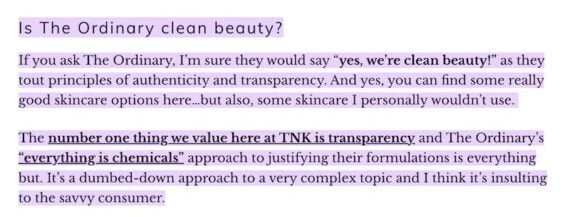
For example, the screenshot below is what a competitor stated about The Ordinary’s ingredients. In response, The Ordinary could create a page answering “Is The Ordinary clean beauty?”
Article from TNK Beauty criticizing the ingredients of The Ordinary, a competitor.
Better Content
Hence content marketing has changed. Only a year or so ago, consumers had to research to find answers about brands and products, such as certifications, alternative pricing or additional rates, and countries where products are manufactured or shipped from.
LLMs can reveal these answers in seconds. Brands that remain silent lose control over that sentiment and fail to contribute to the answers.
Moreover, by creating more brand and product knowledge content, companies increase their chances of being surfaced in answers to non-branded, generic prompts.
SEO for AI
Here’s what to do:
Prompt LLM platforms such as AI Mode, ChatGPT, Perplexity, and Claude about your business. (“What do you know about NAME?”)
Note the fan-out directions to signal your brand’s associations in training data.
Identify third-party citations and their contributions to the answer.
Ensure your site provides better answers than the third parties.
Address frequent confusion or irritation about your brand on social media channels.
Prompt LLMs for your direct competitors and compare the answers to yours.
A few solution providers can track citations for prompts containing your brand.
I use Peec AI, which monitors citations in ChatGPT, Perplexity, and AI Overviews. I can view a report in Peec AI to see the most-cited domains in answers to prompts that include my company.
According to Peec AI’s report, answers to prompts containing Smarty Marketing rarely include our own site! I need to create more content about my brand and products.
“Stop trying to make GEO happen. It’s not going to happen.”
With apologies to Gretchen Wieners and the writers of “Mean Girls,” the line feels like the only way to start this conversation about a buzzword making the rounds: GEO (which is now, allegedly, supposed to mean Generative Engine Optimization).
This article grew out of a LinkedIn post/open plea I wrote recently about this furore, which unexpectedly took off – approaching 10,000 impressions, four dozen comments, and plenty of laughter at bad acronym ideas. Clearly, this struck a nerve with the SEO and marketing community.
On the surface, to be fair, the concept makes sense. We’re in a new era where AI-driven search engines are shaping how content is retrieved, summarized, and delivered. Adapting SEO strategies for that reality is important; however…
Nobody Will Say “G-E-O”
Acronyms survive if they’re pronounceable. If they aren’t easy to say aloud, and also happen to spell an actual word, people will say it like a word.
To my point, no one is going to spell out “G-E-O” when talking about Generative Engine Optimization. It simply doesn’t roll off the tongue nicely. Inevitably, it becomes the word “geo” – and that’s where the trouble starts.
The word geo is ancient. It comes from the Greek word gē (γη), meaning earth or ground. It’s the root of hundreds of words we already use every day: geography, geology, geothermal, geopolitics, geospatial, geotracking, geotagging, geomapping. In technology, it’s baked into concepts like geo-targeting and geo-fencing, and in all cases, geo explicitly means “the earth” in some form or another.
The linguistic baggage here is too heavy. There is no amount of wishful thinking that will make “gee-ee-oh” mean something not related to the earth.
The Branding Problem: Words Have Meaning
Words and acronyms aren’t blank slates. They carry cultural, historical, and linguistic connotations and memories that can’t be erased by decree.
Try to rebrand “GEO” and people’s brains will still instantly (or at least initially) read it as “geography.” They might pause and look at the context, and then decide “Oh, this must be G-E-O which means generative engine optimization, which is like S-E-O but for AI.” That’s a lot of work we are asking the public to do for three little letters.
It’s the same reason I could never (not that I would ever) convince our marketing team to rebrand our SEO plugin as an “FBI” plugin. No matter how hard we try to make FBI mean For Better Indexing, we are not going to be able to overcome the decades of heavy usage that says FBI means Federal Bureau of Investigation.
In this case, GEO doesn’t have decades of historical usage; it has literally millennia of meaning that IS NOT THIS. Hijacking an acronym with multiple centuries of usage is not innovation; it is confusion.
The SEO Problem: Competing With Entrenched Meaning
Let’s set branding aside and look at this purely from an SEO perspective.
Search engines reward authority, longevity, and relevance. The word geo has decades of backlinks, established search volume, and deeply entrenched usage. Every authoritative signal in Google’s system points to geo = geography/geographical/earth-related or adjacent.
Generative Engine Optimization will be competing against that established meaning forever. It won’t matter how many blog posts declare that “GEO is the new SEO” – the search results for “geo” will belong to geography, not generative optimization.
Then we can look beyond Google’s index – the training data behind large language models (LLMs) already “knows” that geo refers to Earth and geography, because that’s what the word has meant in every corpus of text for thousands of years. The idea that we can overwrite that meaning in a few quarters of (AI-generated) blog posts and conference talks is, frankly, wishful thinking.
Acronym Soup: Why Hijacking Fails
This isn’t the first time people have tried to coin a buzzword by hijacking an acronym. It never works. Acronyms only stick when they are:
Unique (no heavy pre-existing baggage).
Clear (people know, or can easily surmise, what they stand for).
Pronounceable (people can easily say them in conversation).
When they aren’t, they dissolve into acronym soup. Everyone gets confused, nobody adopts the term consistently, and the idea dies.
Humor Break: Acronyms We Can Safely Reject Now
Since I’m sure there will be a scramble to come up with something “better” than GEO, let me save you the trouble and pre-remove a few tempting, but alas already in use, options from the list.
FBI – For Better Indexing (all your queries are under surveillance).
PDF – Prompt-Driven Framework (optimized for clients who never open them).
BIO – Bot Interaction Optimization (because the LLMs need to “like” you).
CEO – Crawl Efficiency Orchestration (manage your bots like a boss).
URL – Unified Retrieval Layer (ranking starts at the root).
GPS – Generative Prompt Sequencing (your AI still needs directions).
API – Automated Prompt Injection (though to be fair, my brain always defaults to “armor piercing incendiaries” but that’s probably just a me problem).
HTML – Human-Tuned Model Language (teach the bots to “speak search”).
INFO – Intelligent Neural Findability Optimization (make your content “discoverable” to AI).
PRO – Prompt Response Optimization (win the answer box in AI).
EV – Enhanced Visibility (because apparently that’s the whole point).
SEO – Synthetic Engine Optimization (yes, we’ve come full circle).
They’re funny, but none of them should happen for all of the reasons outlined above.
What Actually Works When Naming Concepts
So, if GEO is a lost cause, what should we be doing instead?
1. Start Unique
Don’t hijack a word or acronym already in heavy use.
The cleanest acronyms are invented, not repurposed.
2. Make It Pronounceable
SEO works because people can say it.
SaaS (Software as a Service) works because it’s short and phonetically easy (“sass” in case you didn’t know).
3. Anchor It In Authority
Google’s own acronyms, like E-E-A-T (Experience, Expertise, Authoritativeness, Trustworthiness), stuck because Google itself enforced them.
A community can rally around a term, but only if it feels backed by authority or usefulness.
4. Check The SERPs First
Before you try to coin an acronym, search it.
If the first three pages of results are about something else entirely, you might be sunk before you begin.
The Bottom Line: Stop Trying To Make GEO Happen
Generative Engine Optimization as a concept makes sense, but GEO as an acronym is doomed.
It fails linguistically (nobody will say “G-E-O”), historically (the word is ancient and already claimed), and strategically (search engines and LLMs already associate “geo” with geography, not generative search).
If you want a new term to catch on, start with one that isn’t already taken. Otherwise, you’re not innovating language – you’re just creating acronym soup … and sabotaging your own visibility from day one.
So please, stop trying to make GEO happen. It’s not going to happen.