
Four things you need to know about China’s AI talent pool 

This story first appeared in China Report, MIT Technology Review’s newsletter about technology in China. Sign up to receive it in your inbox every Tuesday.

In 2019, MIT Technology Review covered a report that shined a light on how fast China’s AI talent pool was growing. Its main finding was pretty interesting: the number of elite AI scholars with Chinese origins had multiplied by 10 in the previous decade, but relatively few of them stayed in China for their work. The majority moved to the US. 

Now the think tank behind the report has published an updated analysis, showing how the makeup of global AI talent has changed since—during a critical period when the industry has shifted significantly and become the hottest technology sector. 

The team at MacroPolo, the think tank of the Paulson Institute, an organization that focuses on US-China relations, studied the national origin, educational background, and current work affiliation of top researchers who gave presentations and had papers accepted at NeurIPS, a top academic conference on AI. Their analysis of the 2019 conference resulted in the first iteration of the Global AI Talent Tracker. They’ve analyzed the December 2022 NeurIPS conference for an update three years later.

I recommend you read the original report, which has a very well-designed infographic that shows the talent flow across countries. But to save you some time, I also talked to the authors and highlighted what I think are the most surprising or important takeaways from the new report. Here are the four main things you need to know about the global AI talent landscape today. 

1.  China has become an even more important country for training AI talent.

Even in 2019, Chinese researchers were already a significant part of the global AI community, making up one-tenth of the most elite AI researchers. In 2022, they accounted for 26%, almost dethroning the US (American researchers accounted for 28%). 
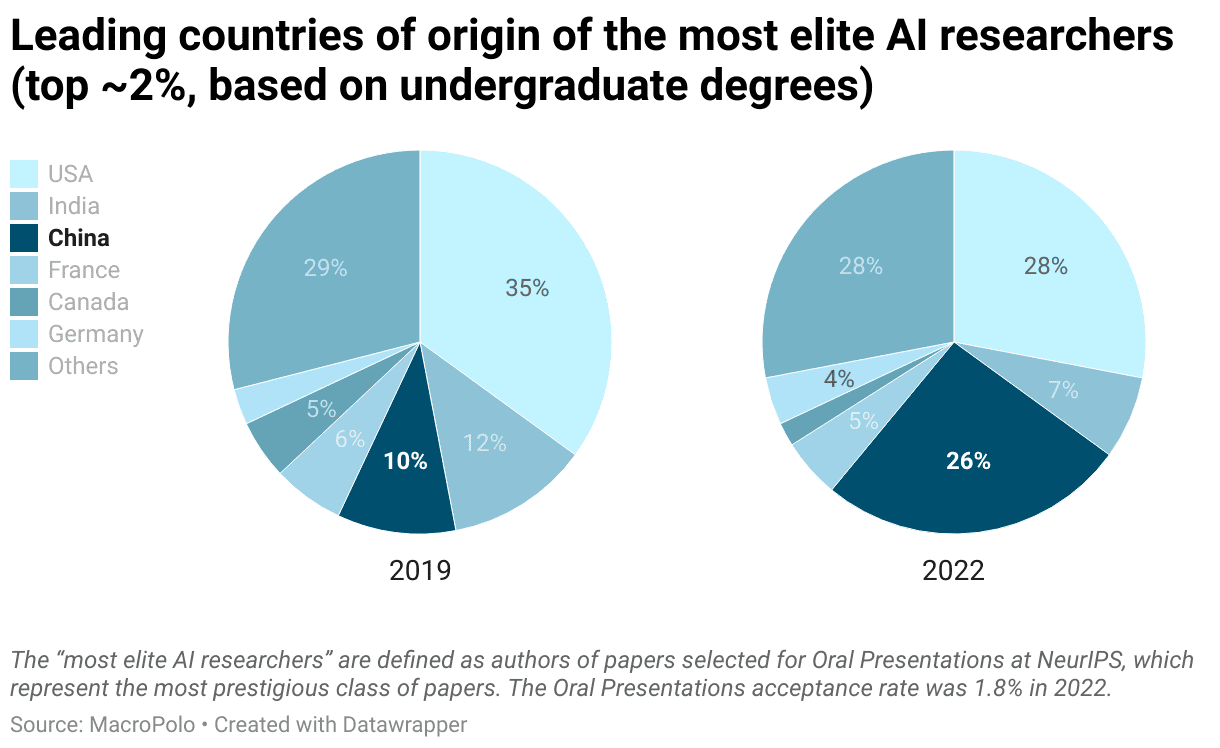
Two pie charts showing the countries of origin of AI researchers in 2019 and 2022.

“Timing matters,” says Ruihan Huang, senior research associate at MacroPolo and one of the lead authors. “The last three years have seen China dramatically expand AI programs across its university system—now there are some 2,000 AI majors—because it was also building an AI industry to absorb that talent.” 

As a result of these university and industry efforts, many more students in computer science or other STEM majors have joined the AI industry, making Chinese researchers the backbone of cutting-edge AI research.

2. AI researchers now tend to stay in the country where they receive their graduate degree. 

This is perhaps intuitive, but the numbers are still surprisingly high: 80% of AI researchers who went to a graduate school in the US stayed to work in the US, while 90% of their peers who went to a graduate school in China stayed in China.

In a world where major countries are competing with each other to take the lead in AI development, this finding suggests a trick they could use to expand their research capacity: invest in graduate-level institutions and attract overseas students to come. 

This is particularly important in the US-China context, where the souring of the relationship between the two countries has affected the academic field. According to news reports, quite a few Chinese graduate students have been interrogated at the US border or even denied entry in recent years, as a Trump-era policy persisted. Along with the border restrictions imposed during the pandemic years, this hostility could have prevented more Chinese AI experts from coming to the US to learn and work. 

3. The US still overwhelmingly attracts the most AI talent, but China is catching up.

In both 2019 and 2022, the United States topped the rankings in terms of where elite AI researchers work. But it’s also clear that the distance between the US and other countries, particularly China, has shortened. In 2019, almost three-fifths of top AI researchers worked in the US; only two-fifths worked here in 2022. 

“The thing about elite talent is that they generally want to work at the most cutting-edge and dynamic places. They want to do incredible work and be rewarded for it,” says AJ Cortese, a senior research associate at MacroPolo and another of the main authors. “So far, the United States still leads the way in having that AI ecosystem—from leading institutions to companies—that appeals to top talent.”
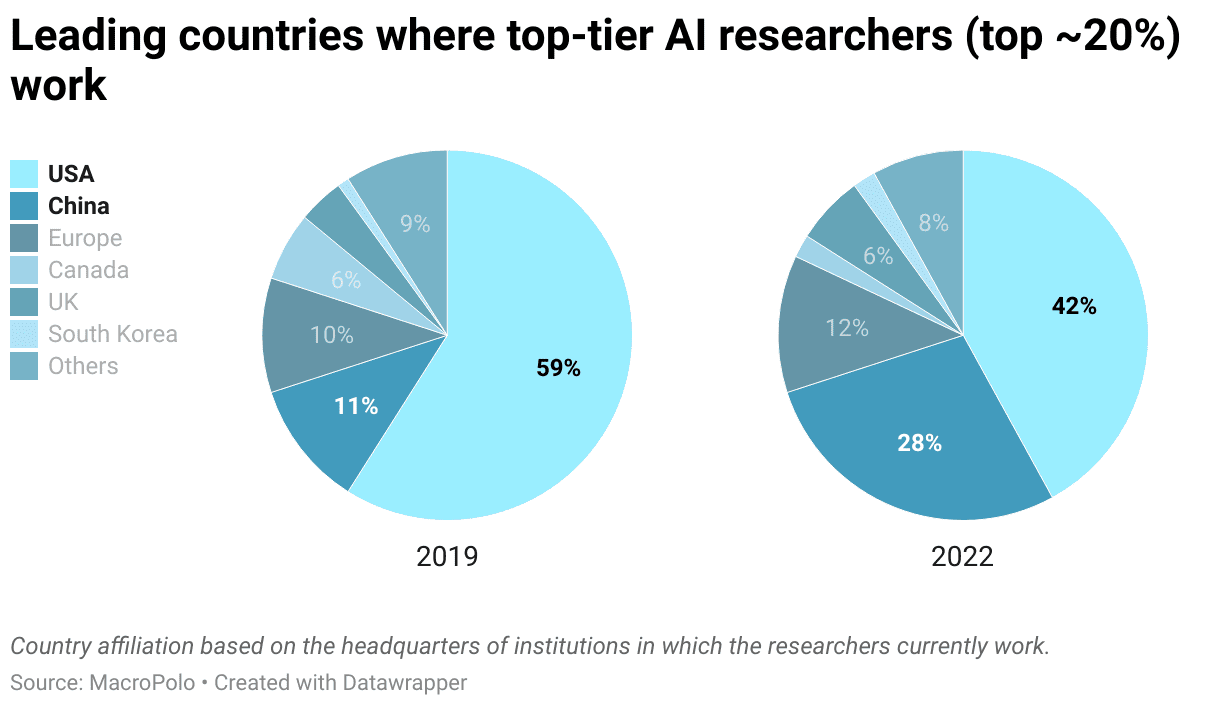
Two pie charts showing the leading countries where AI researchers work in 2019 and 2022.

In 2022, 28% of the top AI researchers were working in China. This significant portion speaks to the growth of the domestic AI sector in China and the job opportunities it has created. Compared with 2019, three more Chinese universities and one company (Huawei) made it into the top tier of institutions that produce AI research. 

It’s true that most Chinese AI companies are still considered to lag behind their US peers—for example, China usually trails the US by a few months in releasing comparable generative AI models. However, it seems like they have started catching up.

4. Top-tier AI researchers now are more willing to work in their home countries.

This is perhaps the biggest and also most surprising change in the data, in my opinion. Like their Chinese peers, more Indian AI researchers ended up staying in their home country for work.

In fact, this seems to be a broader pattern across the board: it used to be that more than half of AI researchers worked in a country different from their home. Now, the balance has tipped in favor of working in their own countries. 
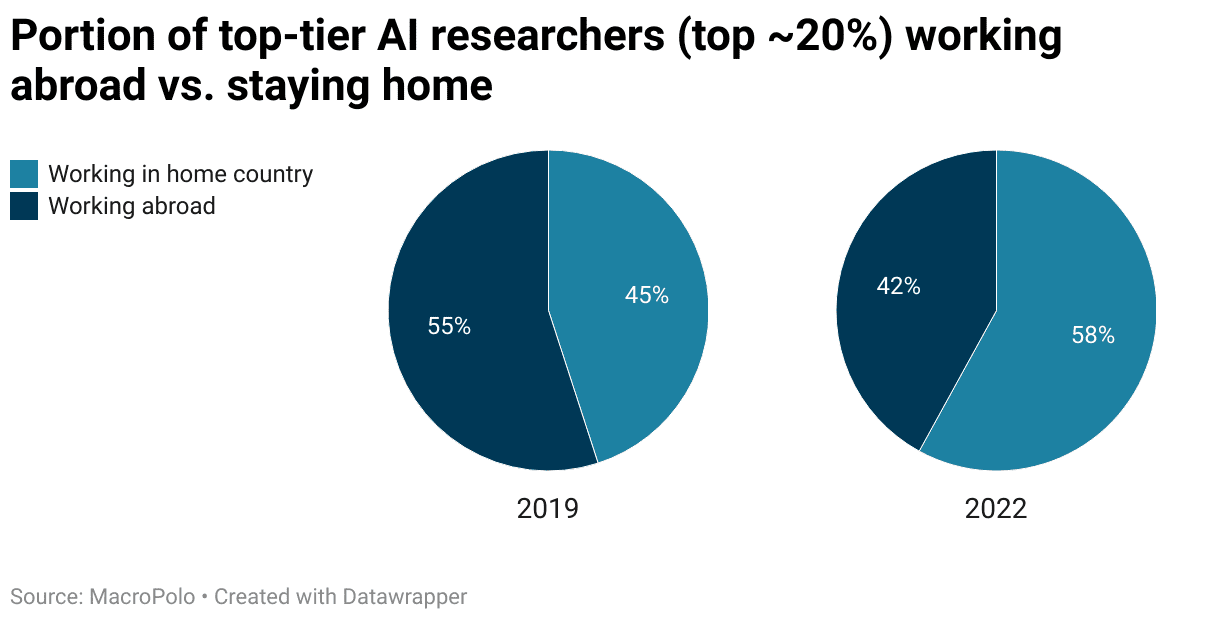
Two pie charts showing the portion of AI researchers choosing to work abroad vs. at home in 2019 and 2022.

This is good news for countries trying to catch up with the US research lead in AI. “It goes without saying most countries would prefer ‘brain gain’ over ‘brain drain’—especially when it comes to a highly complex and technical discipline like AI,” Cortese says. 

It’s not easy to create an environment and culture that not only retains its own talents but manages to pull scholars from other countries, but lots of countries are now working on it. I can only begin to imagine what the report might look like in a few years.  

Did anything else stand out to you in the report? Let me know your thoughts by writing to zeyi@technologyreview.com.


Now read the rest of China Report

Catch up with China

1. The Dutch prime minister will visit China this week to discuss with Chinese president Xi Jinping whether the Dutch chipmaking equipment company ASML can keep servicing Chinese clients. (Reuters $)

  • Here’s an inside look into ASML’s factory and how it managed to dominate advanced chipmaking. (MIT Technology Review)

2. Hong Kong passed a tough national security law that makes it more dangerous to protest Beijing’s rule. (BBC)

3. A new bill in France suggests imposing hefty fines on Shein and similar ultrafast-fashion companies for their negative environmental impact—as much as $11 per item that they sell in France. (Nikkei Asia)

4. Huawei filed a patent to make more advanced chips with a low-tech workaround. (Bloomberg $)

  • Meanwhile, a US official accused the Chinese chip foundry SMIC of breaking US law by making a chip for Huawei. (South China Morning Post $)

5. Instead of the usual six and a half days a week, Tesla has instructed its Shanghai factory to reduce production to five days a week. The slowdown of EV sales in China could be the reason. (Bloomberg $)

6. TikTok is still having plenty of troubles. A new political TV ad (paid for by a mysterious new nonprofit), playing in three US swing states, attacks Zhang Fuping, a ByteDance vice president that very few people have heard of. (Punchbowl News)

  • As TikTok still hasn’t reached a licensing deal with Universal Music Group, users have had to get creative to find alternative soundtracks for their videos. (Billboard)

7. China launched a communications satellite that will help relay signals for missions to explore the dark side of the moon. (Reuters $)

Lost in translation

The most-hyped generative AI app in China these days is Kimi, according to the Chinese publication Sina Tech. Released by Moonshot AI, a Chinese “unicorn” startup, Kimi made headlines last week when it announced it had started supporting inputting text using over 2 million Chinese characters. (For comparison, OpenAI’s GPT-4 Turbo currently supports inputting 100,000 Chinese characters, while Claude3-200K supports about 160,000 characters.)

While some of the app’s virality can be credited to a marketing push that intensified recently. Chinese users are now busy feeding popular and classic books to the model and testing how well it can understand the context. Feeling threatened, other Chinese AI apps owned by tech giants like Baidu and Alibaba have followed suit, announcing that they will soon support 5 million or even 10 million Chinese characters. But processing large amounts of text, while impressive, is very costly in the generative AI age—and some observers worry this isn’t the commercial direction that companies ought to head in.

One more thing

Fluffy pajamas, sweatpants, outdated attire: young Chinese people are dressing themselves in “gross outfits” to work—an intentional provocation to their bosses and an expression of silent resistance to the trend that glorifies career hustle. “I just don’t think it’s worth spending money to dress up for work, since I’m just sitting there,” one of them told the New York Times.

Update: The story has been updated to clarify the affiliation of the report authors.

Chinese EVs have entered center stage in US-China tensions

This story first appeared in China Report, MIT Technology Review’s newsletter about technology in China. Sign up to receive it in your inbox every Tuesday.

So far, electric vehicles have mostly been discussed in the US through a scientific, economic, or environmental lens. But all of a sudden, they have become highly political. 

Last Thursday, the Biden administration announced it would investigate the security risks posed by Chinese-made smart cars, which could “collect sensitive data about our citizens and our infrastructure and send this data back to the People’s Republic of China,” the statement from White House claims.

While many other technologies from China have been scrutinized because of security concerns, EVs have largely avoided that sort of attention until now. After all, they represent a technology that will greatly help the world transition to clean and renewable energy, and people have greeted its rapid growth in China with praise.

But US-China relations have been at a low point since the Trump years and the pandemic, and it seems like only a matter of time before any trade or interaction between the two countries falls under security scrutiny. Now it’s EVs’ turn.

The White House has made clear that there are two motivations behind the investigation: the economy and security.

Even though the statement didn’t explicitly mention EVs, it’s undeniable that they are the only reason Chinese automakers have now become serious challengers to their American peers. Chinese companies like BYD make quality EVs at affordable prices, making them increasingly competitive in international markets. A recent report by the Alliance for American Manufacturing, an industry group, even describes EV competition as “China’s existential threat to America’s auto industry.”

“The issue of Chinese EV imports really hits on so many major political factors all at the same time,” says Kyle Chan, a sociology researcher at Princeton University who studies industrial policies and China. “Not just the auto plants in swing states like Michigan and Ohio, but the broader auto manufacturing sector spread over many important states.”

If the US auto industry fails to remain competitive, it will threaten the job security of millions of Americans, and countless other parts of the US economy will be affected. So it’s no surprise Chinese EVs are seen as a major economic threat that needs to be addressed. 

In fact, it’s one of the few issues everyone seems to agree on in this election cycle. Before the Biden investigation, Trump drew people’s attention to Chinese EVs during campaign speeches, vowing to slap a 60% tariff on Chinese imported goods. Josh Hawley, a Republican senator and a longtime China hawk, proposed a bill last Tuesday for a whopping 125% tariff on Chinese cars, including Chinese-branded cars made in other countries like Mexico.

But the new action taken by the Biden administration introduces another factor to the discussion: security threats.

Basically, the argument here is that Chinese cars—especially the newer ones with smart features that collect information from the environment or connect to the telecom and satellite network—could be used to steal information and harm US national interests. 

To many experts, this argument is a lot less supported by reality. When TikTok and Huawei were subject to similar concerns, it was because their products were widely used in the US. But the majority of Chinese-made cars are running inside China. There are barely any Chinese cars being sold in the US today, let alone the latest models. That makes the White House’s position look slightly bizarre. 

Lei Xing, an auto analyst and observer of the EV industry, has very strong opinions about the security accusations in the Biden administration’s announcement. “It is full of subjective and inaccurate statements trying to paint a picture of threat and security risk that is much greater than it actually is, and is obviously aimed at gaining voter favor as the presidential election race heats up,” Xing tells me.

Nonetheless, fears over data security are shared across the political spectrum in the US. “There has been almost an emerging consensus in Washington, across party lines, that is much more concerned about Chinese data collection through potential technology channels,” Chan says. 

This lens has now been used to question almost any technology product with Chinese connections: whether it’s Chinese cars, Chinese e-commerce apps like Shein and Temu, social media platforms like TikTok and WeChat, or smart home gadgets, the sentiment about data security remains the same.

Having watched these other technologies come into the geopolitical crossfire from afar, Chinese EV companies were mostly prepared for what was announced last week. 

“I think the Chinese EV firms have already baked this into their calculations,” Chan says. “As they’ve been ramping up more joint ventures and partnerships and entering other markets of the world, I’ve noticed a very clear reluctance to put that much investment into the US market.”

Recently, BYD Americas’ CEO said in an interview that its new planned factory in Mexico will serve the domestic market rather than exporting to the US; Xing learned recently that NIO, another Chinese car company, removed the US from its initial plan of entering 25 markets by 2025. These are all signs that Chinese EV companies will shy away from the US market for a while, at least until the political animosity goes away. Being unable to sell in the world’s second-largest auto market is obviously not good news, but they have a lot of potential customers in Europe, Latin America, and Southeast Asia.

“[The Chinese auto industry] for now will remain in a ‘watch and study’ mode and strategize accordingly. Mexico will be an important market and a critical production hub for the Americas region whether [the industry] eventually enters America or not,” says Xing.

I had been counting down the days until we’re able to drive Chinese EVs in the US and see how they compete with American cars on their home turf. I guess I’ll be in for a very long wait. 

Do you think this move will help or harm US domestic automakers in the long run? Let me know your thoughts at zeyi@technologyreview.com.


Now read the rest of China Report

Catch up with China

1. China started its annual parliamentary meeting today. It’s the highest-level of political meeting in China, and it’s where economic plans and other important policy signals are often released. So watch this space. (NBC News)

  • For the first time in 30 years, the country has scrapped the annual tradition where the premier briefs the press and answers questions. It was one of the only moments of access to China’s political leaders, and now it’s gone. (Reuters $)

2. A deepfake clone of a Ukrainian YouTuber is being used by Chinese people to express pro-Russia sentiments and sell Russian goods. (Voice of America News)

3. Hundreds of North Koreans are forced to work in Chinese seafood factories while enduring frequent beatings and sexual abuse. These factories supply major US retailers like Walmart and ShopRite. (New Yorker $)

4. The US government wants to stop data brokers from selling sensitive data to China and a few other adversaries. (Wall Street Journal $)

5. In tiny New York studios, American TikTok influencers are learning the tricks of livestream e-commerce from their Chinese counterparts. (Rest of World)

6. The US Department of Justice accused a Chinese chipmaker of stealing trade secrets five years ago. The company was just found not guilty in court. (Bloomberg $)

7. The number of patents filed by inventors in China has been growing rapidly—surpassing the US figure for the first time ever. (Axios)

Lost in translation

When a Chinese college graduate named Lu Zhi moved on from her first job after eight months at PDD (the Chinese e-commerce company that owns Temu), she didn’t realize the company would ask her to pay $36,000 back as a noncompete compensation. As the Chinese publication Caixin reports, Chinese tech companies, particularly PDD, have sparked outrage for how broad their noncompete agreements have become. 

It doesn’t just affect key personnel in critical positions. Almost any employee, no matter how junior or peripheral their role, has to sign such an agreement when hired. To enforce the agreement, PDD has even hired private detectives to follow former employees around and film their commute to the new workplace. People are questioning whether these companies have gone too far in the name of protecting their trade secrets.

One more thing

The new Dune 2 movie is barely out, and people are already making memes comparing the plot to the real-life geopolitical situation between the US, China, and Taiwan. Is it accurate? I’ll report back after I watch it.

Why China’s EV ambitions need virtual power plants

This story first appeared in China Report, MIT Technology Review’s newsletter about technology in China. Sign up to receive it in your inbox every Tuesday.

The first time I heard the term “virtual power plants,” I was reporting on how extreme heat waves in 2022 had overwhelmed the Chinese grid and led the government to restrict electric-vehicle charging as an emergency solution. I was told at the time that virtual power plants (VPPs) could make grid breakdowns like that less likely to happen again, but I didn’t have a chance to delve in to learn what that meant.

If you, like me, are unsure how a power plant can be virtual, my colleague June Kim just published an insightful article explaining the technology and how it works. For this week’s newsletter, I took the chance to ask her some more questions about VPPs. It turns out the technology has a particularly good synergy with the EV industry, which is why the Chinese government has started to invest in VPPs. 

“VPPs are basically just aggregations of distributed energy resources that can balance electricity on the grid,” June says—resources including electric-vehicle chargers, heat pumps, rooftop solar panels, and home battery packs for power backups. “They’re working in coordination to replace the function of a centralized coal plant or gas plant … but also add a whole host of other functionalities that are beneficial for the grid,” she says.

To really make the most of these resources, VPPs introduce another layer: a central smart system that coordinates energy consumption and supply. 

This system allows utility companies to handle times of higher energy demand by making adjustments like shifting EV charge time to 2 a.m. to avoid peak hours.

The US government is working to triple VPP capacity by 2030, June says. That capacity is equivalent to 80 to 160 fossil-fuel plants that don’t have to be built. “They expect that EV batteries and the EV charging infrastructure are going to be the biggest factor in building up this additional VPP capacity,” she says.

Considering the significant impact that EVs have on the grid, it’s no surprise that China, where an EV revolution is taking place faster than in any other country, has also turned its attention to VPPs.

By the end of 2023, there were over 20 million EVs in China, almost half the global total. Together, these cars can consume monstrous amounts of energy—but their batteries can also be an emergency backup source. The power shortage that happens in China almost every summer is an urgent reminder that the country needs to figure out how to incorporate these millions of EVs into the existing grid.

Luckily, there are already some moves in this area, both from the Chinese government and from Chinese EV companies.

In January 2024, China’s National Development and Reform Commission, the top economic planning authority, released a blueprint for integrating EV charging infrastructure into the grid. The country plans to start pilot programs with dynamic electricity pricing in a few cities: lower prices late at night can incentivize EV owners to charge their vehicles when the grid is not stressed. The goal is that no more than 40% of EV charging will take place outside these “trough hours.” There will also be a batch of bidirectional charging stations in public and private spaces. At these chargers, batteries can either draw electricity from the grid or send it back.

Meanwhile, NIO, a leading Chinese EV company, is transforming its own charging networks. Last month, 10 NIO charging stations opened in Shanghai that allow vehicles to feed energy back into the grid. The company also has over 2,000 battery-swapping stations across the country. These are ideal energy storage resources for the VPP network. Some of them have already been connected to VPP pilot programs in eastern China, the company said in July 2023.

One of the key obstacles to adoption of VPPs is getting people to sign up to participate. But there’s a compelling reward on offer: money. 

If the reverse-charging infrastructure grows larger, millions of Chinese EV owners could make a little income by charging at the right times and selling electricity at others. 

We don’t know how much earning potential there is, since these pilot programs are still in their very early stages in China. But existing VPP projects in the US can offer some reference. Over the course of one summer, a Massachusetts home can make an estimated $550; participants in a separate VPP project in Texas can earn an estimated $150 per year. “It’s not huge, but it’s not nothing,” June says.

Obviously, it will take a long time to transform our electric grids. But developing VPPs along with the EV charging network seems like a win-win situation for China: it helps the country maintain its lead in the EV industry, and it also makes the grid more resilient and less dependent on coal power plants. I won’t be surprised if Chinese local governments and companies work together to roll out virtual power plants in earnest over the next few years.

Do you think China will catch up quickly on adopting virtual power plants? Tell me your thoughts at zeyi@technologyreview.com.

Catch up with China

1. The economic shadows of the pandemic have finally receded. This Lunar New Year, the number of travelers and the amount of spending in China finally surpassed pre-pandemic levels. (Bloomberg $)

2. The European Union is probing China’s state-owned train manufacturer for government subsidies that could give it an unfair advantage when bidding for overseas procurements. (Politico)

  • Last year, the European Commission started another anti-subsidy investigation over imports of Chinese electric vehicles. (MIT Technology Review)

3. Burgeoning sci-fi literature circles in China attracted the prestigious Hugo Awards to be held there last year. But leaked emails show that the awards’ administration team actively censored authors who could upset the Chinese government. (The Guardian)

4. A Volkswagen supplier found a component that might have been produced in Xinjiang, where the use of forced labor has been documented. Now thousands of Porsche, Bentley, and Audi cars are being held at US ports waiting for replacement parts. (Financial Times $)

5. The leading Chinese EV maker BYD is considering building a factory in Mexico. If that happens, we might be able to buy BYD vehicles in the US soon. (Nikkei Asia $)

  • Exports of BYD cars have grown so much in recent years that the company is now buying and hiring massive ships to help deliver them. (MIT Technology Review)

6. A new report by OpenAI and Microsoft says hackers from China, Russia, North Korea, and Iran have used their large language models, but mostly for mundane tasks like drafting emails. (New York Times $)

7. China’s first domestically made passenger airplane made its first overseas trip to Singapore. (Reuters $)

8. New Chinese restaurant chains that combine traditional cuisine with fast food are blowing up in China. When are they going to open one in the US? (Time)

Lost in translation

Huaqiangbei is a neighborhood in Shenzhen known as a hub of domestic innovation and imitation. It has always played a pivotal role in introducing expensive products (like iPhones and AirPods) to Chinese users, either through smuggling or by producing knockoff versions. And the launch of Apple’s Vision Pro has again reminded people of Huaqiangbei’s influence on consumer trends, according to Chinese tech columnist Wang Qingrui

One Shenzhen-based company, EmdoorVR, has already launched a VR headset that looks almost identical to the Vision Pro. This imitator, which is much more limited in function, is named VisionSE and sells for less than 1/10 the price. However, many Huaqiangbei brands have yet to follow suit, since they are not confident about the future of VR headsets. Their hesitation could be another signal that it will be hard for the Vision Pro to find as much acceptance as Apple’s previous successes.

One more thing

For many Chinese families, playing mah-jongg is an essential New Year tradition. But machines are transforming how the game is played: a viral video on social media shows a mah-jongg machine without the usual tiles. Instead, it displays everything on five different screens. It also automatically voices the moves and calculates the results. Not many people in the comments are impressed. Mah-jongg is “99% about feeling the tiles,” says one.

How the internet pushed China’s New Year red packet tradition to the extreme

This story first appeared in China Report, MIT Technology Review’s newsletter about technology in China. Sign up to receive it in your inbox every Tuesday.

If you ask any child in China what’s the most exciting thing about welcoming another year, they are likely to answer: the red packets. It’s a festive tradition: During the holidays, people give out red envelopes full of cold hard cash to young members of the family. You can reliably get cash gifts every year until you graduate from school and start working full-time.

So this week is a great opportunity to talk about how the tradition of giving red packets, which has been around for hundreds of years, has evolved in the digital age. Even though I’m not in China now, I still managed to send two red packets to my nephew and niece, through mobile payments on WeChat.

In fact, red packets have not merely turned from a physical activity to a digital one. They’ve become a way for Chinese tech companies to make a stack of money each year and attract new users and traffic. In return, users have to follow increasingly complicated rules to get a few bucks.

The digitization of red-packet giving started in the early 2010s, when super apps like Alipay and WeChat made it convenient for everyone to send and receive money on their phones. They also introduced mechanisms that breathed new life into the tradition, like a randomization allotment system, where people put one giant red packet in a group chat, and everyone opening it will get a random share of the total amount. 

The promise of variable rewards increases the feeling of excitement when you get a big share. It also prompted those who didn’t get much to ask for another chance, which has really made it a centerpiece of the new red packet culture.

And it didn’t take long until tech companies became the ones giving out the money.

In 2015, WeChat decided to give out over $80 million in red packets during the Spring Festival Gala, a yearly tradition in China that gathers the family around the TV. To get a share of WeChat’s red packets, people had to shake their phones at a certain time of the show. According to data provided by WeChat, throughout Lunar New Year’s Eve, people shook their phones 11 billion times. At the peak, people shook their phones 800 million times in just one minute. 

This immense success inspired every other tech company in China to join the game and spend millions of dollars. Today, every major app offers a version of that promotion during the new year. But what users need to do in return has become much more complicated.

1For example, to participate in one of the red packet events this year on Douyin, the Chinese version of TikTok, users have to complete a series of tasks: log in every day, invite new users to the platform, upload an avatar, follow certain accounts, set up a group chat, post a gif in the group chat, make a video call, upload a video, watch videos for a minimum amount of time, and download other apps. The more time you are willing to spend on these tasks, the more you will get back from the app.

The 2010s saw immense growth in China’s mobile internet sector, and one of the lasting outcomes is that apps have gotten very sophisticated at gamifying their gimmicks to attract users and traffic. The new year’s red packet promotions are essentially the pinnacle of these promotion gimmicks. 

As the rules get increasingly convoluted, most people don’t have the time to follow up with every single mini-game. I stopped participating in these red packet promotions years ago because the payout is always abysmal compared to the efforts required. (Am I willing to message five of my college friends whom I haven’t spoken to for years in order to get this $5 cash gift? No.)

But there are still people who treat it seriously. As Chinese publications have reported, some people, particularly those who are less well off, would study the rules of these red packet games thoroughly, hoping to make a fortune with them. Since the games reward social interactions, some people actually pay others with their own money to join in the efforts. New apps have even emerged that connect people who are gaming the system.

This is a side of the Chinese tech world that the outside doesn’t often get to see. The Chinese mobile internet industry is saturated with mini-games or incentives that are designed to chase infinite growth. 

Thanks to Temu, the Chinese ultra-fast e-commerce app that’s spending millions of dollars on Super Bowl ads, users outside China can also get a taste of these gimmicks. The spinning wheel of coupons, the never-ending request to invite new friends to join the app, and the farming mini-game to keep you hooked—these are the tactics that Chinese users are all too familiar with. 

From what I have heard, most people still see it as a nuisance. But as the longevity of red packet promotions in China shows, once companies find the right audience and the right profitability model, these stunts could become a fact of online life for all of us. 

Did you get any digital red packets this year? Let me know your experience at zeyi@technologyreview.com.

Catch up with China

1. Sam Altman’s plan for a $7 trillion-worth semiconductor empire includes building dozens of chip fabrication plants with money from Middle East investors, then having the Taiwanese chipmaker TSMC run them. (Wall Street Journal $)

2. A former TikTok executive is suing the company for unlawfully firing her due to what they called a lack of “docility and meekness.” (Financial Times $)

3. If he’s reelected, Donald Trump is promising a 60% tariff on all Chinese imports. If that actually happens (big if), it would almost wipe out all imports from China by 2030. (Bloomberg $)

  • For the first time in 22 years, Mexico has surpassed China to be the United States’ largest import source. (ABC News)

4. Members of the European Union have had a falling out because of their different positions on China and how to handle trade across economic sectors. (South China Morning Post $)

5. A new report found more than 100 websites disguised as local news outlets in Europe, Asia, and Latin America are actually part of an influence campaign linked to a Beijing public relations firm. (Reuters $)

6. How Hefei, a city in central China, rose up to become a leader in electric-vehicle production by investing government money in fledgling startups. (New York Times $)

Lost in translation

While we are on the topic of digital red packets, people are selling AI-generated artwork as red packet designs this year, according to the Chinese publication Guokr. After WeChat allowed users to customize what their red packet looks like on the app in 2019, a new business has emerged to let people spend a few bucks and get a new look for their digital gifts every year. Successful artists can make a decent bit of money with it. 

However, the industry is now unsurprisingly being disrupted by image-making AIs like Midjourney. There’s even a burgeoning entrepreneurial scene where people repackage these AI services to tailor them to design red packets, simplifying the process. On social media, some people are promising that you can earn quick cash by generating AI red packets, attracting others to cash in on the trend. But in reality, there are still many obstacles to fine-tuning the designs and gaining traction among potential buyers. 

One more thing

You might not be able to get an Apple Vision Pro yet, but you can hop on a Hainan Airlines flight, where all passengers are given a pair of augmented reality goggles made by a Chinese company for free in-flight entertainment. They look so much lighter than Apple’s headset. I want to try them out!

Passengers making their way from Shenzhen to Xi'an aboard Hainan Airlines flight HU7874 on February 7th were treated to an immersive entertainment experience with Rokid AR Entertainment Kits.

ROKID