Hydropower is the world’s leading source of renewable electricity, generating more power in 2022 than all other renewables combined. But while hydropower is helping clean up our electrical grid, it’s not always a positive force for fish.
Dams that create reservoirs on rivers can change habitats. And for some species, especially those that migrate long distances, hydropower facilities can create dangerous or insurmountable barriers. In some parts of the world, including the US, Canada, and Europe, governments have put protections in place to protect ecosystems from hydropower’s potential harms.
New environmental regulations can leave older facilities facing costly renovations or force them to shutter entirely. That’s a big problem, because pulling hydropower plants off the grid eliminates a flexible, low-emissions power source that can contribute to progress in fighting climate change. New technologies, including fish-safe turbines, could help utilities and regulators come closer to striking a balance between the health of river ecosystems and global climate goals.
That’s where companies like Natel Energy come in. The company started with two big goals: high performance and fish survival, says Gia Schneider, Natel’s cofounder and chief commercial officer.
The company is making new designs for the turbines that generate electricity in hydropower plants as water rushes through equipment and moves their blades. Conventional turbine blades can move as fast as 30 meters per second, or about 60 to 70 miles per hour, Schneider says. When straight, thin edges are moving that quickly and striking fish, “it’s fairly obvious why that’s not a good outcome,” she says.
Natel’s turbine design focuses on preventing fast-moving equipment from making fatal contact with fish. The blades have a thicker leading edge that pushes water out in front of it, creating a stagnation zone, or “basically an airbag for fish,” Schneider says. The blades are also curved, so even if fish are struck, they don’t take a direct hit.
The company has tested its turbines with a range of species, including American eels, alewife, and rainbow trout. In the case of one recent study with American eels, scientists found that over 99% of eels survived after 48 hours of passing through Natel’s equipment. In comparison, one 2010 study found that just 40% of tagged European eels were able to pass through the turbines of a hydropower plant, though survival depended a lot on the size of both the eel and equipment in question.
Changing turbine designs won’t help fish survive all power plants: at some of the biggest plants with the tallest dams, rapid changes in water pressure can kill fish. But Schneider says that the company’s technology could be slotted into up to half of the existing US hydropower fleet to make plants more fish-safe.
Hydropower is one of the world’s older renewable energy sources. By 2030, more than 20% of the global fleet’s generating units will be more than 55 years old, according to the International Energy Agency. The average age of a hydropower plant in the US today is roughly 65 years.
In the US, privately held hydropower plants are licensed by an agency called the Federal Energy Regulatory Commission for a term of up to 50 years. Roughly 17 gigawatts’ worth of hydropower facilities (enough to power 13 million homes) are up for relicensing by 2035, according to the National Hydropower Association.
Since many of those facilities were started up, there have been significant changes to environmental requirements, and some plants may face high costs and difficult engineering work as they try to adhere to new rules and stay in operation. Adding screens to basically filter fish out of the intake for hydropower plants is one potential solution in some cases, but both installation and maintenance of such a system can add significant cost. In these facilities, Natel’s technology represents an alternative, Schneider says.
Natel has installed several projects in Maine, Oregon, and Austria. They all involve relatively small turbines, but the company is on the way to undertaking bigger projects and recently won a bid process with a manufacturing partner to supply a larger turbine that’s three meters in diameter to an existing plant, Schnieder says. The company is also licensing its fish-safe turbine designs to existing manufacturers.
Whether utilities move to adopt fish-safe design could depend on how it affects efficiency, or the amount of energy that can be captured by a given water flow. Natel’s turbine designs will, in some cases, be slightly less efficient than today’s conventional ones, Schneider says, though the difference is marginal, and they likely still represent an improvement over older designs.
While there’s sometimes a trade-off between fish-safe design and efficiency, that’s not the case with all novel turbines in all cases. A 2019 study from the US Army Corps of Engineers found that one new design improved fish safety while also producing more power.
Slotting new turbines into hydropower plants won’t solve all the environmental challenges associated with the technology, though. For example, the new equipment would only be relevant for downstream migration, like when eels move from freshwater rivers out into the ocean to reproduce. Other solutions would still be needed to allow a path for upstream migration.
Ideally, the best solution for many plants would likely be natural bypasses or ramps, which allow free passage of many species in both directions, says Ana T. Silva, a senior research scientist at the Norwegian Institute for Nature Research. However, because of space requirements, these can’t always be installed or used.
Natel CTO Abe Schneider holds a large trout used in fish passage testing at the Monroe Hydro Plant in Madras, Oregon.
NATEL
People have been trying to improve fish passage for a long time, says Michael Milstein, a senior public affairs officer at NOAA Fisheries, part of the US National Oceanic and Atmospheric Administration. The solutions in place today include fish ladders, where fish swim or hop up into successively taller pools to pass dams. Other dams are too tall for that, and fish are captured and loaded onto trucks to go around them.
The challenge, Milstein says, is that “every river is different, and every dam is different.” Solutions need to be adapted to each individual situation, he adds; fish-safe turbines would be most important when there’s no bypass and going through a facility is the only option fish have.
The issue of protecting ecosystems and providing safe passage for fish has sparked fierce debates over existing hydropower projects across the western US and around the world.
Even with the current state-of-the-art technology, “it’s not always possible to provide sufficient passage,” Milstein says. Several dams are currently being removed from the Klamath River in Oregon and Northern California because of the effects on local ecosystems. The dams drastically changed the river, wiping out habitat for local salmon, steelhead, and lamprey and creating ideal conditions for parasites to decimate fish populations.
But while hydropower facilities can have negative environmental impacts, climate change can also be extremely harmful to wildlife, Natel’s Schneider points out. If too many hydropower plants are shut down, it could leave a gap that keeps more fossil fuels on the grid, hampering efforts to address climate change.
Reducing hydropower plants’ impact on local environments could help ensure that more of them can stay online, generating renewable electricity that plays an important role in our electrical grid. “Fish-safe turbines won’t solve everything—there are many, many problems in our rivers,” Schneider says. “But we need to start tackling all of them, so this is one tool.”
This article is from The Spark, MIT Technology Review’s weekly climate newsletter. To receive it in your inbox every Wednesday, sign up here.
Some people track sports scores or their favorite artists’ tour set lists. Meanwhile, I’m just waiting to hear which climate tech startups are getting big funding awards from government agencies. It’s basically the same thing.
Every few years, the US agency that’s often called the “energy moonshot factory” announces such awards for a few companies to help them scale up their technology. (The agency’s official name is the Advanced Research Projects Agency—Energy, or ARPA-E.) The grants are designed to help companies take their tech from the lab or pilot stage and get it out into the world.
The latest batch of these awards was just announced, totaling over $63 million split between four companies. Let’s dig into the winners and consider what each one’s technology says about their respective corners of climate action.
Antora Energy: Heat batteries for industry
Let’s start with the company you’re most likely to know if you follow this newsletter: Antora Energy. The California-based company is building thermal batteries for use in heavy industry. I covered the company and its first pilot project last year, and thermal batteries were the readers’ choice winner on our list of Breakthrough Technologies this year.
In case you need a quick refresher, the basic idea behind Antora’s technology is to store energy from cheap, clean wind and solar power in the form of heat, and then use that heat in industrial facilities. It’s an elegant solution to the problem that renewables are available only sometimes, while industry needs clean energy all the time if it wants to cut its carbon emissions, which amount to a whopping 30% of the global total.
Antora was awarded $14.5 million to scale its technology. One thing the company hopes to achieve with the cash influx is progress on its second product, which delivers not only heat but also electricity.
Queens Carbon: Lower-emissions cement
Cement is a climate villain hiding in plain sight, as I’ve covered in this newsletter before. Producing the gray slabs that scaffold our world accounts for about 7% of global emissions.
The challenge in cleaning up the process lies, at least in part, in the fact that lava-hot temperatures are required to kick off the chemical reactions that make cement—I’m talking over 1,500 °C (2,700 °F).
Queens Carbon developed a new process that cuts down the temperature needed to under 540 °C (1,000 °F). Still toasty, but easier to reach efficiently and with electricity, the company’s CEO, CTO, and cofounder Daniel Kopp said on a press call about the awards. Ideally, that electricity will be supplied with renewables, which could mean big emissions savings.
Queens Carbon will also pocket $14.5 million, and the funding should help with the construction of a pilot plant currently being built in partnership with a major cement producer, Kopp said on the press call. The company plans to scale up to a full-size plant in late 2028 or 2029.
Ion Storage Systems: Next-generation batteries for EVs
The world is always clamoring for better batteries, and Maryland-based Ion Storage Systems wants to deliver with its solid-state lithium-metal technology.
We named lithium-metal batteries one of our 10 Breakthrough Technologies in 2021. The chemistry could deliver higher energy density, meaning longer range in EVs.
Ion Storage Systems is planning to produce its batteries first for military customers. With the funding ($20 million worth), the company may be able to get its tech ready for larger-scale production for the wider customer base of the electric-vehicle market.
I was really interested to hear about the emphasis on manufacturing from CTO Greg Hitz on the press call, as scaling up manufacturing has been a major challenge for other companies trying to build solid-state batteries. Hitz also said that the company’s batteries don’t need to be squeezed at high pressure within cells or heated up, and they can be more simply integrated into battery packs.
AeroShield Materials: High-tech insulation for more efficient buildings
Last but certainly not least is AeroShield Materials. Between 30% and 40% of energy we put into our buildings for heat and cooling is lost through windows and doors—that’s about $40 billion per year for residential buildings, said Elise Strobach, the company’s CEO and cofounder, on the press call.
AeroShield is making materials called aerogels that are clear, lightweight, and fire resistant. They can help make windows 65% more energy efficient, Strobach says.
Insulation isn’t always the most exciting topic, but efficiency is one of the best ways to cut down the need for more energy and provide a straightforward way to slash emissions. AeroShield is starting with windows and doors but plans to explore other projects like retrofitting windows and producing insulation for freezer and refrigerator doors, Strobach said on the call. The $14.5 million award will help build a pilot manufacturing facility.
These projects cover a huge range of businesses, from transportation and buildings to heavy industry. The one thing they have in common? All urgently need to clean up their act if the world is going to address climate change. Each of these awards is a big vote of confidence from an agency that’s had a lot of experience in energy technology—but what really matters is what these companies do with the money now.
There’s a growing pool of money for scientists exploring whether we can reflect away more sunlight to ease warming caused by climate change.
Quadrature Climate Foundation is among the organizations providing millions of dollars for research into solar geoengineering. This sort of funding can help scientists pursue lab work, modeling, and maybe even outdoor experiments that could improve our understanding of the often controversial field.
For more on where the money is coming from and how this might affect our efforts to address climate change, check out my colleague James Temple’s story here.
One more issue
We often talk about tech that’s serious business—but technology also has a huge effect on how we have fun. That’s the idea behind our latest print edition, the Play issue.
For the issue, I wrote about board games that take on the topic of climate change. Are they accurate about the challenge ahead, and crucially, can they be fun? Check out my take here. (For a more in-depth look at one particular game, a new climate-themed Catan, give this newsletter a read.)
I’d also highly recommend this feature from my colleague Eileen Guo, who looked into the growing business of surf pools—facilities that bring a usually ocean-based activity onto land. She gave one a spin, and considered how these spots affect places facing water scarcity.
The whole issue is great—find all the stories here.
Keeping up with climate
A new startup will take sodium sulfate, a waste material from manufacturing lithium-ion batteries, and turn it into chemicals that can go into new batteries. Aepnus Technology calls its approach a “fully circular” one. (Heatmap)
Solugen just scored a loan worth over $200 million from the US Department of Energy. The company uses biology to make chemicals used in industries from agriculture to concrete. (C&EN News)
Some Olympic teams, including the delegation from the US, plan to bring their own air conditioners to the Paris games this summer. It could be a big setback for the event’s climate goals. (Associated Press)
Advanced recycling promises an almost miraculous solution to our plastics crisis, but a close look at the industry reveals some problems. Very little plastic is made with these methods, and the industry is selling them on the basis of some tricky accounting. (ProPublica)
You may not know the name Yet-Ming Chiang, but you’ve probably heard of some of the companies he’s had a hand in starting, including Sublime Systems and Form Energy. Learn more about this MIT professor and serial entrepreneur here. (Cipher)
Running Tide had grand plans to suck carbon dioxide out of the atmosphere with the help of the ocean. Now, the startup is shutting down. Here’s what the company’s implosion means for carbon removal’s future. (Latitude Media)
→ The company was in some rocky waters a couple of years ago, as my colleague James Temple revealed at the time. (MIT Technology Review)
Volkswagen is investing $1 billion in the EV startup Rivian. The deal has the two companies creating a joint venture, and it could provide a path forward for Rivian, which has faced some struggles getting its vehicles to market. (TechCrunch)
For nearly as long as surfing has existed, surfers have been obsessed with the search for the perfect wave. It’s not just a question of size, but also of shape, surface conditions, and duration—ideally in a beautiful natural environment.
While this hunt has taken surfers from tropical coastlines reachable only by boat to swells breaking off icebergs, these days—as the sport goes mainstream—that search may take place closer to home. That is, at least, the vision presented by developers and boosters in the growing industry of surf pools, spurred by advances in wave-generating technology that have finally created artificial waves surfers actually want to ride.
Some surf evangelists think these pools will democratize the sport, making it accessible to more communities far from the coasts—while others are simply interested in cashing in. But a years-long fight over a planned surf pool in Thermal, California, shows that for many people who live in the places where they’re being built, the calculus isn’t about surf at all.
Just some 30 miles from Palm Springs, on the southeastern edge of the Coachella Valley desert, Thermal is the future home of the 118-acre private, members-only Thermal Beach Club (TBC). The developers promise over 300 luxury homes with a dazzling array of amenities; the planned centerpiece is a 20-plus-acre artificial lagoon with a 3.8-acre surf pool offering waves up to seven feet high. According to an early version of the website, club memberships will start at $175,000 a year. (TBC’s developers did not respond to multiple emails asking for comment.)
That price tag makes it clear that the club is not meant for locals. Thermal, an unincorporated desert community, currently has a median family income of $32,340. Most of its residents are Latino; many are farmworkers. The community lacks much of the basic infrastructure that serves the western Coachella Valley, including public water service—leaving residents dependent on aging private wells for drinking water.
Just a few blocks away from the TBC site is the 60-acre Oasis Mobile Home Park. A dilapidated development designed for some 1,500 people in about 300 mobile homes, Oasis has been plagued for decades by a lack of clean drinking water. The park owners have been cited numerous times by the Environmental Protection Agency for providing tap water contaminated with high levels of arsenic, and last year, the US Department of Justice filed a lawsuit against them for violating the Safe Drinking Water Act. Some residents have received assistance to relocate, but many of those who remain rely on weekly state-funded deliveries of bottled water and on the local high school for showers.
Stephanie Ambriz, a 28-year-old special-needs teacher who grew up near Thermal, recalls feeling “a lot of rage” back in early 2020 when she first heard about plans for the TBC development. Ambriz and other locals organized a campaign against the proposed club, which she says the community doesn’t want and won’t be able to access. What residents do want, she tells me, is drinkable water, affordable housing, and clean air—and to have their concerns heard and taken seriously by local officials.
Despite the grassroots pushback, which twice led to delays to allow more time for community feedback, the Riverside County Board of Supervisors unanimously approved the plans for the club in October 2020. It was, Ambriz says, “a shock to see that the county is willing to approve these luxurious developments when they’ve ignored community members” for decades. (A Riverside County representative did not respond to specific questions about TBC.)
The desert may seem like a counterintuitive place to build a water-intensive surf pool, but the Coachella Valley is actually “the very best place to possibly put one of these things,” argues Doug Sheres, the developer behind DSRT Surf, another private pool planned for the area. It is “close to the largest [and] wealthiest surf population in the world,” he says, featuring “360 days a year of surfable weather” and mountain and lake views in “a beautiful resort setting” served by “a very robust aquifer.”
In addition to the two planned projects, the Palm Springs Surf Club (PSSC) has already opened locally. The trifecta is turning the Coachella Valley into “the North Shore of wave pools,” as one aficionado described it to Surfer magazine.
The effect is an acute cognitive dissonance—one that I experienced after spending a few recent days crisscrossing the valley and trying out the waves at PSSC. But as odd as this setting may seem, an analysis by MIT Technology Review reveals that the Coachella Valley is not the exception. Of an estimated 162 surf pools that have been built or announced around the world, as tracked by the industry publication Wave Pool Magazine, 54 are in areas considered by the nonprofit World Resources Institute (WRI) to face high or extremely high water stress, meaning that they regularly use a large portion of their available surface water supply annually. Regions in the “extremely high” category consume 80% or more of their water, while those in the “high” category use 40% to 80% of their supply. (Not all of Wave Pool Magazine’s listed pools will be built, but the publication tracks all projects that have been announced. Some have closed and over 60 are currently operational.)
Zoom in on the US and nearly half are in places with high or extremely high water stress, roughly 16 in areas served by the severely drought-stricken Colorado River. The greater Palm Springs area falls under the highest category of water stress, according to Samantha Kuzma, a WRI researcher (though she notes that WRI’s data on surface water does not reflect all water sources, including an area’s access to aquifers, or its water management plan).
Now, as TBC’s surf pool and other planned facilities move forward and contribute to what’s becoming a multibillion-dollar industry with proposed sites on every continent except Antarctica, inland waves are increasingly becoming a flash point for surfers, developers, and local communities. There are at least 29 organized movements in opposition to surf clubs around the world, according to an ongoing survey from a coalition called No to the Surf Park in Canéjan, which includes 35 organizations opposing a park in Bordeaux, France.
While the specifics vary widely, at the core of all these fights is a question that’s also at the heart of the sport: What is the cost of finding, or now creating, the perfect wave—and who will have to bear it?
Though wave pools have been around since the late 1800s, the first artificial surfing wave was built in 1969, and also in the desert—at Big Surf in Tempe, Arizona. But at that pool and its early successors, surfing was secondary; people who went to those parks were more interested in splashing around, and surfers themselves weren’t too excited by what they had to offer. The manufactured waves were too small and too soft, without the power, shape, or feel of the real thing.
The tide really turned in 2015, when Kelly Slater, widely considered to be the greatest professional surfer of all time, was filmed riding a six-foot-tall, 50-second barreling wave. As the viral video showed, he was not in the wild but atop a wave generated in a pool in California’s Central Valley, some 100 miles from the coast.
Waves of that height, shape, and duration are a rarity even in the ocean, but “Kelly’s wave,” as it became known, showed that “you can make waves in the pool that are as good as or better than what you get in the ocean,” recalls Sheres, the developer whose company, Beach Street Development, is building multiple surf pools around the country, including DSRT Surf. “That got a lot of folks excited—myself included.”
In the ocean, a complex combination of factors—including wind direction, tide, and the shape and features of the seafloor—is required to generate a surfable wave. Re-creating them in an artificial environment required years of modeling, precise calculations, and simulations.
Surf Ranch, Slater’s project in the Central Valley, built a mechanical system in which a 300-ton hydrofoil—which resembles a gigantic metal fin—is pulled along the length of a pool 700 yards long and 70 yards wide by a mechanical device the size of several train cars running on a track. The bottom of the pool is precisely contoured to mimic reefs and other features of the ocean floor; as the water hits those features, its movement creates the 50-second-long barreling wave. Once the foil reaches one end of the pool, it runs backwards, creating another wave that breaks in the opposite direction.
While the result is impressive, the system is slow, producing just one wave every three to four minutes.
Around the same time Slater’s team was tinkering with his wave, other companies were developing their own technologies to produce multiple waves, and to do so more rapidly and efficiently—key factors in commercial viability.
Fundamentally, all the systems create waves by displacing water, but depending on the technology deployed, there are differences in the necessary pool size, the project’s water and energy requirements, the level of customization that’s possible, and the feel of the wave.
Thomas Lochtefeld is a pioneer in the field and the CEO of Surf Loch, which powers PSSC’s waves. Surf Loch uses pneumatic technology, in which compressed air cycles water through chambers the size of bathroom stalls and lets operators create countless wave patterns.
One demo pool in Australia uses what looks like a giant mechanical doughnut that sends out waves the way a pebble dropped in water sends out ripples. Another proposed plan uses a design that spins out waves from a circular fan—a system that is mobile and can be placed in existing bodies of water.
Of the two most popular techniques in commercial use, one relies on modular paddles attached to a pier that runs across a pool, which move in precise ways to generate waves. The other is pneumatic technology, which uses compressed air to push water through chambers the size of bathroom stalls, called caissons; the caissons pull in water and then push it back out into the pool. By choosing which modular paddles or caissons move first against the different pool bottoms, and with how much force at a time, operators can create a range of wave patterns.
Regardless of the technique used, the design and engineering of most modern wave pools are first planned out on a computer. Waves are precisely calculated, designed, simulated, and finally tested in the pool with real surfers before they are set as options on a “wave menu” in proprietary software that surf-pool technologists say offers a theoretically endless number and variety of waves.
On a Tuesday afternoon in early April, I am the lucky tester at the Palm Springs Surf Club, which uses pneumatic technology, as the team tries out a shoulder-high right-breaking wave.
I have the pool to myself as the club prepares to reopen; it had closed to rebuild its concrete “beach” just 10 days after its initial launch because the original beach had not been designed to withstand the force of the larger waves that Surf Loch, the club’s wave technology provider, had added to the menu at the last minute. (Weeks after reopening in April, the surf pool closed again as the result of “a third-party equipment supplier’s failure,” according to Thomas Lochtefeld, Surf Loch’s CEO.)
I paddle out and, at staffers’ instructions, take my position a few feet away from the third caisson from the right, which they say is the ideal spot to catch the wave on the shoulder—meaning the unbroken part of the swell closest to its peak.
The entire experience is surreal: waves that feel like the ocean in an environment that is anything but.
An employee test rides a wave, which was first calculated, designed, and simulated on a computer.
SPENCER LOWELL
In some ways, these pneumatic waves are better than what I typically ride around Los Angeles—more powerful, more consistent, and (on this day, at least) uncrowded. But the edge of the pool and the control tower behind it are almost always in my line of sight. And behind me are the PSSC employees (young men, incredible surfers, who keep an eye on my safety and provide much-needed tips) and then, behind them, the snow-capped San Jacinto Mountains. At the far end of the pool, behind the recently rebuilt concrete beach, is a restaurant patio full of diners who I can’t help but imagine are judging my every move. Still, for the few glorious seconds that I ride each wave, I am in the same flow state I experience in the ocean itself.
Then I fall and sheepishly paddle back to PSSC’s encouraging surfer-employees to restart the whole process. I would be having a lot of fun—if I could just forget my self-consciousness, and the jarring feeling that I shouldn’t be riding waves in the middle of the desert at all.
Though long inhabited by Cahuilla Indians, the Coachella Valley was sparsely populated until 1876, when the Southern Pacific Railroad added a new line out to the middle of the arid expanse. Shortly after, the first non-native settlers came to the valley and realized that its artesian wells, which flow naturally without the need to be pumped, provided ideal conditions for farming.
Agricultural production exploded, and by the early 1900s, these once freely producing wells were putting out significantly less, leading residents to look for alternative water sources. In 1918, they created the Coachella Valley Water District (CVWD) to import water from the Colorado River via a series of canals. This water was used to supply the region’s farms and recharge the Coachella Aquifer, the region’s main source of drinking water.
The author tests a shoulder-high wave at PSSC, where she says the waves were in some ways better than what she rides around Los Angeles.
SPENCER LOWELL
The water imports continue to this day—though the seven states that draw on the river are currently renegotiating their water rights amid a decades-long megadrought in the region.
The imported water, along with CVWD’s water management plan, has allowed Coachella’s aquifer to maintain relatively steady levels “going back to 1970, even though most development and population has occurred since,” Scott Burritt, a CVWD spokesperson, told MIT Technology Review in an email.
This has sustained not only agriculture but also tourism in the valley, most notably its world-class—and water-intensive—golf courses. In 2020, the 120 golf courses under the jurisdiction of the CVWD consumed 105,000 acre-feet of water per year (AFY); that’s an average of 875 AFY, or 285 million gallons per year per course.
Surf pools’ proponents frequently point to the far larger amount of water golf courses consume to argue that opposing the pools on grounds of their water use is misguided.
PSSC, the first of the area’s three planned surf clubs to open, requires an estimated 3 million gallons per year to fill its pool; the proposed DSRT Surf holds 7 million gallons and estimates that it will use 24 million gallons per year, which includes maintenance and filtration, and accounts for evaporation. TBC’s planned 20-acre recreational lake, 3.8 acres of which will contain the surf pool, will use 51 million gallons per year, according to Riverside County documents. Unlike standard swimming pools, none of these pools need to be drained and refilled annually for maintenance, saving on potential water use. DSRT Surf also boasts about plans to offset its water use by replacing 1 million square feet of grass from an adjacent golf course with drought-tolerant plants.
Pro surfer and PSSC’s full-time “wave curator” Cheyne Magnusson watches test waves from the club’s control tower.
SPENCER LOWELL
With surf parks, “you can see the water,” says Jess Ponting, a cofounder of Surf Park Central, the main industry association, and Stoke, a nonprofit that aims to certify surf and ski resorts—and, now, surf pools—for sustainability. “Even though it’s a fraction of what a golf course is using, it’s right there in your face, so it looks bad.”
But even if it were just an issue of appearance, public perception is important when residents are being urged to reduce their water use, says Mehdi Nemati, an associate professor of environmental economics and policy at the University of California, Riverside. It’s hard to demand such efforts from people who see these pools and luxury developments being built around them, he says. “The questions come: Why do we conserve when there are golf courses or surfing … in the desert?”
(Burritt, the CVWD representative, notes that the water district “encourages all customers, not just residents, to use water responsibly” and adds that CVWD’s strategic plans project that there should be enough water to serve both the district’s golf courses and its surf pools.)
Locals opposing these projects, meanwhile, argue that developers are grossly underestimating their water use, and various engineering firms and some county officials have in fact offered projections that differ from the developers’ estimates. Opponents are specifically concerned about the effects of spray, evaporation, and other factors, which increase with higher temperatures, bigger waves, and larger pool sizes.
As a rough point of reference, Slater’s 14-acre wave pool in Lemoore, California, can lose up to 250,000 gallons of water per day to evaporation, according to Adam Fincham, the engineer who designed the technology. That’s roughly half an Olympic swimming pool.
More fundamentally, critics take issue with even debating whether surf clubs or golf courses are worse. “We push back against all of it,” says Ambriz, who organized opposition to TBC and argues that neither the pool nor an exclusive new golf course in Thermal benefits the local community. Comparing them, she says, obscures greater priorities, like the water needs of households.
The PSSC pool requires an estimated 3 million gallons of water per year. On top of a $40 admission fee, a private session there would cost between $3,500 and $5,000 per hour.
SPENCER LOWELL
The “primary beneficiary” of the area’s water, says Mark Johnson, who served as CVWD’s director of engineering from 2004 to 2016, “should be human consumption.”
Studies have shown that just one AFY, or nearly 326,000 gallons, is generally enough to support all household water needs of three California families every year. In Thermal, the gap between the demands of the surf pool and the needs of the community is even more stark: each year for the past three years, nearly 36,000 gallons of water have been delivered, in packages of 16-ounce plastic water bottles, to residents of the Oasis Mobile Home Park—some 108,000 gallons in all. Compare that with the 51 million gallons that will be used annually by TBC’s lake: it would be enough to provide drinking water to its neighbors at Oasis for the next 472 years.
Furthermore, as Nemati notes, “not all water is the same.” CVWD has provided incentives for golf courses to move toward recycled water and replace grass with less water-intensive landscaping. But while recycled water and even rainwater have been proposed as options for some surf pools elsewhere in the world, including France and Australia, this is unrealistic in Coachella, which receives just three to four inches of rain per year.
Instead, the Coachella Valley surf pools will depend on a mix of imported water and nonpotable well water from Coachella’s aquifer.
But any use of the aquifer worries Johnson. Further drawing down the water, especially in an underground aquifer, “can actually create water quality problems,” he says, by concentrating “naturally occurring minerals … like chromium and arsenic.” In other words, TBC could worsen the existing problem of arsenic contamination in local well water.
When I describe to Ponting MIT Technology Review’s analysis showing how many surf pools are being built in desert regions, he seems to concede it’s an issue. “If 50% of the surf parks in development are in water-stressed areas,” he says, “then the developers are not thinking about the right things.”
Before visiting the future site of Thermal Beach Club, I stopped in La Quinta, a wealthy town where, back in 2022, community opposition successfully stopped plans for a fourth pool planned for the Coachella Valley. This one was developed by the Kelly Slater Wave Company, which was acquired by the World Surf League in 2016.
Alena Callimanis, a longtime resident who was a member of the community group that helped defeat the project, says that for a year and a half, she and other volunteers often spent close to eight hours a day researching everything they could about surf pools—and how to fight them. “We knew nothing when we started,” she recalls. But the group learned quickly, poring over planning documents, consulting hydrologists, putting together presentations, providing comments at city council hearings, and even conducting their own citizen science experiments to test the developers’ assertions about the light and noise pollution the project could create. (After the council rejected the proposal for the surf club, the developers pivoted to previously approved plans for a golf course. Callimanis’s group also opposes the golf course, raising similar concerns about water use, but since plans have already been approved, she says, there is little they can do to fight back.)
Just a few blocks from the site of the planned Thermal Beach Club is the Oasis Mobile Home Park, which has been plagued for decades by a lack of clean drinking water.
A water pump sits at the
corner of farm fields in Thermal, California,
where irrigation water is imported from the
Colorado River.
It was a different story in Thermal, where three young activists juggled jobs and graduate programs as they tried to mobilize an under-resourced community. “Folks in Thermal lack housing, lack transportation, and they don’t have the ability to take a day off from work to drive up and provide public comment,” says Ambriz.
But the local pushback did lead to certain promises, including a community benefit payment of $2,300 per luxury housing unit, totaling $749,800. In the meeting approving the project, Riverside County supervisor Manuel Perez called this “unprecedented” and credited the efforts of Ambriz and her peers. (Ambriz remains unconvinced. “None of that has happened,” she says, and payments to the community don’t solve the underlying water issues that the project could exacerbate.)
That affluent La Quinta managed to keep a surf pool out of its community where working-class Thermal failed is even more jarring in light of industry rhetoric about how surf pools could democratize the sport. For Bryan Dickerson, the editor in chief of Wave Pool Magazine, the collective vision for the future is that instead of “the local YMCA … putting in a skate park, they put in a wave pool.” Other proponents, like Ponting, describe how wave pools can provide surf therapy or opportunities for underrepresented groups. A design firm in New York City, for example, has proposed to the city a plan for an indoor wave pool in a low-income, primarily black and Latino neighborhood in Queens—for $30 million.
For its part, PSSC cost an estimated $80 million to build. On top of a $40 general admission fee, a private session like the one I had would cost $3,500 to $5,000 per hour, while a public session would be at least $100 to $200, depending on the surfer’s skill level and the types of waves requested.
In my two days traversing the 45-mile Coachella Valley, I kept thinking about how this whole area was an artificial oasis made possible only by innovations that changed the very nature of the desert, from the railroad stop that spurred development to the irrigation canals and, later, the recharge basins that stopped the wells from running out.
In this transformed environment, I can see how the cognitive dissonance of surfing a desert wave begins to shrink, tempting us to believe that technology can once again override the reality of living (or simply playing) in the desert in a warming and drying world.
But the tension over surf pools shows that when it comes to how we use water, maybe there’s no collective “us” here at all.
Unlike conventional energy sources, green hydrogen offers a way to store and transfer energy without emitting harmful pollutants, positioning it as essential to a sustainable and net-zero future. By converting electrical power from renewable sources into green hydrogen, these low-carbon-intensity energy storage systems can release clean, efficient power on demand through combustion engines or fuel cells. When produced emission-free, hydrogen can decarbonize some of the most challenging industrial sectors, such as steel and cement production, industrial processes, and maritime transport.
“Green hydrogen is the key driver to advance decarbonization,” says Dr. Christoph Noeres, head of green hydrogen at global electrolysis specialist thyssenkrupp nucera. This promising low-carbon-intensity technology has the potential to transform entire industries by providing a clean, renewable fuel source, moving us toward a greener world aligned with industry climate goals.
Accelerating production of green hydrogen
Hydrogen is the most abundant element in the universe, and its availability is key to its appeal as a clean energy source. However, hydrogen does not occur naturally in its pure form; it is always bound to other elements in compounds like water (H2O). Pure hydrogen is extracted and isolated from water through an energy-intensive process called conventional electrolysis.
Hydrogen is typically produced today via steam-methane reforming, in which high-temperature steam is used to produce hydrogen from natural gas. Emissions produced by this process have implications for hydrogen’s overall carbon footprint: worldwide hydrogen production is currently responsible for as many CO2 emissions as the United Kingdom and Indonesia combined.
A solution lies in green hydrogen—hydrogen produced using electrolysis powered by renewable sources. This unlocks the benefits of hydrogen without the dirty fuels. Unfortunately, very little hydrogen is currently powered by renewables: less than 1% came from non-fossil fuel sources in 2022.
A massive scale-up is underway. According to McKinsey, an estimated 130 to 345 gigawatts (GW) of electrolyzer capacity will be necessary to meet the green hydrogen demand by 2030, with 246 GW of this capacity already announced. This stands in stark contrast to the current installed base of just 1.1 GW. Notably, to ensure that green hydrogen constitutes at least 14% of total energy consumption by 2050, a target that the International Renewable Energy Agency (IRENA) estimates is required to meet climate goals, 5,500 GW of cumulative installed electrolyzer capacity will be required.
However, scaling up green hydrogen production to these levels requires overcoming cost and infrastructure constraints. Becoming cost-competitive means improving and standardizing the technology, harnessing the scale efficiencies of larger projects, and encouraging government action to create market incentives. Moreover, the expansion of renewable energy in regions with significant solar, hydro, or wind energy potential is another crucial factor in lowering renewable power prices and, consequently, the costs of green hydrogen.
Electrolysis innovation
While electrolysis technologies have existed for decades, scaling them up to meet the demand for clean energy will be essential. Alkaline Water Electrolysis (AWE), the most dominant and developed electrolysis method, is poised for this transition. It has been utilized for decades, demonstrating efficiency and reliability in the chemical industry. Moreover, it is more cost effective than other electrolysis technologies and is well suited to be run directly with fluctuating renewable power input. Especially for large-scale applications, AWE demonstrates significant advantages in terms of investment and operating costs. “Transferring small-scale manufacturing and optimizing it towards mass manufacturing will need a high level of investment across the industry,” says Noeres.
Industries that already practice electrolysis, as well as those that already use hydrogen, such as fertilizer production, are well poised for conversion to green hydrogen. For example, thyssenkrupp nucera benefits from a decades-long heritage using electrolyzer technology in the chlor-alkali process, which produces chlorine and caustic soda for the chemical industry. The company “is able to use its existing supply chain to ramp up production quickly, a distinction that all providers don’t share,” says Noeres.
Alongside scaling up existing solutions, thyssenkrupp nucera is developing complementary techniques and technologies. Among these are solid oxide electrolysis cells (SOEC), which perform electrolysis at very high temperatures. While the need for high temperatures means this technique isn’t right for all customers, in industries where waste heat is readily available—such as chemicals—Noeres says SOEC offers up to 20% enhanced efficiency and reduces production costs.
Thyssenkrupp nucera has entered into a strategic partnership with the renowned German research institute Fraunhofer IKTS to move the technology toward applications in industrial manufacturing. The company envisages SOEC as a complement to AWE in the areas where it is cost effective to reduce overall energy consumption. “The combination of AWE and SOEC in thyssenkrupp nucera’s portfolio offers a unique product suite to the industry,” says Noeres.
While advancements in electrolysis technology and the diversification of its applications across various scales and industries are promising for green hydrogen production, a coordinated global ramp-up of renewable energy sources and clean power grids is also crucial. Although AWE electrolyzers are ready for deployment in large-scale, centralized green hydrogen production facilities, these must be integrated with renewable energy sources to truly harness their potential.
Making the green hydrogen market
Storage and transportation remain obstacles to a larger market for green hydrogen. While hydrogen can be compressed and stored, its low density presents a practical challenge. The volume of hydrogen is nearly four times greater than that of natural gas, and storage requires either ultra-high compression or costly refrigeration. Overcoming the economic and technical hurdles of high-volume hydrogen storage and transport will be critical to its potential as an exportable energy carrier.
In 2024, several high-profile green hydrogen projects launched in the U.S., advancing the growth of green hydrogen infrastructure and technology. The landmark Inflation Reduction Act (IRA) provides tax credits and government incentives for producing clean hydrogen and the renewable electricity used in its production. In October 2023, the Biden administration announced $7 billion for the country’s first clean hydrogen hubs, and the U.S. Department of Energy further allocated $750 million for 52 projects across 24 states to dramatically reduce the cost of clean hydrogen and establish American leadership in the industry. The potential economic impact from the IRA legislation is substantial: thyssenkrupp nucera expects the IRA to double or triple the U.S. green hydrogen market size.
“The IRA was a wake-up call for Europe, setting a benchmark for all the other countries on how to support the green hydrogen industry in this startup phase,” says Noeres. Germany’s H2Global scheme was one of the first European efforts to facilitate hydrogen imports with the help of subsidies, and it has since been followed up by the European Hydrogen Bank, which provided €720 million for green hydrogen projects in its pilot auction. “However, more investment is needed to push the green hydrogen industry forward,” says Noeres.
In the current green hydrogen market, China has installed more renewable power than any other country. With lower capital expenditure costs, China produces 40% of the world’s electrolyzers. Additionally, state-owned firms have pledged to build an extensive 6,000-kilometer network of pipelines for green hydrogen transportation by 2050.
Coordinated investment and supportive policies are crucial to ensure attractive incentives that can bring green hydrogen from a niche technology to a scalable solution globally. The Chinese green hydrogen market, along with that of other regions such as the Middle East and North Africa, has advanced significantly, garnering global attention for its competitive edge through large-scale projects. To compete effectively, the EU must create a global level playing field for European technologies through attractive investment incentives that can drive the transition of hydrogen from a niche to a global-scale solution. Supportive policies must be in place to also ensure that green products made with hydrogen, such as steel, are sufficiently incentivized and protected against carbon leakage.
A comprehensive strategy, combining investment incentives, open markets, and protection against market distortions and carbon leakage, is crucial for the EU and other countries to remain competitive in the rapidly evolving global green hydrogen market and achieve a decarbonized energy future. “To advance several gigawatt scale or multi-hundred megawatts projects forward,” says Noeres, “we need significantly more volume globally and comparable funding opportunities to make a real impact on global supply chains.”
This content was produced by Insights, the custom content arm of MIT Technology Review. It was not written by MIT Technology Review’s editorial staff.
This story first appeared in China Report, MIT Technology Review’s newsletter about technology in China. Sign up to receive it in your inbox every Tuesday.
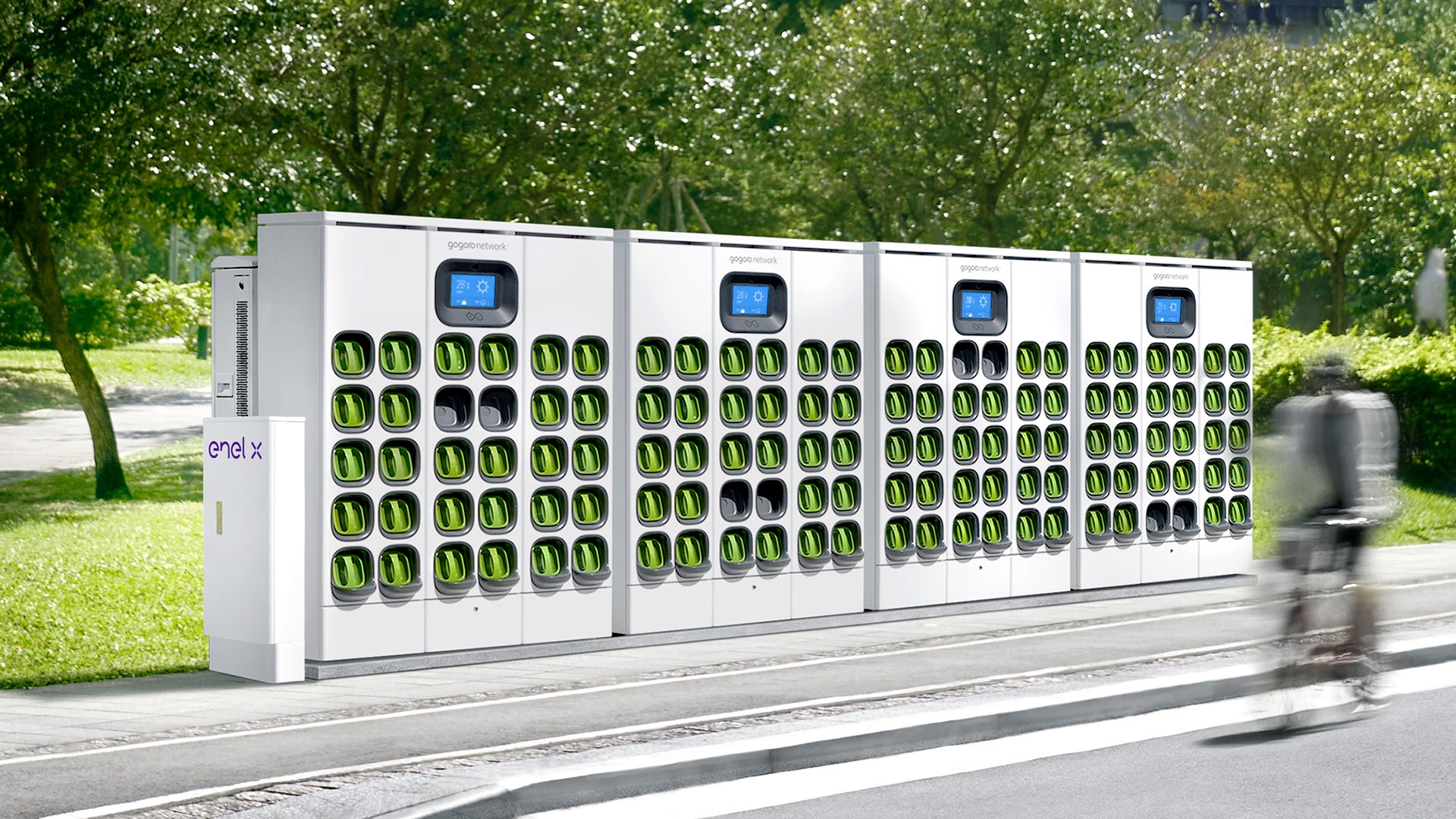
If you’ve ever been to Taiwan, you’ve likely run into Gogoro’s green-and-white battery-swap stations in one city or another. With 12,500 stations around the island, Gogoro has built a sweeping network that allows users of electric scooters to drop off an empty battery and get a fully charged one immediately. Gogoro is also found in China, India, and a few other countries.
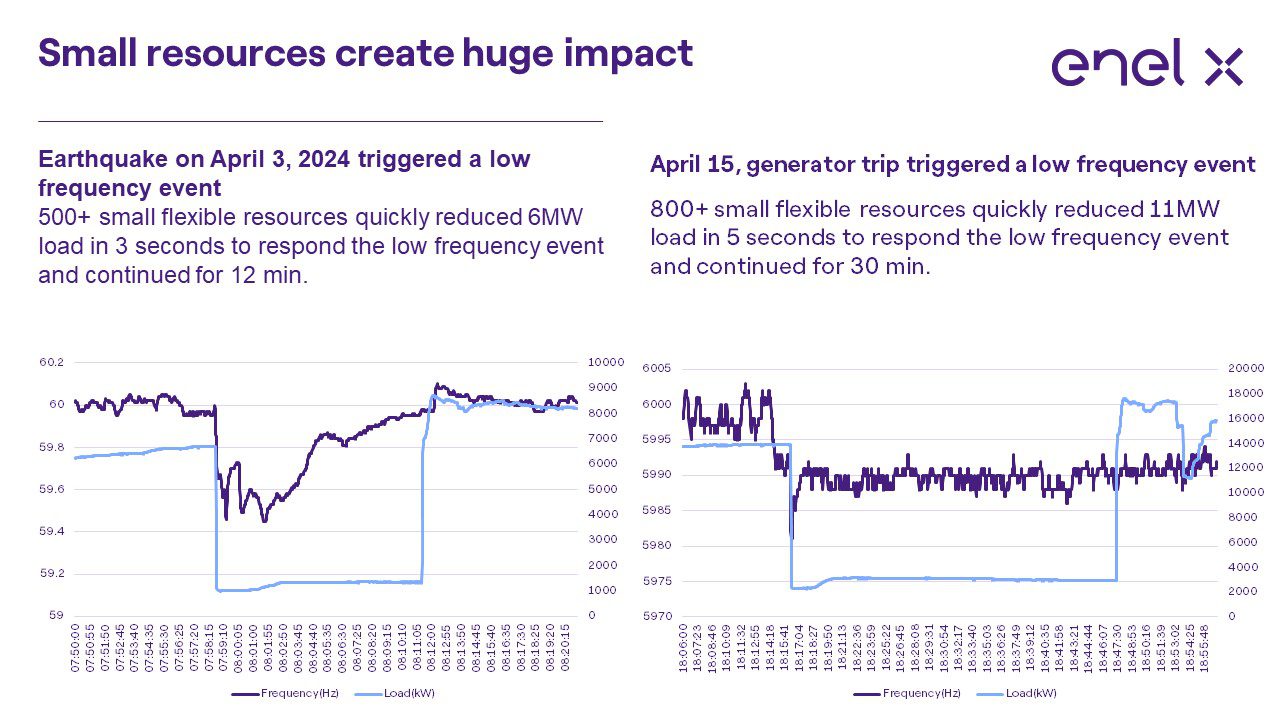
This morning, I published a story on how Gogoro’s battery-swap network in Taiwan reacted to emergency blackouts after the 7.4 magnitude earthquake there this April. I talked to Horace Luke, Gogoro’s cofounder and CEO, to understand how in three seconds, over 500 Gogoro battery-swap locations stopped drawing electricity from the grid, helping stabilize the power frequency.
Gogoro’s battery stations acted like something called a virtual power plant (VPP), a new idea that’s becoming adopted around the world as a way to stitch renewable energy into the grid. The system draws energy from distributed sources like battery storage or small rooftop solar panels and coordinates those sources to increase supply when electricity demand peaks. As a result, it reduces the reliance on traditional coal or gas power plants.
There’s actually a natural synergy between technologies like battery swapping and virtual power plants (VPP). Not only can battery-swap stations coordinate charging times with the needs of the grid, but the idle batteries sitting in Gogoro’s stations can also become an energy reserve in times of emergency, potentially feeding energy back to the grid. If you want to learn more about how this system works, you can read the full story here.
Statistics shared by Gogoro and Enel X show how its battery-swap stations automatically stopped charging batteries on April 3 and April 15, when there were power outages caused by the earthquake.
GOGORO
When I talked to Gogoro’s Luke for this story, I asked him: “At what point in the company’s history did you come up with the idea to use these batteries for VPP networks?”
To my surprise, Luke answered: “Day one.”
As he explains, Gogoro was actually not founded to be an electric-scooter company; it was founded to be a “smart energy” company.
“We started with the thesis of how smart energy, through portability and connectivity, can enable many use case scenarios,” Luke says. “Transportation happens to be accounting for something like 27% or 28% of your energy use in your daily life.” And that’s why the company first designed the batteries for two-wheeled vehicles, a popular transportation option in Taiwan and across Asia.
Having succeeded in promoting its scooters and the battery-swap charging method in Taiwan, it is now able to explore other possible uses of these modular, portable batteries—more than 1.4 million of which are in circulation at this point.
“Think of smart, portable, connected energy like a propane tank,” Luke says. Depending on their size, propane tanks can be used to cook in the wild or to heat a patio. If lithium batteries can be modular and portable in a similar way, they can also serve many different purposes.
Using them in VPP programs that protect the grid from blackouts is one; beyond that, in Taipei City, Gogoro has worked with the local government to build energy backup stations for traffic lights, using the same batteries to keep the lights running in future blackouts. The batteries can also be used as backup power storage for critical facilities like hospitals. When a blackout happens, battery storage can release electricity much faster than diesel generators, keeping the impact at a minimum.
None of this would be possible without the recent advances that have made batteries more powerful and efficient. And it was clear from our conversation that Luke is obsessed with batteries—the long way the technology has come, and their potential to address a lot more energy use cases in the future.
“I still remember getting my first flashlight when I was a little kid. That button just turned the little lightbulb on and off. And that was what was amazing about batteries at the time,” says Luke. “Never did people think that AA batteries were going to power calculators or the Walkman. The guy that invented the alkaline battery never thought that. We’ll continue to take that creativity and apply it to portable energy, and that’s what inspires us every day.”
What other purposes do you think portable lithium batteries like the ones made by Gogoro could have? Let me know your ideas by writing to zeyi@technologyreview.com.
Now read the rest of China Report
Catch up with China
1. Far-right parties won big in the latest European Parliament elections, which could push the EU further toward a trade war with China. (Nikkei Asia $)
2. Volvo has started moving some of its manufacturing capacity from China to Belgium in order to avoid the European Union tariffs on Chinese imports. (The Times $)
3. Some major crypto exchanges have withdrawn from applying for business licenses in Hong Kong after the city government clarified that it doesn’t welcome businesses that offer crypto services to mainland China. (South China Morning Post $)
4. NewsBreak, the most downloaded news app in the US, does most of its engineering work in China. The app has also been found to use AI tools to make up local news that never happened. (Reuters $)
5. The Australian government ordered a China-linked fund to reduce its investment in an Australian rare-earth-mining company. (A/symmetric)
6. China just installed the largest offshore wind turbine in the world. It’s designed to generate enough power in a year for around 36,000 households. (Electrek)
7. Four college instructors from Iowa were stabbed on a visit to northern China. While the motive and identity of the assailant are still unknown, the incident has been quickly censored on the Chinese internet. (BBC)
Lost in translation
Qian Zhimin, a Chinese businesswoman who fled the country in 2017 after raising billions of dollars from Chinese investors in the name of bitcoin investments, was arrested in London and is facing a trial in October this year, according to the Chinese publication Caijing. In the early 2010s, when the cryptocurrency first became known in China, Qian’s company lured over 128,000 retail investors, predominantly elderly people, to buy fraudulent investment products that bet on the price of bitcoins and gadgets like smart bracelets that allegedly could also mine bitcoins.
After the scam was exposed, Qian escaped to the UK with a fake passport. She controls over 61,000 bitcoins, now worth nearly $4 billion, and has been trying to liquidate them by buying properties in London. But those attempts caught the attention of anti-money-laundering authorities in the UK. With her trial date approaching, the victims in China are hoping to work with the UK jurisdiction to recover their assets.
One more thing
I know one day we will see self-driving vehicles racing each other and cutting each other off, but I didn’t expect it to happen so soon with two package delivery robots in China. Maybe it’s just their look, but it seems cuter than when human drivers do the same thing?
TBH, I was expecting a world where unmanned delivery vehicles racing each other on busy streets to come maybe 5 yrs from now, but JD & its subsidiary Dada are making it happen w/o hitting anything
This article is from The Spark, MIT Technology Review’s weekly climate newsletter. To receive it in your inbox every Wednesday, sign up here.
There’s often one overlooked member in a duo. Peanut butter outshines jelly in a PB&J every time (at least in my eyes). For carbon capture and storage technology, the storage part tends to be the underappreciated portion.
Carbon capture and storage (CCS) tech has two main steps (as you might guess from the name). First, carbon dioxide is filtered out of emissions at facilities like fossil-fuel power plants. Then it gets locked away, or stored.
Wrangling pollution might seem like the important bit, and there’s often a lot of focus on what fraction of emissions a CCS system can filter out. But without storage, the whole project would be pretty useless. It’s really the combination of capture and long-term storage that helps to reduce climate impact.
Storage is getting more attention lately, though, and there’s something of a carbon storage boom coming, as my colleague James Temple covered in his latest story. He wrote about what a rush of federal subsidies will mean for the CCS business in the US, and how supporting new projects could help us hit climate goals or push them further out of reach, depending on how we do it.
The story got me thinking about the oft-forgotten second bit of CCS. Here’s where we might store captured carbon pollution, and why it matters.
When it comes to storage, the main requirement is making sure the carbon dioxide can’t accidentally leak out and start warming up the atmosphere.
One surprising place that might fit the bill is oil fields. Instead of building wells to extract fossil fuels, companies are looking to build a new type of well where carbon dioxide that’s been pressurized until it reaches a supercritical state—in which liquid and gas phases don’t really exist—is pumped deep underground. With the right conditions (including porous rock deep down and a leak-preventing solid rock layer on top), the carbon dioxide will mostly stay put.
Shooting carbon dioxide into the earth isn’t actually a new idea, though in the past it’s largely been used by the oil and gas industry for a very different purpose: pulling more oil out of the ground. In a process called enhanced oil recovery, carbon dioxide is injected into wells, where it frees up oil that’s otherwise tricky to extract. In the process, most of the injected carbon dioxide stays underground.
But there’s a growing interest in sending the gas down there as an end in itself, sparked in part in the US by new tax credits in the Inflation Reduction Act. Companies can rake in $85 per ton of carbon dioxide that’s captured and permanently stored in geological formations, depending on the source of the gas and how it’s locked away.
In his story, James took a look at one proposed project in California, where one of the state’s largest oil and gas producers has secured draft permits from federal regulators. The project would inject carbon dioxide about 6,000 feet below the surface of the earth, and the company’s filings say the project could store tens of millions of tons of carbon dioxide over the next couple of decades.
It’s not just land-based projects that are sparking interest, though. State officials in Texas recently awarded a handful of leases for companies to potentially store carbon dioxide deep underwater in the Gulf of Mexico.
And some companies want to store carbon dioxide in products and materials that we use, like concrete. Concrete is made by mixing reactive cement with water and material like sand; if carbon dioxide is injected into a fresh concrete mix, some of it will get involved in the reactions, trapping it in place. I covered how two companies tested out this idea in a newsletter last year.
Products we use every day, from diamonds to sunglasses, can be made with captured carbon dioxide. If we assume that those products stick around for a long time and don’t decompose (how valid this assumption is depends a lot on the product), one might consider these a form of long-term storage, though these markets probably aren’t big enough to make a difference in the grand scheme of climate change.
Ultimately, though of course we need to emit less, we’ll still need to lock carbon away if we’re going to meet our climate goals.
Now read the rest of The Spark
Related reading
For all the details on what to expect in the coming carbon storage boom, including more on the potential benefits and hazards of CCS, read James’s full story here.
This facility in Iceland uses mineral storage deep underground to lock away carbon dioxide that’s been vacuumed out of the atmosphere. See all the photos in this story from 2022.
GOGORO
Another thing
When an earthquake struck Taiwan in April, the electrical grid faced some hiccups—and an unlikely hero quickly emerged in the form of battery-swap stations for electric scooters. In response to the problem, a group of stations stopped pulling power from the grid until it could recover.
New York was set to implement congestion pricing, charging cars that drove into the busiest part of Manhattan. Then the governor put that plan on hold indefinitely. It’s a move that reveals just how tightly Americans are clinging to cars, even as the future of climate action may depend on our loosening that grip. (The Atlantic)
Speaking of cars, preparations in Paris for the Olympics reveal what a future with fewer of them could look like. The city has closed over 100 streets to vehicles, jacked up parking rates for SUVs, and removed tens of thousands of parking spots. (NBC News)
An electric lawnmower could be the gateway to a whole new world. People who have electric lawn equipment or solar panels are more likely to electrify other parts of their homes, like heating and cooking. (Canary Media)
Companies are starting to look outside the battery. From massive moving blocks to compressed air in caverns, energy storage systems are getting weirder as the push to reduce prices intensifies. (Heatmap)
Rivian announced updated versions of its R1T and R1S vehicles. The changes reveal the company’s potential path toward surviving in a difficult climate for EV makers. (Tech Crunch)
First responders in the scorching southwestern US are resorting to giant ice cocoons to help people suffering from extreme heat. (New York Times)
One oil producer is getting closer to making what it calls “net-zero oil” by pumping captured carbon dioxide down into wells to get more oil out. The implications for the climate and the future of fossil fuels in our economy are … complicated. (Cipher)
It’s game night,and I’m crossing my fingers, hoping for a hurricane.
I roll the die and it clatters across the board, tumbling to a stop to reveal a tiny icon of a tree stump. Bad news: I just triggered deforestation in the Amazon. That seals it. I failed to stop climate change—at least this board-game representation of it.
The urgent need to address climate change might seem like unlikely fodder for a fun evening. But a growing number of games are attempting to take on the topic, including a version of the bestseller Catan released this summer.
As a climate reporter, I was curious about whether games could, even abstractly, represent the challenge of the climate crisis. Perhaps more crucially, could they possibly be any fun?
My investigation started with Daybreak, a board game released in late 2023 by a team that includes the creator of Pandemic (infectious disease—another famously light topic for a game). Daybreak is a cooperative game where players work together to cut emissions and survive disasters. The group either wins or loses as a whole.
When I opened the box, it was immediately clear that this wouldn’t be for the faint of heart. There are hundreds of tiny cardboard and wooden pieces, three different card decks, and a surprisingly thick rule book. Setting it up, learning the rules, and playing for the first time took over two hours.
Daybreak, a cooperative board game about stopping climate change.
COURTESY OF CMYK
Daybreak is full of details, and I was struck by how many of them it gets right. Not only are there cards representing everything from walkable cities to methane removal, but each features a QR code players can use to learn more.
In each turn, players deploy technologies or enact policies to cut climate pollution. Just as in real life, emissions have negative effects. Winning requires slashing emissions to net zero (the point where whatever’s emitted can be soaked up by forests, oceans, or direct air capture). But there are multiple ways for the whole group to lose, including letting the global average temperature increase by 2 °C or simply running out of turns.
In an embarrassing turn of events for someone who spends most of her waking hours thinking about climate change, nearly every round of Daybreak I played ended in failure. Adding insult to injury, I’m not entirely sure that I was having fun. Sure, the abstract puzzle was engaging and challenging, and after a loss, I’d be checking the clock, seeing if there was time to play again. But once all the pieces were back in the box, I went to bed obsessing about heat waves and fossil-fuel disinformation. The game was perhaps representing climate change a little bit too well.
I wondered if a new edition of a classic would fare better. Catan, formerly Settlers of Catan, and its related games have sold over 45 million copies worldwide since the original’s release in 1995. The game’s object is to build roads and settlements, setting up a civilization.
In late 2023, Catan Studios announced that it would be releasing a version of its game called New Energies, focused on climate change. The new edition, out this summer, preserves the same central premise as the original. But this time, players will also construct power plants, generating energy with either fossil fuels or renewables. Fossil fuels are cheaper and allow for quicker expansion, but they lead to pollution, which can harm players’ societies and even end the game early.
Before I got my hands on the game, I spoke with one of its creators, Benjamin Teuber, who developed the game with his late father, Klaus Teuber, the mastermind behind the original Catan.
To Teuber, climate change is a more natural fit for a game than one might expect. “We believe that a good game is always around a dilemma,” he told me. The key is to simplify the problem sufficiently, a challenge that took the team dozens of iterations while developing New Energies. But he also thinks there’s a need to be at least somewhat encouraging. “While we have a severe topic, or maybe even especially because we have a severe topic, you can’t scare off the people by making them just have a shitty evening,” Teuber says.
In New Energies, the first to gain 10 points wins, regardless of how polluting that player’s individual energy supply is. But if players collectively build too many fossil-fuel plants and pollution gets too high, the game ends early, in which case whoever has done the most work to clean up their own energy supply is named the winner.
That’s what happened the first time I tested out the game. While I had been lagging in points, I ended up taking the win, because I had built more renewable power plants than my competitors.
This relatively rosy ending had me conflicted. On one hand, I was delighted, even if it felt like a consolation prize.
But I found myself fretting over the messages that New Energies will send to players. A simple game that crowns a winner may be more playable, but it doesn’t represent how complicated the climate crisis is, or how urgently we need to address it.
I’m glad climate change has a spot on my game shelf, and I hope these and other games find their audiences and get people thinking about the issues. But I’ll understand the impulse to reach for other options when game night rolls around, because I can’t help but dwell on the fact that in the real world, we won’t get to reset the pieces and try again.
A London-based nonprofit is poised to become one of the world’s largest financial backers of solar geoengineering research. And it’s just one of a growing number of foundations eager to support scientists exploring whether the world could ease climate change by reflecting away more sunlight.
Quadrature Climate Foundation, established in 2019 and funded through the proceeds of the investment fund Quadrature Capital, plans to provide $40 million for work in this field over the next three years, Greg De Temmerman, the organization’s chief science officer, told MIT Technology Review.
That’s a big number for this subject—double what all foundations and wealthy individuals provided from 2008 through 2018 and roughly on par with what the US government has offered to date.
“We think we can have a very strong impact in accelerating research, making sure it’s happening, and trying to unlock some public money at some point,” De Temmerman says.
Other nonprofits are set to provide tens of millions of dollars’ worth of additional grants to solar geoengineering research or related government advocacy work in the coming months and years. The uptick in funding will offer scientists in the controversial field far more support than they’ve enjoyed in the past and allow them to pursue a wider array of lab work, modeling, and potentially even outdoor experiments that could improve our understanding of the benefits and risks of such interventions.
“It just feels like a new world, really different from last year,” says David Keith, a prominent geoengineering researcher and founding faculty director of the Climate Systems Engineering Initiative at the University of Chicago.
Other nonprofits that have recently disclosed funding for solar geoengineering research or government advocacy, or announced plans to provide it, include the Simons Foundation, the Environmental Defense Fund, and the Bernard and Anne Spitzer Charitable Trust.
In addition, Meta’s former chief technology officer, Mike Schroepfer, told MIT Technology Review he is spinning out a new nonprofit, Outlier Projects. He says it will provide funding to solar geoengineering research as well as to work on ocean-based carbon removal and efforts to stabilize rapidly melting glaciers.
Outlier has already issued grants for the first category to the Environmental Defense Fund, Keith’s program at the University of Chicago, and two groups working to support research and engagement on the subject in the poorer, hotter parts of the world: the Degrees Initiative and the Alliance for Just Deliberation on Solar Geoengineering.
Researchers say that the rising dangers of climate change, the lack of progress on cutting emissions, and the relatively small amount of government research funding to date are fueling the growing support for the field.
“A lot of people are recognizing the obvious,” says Douglas MacMartin, a senior research associate in mechanical and aerospace engineering at Cornell, who focuses on geoengineering. “We’re not in a good position with regard to mitigation—and we haven’t spent enough money on research to be able to support good, wise decisions on solar geoengineering.”
Scientists are exploring a variety of potential methods of reflecting away more sunlight, including injecting certain particles into the stratosphere to mimic the cooling effect of volcanic eruptions, spraying salt toward marine clouds to make them brighter, or sprinkling fine dust-like material into the sky to break up heat-trapping cirrus clouds.
Critics contend that neither nonprofits nor scientists should support studying any of these methods, arguing that raising the possibility of such interventions eases pressure to cut emissions and creates a “slippery slope” toward deploying the technology. Even some who support more research fear that funding it through private sources, particularly from wealthy individuals who made their fortunes in tech and finance, may allow studies to move forward without appropriate oversight and taint public perceptions of the field.
The sense that we’re “putting the climate system in the care of people who have disrupted the media and information ecosystems, or disrupted finance, in the past” could undermine public trust in a scientific realm that many already find unsettling, says Holly Buck, an assistant professor at the University of Buffalo and author of After Geoengineering.
‘Unlocking solutions’
One of Quadrature’s first solar geoengineering grants went to the University of Washington’s Marine Cloud Brightening Program. In early April, that research group made headlines for beginning, and then being forced to halt, small-scale outdoor experiments on a decommissioned aircraft carrier sitting off the coast of Alameda, California. The effort entailed spraying a mist of small sea salt particles into the air.
Quadrature was also one of the donors to a $20.5 million fund for the Washington, DC, nonprofit SilverLining, which was announced in early May. The group pools and distributes grants to solar geoengineering researchers around the world and has pushed for greater government support and funding for the field. The new fund will support that policy advocacy work as well as efforts to “promote equitable participation by all countries,” Kelly Wanser, executive director of SilverLining, said in an email.
She added that it’s crucial to accelerate solar geoengineering research because of the rising dangers of climate change, including the risk of passing “catastrophic tipping points.”
“Current climate projections may even underestimate risks, particularly to vulnerable populations, highlighting the urgent need to improve risk prediction and expand response strategies,” she wrote.
Quadrature has also issued grants for related work to Colorado State University, the University of Exeter, and the Geoengineering Model Intercomparison Project, an effort to run the same set of modeling experiments across an array of climate models.
The foundation intends to direct its solar geoengineering funding to advance efforts in two main areas: academic research that could improve understanding of various approaches, and work to develop global oversight structures “to enable decision-making on [solar radiation modification] that is transparent, equitable, and science based.”
“We want to empower people to actually make informed decisions at some point,” De Temmerman says, stressing the particular importance of ensuring that people in the Global South are actively involved in such determinations.
He says that Quadrature is not advocating for specific outcomes, taking no position on whether or not to ultimately use such tools. It also won’t support for-profit startups.
In an emailed response to questions, he stressed that the funding for solar geoengineering is a tiny part of the foundation’s overall mission, representing just 5% of its $930 million portfolio. The lion’s share has gone to accelerate efforts to cut greenhouse-gas pollution, remove it from the atmosphere, and help vulnerable communities “respond and adapt to climate change to minimize harm.”
Billionaires Greg Skinner and Suneil Setiya founded both the Quadrature investment fund as well as the foundation. The nonprofit’s stated mission is unlocking solutions to the climate crisis, which it describes as “the most urgent challenge of our time.” But the group, which has 26 employees, has faced recent criticism for its benefactors’ stakes in oil and gas companies. Last summer, the Guardianreported that Quadrature Capital held tens of millions of dollars in investments in dozens of fossil-fuel companies, including ConocoPhillips and Cheniere Energy.
In response to a question about the potential for privately funded foundations to steer research findings in self-interested ways, or to create the perception that the results might be so influenced, De Temmerman stated: “We are completely transparent in our funding, ensuring it is used solely for public benefit and not for private gain.”
More foundations, more funds
To be sure, a number of wealthy individuals and foundations have been providing funds for years to solar geoengineering research or policy work, or groups that collect funds to do so.
A 2021 paper highlighted contributions from a number of wealthy individuals, with a high concentration from the tech sector, including Microsoft cofounder Bill Gates, Facebook cofounder Dustin Moskovitz, Facebook alum and venture capitalist Matt Cohler, former Google executive (and extreme skydiver) Alan Eustace, and tech and climate solutions investors Chris and Crystal Sacca. It noted a number of nonprofits providing grants to the field as well, including the Hewlett Foundation, the Alfred P. Sloan Foundation, and the Blue Marble Fund.
But despite the backing of those high-net-worth individuals, the dollar figures have been low. From 2008 through 2018, total private funding only reached about $20 million, while government funding just topped $30 million.
The spending pace is now picking up, though, as new players move in.
The Simons Foundation previously announced it would provide $50 million to solar geoengineering research over a five-year period. The New York–based nonprofit invited researchers to apply for grants of up to $500,000, adding that it “strongly” encouraged scientists in the Global South to do so.
The organization is mostly supporting modeling and lab studies. It said it would not fund social science work or field experiments that would release particles into the environment. Proposals for such experiments have sparked heavy public criticism in the past.
Simons recently announced a handful of initial awards to researchers at Harvard, Princeton, ETH Zurich, the Indian Institute of Tropical Meteorology, the US National Center for Atmospheric Research, and elsewhere.
“For global warming, we will need as many tools in the toolbox as possible,” says David Spergel, president of the Simons Foundation.
“This was an area where there was a lot of basic science to do, and a lot of things we didn’t understand,” he adds. “So we wanted to fund the basic science.”
In January, the Environmental Defense Fund hosted a meeting at its San Francisco headquarters to discuss the guardrails that should guide research on solar geoengineering, as first reported by Politico. EDF had already provided some support to the Solar Radiation Management Governance Initiative, a partnership with the Royal Society and other groups set up to “ensure that any geoengineering research that goes ahead—inside or outside the laboratory—is conducted in a manner that is responsible, transparent, and environmentally sound.” (It later evolved into the Degrees Initiative.)
But EDF has now moved beyond that work and is “in the planning stages of starting a research and policy initiative on [solar radiation modification],” said Lisa Dilling, associate chief scientist at the environmental nonprofit, in an email. That program will include regranting, which means raising funds from other groups or individuals and distributing them to selected recipients, and advocating for more public funding, she says.
Outlier also provided a grant to a new nonprofit, Reflective. This organization is developing a road map to prioritize research needs and pooling philanthropic funding to accelerate work in the most urgent areas, says its founder, Dakota Gruener.
Gruener was previously the executive director of ID2020, a nonprofit alliance that develops digital identification systems. Cornell’s MacMartin is a scientific advisor to the new nonprofit and will serve as the chair of the scientific advisory board.
In February, the UK’s Natural Environment Research Council announced a £10.5 million, five-year research program. In addition, the UK’s Advanced Research and Invention Agency has said it’s exploring and soliciting input for a research program in climate and weather engineering.
Funding has not been allocated as yet, but the agency’s programs typically provide around £50 million.
‘When, not if’
More funding is generally welcome news for researchers who hope to learn more about the potential of solar geoengineering. Many argue that it’s crucial to study the subject because the technology may offer ways to reduce death and suffering, and prevent the loss of species and the collapse of ecosystems. Some also stress it’s crucial to learn what impact these interventions might have and how these tools could be appropriately regulated, because nations may be tempted to implement them unilaterally in the face of extreme climate crises.
It’s likely a question of “when, not if,” and we should “act and research accordingly,” says Gernot Wagner, a climate economist at Columbia Business School, who was previously the executive director of Harvard’s Solar Geoengineering Research Program. “In many ways the time has come to take solar geoengineering much more seriously.”
In 2021, a National Academies report recommended that the US government create a solar geoengineering research program, equipped with $100 million to $200 million in funding over five years.
But there are differences between coordinated government-funded research programs, which have established oversight bodies to consider the merit, ethics, and appropriate transparency of proposed research, and a number of nonprofits with different missions providing funding to the teams they choose.
To the degree that they create oversight processes that don’t meet the same standards, it could affect the type of science that’s done, the level of public notice provided, and the pressures that researchers feel to deliver certain results, says Duncan McLaren, a climate intervention fellow at the University of California, Los Angeles.
“You’re not going to be too keen on producing something that seems contrary to what you thought the grant maker was looking for,” he says, adding later: “Poorly governed research could easily give overly optimistic answers about what [solar geoengineering] could do, and what its side effects may or may not be.”
Whatever the motivations of individual donors, Buck fears that the concentration of money coming from high tech and finance could also create optics issues, undermining faith in research and researchers and possibly slowing progress in the field.
“A lot of this is going to backfire because it’s going to appear to people as Silicon Valley tech charging in and breaking things,” she says.
Cloud controversy
Some of the concerns about privately funded work in this area are already being tested.
By most accounts, the Alameda experiment in marine cloud brightening that Quadrature backed was an innocuous basic-science project, which would not have actually altered clouds. But the team stirred up controversy by moving ahead without wide public notice.
City officials quickly halted the experiments, and earlier this month the city council voted unanimously to shut the project down.
Alameda mayor Marilyn Ezzy Ashcraft has complained that city staffers received only vague notice about the project up front. They were then inundated with calls from residents who had heard about it in the media and were concerned about the health implications, she said, according to CBS News.
In response to a question about the criticism, SilverLining’s Wanser said in an email: “We worked with the lease-holder, the USS Hornet, on the process for notifying the city of Alameda. The city staff then engaged experts to independently evaluate the health and environmental safety of the … studies, who found that they did not pose any environmental or health risks to the community.”
Wanser, who is a principal of the Marine Cloud Brightening Program, stressed they’ve also received offers of support from local residents and businesses.
“We think that the availability of data and information on the nature of the studies, and its evaluation by local officials, was valuable in helping people consider it in an informed way for themselves,” she added.
Some observers were also concerned that the research team said it selected its own six-member board to review the proposed project. That differs from a common practice with publicly funded scientific experiments, which often include a double-blind review process, in which neither the researchers nor the reviewers know each other’s names. The concern with breaking from that approach is that scientists could select outside researchers who they believe are likely to greenlight their proposals, and the reviewers may feel pressure to provide more favorable feedback than they might offer anonymously.
Wanser stressed that the team picked “distinguished researchers in the specialized field.”
“There are different approaches for different programs, and in this case, the levels of expertise and transparency were important features,” she added. “They have not received any criticism of the design of the studies themselves, which speaks to their robustness and their value.”
‘Transparent and responsible’
Solar geoengineering researchers often say that they too would prefer public funding, all things being equal. But they stress that those sources are still limited and it’s important to move the field forward in the meantime, so long as there are appropriate standards in place.
“As long as there’s clear transparency about funding sources, [and] there’s no direct influence on the research by the donors, I don’t precisely see what the problem is,” MacMartin says.
Several nonprofits emerging or moving into this space said that they are working to create responsible oversight structures and rules.
Gruener says that Reflective won’t accept anonymous donations or contributions from people whose wealth comes mostly from fossil fuels. She adds that all donors will be disclosed, that they won’t have any say over the scientific direction of the organization or its chosen research teams, and that they can’t sit on the organization’s board.
“We think transparency is the only way to build trust, and we’re trying to ensure that our governance structure, our processes, and the outcomes of our research are all public, understandable, and readily available,” she says.
In a statement, Outlier said it’s also in favor of more publicly supported work: “It’s essential for governments to become the leading funders and coordinators of research in these areas.” It added that it’s supporting groups working to accelerate “government leadership” on the subject, including through its grant to EDF.
Quadrature’s De Temmerman stresses the importance of public research programs as well, noting that the nonprofit hopes to catalyze much more such funding through its support for government advocacy work.
“We are here to push at the beginning and then at some point just let some other forms of capital actually come,” he says.
This article is from The Spark, MIT Technology Review’s weekly climate newsletter. To receive it in your inbox every Wednesday, sign up here.
SUVs are taking over the world—larger vehicle models made up nearly half of new car sales globally in 2023, a new record for the segment.
There are a lot of reasons to be nervous about the ever-expanding footprint of vehicles, from pedestrian safety and road maintenance concerns to higher greenhouse-gas emissions. But in a way, SUVs also represent a massive opportunity for climate action, since pulling the worst gas-guzzlers off the roads and replacing them with electric versions could be a big step in cutting pollution.
It’s clear that we’re heading toward a future with bigger cars. Here’s what it might mean for the climate, and for our future on the road.
SUVs accounted for 48% of global car sales in 2023, according to a new analysis from the International Energy Agency. This is a continuation of a trend toward bigger cars—just a decade ago, SUVs only made up about 20% of new vehicle sales.
Big vehicles mean big emissions numbers. Last year there were more than 360 million SUVs on the roads, and they produced a billion metric tons of carbon dioxide. If SUVs were a country, they’d have the fifth-highest emissions of any nation on the planet—more than Japan. Of all the energy-related emissions growth last year, over 20% can be attributed to SUVs.
There are several factors driving the world’s move toward larger vehicles. Larger cars tend to have higher profit margins, so companies may be more likely to make and push those models. And drivers are willing to jump on the bandwagon. I understand the appeal—I learned to drive in a huge SUV, and being able to stretch out my legs and float several feet above traffic has its perks.
Electric vehicles are very much following the trend, with several companies unveiling larger models in the past few years. Some of these newly released electric SUVs are seeing massive success. The Tesla Model Y, released in 2020, was far and away the most popular EV last year, with over 1.2 million units sold in 2023. The BYD Song (also an SUV) took second place with 630,000 sold.
Globally, SUVs made up nearly 50% of new EV sales in 2023, compared to just under 20% in 2018, according to the IEA’s Global EV Outlook 2024. There’s also been a shift away from small cars (think the size of the Fiat 500) and toward large ones (similar to the BMW 7-series).
And big-car obsession is a global phenomenon. The US is the land of the free and the home of the massive vehicles—SUVs made up 65% of new electric-vehicle sales in the country in 2023. But other major markets aren’t all that far behind: in Europe, the share was 52%, and in China, it was 36%. (You can see the above chart broken down by region from the IEA here.)
So it’s clear that we’re clamoring for bigger cars. Now what?
One way of looking at this whole thing is that SUVs offer up an incredible opportunity for climate action. EVs will reduce emissions over their life span relative to gas-powered versions of the same model, so electrifying the biggest emitters on the roads would have an outsize impact. If all gas-powered and hybrid SUVs sold in 2023 were instead electric vehicles, about 770 million metric tons of carbon dioxide would be avoided over the lifetime of those vehicles, according to the IEA report. That’s equivalent to all of China’s road emissions last year.
I previously wrote a somewhat hesitant defense of large EVs for this reason—electric SUVs aren’t perfect, but they could still help us address climate change. If some drivers are willing to buy an EV but aren’t willing to downsize their cars, then having larger electric options available could be a huge lever for climate action.
But there are several very legitimate reasons why not everyone is welcoming the future of massive cars (even electric ones) with open arms. Larger vehicles are harder on roads, making upkeep more expensive. SUVs and other big vehicles are way more dangerous for pedestrians, too. Vehicles with higher front ends and blunter profiles are 45% more likely to cause fatalities in crashes with pedestrians.
Bigger EVs could also have a huge effect on the amount of mining we’ll need to do to meet demand for metals like lithium, nickel, and cobalt. One 2023 study found that larger vehicles could increase the amount of mining needed more than 50% by 2050, relative to the amount that would be necessary if people drove smaller vehicles. Given that mining is energy intensive and can come with significant environmental harms, it’s not an unreasonable worry.
New technologies could help reduce the mining we need to do for some materials: LFP batteries that don’t contain nickel or cobalt are quickly growing in market share, especially in China, and they could help reduce demand for those metals.
Another potential solution is reducing the demand for bigger cars in the first place. Policies have historically had a hand in pushing people toward larger cars and could help us make a U-turn on car bloat. Some countries, including Norway and France, now charge more in taxes or registration for larger vehicles. Paris recently jacked up parking rates for SUVs.
For now, our vehicles are growing, and if we’re going to have SUVs on the roads, then we should have electric options. But bigger isn’t always better.
Now read the rest of The Spark
Related reading
I’ve defended big EVs in the past—SUVs come with challenges, but electric ones are hands-down better for emissions than gas-guzzlers. Read this 2023 newsletter for more.
The average size of batteries in EVs has steadily ticked up in recent years, as I touched on in this newsletter from last year.
Electric cars are still cars, and smaller, safer EVs, along with more transit options, will be key to hitting our climate goals, Paris Marx argued in this 2022 op-ed.
Keeping up with climate
We might be underestimating how much power transmission lines can carry. Sensors can give grid operators a better sense of capacity based on factors like temperature and wind speed, and it could help projects hook up to the grid faster. (Canary Media)
North America could be in for an active fire season, though it’s likely not going to rise to the level of 2023. (New Scientist)
Climate change is making some types of turbulence more common, and that could spell trouble for flying. Studying how birds move might provide clues about dangerous spots. (BBC)
The perceived slowdown for EVs in the US is looking more like a temporary blip than an ongoing catastrophe. Tesla is something of an outlier with its recent slump—most automakers saw greater than 50% growth in the first quarter of this year. (Bloomberg)
This visualization shows just how dominant China is in the EV supply chain, from mining materials like graphite to manufacturing battery cells. (Cipher News)
Climate change is coming for our summer oysters. The variety that have been bred to be eaten year round are sensitive to extreme heat, making their future rocky. (The Atlantic)
The US has new federal guidelines for carbon offsets. It’s an effort to fix up an industry that studies and reports have consistently shown doesn’t work very well. (New York Times)
The most stubborn myth about heat pumps is that they don’t work in cold weather. Heat pumps are actually more efficient than gas furnaces in cold conditions. (Wired)
This article is from The Spark, MIT Technology Review’s weekly climate newsletter. To receive it in your inbox every Wednesday, sign up here.
Tech companies keep finding new ways to bring AI into every facet of our lives. AI has taken over my search engine results, and new virtual assistants from Google and OpenAI announced last week are bringing the world eerily close to the 2013 film Her (in more ways than one).
So how worried should we be about AI’s electricity demands? Well, it’s complicated.
Using AI for certain tasks can come with a significant energy price tag. With some powerful AI models, generating an image can require as much energy as charging up your phone, as my colleague Melissa Heikkilä explained in a story from December. Create 1,000 images with a model like Stable Diffusion XL, and you’ve produced as much carbon dioxide as driving just over four miles in a gas-powered car, according to the researchers Melissa spoke to.
But while generated images are splashy, there are plenty of AI tasks that don’t use as much energy. For example, creating images is thousands of times more energy-intensive than generating text. And using a smaller model that’s tailored to a specific task, rather than a massive, all-purpose generative model, can be dozens of times more efficient. In any case, generative AI models require energy, and we’re using them a lot.
Electricity consumption from data centers, AI, and cryptocurrency could reach double 2022 levels by 2026, according to projections from the International Energy Agency. Those technologies together made up roughly 2% of global electricity demand in 2022. Note that these numbers aren’t just for AI—it’s tricky to nail down AI’s specific contribution, so keep that in mind when you see predictions about electricity demand from data centers.
There’s a wide range of uncertainty in the IEA’s projections, depending on factors like how quickly deployment increases and how efficient computing processes get. On the low end, the sector could require about 160 terawatt-hours of additional electricity by 2026. On the higher end, that number might be 590 TWh. As the report puts it, AI, data centers, and cryptocurrency together are likely adding “at least one Sweden or at most one Germany” to global electricity demand.
In total, the IEA projects, the world will add about 3,500 TWh of electricity demand over that same period—so while computing is certainly part of the demand crunch, it’s far from the whole story. Electric vehicles and the industrial sector will both be bigger sources of growth in electricity demand than data centers in the European Union, for example.
Still, some big tech companies are suggesting that AI could get in the way of their climate goals. Microsoft pledged four years ago to bring its greenhouse-gas emissions to zero (or even lower) by the end of the decade. But the company’s recent sustainability report shows that instead, emissions are still ticking up, and some executives point to AI as a reason. “In 2020, we unveiled what we called our carbon moonshot. That was before the explosion in artificial intelligence,” Brad Smith, Microsoft’s president, told Bloomberg Green.
What I found interesting, though, is that it’s not AI’s electricity demand that’s contributing to Microsoft’s rising emissions, at least on paper. The company has agreements in place and buys renewable-energy credits so that electricity needs for all its functions (including AI) are met with renewables. (How much these credits actually help is questionable, but that’s a story for another day.)
Instead, infrastructure growth could be adding to the uptick in emissions. Microsoft plans to spend $50 billion between July 2023 and June 2024 on expanding data centers to meet demand for AI products, according to the Bloomberg story. Building those data centers requires materials that can be carbon intensive, like steel, cement, and of course chips.
Meyer points to estimates from 1999 that information technologies were already accounting for up to 13% of US power demand, and that personal computers and the internet could eat up half the grid’s capacity within the decade. That didn’t end up happening, and even at the time, computing was actually accounting for something like 3% of electricity demand.
We’ll have to wait and see if doomsday predictions about AI’s energy demand play out. The way I see it, though, AI is probably going to be a small piece of a much bigger story. Ultimately, rising electricity demand from AI is in some ways no different from rising demand from EVs, heat pumps, or factory growth. It’s really how we meet that demand that matters.
If we build more fossil-fuel plants to meet our growing electricity demand, it’ll come with negative consequences for the climate. But if we use rising electricity demand as a catalyst to lean harder into renewable energy and other low-carbon power sources, and push AI to get more efficient, doing more with less energy, then we can continue to slowly clean up the grid, even as AI continues to expand its reach in our lives.
Now read the rest of The Spark
Related reading
Check out my colleague Melissa’s story on the carbon footprint of AI from December here.
For a closer look at Microsoft’s new sustainability report and the effects of AI, give this Bloomberg Greenstory from reporters Akshat Rathi and Dina Bass a read.
Robinson Meyer at Heatmap dug into the context around the AI energy demand in this April piece.
Another thing
Missed our event last week on thermal batteries? Good news—the recording is now available for subscribers!
For the latest in our Roundtables series, I spoke with Amy Nordrum, MIT Technology Review executive editor, about how the technology works, who the crucial players are, and what I’m watching for next. Check it out here.
Keeping up with climate
Changing how we generate heat in industry will be crucial to cleaning up that sector in China, according to a new report. Thermal batteries and heat pumps could meet most of the demand. (Axios)
Form Energy is known for its iron-air batteries, which could help unlock cheap energy storage on the grid. Now, the company is working on research to produce green iron. (Canary Media)
The NET Power pilot in Texas is working to generate electricity with natural gas while capturing the vast majority of emissions. But carbon capture technology in power plants is far from proven. (Cipher News)
MIT spinoff Electrified Thermal Solutions is working to bring its thermal battery technology to commercial use. The company’s product is roughly the size of an elevator and can reach temperatures up to 1,800 °C. (Inside Climate News)
Mexico City has seen constant struggles over water. Now groundwater is drying up, and a system of dams and canals may soon be unable to provide water to the city. (New York Times)
Sodium-ion batteries could offer cheap energy storage while avoiding material crunches for metals like lithium, nickel, and cobalt. China has a massive head start, leaving other countries scrambling to catch up. (Latitude Media)
→ Here’s how this abundant material could unlock cheaper energy storage. (MIT Technology Review)
Biochar is made by heating up biomass like wood and plants in low-oxygen environments. It’s a simple approach to carbon removal, but it doesn’t always get as much attention as other carbon removal technologies. (Heatmap)
This startup wants ships to capture their own emissions by bubbling exhaust through seawater and limestone and dumping it into the ocean. Experts caution that some components of the exhaust could harm sea life if they’re not handled properly. (New Scientist)