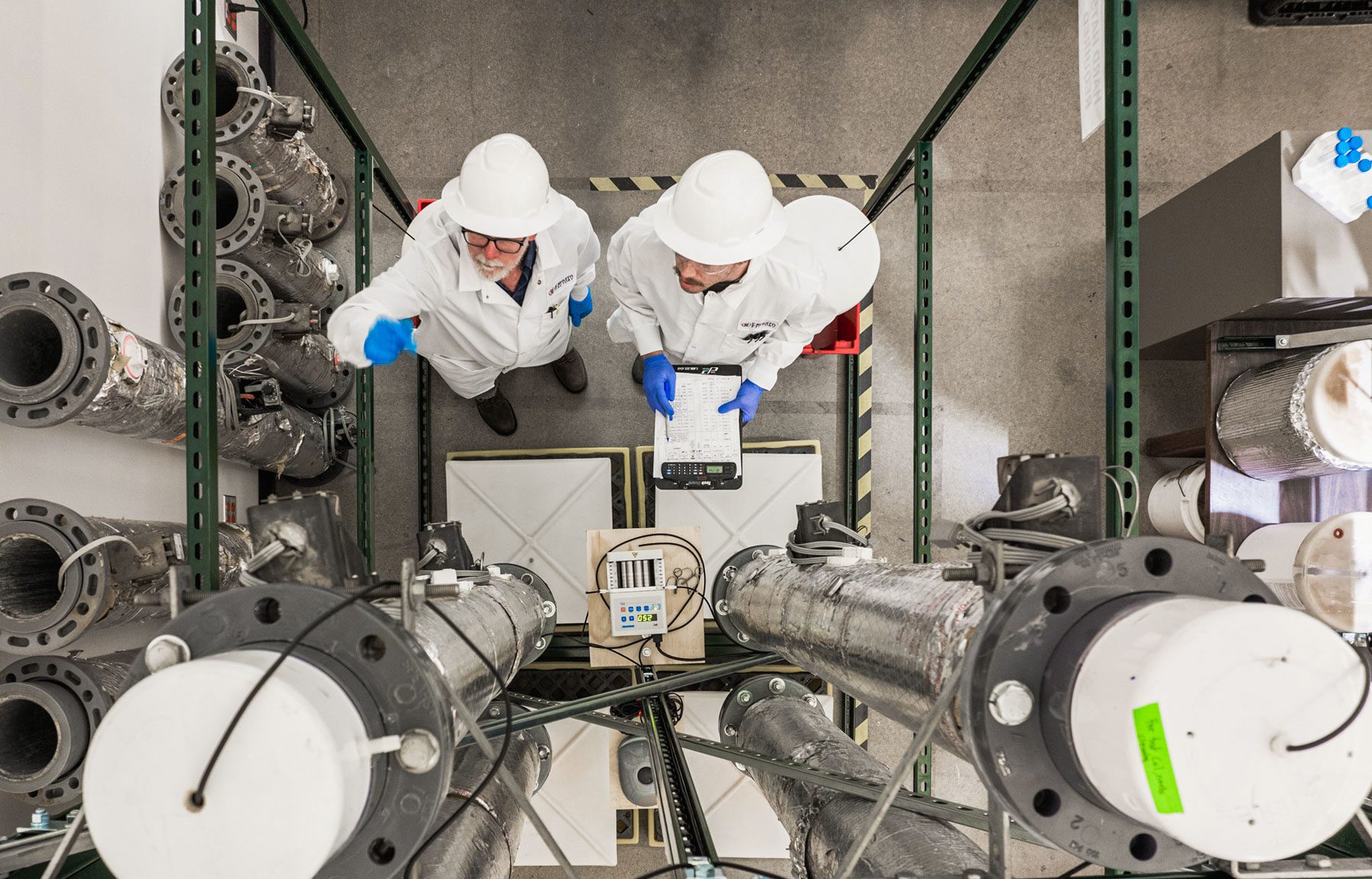
Can AI really help us discover new materials?

Judging from headlines and social media posts in recent years, one might reasonably assume that AI is going to fix the power grid, cure the world’s diseases, and finish my holiday shopping for me. But maybe there’s just a whole lot of hype floating around out there.

This week, we published a new package called Hype Correction. The collection of stories takes a look at how the world is starting to reckon with the reality of what AI can do, and what’s just fluff.

One of my favorite stories in that package comes from my colleague David Rotman, who took a hard look at AI for materials research. AI could transform the process of discovering new materials—innovation that could be especially useful in the world of climate tech, which needs new batteries, semiconductors, magnets, and more. 

But the field still needs to prove it can make materials that are actually novel and useful. Can AI really supercharge materials research? What could that look like?

For researchers hoping to find new ways to power the world (or cure disease or achieve any number of other big, important goals), a new material could change everything.

The problem is, inventing materials is difficult and slow. Just look at plastic—the first totally synthetic plastic was invented in 1907, but it took until roughly the 1950s for companies to produce the wide range we’re familiar with today. (And of course, though it is incredibly useful, plastic also causes no shortage of complications for society.)

In recent decades, materials science has fallen a bit flat—David has been covering this field for nearly 40 years, and as he puts it, there have been just a few major commercial breakthroughs in that time. (Lithium-ion batteries are one.)

Could AI change everything? The prospect is a tantalizing one, and companies are racing to test it out.

Lila Sciences, based in Cambridge, Massachusetts, is working on using AI models to uncover new materials. The company can not only train an AI model on all the latest scientific literature, but also plug it into an automated lab, so it can learn from experimental data. The goal is to speed up the iterative process of inventing and testing new materials and look at research in ways that humans might miss.

At an MIT Technology Review event earlier this year, I got to listen to David interview Rafael Gómez-Bombarelli, one of Lila’s cofounders. As he described what the company is working on, Gómez-Bombarelli acknowledged that AI materials discovery hasn’t yet seen a big breakthrough moment. Yet.

Gómez-Bombarelli described how models Lila has trained are providing insights that are “as deep [as] or deeper than our domain scientists would have.” In the future, AI could “think” in ways that depart from how human scientists approach a problem, he added: “There will be a need to translate scientific reasoning by AI to the way we think about the world.”

It’s exciting to see this sort of optimism in materials research, but there’s still a long and winding road before we can satisfyingly say that AI has transformed the field. One major difficulty is that it’s one thing to take suggestions from a model about new experimental methods or new potential structures. It’s quite another to actually make a material and show that it’s novel and useful.

You might remember that a couple of years ago, Google’s DeepMind announced it had used AI to predict the structures of “millions of new materials” and had made hundreds of them in the lab.

But as David notes in his story, after that announcement, some materials scientists pointed out that some of the supposedly novel materials were basically slightly different versions of known ones. Others couldn’t even physically exist in normal conditions (the simulations were done at ultra-low temperatures, where atoms don’t move around much).

It’s possible that AI could give materials discovery a much-needed jolt and usher in a new age that brings superconductors and batteries and magnets we’ve never seen before. But for now, I’m calling hype. 

This article is from The Spark, MIT Technology Review’s weekly climate newsletter. To receive it in your inbox every Wednesday, sign up here.

This Nobel Prize–winning chemist dreams of making water from thin air

Omar Yaghi was a quiet child, diligent, unlikely to roughhouse with his nine siblings. So when he was old enough, his parents tasked him with one of the family’s most vital chores: fetching water. Like most homes in his Palestinian neighborhood in Amman, Jordan, the Yaghis’ had no electricity or running water. At least once every two weeks, the city switched on local taps for a few hours so residents could fill their tanks. Young Omar helped top up the family supply. Decades later, he says he can’t remember once showing up late. The fear of leaving his parents, seven brothers, and two sisters parched kept him punctual.

Yaghi proved so dependable that his father put him in charge of monitoring how much the cattle destined for the family butcher shop ate and drank. The best-­quality cuts came from well-fed, hydrated animals—a challenge given that they were raised in arid desert.

Specially designed materials called metal-organic frameworks can pull water from the air like a sponge—and then give it back.

But at 10 years old, Yaghi learned of a different occupation. Hoping to avoid a rambunctious crowd at recess, he found the library doors in his school unbolted and sneaked in. Thumbing through a chemistry textbook, he saw an image he didn’t understand: little balls connected by sticks in fascinating shapes. Molecules. The building blocks of everything.

“I didn’t know what they were, but it captivated my attention,” Yaghi says. “I kept trying to figure out what they might be.”

That’s how he discovered chemistry—or maybe how chemistry discovered him. After coming to the United States and, eventually, a postdoctoral program at Harvard University, Yaghi devoted his career to finding ways to make entirely new and fascinating shapes for those little sticks and balls. In October 2025, he was one of three scientists who won a Nobel Prize in chemistry for identifying metal-­organic frameworks, or MOFs—metal ions tethered to organic molecules that form repeating structural landscapes. Today that work is the basis for a new project that sounds like science fiction, or a miracle: conjuring water out of thin air.

When he first started working with MOFs, Yaghi thought they might be able to absorb climate-damaging carbon dioxide—or maybe hold hydrogen molecules, solving the thorny problem of storing that climate-friendly but hard-to-contain fuel. But then, in 2014, Yaghi’s team of researchers at UC Berkeley had an epiphany. The tiny pores in MOFs could be designed so the material would pull water molecules from the air around them, like a sponge—and then, with just a little heat, give back that water as if squeezed dry. Just one gram of a water-absorbing MOF has an internal surface area of roughly 7,000 square meters.

Yaghi wasn’t the first to try to pull potable water from the atmosphere. But his method could do it at lower levels of humidity than rivals—potentially shaking up a tiny, nascent industry that could be critical to humanity in the thirsty decades to come. Now the company he founded, called Atoco, is racing to demonstrate a pair of machines that Yaghi believes could produce clean, fresh, drinkable water virtually anywhere on Earth, without even hooking up to an energy supply.

That’s the goal Yaghi has been working toward for more than a decade now, with the rigid determination that he learned while doing chores in his father’s butcher shop.

“It was in that shop where I learned how to perfect things, how to have a work ethic,” he says. “I learned that a job is not done until it is well done. Don’t start a job unless you can finish it.”


Most of Earth is covered in water, but just 3% of it is fresh, with no salt—the kind of water all terrestrial living things need. Today, desalination plants that take the salt out of seawater provide the bulk of potable water in technologically advanced desert nations like Israel and the United Arab Emirates, but at a high cost. Desalination facilities either heat water to distill out the drinkable stuff or filter it with membranes the salt doesn’t pass through; both methods require a lot of energy and leave behind concentrated brine. Typically desal pumps send that brine back into the ocean, with devastating ecological effects.

hand holding a ball and stick model
Heiner Linke, chair of the Nobel Committee for Chemistry, uses a model to explain how metalorganic frameworks (MOFs) can trap smaller molecules inside. In October 2025, Yaghi and two other scientists won the Nobel Prize in chemistry for identifying MOFs.
JONATHAN NACKSTRAND/GETTY IMAGES

I was talking to Atoco executives about carbon dioxide capture earlier this year when they mentioned the possibility of harvesting water from the atmosphere. Of course my mind immediately jumped to Star Wars, and Luke Skywalker working on his family’s moisture farm, using “vaporators” to pull water from the atmosphere of the arid planet Tatooine. (Other sci-fi fans’ minds might go to Dune, and the water-gathering technology of the Fremen.) Could this possibly be real?

It turns out people have been doing it for millennia. Archaeological evidence of water harvesting from fog dates back as far as 5000 BCE. The ancient Greeks harvested dew, and 500 years ago so did the Inca, using mesh nets and buckets under trees.

Today, harvesting water from the air is a business already worth billions of dollars, say industry analysts—and it’s on track to be worth billions more in the next five years. In part that’s because typical sources of fresh water are in crisis. Less snowfall in mountains during hotter winters means less meltwater in the spring, which means less water downstream. Droughts regularly break records. Rising seas seep into underground aquifers, already drained by farming and sprawling cities. Aging septic tanks leach bacteria into water, and cancer-causing “forever chemicals” are creating what the US Government Accountability Office last year said “may be the biggest water problem since lead.” That doesn’t even get to the emerging catastrophe from microplastics.

So lots of places are turning to atmospheric water harvesting. Watergen, an Israel-based company working on the tech, initially planned on deploying in the arid, poorer parts of the world. Instead, buyers in Europe and the United States have approached the company as a way to ensure a clean supply of water. And one of Watergen’s biggest markets is the wealthy United Arab Emirates. “When you say ‘water crisis,’ it’s not just the lack of water—it’s access to good-quality water,” says Anna Chernyavsky, Watergen’s vice president of marketing.

In other words, the technology “has evolved from lab prototypes to robust, field-deployable systems,” says Guihua Yu, a mechanical engineer at the University of Texas at Austin. “There is still room to improve productivity and energy efficiency in the whole-system level, but so much progress has been steady and encouraging.”


MOFs are just the latest approach to the idea. The first generation of commercial tech depended on compressors and refrigerant chemicals—large-scale versions of the machine that keeps food cold and fresh in your kitchen. Both use electricity and a clot of pipes and exchangers to make cold by phase-shifting a chemical from gas to liquid and back; refrigerators try to limit condensation, and water generators basically try to enhance it.

That’s how Watergen’s tech works: using a compressor and a heat exchanger to wring water from air at humidity levels as low as 20%—Death Valley in the spring. “We’re talking about deserts,” Chernyavsky says. “Below 20%, you get nosebleeds.”

children in queue at a blue Watergen dispenser
A Watergen unit provides drinking water to students and staff at St. Joseph’s, a girls’ school in Freetown, Sierra Leone. “When you say ‘water crisis,’ it’s not just the lack of water— it’s access to good-quality water,” says Anna Chernyavsky, Watergen’s vice president of marketing.
COURTESY OF WATERGEN

That still might not be good enough. “Refrigeration works pretty well when you are above a certain relative humidity,” says Sameer Rao, a mechanical engineer at the University of Utah who researches atmospheric water harvesting. “As the environment dries out, you go to lower relative humidities, and it becomes harder and harder. In some cases, it’s impossible for refrigeration-based systems to really work.”

So a second wave of technology has found a market. Companies like Source Global use desiccants—substances that absorb moisture from the air, like the silica packets found in vitamin bottles—to pull in moisture and then release it when heated. In theory, the benefit of desiccant-­based tech is that it could absorb water at lower humidity levels, and it uses less energy on the front end since it isn’t running a condenser system. Source Global claims its off-grid, solar-powered system is deployed in dozens of countries.

But both technologies still require a lot of energy, either to run the heat exchangers or to generate sufficient heat to release water from the desiccants. MOFs, Yaghi hopes, do not. Now Atoco is trying to prove it. Instead of using heat exchangers to bring the air temperature to dew point or desiccants to attract water from the atmosphere, a system can rely on specially designed MOFs to attract water molecules. Atoco’s prototype version uses an MOF that looks like baby powder, stuck to a surface like glass. The pores in the MOF naturally draw in water molecules but remain open, making it theoretically easy to discharge the water with no more heat than what comes from direct sunlight. Atoco’s industrial-scale design uses electricity to speed up the process, but the company is working on a second design that can operate completely off grid, without any energy input.

Yaghi’s Atoco isn’t the only contender seeking to use MOFs for water harvesting. A competitor, AirJoule, has introduced MOF-based atmospheric water generators in Texas and the UAE and is working with researchers at Arizona State University, planning to deploy more units in the coming months. The company started out trying to build more efficient air-­conditioning for electric buses operating on hot, humid city streets. But then founder Matt Jore heard about US government efforts to harvest water from air—and pivoted. The startup’s stock price has been a bit of a roller-­coaster, but Jore says the sheer size of the market should keep him in business. Take Maricopa County, encompassing Phoenix and its environs—it uses 1.2 billion gallons of water from its shrinking aquifer every day, and another 874 million gallons from surface sources like rivers.

“So, a couple of billion gallons a day, right?” Jore tells me. “You know how much influx is in the atmosphere every day? Twenty-five billion gallons.”

My eyebrows go up. “Globally?”

“Just the greater Phoenix area gets influx of about 25 billion gallons of water in the air,” he says. “If you can tap into it, that’s your source. And it’s not going away. It’s all around the world. We view the atmosphere as the world’s free pipeline.”

Besides AirJoule’s head start on Atoco, the companies also differ on where they get their MOFs. AirJoule’s system relies on an off-the-shelf version the company buys from the chemical giant BASF; Atoco aims to use Yaghi’s skill with designing the novel material to create bespoke MOFs for different applications and locations.

“Given the fact that we have the inventor of the whole class of materials, and we leverage the stuff that comes out of his lab at Berkeley—everything else equal, we have a good starting point to engineer maybe the best materials in the world,” says Magnus Bach, Atoco’s VP of business development.

Yaghi envisions a two-pronged product line. Industrial-scale water generators that run on electricity would be capable of producing thousands of liters per day on one end, while units that run on passive systems could operate in remote locations without power, just harnessing energy from the sun and ambient temperatures. In theory, these units could someday replace desalination and even entire municipal water supplies. The next round of field tests is scheduled for early 2026, in the Mojave Desert—one of the hottest, driest places on Earth.

“That’s my dream,” Yaghi says. “To give people water independence, so they’re not reliant on another party for their lives.”

Both Yaghi and Watergen’s Chernyavsky say they’re looking at more decentralized versions that could operate outside municipal utility systems. Home appliances, similar to rooftop solar panels and batteries, could allow households to generate their own water off grid.

That could be tricky, though, without economies of scale to bring down prices. “You have to produce, you have to cool, you have to filter—all in one place,” Chernyavsky says. “So to make it small is very, very challenging.”


Difficult as that may be, Yaghi’s childhood gave him a particular appreciation for the freedom to go off grid, to liberate the basic necessity of water from the whims of systems that dictate when and how people can access it.

“That’s really my dream,” he says. “To give people independence, water independence, so that they’re not reliant on another party for their livelihood or lives.”

Toward the end of one of our conversations, I asked Yaghi what he would tell the younger version of himself if he could. “Jordan is one of the worst countries in terms of the impact of water stress,” he said. “I would say, ‘Continue to be diligent and observant. It doesn’t really matter what you’re pursuing, as long as you’re passionate.’”

I pressed him for something more specific: “What do you think he’d say when you described this technology to him?”

Yaghi smiled: “I think young Omar would think you’re putting him on, that this is all fictitious and you’re trying to take something from him.” This reality, in other words, would be beyond young Omar’s wildest dreams.

Alexander C. Kaufman is a reporter who has covered energy, climate change, pollution, business, and geopolitics for more than a decade.

Solar geoengineering startups are getting serious

Solar geoengineering aims to manipulate the climate by bouncing sunlight back into space. In theory, it could ease global warming. But as interest in the idea grows, so do concerns about potential consequences.

A startup called Stardust Solutions recently raised a $60 million funding round, the largest known to date for a geoengineering startup. My colleague James Temple has a new story out about the company, and how its emergence is making some researchers nervous.

So far, the field has been limited to debates, proposed academic research, and—sure—a few fringe actors to keep an eye on. Now things are getting more serious. What does it mean for geoengineering, and for the climate?

Researchers have considered the possibility of addressing planetary warming this way for decades. We already know that volcanic eruptions, which spew sulfur dioxide into the atmosphere, can reduce temperatures. The thought is that we could mimic that natural process by spraying particles up there ourselves.

The prospect is a controversial one, to put it lightly. Many have concerns about unintended consequences and uneven benefits. Even public research led by top institutions has faced barriers—one famous Harvard research program was officially canceled last year after years of debate.

One of the difficulties of geoengineering is that in theory a single entity, like a startup company, could make decisions that have a widespread effect on the planet. And in the last few years, we’ve seen more interest in geoengineering from the private sector. 

Three years ago, James broke the story that Make Sunsets, a California-based company, was already releasing particles into the atmosphere in an effort to tweak the climate.

The company’s CEO Luke Iseman went to Baja California in Mexico, stuck some sulfur dioxide into a weather balloon, and sent it skyward. The amount of material was tiny, and it’s not clear that it even made it into the right part of the atmosphere to reflect any sunlight.

But fears that this group or others could go rogue and do their own geoengineering led to widespread backlash. Mexico announced plans to restrict geoengineering experiments in the country a few weeks after that news broke.

You can still buy cooling credits from Make Sunsets, and the company was just granted a patent for its system. But the startup is seen as something of a fringe actor.

Enter Stardust Solutions. The company has been working under the radar for a few years, but it has started talking about its work more publicly this year. In October, it announced a significant funding round, led by some top names in climate investing. “Stardust is serious, and now it’s raised serious money from serious people,” as James puts it in his new story.

That’s making some experts nervous. Even those who believe we should be researching geoengineering are concerned about what it means for private companies to do so.

“Adding business interests, profit motives, and rich investors into this situation just creates more cause for concern, complicating the ability of responsible scientists and engineers to carry out the work needed to advance our understanding,” write David Keith and Daniele Visioni, two leading figures in geoengineering research, in a recent opinion piece for MIT Technology Review.

Stardust insists that it won’t move forward with any geoengineering until and unless it’s commissioned to do so by governments and there are rules and bodies in place to govern use of the technology.

But there’s no telling how financial pressure might change that, down the road. And we’re already seeing some of the challenges faced by a private company in this space: the need to keep trade secrets.

Stardust is currently not sharing information about the particles it intends to release into the sky, though it says it plans to do so once it secures a patent, which could happen as soon as next year. The company argues that its proprietary particles will be safe, cheap to manufacture, and easier to track than the already abundant sulfur dioxide. But at this point, there’s no way for external experts to evaluate those claims.

As Keith and Visioni put it: “Research won’t be useful unless it’s trusted, and trust depends on transparency.”

This article is from The Spark, MIT Technology Review’s weekly climate newsletter. To receive it in your inbox every Wednesday, sign up here.

How one controversial startup hopes to cool the planet

Stardust Solutions believes that it can solve climate change—for a price.

The Israel-based geoengineering startup has said it expects  nations will soon pay it more than a billion dollars a year to launch specially equipped aircraft into the stratosphere. Once they’ve reached the necessary altitude, those planes will disperse particles engineered to reflect away enough sunlight to cool down the planet, purportedly without causing environmental side effects. 

The proprietary (and still secret) particles could counteract all the greenhouse gases the world has emitted over the last 150 years, the company stated in a 2023 pitch deck it presented to venture capital firms. In fact, it’s the “only technologically feasible solution” to climate change, the company said.

The company disclosed it raised $60 million in funding in October, marking by far the largest known funding round to date for a startup working on solar geoengineering.

Stardust is, in a sense, the embodiment of Silicon Valley’s simmering frustration with the pace of academic research on the technology. It’s a multimillion-dollar bet that a startup mindset can advance research and development that has crept along amid scientific caution and public queasiness.

But numerous researchers focused on solar geoengineering are deeply skeptical that Stardust will line up the government customers it would need to carry out a global deployment as early as 2035, the plan described in its earlier investor materials—and aghast at the suggestion that it ever expected to move that fast. They’re also highly critical of the idea that a company would take on the high-stakes task of setting the global temperature, rather than leaving it to publicly funded research programs.

“They’ve ignored every recommendation from everyone and think they can turn a profit in this field,” says Douglas MacMartin, an associate professor at Cornell University who studies solar geoengineering. “I think it’s going to backfire. Their investors are going to be dumping their money down the drain, and it will set back the field.”

The company has finally emerged from stealth mode after completing its funding round, and its CEO, Yanai Yedvab, agreed to conduct one of the company’s first extensive interviews with MIT Technology Review for this story.

Yedvab walked back those ambitious projections a little, stressing that the actual timing of any stratospheric experiments, demonstrations, or deployments will be determined by when governments decide it’s appropriate to carry them out. Stardust has stated clearly that it will move ahead with solar geoengineering only if nations pay it to proceed, and only once there are established rules and bodies guiding the use of the technology.

That decision, he says, will likely be dictated by how bad climate change becomes in the coming years.

“It could be a situation where we are at the place we are now, which is definitely not great,” he says. “But it could be much worse. We’re saying we’d better be ready.”

“It’s not for us to decide, and I’ll say humbly, it’s not for these researchers to decide,” he adds. “It’s the sense of urgency that will dictate how this will evolve.”

The building blocks

No one is questioning the scientific credentials of Stardust. The company was founded in 2023 by a trio of prominent researchers, including Yedvab, who served as deputy chief scientist at the Israeli Atomic Energy Commission. The company’s lead scientist, Eli Waxman, is the head of the department of particle physics and astrophysics at the Weizmann Institute of Science. Amyad Spector, the chief product officer, was previously a nuclear physicist at Israel’s secretive Negev Nuclear Research Center.

Stardust CEO Yanai Yedvab (right) and Chief Product Officer Amyad Spector (left) at the company’s facility in Israel.
ROBY YAHAV, STARDUST

Stardust says it employs 25 scientists, engineers, and academics. The company is based in Ness Ziona, Israel, and plans to open a US headquarters soon. 

Yedvab says the motivation for starting Stardust was simply to help develop an effective means of addressing climate change. 

“Maybe something in our experience, in the tool set that we bring, can help us in contributing to solving one of the greatest problems humanity faces,” he says.

Lowercarbon Capital, the climate-tech-focused investment firm  cofounded by the prominent tech investor Chris Sacca, led the $60 million investment round. Future Positive, Future Ventures, and Never Lift Ventures, among others, participated as well.

AWZ Ventures, a firm focused on security and intelligence technologies, co-led the company’s earlier seed round, which totaled $15 million.

Yedvab says the company will use that money to advance research, development, and testing for the three components of its system, which are also described in the pitch deck: safe particles that could be affordably manufactured; aircraft dispersion systems; and a means of tracking particles and monitoring their effects.

“Essentially, the idea is to develop all these building blocks and to upgrade them to a level that will allow us to give governments the tool set and all the required information to make decisions about whether and how to deploy this solution,” he says. 

The company is, in many ways, the opposite of Make Sunsets, the first company that came along offering to send particles into the stratosphere—for a fee—by pumping sulfur dioxide into weather balloons and hand-releasing them into the sky. Many researchers viewed it as a provocative, unscientific, and irresponsible exercise in attention-gathering. 

But Stardust is serious, and now it’s raised serious money from serious people—all of which raises the stakes for the solar geoengineering field and, some fear, increases the odds that the world will eventually put the technology to use.

“That marks a turning point in that these types of actors are not only possible, but are real,” says Shuchi Talati, executive director of the Alliance for Just Deliberation on Solar Geoengineering, a nonprofit that strives to ensure that developing nations are included in the global debate over such climate interventions. “We’re in a more dangerous era now.”

Many scientists studying solar geoengineering argue strongly that universities, governments, and transparent nonprofits should lead the work in the field, given the potential dangers and deep public concerns surrounding a tool with the power to alter the climate of the planet. 

It’s essential to carry out the research with appropriate oversight, explore the potential downsides of these approaches, and publicly publish the results “to ensure there’s no bias in the findings and no ulterior motives in pushing one way or another on deployment or not,” MacMartin says. “[It] shouldn’t be foisted upon people without proper and adequate information.”

He criticized, for instance, the company’s claims to have developed what he described as their “magic aerosol particle,” arguing that the assertion that it is perfectly safe and inert can’t be trusted without published findings. Other scientists have also disputed those scientific claims.

Plenty of other academics say solar geoengineering shouldn’t be studied at all, fearing that merely investigating it starts the world down a slippery slope toward its use and diminishes the pressures to cut greenhouse-gas emissions. In 2022, hundreds of them signed an open letter calling for a global ban on the development and use of the technology, adding the concern that there is no conceivable way for the world’s nations to pull together to establish rules or make collective decisions ensuring that it would be used in “a fair, inclusive, and effective manner.”

“Solar geoengineering is not necessary,” the authors wrote. “Neither is it desirable, ethical, or politically governable in the current context.”

The for-profit decision 

Stardust says it’s important to pursue the possibility of solar geoengineering because the dangers of climate change are accelerating faster than the world’s ability to respond to it, requiring a new “class of solution … that buys us time and protects us from overheating.”

Yedvab says he and his colleagues thought hard about the right structure for the organization, finally deciding that for-profits working in parallel with academic researchers have delivered “most of the groundbreaking technologies” in recent decades. He cited advances in genome sequencing, space exploration, and drug development, as well as the restoration of the ozone layer.

He added that a for-profit structure was also required to raise funds and attract the necessary talent.

“There is no way we could, unfortunately, raise even a small portion of this amount by philanthropic resources or grants these days,” he says.

He adds that while academics have conducted lots of basic science in solar geoengineering, they’ve done very little in terms of building the technological capacities. Their geoengineering research is also primarily focused on the potential use of sulfur dioxide, because it is known to help reduce global temperatures after volcanic eruptions blast massive amounts of it into the stratospheric. But it has well-documented downsides as well, including harm to the protective ozone layer.

“It seems natural that we need better options, and this is why we started Stardust: to develop this safe, practical, and responsible solution,” the company said in a follow-up email. “Eventually, policymakers will need to evaluate and compare these options, and we’re confident that our option will be superior over sulfuric acid primarily in terms of safety and practicability.”

Public trust can be won not by excluding private companies, but by setting up regulations and organizations to oversee this space, much as the US Food and Drug Administration does for pharmaceuticals, Yedvab says.

“There is no way this field could move forward if you don’t have this governance framework, if you don’t have external validation, if you don’t have clear regulation,” he says.

Meanwhile, the company says it intends to operate transparently, pledging to publish its findings whether they’re favorable or not.

That will include finally revealing details about the particles it has developed, Yedvab says. 

Early next year, the company and its collaborators will begin publishing data or evidence “substantiating all the claims and disclosing all the information,” he says, “so that everyone in the scientific community can actually check whether we checked all these boxes.”

In the follow-up email, the company acknowledged that solar geoengineering isn’t a “silver bullet” but said it is “the only tool that will enable us to cool the planet in the short term, as part of a larger arsenal of technologies.”

“The only way governments could be in a position to consider [solar geoengineering] is if the work has been done to research, de-risk, and engineer safe and responsible solutions—which is what we see as our role,” the company added later. “We are hopeful that research will continue not just from us, but also from academic institutions, nonprofits, and other responsible companies that may emerge in the future.”

Ambitious projections

Stardust’s earlier pitch deck stated that the company expected to conduct its first “stratospheric aerial experiments” last year, though those did not move ahead (more on that in a moment).

On another slide, the company said it expected to carry out a “large-scale demonstration” around 2030 and proceed to a “global full-scale deployment” by about 2035. It said it expected to bring in roughly $200 million and $1.5 billion in annual revenue by those periods, respectively.

Every researcher interviewed for this story was adamant that such a deployment should not happen so quickly.

Given the global but uneven and unpredictable impacts of solar geoengineering, any decision to use the technology should be reached through an inclusive, global agreement, not through the unilateral decisions of individual nations, Talati argues. 

“We won’t have any sort of international agreement by that point given where we are right now,” she says.

A global agreement, to be clear, is a big step beyond setting up rules and oversight bodies—and some believe that such an agreement on a technology so divisive could never be achieved.

There’s also still a vast amount of research that must be done to better understand the negative side effects of solar geoengineering generally and any ecological impacts of Stardust’s materials specifically, adds Holly Buck, an associate professor at the University of Buffalo and author of After Geoengineering.

“It is irresponsible to talk about deploying stratospheric aerosol injection without fundamental research about its impacts,” Buck wrote in an email.

She says the timelines are also “unrealistic” because there are profound public concerns about the technology. Her polling work found that a significant fraction of the US public opposes even research (though polling varies widely). 

Meanwhile, most academic efforts to move ahead with even small-scale outdoor experiments have sparked fierce backlash. That includes the years-long effort by researchers then at Harvard to carry out a basic equipment test for their so-called ScopeX experiment. The high-altitude balloon would have launched from a flight center in Sweden, but the test was ultimately scratched amid objections from environmentalists and Indigenous groups. 

Given this baseline of public distrust, Stardust’s for-profit proposals only threaten to further inflame public fears, Buck says.

“I find the whole proposal incredibly socially naive,” she says. “We actually could use serious research in this field, but proposals like this diminish the chances of that happening.”

Those public fears, which cross the political divide, also mean politicians will see little to no political upside to paying Stardust to move ahead, MacMartin says.

“If you don’t have the constituency for research, it seems implausible to me that you’d turn around and give money to an Israeli company to deploy it,” he says.

An added risk is that if one nation or a small coalition forges ahead without broader agreement, it could provoke geopolitical conflicts. 

“What if Russia wants it a couple of degrees warmer, and India a couple of degrees cooler?” asked Alan Robock, a professor at Rutgers University, in the Bulletin of the Atomic Scientists in 2008. “Should global climate be reset to preindustrial temperature or kept constant at today’s reading? Would it be possible to tailor the climate of each region of the planet independently without affecting the others? If we proceed with geoengineering, will we provoke future climate wars?”

Revised plans

Yedvab says the pitch deck reflected Stardust’s strategy at a “very early stage in our work,” adding that their thinking has “evolved,” partly in response to consultations with experts in the field.

He says that the company will have the technological capacity to move ahead with demonstrations and deployments on the timelines it laid out but adds, “That’s a necessary but not sufficient condition.”

“Governments will need to decide where they want to take it, if at all,” he says. “It could be a case that they will say ‘We want to move forward.’ It could be a case that they will say ‘We want to wait a few years.’”

“It’s for them to make these decisions,” he says.

Yedvab acknowledges that the company has conducted flights in the lower atmosphere to test its monitoring system, using white smoke as a simulant for its particles, as the Wall Street Journal reported last year. It’s also done indoor tests of the dispersion system and its particles in a wind tunnel set up within its facility.

But in response to criticisms like the ones above, Yedvab says the company hasn’t conducted outdoor particle experiments and won’t move forward with them until it has approval from governments. 

“Eventually, there will be a need to conduct outdoor testing,” he says. “There is no way you can validate any solution without outdoor testing.” But such testing of sunlight reflection technology, he says, “should be done only working together with government and under these supervisions.”

Generating returns  

Stardust may be willing to wait for governments to be ready to deploy its system, but there’s no guarantee that its investors will have the same patience. In accepting tens of millions in venture capital, Stardust may now face financial pressures that could “drive the timelines,” says Gernot Wagner, a climate economist at Columbia University. 

And that raises a different set of concerns.

Obliged to deliver returns, the company might feel it must strive to convince government leaders that they should pay for its services, Talati says. 

“The whole point of having companies and investors is you want your thing to be used,” she says. “There’s a massive incentive to lobby countries to use it, and that’s the whole danger of having for-profit companies here.”

She argues those financial incentives threaten to accelerate the use of solar geoengineering ahead of broader international agreements and elevate business interests above the broader public good.

Stardust has “quietly begun lobbying on Capitol Hill” and has hired the law firm Holland & Knight, according to Politico.

It has also worked with Red Duke Strategies, a consulting firm based in McLean, Virginia, to develop “strategic relationships and communications that promote understanding and enable scientific testing,” according to a case study on the company’s  website. 

“The company needed to secure both buy-in and support from the United States government and other influential stakeholders to move forward,” Red Duke states. “This effort demanded a well-connected and authoritative partner who could introduce Stardust to a group of experts able to research, validate, deploy, and regulate its SRM technology.”

Red Duke didn’t respond to an inquiry from MIT Technology Review. Stardust says its work with the consulting firm was not a government lobbying effort.

Yedvab acknowledges that the company is meeting with government leaders in the US, Europe, its own region, and the Global South. But he stresses that it’s not asking any country to contribute funding or to sign off on deployments at this stage. Instead, it’s making the case for nations to begin crafting policies to regulate solar geoengineering.

“When we speak to policymakers—and we speak to policymakers; we don’t hide it—essentially, what we tell them is ‘Listen, there is a solution,’” he says. “‘It’s not decades away—it’s a few years away. And it’s your role as policymakers to set the rules of this field.’”

“Any solution needs checks and balances,” he says. “This is how we see the checks and balances.”

He says the best-case scenario is still a rollout of clean energy technologies that accelerates rapidly enough to drive down emissions and curb climate change.

“We are perfectly fine with building an option that will sit on the shelf,” he says. “We’ll go and do something else. We have a great team and are confident that we can find also other problems to work with.”

He says the company’s investors are aware of and comfortable with that possibility, supportive of the principles that will guide Stardust’s work, and willing to wait for regulations and government contracts.

Lowercarbon Capital didn’t respond to an inquiry from MIT Technology Review.

‘Sentiment of hope’

Others have certainly imagined the alternative scenario Yedvab raises: that nations will increasingly support the idea of geoengineering in the face of mounting climate catastrophes. 

In Kim Stanley Robinson’s 2020 novel, The Ministry for the Future, India unilaterally forges ahead with solar geoengineering following a heat wave that kills millions of people. 

Wagner sketched a variation on that scenario in his 2021 book, Geoengineering: The Gamble, speculating that a small coalition of nations might kick-start a rapid research and deployment program as an emergency response to escalating humanitarian crises. In his version, the Philippines offers to serve as the launch site after a series of super-cyclones batter the island nation, forcing millions from their homes. 

It’s impossible to know today how the world will react if one nation or a few go it alone, or whether nations could come to agreement on where the global temperature should be set. 

But the lure of solar geoengineering could become increasingly enticing as more and more nations endure mass suffering, starvation, displacement, and death.

“We understand that probably it will not be perfect,” Yedvab says. “We understand all the obstacles, but there is this sentiment of hope, or cautious hope, that we have a way out of this dark corridor we are currently in.”

“I think that this sentiment of hope is something that gives us a lot of energy to move on forward,” he adds.

Why the grid relies on nuclear reactors in the winter

As many of us are ramping up with shopping, baking, and planning for the holiday season, nuclear power plants are also getting ready for one of their busiest seasons of the year.

Here in the US, nuclear reactors follow predictable seasonal trends. Summer and winter tend to see the highest electricity demand, so plant operators schedule maintenance and refueling for other parts of the year.

This scheduled regularity might seem mundane, but it’s quite the feat that operational reactors are as reliable and predictable as they are. It leaves some big shoes to fill for next-generation technology hoping to join the fleet in the next few years.

Generally, nuclear reactors operate at constant levels, as close to full capacity as possible. In 2024, for commercial reactors worldwide, the average capacity factor—the ratio of actual energy output to the theoretical maxiumum—was 83%. North America rang in at an average of about 90%.

(I’ll note here that it’s not always fair to just look at this number to compare different kinds of power plants—natural-gas plants can have lower capacity factors, but it’s mostly because they’re more likely to be intentionally turned on and off to help meet uneven demand.)

Those high capacity factors also undersell the fleet’s true reliability—a lot of the downtime is scheduled. Reactors need to refuel every 18 to 24 months, and operators tend to schedule those outages for the spring and fall, when electricity demand isn’t as high as when we’re all running our air conditioners or heaters at full tilt.

Take a look at this chart of nuclear outages from the US Energy Information Administration. There are some days, especially at the height of summer, when outages are low, and nearly all commercial reactors in the US are operating at nearly full capacity. On July 28 of this year, the fleet was operating at 99.6%. Compare that with  the 77.6% of capacity on October 18, as reactors were taken offline for refueling and maintenance. Now we’re heading into another busy season, when reactors are coming back online and shutdowns are entering another low point.

That’s not to say all outages are planned. At the Sequoyah nuclear power plant in Tennessee, a generator failure in July 2024 took one of two reactors offline, an outage that lasted nearly a year. (The utility also did some maintenance during that time to extend the life of the plant.) Then, just days after that reactor started back up, the entire plant had to shut down because of low water levels.

And who can forget the incident earlier this year when jellyfish wreaked havoc on not one but two nuclear power plants in France? In the second instance, the squishy creatures got into the filters of equipment that sucks water out of the English Channel for cooling at the Paluel nuclear plant. They forced the plant to cut output by nearly half, though it was restored within days.

Barring jellyfish disasters and occasional maintenance, the global nuclear fleet operates quite reliably. That wasn’t always the case, though. In the 1970s, reactors operated at an average capacity factor of just 60%. They were shut down nearly as often as they were running.

The fleet of reactors today has benefited from decades of experience. Now we’re seeing a growing pool of companies aiming to bring new technologies to the nuclear industry.

Next-generation reactors that use new materials for fuel or cooling will be able to borrow some lessons from the existing fleet, but they’ll also face novel challenges.

That could mean early demonstration reactors aren’t as reliable as the current commercial fleet at first. “First-of-a-kind nuclear, just like with any other first-of-a-kind technologies, is very challenging,” says Koroush Shirvan, a professor of nuclear science and engineering at MIT.

That means it will probably take time for molten-salt reactors or small modular reactors, or any of the other designs out there to overcome technical hurdles and settle into their own rhythm. It’s taken decades to get to a place where we take it for granted that the nuclear fleet can follow a neat seasonal curve based on electricity demand. 

There will always be hurricanes and electrical failures and jellyfish invasions that cause some unexpected problems and force nuclear plants (or any power plants, for that matter) to shut down. But overall, the fleet today operates at an extremely high level of consistency. One of the major challenges ahead for next-generation technologies will be proving that they can do the same.

This article is from The Spark, MIT Technology Review’s weekly climate newsletter. To receive it in your inbox every Wednesday, sign up here.

How AI is uncovering hidden geothermal energy resources

Sometimes geothermal hot spots are obvious, marked by geysers and hot springs on the planet’s surface. But in other places, they’re obscured thousands of feet underground. Now AI could help uncover these hidden pockets of potential power.

A startup company called Zanskar announced today that it’s used AI and other advanced computational methods to uncover a blind geothermal system—meaning there aren’t signs of it on the surface—in the western Nevada desert. The company says it’s the first blind system that’s been identified and confirmed to be a commercial prospect in over 30 years. 

Historically, finding new sites for geothermal power was a matter of brute force. Companies spent a lot of time and money drilling deep wells, looking for places where it made sense to build a plant.

Zanskar’s approach is more precise. With advancements in AI, the company aims to “solve this problem that had been unsolvable for decades, and go and finally find those resources and prove that they’re way bigger than previously thought,” says Carl Hoiland, the company’s cofounder and CEO.  

To support a successful geothermal power plant, a site needs high temperatures at an accessible depth and space for fluid to move through the rock and deliver heat. In the case of the new site, which the company calls Big Blind, the prize is a reservoir that reaches 250 °F at about 2,700 feet below the surface.

As electricity demand rises around the world, geothermal systems like this one could provide a source of constant power without emitting the greenhouse gases that cause climate change. 

The company has used its technology to identify many potential hot spots. “We have dozens of sites that look just like this,” says Joel Edwards, Zanskar’s cofounder and CTO. But for Big Blind, the team has done the fieldwork to confirm its model’s predictions.

The first step to identifying a new site is to use regional AI models to search large areas. The team trains models on known hot spots and on simulations it creates. Then it feeds in geological, satellite, and other types of data, including information about fault lines. The models can then predict where potential hot spots might be.

One strength of using AI for this task is that it can handle the immense complexity of the information at hand. “If there’s something learnable in the earth, even if it’s a very complex phenomenon that’s hard for us humans to understand, neural nets are capable of learning that, if given enough data,” Hoiland says. 

Once models identify a potential hot spot, a field crew heads to the site, which might be roughly 100 square miles or so, and collects additional information through techniques that include drilling shallow holes to look for elevated underground temperatures.

In the case of Big Blind, this prospecting information gave the company enough confidence to purchase a federal lease, allowing it to develop a geothermal plant. With that lease secured, the team returned with large drill rigs and drilled thousands of feet down in July and August. The workers found the hot, permeable rock they expected.

Next they must secure permits to build and connect to the grid and line up the investments needed to build the plant. The team will also continue testing at the site, including long-term testing to track heat and water flow.

“There’s a tremendous need for methodology that can look for large-scale features,” says John McLennan, technical lead for resource management at Utah FORGE, a national lab field site for geothermal energy funded by the US Department of Energy. The new discovery is “promising,” McLennan adds.

Big Blind is Zanskar’s first confirmed discovery that wasn’t previously explored or developed, but the company has used its tools for other geothermal exploration projects. Earlier this year, it announced a discovery at a site that had previously been explored by the industry but not developed. The company also purchased and revived a geothermal power plant in New Mexico.

And this could be just the beginning for Zanskar. As Edwards puts it, “This is the start of a wave of new, naturally occurring geothermal systems that will have enough heat in place to support power plants.”

This year’s UN climate talks avoided fossil fuels, again

If we didn’t have pictures and videos, I almost wouldn’t believe the imagery that came out of this year’s UN climate talks.

Over the past few weeks in Belem, Brazil, attendees dealt with oppressive heat and flooding, and at one point a literal fire broke out, delaying negotiations. The symbolism was almost too much to bear.

While many, including the president of Brazil, framed this year’s conference as one of action, the talks ended with a watered-down agreement. The final draft doesn’t even include the phrase “fossil fuels.”

As emissions and global temperatures reach record highs again this year, I’m left wondering: Why is it so hard to formally acknowledge what’s causing the problem?

This is the 30th time that leaders have gathered for the Conference of the Parties, or COP, an annual UN conference focused on climate change. COP30 also marks 10 years since the gathering that produced the Paris Agreement, in which world powers committed to limiting global warming to “well below” 2.0 °C above preindustrial levels, with a goal of staying below the 1.5 °C mark. (That’s 3.6 °F and 2.7 °F, respectively, for my fellow Americans.)

Before the conference kicked off this year, host country Brazil’s president, Luiz Inácio Lula da Silva, cast this as the “implementation COP” and called for negotiators to focus on action, and specifically to deliver a road map for a global transition away from fossil fuels.

The science is clear—burning fossil fuels emits greenhouse gases and drives climate change. Reports have shown that meeting the goal of limiting warming to 1.5 °C would require stopping new fossil-fuel exploration and development.

The problem is, “fossil fuels” might as well be a curse word at global climate negotiations. Two years ago, fights over how to address fossil fuels brought talks at COP28 to a standstill. (It’s worth noting that the conference was hosted in Dubai in the UAE, and the leader was literally the head of the country’s national oil company.)

The agreement in Dubai ended up including a line that called on countries to transition away from fossil fuels in energy systems. It was short of what many advocates wanted, which was a more explicit call to phase out fossil fuels entirely. But it was still hailed as a win. As I wrote at the time: “The bar is truly on the floor.”

And yet this year, it seems we’ve dug into the basement.

At one point about 80 countries, a little under half of those present, demanded a concrete plan to move away from fossil fuels.

But oil producers like Saudi Arabia were insistent that fossil fuels not be singled out. Other countries, including some in Africa and Asia, also made a very fair point: Western nations like the US have burned the most fossil fuels and benefited from it economically. This contingent maintains that legacy polluters have a unique responsibility to finance the transition for less wealthy and developing nations rather than simply barring them from taking the same development route. 

The US, by the way, didn’t send a formal delegation to the talks, for the first time in 30 years. But the absence spoke volumes. In a statement to the New York Times that sidestepped the COP talks, White House spokesperson Taylor Rogers said that president Trump had “set a strong example for the rest of the world” by pursuing new fossil-fuel development.

To sum up: Some countries are economically dependent on fossil fuels, some don’t want to stop depending on fossil fuels without incentives from other countries, and the current US administration would rather keep using fossil fuels than switch to other energy sources. 

All those factors combined help explain why, in its final form, COP30’s agreement doesn’t name fossil fuels at all. Instead, there’s a vague line that leaders should take into account the decisions made in Dubai, and an acknowledgement that the “global transition towards low greenhouse-gas emissions and climate-resilient development is irreversible and the trend of the future.”

Hopefully, that’s true. But it’s concerning that even on the world’s biggest stage, naming what we’re supposed to be transitioning away from and putting together any sort of plan to actually do it seems to be impossible.

This article is from The Spark, MIT Technology Review’s weekly climate newsletter. To receive it in your inbox every Wednesday, sign up here.

Three things to know about the future of electricity

<div data-chronoton-summary="

  • Electricity demand is surging globally. Global electricity demand will grow 40% over the next decade. Data center investment hit $580 billion in 2025 alone—surpassing global oil spending. In the US, data centers will account for half of all electricity growth through 2030.
  • Air-conditioning and emerging economies are reshaping energy consumption. Rising temperatures and growing prosperity in developing nations will add over 500 gigawatts of peak demand by 2035, dwarfing data centers’ contribution to overall electricity growth.
  • Renewables are finally overtaking coal, but the transition remains too slow. Solar and wind led electricity generation in the first half of 2025 with nuclear capacity poised to increase by a third this decade. Yet global emissions are likely to hit record highs again this year.

” data-chronoton-post-id=”1128167″ data-chronoton-expand-collapse=”1″ data-chronoton-analytics-enabled=”1″>

One of the dominant storylines I’ve been following through 2025 is electricity—where and how demand is going up, how much it costs, and how this all intersects with that topic everyone is talking about: AI.

Last week, the International Energy Agency released the latest version of the World Energy Outlook, the annual report that takes stock of the current state of global energy and looks toward the future. It contains some interesting insights and a few surprising figures about electricity, grids, and the state of climate change. So let’s dig into some numbers, shall we?

We’re in the age of electricity

Energy demand in general is going up around the world as populations increase and economies grow. But electricity is the star of the show, with demand projected to grow by 40% in the next 10 years.

China has accounted for the bulk of electricity growth for the past 10 years, and that’s going to continue. But emerging economies outside China will be a much bigger piece of the pie going forward. And while advanced economies, including the US and Europe, have seen flat demand in the past decade, the rise of AI and data centers will cause demand to climb there as well.

Air-conditioning is a major source of rising demand. Growing economies will give more people access to air-conditioning; income-driven AC growth will add about 330 gigawatts to global peak demand by 2035. Rising temperatures will tack on another 170 GW in that time. Together, that’s an increase of over 10% from 2024 levels.  

AI is a local story

This year, AI has been the story that none of us can get away from. One number that jumped out at me from this report: In 2025, investment in data centers is expected to top $580 billion. That’s more than the $540 billion spent on the global oil supply. 

It’s no wonder, then, that the energy demands of AI are in the spotlight. One key takeaway is that these demands are vastly different in different parts of the world.

Data centers still make up less than 10% of the projected increase in total electricity demand between now and 2035. It’s not nothing, but it’s far outweighed by sectors like industry and appliances, including air conditioners. Even electric vehicles will add more demand to the grid than data centers.

But AI will be the factor for the grid in some parts of the world. In the US, data centers will account for half the growth in total electricity demand between now and 2030.

And as we’ve covered in this newsletter before, data centers present a unique challenge, because they tend to be clustered together, so the demand tends to be concentrated around specific communities and on specific grids. Half the data center capacity that’s in the pipeline is close to large cities.

Look out for a coal crossover

As we ask more from our grid, the key factor that’s going to determine what all this means for climate change is what’s supplying the electricity we’re using.

As it stands, the world’s grids still primarily run on fossil fuels, so every bit of electricity growth comes with planet-warming greenhouse-gas emissions attached. That’s slowly changing, though.

Together, solar and wind were the leading source of electricity in the first half of this year, overtaking coal for the first time. Coal use could peak and begin to fall by the end of this decade.

Nuclear could play a role in replacing fossil fuels: After two decades of stagnation, the global nuclear fleet could increase by a third in the next 10 years. Solar is set to continue its meteoric rise, too. Of all the electricity demand growth we’re expecting in the next decade, 80% is in places with high-quality solar irradiation—meaning they’re good spots for solar power.

Ultimately, there are a lot of ways in which the world is moving in the right direction on energy. But we’re far from moving fast enough. Global emissions are, once again, going to hit a record high this year. To limit warming and prevent the worst effects of climate change, we need to remake our energy system, including electricity, and we need to do it faster. 

This article is from The Spark, MIT Technology Review’s weekly climate newsletter. To receive it in your inbox every Wednesday, sign up here.

Google is still aiming for its “moonshot” 2030 energy goals

Last week, we hosted EmTech MIT, MIT Technology Review’s annual flagship conference in Cambridge, Massachusetts. Over the course of three days of main-stage sessions, I learned about innovations in AI, biotech, and robotics. 

But as you might imagine, some of this climate reporter’s favorite moments came in the climate sessions. I was listening especially closely to my colleague James Temple’s discussion with Lucia Tian, head of advanced energy technologies at Google. 

They spoke about the tech giant’s growing energy demand and what sort of technologies the company is looking to to help meet it. In case you weren’t able to join us, let’s dig into that session and consider how the company is thinking about energy in the face of AI’s rapid rise. 

I’ve been closely following Google’s work in energy this year. Like the rest of the tech industry, the company is seeing ballooning electricity demand in its data centers. That could get in the way of a major goal that Google has been talking about for years. 

See, back in 2020, the company announced an ambitious target: by 2030, it aimed to run on carbon-free energy 24-7. Basically, that means Google would purchase enough renewable energy on the grids where it operates to meet its entire electricity demand, and the purchases would match up so the electricity would have to be generated when the company was actually using energy. (For more on the nuances of Big Tech’s renewable-energy pledges, check out James’s piece from last year.)

Google’s is an ambitious goal, and on stage, Tian said that the company is still aiming for it but acknowledged that it’s looking tough with the rise of AI. 

“It was always a moonshot,” she said. “It’s something very, very hard to achieve, and it’s only harder in the face of this growth. But our perspective is, if we don’t move in that direction, we’ll never get there.”

Google’s total electricity demand more than doubled from 2020 to 2024, according to its latest Environmental Report. As for that goal of 24-7 carbon-free energy? The company is basically treading water. While it was at 67% for its data centers in 2020, last year it came in at 66%. 

Not going backwards is something of an accomplishment, given the rapid growth in electricity demand. But it still leaves the company some distance away from its finish line.

To close the gap, Google has been signing what feels like constant deals in the energy space. Two recent announcements that Tian talked about on stage were a project involving carbon capture and storage at a natural-gas plant in Illinois and plans to reopen a shuttered nuclear power plant in Iowa. 

Let’s start with carbon capture. Google signed an agreement to purchase most of the electricity from a new natural-gas plant, which will capture and store about 90% of its carbon dioxide emissions. 

That announcement was controversial, with critics arguing that carbon capture keeps fossil-fuel infrastructure online longer and still releases greenhouse gases and other pollutants into the atmosphere. 

One question that James raised on stage: Why build a new natural-gas plant rather than add equipment to an already existing facility? Tacking on equipment to an operational plant would mean cutting emissions from the status quo, rather than adding entirely new fossil-fuel infrastructure. 

The company did consider many existing plants, Tian said. But, as she put it, “Retrofits aren’t going to make sense everywhere.” Space can be limited at existing plants, for example, and many may not have the right geology to store carbon dioxide underground. 

“We wanted to lead with a project that could prove this technology at scale,” Tian said. This site has an operational Class VI well, the type used for permanent sequestration, she added, and it also doesn’t require a big pipeline buildout. 

Tian also touched on the company’s recent announcement that it’s collaborating with NextEra Energy to reopen Duane Arnold Energy Center, a nuclear power plant in Iowa. The company will purchase electricity from that plant, which is scheduled to reopen in 2029. 

As I covered in a story earlier this year, Duane Arnold was basically the final option in the US for companies looking to reopen shuttered nuclear power plants. “Just a few years back, we were still closing down nuclear plants in this country,” Tian said on stage. 

While each reopening will look a little different, Tian highlighted the groups working to restart the Palisades plant in Michigan, which was the first reopening to be announced, last spring. “They’re the real heroes of the story,” she said.

I’m always interested to get a peek behind the curtain at how Big Tech is thinking about energy. I’m skeptical but certainly interested to see how Google’s, and the rest of the industry’s, goals shape up over the next few years. 

This article is from The Spark, MIT Technology Review’s weekly climate newsletter. To receive it in your inbox every Wednesday, sign up here.

The State of AI: Energy is king, and the US is falling behind

Welcome to The State of AI, a new collaboration between the Financial Times and MIT Technology Review. Every Monday for the next six weeks, writers from both publications will debate one aspect of the generative AI revolution reshaping global power.

This week, Casey Crownhart, senior reporter for energy at MIT Technology Review and Pilita Clark, FT’s columnist, consider how China’s rapid renewables buildout could help it leapfrog on AI progress.

Casey Crownhart writes:

In the age of AI, the biggest barrier to progress isn’t money but energy. That should be particularly worrying here in the US, where massive data centers are waiting to come online, and it doesn’t look as if the country will build the steady power supply or infrastructure needed to serve them all.

It wasn’t always like this. For about a decade before 2020, data centers were able to offset increased demand with efficiency improvements. Now, though, electricity demand is ticking up in the US, with billions of queries to popular AI models each day—and efficiency gains aren’t keeping pace. With too little new power capacity coming online, the strain is starting to show: Electricity bills are ballooning for people who live in places where data centers place a growing load on the grid.

If we want AI to have the chance to deliver on big promises without driving electricity prices sky-high for the rest of us, the US needs to learn some lessons from the rest of the world on energy abundance. Just look at China.

China installed 429 GW of new power generation capacity in 2024, more than six times the net capacity added in the US during that time.

China still generates much of its electricity with coal, but that makes up a declining share of the mix. Rather, the country is focused on installing solar, wind, nuclear, and gas at record rates.

The US, meanwhile, is focused on reviving its ailing coal industry. Coal-fired power plants are polluting and, crucially, expensive to run. Aging plants in the US are also less reliable than they used to be, generating electricity just 42% of the time, compared with a 61% capacity factor in 2014.

It’s not a great situation. And unless the US changes something, we risk becoming consumers as opposed to innovators in both energy and AI tech. Already, China earns more from exporting renewables than the US does from oil and gas exports. 

Building and permitting new renewable power plants would certainly help, since they’re currently the cheapest and fastest to bring online. But wind and solar are politically unpopular with the current administration. Natural gas is an obvious candidate, though there are concerns about delays with key equipment.

One quick fix would be for data centers to be more flexible. If they agreed not to suck electricity from the grid during times of stress, new AI infrastructure might be able to come online without any new energy infrastructure.

One study from Duke University found that if data centers agree to curtail their consumption just 0.25% of the time (roughly 22 hours over the course of the year), the grid could provide power for about 76 GW of new demand. That’s like adding about 5% of the entire grid’s capacity without needing to build anything new.

But flexibility wouldn’t be enough to truly meet the swell in AI electricity demand. What do you think, Pilita? What would get the US out of these energy constraints? Is there anything else we should be thinking about when it comes to AI and its energy use? 

Pilita Clark responds:

I agree. Data centers that can cut their power use at times of grid stress should be the norm, not the exception. Likewise, we need more deals like those giving cheaper electricity to data centers that let power utilities access their backup generators. Both reduce the need to build more power plants, which makes sense regardless of how much electricity AI ends up using.

This is a critical point for countries across the world, because we still don’t know exactly how much power AI is going to consume. 

Forecasts for what data centers will need in as little as five years’ time vary wildly, from less than twice today’s rates to four times as much.

This is partly because there’s a lack of public data about AI systems’ energy needs. It’s also because we don’t know how much more efficient these systems will become. The US chip designer Nvidia said last year that its specialized chips had become 45,000 times more energy efficient over the previous eight years. 

Moreover, we have been very wrong about tech energy needs before. At the height of the dot-com boom in 1999, it was erroneously claimed that the internet would need half the US’s electricity within a decade—necessitating a lot more coal power.

Still, some countries are clearly feeling the pressure already. In Ireland, data centers chew up so much power that new connections have been restricted around Dublin to avoid straining the grid.

Some regulators are eyeing new rules forcing tech companies to provide enough power generation to match their demand. I hope such efforts grow. I also hope AI itself helps boost power abundance and, crucially, accelerates the global energy transition needed to combat climate change. OpenAI’s Sam Altman said in 2023 that “once we have a really powerful super intelligence, addressing climate change will not be particularly difficult.” 

The evidence so far is not promising, especially in the US, where renewable projects are being axed. Still, the US may end up being an outlier in a world where ever cheaper renewables made up more than 90% of new power capacity added globally last year. 

Europe is aiming to power one of its biggest data centers predominantly with renewables and batteries. But the country leading the green energy expansion is clearly China.

The 20th century was dominated by countries rich in the fossil fuels whose reign the US now wants to prolong. China, in contrast, may become the world’s first green electrostate. If it does this in a way that helps it win an AI race the US has so far controlled, it will mark a striking chapter in economic, technological, and geopolitical history.

Casey Crownhart replies:

I share your skepticism of tech executives’ claims that AI will be a groundbreaking help in the race to address climate change. To be fair, AI is progressing rapidly. But we don’t have time to wait for technologies standing on big claims with nothing to back them up. 

When it comes to the grid, for example, experts say there’s potential for AI to help with planning and even operating, but these efforts are still experimental.  

Meanwhile, much of the world is making measurable progress on transitioning to newer, greener forms of energy. How that will affect the AI boom remains to be seen. What is clear is that AI is changing our grid and our world, and we need to be clear-eyed about the consequences. 

Further reading 

MIT Technology Review reporters did the math on the energy needs of an AI query.

There are still a few reasons to be optimistic about AI’s energy demands.  

The FT’s visual data team take a look inside the relentless race for AI capacity.

And global FT reporters ask whether data centers can ever truly be green.