What’s next for carbon removal?

MIT Technology Review’s What’s Next series looks across industries, trends, and technologies to give you a first look at the future. You can read the rest of them here.

In the early 2020s, a little-known aquaculture company in Portland, Maine, snagged more than $50 million by pitching a plan to harness nature to fight back against climate change. The company, Running Tide, said it could sink enough kelp to the seafloor to sequester a billion tons of carbon dioxide by this year, according to one of its early customers.

Instead, the business shut down its operations last summer, marking the biggest bust to date in the nascent carbon removal sector.

Its demise was the most obvious sign of growing troubles and dimming expectations for a space that has spawned hundreds of startups over the last few years. A handful of other companies have shuttered, downsized, or pivoted in recent months as well. Venture investments have flagged. And the collective industry hasn’t made a whole lot more progress toward that billion-ton benchmark.

The hype phase is over and the sector is sliding into the turbulent business trough that follows, warns Robert Höglund, cofounder of CDR.fyi, a public-benefit corporation that provides data and analysis on the carbon removal industry.

“We’re past the peak of expectations,” he says. “And with that, we could see a lot of companies go out of business, which is natural for any industry.”

The open question is: If the carbon removal sector is heading into a painful if inevitable clearing-out cycle, where will it go from there? 

The odd quirk of carbon removal is that it never made a lot of sense as a business proposition: It’s an atmospheric cleanup job, necessary for the collective societal good of curbing climate change. But it doesn’t produce a service or product that any individual or organization strictly needs—or is especially eager to pay for.

To date, a number of businesses have voluntarily agreed to buy tons of carbon dioxide that companies intend to eventually suck out of the air. But whether they’re motivated by sincere climate concerns or pressures from investors, employees, or customers, corporate do-goodism will only scale any industry so far. 

Most observers argue that whether carbon removal continues to bobble along or transforms into something big enough to make a dent in climate change will depend largely on whether governments around the world decide to pay for a whole, whole lot of it—or force polluters to. 

“Private-sector purchases will never get us there,” says Erin Burns, executive director of Carbon180, a nonprofit that advocates for the removal and reuse of carbon dioxide. “We need policy; it has to be policy.”

What’s the problem?

The carbon removal sector began to scale up in the early part of this decade, as increasingly grave climate studies revealed the need to dramatically cut emissions and suck down vast amounts of carbon dioxide to keep global warming in check.

Specifically, nations may have to continually remove as much as 11 billion tons of carbon dioxide per year by around midcentury to have a solid chance of keeping the planet from warming past 2 °C over preindustrial levels, according to a UN climate panel report in 2022.

A number of startups sprang up to begin developing the technology and building the infrastructure that would be needed, trying out a variety of approaches like sinking seaweed or building carbon-dioxide-sucking factories.

And they soon attracted customers. Companies including Stripe, Google, Shopify, Microsoft, and others began agreeing to pre-purchase tons of carbon removal, hoping to stand up the nascent industry and help offset their own climate emissions. Venture investments also flooded into the space, peaking in 2023 at nearly $1 billion, according to data provided by PitchBook.

From early on, players in the emerging sector sought to draw a sharp distinction between conventional carbon offset projects, which studies have shown frequently exaggerate climate benefits, and “durable” carbon removal that could be relied upon to suck down and store away the greenhouse gas for decades to centuries. There’s certainly a big difference in the price: While buying carbon offsets through projects that promise to preserve forests or plant trees might cost a few dollars per ton, a ton of carbon removal can run hundreds to thousands of dollars, depending on the approach. 

That high price, however, brings big challenges. Removing 10 billion tons of carbon dioxide a year at, say, $300 a ton adds up to a global price tag of $3 trillion—a year. 

Which brings us back to the fundamental question: Who should or would foot the bill to develop and operate all the factories, pipelines, and wells needed to capture, move, and bury billions upon billions of tons of carbon dioxide?

The state of the market

The market is still growing, as companies voluntarily purchase tons of carbon removal to make strides toward their climate goals. In fact, sales reached an all-time high in the second quarter of this year, mostly thanks to several massive purchases by Microsoft.

But industry sources fear that demand isn’t growing fast enough to support a significant share of the startups that have formed or even the projects being built, undermining the momentum required to scale the sector up to the size needed by midcentury.

To date, all those hundreds of companies that have spun up in recent years have disclosed deals to sell some 38 million tons of carbon dioxide pulled from the air, according to CDR.fyi. That’s roughly the amount the US pumps out in energy-related emissions every three days. 

And they’ve only delivered around 940,000 tons of carbon removal. The US emits that much carbon dioxide in less than two hours. (Not every transaction is publicly announced or revealed to CDR.fyi, so the actual figures could run a bit higher.)

Another concern is that the same handful of big players continue to account for the vast majority of the overall purchases, leaving the health and direction of the market dependent on their whims and fortunes. 

Most glaringly, Microsoft has agreed to buy 80% of all the carbon removal purchased to date, according to  CDR.fyi. The second-biggest buyer is Frontier, a coalition of companies that includes Google, Meta, Stripe, and Shopify, which has committed to spend $1 billion.

If you strip out those two buyers, the market shrinks from 16 million tons under contract during the first half of this year to just 1.2 million, according to data provided to MIT Technology Review by CDR.fyi. 

Signs of trouble

Meanwhile, the investor appetite for carbon removal is cooling. For the 12-month period ending in the second quarter of 2025, venture capital investments in the sector fell more than 13% from the same period last year, according to data provided by PitchBook. That tightening funding will make it harder and harder for companies that aren’t bringing in revenue to stay afloat.

Other companies that have already shut down include the carbon removal marketplace Nori, the direct air capture company Noya and Alkali Earth, which was attempting to use industrial by-products to tie up carbon dioxide.

Still other businesses are struggling. Climeworks, one of the first companies to build direct-air-capture (DAC) factories, announced it was laying off 10% of its staff in May, as it grapples with challenges on several fronts.

The company’s plans to collaborate on the development of a major facility in the US have been at least delayed as the Trump administration has held back tens of millions of dollars in funding granted in 2023 under the Department of Energy’s Regional Direct Air Capture Hubs program. It now appears the government could terminate the funding altogether, along with perhaps tens of billions of dollars’ worth of additional grants previously awarded for a variety of other US carbon removal and climate tech projects.

“Market rumors have surfaced, and Climeworks is prepared for all scenarios,” Christoph Gebald, one of the company’s co-CEOs, said in a previous statement to MIT Technology Review. “The need for DAC is growing as the world falls short of its climate goals and we’re working to achieve the gigaton capacity that will be needed.”

But purchases from direct-air-capture projects fell nearly 16% last year and account for just 8% of all carbon removal transactions to date. Buyers are increasingly looking to categories that promise to deliver tons faster and for less money, notably including burying biochar or installing carbon capture equipment on bioenergy plants. (Read more in my recent story on that method of carbon removal, known as BECCS, here.)

CDR.fyi recently described the climate for direct air capture in grim terms: “The sector has grown rapidly, but the honeymoon is over: Investment and sales are falling, while deployments are delayed across almost every company.”

“Most DAC companies,” the organization added, “will fold or be acquired.”

What’s next?

In the end, most observers believe carbon removal isn’t really going to take off unless governments bring their resources and regulations to bear. That could mean making direct purchases, subsidizing these sectors, or getting polluters to pay the costs to do so—for instance, by folding carbon removal into market-based emissions reductions mechanisms like cap-and-trade systems. 

More government support does appear to be on the way. Notably, the European Commission recently proposed allowing “domestic carbon removal” within its EU Emissions Trading System after 2030, integrating the sector into one of the largest cap-and-trade programs. The system forces power plants and other polluters in member countries to increasingly cut their emissions or pay for them over time, as the cap on pollution tightens and the price on carbon rises. 

That could create incentives for more European companies to pay direct-air-capture or bioenergy facilities to draw down carbon dioxide as a means of helping them meet their climate obligations.

There are also indications that the International Civil Aviation Organization, a UN organization that establishes standards for the aviation industry, is considering incorporating carbon removal into its market-based mechanism for reducing the sector’s emissions. That might take several forms, including allowing airlines to purchase carbon removal to offset their use of traditional jet fuel or requiring the use of carbon dioxide obtained through direct air capture in some share of sustainable aviation fuels.

Meanwhile, Canada has committed to spend $10 million on carbon removal and is developing a protocol to allow direct air capture in its national offsets program. And Japan will begin accepting several categories of carbon removal in its emissions trading system

Despite the Trump administration’s efforts to claw back funding for the development of carbon-sucking projects, the US does continue to subsidize storage of carbon dioxide, whether it comes from power plants, ethanol refineries, direct-air-capture plants, or other facilities. The so-called 45Q tax credit, which is worth up to $180 a ton, was among the few forms of government support for climate-tech-related sectors that survived in the 2025 budget reconciliation bill. In fact, the subsidies for putting carbon dioxide to other uses increased.

Even in the current US political climate, Burns is hopeful that local or federal legislators will continue to enact policies that support specific categories of carbon removal in the regions where they make the most sense, because the projects can provide economic growth and jobs as well as climate benefits.

“I actually think there are lots of models for what carbon removal policy can look like that aren’t just things like tax incentives,” she says. “And I think that this particular political moment gives us the opportunity in a unique way to start to look at what those regionally specific and pathway specific policies look like.”

The dangers ahead

But even if more nations do provide the money or enact the laws necessary to drive the business of durable carbon renewal forward, there are mounting concerns that a sector conceived as an alternative to dubious offset markets could increasingly come to replicate their problems.

Various incentives are pulling in that direction.

Financial pressures are building on suppliers to deliver tons of carbon removal. Corporate buyers are looking for the fastest and most affordable way of hitting their climate goals. And the organizations that set standards and accredit carbon removal projects often earn more money as the volume of purchases rises, creating clear conflicts of interest.

Some of the same carbon registries that have long signed off on carbon offset projects have begun creating standards or issuing credits for various forms of carbon removal, including Verra and Gold Standard.

“Reliable assurance that a project’s declared ton of carbon savings equates to a real ton of emissions removed, reduced, or avoided is crucial,” Cynthia Giles, a senior EPA advisor under President Biden, and Cary Coglianese, a law professor at the University of Pennsylvania, wrote in a recent editorial in Science. “Yet extensive research from many contexts shows that auditors selected and paid by audited organizations often produce results skewed toward those entities’ interests.”

Noah McQueen, the director of science and innovation at Carbon180, has stressed that the industry must strive to counter the mounting credibility risks, noting in a recent LinkedIn post: “Growth matters, but growth without integrity isn’t growth at all.”

In an interview, McQueen said that heading off the problem will require developing and enforcing standards to truly ensure that carbon removal projects deliver the climate benefits promised. McQueen added that to gain trust, the industry needs to earn buy-in from the communities in which these projects are built and avoid the environmental and health impacts that power plants and heavy industry have historically inflicted on disadvantaged communities.

Getting it right will require governments to take a larger role in the sector than just subsidizing it, argues David Ho, a professor at the University of Hawaiʻi at Mānoa who focuses  on ocean-based carbon removal.

He says there should be a massive, multinational research drive to determine the most effective ways of mopping up the atmosphere with minimal environmental or social harm, likening it to a Manhattan Project (minus the whole nuclear bomb bit).

“If we’re serious about doing this, then let’s make it a government effort,” he says, “so that you can try out all the things, determine what works and what doesn’t, and you don’t have to please your VCs or concentrate on developing [intellectual property] so you can sell yourself to a fossil-fuel company.”

Ho adds that there’s a moral imperative for the world’s historically biggest climate polluters to build and pay for the carbon-sucking and storage infrastructure required to draw down billions of tons of greenhouse gas. That’s because the world’s poorest, hottest nations, which have contributed the least to climate change, will nevertheless face the greatest dangers from intensifying heat waves, droughts, famines, and sea-level rise.

“It should be seen as waste management for the waste we’re going to dump on the Global South,” he says, “because they’re the people who will suffer the most from climate change.”

Correction (October 24): An earlier version of this article referred to Noya as a carbon removal marketplace. It was a direct air capture company.
This startup is about to conduct the biggest real-world test of aluminum as a zero-carbon fuel

The crushed-up soda can disappears in a cloud of steam and—though it’s not visible—hydrogen gas. “I can just keep this reaction going by adding more water,” says Peter Godart, squirting some into the steaming beaker. “This is room-temperature water, and it’s immediately boiling. Doing this on your stove would be slower than this.” 

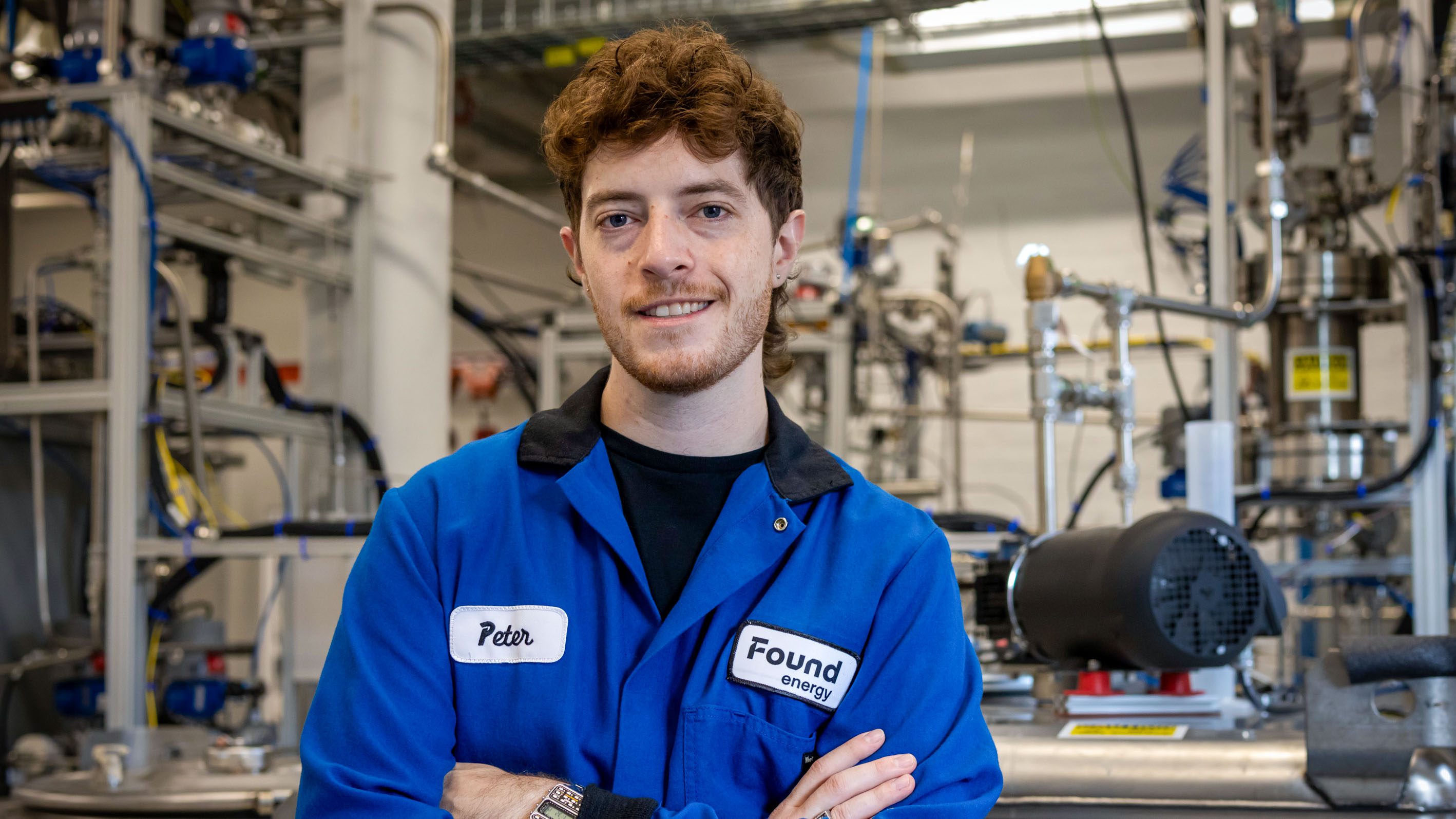
Godart is the founder and CEO of Found Energy, a startup in Boston that aims to harness the energy in scraps of aluminum metal to power industrial processes without fossil fuels. Since 2022, the company has worked to develop ways to rapidly release energy from aluminum on a small scale. Now it’s just switched on a much larger version of its aluminum-powered engine, which Godart claims is the largest aluminum-water reactor ever built. 

Early next year, it will be installed to supply heat and hydrogen to a tool manufacturing facility in the southeastern US, using the aluminum waste produced by the plant itself as fuel. (The manufacturer did not want to be named until the project is formally announced.)

If everything works as planned, this technology, which uses a catalyst to unlock the energy stored within aluminum metal, could transform a growing share of aluminum scrap into a zero-carbon fuel. The high heat generated by the engine could be especially valuable to reduce the substantial greenhouse-gas emissions generated by industrial processes, like cement production and metal refining, that are difficult to power with electricity directly.

“We invented the fuel, which is a blessing and a curse,” says Godart, surrounded by the pipes and wires of the experimental reactor. “It’s a huge opportunity for us, but it also means we do have to develop all of the systems around us. We’re redefining what even is an engine.”

Engineers have long eyed using aluminum as a fuel thanks to its superior energy density. Once it has been refined and smelted from ore, aluminum metal contains more than twice as much energy as diesel fuel by volume and almost eight times as much as hydrogen gas. When it reacts with oxygen in water or air, it forms aluminum oxides. This reaction releases heat and hydrogen gas, which can be tapped for zero-carbon power.

Liquid metal

The trouble with aluminum as a fuel—and the reason your soda can doesn’t spontaneously combust—is that as soon as the metal starts to react, an oxidized layer forms across its surface that prevents the rest of it from reacting. It’s like a fire that puts itself out as it generates ash. “People have tried it and abandoned this idea many, many times,” says Godart.

Some believe using aluminum as a fuel remains a fool’s errand. “This potential use of aluminum crops up every few years and has no possibility of success even if aluminum scrap is used as the fuel source,” says Geoff Scamans, a metallurgist at Brunel University of London who spent a decade working on using aluminum to power vehicles in the 1980s. He says the aluminum-water reaction isn’t efficient enough for the metal to make sense as a fuel given how much energy it takes to refine and smelt aluminum from ore to begin with: “A crazy idea is always a crazy idea.”

But Godart believes he and his company have found a way to make it work. “The real breakthrough was thinking about catalysis in a different way,” he says: Instead of trying to speed up the reaction by bringing water and aluminum together onto a catalyst, they “flipped it around” and “found a material that we could actually dissolve into the aluminum.”

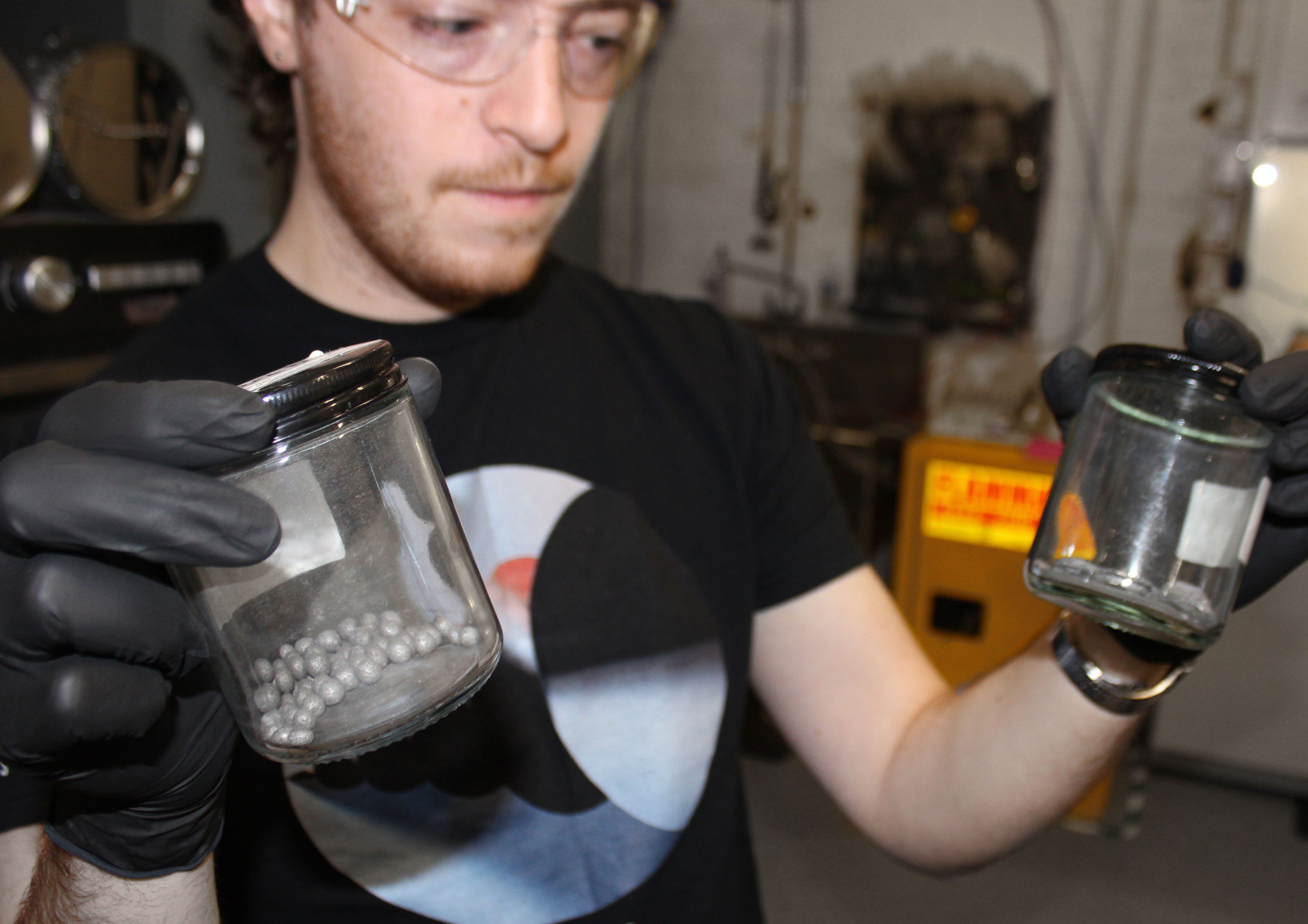
Petert Godart holding up two glass jars; one with metal spheres and the other with flat metal shapes

JAMES DINNEEN

The liquid metal catalyst at the heart of the company’s approach “permeates the microstructure” of the aluminum, says Godart. As the aluminum reacts with water, the catalyst forces the metal to froth and split open, exposing more unreacted aluminum to the water. 

The composition of the catalyst is proprietary, but Godart says it is a “low-melting-point liquid metal that’s not mercury.” His dissertation research focused on using a liquid mixture of gallium and indium as the catalyst, and he says the principle behind the current material is the same.

During a visit in early October, Godart demonstrated the central reaction in the Found R&D lab, which after the company’s $12 million seed round last year now fills the better part of two floors of an industrial building in Boston’s Charlestown neighborhood. Using a pair of tongs to avoid starting the reaction with the moisture on his fingers, he placed a pellet of aluminum treated with the secret catalyst in a beaker and then added water. Immediately, the metal began to bubble with hydrogen. Then the water steamed away, leaving behind a frothing gray mass of aluminum hydroxide.

“One of the impediments to this technology taking off is that [the aluminum-water reaction] was just too sluggish,” says Godart. “But you can see here we’re making steam. We just made a boiler.”

From Europa to Earth

Godart was a scientist at NASA when he first started thinking about fresh ways to unlock the energy stored in aluminum. He was working on building aluminum robots that could consume themselves for fuel when roving on Jupiter’s icy moon Europa. But that work was cut short when Congress reduced funding for the mission.

“I was sort of having this little mini crisis where I was like, I need to do something about climate change, about Earth problems,” says Godart. “And I was like, you know—I bet this aluminum technology would be even better for Earth applications.” After completing a dissertation on aluminum fuels at MIT, he started Found Energy in his house in Cambridge in 2022 (the next year, he earned a place on MIT Technology Review’s annual 35 Innovators under 35 list).

Until this year, the company was working at a tiny scale, tweaking the catalyst and testing different conditions within a small 10-kilowatt reactor to make the reaction release more heat and hydrogen more quickly. Then, in January, it began designing an engine that’s 10 times larger, big enough to supply a useful amount of power for industrial processes beyond the lab.

This larger engine took up most of the lab on the second floor. The reactor vessel resembled a water boiler turned on its side, with piping and wires connected to monitoring equipment that took up almost as much space as the engine itself. On one end, there was a pipe to inject water and a piston to deliver pellets of aluminum fuel into the reactor at variable rates. On the other end, outflow pipes carried away the reaction products: steam, hydrogen gas, aluminum hydroxide, and the recovered catalyst. Godart says none of the catalyst is lost in the reaction, so it can be used again to make more fuel.

The company first switched on the engine to begin testing in July. In September, it managed to power it up to its targeted power of 100 kilowatts—roughly as much as can be supplied by the diesel engine in a small pickup truck. In early 2026, it plans to install the 100-kilowatt engine to supply heat and hydrogen to the tool manufacturing facility. This pilot project is meant to serve as the proof of concept needed to raise the money for a 1-megawatt reactor, 10 times larger again.

The initial pilot will use the engine to supply hot steam and hydrogen. But the energy released in the reactor could be put to use in a variety of ways across a range of temperatures, according to Godart. The hot steam could spin a turbine to produce electricity, or the hydrogen could produce electricity in a fuel cell. By burning the hydrogen within the steam, the engine can produce superheated steam as hot as 1,300 °C, which could be used to generate electricity more efficiently or refine chemicals. Burning the hydrogen alone could generate temperatures of 2,400 °C, hot enough to make steel.

Picking up scrap

Godart says he and his colleagues hope the engine will eventually power many different industrial processes, but the initial target is the aluminum refining and recycling industry itself, as it already handles scrap metal and aluminum oxide supply chains. “Aluminum recyclers are coming to us, asking us to take their aluminum waste that’s difficult to recycle and then turn that into clean heat that they can use to re-melt other aluminum,” he says. “They are begging us to implement this for them.”

Citing nondisclosure agreements, he wouldn’t name any of the companies offering up their unrecyclable aluminum, which he says is something of a “dirty secret” for an industry that’s supposed to be recycling all it collects. But estimates from the International Aluminium Institute, an industry group, suggest that globally a little over 3 million metric tons of aluminum collected for recycling currently goes unrecycled each year; another 9 million metric tons isn’t collected for recycling at all or is incinerated with other waste. Together, that’s a little under a third of the estimated 43 million metric tons of aluminum scrap that currently gets recycled each year.

Even if all that unused scrap was recovered for fuel, it would still supply only a fraction of the overall industrial demand for heat, let alone the overall industrial demand for energy. But the plan isn’t to be limited by available scrap. Eventually, Godart says, the hope is to “recharge” the aluminum hydroxide that comes out of the reactor by using clean electricity to convert it back into aluminum metal and react it again. According to the company’s estimates, this “closed loop” approach could supply all global demand for industrial heat by using and reusing a total of around 300 million metric tons of aluminum—around 4% of Earth’s abundant aluminum reserves. 

However, all that recharging would require a lot of energy. “If you’re doing that, [aluminum fuel] is an energy storage technology, not so much an energy providing technology,” says Jeffrey Rissman, who studies industrial decarbonization at Energy Innovation, a think tank in California. As with other forms of energy storage like thermal batteries or green hydrogen, he says, that could still make sense if the fuel can be recharged using low-cost, clean electricity. But that will be increasingly hard to come by amid the scramble for clean power for everything from AI data centers to heat pumps.

Despite these obstacles, Godart is confident his company will find a way to make it work. The existing engine may already be able to squeeze out more power from aluminum than anticipated. “We actually believe this can probably do half a megawatt,” he says. “We haven’t fully throttled it.”

James Dinneen is a science and environmental journalist based in New York City. 

What a massive thermal battery means for energy storage

Rondo Energy just turned on what it says is the world’s largest thermal battery, an energy storage system that can take in electricity and provide a consistent source of heat.

The company announced last week that its first full-scale system is operational, with 100 megawatt-hours of capacity. The thermal battery is powered by an off-grid solar array and will provide heat for enhanced oil recovery (more on this in a moment).

Thermal batteries could help clean up difficult-to-decarbonize sectors like manufacturing and heavy industrial processes like cement and steel production. With Rondo’s latest announcement, the industry has reached a major milestone in its effort to prove that thermal energy storage can work in the real world. Let’s dig into this announcement, what it means to have oil and gas involved, and what comes next.

The concept behind a thermal battery is overwhelmingly simple: Use electricity to heat up some cheap, sturdy material (like bricks) and keep it hot until you want to use that heat later, either directly in an industrial process or to produce electricity.

Rondo’s new system has been operating for 10 weeks and achieved all the relevant efficiency and reliability benchmarks, according to the company. The bricks reach temperatures over 1,000 °C (about 1,800 °F), and over 97% of the energy put into the system is returned as heat.

This is a big step from the 2 MWh pilot system that Rondo started up in 2023, and it’s the first of the mass-produced, full-size heat batteries that the company hopes to put in the hands of customers.

Thermal batteries could be a major tool in cutting emissions: 20% of total energy demand today is used to provide heat for industrial processes, and most of that is generated by burning fossil fuels. So this project’s success is significant for climate action.

There’s one major detail here, though, that dulls some of that promise: This battery is being used for enhanced oil recovery, a process where steam is injected down into wells to get stubborn oil out of the ground.

It can be  tricky for a climate technology to show its merit by helping harvest fossil fuels. Some critics argue that these sorts of techniques keep that polluting infrastructure running longer.

When I spoke to Rondo founder and chief innovation officer  John O’Donnell about the new system, he defended the choice to work with oil and gas.  

“We are decarbonizing the world as it is today,” O’Donnell says. To his mind, it’s better to help an oil and gas company use solar power for its operation than leave it to continue burning natural gas for heat. Between cheap solar, expensive natural gas, and policies in California, he adds, Rondo’s technology made sense for the customer.

Having a willing customer pay for a full-scale system has been crucial to Rondo’s effort to show that it can deliver its technology.

And the next units are on the way: Rondo is currently building three more full-scale units in Europe. The company will be able to bring them online cheaper and faster because of what it’s learned from the California project, O’Donnell says. 

The company has the capacity to build more batteries, and do it quickly. It currently makes batteries at its factory in Thailand, which has the capacity to make 2.4 gigawatt-hours’ worth of heat batteries today.

I’ve been following progress on thermal batteries for years, and this project obviously represents a big step forward. For all the promises of cheap, robust energy storage, there’s nothing like actually building a large-scale system and testing it in the field.

It’s definitely hard to get excited about enhanced oil recovery—we need to stop burning fossil fuels, and do it quickly, to avoid the worst impacts of climate change. But I see the argument that as long as oil and gas operations exist, there’s value in cleaning them up.

And as O’Donnell puts it, heat batteries can help: “This is a really dumb, practical thing that’s ready now.”

This article is from The Spark, MIT Technology Review’s weekly climate newsletter. To receive it in your inbox every Wednesday, sign up here.

Flowers of the future

Flowers play a key role in most landscapes, from urban to rural areas. There might be dandelions poking through the cracks in the pavement, wildflowers on the highway median, or poppies covering a hillside. We might notice the time of year they bloom and connect that to our changing climate. Perhaps we are familiar with their cycles: bud, bloom, wilt, seed. Yet flowers have much more to tell in their bright blooms: The very shape they take is formed by local and global climate conditions. 

The form of a flower is a visual display of its climate, if you know what to look for. In a dry year, its petals’ pigmentation may change. In a warm year, the flower might grow bigger. The flower’s ultraviolet-absorbing pigment increases with higher ozone levels. As the climate changes in the future, how might flowers change? 

white flower and a purple flower
Anthocyanins are red or indigo pigments that supply antioxidants and photoprotectants, which help a plant tolerate climate-related stresses such as droughts.
© 2021 SULLIVAN CN, KOSKI MH

An artistic research project called Plant Futures imagines how a single species of flower might evolve in response to climate change between 2023 and 2100—and invites us to reflect on the complex, long-term impacts of our warming world. The project has created one flower for every year from 2023 to 2100. The form of each one is data-driven, based on climate projections and research into how climate influences flowers’ visual attributes. 

two rows of flowers that are both yellow and purple
More ultraviolet pigment protects flowers’ pollen against increasing ozone levels.
MARCO TODESCO
a white flower with a yellow center
Under unpredictable weather conditions, the speculative flowers grow a second layer of petals. In botany, a second layer is called a “double bloom” and arises from random mutations.
COURTESY OF ANNELIE BERNER

Plant Futures began during an artist residency in Helsinki, where I worked closely with the biologist Aku Korhonen to understand how climate change affected the local ecosystem. While exploring the primeval Haltiala forest, I learned of the Circaea alpina, a tiny flower that was once rare in that area but has become more common as temperatures have risen in recent years. Yet its habitat is delicate: The plant requires shade and a moist environment, and the spruce population that provides those conditions is declining in the face of new forest pathogens. I wondered: What if the Circaea alpina could survive in spite of climate uncertainty? If the dark, shaded bogs turn into bright meadows and the wet ground dries out, how might the flower adapt in order to survive? This flower’s potential became the project’s grounding point. 

The author studying historical Circaea samples in the Luomus Botanical Collections.
COURTESY OF ANNELIE BERNER

Outside the forest, I worked with botanical experts in the Luomus Botanical Collections. I studied samples of Circaea flowers from as far back as 1906, and I researched historical climate conditions in an attempt to understand how flower size and color related to a year’s temperature and precipitation patterns. 

I researched how other flowering plants respond to changes to their climate conditions and wondered how the Circaea would need to adapt to thrive in a future world. If such changes happened, what would the Circaea look like in 2100? 

We designed the future flowers through a combination of data-driven algorithmic mapping and artistic control. I worked with the data artist Marcin Ignac from Variable Studio to create 3D flowers whose appearance was connected to climate data. Using Nodes.io, we made a 3D model of the Circaea alpina based on its current morphology and then mapped how those physical parameters might shift as the climate changes. For example, as the temperature rises and precipitation decreases in the data set, the petal color shifts toward red, reflecting how flowers protect themselves with an increase in anthocyanins. Changes in temperature, carbon dioxide levels, and precipitation rates combine to affect the flowers’ size, density of veins, UV pigments, color, and tendency toward double bloom.
2025: Circaea alpina is ever so slightly larger than usual owing to a warmer summer, but it is otherwise close to the typical Circaea flower in size, color, and other attributes.
2064: We see a bigger flower with more petals, given an increase in carbon dioxide levels and temperature. The bull’s-eye pattern, composed of UV pigment, is bigger and messier because of an increase in ozone and solar radiation. A second tier of petals reflects uncertainty in the climate model.
2074: The flower becomes pinker, an antioxidative response to the stress of consecutive dry days and higher temperatures. Its size increases, primarily because of higher levels of carbon dioxide. The double bloom of petals persists as the climate model’s projections increase in uncertainty.
2100: The flower’s veins are densely packed, which could signal appropriation of a technique leaves use to improve water transport during droughts. It could also be part of a strategy to attract pollinators in the face of worsening air quality that degrades the transmission of scents.
2023—2100: Each year, the speculative flower changes. Size, color, and form shift in accordance with the increased temperature and carbon dioxide levels and the changes in precipitation patterns.
In this 10-centimeter cube of plexiglass, the future flowers are “preserved,” allowing the viewer to see them in a comparative, layered view.
COURTESY OF ANNELIE BERNER

Based in Copenhagen, Annelie Berner is a designer, researcher, teacher, and artist specializing in data visualization.

The problem with Big Tech’s favorite carbon removal tech

Sucking carbon pollution out of the atmosphere is becoming a big business—companies are paying top dollar for technologies that can cancel out their own emissions.

Today, nearly 70% of announced carbon removal contracts are for one technology: bioenergy with carbon capture and storage (BECCS). Basically, the idea is to use trees or some other types of biomass for energy, and then capture the emissions when you burn it.

While corporations, including tech giants like Microsoft, are betting big on this technology, there are a few potential problems with BECCS, as my colleague James Temple laid out in a new story. And some of the concerns echo similar problems with other climate technologies we cover, like carbon offsets and alternative jet fuels.

Carbon math can be complicated.

To illustrate one of the biggest issues with BECCS, we need to run through the logic on its carbon accounting. (And while this tech can use many different forms of biomass, let’s assume we’re talking about trees.)

When trees grow, they suck up carbon dioxide from the atmosphere. Those trees can be harvested and used for some intended purpose, like making paper. The leftover material, which might otherwise be waste, is then processed and burned for energy.

This cycle is, in theory, carbon neutral. The emissions from burning the biomass are canceled out by what was removed from the atmosphere during plants’ growth. (Assuming those trees are replaced after they’re harvested.)

So now imagine that carbon-scrubbing equipment is added to the facility that burns the biomass, capturing emissions. If the cycle was logically carbon neutral before, now it’s carbon negative: On net, emissions are removed from the atmosphere. Sounds great, no notes. 

There are a few problems with this math, though. For one, it leaves out the emissions that might be produced while harvesting, transporting, and processing wood. And if projects require clearing land to plant trees or grow crops, that transformation can wind up releasing emissions too.

Issues with carbon math might sound a little familiar if you’ve read any of James’s reporting on carbon offsets, programs where people pay for others to avoid emissions. In particular, his 2021 investigation with ProPublica’s Lisa Song laid out how this so-called solution was actually adding millions of tons of carbon dioxide into the atmosphere.

Carbon capture may entrench polluting facilities.

One of the big benefits of BECCS is that it can be added to existing facilities. There’s less building involved than there might be in something like a facility that vacuums carbon directly out of air. That helps keep costs down, so BECCS is currently much cheaper than direct air capture and other forms of carbon removal.

But keeping legacy equipment running might not be a great thing for emissions or local communities in the long run.

Carbon dioxide is far from the only pollutant spewing out of these facilities. Burning biomass or biofuels can release emissions that harm human health, like particulate matter, sulfur dioxide, and carbon monoxide. Carbon capture equipment might trap some of these pollutants, like sulfur dioxide, but not all.

Assuming that waste material wouldn’t be used for something else might not be right.

It sounds great to use waste, but there’s a major asterisk lurking here, as James lays out in the story:

But the critical question that emerges with waste is: Would it otherwise have been burned or allowed to decompose, or might some of it have been used in some other way that kept the carbon out of the atmosphere? 

Biomass can be used for other things, like making plastic, building material, or even soil additives that can help crops get more nutrients. So the assumption that it’s BECCS or nothing is flawed.

Moreover, a weird thing happens when you start making waste valuable: There’s an incentive to produce more of it. Some experts are concerned that companies could wind up trimming more trees or clearing more forests than what’s needed to make more material for BECCS.

These waste issues remind me of conversations around sustainable aviation fuels. These alternative fuels can be made from a huge range of materials, including crop waste or even used cooking oil. But as demand for these clean fuels has ballooned, things have gotten a little wonky—there are even some reports of fraud, where scammers try to pass off newly made oil from crops as used cooking oil.

BECCS is a potentially useful technology, but like many things in climate tech, it can quickly get complicated. 

James has been reporting on carbon offsets and carbon removal for years. As he put it to me this week when we were chatting about this story: “Just cut emissions and stop messing around.”

This article is from The Spark, MIT Technology Review’s weekly climate newsletter. To receive it in your inbox every Wednesday, sign up here.

Unlocking the potential of SAF with book and claim in air freight

Used in aviation, book and claim offers companies the ability to financially support the use of SAF even when it is not physically available at their locations.

As companies that ship goods by air or provide air freight related services address a range of climate goals aiming to reduce emissions, the importance of sustainable aviation fuel (SAF) couldn’t be more pronounced. In its neat form, SAF has the potential to reduce life cycle GHG emissions by up to 80% compared to conventional jet fuel.

In this exclusive webcast, leaders discuss the urgency for reducing air freight emissions for freight forwarders and shippers, and reasons why companies should use SAF. They also explain how companies can best make use of the book and claim model to support their emissions reduction strategies.

Learn from the leaders

  • What book and claim is and how companies can use it
  • Why SAF use is so important
  • How freight-forwarders and shippers can both potentially utilise and contribute to the benefits of SAF

Featured speakers

Raman Ojha, President, Shell Aviation. Raman is responsible for Shell’s global aviation business, which supplies fuels, lubricants, and lower carbon solutions, and offers a range of technical services globally. During almost 20 years at Shell, Raman has held leadership positions across a variety of industry sectors, including energy, lubricants, construction, and fertilisers. He has broad experience across both matured markets in the Americas and Europe, as well as developing markets including China, India, and Southeast Asia.  

Bettina Paschke, VP ESG Accounting, Reporting & Controlling, DHL Express. Bettina Paschke leads ESG Accounting, Reporting & Controlling, at DHL Express a division of DHL Group. In her role, she is responsible for ESG, including, EU Taxonomy Reporting, and Carbon Accounting. She has more than 20 years’ experience in Finance. In her role she is driving the Sustainable Aviation Fuel agenda at DHL Express and is engaged in various industry initiatives to allow reliable book and claim transactions.

Christoph Wolff, Chief Executive Officer at Smart Freight Centre. Christoph Wolff is currently the Chief Executive Officer at Smart Freight Centre, leading programs focused on sustainability in freight transport. Prior to this role, Christoph served as the Senior Advisor and Director at ACME Group, a global leader in green energy solutions. With a background in various industries, Christoph has held positions such as Managing Director at European Climate Foundation and Senior Board Advisor at Ferrostaal GmbH. Christoph has also worked at Novatec, Solar Millennium AG, DB Schenker, McKinsey & Company, and served as an Assistant Professor at Northwestern University – Kellogg School of Management. Christoph holds multiple degrees from RWTH Aachen University and ETH Zürich, along with ongoing executive education at the University of Michigan.

Watch the webcast.

This discussion is presented by MIT Technology Review Insights in association with Avelia. Avelia is a Shell owned solution and brand that was developed with support from Amex GBT, Accenture and Energy Web Foundation. The views from individuals not affiliated with Shell are their own and not those of Shell PLC or its affiliates. Cautionary note | Shell Global

This content was produced by Insights, the custom content arm of MIT Technology Review. It was not written by MIT Technology Review’s editorial staff. It was researched, designed, and written by human writers, editors, analysts, and illustrators. AI tools that may have been used were limited to secondary production processes that passed thorough human review.

Not all offerings are available in all jurisdictions. Depending on jurisdiction and local laws, Shell may offer the sale of Environmental Attributes (for which subject to applicable law and consultation with own advisors, buyers might be able to use such Environmental Attributes for their own emission reduction purposes) and/or Environmental Attribute Information (pursuant to which buyers are helping subsidize the use of SAF and lower overall aviation emissions at designated airports but no emission reduction claims may be made by buyers for their own emissions reduction purposes). Different offerings have different forms of contracts, and no assumptions should be made about a particular offering without reading the specific contractual language applicable to such offering.

Big Tech’s big bet on a controversial carbon removal tactic

Over the last century, much of the US pulp and paper industry crowded into the southeastern corner of the nation, setting up mills amid sprawling timber forests to strip the fibers from juvenile loblolly, long leaf, and slash pine trees.

Today, after the factories chip the softwood and digest it into pulp, the leftover lignin, spent chemicals, and remaining organic matter form a dark, syrupy by-product known as black liquor. It’s then concentrated into a biofuel and burned, which heats the towering boilers that power the facility—and releases carbon dioxide into the air.

Microsoft, JP MorganChase, and a tech company consortium that includes Alphabet, Meta, Shopify, and Stripe have all recently struck multimillion-dollar deals to pay paper mill owners to capture at least hundreds of thousands of tons of this greenhouse gas by installing carbon scrubbing equipment in their facilities.

The captured carbon dioxide will then be piped down into saline aquifers more than a mile underground, where it should be sequestered permanently.

Big Tech is suddenly betting big on this form of carbon removal, known as bioenergy with carbon capture and storage, or BECCS. The sector also includes biomass-fueled power plants, waste incinerators, and biofuel refineries that add carbon capturing equipment to their facilities.

Since trees and other plants absorb carbon dioxide through photosynthesis and these factories will trap emissions that would have gone into the air, together they can theoretically remove more greenhouse gas from the atmosphere than was released, achieving what’s known as “negative emissions.”

The companies that pay for this removal can apply that reduction in carbon dioxide to cancel out a share of their own corporate pollution. BECCS now accounts for nearly 70% of the announced contracts in carbon removal, a popularity due largely to the fact that it can be tacked onto industrial facilities already operating on large scales.

“If we’re balancing cost, time to market, and ultimate scale potential, BECCS offers a really attractive value proposition across all three of those,” says Brian Marrs, senior director of energy and carbon removal at Microsoft, which has become by far the largest buyer of carbon removal credits as it races to balance out its ongoing emissions by the end of the decade.

But experts have raised a number of concerns about various approaches to BECCS, stressing they may inflate the climate benefits of the projects, conflate prevented emissions with carbon removal, and extend the life of facilities that pollute in other ways. It could also create greater financial incentives to log forests or convert them to agricultural land. 

When greenhouse-gas sources and sinks are properly tallied across all the fields, forests, and factories involved, it’s highly difficult to achieve negative emissions with many approaches to BECCS, says Tim Searchinger, a senior research scholar at Princeton University. That undermines the logic of dedicating more of the world’s limited land, crops, and woods to such projects, he argues.

“I call it a ‘BECCS and switch,’” he says, adding later: “It’s folly at some level.”

The logic of BECCS

For a biomass-fueled power plant, BECCS works like this:

A tree captures carbon dioxide from the atmosphere as it grows, sequestering the carbon in its bark, trunk, branches, and roots while releasing the oxygen. Someone then cuts it down, converts it into wood pellets, and delivers it to a power plant that, in turn, burns the wood to produce heat or electricity.

Usually, that facility will produce carbon dioxide as the wood incinerates. But under both European Union and US rules, the burning of the wood is generally treated as carbon neutral, so long as the timber forests are managed in sustainable ways and the various operations abide by other regulations. The argument is that the tree pulled CO2 out of the air in the first place, and new plant growth will bring that emissions debt back into balance over time. 

If that same power plant now captures a significant share of the greenhouse gas produced in the process and pumps it underground, the process can potentially go from carbon neutral to carbon negative.

But the starting assumption that biomass is carbon neutral is fundamentally flawed, because it doesn’t fully take into account other ways that emissions are released throughout the process, according to Searchinger.

Among other things, a proper analysis must also ask: How much carbon is left behind in roots or branches on the forest floor that will begin to decompose and release greenhouse gases after the plant is removed? How much fossil fuel was burned in the process of cutting, collecting, and distributing the biomass? How much greenhouse gas was produced while converting timber into wood pellets and shipping them elsewhere? And how long will it take to grow back the trees or plants that would have otherwise continued capturing and storing carbon?

“If you’re harvesting wood, it’s essentially impossible to get negative emissions,” Searchinger says.

Burning biomass, or the biofuels created from it, can also produce other forms of pollution that can harm human health, including particulate matter, volatile organic compounds, sulfur dioxide, and carbon monoxide.

Preventing carbon dioxide emissions at a given factory may necessitate capturing certain other pollutants as well, notably sulfur dioxide. But it doesn’t necessarily filter out all the other pollution floating out of the flue stack, notes Emily Grubert, an associate professor of sustainable energy policy at the University of Notre Dame who focuses on carbon management issues and the transition away from fossil fuels. 

Driving demand

The idea that we might be able to use biomass to generate energy and suck down carbon dates back decades. But as global temperatures and emissions both continued to rise, climate modelers found that more and more BECCS or other types of carbon removal would be needed to prevent the planet from tipping past increasingly dangerous warming thresholds.

In addition to dramatic cuts in emissions, the world may need to suck down 11 billion tons of carbon dioxide per year by 2050 and 20 billion by 2100 to limit warming to 2 °C over preindustrial levels, according to a 2022 UN climate panel report. That’s a threshold we’re increasingly likely to blow past.

These grave climate warnings sparked growing interest and investments in ways to draw carbon dioxide out of the atmosphere. Companies sprang up offering to sink seaweed, bury biomass, develop carbon-sucking direct air capture factories, and add alkaline substances to agricultural fields or the oceans. 

But BECCS purchases have dwarfed those other approaches.

For companies with fast-approaching climate deadlines, BECCS is one of the few options for removing hundreds of thousands of tons over the next few years, says Robert Höglund, who cofounded CDR.fyi, ​​a public-benefit corporation that analyzes the carbon removal sector.

“If you have a target you want to meet in 2030 and you want durable carbon removal, that’s the thing you can buy,” he says.

That’s chiefly because these projects can harness the infrastructure of existing industries. At least for now, you don’t have to finance, permit, and develop new facilities.

“They’re not that hard to build, because it’s often a retrofitting of an existing plant,” Höglund says. 

BECCS is also substantially less expensive for buyers than, say, direct air capture, with weighted average prices of $210 a ton compared with $490 among the deals to date, according to CDR.fyi. That’s in part because capturing the carbon dioxide from, say, a pulp and paper mill, where it makes up around 15% of flue gas, takes far less energy than plucking CO2 molecules out of the open air, where they account for just 0.04%.

Microsoft’s big BECCS bet

In 2020, Microsoft announced plans to become carbon negative by the end of this decade and, by midcentury, to remove all the emissions the company generated directly and from electricity use throughout its corporate history. 

It’s leaning particularly heavily on BECCS to meet those climate commitments, with the category accounting for 76% of its known carbon removal purchases to date.

In April, the company announced it would purchase 3.7 million tons of carbon dioxide that a paper and pulp mill, located at some unspecified site in the southern US, will eventually capture and store over a 12-year period. It reached the deal through CO280, a startup based in Vancouver, British Columbia, that is forming joint ventures with paper and pulp mill companies in the US and Canada, to finance, develop, and operate the projects. 

It was the biggest carbon removal purchase on record—until four days later, when Microsoft revealed it had agreed to buy 6.75 million tons of carbon removal from AtmosClear, CDR.fyi noted. That company is building a biomass power plant at the Port of Greater Baton Rouge in Louisiana, which will run largely on sugarcane bagasse (a by-product of sugar production) and forest trimmings. AtmosClear says the facility will be able to capture 680,000 tons of carbon dioxide per year.

“What we’ve seen is a lot of these BECCS projects have been very helpful, if not transformational, for providing investment in rural economies,” Marrs says. “We look at our BECCS deals, in Louisiana with AtmosClear and some other Gulf State providers, like CO280, as a real means of helping support these economies, while at the same time promoting sustainable forestry practices.”

In earlier quarters, Microsoft also made substantial purchases from Orsted, which operates power plants that burn wood pellets; Gaia, which runs facilities that convert municipal waste into energy; and Arbor, whose plants are fueled by “overgrown brush, crop residues, and food waste.” 

Don’t let waste go to waste

Notably, at least three of these projects rely on some form of waste, a category distinct from fresh-cut timber or crops grown for the purpose of fueling BECCS projects. Solid waste, agricultural residues, logging leftovers, and plant material removed from forests to prevent fires present some of the ripest opportunities for BECCS—as well as some difficult questions of carbon accounting.

A 2019 report from the National Academy of Sciences estimated that the US could achieve more than 500 million tons of carbon removal a year through BECCS by 2040, while the world could exceed 3.5 billion tons, by relying just on agricultural by-products, logging residues, and organic waste—without needing to grow crops dedicated to energy.

Roger Aines, chief scientist of the energy program at Lawrence Livermore National Laboratory, argues we should at least be putting these sources to use rather than burning them or leaving them to decompose in fields. (Aines coauthored a similar analysis focused on California’s waste biomass and contributed to a 2022 lab report prepared for Microsoft to evaluate costs and options for carbon removal purchases.)

He stresses that the BECCS sector can learn a lot from using that waste material. For example, it should help to provide a sharper sense of whether the carbon math will work if more land, forests, and crops are dedicated to these sorts of purposes.

“The point is you won’t grow new material to do this in most cases, and won’t have to for a very long time, because there’s so much waste available,” Aines says. “If we get to that point, long into the future, we can address that then.”

Wonky accounting

But the critical question that emerges with waste is: Would it otherwise have been burned or allowed to decompose, or might some of it have been used in some other way that kept the carbon out of the atmosphere? 

Sugarcane bagasse, for instance, is or could also be used to produce recyclable packaging and paper, biodegradable food packaging and cutlery, building materials, or soil amendments that add nutrients back to agricultural fields.

“A lot of the time those materials are being used for something else already, so the accounting gets wonky really quickly,” Grubert says. 

Some fear that the financial incentives to pursue BECCS could also compel companies to trim away more trees and plants than is truly necessary to, say, manage forests or prevent fires—particularly as more and more BECCS plants create greater and greater demand for the limited supplies of such materials.

“Once you start capturing waste, you create an incentive to produce waste, so you have to be very careful about the perverse incentives,” says Danny Cullenward, a researcher and senior fellow at the Kleinman Center for Energy Policy at the University of Pennsylvania who studies carbon markets.

Due diligence 

Like other big tech companies, Microsoft has lost some momentum when it comes to its climate goals, in large part because of the surging energy demands of its AI data centers. 

But the company has generally earned a reputation for striving to clean up its direct emissions where possible and for seeking out high-quality approaches to carbon removal. It has consulted extensively with critically minded researchers at advisory firms like Carbon Direct and demonstrated a willingness to pay higher prices to support more credible projects.

Marrs says the company has extended that scrutiny to its BECCS deals.

“We want as much positive environmental impact as possible from every project,” he says.

“We’re doing months and months of technical due diligence with teams that visit the site, that interview stakeholders, that produce a report for us that we go through in depth with a third-party engineering provider or technical perspective provider,” he adds.

In a follow-up statement, Microsoft stressed that it strives to validate that every BECCS project it supports will achieve negative emissions, whatever the fuel source.

“Across all of these projects, we conducted substantial due diligence to ensure that BECCS feedstocks would otherwise return carbon to the atmosphere in a few years,” the company said. 

Likewise, Jonathan Rhone, the cofounder and chief executive of CO280, stresses that they’ve worked with consultants, carbon market registries, and pulp and paper mills “to make sure we’re adopting the best standards.” He says they strive to conservatively assess the release and uptake of greenhouse gases across the supply chain of the mills they work with, taking into account the type of biomass used by a given plant, the growth rate of the forests it’s harvested from, the distance trucks drive to ship the timber or sawmill residues, the total emissions of the facility, and more.

Rhone says its typical projects will capture and store away on the order of 850,000 to 900,000 tons of carbon dioxide per year. How much that would make up of the plant’s total emissions would vary, based in part on how much of the facility’s energy comes from by-product biomatter and how much comes from fossil fuels. For its first projects, the company will aim to capture 50% to 65% of the CO2 emissions at the pulp and paper mills, but it eventually hopes to exceed 90%. 

In a follow-up email, Rhone said the carbon capture equipment at the mills it works with will also prevent “substantial levels” of particulate matter and sulfur dioxide emissions and might reduce emissions of other pollutants as well.

The company is in active discussions with 10 pulp and paper mills in the Gulf Coast and Canada. Each carbon capture and storage project could cost hundreds of millions of dollars. 

“What we’re trying to do at CO280 is show and demonstrate that we can create a stable, repeatable playbook for developing projects that are low risk and provide the market with what it wants, with what it needs,” Rhone says. 

Proponents of BECCS say we could leverage biomass to deliver substantial volumes of carbon removal, so long as appropriate industry standards are put in place to prevent, or at least minimize, bad behavior.

The question is whether that will be the case—or whether, as the BECCS sector matures, it will veer closer to the pattern of carbon offset markets. 

Studies and investigations have consistently shown that loosely regulated or poorly designed carbon credit and offset programs have allowed, if not invited, companies to significantly exaggerate the climate benefits of tree planting, forest preservation, and similar projects. 

“It appears to me to be something that will be manageable but that we’ll always have to keep an eye on,” Aines says. 

Magic

Even with all these carbon accounting complexities, BECCS projects can often deliver climate benefits, particularly for existing plants.

Adding carbon capture to an operating paper and pulp mill, power plant, or refinery is at least an improvement over the status quo from a climate perspective, insofar as it prevents emissions that would otherwise have continued.

But ambitions for BECCS are already growing beyond existing plants: Last year Drax, the controversial UK power giant, announced plans to launch a Houston-based division tasked with developing enough new BECCS projects to deliver 6 million tons of carbon removal per year, in the US or elsewhere.

Numerous other companies have also built or proposed biomass power plants in recent years, with or without carbon capture systems—decisions driven in part by policies that classify them as carbon neutral.

But if biomass isn’t carbon neutral, as Searchinger and others argue it can’t be in many applications, then these new unfiltered power plants are just adding more emissions to the atmosphere—and BECCS projects aren’t drawing any out of the air. And if that’s the case, it raises tough questions about corporate climate claims that depend on its doing so and the societal trade-offs involved in building lots of new plants dedicated to these purposes.

That’s because crops grown for energy require land, fertilizer, insecticides, and human labor that might otherwise go toward producing food for an expanding global population. And greater demand for wood invites the timber industry to chop down more and more of the world’s forests, which are already sucking up and storing away vast amounts of carbon dioxide and providing homes for immense varieties of plants and animals.

If these projects are merely preventing greenhouse gas from floating into the atmosphere but not drawing any down, we’re better off adding carbon capture and storage (CCS) equipment to an existing natural-gas plant instead, Searchinger argues.

Companies may think that harnessing nature to draw carbon dioxide out of the sky sounds better than cutting the emissions of a fossil-fuel turbine. But the electricity from the latter plant would cost dramatically less, the carbon capture system would reduce emissions more for the amount of same energy generated, and it would avoid the added pressures to cut down trees, he says.

“People think some magic happens—this magic combination of using biomass and CCS creates something bigger than its parts,” Searchinger says. “But it’s not magic; it’s simply the sum of the two.”

3 takeaways about climate tech right now

On Monday, we published our 2025 edition of Climate Tech Companies to Watch. This marks the third time we’ve put the list together, and it’s become one of my favorite projects to work on every year. 

In the journalism world, it’s easy to get caught up in the latest news, whether it’s a fundraising round, research paper, or startup failure. Curating this list gives our team a chance to take a step back and consider the broader picture. What industries are making progress or lagging behind? Which countries or regions are seeing quick changes? Who’s likely to succeed? 

This year is an especially interesting moment in the climate tech world, something we grappled with while choosing companies. Here are three of my takeaways from the process of building this list. 

1. It’s hard to overstate China’s role in energy technology right now. 

To put it bluntly, China’s progress on cleantech is wild. The country is dominating in installing wind and solar power and building EVs, and it’s also pumping government money into emerging technologies like fusion energy. 

We knew we wanted this list to reflect China’s emergence as a global energy superpower, and we ended up including two Chinese firms in key industries: renewables and batteries.

In 2024, China accounted for the top four wind turbine makers worldwide. Envision was in the second spot, with 19.3 gigawatts of new capacity added last year. But the company isn’t limited to wind; it’s working to help power heavy industries like steel and chemicals with technology like green hydrogen. 

Batteries are also a hot industry in China, and we’re seeing progress in tech beyond the lithium-ion cells that currently dominate EVs and energy storage on the grid. We represent that industry with HiNa Battery Technology, a leading startup building sodium-ion batteries, which could be cheaper than today’s options. The company’s batteries are already being used in electric mopeds and grid installations. 

2. Energy demand from data centers and AI is on everyone’s mind, especially in the US. 

Another trend we noticed this year was a fixation on the growing energy demand of data centers, including massive planned dedicated facilities that power AI models. (Here’s another nudge to check out our Power Hungry series on AI and energy, in case you haven’t explored it already.) 

Even if their technology has nothing to do with data centers, companies are trying to show how they can be valuable in this age of rising energy demand. Some are signing lucrative deals with tech giants that could provide the money needed to help bring their product to market. 

Kairos Power hopes to be one such energy generator, building next-generation nuclear reactors. Last year, the company signed an agreement with Google that will see the company buy up to 500 megawatts of electricity from Kairos’s first reactors through 2035. 

In a more direct play, Redwood Materials is stringing together used EV batteries to build microgrids that could power—you guessed it—data centers. The company’s first installation fired up this year, and while it’s small, it’s an interesting example of a new use for old technology. 

3. Materials continue to be an area that’s ripe for innovation. 

In a new essay that accompanies the list, Bill Gates lays out the key role of innovation in making progress on climate technology. One thing that jumped out at me while I was reading that piece was a number: 30% of global greenhouse-gas emissions come from manufacturing, including cement and steel production. 

I’ve obviously covered materials and heavy industry for years. But it still strikes me just how much innovation we still need in the most important materials we use to scaffold our world. 

Several companies on this year’s list focus on materials: We’ve once again represented cement, a material that accounts for 7% of global greenhouse-gas emissions. Cemvision is working to use alternative fuel sources and starting materials to clean up the dirty industry. 

And Cyclic Materials is trying to reclaim and recycle rare earth magnets, a crucial technology that underpins everything from speakers to EVs and wind turbines. Today, only about 0.2% of rare earths from recycled devices are recycled, but the company is building multiple facilities in North America in hopes of changing that. 

Our list of 10 Climate Tech Companies to Watch highlights businesses we think have a shot at helping the world address and adapt to climate change with the help of everything from established energy technologies to novel materials. It’s a representation of this moment, and I hope you enjoy taking a spin through it.

This company is planning a lithium empire from the shores of the Great Salt Lake

BOX ELDER COUNTY, Utah – On a bright afternoon in August, the shore on the North Arm of the Great Salt Lake looks like something out of a science fiction film set in a scorching alien world. The desert sun is blinding as it reflects off the white salt that gathers and crunches underfoot like snow at the water’s edge. In a part of the lake too shallow for boats, bacteria have turned the water a Pepto-Bismol pink. The landscape all around is ringed with jagged red mountains and brown brush. The only obvious sign of people is the salt-encrusted hose running from the water’s edge to a makeshift encampment of shipping containers and trucks a few hundred feet away. 

This otherworldly scene is the test site for a company called Lilac Solutions, which is developing a technology it says will shake up the United States’ efforts to pry control over the global supply of lithium, the so-called “white gold” needed for electric vehicles and batteries, away from China. Before tearing down its demonstration facility to make way for its first commercial plant, due online next year, the company invited me to be the first journalist to tour its outpost in this remote area, a roughly two-hour drive from Salt Lake City.

The startup is in a race to commercialize a new way to extract lithium from rocks, called direct lithium extraction (DLE). This approach is designed to reduce the environmental damage caused by the two most common traditional methods of mining lithium: hard-rock mining and brining. 

Australia, the world’s top producer of lithium, uses the first approach, scraping rocks laden with lithium out of the earth so they can be chemically processed into industrial-grade versions of the metal. Chile, the second-largest lithium source, uses the second: It floods areas of its sun-soaked Atacama Desert with water. This results in ponds rich in dissolved lithium, which are then allowed to dry off, leaving behind lithium salts that can be harvested and processed elsewhere. 

a black hose crusted and partly buried with white and pink minerals winds into a pool of water
An intake hose, used to pump water to Lilac Solutions’ demonstration site, snakes into the pink-hued Great Salt Lake.
ALEXANDER KAUFMAN

The range of methods known as DLE use lithium brine too, but instead of water-intensive evaporation, they all involve advanced chemical or physical filtering processes that selectively separate out lithium ions. While DLE has yet to take off, its reduced need for water and land has made it a prime focus for companies and governments looking to ramp up production to meet the growing demand for lithium as electric vehicles take off and even bigger batteries are increasingly used to back up power grids. China, which processes more than two-thirds of the world’s mined lithium, is developing its own DLE to increase domestic production of the raw material. New approaches are still being researched, but nearly a dozen companies are actively looking to commercialize DLE technology now, and some industrial giants already offer basic off-the-shelf hardware. 

In August, Lilac completed its most advanced test yet of its technology, which the company says doesn’t just require far less water than traditional lithium extraction—it uses a fraction of what other DLE approaches demand. 

The company uses proprietary beads to draw lithium ions from water and says its process can extract lithium using a tenth as much water as the alumina sorbent technology that dominates the DLE industry. Lilac also highlights its all-American supply chain. Technology originally developed by Koch Industries, for example, uses some Chinese-made components. Lilac’s beads are manufactured at the company’s plant in Nevada. 

Lilac says the beads are particularly well suited to extracting lithium where concentrations are low. That doesn’t mean they could be deployed just anywhere—there won’t be lithium extraction on the Hudson River anytime soon. But Lilac’s tech could offer significant advantages over what’s currently on the market. And forgoing plans to become a major producer itself could enable the company to seize a decent slice of global production by appealing to lithium miners companies looking for the best equipment, says Milo McBride, a researcher at the Carnegie Endowment for International Peace who authored a recent report on DLE. 

If everything pans out, the pilot plant Lilac builds next to prove its technology at commercial scale could significantly increase domestic supply at a moment when the nation’s largest proposed lithium project, the controversial hard-rock Thacker Pass mine in Nevada, has faced fresh uncertainty. At the beginning of October, the Trump administration renegotiated a federal loan worth more than $2 billion to secure a 5% ownership stake for the US government. 

walking path between several tall blue tanks connected by hose
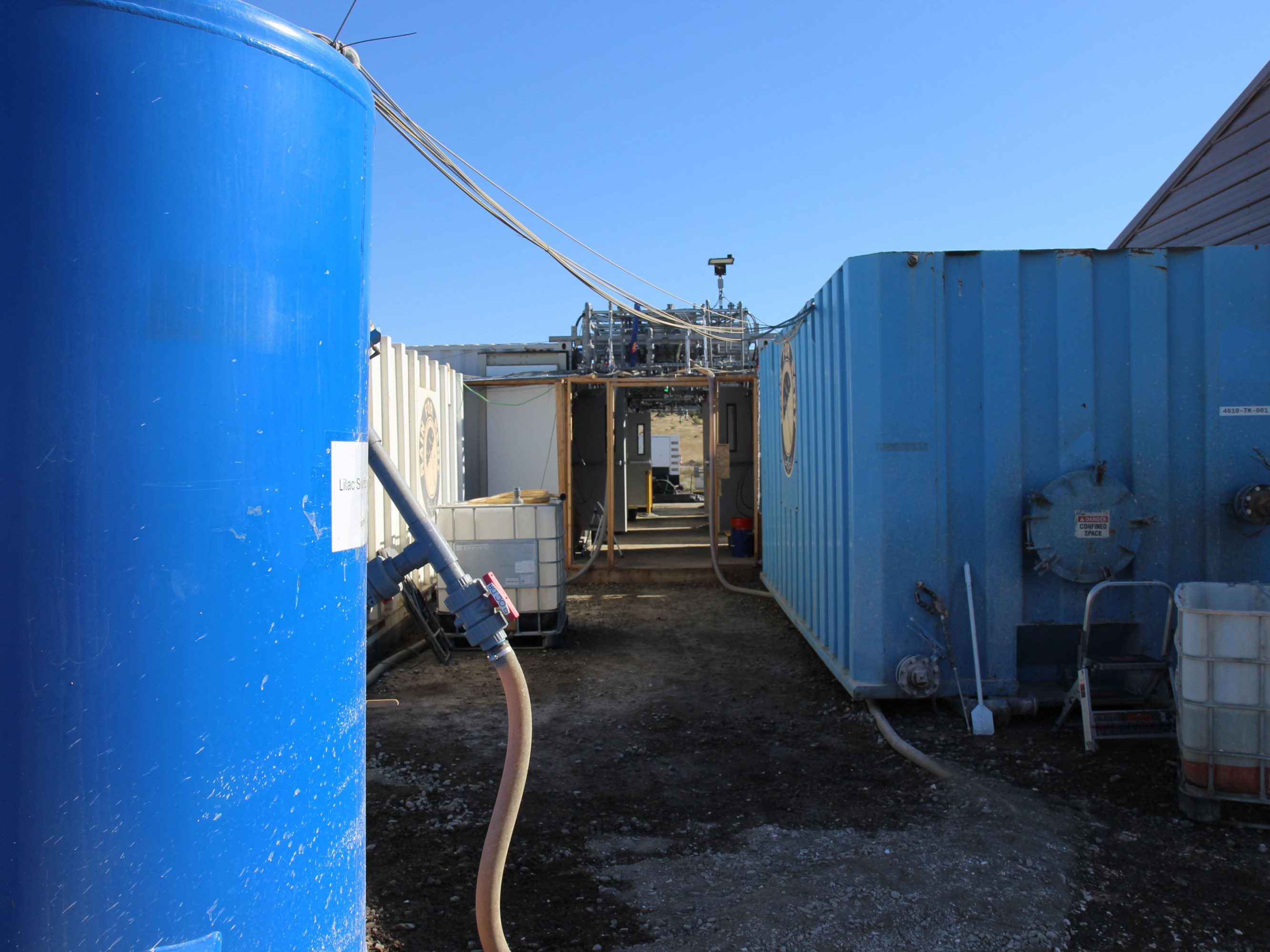
The blue tank on the left filters the brine from the Great Salt Lake to remove large particles before pumping the lithium-rich water into the ion-exchange systems located in the shipping containers.
ALEXANDER KAUFMAN

Despite bipartisan government support, the prospect of opening a deep gash in an unspoiled stretch of Nevada landscape has drawn fierce opposition from conservationists and lawsuits from ranchers and Native American tribes who say the Thacker Pass project would destroy the underground freshwater reservoirs on which they depend. Water shortages in the parched West have also made it difficult to plan on using additional evaporation ponds, the other traditional way of extracting lithium. 

Lilac is not the only company in the US pushing for DLE. In California’s Salton Sea, developers such as EnergySource Minerals are looking to build a geothermal power plant to power a DLE facility pulling lithium from the inland desert lake. And energy giants such as Exxon Mobil, Chevron, and Occidental Petroleum are racing to develop an area in southwestern Arkansas called the Smackover region, where researchers with the US Geological Survey have found as much as 19 million metric tons of untapped lithium in salty underground water. In between, both geographically and strategically, is Lilac: It’s looking to develop new technology like the California companies but sell its hardware to the energy giants in Arkansas. 

The Great Salt Lake isn’t an obvious place to develop a lithium mine. The Salton Sea boasts lithium concentrations of just under 200 parts per million. Argentina, where Lilac has another test facility, has resources of above 700 parts per million. 

Here on the Great Salt Lake? “It’s 70 parts per million,” Raef Sully, Lilac’s Australia-born chief executive, tells me. “So if you had a football stadium with 45,000 seats, this would be three people.”

For Lilac, this is actually a feature of the location. “It’s a very, very good demonstration of the capability of our technology,” Sully says. Showing that Lilac’s hardware can extract lithium at high purity levels from a brine with low concentration, he says, proves its versatility. That wasn’t the reason Lilac selected the site, though. “Utah is a mining friendly state,” says Elizabeth Pond, the vice president of communications. And though the lake water has low concentrations of lithium, extracting the brine simply calls for running a hose into the water, whereas other locations would require digging a well at great cost. 

When I accompanied Sully to the test site during my tour, our route following unpaved county roads lined with fields of wild sunflowers. The facility itself is little more than an assortment of converted shipping containers and two mobile trailers, one to serve as the main office and the other as a field laboratory to test samples. It’s off the grid, relying on diesel generators that the company says will be replaced with propane units once this location is converted to a permanent facility but could eventually be swapped for geothermal technology tapping into a hot rock resource located nearby. (Solar panels, Sully clarifies, couldn’t supply the 24-7 power supply the facility will need.) But it depends on its connection to the Great Salt Lake via that lengthy hose. 

hand holding a square of wire mesh with a clump of crystals in the center
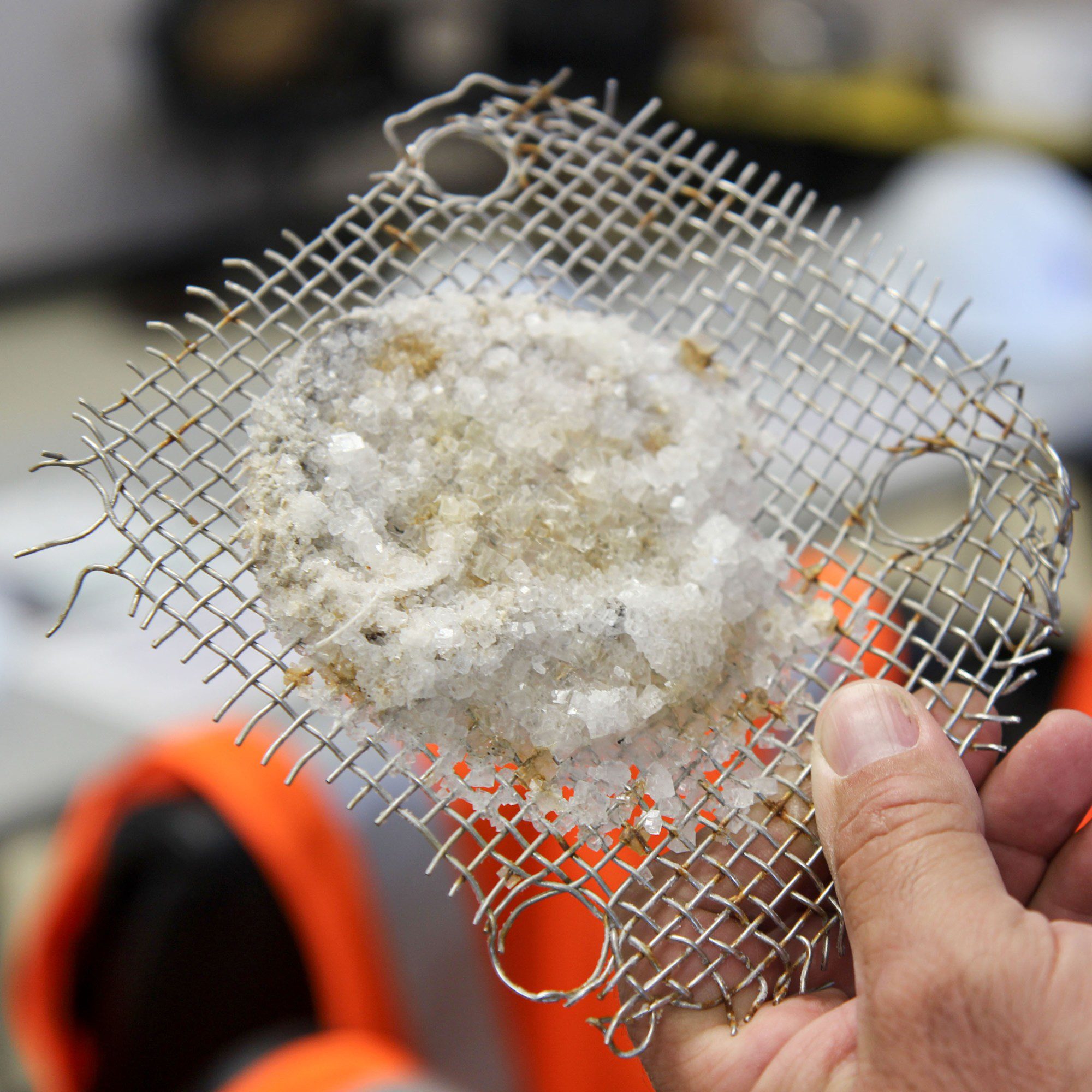
Hardened salt and impurities are encrusted on metal mesh that keeps larger materials out of Lilac’s water intake system.
ALEXANDER KAUFMAN

Pumped uphill, the lake water passes through a series of filters to remove solids until it ends up in a vessel filled with the company’s specially designed ceramic beads, made from a patented material that attracts lithium ions from the water. Once saturated, the beads are put through an acid wash to remove the lithium. The remaining brine is then repeatedly tested and, once deemed safe to release back into the lake, pumped back down to the shore through an outgoing tube in the hose. The lithium solution, meanwhile, is stockpiled in tanks on site before shipping off to a processing plant to be turned into battery-grade lithium carbonate, which is a white powder. 

“As a technology provider in the long term, if we’re going to have decades of lithium demand, they want to position their technology as something that can tap a bunch of markets,” McBride says. “To have a technology that can potentially economically recover different types of resources in different types of environments is an enticing proposition.” 

This testing ground won’t stay this way for long. During my visit, Lilac’s crew was starting to pack up the location after completing its demonstration testing. The results the company shared exclusively with me suggest a smashing success, particularly for such low-grade brine with numerous impurities: Lilac’s equipment recovered 87% of the available lithium, on average, with a purity rate of 99.97%.

The next step will be to clear the area to make way for construction of Lilac’s first permanent commercial facility at the same site. To meet the stipulations of Utah state permits for the new plant, the company had to cease all operations at the demonstration project. If everything goes according to plan, Lilac’s first US facility will begin commercial production in the second half of 2027. The company has lined up about two-thirds of its funding for the project. That could make the plant the first new commercial source of lithium in the US to come online in years, and the first DLE facility ever. 

Once it’s fully online, the project should produce 5,000 tons per year—doubling annual US production of lithium. But a full-scale plant using Lilac’s technology would produce between three and five times that amount. 

There are some potential snags. Utah regulators this year started cracking down on mineral companies pumping water from the Great Salt Lake, which is shrinking amid worsening droughts. (Lilac says it’s largely immune to the restrictions since it returns the water to the lake.) While the relatively low concentrations of lithium in the water make for a good test case, full-scale commercial production would likely prove far more economical in a place with more of the metal. 

sunflowers growing next to a dirt road
Wild sunflowers line the unpaved county roads that cut through ranching land en route to Lilac Solutions’ remote demonstration site.
ALEXANDER KAUFMAN

“The Great Salt Lake is probably the worst possible place to be doing this, because there are real challenges around pulling water from the lake,” says Ashley Zumwalt-Forbes, a mining engineer who previously served as the deputy director of battery minerals at the Department of Energy. “But if it’s just being used as a trial for the technology, that makes sense.” 

What makes Lilac stand out among its peers is that it has no plans to design and manufacture its own DLE equipment and produce actual lithium. Lilac wants instead to sell its technology to others. The pilot plant is just intended to test and debut its hardware. Sully tells me it’s being built under a separate limited-liability corporation to make a potential sale easier if it’s successful. 

It’s an unusual play in the lithium industry. Once most companies see success with their technology, “they go crazy and think they can vertically integrate and at the same time be a miner and an energy producer,” Kwasi Ampofo, the head of minerals and metals at the energy consultancy BloombergNEF, tells me. 

“Lilac is trying to be a technology vendor,” he says. “I wonder why a lot more people aren’t choosing that route.” 

If things work out the right way, Sully says, Lilac could become the vendor of choice to projects like the oil-backed sites in the Smackover and beyond. 

“We think our technology is the next generation,” he says. “And if we end up working with an Exxon or a Chevron or a Rio Tinto, we want to be the DLE technology provider in their lithium project.”

The Trump administration may cut funding for two major direct-air capture plants

The US Department of Energy appears poised to terminate funding for a pair of large carbon-sucking factories that were originally set to receive more than $1 billion in government grants, according to a department-issued list of projects obtained by MIT Technology Review and circulating among federal agencies.

One of the projects is the South Texas Direct Air Capture Hub, a facility that Occidental Petroleum’s 1PointFive subsidiary planned to develop in Kleberg County, Texas. The other is Project Cypress in Louisiana, a collaboration between Battelle, Climeworks, and Heirloom.

The list features a “latest status” column, which includes the word “terminate” next to the roughly $50 million award amounts for each project. Those line up with the initial tranche of Department of Energy (DOE) funding for each development. According to the original announcement in 2023, the projects could have received $500 million or more in total grants as they proceeded.

It’s not clear if the termination of the initial grants would mean the full funding would also be canceled.

“It could mean nothing,” says Erin Burns, executive director of Carbon180, a nonprofit that advocates for the removal and reuse of carbon dioxide. “It could mean there’s a renegotiation of the awards. Or it could mean they’re entirely cut. But the uncertainty certainly doesn’t help projects.”

A DOE spokesman stressed that no final decision has been made.

“It is incorrect to suggest those two projects have been terminated and we are unable to verify any lists provided by anonymous sources,” Ben Dietderich, the department’s press secretary, said in an email, adding: “The Department continues to conduct an individualized and thorough review of financial awards made by the previous administration.”

Last week, the DOE announced it would terminate about $7.5 billion dollars in grants for more than 200 projects, stating that they “did not adequately advance the nation’s energy needs, were not economically viable, and would not provide a positive return on investment of taxpayer dollars.”

Battelle and 1PointFive didn’t respond to inquiries from MIT Technology Review.

“Market rumors have surfaced, and Climeworks is prepared for all scenarios,” Christoph Gebald, one of the company’s co-CEOs, said in a statement. He added later: “The need for DAC is growing as the world falls short of its climate goals and we’re working to achieve the gigaton capacity that will be needed.”

“We aren’t aware of a decision from DOE and continue to productively engage with the administration in a project review,” Heirloom said in a statement.

The rising dangers of climate change have driven the development of the direct-air capture industry in recent years.

Climate models have found that the world may need to suck down billions of tons of carbon dioxide per year by around midcentury, on top of dramatic emissions cuts, to prevent the planet from warming past 2˚ C.

Carbon-sucking direct-air factories are considered one of the most reliable ways of drawing the greenhouse gas out of the atmosphere, but they also remain one of the most expensive and energy-intensive methods.

Under former President Joe Biden, the US began providing increasingly generous grants, subsidies and other forms of support to help scale up the nascent sector.

The grants now in question were allocated under the DOE’s Regional Direct Air Capture Hubs program, which was funded through the Bipartisan Infrastructure Law. The goal was to set up several major carbon removal clusters across the US, each capable of sucking down and sequestering at least a million tons of the greenhouse gas per year.

“Today’s news that a decision to cancel lawfully designated funding for the [direct-air-capture projects] could come soon risks handing a win to competitors abroad and undermines the commitments made to businesses, communities, and leaders in Louisiana and South Texas,” said Giana Amador of the Carbon Removal Alliance and Ben Rubin of the Carbon Business Council in a joint statement.

This story was updated to include additional quotes, a response from the Department of Energy and added context on the development of the carbon removal sector.