AI Turns Ecommerce Design into Reality

Ecommerce websites consist of themes and templates made with HTML, CSS, and JavaScript. Executives typically define the requirements, designers create the layouts, and developers code or implement the components.

AI is upending that process.

Upwards of 97% of developers now use AI to plan software implementations and generate code. Increasingly, generative AI is also impacting website design.

Ecommerce design concepts

AI is upending the traditional process of designing and coding ecommerce sites.

Website Theming

The conventional website workflow exists because people needed a way to convert ideas into HTML, CSS, JavaScript, Liquid (used for Shopify), React (a JavaScript framework), or another programming or templating language.

The workflow goes (went) something like this.

  • An ecommerce owner or manager has an idea for a visual theme and communicates the concept to a designer.
  • The designer translates the concept into a visual for developers.
  • Developers code and assemble the designers’ theme, template, or function.

That handoff from business to design to development creates expense and delay. Once designed, a custom site or component might require weeks of back-and-forth revisions to code responsive layouts, test the interactions, and tweak the visuals.

AI Translates

AI tools can expedite the workflow, translating concepts into designs and designs into functional website themes.

Shopify Magic already helps merchants create product descriptions and other content, and is steadily expanding AI-powered capabilities across the platform. Netlify offers AI-assisted development workflows for creating boilerplate websites. Tools such as GitHub Copilot, Vercel’s v0, Bolt.new, and Replit generate functioning interfaces or application code from natural-language prompts.

The common thread is that executives can describe what they want, and AI generates it.

A merchant might ask for “a minimalist outdoor apparel store with oversized photography, earthy colors, and a streamlined checkout,” and AI produces the initial implementation. The better the instructions, the better the outcome.

AI Infrastructure

Figma’s acquisition of Payload CMS last year exemplifies this trend.

The companies have not revealed their long-term roadmap, yet the combination suggests a future in which a designer or even a business owner uses Figma’s AI to create a website design and convert it into a production website.

Instead of creating mockups for developers, designers could generate interfaces that translate to working websites. The design becomes the site.

The implications go beyond convenience. When AI can automatically translate layouts into production-ready code, the traditional separation between design and development is gone.

All of this is happening now. Many companies are vibe coding their own tools, components, and sites.

Benefits

Enterprise-level businesses will likely have the most AI-enabled theming capabilities, but the entire ecommerce industry benefits in at least four ways.

  • Stakeholder control. The traditional workflow is inefficient. With AI-aided design and deployment, a stakeholder has direct control.
  • Speed. AI-generated web themes are much faster to create. The design and development phases are much shorter.
  • Cost. Human labor comprises most of the cost of ecommerce development. With relatively fewer hours designing and coding layouts, the overall cost drops significantly.
  • Better decisions. Fewer hours also frees up stakeholders to test, iterate, and decide.

Hence the traditional handoff between stakeholders, designers, and developers will continue to shrink.

For merchants, the savings in time and money could be a game-changer.
AI Revives Ecommerce DIY

Many ecommerce businesses are adopting an AI and automation culture that encourages experimentation and problem-solving.

The effect is a renaissance of do-it-yourself projects reminiscent of the ecommerce industry’s early innovations. It is a test-and-see attitude.

AI Trend

LinkedIn’s 2025 “Work Change Report” foretells a more innovative, AI-driven workplace.

Myriad surveys and reports point to the emerging DIY shift.

A 2025 LinkedIn study found that 80% of C-suite executives believe AI adoption is important and will foster a more innovative workplace culture. Gartner reported in December 2025 that 65% of employees said they are excited to use AI at work.

The trend suggests a convergence of three priorities.

  • Management fears their companies will fall behind if they don’t adopt AI and automation.
  • Employees use AI because it makes their jobs easier, and the knowledge gained is an important career skill.
  • The cost of off-the-shelf software and development makes AI an attractive alternative.

Old Is New Again

Here is an example. I interacted with a business in the northwest U.S. that gave nearly every employee access to premium accounts with OpenAI, Gemini, and the workflow automation platform n8n.

Management encouraged employees to tackle problems with AI. I reviewed examples and found the staff had built a simple n8n-driven tool to monitor competitors’ prices.

It was relatively basic. It gathered prices, used an AI agent to compare them against its own data, and added them to a Google Sheet each week. That weekly update fed a pivot table that the marketer used to identify changes.

It was similar to my 2015 article, “Monitor Competitor Prices with Python and Scrapy,” which described a simplified price-checker from a regional retailer that was less expensive and less functional, yet still a functional problem-solver.

DIY

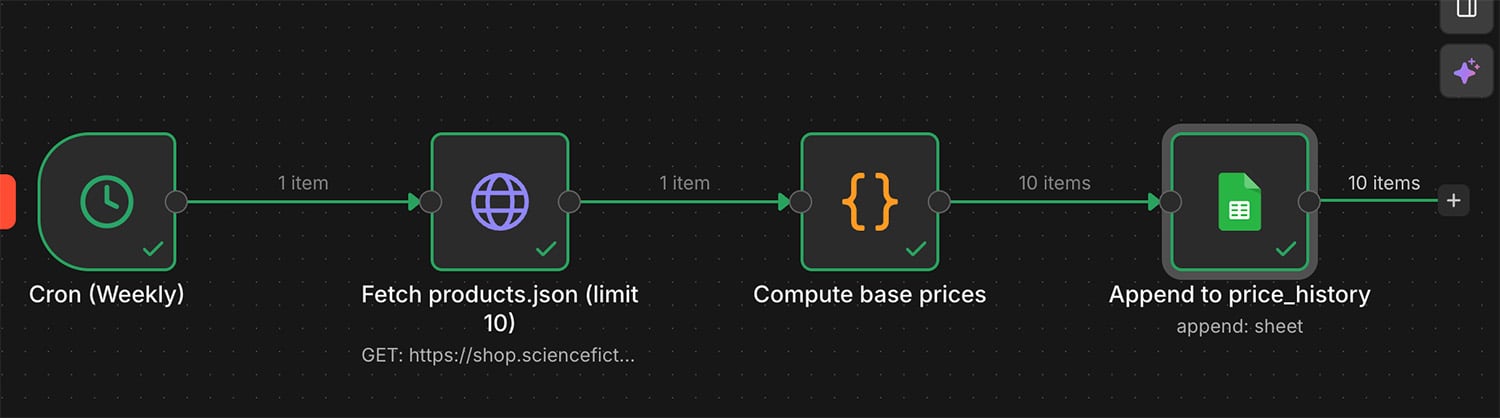
A boiled-down version of the n8n price checker does not even require AI, and might have just four steps.

Screenshot of an automation workflow showing a weekly cron trigger that fetches a products.json file via API, computes base prices, and appends the results to a Google Sheets “price_history” sheet, with status checkmarks indicating successful steps.

The n8n workflow fetches prices weekly and appends the results to a Google Sheet.

Here is how it would work.

  • Use an n8n cron node ( a scheduler) to run the automation once per week.
  • An HTTP Get request node fetches competitors’ products and prices. In some cases, collecting the data could be as simple as adding /products.json to a shop’s URL.
  • A code step uses JavaScript to find the lowest price in a set of product variants.
  • A Google Sheets integration captures the data.

Merchants may not even need to assemble the workflow manually. Generative AI tools can produce n8n-importable JSON files from simple prompts.

Culture

The importance of the price-monitoring example lies not in the workflow but in the attitude it fosters. A member of the marketing team with almost no programming background built a problem-solving automation.

Ultimately, a developer might improve the workflow or clean up the code. Nonetheless, the shift toward building something reduces the friction between operational problems and solutions.

The DIY attitude that drove ecommerce entrepreneurs years ago is reborn with this new set of tools.

With an AI and automation-first culture, a team could build custom workflows, such as:

  • Inventory monitoring. An AI agent watches stock levels and sales velocity. The tool warns when inventory is low and suggests promotions when it is high.
  • Review sentiment extraction. AI analyzes each new product review, deducing its sentiment and theme. Insights feed support prioritization or marketing content without manual sorting.
  • FAQ chatbot. Using n8n, a frequently-asked-questions database, and ChatGPT, a merchant builds a custom chatbot to answer shoppers’ questions.
  • Customer-service email filter. Connected to Gmail, Slack, and a customer-service ticketing system, an AI agent monitors the customer-service inbox, sorting messages into tickets or sending Slack messages in an emergency.
  • 3D video generation. This workflow uses Google Drive, Remove.bg, and Fal.ai to convert product videos for a Shopify store.

Opportunity

The DIY trend is an opportunity wherein AI and workflow needs converge. Executives seek competitive protection, employees pursue efficiency and skills, and budget constraints limit software and development.