Creating Value And Content Across Multiple City And Area Service Pages via @sejournal, @TaylorDanRW

For enterprise multi-location businesses, the alignment of your SEO strategy and business strategy is crucial for success.

Whether the business is operating a franchise model, a retail chain, or multiple hubs operating as a service area business, your approach to local SEO needs to be tailored to meet your specific goals. It also needs to be scalable and efficient enough to be maintained while returning long-term ROI.

Another key requirement is that your content approach produces enough value for users, and Google, so that it falls above the indexing quality threshold.

This means going beyond the standard best practices for local SEO and creating a local SEO campaign that drives brand visibility and conversions sustainably.

Aligning The SEO & Business Strategies

Multi-location businesses have different objectives.

While the basics of multi-location management are the same, your approach needs to work with the overall strategy and align with the overall business objectives.

For example, the strategy franchise business with multiple operators running service businesses in multiple towns, cities, and states will differ from a big-box store with hundreds of locations in multiple states.

Success metrics also vary. Typically, the KPIs for enterprise local SEO campaigns fall into one of the following categories:

  • To drive visibility and footfall to the individual locations.
  • To funnel local intent searches to the online store for direct delivery, or future interaction with local stores.
  • A combination of the two above.

Depending on what the business determines as “success” will greatly impact your approach to creating a choice architecture for users, and how you report on success.

Approaches To Bulk Local Page Creation

Over the years, our approach to describing and producing multiple area service pages has changed.

A decade ago, we’d describe low-quality versions with small amends and largely the same content as doorway pages, something Google moved to devalue over time.

In more recent years, with the increased popularity of programmatic SEO, or pSEO, this method has become a popular go-to for creating these pages at scale.

Programmatic Content Creation For Local Service Pages

For businesses that operate hundreds or thousands of locations, programmatic or partial-programmatic content creation can be an attractive option.

Programmatic SEO, or pSEO, allows you to scalably generate large volumes of content. This approach has helped a number of businesses scale, but it can also lead to problems if the pages being created don’t create enough of a unique value proposition for Google to invest resources.

If we look at two common website architectures for local service pages, we typically have either a central service page and then local service pages, or a central page that acts as a gateway to the locale service pages – such as a store locator.

Local service page hierarchyImage from author, July 2024

Depending on your business type, you will likely choose one structure over the other by default, but both can come with their challenges.

With a central service page structure you can run into issues with creating unique value propositions and ensuring each page has enough differentiation and falls above Google’s quality thresholds for indexing.

The store locator page approach can cause issues with PageRank distribution and how you internally link to the different locations. Most user-friendly store location applications don’t load HTML links, so while visually linking to all the stores, Google can’t crawl the links.

A common issue with both of these approaches, however, is how you work to capture “wider” searches around the locations.

Local Content Value Propositions

Local pages are at their most helpful when they tailor best to the location.

Historically, I’ve seen companies do this by “bloating” pages with additional information about the area, such as a paragraph or two on local infrastructure, schools, and sports teams – none of which is relevant if you’re trying to get people to visit your hardware store or enquire about your home-visit security fitting services.

It’s also not enough to just change the location name in the URL, H1, Title Tag, and throughout the body copy.

When this happens, Google effectively sees near-duplicate pages with very little differentiation in the value proposition that is relevant to the user query.

A symptom of this is when pages are shown as not indexed in Search Console, and Google is either choosing to override the user-declared canonical, or they’re stuck in either the Discovered or Crawled, not currently indexed phases.

There will always be a level of duplication across local service and location pages. Google is fine with this. Just because something is duplicated on multiple pages doesn’t mean it’s low quality.

Creating Value Proposition Differentiations

This is where I tend to favor the partially programmatic approach.

Programmatic can fulfill 70%(+) of the page’s content; it can cover your service offerings, pricing, and company information for those specific locations.

The remaining percentage of the page is manual but allows you to create the value proposition differentiation against other pages.

Let’s say you’re a multi-state courier service, and you have many routes to market, and your main distribution hubs in Texas are in Austin, San Antonio, and Dallas, and you want to target potential customers in Euless.

The services you offer for Euless are the same as what you offer customers in Pflugerville, Kyle, and Leander – so those parts of each location page will be the same on all of them.

But Euless is served by the Dallas hub and the others by the Austin hub – this is your first content differentiation point to highlight.

You can then use data from within the business, and keyword research, to flesh out these pages with travel time data.

Customers looking for courier services in Euless might be looking for Euless to Austin, or Euless to Houston services – so building this into the local page and having a time estimation to popular locations from the destination shows local specialism and helps customers better understand the service and plan.

Your business data will also help you identify the customer types. For example, many jobs booked in Euless might be for university students moving out to live on campus, so this is again more localized targeting to the customer base that can be included on the page.

Internal Linking

When it comes to internal linking, the use of pseudo-HTML sitemaps can help with this and not only act as clean internal links through the pages, but also be beneficial to users and allow you to create other landing pages to target county or area level searches.

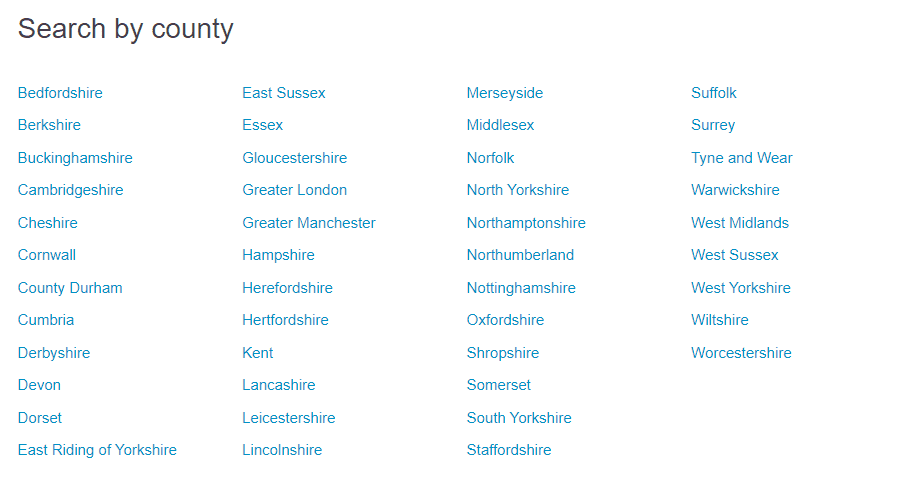
Ten years ago on a property finder page, the team I worked with built out a page structure pattern of County > Town/City whilst pulling through relevant locations into the landing pages along the way.

Search by countyScreenshot from author, July 2024

Visually, this just acted as a more “manual” method for users to filter from the non-location specific pages towards their local areas.

Google Business Profile Linking

Another key component that is often missed is the direct linking of Google Business Profiles (GBPs) to their related location page on the website.

I come across a number of multinationals and nationals who link back to their company homepage, sometimes with a parameter to highlight which GBP the user has clicked through from – but this is both poor web architecture and poor user choice architecture.

If a user is looking for a service/store in XYZ, they don’t want a homepage or generic information page if they click on the website link.

In terms of user-choice architecture, from here a user could navigate to a different store or page and miss key information relevant to them, that otherwise could have driven a sale or enquiry.

Google’s Local Algorithms

In addition to Google’s core algorithm and more general Search ranking signals, Google has released updates specifically targeting local queries. The two main ones are:

  • Pigeon 2014: This update aimed to provide more relevant and accurate local search results by tying local search results more closely to general Search ranking signals. User proximity (as a signal) also received a boost.
  • Possum 2016: This update aimed to enhance the ranking of businesses located just outside city limits, making search results more location-specific to the user’s proximity to the business. Address-based filtering was also introduced to avoid duplicate listings for businesses sharing the same address (such as virtual offices).

These updates make it harder for businesses to spoof being present in a local market, and potentially not offering a value proposition that matches or meets the needs of the searcher.

Anecdotally, Google seems to prioritize ranking businesses that provide the most comprehensive information.

This includes opening dates, onsite dining options (if applicable), special opening hours, business categories, service listings, and defining the service area and service types.

Google Business Profile Importance

Following the guidelines is a must, but even then, you can fall foul of Google’s auto-detection checks.

Working with an international software company, that has multiple offices across Asia, a number are rented floors in shared offices.

We assume that occasionally, Google detects the shared addresses and mistakes them as being a virtual office/fake address, which is something the Possum algorithm update looked to reduce.

When you’re working with an enterprise organization with a large number of physical locations, the approach to Google Business Profile management can become more complex through internal stakeholder management and understanding how GBPs fit into, and contribute, to the overall objectives and ecosystem.

Reporting GBP Data

Depending on your objectives, how you report success will vary between campaigns.

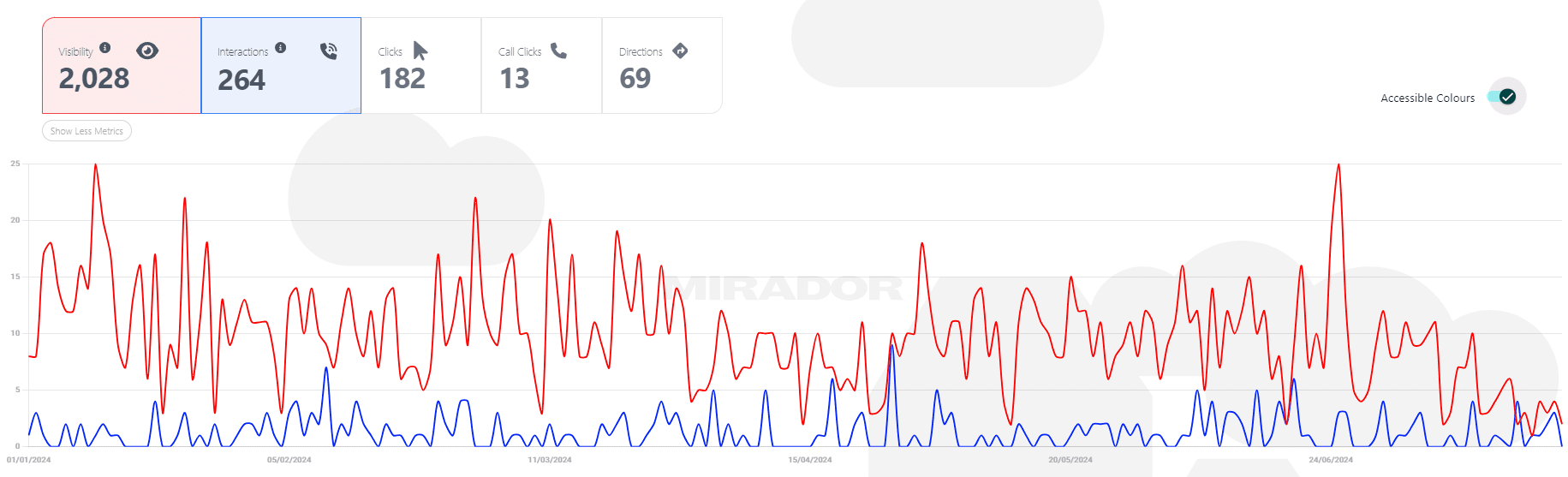
From the Google API, you can access listing-level data for your Impressions, and a breakdown of different user interactions (infer impressions and clicks from GSC mirror metrics).

Atypical Google Business Profile reporting dashboard. (Screenshot from author, July 2024)

In my opinion, any business operating across multiple towns, cities, counties, or states needs to have some form of GBP monitoring and reporting visibility outside of tracking parameterized URLs in Google Search Console and other analytics platforms (assuming you’re using parameters on your GBP website links).

More resources: 


Featured Image: ivector/Shutterstock

SEO in the Martech Stack: How Tech Decisions Can Impact SEO via @sejournal, @TaylorDanRW

Organizations typically are a mixture of orientations that impact all aspects of the business from operations, finance, and marketing and sales functions.

This also means it can influence the marketing technology stack, and subsequently, these decisions can impact the performance of marketing channels, including SEO.

When organizations determine the technologies they want to use to build their stack, there are several different objectives and criteria that stakeholders look to satisfy.

Regardless of a stakeholder’s objectives, the overall objective is for the Martech stack to significantly contribute to the success and performance of the business, either directly or indirectly.

This happens directly through acting as a vehicle to drive customer acquisition and conversion or indirectly as a mechanism to improve operational performances.

What Is A Martech Stack?

A marketing technology stack (Martech stack) is the collective noun for an organization group of software, hardware, and tools purchased (or utilized) by the business to monitor and improve marketing performance, monitor and enable sales activities, and improve other business functions such as speed of order fulfillment through to errorless payment gateways.

Typical Martech stacks are compromised of software and technology designed to achieve different tasks and objectives such as:

  • Data analytics tools (warehousing, visualization)
  • CRMs
  • Teamwork and project management tools (JIRA, Trello)
  • Payment gateways & order fulfillment/dispatch

Anecdotally most Martech decisions are led by engineering and infrastructure teams, but influenced by marketing, sales, community, and C-level.

So why is this important to SEO?

A lot of these decisions impact SEO, or potential SEO performance, so it is important that given the opportunity to contribute to these discussions, we do. We must ask the right questions and put forward the right arguments to make the case for, and make the business aware of, the potential impact on SEO performance.

CMOs (and organizations) typically engage with SEOs to achieve one or more of the following objectives:

  • To improve organic search visibility for business-relevant non-branded queries at various stages of the decision funnel.
  • To improve the stability and visibility of desired messaging for branded queries.
  • To work with other departments within the business and improve the user experience and conversion rate of the website for all web traffic.

Not all of the Martech stack will impact SEO performance, and not all arguments are worth having.

If an organization utilizes Salesforce CRM and the tooling is firmly established, moving to Salesforce Commerce Cloud or Experience Cloud as a website platform isn’t likely going to be a decision you will be able to influence – but is one you need to be aware to ensure things like the SEO migration and out-of-the-gate strategy are geared for success.

When Can Martech Decisions Impact SEO?

So how can the Martech stack impact SEO?

Let’s take a look at some common situations in which the business might make Martech decisions that could impact SEO either positively or negatively.

Integrations With Sales CRMs & CRM Led Decision-Making

Sales-oriented organizations tend to base a large number of their technology decision-making around improving sales enablement.

As a result, you see website technologies closely tied to sales CRMs, such as Salesforce and Hubspot.

While both of these are good platforms, websites designed with too much of the influence coming from the sales orientation are often designed to try and funnel a user to completing a sales action, such as downloading a marketing asset, completing a contact form, or requesting a demo as soon as possible.

This direct funnel approach to page templates, and content, doesn’t always create the best environment for organic search. Whilst the pages are hyperfocused on user conversion, they don’t always hold the value proposition and messaging that search engines are looking to rank for all queries.

The conflict you find here with heavy sales orientation is that the client will want these conversion pages to rank for all the high search volume queries, regardless of the funnel stage.

Being able to influence and highlight the need for content and a user experience that caters for and helps satisfy the different reasons as to why a user visits your website (not only just to get in touch) is vital to long-term organic success.

C-Level Led Platform Decisions

In an ideal world, CMOs and CTOs work together to identify and fill gaps in the Martech stack, prioritizing customer-centric technologies that act as enablers to marketing, sales, and operations functions.

Most CMOs/CTOs have their preferred suite of tools and platforms, and they build their playbooks that they take when they move roles, and some of these plays have stack dependencies.

Another time this can happen is when an organization gets a new CMO or Marketing Director, and at their previous company, they’ve used another platform or technology.

In the SaaS space, I see this happen a lot with new CMOs and CTOs wanting to champion a form of headless or React/Nuxt website build in place of the incumbent technology, and similarly, in ecommerce I see this happen a lot when a CMO or CTO inherits a stack they’re not familiar with, and will prefer familiarly regardless of how the existing platform is performing.

Depending on the size of the organization these changes vary in terms of overall disruption. For example, moving from a performant established Salesforce Commerce Cloud build to a Shopify build will bring with it changes in CRM, order management, and development team (who will need to get used to the business), but from an SEO perspective, a forced change in URL structures and other dynamic onsite elements, as Shopify doesn’t have Einstein or Lightning.

As well as highlighting the change variables that will impact SEO performance – and their associated short and long-term risks – this is also an opportunity to utilize SEO data to inform the new site build architecture and use data (to try to ensure) the new stack meets the needs of marketing teams and your audience.

Adopting Technologies For Competitive Advantage

There is also the drive for businesses to continuously identify and adopt emerging technologies to find a competitive advantage over their competition. A 2019 Gartner study found that 68% of CTOs actively invest in emerging technologies to gain a competitive edge.

Outside of personal preference, CMOs/CTOs also decide to make these changes for product, financial, and operational reasons.

Where this is the case, whilst the marketing (and SEO) variables are heavily considered, there is generally an overriding attitude that marketing is the most adaptable and innovative stakeholder in this mix.

Technologies For UX & Legal Compliance

Many website page load and speed issues are caused by third-party tools and software, and these are typically tools for user experience monitoring and AB testing.

Organizations may deploy these technologies in ways that slow down site loading times, negatively affect user experience, and potentially violate data privacy regulations.

From experience, a lot of issues with these tools will be picked up early into an SEO partnership through a baseline technical overview, and once resolved the problem is solved.

But when the business is looking to introduce these tools, SEOs must be consulted as part of the implementation and deployment process.

Outside of UX and AB testing tools, issues can also be caused by the implementation of cookie consent banners and other accessibility tools. With the European Accessibility Act coming into force in 2025, we’re likely going to see these sorts of issues on the rise as organizations adopt third-party accessibility tools.

As these tools often introduce and load scripts, outside of degrading page load speeds, in some instances, the implementations can cause the to close prematurely or create infinite internal linking traps.

Educating stakeholders on best practices for integrating these tools is crucial to maintaining optimal website performance and adhering to consent requirements.

How SEO Can Influence Martech Decisions

While SEO is just one marketing channel, it could be argued its success is the most influenced by the technology decisions that a business makes.

Acknowledging that the stack significantly impacts SEO, a large number of decisions are still made independently of the SEO (and marketing) teams.

Mostly all businesses take elements of each different orientation to be successful, and this means maximizing customer experience. SEO can provide key data that offers insights into the user journey and how users interact and discover the website.

Arming CMOs and CTOs with the foresight and knowledge that these decisions could negatively impact the performance of what could be their biggest traffic-driving channel.

More resources: 


Featured Image: Gorodenkoff/Shutterstock