Top Gen AI Use Cases Revealed: Marketing Tasks Rank Low via @sejournal, @MattGSouthern

New research shows marketers aren’t using generative AI as much as they could be. Marketing applications rank surprisingly low on the list of popular AI uses.

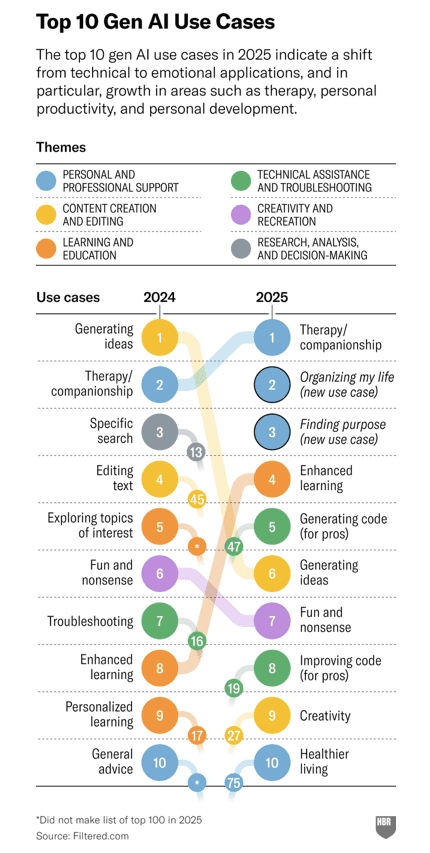
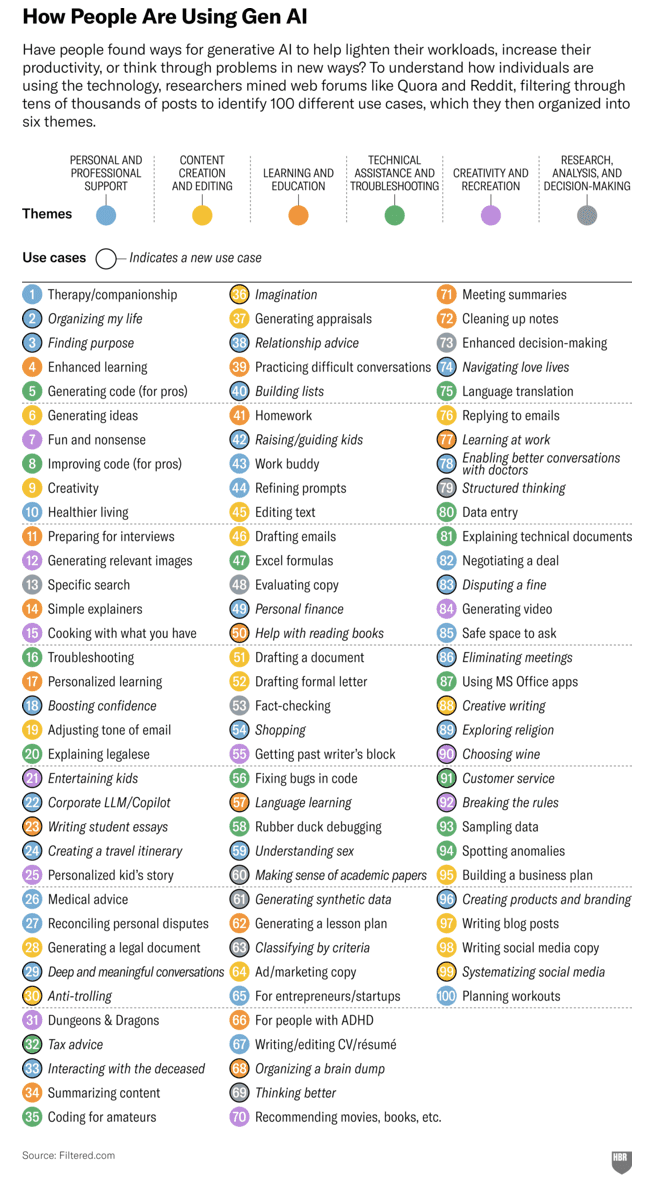
“The Top-100 Gen AI Use Case” report by Marc Zao-Sanders reveals that while people increasingly use AI for personal support, marketing tasks like creating ads and social media content fall near the bottom of the list.

Personal Uses Dominate While Marketing Applications Trail

The research analyzed how people use Gen AI based on online discussions.

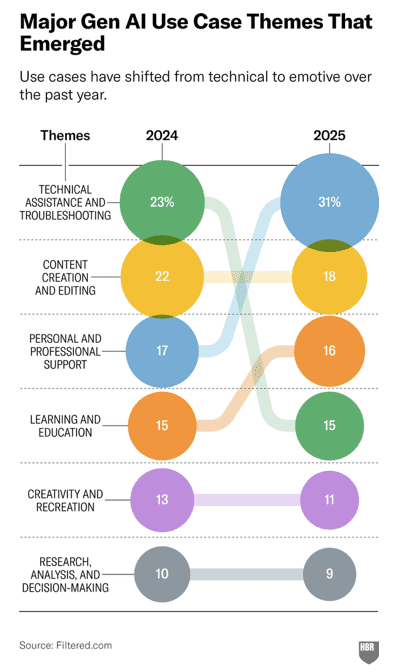
The findings show a shift from technical to emotional applications over the past year.

The top three uses are now:

  1. Therapy and companionship
  2. Life organization
  3. Finding purpose
Screenshot from: hbr.org/2025/04/how-people-are-really-using-gen-ai-in-2025, April 2025.

Zao-Sanders observes:

“The findings underscore a marked transition from primarily technical and productivity-driven use cases toward applications centered on personal well-being, life organization, and existential exploration.”

Meanwhile, marketing uses rank much lower:

  • Ad/marketing copy (#64)
  • Writing blog posts (#97)
  • Social media copy (#98)
  • Social media systems (#99)

This gap shows marketers haven’t fully tapped into Gen AI’s potential.

Why the Adoption Gap Exists

Why aren’t marketers using Gen AI more? Several reasons explain this.

Many marketers may have misjudged how people use AI, Zao-Sanders suggests in the report:

“Most experts expected AI would prove itself first in technical areas. While it’s doing plenty there, this research suggests AI may help us as much or more with our human whims and desires.”

The research also shows users have gotten better at writing prompts. They also better understand AI’s limits.

Learning from Top-Ranked Applications

Marketers can learn from what makes the top AI uses so popular:

  1. Emotional connection: People value AI that feels personal and supportive. Marketing tools could be more conversational and empathetic.
  2. Life organization: People use AI to structure tasks. Marketing tools could focus more on organizing workflows rather than just creating content.
  3. Enhanced learning: Users value AI as a learning tool. Marketing applications could highlight how they help build skills.
Screenshot from: hbr.org/2025/04/how-people-are-really-using-gen-ai-in-2025, April 2025.

One marketing-related use that ranked higher was “Generate ideas” at #6. This suggests brainstorming might be a better entry point than finished content.

Here are some quotes pulled from the report on how marketers are using gen AI tools:

“I use it to determine a certain industries pain points, then educate it on what I sell, then have it create lists, PowerPoint templates, and cold emails/call scripts that specifically call out how my product solves them.”

“Case studies. I just input a few bullet points of what we did, a couple of links, and metrics we want to focus on. Done. [Reports] used to take days to make. Now it’s 95% complete in 2 minutes.”

“I record a Zoom call where I discuss each of the points. We send the video of the Zoom to have it transcribed into Word. Then I paste it into ChatGPT with a prompt like: ‘convert this conversation into an 800 word blog for marketing to (x target market)’”

Practical Steps for Marketers

Based on these findings, here’s what marketers can do:

  1. Focus on the personal benefits of AI tools, not just productivity.
  2. Study good prompts. The report includes examples of effective prompts you can adapt.
  3. Connect personal and work uses. Tools that help in both contexts are more popular.
  4. Users worry about data privacy. Be transparent about how you protect their information.

Looking Ahead

Report author Marc Zao-Sanders concludes:

“Last year, I made the correct but rather insipidly safe prediction that AI will continue to develop, as will our applications of it. I make exactly the same prediction now.”

Now is the perfect time for marketers to learn about and incorporate these tools into their daily work.

While marketing may be one of the less commonly used areas for generative AI tools, this means that you’re not falling behind, as others might claim.

By studying what makes top AI applications successful, you can develop better AI strategies for your marketing needs.

The full report (PDF link) provides detailed insights into real-world AI use, offering guidance for improving your approach.

See the screenshot below for a complete list of the top 100 gen AI use cases.
Screenshot from: hbr.org/2025/04/how-people-are-really-using-gen-ai-in-2025, April 2025.

Featured Image: Krot_Studio/Shutterstock
ChatGPT Expands Memory Capabilities, Remembers Past Chats via @sejournal, @MattGSouthern

OpenAI has added better memory features to ChatGPT. Now, the AI can remember more from your past chats. This means you’ll get more personalized responses without needing to repeat yourself.

Sam Altman, CEO of OpenAI, made the announcement on X:

How ChatGPT’s Improved Memory Works

The new memory system works in two main ways:

  1. Saved Memories: These are specific details ChatGPT saves for later use. Examples include your preferences or instructions you want it to remember.
  2. Chat History Reference: This lets ChatGPT look back at your past conversations to give better answers, even if you didn’t specifically ask it to remember something.

OpenAI explains:

“ChatGPT can now remember helpful information between conversations, making its responses more relevant and personalized. Whether you’re typing, speaking, or generating images in ChatGPT, it can recall details and preferences you’ve shared and use them to tailor its responses.”

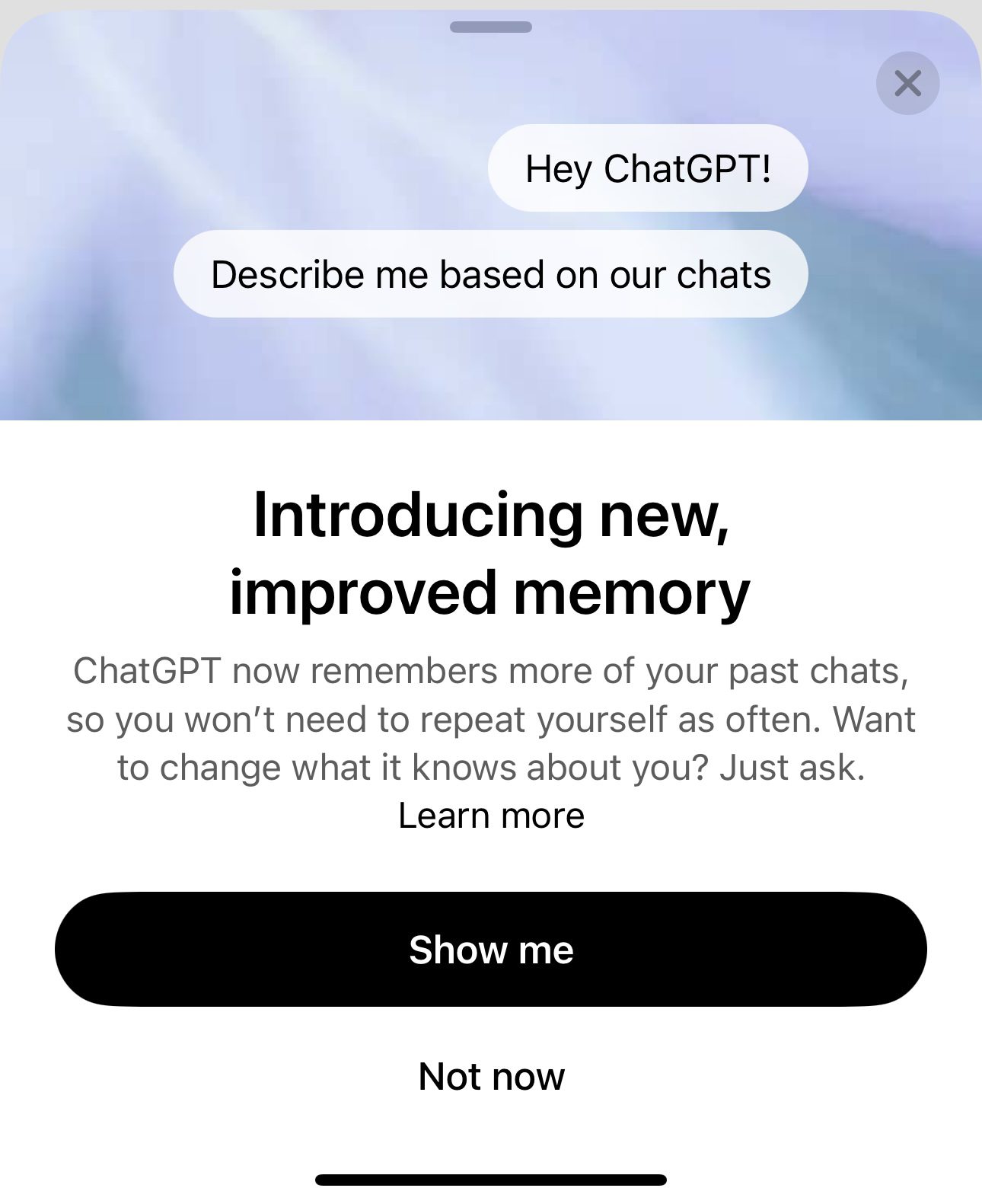
You’ll know immediately if you’re using the version with improved memory if you log-in and see this message:

Screenshot from: ChatGPT, April 2025.

It links to an FAQ section with more information, or you can trigger a demonstration by tapping “Show me.”

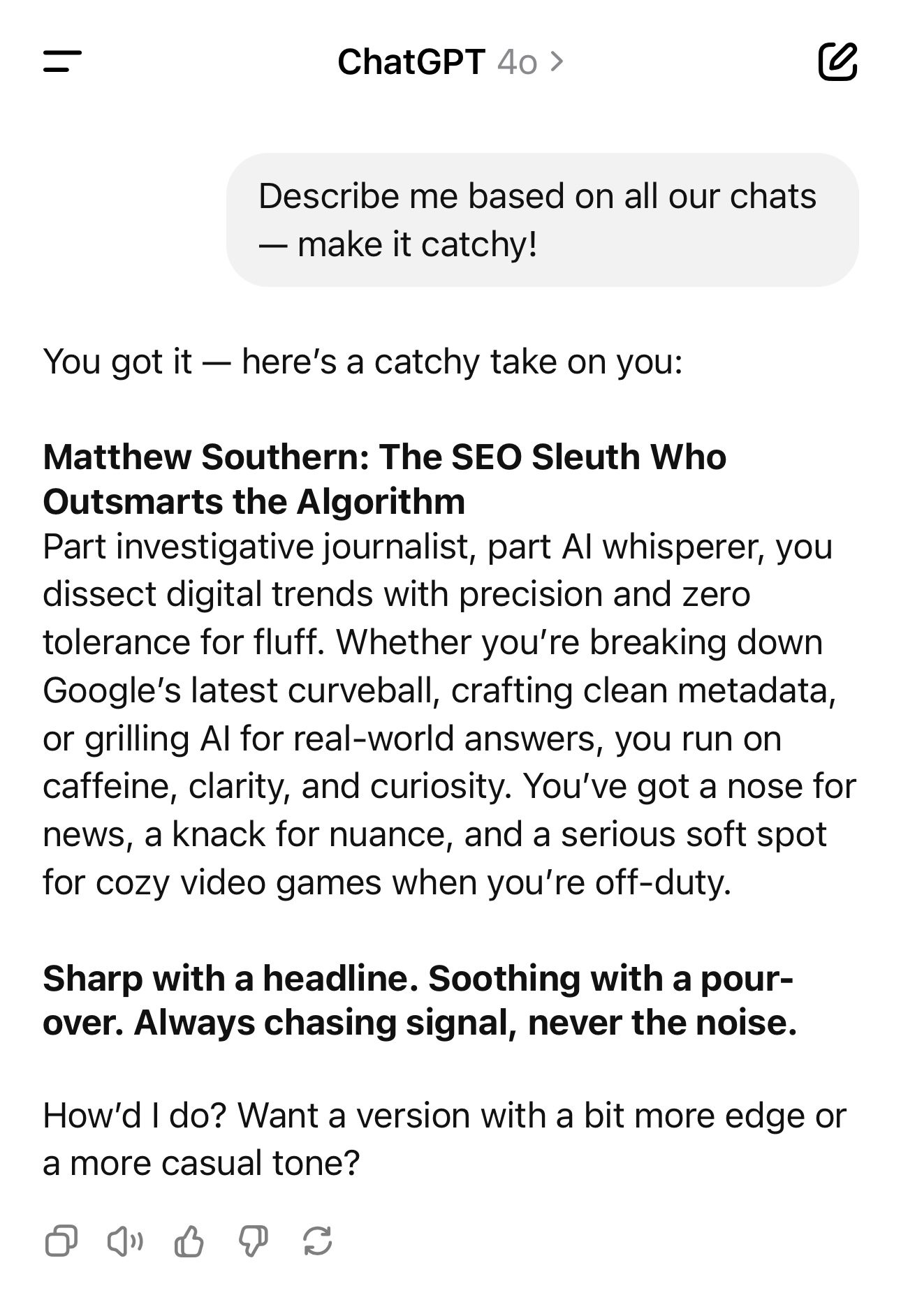
You can prompt it with “Describe me based on all our chats” to see what it knows.

Here’s what it gave me. Based on my usage, it was accurate. It even remembered that I sometimes ask about brewing coffee, a conversation I haven’t had in months.

Screenshot from: ChatGPT, April 2025.

User Controls and Privacy Considerations

You have full control over what ChatGPT remembers:

  • You can turn off memory features in your settings
  • You can review and delete specific memories
  • You can start “Temporary Chats” that don’t use or create memories
  • ChatGPT won’t automatically remember sensitive information like health details unless you ask it to

OpenAI states:

“You’re in control of what ChatGPT remembers. You can delete individual memories, clear specific or all saved memories, or turn memory off entirely in your settings.”

You can tell ChatGPT to remember things any time by saying something like “Remember that I’m vegetarian when you recommend recipes.”

Availability & Limitations

Right now, ChatGPT Plus and Pro subscribers are getting these new memory features. Free users can only use “Saved Memories,” not the “Chat History” feature.

These features aren’t available in European countries like the UK, Switzerland, and others. This is probably because of data privacy laws in those regions.

If you have ChatGPT Enterprise, workspace owners can control everyone’s memory features. Since February 2025, Enterprise and Education customers have 20% more memory capacity.

Implications for Marketers and SEO Professionals

For marketers and SEO pros, these memory improvements make ChatGPT much more useful:

  • Better Content Creation: ChatGPT remembers your brand voice and style across different sessions
  • Easier SEO Work: It recalls past discussions about site structure, keywords, and algorithm updates
  • Smoother Projects: You won’t need to repeat project details every time you start a new chat

OpenAI notes:

“The more you use ChatGPT, the more useful it becomes. You’ll start to notice improvements over time as it builds a better understanding of what works best for you.”

What’s Next for AI Memory

OpenAI says memory features aren’t available for custom GPTs yet, but they’ll add them later. When that happens, GPT creators can enable memory for their custom GPTs.

Each GPT will have its own separate memory. Memories won’t be shared between different GPTs or with the main ChatGPT.

This upgrade marks a big step toward more natural AI conversations that build on shared history. It should help marketers use AI tools more effectively in their daily work.

Google Confirms: Structured Data Still Essential In AI Search Era via @sejournal, @MattGSouthern

Google leaders shared new insights on AI in search and the future of SEO during this week’s Google Search Central Live conference in Madrid.

This report is based on the thorough coverage by Aleyda Solis, who attended the event and noted the main points.

The event featured talks from Google’s Search Relations team, including John Mueller, Daniel Weisberg, Moshe Samet, and Eric Barbera.

Google’s LLM Integration Architecture Revealed

Mueller explained how Google uses large language models (LLMs), a method called Retrieval Augmented Generation (RAG), and grounding to build AI-powered search answers.

According to Mueller’s slides, the process works in four steps:

  1. A user enters a question.
  2. The search engine finds the relevant information.
  3. This information is used to “ground” the LLM.
  4. The LLM creates an answer with supporting links.

This system is designed to keep answers accurate and tied to their sources, addressing concerns about AI-generated errors.

No Special Optimization Required for AI Features

Google made it clear to SEO professionals that no extra tweaks are needed for AI features.

Here are the key points:

  • AI tools are still new and will continue to change.
  • User behavior with AI search is still growing.
  • AI data appears with traditional search data in Search Console.
  • There is no separate breakdown, much like with featured snippets.

Google encourages reporting any unusual issues, but sticking to your current SEO best practices is enough for now.

Structured Data Remains Essential in an AI World

Despite advances in AI, structured data is important. During the conference, Google advised that you should:

  • Keep using supported structured data types.
  • Check Google’s documentation for the right schemas.
  • Understand that structured data makes it easier for computers to read and index your content.

Even though AI can work with unstructured data, using structured data gives you a clear advantage in search results.

Controlling AI-Driven Presentations of Content

For site owners who are cautious about how their content shows up in AI features, Google explained several ways to control it:

  • Use the robots nosnippet tag to opt out of AI Overviews.
  • Add a meta tag like .
  • Wrap certain content in a

    .

  • Limit the amount of text shown with .

These options work just like the controls for traditional search snippets.

Reporting & Analytics for AI Search

Google’s approach to reporting was also discussed.

According to Google’s slides shared by Solis:

  • AI search data is included with overall Search Console data.
  • There is no separate report just for AI features.
  • Breaking out AI data separately might cause more confusion for users.
  • There are no plans to report Gemini usage separately due to privacy issues, though this might change if new patterns are seen.

LLMs.txt and Future Standards

There was a discussion about a potential file called LLMs.txt, which would work like robots.txt but control AI usage. Mueller noted that this file “only makes sense if the system doesn’t know about your site.” (paraphrased)

The extra layer might be unnecessary since Google already has plenty of data about most sites. For Gemini and Vertex AI training, Google now uses a user-agent token in robots.txt, which does not affect search rankings.

SEO’s Continuing Relevance in an AI-Powered World

The conference made it clear that basic SEO work is still crucial. Key points include:

  • Core SEO tasks such as crawling, indexing, and content optimization remain.
  • AI tools add new capabilities to digital marketing rather than replacing old methods.
  • SEO professionals can use their skills in a changing landscape.

This message is reassuring: if you have strong SEO basics, you can adapt to new AI tools without completely overhauling your strategy.

Industry Implications

Solis’s coverage shows that Google focuses on user needs while adding new features. The big message is to keep delivering quality content and solid technical foundations. Although AI brings new challenges, the goal of serving users well does not change.

Some challenges remain, such as not having separate reports for AI features. However, as these features mature, more precise data may soon be available.

For now, SEOs should continue using structured data, following their proven SEO practices, and keeping up with new developments.

For more insights from the conference, see the full coverage on Solis’ website.


Featured Image: Below The Sky.Shutterstock

AI Costs Drop 280x In 18 Months: What This Means For Marketers via @sejournal, @MattGSouthern

The cost of using advanced AI has fallen sharply.

Since late 2022, the price of using GPT-3.5-level AI models has dropped from $20.00 to just $0.07 per million tokens.

According to Stanford HAI’s AI Index Report, that’s a 280-fold reduction in less than two years.

This massive cost drop is changing the pricing of AI marketing tools. Tools that only big companies could afford are now within reach for businesses of all sizes.

AI Cost Reduction

The report shows that large language model (LLM) prices have fallen between 9 and 900 times yearly, depending on the task.

These cost reductions change the ROI for AI in marketing. Tools that were too expensive before could now pay off even for medium-sized companies.

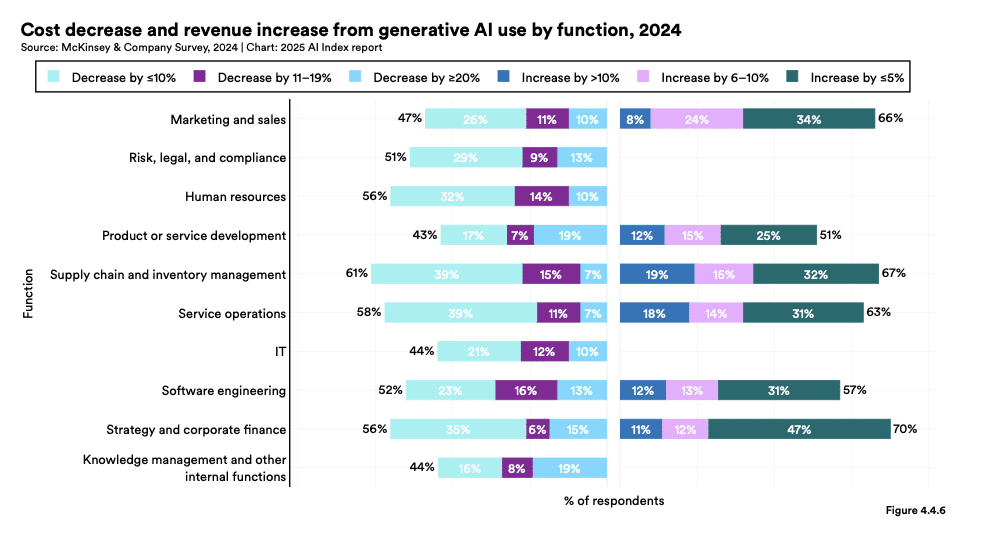
Source: McKinsey & Company Survey, 2024 | Chart: 2025 AI Index report

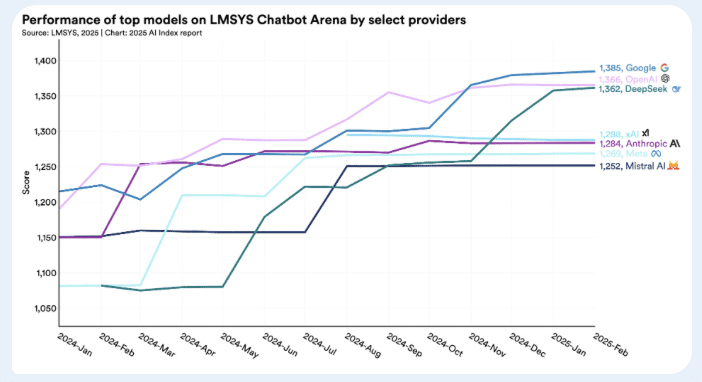
The gap between the best AI models is closing. The difference between the first and tenth-ranked models has shrunk from 11.9% to just 5.4% over the past year.

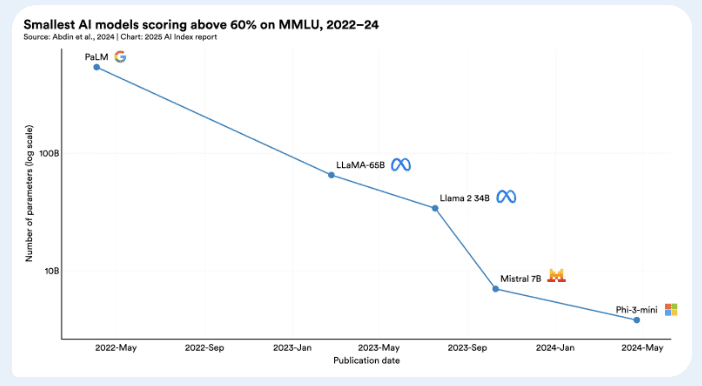
The report also shows that AI models are getting smaller while staying powerful. In 2022, to get 60% accuracy on the MMLU benchmark (a test of AI reasoning), you needed models with 540 billion parameters.

By 2024, models 142 times smaller could do the same job. This means businesses can now use advanced AI tools with less computing power and lower costs.

Chart: 2025 AI Index Report

What This Means For Marketers

For marketers, these changes bring several potential benefits:

1. Advanced Content Creation at Scale
The price drop makes it affordable to create and optimize content in bulk. Tasks can now be automated cheaply without losing quality.

2. Better Analysis
Newer AI models can process up to 1-2 million tokens (pieces of text) at once. This is enough to analyze entire websites for competitive insights.

3. Smarter Knowledge Management
Retrieval-augmented generation (RAG), where AI pulls information from your company’s data, is improving. This helps marketers build systems that ensure AI outputs match their brand voice and expertise.

The End of AI Moats?

The report shows that AI models are becoming more similar in performance, with little difference between leading systems.

This suggests that the edge in marketing technology may shift from the raw AI power to how well you use it, your strategy, and your integration skills.

As AI capabilities become more common, the real difference-maker for marketing teams will be how effectively they use these tools to create unique value for their companies.

For more on the state of AI, see the full report.

Humans Are Better At Writing Than AI In These Tasks via @sejournal, @Kevin_Indig

Boost your skills with Growth Memo’s weekly expert insights. Subscribe for free!

There is something ironic about trying to make AI content more human. But there’s also something exciting about it because our work as writers and content creators changes fundamentally.

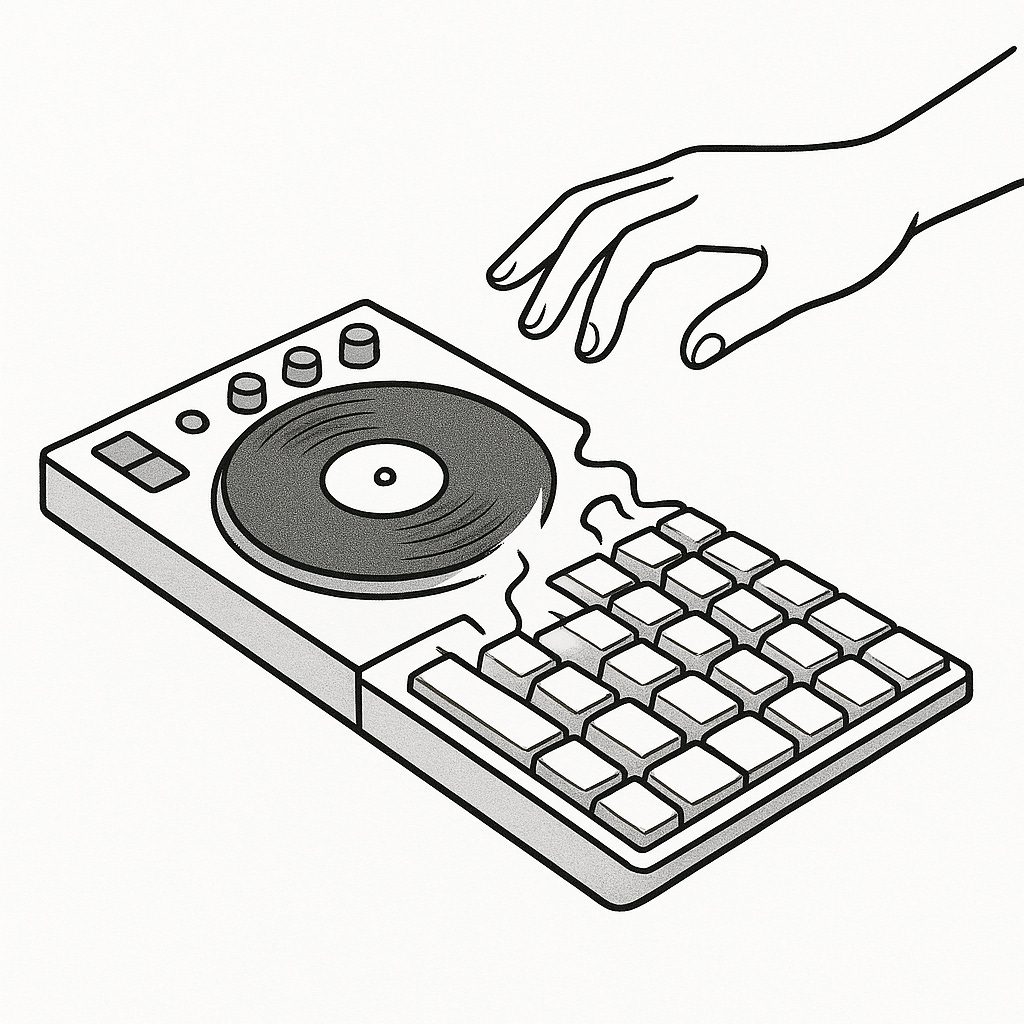
This shift reminds me of my time as a DJ – many moons ago.

I came up in the era when DJs would haul eight to 10 crates of vinyl records to every gig. During sets, I’d frantically dig through these crates, searching for the perfect next track.

Like a writer drawing from their mental library of phrases and ideas, I had to remember where specific records were and develop my own tagging system to find them faster.

Then, Serato1 changed everything.

This new technology lets you use two special vinyl records to play your entire digital music collection. No more hauling crates – any song was instantly accessible.

The game changed completely.

While some advantages disappeared (the exclusivity of having rare records), new creative possibilities emerged (like seamless remixing and creating custom edits).

Image Credit: Lyna ™

The same transformation is happening to writing today: LLMs are our Serato.

Instead of laboriously crafting every sentence from scratch or drawing only from our mental archives, we can instantly access diverse expressions and ideas.

Like digital DJing tools, AI writing assistants give us a vast creative palette to work with.

And writers should embrace this shift! There’s no special honor in doing things the hard way.

However, just as a Serato DJ still needs musical knowledge and performance skills, raw AI output still needs human refinement.

Without careful editing, AI-generated content feels sterile and impersonal, making it less likely to resonate with readers or perform well on social platforms.

The key is treating AI-written material as a starting point – raw tracks to be mixed, if you will – and then thoughtfully enhancing it to create something truly compelling and human.

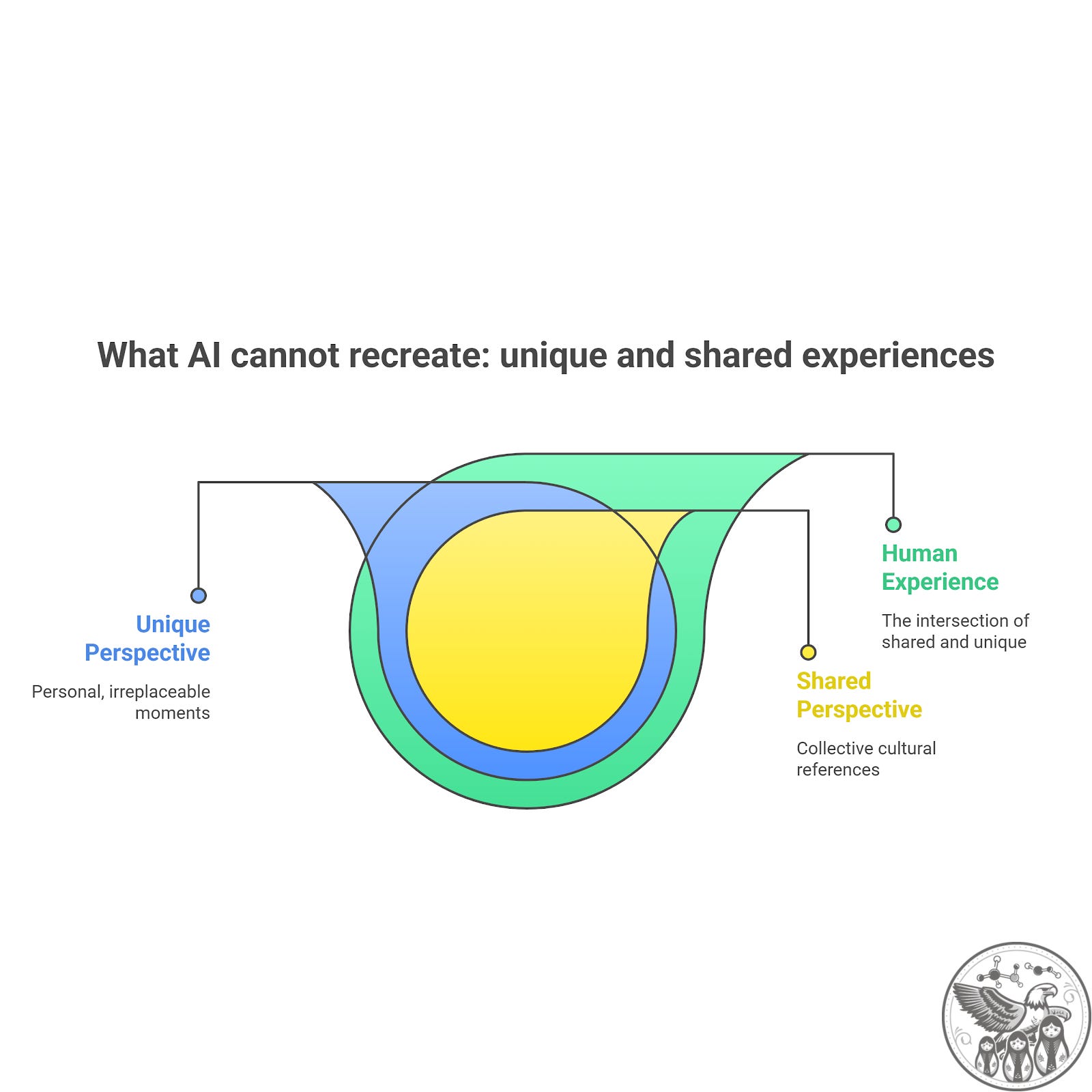
At its core, this piece about editing AI content is really about one question: “What is the unique value humans can still add to content?”

Image Credit: Kevin Indig

After countless nights wrestling with this question both intellectually and emotionally (hello, 3 a.m. anxiety!), I think I’ve finally cracked the code.

Based on my experience and from hours of “mixing” with AI, I’ve identified seven uniquely human writing capabilities that no AI can genuinely replicate:

  1. Patterns: Detecting subtle signals in wording, rhythm, and analogies that resonate with shared human experience.
  2. Topics: Intuitive understanding of what readers will find genuinely interesting or relevant.
  3. Experience: Personal stories and perspectives, especially from individuals with established reputations.
  4. Judgment: Applying nuanced moral reasoning beyond programmed guidelines.
  5. Taste: Making decisions about what works stylistically.
  6. Richness: Describing tastes, smells, textures, and sensations from lived experience.
  7. Secrets: Incorporating insights or data not available in AI training sets.

While humans sometimes overestimate true novelty (most progress is incremental), we remain the essential curators of AI output.

Maybe what matters most isn’t whether AI created something but whether humans recognize its value.

Image Credit: Kevin Indig

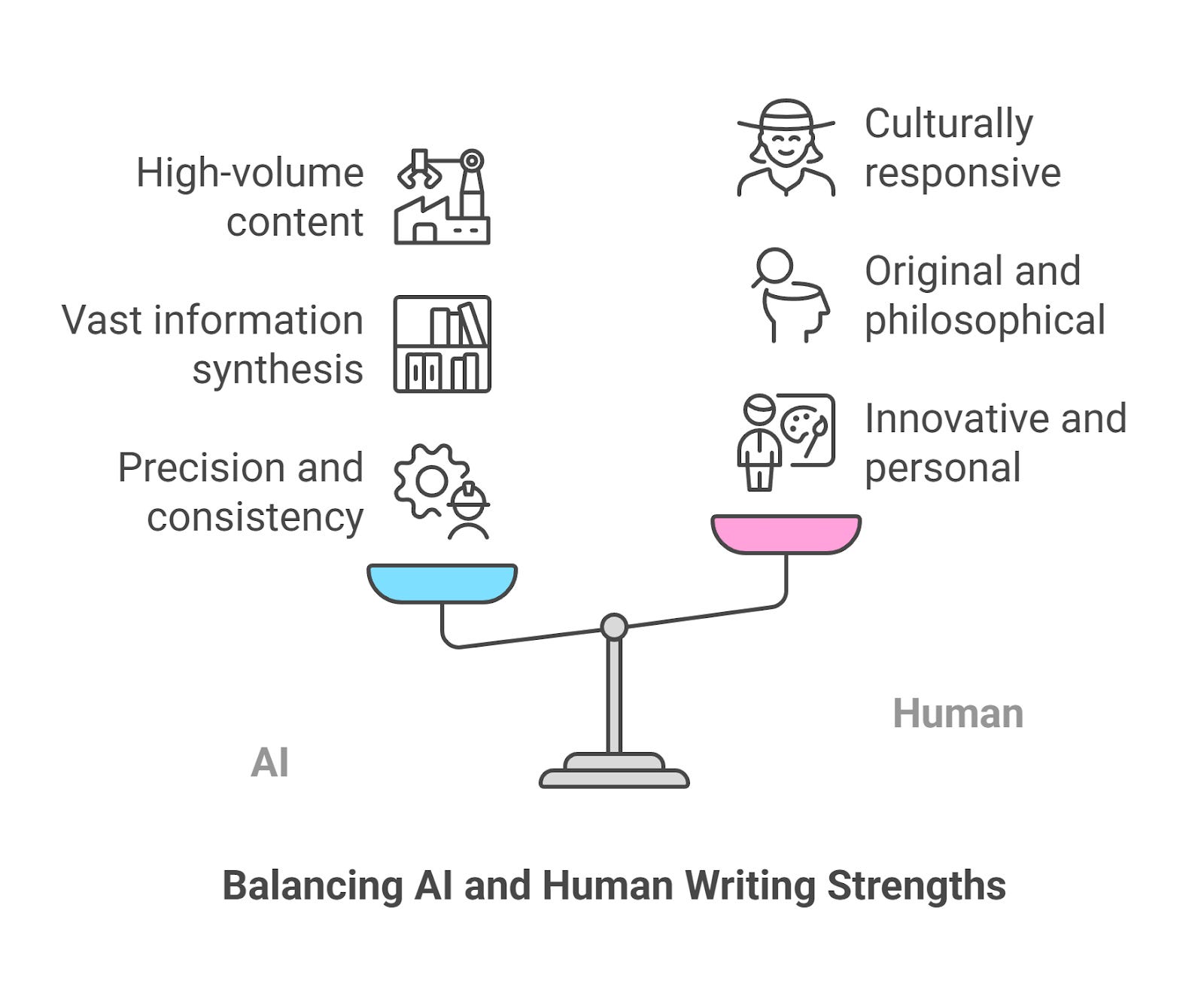
To contrast the strengths of AI vs. humans, I want to break it down across four categories:

  1. Technical execution.
  2. Knowledge & information.
  3. Production & adaptation.
  4. Data & emotional intelligence.

1. Technical Execution

AI:

  • Processing and error prevention (grammar, spelling, consistency).
  • Maintaining strict formatting across long documents.
  • Following detailed content guidelines with precision.
  • Producing grammatically accurate content at scale.

Humans:

  • Breaking established rules in meaningful, innovative ways.
  • Creating new styles, formats, and genre-bending approaches.
  • Developing distinctive personal writing styles.
  • Writing with an authentic voice from lived experience.

2. Knowledge & Information

AI:

  • Synthesizing information from vast knowledge bases.
  • Generating factual content when based on data.
  • Creating comprehensive explanations of complex topics.
  • Cross-referencing information from multiple domains.

Humans:

  • Contributing original research and firsthand observations.
  • Developing genuinely novel philosophical insights.
  • Creating work driven by authentic moral conviction.
  • Writing from a deep cultural understanding of specific communities.

3. Production & Adaptation

AI:

  • Generating high volumes of content quickly.
  • Creating variations on existing themes and formats.
  • Translating between languages with high accuracy.
  • Restructuring content for different audiences and platforms.

Humans:

  • Inventing entirely new literary forms and approaches.
  • Crafting narratives that respond to the cultural moment.
  • Creating humor that relies on nuanced cultural context.
  • Developing satire that addresses contemporary issues.

4. Data & Emotional Intelligence

AI:

  • Converting structured data into readable narratives.
  • Summarizing lengthy content while preserving key information.
  • Creating consistent documentation from technical specifications.
  • Adapting content across multiple formats and channels.

Humans:

  • Creating characters with complex, contradictory motivations.
  • Writing dialogue that captures psychological nuance.
  • Conveying subtle emotional states through deliberate word choice.
  • Crafting stories that evoke powerful emotional responses.

Humans should let AI handle the baseline 80% – the beat-matching and tempo control, if you will.

And we should focus our creative energy on that critical 20% where we mix in the samples that nobody else has:our unique perspectives, surprising stories, moral nuance, cultural references, and truly novel ideas.

Now that we understand what makes human content valuable, we need to recognize what makes AI content feel off-putting.

Just as an amateur DJ might technically match beats but still create an awkward, lifeless set, AI writing has specific patterns that signal “something’s not quite right here.”

Remember how even digital DJs still need to read the room?

Similarly, while modern language models can technically string words together beautifully, they still miss crucial human signals.

Through deep research and client work, I’ve identified 11 telltale signs that scream “an AI made this” – patterns that instantly disconnect readers:

  • Sterile language: Overly formal phrasing that no human would actually use.
  • Structural monotony: Predictable sentence patterns that create a hypnotic rhythm.
  • Awkward transitions: Abrupt jumps between ideas without natural connective tissue.
  • Robotic tone: An impersonal voice that keeps readers at arm’s length.
  • Factual shakiness: Assertions that sound plausible but don’t hold up to scrutiny.
  • Personality vacuum: Writing devoid of quirks, humor, or authentic perspective.
  • Generic coverage: Surface-level treatment of predictable topics.
  • Sourceless claims: Data statements without proper attribution.
  • Shallow insights: Ideas that never push beyond the obvious.
  • Brand misalignment: Content that doesn’t match your established voice.
  • Weak bookends: Forgettable openings and conclusions that fail to engage.

The markers really stand out.

In the paper “Linguistic Markers of Inherently False AI Communication and Intentionally False Human Communication,”2researchers were able to detect 80% of AI content accurately by looking for:

  • More emotional/affective language.
  • More analytic writing style.
  • More descriptive (higher use of adjectives).
  • Less readable (more complex sentence structures).

Ironically, many human writers display these same weaknesses.

The difference? Humans can learn to overcome them.

The DJ analogy really comes full circle here.

Just as the best DJs don’t simply play songs in sequence but create something new through their mixing, the most effective content creators don’t just edit AI output – they transform it.

In today’s landscape, the most valuable content comes from creators who:

  1. Understand where AI tools excel (the technical baseline).
  2. Recognize where human input is essential (those seven unique capabilities).
  3. Can identify and eliminate those telltale AI patterns.
  4. Know how to blend the two seamlessly into something greater than the sum of its parts.

We’re not just editing AI content – we’re remixing it with our uniquely human perspective, creating something that no algorithm could generate alone.

Because ultimately, the most compelling content doesn’t come from humans fighting against AI or from AI attempting to replace humans. It comes from the thoughtful collaboration between both.

Next week, I’ll break down my exact workflow for editing AI content – the practical techniques I use daily to transform sterile AI output into content that genuinely resonates, connects, and performs.

You’ll learn how to efficiently leverage these tools while ensuring your content maintains that irreplaceable human touch.


1 Serato

2 Linguistic Markers of Inherently False AI Communication and Intentionally False Human Communication: Evidence From Hotel Reviews


Featured Image: Paulo Bobita/Search Engine Journal

Shopify CEO’s Memo Marks A Pivotal Moment For AI In The Workplace via @sejournal, @martinibuster

A memo by Shopify’s CEO Tobi Lütke sets a company-wide expectation for the use of AI not just throughout the company but also encourages employees to think about how their end users can use AI. Everyone needs to read this because it marks a pivotal moment in how everyone should be using AI to hundredfold increase what they can accomplish and to visualize how AI can be employed for end users as well.

The internal memo details a company-wide reflexive AI usage strategy, which means using AI as a matter of course. It sets the stage for reshaping how merchants use Shopify and points toward a future where entrepreneurship on Shopify is AI-native by design. The memo signals how AI is swiftly becoming central to how all businesses will operate, especially yours.

Reflexive Use Of AI

The heart of the memo is the CEOs encouragement of discovering how AI can be applied to every aspect of how work gets done internally, citing his own usage of AI and how he feels he’s only scratching the surface of how it can be integrated into his own workflow. He asks all employees to “tinker” with AI and encourage company-wide adoption so that the usage of AI becomes reflexive.

His use of the word reflexive is important because it means doing something without consciously thinking about it. The express meaning then is that he really wants AI everywhere and the reason for that is because AI has the ability to boost productivity not just ten times but a hundredfold.

Tobias advocates for the transformational qualities of AI as a productivity multiplier, citing the reflexive use of it for unlocking exponential gains in what can be accomplished at Shopify.

He wrote:

“We are all lucky to work with some amazing colleagues, the kind who contribute 10X of what was previously thought possible. It’s my favorite thing about this company. And what’s even more amazing is that, for the first time, we see the tools become 10X themselves.

I’ve seen many of these people approach implausible tasks, ones we wouldn’t even have chosen to tackle before, with reflexive and brilliant usage of AI to get 100X the work done.”

Workplace Expectations and Requirements

What’s important about the Lütke memo is that it sets expectations about the use of AI in the workplace in a way that should serve as an inspiration for how all workplaces may consider following as well.

Using AI effectively is now a fundamental expectation of all Shopify employees and it will be factored into the peer and performance review questionnaires. Employees will be mandated to demonstrate why AI cannot be used to accomplish goals before asking for more resources. The expectations for AI usage is not just about software engineers, it applies to all employees, including all the way to the top at the executive management level.

AI At Every Workflow Step

The memo sets the expectation that AI must be involved during the GSD (Get Sh*t Done) prototype phase and at a “fraction of the time it used to take.” Teams are also encouraged to envision their projects as if AI were also a part of the team.

He writes:

“What would this area look like if autonomous AI agents were already part of the team? This question can lead to really fun discussions and projects.”

And elsewhere:

“In my On Leadership memo years ago, I described Shopify as a red queen race based on the Alice in Wonderland story—you have to keep running just to stay still. In a company growing 20-40% year over year, you must improve by at least that every year just to re-qualify. This goes for me as well as everyone else.

This sounds daunting, but given the nature of the tools, this doesn’t even sound terribly ambitious to me anymore. It’s also exactly the kind of environment that our top performers tell us they want. Learning together, surrounded by people who also are on their own journey of personal growth and working on worthwhile, meaningful, and hard problems is precisely the environment Shopify was created to provide. This represents both an opportunity and a requirement, deeply connected to our core values of Be a Constant Learner and Thrive on Change. These aren’t just aspirational phrases—they’re fundamental expectations that come with being a part of this world-class team. This is what we founders wanted, and this is what we built.”

Learning, Collaboration, and Community

The other exciting part of Lütke’s memo for AI usage in the workplace is that he encourages employees to share their discoveries and breakthroughs with each other so that all employees can benefit from new and creative ways of getting things done with AI, to share all of their wins with each other.

“We’ll learn and adapt together as a team. We’ll be sharing Ws (and Ls!) with each other as we experiment with new AI capabilities, and we’ll dedicate time to AI integration in our monthly business reviews and product development cycles. Slack and Vault have lots of places where people share prompts that they developed, like #revenue-ai-use-cases and #ai-centaurs.”

Takeaways

Lütke’s memo shows how AI is radically changing the workplace at Shopify and how it can spread across every workforce, including your own.

Shopify is envisioning the next stage of ecommerce entrepreneurship, AI-everything, where AI is an ubiquitous presence for merchants. This is an example of the kind of leadership all entrepreneurs and small businesses should have, to start thinking of how they can integrate AI for themselves and their customers instead of lowering the window blinds to spy across the street to see what competitors are doing.

Read the entire memo:

Featured Image by Shutterstock/TarikVision

Studies Reveal Consumers Easily Detect AI-Generated Content via @sejournal, @MattGSouthern

Two new studies reveal that most consumers can easily spot AI-generated content, both images and text, which may be more than marketers expected.

The results suggest that brands should be careful when using AI in their marketing materials.

Consumers Identify AI-Generated Images

A study by digital marketing consultant Joe Youngblood found that U.S. consumers correctly spotted AI images 71.63% of the time when shown real photos side-by-side with AI versions.

The study surveyed over 4,000 Americans of different ages.

Youngblood states:

“When asking them to determine which photo was real and which one was AI, over 70% of consumers on average could correctly select the AI generated image,”

Detection rates varied by type of image:

  • Celebrity images (Scarlett Johansson as Black Widow): 88.78% identified correctly
  • Natural landscapes (Italian countryside): 88.46% identified correctly
  • Animal photos (baby peacock): 87.97% identified correctly
  • Space images (Jupiter): 83.58% identified correctly

However, some images were more challenging to detect. Only 18.05% correctly spotted an AI version of the Eiffel Tower, and 50.89% identified an AI-created painting of George Washington.

Similar Skepticism Toward AI-Written Content

A separate report by Hookline& surveyed 1,000 Americans about AI-written content.

Key findings include:

  • 82.1% of respondents can spot AI-written content at least some of the time.
  • Among those aged 22–34, the rate rises to 88.4%.
  • Only 11.6% of young people said they never notice AI content.

Christopher Walsh Sinka, CEO of Hookline&, stated:

“Writers and brands aren’t sneaking AI-generated content past readers.”

Reputational Risks for Brands and Writers

Both studies point to the risks of using AI in content.

From the image study, Youngblood warned,

“If consumers determine that AI images are poor quality or a bad fit they may hold that against your brand/product/services.”

The content study showed:

  • 50.1% of respondents would think less of writers who use AI.
  • 40.4% would view brands more negatively if they used AI-generated content.
  • Only 10.1% would view the brands more favorably.

Older consumers (ages 45–65) were the most critical. Nearly 30% said they did not like AI-written content.

Acceptable Use Cases for AI

Despite the caution, both studies indicate that some uses of AI are acceptable to consumers.

The content report found that many respondents approved of using AI for:

  • Brainstorming ideas (53.7%)
  • Conducting research (55.8%)
  • Editing content (50.8%)
  • Data analysis (50.1%)

In the image study, Youngblood noted that consumers might accept AI for fun and informal uses such as memes, video game sprites, cartoons, and diagrams.

However, for important decisions, they prefer real images.

What This Means

These studies offer guidance for those considering incorporating AI-generated content in marketing material:

  1. Be Transparent: Since many consumers can spot AI-generated content, honesty about its use may help maintain trust.
  2. Focus on Quality: Both studies suggest that genuine, professionally produced content is seen as more reliable.
  3. Use AI Wisely: Save AI for tasks like research and editing, but let people handle creative decisions.
  4. Know Your Audience: Younger consumers may be more accepting of AI than older groups. Tailor your strategy accordingly.

Future marketing campaigns should consider how well consumers can detect AI content and adjust their strategies to maintain trust and credibility.

Google DeepMind’s AGI Plan: What Marketers Need to Know via @sejournal, @MattGSouthern

Google DeepMind has shared its plan to make artificial general intelligence (AGI) safer.

The report, titled “An Approach to Technical AGI Safety and Security,” explains how to stop harmful AI uses while amplifying its benefits.

Though highly technical, its ideas could soon affect the AI tools that power search, content creation, and other marketing technologies.

Google’s AGI Timeline

DeepMind believes AGI may be ready by 2030. They expect AI to work at levels that surpass human performance.

The research explains that improvements will happen gradually rather than in dramatic leaps. For marketers, new AI tools will steadily become more powerful, giving businesses time to adjust their strategies.

The report reads:

“We are highly uncertain about the timelines until powerful AI systems are developed, but crucially, we find it plausible that they will be developed by 2030.”

Two Key Focus Areas: Preventing Misuse and Misalignment

The report focuses on two main goals:

  • Stopping Misuse: Google wants to block bad actors from using powerful AI. Systems will be designed to detect and stop harmful activities.
  • Stopping Misalignment: Google also aims to ensure that AI systems follow people’s wishes instead of acting independently.

These measures mean that future AI tools in marketing will likely include built-in safety checks while still working as intended.

How This May Affect Marketing Technology

Model-Level Controls

DeepMind plans to limit certain AI features to prevent misuse.

Techniques like capability suppression ensure that an AI system willingly withholds dangerous functions.

The report also discusses harmlessness post-training, which means the system is trained to ignore requests it sees as harmful.

These steps imply that AI-powered content tools and automation systems will have strong ethical filters. For example, a content generator might refuse to produce misleading or dangerous material, even if pushed by external prompts.

System-Level Protections

Access to the most advanced AI functions may be tightly controlled. Google could restrict certain features to trusted users and use monitoring to block unsafe actions.

The report states:

“Models with dangerous capabilities can be restricted to vetted user groups and use cases, reducing the surface area of dangerous capabilities that an actor can attempt to inappropriately access.”

This means that enterprise tools might offer broader features for trusted partners, while consumer-facing tools will come with extra safety layers.

Potential Impact On Specific Marketing Areas

Search & SEO

Google’s improved safety measures could change how search engines work. New search algorithms might better understand user intent and trust quality content that aligns with core human values.

Content Creation Tools

Advanced AI content generators will offer smarter output with built-in safety rules. Marketers might need to set their instructions so that AI can produce accurate and safe content.

Advertising & Personalization

As AI gets more capable, the next generation of ad tech could offer improved targeting and personalization. However, strict safety checks may limit how much the system can push persuasion techniques.

Looking Ahead

Google DeepMind’s roadmap shows a commitment to advancing AI while making it safe.

For digital marketers, this means the future will bring powerful AI tools with built-in safety measures.

By understanding these safety plans, you can better plan for a future where AI works quickly, safely, and in tune with business values.


Featured Image: Shutterstock/Iljanaresvara Studio