Unleashing the potential of qubits, one molecule at a time

It all began with a simple origami model. 

As an undergrad at Harvard, Danna Freedman went to a professor’s office hours for her general chemistry class and came across an elegant paper model that depicted the fullerene molecule. The intricately folded representation of chemical bonds and atomic arrangements sparked her interest, igniting a profound curiosity about how the structure of molecules influences their function. 

She stayed and chatted with the professor after the other students left, and he persuaded her to drop his class so she could instead dive immediately into the study of chemistry at a higher level. Soon she was hooked. After graduating with a chemistry degree, Freedman earned a PhD at the University of California, Berkeley, did a postdoc at MIT, and joined the faculty at Northwestern University. In 2021, she returned to MIT as the Frederick George Keyes Professor of Chemistry.

Freedman’s fascination with the relationship between form and function at the molecular level laid the groundwork for a trailblazing career in quantum information science, eventually leading her to be honored with a 2022 MacArthur fellowship—and the accompanying “genius” grant—as one of the leading figures in the field.

Today, her eyes light up when she talks about the “beauty” of chemistry, which is how she sees the intricate dance of atoms that dictates a molecule’s behavior. At MIT, Freedman focuses on creating novel molecules with specific properties that could revolutionize the technology of sensing, leading to unprecedented levels of precision. 

Designer molecules

Early in her graduate studies, Freedman noticed that many chemistry research papers claimed to contribute to the development of quantum computing, which exploits the behavior of matter at extremely small scales to deliver much more computational power than a conventional computer can achieve. While the ambition was clear, Freedman wasn’t convinced. When she read these papers carefully, she found that her skepticism was warranted.

“I realized that nobody was trying to design magnetic molecules for the actual goal of quantum computing!” she says. Such molecules would be suited to acting as quantum bits, or qubits, the basic unit of information in quantum systems. But the research she was reading about had little to do with that. 

Nevertheless, that realization got Freedman thinking—could molecules be designed to serve as qubits? She decided to find out. Her work made her among the first to use chemistry in a way that demonstrably advanced the field of quantum information science, which she describes as a general term encompassing the use of quantum technology for computation, sensing, measurement, and communication. 

Unlike traditional bits, which can only equal 0 or 1, qubits are capable of “superposition”—simultaneously existing in multiple states. This is why quantum computers made from qubits can solve large problems faster than classical computers. Freedman, however, has always been far more interested in tapping into qubits’ potential to serve as exquisitely precise sensors.

Qubits store information in quantum properties that can be easily disrupted. While the delicacy of those properties makes qubits hard to control, it also makes them especially sensitive and therefore very useful as sensors.

Qubits encode information in quantum properties—such as spin and energy—that can be easily disrupted. While the delicacy of those properties makes qubits hard to control, it also makes them especially sensitive and therefore very useful as sensors.

Harnessing the power of qubits is notoriously tricky, though. For example, two of the most common types—superconducting qubits, which are often made of thin aluminum layers, and trapped-ion qubits, which use the energy levels of an ion’s electrons to represent 1s and 0s—must be kept at temperatures approaching absolute zero (–273 °C). Maintaining special refrigerators to keep them cool can be costly and difficult. And while researchers have made significant progress recently, both types of qubits have historically been difficult to connect into larger systems.

Eager to explore the potential of molecular qubits, Freedman has pioneered a unique “bottom-up” approach to creating them: She designs novel molecules with specific quantum properties to serve as qubits targeted for individual applications. Instead of focusing on a general goal such as maximizing coherence time (how long a qubit can preserve its quantum state), she begins by asking what kinds of properties are needed for, say, a sensor meant to measure biological phenomena at the molecular level. Then she and her team set out to create molecules that have these properties and are suitable for the environment where they’d be used. 
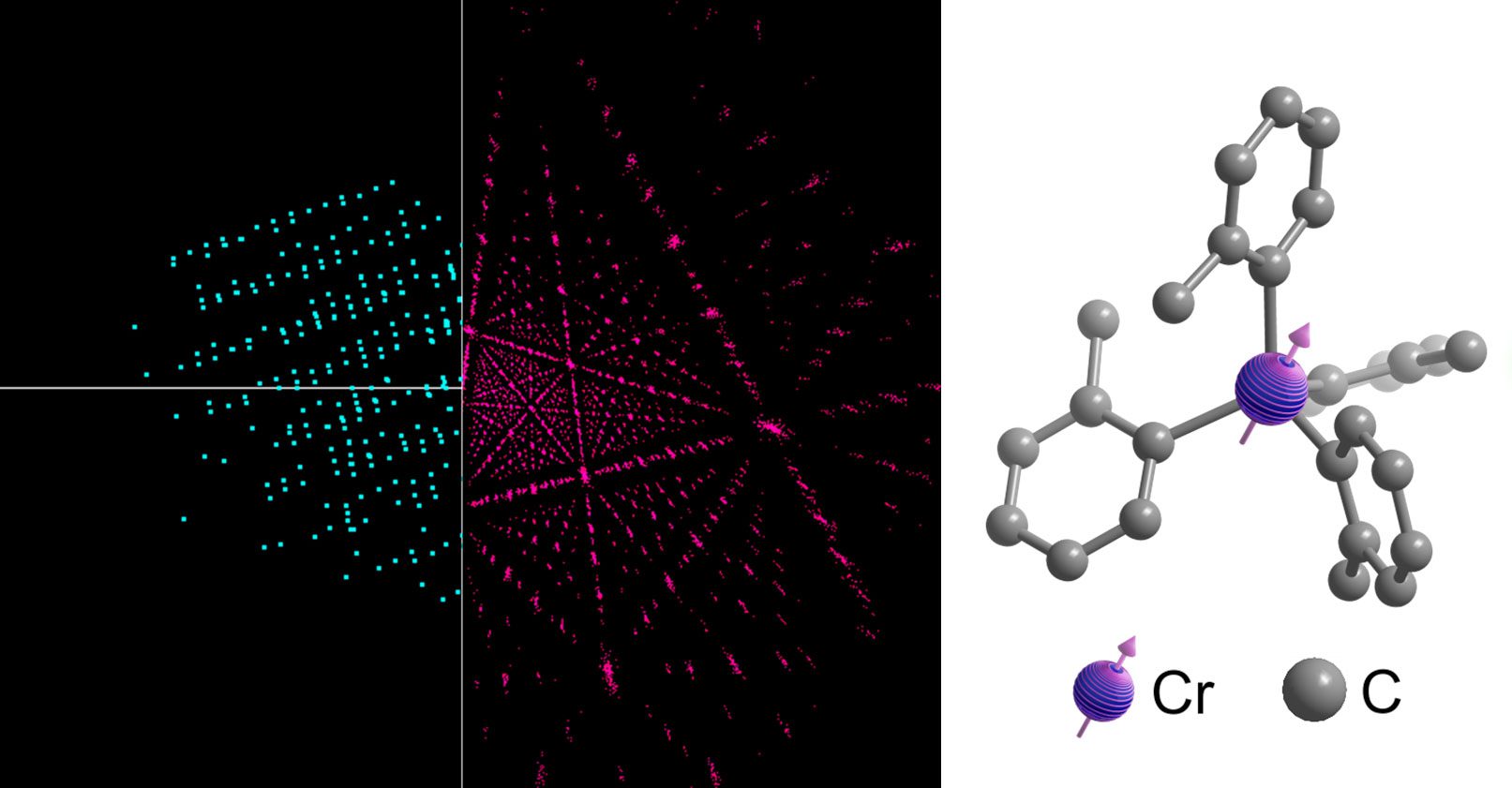
To determine the precise structure of a new molecule, Freedman’s team uses software to analyze and process visualizations (such as those in teal and pink above) of data collected by an x-ray diffractometer. The diagram at right depicts an organometallic Cr(IV) complex made of a central chromium atom and four hydrocarbon ligands.
COURTESY OF DANNA FREEDMAN

Made of a central metallic atom surrounded by hydrocarbon atoms, molecular qubits store information in their spin. The encoded information is later translated into photons, which are emitted to “read out” the information. These qubits can be tuned with laser precision—imagine adjusting a radio dial—by modifying the strength of the ligands, or bonds, connecting the hydrocarbons to the metal atom. These bonds act like tiny tuning forks; by adjusting their strength, the researchers can precisely control the qubit’s spin and the wavelength of the emitted photons. That emitted light can be used to provide information about atomic-level changes in electrical or magnetic fields. 

While many researchers are eager to build reliable, scalable quantum computers, Freedman and her group devote most of their attention to developing custom molecules for quantum sensors. These ultrasensitive sensors contain particles in a state so delicately balanced that extremely small changes in their environments unbalance them, causing them to emit light differently. For example, one qubit designed in Freedman’s lab, made of a chromium atom surrounded by four hydrocarbon molecules, can be customized so that tiny changes in the strength of a nearby magnetic field will change its light emissions in a particular way.  

A key benefit of using such molecules for sensing is that they are small enough—just a nanometer or so wide—to get extremely close to the thing they are sensing. That can offer an unprecedented level of precision when measuring something like the surface magnetism of two-­dimensional materials, since the strength of a magnetic field decays with distance. A molecular quantum sensor “might not be more inherently accurate than a competing quantum sensor,” says Freedman, “but if you can lose an order of magnitude of distance, that can give us a lot of information.” Quantum sensors’ ability to detect electric or magnetic changes at the atomic level and make extraordinarily precise measurements could be useful in many fields, such as environmental monitoring, medical diagnostics, geolocation, and more.

When designing molecules to serve as quantum sensors, Freedman’s group also factors in the way they can be expected to act in a specific sensing environment. Creating a sensor for water, for example, requires a water-compatible molecule, and a sensor for use at very low temperatures requires molecules that are optimized to perform well in the cold. By custom-­engineering molecules for different uses, the Freedman lab aims to make quantum technology more versatile and widely adaptable.

Embracing interdisciplinarity

As Freedman and her group focus on the highly specific work of designing custom molecules, she is keenly aware that tapping into the power of quantum science depends on the collective efforts of scientists from different fields.

“Quantum is a broad and heterogeneous field,” she says. She believes that attempts to define it narrowly hurt collective research—and that scientists must welcome collaboration when the research leads them beyond their own field. Even in the seemingly straightforward scenario of using a quantum computer to solve a chemistry problem, you would need a physicist to write a quantum algorithm, engineers and materials scientists to build the computer, and chemists to define the problem and identify how the quantum computer might solve it. 

MIT’s collaborative environment has helped Freedman connect with researchers in different disciplines, which she says has been instrumental in advancing her research. She’s recently spoken with neurobiologists who proposed problems that quantum sensing could potentially solve and provided helpful context for building the sensors. Looking ahead, she’s excited about the potential applications of quantum science in many scientific fields. “MIT is such a great place to nucleate a lot of these connections,” she says.

“As quantum expands, there are so many of these threads which are inherently interdisciplinary,” she says.

Inside the lab

Freedman’s lab in Building 6 is a beehive of creativity and collaboration. Against a backdrop of colorful flasks and beakers, researchers work together to synthesize molecules, analyze their structures, and unlock the secrets hidden within their intricate atomic arrangements.

“We are making new molecules and putting them together atom by atom to discover whether they have the properties we want,” says Christian Oswood, a postdoctoral fellow. 

Some sensitive molecules can only be made in the lab’s glove box, a nitrogen-filled transparent container that protects chemicals from oxygen and water in the ambient air. An example is an organometallic solution synthesized by one of Freedman’s graduate students, David Ullery, which takes the form of a vial of purple liquid. (“A lot of molecules have really pretty colors,” he says.)

Freedman is a passionate educator, dedicated to demystifying the complexities of chemistry for her students. Aware that many of them find the subject daunting, she strives to go beyond textbook equations.

Once synthesized, the molecules are taken to a single-crystal x-ray diffractometer a few floors below the Freedman lab. There, x-rays are directed at crystallized samples, and from the diffraction pattern, researchers can deduce their molecular structure—how the atoms connect. Studying the precise geometry of these synthesized molecules reveals how the structure affects their quantum properties, Oswood explains.

Researchers and students at the lab say Freedman’s cross-disciplinary outlook played a big role in drawing them to it. With a chemistry background and a special interest in physics, for example, Ullery joined because he was excited by the way Freedman’s research bridges those two fields. 
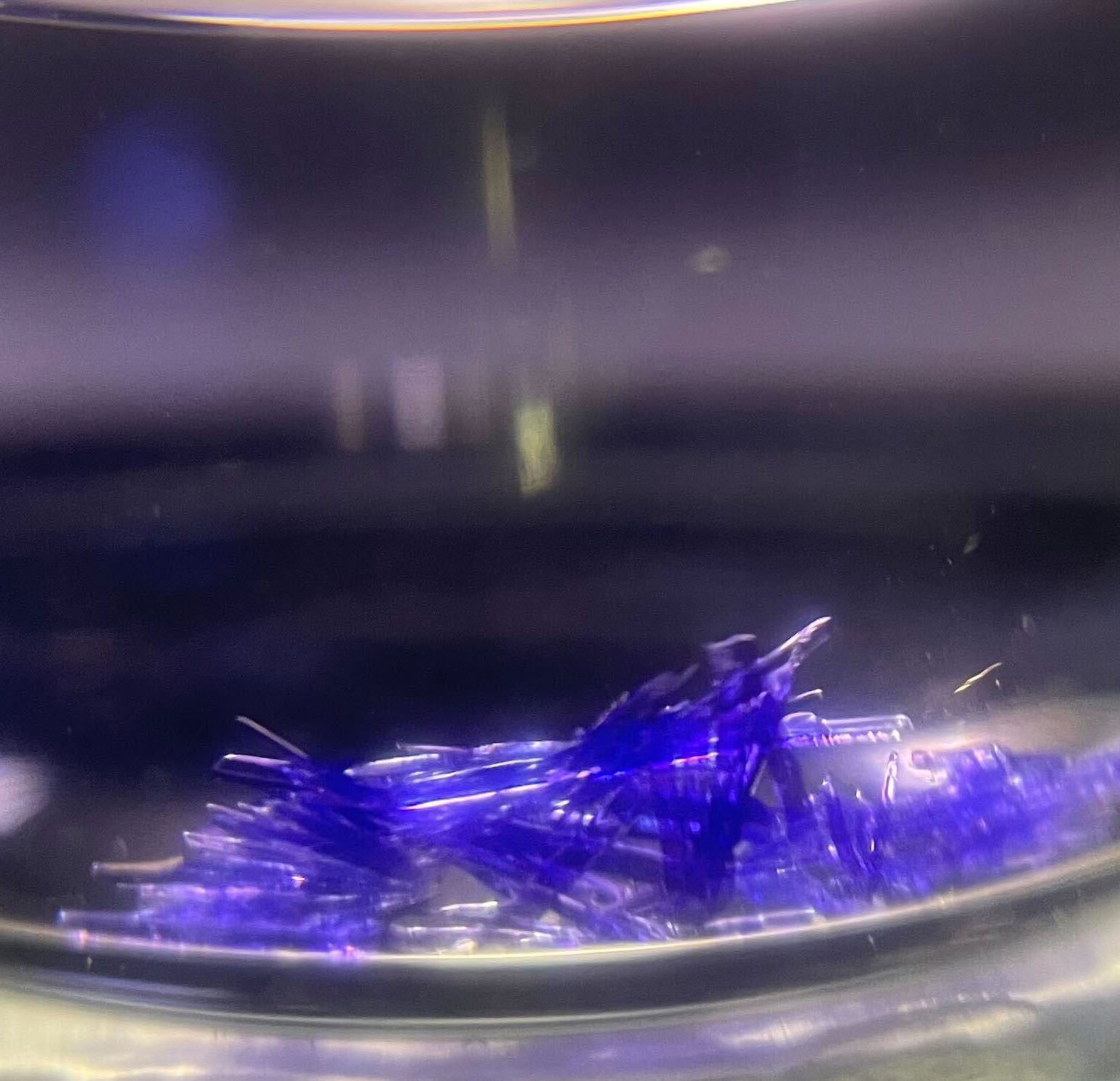
Crystals of an organometallic Cr(IV) complex. Freedman’s lab designed a series of molecules like this one to detect changes in a magnetic field.
COURTESY OF DANNA FREEDMAN

Others echo this sentiment. “The opportunity to be in a field that’s both new and expanding like quantum science, and attacking it from this specific angle, was exciting to me both intellectually and professionally,” says Oswood.

Another graduate student, Cindy Serena Ngompe Massado, says she enjoys being part of the lab because she gets to collaborate with scientists in other fields. “It allows you to really approach scientific challenges in a more holistic and productive way,” she says.

Though the researchers spend most of their time synthesizing and analyzing molecules, fun infuses the lab too. Freedman checks in with everyone frequently, and conversations often drift beyond just science. She’s just as comfortable chatting about Taylor Swift and Travis Kelce as she is discussing research.

“Danna is very personable and very herself with us,” Ullery says. “It adds a bit of levity to being in an otherwise stressful grad school environment.”

Bringing textbook chemistry to life

In the classroom, Freedman is a passionate educator, dedicated to demystifying the complexities of chemistry for her students. Aware that many of them find the subject daunting, she strives to go beyond textbook equations.

For each lecture in her advanced inorganic chemistry classes, she introduces the “molecule of the day,” which is always connected to the lesson plan. When teaching about bimetallic molecules, for example, she showcased the potassium rubidium molecule, citing active research at Harvard aimed at entangling its nuclear spins. For a lecture on superconductors, she brought a sample of the superconducting material yttrium barium copper oxide that students could handle. 

Chemistry students often think “This is painful” or “Why are we learning this?” Freedman says. Making the subject matter more tangible and showing its connection to ongoing research spark students’ interest and underscore the material’s relevance.
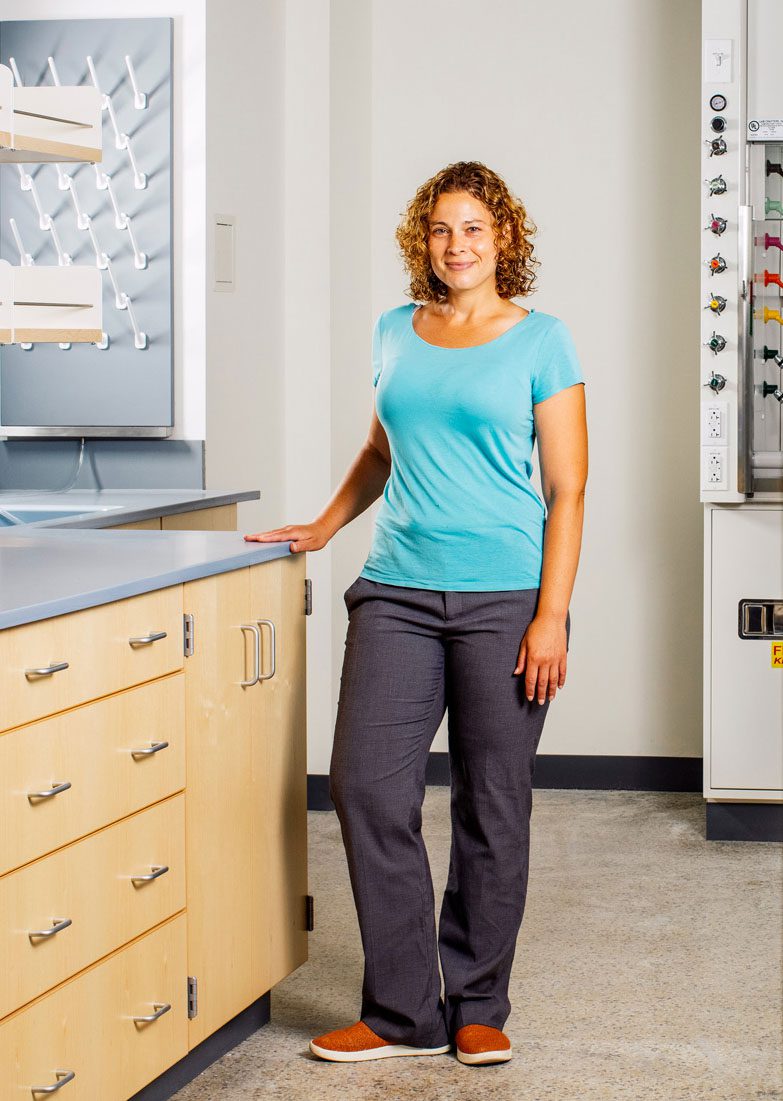
Danna Freedman
Freedman sees frustrating research as an opportunity to discover new things. “I like students to work on at least one ‘safer’ project along with something more ambitious,” she says.
M. SCOTT BRAUER/MIT NEWS OFFICE

Freedman believes this is an exceptionally exciting time for budding chemists. She emphasizes the importance of curiosity and encourages them to ask questions. “There is a joy to being able to walk into any room and ask any question and extract all the knowledge that you can,” she says. 

In her own research, she embodies this passion for the pursuit of knowledge, framing challenges as stepping stones to discovery. When she was a postdoc, her research on electron spins in synthetic materials hit what seemed to be a dead end that ultimately led to the discovery of a new class of magnetic material. So she tells her students that even the most difficult aspects of research are rewarding because they often lead to interesting findings. 

That’s exactly what happened to Ullery. When he designed a molecule meant to be stable in air and water and emit light, he was surprised that it didn’t—and that threw a wrench into his plan to develop the molecule into a sensor that would emit light only under particular circumstances. So he worked with theoreticians in Giulia Galli’s group at the University of Chicago, developing new insights on what drives emission, and that led to the design of a new molecule that did emit light. 

“Frustrating research is almost fun to deal with,” says Freedman, “even if it doesn’t always feel that way.” 

The Institute’s greatest ambassadors

After decades of working as a biologist at a Southern school with a Division 1 football team, coming to MIT was a bit of a culture shock—in the best possible way. I’ve heard from MIT alumni all about late-night psetting, when to catch MITHenge, and the best way to celebrate Pi Day (with pie, of course). And I’ve also learned that for many of you, the Institute is more than simply your alma mater. As the MIT Alumni Association celebrates its 150th anniversary, I’m reflecting on the extraordinary talent and drive of the people here, and what it is that makes MIT alumni—like MIT itself—just a little bit different.

As students, you learned to investigate, question, argue, critique, and refine your ideas with faculty and with each other, managing to be both collaborative and competitive. You hacked the toughest and most interesting problems and came up with the most unconventional solutions. And you developed and nurtured a uniquely entrepreneurial, hands-on MIT spirit that only those who have earned a degree here can fully understand, but that the rest of us can easily identify and admire.

An article in this magazine about the history of the MIT Alumni Association notes that when the association was formed, there were 84 alumni in total. By 1888, the number had increased to an impressive 579. And it grew by orders of magnitude; today nearly 149,000 alumni are members. But even as the alumni community has grown and evolved, its culture and character have remained remarkably consistent, represented by men and women known for their rigorous thinking, incisive analysis, mens et manus ethos, and drive to make a real and transformative impact on people and communities everywhere.

As MIT alumni, you recognize each other by your Brass Rats. These sturdy, cleverly designed rings not only signify your completion (some might say survival) of an immensely difficult course of study. They also signal to the world that you stand ready to share your expertise, knowledge, and experience in the service of humanity. 

Alumni have always been the Institute’s greatest ambassadors, and today that role has taken on even greater meaning and importance. We are working intensely, every day, to make the case for the vital importance of MIT to ensuring the nation’s security, prosperity, health, and quality of life. And I’m deeply grateful that we can rely on MIT’s extraordinary family of alumni to help share that message far and wide.

Bug-size robots that fly and flip could pollinate futuristic farms’ crops

Tiny flying robots could perform such useful tasks as pollinating crops inside multilevel warehouses, boosting yields while mitigating some of agriculture’s harmful impacts on the environment. The latest robo-bug from an MIT lab, inspired by the anatomy of the bee, comes closer to matching nature’s performance than ever before. 

Led by Kevin Chen, an associate professor in the Department of Electrical Engineering and Computer Science and the senior author of a paper on the work, the team adapted an earlier flying robot composed of four identical two-winged units, combined into a rectangular device about the size of a microcassette. The wings managed to flap like an insect’s, but the bot couldn’t fly for long. One problem is that the wings would blow air into each other when flapping, reducing the lift forces they could generate.

In the new design, each of the four units has a single flapping wing pointing away from the robot’s center, stabilizing the wings and boosting their lift forces. The researchers also improved the way the wings are connected to the actuators, or artificial muscles, that flap them. In previous designs, when the actuators’ movements reached the extremely high frequencies needed for flight, the devices often started buckling. That reduced the power and efficiency of the robot. Thanks in part to a new, longer wing hinge, the actuators now experience less mechanical strain and can apply more force, so the bots can fly faster, longer, and in more precise paths.

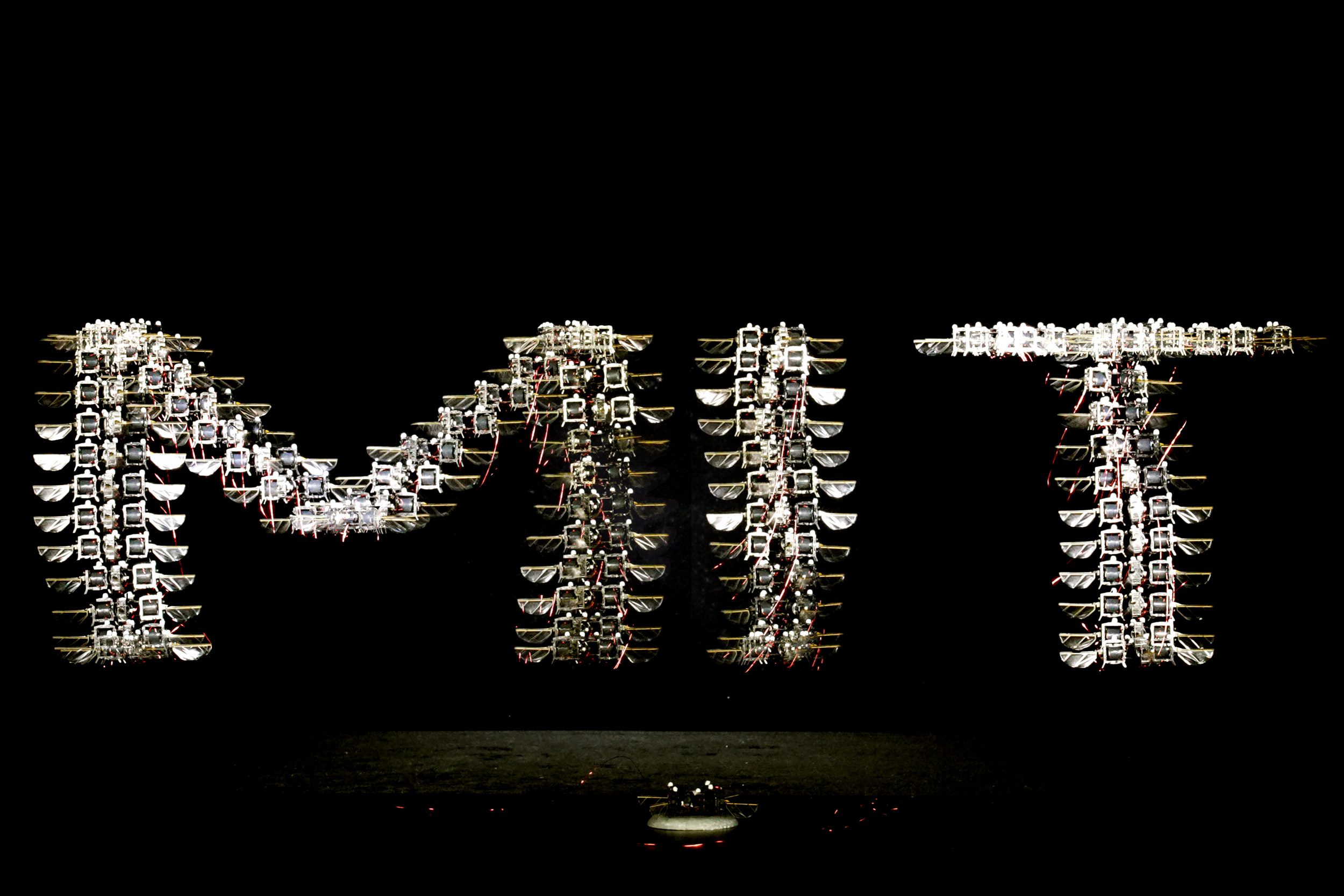
the motion of a robot captured in flight
The robots can precisely track a trajectory enough to spell M-I-T.
COURTESY OF THE RESEARCHERS

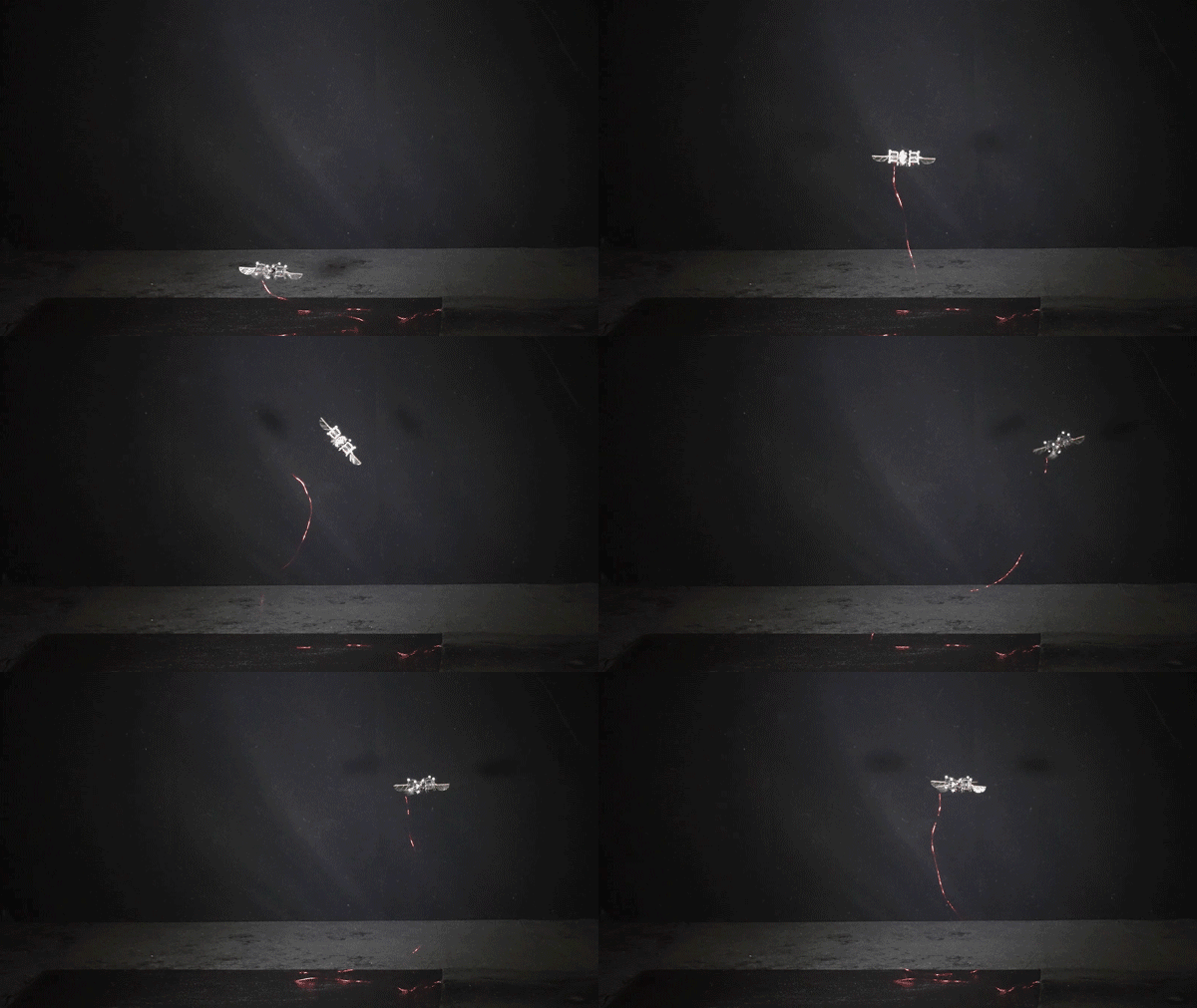
Weighing less than a paper clip, the new robotic insect can hover for more than 1,000 seconds—almost 17 minutes—without any degradation of flight precision.

“When my student Yi-Hsuan Hsiao was performing that flight, he said it was the slowest 1,000 seconds he had spent in his entire life. The experiment was extremely nerve-racking,” Chen says.

The new robot also reached an average speed of 35 centimeters per second, the fastest flight researchers have reported, and was able to perform body rolls and double flips. It can even precisely track a trajectory that spells M-I-T.

“At the end of the day, we’ve shown flight that is 100 times longer than anyone else in the field has been able to do, so this is an extremely exciting result,” Chen says.

COURTESY OF THE RESEARCHERS

From here, he and his students want to see how far they can push this new design, with the goal of achieving flight for longer than 10,000 seconds.

They also want to improve the precision of the robots so they could land in and take off from the center of a flower. In the long run, the researchers hope to install tiny batteries and sensors so the robots could fly and navigate outside the lab. The design has more room for those electronics now that they’ve halved the number of wings.

The bots still can’t achieve the fine-tuned behavior of a real bee, Chen acknowledges. Still, he says, “with the improved lifespan and precision of this robot, we are getting closer to some very exciting applications, like assisted pollination.” 

How the brain, with sleep, maps space

Scientists have known for decades that certain neurons in the hippocampus are dedicated to remembering specific locations where an animal has been. More useful, though, is remembering where places are relative to each other, and it hasn’t been clear how those mental maps are formed. A study by MIT neuroscientist Matthew Wilson and colleagues sheds light on that question. 

The researchers let mice explore mazes freely for about 30 minutes a day for several days. While the animals were wandering and while they were sleeping, the team monitored hundreds of neurons that they had engineered to flash when electrically active. Wilson’s lab has shown that animals essentially refine their memories by dreaming about their experiences.

The recordings showed that the “place cells” were equally active for days. But activity in another group of cells, which were only weakly attuned to individual places, gradually changed so that it correlated not with locations, but with activity patterns among other neurons in the network. As this happened, an increasingly accurate cognitive map of the maze took shape. Sleep played a crucial role in this process: When mice explored a new maze twice with a siesta in between, the mental maps of those allowed to sleep during the break showed significant refinement, while those of mice that stayed awake did not. 

“On day 1, the brain doesn’t represent the space very well,” says research scientist Wei Guo, the study’s lead author. “Neurons represent individual locations, but together they don’t form a map. But on day 5 they form a map. If you want a map, you need all these neurons to work together.”

Odd new tricks from a massive black hole

In 2018 astronomers at MIT and elsewhere observed previously unseen behavior from a black hole known as 1ES 1927+654, which is about as massive as a million suns and sits in a galaxy 270 million light-years away. Its corona—a cloud of whirling, white-hot plasma—suddenly disappeared before reassembling months later. 

Now members of the team have caught the same object exhibiting another strange pattern: Flashes of x-rays are coming from it at a steadily increasing clip. By looking through observations of the black hole taken by the European Space Agency’s XMM-Newton, a space-based observatory that detects and measures x-ray emissions from extreme cosmic sources, they found that the flashes increased from every 18 minutes to every seven minutes over a two-year period. 

One possible explanation is that the corona is oscillating. But the researchers believe the most likely culprit is a spinning white dwarf—an extremely compact core of a dead star orbiting around the black hole and getting closer to its event horizon, the boundary beyond which nothing can escape its gravitational pull. Circling closer would mean moving faster, explaining the increasing frequency of x-ray oscillations. 

If this is the case, the white dwarf could be coming right up to the black hole’s edge without falling in. “This would be the closest thing we know of around any black hole,” says Megan Masterson, a graduate student in physics at MIT, who reported the findings with associate professor Erin Kara and others. 

If a white dwarf is at the root of the mysterious flashing, it can also be expected to give off gravitational waves, detectable by next-generation observatories such as ESA’s Laser Interferometer Space Antenna (LISA). Its launch is currently planned for the mid-2030s.

“The one thing I’ve learned with this source is to never stop looking at it, because it will probably teach us something new,” Masterson says. “The next step is just to keep our eyes open.

Cheaper buildings, courtesy of mud

One costly and time-consuming step in constructing a concrete building is creating the “formwork,” the wooden mold into which the concrete is poured. Now MIT researchers have developed a way to replace the wood with lightly treated mud.

“What we’ve demonstrated is that we can essentially take the ground we’re standing on, or waste soil from a construction site, and transform it into accurate, highly complex, and flexible formwork for customized concrete structures,” says Sandy Curth, a PhD student in MIT’s Department of Architecture, who has helped spearhead the project.

The EarthWorks method, as it’s known, introduces some additives, such as straw, and a waxlike coating to the soil material. Then it’s 3D-printed into a custom-designed shape. “We found a way to make formwork that is infinitely recyclable,” Curth says. “It’s just dirt.”

A particular advantage of the technique is that the material’s flexibility makes it easier to create unique shapes optimized so that the resulting buildings use no more concrete than structurally necessary. This can significantly reduce the carbon emissions associated with concrete construction.

“What’s cool here is we’re able to make shape-optimized building elements for the same amount of time and energy it would take to make rectilinear building elements,” says Curth, who recently coauthored a paper on the work with MIT professors Lawrence Sass, SM ’94, PhD ’00; Caitlin Mueller ’07, SM ’14, PhD ’14; and others. He has also founded a firm, Forma Systems, through which he hopes to take EarthWorks into the construction industry.

A worldwide road trip for the Institute’s president

Soon after MIT’s 18th president, Sally Kornbluth, was inaugurated in May 2023, she made it a priority to expand her early on-campus listening tour to alumni living and working around the world. She wanted to learn more about their priorities and their connections with MIT, while also engaging them in her expansive vision for its future. 

This international “presidential welcome tour” brought Kornbluth to cities with large alumni communities, including New York, San Francisco, and Washington, DC, as well as London and Singapore. She mingled with alumni and friends, including MIT donors and the families of current students, at receptions that were followed by fireside chats with MIT alumni leaders. At these events, she underscored the ways alumni and friends can help promote the Institute’s mission—such as volunteering, donating, and spreading positive news from MIT throughout the world.

“I think that communication about the wonderful things that are going on at MIT to the broader community is actually really important,” she said. “There’s no place like MIT to address the serious problems of our time.”

The impact of the alumni community on MIT’s mission was further articulated by MIT Alumni Association CEO Whitney T. Espich, HM ’24. “You are the walking embodiment of MIT’s values and potential in the world,” she told alums. “It is this community that keeps taking on our toughest problems, healing our planet, leading on AI, and finding grand solutions in tiny quantum dots.”

Past MITAA president R. Robert Wickham ’93, SM ’95, who moderated the conversation with President Kornbluth in London, noted that the event gave him and his peers a renewed sense of MIT’s role in meeting the world’s greatest challenges, such as combating climate change, ensuring ethical AI, and treating and curing disease. “Energizing the global connectivity of our community is something that’s very important to me as an international alum, so having Sally come to London and meet with so many of our European-based alums was very special,” says Wickham. 

Natalie Lorenz Anderson ’84, the MITAA’s 2024–’25 president, traveled to Singapore for the tour’s final event. “I have found the president to be an excellent listener, very empathetic, attuned to the audience, and very wise in what she communicates,” says Lorenz Anderson. “There was such palpable energy, and alumni enjoyed hearing from her about the future of MIT. All five of these events have been a terrific way for alumni to get to know her.” 

Gooey greatness

A new type of glue developed by researchers from MIT and Germany combines sticky polymers inspired by the mussel with the germ-­fighting properties of another natural material: mucus.

To stick to a rock or a ship, mussels secrete a fluid full of proteins connected by chemical cross-links. As it happens, similar cross-linking features are found in mucin—a large protein that, besides water, is the primary component of mucus. George Degen, a postdoc in MIT’s Department of Mechanical Engineering and a coauthor of a paper on the work, wondered whether mussel-inspired polymers could link with chemical groups in mucin.

To test this idea, he combined solutions of natural mucin proteins with synthetic mussel-­inspired polymers and observed how the resulting mixture solidified and stuck to surfaces over time.

“It’s like a two-part epoxy. You combine two liquids together, and chemistry starts to occur so that the liquid solidifies while the substance is simultaneously gluing itself to the surface,” Degen says. 

The resulting gel strongly adheres even to wet surfaces while preventing the buildup of bacteria. The researchers envision that it could be injected or sprayed as a liquid, which would soon turn into a sticky gel. The material might coat medical implants, for example, to help prevent infection. The approach could also be adapted to incorporate other natural materials such as keratin, which might be used in sustainable packaging materials.

Studying the uninvited guests

Microbes that gobble up or break down environmental toxins can clean up oil spills, waste sites, and contaminated watersheds. But until his faculty mentor asked him for help with a project he was working on with doctors at Boston Children’s Hospital in 2009, Eric Alm had not thought much about their role in a very different environment: the human digestive system.

David Schauer, a professor of biological engineering, was examining how microorganisms in the gut might be linked to inflammatory bowel disease (IBD), and he hoped advanced statistical analysis of the data he was collecting could make those connections clearer. Alm, who’d joined the civil and environmental engineering faculty in 2006 as a computational biologist studying environmental uses of microbes, had the statistical experience needed and could apply machine-learning tools to help. But for him, the project was supposed to be a brief detour.  

In June of 2009, however, Schauer—just 48—died unexpectedly, only two weeks after falling ill. Alm, heartbroken, worked to help push his mentor’s project over the finish line. As that effort was underway, Neil Rasmussen ’76, SM ’80, a longtime member of the MIT Corporation and the philanthropist funding the project, asked for a tour of his lab. That encounter would change the course of Alm’s career.

At the end of the lab tour, Rasmussen, who has a family member with IBD, had a surprise: He asked Alm if he’d be willing to pivot to researching inflammatory bowel disease—and offered to fund his lab if he did so.

Alm was game. He began shifting the main focus of his research away from harnessing microbes for the environment and turned most of his attention to exploring how they could be applied to human health. Then Rasmussen decided he wanted to “do something really big,” as Alm puts it, and make Boston a hub for microbiome research. So in 2014, with a $25 million grant from the Neil and Anna Rasmussen Foundation, the Center for Microbiome Informatics and Therapeutics (CMIT) was launched with Alm and Ramnik Xavier, chief of gastroenterology at Massachusetts General Hospital, as its co-directors. 

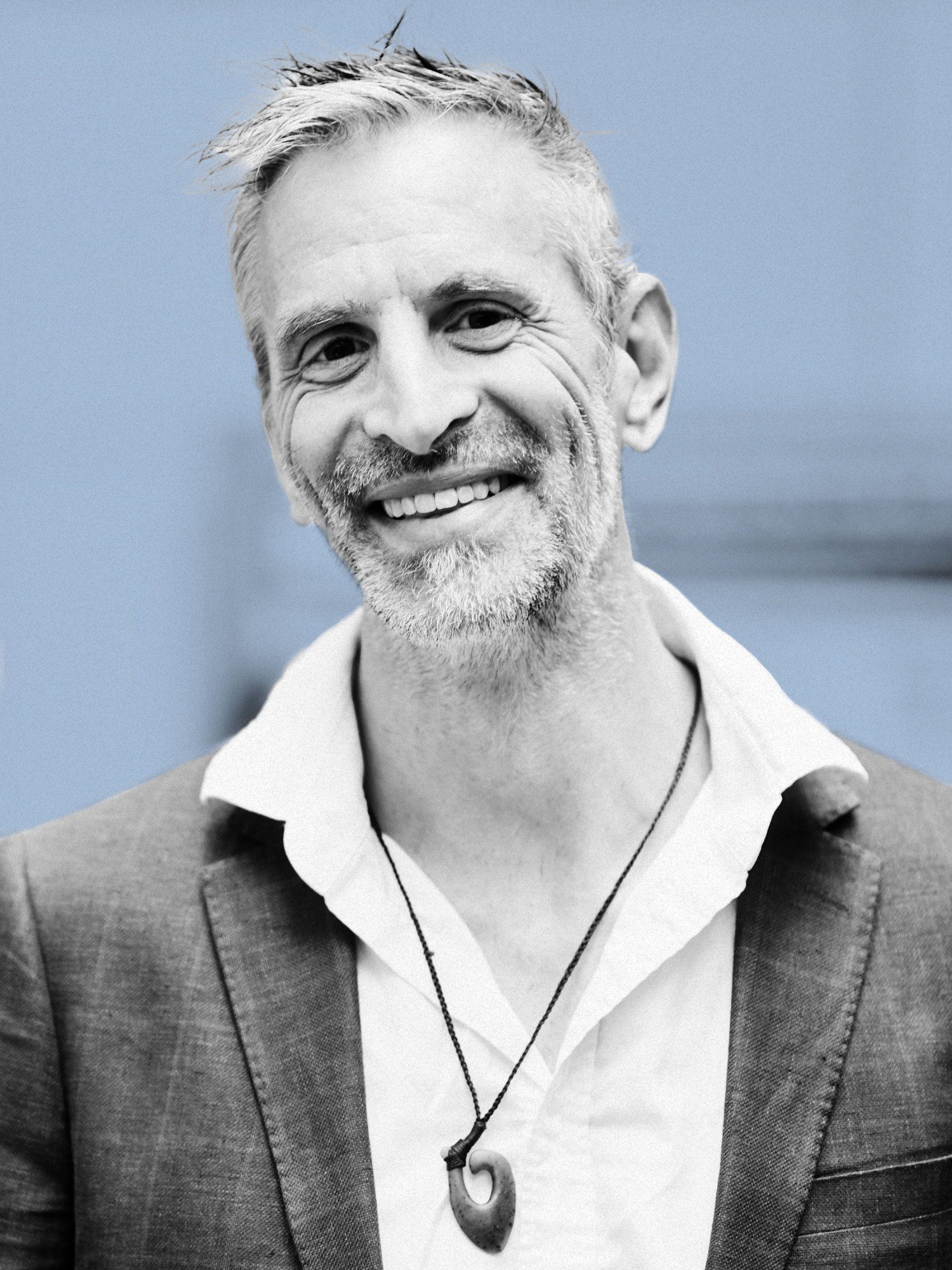
Eric Alm
CMIT co-director Eric Alm is a professor of biological engineering and civil and environmental engineering and an Institute Member of the Broad Institute. His research uses data science, quantitative analysis, and novel molecular techniques to
engineer the human microbiome.
COURTESY OF ERIC ALM

By teaming up with Alm and others, Rasmussen hoped to create a research hub where scientists, engineers, doctors, and next-generation trainees would collaborate across scientific disciplines. They would build the tools needed to support a new research field and translate cutting-­edge research into clinic-ready interventions for patients suffering from a wide range of inflammatory and autoimmune conditions influenced by the gut, including not only IBD but diabetes and Alzheimer’s—and potentially autism, Parkinson’s disease, and depression as well.  

In its first 10 years, CMIT has made remarkable progress. 

When the center started, Alm says, it was still a relatively novel idea that the human microbiome—particularly the community of trillions of symbiotic microbes that reside in the gut—might play a key role in human health. Few serious research programs existed to study this idea.  

“It was really this undiscovered territory,” he recalls. “[In] a lot of diseases where there seemed to be things that we couldn’t explain, a lot of people thought maybe the microbiome plays a role either directly or indirectly.”  

It has since become increasingly clear that the microbiome has a far greater impact on human health and development than previously thought. We now know that the human gut—often defined as the series of food-processing organs that make up the gastrointestinal tract—is home to untold trillions of microorganisms, each one a living laboratory capable of ingesting nutrients, sugars, and organic materials, digesting them, and releasing various kinds of organic outputs. And the metabolic outputs of these gut-dwelling microbes are similar to those of the liver, Alm says. In fact, the gut microbiome can essentially mirror some of the liver’s functions, helping the body metabolize carbohydrates, proteins, and fats by breaking down complex compounds into simpler molecules it can process more easily. But the gut’s outputs can change in either helpful or harmful ways if different microbes establish themselves within it. 

“I would love to have bacteria that live on my face and release sunscreen in response to light. Why can’t I have that?”

Tami Lieberman

“Our exquisite immune defenses evolved in response to the microbiome and continue to adapt during our lifetime,” Rasmussen says. “I believe that advancing the basic science of human interactions with the microbiome is central to understanding and curing chronic immune-­related diseases.”

By now, researchers affiliated with the center have published some 200 scientific papers, and it has found ways to advance microbiome research far beyond its walls. It funds a team at the Broad Institute (where Alm is now an Institute Member) that does assays and gene sequencing for scientists doing such research. Meanwhile, it has established one of the world’s most comprehensive microbiome “strain libraries,” facilitating studies around the globe.

To create this library—which includes strains in both the Broad Institute–OpenBiome Microbiome Library and the Global Microbiome Conservancy’s Biobank­—researchers have isolated more than 15,000 distinct strains of microbes that are found in the human gut. The library can serve as a reference for those hoping to gain information on microbes they have isolated on their own, but researchers can also use it if they need samples of specific strains to study. To supplement the strain library, CMIT-affiliated researchers have traveled to many corners of the globe to collect stool samples from far-flung indigenous populations, an effort that continues to this day through the Global Microbiome Conservancy.  

“We’re trying to build a critical mass and give folks working in different labs a central place where they can communicate and collaborate,” says Alm. “We also want to help them have access to doctors who might have samples they can use, or doctors who might have problems that need an engineering solution.”  

The clinical applications produced by CMIT have already affected the lives of tens of thousands of patients. One of the most significant began making an impact even before the center’s official launch. 

For decades, hospitals had been grappling with the deadly toll of bacterial infections caused by Clostridioides difficile (C. diff), a hardy, opportunistic bacterium that can colonize the gut of vulnerable patients, often after heavy doses of antibiotics wipe out beneficial microbes that usually keep C. diff at bay. The condition, which causes watery diarrhea, abdominal pain, fever, and nausea, can be resistant to conventional treatments. It kills roughly 30,000 Americans every year. 

By 2003, researchers had discovered that transplanting stool from a healthy donor into the colon of a sick patient could restore the healthy microbes and solve the problem. But even a decade later, there was no standardized treatment or protocol—relatives were often asked to bring in their own stool in ice cream containers. In 2013, Mark Smith, PhD ’14, then a graduate student in Alm’s lab, cofounded the nonprofit OpenBiome, the nation’s first human stool bank. OpenBiome developed rigorous methods to screen donors (people joke that it’s harder to get approved than to get into MIT or Harvard) and standardized the procedures for sample processing and storage. Over the years, the nonprofit has worked with some 1,300 health-care facilities and research institutions and facilitated the treatment of more than 70,000 patients—work that OpenBiome says helped set the stage for the US Food and Drug Administration to approve the first microbiome-based therapeutic for recurrent C. diff infections.  

Today, CMIT’s flagship effort is a 100-patient clinical trial that it launched to study IBD, using a wide array of technologies to monitor two cohorts of patients—one in the US and the other in the Netherlands—over the course of a year. People with Crohn’s disease and ulcerative colitis typically experience periods of full or partial remission, but they currently have no way to predict when they will relapse. So researchers are tracking weekly changes in each patient’s microbiome and other biological indicators while amassing continuous physiological data from Fitbits and recording self-reported symptom scores along with other clinical data. The goal is to identify biomarkers and other indicators that might be used to predict flare-ups so that already approved therapies can be used more effectively.

 Although data is still being collected, early analysis suggests that a patient’s gut microbiome begins to change six to eight weeks before flare symptoms appear, and a few weeks later, genetic analysis of epithelial cells in their stool samples starts to show signs of increased inflammation. The team is planning to host a hackathon this summer to help speed analysis of the mountain of disparate types of data being collected.  

Meanwhile, the community of clinicians, engineers, and scientists CMIT has nurtured is undertaking projects that Alm could hardly have imagined when he first delved into research on the human microbiome.

Survivor: Microbe edition 

Right below the photograph on the bio page of her Twitter/X account, Alyssa Haynes Mitchell has three emojis: a tiny laptop, a red and blue strand of DNA, and a smiling pile of poo. The digital hieroglyphics neatly sum up her area of focus as she pursues a doctorate in microbiology. A 2024 Neil and Anna Rasmussen fellow, Mitchell is attempting to understand precisely what it is that allows microbes to survive and thrive in the human gut.

Mitchell fell in love with the study of microbes as an undergrad at Boston University. First, her mind was blown after she read a paper by researchers who could create a facsimile of a patient’s intestinal cell population—a “gut on a chip”—and planned to culture a microbiome on it. She was fascinated by the idea that this might lead to personalized treatments for conditions like IBD. Then she cultured her first colony of a strain of the microbe Bacillus subtilis that had been genetically engineered to fluoresce. 

“They form these really complex ridges, and the more you look at microscopy images, the more you realize that there’s patterns of collective behavior of bacterial biofilms that we just don’t understand,” she says. “They’re super beautiful, and it’s really quite amazing to look at.” 

In 2023, Mitchell joined the lab of Tami Lieberman, an associate professor of civil and environmental engineering and a member of both CMIT and MIT’s Institute for Medical Engineering and Science. 

Mitchell and others who study the microbiome think that “probiotics,” beneficial microbes that are applied to the skin or ingested in supplements or foods such as yogurt or kombucha, could have broad potential to help treat disease. But for reasons that still aren’t well understood, once probiotics are introduced into the gut, only a small percentage of them are able to survive and proliferate, a process known as engraftment. A probiotic with an engraftment rate of 30% (meaning it’s still detectable in 30% of subjects) six months after administration is considered good, says Mitchell. She and Lieberman, who also holds the title of Hermann L.F. von Helmholtz Professor, are studying the way individual strains of microbes evolve to survive in the microbiome—a key mystery that needs to be solved to engineer more effective, longer-lasting therapies.   

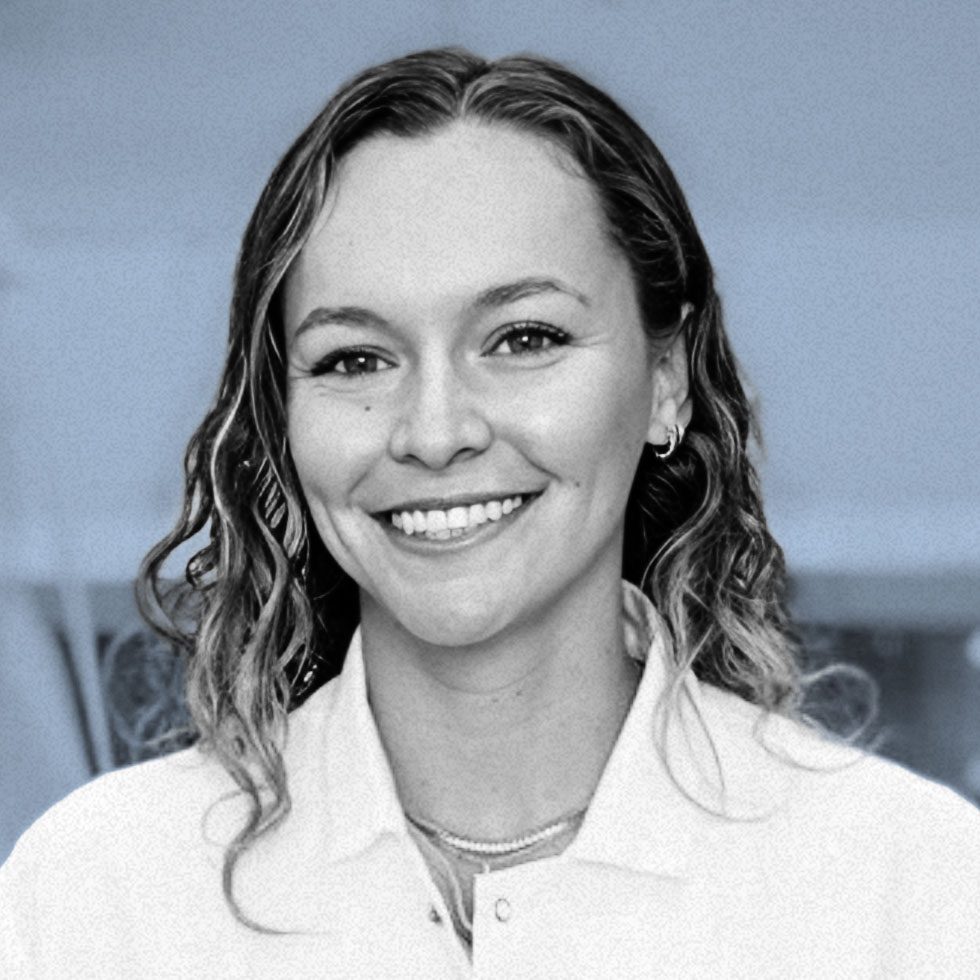
ALYSSA HAYNES MITCHELL

Alyssa Haynes Mitchell, a PhD student pursuing a doctorate in microbiology, is working with Tami Lieberman, an assistant professor of civil and environmental engineering, to study how strains of microbes evolve to survive in the gut. Lieberman also studies how microbes survive and proliferate on the skin.

“Hopefully if we learn a little bit more about what drives evolution of the ones that stick around, we might be able to learn why some don’t,” she says.

Mitchell has been working with samples collected by a local biotech company developing biotherapeutics for the gut. Its probiotic products, which are used to treat recurrent C. diff infections, contain eight closely related microbial strains belonging to the order known as Clostridiales. The company gave one of its products to 56 human subjects and collected stool samples over time. Mitchell is using genetic sequencing techniques to track how three of the microbial species evolved in 21 of the subjects. Identifying person-specific differences and similarities might reveal insights about the host environment and could help explain why some types of mutations allow some microbes to survive and thrive. The project is still in its early phases, but Mitchell has a working hypothesis.

“The model that I have in my mind is that people have different [gut] environments, and microbes are either compatible with them or not,” she says. “And there’s a window in which, if you’re a microbe, you might be able to stick around but maybe not thrive. And then evolution kind of gets you there. You might not be very fit when you land there, but you’re close enough to hang around and get there. Whereas in other people, you’re totally incompatible with what’s already there, and the resident microbes beat you out.”

Her work is just one of many projects using new approaches developed by Lieberman, who worked as a postdoc in Alm’s lab before starting her own in 2018. As a graduate student at Harvard, Lieberman gained access to more than 100 frozen samples collected from the airways, blood, and chest tissue of 14 patients with cystic fibrosis, a genetic disease that causes mucus to build up in the lungs and creates conditions ripe for infections. The patients were among those who had developed bacterial infections during an outbreak in the 1990s.  

Lieberman and her colleagues recognized a perfect opportunity to use genetic sequencing technologies to study the way the genome of the Burkholderia dolosa bacterium evolved when she cultured those samples. What was it that allowed B. dolosa to adapt and survive? Many of the surviving microbes, she discovered, had developed similar mutations independently in different patients, suggesting that at least some of these mutations helped them to thrive. The research indicated which genes were worthy of further study—and suggested that this approach holds promise for understanding what it takes for microbes to grow well in the human body.

Lieberman joined Alm’s lab in 2015, aiming to apply the same experimental paradigm and the statistical techniques she had developed to the emerging field of microbiome research. In her own lab, she has developed an approach to figuring out how the pressures of natural selection result in mutations that may help certain microbes to engraft. It involves studying colonies of bacteria that form on the human skin.

“The idea is to create a genetically engineered metabolite factory in the gut.”

Daniel Pascal

In the gut, Lieberman explains, hundreds of different species of microbes coexist and coevolve, forming a heterogeneous community whose members interact with one another in ways that are not fully understood. This creates a wide array of confounding variables that make it more difficult to identify why some engraft and others don’t. But on the skin, the metabolic environment is less complex, so fewer species of bacteria coexist. The smaller number of species makes it far easier to track the way the genomes of specific microbes change over time to facilitate survival, and the accessibility of the skin makes it easier to figure out how spatial structure and the presence of other microbes affect this process. 

One discovery from Lieberman’s lab is that each pore is dominated by just one random strain of a single species. Her group hypothesizes that survival may depend on the geometry of the pore and the location of the microbes. For example, as these anaerobic microbes typically thrive at the hard-to-access bottom of the pore, where there is less oxygen, the first to manage to get there can crowd out new migrants.

“My vision, and really a vision for the microbiome field in general,” Lieberman says, is that one day therapeutic microbes could be added to the body to treat medical conditions. “These could be microbes that are naturally occurring, or they could be genetically engineered microbes that have some property we want,” she adds. “But how to actually do that is really challenging because we don’t understand the ecology of the system.” Most bacteria introduced into a person’s system, even those taken from another healthy human, will not persist in the new person’s body, she notes, unless you “first bomb it with antibiotics” to get rid of most of the microbes that are already there. “Why that is,” she adds, “is something we really don’t understand.”

If Lieberman can solve the puzzle, the possible applications are tantalizing.  

“I would love to have bacteria that live on my face and release sunscreen in response to light,” she says. “Why can’t I have that? In the future, there’s no reason we can’t figure out how to do that in a safe and controlled manner. And it would be much more convenient than applying sunscreen every day.” 

Harnessing light-sensitive, sunblock-­producing microbes may sound like a distant fantasy. But it’s not beyond the realm of possibility. Other microbial products that sound straight out of a science fiction novel have already been invented in the lab. 

Molecular assassin

When Daniel Pascal first landed in the lab of MIT synthetic biologist Christopher Voigt, he had no idea he’d be staying on to make bacteria with superpowers. He was a first-year PhD student rotating through various labs, with little inkling of the potential contained in the microbes that live inside us.

Pascal, a 2024 Neil and Anna Rasmussen fellow who is pursuing a doctorate in biological engineering, was originally paired with a graduate student doing a more materials-­related synthetic biology project. But he came from a family of physicians and soon found himself speaking with other graduate students in the lab whose projects had to do with health. 

He then learned that two of the lab’s postdocs, Arash Farhadi and Brandon Fields, were receiving funding under a program sponsored by the Defense Advanced Research Projects Agency (DARPA), the Pentagon’s R&D organization, to develop solutions for common traveler’s ailments that result from problems like disrupted sleep cycles and limited access to safe food and water. When they explained that they hoped to harness microbes in the human body, they had his attention. 

Daniel Pascal, a graduate student pursuing a doctorate in biological engineering, is using synthetic biology to get microbes to carry out functions that they would not perform in the natural world.
COURTESY OF DANIEL PASCAL

“It’s amazing how these tiny little organisms have so much control and can wreak so much havoc,” he says.  

Intrigued, Pascal wound up officially joining Voigt’s lab, where he is working to create microbes that can carry out a wide array of functions they would not perform in the natural world.  

To do so, he is using a custom “landing pad” system developed in the lab. The system relies on synthetic biology to create a new region in the genome of a microbe that, using specific enzymes, can be filled with pieces of DNA designed to imbue the microbe with special new abilities.  

After engineering the landing pad into samples of an existing probiotic, Pascal and his collaborators on a project funded by the US Air Force and DARPA were able to deliver DNA that allows the probiotic to essentially set up a specialized drug production facility within the gut. First it absorbs two common amino acids, arginine and glycine. Then it converts them into a precursor compound that the body transforms into creatine, which can facilitate the production of muscle tissue from exercise and may help with memory.  

Pascal explains that creatine is often taken as an over-the-counter supplement by people doing weight training and other athletes who want to improve their fitness. “But creatine has been shown to improve performance in fatigued humans,” he says. “So the motivation for this project was the idea that Air Force pilots that are traveling all over the world are jet-lagged, are working crazy hours and shifts.” What if, the researchers wondered, those pilots “could take a supplement that would improve some of their responsiveness, athletic accuracy, intelligence, and reasoning?”

A typical oral supplement delivers a spike of creatine in the bloodstream that largely dissipates relatively quickly. More useful to the pilots would be a probiotic engineered to produce a consistent amount of the creatine precursor that could be turned into creatine as needed.

CMIT is also funding Pascal’s project using the landing pad system to get microbes to produce substances that target specific pathogens without disrupting the entire microbiome. Although Pascal cannot yet reveal any details about these molecular-­level assassins, he notes that other researchers in the Voigt lab have recently used the landing pad system to redesign the Escherichia coli Nissle (EcN) microbe, which had previously been engineered to produce such things as antibiotics, enzymes that break down toxins, and chemotherapy drugs to fight cancer. The lab’s work made it possible to improve the efficacy of a treatment for phenylketonuria and perhaps of other EcN therapeutics as well.  

The lab has, in short, been able to get microbe strains (one of which he says is a commercially available probiotic that in some countries you can buy over the counter) to do some very useful things. “They’ve figured out a way to take this mundane thing and give it these extraordinary capabilities,” he says. “The idea is to create a genetically engineered metabolite factory in the gut.”

Tackling childhood obesity  

Understanding the microbiome may also lead to new therapies for one of the greatest public health challenges currently facing the US: rising rates of obesity.

Jason Zhang, a pediatric gastroenterologist at Boston Children’s Hospital, has received a CMIT clinical fellowship to study how gut bacteria may be linked to childhood obesity and diabetes. As a visiting scientist in Alm’s lab, he is using AI to predict people’s loss of control over what or how much they eat. His working hypothesis is that microbial metabolites are interacting with endocrine cells in the lining of the gut. Those endocrine cells in turn secrete hormones that travel to the brain and stimulate or suppress hunger. 

“We believe that the microbiome plays a role in how we make choices around food,” he says. “The microbiome can send metabolites into the bloodstream that will maybe cross the blood-brain barrier. And there may be a direct connection. There is some evidence of that. But more likely they’re going to be interacting with cells in the epithelial layer in the gut.”

JASON ZHANG
Jason Zhang, a pediatric gastroenterologist at Boston Children’s Hospital, studies the link between gut bacteria and childhood obesity and diabetes. As a visiting scientist in the lab of Eric Alm, he uses AI to model what’s known as “loss-of-control eating.”
COURTESY OF JASON ZHANG

Zhang has sequenced the microbes found in the stool of subjects who have exhibited “loss-of-control eating” and developed a machine-learning algorithm that can predict it in other patients on the basis of their stool samples. He and his colleagues have begun to home in on a specific microbe that appears to be deficient in kids who experience this eating pattern. 

The researchers have discovered that this particular microbe appears to respond to food in the gut by creating compounds that stimulate enteroendocrine cells to release a series of hormones signaling satiety to the brain—among them GLP-1, the hormone whose signal is turned up by weight-loss drugs like Ozempic. Zhang has already begun experimenting with therapies that artificially introduce the microbe into mice to treat obesity, diabetes, and food addiction.  

“As with any single mechanism that treats a really complex disease, I would say it’s likely to make a difference,” he says. “But is it the silver bullet? Probably not.” Still, Zhang isn’t ruling it out: “We don’t know yet. That’s the ongoing work.” 

All these projects provide a taste of what’s to come. For more than a decade, CMIT has played a key role in building the fundamental infrastructure needed to develop the new field.But with as many as 100 trillion bacterial cells in the human microbiome, the efforts to explore it have only just begun.

The poetry of data

Jane Muschenetz’s poems don’t look like the sonnets you remember studying in high school English. If anything, they’re more likely to call to mind your statistics class.

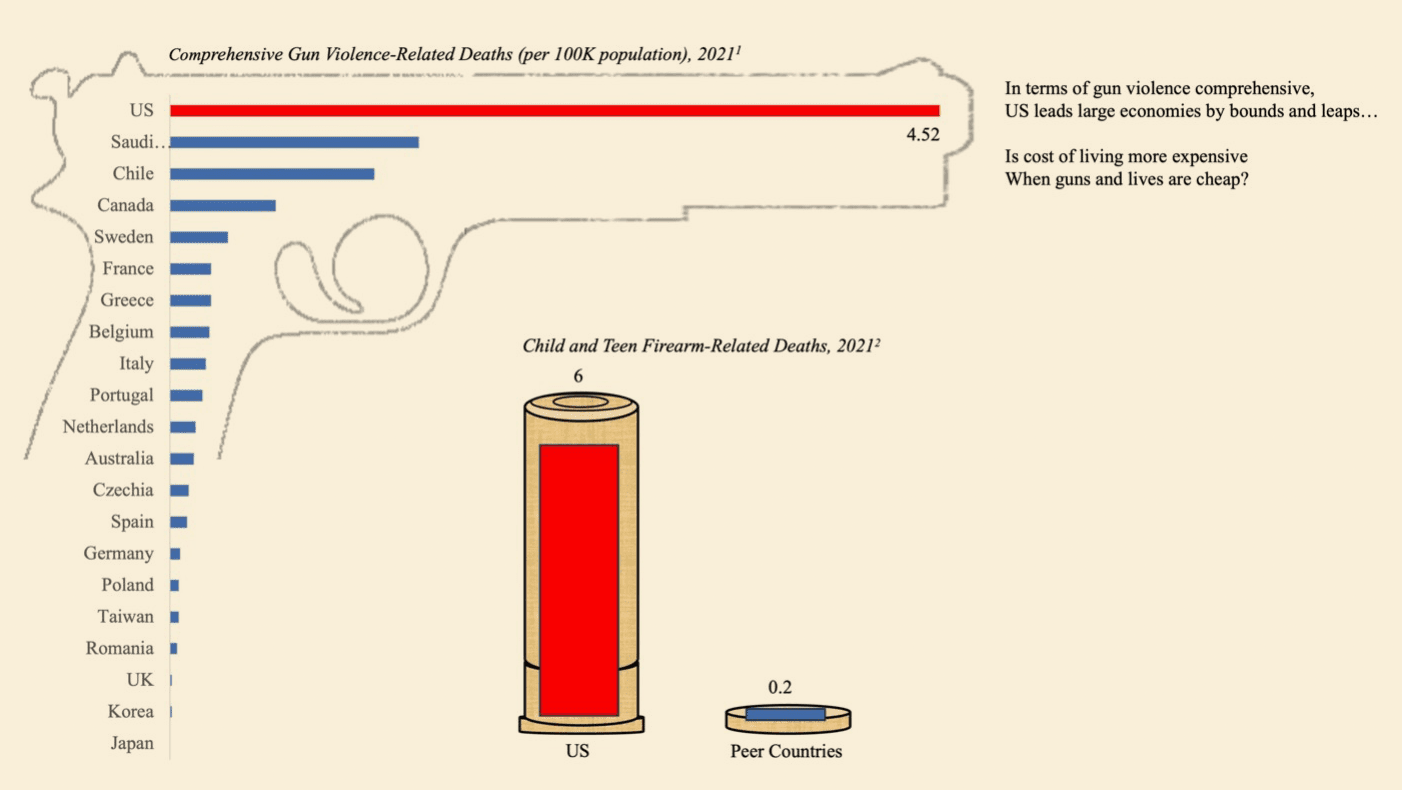
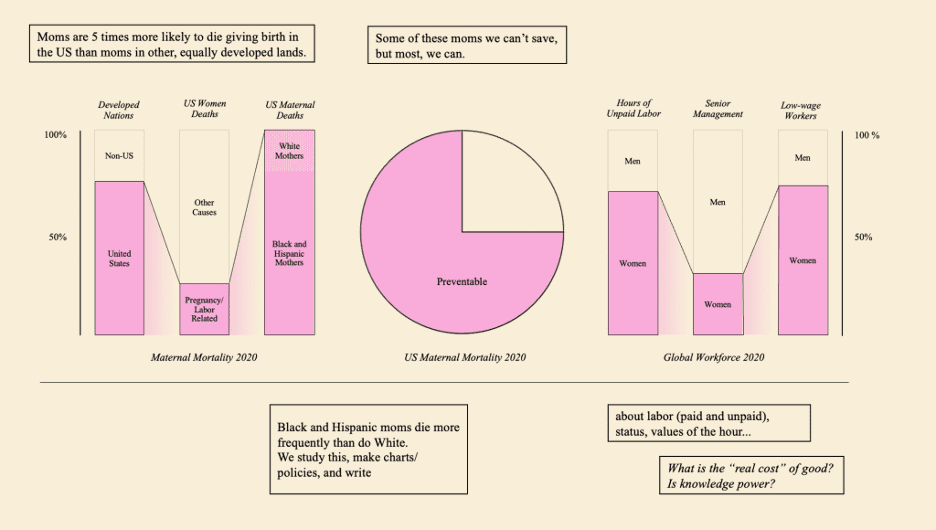
Flip through the pages of her poetry chapbook Power Point and you’ll see charts, graphs, and citations galore. One poem visually documents maternal mortality rates and women’s unpaid domestic labor in such a way that the bar and pie graphs spell out the word “MOM.” Another tracks deaths from gun violence across the globe and is presented as a gun-shaped graph. Still others are written in more standard poetic form but include citations that reference documents put out by the US government, the United Nations, and news organizations.

These poems are just a few of the many in Muschenetz’s latest book that wrestle with contemporary social issues using a combination of data-driven insights and the poetic form. The format is a unique one: The first time Hayley Mitchell Haugen, founding editor in chief of Muschenetz’s publisher Sheila-Na-Gig, saw the poems, she thought to herself, “I’ve never seen anything like this before.”

Point Blank
13. “Incidents of firearm mortality per 100K population for high income global economies with populations over 10M,” Institute for Health Metrics Evaluation, United Nations. Graphics treatment by Ingo Muschenetz. 14. “Child and Teen Firearm Mortality in the US and Peer Countries,” per 100K population, KFF.org, July 2023; CDC. Detailed citations at technologyreview.com/Muschenetz.
ORIGINALLY PUBLISHED BY WRITERS RESIST, WINTER 2023

While cold, hard numbers and poetry might seem antithetical at first blush, from Muschenetz’s perspective, the two couldn’t be a better fit. A former business consultant at Bain & Company who received her MBA at the Sloan School of Management, she released her first poetry book in her 40s, and she’s enjoyed uncovering what the artistic and scientific approaches to understanding the world have in common.

“Even though it maybe feels unintuitive that poetry and science are interrelated, they both make connections that are not immediately obvious,” she says. “They test out theories; they take risks. There’s a lot of nonlinear thinking that happens in both.”

Many of the poems in Power Point were inspired by watershed moments in global politics and culture, particularly ones that would shape the lives of women. From the partisan political theater on display at the confirmation hearing of US Supreme Court Justice Ketanji Brown Jackson to the passage of laws restricting women’s freedoms in Iran and Afghanistan, these events often left Muschenetz overwhelmed with frustration at the state of women’s rights today.

But knowing that women’s emotions are so often dismissed, she looked for a way to turn those feelings into something that she hoped would be harder to write off than standard poetry while still evoking the openheartedness with which people tend to approach art.

“I wanted something that listed just facts but expressed how angry I am,” she says. “I really wanted it to be fact-based. I wanted my sources to be publicly available and almost unassailable.” Her hope was that by repackaging these facts in the form of statistics-driven poetry, she might allow readers to receive the information in a new way—and get them thinking.

From Ukraine to California

Muschenetz’s childhood primed her to understand how global currents can shape an individual life from an early age. Born Yevgenia Leonidovna Veitzman to a Jewish family in the Ukrainian city of Lviv, Muschenetz says her family began trying to leave the country before she was born, hoping to escape the discrimination they faced under the Soviet government. But it wasn’t until she was 10 years old that the family was finally able to emigrate. When they were at last cleared to cross the border, they headed for San Diego, where she decided that Jane would be easier for Americans to pronounce than her given first name. (Ultimately, she would change her last name, too, when she married.)

Muschenetz often felt out of place in her new home, even though she was surrounded by other immigrant kids whose parents had moved to California in search of a better life. In one way she was like many American teenage girls, though: She had a lot of feelings, especially about romantic relationships, whether real or imagined, and she often wrote poems about them.  

At age 16, she began submitting her poetry to magazines and publishers, which brought her first taste of writerly rejection. “I was like, ‘Oh, well, I tried. Clearly this isn’t for me.’ Even though in my heart, since I was like four years old, I knew I was a writer and I loved literature,” she says. 

Her parents were “completely horrified” about the prospect of her pursuing a career in writing, but they weren’t much more excited about what she eventually landed on instead: a degree in political science at UC San Diego. “The response was always ‘Poets get shot. Politicians get shot,’” she says. 

She might not have been able to articulate it at age 18, but looking back, Muschenetz makes sense of the decision to study political science as driven by her desire to understand the global forces that caused her family to emigrate. “I wanted to know: How do we structure policy? Who makes these choices, and how can we change them and make them better?” she says.

Jane Muschenetz

STACY KECK

But the dream of writing was hard to let go of. By the time Muschenetz was a few years out of college, she’d applied for two different programs: an MFA in writing and the MBA program at Sloan. And though she didn’t get accepted to the MFA program, her time at Sloan ended up profoundly shaping the poetry she would write two decades later, giving her the statistical analysis and data interpretation skills that formed the backdrop for Power Point. Those were skills she sharpened even further in the years she spent working as a business consultant at Bain right after earning her MBA.

“I don’t think the average joe could pull off [what she does in that book], because she knows how to present statistics well,” says Haugen. “She knows how to look at them analytically and offer them up in a way that a layperson can understand.”

Muschenetz left the business world after four years at Bain to focus on parenting her two children, as well as serving in various volunteer capacities at their schools and with local community organizations. It wasn’t until the world shut down in 2020 with the onset of the covid-19 pandemic that she found herself getting back in touch with the creative impulses that had animated her previously. Those impulses manifested in part as visual art: Muschenetz began painting a menagerie of animals on the bases of palm fronds she would find on the ground after a big storm in San Diego. “It just felt good, even though it made no sense,” she says. “At the same time, it was keeping me sane.”

Being willing to dip her toe into a creative endeavor that she knew she “didn’t have to be good at” also helped open Muschenetz to the idea of getting back to the poetry writing that had made her heart sing as a girl.

“Through my high school and early college years, every margin of every notebook was covered with poems or rhymes,” she says. “And then it was just gone. It was scary for me to realize that I had cut that part out of myself, and how bad that was for me.”

Coming home to poetry

When Muschenetz did start writing again, she thought she might write a collection of poems rooted in domesticity and home life. She was surprised to find that what started flowing out of her instead were poems about her immigrant experience, which had never been the subject of her poetry while she was living it as a teenager. “I thought, ‘Well, shouldn’t I have gotten this out of my system?’ But here I was writing about this aspect of my identity that I never actually had written about before.” 

She eventually had enough poems to pull together what became her first collection, titled All the Bad Girls Wear Russian Accents. The book reveals her propensity for weaving together dark and light, humor and tragedy, in a range of poems that cover everything from the war in Ukraine to the experience of being stereotyped for her ability to speak Russian, the language of many American movie villains. 

Muschenetz initially thought that writing a book of poetry might be a onetime thing, the kind of undertaking that would allow her to check a box and move on. But as she was promoting her first book, she found herself fixating on a poem she hadn’t even written yet—one in the form of data that would spell out a word. The idea was eventually realized in “100% MOM.” 

100% MOM: A PowerPoint Poem about Women and Labor
Data sources include: “Life Stages and Populations by Sex,”CDC, NCHS; “Most pregnancy-related deaths are preventable, ”Hear Her Campaign, CDC, 2022; “The U.S. Maternal Mortality Crisis Continues to Worsen: An International Comparison, ”Commonwealth Fund, 2022; “The World’s Women 2020 Trends and Statistics,” United Nations; Oxfam International Inequality Reports: 2020, 2021; “Hard Work Is Not Enough: Women in Low-Paid Jobs,” National Women’s Law Center, July 2023. Detailed citations at technologyreview.com/Muschenetz.
ORIGINALLY PUBLISHED IN WHALE ROAD REVIEW, SPRING 2023

That poem was the seed that grew into Power Point, and Muschenetz, whose poetry has been nominated for the Pushcart Prize three times, hasn’t looked back since. In addition to releasing that second volume of poetry, the product of what she calls the “analytic and overachieving brain” that helped her get through (and enjoy) business school, Muschenetz has used those same skills to help the poetry community in San Diego with some of the more practical needs, like grant writing, that are often lacking in communities of artists, says Katie Manning, a local poet and professor emeritus of poetry. 

Muschenetz is mostly just happy to have found a way to use poetry to keep integrating and honoring the many different parts of her identity, from immigrant to business consultant. 

“It is a huge disservice to all humanity when we ask our scientists or mathematicians or poets to only be that one thing, as opposed to being their whole selves,” she says. 


You Are 600% Hotter than the Sun
By Jane Muschenetz

A cup of the Sun’s core produces ~60 milliwatts
of thermal energy. By volume … less than that of
a human [350 mW]. In a sense, you are hotter than
the Sun—there’s just not as much of you. 

—Henry Reich, Minute Physics

Speaking roughly, in terms of heat
generated per every human inch, you give
off more milliwatts—surge/energy. Only
the Sun is bigger … it matters.
We are all blinded 
by love, the expanding/contracting
universe is just another metaphor
for longing, and life—its own purpose.
How dazzling, this science!
Consider falling for a physicist—
the painstakingly slow way they undress
mathematical mysteries,
talk about bodies in motion
gets me every time—space 
—continuum, part, particle—
Atomic. Incandescent! You
are, pound-for-pound, more Life-Source,
more Bomb, more Season-Spinning Searing Center
Heart/Engine/Radiating Nuclear Dynamic
than the Sun. Can’t look directly 
in the mirror? Small Wonder! Imagine—

none of us powerless.

Originally published by Cathexis Northwest Press, May 2024 


For Those of Us Forced to Flee
By Jane Muschenetz

For those of us forced to flee
the world is forever shrinking down to a single question:
What can you carry?
The suitcase of your heart closed tight
on all the things there was no room to bring—
your memories of “home,” the snowflake moments
of your youth, the blooming Lilac tree
outside your bedroom window … a heavy burden
saps your strength on the long journey, bring
only what you need.
Homes can be built again,
a new tree can be rooted.

Survive.

When you have nothing left to plant, become the seed.

Originally published in Issue 8, The Good Life Review, 2022. It received the 2022 Honeybee Poetry Prize and was nominated for a Pushcart Prize.

Find more poetry by Jane Muschenetz at www.palmfrondzoo.com/janewriting.