Rethink Your Product Detail Pages

Conversion is the primary job of ecommerce product pages. Ranking in search engines has always been a close second. Until now.

It’s near cliché in 2026 to note that search and product discovery are changing. AI Overviews, AI Mode, various answer solutions, AI chat interfaces, and emerging shopping agents are remaking how consumers find and buy, from luxury items to everyday goods.
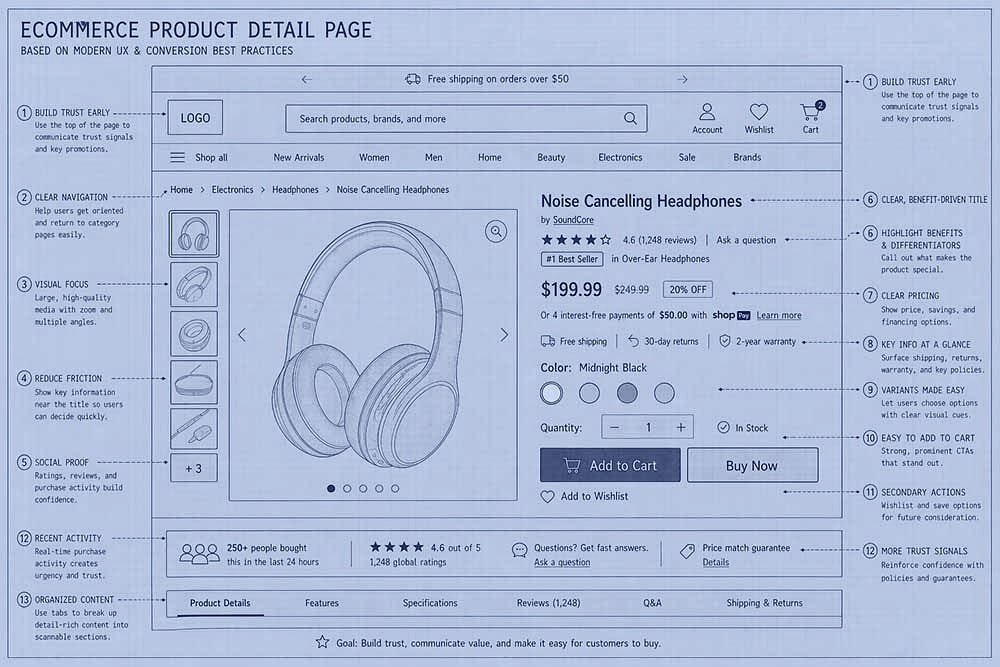
Annotated blueprint diagram of an ecommerce product detail page, illustrating 13 UX and conversion best practices. The layout includes a header with a promotional banner, logo, search bar, and navigation menu; a product section featuring a large image gallery, product title, star ratings, pricing with discount, color and quantity selectors, and Add to Cart and Buy Now buttons; a social proof bar with purchase activity and ratings; and a tabbed content area for product details, specifications, reviews, and shipping. Numbered callouts identify key elements including trust signals, clear navigation, visual focus, friction reduction, social proof, benefit-driven titles, transparent pricing, variant selectors, and prominent calls to action.

Conversion is the primary aim of a product detail page. But it should also attract traffic via traditional rankings and generative AI visibility. Click image to enlarge.

Information Source

In this new environment, product detail pages must be “AI consumable” to provide answers and model products as structured entities.

Hence today’s product detail pages should be:

  • Rankable,
  • Extractable,
  • Understandable as an entity.

Each aligns with familiar practices. Search engine optimization supports ranking. Answer engine optimization supports extraction. Generative engine optimization supports how AI systems understand and use data.

And a single product page must address all three.

Content Focus

In preparing this article, I used AI to review product detail pages from Amazon, Walmart, Target, L.L.Bean, a collection of direct-to-consumer brands, and several smaller ecommerce sites. The focus was on how the content of these pages addresses ranking, extracting, and understanding — not structured data markup, but content alone.

The AI provided a subjective score for each category of retailer.

Segment Example Sources Rankable Extractable Understandable as Entity
Marketplaces Amazon Very High Medium Very High
Large Retailers Walmart, Target High Medium–High High
Specialty Retail L.L.Bean Medium High Medium–High
D2C (Structured) AG1, Beekman 1802 Low–Medium High Medium
D2C (Hybrid) Casper, Allbirds Medium Medium Medium
D2C (Aesthetic) Vuori, Glossier Low Low Low–Medium
Small Merchants Mixed Shopify stores Low Low–Medium Low–Medium

Rankable

Traditional search still drives visibility.

Almost without exception, the product detail pages passed a basic search-optimization content audit. But large retailers did better, unsurprisingly.

Marketplaces and enterprise retailers such as Amazon, Walmart, and Target tend to use expansive titles, dense attributes, and strong internal links. The pages match many queries, not just one.

Amazon’s product pages include:

  • Titles,
  • Bullet points (“About this item”),
  • Product descriptions,
  • Specifications,
  • Frequently asked questions,
  • Reviews (often thousands of words).

In some cases, the composite product information reaches 10,000 words (mostly shopper reviews), although the average is around 2,000.

Several D2C brands favor clean names and brand-consistent language. The approach improves readability, but likely limits organic reach.

Smaller merchants’ product pages resemble those of D2C brands and could benefit from mimicking Amazon by adding more information.

Extractable

Answers determine what gets used.

To be “extractable,” a product page needs to explain itself directly. What is the product? What does it do? Who is it for? The answers to those questions should be concise and easy to isolate. Discreet sections, labeled features, and question-and-answer formats help.

Many of the product pages reviewed underperform in this area. The exception was the large retail marketplaces, which often contain extensive answer information.

Here again, even small retailers could benefit from adding an FAQ section.

Understandable

Data determines visibility.

Search engines and AI systems increasingly treat products as entities or objects with attributes such as brand, category, price, specifications, and relationships to other products.

While a product entity is certainly communicated through structured data, content also plays a role.

To be understandable as an entity, a product page’s content should define attributes (name, variants, specifications) clearly and consistently.

Product pages from large retailers, especially marketplaces, consistently describe products with clear attributes, normalized naming, and consistent variant handling. This allows products to appear in shopping results, comparison features, and structured listings.

3 Layers Combined

Combined, the three layers should drive traffic from traditional search and generative AI channels.

  • A rankable page is discoverable.
  • Extractable content facilitates answers.
  • Easily understood products can appear consistently across multiple systems.

My AI-driven site review identified patterns related to these layers and their individual goals. But it also revealed a gap.

Marketplaces excel at providing product information. The difference is pronounced and should lead all merchants, large and small, to ensure their product content addresses SEO, AEO, and GEO.

In 2026, you need all three.
AI Prompts for Better Product Descriptions

Product descriptions have always been a vital ecommerce selling tool. But crafting unique and persuasive copy is challenging.

So almost a decade ago, I wrote what has become one of my favorite articles, “How to ‘Manufacture’ Product Descriptions for Ecommerce.” The piece describes a composition process and, ultimately, produces this description for a soup spoon:

Hungry for some hearty chicken noodle or creamy clam chowder? This soup spoon has a large bowl meant to haul bisques and broths to your mouth. In fact, this soup spoon can hold about three times as much soupy goodness as your standard table spoon. You could take three times as many bites, or you could buy this soup spoon and slurp large.

Descriptions at Scale

I had been struggling with product descriptions on the website of my employer, a regional brick-and-click farm-and-ranch retailer. We had thousands of items needing descriptions for our ecommerce site. I tried three options: Amazon’s Mechanical Turk, a Romanian product description agency, and a template-based tool.

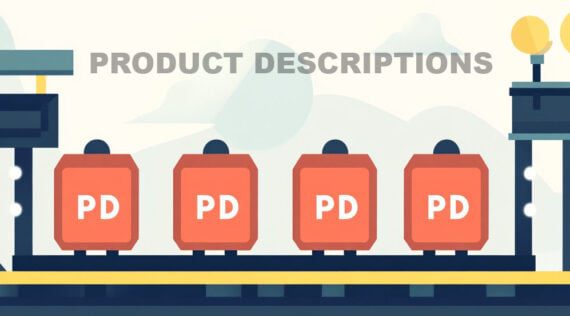
Illustration of a product description concept the resembles a factory process

Artificial intelligence has made it easy to produce product descriptions in a mechanical or algorithmic way, almost like manufacturing.

Writers hired via the Turk or in Romania tended to approach each description like a novel with a plot. Some descriptions were excellent, but not all. The bad ones missed the point.

I then devised the product description “manufacturing” process.

  • Focus on a single thing. The item’s top feature or competitive advantage.
  • Connect to a benefit. Explain how the feature helps the shopper.
  • Clarify and specify. Make the feature-and-benefit bridge precise and understandable.
  • Test your words. Remove redundancy, add action verbs, and spark interest.
  • Spell and grammar check. Sloppy text erodes trust and harms conversions.
  • Add an introduction. Polish, humanize, and insert a hook.
  • Add a call to action. Encourage the sale.

The process was a framework for writers and marketing teams.

Mad Libs

Unfortunately, the process took a lot of time. So we doubled down on a tactic that I likened to playing “Mad Libs” — a template-based word game — and wrote another article, “Generate Product Descriptions with Natural Language Software.”

Natural language templates were forerunners to today’s generative artificial intelligence platforms. The templates used product-category variables to mass-produce copy.

A template for LED televisions might look like this:

{{ “Experience” || “Enjoy” || “Imagine” }} {{ screen size >= 55 ? {{“cinema-like” || “theater-style”}} “viewing”: “the shows and movies you love: }} from the comfort of your {{“living room” || “home”}} with this {{ screen size }} {{ brand }} {{ screen type }} television.

That example came from Best Buy:

Experience cinema-like viewing from the comfort of your living room with this 55-inch Insignia LED television. It displays Blu-ray and high-definition movies in full 1080p resolution with stunning HD detail. Use the three HDMI inputs to create a home theater experience with this Insignia LED TV and your other audio and video devices.

Generative AI

I’ve used the “manufacturing” and natural-language processes on dozens of ecommerce sites.

But generative AI makes the task easier with better results — morphing from templates and natural language into prompt engineering.

Start with Google’s five-step prompt engineering framework: Task, Context, References, Evaluate, and Iterate.

Task

Instruct the AI on what to do. Here the aim is to produce a product description focusing on a single feature.

First, produce a template-like prompt:

Compose a compelling product description for [Product Name], focusing on the [Detailed Key Feature]. Describe how the [Short Key Feature] benefits customers, providing specific examples and comparisons.

The variables could be:

  • [Product Name] – “a soup spoon.”
  • [Detailed Key Feature] – “large spoon bowl that holds soup.”
  • [Short Key Feature] – “large bowl.”

The prompt addresses two elements of my original manufacturing process: “focus on a single thing” and “connect to a benefit.”

Context

Generative AI is better with context. So to engineer our prompt, we once again “connect to a benefit” while adding the “clarify and specify” step to include our target customer.

Imagine you are an experienced copywriter working on product descriptions. Compose a compelling product description for [Product Name], focusing on the [Detailed Key Feature]. Describe how the [Short Key Feature] benefits customers, for example, [Benefit Bridge], providing specific examples and comparisons.

Include a direct address call to action, too. Note [Product Name] is for [Target Audience]. Use a [Brand Voice] tone. Ensure the description is engaging, grammatically correct, and avoids repetition. Use a varied, relevant, and meaningful vocabulary.

Our variables could be:

  • [Benefit Bridge] – “so customers get more soup with each bite.”
  • [Target Audience] – “anyone who likes soups and doesn’t want to take tiny bites.”
  • [Brand Voice] – “casual and fun.”

I’ve integrated three steps from the original process: “test your words,” “spell and grammar check,” and “add a call-to-action.”

References

Next, we can provide the AI with examples of successful, category-specific product descriptions.

The product description may be similar in style to these examples:

“[First Example]”

“[Optional Second Example]”

Craft three excellent product descriptions.

Filling in the example variables, we have a completed prompt.

Imagine you are an experienced copywriter working on product descriptions.

Compose a compelling product description for a soup spoon, focusing on the large bowl or head that allows it to hold soup. Describe how the large bowl benefits customers — such as “get more soup with each bite” — while providing examples and comparisons.

Include a direct call to action.

Note that a soup spoon is for anyone who likes soups and doesn’t want to take tiny bites. When you write, use a casual and fun tone. Ensure the description is engaging, grammatically correct, and avoids repetition. Use a varied, relevant, and meaningful vocabulary.

The product description may be similar in style to this example:

Hungry for some hearty chicken noodle or creamy clam chowder? This soup spoon has a large bowl meant to haul bisques and broths to your mouth. In fact, this soup spoon can hold about three times as much soupy goodness as your standard table spoon. You could take three times as many bites, or you could buy this soup spoon and slurp large.

Craft three excellent product descriptions.

Evaluate

Even the best AI prompts will not always produce the desired results, so evaluate the output. The example prompt generated this response from ChatGPT 4o.

Tired of chasing soup around your bowl with a tiny spoon? Meet the soup spoon designed for real soup lovers. Its generous, deep bowl lets you scoop up rich, velvety bisques, hearty stews, and soul-warming broths in satisfying mouthfuls — no more dainty sips. Compared to your average tablespoon, this bad boy holds nearly three times as much, so you can enjoy more flavor with every bite. Whether you’re slurping ramen or savoring homemade chicken noodles, this spoon gets the job done. Go big or go hungry — grab yours today.

Iterate

The final step in Google’s prompt engineering framework is to iterate or repeat the process with minor changes until you get the right response.

Product descriptions have never been more critical for ecommerce success. How we produce and test them reflects their importance.

Structured Data Markup for Ecommerce Product Pages

Structured data markup helps optimize a site for search engines in two ways. First, it aids in understanding the content and purpose of a web page. For example, structured data will help search engines distinguish a page selling beer-making kits from an article about beer.

Second, structured data can enhance the appearance of an organic search listing, making it much more prominent. These enhancements — called “rich results” — can include:

  • Average rating stars
  • Product images,
  • Pricing,
  • Availability,
  • Special offers
  • Shipping pricing
  • Shipping time
  • Return policies.

Product Rich Results

Rich snippets make organic search listings much more noticeable, but they also add a competitive advantage by providing lower pricing, higher ratings, and better delivery terms.

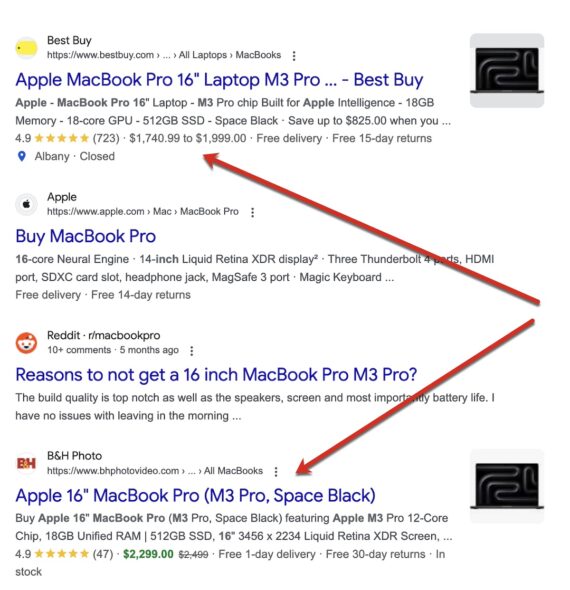
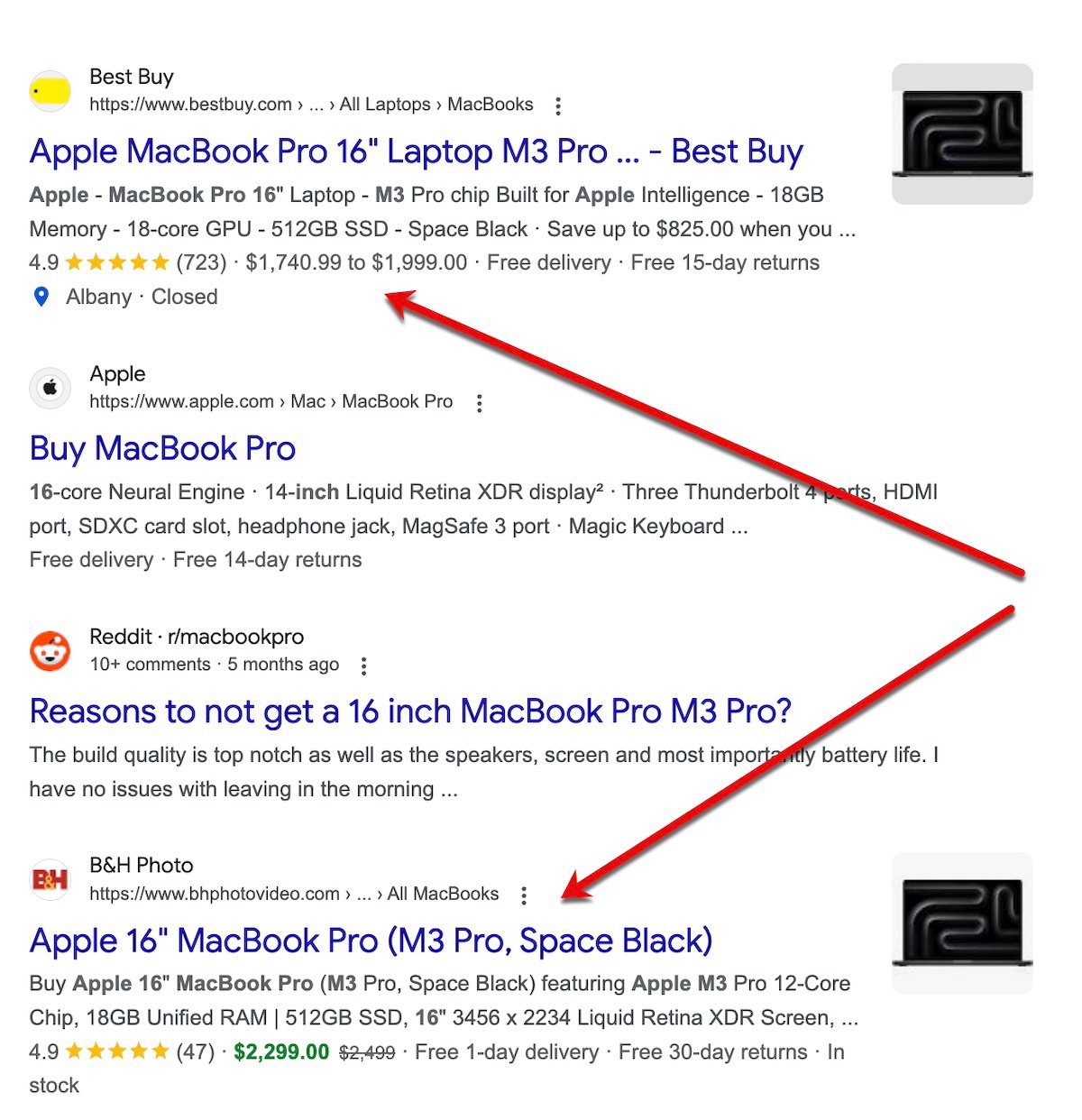
For example, in an “apple macbook pro 16 m3” search, Best Buy’s structured data claims affordable pricing options, while B&H Photo includes detailed delivery information, including free one-day delivery.

Hence rich snippets stand out in search results and likely drive targeted clicks and higher conversions since buyers land on a website with set expectations.

For a search of “apple macbook pro 16 m3,” Best Buy’s structured data shows prices from “$1,740.99 to $1,999.00,” while B&H Photo includes “Free 1-day delivery.”

More Visibility

Structured data markup helps brands stand out beyond Google’s traditional organic listings to include image packs, “popular products” sections, and “deals.”

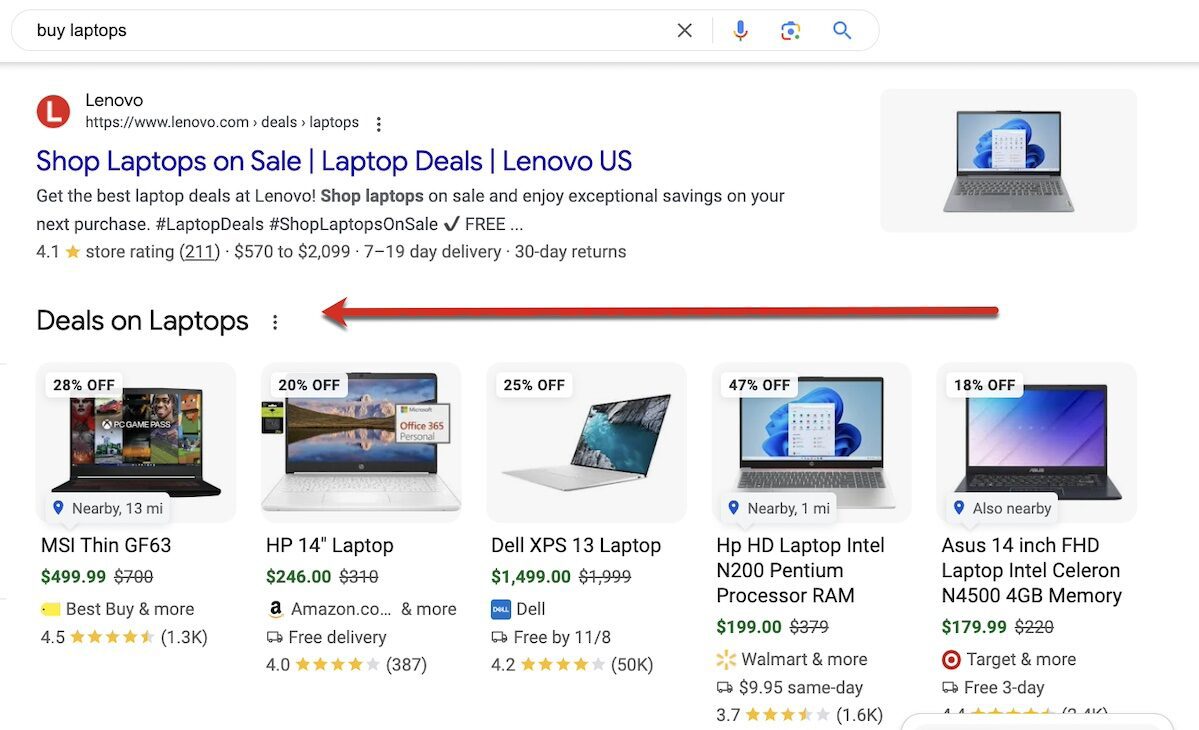
For example, for a “buy laptops” search, Google generates a “Deals on Laptops” section that partly relies on structured data (and partly on Shopping feeds).

Searching “buy laptops” produces a “Deals on Laptops” section.

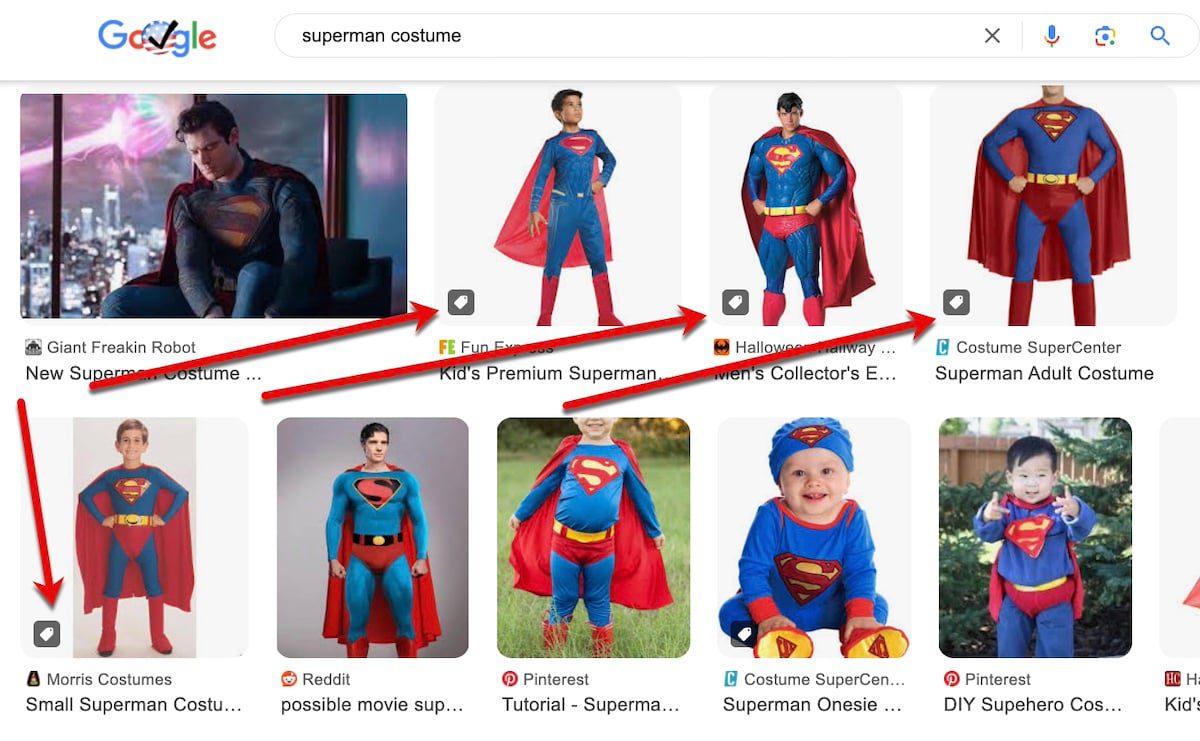
Search for “superman costume” in Google Images, and the results blend images into traditional organic listings, labeling images associated with product pages.

An image search for “superman costume” produces blended results with images of products labeled as such.

Types of Structured Data

Structured data markup sits in your code. Google supports three markup types for generating rich snippets: JSON-LD, Microdata, and RDFa. Schema.org provides a popular method of organizing JSON-LD into a vocabulary recognized and recommended by Google and Bing and easily understood by non-coders. (JSON-LD helpfully resides inside of a script, away from HTML.)

Markup from Schema.org is now more or less ubiquitous. Hence the term “schema” is synonymous with “structured data markup.”

There’s schema to describe just about anything on a product detail page — pricing, ratings, shipping, and more.

Implementation

Implementing product schema on a site depends on the content management system or platform. Shopify’s App Store lists a variety of free and paid apps for that purpose. Wix has a built-in solution.

Schema for products must be dynamic, requiring updates based on inventory. Only seasoned developers should attempt to code it manually.

Next, test and validate the schema once it’s set up. Then keep an eye on the “Enhancements” tab in Search Console to ensure Google can see the structured data and it provides no recommendations on improving it. (Search Console lists only the schema resulting in rich snippets.)

Organic Rankings

Structured data has no direct impact on organic rankings. Google has confirmed this multiple times, as recently as last year.

However, it can influence rankings by clarifying the page’s content, thereby helping to rank for the right search queries at the right time.

Rich snippets from structured data can increase clicks and engagement. Clicks and on-page engagement are confirmed ranking signals. Thus rich snippets can improve organic positions by making results more attractive and setting the right expectations for searchers.