OpenAI To Show Content & Links In Response To Queries via @sejournal, @martinibuster

OpenAI content deal will enhance ChatGPT with the ability to show real-time content with links in response to queries. OpenAI quietly took steps to gaining more search engine type functionality as part of a content licensing deal that may have positive implications for publishers and SEO.

Content Licensing Deal

OpenAI agreed to content licensing with the Financial Times, a global news organization with offices in London, New York, across continental Europe and Asia.

Content licensing deals between AI organizations and publishers are generally about getting access to high quality training data. The training data is then used by language models to learn connections between words and concepts. This deal goes far beyond that use.

ChatGPT Will Show Direct Quotes With Attribution

What makes this content licensing deal between The Financial Times and OpenAI is that there is a reference to giving attribution to content within ChatGPT.

The announced licensing deal explicitly mentions the use of the licensed content so that ChatGPT could directly quote it and provide links to the licensed content.

Further, the licensing deal is intended to help improve ChatGPT’s “usefulness”, which is vague and can mean many things, but it takes on a slightly different meaning when used in the context of attributed answers.

The Financial Times agreement states that the licensing deal is for use in ChatGPT when it provides “attributed content” which is content with an attribution, commonly a link to where the content appeared.

This is the part of the announcement that references attributed content:

“The Financial Times today announced a strategic partnership and licensing agreement with OpenAI, a leader in artificial intelligence research and deployment, to enhance ChatGPT with attributed content, help improve its models’ usefulness by incorporating FT journalism, and collaborate on developing new AI products and features for FT readers. “

And this is the part of the announcement that mentions ChatGPT offering users attributed quotes and links:

“Through the partnership, ChatGPT users will be able to see select attributed summaries, quotes and links to FT journalism in response to relevant queries.”

The Financial Times Group CEO was even more explicit about OpenAI’s intention to show content and links in ChatGPT:

“This is an important agreement in a number of respects,” said FT Group CEO John Ridding. “It recognises the value of our award-winning journalism and will give us early insights into how content is surfaced through AI. …this partnership will help keep us at the forefront of developments in how people access and use information.

OpenAI understands the importance of transparency, attribution, and compensation…”

Brad Lightcap, COO of OpenAI directly referenced showing real-time news content in ChatGPT but more important he referenced OpenAI exploring new ways to show content to its user base.

Lastly, the COO stated that they embraced disruption, which means innovation that creates a new industry or paradigm, usually at the expense of an older one, like search engines.

Lightcap is quoted:

“We have always embraced new technologies and disruption, and we’ll continue to operate with both curiosity and vigilance as we navigate this next wave of change.”

Showing direct quotes of Financial Times content with links to that content is very similar to how search engines work. This is a big change to how ChatGPT works and could be a sign of where ChatGPT is going in the future, a functionality that incorporates online content with links to that content.

Something Else That Is Possibly Related

Someone on Twitter recently noticed a change that is related to “search” in relation to ChatGPT.

This change involves an SSL security certificate that was added for a subdomain of ChatGPT.com. ChatGPT.com is a domain name that was snapped up by someone to capitalize on the 2022 announcement of ChatGPT by OpenAI. OpenAI eventually acquired the domain and it’s been redirecting to ChatGPT.

The change that was noticed is to the subdomain: search.chatgpt.com.

This is a screenshot of the tweet:
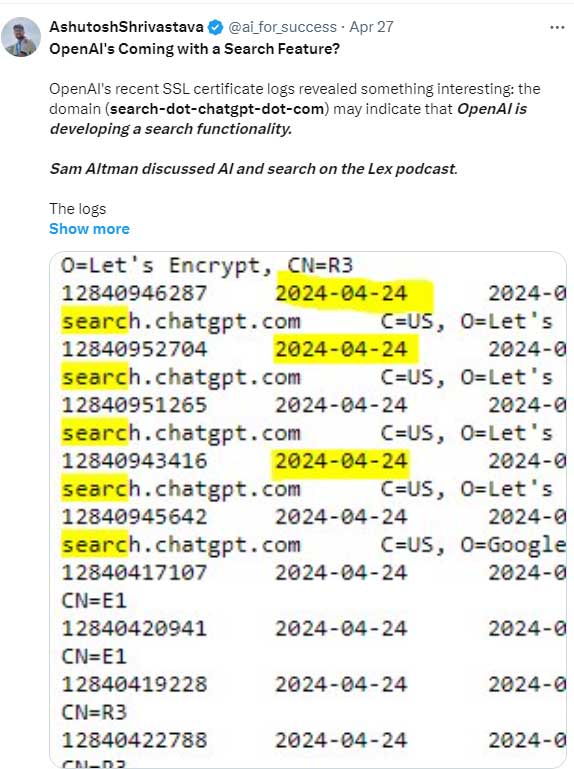
Screenshot of SSL logs for search.chatgpt.com

Big News For SEO and Publishers

This is significant news for publishers and search marketers ChatGPT will become a source of valuable traffic if OpenAI takes ChatGPT in the direction of providing attributed summaries and direct quotes.

How Can Publishers Get Traffic From ChatGPT?

Questions remain about attributed quotes with links in response to relevant queries. Here are X unknowns about ChatGPT attributed links.

  • Does this mean that only licensed content will be shown and linked to in ChatGPT?
  • Will ChatGPT incorporate and use most web data without licensing deals in the same way that search engines do?
  • OpenAI may incorporate an Opt-In model where publishers can use a notation in Robots.txt or in meta data to opt-in to receiving traffic from ChatGPT.
  • Would you opt into receiving traffic from ChatGPT in exchange for allowing your content to be used for training?
  • How would SEOs and publisher’s equation on ChatGPT change if their competitors are all receiving traffic from ChatGPT?

Read the original announcement:

Financial Times announces strategic partnership with OpenAI

Featured Image by Shutterstock/Photo For Everything

Google’s John Mueller On Website Recovery After Core Updates via @sejournal, @MattGSouthern

John Mueller, a Google Search Advocate, provided guidance this week regarding the path forward for websites impacted by recent search algorithm updates.

The discussion started on X (formerly Twitter) by SEO professional Thomas Jepsen.

Jepsen tagged Mueller, asking:

“Google has previously said Google doesn’t hold a grudge and sites will recover once issues have been solved. Is that still the case after HCU?”

Mueller’s response offered hope to site owners while being realistic about the challenges ahead.

Addressing Recovery Timelines

Mueller affirmed Google’s stance on not holding grudges, stating, “That’s still the case.”

However, he acknowledged the complexity of rankings, saying:

“…some things take much longer to be reassessed (sometimes months, at the moment), and some bigger effects require another update cycle.”

Mueller pointed to a Google help document explaining the nuances. The document reads:

“Broad core updates tend to happen every few months. Content that was impacted in Search or Discover by one might not recover—assuming improvements have been made—until the next broad core update is released.

Do keep in mind that improvements made by site owners aren’t a guarantee of recovery, nor do pages have any static or guaranteed position in our search results. If there’s more deserving content, that will continue to rank well with our systems.”

The Comments Sparking Debate

Jepsen probed further, asking, “Is a core update what’s needed for HCU-affected sites to recover (assuming they’ve fixed their issues)?”

Mueller’s response highlighted how situations can differ:

“It depends on the situation… I realize there’s a big space between the situations, but generalizing doesn’t help. Sometimes it takes a lot of work on the site, a long time, and an update.”

The thread grew as user @selectgame raised concerns about Google Discover traffic, to which Mueller replied:

“Google Discover is affected by core updates as well as other parts of Search (and there are more policies that apply to Discover).”

Growing Frustrations

Prominent industry figure Lily Ray voiced mounting frustrations, stating,

“…many HCU-affected websites – which have been making all kinds of improvements over the last 7 months – have only seen further declines with the March Core Update.

I have seen some sites lose 90% or more of their SEO visibility since the HCU, with the last few weeks being the nail in the coffin, despite making significant improvements.”

Ray continued:

“And in my professional opinion, many of these sites did not deserve anywhere near that level of impact, especially the further declines over the past month.”

Mueller hasn’t responded to Ray’s tweet at this time.

Looking Ahead

As the search community awaits Google’s next moves, the path to recovery appears arduous for many impacted by recent algorithm reassessments of “Helpful Content.”

Site improvements don’t guarantee immediate recovery, so publishers face an uphill battle guided only by Google’s ambiguous public advice.

Why SEJ Cares

The March 2024 core update has proven disastrous for many websites, with severe traffic losses persisting even after sites try to improve low-quality content, address technical issues, and realign with Google’s guidelines.

Having clear, actionable guidance from Google on recovering from core update updates is invaluable.

As evidenced by the frustrations expressed, the current communications leave much to be desired regarding transparency and defining a straightforward recovery path.

How This Can Help You

While Mueller’s comments provide some insights, the key takeaways are:

  • Regaining previous rankings after an algorithm hit is possible if sufficient content/site quality improvements are made.
  • Recovery timelines can vary significantly and may require a future core algorithm update.
  • Even with enhancements, recovery isn’t guaranteed as rankings depend on the overall pool of competing content.

The path is undoubtedly challenging, but Mueller’s comments underscore that perseverance with substantial site improvements can eventually pay off.


FAQ

Can SEO professionals predict recovery time for a website hit by core updates?

SEO professionals can’t pinpoint when a site will recover after a core Google algorithm update.

Reasons for this include:

  • Google releases core updates every few months, so sites may need to wait for the next one.
  • It can take months for Google to reassess and adjust rankings.
  • How competitive the query is also impacts if and when a site recovers.

Does making site improvements after a core update ensure recovery in rankings and visibility?

After making improvements following a Google algorithm update, regaining your previous rankings isn’t guaranteed.

Reasons why include:

  • Your impacted content may not recover until the next core update, provided you’ve implemented enough site improvements.
  • Google’s search results are dynamic, and rankings can fluctuate based on the quality of competitor content.
  • There’s no fixed or guaranteed position in Google’s search results.

What is the relationship between Google Discover traffic and core search updates?

Google’s core algorithm updates that impact regular search results also affect Google Discover.

However, Google Discover has additional specific policies that determine what content appears there.

This means:

  • Improving your content and website quality can boost your visibility on Google Discover, just like regular searches.
  • You may see changes in your Discover traffic when Google rolls out core updates.
  • Your SEO and content strategy should account for potential impacts on regular searches and Google Discover.


Featured Image: eamesBot/Shutterstock

Google News Deletes Manual Submission Option via @sejournal, @martinibuster

Google removed their documentation on manually adding publications for review to be included Google News. An announcement via new documentation advises that publishers can no longer manually add their sites to be considered for Google News but existing publishers will continue to have access to customization features but that those too will be removed soon.

Google Publisher Center

The Google Publisher Center was a service that allows publishers to submit their site content to Google News. Publishers could also submit a constantly updated feed that would alert Google to newly published articles. Google could also use a sitemap to discover newly published news articles.

While Google offered publishers a way to submit webpages to Google for display in Google News, Google never promised to show those sites.

Google also has maintained that they had automated ways to include content into Google News.

Google News Inclusion System

Google removed the ability for publishers to manually submit websites to be considered for inclusion to Google News. The process is transitioning to a fully automated system of discovery and inclusion.

The new system will be rolling out later this year.

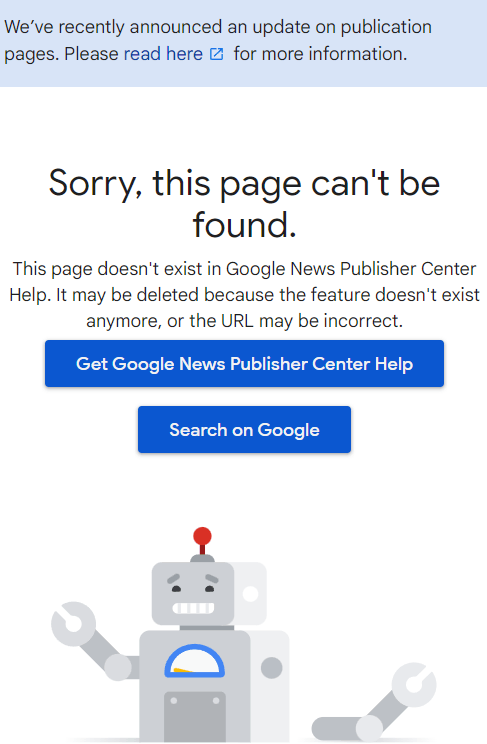
The “Submit your publication for review” documentation was removed and is replaced with a 404 response webpage.

Screenshot of 404 page not found displayed in publisher center help page

New Documentation

Google’s new documentation explains that publishers will be unable to do manual submissions and that current publishers will continue to have access to the submission tools but that those tools will be removed some time later in 2024.

From the new Publisher Center documentation:

“Starting today, publishers can no longer add publications to the Publisher Center. We are making this change as part of a transition to roll out automatically created publication pages later this year.”

The new documentation further explains that current publishers with access to the Publisher Center will continue to have access to customization features but that access will at some point be removed.

What’s next for publication pages?
By adding a publication to Publisher Center, publishers were able to manually create a source page for users to follow. Publishers with manually created publication pages will continue to have access to customization features until later this year, when pages will shift to being automatically created. Users will continue to be able to follow their favorite publications.”

SearchLiaison Explains Reasons For Change

Google SearchLiaison posted this explanation on X (formerly known as Twitter):

“To clarify (some people get this, I know — but others get confused)….

Content is automatically considered for Google News and news surfaces, as has been the case since Dec. 2019.  That hasn’t changed.

Publisher Center offered a way to create source pages manually, which did not somehow get content overall considered for Google News and news surfaces. Some who made these pages would get confused and think source page = content in Google News and news surfaces. We’ve tried to clarify this more over the years…

Despite that, some still get confused because … yeah, it’s confusing! So part of this change is eliminating that confusion. Sites small and big are still automatically considered…

Also, anticipating those who say we should do more to include more news sites — moving to automatic consideration has helped, versus the past where someone would actually have to know to apply.

That said, yes, there’s always more we can do — it’s something I push on (and I’m not alone) especially in cases where sites are not having their content appear at all in news queries but are referenced by other who do. I’d really like to see us improve with this.”

How Sites Can Be Included In Google News

Sites wishing to be included into Google News need to abide by Google’s Content policies. Google then uses algorithmic signals to determine eligibility for being shown in Google News as well as in additional Google News surfaces such as Top Stories and the News Tab in the Search Results.

Google News Ranking Signals

Understanding the ranking signals Google uses for Google News is more important now than ever before.

Google lists general factors as part of the Google News ranking signals and a separate group of factors for personalized news (this is the “For You” tab of Google News).

General Google News Ranking Factors

  • Relevance of content
  • Prominence
  • Authoritativeness
  • Freshness
  • Location
  • Language

Ranking Factors For Personalized News

  • Interests
  • Usability
  • User preferences for topics or publishers

That’s the extent of hints offered by Google on what to know about Google News ranking factors.

A statement reads:

“You can improve your site’s ranking by maintaining a Google-friendly website.

…While we’re happy to help you with technical issues in Google News, we can’t provide much feedback regarding ranking. We appreciate your understanding.”

Read Google’s newly updated documentation for eligibility for Google News:
An update on publication pages

Read Google News content policies:
Google News Content Policies

See an archive of the missing Publisher Center support page:
Archive.org – Submit your publication for review

Featured Image by Shutterstock/robuart

Google’s Gary Illyes On AI, Site Migrations, & “SEO Is Dead” Claims via @sejournal, @MattGSouthern

Following the recent SERPConf event, Google Search Analyst Gary Illyes shared insights that provided a glimpse into the latest trends and challenges in the SEO world.

His LinkedIn post touches on a range of topics, from technical issues to the role of AI, providing a thorough overview of the industry’s current state.

Addressing hreflang Frustrations

One key discussion area was the ongoing struggle with hreflang, a markup that indicates a website’s language and regional variations.

Illyes acknowledged the difficulties, stating, “hreflang is annoying. I don’t disagree.”

However, he was open to finding a better solution, adding:

“I’m still very open to coming up with something less annoying, but it needs to work for small sites and mammoths as well, while delivering at least the same amount of information.”

The AI Conundrum: Fear vs Innovation

The rise of AI, particularly generative AI, was a hot topic at the conference.

While some attendees expressed concerns, Illyes offered a balanced perspective.

“AI is a tool that you can use and, just like with any tool, misuse. It’s not in any way different from any other feature accessible to you.”

He encouraged SEOs to “use it as you like, liberally and innovatively” but cautioned against contributing to the abundance of low-quality content already present online.

Site Migrations: A Persistent Challenge

Another area of concern highlighted by Illyes was the ongoing issue of site migrations gone wrong.

“This shouldn’t happen,” he stated, urging webmasters who have experienced prolonged issues with site migrations to contact Google for assistance.

The Persistent “SEO is Dead” Myth

Addressing the recurring claim that SEO is becoming obsolete, Illyes dismissed it as a cyclical phenomenon.

“Every single time something changes on search engines there’s a plethora of posts published about how SEO is dead now,” he remarked.

Drawing from the history of search engines, he added:

“Looking at the history of search engines and according to these posts, SEO has been dying since cca 2003. Hell of a slow death.”

Why SEJ Cares

As SEO evolves, with AI and other emerging technologies playing a prominent role, Illyes’ insights show there are both challenges and opportunities.

His willingness to address concerns head-on and acknowledge areas for improvement may foster a more open dialogue between Google and SEO professionals.

How This Can Help You

There are several key takeaways for SEO professionals:

  • Stay tuned for potential hreflang improvements. Illyes suggested that changes could be on the horizon.
  • Embrace AI responsibly. Illyes encourages SEO professionals to explore these technologies innovatively while emphasizing the importance of maintaining high standards and producing quality content.
  • Reach out to Google regarding site migration issues. With site migrations being a pain point, Illyes’ recommendation to escalate prolonged issues highlights the need for proactive communication with Google.
  • Tune out the “SEO is dead” noise. Illyes offered a reality check for those overwhelmed by doomsday narratives. Understanding that the industry has weathered similar claims can help you maintain focus.

Featured Image: fran_kie/Shutterstock

The Best SEO Conferences For 2024-2025 (Virtual And In-Person) via @sejournal, @lorenbaker

The rapid advancements in artificial intelligence and machine learning have dramatically reshaped the SEO and digital marketing landscape, and attending a conference is arguably one of the best ways to benefit from the latest industry insights while expanding your professional network.

Spending hours researching articles, forum discussions, and other online resources is always valuable, but attending conferences can significantly enhance your learning experience.

By directly interacting with industry professionals and experts, having the opportunity to ask them questions offers a depth of knowledge that complements and goes beyond what self-guided online research can provide.

In short, attending conferences, whether in-person or virtual, offers a wide range of benefits:

  • Networking opportunities.
  • Learning from experts.
  • Interactive workshops.
  • Staying updated with trends.
  • Exposure to new tools and discovering the marketplace.
  • Direct Q&A sessions.
  • Receiving feedback from experts on your work.
  • Building your company or personal brand.
  • Competitive insights.
  • Inspiration and creativity.
  • Unique case studies available only to conference attendees.

To help you decide which ones you should attend, we’ve compiled a list of the best SEO conferences in 2024.

Whether you’re a road warrior who wants to attend as many events as possible or an introvert who only wants to attend digitally, there are sure to be several conferences that fit your needs.

So, without further ado, here is our list of the best online and in-person SEO conferences this year.

SEO & Digital Marketing Events For 2024

Here are some SEO and digital marketing conferences and events coming up this year. Mark your calendar now so you don’t miss them.

Friends Of Search Fest

  • Website
  • Date: March 21, 2024.
  • Format: In-person.
  • Location: Amsterdam, Netherlands.
  • Speakers: Kevin Indig, Aleyda Solís, Purna Virji, and Barry Adams, among others.
  • Cost: Starting from €477,95-€568,95.
  • About: One of Europe’s largest search conferences. The event brings together consultants, marketers, and business owners to share their insights on SEO, PPC, and digital marketing. This three-day event will feature sessions designed to provide attendees with actionable insights and the latest information from industry experts.

In the video below, you can see what a real-life conference looks and feels like.

Adobe Summit

  • Website
  • Date: March 26-28, 2024.
  • Format: In-person, on-demand sessions available.
  • Location: Las Vegas, NV.
  • Speakers: Shantanu Narayen, Karen Hopkins, Greg Cobb, Trevor Paulsen, Bob Conklin, Badsah Mukherji, and many others.
  • Cost: $1895-$2095 with various discounts available; on-demand sessions after the event are free.
  • About: The Adobe Summit features a massive variety of guests and keynotes, including actors, producers, CEOs, and Olympians. The in-person conference includes sessions, hands-on labs, meals, and evening events. You can register for the virtual summit for free to access keynotes and speaking sessions after the event.

Preview of the conference from Adobe.

Brighton SEO

  • Website
  • Date: April 25-26 and October 3-4, 2024 (UK) and November 19-20, 2024 (US).
  • Format: In-person and online.
  • Location: Brighton, U.K. and San Diego, US.
  • Speakers: Adriana Stein, Dan Taylor, and Amanda Walls, among others.
  • Cost: In-person starts at £350; virtual video bundle at £110. You can also join a waitlist for free tickets.
  • About: This twice-yearly conference is attended by thousands of digital marketers worldwide. It features training workshops, sessions on niche topics, social networking events, and talks from experts. There is also a US-based version of the conference; brightonSEO San Diego takes place in November 2024.

Below is video feedback from attendees.

MnSearch Summit

  • Website
  • Date: June 14, 2024
  • Format: In-person.
  • Location: Saint Paul RiverCentre in St. Paul, Minnesota.
  • Speakers: Mike King, Greg Gifford, Susan Wenogra, Ian Lurie, and many others.
  • Cost: $347-547.
  • About: MnSearch Summit is two days of learning and networking with thought leaders from the digital marketing industry. It includes workshops, sessions, and events focused on SEO, PPC, social media, and analytics, among other topics.

MozCon 2024

  • Website
  • Date: June 3-4, 2024.
  • Format: In-person or live streaming.
  • Location: Seattle, WA.
  • Speakers: Amanda Jordan, Andy Crestodina, and Azeem Ahmad, among others.
  • Cost: Early bird in-person tickets start at $899; livestream only for $299-$499.
  • About: The annual digital marketing conference hosted by Moz, this conference features networking and expert sessions from SEO industry leaders, as well as experts in mobile search, conversion optimization, and search marketing.

Below is a sample talk from past MozCon.

WTSFest

  • Website
  • Dates: June 7, 2024, September, 19 2024.
  • Format: In-person & Recording tickets available.
  • Locations: London, Berlin, Philadelphia, PA.
  • Speakers: Grace Frohlich, Joyann Boyce, Lily Ray, Navah Hopkins, Purna Virji, Chima Mmeje and more.
  • Cost: From $199 to $399 in Philadelphia, £99 or £299 in London, sold out in Berlin (waiting list available).
  • About: The Women in Tech SEO Festival is a full-day conference coming back to London for the fifth time on International Women’s Day, expanding this year to 2 more locations in Germany and the USA. A community-led one-track conference featuring a line of 10 brilliant speakers on analytics, search, technical SEO and empowerment talks.

Below is a snapshot from the conference venue sidelines, where you can get a real-life overview of the conference.

Growth Marketing Summit 2024

  • Website
  • Date: June 19, 2024.
  • Format: In-person.
  • Location: Frankfurt am Main, Germany
  • Speakers: Michael Aagaard, Lukas Vermeer, and Erin Weigel, among others.
  • Cost: Early bird rate from €699.
  • About: Assembling growth marketers and digital professionals worldwide, this single-day event features world-class speakers sharing their expertise on flexible and data-driven marketing solutions.

Here is what the venue looks like and some video feedback from attendees.

INBOUND 2024

  • Website
  • Date: September 18-20, 2024.
  • Format: In-person or online.
  • Location: Boston, MA.
  • Speakers: TBA.
  • Cost: In-person from $899 for September 18-20; from $1,699 for the September 17-20 VIP pass.
  • About: This annual event is powered by HubSpot, bringing together global thought leaders for a hybrid conference discussing marketing, sales, and customer success operations. It covers a wide range of topics and gives attendees the opportunity to network and learn from some of the best in the business.

Below is a comprehensive review from attendees.

B2B Marketing Expo 2024

  • Website
  • Date: October 9-10, 2024.
  • Format: In-person.
  • Locations: Miami, FL, and Los Angeles, CA.
  • Speakers: Ryan Ross, Winston T Marshall, David Jarvis, and many others.
  • Cost: Free.
  • About: Featuring education masterclasses for marketing professionals, this annual conference covers a variety of tracks, including advertising and promotion, content and experience, and commerce and sales. Hundreds of suppliers and speakers will be on hand to discuss the state of the industry and recent happenings.

Below is the video from the real-life experiences of attendees.

Engage (Formerly SearchFest)

  • Website
  • Date: October 17-18, 2024.
  • Format: In-person.
  • Location: Portland, OR.
  • Speakers: Ryan Jones, Martha van Berkel, Jesse McDonald, and many others.
  • Cost: $299-$900.
  • About: Engage Marketing Conference is a one-day digital marketing conference featuring informative learning tracks and panel sessions designed to provide expert insight into the latest strategies and technological advancements in digital marketing, social media, content, UX/design, creative, advertising, SEO, paid media, and more!

Below is a picture from the conference venue by one of the attendees.

Content Marketing World

  • Website
  • Date: October 21-23, 2024.
  • Format: In-person or online.
  • Location: San Diego, CA.
  • Speakers: Ann Handley, Robert Rose, Cassie Kozyrkov, and many others.
  • Cost: Super Early bird in-person tickets start at $1199; livestream only for $899.
  • About: Over four days, attendees will learn strategies for building winning SEO teams, systems, and processes. With more than 100 sessions, workshops, and industry forums, you can choose the topics and sessions that are relevant to you. Thousands of marketers and representatives from numerous global brands will be in attendance.

Here is an example video from last year’s conference.

ADworld Experience

  • Website
  • Date: October 17-18, 2024.
  • Format: In-person and online.
  • Location: Bologna, Italy.
  • Speakers: Fiona Bradley, Tom Breeze, Valerio Celetti, and many others.
  • Cost: Early bird in-person tickets start at €529; livestream only for €199.
  • About: Bringing together PPC experts from across the globe for the largest paid ad and conversion rate optimization event in Europe – and the largest real PPC-based conference in the world.

State Of Search 2024

  • Website 
  • Date: October 28-29, 2024.
  • Format: In-person and online.
  • Location: Grapevine, TX.
  • Speakers: TBD.
  • Cost: TBA.
  • About: The State of Search brings together top speakers from the digital marketing field to cover various topics, from search engine optimization to emerging technology, lead generation, and display advertising.

Below is one of the talks from past conferences by Eric Enge.

DMO Advanced 2024

  • Website 
  • Date: TBA.
  • Format: In-person.
  • Location: Napa Valley, CA.
  • Speakers: TBA.
  • Cost: TBA.
  • About: Digital Marketers Organization will again host their advanced digital marketing event, blending interactive and educational sessions with networking opportunities. There will be numerous sessions specifically designed for SEO, including information on technical debt, localization, and internationalization.

DigiMarCon

  • Website
  • Date: On-going throughout 2024.
  • Format: In-person and online.
  • Location: Various global locations.
  • About: DigiMarCon offers a range of events throughout the year, both virtual and in-person conferences in various global locations. Digital Marketing Conferences is a global series of events bringing together thought leaders from the digital marketing, media, and advertising industries. These conferences focus on emerging strategies, the latest technology, recent best practices, networking, and collaboration.

International Search Summit (IIS) Barcelona

  • Website 
  • Date: November 14, 2024.
  • Format: In-person.
  • Location: World Trade Center, Barcelona, Spain.
  • Speakers: TBA. Past speakers include Gary Illyes, Mordy Oberstein, Olga Andrienko, Navah Hopkins, among others.
  • Cost: Tickets from €750, including access to ISS and International SEO Workshop.
  • About: The International Search Summit is dedicated entirely to global digital marketing and learning the strategies to drive sales and growth around the world. With a focus on people, as well as learning, networking sessions are integrated into the whole event to ensure attendees leave with new knowledge and new connections. In the past, there have been 3 tracks with 30 sessions, all focused on international SEO and PPC. There will also be a deep dive International SEO Workshop running on November 14.

Below is a review from attendees.

The eCommerce & Omnichannel Retail Conference (eTail)

  • Website
  • Date: February 24 -February 27, 2025.
  • Format: In-person with on-demand available for a limited time following events.
  • Location: Palm Springs, CA.
  • Speakers: Kristin Shane, Drew Green, Dave Spector, and Anngelica Newland, among many others.
  • Cost: In-person starting at $2,099.
  • About: With a focus on digital commerce, this event is a four-day retreat designed to help ecommerce and omnichannel stores uncover new ways to maximize profits from some of America’s most successful retailers. Check out the full series of conferences throughout the year in Boston, Toronto, Canada, and London, England.

Preview of the conference from past attendees.

Pubcon 2025

  • Website
  • Date: TBA.
  • Format: In-person.
  • Location: Las Vegas, NV.
  • Speakers: Gary Illyes, Brett Tabke, Fabrice Canel, and many others.
  • Cost: $599-$1699.
  • About: Pubcon, a “fullstack marketing conference,” is in its 21st year. This two-day, in-person event features keynotes from Google and Bing and a packed schedule of conference sessions. Based on your interest, choose between different topic tracks such as organic SEO, marketing potpourri, site reviews, and ChatGPT and AI content.

Here is a snapshot of what it looked like during past conferences.

Search Marketing Expo (SMX Munich)

  • Website
  • Date: March 18-19, 2025.
  • Format: In-person.
  • Location: Munich.
  • Speakers: Bastian Grimm, Andrey Lipattsev and Jes Scholz, among others.
  • Cost: Starting from €550-€2,295.
  • About: SMX Munich is large event with +1000 attendees focused on search marketing, attracting a diverse range of industry professionals. It offers a valuable opportunity for networking, learning, and discovering new tools and practices in the field of SEO, Social Media and PPC.

Below is a presentation from the past that can help you grasp what the event’s content looks like.

Social Media Marketing World

  • Website
  • Date: March 30- April 1, 2025.
  • Format: In-person and on-demand.
  • Location: San Diego, CA.
  • Speakers: Michael Stelzner, Ann Handley, Dr. Mindy Weinstein, Joe Pulizzi, and many others.
  • Cost: In-person starting at $1497-$1997; streaming for $697; on-demand for $997.
  • About: Bringing together top social media marketing pros, this conference is not directly focused on SEO but features sessions on organic social marketing, paid social marketing, social strategy, content marketing, and several workshops.

It strives to immediately provide attendees with ideas they can implement for their clients or businesses.

Below is a real-life experience of what it looks like by Latasha James.

Great SEO Pros Never Stop Learning

For an SEO professional, experience is important – but not nearly as vital as staying up to date.

While you can keep an eye on what’s going on in the world of search engines, paid advertising, and digital marketing by reading expert publications (like this one, for example), it’s also great to meet with other people who are performing the same job.

This gives you a chance not just to interact with them but to ask questions and develop relationships that could reap rewards far down the line. And SEO conferences are a great place to do this.

So, whether you’re trying to brush up on the basics, identify the latest techniques, or just take a trip on the company dime, the above events are a great place to start.

Include Your SEO Conference

This article is updated whenever possible to reflect frequent changes to event schedules and details.

If you’re hosting an upcoming SEO event and want it listed, please submit it via the form below:

More resources: 


Featured Image: l i g h t p o e t/Shutterstock

5 Things To Consider Before A Site Migration via @sejournal, @martinibuster

One of the scariest SEO tasks is a site migration because the stakes are so high and the pitfalls at every step . Here are five tips that will help keep a site migration on track to a successful outcome.

Site Migrations Are Not One Thing

Site Migrations are not one thing, they are actually different scenarios and the only thing they have in common is that there is always something that can go wrong.

Here are examples of some of the different kinds of site migrations:

  • Migration to a new template
  • Migrating to a new web host
  • Merging two different websites
  • Migrating to a new domain name
  • Migrating to a new site architecture
  • Migrating to a new content management system (CMS)
  • Migrating to a new WordPress site builder

There are many ways a site can change and more ways for those changes to result in a negative outcome.

The following is not a site migration checklist. It’s five suggestions for things to consider.

1. Prepare For Migration: Download Everything

Rule number one is to prepare for the site migration. One of my big concerns is that the old version of the website is properly documented.

These are some of the ways to document a website:

  • Download the database and save it in at least two places. I like to have a backup of the backup stored on a second device.
  • Download all the website files. Again, I prefer to save a backup of the backup stored on a second device.
  • Crawl the site, save the crawl and export it as a CSV or an XML site map. I prefer to have redundant backups just in case something goes wrong.

An important thing to remember about downloading files by FTP is that there are two formats for downloading files: ASCII and Binary.

  1. Use ASCII for downloading files that contain code, like CSS, JS, PHP and HTML.
  2. Use Binary for media like images, videos and zip files.

Fortunately, most modern FTP software have an automatic setting that should be able to distinguish between the two kinds of files. A sad thing that can happen is to download image files using the ASCII format which results in corrupted images.

So always check that your files are all properly downloaded and not in a corrupted state. Always consider downloading a copy for yourself if you have hired a third party to handle the migration or a client is doing it and they’re downloading files. That way if they fail with their download you’ll have an uncorrupted copy backed up.

The most important rule about backups: You can never have too many backups!

2. Crawl The Website

Do a complete crawl of the website. Create a backup of the crawl. Then create a backup of the backup and store it on a separate hard drive.

After the site migration, this crawl data can be used to generate a new list for crawling the old URLs to identify any URLs that are missing (404), are failing to redirect, or are redirecting to the wrong webpage. Screaming Frog also has a list mode that can crawl a list of URLs saved in different formats, including as an XML sitemap, and directly input into a text field.  This is a way to crawl a specific batch of URLs as opposed to crawling a site from link to to link.

3. Tips For Migrating To A New Template

Website redesigns can be can be a major source of anguish when they go wrong. On paper, migrating a site to a new template should be a one-to-one change with minimal issues. In practice that’s not always the case.  For one, no template can be used off the shelf, it has to be modified to conform to what’s needed, which can mean removing and/or altering the code.

Search marketing expert Nigel Mordaunt (LinkedIn), who recently sold his search marketing agency, has experience migrating over a hundred sites and has important considerations for migrating to a new WordPress template.

This is Nigel’s advice:

“Check that all images have the same URL, alt text and image titles, especially if you’re using new images.

Templates sometimes have hard-coded heading elements, especially in the footer and sidebars. Those should be styled with CSS, not with H tags. I had this problem with a template once where the ranks had moved unexpectedly, then found that the Contact Us and other navigation links were all marked up to H2. I think that was more of a problem a few years ago. But still, some themes have H tags hard coded in places that aren’t ideal.

Make sure that all URLs are the exact same, a common mistake. Also, if planning to change content then check that the staging environment has been noindexed then after the site goes live make sure that the newly uploaded live site no longer contains the noindex robots meta tag.

If changing content then be prepared the site to perhaps be re-evaluated by Google. Depending on the size of the site, even if the changes are positive it may take several weeks to be rewarded, and in some cases several months. The client needs to be informed of this before the migration.

Also, check that analytics and tracking codes have been inserted into the new site, review all image sizes to make sure there are no new images that are huge and haven’t been scaled down. You can easily check the image sizes and heading tags with a post-migration Screaming Frog crawl. I can’t imagine doing any kind of site migration without Screaming Frog.”

4. Advice For Migrating To A New Web Host

Mark Barrera (LinkedIn), VP SEO, Newfold Digital (parent company of Bluehost), had this to say about crawling before a site migration in preparation for a migration to a new web host:

“Thoroughly crawl your existing site to identify any indexing or technical SEO issues prior to the move.

Maintain URL Structure (If Possible): Changing URL structures can confuse search engines and damage your link equity. If possible, keep your URLs the same.

301 Redirects: 301 Redirects are your friend. Search engines need to be informed that your old content now lives at a new address. Implementing 301 redirects from any old URLs to their new counterparts preserves link equity and avoids 404 errors for both users and search engine crawlers.

Performance Optimization: Ensure your new host provides a fast and reliable experience. Site speed is important for user experience.

Be sure to do a final walkthrough of your new site before doing your actual cutover. Visually double-check your homepage, any landing pages, and your most popular search hits. Review any checkout/cart flows, comment/review chains, images, and any outbound links to your other sites or your partners.

SSL Certificate: A critical but sometimes neglected aspect of hosting migrations is the SSL certificate setup. Ensuring that your new host supports and correctly implements your existing SSL certificate—or provides a new one without causing errors is vital. SSL/TLS not only secures your site but also impacts SEO. Any misconfiguration during migration can lead to warnings in browsers, which deter visitors and can temporarily impact rankings.

Post migration, it’s crucial to benchmark server response times not just from one location, but regionally or globally, especially if your audience is international. Sometimes, a new hosting platform might show great performance in one area but lag in other parts of the world. Such discrepancies can affect page load times, influencing bounce rates and search rankings. “

5. Accept Limitations

Ethan Lazuk, SEO Strategist & Consultant, Ethan Lazuk Consulting, LLC, (LinkedIn, Twitter) offers an interesting perspective on site migrations on the point about anticipating client limitations imposed upon what you are able to do. It can be frustrating when a client pushes back on advice and it’s important to listen to their reasons for doing it.

I have consulted over Zoom with companies whose SEO departments had concerns about what an external SEO wanted to do. Seeking a third party confirmation about a site migration plan is a reasonable thing to do. So if the internal SEO department has concerns about the plan, it’s not a bad idea to have a trustworthy third party take a look at it.

Ethan shared his experience:

“The most memorable and challenging site migrations I’ve been a part of involved business decisions that I had no control over.

As SEOs, we can create a smart migration plan. We can follow pre- and post-launch checklists, but sometimes, there are legal restrictions or other business realities behind the scenes that we have to work around.

Not having access to a DNS, being restricted from using a brand’s name or certain content, having to use an intermediate domain, and having to work days, weeks, or months afterward to resolve any issues once the internal business situations have changed are just a few of the tricky migration issues I’ve encountered.

The best way to handle these situations require working around client restrictions is to button up the SEO tasks you can control, set honest expectations for how the business issues could impact performance after the migration, and stay vigilant with monitoring post-launch data and using it to advocate for resources you need to finish the job.”

Different Ways To Migrate A Website

Site migrations are a pain and should be approached with caution. I’ve done many different kinds of migrations for myself and have assisted them with clients. I’m currently moving thousands of webpages from a folder to the root and it’s complicated by multiple redirects that have to be reconfigured, not looking forward to it. But migrations are sometimes unavoidable so it’s best to step up to it after careful consideration.

Featured Image by Shutterstock/Krakenimages.com

IndexNow: When To Update Search Engines With Your Content Changes via @sejournal, @facan

Crawlers. In the ever-evolving landscape of SEO, they’re a necessary evil.

A critical component in ensuring that your content is discovered, indexed, and ranked by search engines.

However, the traditional approach to SEO often involves a passive stance – waiting for search engines like Google to crawl your site on their own schedule.

This can lead to delays in your content being found and ranked, affecting your site’s visibility, and ultimately, its success.

IndexNow: The Universal Protocol For Content Updates

One powerful tool ecommerce sites, news outlets, weather services, blogs and other digital entities are using to communicate their content changes to search engines is IndexNow.

This free, open-source protocol helps maintain your relevancy and position in search engines by allowing you to proactively notify them of the new, updated, or removed content on your website.

However, the effectiveness of IndexNow relies on the ability to identify what qualifies as a significant update to your content. It’s crucial to understand that not every change on your website is important enough to necessitate a notification to search engines.

Instead, focus on substantial content changes that genuinely enhance your website’s value as these updates won’t improve search engines’ ability to index your pages or the ranking of your content.

According to Fabrice Canel, Principal Product Manager for Microsoft, Bing, “To reduce server load and conserve resources, IndexNow should only be updated for meaningful changes.”

For example, a minor tweak in a blog’s footer or a slight adjustment in a stock price might not necessitate an IndexNow notification.

However, substantial updates like new product pages, updated pricing, a breaking news story, or a product becoming out of stock are prime candidates for IndexNow notifications.

Some examples of meaningful changes for several different industries would include:

1. Digital Retail

In a domain where timing can make or break a sale, IndexNow is a valuable tool to help ensure customers always have access to your most current and accurate product information.

  • Product Availability: Immediate notification of stock status changes helps avoid customer disappointment and bolster reliability and consumer confidence. For instance, if a hot-selling item runs out of stock, notifying IndexNow ensures that this information is swiftly reflected in search results, preventing customer frustration over unavailable items.
  • New Arrivals: Launching a new product? With IndexNow, the moment a new item hits your website, it can be indexed, helping capture the initial surge of interest and convert it into sales.
  • Dynamic Pricing: In a fast-paced online retail environment, prices fluctuate. Whether it’s a flash sale or a regular price update, IndexNow ensures that the latest pricing is immediately available to consumers, maintaining transparency and trust.
  • Reviews: While reviews lend great credibility to your products and customer service, it’s not necessary to notify IndexNow each time you receive one unless you have just listed a particular product or just started taking reviews. Consider reporting reviews incrementally from 1 to 10, then every two reviews from 11 to 20, and continue exponentially after that. This approach provides meaningful information without overwhelming IndexNow with excessive notifications.

Note: To avoid overloading servers with unnecessary updates, do not update constantly fluctuating inventory levels. A good rule of thumb is to monitor when inventory levels are low and promptly submit a deletion to IndexNow of the product once levels have diminished.

2. The Speed Of News

In the fast-paced world of news, where every second counts, IndexNow empowers news platforms to disseminate breaking stories with remarkable speed.

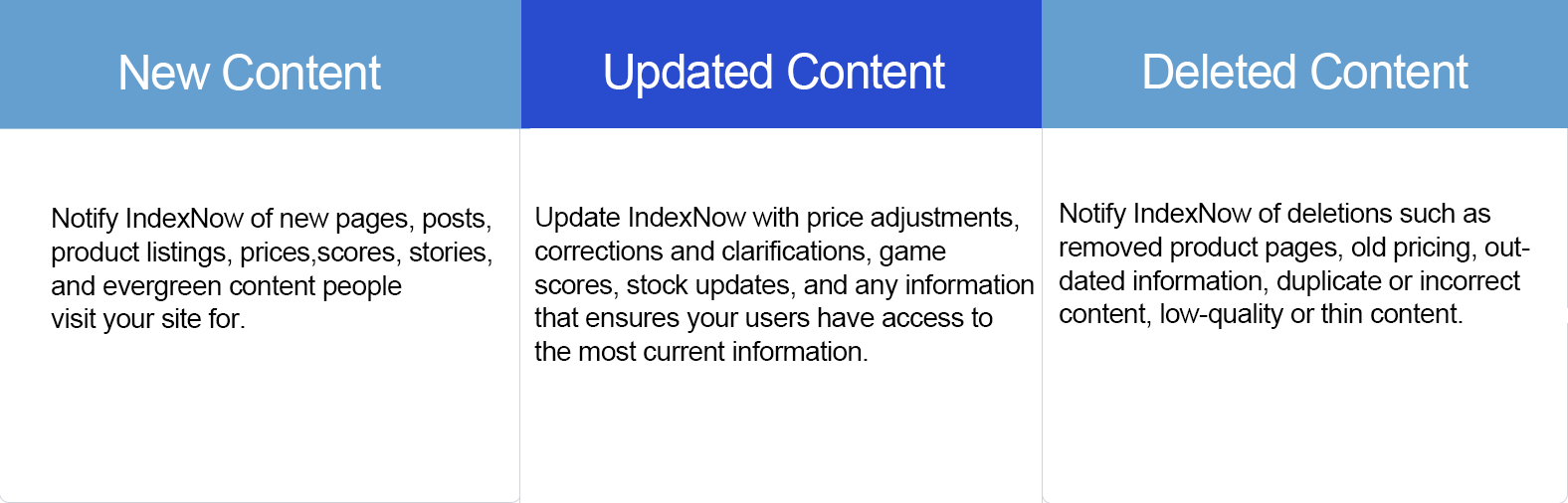
  • Stories and content updates: Whether breaking news, follow-up stories, or investigative reports – IndexNow should be notified of all of your new and updated news and article content on your website.
  • Corrections and Clarifications: If initial reports contain inaccuracies or require clarification, it’s vital to update search engines immediately. IndexNow’s quick indexing ensures audiences are informed with the most current information.
  • Outdated information, errors, and clutter: It’s important to remove content from indexing that is inaccurate or negatively affects your website’s SEO. This could include duplicate content, low-quality or thin content, or articles with outdated information.

3. Dynamic Websites

For sites with moderate to extreme fluctuations, it can be especially difficult to know when to notify IndexNow to strategically ensure content remains current in search engine results. While each site is different, here are some tips on when to consider updating IndexNow:

  • Financial Market Websites: Update at critical intervals, (such as the end of trading hours), the release of significant financial news, stock updates, or market analysis.
  • Sports Scores and Statistics: Update scores and significant event information based on the importance and action of the game, especially during and immediately after games. However, leave out time left and other momentarily important information.
  • Auction Trading Sites: Notify whenever new items are listed, sold, or when auction statuses change, or any information that ensures users have access to the most current information.
  • Travel Sites: For sites with price fluctuations per day of the year, notify IndexNow if the default price change when customers visit your site from search engines.
A graphic with three types of website content updatesImage from author, April 2024

Best Practices For When Not To Notify

  • It’s crucial not to flood IndexNow with notifications for the same URL in a short timeframe. Even if a piece of content becomes exceptionally popular and garners numerous views quickly, avoid notifying it too frequently. This can cause search engines to mistrust your content, resulting in lower rankings.
  • Timing is crucial when notifying IndexNow. However, some CMS platforms may have a lag between the time you make your changes, and when they are reflected on the web server. If you are experiencing this issue, it is best to notify IndexNow only after your content is live to avoid search engines from indexing dead links or outdated content prematurely.
  • It’s equally crucial to notify IndexNow when content is updated or removed. Neglecting to notify IndexNow when you add, update, or remove content can result in search engines serving outdated information to users, leading to poor user experiences, and potentially negatively impacting your site’s ranking.
  • If your CMS has seamless integration with IndexNow, you’re in good hands. However, if you’re coding and handling APIs yourself, follow these best practices to make the most of this powerful tool.

Note: Keep in mind that not all websites are created equal, and the way you interact with IndexNow can vary depending on your Content Management System (CMS) or coding approach. Some CMSes like Wix or Duda have direct integration with IndexNow, while others like WordPress have a free Open Source IndexNow plugin that handles IndexNow notifications for you. If your CMS has seamless integration with IndexNow, you’re in good hands, as we work with them to ensure the highest quality and accuracy of submitted URLs.

Changing Content Intelligently

Having better online visibility isn’t just about having a website.

It’s about your latest content being found. With these guidelines, you’ll ensure that your content is not just changing but changing intelligently for better search engine visibility.

Visit IndexNow/bing to learn more.

Co-authored by: Valerie Wells, Product Marketing Manager, IndexNow

More resources:


Featured Image: BestForBest/Shutterstock

Big Update To Google’s Ranking Drop Documentation via @sejournal, @martinibuster

Google updated their guidance with five changes on how to debug ranking drops. The new version contains over 400 more words that address small and large ranking drops. There’s room to quibble about some of the changes but overall the revised version is a step up from what it replaced.

Change# 1: Downplays Fixing Traffic Drops

The opening sentence was changed so that it offers less hope for bouncing back from an algorithmic traffic drop. Google also joined two sentences into one sentence in the revised version of the documentation.

The documentation previously said that most traffic drops can be reversed and that identifying the reasons for a drop aren’t straightforward. The part about most of them can be reversed was completely removed.

Here is the original two sentences:

“A drop in organic Search traffic can happen for several reasons, and most of them can be reversed. It may not be straightforward to understand what exactly happened to your site”

Now there’s no hope offered for “most of them can be reversed” and more emphasis on understanding what happened is not straightforward.

This is the new guidance

“A drop in organic Search traffic can happen for several reasons, and it may not be straightforward to understand what exactly happened to your site.”

Change #2 Security Or Spam Issues

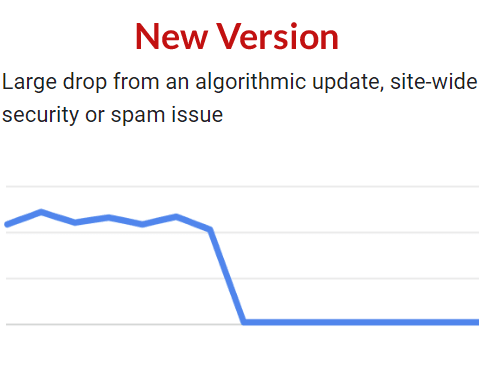
Google updated the traffic graph illustrations so that they precisely align with the causes for each kind of traffic decline.

The previous version of the graph was labeled:

“Site-level technical issue (Manual Action, strong algorithmic changes)”

The problem with the previous label is that manual actions and strong algorithmic changes are not technical issues and the new version fixes that issue.

The updated version now reads:

“Large drop from an algorithmic update, site-wide security or spam issue”

A line graph labeled

Change #3 Technical Issues

There’s one more change to a graph label, also to make it more accurate.

This is how the previous graph was labeled:

“Page-level technical issue (algorithmic changes, market disruption)”

The updated graph is now labeled:

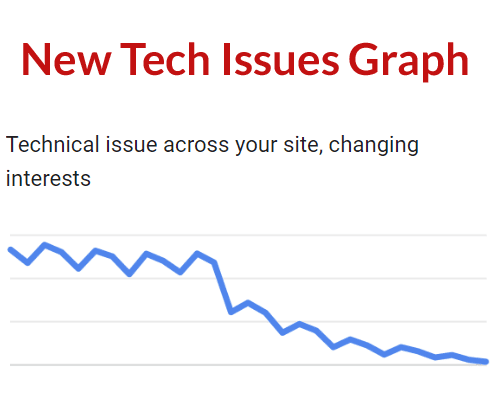
“Technical issue across your site, changing interests”

Now the graph and label are more specific as a sitewide change and “changing interests” is more general and covers a wider range of changes than market disruption. Changing interests includes market disruption (where a new product makes a previous one obsolete or less desirable) but it also includes products that go out of style or loses their trendiness.

Graph titled

Change #4 Google Adds New Guidance For Algorithmic Changes

The biggest change by far is their brand new section for algorithmic changes which replaces two smaller sections, one about policy violations and manual actions and a second one about algorithm changes.

The old version of this one section had 108 words. The updated version contains 443 words.

A section that’s particularly helpful is where the guidance splits algorithmic update damage into two categories.

Two New Categories:

  • Small drop in position? For example, dropping from position 2 to 4.
  • Large drop in position? For example, dropping from position 4 to 29.

The two new categories are perfect and align with what I’ve seen in the search results for sites that have lost rankings. The reasons for dropping up and down within the top ten are different from the reasons why a site drops completely out of the top ten.

I don’t agree with the guidance for large drops. They recommend reviewing your site for large drops, which is good advice for some sites that have lost rankings. But in other cases there’s nothing wrong with the site and this is where less experienced SEOs tend to be unable to fix the problems because there’s nothing wrong with the site. Recommendations for improving EEAT, adding author bios or filing link disavows do not solve what’s going on because there’s nothing wrong with the site. The problem is something else in some of the cases.

Here is the new guidance for debugging search position drops:

Algorithmic update
Google is always improving how it assesses content and updating its search ranking and serving algorithms accordingly; core updates and other smaller updates may change how some pages perform in Google Search results. We post about notable improvements to our systems on our list of ranking updates page; check it to see if there’s anything that’s applicable to your site.

If you suspect a drop in traffic is due to an algorithmic update, it’s important to understand that there might not be anything fundamentally wrong with your content. To determine whether you need to make a change, review your top pages in Search Console and assess how they were ranking:

Small drop in position? For example, dropping from position 2 to 4.
Large drop in position? For example, dropping from position 4 to 29.

Keep in mind that positions aren’t static or fixed in place. Google’s search results are dynamic in nature because the open web itself is constantly changing with new and updated content. This constant change can cause both gains and drops in organic Search traffic.

Small drop in position
A small drop in position is when there’s a small shift in position in the top results (for example, dropping from position 2 to 4 for a search query). In Search Console, you might see a noticeable drop in traffic without a big change in impressions.

Small fluctuations in position can happen at any time (including moving back up in position, without you needing to do anything). In fact, we recommend avoiding making radical changes if your page is already performing well.

Large drop in position
A large drop in position is when you see a notable drop out of the top results for a wide range of terms (for example, dropping from the top 10 results to position 29).

In cases like this, self-assess your whole website overall (not just individual pages) to make sure it’s helpful, reliable and people-first. If you’ve made changes to your site, it may take time to see an effect: some changes can take effect in a few days, while others could take several months. For example, it may take months before our systems determine that a site is now producing helpful content in the long term. In general, you’ll likely want to wait a few weeks to analyze your site in Search Console again to see if your efforts had a beneficial effect on ranking position.

Keep in mind that there’s no guarantee that changes you make to your website will result in noticeable impact in search results. If there’s more deserving content, it will continue to rank well with our systems.”

Change #5 Trivial Changes

The rest of the changes are relatively trivial but nonetheless makes the documentation more precise.

For example, one of the headings was changed from this:

You recently moved your site

To this new heading:

Site moves and migrations

Google’s Updated Ranking Drops Documentation

Google’s updated documentation is a well thought out but I think that the recommendations for large algorithmic drops are helpful for some cases and not helpful for other cases. I have 25 years of SEO experience and have experienced every single Google algorithm update. There are certain updates where the problem is not solved by trying to fix things and Google’s guidance used to be that sometimes there’s nothing to fix. The documentation is better but in my opinion it can be improved even further.

Read the new documentation here:

Debugging drops in Google Search traffic

Review the previous documentation:

Internet Archive Wayback Machine: Debugging drops in Google Search traffic

Featured Image by Shutterstock/Tomacco

Google March 2024 Core Update Officially Completed A Week Ago via @sejournal, @MattGSouthern

Google has officially completed its March 2024 Core Update, ending over a month of ranking volatility across the web.

However, Google didn’t confirm the rollout’s conclusion on its data anomaly page until April 26—a whole week after the update was completed on April 19.

Many in the SEO community had been speculating for days about whether the turbulent update had wrapped up.

The delayed transparency exemplifies Google’s communication issues with publishers and the need for clarity during core updates

Google March 2024 Core Update Timeline & Status

First announced on March 5, the core algorithm update is complete as of April 19. It took 45 days to complete.

Unlike more routine core refreshes, Google warned this one was more complex.

Google’s documentation reads:

“As this is a complex update, the rollout may take up to a month. It’s likely there will be more fluctuations in rankings than with a regular core update, as different systems get fully updated and reinforce each other.”

The aftershocks were tangible, with some websites reporting losses of over 60% of their organic search traffic, according to data from industry observers.

The ripple effects also led to the deindexing of hundreds of sites that were allegedly violating Google’s guidelines.

Addressing Manipulation Attempts

In its official guidance, Google highlighted the criteria it looks for when targeting link spam and manipulation attempts:

  • Creating “low-value content” purely to garner manipulative links and inflate rankings.
  • Links intended to boost sites’ rankings artificially, including manipulative outgoing links.
  • The “repurposing” of expired domains with radically different content to game search visibility.

The updated guidelines warn:

“Any links that are intended to manipulate rankings in Google Search results may be considered link spam. This includes any behavior that manipulates links to your site or outgoing links from your site.”

John Mueller, a Search Advocate at Google, responded to the turbulence by advising publishers not to make rash changes while the core update was ongoing.

However, he suggested sites could proactively fix issues like unnatural paid links.

Mueller stated on Reddit:

“If you have noticed things that are worth improving on your site, I’d go ahead and get things done. The idea is not to make changes just for search engines, right? Your users will be happy if you can make things better even if search engines haven’t updated their view of your site yet.”

Emphasizing Quality Over Links

The core update made notable changes to how Google ranks websites.

Most significantly, Google reduced the importance of links in determining a website’s ranking.

In contrast to the description of links as “an important factor in determining relevancy,” Google’s updated spam policies stripped away the “important” designation, simply calling links “a factor.”

This change aligns with Google’s Gary Illyes’ statements that links aren’t among the top three most influential ranking signals.

Instead, Google is giving more weight to quality, credibility, and substantive content.

Consequently, long-running campaigns favoring low-quality link acquisition and keyword optimizations have been demoted.

With the update complete, SEOs and publishers are left to audit their strategies and websites to ensure alignment with Google’s new perspective on ranking.


Featured Image: Rohit-Tripathi/Shutterstock

FAQ

After the update, what steps should websites take to align with Google’s new ranking criteria?

After Google’s March 2024 Core Update, websites should:

  • Improve the quality, trustworthiness, and depth of their website content.
  • Stop heavily focusing on getting as many links as possible and prioritize relevant, high-quality links instead.
  • Fix any shady or spam-like SEO tactics on their sites.
  • Carefully review their SEO strategies to ensure they follow Google’s new guidelines.

What Is Personal Branding? Here’s Why It’s So Important via @sejournal, @AdamHeitzman

Personal branding lets you take charge of your digital footprint, ensuring that what people find when they search for you online is accurate, positive, and aligned with your professional goals.

Examples Of Personal Branding That Work

Now that you understand the advantages of developing a personal brand, let’s look at a couple of real-life examples of professionals who have nailed their branding and reaped the rewards from it.

David Perell

Known as “The Writing Guy,” David Perell has built a strong personal brand around his expertise in online writing.

He has harnessed the power of the internet to inspire and coach thousands of people to improve their writing, build an online audience, and leverage that audience to propel their careers.

Thanks to his popular course “Write of Passage,” his prolific social media output, and his frequent podcast appearances, David has successfully positioned himself as one of the world’s leading proponents of the power of online writing.

Example 2 of personal brandingImage from perell.com, April 2024

Marie Forleo

Marie Forleo is an entrepreneur, author, and the creator of MarieTV, an award-winning web show that helps viewers realize their potential in business and in their personal lives.

Her personal brand revolves around the philosophy that anyone can lead a dream life if they’re willing to put in the effort. The title of her book, “Everything Is Figureoutable,” has become a mantra for personal growth and resilience, emphasizing that all problems can be solved with enough determination.

Marie has successfully used her platform to inspire millions with her practical advice, engaging personality, and unwavering belief in the potential of her viewers.

Example 3 of personal brandingImage from YouTube, April 2024

6 Steps To Build Your Own Personal Brand

So, what should you do to develop a personal brand?

Here are the six key steps to successful personal branding.

1. Define Your Brand Identity

The first step is all about self-reflection and clarity.

Your goal here is to figure out what you stand for and how you want to be perceived.

Identify what makes you unique – this could be a combination of your distinctive talents, perspectives, values, and passions. Consider your career achievements, distinguishing personality traits, and any notable challenges you’ve overcome that shape who you are today.

Remember to stay true to your authentic self, not just what you think others want to see. Being genuine will help you connect more deeply with your audience, shaping a brand identity that is both relatable and trustworthy.

Plus, being yourself is much less work than pretending to be someone else!

2. Determine Your Target Audience

Next, you need to clarify who your personal brand is speaking to.

Your target audience could be potential employers, clients in a specific industry, a professional community, or peers who share similar interests to you.

You should understand what they care about and their challenges so you can tailor your content and messaging to align with their specific needs.

3. Develop A Personal Brand Statement

A personal brand statement is a succinct description of who you are, what you do, who you serve, and why it matters.

Think of it as your professional tagline.

It should be compelling and memorable, encapsulating your unique value proposition.

For example, if you’re a software developer with a focus on educational technology, your personal brand statement might be something like: “Designing edtech to empower learners everywhere.”

A solid brand statement not only helps focus your communication across different platforms but is also a powerful tool that can differentiate you from your peers and competitors.

4. Optimize Your Online Presence

Once you’ve laid the groundwork for your personal brand, it’s time to update your digital footprint accordingly.

Make sure your social media profiles on platforms like LinkedIn and your personal website are polished, professional, and aligned with your brand identity. Consider removing any old posts or content pieces that don’t reflect the image you want to project.

It’s also worth investing in new professional headshots, a logo for your brand, and a consistent color scheme and design elements across your platforms. Visual consistency helps reinforce your brand identity and makes you easily recognizable to your audience.

5. Create And Share Valuable Content

Posting high-quality content is essential for establishing your authority and amplifying your message.

You can bolster your reputation and expand your reach by creating and sharing insightful blog posts, social media content, and videos, as well as appearing on other creators’ podcasts and YouTube channels.

Your content should not only reflect your professional insights but also your unique personality and perspectives.

Also, to build your email list, it’s a good idea to offer audience members a free, valuable resource on your website (like an ebook, webinar, or online course) in exchange for their email address.

6. Network And Engage With Your Community

Finally, building and nurturing a professional network is critical.

In addition to connecting with people online, you should actively engage with their content, contribute to relevant industry conversations, and participate in both virtual and in-person events related to your field.

Offering your expertise by answering questions, sharing insights, and providing valuable feedback solidifies your reputation as an approachable and knowledgeable thought leader.

By investing time in building relationships and promoting the work and efforts of your peers, you’ll foster more goodwill around your brand, which could open up new doors for you down the line.

Personal Branding Should Be Important For Everyone