Automattic Terminates 16% Of Workforce via @sejournal, @martinibuster

Automattic announced that Matt Mullenweg is terminating 16% of Automattic employees, citing the need to increase productivity and the capacity to invest. The company is currently in a period of growth and profitability, six months after more than 8% of employees resigned.

The announcement explains:

“We have reached an important crossroads. While our revenue continues to grow, Automattic operates in a highly competitive market, and technology is evolving at unprecedented levels. To support our customers and products, we must improve our productivity, profitability, and capacity to invest.”

The decision to terminate the employees is not based on survival or avoiding decline but rather it’s about becoming more profitable than they already are by squeezing more juice out of less oranges. One can imagine how much this must sting for the Automattic employees who were terminated, given that they enjoyed working at the company enough decline the severance package Mullenweg offered six months ago.

Automattic Software Engineers Let Go

Several former Automattic software engineers were posting on LinkedIn hoping to find new jobs.

A Special Projects Engineer named Mike Straw posted:

“Hi everyone! I was part of a sizable group of folks that were suddenly laid off at Automattic today. So, I’m seeking a new role and would appreciate your support. If you hear of any opportunities or just want to catch up, please send me a message or comment below. I’d love to reconnect. hashtag#OpenToWork”

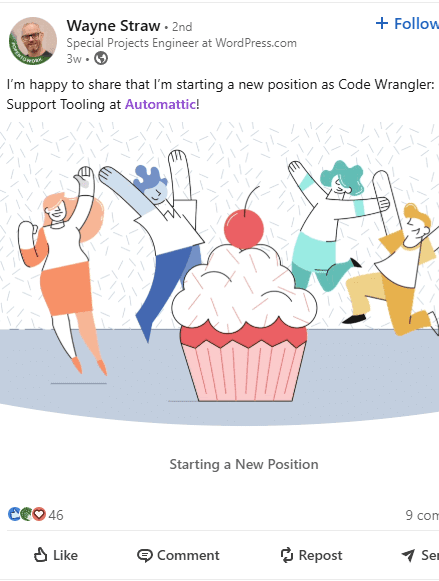
Just three weeks ago he had posted this:

Read Automattic’s announcement:

Restructuring Announcement

Featured Image by Shutterstock/Serg64

How DoorDash Became Huge Starting With A $10 Domain Name via @sejournal, @martinibuster

Garry Tan, President and CEO of Y Combinator, interviewed Tony Xu, co-founder of DoorDash, in a conversation that revealed useful insights on how to research a niche before building a business around it, the wisdom of understanding pain points and why following competitors is not always the best path for long-term success. Building a strong brand is an important factor for competing in today’s AI-saturated environment, read how Tony Xu turned DoorDash into a trusted businesses of today.

Screenshot of Y Combinator CEO Garry Tan speaking with DoorDash co-founder Tony Xu speaking on the Y Combinator video podcast episode

DoorDash began with the non-scalable $10 domain (‘Palo Alto Delivery’) and PDF menus on a static HTML web page, taking orders over Google Voice and the founders were able to scale that to the nationwide success it is today by focusing on three actionable principles which allowed them to grow past their initial shortcomings and build on their strengths.

These lessons are especially important in today’s digital marketing environment where the importance of building relationships with customers has accelerated because of the advent of AI-powered search and AI assistants.

Y Combinator

Y Combinator is a Venture Capital and startup incubator responsible for dozens of the biggest digital brands like Airbnb, DoorDash, Quora, Stripe, Webflow, and Zapier to name a few. The Y Combinator video podcast interviews brings real insights directly related to digital marketing, entrepreneurship, and the daily work involved in keeping running businesses today.

Their podcast’s tag line suggests finding a place within the digital technology economy and the DoorDash experience shows how to do it.

“All the world is changing around technology and you may contribute a line of code. What will yours be?”

Screenshot of DoorDash Co-founder Tony Xu speaking on video podcast

Three Takeaways

Tony Xu relates the beginnings of DoorDash and how it grew to become a successful company. It wasn’t a matter of getting a lot of money thrown at him and then finding success. He and his team struggled to figure out how to make the business successful. Perhaps a key to their success was that they founded the company on three ideas, creating a strong foundation upon which to build success.

Another takeaway is that a good business idea isn’t always an instant success. Success can take years to build. So be sure to give yourself a long runway measured in years not months for taking off.

The three takeaways are:

  1. Choose Business Niche By What Feels Meaningful
  2. Customer Obsession As A Strategic Philosophy
  3. Don’t Follow The Competition: Follow The Opportunity

Choosing Your Best Niche

Tony Xu explained that the DoorDash team started by exploring different projects that felt interesting to them and ultimately settling on the one that felt the most meaningful and exciting. The idea for DoorDash came about by observing a local macaroon shop that had to decline delivery orders because they lacked the infrastructure.

What’s interesting about DoorDash is that they’re in between two customer bases, the merchants and the end users. They opted to not conduct surveys but rather the founders immersed themselves in the merchants’ daily routines to identify the pain points for growth and expansion and to identify where DoorDash could help.

Tony Xu explains:

“Our question that we tended to ask business owners was can we follow you around for a day… we wanted to actually feel what it was like, their lived experience versus just asking a bunch of survey questions. It was toward the end of the time we spent with the store manager that she had showed us a booklet of orders she had turned down. All of them were delivery orders.”

He described that this was a common thread with business owners who had these small shops with orders they were unable to fulfill. He said they imagined the scale of what could be done, that they could have just delivered orders for this one bakery, or for all bakeries, all types of restaurants, all types of retailers. They discovered a need from a wide range of merchants but what they didn’t know at this point was if consumers cared or whether there was a driver workforce to partner for.

Customer Obsession As A Strategic Philosophy

Tony Xu shared that their early customer base was mainly young families and that ended up shaping their service through direct feedback. Another example of allowing the business to be shaped by the customer is an event that went badly and resulted in many upset customers. DoorDash settled on the customer-first approach by choosing to refund all the customers after a service meltdown during a Stanford football game, at the cost of 40% of the founder’s bank balances. Further, they stayed up overnight to bake and hand-deliver apology cookies the next morning at 5 AM before their customers awakened.

Tony shared how that experience solidified their business around customer satisfaction:

“That was an early story that ultimately, you know, became the story that translated to our internal company value of customer obsessed, not competitor focused… I think the founding team always had this desire to at least do things the right way even if we wouldn’t have made it.”

These experiences cemented the company’s core customer-centered philosophy of being “customer obsessed, not competitor focused.”

Don’t Follow The Competition: Follow the Opportunity

Conventional wisdom assumes that established players have done the research and that there are good reasons for why competitors do what they do. What Tony Xu revealed is that isn’t necessarily true. He doesn’t explain the reasons why competitors missed a golden opportunity but it’s easy to surmise that competitors build based on conventional assumptions and are unaware that demographics and user habits change which results in opportunities.

Tony shared that their competitors focused on dense urban markets because the conventional wisdom was that this was where more people it was more profitable to serve the densely populated areas. DoorDash went a different direction by focusing on suburbs because they discovered a customer need in that suburban customers had fewer nearby restaurants and it was that fact that made a delivery service more valuable. Serving families also resulted in higher average order size, easier parking, and simpler food drop-offs which in turn led to stronger performance across the board.

Takeaway:

Many smaller independent sites today fail to differentiate themselves to site visitors. They follow what their competitors do and because of that virtually all recipe sites, all mom sites all travel sites look exactly the same.

Becoming the same as your competitor is not the way to beat your competitors. That’s why the skyscraper and 10x content strategies are so lousy because they presume that being the same as the competitor “but better” is what your users want. Circling back to Tony Xu, he found success by being customer obsessed so the question is what does that mean for you and your site visitors?

Becoming customer-focused isn’t a new age feel-good thing to do, it’s a practical and proven approach to creating a successful business. It informs every choice you make from the design of the site, the service, and the content and it becomes a strength that no competitor can copy and steal from you.

Lastly, it’s satisfying and easier to focus on a topic that is meaningful. If there’s a way to build an ecosystem that might be even better as it can become a moat around the business.

Watch the Y Combinator podcast:

DoorDash CEO: Customer Obsession, Surviving Startup Death & Creating A New Market

Featured Image by Shutterstock/sockagphoto

Google Explains SEO Impact Of Adding New Topics via @sejournal, @martinibuster

Google’s Danny Sullivan discussed what happens when a website begins publishing content on a topic that’s different from the one in which it had gained a sitewide reputation. His comments were made at Search Central Live NYC, as part of a wide-ranging discussion about site reputation.

Danny said that introducing a new topic to a website won’t result in the site taking a hit in rankings. But what could happen is that Google might try to figure out how that content fits into the rest of the site.

Here’s what Danny said:

“We have long done work and are going to continue doing that to understand if parts of the site seem to be independent or starkly different than other parts of the site. It is not bad to have a website do whatever you want the website to do for your readers. It’s not bad that you started off covering one thing and you start writing about something else.

I had one person at an event who was very, very concerned. They started writing about snowboards but now wanted to start writing about skis and was terrified.

That if they write about skiing that somehow the topic of the website and the focus will somehow… it doesn’t work that way.

We’re not kind of building it up on the expertise you have in this particular thing, that type of thing, but what we are trying to understand is if the site seems to be different in some way from other parts of the site.”

It Doesn’t Work That Way

What Danny is saying is that Google looks at how different one part of a site is from another. And if another part is vastly different, he went on to say that sometimes it may rank well for a time based on the reputation of the entire site for the main topic but then the new section may lose rankings.

Danny explained that the loss in rankings is not a penalty but rather it’s just a recognition that a section of a site is so vastly different that the reputation of the entire site doesn’t really apply for that particular topic.

Danny used the metaphor of a “mini-site” to explain how Google might split off the reputation of a new section of a site from the rest of the site so that it can earn reputation for its topic. More about the mini-site metaphor here.

It makes sense that Google would differentiate the different parts of a site because it allows it to understand that a collection of pages is on one topic and another collection of pages within the website are about a different topic.

Featured Image by Shutterstock/Rene Jansa

DoorDash Co-Founder: Customer Obsessed, Not Competitor Focused via @sejournal, @martinibuster

Garry Tan, President and CEO of Y Combinator, interviewed Tony Xu, co-founder of DoorDash, in a conversation that revealed useful insights on how to choose a niche, what it takes for an entrepreneur to succeed in a crowded and competitive field, and how DoorDash built long-lasting brand signals that can benefit any business in today’s digital economy.

DoorDash began with the non-scalable $10 domain (‘Palo Alto Delivery’) and PDF menus on a static HTML web page, taking orders over Google Voice and the founders were able to scale that to the nationwide success it is today by focusing on three actionable principles which allowed them to grow past their initial shortcomings and build on their strengths.

These lessons are especially important in today’s digital marketing environment where the importance of building relationships with customers has accelerated because of the advent of AI-powered search and AI assistants.

Y Combinator

Y Combinator is a Venture Capital and startup incubator responsible for dozens of the biggest digital brands like Airbnb, DoorDash, Quora, Stripe, Webflow, and Zapier to name a few. The Y Combinator video podcast interviews brings real insights directly related to digital marketing, entrepreneurship, and the daily work involved in keeping running businesses today.

Their podcast’s tag line suggests finding a place within the digital technology economy and the DoorDash experience shows how to do it.

“All the world is changing around technology and you may contribute a line of code. What will yours be?”

Three Takeaways

Tony Xu relates the beginnings of DoorDash and how it grew to become a successful company. It wasn’t a matter of getting a lot of money thrown at him and then finding success. He and his team struggled to figure out how to make the business successful. Perhaps a key to their success was that they founded the company on three ideas, creating a strong foundation upon which to build success.

Another takeaway is that a good business idea isn’t always an instant success. Success can take years to build. So be sure to give yourself a long runway measured in years not months for taking off.

The three takeaways are:

  1. Choose Business Niche By What Feels Meaningful
  2. Customer Obsession As A Strategic Philosophy
  3. Don’t Follow The Competition: Follow The Opportunity

Choosing Your Best Niche

Tony Xu explained that the DoorDash team started by exploring different projects that felt interesting to them and ultimately settling on the one that felt the most meaningful and exciting. The idea for DoorDash came about by observing a local macaroon shop that had to decline delivery orders because they lacked the infrastructure.

What’s interesting about DoorDash is that they’re in between two customer bases, the merchants and the end users. They opted to not conduct surveys but rather the founders immersed themselves in the merchants’ daily routines to identify the pain points for growth and expansion and to identify where DoorDash could help.

Tony Xu explains:

“Our question that we tended to ask business owners was can we follow you around for a day… we wanted to actually feel what it was like, their lived experience versus just asking a bunch of survey questions. It was toward the end of the time we spent with the store manager that she had showed us a booklet of orders she had turned down. All of them were delivery orders.”

He described that this was a common thread with business owners who had these small shops with orders they were unable to fulfill. He said they imagined the scale of what could be done, that they could have just delivered orders for this one bakery, or for all bakeries, all types of restaurants, all types of retailers. They discovered a need from a wide range of merchants but what they didn’t know at this point was if consumers cared or whether there was a driver workforce to partner for.

Customer Obsession As A Strategic Philosophy

Tony Xu shared that their early customer base was mainly young families and that ended up shaping their service through direct feedback. Another example of allowing the business to be shaped by the customer is an event that went badly and resulted in many upset customers. DoorDash settled on the customer-first approach by choosing to refund all the customers after a service meltdown during a Stanford football game, at the cost of 40% of the founder’s bank balances. Further, they stayed up overnight to bake and hand-deliver apology cookies the next morning at 5 AM before their customers awakened.

Tony shared how that experience solidified their business around customer satisfaction:

“That was an early story that ultimately, you know, became the story that translated to our internal company value of customer obsessed, not competitor focused… I think the founding team always had this desire to at least do things the right way even if we wouldn’t have made it.”

These experiences cemented the company’s core customer-centered philosophy of being “customer obsessed, not competitor focused.”

Don’t Follow The Competition: Follow the Opportunity

Conventional wisdom assumes that established players have done the research and that there are good reasons for why competitors do what they do. What Tony Xu revealed is that isn’t necessarily true. He doesn’t explain the reasons why competitors missed a golden opportunity but it’s easy to surmise that competitors build based on conventional assumptions and are unaware that demographics and user habits change which results in opportunities.

Tony shared that their competitors focused on dense urban markets because the conventional wisdom was that this was where more people it was more profitable to serve the densely populated areas. DoorDash went a different direction by focusing on suburbs because they discovered a customer need in that suburban customers had fewer nearby restaurants and it was that fact that made a delivery service more valuable. Serving families also resulted in higher average order size, easier parking, and simpler food drop-offs which in turn led to stronger performance across the board.

Takeaway:

Many smaller independent sites today fail to differentiate themselves to site visitors. They follow what their competitors do and because of that virtually all recipe sites, all mom sites all travel sites look exactly the same.

Becoming the same as your competitor is not the way to beat your competitors. That’s why the skyscraper and 10x content strategies are so lousy because they presume that being the same as the competitor “but better” is what your users want. Circling back to Tony Xu, he found success by being customer obsessed so the question is what does that mean for you and your site visitors?

Becoming customer-focused isn’t a new age feel-good thing to do, it’s a practical and proven approach to creating a successful business. It informs every choice you make from the design of the site, the service, and the content and it becomes a strength that no competitor can copy and steal from you.

Lastly, it’s satisfying and easier to focus on a topic that is meaningful. If there’s a way to build an ecosystem that might be even better as it can become a moat around the business.

Watch the Y Combinator podcast:

DoorDash CEO: Customer Obsession, Surviving Startup Death & Creating A New Market

Featured Image by Shutterstock/sockagphoto

Google On Negative Authorship Signal And Mini-Site Reputation via @sejournal, @martinibuster

At the recent Search Central Live NYC event, Danny Sullivan discussed what happens when a site begins publishing vastly different content on a site and how that may affect rankings, introducing the concept of a mini-site as a metaphor for dividing the reputation of a site. He also discussed the concept of negative authorship authority, which some SEOs believe follows authors from penalized websites and can negatively affect the other sites they publish on.

Negative Authorship Reputation

Danny initially discussed a negative authorship signal that some in the SEO community believe can follow an author from site to site. The idea is that an author of content that is banned on one site will also have their content banned on another site. He denied that Google tracked author authority signals from site to site.

Sullivan explained:

“If you wrote for a site that got a manual action, it doesn’t somehow infect the other site that you might work for later on, so again, this is not something that freelancers should be worried about.

If you’re a publication and for whatever reason you feel like employing a freelancer, and it makes sense, that’s fine. You don’t need to worry about who they worked for before.

And if you are a freelancer you do not need to go back to the publications and say, can you take my byline down because now I can’t get hired from anybody else because they think I’m going to infect them. It is not like that. It’s not a disease. “

The above SEO myth likely began when publishers noticed that content created by a certain author across multiple sites was banned. In that case, it’s reasonable to assume that there was something wrong with the content but that’s not necessarily true. It could have been the case that the website itself was poorly promoted with unnatural links. Or, it could be that the site itself was engaged with selling links.

The takeaway from what Danny Sullivan shared is that a manual action on one site doesn’t follow an author to another site. Another takeaway is that there is no negative authorship signal that Google is tracking.

And if there’s no negative authorship signal could it be that there is no positive author signal as well? In my opinion it’s a reasonable assumption. A signal like that would be too easy to manipulate. Whatever signals Google uses to understand site reputation is likely enough for the purpose of citing an information source in the search results.

Although claims by some SEOs have been made about authorship signals, authorship signals have never been known to be a thing with Google’s algorithms. Google has a long history of denying the use of authorship signals and Danny’s statements offer further validation that Google continues to not use authorship as signals for ranking purposes.

Ranking Drops And Mini-Site Reputation

Danny next begins talking about how a new section of a site could suddenly lose rankings. He says this isn’t necessarily a bad thing. It’s just Google trying to figure out this new section and that if it’s sufficiently different Google could even start treating it as a standalone mini-site. This is a really fascinating thing he gets into here.

Danny used the example of the addition of a forum to a website.

Danny explained

“For example, you might have a site where you start running a forum. Forums can be different and we would want to understand that this looks like a forum so that we can then rank the forum content against other kinds of forum content on kind of a level playing field or understand that that forum content should be included in things where we try to show forum content.”

What can happen is… that it could be that part of your site was doing better because it was seen as part of the overall site. Now we kind of see it as more of independent and part of a full site on its own.

And potentially you could see a traffic drop that comes from that. That doesn’t mean that you suddenly got a site reputation abuse ban issue because first of all that might not have involved third party content abusing first party work, right? Those were the things. So if it doesn’t have any of that it doesn’t have anything to do with that.Secondly, we would have sent you an email. So, it’s not bad.

Because it just could be we’ve had a general re-ranking… It could also mean that in the long run that part of your site might actually do better, because we might recognize it in different ways, that we might be able to surface it in different ways. And it might start sort of earning its own like ‘mini-site’ reputation along the way.”

Three things to take away from that last part.

A ranking drop could be due to benign things, don’t always assume that a ranking drop is due to a spam or other negative algorithmic action.

Second, a rankings drop could be due to a “general re-ranking” which is a vague term that went unexplained but is probably a reference to minor ranking adjustments outside of a core algorithm update.

The third takeaway is the part about a section of a website earning it’s own “mini-site” reputation. I think SEOs should not create theories about mini-sites and mini-site reputations because that’s not what Danny Sullivan said. He used the word “like” which means that he likely used the phrase “mini-site” as a metaphor.

Featured Image by Shutterstock/Joseph Hendrickson

Data Shows Google AIO Is Citing Deeper Into Websites via @sejournal, @martinibuster

New data from BrightEdge that was shared with Search Engine Journal shows that Google’s AI Overviews (AIO) in March 2025 have rapidly expanded in size and are shifting how traffic is distributed across search results. The analysis suggests that deep, specialized content is likelier to be cited than homepages.

This shows that AIO is becoming more precise about the answers it is giving, aligning with the concepts of Predictive Summaries and Grounding Links that Google recently shared with marketers at Search Central NYC.

Google has traditionally favored showing precise answers to questions, something that the home pages of websites generally cannot do. It makes sense that BrightEdge’s data reflects the kind of precise linking that Predictive Summaries and Grounding Links display in AIO.

Google has expanded the pixel height of AIO by 18.26% in the first two weeks of March. Although some may rightly note that it’s reducing the outbound links of the organic search results it’s important to put that into the context that Google’s AIO also has outbound links and that those links are highly precise contextually relevant links.

The expansion of AIO size was not across the board. Industry-specific increases in AI Overview size:

  • Travel: +39.49%
  • B2B Tech: +37.13%
  • Education: +35.49%
  • Finance: +32.89%

Strategic Response for SEOs And Publishers

BrightEdge suggests that publishers and SEOs should monitor performance metrics to track changes in traffic, impressions, CTRs, and clicks to evaluate how AI Overviews may be influencing traffic trends. Of absolute importance is to try to identify sales or revenue trends because those are the most important metrics, not traffic.

Although it may be useful to create citable content, Google is generally summarizing content and then linking to where users can read more. Now more than ever it’s important to be aware of user trends relative to your industry and be able to anticipate them, including the context of a user’s search. Jono Alderson recently suggested targeting users at the very early side of the consumer journey in order to get ahead of AI-based citations.

Importance of In-Depth, Specialized Content

Google AIO is showing a citation preference for deep-linked content, two more clicks from the home page deep (2+ deep). 82.5% of clicks were to 2+ deep pages. Home pages accounted for less than 0.5% of all clicks.

86% of cited pages were ranked for only one keyword, often high-volume. This represents an opportunity for high traffic volume keyword traffic. The median keyword volume for citations was 15,300 monthly searches and 19% of citation-triggering keywords contain traffic volume in excess of 100k monthly searches.

Implications For Technical SEO And Content Optimization

BrightEdge suggests that full site indexing is critical for AI Overviews in order to ensure that every page is available to be cited as a potential source. Even older and otherwise overlooked content may gain value, especially if they’re reviewed and updated to make them suitable to be cited and reflect the most current information.

Google has been citing deeper content for many years now and the age of the primacy of the home page has been long over, except in local search. That said, home pages only accounted for half a percent of clicks from AIO so it’s super important now more than ever to optimize inner pages.

Takeaways:

The following are the top takeaways from the data:

  • Google’s AI Overviews are rapidly expanding in visual size on the SERP
  • Industries like Travel, B2B Tech, Education, and Finance are experiencing the fastest AI Overview growth
  • Deeper, more specific content is overwhelmingly favored for AI citations over homepages
  • Pages cited in AI Overviews often surface for just one keyword—frequently high-volume
  • Technical SEO and full-site indexing are now essential for brand visibility in AI-driven search

Google’s AI Overviews are not just expanding in size; they are improving the contextual relevance of outbound links to websites. Optimizing for AIO should turn an eye toward keeping older content fresh and up to date to keep it relevant for users who will appreciate that content.

BrightEdge data shared with Search Engine Journal has not been published but a monthly updated guide to AIO is available.

Featured Image by Shutterstock/B..Robinson

Google On Scaled Content: “It’s Going To Be An Issue” via @sejournal, @martinibuster

Google’s John Mueller and Danny Sullivan discussed why AI generated content is problematic, citing the newly updated quality rater guideline and sharing examples of how AI can be used in a positive way that has added value.

Danny Sullivan, known as Google Search Liaison, spoke about the topic in more detail, providing an example of what a high quality use of AI generated content is to serve as a contrast to what isn’t a good use of it.

Update To The Quality Rater Guidelines

The quality rater guidelines (QRG) is a book created by Google to provide guidance to third-party quality raters who rate tests of changes to Google’s search results. It was recently updated and it now includes guidance about AI generated content that’s folded into a section about content created with little effort or originality.

Mueller discussed AI generated content in the context of scaled content abuse, noting that the quality raters are taught to rate that kind of content as low quality.

The new section of the QRG advises the raters:

“The lowest rating applies if all or almost all of the MC on the page (including text, images, audio, videos, etc) is copied, paraphrased, embedded, auto or AI generated, or reposted from other sources with little to no effort, little to no originality, and little to no added value for visitors to the website. Such pages should be rated Lowest, even if the page assigns credit for the content to another source.”

Doesn’t Matter How It’s Scaled: It’s Going To Be An Issue

Danny Sullivan, known as Google Search Liaison, started his part of the discussion by saying that to Google, AI generated content is no different than scaled content tactics from the past, comparing it to the spam tactics of 2005 when Google used statistical analysis and other methods to catch scaled content. He also emphasized that it doesn’t matter how the content was scaled.

According to my notes, here’s a paraphrase of what he said:

“The key things are, large amounts of unoriginal content and also no matter how it’s created.

Because like, ‘What are you going to do about AI? How are you going to deal with all the AI explosion? AI can generate thousands of pages?’

Well 2005 just called, it’d like to explain to you how human beings can generate thousands of pages overnight that look like they’re human generated because they weren’t human generated and etcetera, etcetera, etcetera.

If you’ve been in the SEO space for a long time, you well understand that scaled content is not a new type of thing. So we wanted to really stress: we don’t really care how you’re doing this scaled content, whether it’s AI, automation, or human beings. It’s going to be an issue.

So those are things that you should consider if you’re wondering about the scaled content abuse policy and you want to avoid being caught by it.”

How To Use AI In A Way That Adds Value

A helpful thing about Danny’s session is that he offered an example of a positive use AI, citing how retailers offer a summary of actual user reviews that give an overall user sentiment of the product without having to read reviews. This is an example of how AI is providing an added value as opposed to being the entire main content.

This is from my notes of what he said:

“When I go to Amazon, I skip down to the reviews and the reviews have a little AI-generated thing at the top that tells me what the users generally think, and I’m like, this is really helpful.

And the thing that’s really helpful to me about it is, it’s AI applied to original content, the reviews, to give me a summary. That was added value for me and unique value for me. I liked it.”

As Long As It’s High Quality….

Danny next discussed how they tried to put out a detailed policy about AI generated content but he said it was misconstrued by some parts of the SEO community to mean that AI generated content was fine as long as it was quality AI generated content.

In my 25 years of SEO experience, let me tell you, whenever an SEO tells you that an SEO tactic is fine “as long as it’s quality” run. The “as long as it’s quality” excuse has been used to justify low-quality SEO practices like reciprocal links, directory links, paid links, and guest posts – If it’s not already an SEO joke it should be.

Danny continued:

“And then people’s differentiation of what’s quality is all messed up. And they say Google doesn’t care if it’s AI!’ And that is not really what we said.

We didn’t say that.”

Don’t Mislead Yourself About Quality Of Scaled Content

Danny advised that anyone using artificially generated content should think about two things to use as tests for whether it’s a good idea:

  1. The motivation for mass generated content.
  2. Unoriginality of the scaled content.

Traffic Motivated Content

The motivation shouldn’t be because it will bring more traffic. The motivation should because there’s a value-add for site visitors.

This is how Danny Sullivan explained it, according to my notes:

“Any method that you undertake to mass generate content, you should be carefully thinking about it. There’s all sorts of programmatic things, maybe they’re useful. Maybe they’re not. But you should think about it.

And the things to especially think about is if you’re primarily doing into it to game search traffic.

Like, if the primary intent of the content was, ‘I’m going to get that traffic’ and not, ‘some user actually expected it’ if they ever came to my website directly. That’s one of the many things you can use to try to determine it.”

Originality Of Scaled Content

SEOs who praise their AI-generated content lose their enthusiasm when the content is about a topic they’re actually expert in and will concede that it’s not as smart as they are… And what’s going on, that if you are not an expert then you lack the expertise to judge the credibility of the AI generated content.

AI is trained to crank out the next likeliest word in a series of words, a level of unoriginality so extreme that only a computer can accomplish it.

Sullivan next offered a critique of the originality of AI-generated content:.

“The other thing is, is it unoriginal?

If you are just using the tool saying, ‘Write me 100 pages on the 100 different topics that I got because I ran some tool that pulled all the People Also Asked questions off of Google and I don’t know anything about those things and they don’t have any original content or any value. I just kind of think it’d be nice to get that traffic.’

You probably don’t have anything original.

You’re not necessarily offering anything with really unique value with it there.

A lot of AI tools or other tools are very like human beings because they’ve read a lot of human being stuff like this as well. Write really nice generic things that read very well as if they are quality and that they answer what I’m kind of looking for, but they’re not necessarily providing value.

And sometimes people’s idea of quality differ, but that’s not the key point of it when it comes to the policy that we have with it from there, that especially because these days some people would tell you that it’s quality.”

Takeaways:

  • Google doesn’t “care how you’re doing this scaled content, whether it’s AI, automation, or human beings. It’s going to be an issue.”
  • The QRG explicitly includes AI-generated content in its criteria for ‘Lowest’ quality ratings, signaling that this is something Google is concerned about.
  • Ask if the motivation for using AI-generated content is primarily to drive search traffic or to help users
  • Originality and value-add are important qualities of content to consider

Google Cautions SEOs & Creators About Filler Content via @sejournal, @martinibuster

Google’s John Mueller cautioned publishers and SEOs about filler content, which is generally created with the apparent goal of reaching a word-count threshold without concern for the user experience. Although recipe sites are the cause of this warning, this is the kind of thing that all SEOs and publishers should be concerned about.

Probable Origin Of Filler Content

What Mueller warned about, filler content, probably has origins in the idea that “content is king” which resulted in the SEO practice that values creating content similar to what Google is already ranking except doing it ten times better so that it towers over the competition (10x and skyscraper content strategies).

John Mueller Warns About Filler Content

Mueller’s observations about filler content were in the context of an overview of recent changes in the Quality Rater Guidelines (QRG), a book that Google created to bring more objective standards to how third party raters rate search results that are being tested.

Mueller said that filler content is low quality content that’s designed to make a page longer. Speaking informally and loosely, he said that filler content is problematic because users can find it “annoying.”

This is, according to my notes, what he said:

“Recently, quality rater guidelines, there are few things that I think are interesting for some sites that we have mentioned in the quality rater guidelines now which weren’t in there before.

And so this is the kind of thing which I think is important for sites to realize. On the one hand we’ve written about filler content, which is the kind of fluff that some websites put on their pages to make the pages longer. And sometimes they have good reasons to make the pages longer.

But for us this is sometimes problematic and users sometimes find it annoying. So we have that mentioned in the quality rater guidelines.”

Filler Content Is A Poor User Experience

What Mueller is referring to is the new section 5.2.2 of the QRG which lays out how to objectively judge whether a page has filler content. Filler content previously was nestled within section 5.2 but it’s now broken out into its own section. The main takeaway is that filler content is a user experience issue.

Here’s what the new section of the QRG says:

“5.2.2 Filler as a Poor User Experience

The main content (MC) of a page should support its purpose. Web site owners and content creators should place the most helpful and essential MC near the top of the page so that visitors can immediately access it.

A high quality page has the most helpful MC placed most prominently. Content that supports the page purpose without directly contributing to the primary goal can be included, but it should be shown lower on the page in a less prominent position. For example, on recipe pages, the recipe itself and important supporting content directly related to the recipe should be prominently displayed near the top of the webpage.

Sometimes, MC includes “filler” – low-effort content that adds little value and doesn’t directly support the purpose of the page. Filler can artificially inflate content, creating a page that appears rich but lacks content website visitors find valuable. Filler can result in a poor experience for people who visit the page, especially if placed prominently ahead of helpful content for the purpose of the page.

Important: Content that supports the page purpose without directly contributing to its primary goal can still be valuable if placed appropriately. Filler refers to low-effort content that occupies valuable and prominent space without providing value or without being helpful or satisfying for the primary purpose of the page.

A Low rating is appropriate if the page

● Contains a large amount of low quality and unhelpful filler, causing a poor experience for people visiting the page

● Contains a large amount visually prominent filler that makes it difficult to find the helpful MC, causing frustration for people visiting the page”

Content Filler – Not Just For Recipe Sites

The new quality rater guideline section about filler content specifically mentions recipe sites, likely because of their notoriously long filler content that’s so bad they have to add a link to skip to the the part that’s useful.

Some SEOs generally dislike change and this will probably make some people angry, but in my opinion, any publisher that feels they need to add a link to “skip to recipe” should probably consider that they’re doing something wrong. As Google says, important supporting content should be up front. If users have to skip the content to get to it then whatever it is that’s being skipped is not useful.

Recipe sites may be the worst offenders for filler content, but that doesn’t mean publishers in other niches can ignore the policy. All SEOs and content creators should recognize that filler content is problematic.

Imitating the top-ranked content is a practice that content publishers need to reconsider. It works against what Google is actually trying to rank and can lead to artificial word count targets instead of focusing on the user’s needs.

Win Higher-Quality Links: The PR Approach To SEO Success [Webinar] via @sejournal, @lorenbaker

Are you ready to master the art of earning high-quality editorial links?

Join us on April 9, 2025, for our exclusive webinar, “Win Higher-Quality Links: The PR Approach To SEO Success.” As Google’s AI-driven algorithms evolve, the importance of securing authoritative links has never been greater. Learn from the experts how to enhance your SEO strategy with proven Digital PR techniques.

Why This Webinar Is a Must-Attend Event

This session is designed for those looking to elevate their link-building strategies beyond traditional methods. Discover a data-driven approach that has helped large brands secure hundreds of top-tier links and media mentions.

What You Will Learn:

  • Effective Digital PR Processes: Uncover the step-by-step process and tools needed to earn contextual, editorial links from leading publications.
  • Strategic Insights: Learn how combining data insights with expert commentary can attract significant press coverage.
  • Success Stories: Examine real-world case studies from enterprise brands that have successfully implemented these digital PR strategies.

Expert Guidance From Kevin Rowe

Kevin Rowe, an expert in digital PR strategies for enterprise brands, will lead the webinar. He’ll share the methodologies he’s used to gain impactful links, helping you understand how to apply these strategies to your own efforts.

Interactive Q&A Session

The webinar will conclude with a LIVE Q&A session, offering you the chance to ask Kevin your detailed questions about digital PR and link building.

Don’t Miss Out!

If you’re aiming to earn links that truly reflect your brand’s expertise and drive SEO success, this webinar will provide you with the actionable strategies you need.

Reserve your spot now to start leveraging your brand’s data and expertise into authoritative media coverage.

Google Confirms You Can’t Add EEAT To Your Web Pages via @sejournal, @martinibuster

Google’s John Mueller offered an overview of EEAT (Experience, Expertise, Authoritativeness, and Trustworthiness) at the Search Central Live NYC event and affirmed why it matters for some sites and why it’s not something SEOs can add to a website.

EEAT’s Relation To Quality Raters And YMYL Websites

John Mueller started this part of his discussion by explicitly tying the concept to its use as a way for the third party quality raters to provide a more objective judgment about the quality of the search results. He did not say that EEAT was created for SEOs to use as a ranking factor guide, in fact he expressly said that’s not how it works.

What is especially notable is that Mueller says that EEAT comes into play algorithmically for sites that are in topics that affect health or finance, what Google terms Your Money Or Your Life (YMYL) topics.

This is what he said, according to my notes, which contains some paraphrasing:

“EEAT is one of the ways that we look at page quality. EEAT is experience, expertise, authoritativeness and trustworthiness. And this is something that we tell the third party quality raters to watch out for when they’re doing page quality evaluation and something that we take into account when we think the query or a set of pages is on a specific topic where it’s more critical, where we call them your money, your life pages. Where we think that the user actually needs to have something that they can rely on and some signs that they can rely on the content that is present.”

EEAT Is Not Something You Add To Web Pages

In his follow-up statements he dismissed the idea that an SEO can add EEAT to their web pages. EEAT is not something you can add to a website. That’s not how it works. So if adding EEAT is part of what you do for SEO, stop. That’s not SEO.

This is what Mueller said:

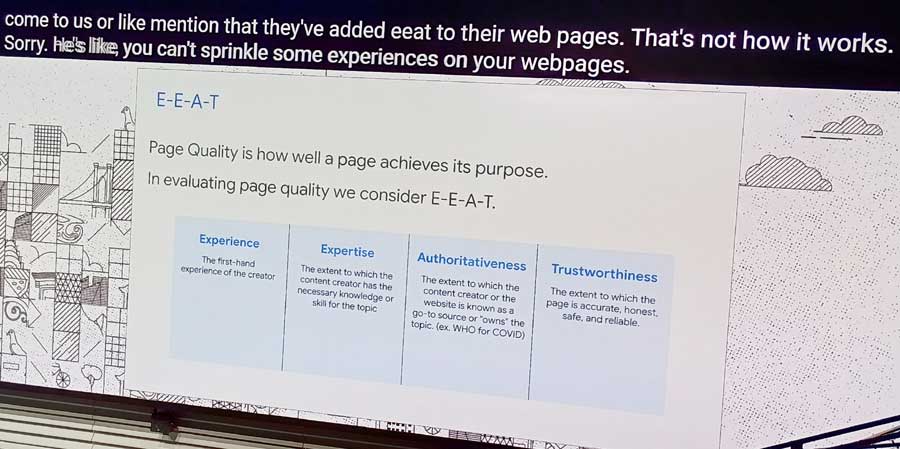
“Sometimes SEOs come to us or like mention that they’ve added EEAT to their web pages. That’s not how it works. Sorry, you can’t sprinkle some experiences on your web pages. It’s like, that’s that doesn’t make any sense.”

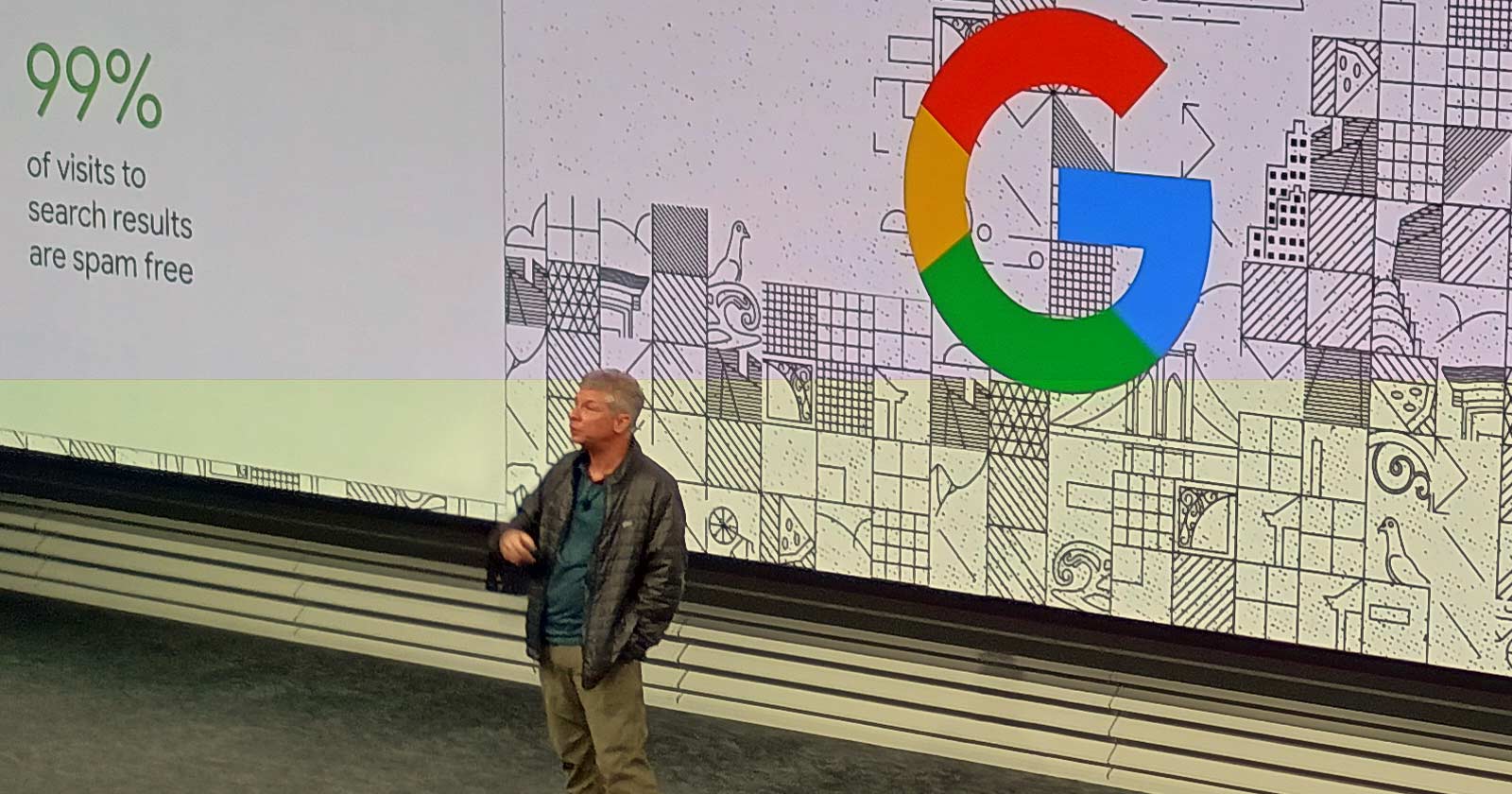
Photo From Google Search Central Live NYC

EEAT Is Not Needed On Non-YMYL Pages

Lastly, Mueller repeated the point that EEAT is not something that they’re looking for in run of the mill websites. Obviously it’s great if the content has expertise and trustworthiness and so on. But he said it’s not something they’re algorithmically alert for on those kinds of sites, specifically naming recipe sites.

This is what he said:

“From a practical point of view, it’s important to look at this, especially if you’re publishing things on these critical topics, and to look at how you can highlight what it is that you’re already doing so that it’s clear for users.

But if you’re creating a recipe for cookies, you don’t need to have the sidebar with like, ‘this author has created cookies for 27 years.’ I think most people will be able to understand.”

Takeaways

EEAT’s Purpose and Scope

EEAT is used by third-party quality raters to assess search result quality. It was not created by Google as a list of ranking factors for an SEO checklist.

EEAT’s Role in YMYL Topics

Google algorithmically considers EEAT for pages that affect users’ finances or health, which is  referred in the Quality Raters Guidelines  Your Money or Your Life (YMYL) topics. These are the topic areas where reliability and trust are critical for user safety and confidence and where Google is especially concerned that those qualities are expressed in some way internally and/or externally about those sites. Google doesn’t say what those signals are.

Misconceptions About EEAT in SEO

John Mueller emphasized that EEAT is not something SEOs can “add” to a website the way they might add keywords or internal links. Attempting to “add EEAT” is a misunderstanding of how the concept works within search.

EEAT and Non-YMYL Websites

EEAT is not something that is required in an algorithmic context for non-YMYL sites, such as recipe blogs or other kinds of non-critical content. While it’s useful in a general or marketing sense to to reflect expertise and trust, it’s not a ranking focus for most topics.

EEAT is explicitly created for the third party quality raters to use as a more objective benchmark. That fact gets lost in all the conversations by SEOs about the topic of EEAT. It is also something that’s not particularly important for sites that are outside of YMYL topics. Lastly, EEAT is not something that an SEO can add to their page. Creating a bio with an AI generated image, linking it to a fake LinkedIn profile and then calling it EEAT is not a thing. Trustworthiness, for example, is something that is earned and results in people making recommendations (which doesn’t mean that SEOs should create fake social media profiles and start talking about an author at a website). Nobody really knows what the EEAT signals are.

Featured Image by Shutterstock/RealPeopleStudio