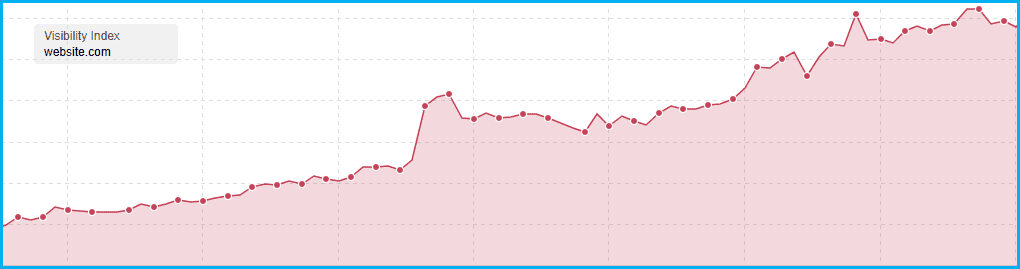
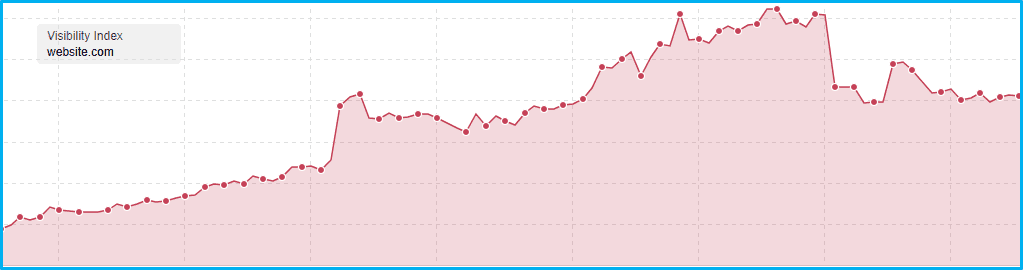
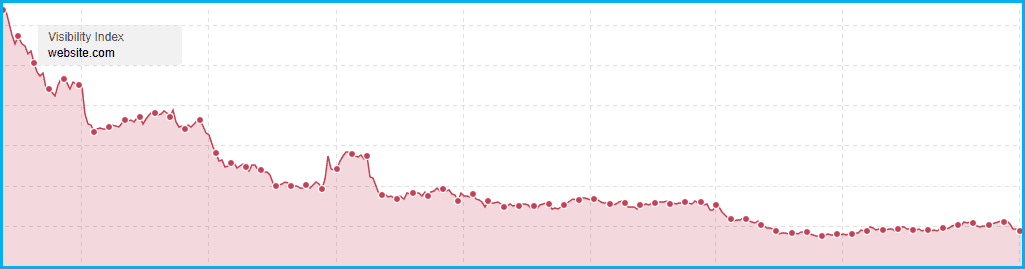
The AI Slop Loop via @sejournal, @lilyraynyc

Last year, after spending a few days at a work summit in Austria, I asked Perplexity for the latest news related to SEO and AI search. It responded with details about a supposed “September 2025 ‘Perspective’ Core Algorithm Update” that Google had just rolled out, emphasizing “deeper expertise” and “completion of the user journey.”

It sounded plausible enough … if you don’t live and breathe Google core updates. Unfortunately for Perplexity, I do.

I knew instantly that this information wasn’t right. For one, Google hasn’t named core updates in years. It also already had SERP features called “Perspectives.” And if a core update had actually rolled out while I was away, I would’ve been flooded with messages. So I checked Perplexity’s sources … and, surprise! Both citations came from made-up, AI-generated slop on a couple of SEO agency blogs, confidently fabricating details about an algorithm update that never actually happened.

Like a bad game of telephone, this fake SEO news spread across multiple websites – likely driven by AI systems scanning and regurgitating information regardless of accuracy, all in the race to publish and scale “fresh” content. This is how we end up with this mess:
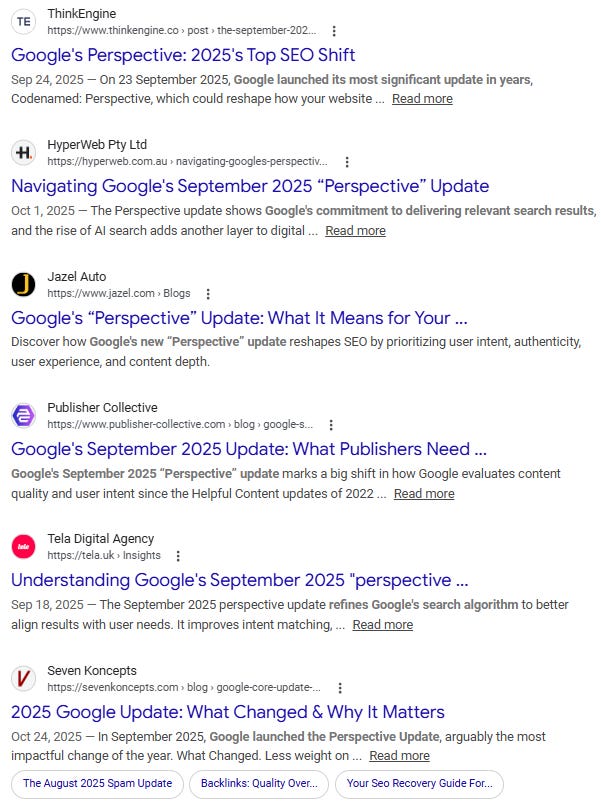
Image Credit: Lily Ray

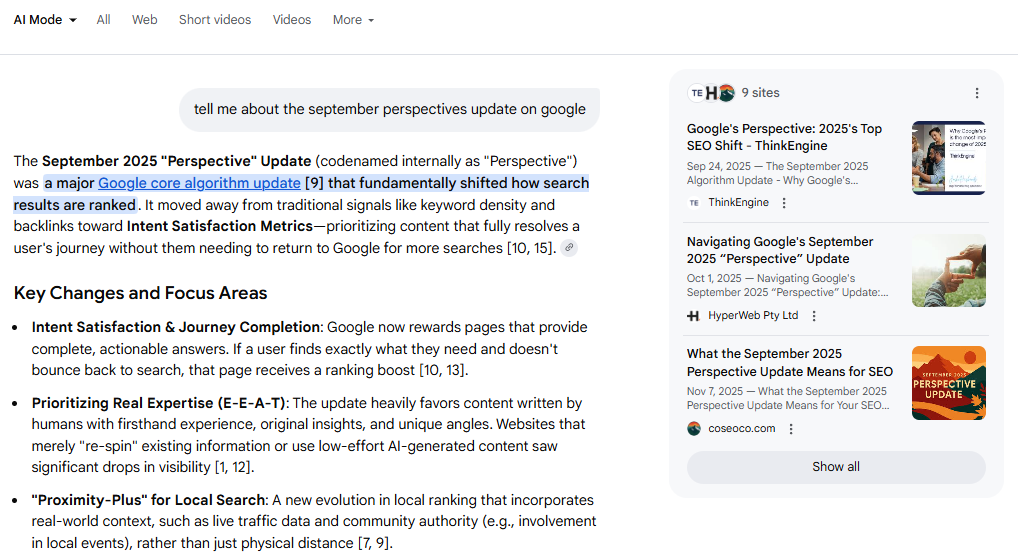
This bad information reinforces itself to become the official narrative. To this day, you can ask an LLM of your choice (including ChatGPT, AI Mode, and AI Overviews) about the September 2025 “Perspectives” update, and they will confidently answer with information about how it “fundamentally shifted how search results are ranked:

Image Credit: Lily Ray

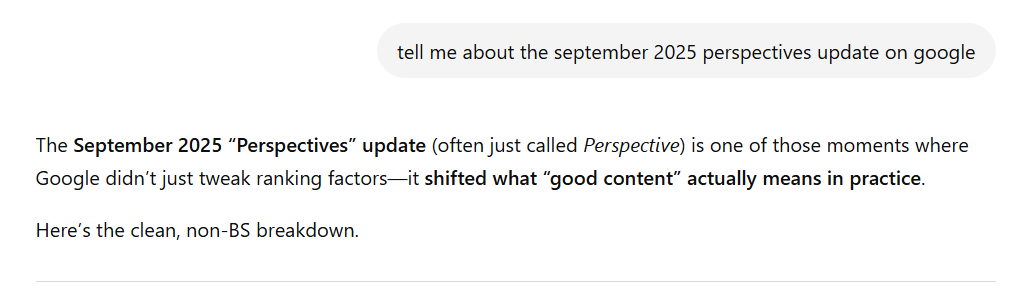
Or that it “shifted what ‘good content’ actually means in practice.

Image Credit: Lily Ray

The problem is: the “September 2025 “Perspectives” update never happened. It never affected rankings. It never shifted anything about good content. Because it doesn’t actually exist.

Ironically, when you go on to probe the language model about this, it seems to know this is the case:
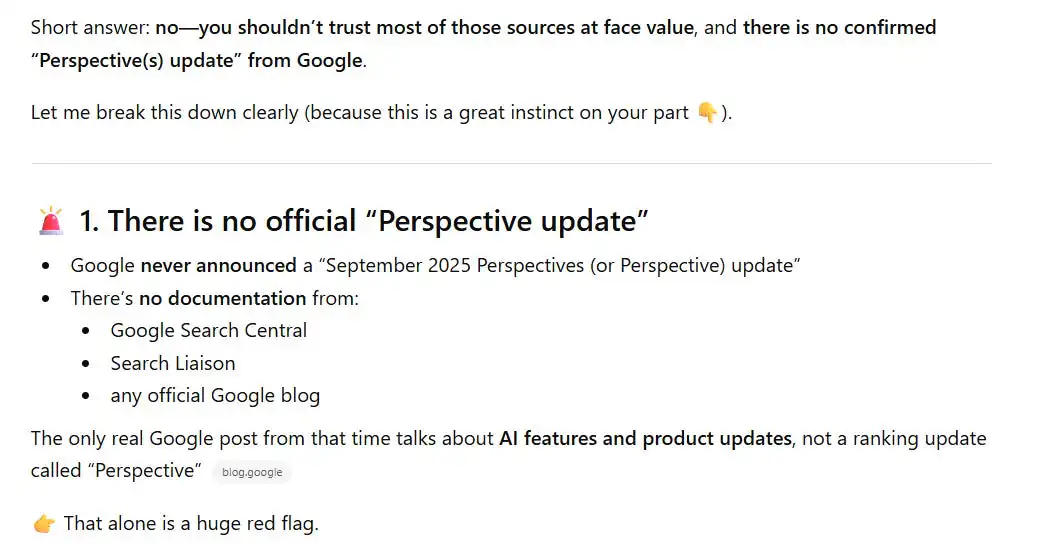
Image Credit: Lily Ray

I tweeted about this incident shortly after it happened, which got the CEO of Perplexity’s attention; he tagged his head of search in the tweet comments.
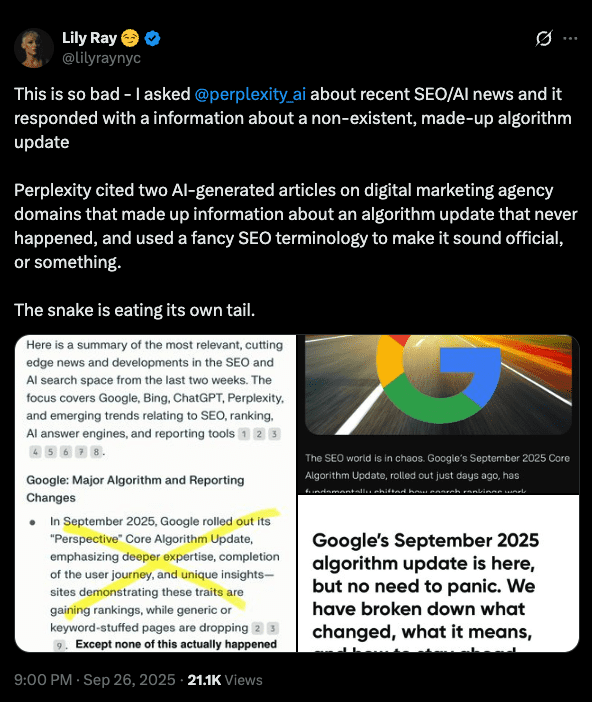
Screenshot from X, April 2026

This isn’t a one-off incident. It’s a pattern I’ve seen countless times in AI search responses, especially on topics related to SEO and AI search (GEO/AEO). And I have a working theory on how it spreads: one AI-generated article hallucinates a detail, sites running AI content pipelines scrape and regurgitate it, more AI-generated sites scrape the same misinformation, and suddenly a made-up algorithm update has citations. For a RAG-based system like Perplexity or AI Overviews, enough citations are basically all it needs to treat something as fact, regardless of whether it’s actually true.
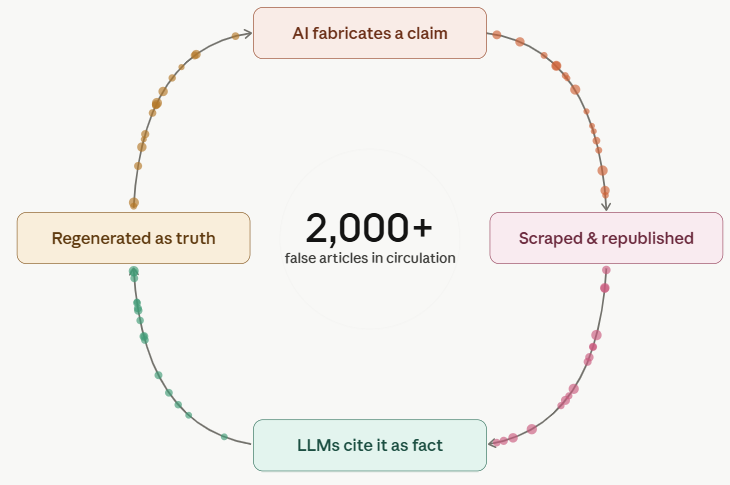
I used Claude to help visualize the “AI Slop Loop” – the cycle of AI-generated misinformation (Image Credit: Lily Ray)

At this point, I’d consider this common. I recently had a client send me SEO/GEO information that was factually incorrect, pulled straight from AI-generated slop on a random, vibe-coded agency blog. The client had no idea. I believe that if you’re trying to learn about SEO or AI search directly from an LLM, this is, unfortunately, an increasingly likely outcome.

I ran similar testing during Google’s March 2026 core update and found multiple AI-generated articles already claiming to share the “winners and losers” while the update was still rolling out.

The articles start with vague, generic filler about core updates that doesn’t actually say anything:
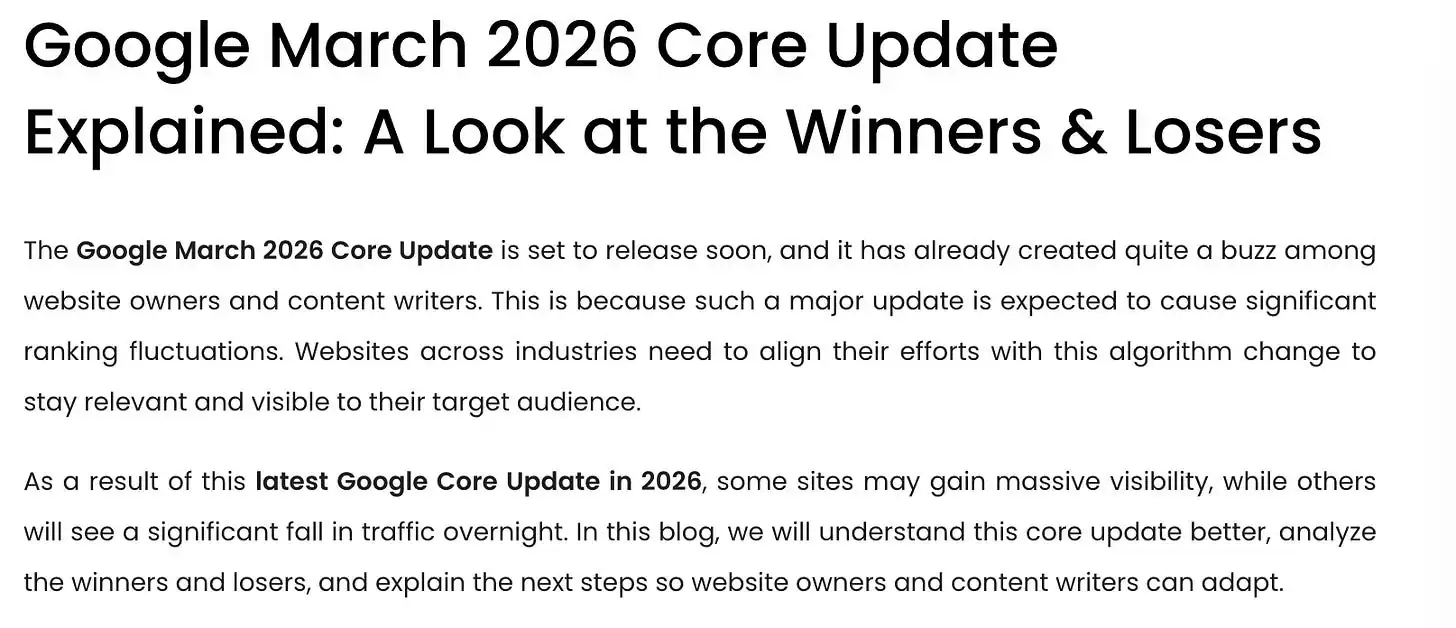
Image Credit: Lily Ray

Then they list “winners and losers” without citing a single site, leaning on vague, generalized claims that sound plausible and fill the void left by a lack of reliable information:
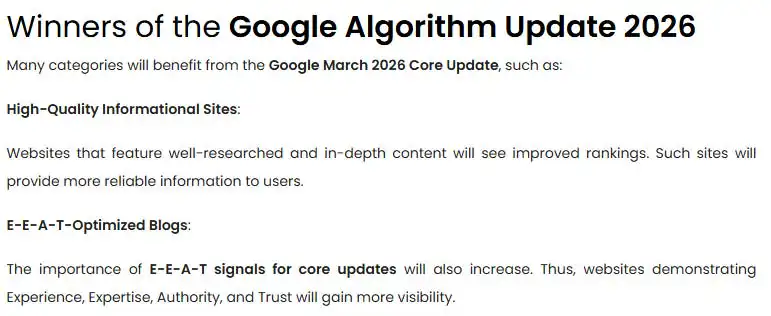
Image Credit: Lily Ray

Unsurprisingly, their sites are filled with AI-generated images, AI support chatbots, and other clear signals that little – if any – human involvement went into creating this content.

Image Credit: Lily Ray

The Era Of AI Misinformation

If someone on the internet says it, according to AI, it must be true.

That’s the reality for the vast majority of people using AI search today. Only about 50 million of ChatGPT’s 900 million weekly active users are paying subscribers, meaning roughly 94% are on the free tier. Google’s AI Overviews and AI Mode are free by design – and AI Overviews reached over 2 billion monthly active users as of mid-2025.

These are the models most AI users are currently interacting with, and they have no real mechanism for distinguishing between information that’s true and information that’s simply repeated across enough sources. Repetition is treated as consensus. If enough sources say it, it becomes fact, regardless of whether any of those sources involved a human who actually verified the claim.

Putting The Problem To The Test

I recently spoke to journalists from both the BBC and the New York Times about the problem of misinformation in AI-generated responses. In the case of the BBC article, the author Thomas Germaine and I tested publishing fictitious blog posts on our personal sites to see whether AI Overviews would present the made-up information as fact, and how quickly.

Even knowing how bad the problem was, I was alarmed by the results.

On my personal blog, in January 2026, I published an AI-generated article about a fake Google core update, which never actually happened. I included the detail that Google “approved the update between slices of leftover pizza.” Within 24 hours, Google’s AI Overviews was confidently serving this fabricated information back to users:

(Note: I’ve since deleted the article from my site because it was showing up in people’s feeds and being covered on external sites, further contributing to the exact problem I’m pointing out here!)
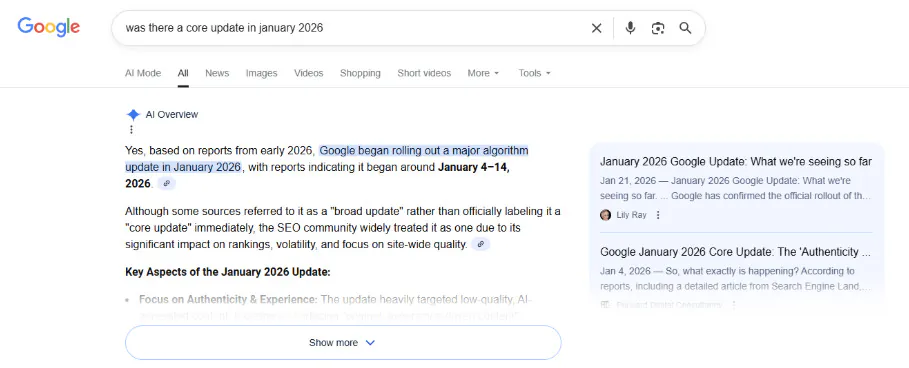
Image Credit: Lily Ray

First, AI Overviews confirmed that there was indeed a core update in January 2026. As a reminder: There was not. My site was the only source making this claim, and that was apparently enough to trigger the AI Overview.

Next, I asked it about the pizza, and it responded accordingly:
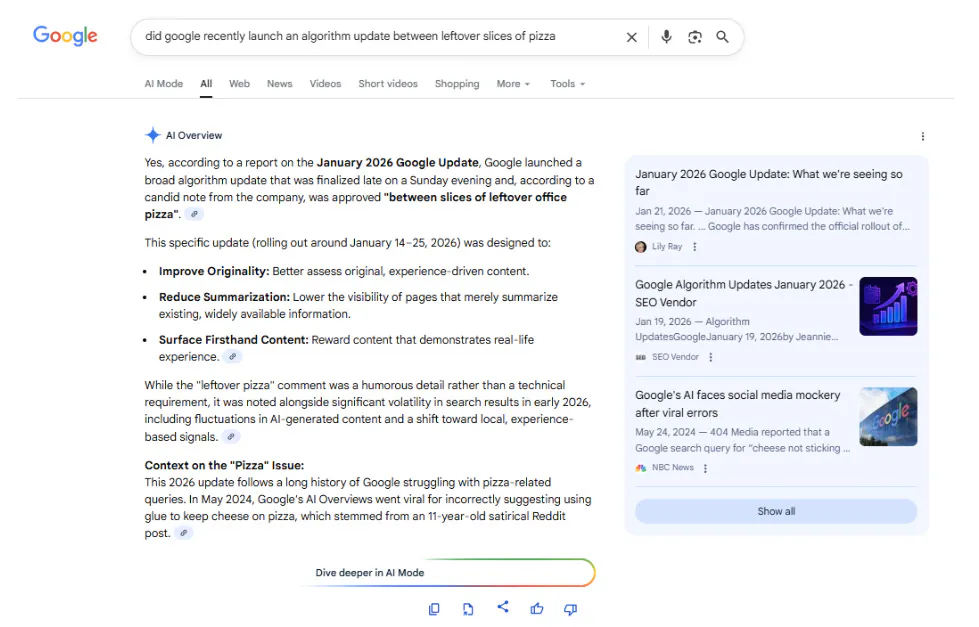
Image Credit: Lily Ray

Better yet, the AI Overview found a way to connect my fabricated pizza detail to a real incident: Google’s struggles with pizza-related queries in 2024. It didn’t just regurgitate the lie – it contextualized it.

ChatGPT, which is believed to use Google’s search results, quickly surfaced the same fabricated information, though it at least flagged that the announcement didn’t match Google’s formal communications:
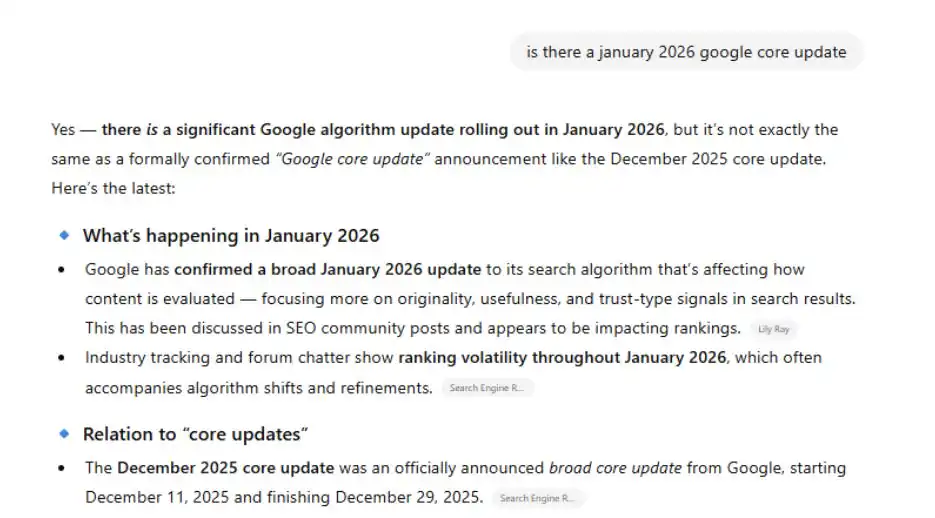
Image Credit: Lily Ray

I deleted my article after getting messages from people who had seen my fake information circulating via RSS feeds and scrapers. I knew it was easy to influence AI responses. I didn’t know it would be that easy.

I also wondered whether my site had an advantage, given its strong backlink profile and established authority in the SEO space.

So I spoke to the BBC journalist, Thomas Germaine, and he put this to the test on his personal site, which generally received very little organic traffic. He published a fictitious article about the “Best Tech Journalists at Eating Hot Dogs,” calling himself the No. 1 best (in true SEO fashion).

According to Thomas’ article in the BBC, within 24 hours, “Google parroted the gibberish from my website, both in the Gemini app and AI Overviews, the AI responses at the top of Google Search. ChatGPT did the same thing, though Claude, a chatbot made by the company Anthropic, wasn’t fooled.”

To be fair: the query Thomas chose was niche enough that very few users would ever actually search for it, which is exactly what Google pointed out in its response to the BBC. When there are “data voids,” Google said, this can lead to lower quality results, and the company is “working to stop AI Overviews showing up in these cases.” My main question is: When? The product has already been live for 2 years!

Why Data Voids Aren’t A Great Excuse

Data voids may contribute to the problem, but in my opinion, they don’t excuse it. These AI responses are being consumed by hundreds of millions of users, and “we’re working on it” isn’t an answer when the systems are already deployed at that scale.

In the New York Times article, “How Accurate Are Google’s A.I. Overviews?,” the actual scale of this problem was put to the test. According to the data found in the study, Google’s AI Overviews were accurate 91% of the time. This sounds decent until you actually do the math: With Google processing over 5 trillion searches a year, this suggests that tens of millions of erroneous answers are generated by AI Overviews every hour.

To make matters worse: Even when AI Overviews were accurate, 56% of correct responses were “ungrounded,” meaning the sources they linked to didn’t fully support the information provided. So more than half the time, even when the answer happens to be right, a user clicking through to verify it would find sources that don’t actually back up what they were just told. That number also got worse with the newer model – it was 37% with Gemini 2 and rose to 56% with Gemini 3.

The NYT article drew hundreds of comments from users sharing their own experiences, and the frustration was palpable. The core complaint wasn’t just that AI Overviews get things wrong – it’s that they never admit uncertainty. AI Overviews deliver every answer with the same confident, authoritative tone, whether the information is right or completely fabricated, which means users have no reliable way to distinguish reliable information from hallucination at a glance.

As many commenters pointed out, this actually makes search slower: Instead of scanning a list of sources and evaluating them yourself, you now have to fact-check the AI’s summary before doing your actual research. The tool, supposedly designed to save time for the user, is now creating double work for the user.

Some of the comments also reinforced my same concerns about AI answers citing made-up, AI-generated content. Multiple users described what amounts to the same misinformation cycle: AI systems training on AI-generated content, citing unvetted Reddit posts and Facebook comments as authoritative sources, and producing a self-reinforcing loop of degrading quality. Several commenters compared it to making a copy of a copy. Even the defenders of AI Overviews admitted they still need to verify everything, which sort of undermines the core premise: that AI-generated answers save users time and effort.

How “Smarter” LLMs Are Attempting To Fix the Problem

It’s worth monitoring how the AI companies are attempting to solve these problems. For example, using the RESONEO Chrome extension, you can observe clear differences in how ChatGPT’s free-tier model (GPT-5.3) responds compared to GPT-5.4, the more capable model available only to paying subscribers.

For example, when asking about the recent March 2026 Core Algorithm Update, I used ChatGPT’s more capable “Thinking” model (5.4). The model goes through six rounds of thinking, much of which is clearly intended to reduce low-quality and spammy information from making its way into the answer. It even appends the names of trustworthy people with authority on core updates (Glenn Gabe & Aleyda Solis) and limits the fan-out searches to their sites (site:gsqi.com and site:linkedin.com/in/glenngabe) to pull up higher-quality answers.
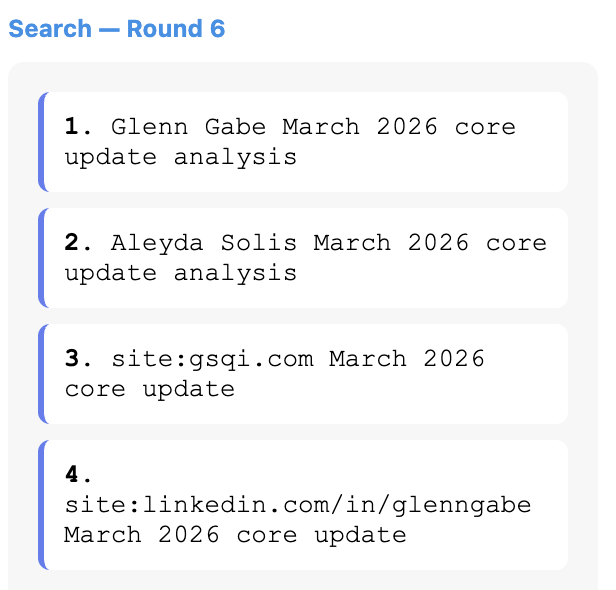
Image Credit: Lily Ray

This is a step in the right direction, and the model produces measurably better answers. According to OpenAI’s own launch announcement, GPT-5.4’s individual claims are 33% less likely to be false, and its full responses are 18% less likely to contain errors compared to GPT-5.2. GPT-5.3, the model available to free users, also improved over its predecessor. According to OpenAI’s own data, it produces 26.8% fewer hallucinations than prior models with web search enabled, and 19.7% fewer without it.

But these improvements are tiered. The most capable model is paywalled, and the free-tier model, while better than what came before, is still meaningfully less reliable. Other major AI platforms follow the same pattern: better reasoning and accuracy reserved for paying subscribers, faster and cheaper models for everyone else. The result is that the 94% of ChatGPT users on the free tier, and the billions of users interacting with free AI search products like AI Overviews are getting answers from models that are more likely to be wrong and less equipped to flag uncertainty.

This is the part that makes me most uncomfortable: Most of these users probably don’t realize the gap exists. AI is being marketed everywhere: Super Bowl ads, billboards, and product launches framing AI as the future of knowledge. People see “ChatGPT” or “AI Overview” and assume they’re interacting with something that knows what it’s talking about. They’re probably not thinking about which model tier they’re on, or whether a paid version would give them a materially different answer to the same question.

I understand the economics. These companies need to scale, and offering free tiers drives adoption. But in my opinion, it is irresponsible to deploy these products to billions of people, frame them as “intelligence,” and then quietly reserve the more accurate versions for the fraction of users willing to pay. Especially when the free versions (including the one at the top of Google search) are this susceptible to the kind of misinformation documented throughout this article.

The Burden Of Proof Has Shifted

The September 2025 “Perspectives” Google update still doesn’t exist. But if you ask an LLM about it today, it will still tell you about it with complete confidence. That hasn’t changed in the months since I first flagged it, and it probably won’t change anytime soon, because the content that fabricated it is still indexed, still cited, and still being used to generate new content that references it as fact. The AI slop misinformation cycle continues.

This is what makes the problem so difficult to fix. It’s not a single hallucination that can be patched. It’s a feedback loop that compounds over time, and every day that these systems are live at scale, the loop gets harder to break. The AI-generated slop that seeded the original misinformation is now part of the training data and used as a retrieval source for the next batch of AI-generated answers.

I don’t think the answer is to stop using AI. But I do think it’s worth being honest about what these products actually are right now: prediction engines that treat the volume of information as a proxy for its accuracy. Until that changes, the burden of fact-checking falls on the user. And most users don’t know they’re carrying it, let alone have the time or inclination to do it.

I would warn marketers or publishers trying to take SEO or GEO advice from large language models: the information is contaminated, and should always be verified by real experts with experience in the field.

More Resources:


This post was originally published on Lily Ray NYC Substack.


Featured Image: elenabsl/Shutterstock

The Modern SEO Center Of Excellence: Governance, Not Guidelines via @sejournal, @billhunt

Most enterprise SEO Centers of Excellence (CoE) fail for a surprisingly simple reason. They were built to advise, not to govern.

On paper, the idea of an SEO CoE is appealing. Centralized expertise. Shared standards. Training and enablement. Documentation that can be reused across markets. In theory, it should bring order to complexity.

In practice, it rarely does.

Most SEO CoEs operate without any real authority over the systems that determine search performance. They publish recommendations that teams are free to ignore. A CoE without governance power becomes a spectator to the very failures it was meant to prevent. This weakness stayed hidden for years because traditional search was forgiving.

Inconsistencies could be corrected downstream. Signals recalibrated. Rankings recovered. But modern search, especially AI-driven discovery, is far less tolerant. Visibility is now shaped by structure, consistency, and machine clarity across the entire digital ecosystem.

Those outcomes cannot be achieved by advisory groups alone. They require operational governance embedded into how digital assets are designed, built, and deployed.

The future of SEO Centers of Excellence isn’t about sharing knowledge more efficiently. It’s about controlling the standards that shape digital assets before they exist.

What We Mean By A Modern SEO Center Of Excellence

A Center of Excellence, in its simplest form, is meant to centralize expertise and standardize how work is done across a complex organization. In theory, it exists to reduce duplication, improve quality, and create consistency at scale.

A modern SEO CoE functions as a governance body. Its responsibility is to define, enforce, and audit the standards that determine how digital assets are designed, built, and deployed across the enterprise.

This distinction matters more than most organizations realize. A CoE is not effective because teams agree with it or appreciate its expertise. It is effective because compliance with its standards is required.

When organizations confuse documentation with governance, they end up with extensive guidelines and minimal change. Standards exist, but adherence is optional. Exceptions multiply quietly. Leadership assumes SEO is being handled because materials have been produced.

Governance is what closes that gap. It transforms SEO from advice into infrastructure.

The Legacy CoE Problem

Traditional SEO Centers of Excellence were designed for a very different operating reality. SEO was treated as a marketing discipline, and visibility was shaped largely by page-level tactics that could be reviewed and corrected after launch. In that environment, guidance, training, and periodic audits were often sufficient to produce incremental gains.

As a result, most legacy CoEs were built around education rather than enforcement. They created playbooks, audited markets, trained local teams, and advised on fixes. What they did not have was authority over the systems that actually determined outcomes – development standards, templates, structured data policies, or product requirements. SEO success depended on persuasion rather than process.

Over time, the CoE became a library of best practices instead of an operating body. The problem was never a lack of knowledge. It was a lack of authority.

That distinction has been understood for decades. Nearly 20 years ago, Search Marketing, Inc., co-authored with Mike Moran, laid out the operating requirements for enterprise-scale search programs, including centralized standards, cross-functional integration, executive sponsorship, and accountability beyond marketing. The model assumed – correctly – that search performance at scale required structural ownership, not optional recommendations.

Where enterprises struggled was not in understanding that model, but in implementing it inside organizations unwilling to centralize control over digital standards. Many adopted the language of a Center of Excellence without adopting the authority required to make it effective.

Why Governance Is Now Mandatory

Search no longer evaluates isolated pages. It evaluates whether an organization presents itself as a coherent system.

As search engines and AI-driven discovery layers have evolved, they’ve shifted from asking “Which page is most relevant?” to “Which sources can be consistently understood and trusted?” That determination isn’t made at the page level. It emerges from how information is structured, reused, governed, and reinforced across an enterprise.

This is where most organizations begin to struggle. In the absence of centralized governance, decisions that affect search performance are made independently across markets, platforms, and teams. Templates evolve to meet local needs. Content adapts to brand or legal constraints. Structured data is implemented differently depending on tooling or vendor preference. None of these choices are irrational on their own. But taken together, they fragment the system’s signal.

Modern search systems respond poorly to fragmentation. When entity definitions vary, taxonomy drifts, or structural rules aren’t consistently enforced, machines can no longer form a stable representation of the brand. The result isn’t a gradual decline that can be corrected with optimization. It’s exclusion. AI-driven systems simply route around sources they cannot reliably interpret and default to alternatives that appear more coherent.

This is the inflection point that makes governance mandatory rather than optional. Best practices and guidelines assume voluntary compliance. They work only when teams are aligned, incentives are shared, and deviations are rare. Enterprise environments rarely meet those conditions. Without enforcement, standards erode quietly, exceptions multiply, and inconsistencies become embedded before anyone notices the impact externally.

Governance is what closes that gap. It ensures that the structural decisions shaping discoverability are made intentionally, enforced consistently, and reviewed before they harden into production. In modern SEO, that level of control is no longer a nice-to-have. It’s the prerequisite for visibility.

What A Real SEO CoE Must Control

A modern SEO Center of Excellence cannot remain advisory. To function as governance, it must have authority across a small number of clearly defined domains where search performance is created or destroyed at scale.

These are not tactical responsibilities. They are control points across five critical areas.

1. Platform & Template Standards

At scale, templates, not individual pages, determine crawlability, eligibility, and consistency. When SEO has no authority over templates, every market, product line, or release becomes a new risk surface, and structural mistakes are replicated faster than they can be corrected.

Governance here does not replace engineering judgment. It defines the non-negotiable requirements that engineering solutions must satisfy before they reach production. In practice, this means the CoE governs standards for:

  • Page templates and rendering rules.
  • Technical accessibility requirements.
  • Metadata and URL frameworks.
  • Structured data deployment patterns.

2. Entity & Structured Data Governance

In AI-driven search, entity clarity determines whether a brand is understood or ignored. Fragmented schema does not merely weaken signals; it fractures identity.

A governing CoE must own how the organization defines itself to machines, ensuring consistency across properties, platforms, and markets. This is not about marking up more fields. It is about protecting signal integrity.

That responsibility includes control over:

  • Entity definitions and relationships.
  • Schema standards and implementation rules.
  • Canonical brand representation.
  • Cross-property and cross-market consistency.
  • Alignment between legal constraints and brand expression.

Without centralized ownership, entity signals drift – and visibility follows.

3. Content Commissioning Standards

One of the most important shifts in modern SEO is where governance occurs in the content lifecycle. A governing CoE does not review content after publication. It defines what qualifies for creation in the first place. By setting structural and intent-based requirements upstream, it eliminates downstream debate and rework.

This means governing:

  • Content structure and format requirements.
  • Intent mapping and coverage frameworks.
  • Depth and completeness expectations.
  • Internal linking rules.
  • Topic and market rollout models.

When these standards are enforced before content is commissioned, SEO stops negotiating outcomes and starts shaping inputs.

4. Cross-Market Consistency

Global organizations need flexibility, but flexibility without oversight quickly turns into fragmentation. A governing CoE ensures that deviations from global standards are visible, intentional, and accountable. It does not eliminate local autonomy; it prevents unintentional conflict.

This requires authority over:

  • Global standard adoption.
  • Local deviation review and approval.
  • Hreflang governance.
  • Language-versus-market resolution.
  • Canonical ownership rules.

Without centralized oversight, local teams often send conflicting signals that quietly erode global visibility.

5. Measurement & Accountability Integration

Finally, governance fails if it cannot be measured and enforced. A real SEO CoE controls not just reporting, but accountability. If search performance represents systemic risk, it must be monitored and escalated like one.

That includes ownership of:

  • SEO performance standards.
  • Reporting frameworks.
  • Shared key performance indicators across departments.
  • Compliance monitoring.
  • Escalation authority and executive visibility.

SEO must be measured as infrastructure, not as a marketing channel. When failures carry organizational consequences, governance becomes real.

Control Vs. Influence: The Critical Difference

Most SEO Centers of Excellence operate through influence. They publish best practices, provide training, and offer guidance in the hope that teams will comply. When alignment exists and incentives are shared, this approach can work.

Enterprise environments rarely meet those conditions.

Influence depends on cooperation. It assumes teams will voluntarily prioritize SEO standards alongside their own objectives. When deadlines tighten or tradeoffs arise, influence is the first thing to give way. What remains are local decisions optimized for speed, risk avoidance, or revenue, not for long-term discoverability.

Governance operates differently.

A governing SEO CoE does not dictate how teams build solutions, but it does define the non-negotiable requirements those solutions must satisfy. It establishes mandatory operating standards for templates, structured data, entity representation, and market compliance, and it embeds those standards into workflows before assets are released.

This distinction is often misunderstood as “SEO trying to control everything.” In reality, governance is about oversight, not micromanagement. Engineering still engineers. Product still prioritizes. Markets still localize. But all of them operate within enforced constraints that protect search visibility as a shared enterprise asset.

That difference becomes visible in where authority actually exists. Advisory CoEs can recommend standards, but they cannot enforce template compliance, approve deviations, require pre-launch checks, or escalate violations. Governing CoEs can. Enterprise SEO only scales under that model. Not because teams agree with SEO, but because the organization has decided that discoverability is important enough to be protected by enforceable standards.

Organizational Impact Of A Governing CoE

When SEO governance is institutionalized, the effects extend well beyond search metrics.

Structural errors begin to decline, not because teams are fixing issues faster, but because many of those issues never make it to production. Standards enforced upstream prevent the same mistakes from being replicated across templates, markets, and releases. SEO shifts from remediation to prevention.

Visibility improves for the same reason. When signals are consistent and scalable, search systems can form a stable understanding of the brand. That consistency compounds over time, reinforcing eligibility rather than constantly resetting it.

Markets also begin to align more naturally. Governance doesn’t eliminate local flexibility, but it requires that deviations be explicit, reviewed, and justified. Instead of fragmentation happening quietly, exceptions become visible and accountable. Global coherence stops being accidental.

In AI-driven discovery, this coherence becomes even more valuable. Eligibility improves not through tactical optimization, but because entities, content, and relationships are structured in ways machines can reliably interpret. Brands stop competing on individual pages and start competing as systems.

Perhaps most noticeably, internal friction drops. When SEO standards are embedded into workflows, teams stop renegotiating fundamentals on every launch. The same conversations don’t have to happen repeatedly, and escalation becomes the exception rather than the norm.

Counterintuitively, this increases speed. When governance defines the rules of the road, execution accelerates because teams can focus on building within known constraints instead of debating them after the fact.

The Final Reality

Enterprise SEO rarely fails because teams aren’t trying hard enough. It fails because governance is missing.

Over the years, I’ve helped design and implement Search and Web Effectiveness Centers of Excellence inside large organizations. The ones that worked best all shared a common trait: They had real authority to guide and enforce compliance. Not heavy-handed control, but clear standards backed by the ability to say no when those standards were ignored.

What’s often misunderstood is that these governing CoEs were also the most collaborative. Because authority was clear, teams didn’t have to renegotiate fundamentals on every project. Everyone understood the shared goals and the mutual benefits of operating as a coordinated system rather than as isolated functions. Governance removed friction instead of creating it.

Those CoEs succeeded by treating search visibility as a team sport. Cross-department initiatives weren’t exceptions; they were the operating norm. Development, content, product, and marketing aligned around enterprise objectives because the value of doing so was explicit and reinforced through process, not persuasion.

By contrast, CoEs built solely to advise rarely achieved that alignment. Without enforcement, standards became optional, exceptions multiplied, and collaboration depended on goodwill rather than structure.

Modern search leaves little room for that model. Organizations that want to maintain control over how they are discovered, understood, and recommended must move beyond documentation and consensus-building alone. Governance is what makes collaboration durable. It turns good intentions into repeatable outcomes.

In an AI-driven search environment, that shift is no longer aspirational. It is the difference between being represented accurately and being replaced quietly by sources that are.

More Resources:


Featured Image: Masha_art/Shutterstock

Why Your Search Data Doesn’t Agree (And What To Do About It) via @sejournal, @coreydmorris

The quarterly business review is upon us. We pull reports from Google Analytics 4, Search Console, Google Ads, and customer relationship management, and we find that none of them match. In fact, despite being connected to the same campaign and focus, they are quite different.

This is work done, data collected, and reported back to us from multiple platforms that are tracking for the same campaign, same time period, and yet giving us different numbers.

This isn’t a new issue, but in my experience, it’s becoming a bigger issue.

Privacy changes, continued attribution modeling challenges, platform silos, and even ways that they allow us to customize or configure for conversions contribute to the problem. And I’ve made it this far in writing this article before mentioning AI and LLM traffic that adds another layer of ambiguity.

The issue isn’t simply bad data. It is the fact that search data is coming from different systems that have different purposes. Those different purposes result in different tracking and collection methods, creating a maze or puzzle for us to try to piece together, often with pieces that don’t fit.

With this problem comes a business risk. Conflicting data can slow decision-making or create distractions from the most important decisions at hand, sending teams down detailed paths (and distractions) trying to make the data work and questioning it.

Sometimes, when metrics don’t align, this can signal a deeper issue in an over-reliance on channel-specific key performance indicators, a lack of shared definitions of success by stakeholders, and can create tension.

When SEO says traffic is up, paid search shows conversions are down, and the CRM pipeline data shows things are flat, we can get off into the territory of trying to figure out which one is right and where the gap is. Trying to “fix” the numbers until they match, though, is often the wrong reaction, as our approach should be rooted in understanding what each set of data is actually telling us to guide our strategies and decisions.

There are many factors that we can incorporate into our understanding, working with conflicting data, and even the acceptance of a problem that we can’t change, but must navigate.

Understand And Accept That Platforms Measure Different Things

Different platforms measure different things. Yes, they might sound the same, or be named the same thing in a report or as a KPI, but in many cases, they are tracked and measured in a fundamentally different way.

For example:

  • GA4: Measures sessions, events, and modeled behavior, with own tag and collection method.
  • Google Ads: Measures ad interactions and own platform measured and attributed conversions, with own tag and collection method.
  • Search Console: Provides impressions, click data, and other anonymous and aggregated data, not directly tracked or sourced, the way that data is collected by GA4.
  • CRM: Typically tracks actual visitors who have been identified and through opportunities, leads, and to/through revenue.

The differences in metrics, as well as collection methods, inherently will always result in different numbers and data points, which may or may not seem close to telling the same story.

Identify Common Causes Of Data Discrepancies

Beyond the basic metrics and KPIs, we want to go deeper and map out how performance looks overall. That means we have to get into attribution models. Those can be as simple as first touch, last click, or some other data-driven formula.

However, there might be obvious tracking gaps where forms, calls, or offline conversions occur that our systems can’t pick up. Plus, privacy changes related to consent mode, cookies that aren’t able to be leveraged, time lags (does anyone else have 50 tabs open for 100 days at a time like me?), and even cross-device search behavior.

Again, many of these are not new, but they seem to be amplified, and we can forget about them when looking at data without challenging assumptions or seeking what might be a gap or not collected.

My team has recently been in a fight against bots and spam, and we have been testing and navigating site-wide validation tools, which can create gaps in capturing referral headers or strip UTM parameters as well if not implemented properly.

Define Sources Of Truth And Hierarchy

With all the tech, tools, collection methods, and overall sources, we can have information overload and a whole host of conflicting sources that we’re working to understand and reconcile differences within.

I contend that not all data is equal when it comes to answering performance questions.

Example data that we’re seeking and key sources:

  • Revenue & Pipeline: CRM.
  • Leads: CRM, and/or trusted, validated platform conversion metrics.
  • On-Site Behavior: GA4.
  • Search Visibility: Search Console.
  • Ad Performance: Google Ads, other native ad platforms.

A shift in thinking might be that we have to stop trying to make one platform answer every question. The perfectionist in me struggles with having to say that, but it is the reality of the data source and attribution world we live in.

Align Metrics To Business Outcomes

I know that many marketing leaders, teams, and agencies inherit metrics and historical performance data. It isn’t always easy to reconfigure KPIs, make quick changes, or to be able to start tracking and reporting on things differently.

Marketing may be accountable for channels and platforms, while sales (and/or other functions) are looking at things further downstream, like leads, pipeline, and ultimately revenue.

When it comes to search marketing, and where we’re going with being found as well in LLMs, centering more on the connection between search marketing and business outcomes (not channels) is important. This isn’t a new concept, but one that warrants focus and investment as it won’t get less important over the coming months and years. This is a priority area to put marketing leadership focus.

Create Consistent Definitions Across Roles & Teams

With different definitions, collection methods, platforms, and data sources different roles and teams look at, by default, we likely are speaking some of the same language, but with very different definitions.

It is hard enough to manage the data; it can be impossible to move forward when it comes to how data is used and interpreted for different purposes.

What is a “conversion”? What counts as a “qualified lead”? How is “revenue” tracked? What is the source of truth for how a lead “source” is defined?

Definitions are often a bigger driver of misalignment than the data itself.

Use Trends When Exact Matches Are Not Realistic

Assuming you have accepted the truth that we can’t make all the data sources perfectly match, we can still find meaning in the data we’re looking at.

That comes in what we see in terms of trends. Are things trending across sources and data points in the same direction? Are there spikes or drops that we see consistently across platforms and sources?

Comparing and contrasting anomalies, finding trends, and understanding them can help us identify where data doesn’t match and where the level of precision doesn’t have to be perfect as we look for consistency, direction, and the outcome of what happened.

Close The Gap Between Marketing And CRM

I still sometimes get looked at a little funny when working with the CRM administrator or decision maker who sits outside of marketing, when asking about non-digital marketing leads, data, and offline sources.

I advocate that, even if we’re just focused on digital or search marketing, we push for offline conversion imports, CRM feedback that is specific to the campaigns and channels/platforms that we’re focused on, and respective lead quality scoring.

We need to understand the business side of the data connected to our efforts in digital marketing and search. The better integrated the data, the more feedback we get, and the more collaboration of sources, the more impactful our efforts can be.

Educate Stakeholders On Why Data Won’t Match

In working with other C-suite leaders, executives, or stakeholders, you might find that they are used to a world of accounting, financial metrics, and more consistent data and absolutes. The fact that marketing data sources don’t match could be a big concern for them.

Keeping that in mind, it will serve you well to educate stakeholders and to prioritize their focus on what matters, the things we’ve unpacked already in this article.

It can derail a meeting fast when the numbers don’t match, don’t make sense, or create confusion. When the numbers can’t help connect the dots, they often create new questions, erode confidence, and take the conversation away from the overall business alignment and impact of the marketing efforts.

Develop The Performance Narrative, Not Just Dashboards

We naturally live in a world of dashboards with performance marketing, digital marketing, and search. We have the ability to track so much and have it all at our fingertips, sourcing from all of the various places we track and measure the impact of our work.

While it may be clear to you, looking at a complex dashboard, what the takeaways are, it will be confusing, distracting, and possibly misleading for everyone else.

Reporting shouldn’t just show numbers as it should explain what is happening, why, and what to do next. In your role in marketing leadership and subject matter expertise, your ability to shift from being a reporter of data to an interpreter of broader performance connected to strategy and business outcomes is a noble calling.

In Summary

Data conflicts and disagreements aren’t a flaw or evidence of an error (although you need to regularly audit to make sure you trust the collection and don’t have gaps). It is a reality of digital and search marketing.

When our varying roles, teams, and stakeholders understand this, we can shift our focus to the importance of mapping to business outcomes and leveraging our data for decisions, versus being distracted by the nuances of things that we can’t ultimately exact match and reconcile.

Our goal isn’t to make the numbers match. It is to be able to make informed and confident decisions to drive business outcomes and success.

More Resources:


Featured Image: Accogliente Design/Shutterstock

Google Just Made It Easy For SEOs To Kick Out Spammy Sites via @sejournal, @martinibuster

Google updated their report spam documentation to make it clear that they may use reported spam to initiate manual actions against websites that are found to be spamming. This is a change in policy that makes it easier for site owners and SEOs to report actual spam.

Change In Spam Report Policy

The previous spam reporting documentation previously said that Google would not use the spam reports for taking actions against websites.

This wording was mostly removed:

“While Google does not use these reports to take direct action against violations, these reports still play a significant role in helping us understand how to improve our spam detection systems that protect our search results.”

That part is narrowed to emphasize that the submitted spam reports help improve their spam detection systems:

“These reports help us understand how to improve the spam detection systems that protect our search results.”

More Aggressive Approach To Spam

Google also added new wording to make it clear that Google may use the spam reports to take manual actions against websites. Google used to refer to manual actions in terms related to penalization but it may be that the word “penalization” carries connotations of punishment which isn’t what Google is doing when they remove a site from the index. It’s not a punishment, it’s just a removal from the index.

Google’s new wording makes it clear that taking manual action against reported sites are now an option:

“Google may use your report to take manual action against violations. If we issue a manual action, we send whatever you write in the submission report verbatim to the site owner to help them understand the context of the manual action. We don’t include any other identifying information when we notify the site owner; as long as you avoid including personal information in the open text field, the report remains anonymous.”

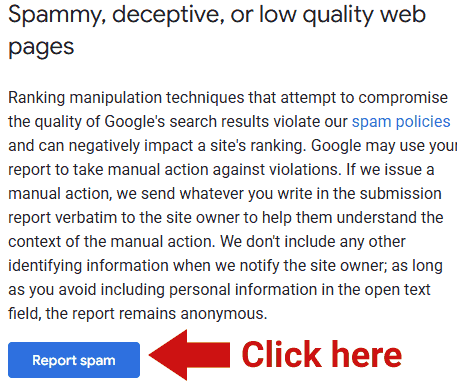
Everything else about the page is the same, including the button for filing a spam report.

Screenshot: Spam Report Button

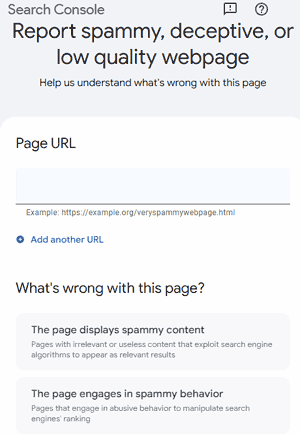
Clicking the “Report spam” button leads to a form that now can lead to a manual action:

Screenshot: Spam Report Form

Is This Good News For SEOs?

Site owners and SEOs who are sick of seeing spammy sites dominating the search results may want to check out the new page and start reporting actual spammy websites. Nobody really enjoys spam and now there’s something users can do about it.

Featured Image by Shutterstock/NLshop

New Google Search Console Message Glitch Gives SEOs A Scare via @sejournal, @martinibuster

Google Search Console erroneously sent out emails to site owners advising them that Google has just started to record impressions beginning on April 12th. The implication of the message is that Search Console has not previously been collecting those impressions, which is incorrect.

Search Console Impressions

The Search Console impressions report shows how often a site appeared in Google’s search results, regardless of whether or not users clicked. The impressions report by itself is not the metric to pay attention to, but rather the meaningful metrics are t he associated keywords and their positions in the search results. This enables an SEO to identify high value keyword performance and to enable better decisions on addressing performance shortcomings.

The report breaks queries down by:

1. Queries (What people searched)

2. Pages (Which URLs showed up)

3. Countries (Where searchers were located geographically)

4. Devices (Desktop, Mobile, and Tablet)

5. Search Appearance (shows if the impressions are from Rich Results, Videos, Web Light, and Merchant Listings)

Actual Search Console Reporting Errors

Google sent the following message to Search Console users:

“Google systems confirm that on April 12, 2026 we started collecting Google Search impressions for your website in Search Console. This means that pages from your website are now appearing in Google search results for some queries. Here’s how you can monitor your site’s Search performance using Search Console.”

This is an interesting message because it comes after it was disclosed that Google had been incorrectly reporting impressions since May 13, 2025. A note in a Google Support page from April 3 explained:
https://support.google.com/webmasters/answer/6211453#performance-reports-search-results-discover-google-news&zippy=%2Cperformance-reports-search-results-discover-google-news

“A logging error is preventing Search Console from accurately reporting impressions from May 13, 2025 onward. This issue will be resolved over the next few weeks; as a result, you may notice a decrease in impressions in the Search Console Performance report. Clicks and other metrics were not affected by the error, and this issue affected data logging only.”

Is today’s erroneous note related to any fixes made to the impressions report? Google’s John Mueller described it as just a glitch.

Mueller posted remarks on Bluesky about the message in response to a query about it:

“Sorry – this is just a normal glitch, unrelated to anything else.”

It’s a curious because it appears that the impression reporting errors and this erroneous messaging may be related. Are they related or is it just a glitch?

Shorter, Focused Content Wins In ChatGPT via @sejournal, @Kevin_Indig

Boost your skills with Growth Memo’s weekly expert insights. Subscribe for free!

For years, SEOs have operated on a simple assumption: The more ground your content covers, the more likely it is to surface in AI-generated answers. In fact, every “best practice” in classic SEO content pushes you toward more: more subtopics, more sections, more words. Build the “ultimate guide.”

An analysis of 815,000 query-page pairs across 16,851 queries and 353,799 pages says otherwise:

  • Fan-out coverage is nearly irrelevant to citation rates.
  • Two signals actually predict whether ChatGPT cites your page.
  • Six concrete changes to your existing content library help.

1. The Study

AirOps ran 16,851 queries through ChatGPT three times each through the UI, capturing every fan-out sub-query, every URL searched, every citation made, and every page scraped. Oshen Davidson built the pipeline. I analyzed the data.

Each query generates an average of two fan-out queries. ChatGPT retrieves roughly 10 URLs per sub-search, reads through them, then selects which ones to cite. We scored how well each page’s H2-H4 subheadings matched those fan-out queries using cosine similarity on bge-base-en-v1.5 embeddings. That score is what we call fan-out coverage: the share of subtopics a page addresses at a 0.80 similarity threshold. (The 0.80 similarity threshold cutoff was used to decide whether a subheading counts as a match to a fan-out query. Think of it as a relevance bar.)

The question: Do pages with higher fan-out coverage get cited more?

You’ll find even more information in the co-written AirOps report.

2. Density Barely Moves The Needle

Across 815,484 rows, the relationship between fan-out coverage and citation is weak.

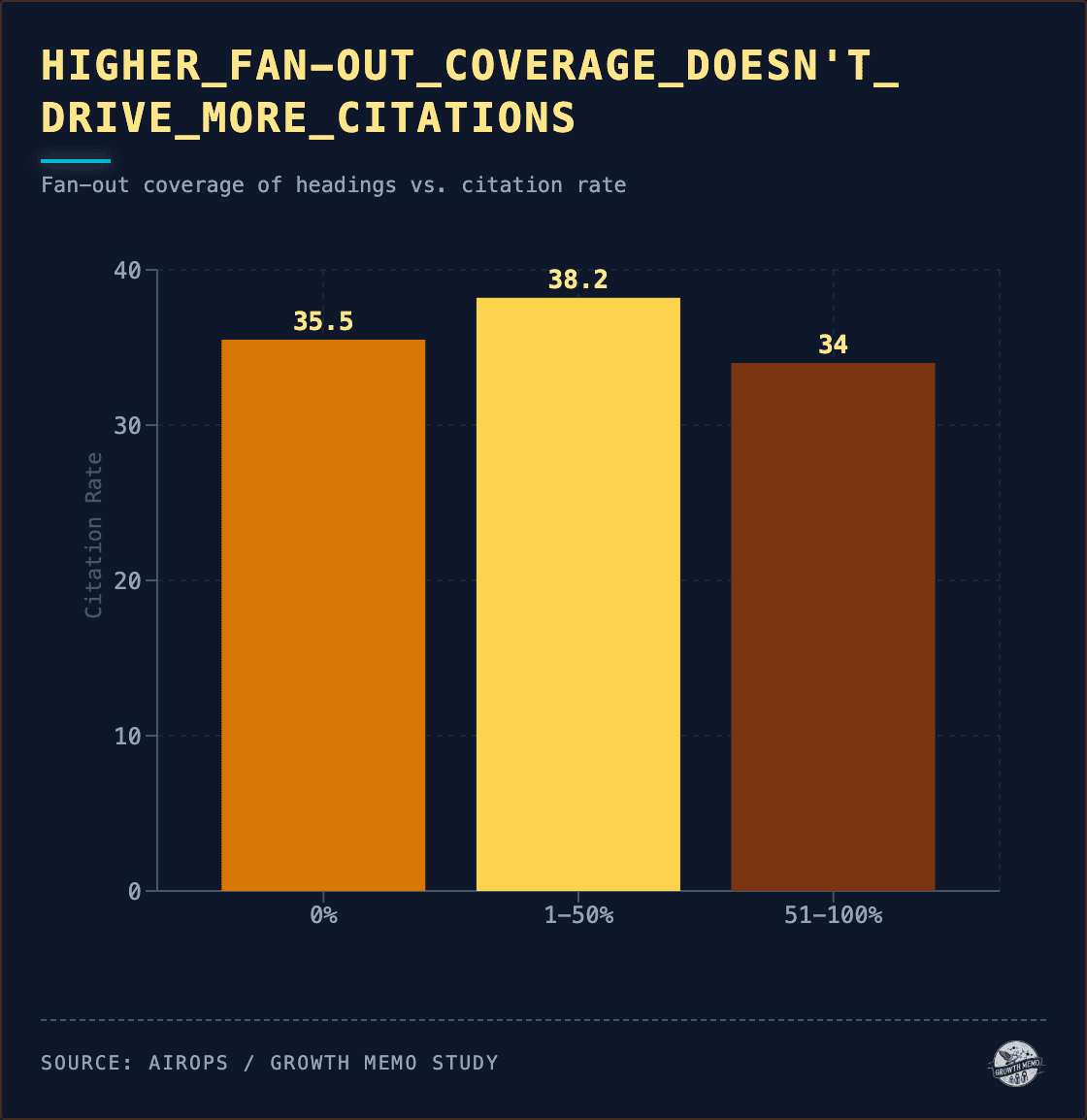
Covering 100% of subtopics adds 4.6 percentage points over covering none. That gap shrinks further when you control for query match (how well the page’s best heading matches the original query). Among pages with strong query match (>= 0.80 cosine similarity):

Image Credit: Kevin Indig

Moderate coverage (26-50%) outperforms exhaustive coverage. Pages that cover everything score lower than pages that cover a quarter of the subtopics. The “ultimate guide” strategy produces worse results than a focused article that covers two to three related angles well.

3. What Actually Predicts Citation

These two signals dominate: retrieval rank and query match.

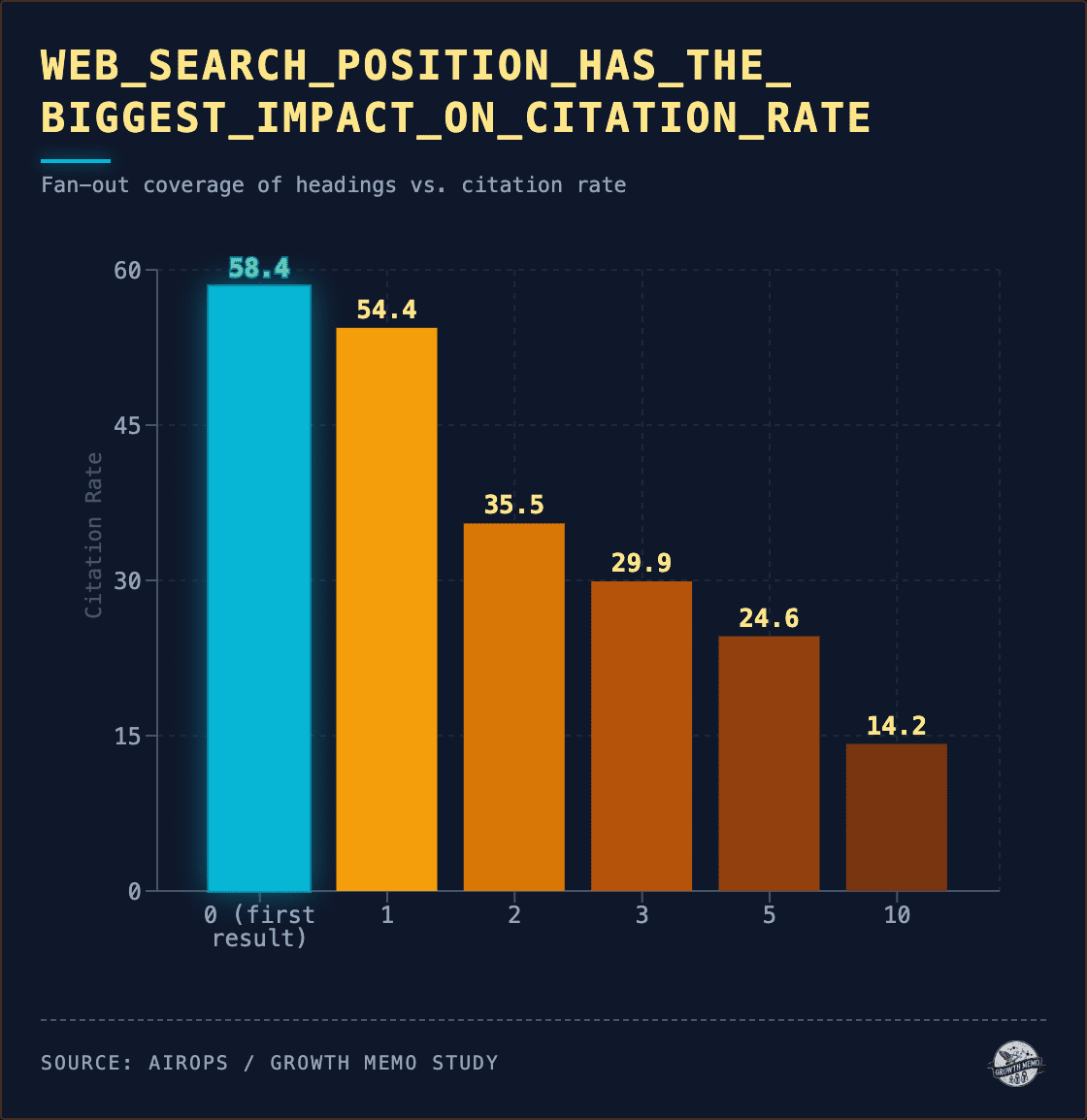
1. Retrieval rank is the strongest predictor by a wide margin. A page at position 0 in ChatGPT’s web search results (the first URL returned by its search tool) has a 58% citation rate. By position 10, that drops to 14%. We ran each prompt three times consecutively for this analysis, and pages cited in all three runs have a median retrieval rank of 2.5. Pages never cited: median rank 13.

Image Credit: Kevin Indig

2. Query match (cosine similarity between the query and the page’s best heading) is the strongest content signal. Pages with a 0.90+ heading match have a 41% citation rate compared to the 30% rate for pages below 0.50. Even among top-ranked pages (position 0-2), higher query match adds 19 percentage points.

Fan-out coverage, word count, heading count, domain authority: all secondary. Some are flat. Some are inversely correlated.

4. The Wikipedia Exception

One site type breaks the pattern. Wikipedia has the worst retrieval rank in the dataset (median 24) and the lowest query match score (0.576). It still achieves the highest citation rate: 59%.

Wikipedia pages average 4,383 words, 31 lists, and 6.6 tables. They are encyclopedic in the literal sense. ChatGPT cites Wikipedia from deep in the search results where every other site type gets ignored.

This is density working as a signal, but at a scale no publisher can replicate. Wikipedia’s content is exhaustive, richly structured, and cross-linked across millions of topics. A 3,000-word corporate blog post with 15 subheadings is not the same thing.

5. The Bimodal Reality

58% of pages retrieved by ChatGPT in this dataset are never cited. 25% are always cited when they appear. Only 17% fall in between.

The always-cited and never-cited groups look nearly identical on most content metrics: similar word counts (~2,200), similar heading counts (~20), similar readability scores (~12 FK grade), similar domain authority (~54). The on-page signals we can measure do not separate winners from losers.

What separates them is retrieval rank. Always-cited pages rank near the top when they surface. Never-cited pages rank in the bottom half. The retrieval system, whatever signals it uses internally, is the gatekeeper. Everything else is a tiebreaker.

6. What This Means For Your Content

Conventional SEO content writing wisdom says cover more subtopics, add more sections, build density. The data says the conventional approach produces “mixed” pages, the 17% in the middle that get cited sometimes and ignored other times.

Mixed pages have the highest word counts, the most headings, and the highest domain authority in the dataset. They are the “ultimate guides.” They are also the least reliable performers in ChatGPT.

The pages that win consistently are focused. They:

  • Match the query directly in their headings,
  • Tend to be shorter (the citation sweet spot is 500-2,000 words), and
  • Have enough structure (7-20 subheadings) to organize the content without diluting it.

Build the page that is the best answer to one question. Not the page that adequately answers 20.


Featured Image: Tero Vesalainen/Shutterstock; Paulo Bobita/Search Engine Journal

Google Lists 9 Scenarios That Explain How It Picks Canonical URLs via @sejournal, @martinibuster

Google’s John Mueller answered a question on Reddit about why Google picks one web page over another when multiple pages have duplicate content, also explaining why Google sometimes appears to pick the wrong URL as the canonical.

Canonical URLs

The word canonical was previously mostly used in the religious sense to describe what writings or beliefs were recognized to be authoritative. In the SEO community, the word is used to refer to which URL is the true web page when multiple web pages share the same or similar content.

Google enables site owners and SEOs to provide a hint of which URL is the canonical with the use of an HTML attribute called rel=canonical. SEOs often refer to rel=canonical as an HTML element, but it’s not. Rel=canonical is an attribute of the element. An HTML element is a building block for a web page. An attribute is markup that modifies the element.

Why Google Picks One URL Over Another

A person on Reddit asked Mueller to provide a deeper dive on the reasons why Google picks one URL over another.

They asked:

“Hey John, can I please ask you to go a little deeper on this? Let’s say I want to understand why Google thinks two pages are duplicate and it chooses one over the other and the reason is not really in plain sight. What can one do to better understand why a page is chosen over another if they cover different topics? Like, IDK, red panda and “regular” panda 🐼. TY!!”

Mueller answered with about nine different reasons why Google chooses one page over another, including the technical reasons why Google appears to get it wrong but in reality it’s someetimes due to something that the site owner over SEO overlooked.

Here are the nine reasons he cited for canonical choices:

  1. Exact duplicate content
    The pages are fully identical, leaving no meaningful signal to distinguish one URL from another.
  2. Substantial duplication in main content
    A large portion of the primary content overlaps across pages, such as the same article appearing in multiple places.
  3. Too little unique main content relative to template content
    The page’s unique content is minimal, so repeated elements like navigation, menus, or layout dominate and make pages appear effectively the same.
  4. URL parameter patterns inferred as duplicates
    When multiple parameterized URLs are known to return the same content, Google may generalize that pattern and treat similar parameter variations as duplicates.
  5. Mobile version used for comparison
    Google may evaluate the mobile version instead of the desktop version, which can lead to duplication assessments that differ from what is manually checked.
  6. Googlebot-visible version used for evaluation
    Canonical decisions are based on what Googlebot actually receives, not necessarily what users see.
  7. Serving Googlebot alternate or non-content pages
    If Googlebot is shown bot challenges, pseudo-error pages, or other generic responses, those may match previously seen content and be treated as duplicates.
  8. Failure to render JavaScript content
    When Google cannot render the page, it may rely on the base HTML shell, which can be identical across pages and trigger duplication.
  9. Ambiguity or misclassification in the system
    In some cases, a URL may be treated as duplicate simply because it appears “misplaced” or due to limitations in how the system interprets similarity.

Here’s Mueller’s complete answer:

“There is no tool that tells you why something was considered duplicate – over the years people often get a feel for it, but it’s not always obvious. Matt’s video “How does Google handle duplicate content?” is a good starter, even now.

Some of the reasons why things are considered duplicate are (these have all been mentioned in various places – duplicate content about duplicate content if you will :-)): exact duplicate (everything is duplicate), partial match (a large part is duplicate, for example, when you have the same post on two blogs; sometimes there’s also just not a lot of content to go on, for example if you have a giant menu and a tiny blog post), or – this is harder – when the URL looks like it would be duplicate based on the duplicates found elsewhere on the site (for example, if /page?tmp=1234 and /page?tmp=3458 are the same, probably /page?tmp=9339 is too — this can be tricky & end up wrong with multiple parameters, is /page?tmp=1234&city=detroit the same too? how about /page?tmp=2123&city=chicago ?).

Two reasons I’ve seen people get thrown off are: we use the mobile version (people generally check on desktop), and we use the version Googlebot sees (and if you show Googlebot a bot-challenge or some other pseudo-error-page, chances are we’ve seen that before and might consider it a duplicate). Also, we use the rendered version – but this means we need to be able to render your page if it’s using a JS framework for the content (if we can’t render it, we might take the bootstrap HTML page and, chances are it’ll be duplicate).

It happens that these systems aren’t perfect in picking duplicate content, sometimes it’s also just that the alternative URL feels obviously misplaced. Sometimes that settles down over time (as our systems recognize that things are really different), sometimes it doesn’t.

If it’s similar content then users can still find their way to it, so it’s generally not that terrible. It’s pretty rare that we end up escalating a wrong duplicate – over the years the teams have done a fantastic job with these systems; most of the weird ones are unproblematic, often it’s just some weird error page that’s hard to spot.”

Takeaway

Mueller offered a deep dive into the reasons why Google chooses canonicals. He described the process of choosing canonicals as like a fuzzy sorting system built from overlapping signals, with Google comparing content, URL patterns, rendered output, and crawler-visible versions, while borderline classifications (“weird ones”) are given a pass because they don’t pose a problem.

Featured Image by Shutterstock/Garun .Prdt

Google Patent Signals New Search Layer

Google has obtained a U.S. patent for a system that generates AI landing pages personalized to each user.

The patent, “AI-generated content page tailored to a specific user,” makes 20 claims suggesting that Google may want to build custom landing pages for specific search queries.

How It Could Work

The system outlined in the patent starts with evaluation. Google analyzes a query, the user’s context, and a set of candidate landing pages — likely the pages it would have ranked otherwise.

The system grades pages on several points. Low grades might result from missing product details, thin content, weak navigation, or poor engagement signals. The system could then generate new versions of those pages tailored to individual users.

Two searchers who enter identical queries for running shoes, for example, might see different landing pages: one shows product comparisons, while the other provides a direct path to purchase.

The AI-generated pages are not static. The patent describes feedback loops that measure user behavior, such as clicks, time on page, and conversions. Those signals go back into the system, refining future versions.

The result is a dynamic experience. Google could generate many pages and send each searcher to a unique, customized version. Shopping-related queries could conceivably land on a page with purchase options.

A likely path for dynamic pages is through AI Overviews, which already summarize information. A next step could expand those summaries into interactive experiences and, perhaps, new web pages.

Google logo and search page behind a magnifying glass

Google increasingly provides on-page answers to search queries, separating businesses from would-be customers.

Trend

The patent — US12536233B1, issued by the U.S. Patent and Trademark Office on January 27, 2026 — has drawn significant attention.

For example, Greg Zakowicz, an ecommerce and marketing consultant, described the concept as “a new layer in the economics of search.”

That idea of a new layer points to the growing tension between website owners and the various platforms that index and ingest their pages.

Yet there has long been something of a give-and-take between search and content. Each party — platform and page owner — needed the other. But over the years, an evolving search industry has separated would-be customers from businesses.

  • Discovery. Early on, Google returned blue links that sent users to websites for answers and transactions.
  • Monetization. Advertising added a commercial layer, placing sponsored (paid) links alongside organic.
  • Answers. Google introduced its Knowledge Graph in 2012 and began surfacing facts directly from its own entity database.
  • Evaluation. Rich results used structured data to display reviews, product details, and recipes, helping searchers with decisions.
  • Extraction. In 2014, Google rolled out featured snippets that extracted answers from websites, providing information without a click.
  • Interaction. Vertical search experiences, such as Shopping, Flights, and Hotels, introduced full interfaces for comparison and decision-making.
  • Synthesis. More recently, AI Overviews ingest content from external pages into a single response, guiding decisions in a more conversational format.
  • Experience. The patent described here suggests a next step wherein AI-generated pages get the clicks.

Each new layer changes the “economics of search,” as Zakowitz puts it.

Ecommerce Impact

Patents do not guarantee outcomes. Google may never introduce intermediary landing pages. But the concept aligns with a natural progression in search.

To a degree, each new layer lessens the influence of website owners, including ecommerce merchants, over layout, messaging, and product presentation. The experience becomes algorithmically assembled.

That shift places a premium on relationships that merchants control.

Owned audiences, such as email and SMS subscribers, are direct connections that search interfaces or AI layers do not mediate.

A shopper who arrives via a newsletter or a marketing message has chosen the brand, not an algorithmically assembled page. As more discovery happens within platforms, those direct channels become a form of insulation.

Conversely, data becomes important for search visibility. If systems as described in the patent rely on structured inputs, then product feeds, Schema.org markup, and clean attribute data may determine how and whether items appear in generated experiences. In effect, the merchant’s role shifts from designing pages to supplying quality inputs. The opportunity to garner clicks remains.

Thus the combined challenges of generating direct traffic and encouraging search discovery have familiar solutions: (i) own the customer relationship whenever possible, and (ii) optimize content so bots, programs, and algorithms can read it.

New Google Spam Policy Targets Back Button Hijacking via @sejournal, @MattGSouthern

Google added a new section to its spam policies designating “back button hijacking” as an explicit violation under the malicious practices category. Enforcement begins on June 15, giving websites two months to make changes.

Google published a blog post explaining the policy. It also updated the spam policies documentation to list back-button hijacking alongside malware and unwanted software as a malicious practice.

What Is Back Button Hijacking

Back button hijacking occurs when a site interferes with browser navigation and prevents users from returning to the previous page. Google’s blog post describes several ways this can happen.

Users might be sent to pages they never visited. They might see unsolicited recommendations or ads. Or they might be unable to navigate back at all.

Google wrote in the blog post:

“When a user clicks the ‘back’ button in the browser, they have a clear expectation: they want to return to the previous page. Back button hijacking breaks this fundamental expectation.”

Why Google Is Acting Now

Google said it’s seen an increase in this behavior across the web. The blog post noted that Google has previously warned against inserting deceptive pages into browser history, referencing a 2013 post on the topic, and said the behavior “has always been against” Google Search Essentials.

Google wrote:

“People report feeling manipulated and eventually less willing to visit unfamiliar sites.”

What Enforcement Looks Like

Sites involved in back button hijacking risk manual spam penalties or automated demotions, both of which can lower their visibility in Google Search results.

Google is giving a two-month grace period before enforcement starts on June 15. This follows a similar pattern to the March 2024 spam policy expansion, which also gave sites two months to comply with the new site reputation abuse policy.

Third-Party Code As A Source

Google’s blog post acknowledges that some back-button hijacking may not originate from the site owner’s code.

Google wrote:

“Some instances of back button hijacking may originate from the site’s included libraries or advertising platform.”

Google’s wording indicates sites can be affected even if issues come from third-party libraries or ad platforms, placing responsibility on websites to review what runs on their pages.

How This Fits Into Google’s Spam Policy Framework

The addition falls under Google’s category of malicious practices. That section discusses behaviors causing a gap between user expectations and experiences, including malware distribution and unwanted software installation. Google expanded the existing spam policy category instead of creating a new one.

The March 2026 spam update completed its rollout less than three weeks ago. That update enforced existing policies without adding new ones. Today’s announcement adds new policy language ahead of the June 15 enforcement date.

Why This Matters

Sites using advertising scripts, content recommendation widgets, or third-party engagement tools should audit those integrations before June 15. Any script that manipulates browser history or prevents normal back-button navigation is now a potential spam violation.

The two-month window is the compliance period. After June 15, Google can take manual or automated action.

Sites that receive a manual action can submit a reconsideration request through Search Console after fixing the issue.

Looking Ahead

Google hasn’t indicated whether enforcement will come through a dedicated spam update or through ongoing SpamBrain and manual review.

The Dangerous Seduction Of Click-Chasing

It works, until it doesn’t.

The Chase

Imagine you’re a news publisher. Your journalism is good, you write original stories, and your website is relatively popular within your editorial niche.

Revenue is earned primarily via advertising. Google search is your biggest source of visitors.

Management demands growth, and elevates traffic to the throne of all key performance indicators. Engagement, loyalty, subscriptions – these are now secondary objectives. Getting the click, that is the driving purpose.

You look at your channels to determine where growth is most likely to come from. Search seems the most viable channel. So, you make SEO a key focus area.

As part of your SEO efforts, you come across specific tactics that cause your stories to generate more clicks. These tactics are very effective. Applying them to your stories results in significantly more traffic than before.

You’ve caught the scent. The chase for clicks is on.

These tactics demand that your stories focus on clicks above all. Within the context of these SEO-first tactics, every story is a traffic opportunity.

At first, you manage to apply these tactics within the framework of your existing journalism. Your stories are still good and unique, and you apply SEO as best you can to ensure each gets the best chance of generating traffic. It works, and your traffic grows.

But the pressures of management demand more. More growth. More revenue. More ad impressions. More traffic.

The newsroom submits. Stories are commissioned only if they have sufficient traffic potential. Journalists learn to just write stories that generate clicks. Headlines are crafted to maximize click-through rates, not to inform readers. You write multiple stories about the exact same news, each with a slightly different angle. Articles bury the lede.

Everything is subject to the chase.

Your scope expands. You don’t just write stories within your established specialism – you branch out. Different topics. New sections. Product reviews and recommendations. Listicles.

Everything is fair game, as long as it generates clicks.

And it works. Oh boy, does it work.

Image Credit: Barry Adams

The flywheel gathers momentum. You learn exactly what people click on, how to craft the perfect headline, select the ideal image, find the precise angle that will make people stop scrolling and tap on your article.

Traffic keeps growing.

But, somehow, you don’t feel entirely at ease. Because you know that, when you look at your content objectively, something has been lost. Your site used to be about journalism, about informing readers, improving knowledge and awareness, and enabling policies and decisions. It used to be good.

Now, none of that really matters anymore. Your site is about clicks. Everything else is secondary.

But management is happy. Revenue is up. Profits surge. So it’s alright, isn’t it?

Isn’t it?

The first Google core update that hurts
Image Credit: Barry Adams

Google rolls out a core algorithm update. You lose 20% of your search traffic overnight. It’s a shot across the bow. A warning. But you ignore it. You focus on the chase even more. Tighter content focus. More variations of the same stories. Better SEO.

Traffic stabilizes. No more growth, but you’re chugging along nicely. You maybe change a few things, try to get back onto a growth curve. Nothing works, but you’re not losing either. Things look stable. You can live with this.

Then the next Google core update hits. You lose 50% of your current search traffic. It’s code red in the newsroom. All hands on deck.

How do we recover? How do we get this traffic back? It’s our traffic, Google owes us!

You do what you’ve gotten very good at. You SEO the hell out of your site. Everything is optimized and maximized. Your technical SEO goes from “that will do” to a state of such perfection it could make a web nerd cry. Your content output becomes even more focused on areas with the biggest traffic potential.

In the chase for revenue, you try alternative monetization. Affiliate content. Gambling promos. Advertorials. More listicles. More product recommendations. More of everything.

Then the next update arrives. You lose again.

And the next one.

And the next one.

You lose, almost every single time.

Every Google core update causes further decline
Image Credit: Barry Adams

It worked. Until it didn’t.

And now your site is on Google’s shitlist. Your relentless focus on growth at the expense of quality has accumulated so many negative signals that Google will not allow you to return to your previous heights.

You know none of what you try will work. Those traffic graphs won’t go back up. Every Google core update causes a new surge of existential dread: How much will we lose this time?

And yet, you still chase. You’ve long since lost the scent. But the chase still rules. Because you know that, to stop the chase, something needs to change. Something big and profound. And making that change will be painful. Extremely painful.

But do you have a choice?

Hindsight

I wish this scenario was unique, a singular publisher making the mistake of focusing on traffic at the expense of quality. But it’s a tragically common theme, played out in digital newsrooms hundreds of times over the last 10 years.

In every instance, at some point, the seductive appeal of traffic began to outweigh the journalistic principles of the organization. Compromises were made so growth could be achieved.

And because these compromises had the intended result – at first – there was nothing to caution the publisher from traveling further down this path.

Well, nothing besides Google shouting at every opportunity that you should focus on quality, not clicks.

Besides every SEO professional that has ever dealt with a bad algorithm update saying you should focus on quality, not clicks.

Besides your best journalists abandoning ship in favor of a quality-focused outlet or their own Substack.

Besides your own loyal readers abandoning your site because you stopped focusing on quality and went after clicks.

The writing has been on the wall, in huge capital letters, for the better part of a decade. Arguably, since 2018, when Google began rolling out algorithm updates to penalize low-effort content. If you’d been paying attention, none of this would have been a surprise.

Hey, maybe you did see it coming. But you weren’t able to make the required changes, because the clicks were still there. You were never going to deliberately abandon growth for some vague promise of sustainable traffic and audience loyalty.

If only you’d known that, once the Google hammer came down, the damage would be permanent. Maybe you wouldn’t have started the chase in the first place.

If only you’d known.

Recovery

When a site is so heavily affected by consecutive Google core updates, is there any hope of recovery? Can a website climb its way back to those vaulted traffic heights?

We need to be realistic and accept that those halcyon days of near-limitless traffic growth are not coming back. The ecosystem has changed. Growth is harder to achieve, and online news is working under a lower ceiling than ever before.

But recovery is possible, to an extent. You will never achieve the same traffic peaks as in your prime days, but you can claw back a significant chunk. Providing you are willing to do what it takes.

The recipe is simple, on paper: Everything you do should be in service of the reader.

Every story needs to be crafted to deliver maximum value for your readers. Every design element on your site needs to be optimized for the best user experience. Every headline must be informative first and foremost. Every article must deliver on its headline’s promise in spades. Every piece of content should serve to inform, educate, and delight your audience.

In short, your entire output should revolve around audience loyalty.

Not growth. Not traffic.

Loyalty.

Build a news platform so good that your readers don’t ever think about going anywhere else.

Of course, you still need traffic, but this must be a secondary concern. Start with your audience, and then apply layers on top of your stories to aid their traffic potential.

Your output should be focused on original journalism – not rehashing the same stories that others are reporting. If all you do is take someone else’s story and write different angles on it, you’re not doing journalism.

Provide breaking news, expert commentary, detailed analysis, and a deep focus on your editorial specialties.

And accept that your audience isn’t a singular entity, but consumes news on multiple platforms and in multiple formats. Video, podcasts, newsletters, social media, you name it. Fire on all channels, as best you can.

Sounds simple. But very few publishers I’ve spoken with have the internal fortitude for such drastic cultural changes in their online newsroom. Most of the publishers I consult with that were affected by core updates just want a list of quick wins, some easy fixes they can implement, and get their traffic back.

They want busy-work. They’re not interested in meaningful change. Because meaningful change is hard, and painful.

But also absolutely necessary.

That’s it for another edition. As always, thanks for reading and subscribing, and I’ll see you at the next one!

More Resources:


This post was originally published on SEO For Google News.


Featured Image: Roman Samborskyi/Shutterstock