The competitive research tool similarweb released its Digital 100 list of sites with the largest growth in traffic, providing insights into what’s driving traffic growth across various informational and shopping categories.
Gig Economy Shows Strong Growth
The website with the most growth is JustAnswer.com, a gig economy platform that enables consumers to consult with experts such as doctors, home repair experts, lawyers, and veterinarians. JustAnswer.com experienced 81% year over year visitor growth, soaring from 11.6M monthly unique visitors (MUVs) in 2023 to a whopping 21M visitors.
JustAnswer.com’s performance highlights the popularity of the gig economy with consumers and freelancers who are able to share their expertise without the overhead of a storefront and traditional advertising
ChatGPT Shows Strong Growth
ChatGPT kept on growing in 2024, surging by 33% from 28.8M monthly unique visitors (MUVs) to 38.2M MUVs.
News Site Category Experiences Growth
Fifty percent of the top ten fastest growing sites were in the news industry. Growth in traffic to news sites increased year over year with the recent American election driving a large part of that growth.
Newsweek.com 71% growth, increasing from 27.2M in 2023 to 46.4M in 2024.
APNews.com experienced 47% growth, increasing from 26.1M to 38.4M visitors in 2024.
Traffic to ABCNews.go.com grew by 35% year over year, growing from 19.6M visitors in 2023 to 26.4M site visitors in 2024.
Fortune.com experienced 33% growth with traffic soaring from 12.6M to 16.7M visits in 2024.
The surprise winner in the news category is Substack, the news outlet for trustworthy independent news content. Substack is a platform that allows journalists and other writers to monetize their talent, keeping 90% of their earnings. Substack experienced 37% growth in traffic, increasing from 13.8M visitors in 2023 to 18.9M visitors in 2024.
Similarweb shared:
“Unsurprisingly, in an election year, news sites saw high growth. The real surprise? Half of the top 10 fastestgrowing US sites were news-focused. Like Newsweek (up 71%). But among the traditional sites is Substack — our overall Digital Winner. Its success suggests consumers are increasingly seeking independent news sources.”
Apparel Websites
Similarweb’s statistics for apparel websites shows where consumer trends are and also has surprises related to the kinds of top level domains consumers feel comfortable with.
Similarweb’s insight on this category:
“The sportswear and sneakers craze shows no signs of slowing down. JD Sports emerged as the overall Digital Winner in the category — 150% growth in monthly active app users and 35% in web visitors. Additionally, the growth of Discount Divas and Depop reflects the rising demand for sustainability and affordability in fashion.”
Biggest Growth In Apparel Category
Peppermayo.com experienced the strongest growth for apparel websites, rising from 416% from 58.8K monthly unique visitors in 2023 to 303.7K in 2024. T
Most Actual Traffic
The apparel website with the most actual traffic is Quince.com, a fashion company that offers fashionable clothing for men and women at reasonable prices. They’re not fast fashion but focus on every day staples as well as clothes that an adult man or woman might wear on a night out or on vacation. Judging by the images posted on their site it looks like they’re focusing on a relatively underserved segment of the clothing consumer from the thirties on up and they’ve certainly cracked it because their monthly unique visitors jumped 176% from 2.06 million monthly unique visitors to 5.68 million visitors. How did they do it? Something that may be contributing to their success is that Quince encourages their customers to leave reviews with images, which in turn makes it easier to see how the clothes fit on real people and read the reviews on the clothes. The discounts offered to repeat customers and their liberal return and exchange policies encourage a positive user experience, a strategy that made a company like Zappos wildly popular in the early 2000s.
Something else that’s interesting about the apparel website rankings is that there are two .US top level domains, one .SHOP generic top level domain, and one site with a hyphen in it, showing how consumers are okay with domains that aren’t dot coms and that a hyphenated domain name can still work fine.
Here are the top ten by year over year growth (2023 to 2024) for apparel websites:
peppermayo.com 416% (58.8K to 303.7K MUVs)
babyboofashion.com 210% (80.2K to 248.6K)
sopula.com 207% (38.9K to 119.3K)
jeanpaulgaultier.com 198% (85.9K to 256.2K)
edikted.com 182% (167.1K to 471.8K)
quince.com 176% (2.06M to 5.68M)
retro-stage.com 167% (69.3K to 184.6K)
disturbia.us 154% (78.9K to 200.2K)
amberjack.shop 140% (55.6K to 133.7K)
clubllondon.us 139% (111.5K to 266.5K)
Serving Niche Product Consumers
Other notable rankings are in consumer electronics which shows the value of offering useful products at a reasonable price point to value ratio like SharkNinja vacuums. SharkNinja.com improved their traffic by 187%, going from 98.9K to 283.7K monthly unique visitors. SharkNinja offers popular and well reviewed products.
The other notable consumer electronics brand making big strides in traffic is Yotoplay.com, which offers a unique product that may be higher cost but appeals to parental values. The screen-free children’s audio player electronics company Yotoplay.com increased traffic by 130%, going from 199K monthly unique visitors in 2023 to 457.6K monthly visitors in 2024. Their secret is offering parents a screen-free way to engage young children with stories, music and learning with a device that’s easy for little kids to use together with their parents.
Both of these sites show how profitable it can be to focus on a narrow niche, understand your customers and deliver a quality product and experience.
WordPress Multisite is a feature for managing the structure and multiple sites from a single WordPress installation.
In this article, I’ll share the step-by-step approach to creating a new WordPress website or converting an existing WordPress website into a WordPress Multisite.
But before that, let’s understand the basics of WordPress Multisite.
What Is WordPress Multisite?
WordPress Multisite enables you to create and run multiple websites on the same WordPress installation. It is like having one central hub to control an entire network of sites.
Websites on a Multisite network share core files and databases, making it easy for network administrators to manage all websites from one WordPress user account.
The reason why businesses opt for Multisite is because it helps save both time and money. Plus, it takes less server space than separate installations.
To know WordPress Multisite better, let’s look at some of its significant features:
Centralized management: Allows you to control all your websites from one single dashboard.
Shared themes and plugins: Use your website anywhere after you install these shared themes and plugins.
User management: Enables you to create super admins to oversee the entire network.
Domain mapping: Facilitates you assigning unique domains to each site in your network.
How Does WordPress Multisite Work?
To understand the functionality of WordPress Multisite, you need to understand WordPress user roles and how they differ. By default, a standard WordPress site has five user roles:
Administrator (site Admin).
Editor.
Author.
Contributor.
Subscriber.
However, for WordPress Multisite, there is one more user role called super admin. There are six user roles for WordPress Multisite:
Super Admin (own/control – all sites of multisite network).
Administrator (site Admin) – controls one website of the network.
Editor.
Author.
Contributor.
Subscriber.
For a regular WordPress website, the site admin has administrative access to only one website. As there is just one website on the network, the admin controls only that website.
Site admins can add users, but only to the websites they administer. They cannot install WordPress plugins or themes, but they can choose which ones to activate or deactivate.
However, in WordPress Multisite, the super admin has access to more than one website.
The super admin, also known as the network admin, controls a whole network of websites and has activated Multisite initially.
They also have access to every website’s network admin setting and dashboard within the network. Super admins can also map custom domains.
Pros And Cons
After weighing the pros and cons of WordPress Multisite, it will become easy for you to decide if it aligns with your specific needs and technical expertise.
The Pros
Easy To Manage: With Multisite installation, you can control multiple sites from one admin panel. There is no need to switch and log each site separately.
Efficient Updates: You can apply core updates, plugin updates, and theme changes across all your websites with just a few clicks.
Easier Delegation: WordPress Multisite enables you to assign site-level admins to network sites to make it easy to share site management tasks.
Scalability: The best part about Multisite websites is that you can scale it as your business grows, as unlimited WP subsites are allowed under one URL. It will also enable you to delete the old ones that are not required without impacting the rest of the network.
Targeting Marketing And Branding: Multisite websites let you create tailored experiences for different geographic regions, product categories, and customer segments. For instance, if you’re doing SEO and link building, you can promote content in a much more geographically or niche-relevant way.
Greater Control: When you use multisite, you have greater control over using plugins and themes for each site. This lessens the risk of bad plugins or themes, which can compromise the security or performance of the entire network.
SEO-Friendly: WordPress multisite can help with SEO as well. You can properly structure your website and content for languages, locations, topics, products/services, etc. Having a well-structured website helps Google to understand your website easily. Also, you can track and understand which part of the site is performing well (even for Google algorithmic updates) and adjust your SEO strategy accordingly.
The Cons
Here are some of the drawbacks of using multisite:
Performance Issues: One of the major challenges with Multisite is that users may face performance issues in situations when one site gets adversely impacted; it affects the other sites as well.
Steep Learning Curve: Multisite has its own set of complexities. If you are not a technical expert, the initial setup and management can be quite challenging for you.
Limited Plugin Compatibility: Not all plugins are compatible with a Multisite setup, which can limit your options. In fact, various premium plugins may require a license per subsite, which can lead to an increase in cost.
Backup And Migration Challenges: Migrations can be challenging as every site shares one database. Migrating one site off your network is very challenging; therefore, ensure that you have a solid backup strategy in place.
Use Cases: When To Use A WordPress Multisite
Here are some use cases when using a WordPress Multisite is a good idea:
Franchise Businesses
If you have a franchise business, opting for Multisite can be one of the best decisions.
Every franchise will get a separate website, but you will have control over the look and functionality of all of them.
Subway, McDonalds, Dominos, and many other brands use this to give every location a unique online presence while ensuring brand consistency.
Learning Management System (LMS) Websites
Imagine a university where every department needs its own website. Using Multisite, offers each department its own space while maintaining brand consistency and centralized management.
LMS websites are created for various schools and universities, but they have a similar structure and functionality.
Multi-Language Websites
WordPress Multisite can be a great idea for businesses that target a global audience. It also offers a solution for managing multiple language versions of a website.
Every language gets its own site, which makes it easier to manage translations and localized content.
Business Or Ecommerce Sites
Using WordPress Multisite is a perfect option for ecommerce sites. It creates different versions of the same service or product website.
For instance, you can create different sites on the same product line, accounting for differences in language and culture. Furthermore, you can delegate network administrator control to business representatives in every region.
Social Commerce Integration
WordPress Multisite can be a powerful tool for businesses looking to leverage social commerce.
By creating separate subsites for different product categories or target audiences, businesses can tailor their offerings and marketing messages to specific demographics.
Additionally, plugins can be integrated to allow for direct product sales from social media platforms like Facebook and Instagram, creating a seamless shopping experience for customers.
A Multisite installation could be useful for government sites, SaaS businesses, educational organizations, magazines and media publications, ecommerce, etc., or simply where you want to create a well-structured website with an easy approach.
When Using A WordPress Multisite Is Not Recommended
Here are some of the use cases that explain when you should think twice about using WordPress Multisite capability:
1. Have Different Website Requirements
WordPress Multisite is not recommended for websites with varied functionalities, structures, plugins, or purposes.
For example, if you have three types of businesses that provide healthcare, LMS, and SaaS services, Multisite won’t help.
2. Can’t Afford Sufficient Hosting
WordPress Multisite is resource-intensive, especially when your business grows.
It requires substantial hosting plans, as inadequate hosting can lead to slow load times across all your sites. To avoid this, you should ensure that you have a WordPress Multisite optimized hosting for your website.
3. Security Risks
All the websites in a multisite network share a single database, potentially compromising data isolation. This shared structure might also not comply with industry-specific regulations.
Thus, if you have security concerns, it might not be an ideal choice for you.
4. Don’t Have A Permanent Programmer
If you run a small company without a dedicated programmer or IT team, opting for Multisite might get you in more trouble than it’s worth.
Multisite demands more technical know-how to set up and maintain, so if any issues arise, they will be challenging to diagnose and fix without expert help.
Steps To Create A WordPress Multisite
Before you start creating a WordPress Multisite, you need to choose a domain structure for Multisite – either a subdomain or subfolder structure.
Example of Sub-domain structure:blog.website.com/
uk.website.com/
Examples of Sub-folder structure:
website.com/blog/
website.com/uk/
WordPress Multisite also allows using a different domain for each website of the network. For example, you can use the website.us domain for the USA-targeting website and website.ca for the Canada website.
You can follow this guide to set up domain mapping for your WordPress website.
Once you have these essentials, you can start with the process of creating a WordPress Multisite.
Step 1: Enable The WordPress Multisite Network Feature
To enable this, you need to install a new WordPress as you normally do. You need to enable a WordPress Multisite network feature on an existing WordPress website if you want to convert it into a Multisite.
But before that, you should completely back up your website.
Follow these steps to enable the Multisite feature:
Set up an FTP connection to your website or Cpanel > file manager and edit the wp-config.php file.
Navigate to the wp-config.php file. Scroll down to the bottom and add this code before the /* That’s all, stop editing! Happy blogging. */. line:
Save the changes and close the wp-config.php file.
Step 2: Setting Up The Multisite Network
Screenshot from WordPress, December 2024
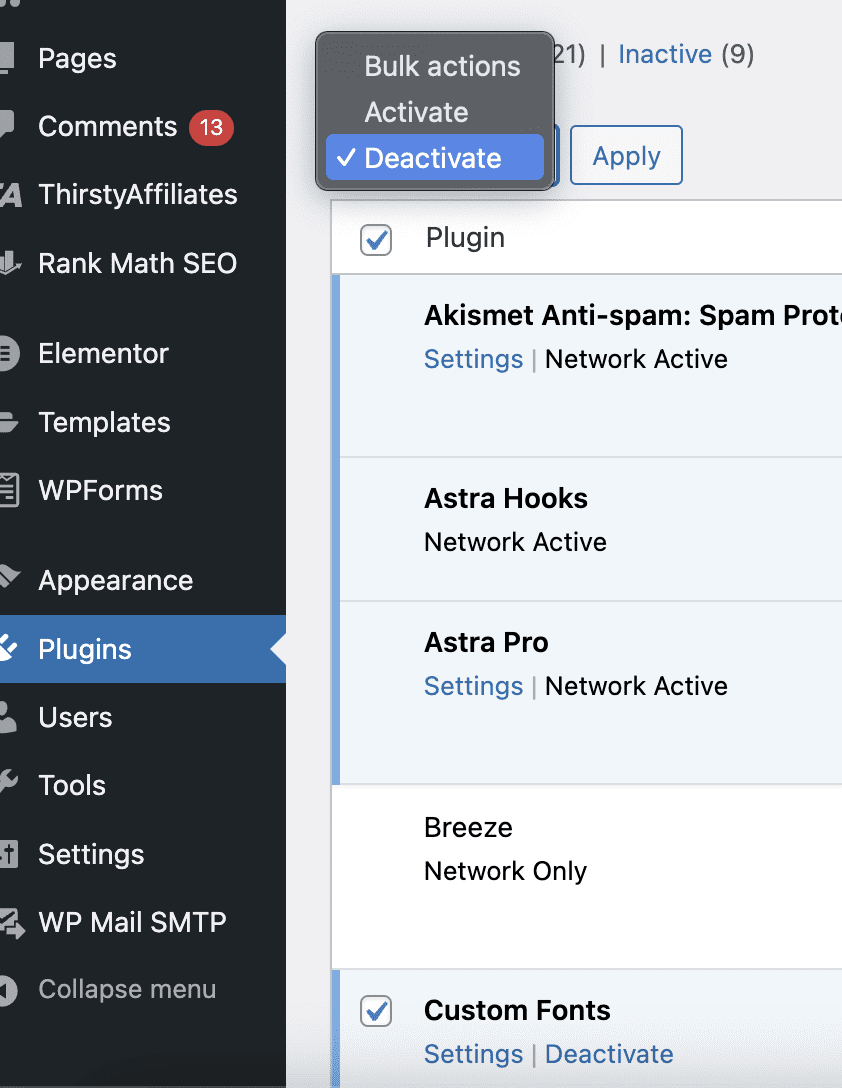
Before doing anything, you need to deactivate all of your plugins to complete the process.
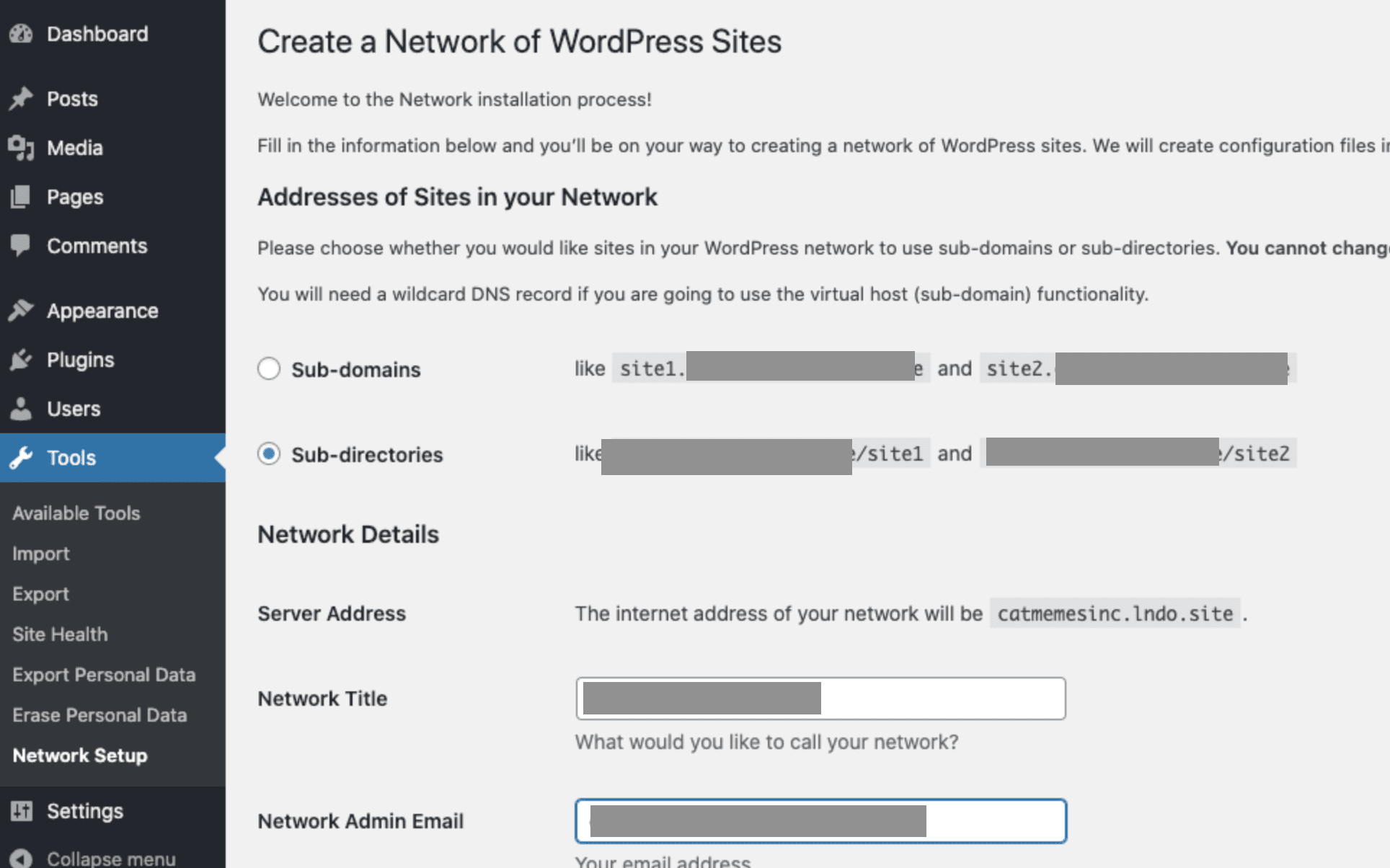
Then go to Tools > Network Setup page.
Screenshot from WordPress, December 2024
Now, you should choose between subdomains (e.g., site1.yourdomain.com) or subdirectories (e.g., yourdomain.com/site1) for the Multisite structure. Then Click “Install.”
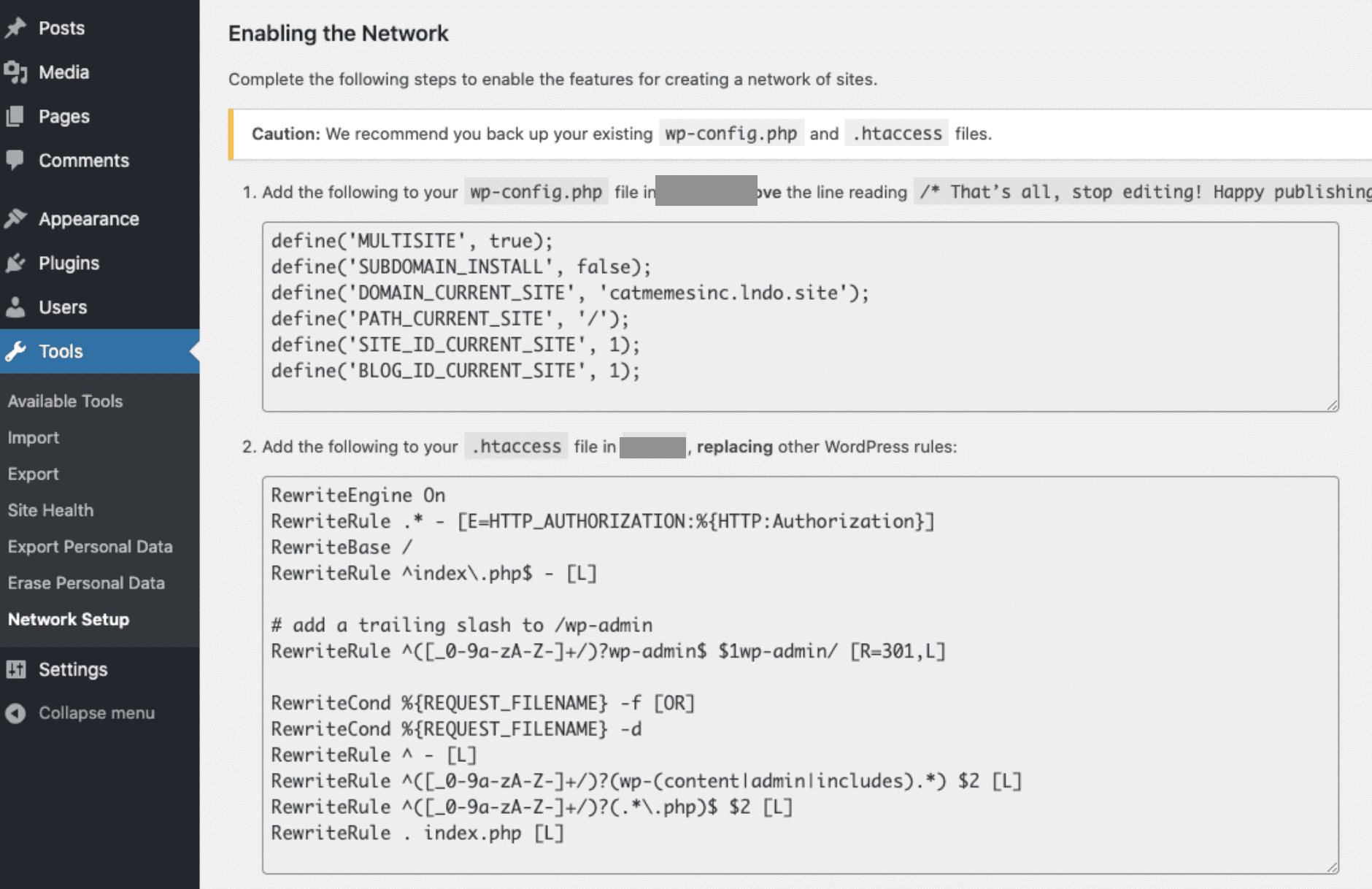
Now, WordPress will show you some code snippets to add to your website’s wp-config.php and .htaccess files.
Screenshot from WordPress, December 2024
Step 3: Edit The wp-config.php And .htaccess Files
You need to edit the wp-config.php file and add the code just below the line (code) you added before.
Then, edit the .htaccess file and replace the existing code with the new code of the WordPress Multisite installation.
Don’t forget to save the changes.
After finishing it, you need to re-login to your website to access the Multisite network.
Step 4: Configure Network Settings
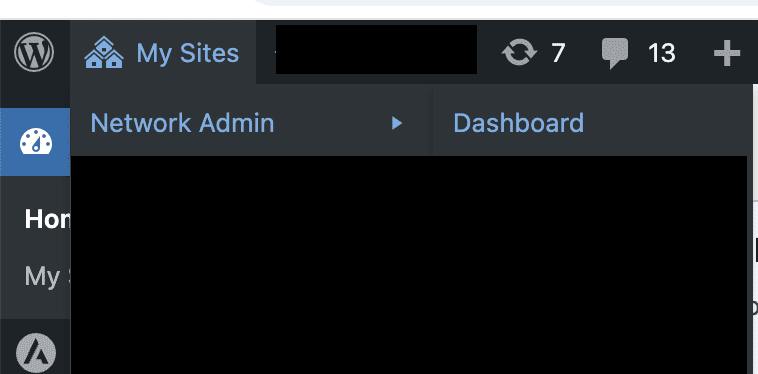
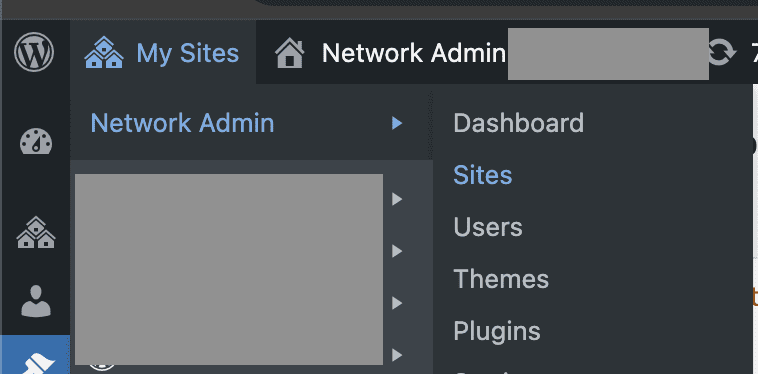
After logging in to your website, go to Network Dashboard to add new sites and change network settings. For this, go to My Sites > Network Admin > Dashboard.
Screenshot from WordPress, December 2024
Settings and other things are the same as those for the normal WordPress installation.
It’s done. This is how you can create your first site in your Multisite network.
If you want to convert your existing website into a Multisite, then here are the steps.
How To Convert An Existing Site To Multisite?
By default, WordPress allows you to convert an existing WordPress site into a Multisite sub-domain only.
If you want to convert a WordPress SubdomainMultisite, then you can follow the above-mentioned steps.
But if you want to convert an existing site into a Multisite Subfolder, then follow these steps:
(Pro tip: Take a complete website backup before starting the process.)
Step 1: Enable The WordPress Multisite Network Feature
You need to edit the wp-config.php file and add this code:
Now, you can find and choose the subfolder option for your Multisite. To do this, go to Tools > Network setup.
Screenshot from WordPress, December 2024
Then, choose the Subfolders option, and click the Install button.
Step 4: Enable The Network
You need to add the code shown by WordPress to the wp-config.php and .htaccess files, as shown above in Step 3 of creating a new multisite.
Once you have done it, you can create your first subfolder site. For this:
Screenshot from WordPress, December 2024
Go to My Sites > Network Admin > Sites.
Congratulations! You’ve successfully converted your WordPress site to a Multisite.
WordPress Multisite FAQs
What is the difference between WordPress Multisite vs. managing separate installations?
Here are the major differences:
In separate installations, you have full control and customization for each site, whereas WordPress Multisite offers limited individual site customization.
WordPress Multisite has a centralized dashboard for all sites, whereas separate installations demand individual management for each site.
Multisites generally use server resources more efficiently; on the contrary, for separate installations, each site uses its own resources.
What are the best tips for managing WordPress Multisite?
Some of the best tips for managing WP multisite are:
Choose network-wide themes carefully.
Implement two-factor authentication.
Set up regular, automated backups of your entire network.
Wrapping Up
Setting up a WordPress Multisite network is like creating a digital theme park where visitors can effortlessly explore all your attractions.
Converting a WordPress site to a Multisite subdirectory is a powerful solution whether you are managing multiple brands, creating a network of niche sites, or simply planning for future growth.
Use this guide to create a WordPress Multisite for your business.
A post on LinkedIn questioned the idea that Schema.org structured data has an impact on what a large language model outputs. Apparently there are some SEOs who are recommending structured data to rank better in AI search engines.
Patrick Stox wrote the following post on LinkedIn:
“Did I miss something? Why do SEOs think schema markup will impact LLM output?”
Patrick said “LLM output” in the context of an SEO recommendation so it’s likely that it’s a reference to ChatGPT Search and other AI search engines. So do AI search engines get their data from structured data?
LLMs are trained on web text, books, government records, legal documents and other text data (as well as other forms of media, too) which is then used to produce summaries and answers but without plagiarizing the training data. What that means is that it’s pointless to think that optimizing your web content will result in the LLM itself sending referrals to that website.
AI search engines are grounded on search indexes (and knowledge graphs) through Retrieval Augmented Generation (RAG). Search engine indexes themselves are created from crawled data, not Schema structured data.
Perplexity AI ranks web-crawled content using a modified version of PageRank on their search index, for example. Google and Bing crawl text data and do things like remove duplicate content, remove stop words, and other manipulation of the text extracted from the HTML, plus not every page has structured data on it.
In fact, Google only uses a fraction of the available Schema.org structured data for specific kinds of search experiences and rich results, which in turn limits the kind of structured data that publishers use.
Then there’s the fact that both Bing and Google’s crawlers render the HTML, identify the headers, footers and main content (from which they extract the text for ranking purposes). Why would they do that if they’re going to rely on Schema structured data, right?
The idea that it’s good to use Schema.org structured data to rank better in an AI search engine is not based on facts, it’s just fanciful speculation. Or it could be from a “game of telephone” effect where one person says something and then twenty people later it’s transformed into something completely different.
For example, Jono Alderson proposed that structured data could be a standard that AI search engines could use to understand the web better. He wasn’t saying that AI search engines currently use it, he was just proposing that AI search engines should consider adopting it and maybe that post got telephoned into a full-blown theory twenty SEOs later.
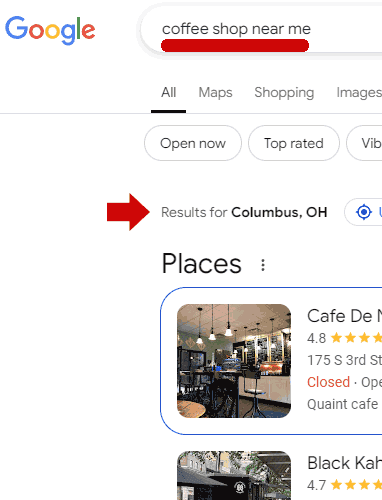
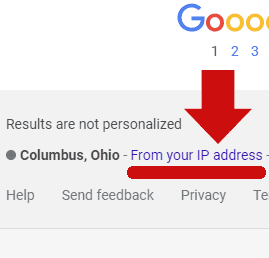
Unfortunately, there’s a lot of unfounded ideas floating around in SEO circles. The other day I saw an SEO assert in social media that Google Local Search doesn’t use IP addresses in response to search “near me” search queries. All anyone had to do to test that idea is to sign into a VPN, choose a geographic location for their IP address and do a “near me” search query and they will see that the IP address used by the VPN influenced the “near me” search results.
Screenshot Of Near Me Query Influenced By IP Address
Google even publishes a support page that says they use IP address to personalize search results yet there are people who believe otherwise because some SEO did a correlation study and when questioned we’re back to someone bellowing that Google lies.
Will You Believe Your Lying Eyes?
Schema.Org Structured Data And AI Search Results
“SEOs” recommending that publishers use Schema.org structured data for LLM training data also makes no sense because training data isn’t cited in LLM output, just for output that is sourced from the web, which itself is sourced from a search index that’s from a crawler. As mentioned earlier, publishers only use a fraction of available Schema.org structured data because Google itself only uses a tiny fraction of it. So it makes no sense for an AI search engine to rely on structured data for their output.
Search marketing expert Christopher Shin (LinkedIn profile) commented:
“Thinking the same thing after reading your post Patrick. This is how I interpret it currently. I thought LLM’s typically do not generate responses from search engines serps but rather from data interpretation. Right? But schema data markup would be used by SER{s to show rich snippets etc. no? I think the key nuance with schema and LLMs is that search engines use schema for SERPs whereas LLM’s use data interpretation when it comes to how schema impacts LLM’s.”
People like Christopher Shin and Patrick Stox give me hope that pragmatic and sensible SEO is still fighting to get through the noise, Patrick’s LinkedIn post is proof of that.
Pragmatic SEO
The definition of pragmatic is doing things for sensible and realistic reasons and not on opinions that are based on incomplete information and conjecture.
Speaking as someone who’s been involved with SEO since virtually the birth of it, not thinking things through is why SEOs and publishers have traditionally wasted time with vaguely defined issues, spun their wheels on useless activities like superficial signals of EEAT and so on and so forth. It’s truly dispiriting to point to documentation and official statements and get blown back with statements like, “Google lies.” That kind of attitude makes a person “want to holler.”
With the punishment for Google’s first search antitrust case expected to be delivered in August 2025, the looming question is what will happen now with a new U.S. President and a new set of Department of Justice (DOJ) appointees.
Early signs suggest the Trump administration will largely stay the course of the Biden administration when it comes to antitrust enforcement against large tech companies, including Google.
Their rationale is drastically different from that of the previous administration, but the recent nominations and appointments for the DOJ suggest that President Trump is serious about holding Google accountable, even if their preferred remedies may differ.
Before we get into it, let’s recap what has happened so far.
The U.S. Vs. Google Case
In August 2024, Federal Judge Amit Mehta ruled that Google violated the U.S. antitrust law by maintaining an illegal monopoly through exclusive agreements it had with companies like Apple to be the world’s default search engine on smartphones and web browsers.
Additionally, Google was found guilty of monopolizing general search text advertising because Google was able to raise prices on search advertising products higher than what the government claimed would have been expected or possible in a fair market.
Potential Remedies For Google
The DOJ submitted two filings with their suggestions to remediate Google’s monopolistic actions.
Proposed remedies range from restrictions on deals that feature Google’s search engine as the default on browsers and devices all the way to a breakup of the company by forcing the sale of Google’s browser Chrome.
Other intriguing remedies that have been proposed include syndicating the Google search algorithm to competitors, forced licensing of ad feeds to competitors, and divesting the Android operating system.
The DOJ under Biden made it clear in their most recent filing on November 20, 2024, that divesting Chrome is their preferred option, along with the discontinuation of exclusive agreements with browsers and phone companies.
The implications of divesting Chrome are also the most wide-reaching – not only is Chrome used by nearly two-thirds of the world’s internet users, but we learned through this trial that click data from Chrome is used to train the search algorithms using Navboost, helping Google maintain its competitive edge.
Losing Chrome’s data would almost certainly guarantee a drastically different Google search engine.
Google filed its response to the DOJ, arguing that the proposed remedies are much wider reaching than what the case was about and that America’s global leadership position in tech could be hindered by this.
Instead, they proposed allowing exclusive agreements to be made with companies like Apple and Mozilla, but with the ability to set a different default search engine on different platforms and browsing modes.
It also proposed that Android device manufacturers could preload multiple search engines, as well as preload Google apps without Google Search or Chrome.
Both sides will return to court for the remedies litigation in May 2025, with a ruling expected to be delivered in August 2025.
What Happens Now
Back to the question at hand: What happens once Trump takes office?
The initial signals, including Trump’s nominations for key roles at the FTC and the Department of Justice Antitrust Division, suggest the administration will continue to use a heavy hand against large tech companies facing antitrust troubles like Google. But, their solutions may differ from the current proposed remedies.
Trump’s Relevant Nominees
Trump has nominated several key individuals who will influence antitrust enforcement, particularly concerning Big Tech companies.
These appointments indicate that the crackdown on tech giants will likely continue, in effect, a surprising bipartisan effort. Trump’s key nominees include:
Gail Slater: Nominated to lead the Department of Justice’s Antitrust Division, Slater has a background as a policy advisor to Vice President-elect J.D. Vance and experience in tech policy at the National Economic Council. If confirmed, she would inherit the antitrust case against Google.
Andrew N. Ferguson: Appointed as Chair of the Federal Trade Commission (FTC), Ferguson has expressed intentions to reassess the agency’s approach to mergers and acquisitions, which has been uncommonly strong against mergers and acquisitions, while still maintaining oversight of dominant tech platforms.
Mark Meador: Appointed as an FTC Commissioner, a role previously held by Ferguson, Meador is recognized for his pro-enforcement stance, especially regarding technology companies, in his previous work with the U.S. Senate Judiciary Committee. His previous work includes drafting legislation aimed at addressing competitive practices in the tech industry.
While all three of these nominees are deeply rooted in the Republican party, they are all united in their pro-enforcement stances when it comes to Big Tech.
This is a departure from the typical Republican pro-business, anti-regulation position, signifying Trump’s seriousness in curbing the power of Google and other tech giants.
The Trump Administration’s Views On Google’s Antitrust Case
Trump’s disdain for Big Tech companies, including Google, has been consistent since his first presidency.
Why does he hate Google so much? A couple of reasons seem most likely:
He sees weakening Big Tech companies as a way to promote “free speech” because of their misinformation moderation policies and claims the search results are biased against conservatives.
Despite this seemingly constant position against Google, President Trump has also suggested that breaking Google up may destroy the company rather than help promote fairness and competition.
He has also warned that breaking up Google may make the U.S. appear weaker to foreign powers because “China is afraid of Google.”
Elsewhere in the administration, Vice President Vance has previously called for the breakup of Google and praised the Biden administration’s Federal Trade Commission Chair, Lina Khan, for her aggressive approach to antitrust enforcement.
Whether they decide to take a stance that is pro-breaking Google up remains to be seen, but it appears that they will be taking office with a desire to strengthen competition in this market.
Final Thoughts
There is a lot of time between Trump taking office and the remedies litigation starting up again for the case against Google in May 2025.
The DOJ still needs to argue why they believe Google should be forced to sell Chrome, and if this is no longer the belief of the DOJ appointees, they will need to argue why other remedies make more sense.
It seems reasonable to assume, based on the appointees, that they will be taking some big swings at Google and arguing for the remedies that they believe would be most effective at enhancing competition.
If you are someone who believes action needs to be taken against Google, Trump’s current anti-Google stance may work in your favor regardless of whether you agree with his rationale for it.
Brick-and-click retailers can struggle to balance local and ecommerce search engine optimization. A physical store wants to target folks in a geographic area and drive in-person visits, while an ecommerce site aims for buyers anywhere.
Different goals, however, don’t necessarily mean there is a problem.
Imagine a furniture retailer with dozens of stores in California and Florida. The CEO could message the marketing team concerned that ecommerce represents less than 20% of total revenue. Her concern the next day could be a new Miami store not appearing on a local Google search.
It feels like a conflict — from link building to content marketing. But it doesn’t have to be. A brick-and-click marketing team can balance the priorities by planning day-to-day SEO activities and developing processes.
3-Part SEO
Marketers often say that SEO has three areas of focus: technical, on-page, and off-page.
Omnichannel marketing teams balance local and ecommerce SEO.
Technical SEO focuses on site speed, URL structure, microdata, and general crawlability. The same technical practices that work for local SEO also help promote products.
Teams of content marketers and on-page optimizers frequently work hand-in-glove to ensure a site ranks for key products, categories, and locations. There is no reason local and ecommerce efforts cannot live in harmony.
Off-page SEO includes backlinks, brand mentions, and filling out and maintaining business profiles, which feed into Google’s local pack and map results. Off-page efforts fit naturally into local optimization even if the focus is ecommerce.
In Action
Sharing tasks for ecommerce and local SEO helps both. Here are priorities, workflows, and automation to streamline the load.
Prioritize setup and integration. Many SEO tasks require initial time-consuming effort followed by less intense maintenance.
For example, optimizing a Google My Business page requires claiming, adding contact info, images, and videos, and encouraging reviews — a lot of upfront work. Keeping the My Business page fresh is much easier.
Similarly, the furniture retailer with dozens of stores might want to set up location-specific landing pages on its website. Each page will have images from the local store, a Google map, store hours, and a greeting from the store manager. Building the pages takes more effort than maintaining them.
Thus a marketing team that prioritizes setup is building the SEO infrastructure to manage selling products online and driving physical foot traffic.
Develop standard operating procedures. Many omnichannel retailers approach SEO by the project. The CEO says to promote the new Miami store, and the team focuses on that effort.
Unfortunately, this sort of project-first approach has three potential problems. It’s (i) reactionary instead of strategic; (ii) creates redundancy, as every project starts anew, and (iii) overlooks critical maintenance.
A better approach is to build a set of standard operating procedures, such as (i) how blog articles are optimized, (ii) the SEO process for adding products or pages, and (iii) a schedule for maintenance and updates.
Use AI to generate content. Working on ecommerce and local SEO simultaneously requires more on-page content.
Developing that extra content may be fairly easy in 2025. Imagine our furniture store. Its content team might produce a blog post targeting the keyword phrase “top Scandinavian design trends for 2025.”
The initial human-written draft could be an AI prompt, generating regional variations like “top Scandinavian design trends for South Florida.”
The primary article would serve as a hub linking to and receiving links from pages of each region.
Automate repetitive tasks. Finally, automation can expedite many aspects of SEO maintenance and improvements. Zapier, generative AI platforms, and similar tools can quickly complete repeat functions and even run SEO audits.
Fundamentals
My impetus for this article was a real-world consultation with a furniture chain. The business focused on the differences between local and ecommerce SEO instead of the overall goal.
Although attracting online buyers and driving in-store traffic may seem different, the SEO fundamentals are the same.
Google has updated its documentation to provide clearer guidance on its site reputation abuse policy.
The changes are meant to you better understand what qualifies as a violation and how to stay compliant.
While the updates don’t change how the policy is applied, they make the rules easier to follow by incorporating more detailed explanations from a recent blog post FAQ.
What Changed?
The updated documentation now includes content directly pulled from Google’s November blog post about site reputation abuse.
That blog post introduced a Q&A section to clarify the policy. Google has now added this FAQ guidance to its official spam policies documentation.
In a statement, Google explained:
“We updated the site reputation abuse policy to include guidance from our blog post’s FAQ on site reputation abuse. These are editorial changes only, no change in behavior.”
This means the policy hasn’t changed—it’s just been rewritten to make it easier to understand.
What Is Site Reputation Abuse?
Site reputation abuse happens when third-party content is published on a well-established website to take advantage of that site’s ranking signals.
Essentially, it occurs when someone uses a reputable site as a shortcut to boost rankings for unrelated or low-quality content rather than earning those rankings independently.
For example:
A news site hosting coupon pages from a third-party service purely to benefit from the site’s strong rankings in Google.
An educational site publishing sponsored reviews about payday loans.
A movie review site hosting unrelated pages about essay writing services or buying social media followers.
However, not all third-party content is considered abuse. Forums, user-generated content, syndicated news articles, and editorial pieces are generally acceptable if they’re not designed to manipulate search rankings.
Why Does This Matter?
These updates make it easier to determine whether your content violates the policy.
For example, Google’s FAQ now clarifies common scenarios, such as:
Third-party content: Simply having third-party content isn’t a violation unless explicitly published to exploit a site’s rankings.
Freelance and affiliate content: Freelance content or affiliate pages are acceptable if they’re not used to manipulate rankings. Affiliate links, when tagged appropriately (e.g., with “nofollow” or “sponsored” attributes), don’t violate the rules.
The FAQ also explains how to address violations. You can fix the issue by removing or relocating problematic content, submitting reconsideration requests in Search Console, and following Google’s spam guidelines.
This is a good reminder to review your content practices to ensure they align with Google’s policies. If you host third-party content, make sure it adds value for users and doesn’t just serve to piggyback off your site’s reputation.
Advancing your in-house SEO career can be incredibly lucrative and fulfilling. But most advice is theoretical, too high-level, and comes from people who haven’t done it.
I had the good fortune of a very fruitful in-house career, leading large organizations at companies like Atlassian, G2, or Shopify.
Over the recent years, I have had the honor of helping companies like Ramp, Hims, Nextdoor, and many others hire top-tier talent and design effective teams.
But my experience is subjective, so I asked four of the most accomplished SEO pros in the world to share their insights as well (you can find their full answers at the end of the Memo):
Image Credit: Kevin Indig
Thank you so much for sharing your valuable insights!
The 5 Core Competencies Of SEO
SEO professionals need five core competencies to succeed in the long-term, that I broke down into three skills each.
I created the framework based on John’s, Malte’s, Jordan’s, Tom’s, and my own experience. Each skill is critical. You cannot just be strong in four. You need to be strong in all of them to succeed in the long term.
Image Credit: Kevin Indig
Skill 1: Communication
Communication is made up of alignment, collaboration, and outward communication.
Creating internal alignment means helping everyone understand what matters in SEO to get buy in, but also contemplate what’s happening in a crisis. For example, when an algorithm update hits your site.
Since SEO is a recommended discipline, it’s critical to collaborate effectively with supporting teams like engineering, design, content, etc., and adjacent teams like legal or procurement.
Outward communication, the way you present yourself and the company at events or on social media, matters it comes to hiring new talent and raising your company’s reputation.
Skill 2: Learning
Learning breaks down into adaptability, experience, and filtering information.
Adaptability is important because Google’s algorithms and design change a lot. Just think about the shift we’re going through with AI search right now. So, you need to be able to shift gears, leave old mental models behind, and develop new ones. You can learn about SEO, but doing it is a different kind of beast. To learn, you can have one or more side projects to tinker with or analyze and reverse engineer other sites.
It’s also important to at least know the basics of other disciplines because they all impact SEO: copywriting, positioning and messaging, conversion optimization, design, web development, and product development.
Lastly, get good at filtering information. What do you read? How do you learn from experiments, and how well are you connected to the industry so you can learn from peers?
Skill 3: Business Savviness
Business savviness breaks down into planning, focus, and execution.
Planning is a crucial skill for almost anything in life. You need to be good at setting goals, priorities, timings, and responsibilities. Planning also includes knowing what resources you need and pitching for them. Also, develop proficiency in forecasting and projecting impact.
Focus is the skill of working on the most important projects while tuning out the noise. It’s measuring the right data to know whether you’re successful and to report upwards and sideways.
Good execution is really hard. In my experience, it comes down to good project management but also understanding how your business and industry work.
Technicality doesn’t mean technical SEO but the skills of automation, data analysis, and a general technical understanding.
Automation is about doing work more efficiently while controlling for dependencies and liabilities. This skill is rapidly becoming more important as AI gets better. It used to be about proficiency with Excel, Google Sheets, SQL, web analytics, etc. But in the future, a lot of it will come down to prompt engineering and workflow automation.
Data analysis is the skill of getting and analyzing data, i.e., knowing which data to look at and how to interpret it well.
A good technical understanding comes down to learning how Google works but also being “technical” enough to talk to engineers and product managers. For example, you want to learn what tech stack your company’s site and application is built on, how the engineering team works, etc.
Leadership is the result of advocacy, hiring, and relationship building. To be clear, you should develop leadership qualities, whether you have management responsibility or not.
Advocacy means representing SEO where it matters. It demands you to proactively find out where conversations happen that impact SEO and how to influence them.
Good hiring skills come down to whether you have a high bar and if you can bring in good talent. Who do you know, and how do you evaluate them for the job?
Relationship building is critical for rapport with your manager and peers. You need allies and “friends” to lean on and learn from. Part of this is getting good at coaching others and finding a good coach.
The five core competencies offer you a helpful overview of what you need to develop. But without understanding how to apply them, they’re only half as useful.
General Vs. Specific Skills
Everybody needs to be proficient in the five core competencies, but you need to adjust the emphasis of your skills based on the industry and business model of the company you work for.
I have three tips for you:
Learn more about technical SEO and product development when you work on larger sites, usually in B2C. Get better at demand generation and content marketing for smaller sites, usually in B2B. The reason is that you want to align your skills with the biggest growth levers of the business.
Develop expertise in SERP Features that matter for your industry. For example:
News: top stories.
Ecommerce: product grids.
SaaS: video carousels.
SMB: Map Packs.
Tailor your skills to the size and maturity of a company. For example, in startups it’s more important to execute fast while you need to invest more time into creating alignment at large enterprises.
Hard Vs. Soft Skills
Hard skills are not as important as soft skills in SEO because you need to constantly adapt to Google changes and learn new hard skills as tech and consumer behavior evolve.
I recommend writing down and refining your mental model about how Google works and what drives success.
Forcing yourself to explain and think about why things are the way they are allows you to truly refine your approach to SEO.
You need to balance two things at the same time: being confident in your approach but open to new insights. Jeff Bezos: “Strong opinions, loosely held.”
Career Planning
This is hard, but most people never think about where they want to be and what it takes to get there.
But without focus, it’s easy to dabble in too many areas and waste time. What are you optimizing for?
Think about your endgame and what you need to get there. Remember, you can always change your goal. But have one.
I love Ray Dalio’s five-step framework for endgame planning 1:
Have clear goals.
Identify and don’t tolerate the problems that stand in the way of your achieving those goals.
Accurately diagnose the problems to get at their root causes.
Design plans that will get you around them.
Do what’s necessary to push these designs through to results.
I want to finish by leaving you with some top-notch resources you can use to keep developing yourself.
1. Malte suggests Learning SEO by Aleyda Solis, probably the most comprehensive repository of SEO learning material.
I present to you the raw inputs I got from John, Tom, Jordan, and Malte:
What core skills and knowledge areas are essential for success in SEO today, and how do you recommend developing them?
Jordan Silton: If I were recreating my personal career path, I would emphasize technical expertise, data analysis, communication skills, and business acumen.
However, SEO roles today are so varied across different business types, industries, and strategies that a multitude of skills are valuable and relevant.
Malte Landwehr: I think SEO has become so diverse that there is no longer one set of skills.
A technical SEO needs very different skills from a content-marketing-focused SEO. A director of SEO needs very different skills from a principal SEO consultant. The SEO work for a B2B SaaS looks totally different from the SEO work for a marketplace or aggregator. News SEO is completely different from ecommerce SEO.
If I had to pick the traits that helped me the most, I would say:
The ability to simultaneously hold multiple, contradicting frameworks and mental models in your head. Two SEOs might tell you two completely different models, how they implement SEO. Both might be wrong – but you might still learn something from both approaches.
Embrace uncertainty. When reverse engineering the Google algorithm, there are many unknowns. You need to get comfortable with that.
ELI5 & ELIPhD. You need to be able to explain SEO to everyone. During your career, you might talk to a CEO, CFO, CMO, CTO, CPO, Head of Web Product, Product Manager, Content Editor, Software Developer, Analyst, and many other roles. Each of these people needs different information. And to convince them, you need to tell different stories. You must develop the ability to talk to each of them.
John Shehata: Today’s SEO landscape has evolved from a generalist approach to a more specialized one. We now see technical SEOs, content SEOs, commerce SEOs, and many more.
The most critical skill right now is adaptability. Google’s algorithms are becoming more sophisticated, advanced, and complex, requiring SEOs to maneuver through frequent changes and quickly pivot strategies when necessary.
Developing this skill involves staying informed through industry updates, engaging with the community, and experimenting to see what works in real time.
Equally important is the ability to think with a business mindset. Historically, SEOs have been focused heavily on driving traffic, but generating traffic for traffic’s sake is no longer enough.
SEOs today need to align their strategies with business goals and revenue streams, focusing on attracting the right audience that converts rather than casting the widest net possible. This shift requires optimizing content not just to attract visitors but to support key business objectives.
Additionally, leveraging AI is essential – not just for automating tasks but for enhancing your analysis and decision-making.
AI can streamline workflows, handle complex data analysis, and support content optimization, allowing SEOs to focus on strategic tasks.
To build these skills, SEOs should learn about AI tools, experiment with them, and stay updated on new developments.
However, none of these skills will be fully effective without strong communication abilities. Being able to translate complex SEO insights into clear, actionable recommendations for non-technical stakeholders is invaluable.
This involves bridging the gap between technical teams and business units, ensuring that all departments are aligned and moving toward shared objectives.
Lastly, data analytics is a foundational skill that ties everything together. A deep understanding of data helps uncover hidden opportunities and supports informed, strategic decisions.
Mastery of tools like Google Analytics, BigQuery, and Looker Studio will allow SEOs to extract meaningful insights that can shape strategies, validate recommendations, and ultimately drive better business outcomes.
Tom Critchlow: This will be no surprise to those who know me, but business skills are critical.
The ability to first understand the full revenue profile and mechanics of the companies you work with, and then being able to communicate confidently, credibly, and clearly.
SEO is more than ever a cross-functional activity and so what we consider “soft skills” are actually critical to be able to convince teams, stakeholders, clients and organizations to invest appropriately in SEO.
Of course, you need some knowledge of SEO too! I think the ideal career experience is a role that allows you to invest in your technical and analytical SEO skills while getting a front-row seat to the wider business context and communication.
What pivotal experiences contributed most to your professional growth?
Jordan Silton: I’ve been fortunate to keep learning different roles, and each shift into a new context accelerated my growth.
Starting in paid search/SEM taught me to monitor KPIs, optimize for ROI, and use an experimental approach to improvement.
Evolving a reporting team into a data science and experimentation team expanded my understanding of how teams and metrics connect across the entire business.
Becoming a product leader was transformational in teaching me how to build consensus and influence to move a business forward.
Malte Landwehr: For me personally, it was a combination of three things:
I started tinkering with websites in my early teen year. I did everything on my own, from repairing corrupted SQL databases, to editing .htaccess files, creating content, attracting visitors, and former partnerships for monetization. This allowed me to understand the full picture of running a website.
I studied Computer Science with a focus on graph algorithms, web scraping, machine learning, information retrieval, and NLP. This allowed me to form a deep understanding of Google’s algorithms and patents.
I worked in Management Consulting. One thing I oversaw was making sure our PowerPoint slides can be read on a BlackBerry in the backseat of a car. This gave me the skills to talk to the C-level and craft proper proposals.
John Shehata: My career growth has been shaped by a diverse range of experiences.
Coming from a technical background as a software engineer and transitioning to marketing has given me a strong foundation.
One key moment was learning to translate complex SEO concepts into a language that editorial, PR, and marketing teams could understand, which helped bridge the gap between SEO needs and business objectives.
Another pivotal decision early in my career was to become a well-rounded marketer instead of specializing only in SEO.
I gained expertise in social media when platforms like Twitter and Facebook were in their infancy, built one of the first social media teams for a major news publisher, and developed a deep understanding of newsletters and partnerships. This diverse experience allowed me to eventually lead global audience development strategies for large organizations.
Managing cross-functional teams was another formative experience.
Working closely with development and engineering teams taught me to speak their language, advocate for SEO needs, and propose technical solutions that accelerated our initiatives.
While working with Editorial teams taught me how to respect the craft and appreciate all the due diligence that goes into writing content.
Working with all these different teams and understanding their strengths and needs, strengthened my ability to push back when necessary and collaborate effectively, which is crucial for driving SEO projects forward within complex organizations.
One of the most fulfilling aspects of my career has been mentoring and team building. I’ve had the privilege of hiring hundreds of SEOs and mentoring some of the best SEOs in the industry, helping them develop their own skills and grow into leadership roles.
Watching them succeed has been one of the most rewarding parts of my journey.
Finally, a turning point in my career was the conscious effort I made to build my personal brand.
Early on, I had supportive managers who encouraged me to refine my public speaking skills and present within the company.
I took these opportunities seriously, which eventually led to my first speaking engagement at SES 18 years ago, the largest SEO conference at the time with thousands of attendees.
From there, I focused on establishing my presence both online and offline, which not only advanced my career but also opened doors for me to promote my own software solutions.
Building a personal brand has proven invaluable in expanding my influence and credibility in the industry.
Tom Critchlow: My first job in digital was as an account manager for a digital agency. The first week on the job the account director and the SEO director both quit!
So, I was left speaking directly to clients about SEO with zero experience. Great way to learn both sides of the equation.
After that, working at Distilled, my brother Will taught me everything I know. I am forever indebted to his guidance.
What are the biggest mistakes you made or have seen others make in developing their career?
Jordan Silton: Most of my early career success was predicated on finding an issue or problem or opportunity and shining a light on it to get others to rally and fix it.
That approach worked well in a world of technical audits and a focus purely on what to do, rather than how to get it done.
I wish I had understood earlier how crucial it is to build up the people and relationships along the way.
In larger organizations (and small ones, too), success is almost exclusively driven by teamwork and communication rather than individual expertise.
Recognizing the value of people in the process transformed my approach, and I believe it has made me a more effective leader.
Malte Landwehr: For a long time, I underestimated the impact a good coach can have. Mindset and manifestation sound like a scam. But they work – also beyond career topics.
John Shehata: One mistake I made early on was focusing too much on rankings as a primary metric. While rankings are a great indicator, they are not the ultimate measure of success.
As I matured, I evolved to focus on traffic, and ultimately how SEO metrics align with overall business goals.
Now, my primary focus is on understanding how each SEO activity impacts revenue and long-term business growth.
I’ve also seen many SEOs panic over algorithm updates. While these changes can be disruptive, a better approach is to remain calm, evaluate the impact, and create both immediate and long-term action plans.
Sometimes, Google reverses its changes, so it’s important not to overreact.
Another common mistake is made by managers transitioning into director roles. Many struggle with balancing tactical and strategic thinking. They might dive into tactical details when speaking with C-level executives instead of focusing on strategy.
Mastering the art of switching between tactical and strategic conversations is crucial for career growth at this level.
Tom Critchlow: Not giving yourself access to context. Whatever role you’re in, if you’re not in the room where budgets are discussed and decisions are made, then you’re missing so much context.
So much of this comes down to your manager and how much they invite you into conversations “above your pay grade,” so to speak.
How do you think strategically about your career?
Jordan Silton: My favorite question about career aspirations is, “What’s your endgame?”
While it’s not crucial to stick to the same endgame, having a clear vision of what you want to achieve is vital.
My aspiration has been fairly consistent in helping businesses turn themselves around and accelerate growth, but my approach has evolved.
Initially, I thought that meant becoming a management consultant, but I was able to reframe this early in my career by realizing that agencies had significant leverage in this area.
This mindset guided my career decisions, including transitioning in-house to gain insight into internal business dynamics and knowing when to leave a successful, industry-leading business to explore opportunities with companies focused on reimagining and rebuilding their brands.
Having an end state to point toward – no matter how much you zigzag to get there – helps ground you in your professional journey.
Malte Landwehr: I am in the incredibly lucky and privileged position that I found something that I thoroughly enjoy doing, happen to be very good at it, and that companies are willing to pay a lot of money for.
I just show up every day at work and focus on whatever task sounds reasonable (and fun) to me.
John Shehata: I’ve always focused on becoming a well-rounded digital marketer rather than a specialist. My strategy was to gain experience across different channels – SEO, social media, newsletters, partnerships, etc. – so I could integrate these areas into a cohesive strategy.
This approach has paid off as I moved into senior leadership roles, where I was able to oversee not just SEO but broader audience development strategies.
Now, as the founder of an SEO software company, my focus has shifted significantly.
Running a SaaS startup requires wearing many hats – product development, sales, support, and client relations – each demanding its own set of skills.
My strategy now is centered on building long-term relationships, and deeply understanding my customers, identifying their pain points, and positioning our software as a long-term solution rather than just a tactical tool.
This means continuously evaluating how our products can deliver real value and helping publishers see the impact through clear, actionable insights.
It’s a constant balance between addressing immediate customer needs and aligning those solutions with their long-term business goals.
In addition, I place a strong emphasis on long-term skill building. I focus on developing skills that I anticipate will be critical in the next 5 to 10 years, such as AI, automation, and business development.
Staying ahead of the curve is essential in such a fast-evolving industry, and it’s important to proactively build expertise in emerging areas.
Another crucial element of my strategy is networking. Building a strong network has consistently opened new doors and opportunities for collaboration.
It’s not just about who you know, but ensuring that the people in your network know the value you bring to the table.
By fostering genuine relationships and contributing to the community, I’ve been able to establish connections that have proven invaluable throughout my career journey.
Tom Critchlow: There’s a great post on a 40-year career that uses a framework of “pace, people, prestige, profit and learning” where different career/life stages require different focus. I like that a lot.
Personally, I’ve always been motivated by learning primarily – the ability to learn new skills and new industries.
Can you suggest any resources or material for career growth?
Jordan Silton: Three books that come to mind immediately are “Turn the Ship Around! A True Story of Turning Followers Into Leaders” by L. David Marquet, “The Checklist Manifesto” by Atul Gawande, and “Never Split the Difference: Negotiating As If Your Life Depended On It” by Christopher Voss and Tahl Raz.
Each of these challenges traditional norms and presents innovative approaches grounded in science and contemporary insights.
Additionally, I’m excited about what Evan LaPointe is building at CORE Sciences. His team leverages clinical insights from neuroscience to evolve business thinking, addressing the many counterproductive norms that persist in the workplace. It’s time to upgrade our understanding, thinking, and practices for better outcomes.
Malte Landwehr: https://learningseo.io/ is the only resource you need to advance your SEO career.
John Shehata: The resources you should focus on depend on where you are in your career.
For early-stage professionals, I recommend mastering tactical skills using resources like Aleyda’s Learning SEO, Moz’s Beginner’s Guide to SEO, WIX, Semrush, or Ahrefs’ Academy.
As you progress, start exploring strategic resources like Kevin’s Growth Memo newsletter.
For more experienced professionals and SaaS owners, I suggest diving into leadership books like “Leaders Eat Last” by Simon Sinek or exploring resources that help you develop a business mindset, Rand Fishkin’s “Lost and Founder,” case studies from Harvard Business Review.
Additionally, staying connected with the SEO community through conferences, webinars, and podcasts is invaluable for continuous learning and networking.
One thing that applies across all stages is the need to stay updated.
SEO and digital marketing are constantly evolving, and keeping a pulse on the latest Google algorithm updates, industry changes, and new tools is crucial to maintaining a competitive edge.
Beyond reading, mentorship is a powerful tool for career growth. Finding a mentor in your field, or becoming one for others, accelerates learning in ways that books and courses alone cannot.
Teaching and guiding others not only solidifies your own understanding but also deepens your expertise.
Finally, hands-on experience is irreplaceable. No amount of reading or watching tutorials can substitute for real-world application.
Create your own projects, build websites, do your own affiliate content, and test different strategies.
Experimenting firsthand is the best way to learn what works and, just as importantly, what doesn’t.
Ultimately, it’s the combination of learning, mentorship, and practical application that will propel your career forward.
Tom Critchlow: I mean, I’m biased, but I think a lot of the SEO MBA archives are relevant!
In particular, the SEO skills maturity matrix is my most popular all-time post and looks at career progression, specifically balancing the “hard” and “soft” skills you need as you grow.
Google quietly updated their Estimated Salary (Occupation) Structured Data page with subtle edits that make the information more relevant and easily understood. The changes show how a page can be analyzed for weaknesses and subsequently improved.
Subtle Word Shifts Make A Difference
The art of writing is something SEO should consider now more than ever. It’s been important for at least the past six years but in my opinion it’s never been more important than it is today because of the preciseness of natural language queries for AI Overviews and AI assistants.
Three Takeaways About Content
The words used on a page can exert a subtle influence in how a reader and a machine understand the page.
Relevance is commonly understood as whether a web page is a match for a user’s search query and the user’s intent, which is an outdated way to think about it, in my opinion.
A query is just a question and the answer is never a web page. The answer is generally a passage in a web page.
Google’s update to their “Estimated Salary (Occupation) Structured Data” web page offers a view of how Google updated one of their own web pages to be more precise.
There were only two changes that were so seemingly minimal they didn’t even merit a mention on their documentation changelog, they just updated it and pushed it live without any notice.
But the changes do make a difference in how precise the page is on the topic.
First Change: Focus Of Content
Google refers to “enriched search results” as different search experiences, like the recipe search experience, event search experience and the job experience.
The original version of the “Estimated Salary (Occupation) Structured Data” documentation focused on talking about the Job Experience search results. The updated version completely removed all references to the Job Experience and is now more precisely focused on the “estimated salary rich result” which is more precise than the less precise “Job Experience” phrasing.
This is the original version:
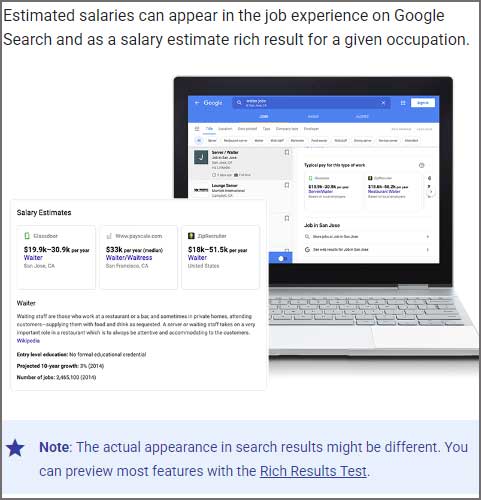
“Estimated salaries can appear in the job experience on Google Search and as a salary estimate rich result for a given occupation.”
This is the updated version:
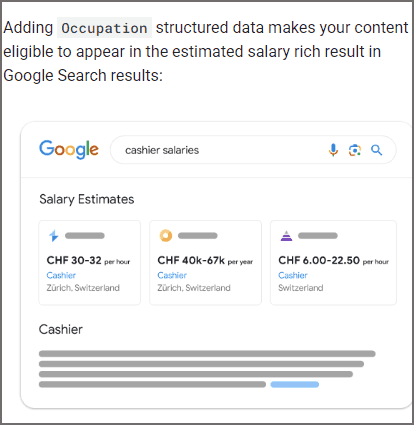
“Adding Occupation structured data makes your content eligible to appear in the estimated salary rich result in Google Search results:”
Second Change: Refreshed Image And Simplified
The second change refreshes an example image.
The change has three notable qualities:
Precisely models a search result
Aligns with removal of “job experience”
Simplifies message
The original image contained a screenshot of a laptop with a search result and a closeup of the search result overlaid. The image looks more at home on a product page than an informational page. Someone spent a lot of time creating an attractive image but it’s too complex and neglects the number one rule of content which is that all content must communicate the message quickly.
All content, whether text or image, is like a glass of water: the important part is the water, not the glass.
Screenshot Of Attractive But Slightly Less Effective Image
The image that replaced it is literally an example of the actual rich result. It’s not fancy but it doesn’t have to be. It just has to do the job of communicating.
Screenshot Of Google’s More Effective Image
The other thing this change accomplishes is that it removes the phrase “job experience” and replaces it with a sentence that aligns with the apparent goal of making this page about the Occupation structured data.
This is the new text:
“Adding Occupation structured data makes your content eligible to appear in the estimated salary rich result in Google Search results:”
Third change: Replace Confusing Sentence
The third change corrected a sentence that was grammatically incorrect and confusing.
Original version:
“You must include the required properties for your content to be eligible for display the job experience on Google and rich results.”
Google corrected the grammar error, made the sentence specific to the ‘estimated salary’ rich result, and removed the reference to Job Experience, aligning it more strongly with estimated salary rich results.
This is the updated version:
“You must include the required properties for your content to be eligible for display in the estimated salary rich result.”
Three Examples For Updating Web Pages
On one level the changes were literally about removing the focus on one topic and reinforcing a slightly different one. On another level it’s an example of giving users a better experience by communicating more precisely. Writing for humans is not just a creative art, it’s also a technical one. All writers, even novelists, understand that the craft of writing is technical because one of the most important factors is communicating ideas. Other issues like being comprehensive or fancy don’t matter as much as the communication part.
I think that the revisions Google made fits into what Google means when it says to make content for humans not search engines.
There are several reasons to migrate your website. They might be to enhance website security through another hosting provider, update your brand image, or improve your user experience.
Whatever the reason, you’ll need to follow a migration process that allows you to update your site without compromising your SEO rankings, traffic, and revenue.
Many SEO professionals face a common fear when it comes to website migration: the loss of valuable traffic, rankings, and users during the transition.
A migration strategy prevents data loss, performance dips, and downtime when you move your site to a new domain, hosting platform, or CMS.
In this guide, I’ll walk you through the 16 best practices for a successful website migration.
The Website Migration Process: A 16-Step Checklist
I’ll break down all the tasks into three phases: planning, pre-migration, and post-migration phase.
Phase 1: Planning
As with any multi-dimensional project, your website migration needs thorough planning. Complete these steps before you begin development:
1. Define Project Scope
First, take inventory of all your webpages. What are you trying to achieve with the migration, and how much of the site will it affect?
Your website migration is set to fail if you don’t have a well-defined goal and scope.
2. Set Migration Team And Responsibilities
Who will lead the project? The in-house SEO team or an outsourced SEO agency?
If you’re managing the project internally, be sure to set up a project management framework so everyone can keep tabs on tasks that belong to them.
3. Manage Cross-Department And Stakeholder Expectations
Which other departments will the project impact? Identify all stakeholders involved in the migration process.
Alongside the SEO and dev teams, this often includes designers, IT staff, quality assurance testers, content managers, product designers, and marketers.
It all depends on what your company is and how many department needs to be involved in an activity like website migration.
You can schedule a meeting to explain why you need it and what you aim to achieve. This is also an excellent opportunity to gather feedback on their specific needs, which could help you choose a better domain (or CMS) that serves your future needs.
Tip: Be transparent about the migration process and what they should expect in terms of functionality, design, and performance.
4. Define Your Timelines And Launch Date
Ideally, your new site should go live when site traffic is at its lowest, and your team has the capacity to respond to any unforeseen hiccups.
Choose a day that has the least impact on your business. This can be during off-hours or when you have little to no low business activity.
You can also do it batch by batch rather than migrate all your pages at once.
Phase 2: Pre-Migration Stage
This is an extension of the planning stage. It’s where you set the foundation for a smooth transition and minimize during or post-migration risks.
5. Run A Detailed Risk Assessment
Audit your webpages to spot potential issues before, during, and after migration. This could be traffic loss, disrupted user flow, broken links, or other technical SEO issues.
Rank these risks by their impact on your business using a simple low-medium-high scale, then tackle the most critical first.
Then, create an effective mitigation plan to minimize the severity of the risks. Some effective techniques are:
Backup all content, meta-data, and configurations before migration.
Use a risk assessment matrix to measure the risks involved in the website migration process and its impact on your business goals.
Use a staging environment to test changes before it goes live.
Implement 301 redirects for all the changed URLs to maintain their SEO value.
6. Define Performance Benchmarks And Set Up Tracking
Build a detailed picture of your site’s existing performance so you have something to compare your new site with.
At this stage, it’s a good idea to back up your existing site in case you need to restore it during the migration process. You’ll want to pull benchmark data for the following:
Core Web Vitals: Use Google’s PageSpeedInsights to measure metrics like loading speed, user interactivity, and visual stability.
Server Response Time: Tools like GTMetrix let you see vitals such as the time to first byte (TTFB) and the overall performance of your website server.
Database Performance Metrics: Analyze database performance to ensure that it can handle the expected traffic loads post-migration. This may require reviewing query execution times, indexing, etc.
Usability Testing: Manually check out all the key areas (conversion elements) to ensure they’re working effectively. You can run A/B tests to identify conversion-deficient areas or pain points that need to be addressed in the new design.
Overall Website Performance: Use Google Analytics, Search Console, or third-party tools like Ahrefs to evaluate your current organic traffic, rankings, indexed pages, crawl errors, indexing rate, and backlinks.
In addition to benchmarking, this is a good time to double-check that you’re tracking all your target keywords in your rank-tracking tool.
This is (very) important as it helps you know how much traffic/rankings you lost/gained after the migration.
7. Ensure Dev and SEO Are Aligned On Performance
If your migration involves a technical overhaul (a CMS change, server migration, or redesign), let your developers know the SEO performance metrics that are important to you. This helps minimize the migration’s impact on your SEO performance.
These migrations might require a complete mapping of old URLs to new ones – give these details to your developers, as missing redirects will tank your rankings and affect organic traffic.
Other issues to look out for are:
Ideally, review your entire SEO performance before and after the migration is complete so that you can compare results.
8. Document Everything
Document all your active server settings and configurations before you migrate your website. This includes the details about the DNS settings, CDN configurations, and hosting environment.
Server documentation has several benefits:
It ensures the new server environment mirrors the old one and reduces the risks of inconsistencies that may cause performance issues.
If any problems arise post-migration, detailed server documentation makes it easier for relevant teams to find, diagnose, and resolve them.
It acts as a comprehensive reference for future migrations or server updates.
Configuration management tools like Ansible, Puppet, or Terraform are popular tools for documenting server configurations in a reusable, readable, and version-controlled format.
Version control tools like Git can also be used to track changes made and collaborate effectively with teams during the migration.
9. Set Up A Testing Environment
It’s best to develop your site in a closed testing environment on a separate server to verify the new site functions properly before launching. This is called a staging website.
It is a clone of your website where you can try out all functionalities – themes, calls to action, plugins, etc. – without disrupting operations on the live website.
A staging website also allows you to identify and fix any potential issues or conflicts before the migration process.
Of course, you’ll need to block public access to the testing environment and prevent search engines from indexing your new pages too soon.
You can either create a robot.txt file to block search engines like Google, add the noindex tag to your new URLs, or set up password protection (.htpasswd).
It looks like this:
Once you have this all set up, run a technical SEO audit on the staging site to find and fix issues before migrating to your live site.
Watch out for little foxes like broken site links, missing alt-texts, meta titles, duplicate URLs, etc., and fix them before migrating to your live website.
Third-party SEO tools like Ahrefs, Semrush, or Screaming Frog can help you achieve this.
Tip: Ensure you have a recent backup of your website after the clone. This way, you have a version to revert to if needed.
10. Conduct A Content Inventory
Now, it’s time to build a complete overview of your existing content and pages.
A content inventory lets you identify if anything goes missing during the migration. Moreover, creating a list of URLs will draw your attention to any existing bugs (like broken links or bad redirects) for you to address before the migration.
You can use a combination of methods to create a comprehensive list of your pages and content assets, such as:
Pulling all your URLs with a site crawler.
Downloading page data from your CMS.
Exporting URLs from Google Search Console.
Don’t forget that site crawlers don’t always pick up orphan pages in a standard crawl if they are not linked internally.
Also, be sure to identify your most valuable pages when assembling your list of URLs. High-value pages are pages with high-intent content, high conversion rates, high traffic levels, and quality backlinks.
This data helps you know which pages to prioritize for minimal impact during the migration.
Finally, if you plan to add additional pages and categories to your new site, this is the time to check that they can fit into your existing architecture. If not, you may need to reconsider your website structure.
Tip: Use a visual sitemap to visualize your current website architecture and find gaps in your content strategy that need to be filled.
Again, ensure you’re tracking the keywords your high-value pages are ranking for. As mentioned above, this helps you to benchmark your performance before and after the migration process.
11. Create A Redirect Map
Next, use your URL list to determine the pages to move to the new site, which ones you can merge, and the ones to drop.
Use redirect links to connect your old content and the new one. So, when users try to access the content on your old page, they’re automatically redirected to the latest version of it.
For your redirect plan, start with the most important pages you identified in the previous step.
Implement a 301 redirect for each page you’re moving to the new site. For context, a 301 redirect indicates that a page has been moved permanently from one URL to another. The authority on the old page is also transferred to the new site.
Technically, your URLs should point to the most relevant page on the new site. For example, let’s assume you have a website (example.com) and want to redirect to a new location:
Old URL: example.com/old-page
New URL: example.com/new-page
In this case, you’ll set up a 301 redirect from “example.com/old-page” to “example.com/new-page.”
Also, avoid redirecting old URLs to your new homepage. This can result in soft 404 errors, which will dilute overall link equity and harm your rankings.
Instead, if you can’t identify an appropriate new page to point to, either create a new page or remove your old URL.
Using our previous example, let’s say you have another URL (example.com/blog); you need to redirect it to the newer version of the page (example.com/new-page/blog).
Old URL: example.com/blog
New URL: example.com/new-page/blog
Then: “example.com/new-page/blog” should 301 redirect to “example.com/new-page.”
This way, each domain is redirected to the most relevant page on your website.
When you’ve completed your redirect map, share a list of your new URLs with your broader marketing team so they can update their campaign links once the new site launches.
Tip: Cross-check your redirects on your staging website to be sure they’re not redirecting to another URL that’s redirected.
This is called chain redirects, and it confuses search engine bots when they try to crawl and index the page.
For best results, ensure your redirects are one-to-one and are ideally not going through redirect chains.
12. Run Pre-Launch Checks
Before launching your new site, you’ll need to run various checks in your testing environment to ensure the new site functions as expected.
Work with your SEO team to confirm if the following elements meet the required standards:
Test Redirects: Ensure that all redirects are correctly implemented and functioning properly. This includes checking the 301 redirects from the old URLs to the new ones to avoid redirect chains or soft 404s.
XML Sitemap: Verify that the new site contains a valid XML sitemap. Use tools like XML Sitemap Validator to check for errors and compliance with search engine requirements.
Robots.txt File: If you’ve added a robots.txt file in the staging file, reconfigure it to include pages you want to index on the search engines.
Canonical URLs: Do all your canonical URLs point to the relevant variant of the page? Consolidate any duplicates to maintain a clear content hierarchy.
Structured Data: Implement structured data (Schema markup) to help search engines understand your pages’ content and deliver rich results to users.
Status Codes: Check the HTTP status code for all pages to ensure they return the correct responses. Address any 404 errors or other related issues immediately.
Internal Linking:Internal links create connections between your webpages and distribute link equity. Review all internal links to ensure that they are intact and redirect users to the right content.
Title Tags, Header Tags, And Meta Descriptions: Are they optimized for the right keywords? Do they follow SEO best practices? Review and update them accordingly.
Tip: Use third-party SEO tools like Ahrefs or Semrush to run a quick audit of your website to find any SEO issues that will become roadblocks during and after migration.
Phase 3: Launch
Now that you’ve crossed all your Ts and dotted your Is, you can proceed to launch your website.
13. Launch And Promote Your New Site
When your site goes live, you’ll need to lift any user and search engine restrictions you set up during the development phase. Remember, the quicker you implement the migration, the better.
Your site will temporarily go offline during the migration, so minimizing downtime will reduce the impact on traffic and revenue.
Remove all the limitations you’ve placed on the staging site so that search engines and users can access it. This includes robots.txt disallows, no index tags, and password protection.
Also, ensure your DNS records point to the right servers after migration.
It’s also a good idea to plan PPC campaigns to coincide with the site launch. Not only will this spread the word about your new site, but it can also help make up for the short-term organic traffic dips you experienced during the migration process.
Phase 4: Post-Migration
Lastly, re-check all the changes to ensure everything is working as intended. Sometimes, the migration may not go as planned, and this is where you decide whether to tweak your edits or roll back to the previous website.
Let’s run through a few of the vitals:
14. Optimize Your Website Performance
Monitor the new website closely to verify if everything is working as it should and check critical aspects of the site, including your new robot.txt file, XML sitemap, redirects, usability, and analytics.
Also, check your website performance compared with your old site. It’s natural to experience a dip in performance for a while, but as the weeks go by, your rankings and traffic should return to their original levels.
To optimize your website:
Use website caching to store content/data so users can access it faster.
Use a CDN (Content Delivery Network) to reduce latency and improve content delivery time.
For best results, minify your JavaScript, CSS, and HTML files to improve Content Delivery Network (CDN) performance. You can also use IPV6 (Internet Protocol version 6) to improve routing efficiency and reduce content delivery times.
Optimize your database systems to improve query speed, user experience, and overall website performance. Best practices such as proper indexing, data tables optimization, query structuring, materialized views, vertical scaling, etc., can help the database handle complex requests without downtime.
Now that you’ve launched your website, you need to revise your technical documents to ensure it’s accurate and up-to-date.
This documentation guides the migration process and can mitigate risks such as duplicate/lost content, missing/broken links, etc.
Also, it allows for faster collaboration between cross-functional teams and stakeholders. Your documentation should include:
A spreadsheet or map of your 301 redirects, including the old and new links.
An updated XML sitemap that lists all necessary pages. This is important for search engine indexing.
Title tags and meta descriptions for all pages on your site.
A report showing performance metrics before and after the migration. You can also add your primary keyword rankings as well.
The state of your robots.txt file to ensure only the right pages are indexed on the search results.
16. Implement Basic Maintenance Practices
Lastly, set preventive maintenance practices to keep your website functioning properly after the backup. This helps you catch and resolve potential issues before they become a bigger problem.
Use third-party SEO tools like Google Search Console, Screaming Frog, Ahrefs, and Semrush as monitoring systems to track your performance metrics and detect anomalies that affect web performance.
These tools also give insight into your user activity on your website and your overall performance strength on the search results.
Tip: Since migration impacts search and user experience, recrawl your new site to ensure it’s performing as required. And if your key performance indicators (KPIs) don’t improve, troubleshoot the causes. These could include:
Pages on your old site are still being indexed.
Slow load times.
Bad redirects.
Missing internal links.
Activate specific alerts on Google Search Console to highlight issues that could affect performance so you can fix them as soon as they occur.
Final Thoughts
Website migration can be a complex undertaking.
Following the above steps will set you up for success and allow you to prepare, execute, and monitor your migration while minimizing associated risks.
Google has made a change to how it’s search results are served which will also help to secure it against bots and scrapers. Whether this will have further effect on SEO Tools or if they can use a headless Chrome that uses JavaScript remains an open question at the moment but it’s likely that Google is using rate limiting to throttle how many pages can be requested within a set period of time.
Google Search Now Requires JavaScript
Google quietly updated their search box to require all users, including bots, to have JavaScript turned on when searching.
Surfing Google Search without JavaScript turned on results in the following message:
Turn on JavaScript to keep searching The browser you’re using has JavaScript turned off. To continue your search, turn it on.
Screenshot Of Google Search JavaScript Message
In an email to TechCrunch a Google spokesperson shared the following details:
“Enabling JavaScript allows us to better protect our services and users from bots and evolving forms of abuse and spam, …and to provide the most relevant and up-to-date information.”
JavaScript possibly enables personalization in the search experience, which is what that spokesperson may mean by providing the most relevant information. But JavaScript can also be used for blocking bots.
Using the latest version of Chrome I copied some of the JavaScript and ran it through ChatGPT to ask what it does. One part of it may relate to restricting abusive requests for documents.
Screenshot Of Chrome Dev Tools
ChatGPT gave me the following feedback:
“Core Functionalities Randomized Value Generation (rdb)
Generates a random value based on properties (D_d, idc, and p4b) of the input object a, constrained by p7d. This may be used for rate-limiting, exponential backoff, or similar logic.
Purpose and Context From its components, the script:
Likely handles request retries or access control for web resources.
Implements a policy enforcement system, where:
Policies determine if requests are valid.
Errors are logged and sometimes retried based on rules.
Randomized delays or limits might control the retry mechanism.
Appears optimized for error handling and resilience in distributed or high-traffic systems, possibly within a Google service or API.”
ChatGPT said that the code may use rate-limiting which is a way to limit the number of actions a user or a system can take within a specific time period.
Rate-Limiting:
Used to enforce a limit on the number of actions (e.g., API requests) a user or system can perform within a specific time frame. In this code, the random values generated by rdb could be used to introduce variability in when or how often requests are allowed, helping to manage traffic effectively.
Exponential Backoff:
ChatGPT explained that exponential backoff is a way to limit the amount of retries for a failed action a user or system is allowed to make. The time period between retries for a failed action increases exponentially.
Similar Logic:
ChatGPT explained that random value generation could be used to manage access to resources to prevent abusive requests.
I don’t know for certain that this is what that specific JavaScript is doing, that’s what ChatGPT explained and it definitely matches the information that Google shared that they are using JavaScript as part of their strategy for blocking bots.