OpenAI acquired a technology from Rockset that will enable the creation of new products, real-time data analysis, and recommendation systems, possibly signaling a new phase for OpenAI that could change the face of search marketing in the near future.
What Is Rockset And Why It’s Important
Rockset describes its technology as a Hybrid Search, a type of multi-faceted approach to search (integrating vector search, text search and metadata filtering) to retrieve documents that can augment the generation process in RAG systems. RAG is a technique that combines search with generative AI that is intended to create more factually accurate and contextually relevant results. It’s a technology that plays a role in BING’s AI search and Google’s AI Overviews.
Rockset’s research paper about the Rockset Hybrid Search Architecture notes:
“All vector search is becoming hybrid search as it drives the most relevant, real-time application experiences. Hybrid search involves incorporating vector search and text search as well as metadata filtering, all in a single query. Hybrid search is used in search, recommendations and retrieval augmented generation (RAG) applications.
…Rockset is designed and optimized to ingest data in real time, index different data types and run retrieval and ranking algorithms.”
What makes Rockset’s hybrid search important is that it allows the indexing and use of multiple data types (vectors, text, geospatial data about objects & events), including real-time data use. That powerful flexibility allows the technology to interact with different kinds of data that can be used for in-house and consumer-facing applications related to contextually relevant product recommendations, customer segmentation and analysis for targeted marketing campaigns, personalization, personalized content aggregation, location-based recommendations (restaurants, services, etc.) and in applications that increase user engagement (Rockset lists numerous case studies of how their technology is used).
“AI has the opportunity to transform how people and organizations leverage their own data. That’s why we’ve acquired Rockset, a leading real-time analytics database that provides world-class data indexing and querying capabilities.
Rockset enables users, developers, and enterprises to better leverage their own data and access real-time information as they use AI products and build more intelligent applications.
…Rockset’s infrastructure empowers companies to transform their data into actionable intelligence. We’re excited to bring these benefits to our customers…”
OpenAI’s announcement also explains that they intend to integrate Rockset’s technology into their own retrieval infrastructure.
At this point we know the transformative quality of hybrid search and the possibilities but OpenAI is at this point only offering general ideas of how this will translate into APIs and products that companies and individuals can create and use.
The official announcement of the acquisition from Rockset, penned by one of the cofounders, offered these clues:
“We are thrilled to join the OpenAI team and bring our technology and expertise to building safe and beneficial AGI.
…Advanced retrieval infrastructure like Rockset will make AI apps more powerful and useful. With this acquisition, what we’ve developed over the years will help make AI accessible to all in a safe and beneficial way.
Rockset will become part of OpenAI and power the retrieval infrastructure backing OpenAI’s product suite. We’ll be helping OpenAI solve the hard database problems that AI apps face at massive scale.”
What Exactly Does The Acquisition Mean?
Duane Forrester, formerly of Bing Search and Yext (LinkedIn profile), shared his thoughts:
“Sam Altman has stated openly a couple times that they’re not chasing Google. I get the impression he’s not really keen on being seen as a search engine. More like they want to redefine the meaning of the phrase “search engine”. Reinvent the category and outpace Google that way. And Rockset could be a useful piece in that approach.
Add in Apple is about to make “ChatGPT” a mainstream thing with consumers when they launch the updated Siri this Fall, and we could very easily see query starts migrate away from traditional search engine boxes. Started with TikTok/social, now moving to ai-assistants.”
Another approach, which could impact SEO, is that OpenAI could create a product based on an API that can be used by companies to power in-house and consumer facing applications. With that approach, OpenAI provides the infrastructure (like they currently do with ChatGPT and foundation models) and let the world innovate all over the place with OpenAI at the center (as it currently does) as the infrastructure.
I asked Duane about that scenario and he agreed but also remained open to an even wider range of possibilities:
“Absolutely, a definite possibility. As I’ve been approaching this topic, I’ve had to go up a level. Or conceptually switch my thinking. Search is, at its heart, information retrieval. So if I go down the IR path, how could one reinvent “search” with today’s systems and structures that redefine how information retrieval happens?
This is also – it should be noted- a description for the next-gen advanced site search. They could literally take over site search across a wide range of mid-to-enterprise level companies. It’s easily as advanced as the currently most advanced site-search systems. Likely more advanced if they launch it. So ultimately, this could herald a change to consumer search (IR) and site-search-based systems.
Expanding from that, apps, as they allude to. So I can see their direction here.”
Deedy Das of Menlo Ventures (Poshmark, Roku, Uber) speculated on Twitter about how this acquisition may transform OpenAI:
“This is speculation but I imagine Rockset will power all their enterprise search offerings to compete with Glean and / or a consumer search offering to compete with Perplexity / Google. Permissioning capabilities of Rockset make me think more the former than latter”
Others on Twitter offered their take on how this will affect the future of AI:
“I doubt OpenAI will jump into the enterprise search fray. It’s just far too challenging and something that Microsoft and Google are best positioned to go after.
This is a play to accelerate agentic behaviors and make deep experts within the enterprise. You might argue it’s the same thing an enterprise search but taking an agent first approach is much more inline with the OpenAI mission.”
A Consequential Development For OpenAI And Beyond
The acquisition of Rockset may prove to be the foundation of one of the most consequential changes to how businesses use and deploy AI, which in turn, like many other technological developments, could also have an effect on the business of digital marketing.
Read how Rockset customers power recommendation systems, real-time personalization, real-time analytics, and other applications:
Google quietly updated their organization structured data documentation in order to clarify two points about merchant returns in response to feedback about an ambiguity in the previous version.
Organization Structured Data and Merchant Returns
Google recently expanded their Organization structured data so that it could now accommodate a merchant return policy. The change added support for adding a sitewide merchant return policy.
The original reason for adding this support:
“Adding support for Organization-level return policies
What: Added documentation on how to specify a general return policy for an Organization as a whole.
Why: This makes it easier to define and maintain general return policies for an entire site.”
However that change left unanswered about what will happen if a site has a sitewide return policy but also has a different policy for individual products.
The clarification applies for the specific scenario of when a site uses both a sitewide return policy in their structured data and another one for specific products.
What Takes Precedence?
What happens if a merchant uses both a sitewide and product return structured data? Google’s new documentation states that Google will ignore the sitewide product return policy in favor of a more granular product-level policy in the structured data.
The clarification states:
“If you choose to provide both organization-level and product-level return policy markup, Google defaults to the product-level return policy markup.”
Change Reflected Elsewhere
Google also updated the documentation to reflect the scenario of the use of two levels of merchant return policies in another section that discusses whether structured data or merchant feed data takes precedence. There is no change to the policy, merchant center data still takes precedence.
This is the old documentation:
“If you choose to use both markup and settings in Merchant Center, Google will only use the information provided in Merchant Center for any products submitted in your Merchant Center product feeds, including automated feeds.”
This is the same section but updated with additional wording:
“If you choose to use both markup (whether at the organization-level or product-level, or both) and settings in Merchant Center, Google will only use the information provided in Merchant Center for any products submitted in your Merchant Center product feeds, including automated feeds.”
Read the newly updated Organization structured data documentation:
I’ve received so many questions about advancing an in-house career lately.
All answers can be found in an extensive guide I wrote in 2020. Since I have collected more experience working with some of the best tech companies in the world, I decided to spend another ~10 hours rewriting and updating this post. In my humble opinion, this is still the best in-house SEO guide on the web.
Boost your skills with Growth Memo’s weekly expert insights. Subscribe for free!
In-house SEO is a skill you can learn and develop.
The most successful people I encountered had a strong sense for working on the right things, crisp communication skills and the ability to find solutions for important problems. They mastered skills to solve problems related to buy-in, resourcing, prioritization, and getting teams on the same page – no matter if they were managers or individual contributors.
Over my own +10-year in-house career at Atlassian, G2, and Shopify, I was able to climb the ranks from technical SEO expert to vice president. Along the way, I learned how to develop in-house skills and observed what great looks like from ultra-successful people.
The following collection of principles, frameworks, and experiences will tremendously shortcut your learning curve.
Don’t just take my word for it. This guide features generous input from:
The 5 Key Challenges Of In-House SEO
Being successful at in-house SEO all comes down to impact, and to make an impact, you need resources. The best plans, audits, and tricks don’t matter if you cannot execute them.
Jordan Silton:
The best in-house SEOs are able to influence and drive strategy. It’s no longer enough to do an SEO audit, keyword research or a competitive assessment and hand it over. This applies to agencies, too, the handover is a thing of the past. True progress and success in SEO today is a lot more about alignment and impact. More than ever, figuring out what to do is table stakes. Those that are successful get stuff done.
The biggest challenge in SEO is not knowing what to do but to get things done. The most successful companies ship, learn, and iterate fast to succeed with users and Google’s machine learning-driven algorithms.
Jackie Chu:
There are a lot of wins to being an in-house SEO, but you need to be just as mindful about growing your soft skills as your tech ones. Even if you’re somehow able to get huge wins without buy-in, if you don’t make it a priority to evangelize the team and your work it’s unlikely you will continue to find support in the company. And you’ll never get the chance to do edge SEO if your site isn’t even getting the basics right 🙂.
Getting resources like money and people to ship optimizations is a problem we can break down into five sub-problems:
1. Robust Business Cases
The number one thing (!) holding SEOs back from having an impact is making robust business cases for their recommendations.
SEOs commonly get too wrapped up in technical, nerdy details. Instead, they need to think like more product managers who talk to customers, prioritize features, and break their impact down all the way to revenue.
A Twitter poll reveals the biggest perceived challenges with resourcing:
SEO isn’t a company priority
Leadership “doesn’t get it”
SEOs have a hard time showing value
But, the last point really hits the nail on the head: Almost any problem is SEO can be traced back to poor demonstration of ROI.
Early in my in-house career, I felt defensive when decision-makers wouldn’t fund my recommendations. “But it says to do this in the Google guidelines!” Later, I understood.
When I became a decision-maker with budget responsibility, I realized the importance of strong business cases to gain long-term trust and invest resources thoughtfully. It’s not just a tool for alignment but to double-check that you really thought things through.
The characteristics of a good SEO business case are:
Clarity about the problem you’re trying to solve and why it’s important.
Strong logic around issues and solutions.
Good reasons for working on this project at that time instead of something else.
A visible line from organic traffic to revenue.
A list of what’s needed to make it happen.
An action plan with timings.
Success criteria/metrics.
You can write business cases down into a written doc or spreadsheet, but they must answer the biggest questions.
Now, SEO is a complicated discipline between art and science. Its black-box nature and time to impact for some optimizations make projections difficult.
SEO A/B tests and measuring leading indicators (Googlebot server hits, impressions, ranks) can help increase confidence and gauge impact early. But it takes a lot of transparency about where recommendations come from and what to expect to create long-term trust.
A very elegant way to tackle big projects with high resource demands is to ship a small version manually.
If, for example, you need engineering and design resources to build lead generation tools, you could build and test an MVP with a turnkey third-party solution first. If the results are promising, you have a stronger base to ask for in-house resources.
Advice: Find a person who gets things done in the company and learn from them how to do it.
2. Business Model Differences
The type of site decides what resources you need and how you can make a business case.
Impact projections are easier for Aggregators and high-trafficked sites than Integrators since the former typically has a lot more pages and can get to test results faster.
An aggregator like G2, for example, has very different levers that are much more tied to the product than marketing. An Integrator like Ramp, on the other hand, needs mostly marketing resources to drive impact.
Aggregators can leverage the power of network effects that result from consolidating demand. They benefit from aggregated instead of self-created “inventory”: products, users, businesses, or ads. That lends itself to technical SEO and product-led growth loops, as I describe in How Social Networks Drive Billions of Search Visits with SEO.
Working for an integrator, you have to either pick a company to work for that has strong buy-in with SEO or be strategic in how you prioritize and sequence projects.
You cannot change the nature of growth levers, but you can create trust with results by targeting low-hanging fruit and high-confidence projects.
The more results you deliver, the more leeway you get on time-to-results. That’s why shipping optimizations with a fast and strong impact first is a smart idea.
The way you “enter” a company also makes a big difference. If you can prove your ability to drive results within your first 30 days, the rest of your tenure goes that much smoother.
Jackie Chu:
Even outside of your SEO growth work, you do a considerable amount of SEO defense work that’s spent guard-railing things like new product launches, migrations, or rebranding. You have to be a strong communicator to fairly articulate tradeoffs that are being made while striving to maintain rapport and a good relationship with your peers.
When I see in-house SEOs struggle, they’re sadly often right about the SEO problem, and the real problem is they’re struggling with resourcing, buy-in, and prioritization. This is where being a strong communicator and storyteller is especially helpful – to help de-escalate the inevitable points of conflict that occur between teams working on the same project with different incentives.
Companies selling products with large contract values often rely on human input for attribution and take months to close deals, which can blur the impact of SEO.
Along the way, leads can have many touchpoints across paid and organic channels with a company. Since paid teams have better data (e.g., keyword referrers) and faster feedback loops, they often overpower revenue attribution.
Comparing the last with the first touch can reveal eye-opening differences in revenue attribution and show how important it is to choose the right model.
Overindexing on advertising can cost a company a lot of money if the same results would come in with much lower spend. But you have to show that story in conversion and spend data to convince stakeholders.
Another solution can be to frame SEO as a brand marketing channel that drives exposure instead of direct revenue or focus on revenue contribution/margin instead of relative revenue. A different way to look at SEO can help decision-makers justify the investment.
Advice: Lean into technical SEO when working at an aggregator and content marketing for an Integrator.
3. Slow And Fuzzy Impact
Some optimizations have a slow and broad impact over time, making it harder to attribute a dollar value.
For example, we all know building a strong brand is important for SEO, but there are so many things involved that it’s next to impossible to make a business case for it.
The most important questions to navigate varying time-to-impact are:
How easily can you test the optimization on a small scale?
Across how many pages can you scale the optimization without manual effort?
Has a competitor done something similar?
How hard is the optimization to implement?
The longer something takes and the harder it is to implement, the lower you should generally prioritize it unless it has a very high traffic impact and you have lots of leverage to ship it.
Advice: Strong storytelling skills can get buy-in despite blurry numbers. Decision-makers respond strongly to stakes – the consequences of not doing something.
Being able to paint a picture of the risk can open doors, but they quickly close when things don’t work out. So, you better have a way to show that your suggestion helped.
Jackie Chu:
Having strong soft skills around leadership, storytelling and executive presence are critical to an in-house SEO’s success. The reality is a lot of times, enterprise sites are really not even doing the basics correctly, and that’s because getting something seemingly ‘small’ like title tags, or hreflang changed at scale can be a significant investment when you consider things like having multiple services, translation needs, surface area owners, legal considerations and more.
4. Weak Social Capital
Credibility, likeability, and respect matter when working with humans. People are more likely to trust your recommendations when you have a proven track record or respect from important people at the company.
Weak social capital in the form of favors and how well people perceive you, in general, has an impact on your ability to ship as well.
Matt Howell-Barby:
Here’s the thing… it doesn’t matter if you have the correct solution to a problem. What matters most is that you know how to sell the idea internally, get the resources you need to support the solution, and how (and when) to use leverage you have in the process. The last part of this is particularly important.
Advice: Find out who holds power in the company, learn what they need, and help them get it. Sometimes, it’s non-craft-specific things like finding a great candidate for a key role or contacts at another company. Other times, it’s an opportunity or risk a person or team wasn’t aware of previously.
Jordan Silton:
The best in-house SEOs are well-liked and pulled into initiatives because people like to work with them. It’s not enough to be the smartest person in the room, or the “expert”, or a technical superstar.
In-house SEO is about being part of a team. You can make yourself a checkpoint or gate to ensure everything is above board, but that slows things down and doesn’t accelerate progress. Success is how much you can accomplish, not how many mistakes you can catch.
Build strong relationships with the leaders of those teams. Meet for coffee or lunch, understand who they are, and talk about their goals.
Some call it “playing the game,” but I think it’s simply about building genuine relationships and working toward a common goal.
Matt Barby:
One of the ways that I see many people inside companies going wrong (and then often feeling frustrated) is that they choose the wrong hill to die on. Sometimes you have to let your idea die in order to build some leverage that you can use elsewhere. Any time you use your influence and accumulated leverage to get something you need, you need to either focus on building more for the future or be ok with passing on some other things you need.
If you’ve ever looked at someone in a senior management position and wondered, ‘how did this person get to where they are? I know so much more than they do!’… Well, the likelihood is that they’re much better at selling than you are. No matter what role you’re operating in within a company, you need to be a salesperson; the difference between this and a client-facing role where you’re actually selling an idea to an external client is that you’re selling to your peers. Learn this and you’ll get far.
SEO teams often lack resources when they live under marketing, while engineering teams live under product.
For most companies, SEO under marketing makes sense because they drive SEO with self-generated content and tools (Integrators).
But, SEO has to be in the product org at Aggregators for maximal impact since the business impact of SEO is proportional to the number of indexable pages on a domain.
Product-led growth companies, which are always Aggregators, should push for growth teams with SEOs under product. Sales-driven companies should use content marketing or a hybrid approach.
Igal Stolpner:
The key to success as an inhouse SEO is becoming part of the process. In most companies, Product or R&D are running the roadmap. As an in-house SEO, you want to make sure that you are right in the middle of that process and that no significant changes or launches are going over your head.
Advice: Go on an education tour across the company, especially for teams you depend on.
When I was part of Atlassian, I realized I’d never have enough resources to do all the things I wanted.
So, I ran workshops with engineers, designers, and content creators to show them how little changes in their work can make an impact.
I shared SEO checklists, presented at all-hands, and kept beating the SEO drum. I wrote a lot of internal documentation in Confluence (our “wiki”), so people have reference material and can learn at their own pace.
Most importantly, I tracked results and showed them to the people who drove them. This kind of feedback loop motivates and builds an appetite for more.
In-House And Agency SEO Are Different Games
The biggest difference between agency and in-house work is the scope.
In agencies, you go broad. Inhouse, you go deep.
Agency work exposes you to many sites and problems. It’s a great point to start an SEO career because you get such a good grasp of various issues, industries, and companies.
The challenges are winning clients, managing accounts, and getting clients to implement your recommendations. What clients want and what they need are not always the same, which you need to juggle.
In-house, you focus on a single site (maybe a few) and deeply immerse yourself in the product and market. You develop vertical expertise and own a bigger part of the process. The challenges are overcoming red tape, getting resources, and prioritizing the right work.
The part that will follow you on both sides is pitching and selling. You either pitch a client or your boss. So, you might as well get good at it. Keep this in mind because it will come back over and over in this guide.
Matt Howell-Barby:
Working in-house is very different to working agency-side. Similarly, working at a 40 person startup is a world away from a 4,000 employee enterprise org. That said, there are some common truths that apply.
Transitioning
When transitioning from agency to in-house, two traps to avoid are waiting for approval and execution speed.
Consultants need to be very transparent with their work and bill by the hour, but in-house work takes faster execution and decision-making.
Inhouse, you need to ship projects end-to-end, while agency consultants switch focus once recommendations are packaged and delivered. Many consultants experience a “culture shock” when switching to an in-house role.
In-House SEO As A Manager Vs. IC
Your experience and focus point vary based on whether you have management responsibility or not.
Oftentimes, your career will lead you from individual contributor (IC) to manager. With that jump, your in-house experience changes tremendously.
Jordan Silton:
Not every in-house SEO role is the same. Some are truly individual contributor technical analyst roles that are similar to agency life. Others are closer to product managers and are embedded with engineers on agile/scrum teams.
Still others are more senior and strategic and need to be able to influence across the organization well beyond product and marketing teams. And finally there are lots of content roles that sometimes are connecting and other times are quite separate from technical in-house teams. In house SEO is not one thing.
One of the most important skills for contributors is working on the right projects and doing good work.
It’s easy to have too much on your plate if you don’t push back. But pushing back elegantly is a skill in itself.
Share your priorities with your manager and let them redefine them instead of saying yes to everything. Hold them accountable for giving you impactful projects you can build your career on.
Not every task has to be exciting, but a big part of tour work should clearly ladder up to strategically important initiatives.
Managers, on the other hand, need leadership and management skills.
Leadership is the art of persuading people to do something. You don’t need to have direct reports to demonstrate this skill, by the way. Management is the process of setting the right goals, hiring the right people, and executing well.
At Shopify, we used a framework to collect the main tasks of managers:
Aim -> strategy.
Assemble -> hiring.
Achieve -> execution.
Keep in mind that not everyone is cut out or wants to be a manager. I have promoted several contributors to managers who regretted their choice shortly after. The best companies open contributor tracks up to the highest levels and define clear career paths.
The idea of internal advocacy work is to educate and motivate people so well about SEO they want to contribute. Advocacy is a hard but effective way to scale SEO throughout a company without a large team.
Positively reinforce contributions from outside the SEO team with recognition on messengers, email, or internal wikis to incentivize more “good” behavior.
At Atlassian, we had the saying, “Do good work and talk about it.”
A big part of advocacy is regular and irregular progress updates.
Weekly reports with progress updates for close stakeholders and monthly reports for broader organization members create alignment and spark questions.
Ad-hoc memos with insights that benefit the whole company invite others to problem-solve with you.
Annual or semi-annual reports with state-of-SEO overview can set the tone for future strategies and address decision-makers at a time they think about budget and resource allocation. Include broad trends, call out teams and individuals who support SEO and highlight threats. Release annual reports in time for (next year) planning.
Bottom Line: Ship Career-Making Projects
In-house SEO is a skill you can improve by deflecting distractions, being thoughtful about your (meta) work outside the craft work, and working on company-making projects.
Some projects that made my (inhouse) career:
Turning the organic traffic trend on Dailymotion around.
Countless migrations, kickstarting a community, growing blog traffic, and growing the third-party app marketplace at Atlassian.
Landing several big bets that grew organic traffic and hiring an A-class team at G2.
Restructuring the SEO org, bringing on a-class talent, and unifying domains at Shopify.
Luck certainly plays a role, but it’s even more important to keep an eye out for big, promising projects and fully lean into them. None of those projects would have mattered on paper. They only mattered because they shipped.
Of course, I worked on many projects that didn’t work out and failed many times.
Featured Image: Paulo Bobita/Search Engine Journal
In this guide, you will learn about alternative text (known as alt text): what it is, why it is important for on-page SEO, how to use it correctly, and more.
It’s often overlooked, but every image on your website should have alt text. More information is better, and translating visual information into text is important for search engine bots attempting to understand your website and users with screen readers.
Alt text is one more source of information that relates ideas and content together on your website.
This practical and to-the-point guide contains tips and advice you can immediately use to improve your website’s image SEO and accessibility.
What Is Alt Text?
Alternative text (or alt text) – also known as the alt attribute or the alt tag (which is not technically correct because it is not a tag) – is simply a piece of text that describes the image in the HTML code.
What Are The Uses Of Alt Text?
The original function of alt text was simply to describe an image that could not be loaded.
Many years ago, when the internet was much slower, alt text would help you know the content of an image that was too heavy to be loaded in your browser.
Today, images rarely fail to load – but if they do, then it is the alt text you will see in place of an image.
Screenshot from Search Engine Journal, May 2024
Alt text also helps search engine bots understand the image’s content and context.
More importantly, alt text is critical for accessibility and for people using screen readers:
Alt text helps people with disabilities (for example, using screen readers) learn about the image’s content.
Of course, like every element of SEO, it is often misused or, in some cases, even abused.
Let’s now take a closer look at why alt text is important.
Why Alt Text Is Important
The web and websites are a very visual experience. It is hard to find a website without images or graphic elements.
That’s why alt text is very important.
Alt text helps translate the image’s content into words, thus making the image accessible to a wider audience, including people with disabilities and search engine bots that are not clever enough yet to fully understand every image, its context, and its meaning.
Why Alt Text Is Important For SEO
Alt text is an important element of on-page SEO optimization.
Proper alt text optimization makes your website stand a better chance of ranking in Google image searches.
Depending on your website’s niche and specificity, Google image search traffic may play a huge role in your website’s overall success.
For example, in the case of ecommerce websites, users very often start their search for products with a Google image search instead of typing the product name into the standard Google search.
Screenshot from search for [Garmin forerunner], May 2024
Google and other search engines may display fewer product images (or not display them at all) if you fail to take care of their alt text optimization.
Without proper image optimization, you may lose a lot of potential traffic and customers.
Why Alt Text Is Important For Accessibility
Visibility in Google image search is very important, but there is an even more important consideration: Accessibility.
Fortunately, in recent years, more focus has been placed on accessibility (i.e., making the web accessible to everyone, including people with disabilities and/or using screen readers).
Suppose the alt text of your images actually describes their content instead of, for example, stuffing keywords. In that case, you are helping people who cannot see this image better understand it and the content of the entire web page.
Let’s say one of your web pages is an SEO audit guide that contains screenshots from various crawling tools.
Would it not be better to describe the content of each screenshot instead of placing the same alt text of “SEO audit” into every image?
Let’s take a look at a few examples.
Alt Text Examples
Finding many good and bad examples of alt text is not difficult. Let me show you a few, sticking to the above example with an SEO audit guide.
Good Alt Text Examples
So, our example SEO guide contains screenshots from tools such as Google Search Console and Screaming Frog.
Some good examples of alt text may include:
Tip: It is also a good idea to take care of the name of your file. Using descriptive file names is not a ranking factor, but I recommend this as a good SEO practice.
Bad And/Or Spammy Alt Text Examples
I’ve also seen many examples of bad alt text use, including keyword stuffing or spamming.
Here is how you can turn the above good examples into bad examples:
As you can see, the above examples do not provide any information on what these images actually show.
You can also find examples and even more image SEO tips on Google Search Central.
Common Alt Text Mistakes
Stuffing keywords in the alt text is not the only mistake you can make.
Here are a few examples of common alt text mistakes:
Failure to use the alt text or using empty alt text.
Using the same alt text for different images.
Using very general alt text that does not actually describe the image. For example, using the alt text of “dog” on the photo of a dog instead of describing the dog in more detail, its color, what it is doing, what breed it is, etc.
Automatically using the name of the file as the alt text – which may lead to very unfriendly alt text, such as “googlesearchconsole,” “google-search-console,” or “photo2323,” depending on the name of the file.
Alt Text Writing Tips
And finally, here are the tips on how to write correct alt text so that it actually fulfills its purpose:
Do not stuff keywords into the alt text. Doing so will not help your web page rank for these keywords.
Describe the image in detail, but still keep it relatively short. Avoid adding multiple sentences to the alt text.
Use your target keywords, but in a natural way, as part of the image’s description. If your target keyword does not fit into the image’s description, don’t use it.
Don’t use text on images. All text should be added in the form of HTML code.
Don’t write, “this is an image of.” Google and users know that this is an image. Just describe its content.
Make sure you can visualize the image’s content by just reading its alt text. That is the best exercise to make sure your alt text is OK.
How To Troubleshoot Image Alt Text
Now you know all the best practices and common mistakes of alt text. But how do you check what’s in the alt text of the images of a website?
You can analyze the alt text in the following ways:
Inspecting an element (right-click and select Inspect when hovering over an image) is a good way to check if a given image has alt text.
However, if you want to check that in bulk, I recommend one of the below two methods.
Screenshot from Web Developer Extension, Chrome by author, May 2024
Next, open the page whose images you want to audit.
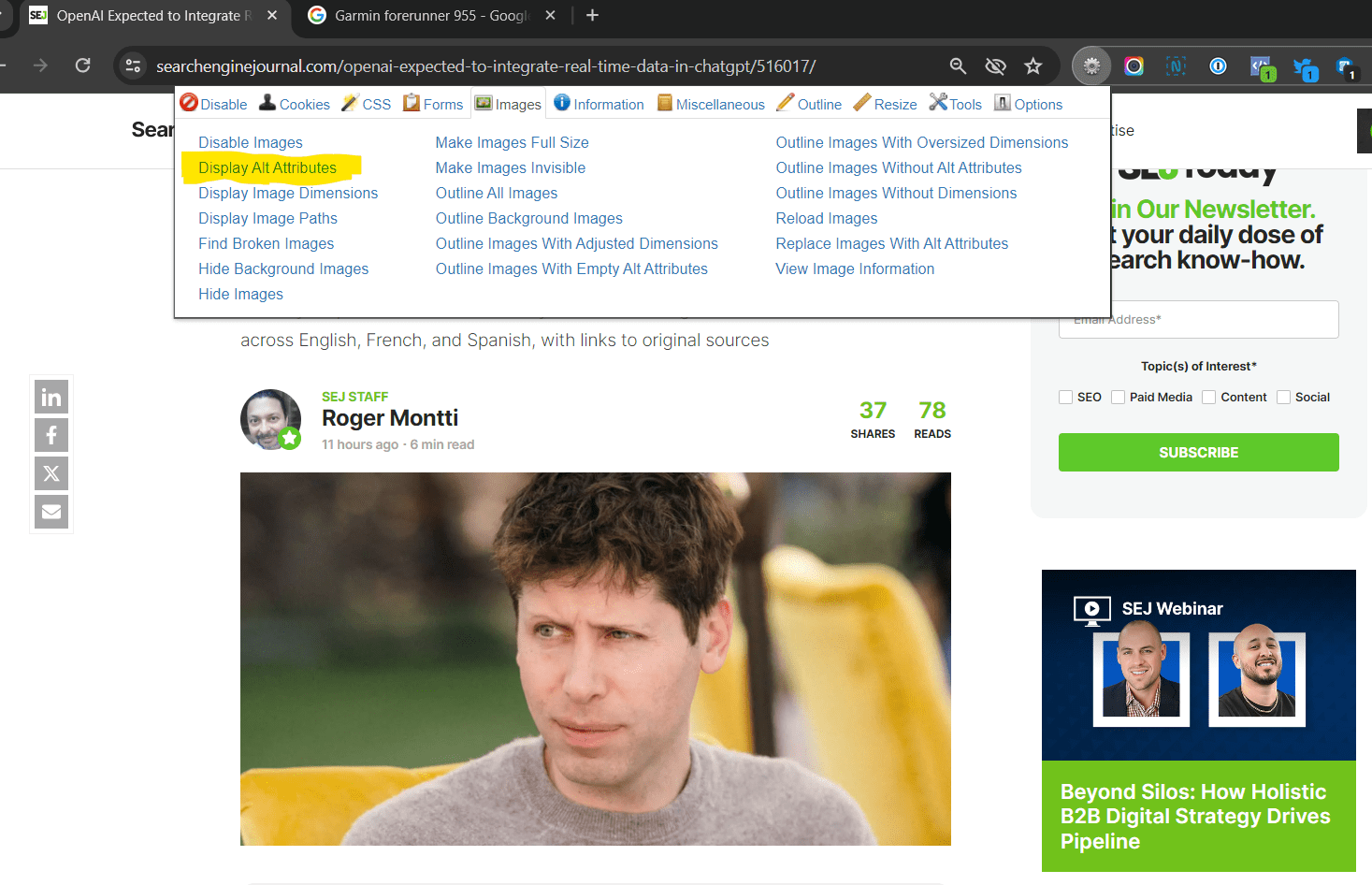
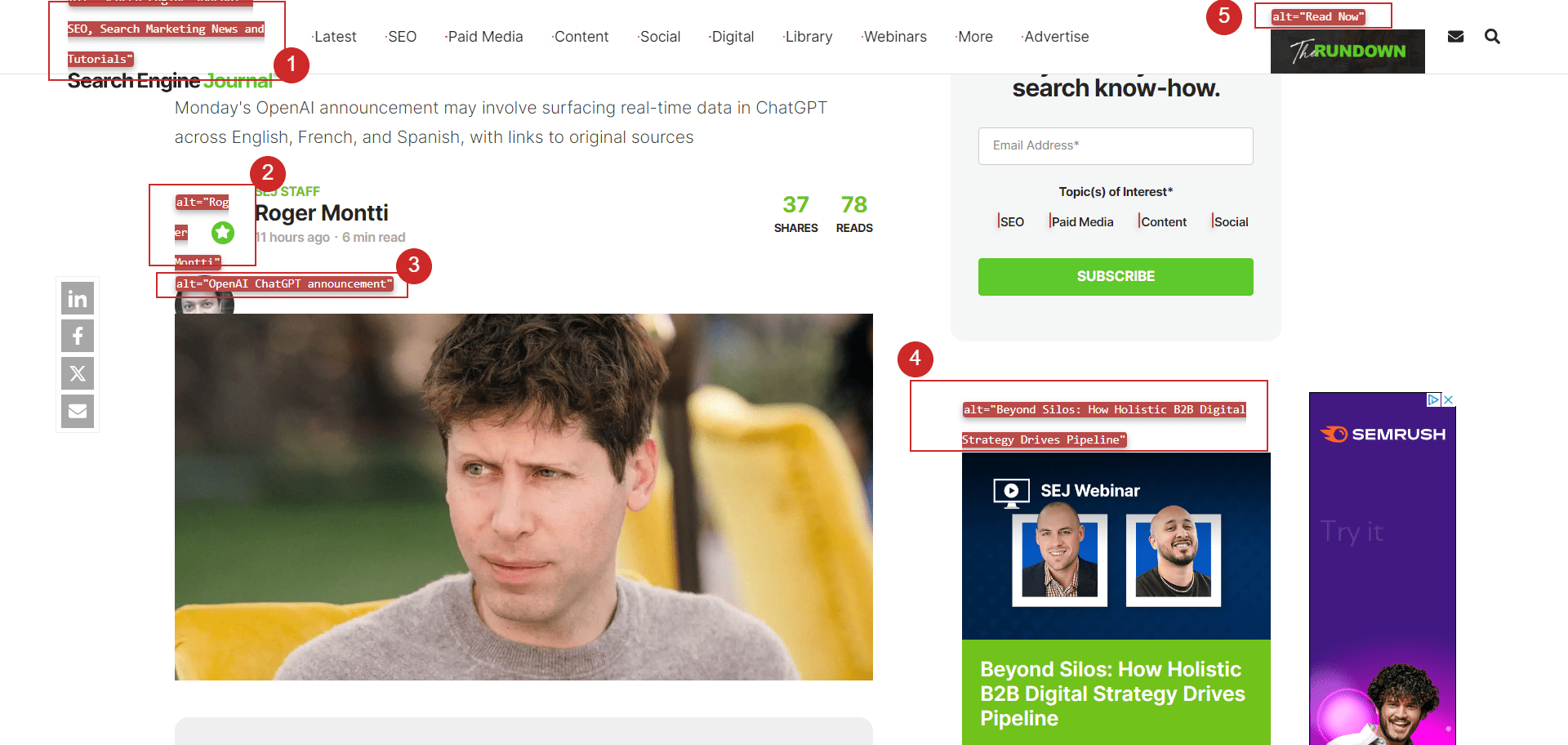
Click on Web Developer and navigate to Images > Display Alt Attributes. This way, you can see the content of the alt text of all images on a given web page.
Screenshot from Web Developer Extension, Chrome by author, May 2024
How To Find And Fix Missing Alt Text
To check the alt text of the images of the entire website, use a crawler like Screaming Frog or Sitebulb.
Crawl the site, navigate to the image report, and review the alt text of all website images, as shown in the video guide below.
You can also export only images that have missing alt text and start fixing those issues.
Alt Text May Not Seem Like A Priority, But It’s Important
Every source of information about your content has value. Whether it’s for vision-impaired users or bots, alt text helps contextualize the images on your website.
While it’s only a ranking factor for image search, everything you do to help search engines understand your website can potentially help deliver more accurate results. Demonstrating a commitment to accessibility is also a critical component of modern digital marketing.
FAQ
What is the purpose of alt text in HTML?
Alternative text, or alt text, serves two main purposes in HTML. Its primary function is to provide a textual description of an image if it cannot be displayed. This text can help users understand the image content when technical issues prevent it from loading or if they use a screen reader due to visual impairments. Additionally, alt text aids search engine bots in understanding the image’s subject matter, which is critical for SEO, as indexing images correctly can enhance a website’s visibility in search results.
Can alt text improve website accessibility?
Yes, alt text is vital for website accessibility. It translates visual information into descriptive text that can be read by screen readers used by users with visual impairments. By accurately describing images, alt text ensures that all users, regardless of disability, can understand the content of a web page, making the web more inclusive and accessible to everyone.
Google spam updates have in previously been welcomed by the search marketing community. Today’s announcement reflected the sour mood of the search marketing and publishing community that is still reeling from six months of disruptive updates and the rollout of AI Overviews which is widely regarded as a traffic-stealing feature.
It’s not an overstatement to say that the response to Google’s spam update is relentlessly negative.
Does the SPAM stand for “Small Publishers Are Meaningless” ? I miss the days when updates favored better content rather than prioritizing big players and killing content sites by calling them spam.
Google’s March 2024 Core Update, which took about 45 days to complete, devastated the rankings for many site owners. Although Google no longer has a Helpful Content system (aka HCU), many site owners and SEOs who were affected by the HCU from last year are still waiting for a new update that would hopefully “fix” what many feel was a broken update.
“@JohnMu @searchliaison can this update remove the sitewide classifier still applied to sites since last September HCU? Or do we need to wait for a larger core update?”
Another person appeared to be laughing through their tears when they tweeted a screenshot showing their web traffic was down to six organic visitors:
“Google is coming after my last 6 organic visitors🤣Bring it on! Let’s see if we get to 0.”
Google is coming after my last 6 organic visitors🤣Bring it on! Let’s see if we get to 0. pic.twitter.com/jK42jLk71K
Another person shared that they are demoralized from having lost 95% of their traffic from past updates:
“Honestly, it doesn’t matter what update you have under your sleeve. I’m uninstalling Google Site Kit from my site. Seeing constant, declining charts and figures every time I log into WordPress is demoralizing. They remind me that I’ve lost 95% of my traffic for no reason at all.”
A tweet that’s representative of the widespread sentiment that Google’s updates are broken:
“Your harmful monopoly is ruining the internet. Every one of your updates kills more independent websites while boosting spam.”
It could be that Google’s last update missed the mark. But some of those who are affected by the updates from last year could (rightly or wrongly) be suffering from a shift in how Google defines site quality or relevance. Many are hoping that Google reverses course.
Backlash Against Pinterest In SERPs
Some of the feedback was about dissatisfaction with how Google ranked websites. One person tweeted that they hoped the spam update fixed Google’s preference for ranking Pinterest:
“Does this update means that Google will start to show my website when users make a “brand search” instead of my pins on pinterest?”
Backlash About Reddit in SERPs
Another person offered feedback about the (common) perception that Google is ranking Reddit for too many queries.
That sentiment about Reddit in the SERPs was shared by many others:
“Interesting to see Google roll out a spam update! I wonder how it will affect Reddit’s ranking in search results. Personally, I haven’t found a lot of truly helpful content there, Reddit is just spamming in search result.”
Will this stop ranking the irrelevant discussions on Reddit for most technical keywords? 😂
— Madusanka Premaratne (@maduspremaratne) June 21, 2024
What About The Site Reputation Update?
Site reputation abuse is a form of spam where a digital marketer publishes content on a third party website for the purpose leveraging the site reputation for quick rankings. It’s a shortcut for avoiding having to create and promote an entirely new website.
Google SearchLiaison responded to a question of whether this spam update included the algorithmic version of the site reputation abuse update that Google announced was forthcoming. SearchLiaison responded that no, this update didn’t contain algorithmic elements for targeting site reputation abuse.
“For the third time now, I’ll say again, I have every confidence that when we’re acting on site reputation abuse algorithmically, we’ll say that. It’s not right now. I also won’t be responding to this particular question every week so maybe let it go a month between asking (I don’t mean that as harsh as it sounds just that it’s not useful or productive for me to do the “are we there yet” over and over again)”
“I mean I’d figure most wondering about this would know it’s a standard spam update given there’s no blog post, no “FYI things to know” and it’s just a regular posting to our dashboard
That said, I know people are asking Barry even though I’ve said what I just said above at least twice before. So I figured if I’m going to say it at least a third time, I’ll try again to explain why it’s not really something to ask about each week.”
No Description Of Spam Update
Changes to Google’s rankings are rarely announced except when it’s anticipated that the effects to rankings may be noticeable, which by that measure makes this update notable and significant, particularly because the update will take an entire week to roll out.
Google sometimes publishes a blog post about their spam updates but there is no accompanying article that details what this spam update is targeting, which may be a factor contributing to the anxiety expressed in some of the responses to Google’s announcement.
Google Has A Sentiment Problem
A combination of AI Overviews, Helpful Content Update from late 2023 to the recent updates dating from March are all combining to create negative sentiment in the digital marketing community. The so-called leak added to fuel to that fire. Even though the data revealed nothing that wasn’t already known, some are using it justify their long held suspicions and accusing Google of lying. And it’s not just the search marketing community, independent web publishers and big brand news organizations have soured on Google, too.
So much negative sentiment has accumulated over the past year that the spam update, which would normally be cheered, is now met with skepticism and complaints.
Read Google’s spam announcement:
Today we released the June 2024 spam update.
It may take up to 1 week to complete, and we’ll post on the Google Search Status Dashboard when the rollout is done: https://t.co/EkzeXvUZwH
— Google Search Central (@googlesearchc) June 20, 2024
The most recent Helpful Content Update (HCU) concluded with the Google March core update, which finished rolling out on April 19, 2024. The updates integrated the helpful content system into the core algorithm.
To investigate changes in Google’s ranking of webpages, data scientists at WLDM and ClickStream partnered with Surfer SEO, which pulled data based on our keyword lists.
Implications Of The March Update And Google’s Goals
Google is prioritizing content that offers exceptional value to humans, not machines.
“This [HCU] update involves refining some of our core ranking systems to help us better understand if webpages are unhelpful, have a poor user experience, or feel like they were created for search engines instead of people. This could include sites created primarily to match very specific search queries.
We believe these updates will reduce the amount of low-quality content on Search and send more traffic to helpful and high-quality sites.”
Google also released the March 2024 spam update, finalized on March 20.
SEO Industry Impact
The update significantly affected many websites, causing search rankings to fluctuate and even reverse course during the update. Some SEO professionals have called it a “seismic shift” in the SEO industry.
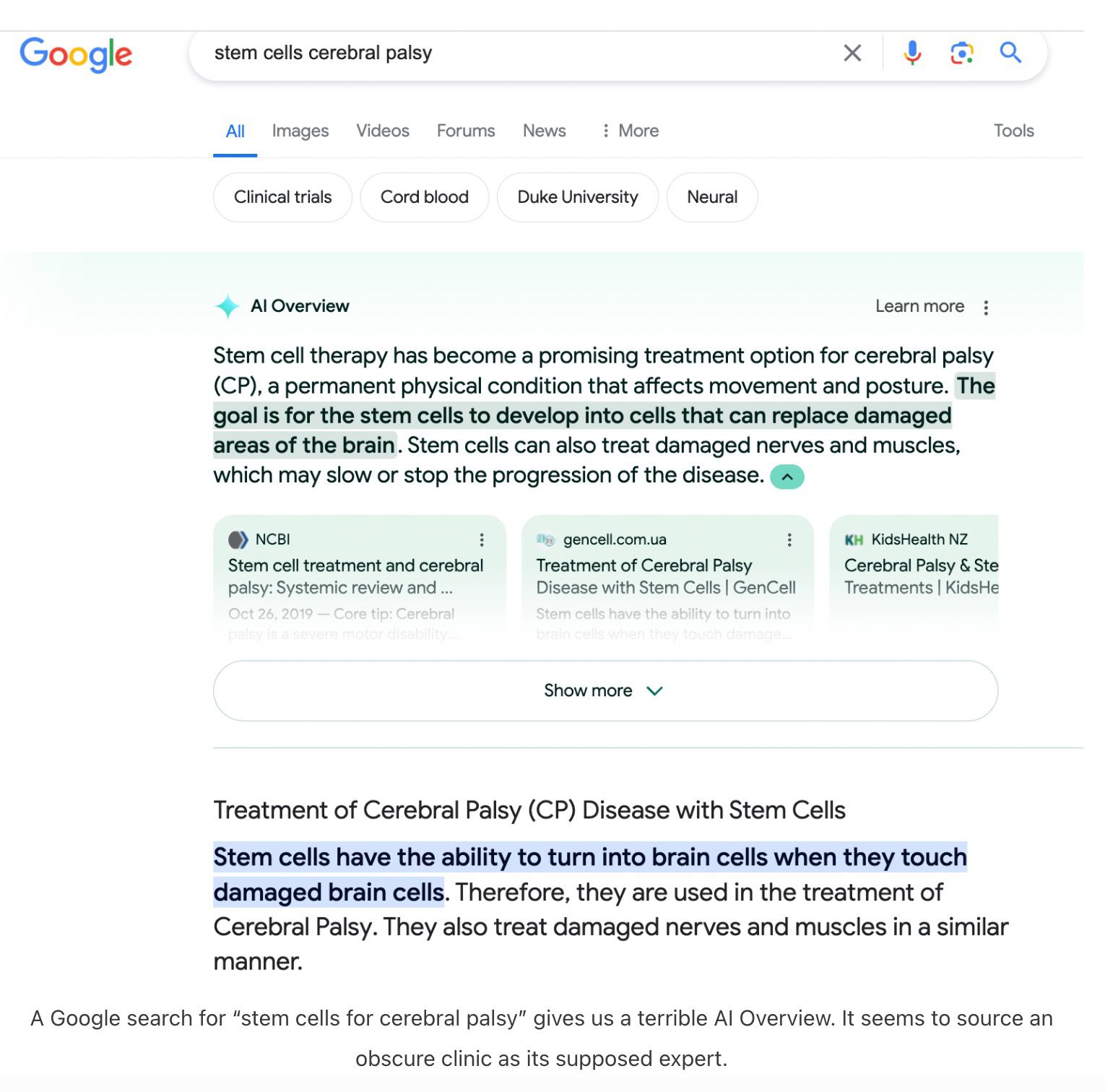
Frustratingly, over the past few weeks, Google undermined the guidelines and algorithms central HCU system by releasing AI search results that include dangerous and incorrect health-related information.
There remains SERP volatility to date. It appears adjustments to the March update are still occurring now.
Background
Methodology
In December 2023, we analyzed the top 30 results on Google SERPs for 12,300 keywords. In April 2024, we expanded our study by examining 428,436 keywords and analyzing search results for 8,460. The study covered 253,800 final SERP results in 2024.
Our 2023 keyword set was more limited, providing a baseline for an expanded study. This allowed us to understand Google’s ranking signal changes after March and some of the “rank tremors” that occurred in early April.
We appended “how to use” to the front of keywords to create information-intent keywords for both data sets. JungleScout provided access to a database of ecommerce keywords grouped and siloed using NLP. Our study focused on specific product niches.
Correlation And Measurements
We used the Spearman correlation to measure the strength and direction of associations between ranked variables.
In SEO ranking studies, a .05 correlation is considered significant. With hundreds of ranking signals, each one impacts the ranking only slightly.
Our Focus Is On-Page Ranking Factors
Our study primarily analyzes on-page ranking signals. By chance, our 2024 study was scheduled for April, coinciding with the end of Google’s most significant ranking changes in over eight years. Data studies require extensive planning, including setting aside people and computing resources.
Our key metric for the study was comprehensive content coverage, which means thorough or holistic writing about the primary topic or keyword on a page. Each keyword was matched to text on the pages of the 30 top URLs in the SERP. We had highly precise measurements for scoring natural language processing-related topics used on pages.
Another key study goal was understanding webpages covering health-sensitive topics versus those in non-health pages. Would pages not falling into the now-infamous YMYL category be less sensitive to some ranking factors?
Since Google is looking for excellent user experience, data was pulled on each webpage’s speed and Core Web Vitals in real-time to see if Google considers it a key component of the user experience.
Content Score As A Predictor
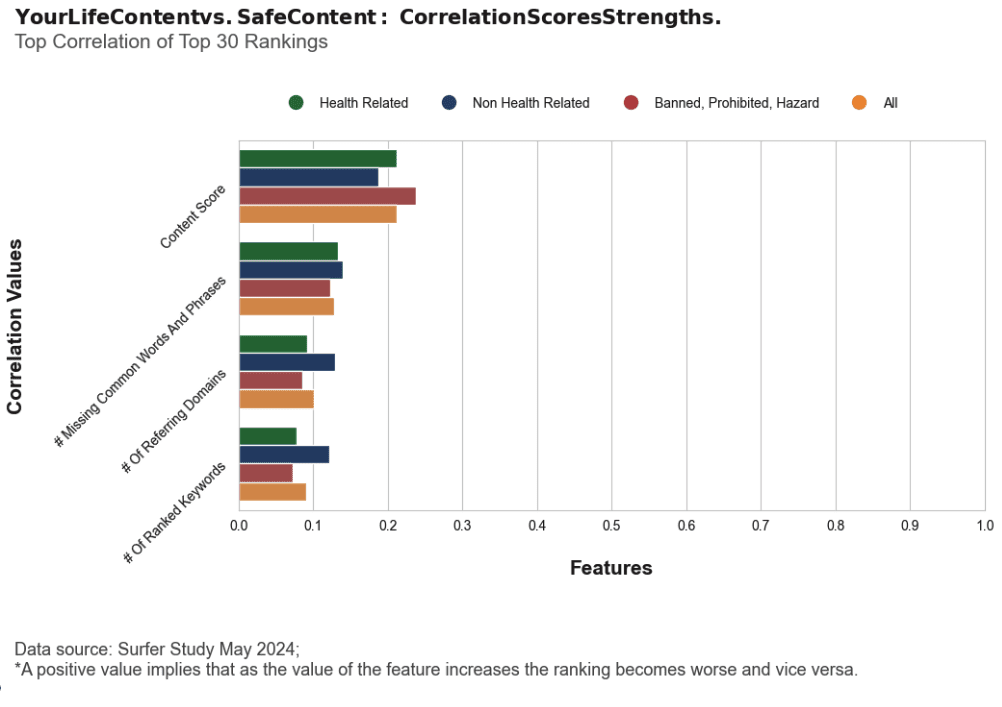
It’s not surprising that Surfer SEO’s proprietary “Content Score” was the best predictor of high ranking compared to any single on-page factor we examined in our study. This is true for 2023, where the correlation was .18, and 2024, which is .21.
The score is an amalgamation of many ranking factors. Clearly, the scoring system shows helpful content that’s meaningful for users. The small correlation change from the two periods shows the March update did not change many key on-page signals.
The Content Score consists of many factors, including:
Main and partial keywords – not only how often but where exactly those are used.
… and many more good SEO practices.
More About Correlations And Measurements In The Study
Niches were chosen because we wanted domains with multiple URLs to appear in our study. It was important to get many niche and “specialty” oriented sites, as is the case for most non-mega sites.
Most data studies overlook how a group of URLs from one domain tells a story: The keywords they use are so randomized that the mega websites have the vast majority of URLs in results.
The narrow topics also meant fewer keywords with extreme ranking competition. Many ranking studies use a preponderance of keywords with over 40,000 monthly searches, but most SEO professionals don’t work for websites that can rank in the top 10 for those. This study is biased toward less competitive keywords, and we didn’t look at Google keyword search volume – just the volume on Amazon.
Our keywords had more than 10 monthly searches on Amazon per month (via JungleScout). However, when appending “how to use” to the front of the keyword, the search volume in Google would be less than 10 a month in many cases.
The “dangerous, prohibited, banned” group was excluded from most comparisons of health vs. non-health. Many of these were very esoteric topics or Amazon needed six to 10 words to describe them.
Most SEO professionals don’t work for the top 50 largest websites. Instead, we want results that help the vast majority of SEO pros.
Here’s How We Generated Different Keyword Types
For example, we appended “buy” to the product keyword “adobe professional” in one instance and “how to use” in another.
Product
Category
Search Intent
Appended
Keyword
adobe professional
software
informational
how to use
how to use adobe professional
We examined data using the Spearman rank-order correlation formula. Spearman calculates the correlation between two variables, and the correlation is measured from -1 to 1. A correlation coefficient of 1 or -1 would mean that there is a strong monotonic relationship between the two variables.
The Spearman correlation is used instead of Pearson because of the nature of Google search results; they are ranked by importance in decreasing order.
Spearman’s correlation compares the ranks of two datasets, which fits our goal better than Pearson’s. We used .05 as our level of correlation confidence.
When we show a correlation of .08, it suggests a ranking signal that is twice as powerful as another ranking signal measure of .04. Greater than .05 is a positive correlation; less than .05 is no correlation. Correlations range from .05 to -.05. A negative correlation shows that it is causing the direct variable number to go down.
Many of the domains in the study are from outlier or niche topics or are small because little time and money is spent on them. That is, first and foremost, why they don’t rank well.
That is also why we must look for “controls” that might show that two domains have the same amount of time, web development/design superiority, and money invested in them, but they are, for example, health vs. non-health topics.
Correlation is not causation. We did want to understand how we could “control” some large factors to better pinpoint the effect of results. This was done with graph visualizations.
Google uses potentially thousands of factors, so isolating independent variables is very difficult. Correlations have been used in science for centuries, where variables can’t be totally controlled. They are accepted science, and to say otherwise is a fool’s errand.
Keyword Categories And Classifications
Our keywords were search terms related to products.
Using narrow niches lets us cluster topics that are very much not YMYL vs. those that are.
Image from author, June 2024
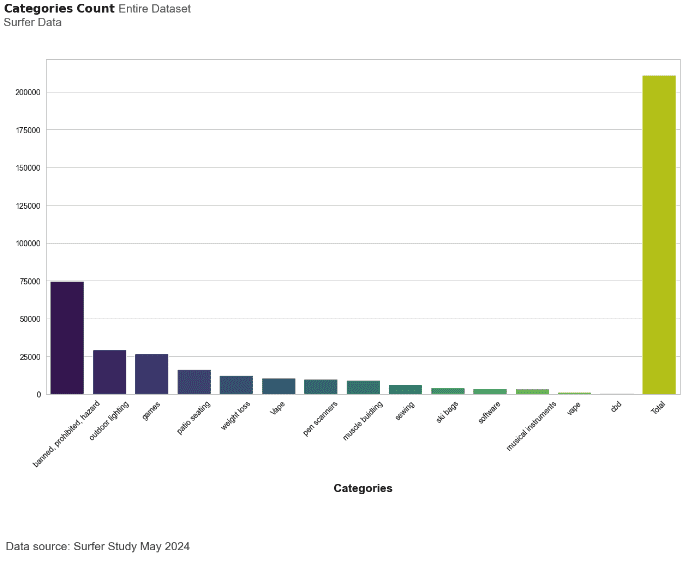
For example, CBD and vape keywords are banned from Google Ads, so they are very good for our health-related keyword set. The FDA and others consider muscle building and weight loss two of the riskiest (read: dangerous) health-related categories on Amazon.
We chose the other non-health categories because they were near-poster children of innocuous niches.
The “dangerous, prohibited, banned” keywords come from products that are manually removed from Amazon’s Seller Central page list.
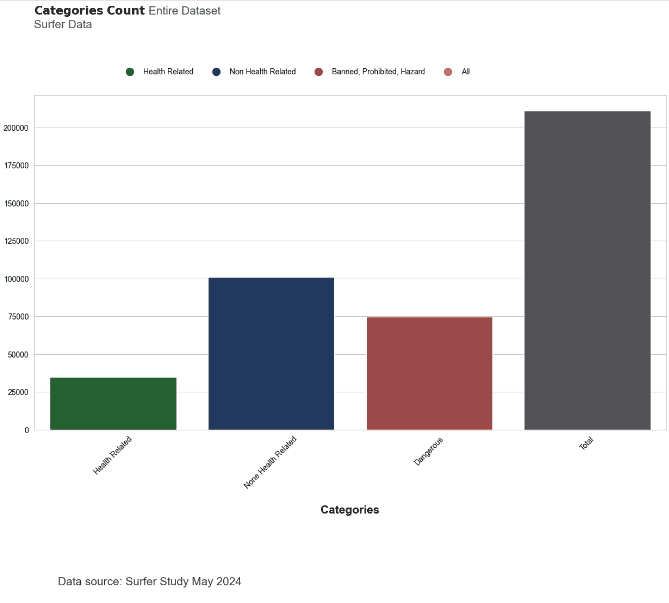
Each category fits into one of three classifications (The X axis here is a number of keywords).
Image from author, June 2024
Detailed Findings And Actionable Insights
Importance Of Topic Authority And Semantic SEO
The largest on-page ranking factor is the use of topics related to the searched keyword phrase (our measure of topic authority and semantic SEO).
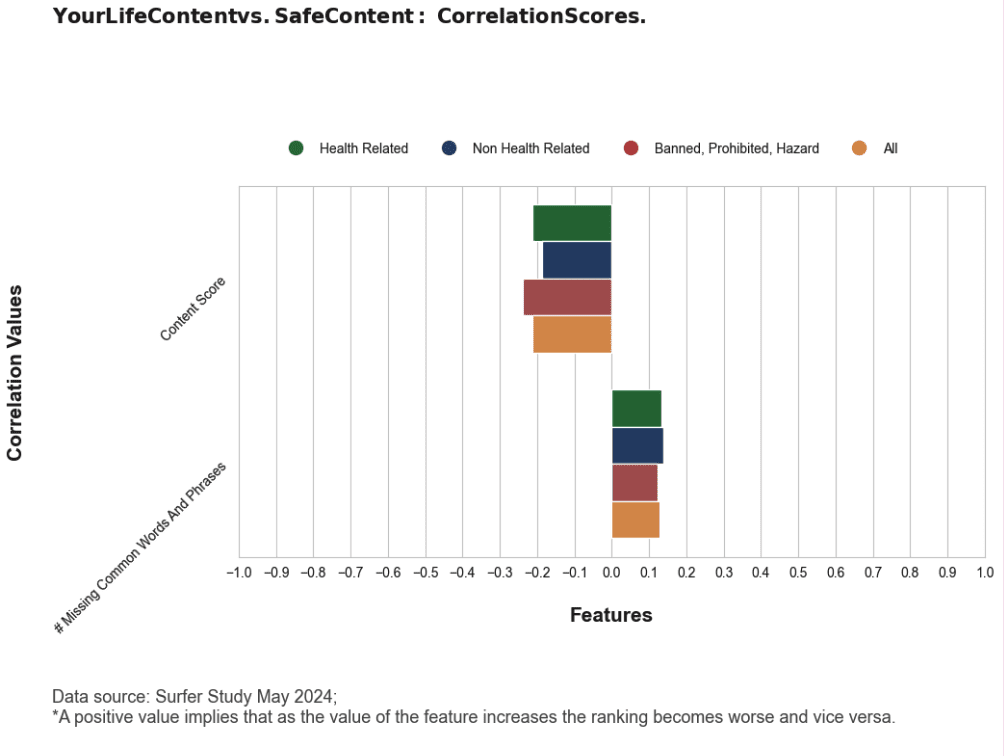
We found a correlation of -.11 in December 2023, which increased to -.13 in April 2024 for “missing common keywords and phrases.” These numbers are calculated by examining the relationship between the metric and a site’s Google ranking.
A higher negative correlation, like -.13, signifies that omitting these keywords significantly decreases the site’s ranking.
2024 YMYL vs. Safe Content – Not (Image from author, June 2024)
Surfer SEO’s algorithm typically reveals 10-100 words and phrases that should be included to cover the topic comprehensively.
That factor is so strong that it is more important than the domain monthly traffic volume for the domain a webpage is on (for example, articles on Amazon.com rank higher than those published on small websites).
A domain’s traffic is a measure of authority (and, perhaps, trust to some extent). Domain rating or Domain authority, metrics calculated by Ahrefs and Moz, are other ways to measure a website’s ability to rank highly in the SERP. However, they rely much more on links, an off-page ranking factor.
This is a novel finding. We’ve never seen any large Google ranking study demonstrate such high importance of topical authority. Concurrently, none used such highly precise on-page data examining text with thousands of search result pages.
If you’re not paying attention to natural language processing, a.k.a topic modeling known as semantic SEO, you’re almost nine years late. That’s when the Hummingbird algorithm launched. Six years later, the sub-algorithm of Hummingbird appeared: BERT.
The BERT algorithm is a neural machine translation system developed by Google that performs word-level training and uses a bidirectional LSTM with attention to learning representations of words. It’s particularly important in helping Google understand the meaning of users’ queries.
Health-Related Vs. Non-Health Pages
We found that Google’s algorithms increase their sensitivity to on-page factors when returning results about health-sensitive topics. To rank highly in Google, YMYL pages need more comprehensive topic coverage. Since the March update, this has become more important than in December.
Image from author, June 2024
Generally, YMYL search results prioritize content from government sites, established financial companies, research hospitals, and very large news organizations. Sites like Forbes, NIH, and official government pages often rank highly in these areas to ensure users receive reliable and accurate information.
More About The Massive March Update And YMYL
Websites in YMYL started getting slews of attention and traction in the SEO community in 2018 when Google rolled out the “Medic Update.” Health and finance categories have seen a rollercoaster ride in the SERPs over the years since then.
One way of understanding the changes is that Google tries to be more cautious in ranking pages related to personal health and finances. This might be especially true when topics lack broad consensus, are controversial, or have an outsized impact on personal health and finance choices.
Most SEO pros agree that there is no YMYL ranking factor per se. Instead, websites in these sectors have E-E-A-T signals that are examined with far higher demands and expectations.
When we look at on-page ranking signals, many other factors interfere with what we are trying to measure. For example, in link studies, SEO pros would love to isolate how different types of anchor texts perform. Unless you own over 500 websites, you don’t have enough control over what affects minor differences among anchor text variables.
Nevertheless, we find differences in correlations between health vs. non-health ranking signals in both of our studies.
The “banned, hazardous, prohibited” pages were even more sensitive to one page’s optimization than the non-health-related group.
Since the Content Score we used amalgamates many factors, it is especially good at showing the differences. Isolating for a small factor like “body missing/having common words” (topic coverage) is too weak a signal in itself to show a pronounced difference between two types of content pages.
The number of domain-ranked keywords and the website’s (domain’s) estimated monthly traffic affect how a page ranks – a lot.
These measure domain authority. Google doesn’t use its own results (organic search traffic) as a ranking factor, but it’s one of the most useful stats for understanding how successful a site is with organic search.
Most SEO pros evaluate via scores like DA (Moz) or DR (Ahrefs), which are much more heavy on link profiles and less on actual traffic driven via organic search.
Ranked keywords and estimated traffic are critical ways to find E-E-A-T for a domain. They show the website’s success but not the page’s. Looking at these external ranking factors on a page level would give more insights, but it is important to remember that this study focuses on on-page factors.
Ranked keywords had a strong relationship, with correlations of .11 for 2023 and .09 for 2024. For traffic estimations, we saw .12 (2023) and .11 (2024).
Having a page on a larger website predicts higher rankings. One of the first things SEO pros learn is to avoid going after parent topics and competitive keywords where authority sites dominate the SERPs.
Five years ago, when most SEO practitioners weren’t paying attention to topic coverage, the best way to create keyword maps or plans was using the “if they can rank, we can rank” technique.
This strategy is still important when used alongside topic modeling, as it relies heavily on being certain that competitor sites analyzed have similarauthority and trust.
Website Speed And High-Ranking Pages
Google created a lot of hoopla when it announced:
“Page experience signals [will] be included in Google Search ranking. These signals measure how users perceive the experience of interacting with a webpage and contribute to our ongoing work to ensure people get the most helpful and enjoyable experiences from the web…the page experience signals in ranking will roll out in May 2021.”
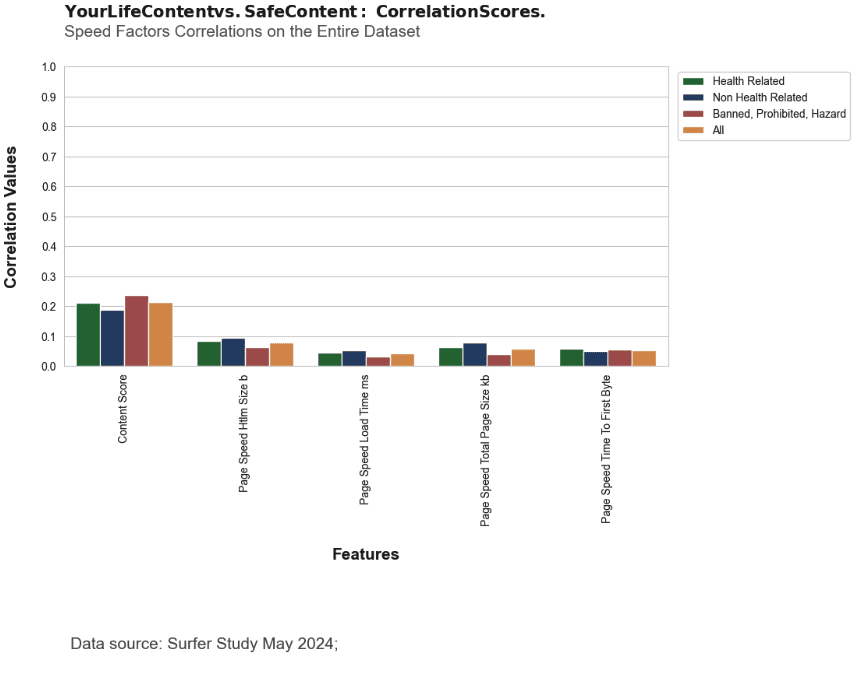
We looked at four site speed factors. These are:
HTML size (in bytes).
Page speed time to first byte.
Load time in milliseconds.
Page size in kilobytes
In our 2023 study, we did not find a correlation with the page speed measurements. That was surprising. Many website owners placed too much emphasis on them last year. The highest correlation was just .03 for both time to first byte and HTML file size.
However, we saw a significant jump since the March update. This matches squarely with Google’s statement that user experience is its priority for Helpful Content. Time to first byte is the most important factor, as it was five years ago. HTML file size was the second speed factor that mattered most.
April 2024 Speed correlations (Image from author, June 2024)
In 2016, I oversaw the first study to show Google measures page speed factors other than time to first byte. Since then, others have also found even bigger effects on higher ranking by having fast sites in other areas like “Time to First Paint” or “Time to First Interactive.” However, that was before 2023.
Informational Vs. Buy Intent Content
Different search intents require different approaches.
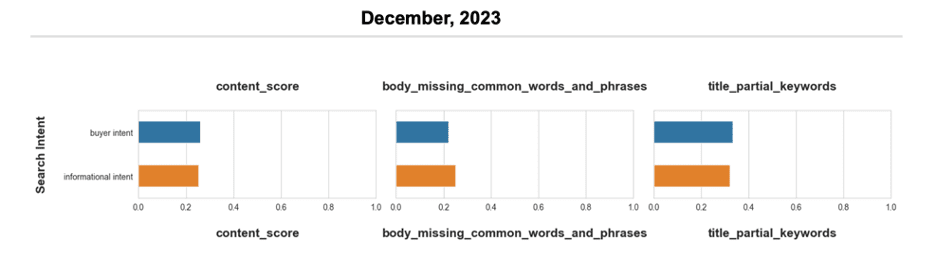
Content must be better optimized for informational searches compared to buyer intent searches.
We created two groups for user intent query types. This is another test we’ve not seen done with a big data set.
Image from author, June 2024
For buyer intent, “for sale” was appended to the end of search terms and “buy” to the front of other terms. This was implemented randomly on half of all keywords in the study. The other half had “how to use” appended to the beginning.
Since there are so many impacts on rank, these differences – if there even are any – get a bit lost. We did see a small difference where informational pages, which tend to have more comprehensive topic coverage, are slightly more sensitive when they are missing related keywords.
Our hypothesis was ecommerce pages are not expected to be as holistic in word coverage. They have authority from user reviews and unique images not found elsewhere. An informational page has less to prove its authoritativeness and trustworthiness, as the writing is more critical.
Prior to the March update, we saw a more pronounced difference.
Image from author, June 2024
Google knows users don’t want to see too much text on an ecommerce page. If they are ready to buy, they’ve typically done some due diligence on what to buy and have completed most of their customer journey.
Ecommerce sites use more complex frameworks, and Google can tell much about buyer user experience with technical SEO page factors that are less important on informational pages.
In addition, for sites with more than a handful of products, category pages tend to have the more thorough content that users and Google look for before diving deeper.
Challenges And Considerations
Google is under intense scrutiny because of its AI search results that give incorrect, dangerous answers to health questions. Google lowered the number of YMYL responses that trigger AI results, but it has left a double standard in place: websites appearing in Search must have content from personal experience, expertise, etc. Yet Google’s AI overviews come from scraping content to generate answers via large language models known to make mistakes (hallucinations).
There was outrage over answers to uncommon searches that produced ridiculous results for health-related questions (for example, suggesting users use glue with their pizza). In our view, the bigger issue is that AI results don’t use the same tough standards the search giant expects of website owners.
Screenshot from search for [stem cells cerebral palsy], June 2024
Potential For Over-Optimization
An interesting consideration posed by HCU is whether having too many of the same entities and topics as the existing top results for the same topic is considered “creating for search engines.”
There’s no way to answer that with a correlation study, but Google likely looks for subtle clues of overoptimization. Its use of machine learning suggests it examines pages for such clues, including related topics.
Keyword “stuffing” stopped being a valid SEO tactic. Perhaps “topic stuffing” might someday become a no-no. We didn’t measure that, but if having fewer related words and phrases hurts ranking, it seems this is not an issue now.
Recommendations Based On Findings
Enhance Topic Coverage And Comprehensive Content
To achieve high rankings, ensure your content is thorough and covers topics extensively. This is often referred to as “semantic SEO.”
By focusing on related topics, you can create content that addresses the primary subject and covers related subtopics, making it more valuable to readers and search engines alike.
Actionable Tips:
Research Related Topics: Use tools like SurferSEO.com, Frase.io, AnswerThePublic.com, Ahrefs.com, or Google’s Keyword Planner to identify related topics that complement your main content. Look for questions people are asking about your main topic and address those within your content.
Create Detailed Content Outlines: Develop comprehensive outlines for your articles, including primary and secondary topics. This ensures your content covers the subject matter in depth and addresses related subtopics.
Use Topic Clusters: Consider organizing your content into clusters, where a central “pillar” page covers the main topic broadly and links to “cluster” pages that dive deeper into related subtopics. This helps search engines understand the breadth and depth of your content.
Incorporate User Intent:Understand the different intents behind search queries related to your topic (informational, navigational, transactional) and create content that satisfies these intents. This could include how-to guides, detailed explanations, product reviews, and more.
Update Regularly:Keep your content fresh by regularly updating it with new information, trends, and insights. This shows search engines that your content is current and relevant.
Meet Higher Standards Of E-E-A-T For Health-Related Content
If your website covers health or finance-related topics, it’s crucial to meet the high standards of expertise, authoritativeness, trustworthiness, and experience (E-E-A-T). This ensures your content is reliable and credible, which is essential for user trust and search engine rankings.
Actionable Tips:
Collaborate with qualified healthcare professionals to create and review your content.
Include clear author bios that highlight their credentials and expertise in the field.
Regularly review and update your health content to ensure it remains accurate and current.
Build links and ensure you’re getting brand mentions off-site. Our study didn’t focus on this, but it’s critical.
Improve Website Speed And User Experience
Website speed and user experience are increasingly important for SEO. To enhance load times and overall user satisfaction, focus on improving the “time to first byte” (TTFB) and minimizing the HTML file size of your pages.
Actionable Tips:
Optimize your server response time to improve TTFB. This might involve upgrading your hosting plan or optimizing your server settings.
Minimize page size by compressing images, reducing unnecessary code, and leveraging browser caching.
Ensure your website is mobile-friendly, as most traffic comes from mobile devices.
Future Research
We tried to compare the top 15% of large websites to the lower 85% to see if they benefited more from the March update. There was no meaningful change.
However, slews of small publishers spoke up about the update’s outsized impact on them. We wish we had more time to examine this area. It’s important to understand how Google dramatically changed the landscape of Search.
Further studies are needed to understand the impact of semantic SEO and user intent on rankings. Google is looking at this as a site-wide signal, so the SEO community can learn a lot from a study that looks at entity and topic coverage site-wide.
Other site-wide studies with big data sets are also absent in SEO studies. Can we measure site architecture across 1,000 websites to find other best practices for Google rewards?
Additional Notes And Footnotes
Editor’s Note: Search Engine Journal, ClickStream, and WLDM are not affiliated with Surfer SEO and did not receive compensation from it for this study.
All Metrics Measured And Analyzed In Our Study
Metric
Description
For Domain Estimated Traffic
Surfer SEO’s estimation based on search volumes, ranked keywords, and positions.
For Domain Referring Domains
Number of unique domains linking to a domain, a bit outdated.
URL Domain Partial Keywords
Number of partial keywords in the domain name.
Title Exact Keywords
Number of exact keywords in the title.
Body Words
Word count.
Body Partial Keywords
Number of partial keywords in the body (exact keywords variations, a word matches if it starts with the same three letters).
Links Unique Internal
How many links are on the page pointing to the same domain (internal outgoing links).
Links Unique External
How many links are on the page pointing to other domains (external outgoing links).
Page Speed HTML Size (B)
HTML size in bytes.
Page Speed Load Time (ms)
Load time in milliseconds.
Page Speed Total Page Size (KB)
Page size in kilobytes.
Structured Data Total Structured Data Types
How many schema markup types are embedded on the page, e.g., local business, organization = 2.
Images Number of Elements
Number of images.
Images Number of Elements Outside Links Toggle Off
Number of images, including clickable images like banners or ads.
Body Number of Words in Hidden Elements
Number of words hidden (e.g., display none).
Above the Fold Words
Number of words visible within the first 700 pixels.
Above the Fold Exact Keywords
Number of exact keywords visible within the first 700 pixels.
Above the Fold Partial Keywords
Number of partial keywords visible within the first 700 pixels.
Body Exact Keywords
Number of exact keywords used in the body.
Meta Description Exact Keywords
Number of exact keywords used in the meta description.
A recent study by the digital marketing agency Amsive documented a notable change in Google’s search results rankings over the last year.
The study found that Google is surfacing more ecommerce websites and sites featuring user-generated content while reducing the visibility of product review and affiliate marketing sites.
Here’s a look at the findings and the implications for online businesses if the shifts continue.
Ecommerce Dominance In Search Results
The study found a marked increase in ecommerce sites appearing in top search positions for many commercial queries.
Keywords that previously returned results from product reviews and affiliate sites now predominantly feature online retailers.
For example:
“Bird feeders“: Ecommerce stores now hold all 10 top positions, replacing several product review sites from the previous year.
“Laptops“: The top 10 results now consist exclusively of ecommerce websites, with some appearing multiple times.
“Towel warmer“: Ecommerce giants like Amazon and Walmart have multiple listings, completely replacing affiliate websites in the top results.
Rise Of User-Generated Content
Alongside ecommerce sites, user-generated content (UGC) platforms have seen a significant boost in search visibility.
Reddit, Quora, and YouTube now frequently appear in top positions for various queries where they were previously absent or ranked lower.
This trend is particularly noticeable for longer queries like “toys for 2-year-old boys,” where UGC sites are more visible.
Impact On Product Review & Affiliate Sites
The shift in search rankings introduces challenges for product review and affiliate websites, as they’re now less visible for many commercial queries.
While Google hasn’t explicitly stated that product review content is considered “unhelpful,” the data suggests that recent updates have disproportionately affected these pages.
Implications For Digital Marketing Strategies
Due to these changes, product review and affiliate sites may need to reconsider their strategies to maintain visibility and traffic.
Lily Ray and Silvia Gituto, the study’s authors, suggest diversifying traffic sources through:
For ecommerce sites, this is an opportunity to gain more visibility and traffic.
They could take advantage of this shift by getting more customer reviews and user-generated content on their sites.
Product review and affiliate sites may need to change strategies.
Promoting themselves on social media, making videos, starting podcasts, and engaging in online forums could help compensate for lost Google search traffic.
Adapting to these changes, especially around user-generated content, will likely be needed for continued success.
However, when they appear, they’re more detailed than they were previously.
The study digs into which topics and industries are more likely to get an AI overview. It also looks at how the AI snippets interact with other search features like featured snippets and ads.
Here’s an overview of the findings and what they mean for your SEO efforts.
Declining Frequency Of AI Overviews
In contrast to pre-rollout figures, 8% of the examined searches now trigger an AI Overview.
This represents a 52% drop compared to January levels.
Yevheniia Khromova, the study’s author, believes this means Google is taking a more measured approach, stating:
“The sharp decrease in AI Overview presence likely reflects Google’s efforts to boost the accuracy and trustworthiness of AI-generated answers.”
Longer AI Overviews
Although the frequency of AI overviews has decreased, the ones that do appear provide more detailed information.
The average length of the text has grown by nearly 25% to around 4,342 characters.
In another notable change, AI overviews now link to fewer sources on average – usually just four links after expanding the snippet.
However, 84% still include at least one domain from that query’s top 10 organic search results.
Niche Dynamics & Ranking Factors
The chances of getting an AI overview vary across different industries.
Searches related to relationships, food and beverages, and technology were most likely to trigger AI overviews.
Sensitive areas like healthcare, legal, and news had a low rate of showing AI summaries, less than 1%.
Longer search queries with ten words were more likely to generate an AI overview, with a 19% rate indicating that AI summaries are more useful for complex information needs.
Search terms with lower search volumes and lower cost-per-click were more likely to display AI summaries.
Other Characteristics Of AI Overviews
The research reveals that 45% of AI overviews appear alongside featured snippets, often sourced from the exact domains.
Around 87% of AI overviews now coexist with ads, compared to 73% previously, a statistic that could increase competition for advertising space.
What Does This Mean?
SE Ranking’s research on AI overviews has several implications:
Reduced Risk Of Traffic Losses: Fewer searches trigger AI Overviews that directly answer queries, making organic listings less likely to be demoted or receive less traffic.
Most Impacted Niches: AI overviews appear more in relationships, food, and technology niches. Publishers in these sectors should pay closer attention to Google’s AI overview strategy.
Long-form & In-Depth Content Essential: As AI snippets become longer, companies may need to create more comprehensive content beyond what the overviews cover.
Looking Ahead
While the number of AI overviews has decreased recently, we can’t assume this trend will continue.
AI overviews will undoubtedly continue to transform over time.
It’s crucial to monitor developments closely, try different methods of dealing with them, and adjust game plans as needed.
Google has announced the rollout of the June 2024 spam update, which aims to further improve search results by targeting websites that violate Google’s spam policies.
According to a statement, the update, which began on June 20, is expected to take up to one week to roll out fully.
Today we released the June 2024 spam update.
It may take up to 1 week to complete, and we’ll post on the Google Search Status Dashboard when the rollout is done: https://t.co/EkzeXvUZwH
— Google Search Central (@googlesearchc) June 20, 2024
Background On Google’s Spam Updates & Policies
Google regularly updates its systems to reduce low-quality and spammy content from its search results.
Spam updates target websites that break Google’s rules, such as:
Automatically generating content solely to improve search rankings.
Buying or selling links to manipulate rankings.
Having thin, duplicated, or poor-quality content.
Tricking users with hidden redirects or other deceptive techniques.
Despite the March update impacting many spammy websites, some AI-generated content still managed to rank well in search results.
Analysis by Search Engine Journal’s Roger Montti notes that some AI spam sites ranked for over 217,000 queries, with more than 14,900 ranking in the top 10 search results.
The sites employed tactics such as rapid content churn, AI-generated images, and templated article structures, exploiting a loophole that allowed new content to receive an initial ranking boost.
Potential Impact On Search Results
The June spam update will likely refine Google’s spam detection capabilities further.
However, past experiences have shown that closing loopholes can inadvertently impact legitimate websites.
As with any significant update, the June spam update may result in fluctuations in search rankings for some websites.
Websites that engage in practices that violate Google’s spam policies or rely heavily on AI-generated content may see a decline in their search visibility.
On the other hand, some websites may benefit from the update, as they will face less competition from spammy websites in search results.
Looking Ahead
Google says the June 2024 spam update may take up to one week to roll out fully.
Once the rollout is complete, Google will post an update on its Search Status Dashboard, and you can assess the update’s impact on your search rankings.
Why is Reddit growing so fast, and what does this mean for businesses and SEO professionals?
Here’s our take on it.
Why Is Reddit Growing?
Several factors, including Google prioritizing “helpful content” from discussion forums in a recent algorithm update, have likely contributed to Reddit’s improved search rankings and visibility.
A report from Business Insider indicates that more people are now finding Reddit through Google searches than by directly visiting the reddit.com website.
Mordy Oberstein, Wix’s Head of SEO, shared recent data showing a consistent increase in the share of Reddit sources appearing in Google’s Discussion and Forums SERP feature.
A week ago I anecdotally “noticed” that perhaps there is less Reddit in the Discussion & Forums SERP Feature. @type_SEO noticed the same.
Asked the folks at @semrush to pull data to see if I was crazy or not and the answer is… maybe?
“Opinions shared on Reddit by people who lack expertise and are sharing opinions in anonymity qualify as dubious. Yet Google is not only favoring Reddit in the search results, it is also paying millions of dollars for access to content that is lacking in expertise, experience, authoritativeness and trustworthiness.”
This is challenging because it means your expert-written content could get outranked by the opinions of anonymous Reddit users.
Opportunities
Search Engine Journal founder Brent Csutoras offers a more optimistic view, believing marketers should lean into Reddit’s newfound prominence.
“If your brand has something meaningful to say and is interested in truly connecting with your audience, then yes, you should be on Reddit.”
However, Reddit’s community-driven nature requires a delicate approach, Csutoras adds:
“Reddit communities can be highly negative toward self-serving promotion. But if you put in the effort and solve people’s needs and problems, Reddit has the potential to be a high-performance channel.”
Why SEJ Cares
SEO professionals and marketers should be mindful that expert-written resources could be outranked by Reddit threads that reflect personal opinions rather than authoritative information.
However, by providing genuine value and respecting Reddit’s community guidelines, businesses may be able to leverage the platform’s prominence for increased visibility and audience engagement.


![Screenshot from search for [Garmin forerunner]](https://ecommerceedu.com/wp-content/uploads/2024/06/alt-text-serp-790.png)