How Millie Dresselhaus paid it forward

Institute Professor Mildred “Millie” Dresselhaus forever altered our understanding of matter—the physical stuff of the universe that has mass and takes up space. Over 57 years at MIT, Dresselhaus also played a significant role in inspiring people to use this new knowledge to tackle some of the world’s greatest challenges, from producing clean energy to curing cancer. Although she became an emerita professor in 2007, Dresselhaus, who taught electrical engineering and physics, remained actively involved in research and all other aspects of MIT life until her death in 2017. She would have been 95 this November.

Known as the “Queen of Carbon,” Dresselhaus was most often heralded for her pioneering work with one of nature’s most abundant and versatile substances. As a result of her insatiable curiosity about our world and her nearly six-decade career as a scientific explorer, we can thank her for significant leaps in how we think about carbon’s various forms and the company it keeps. In her early career, Dresselhaus employed a then-new invention—laser light—to probe carbon’s inner workings. She worked to distinguish how, for example, flat sheets of carbon atoms act differently from carbon crystals of three dimensions, especially in the presence of heat, electrons, or a magnetic field. And later she predicted the existence of what we now call carbon nanotubes, sheets of carbon atoms rolled up into minuscule cylinders that can be remarkably adept at conducting electricity. 

Building on Dresselhaus’s far-reaching foundational research, scientists and engineers have made enormous advances at the nanoscale—with structures on the order of one hundred-thousandth the width of a human hair. Spherical carbon “buckyballs,” cylindrical carbon nanotubes, and two-dimensional carbon sheets known as graphene have already been used for energy storage, medical research, building materials, and paper-thin electronics, among many other applications. Today, these carbon structures continue to be developed for myriad novel uses that often seem taken from the realm of science fiction, including ultrafast quantum computers, efficient desalination devices, and quantum dots with applications in biosensing and drug delivery. For her work she won—among other honors—the Kavli Prize in Nanoscience, the National Medal of Science, and the Presidential Medal of Freedom, the highest civilian award given by the United States government.

But her journey to MIT, and to global leadership in solid-state physics, was an improbable one. Born in Brooklyn, New York, to immigrant parents in 1930, Dresselhaus came of age at a time when women were rarely welcomed as scientists or encouraged to pursue technical fields. Yet she benefited from several key mentors who saw her potential and took deliberate steps to support a brilliant young mind. 

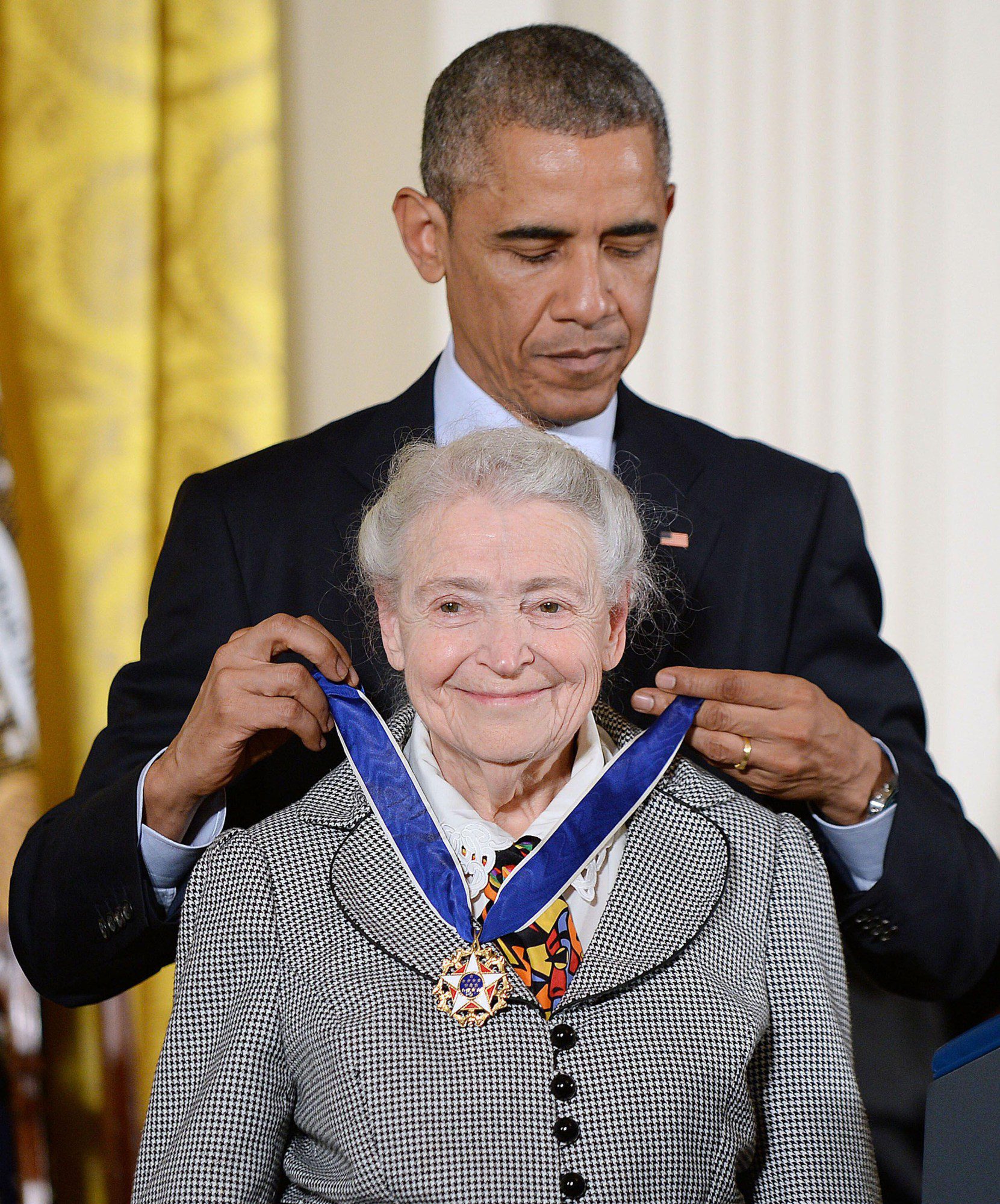
President Barack Obama presented Dresselhaus with the Presidential Medal of Freedom in 2014.
OLIVIER DOULIERY/ABACAPRESS.COM VIA ALAMY

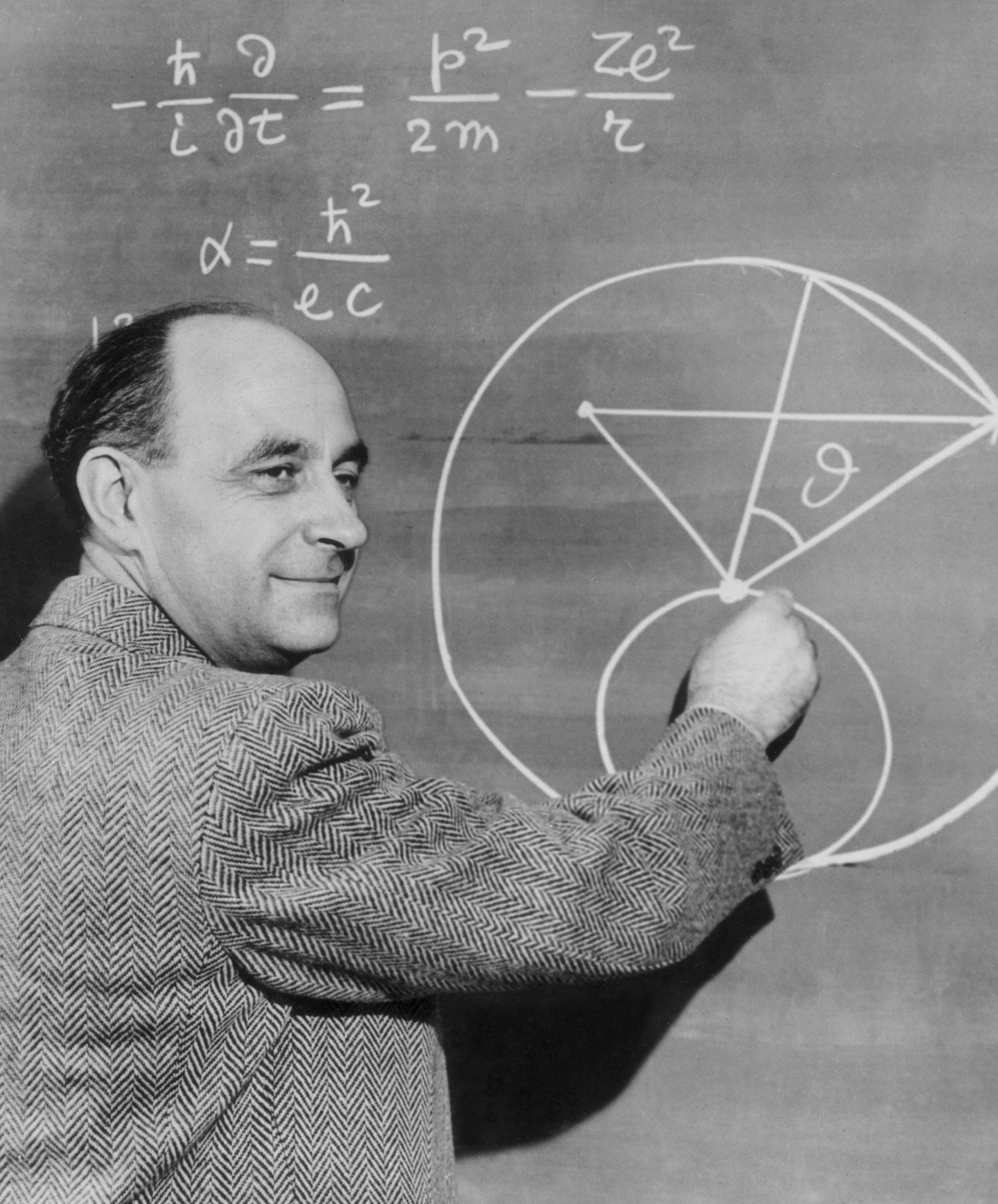
One of those mentors was Enrico Fermi, the distinguished Italian-born nuclear scientist who played a leading role in the Manhattan Project and who concluded his career as a professor of physics at the University of Chicago. Fermi came to America after receiving a solo Nobel Prize in 1938 (for work on induced radioactivity) and then fleeing the Nazi regime with his Jewish wife, Laura. The story of how Fermi influenced an up-and-coming Millie Dresselhaus—and, by proxy, scores of students who would study under her—reveals how paying it forward to the next generation of scientists and engineers can yield lasting dividends. 


In 1953, with the nuclear age firmly underway and the Cold War heating up, Dresselhaus found herself, at 22, one of the new graduate students within the University of Chicago’s world-class physics department. Although a number of researchers who had worked on the Manhattan Project there had by then left for other opportunities, many luminaries remained. In addition to the renowned Enrico Fermi, notable faculty included the Nobel laureates Harold Urey and Maria Goeppert Mayer (with whom Dresselhaus lived for about a year as a boarder) as well as the physicist Leona Woods, the only woman present during the famous 1942 fission demonstration on one of the school’s squash courts.

The university’s physics program was fairly small in those days: Dresselhaus had earned a spot as one of just about a dozen new graduate students that year. She was also, it turns out, the only female student in the department. Despite a master’s degree in physics from Radcliffe College and a Fulbright fellowship at the University of Cambridge, she felt not quite prepared as she began her PhD. And so, at the start of her doctoral studies, she discovered a cache of old examinations, and she worked the problems therein forward and back until she felt up to speed.

Despite this added practice, the coursework for first-year PhD candidates was brutal—so brutal that around three-quarters of all entering physics students eventually dropped out of the program. But Dresselhaus’s relationship with Fermi would provide an unexpected boost.

She first encountered the unflappable scientist—who made crucial strides not only in the development of the atomic bomb but in particle physics after the war—as a student in his class on quantum mechanics. And through that class, Dresselhaus got to know his teaching style, which she recalled as patient, inspiring, and mind-opening. With a slow, deliberate, accented voice that Dresselhaus described as “halting,” Fermi expertly distilled complicated topics so that anyone in attendance could comprehend them. Brilliant at both theory and experimentation, he delighted in stripping concepts to their essence, and unlike more impatient professors who were absorbed in their own work, Fermi cherished the opportunity to review whatever he knew about a physical concept by explaining it to someone else. For this he clearly had a talent; thanks to the way he presented the finer details of quantum mechanics, Dresselhaus explained, “any youngster could think, when they heard the lecture, that they understood every word.”

One key to the eminent scientist’s clarity was the ban he placed on taking notes. Fermi demanded full attention, so he would prepare and dole out handwritten notes before his lectures, lest students be tempted to take out their pens or slide rules. “What was so impressive and amazing about it is that the lectures were very exciting, whatever the subject was,” Dresselhaus said in a 2001 interview.

Nuclear scientist Enrico Fermi, shown here circa 1942, was a key early mentor to Dresselhaus at the University of Chicago.
HULTON ARCHIVE/GETTY IMAGES

And then there was the homework, which was always tricky, but delightfully enlightening once you figured it out. At the end of every class, Fermi floated a seemingly simple problem to be solved as an exercise prior to the following lecture. These included questions like: Why is the sky blue? Why do the sun and stars emit spectra of light? And, famously, how many piano tuners are there in Chicago? “You thought it was simple until you got home,” Dresselhaus said in 2012, upon receiving the Enrico Fermi Award, a lifetime achievement award given by the US Department of Energy. These types of questions became known, collectively, as “Fermi problems” and are taught today in schools around the world, from kindergarten all the way to graduate-level courses, as examples of how to estimate and triangulate in search of an answer, even when you don’t know all the relevant—and seemingly necessary—parameters. Back when Dresselhaus was learning about such problems, all she knew was they were due by the next class, no more than a day or two away, and they took a significant effort. “I think we learned a great deal from him in the formulation of problems of physics, how to think about physics, how to solve problems, and how to generate your own problems,” she said.

Indeed, throughout her career, Dresselhaus credited Fermi with teaching her how to “think as a physicist.” A key concept behind the Fermi system, she often stated, was the idea of single-authorship research: Grad students were expected to conceive of, carry out, and publish their thesis work more or less on their own, without the guiding hand of a more senior faculty member. This required them to work with others to develop a broad understanding of physics that they could then apply to a research topic they’d generate themselves. 

Fermi’s connection with students didn’t end in the classroom. He was well known for frequent interactions with young people, and for being the rare senior faculty member who regularly integrated students into his personal life. “It was not beneath him to associate freely with students and to treat them as equals,” said Jay Orear, a career physicist and graduate student of Fermi’s, in a book of remembrances about his advisor. “In fact, I think he enjoyed young physics students more than some of his older colleagues.”

For Dresselhaus, this integration began, quite literally, on her way to school. She and Fermi lived in the same general vicinity, and both were early risers who walked down Ellis Avenue on their way to the lab each day. “I had him for class first thing in the morning. And on my way, walking to school, I would see him. And he would cross the street and walk with me,” Dresselhaus recalled in a 2007 oral history interview. “That’s just being very friendly, and that made a long-term impression on me.”

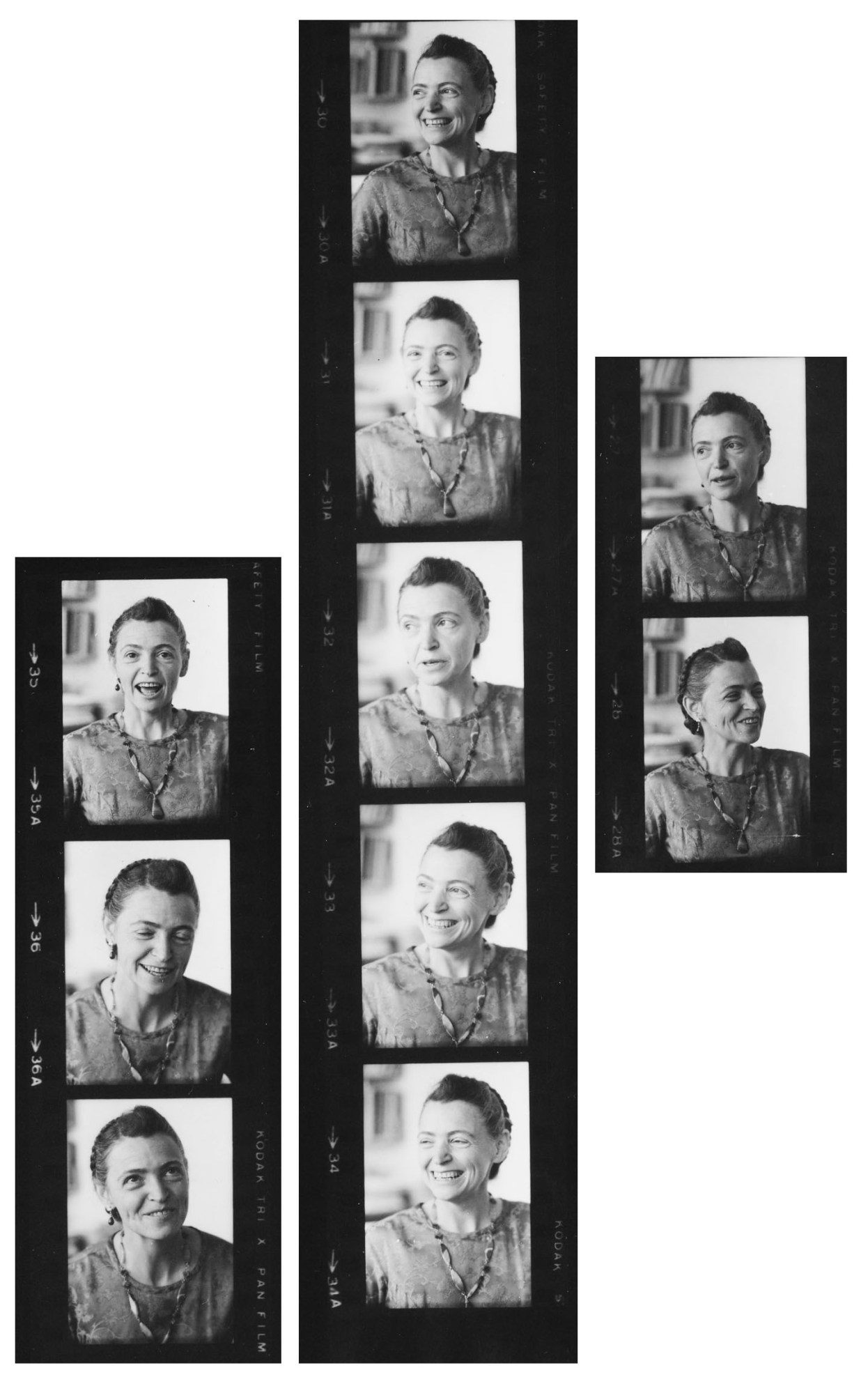
Dresselhaus shown in conversation early during her tenure at MIT. She would spend 50 years as a member of the faculty.
MARGO FOOTE/MIT MUSEUM

Whenever they met, Fermi would always select the subject of discussion and would never fail to energize and inspire her. “I was a very shy youngster and wouldn’t think of suggesting the topic to Enrico Fermi,” she told MIT Alumni News in 2013. “He would always ask questions about ‘What if this and this and this were true? What if we could make this—would it be interesting, and what could we learn?’”

Fermi and his wife, Laura, were well known for hosting monthly dinners at their house, with dancing afterward—and his students were always invited. “Fermi especially liked young people,” noted Harold Agnew, a longtime physicist and one of his graduate students, in a remembrance published after Fermi’s death. “The top floor of his Chicago house had a large room in which he would invite students to come and square-dance.”

“I remember those dinners,” Dresselhaus said in 2012. “Laura Fermi was a very, very good Italian cook.” But more than the cooking, she said, “it was the ambiance and the friendliness in that household that really made us enjoy physics—it was something more.” That “something more” would inspire Dresselhaus later in her career to provide her own students at MIT with a familial atmosphere in the lab, at group luncheons, and at events in her home, where lines between student and professor were blurred a bit and kindred spirits enjoyed one another’s company.

Dresselhaus’s acquaintance with Fermi would last only a year. He had developed an incurable stomach cancer, possibly a result of exposure to radiation from his earlier work, and died on November 28, 1954. But he left a fantastic impression that influenced her for the rest of her days, instilling in her a commitment to public service and guiding how she trained her own students.

“The most important thing that young people need is the confidence that they can succeed. That’s what I work on.”

“Fermi had the most profound influence on physics teaching in the United States, and our graduate programs … are much fashioned from his way of teaching,” Dresselhaus said in 2001. She later added, “From him, I learned that we don’t have to be leaders in every field, but we can use our understanding to see connections that others might miss.”

The broad physical and scientific knowledge that Dresselhaus developed as a result of Fermi’s system for teaching graduate students helped her in numerous ways throughout her career. It proved useful on several occasions when she had to make significant course corrections, with very little background in the areas into which she pivoted. And she relied on it as a leader of national programs with diverse constituents. 

But perhaps the grandest lesson that Dresselhaus gained from her mentor was an understanding of what it takes to be a great teacher and advocate. “The most important thing that young people need is the confidence that they can succeed,” she explained in 2012. “That’s what I work on. When I have students, I make sure they are able to formulate and solve their own problems. I will help them, if they come in and talk with me. And I make sure they receive training for their next job.”

By all accounts, she more than succeeded in that effort. At MIT, she became a beloved professor who both pushed her students to be their very best and provided support in ways big and small to ensure high achievement—helping students network for career opportunities, hosting any student who didn’t have a place to go for Thanksgiving dinner, teaching an entire recitation section for an engineering student who showed great promise but needed help getting up to speed in solid-state physics. She said, “I always felt Fermi and Rosalyn [Yalow, her undergraduate mentor at Hunter College] were interested in my career, and I try to show the same concern for my students.”


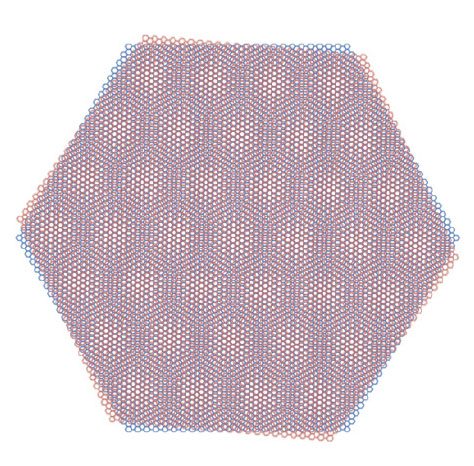
In the eight years since Dresselhaus’s death, new advances from her colleagues have borne the signature of her research—and have begun branching out in ever more fascinating directions. Graphene, for example, remains one of the hottest topics in science. Back in the early and mid-2010s, Dresselhaus worked on what she and others called “misoriented graphene.” She and others predicted that by twisting sheets of graphene so that their honeycomb patterns are slightly misaligned when superimposed, researchers could introduce “interesting patterns” that might lead to useful properties. In 2018, Dresselhaus’s MIT colleague Pablo Jarillo-Herrero realized this idea: He and others discovered that if two graphene sheets are combined into a superlattice, aligned at a “magic angle” of 1.1 degrees, the system can become either superconducting or insulating. The development was hailed as a major discovery and marked a jumping-off point for a subfield now known as ­“twistronics.” Physics World named it Breakthrough of the Year.

hexagonal sheets of graphene in slight misalignment
Dresselhaus hypothesized that misaligning sheets of graphene could produce novel properties. In 2018, her MIT colleague Pablo Jarillo- Herrero demonstrated that such an arrangement can become either a superconductor or an insulator.
COURTESY OF THE RESEARCHERS

Also in 2018, MIT opened its doors to a gleaming new nanoscience and nanotechnology research facility at the heart of campus. The $400 million MIT.nano project was a long time in coming; although Dresselhaus missed out on the grand opening, she was very much looking forward to its completion, and to the start of a new generation of nanoscale endeavors at the Institute that would seek to expand humanity’s understanding of physics, chemistry, materials science, energy, biology, and more. In her final years, Dresselhaus had looked to MIT.nano as an extension of her legacy. 

In late 2019, the courtyard between the Institute’s Infinite Corridor and the southern façade of the MIT.nano building was dedicated in her memory. Dubbed the Improbability Walk, the space is a nod to Dresselhaus’s unlikely rise to international prominence from her humble beginnings in Depression-era New York. It also encourages those who might serve as mentors to take time to get to know younger colleagues and students, as Enrico Fermi did with Dresselhaus and Dresselhaus did with so many at MIT. For as improbable as it might seem, an encouraging word from a mentor can immeasurably enhance a young scientist’s life path. 

cover of Carbon Queen

Like Fermi before her, Dresselhaus was deeply committed to giving back—to students, to her research community, to society at large. Throughout her 86-plus years, she gave of her time, her intellect, her energy, her love, and her enthusiasm. In one of her final interviews, the Queen of Carbon issued a ringing invitation. “We need new science and we need new ideas, and there’s plenty of room for young people to come in and have careers discovering those new ideas,” she declared. “Life is very interesting in this lane. Come and join me!” 


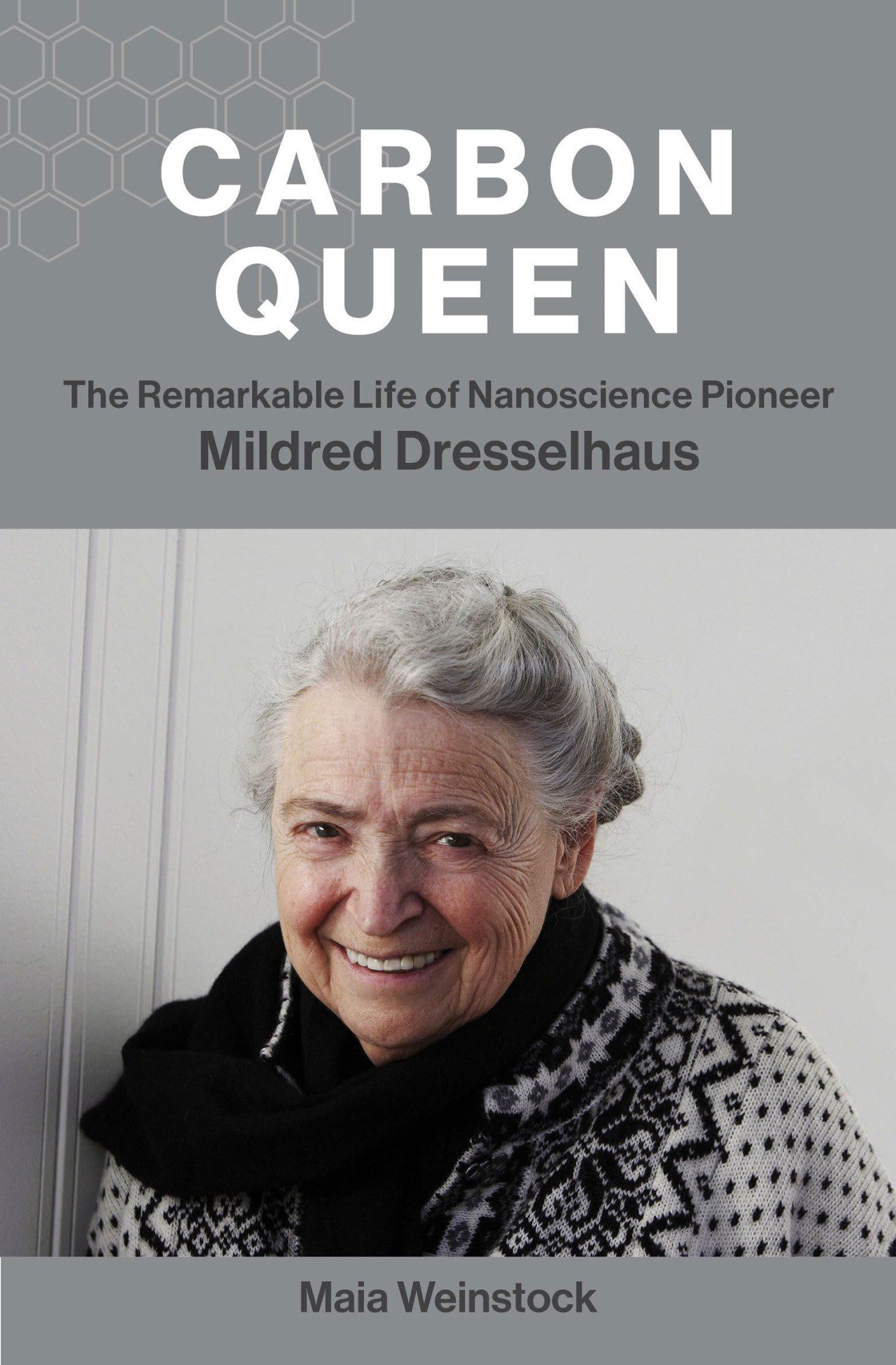
Adapted from Carbon Queen: The Remarkable Life of Nanoscience Pioneer Mildred Dresselhaus, by Maia Weinstock (MIT Press). Copyright 2022. Reprinted with permission.

Navigating MIT

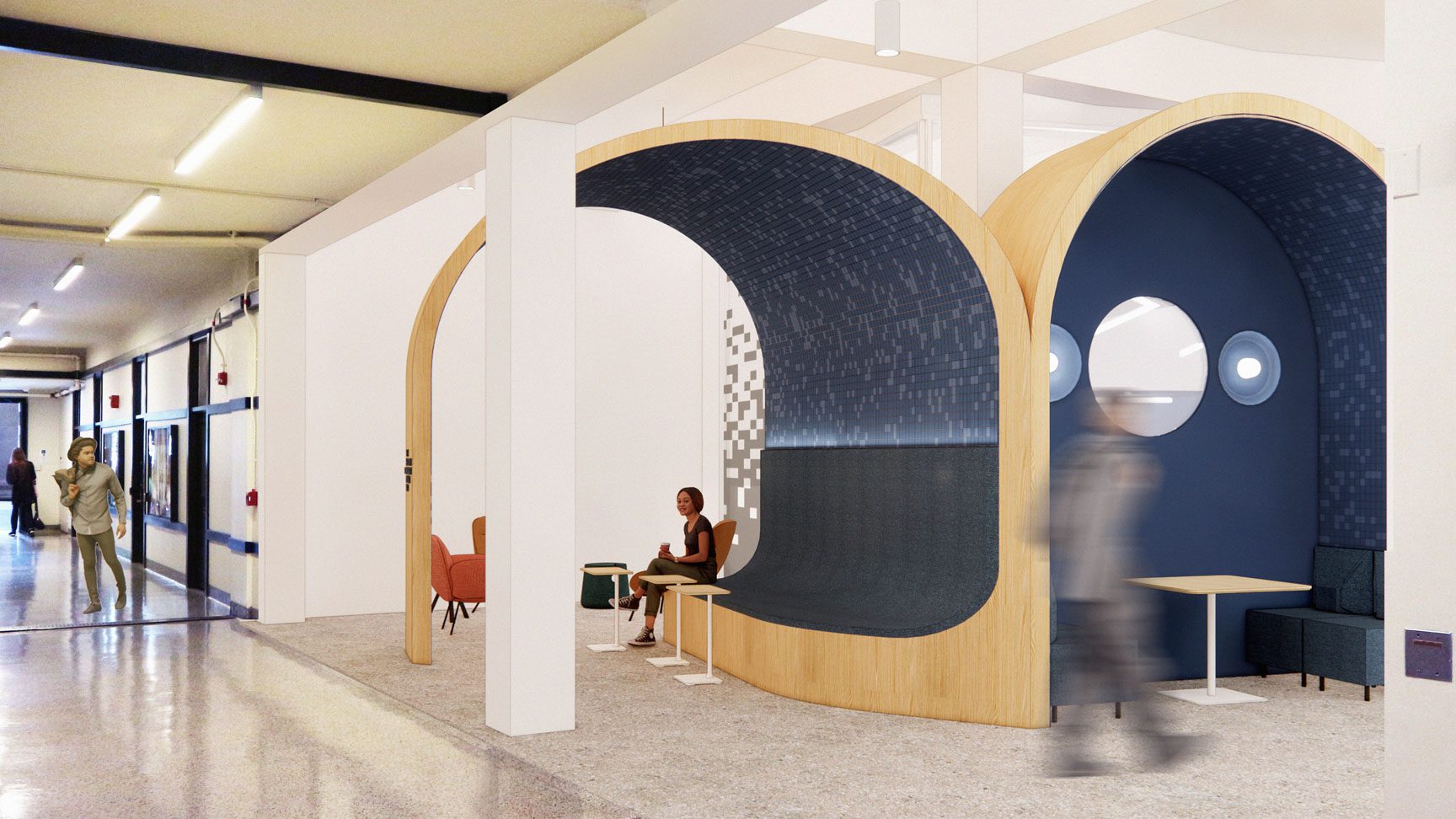
Take a stroll along the Infinite Corridor these days and you’ll encounter a striking new space, in a prominent location on the first floor of Building 11. With bright blue seating modules, orange accents, and an eye-catching design, it looks like a futuristic space station, sleek and ultramodern—but also welcoming and fun. 

This is the new home of the Undergraduate Advising Center (UAC). And while the design might be surprising, the creation of the center is no surprise at all. It’s simply another example of MIT’s ongoing innovation in improving student advising.

MERGE ARCHITECTS (RENDERING)

The MIT experience looks different for everyone, and the UAC was launched in 2023 with that in mind, offering individualized support to help undergraduates reach their full potential. The new hub brings together the people and programs dedicated to helping them navigate MIT, offering guidance that’s both personalized and proactive, with an emphasis on identifying students who might need help and reaching out to them sooner rather than later.

The 5,000-square-foot space, designed by Boston’s Merge Architects, reflects the needs of our students, who offered input on lighting (natural), seating (comfortable), and multifunctional areas that can be used for everything from private conversations to large-scale gatherings. 

I don’t have to tell all of you that there’s more to thriving at MIT than being incredibly smart. UAC advisors help students set goals, manage their time, and build relationships with faculty. And they help students navigate what’s often called the “hidden curriculum”—the unspoken norms and values of university life. Once they’ve chosen their majors, students are assigned a faculty advisor, but that doesn’t mean their UAC advisors step aside—these relationships continue for all four years, providing
a sense of continuity and care.

Already, the new hub is in constant use for consultations, study sessions, and impromptu visits to grab a snack and catch up with friends. And it’s much more than a physical upgrade—it’s a symbol of our commitment to continually strengthening advising resources for all students, from orientation to the moment they finally turn their Brass Rats.

A bionic knee restores natural movement

MIT researchers have developed a new bionic knee that is integrated directly with the user’s muscle and bone tissue. It can help people with above-the-knee amputations walk faster, climb stairs, and avoid obstacles more easily than they could with a traditional prosthesis, which is attached to the residual limb by means of a socket and can be uncomfortable.

For several years, Hugh Herr, SM ’93, co-director of the K. Lisa Yang Center for Bionics, has been working with his colleagues on techniques that can extract neural information from muscles left behind after an amputation and use that information to help guide a prosthetic limb. The approach, known as agonist-antagonist myoneuronal interface (AMI), has been shown to help people with below-the-knee amputations walk faster and navigate around obstacles much more naturally. 

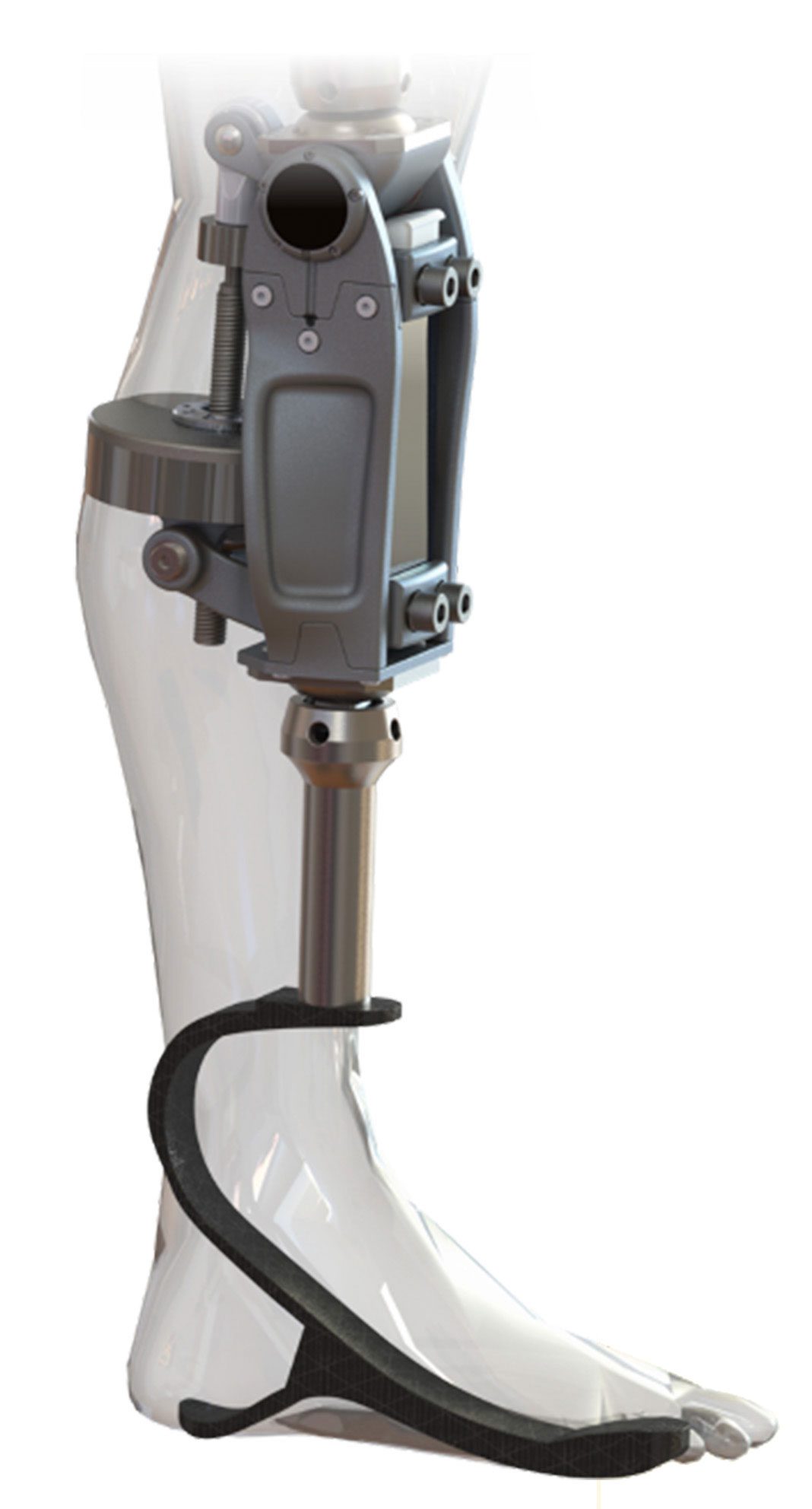
model of bionic knees
The new system is anchored to the bone and controlled by the nervous system, offering more stability and easier navigation.
COURTESY OF THE RESEARCHERS

In the new study, the researchers developed a procedure to insert a titanium rod into the residual femur bone of people who had amputations above the knee. This implant allows for better mechanical control and load bearing than a traditional prosthesis. It also contains 16 wires that collect information from electrodes located on the AMI muscles inside the body, offering better neuroprosthetic control.

Two people who received the implant in a clinical study performed better on several types of tasks, including stair climbing, and reported that the limb felt more like a part of their own body, compared with people who had more traditional above-the-knee amputations and used conventional prostheses.

“A prosthesis that’s tissue-integrated—anchored to the bone and directly controlled by the nervous system—is not merely a lifeless, separate device,” says Herr, but rather “an integral part of self.” The system will need larger trials to receive FDA approval for commercial use, which he expects may take about five years. 

Biodiversity: A missing link in combating climate change

A lot of attention has been paid to how climate change can reduce biodiversity. Now MIT researchers have shown that the reverse is also true: Loss of biodiversity can jeopardize regrowth of tropical forests, one of Earth’s most powerful tools for mitigating climate change.

Combining data from thousands of previous studies and using new tools for quantifying interconnected ecological processes, the researchers analyzed numerous tropical sites where deforestation was being followed by natural regrowth, focusing on the role of animals such as birds and monkeys that spread plant seeds by eating them in one place and then defecating someplace else. Evan Fricke, a research scientist in the MIT Department of Civil and Environmental Engineering and the lead author of a paper on the work, has studied such animals for 15 years, showing that without their role, trees have lower survival rates and a harder time keeping up with environmental changes. 

Since tropical forests are Earth’s largest land-based carbon sink, such challenges make it harder to fight climate change. But the influence of biodiversity on forests’ ability to absorb carbon has not been fully quantified.

To do that, the researchers looked at data on where seed-dispersing animals live, how many seeds each animal disperses, and how they affect germination. Then they incorporated data revealing the impact of human activity such as hunting and forest degradation. They found, for example, that the animals move less, and thus spread seeds less widely, in areas with a bigger human footprint.

With the data, the researchers created an index that revealed a link between human activities and declines in seed dispersal. They analyzed the relationship between that index and records of carbon accumulation in naturally regrowing tropical forests over time, controlling for factors like droughts, fires, and livestock grazing.

“What’s particularly new about this study is we’re actually getting the numbers around these effects,” Fricke says. In particular, they found that naturally regrowing forests with healthy populations of seed-dispersing animals absorbed up to four times more carbon than those without as many. Meanwhile, in sites identified as suitable for reforestation, current levels of disruption to seed dispersal reduce the potential for regrowth by 57%.

These findings could help direct reforestation strategies. “In the discussion around planting trees versus allowing trees to regrow naturally, regrowth is basically free, whereas planting trees costs money, and it also leads to less diverse forests,” says César Terrer, a professor of civil and environmental engineering and a coauthor of the paper. “Now we can understand where natural regrowth can happen effectively because there are animals planting the seeds for free, and we also can identify areas where, because animals are affected, natural regrowth is not going to happen, and therefore planting trees actively is necessary.”

The researchers encourage action to protect or improve animal habitats, reduce pressures on seed-dispersing species, and potentially reintroduce them where they’ve been lost. Overall, they hope the study helps improve our understanding of the planet’s complex ecological processes.

“When we lose our animals, we’re losing the ecological infrastructure that keeps our tropical forests healthy and resilient,” Fricke says. 

A I-designed compounds can kill drug-resistant bacteria

With help from artificial intelligence, MIT researchers have designed novel antibiotics that can combat two hard-to-treat bacteria: multi-drug-­resistant Neisseria gonorrhoeae and Staphylococcus aureus (MRSA).

The team used two approaches. First, they directed generative AI to design molecules based on a chemical fragment their model had predicted would show antimicrobial activity, and second, they let the algorithms generate molecules without constraints. They designed more than 36 million possible compounds this way and computationally screened them for antimicrobial properties. 

The top candidates they discovered are structurally distinct from any existing antibiotics, and they appear to work by novel mechanisms that disrupt bacterial cell membranes. This makes them less vulnerable to antibiotic resistance, a growing problem: It is estimated that drug-­resistant bacterial infections cause nearly 5 million deaths per year worldwide.

Now that they can generate and evaluate compounds that have never been seen before, the researchers hope they can use the same strategy to identify and design drugs that attack other species of bacteria.

“We’re excited about the new possibilities that this project opens up for antibiotics development,” says James Collins, a professor of biological engineering and the senior author of the study. “Our work shows the power of AI from a drug design standpoint and enables us to exploit much larger chemical spaces that were previously inaccessible.”

Walking faster, hanging out less

City life is often described as “fast-paced.” A study coauthored by MIT scholars suggests that’s more true than ever: The average walking speed in three northeastern US cities increased 15% from 1980 to 2010, while the number of people lingering in public spaces declined by 14%.

The researchers used machine-learning tools to assess 1980s-era video footage captured in Boston, New York, and Philadelphia by William Whyte, an urbanist and social thinker best known as the author of The Organization Man. They compared the old material with newer videos from the same locations.

“Something has changed over the past 40 years,” says coauthor Carlo Ratti, director of MIT’s Senseable City Lab. “Public spaces are working in somewhat different ways, more as a thoroughfare and less a space of encounter.” The scholars speculate that some of the reasons may have to do with cell phones and Starbucks: People text each other to meet up instead of hanging around to encounter each other in public, and when they do get together, they often choose an indoor space like a coffee shop.

The results could help designers seeking to create new public areas or modify existing ones. “Public space is such an important element of civic life, and today partly because it counteracts the polarization of digital space,” says Arianna Salazar-Miranda, MCP ’16, PhD ’23, an assistant professor at Yale and another coauthor. “The more we can keep improving public space, the more we can make our cities suited for convening.” 

Estrada signs with the Dodgers

Like almost any MIT student, Mason Estrada wants to take what he learned on campus and apply it to the working world. Unlike any other current MIT student, Estrada’s primary workplace is a pitcher’s mound.

Estrada, the star pitcher for MIT’s baseball team, has signed a contract with the Los Angeles Dodgers, who selected him in the seventh round of the Major League Baseball draft on July 14. The right-hander, whose fastball has reached 96 miles per hour, is taking a leave of absence from the Institute and reported to the Dodgers’ instructional camp in Arizona.

An aero-astro major, Estrada says that pitching at MIT has never involved transferring aerodynamic knowledge from the classroom to the mound. Still, he says, he’s benefited as an athlete from “learning to think like an engineer generally, learning to think through problems the right way and finding the best solution.”

In the 2025 season Estrada went 6–0 with a 2.21 ERA, striking out 66. He is the fifth MIT undergraduate selected in baseball’s draft, of whom one—Jason Szuminski ’00—reached the majors, with the San Diego Padres. 

De-risking investment in AI agents

Automation has become a defining force in the customer experience. Between the chatbots that answer our questions and the recommendation systems that shape our choices, AI-driven tools are now embedded in nearly every interaction. But the latest wave of so-called “agentic AI”—systems that can plan, act, and adapt toward a defined goal—promises to push automation even further.

“Every single person that I’ve spoken to has at least spoken to some sort of GenAI bot on their phones. They expect experiences to be not scripted. It’s almost like we’re not improving customer experience, we’re getting to the point of what customers expect customer experience to be,” says vice president of product management at NICE, Neeraj Verma.

For businesses, the potential is transformative: AI agents that can handle complex service interactions, support employees in real time, and scale seamlessly as customer demands shift. But the move from scripted, deterministic flows to non-deterministic, generative systems brings new challenges. How can you test something that doesn’t always respond the same way twice? How can you balance safety and flexibility when giving an AI system access to core infrastructure? And how can you manage cost, transparency, and ethical risk while still pursuing meaningful returns?

These solutions will determine how, and how quickly, companies embrace the next era of customer experience technology.

Verma argues that the story of customer experience automation over the past decade has been one of shifting expectations—from rigid, deterministic flows to flexible, generative systems. Along the way, businesses have had to rethink how they mitigate risk, implement guardrails, and measure success. The future, Verma suggests, belongs to organizations that focus on outcome-oriented design: tools that work transparently, safely, and at scale.

“I believe that the big winners are going to be the use case companies, the applied AI companies,” says Verma.

Watch the webcast now.

This content was produced by Insights, the custom content arm of MIT Technology Review. It was not written by MIT Technology Review’s editorial staff. It was researched, designed, and written by human writers, editors, analysts, and illustrators. AI tools that may have been used were limited to secondary production processes that passed thorough human review.

Reimagining sound and space

On a typical afternoon, MIT’s new Edward and Joyce Linde Music Building hums with life. On the fourth floor, a jazz combo works through a set in a rehearsal suite as engineers adjust microphone levels in a nearby control booth. Downstairs, the layered rhythms of Senegalese drumming pulse through a room built to absorb its force. In the building’s makerspace, students solder circuits, prototype sensor systems, and build instruments. Just off the main lobby, beneath the 50-foot ­ceiling of the circular Thomas Tull Concert Hall, another group tests how the room, whose acoustics can be calibrated to shift with each performance, responds to its sound.

Situated behind Kresge Auditorium on the site of a former parking lot, the Linde building doesn’t mark the beginning of a serious commitment to music at MIT—it amplifies an already strong program. Every year, more than 1,500 students enroll in music classes, and over 500 take part in one of the Institute’s 30 ensembles, from the MIT Symphony Orchestra to the Fabulous MIT Laptop Ensemble, which creates electronic music using laptops and synthesizers. They rehearse and perform in venues across campus, including Killian Hall, Kresge, and a network of practice rooms, but the Linde Building provides a dedicated home to meet the depth, range, and ambition of music at MIT.

“It would be very difficult to teach biology or engineering in a studio designed for dance or music,” Jay Scheib, section head for Music and Theater Arts, told MIT News shortly before the building officially opened. “The same goes for teaching music in a mathematics or chemistry classroom. In the past, we’ve done it, but it did limit us.” He said the new space would allow MIT musicians to hear their music as it was intended to be heard and “provide an opportunity to convene people to inhabit the same space, breathe the same air, and exchange ideas and perspectives.”

The building, made possible by a gift from the late philanthropists Edward ’62 and Joyce Linde, has already transformed daily music life on campus. Musicians, engineers, and designers now cross paths more often as they make use of its rehearsal rooms, performance spaces, studios, and makerspace, and their ideas have begun converging in distinctly MIT ways. Antonis Christou, a second-year master’s student in the Opera of the Future group at the MIT Media Lab and an Emerson/Harris Scholar, says he’s there “all the time” for classes, rehearsals, and composing.

“It’s really nice to have a dedicated space for music on campus. MIT does have very strong music and arts programs, so I think it reflects the strength of those programs,” says Valerie Chen ’22, MEng ’23, a cellist and PhD candidate in electrical engineering who works on interactive robotics. “But more than that, I think it makes a statement that technology and the arts, and music in particular, are very interconnected.”

A building tuned for acoustics and performance

Acoustic innovation shaped every aspect of the building’s 35,000 square feet of space. From the outset, the design team faced a fundamental challenge: how to create a facility where radically different types of music could coexist without interference. Keeril Makan, the Michael (1949) and Sonja Koerner Music Composition Professor and associate dean of MIT’s School of Humanities, Arts, and Social Sciences (SHASS), helped lead that effort.

“It was important to me that we could have classical music happening in one space, world music in another space, jazz somewhere else, and also very fine measurements of sound all happening at the same time. And it really does that,” says Makan. “But it took a lot of work to get there.”

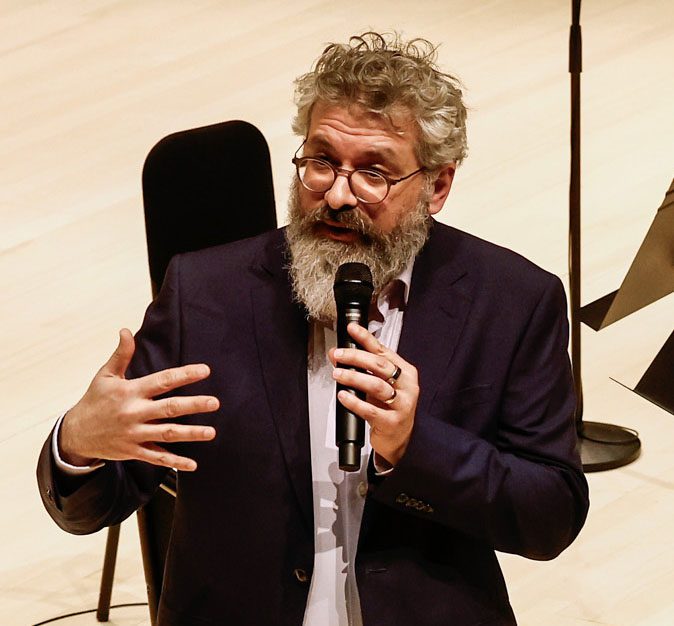
Keeril Makan
Keeril Makan, professor of composition and associate dean of SHASS, helped spearhead the effort to create a building in which radically different kinds of musicmaking could happen simultaneously.
WINSLOW TOWNSON

That work resulted in a building made up of three artfully interconnected blocks, creating three acoustically isolated zones: the Thomas Tull Concert Hall, the Erdely Music and Culture Space, and the Lim Music Maker Pavilion. Thick double shells of concrete enclose each zone, and their physical separation minimizes vibration transfer between them. One space for world music rests on a floating slab above the building’s underground parking garage and is constructed using a box-in-box method, with its inner room structurally isolated from the rest of the building. Other rooms use related techniques, with walls, floors, and ceilings separated by layers of sound-dampening materials and structural isolation systems to reduce sound transmission.

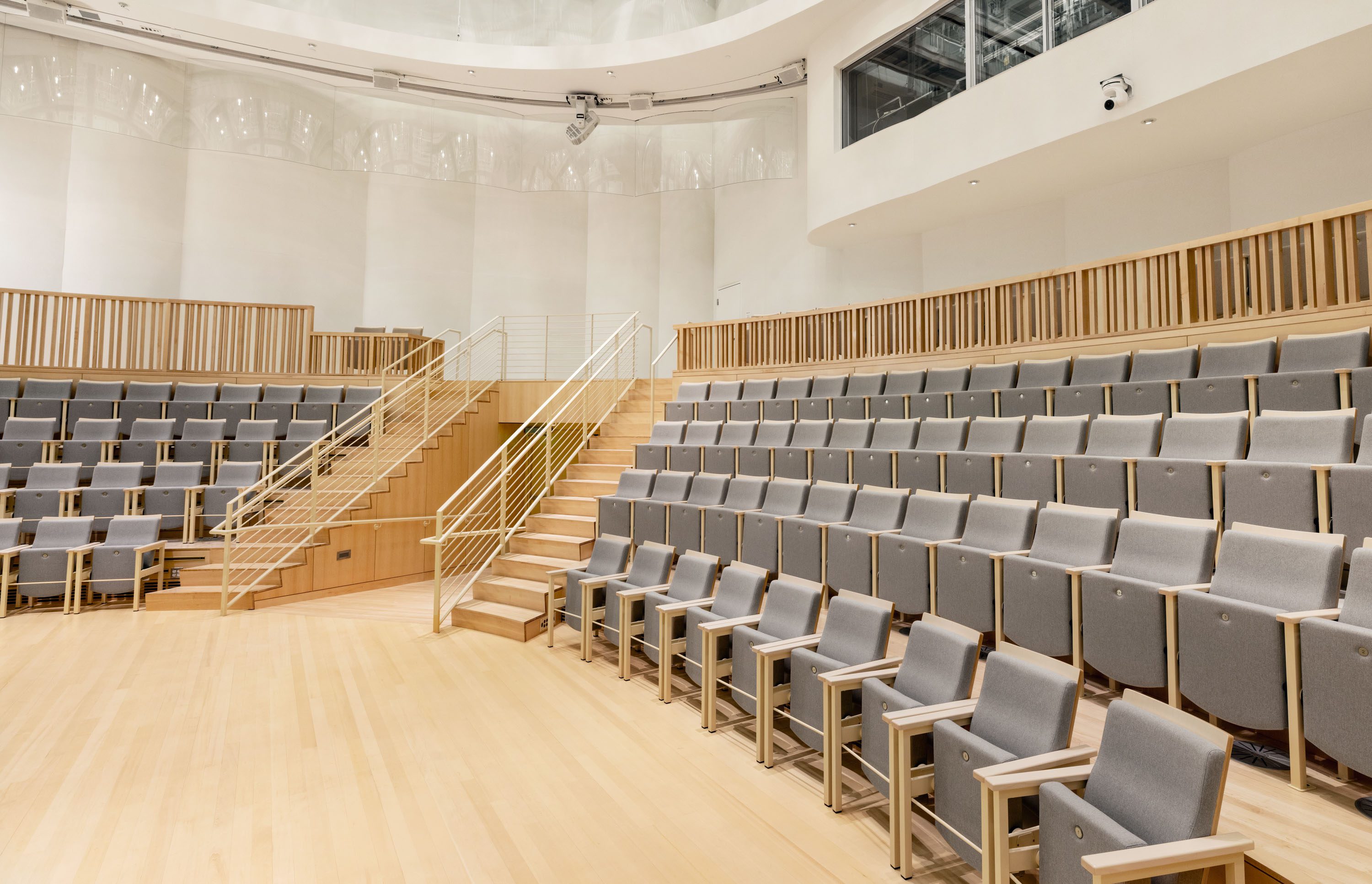
The building was designed by the Japanese architecture firm SANAA, in close collaboration with Nagata Acoustics, the team behind Berlin’s Pierre Boulez Saal. Inspired in part by that German hall, the 390-seat Thomas Tull Concert Hall is meant to serve musicians’ varying acoustic needs. Inside, ceiling baffles and perimeter curtains make it possible to adapt the room on demand, shifting the acoustics from resonant and open for chamber music and classical performances to drier and more controlled for jazz or electronic music.

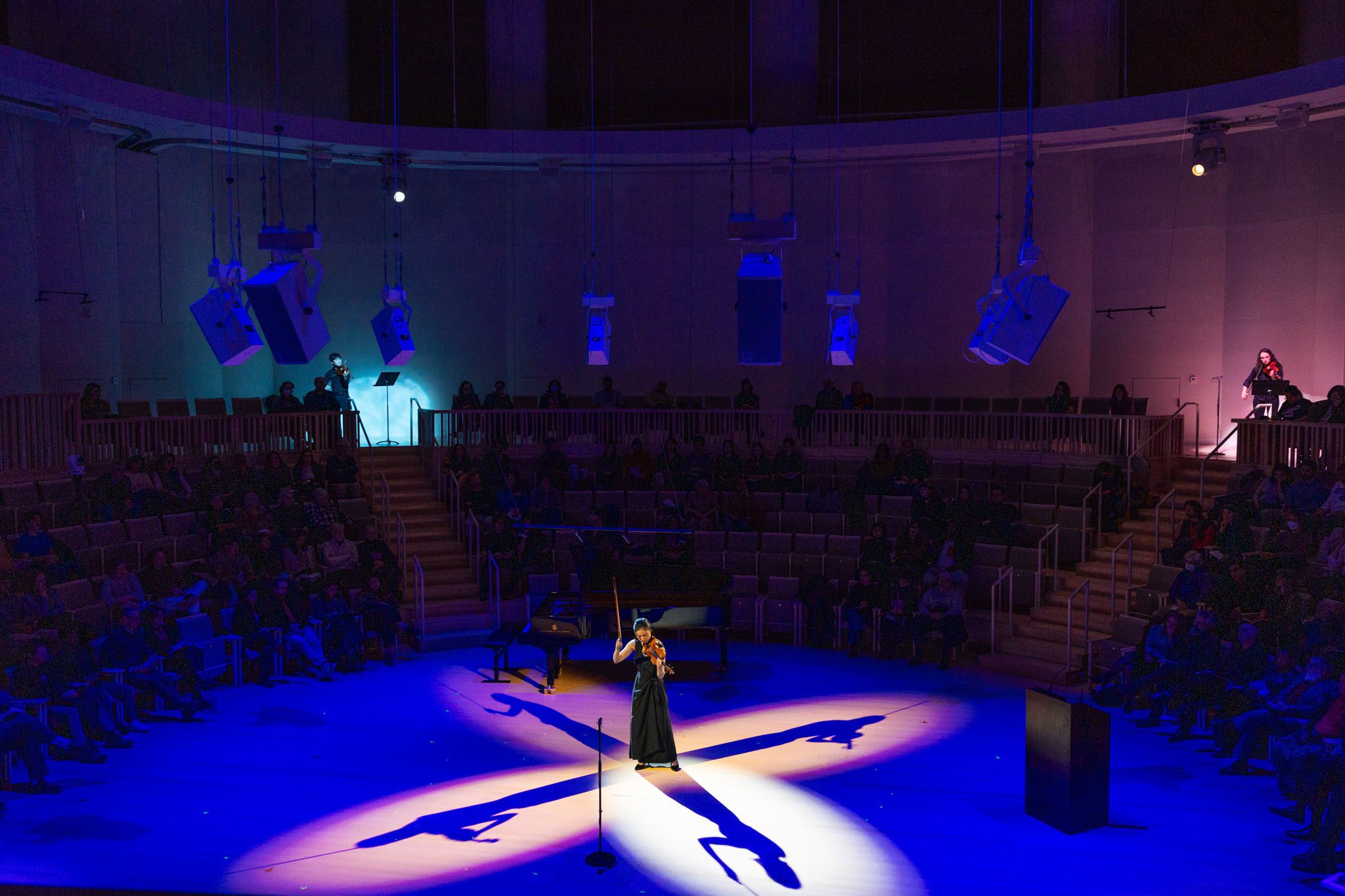
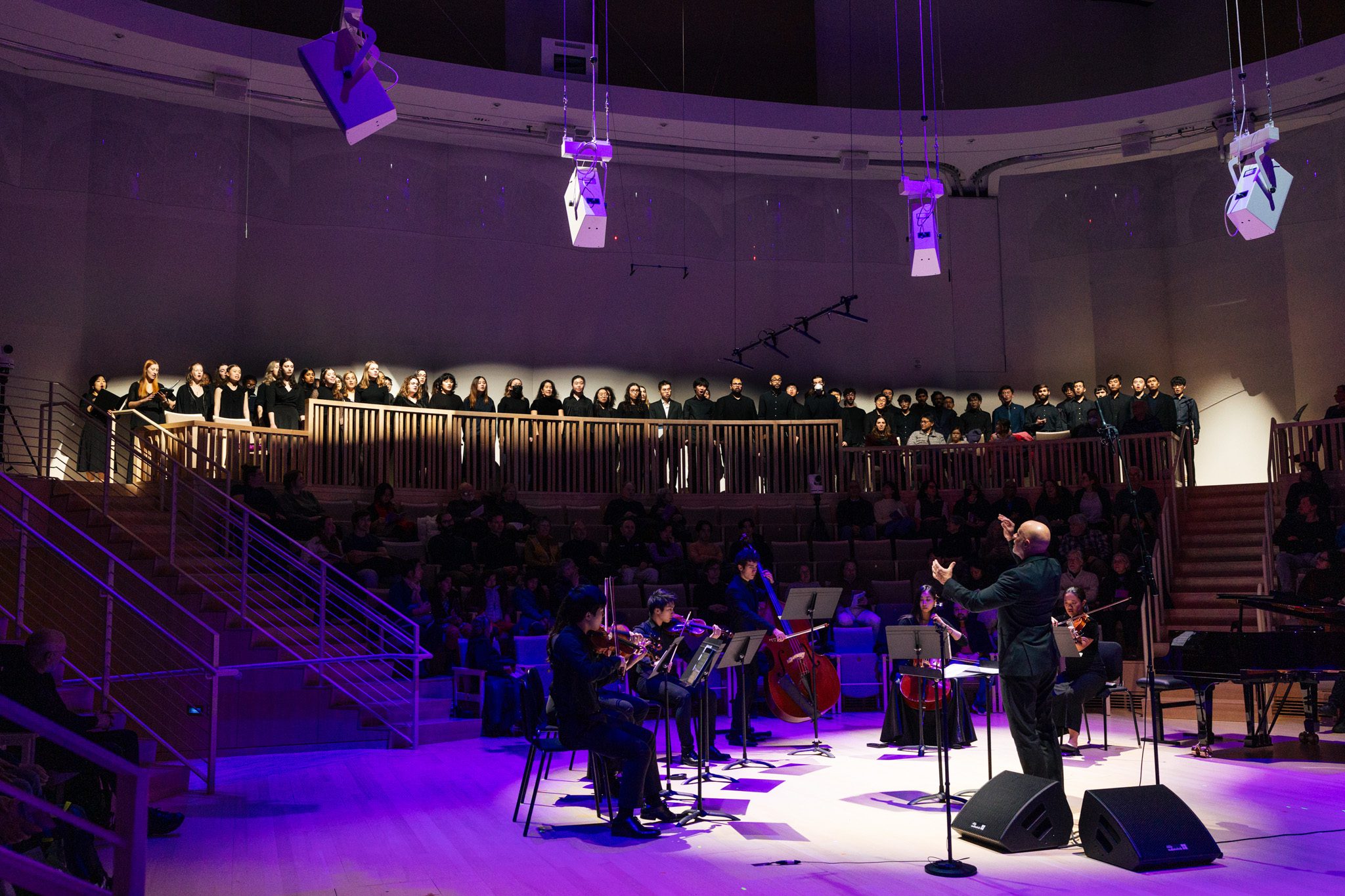
Makan and the acoustics team pushed for a 50-foot ceiling, a requirement from Nagata for acoustic flexibility and performance quality. The result is a concert hall that breaks from traditional form. Instead of occupying a raised stage facing rows of seats, performers in Tull Hall are positioned at the bottom of the space, with the audience seated around and above them. This layout alters the relationship between listeners and performers; audience members can choose to sit next to the string section or behind the pianist, experiencing sounds and sights typically reserved for musicians. The circular configuration encourages movement, intimacy, and a more immersive musical experience. 

“It’s a big opportunity for creativity,” says Ian Hattwick, a lecturer in music technology. “You can distribute musicians around the hall in interesting ways. I really encourage people in electronic music concerts to come up and get close. You can come up and peer over somebody’s shoulder while they’re playing. It’s definitely different. But I think it’s beautiful.”

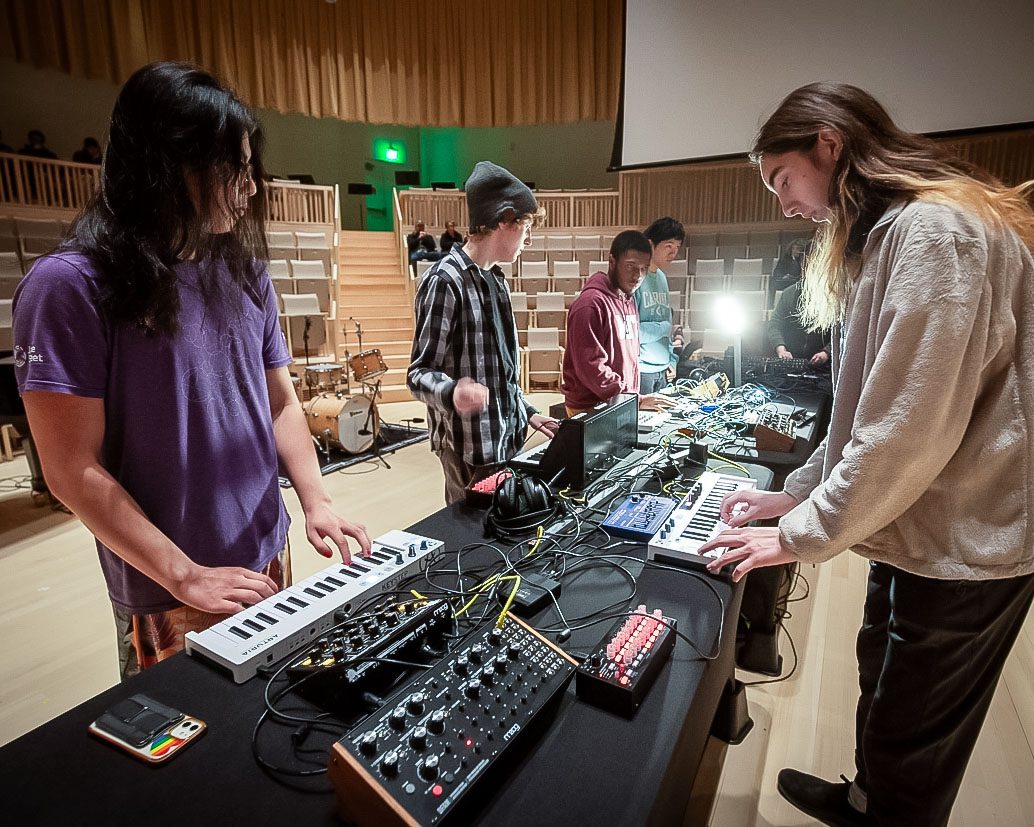
That sense of openness shaped one of the first performances in the new hall. As part of the building’s opening-weekend event in February, called “Sonic Jubilance,” the Fabulous MIT Laptop Ensemble (FaMLE), directed by Hattwick, took the stage, testing the venue’s variable acoustics and capacity for spatial experimentation as it employed laptops, gestural controllers, and other electronic devices to improvise and perform electronic music.

“I was really struck by how good it sounded for what I do and for what FaMLE does,” says Hattwick. “There’s a surround system of speakers. It was really fun and really satisfying, so I’m super excited to spend some more time working on spatial audio applications.” That evening, a concert featured performances by a diverse array of additional ensembles and world premieres by four MIT composers. It was the first moment many performers heard what the hall could do—and the first time they’d shared a space designed for all of them.

JONATHAN SACHS
Students on the performance floor stand at a long table with keyboards and other controllers

JONATHAN SACHS

The community joined MIT music faculty, staff, and students for special workshops and short performances at the building’s public opening in February.

Since then, the hall has hosted a wide range of performances, from student recitals to concerts featuring guest artists. In the span of two weeks in March, the Boston Chamber Music Society celebrated the music of Fauré and the Boston Symphony Chamber Players performed works by Aaron Copland, Brahms, and MIT’s own Makan. Other concerts have featured student compositions, historical instruments, and multichannel electronic works. 

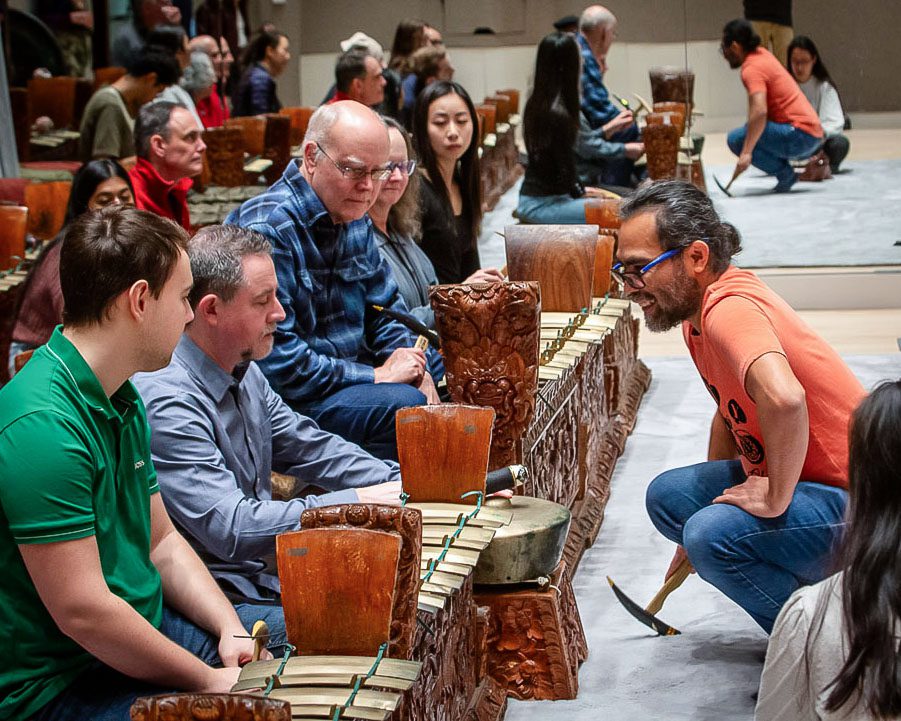
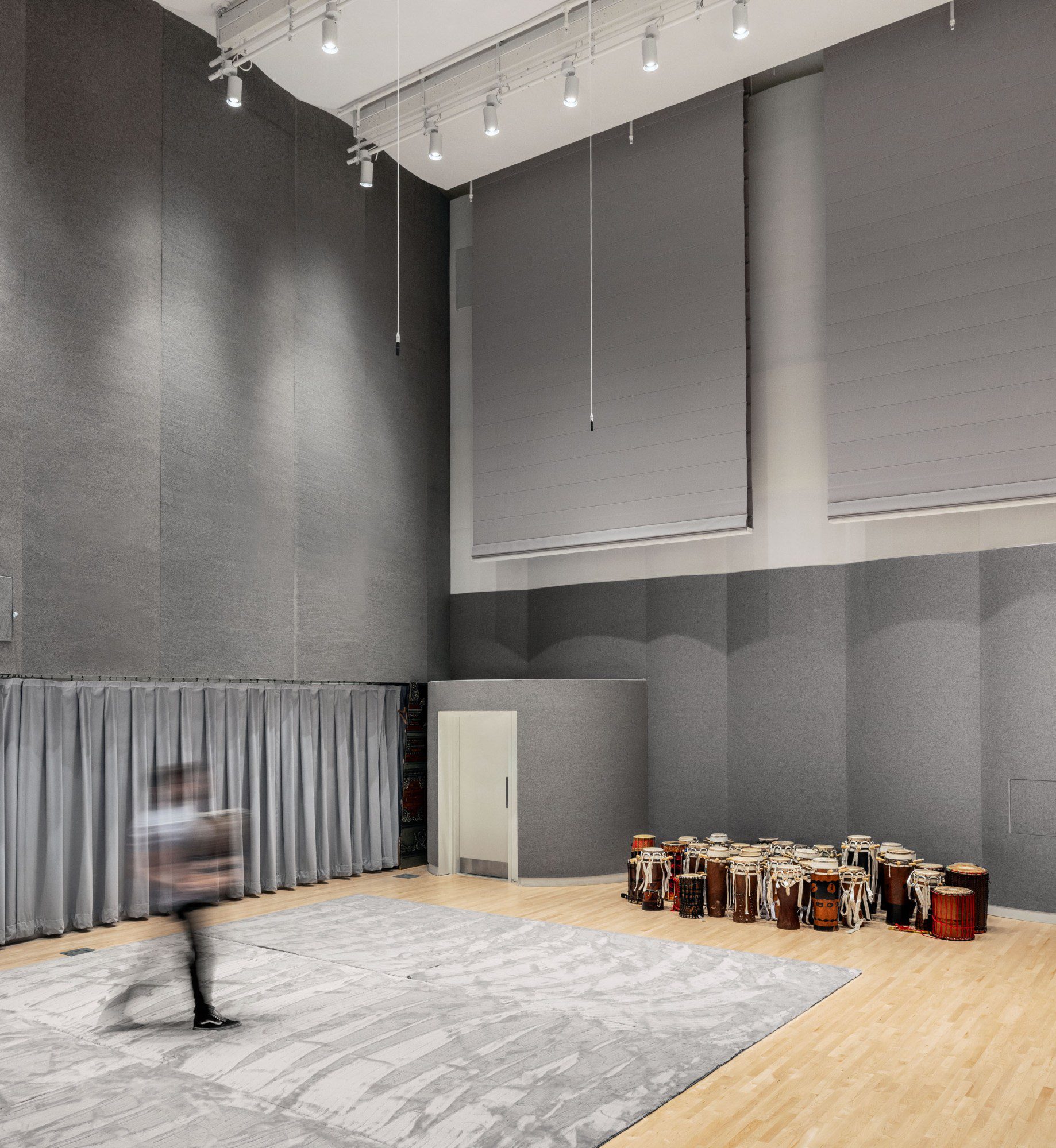
Just a few steps from the entrance to Tull Concert Hall, across the brick- and glass-lined lobby, the Beatrice and Stephen Erdely Music and Culture Space supports a different kind of sound. It’s designed to host rehearsals of percussion groups like Rambax MIT, the Institute’s Senegalese drumming ensemble, which uses hand-carved sabar drums, each played with a stick and open palm to produce tightly woven polyrhythms. At other times, students gather there around bronze-keyed instruments as they play with the Gamelan Galak Tika ensemble, practicing the interlocking patterns of Balinese kotekan

Such music was originally meant to be performed in the open. The Music and Culture Space provides the physical and sonic headroom these traditions require, using materials chosen not only to isolate sound but also to let it breathe. Inside, the room thrums with rhythm, while just outside its walls, the rest of the building stays silent.

“We can imagine [world music] growing with this new home,” says Makan. Previously, these ensembles had rehearsed in a converted space inside the old MIT Museum building on Massachusetts Avenue, separated from the rest of the music program. 

“They deserved their own space for so long,” says Hattwick, “and it’s really fantastic that they managed to get it and that it is integrated in the music building the way that it is.” 

a figure in motion walks toward a number of traditional wood drums
The soaring ceiling of the Beatrice and Stephen Erdely Music and Culture Space provides the physical and sonic headroom for percussion ensembles.
ADAM DETOUR

The building’s commitment to sound isolation extends beyond its rehearsal and performance spaces, and for faculty working in sound design and music technology, it has changed their daily rhythms. Mark Rau, an assistant professor of music technology with a joint appointment in electrical engineering and computer science (EECS), regularly uses speakers at high volume in his office—something that he says wouldn’t have been possible in MIT’s previous facilities.

“All the rooms in the building have good sound isolation, even the offices—not just the performance rooms, which is pretty great,” says Rau, whose second-floor office in the Jae S. and Kyuho Lim Music Maker Pavilion features gray acoustic panels lining the walls and ceiling. “To be able to test the algorithms that I’m working on and things for homework assignments, and not bother my neighbors, is important.” 

The attention to acoustic detail continues upstairs. On the fourth floor, Rau ran the first two sessions in the building’s new recording facilities, which were purpose-­built to support both ensemble work and critical listening. He says they offer professional-­quality recording.

The recording suite includes a large main room that can accommodate up to a dozen players, a smaller isolation booth for separating instruments or voices, and a control room designed for precise monitoring. Each space is acoustically treated and linked to the building’s dedicated audio network, so sound can be routed from any room in the building to any other in real time.  

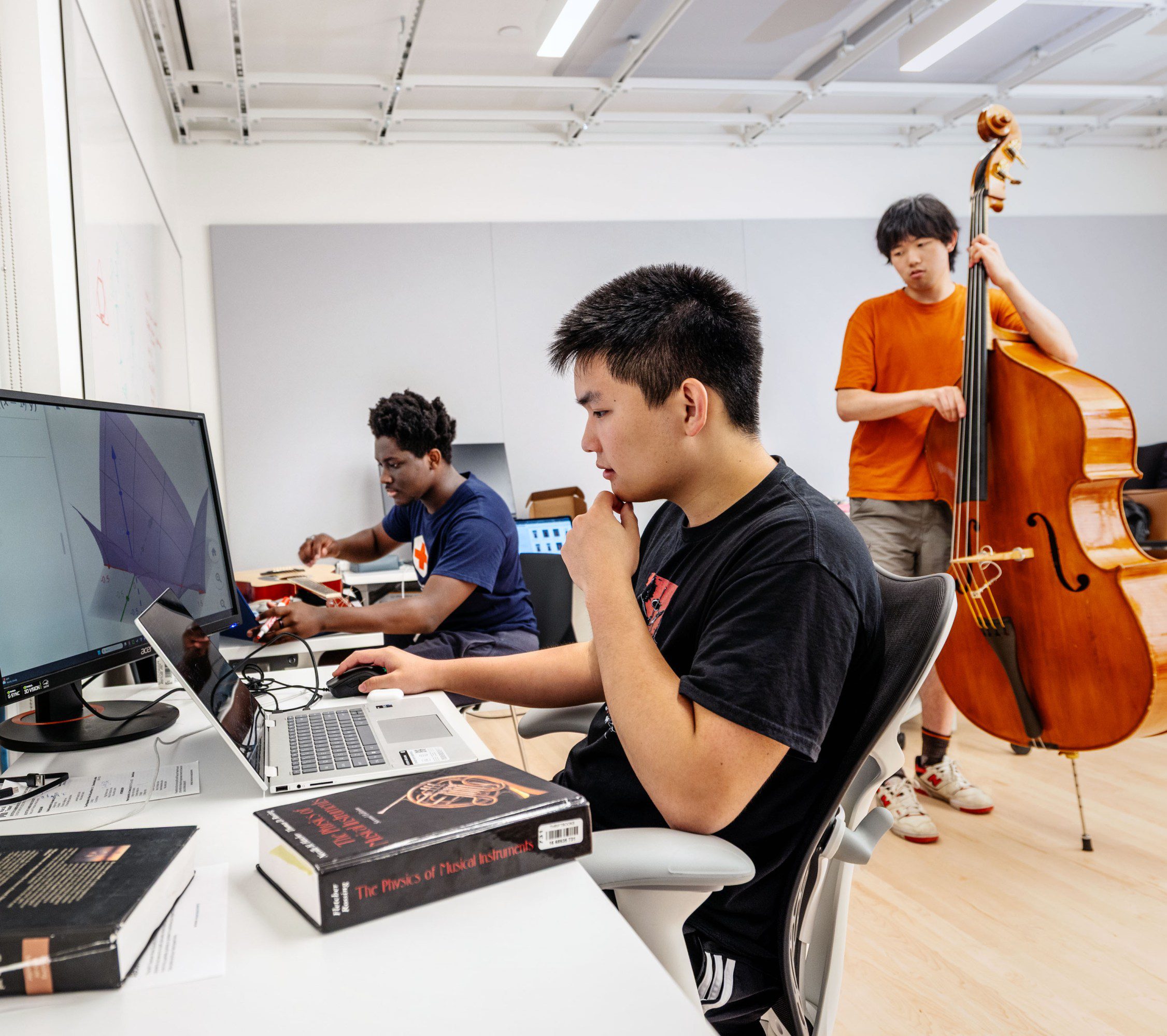
In the music technology research lab, undergraduate researchers (from left) Mouhammad Seck ’27, Anthony Wang ’28, and Alex Jin ’27 model the sounds of historic instruments— many of which are unplayable—from the collection of the MFA Boston.
ADAM DETOUR

“You could record an entire symphony orchestra, and almost everybody could be in a different room,” says Hattwick. Or you could have the orchestra playing together in the concert hall and record it in one of the studios. The whole building uses a digital audio protocol called Dante, which allows low-latency, high-fidelity ­transmission over Ethernet.

MIT multimedia specialist Cuco Daglio, who helped oversee technical planning, advocated for that level of fidelity. “It’s a beautifully designed acoustic space,” says Hattwick. 

The building’s exterior reflects a similar attention to performance. The arch above its entryway facing the Johnson Athletic Center and the Zesiger Sports and Fitness Center forms a conical shell that shapes and reflects sound, creating a natural stage. On warm days, music drifts out into the open air as groups rehearse beneath the overhang or students gather to play informally in small groups. 

New program, new space

This fall, MIT is launching a new one-year master’s program in music technology, bringing together faculty from engineering and the arts. The Linde Music Building serves as the program’s home base, providing studios, tools, and collaborative spaces that students will use to design new instruments, software, and performance systems. Eran Egozy ’93, MEng ’95, professor of the practice in music technology and cofounder of Harmonix Music Systems, which developed Guitar Hero and Rock Band, directs the program. He developed the curriculum with Anna Huang, SM ’08, an associate professor with a joint appointment in music and EECS who did research on human-AI music collaboration technologies at Google, and he, Huang, and Rau are among its faculty.

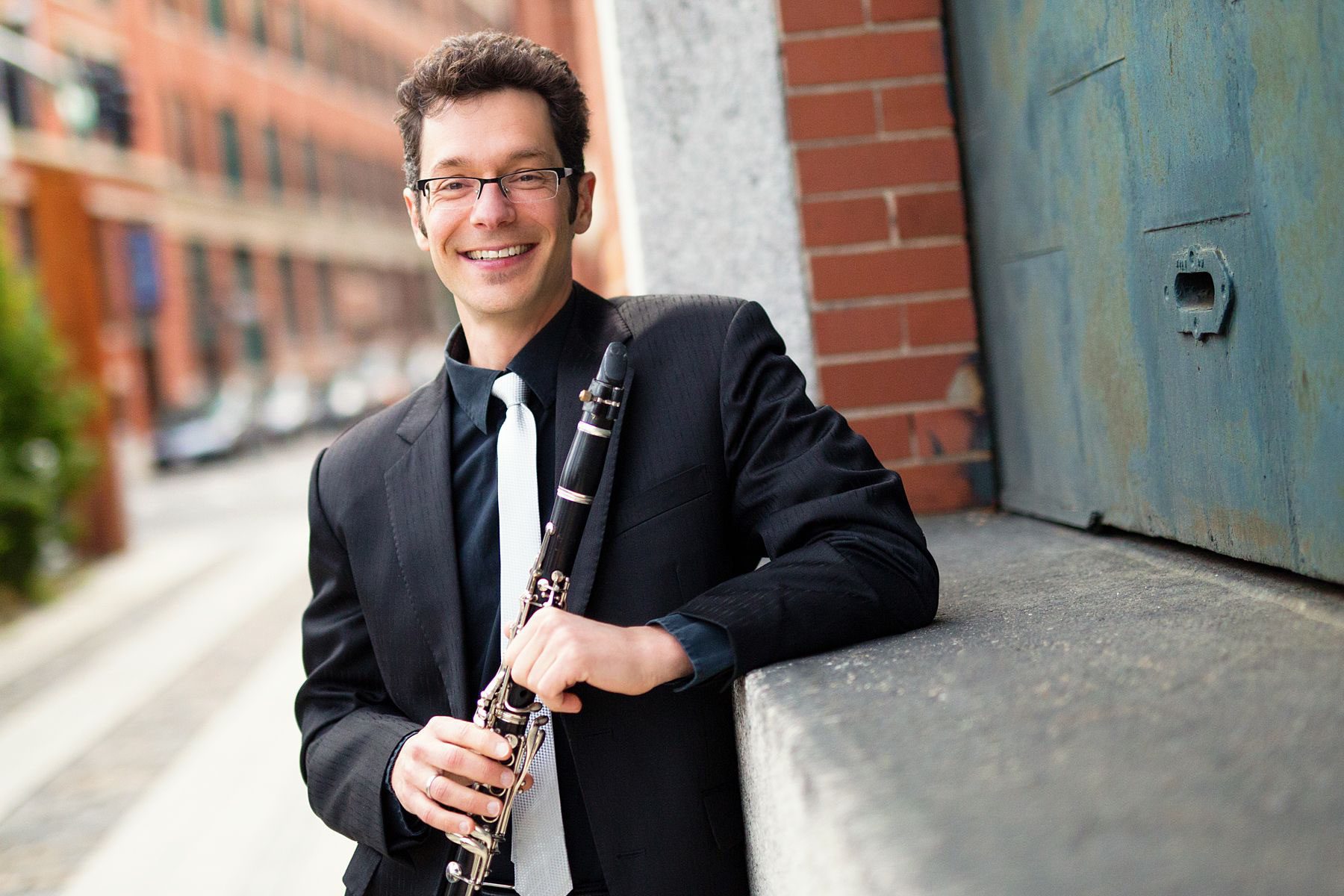
Eran Egozy
Eran Egozy ’93, MEng ’95, professor of the practice in music technology and one of the masterminds behind Guitar Hero and Rock Band, directs the Institute’s new master’s program in music technology.
KATE LEMMON

“It’s really about inventing new things,” says Egozy. “Asking questions like: What would the future musician want? What kinds of tools will a composer want?”

Rachel Loh ’25, who double-majored in computer science and engineering and music, will be part of the inaugural cohort. A vocalist with Syncopasian, MIT’s East Asian a cappella group, she draws on performance experience in her research. Her current project explores how AI systems improvise alongside human musicians, using visualizations to provide insight into machine decision-making.

“In high school, I knew I wanted to work at the intersection of music and computer science,” she says. “Now, this new music tech program is the perfect thing for me.”

a woman holds her bow aloft as she plays the violin at the center of converging beams of the spotlights such that four shadows extend away from her at each 90 degree angle.
A performance in the Thomas Tull Concert Hall.
KATE LEMMON

A flexible workshop on the Music Maker Pavilion’s second floor will serve as a core space for the new program, outfitted with essentials like soldering stations, a laser cutter, and testing gear but left unfinished by design. Hattwick and Rau, who oversee the space, are allowing its exact form to emerge over time. 

“We’ve been spending this year outfitting it and starting to think about how we make all of these resources available to our students, and what the best way is to utilize this opportunity in this space,” Hattwick says. “[The makerspace] directly supports research and our specific coursework.” 

Already, students have begun to push the makerspace into new territory. Some are designing analog circuits and signal-­boosting devices known as preamplifiers for musical instrument sensors. Others are experimenting with embedded systems that blur the boundary between physical and digital sound. In one class, students are building custom digital instruments from scratch—tools that don’t yet exist, shaped to suit musical ideas still in formation. The building’s infrastructure, including features like Dante, gives these projects unusual flexibility.

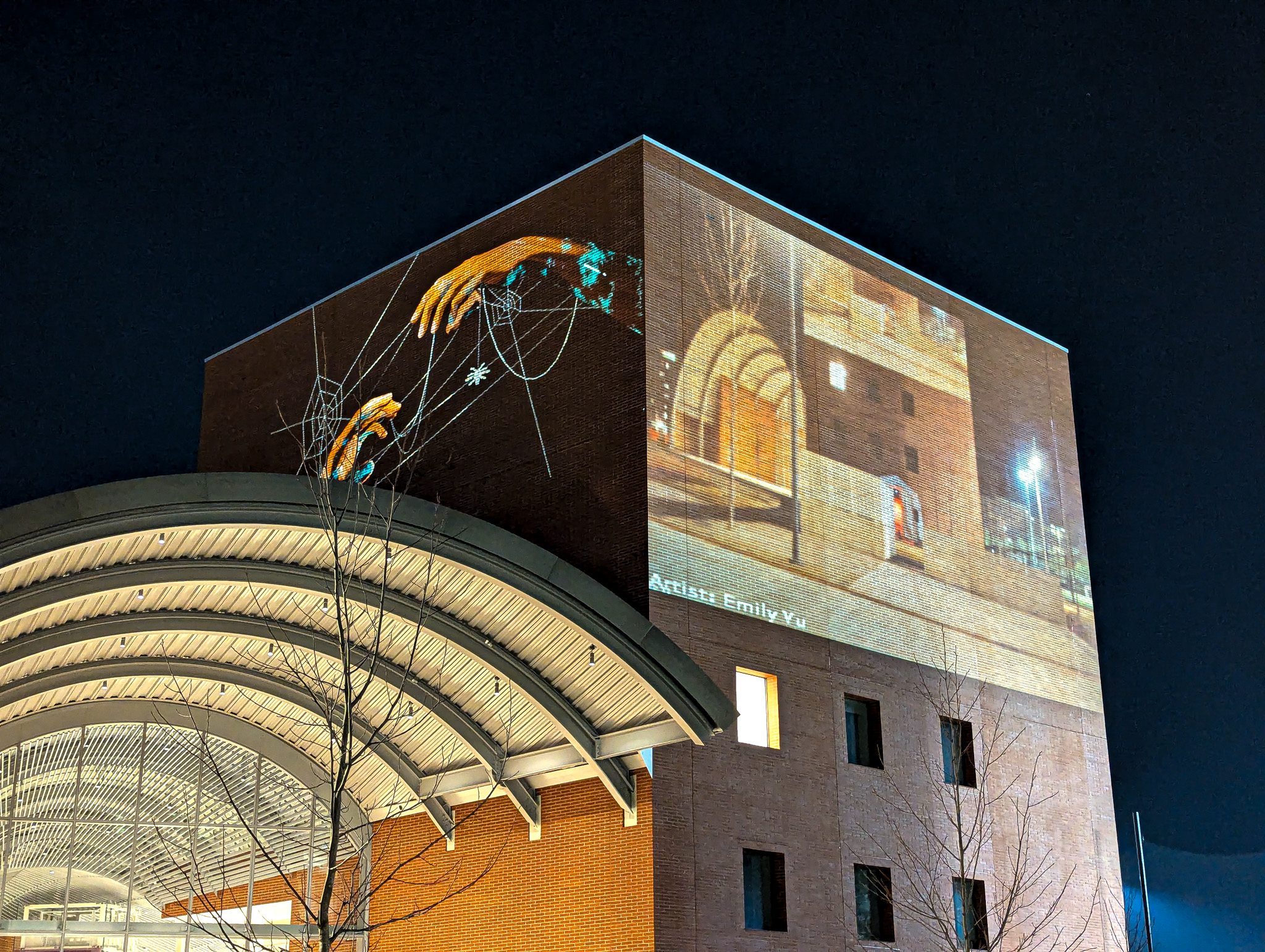
In March, the building served as a backdrop for large-scale projections of animated visuals created by students in MIT’s Interactive Design and Projection for Live Performance class.
AV PRODUCTIONS

Ayyub Abdulrezak ’24, MEng ’25, one of Egozy’s students, worked in the makerspace to develop compact sensor boxes that combine a microphone, a Raspberry Pi board, and custom signal-processing software. Each device logs when and how long a campus piano is played, sending the data to a central server. The resulting heat maps could help inform tuning schedules, improve access, or guide planning for music spaces across MIT.

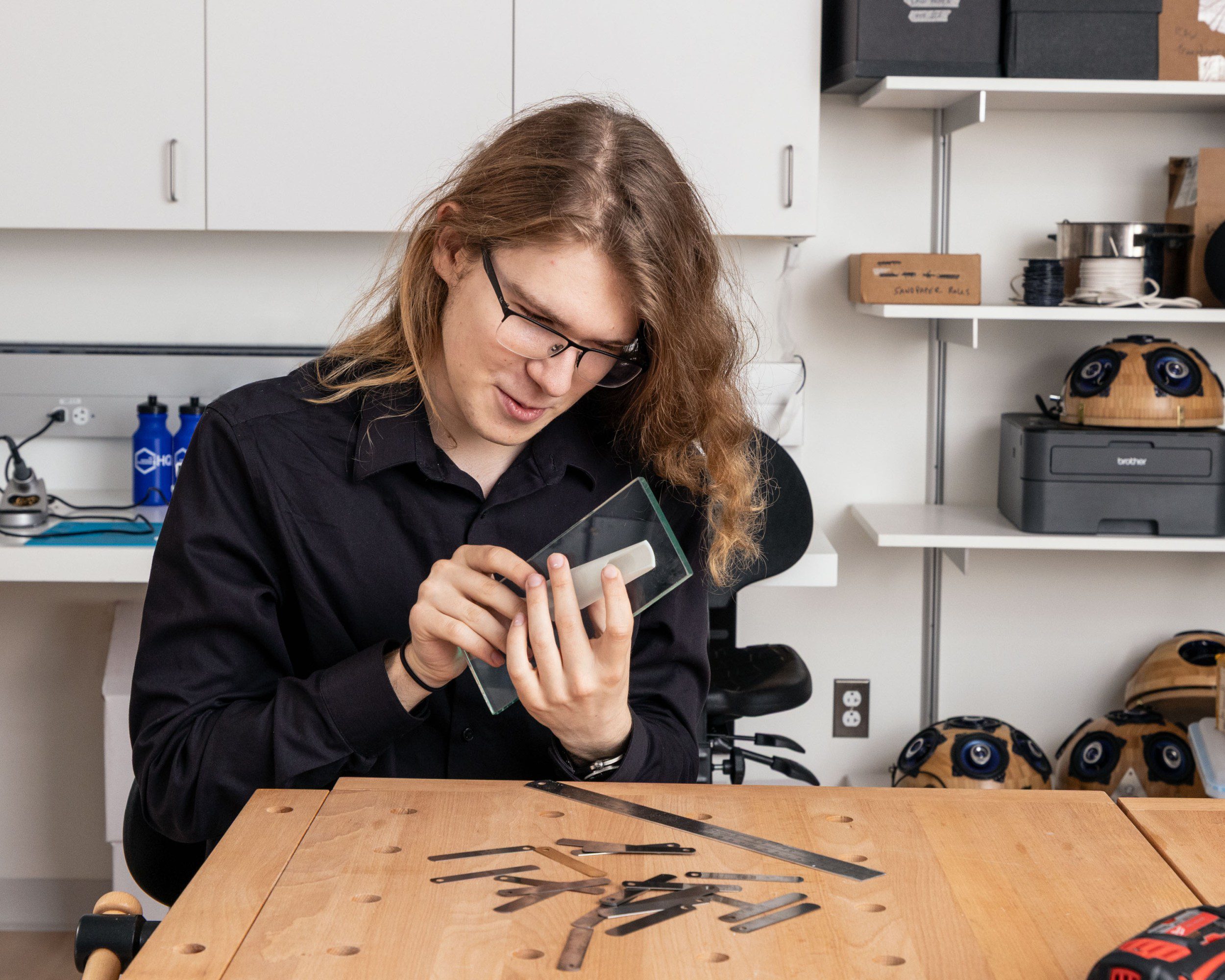
The makerspace also supports repair, maintenance, and modification. Hattwick describes it as a place to “build and fix and maintain and explore new kinds of instruments,” where students can learn what it means to refine a musical system—not just in theory but in screws, solder, and code. Rau, who also builds guitars, is incorporating more hands-on fabrication into his courses, merging electronics with instrument making and repair to yield a unified design practice.

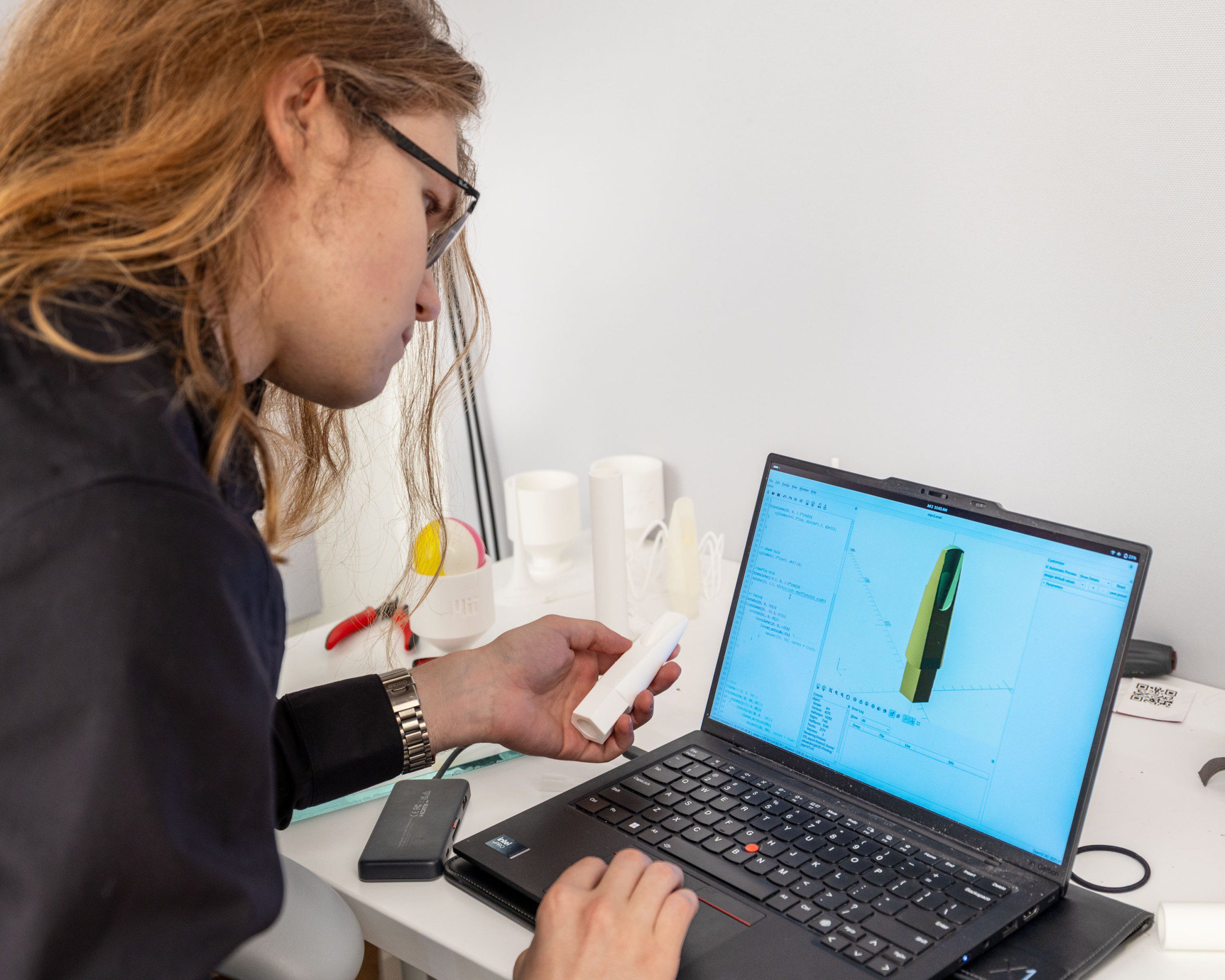
Alex at a laptop with a prototype in one hand
Alex Mazurenko ’28 is an undergraduate researcher working on slip casting, impedance testing, and musical instrument accessory designs. Here, he uses CAD software to design a custom saxophone mouthpiece.
ADAM DETOUR
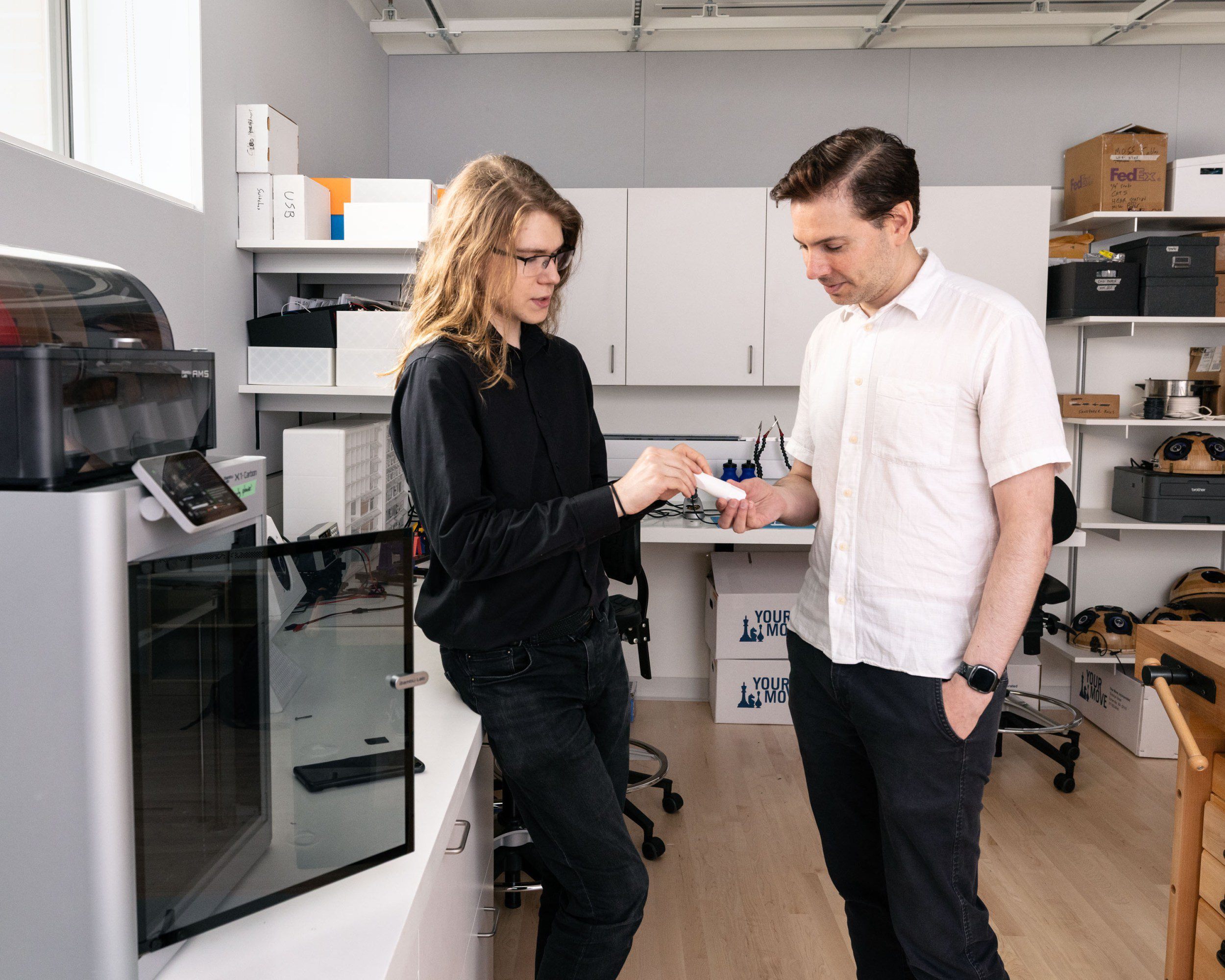
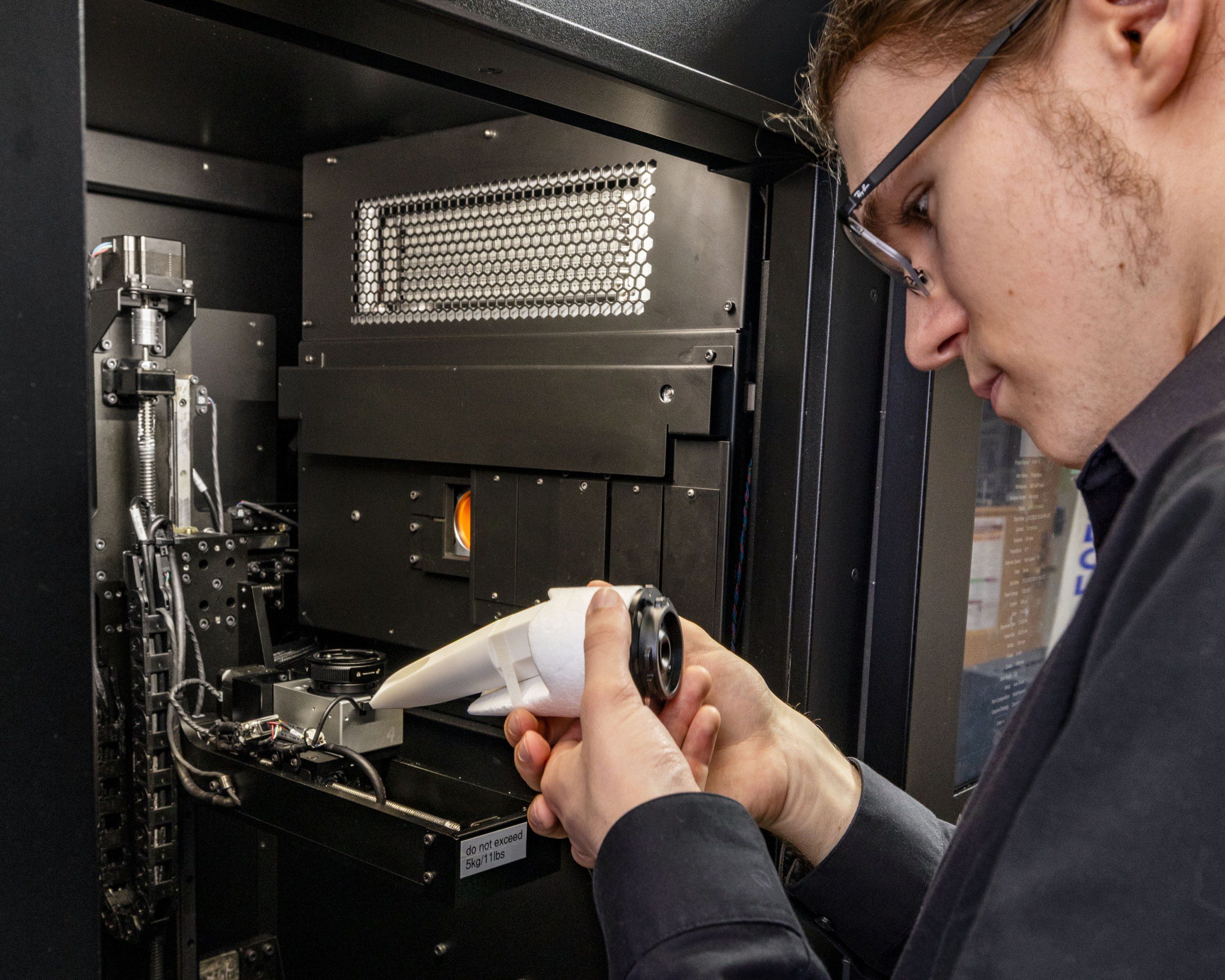
After 3D-printing his model, Mazurenko reviews the design with his advisor, senior postdoctoral associate Benjamin Sabatini.
ADAM DETOUR

He then refines the prototype using tools in the makerspace, a workshop where students can fabricate analog circuits, musical sensors, and even custom instruments.
ADAM DETOUR
Mazurenko brings the prototype to the Laboratory for Manufacturing and Productivity, where he images it in an x-ray CT scanner built by Lumafield, a startup founded by MIT alumni. He will use the scan to create a digital model for further testing and iteration.
ADAM DETOUR

While the space is still growing into its full potential, its ethos is clear: experimentation at the intersection of sound, system, and student agency. These kinds of projects rely not only on equipment but on space where musicians can experiment, fail, and refine. As the new master’s program takes shape, that environment will be central to how students learn and create.

Building sound and community

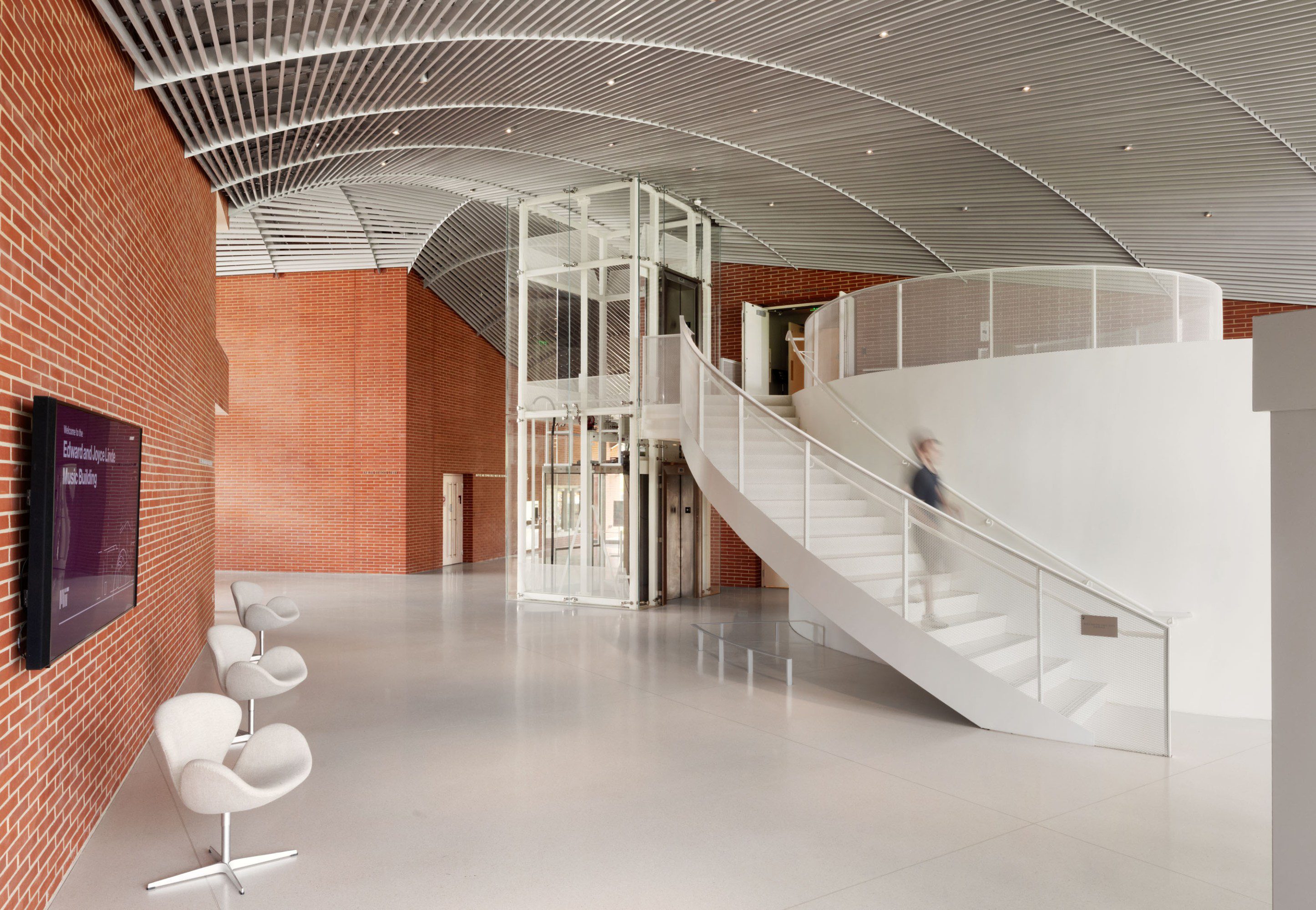
For the first time, MIT musicians, technologists, composers, and researchers share a space designed to bring their disciplines into conversation. The building’s form encourages these exchanges. Its three wings connect through a glass-lined lobby filled with daylight and movement. Students pause there to talk, overhear a rehearsal in progress, or catch sight of a friend heading to a practice room. 

a brick-walled lobby with freestanding elevator next to a white staircase
Curves abound in the brick- and glass-lined lobby of the Edward and Joyce Linde Music Building.
ADAM DETOUR

“Music is such a community thing,” says Christou. “I’ve learned about concerts, or that someone is coming to visit, or I’ve seen friends just studying or practicing. It’s really nice to have a hub with musical activity.”

Egozy sees these exchanges as central to the building’s mission. “It’s the idea cross-pollination that happens when you just happen to run into someone you know, literally by the water cooler, and you’re just chatting about this or that,” he says. “That’s my favorite part.”

Many of these encounters occur in the makerspace, where students working on entirely different projects end up asking each other questions, swapping tools, or launching ideas together. 

“Lots of students from all different walks of life have been building instruments, prototyping different devices,” says Makan, who adds that he wants the new building to be “a place for people to gather and hang out.” Many ensembles that once rehearsed in classrooms scattered across campus now work in adjoining rooms. “You feel like something is always happening,” Christou says. “It’s not just your practice or your rehearsal. It’s this sense of a shared rhythm.”

New frontiers for MIT’s music culture

Already, the Linde Music Building is affecting how music is conceived, taught, and experienced at MIT. Faculty members are rethinking syllabi to take advantage of the building’s multi-room routing capability and to delve more into spatial acoustics, interactive sound design, and even instrument making. Students are beginning to compose with acoustics in mind, treating the building itself as part of their instrument.

For example, Rau is engaging students in projects that explore room dynamics and acoustics as integral to music. In one class, students listen for differences in how music sounds in various parts of Tull Hall and observe changes when the curtains are used. Then they conduct acoustic measurements of the hall’s reverberation and build a digital copy of the hall, creating a sonic blueprint of the space that lets them produce artificial reverberation. Egozy, meanwhile, is developing tools that let performers engage audiences in new ways. 

This June, one of those ideas was scaled up. As part of the International Computer Music Conference, MIT premiered a piece that invited audience members to shape the sound in real time using their phones. Musicians performed in Tull Hall, surrounded by a circular array of 24 speakers, with the audio shifting throughout the space in response to the audience input. 

seating in the concert hall
Undulating walls and an overhanging ring of glass panels help engineers customize the acoustics for each performance in the Thomas Tull Concert Hall.
ADAM DETOUR

Performances like these are fueling growing interest in the building’s creative potential at MIT and beyond. Visiting composers have proposed site-specific works. Local ensembles are booking time to record in Tull Hall. Faculty are exploring how the building might support residencies that pair MIT researchers with performers working at the leading edges of both sound and computation.

performance at the Linde
The circular Tull Hall allows countless configurations for both performers and audiences. Here singers perform from the upper level of the hall while instrumentalists play from center stage at the base of the room.
CAROLINE ALDEN

“This hall is really special. There’s nothing like it anywhere in the Boston area,” Egozy says. “We will have a lot of really amazing events that will draw people into MIT. We’re excited about what it’s going to do for the MIT students, but it’s also going to do a lot just for the whole Boston area.”

Each day, students and faculty explore its possibilities—linking rehearsal with recording, sound design with performance, tradition with experiment.

MIT is “a place to enable exploration of new vistas, and really letting everyone pursue their path to what their vision is,” Hattwick says. “The music building is just going to be like a huge boost to doing even more cool things in the future.”

Junior Peña, neutrino hunter

Growing up in South Central Los Angeles, Junior Peña learned to keep his eyes down and his schedule full. In his neighborhood, a glance could invite trouble, and many kids—including his older brother—were pulled into gang culture. He knew early on that he wanted something else. With his parents working long hours, he went to after-school programs, played video games, and practiced martial arts. But his friends had no idea that he also spent hours online poring over textbooks and watching lectures, teaching himself advanced mathematics and philosophy. “Being good at school wasn’t how people saw me,” he says. 

One night in high school, he came across a YouTube video about the Higgs boson—the so-called “God particle,” thought to give mass to nearly everything in the universe. “I remember my mind being flooded with questions about life, the universe, and our existence,” he recalls. He’d already looked into philosophers’ answers to those questions but was drawn to the more concrete explanations of physics.

After his independent study helped Peña pass AP calculus as a junior, his fascination with physics led him to the University of Southern California, the 2019 session of MIT’s Summer Research Program, and then MIT for grad school. Today, he’s working to shed light on neutrinos, the ghostly uncharged particles that slip effortlessly through matter. Particles that would require a wall of lead five light-years thick to stop.

As a grad student in the lab of Joseph Formaggio, an experimental physicist known for pioneering new techniques in neutrino detection, Peña works alongside leading physicists designing technology to precisely measure what are arguably the universe’s most elusive particles. Emanating from such sources as the sun and supernovas (and generated artificially by particle accelerators and nuclear reactors), neutrinos reveal their presence through an absence. Their existence was initially posited in the 1930s by the physicist Wolfgang Pauli, who noticed that energy seemed to go missing when atoms underwent a process known as radioactive beta decay. According to the law of conservation of energy, the total energy of the particles emitted during radioactive decay must equal the energy of the decaying atom. To account for the missing energy, Pauli proposed the existence of an undetectable particle that was carrying it away. 

Einstein’s E = mc2 tells us that if energy is missing, then mass must be too. Yet according to the standard model of physics—which offers our most trusted theory for how particles behave—neutrinos should have no mass at all. Unlike other particles, they don’t interact with the Higgs field, a kind of cosmic molasses that slows particles down and gives them mass. Because they pass through it untouched, they should remain massless. 

But by the early 2000s, researchers had discovered that neutrinos, which had first been detected in the 1950s, can shift between three types, a feat possible only if they have mass. So now the tantalizing question is: What is their mass? 

Determining neutrinos’ exact mass could explain why matter triumphed over antimatter, refine models of cosmic evolution, and clarify the particles’ role in dark matter and dark energy. And the Formaggio Lab is part of Project 8, an international collaboration of 71 scientists in 17 institutions working to make that measurement. To do this, the lab uses tritium, an unstable isotope of hydrogen that decays into helium, releasing both an electron and a particle called an antineutrino (“every particle has an antiparticle counterpart,” Formaggio explains). By precisely measuring the energy spectrum of those electrons, scientists can determine how much energy is missing, allowing them to infer the neutrinos’ mass.

At the heart of this experiment is a novel detection method called cyclotron radiation emission spectroscopy (CRES), first proposed in 2008 by Formaggio and his then postdoc Benjamin Monreal, which “listens” to the faint radio signals emitted as electrons spiral through a magnetic field. Peña was instrumental in designing a crucial part of the tool that will make this possible: a copper cavity that he likens to a guitar, with the electrons released during beta decay acting like plucked strings. The cavity will amplify their signals, helping researchers to measure them exactly. Peña spent more than a year developing and refining a flashlight-size prototype of the device in collaboration with machinists and fellow physicists.

Peña designed a prototype copper microwave resonator to amplify the signals of electrons emitted as tritium decays, allowing researchers to measure them exactly and infer the neutrino’s mass.
JESSICA CHOMIK-MORALES, SM ’25

“He had to learn the [design and simulation] software, figure out how to interpret the signals, and test iteration after iteration,” says Formaggio, Peña’s advisor. “It’s been incredible watching him take this from a rough idea to a working design.”

The design of Peña’s cavity had to balance competing demands. It needed a way to extract the electrons’ signals that was compatible with the researchers’ methods for calibrating the system, one of which involves using an electron gun to inject electrons of a known, precise energy into the cavity. And it also needed to preserve the properties of the electromagnetic fields within the cavity. In May, Peña sent his final prototype to the University of Washington, where it was installed in July. Researchers hope to begin calibration this fall. Then Peña’s cavity and the full experimental setup will be scaled up so in a few years they can begin collecting CRES data using tritium.

“We’ve been working toward this for at least three years,” says Jeremy Gaison, a Project 8 physicist at the Pacific Northwest National Lab. “When we finally turn on the experiment, it’s going to be incredible to see if all of our simulations and studies actually hold up in real data.”

Peña’s contribution to the effort “is the core of this experiment,” says Wouter Van De Pontseele, another Project 8 collaborator and former Formaggio Lab postdoc. “Junior took an idea and turned it into reality.” 

Project 8 is still in its early stages. The next phase will scale up with larger, more complex versions of the technology Peña played a key role in developing, culminating in a vast facility designed to hunt for the neutrino’s mass. If that is successful, the findings could have profound implications for our understanding of the universe’s structure, the evolution of galaxies, and even the fundamental nature of matter itself.

Eager to keep probing such open questions in fundamental physics, Peña is still exploring options for his postdoc work. One possibility is focusing on the emerging field of levitated nanosensors, which could advance gravitation experiments, efforts to detect dark matter, and searches for the sterile neutrino, a posited fourth variety that interacts even more rarely than the others.

“Experimental particle physics is long-term work,” says Van De Pontseele. “Some of us will stay on this project for decades, but Junior can walk away knowing he made a lasting impact.”

Peña also hopes to have a lasting impact as a professor, opening doors for students who, like him, never saw themselves reflected in the halls of academia. “A summer program brought me here,” he says. “I owe it to the next kid to show they belong.”