MIT is worth fighting for

As I write in late July, we’re contending with a major tax increase on the annual returns from MIT’s endowment as well as other investments and assets. This new tax burden will strain the resources we use to support research, innovation, and student scholarships and financial aid—the heart and soul of the Institute. 

And the financial impact on us will be significant: This tax increase alone will cost in the range of 10% of MIT’s annual central budget. 

Unfortunately, we face the prospect of further threats to our mission and financial model this fall when Congress considers drastic cuts to the research budgets of federal agencies. And all this comes on the heels of multiple US science agencies capping their reimbursement of research infrastructure and administration expenses well below actual costs. These reimbursements are critical to operating our world-class research enterprise, and that’s why we have challenged the government’s actions in court. 

I don’t expect we all agree on the ideal contours of the Institute’s future. But I have to believe that we all agree it should have a future.

For more information—and ways to help—you can consult these online resources:

Visit Understanding MIT for a comprehensive view of the Institute’s value to the nation and the world.  

Go to Stand up for MIT and find ways to take action.

And visit MIT’s Response to government activity page to keep up to date on what’s happening in Washington and how it’s affecting the nation’s great research enterprise. 

MIT was built with the support of generations of alumni and friends—and it’s up to us to keep its foundations strong for those to come. 

So I hope you will join me in standing up for MIT.

Infinite Threads

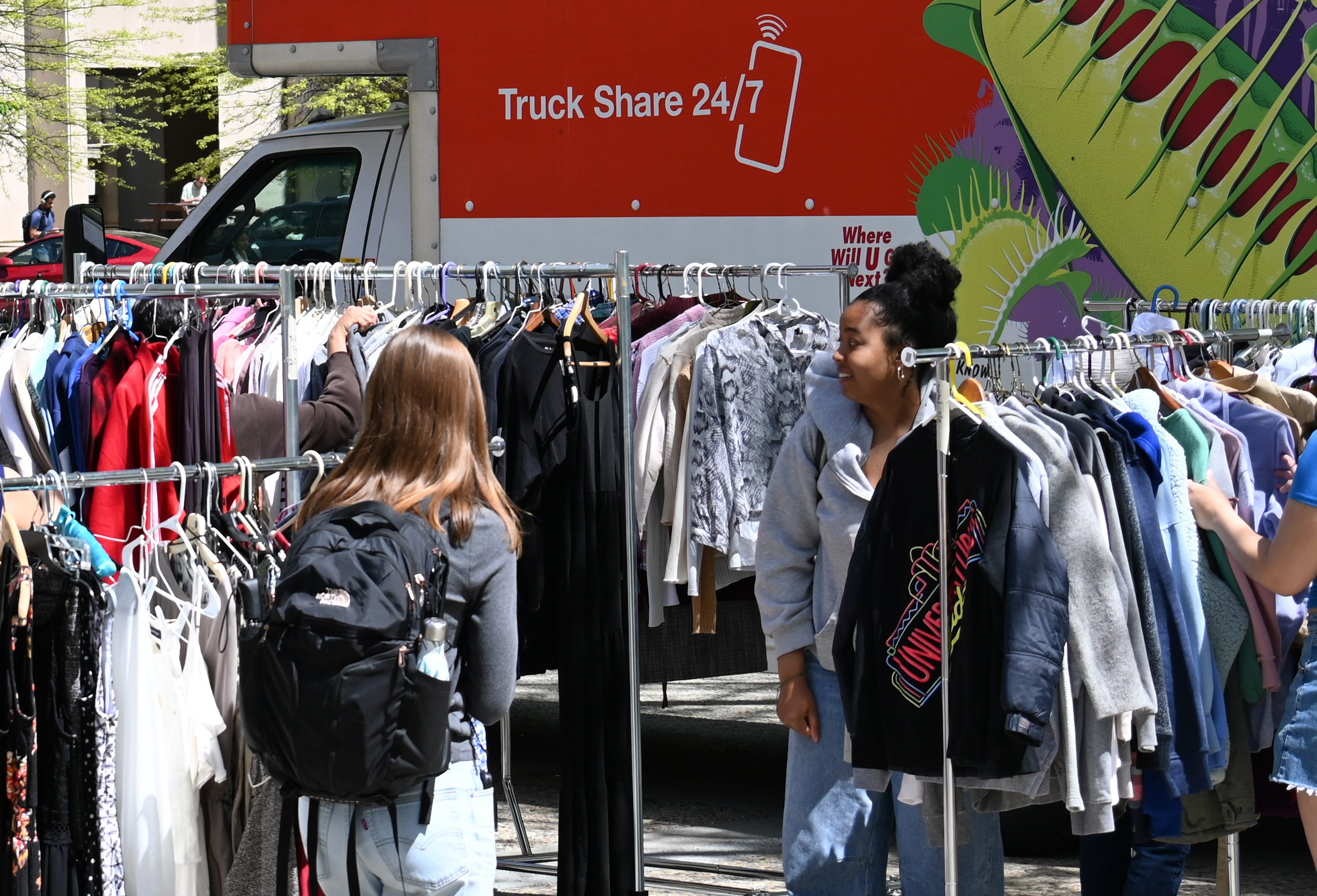
Textiles account for 5% of landfill space—and clothing made with polyester can take up to 200 years to decompose. Massachusetts tackled the problem by banning disposal of clothing and fabrics in 2022. And Infinite Threads, a spinoff of the Undergraduate Association Sustainability Committee, is addressing it by collecting lightly used clothing from the MIT community and selling it for $2 to $6 per item at popup sales held several times each semester. 

“Our goal is simple: We want to keep clothing out of landfills,” says Cameron Dougal ’25, who led the effort with Erin Hovendon ’26 in 2024–’25. That year, the group sold over 1,000 items and gave about 750 pounds of unsold goods to Helpsy, an organization that collects used clothing for resale and recycling. Infinite Threads uses proceeds from its sales to pay student workers and to rent a U-Haul to bring clothing to the popups. 

people look through racks of clothes outdoors with a U-haul truck in the background

SARAH FOOTE

In addition to helping the planet, offering affordable clothing options generates a lot of positive feedback on campus. “I love hearing from students that they got clothing items they now wear frequently from one of our sales,” says Hovendon. 

Infinite Threads also gives away leftover T-shirts from residence hall events and career fairs, which Dougal says demonstrates the importance of a hyperlocal reuse ecosystem. “As soon as these types of items leave campus,” he says, “there is a much lower chance that they will find a new home.”

Fix damaged art in hours with AI

Art restoration takes steady hands and a discerning eye. For centuries, conservators have identified areas needing repair and then mixed the exact shades needed to fill in one area at a time. Restoring a single painting can take anywhere from a few weeks to over a decade. Now an MIT graduate student in mechanical engineering has used artificial intelligence to speed up the process by orders of magnitude.

Digital restoration tools are not new; computer vision, image recognition, and color matching have all helped generate repaired versions of damaged paintings in recent years. But until now, there has been no way to apply the results directly onto an original canvas. Instead, they are usually displayed virtually or printed as stand-alone works.

In his study, Alex Kachkine, SM ’23, presents a new method he’s developed that involves printing the restoration on a very thin polymer film that can be carefully aligned with a painting and adhered to it or easily removed. As a demonstration, he used the method to repair a highly damaged 15th-century oil painting he owned. First he used traditional techniques to clean the painting and remove any past restoration efforts. Then he scanned the painting, including the many regions where paint had faded or cracked, and used existing algorithms to create a virtual version of what it may have looked like originally.

Next, Kachkine used software he developed to create a map of regions on the original painting that require infilling, along with the exact colors needed. The method automatically identified 5,612 regions in need of repair and filled them in using 57,314 different shades. This map was then translated into a physical, two-layer mask printed onto polymer-based films. The first layer was printed in color, while the second layer was printed in the exact same pattern but in white.

“In order to fully reproduce color, you need both white and color ink to get the full spectrum,” Kachkine explains. He used high-fidelity commercial inkjets to print the mask’s two layers, which he carefully aligned with the help of computational tools he developed. Then he overlaid them by hand onto the original painting and adhered them with a thin spray of conventional varnish. The films are made from materials that can be easily dissolved in case conservators need to reveal the original, damaged work. The entire process took 3.5 hours, which he estimates is about 66 times faster than traditional restoration methods.

If this method is adopted widely, Kachkine emphasizes, conservators should be involved at every step, to ensure that the final work is in keeping with an artist’s style and intent. The digital file of the mask can also be saved to document exactly what was restored. “Because there’s a digital record of what mask was used, in 100 years, the next time someone is working with this, they’ll have an extremely clear understanding of what was done to the painting,” Kachkine says. “And that’s never really been possible in conservation before.”

The result, he hopes, will be a new lease on life for many works that have not had a chance to be repaired by hand. “There is a lot of damaged art in storage that might never be seen,” he says. “Hopefully with this new method, there’s a chance we’ll see more art.” 

Emergency help for low blood sugar

Most people with type 1 diabetes inject insulin to prevent their blood sugar levels from getting too high. However, if their blood sugar gets too low, it can lead to confusion, seizures, and even death.

To combat this hypoglycemia, some patients carry syringes of glucagon, a hormone that stimulates release of glucose. Now MIT engineers have developed an alternative that could work even when people don’t realize they are becoming hypoglycemic. It could also help during sleep, or for children who are unable to inject themselves. “Our goal was to build a device that is always ready to protect patients,” says Daniel Anderson, a professor in MIT’s Department of Chemical Engineering and the senior author of a study on the work.

The implantable device, about the size of a quarter, contains a polymer reservoir holding powdered glucagon and sealed with a material that can be programmed to change shape when heated. It also includes an antenna that allows the user to remotely turn on a small electrical current, which heats that material until it bends and releases the drug. Because the device can receive wireless signals, it could also be triggered automatically by a glucose monitor.

The researchers have successfully tested the implant in mice and say it could also be used to deliver epinephrine to treat heart attacks or prevent anaphylactic shock. 

‘Bubbles’ turn air into drinkable water

Today, 2.2 billion people in the world lack access to safe drinking water. But the atmosphere contains millions of billions of gallons of water in the form of vapor, and researchers have tried various strategies to capture and condense it in places where traditional sources are inaccessible. Now MIT engineers have improved on that approach with an atmospheric water harvester based on an absorbent hydrogel.

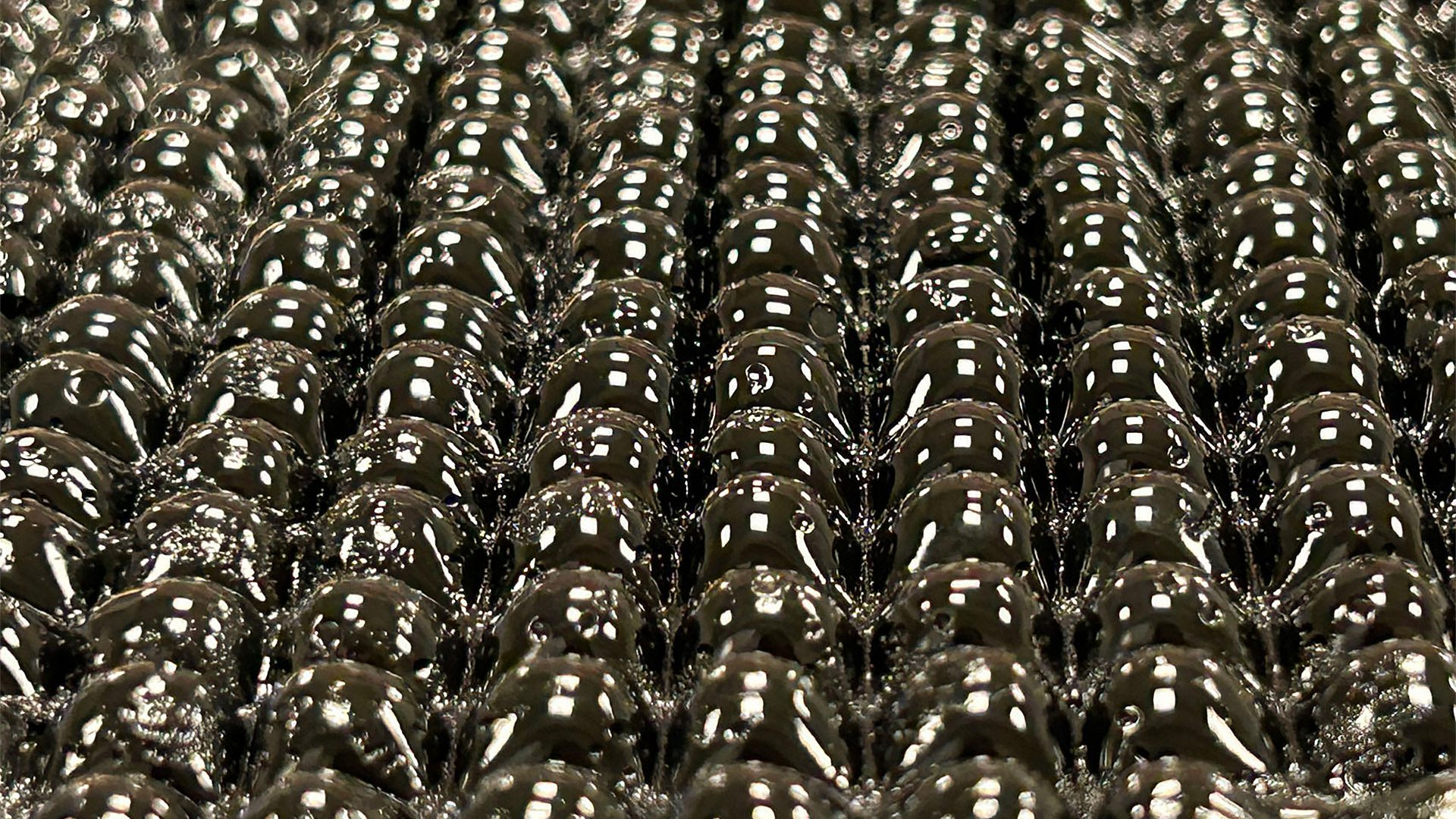
The gel they developed has more vapor-carrying capacity than some materials others have used to trap water from the air, and it is less likely to leak the salts that are often embedded in hydrogels to increase absorption. They also increased its surface area, and thus the amount of vapor it can hold, by molding it into a pattern of small domes resembling bubble wrap. 

a grid of bubbles on a dark surface

COURTESY OF THE RESEARCHERS

In the researchers’ prototype device, a half-square-meter panel of the hydrogel is enclosed in a glass chamber coated with a cooling polymer film. When the vapor captured by the textured material evaporates, the bubbles shrink down in an origami-­like transformation. The vapor then condenses on the glass, where it can flow out through a tube.

The system runs entirely on its own, unlike other designs that require batteries, solar panels, or electricity from the grid. The team ran it for over a week in Death Valley, California—the driest place in North America. Even in those conditions, it squeezed clean water from the air at rates of up to 160 milliliters (about two-thirds of a cup) per day.

“We have built a meter-scale device that we hope to deploy in resource-limited regions, where even a solar cell is not very accessible,” says Professor Xuanhe Zhao, the senior author of a paper on the work. The team estimates that a small array of the panels could passively supply a household with drinking water even in a desert, with greater production in temperate and tropical climates.

Chandrakasan named provost

Anantha Chandrakasan became the Institute’s new provost on July 1, succeeding Cynthia Barnhart, SM ’86, PhD ’88, who announced her decision to step down in February.

Chandrakasan, who earned his BS, MS, and PhD in electrical engineering and computer science from the University of California, Berkeley, joined MIT in 1994. Head of the Energy-Efficient Circuits and Systems Group, he has been dean of the School of Engineering since 2017 and MIT’s inaugural chief innovation and strategy officer, playing a key role in launching multiple new initiatives, since 2024. He headed the Department of Electrical Engineering and Computer Science, MIT’s largest academic department, for six years.

As MIT’s senior academic and budget officer, Chandrakasan will focus on understanding institutional needs and strategic financial planning, attracting and retaining top talent, and supporting cross-cutting research, education, and entrepreneurship programming. On all these fronts, he plans to seek frequent input from across the Institute. He also plans to establish a provost faculty advisory group, as well as student/postdoc advisory groups and an external provost advisory council.

“There is a tremendous opportunity for MIT to be at the center of the innovations in areas where the United States wants to lead,” Chandrakasan says. “It’s about AI. It’s about semiconductors. It’s about quantum, the bio­security and biomanufacturing space—but not only that. We need students who can do more than just code or design or build. We really need students who understand the human perspective and human insights.” 

One-shot vaccines for HIV and covid

A team at MIT and the Scripps Research Institute has made important progress toward vaccines that can protect against HIV, and potentially other diseases, with a single dose.

The researchers treated mice with a vaccine that combines two different adjuvants, materials that help stimulate the immune system—one incorporating a compound previously developed by Scripps professor Darrell Irvine. 

Irvine and MIT professor J. Christopher Love, the senior authors of a paper on the work, had found that the combination helped generate more robust immune responses. In the new paper, they showed that the dual-adjuvant vaccine accumulated in the lymph nodes, where white blood cells known as B cells encounter antigens and undergo rapid mutations that generate new antibodies. The vaccine’s antigens remained there for up to a month, allowing the immune system to build up a much greater number and diversity of antibodies against the HIV protein than the vaccine given alone or with one adjuvant.

“When you think about the immune system sampling all of the possible solutions, the more chances we give it to identify an effective solution, the better,” Love says. 

This approach may mimic what occurs during a natural infection and could lead to an immune response so strong and broad that vaccines only need to be given once. Love says, “It offers the opportunity to engineer new formulations for these types of vaccines across a wide range of different diseases, such as influenza, SARS-CoV-2, or other pandemic outbreaks.”

The Download: churches in the age of AI, and how to run an LLM at home

This is today’s edition of The Download, our weekday newsletter that provides a daily dose of what’s going on in the world of technology.

How churches use data and AI as engines of surveillance

On a Sunday morning in a Midwestern megachurch, worshippers step through sliding glass doors into a bustling lobby—unaware they’ve just passed through a gauntlet of biometric surveillance. High-speed cameras snap multiple face “probes” per second, before passing the results to a local neural network that distills these images into digital fingerprints. Before people find their seats, they are matched against an on-premises database—tagged with names, membership tiers, and watch-list flags—that’s stored behind the church’s firewall.

This hypothetical scene reflects real capabilities increasingly woven into places of worship nationwide, where spiritual care and surveillance converge in ways few congregants ever realize. 

Where Big Tech’s rationalist ethos and evangelical spirituality once mixed like oil and holy water, now they’re combining to redraw the contours of community and pastoral power in modern spiritual life. Read the full story.

—Alex Ashley

This story is from our forthcoming print issue, which is all about security. If you haven’t already, subscribe now to receive future issues once they land.

MIT Technology Review Narrated: How to run an LLM on your laptop

For people who are concerned about privacy, want to break free from the control of the big LLM companies, or just enjoy tinkering, local models offer a compelling alternative to ChatGPT and its web-based peers. Here’s how to get started running one from the safety and comfort of your own computer.

This is our latest story to be turned into a MIT Technology Review Narrated podcast, which we’re publishing each week on Spotify and Apple Podcasts. Just navigate to MIT Technology Review Narrated on either platform, and follow us to get all our new content as it’s released.

The must-reads

I’ve combed the internet to find you today’s most fun/important/scary/fascinating stories about technology.

1 US tech stocks are sliding over fears the AI bubble may be about to burst
After an MIT report found that the vast majority of organizations are getting zero return on their AI investments. (FT $)
+ Even Sam Altman thinks the current hype is unsustainable. (CNBC)

2 Meta is reportedly weighing up downsizing its AI division
It wants to split it into four groups—and layoffs could be imminent. (NYT $)+ What’s happening with the metaverse, then? (NY Mag $)
+ Meta is desperately hoping its AI hiring spree will pay off. (Bloomberg $)

3 The American Academy of Pediatrics is defying RFK Jr

By releasing its own vaccination schedule for children. (Ars Technica)
+ It’s breaking with current CDC recommendations. (CNN)
+ Why US federal health agencies are abandoning mRNA vaccines. (MIT Technology Review)

4 Elon Musk’s America Party isn’t going so well
He’s said to be refocusing his attention on his companies instead. (WSJ $)

5 The White House has a TikTok account now
The very same TikTok that Donald Trump once tried to ban. (WP $)
+ What appears to have changed Congress’ stance? (The Verge)
+ There’s still no sign of a sale on the horizon. (The Guardian)

6 Nvidia is working on another chip for China
One that’s faster and more powerful than its current H20 model. (Reuters)

7 How AGI preppers are bracing themselves for an AI apocalypse
Some are spending all their retirement savings along the way. (Insider $)

8 Demand for critical minerals is soaring
Is there a less-invasive way to mine them? (New Scientist $)
+ The race to produce rare earth elements. (MIT Technology Review)

9 What’s an automaker CEO to do?
In our increasingly topsy turvy world, many of them feel like they can’t win. (Wired $)

10 This mattress company is building an AI agent for sleep
Eight Sleep’s agent could simulate digital twins of a user’s sleep habits. (The Information $)
+ I tried to hack my insomnia with technology. Here’s what worked. (MIT Technology Review)

Quote of the day

Too many cooks, too many kitchens.”

—Tech investor M.G. Siegler wryly comments on the news Meta is planning to restructure its AI division in a post on Bluesky.

One more thing

Responsible AI has a burnout problem

Margaret Mitchell had been working at Google for two years before she realized she needed a break. Only after she spoke with a therapist did she understand the problem: she was burnt out.

Mitchell, who now works as chief ethics scientist at the AI startup Hugging Face, is far from alone in her experience. Burnout is becoming increasingly common in responsible AI teams.

All the practitioners MIT Technology Review interviewed spoke enthusiastically about their work: it is fueled by passion, a sense of urgency, and the satisfaction of building solutions for real problems. But that sense of mission can be overwhelming without the right support. Read the full story

—Melissa Heikkilä

We can still have nice things

A place for comfort, fun and distraction to brighten up your day. (Got any ideas? Drop me a line or skeet ’em at me.)

+ Check out Wes Andersons’ quirky love letter to New York 🗽
+ Uhoh—beware the rise of the groomzilla.
+ The Rocky Horror Picture Show is 50 years old, if you can believe it.
+ Whisk me away to Lake George ASAP.

This quantum radar could image buried objects

Physicists have created a new type of radar that could help improve underground imaging, using a cloud of atoms in a glass cell to detect reflected radio waves. The radar is a type of quantum sensor, an emerging technology that uses the quantum-mechanical properties of objects as measurement devices. It’s still a prototype, but its intended use is to image buried objects in situations such as constructing underground utilities, drilling wells for natural gas, and excavating archaeological sites.

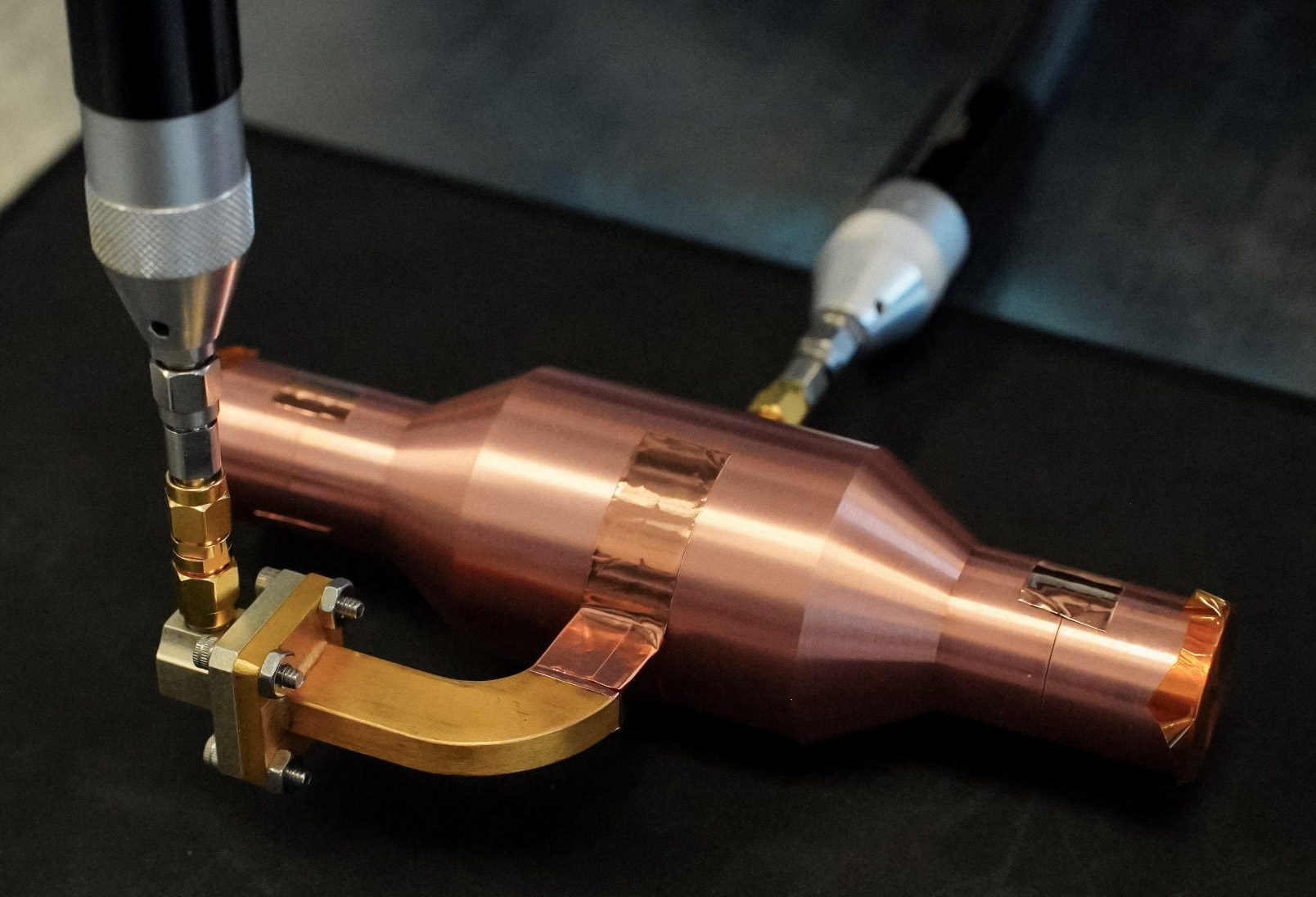
Like conventional radar, the device sends out radio waves, which reflect off nearby objects. Measuring the time it takes the reflected waves to return makes it possible to determine where an object is. In conventional radar, the reflected waves are detected using a large antenna, among other receiver components. But in this new device, the reflected waves are registered by detecting the interactions between the returning waves and the atom cloud.

The current incarnation of the radar is still bulky, as the researchers have kept it connected to components on an optical table for ease of testing. But they think their quantum radar could be significantly smaller than conventional designs. “Instead of having this sizable metal structure to receive the signal, we now can use this small glass cell of atoms that can be about a centimeter in size,” says Matthew Simons, a physicist at the National Institute of Standards and Technology (NIST), who was a member of the research team. NIST also worked with the defense contractor RTX to develop the radar.  

The glass cell that serves as the radar’s quantum component is full of cesium atoms kept at room temperature. The researchers use lasers to get each individual cesium atom to swell to nearly the size of a bacterium, about 10,000 times bigger than the usual size. Atoms in this bloated condition are called Rydberg atoms. 

When incoming radio waves hit Rydberg atoms, they disturb the distribution of electrons around their nuclei. Researchers can detect the disturbance by shining lasers on the atoms, causing them to emit light; when the atoms are interacting with a radio wave, the color of their emitted light changes. Monitoring the color of this light thus makes it possible to use the atoms as a radio receiver. Rydberg atoms are sensitive to a wide range of radio frequencies without needing to change the physical setup, says Michał Parniak, a physicist at the University of Warsaw in Poland, who was not involved in the work. This means a single compact radar device could potentially work at the multiple frequency bands required for different applications.

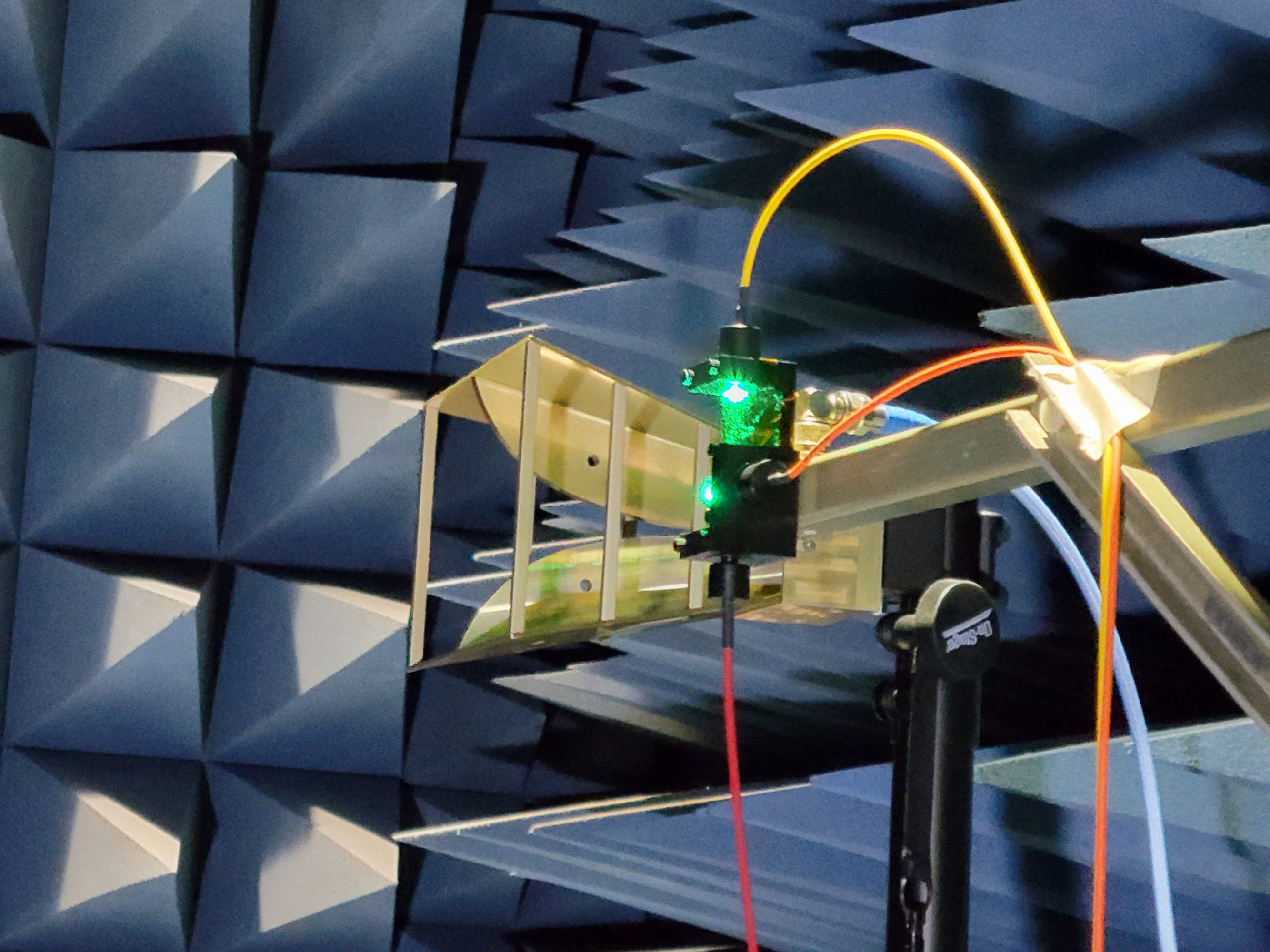
Simons’s team tested the radar by placing it in a specially designed room with foam spikes on the floor, ceiling, and walls like stalactites and stalagmites. The spikes absorb, rather than reflect, nearly all the radio waves that hit them. This simulates the effect of a large open space, allowing the group to test the radar’s imaging capability without unwanted reflections off walls. 

radar setup in a room lined by dampening foam

MATT SIMONS, NIST

The researchers placed a radio wave transmitter in the room, along with their Rydberg atom receiver, which was hooked up to an optical table outside the room. They aimed radio waves at a copper plate about the size of a sheet of paper, some pipes, and a steel rod in the room, each placed up to five meters away. The radar allowed them to locate the objects to within 4.7 centimeters. The team posted a paper on the research to the arXiv preprint server in late June.

The work moves quantum radar closer to a commercial product. “This is really about putting elements together in a nice way,” says Parniak. While other researchers have previously demonstrated how Rydberg atoms can work as radio wave detectors, he says, this group has integrated the receiver with the rest of the device more sleekly than before. 

Other researchers have explored the use of Rydberg atoms for other radar applications. For example, Parniak’s team recently developed a Rydberg atom sensor for measuring radio frequencies to troubleshoot chips used in car radar. Researchers are also exploring whether radar using Rydberg-atom receivers could be used for measuring soil moisture.

This device is just one example of a quantum sensor, a type of technology that incorporates quantum components into conventional tools. For example, the US government has developed gyroscopes that use the wave properties of atoms for sensing rotation, which is useful for navigation. Researchers have also created quantum sensors using impurities in diamond to measure magnetic fields in, for example, biomedical applications.

One advantage of quantum sensors is the inherent consistency of their core components. Each cesium atom in their device is identical. In addition, the radio receiver relies on the fundamental structure of these atoms, which never changes. Properties of the atoms “can be linked directly to fundamental constants,” says Simons. For this reason, quantum sensors should require less calibration than their non-quantum counterparts. 

Governments worldwide have invested billions of dollars to develop quantum sensors and quantum computers, which share similar components. For example, researchers have built quantum computers using Rydberg atoms as qubits, the equivalent to bits in a conventional computer. Thus, advances in quantum sensing can potentially translate into advances into quantum computing, and vice versa. Parniak has recently adapted an error-correction technique from quantum computing to improve a Rydberg-atom-based sensor. 

Researchers still need to continue developing quantum radar before it can be made commercially viable. In the future, they need to work on improving the device’s sensitivity to fainter signals, which could involve improving the coatings for the glass cell. “We don’t see this replacing all radar applications,” says Simons. Instead, he thinks it will be useful for particular scenarios that require a compact device.

From MIT to low Earth orbit

Not everyone can point to the specific moment that set them on their life’s course. But for me, there’s no question: It happened in 1982, when I was a junior at MIT, in the Infinite Corridor. In those pre-internet days, it was where we got the scoop about everything that was happening on campus. One day, as I was racing to the chemistry labs, a poster caught my eye.

As I remember it, the poster showed a smiling woman in a flight suit, holding a helmet by her side. I recognized her immediately: Sally Ride, one of America’s first group of female astronauts. It had just been announced that she would be part of the crew for one of the upcoming space shuttle flights, making her the first American woman in space. And while she was visiting Lincoln Lab for training, she would be giving a speech and attending a reception hosted by the Association of MIT Alumnae. A woman speaker was still a novelty at MIT in those days. But a woman astronaut? I knew this was one event I had to attend. 

Coleman sits in the rear seat of a supersonic T-38 jet for pilot training as a newly minted NASA astronaut candidate in 1992. “When a chemist gets to fly a T-38, she will always be smiling,” she says.
NASA

On the day of Sally Ride’s talk, I hurried into 10-250, the large lecture hall beneath the Great Dome that is the emblem of MIT. Sandy Yulke, the chair of the Association of MIT Alumnae, was already introducing Sally. Sally. Just a first name. As if she were one of us. I slid into an empty seat just a few rows back as Sandy talked about how proud she was to welcome the soon-to-be first American woman in space. And Sally was standing there, right where our professors stood every day. A woman. And an astronaut. 

When I was growing up in the 1960s and ’70s, the image I’d had of astronauts—or any kind of explorer, for that matter—could not have been further from the figure before me that day. And I’m not just talking about images I saw in the media—I had one much closer to home. My dad—James Joseph Coleman, known as JJ—was a career naval officer who ultimately led the Experimental Diving Unit. A legend among Navy divers, he had also been a project officer for the Sealab program that built the first underwater habitats, allowing men—and it was all men at the time—to live and work in the deep seas for extended periods. The spirit of exploration, the desire to understand fascinating and challenging environments, seemed normal to me. But because none of the explorers I saw looked like me, it didn’t occur to me that I could be one. My dad worked in a male-dominated world where I’m sure very few of his colleagues imagined that people like me might belong too.

By the time I got to MIT, in 1979, only six women had been selected as NASA astronauts. But seeing Sally Ride on the stage that day turned a possibility into a reality—a reality that could include me. Instead of being larger than life, she was surprisingly real and relatable: a young, bright-eyed woman, with wavy brown hair kind of like mine, wearing a blue flight suit and black boots. She seemed a little shy, looking down at her hands as she was introduced and applauded. 

Sally was obviously passionate about her scientific work—she was an accomplished astrophysicist—but she also had this amazing job where she flew jets, practiced spacewalking, and was part of a crew with a mission. Both scientist and adventurer, she was accomplishing something that no American woman ever had—and, in the process, opening the door for the rest of us. As I listened to her speak that day, an utterly unexpected idea popped into my head: Maybe I—Cady Coleman—could have that job. 

If you can see it, you can be it. Representation doesn’t fix everything, but it changes, on a visceral level, the menu of options that you feel you can reach for. No matter how many people tell us we can be whatever we want to be—and my mother told me that from the moment I was old enough to understand—some of us need more than words. Representation matters. A lot. We are enormously influenced by the signals that we get from our surroundings. What do people expect of us? What models do we have? What limitations do we internalize without knowing it? In her quiet, matter-of-fact way, Sally Ride shattered assumptions I didn’t know I’d taken on. Like so many people at MIT, I was an explorer at heart. What if I could explore in space as well as in the lab? 

Becoming an astronaut

No one just becomes an astronaut. Every astronaut is something else first. At MIT, I had fallen in love with organic chemistry and was determined to become a research chemist, hoping to use science to improve people’s lives. Because I attended MIT on an ROTC scholarship, I was commissioned as a second lieutenant in the US Air Force upon graduation, but I was given permission to get my doctorate in polymer science and engineering from UMass Amherst before serving. I was then stationed at Wright-Patterson Air Force Base, where I worked on new materials for airplanes and consulted on NASA’s Long Duration Exposure Facility experiment. I also set endurance and tolerance records as a volunteer test subject in the centrifuge at the aeromedical laboratory, testing new equipment.

But the ideas that Sally Ride had sparked were never far from my mind, and when NASA put out a call for new astronauts in 1991, I applied—along with 2,053 others. I was among the 500 who got our references checked, and then one of about 90 invited to Houston for an intense weeklong interview and physical. In 1992, after months of suspense, I got the fateful phone call asking, “Would you still like to come and work with us at NASA?” Thrilled beyond words, I felt a kind of validation I’d never experienced before and have never forgotten.

Four months later, I reported for duty at the Johnson Space Center. Knowing that years of rigorous training lay ahead before I might launch into space on a mission, I couldn’t wait to dive in.

That training turned out to be a wild ride. Within days of our arrival in Houston, we ASCANs (NASA-speak for astronaut candidates) headed to Fairchild Air Force Base in Washington state for land survival training. We practiced navigation skills and shelter building. Knots were tied. Food was scavenged. Worms were eaten. Tired, grubby people made hard decisions together. Rules were broken. Fun was had. And, importantly, we got to know one another. Water survival skills were next—we learned to disconnect from our parachutes, climb into a raft, and make the most of the supplies we had in case we had to eject from a jet or the space shuttle. 

Coleman and the rest of the STS-93 crew head to Launch Pad 39-B for their second attempt at liftoff on the space shuttle Columbia. With this mission, Eileen M. Collins (front row, right) would become the first woman to serve as commander of a shuttle mission.
NASA

Back in Houston, we learned about each of the shuttle systems, studying the function of every switch and circuit breaker. (For perspective, the condensed manual for the space shuttle is five inches thick.) The rule of thumb was that if something was important, then we probably had three, so we’d still be okay if two of them broke. We worked together in simulators (sims) to practice the normal procedures and learn how to react when the systems malfunctioned. For launch sims, even those normal procedures were an adventure, because the sim would shake, pitch, and roll just as the real shuttle could be expected to on launch day. We learned the basics of robotics, spacewalking, and rendezvous (how to dock with another spacecraft without colliding), and we spent time at the gym, often after hours, so we’d be in shape to work in heavy space suits. 

Our training spanned everything from classes in how to use—and fix—the toilet in space to collecting meteorites in Antarctica, living in an underwater habitat, and learning to fly the T-38, an amazing high-performance acrobatic jet used to train Air Force pilots. (On our first training flight, we got to fly faster than the speed of sound.) All of this helped us develop an operational mindset—one geared to making decisions and solving problems in high-speed, high-pressure, real-risk ­situations that can’t be simulated, like the ones we might encounter in space. 

Mission: It’s not about you, but it depends on you

Each time a crew of astronauts goes to space, we call it a mission. It’s an honor to be selected for a mission, and an acknowledgment that you bring skills thatwillmake it successful. Being part of a mission means you are part of something that’s bigger than yourself, but at the same time, the role you play is essential. It’s a strange paradox: It’s not about you, but it depends on you. On each of my missions, that sense of purpose brought us together, bridging our personal differences and disagreements and allowing us to achieve things we might never have thought possible. A crew typically spends at least a year, if not a few years, training together before the actual launch, and that shared mission connects us throughout.

In 1993, I got word that I’d been assigned to my first mission aboard the space shuttle. As a mission specialist on STS-73, I would put my background as a research scientist to use byperforming 30 experiments in microgravity. These experiments, which included growing potatoes inside a locker (just like Matt Damon in The Martian), using sound to manipulate large liquid droplets, and growing protein crystals, would advance our understanding of science, medicine, and engineering and help pave the way for the International Space Station laboratory.

While training for STS-73, I got a call from an astronaut I greatly admired: Colonel Eileen Collins. One of the first female test pilots, she would become the first woman to pilot the space shuttle in 1995, when the STS-63 mission launched. Collins had invited some of her heroes—the seven surviving members of the Mercury 13—to attend the launch, and she was calling to ask me to help host them. The Mercury 13 were a group of 13 women who in the early 1960s had received personal letters from the head of life sciences at NASA asking them to be part of a privately funded program to include women as astronauts. They had accepted the challenge and undergone the same grueling physical tests required of NASA’s first astronauts. Although the women performed as well as or better than the Mercury 7 astronauts on the selection tests, which many of them had made sacrifices even to pursue, the program was abruptly shut down just days before they were scheduled to start the next phase of testing. It would be almost two decades before NASA selected its first female astronauts. 

Never had I felt more acutely aware of being part of that lineage of brave and boundary-breaking women than I did that day, standing among those pioneers, watching Eileen make history. I can’t know what the Mercury 13 were thinking as they watched Eileen’s launch, but I sensed that they knew how much it meant to Eileen to be carrying their legacy with her in the pilot seat of that space shuttle.

Missions and malfunctions

Acouple of years after I had added my name to the still-too-short list of women who had flown in space, Eileen called again. This time she told me that I would be joining her on her next mission, ­STS-93, scheduled to launch in July 1999. Our Mercury 13 heroes would attend that launch too, and Eileen would be making history once again, this time as NASA’s first female space shuttle commander. I would be the lead mission specialist for delivering the shuttle’s precious payload, the Chandra X-ray Observatory, to orbit. I’d also be one of the EVA (extravehicular activity) crew members, if any spacewalking repairs were needed.  

Our mission to launch the world’s most powerful x-ray telescope would change the world of astrophysics. With eight times the resolution of its predecessors and the ability to observe sources that were fainter by a factor of more than 20, Chandra was designed to detect x-rays from exploding stars, black holes, clusters of galaxies, and other high-energy sources throughout the universe. Because cosmic x-rays are absorbed by our atmosphere, we can’t study them from Earth, so an x-ray telescope must operate from well above our atmosphere. Chandra wouldlaunch into low Earth orbit on the shuttle and then require additional propulsion to achieve its final orbit, a third of the way to the moon.

I was thrilled by the idea that my team and I would be launching a telescope whose work would continue long after we were back on Earth. Preparation for launch was intense. As Chandra’s shepherd, I needed to be able to perform what we called the deploy sequence in my sleep. And I had to have a close relationship with the folks at the Chandra Mission Control, which was separate from NASA Mission Control, and make sure the two groups were working together. In a very real sense, Chandra represented the future of astrophysics—a window that promised a deeper understanding of the universe. When the moment came for the telescope to be deployed, all of this would be, quite literally, in my hands.

But first it was in the hands of the launch team at the Kennedy Space Center, whose job it was to get us off the ground and into orbit. And we almost didn’t make it.

Our first launch attempt was aborted eight seconds before liftoff. There we were, waiting for the solid rocket boosters to ignite and the bolts holding us to the launchpad to explode. Instead, we heard “Abort for a hydrogen leak” from Launch Control. Later it was revealed that a faulty sensor had been the issue.  

For our second attempt, we were confidently told we were “one hundred percent GO for weather.” In other words, there was not even a hint of bad weather to delay us. And then there were lightning strikes at the launchpad. Really.

For our third launch attempt, under a bright moon on a cool, clear night, we strapped in and the countdown began. This time I was determined I wouldn’t take anything for granted—even in those final 30 seconds after control switched over to the shuttle’s internal computers. Even when the engines kicked in and I felt the twang of the nose tipping forward and then back. Only when the solid rockets ignited did I let myself believe that we were actually heading back to space. As a seasoned second-time flyer, I kept my excitement contained, but inside I was whooping and hollering. And then, as Columbia rolled to the heads-down position just seconds after liftoff, my joyful inner celebration was drowned out by an angry alert tone and Eileen’s voice on the radio:

Houston: Columbia is in the roll and we have a fuel cell pH number one.

Almost immediately, we got a response from the flight controllers in Houston: 

Columbia, Houston: We’d like AC bus sensors to OFF. We see a transient short on AC1.

It was incomprehensible to be hearing these words less than 30 seconds into our actual flight. An electrical short had taken out two of our six main engine controllers.

My first thought: We know how to deal with this. We did it last week in the simulator. But we weren’t in the simulator anymore. This was a real, no-shit emergency. After we returned to Earth we realized just how close we’d come to several actual life-or-death situations. No matter how much you train for just such a moment, you can’t really anticipate what it will mean to find yourself in one. I was relieved that it wasn’t long before I heard the steady voice of Jeff Ashby, our pilot, confirming that he had successfully flipped the bus sensor switches, reducing our exposure to the potential catastrophe of additional engine shutdowns.

An image of the Space Shuttle taking off.
The Space Shuttle Columbia lifted off from Kennedy Space Center on July 23, 1999, for a five-day mission that would include releasing the Chandra X-ray Observatory.
NASA

We were still headed to space, but with the loss of some of our backup capabilities, we were vulnerable. We carefully monitored the milestones that would tell us which options we still had. I tried not to hold my breath as the shuttle continued to climb and we listened for updates from Houston:

Columbia, Houston: Two Engine Ben. Translation: We could lose an engine and still safely abort the mission and make it to our transatlantic landing site in Ben Guerir, Morocco.

Columbia, Houston: Negative return. Translation: We were too far along to perform an RTLS (return to launch site) and head back to Florida.

Then finally, the call we’d been wishing and waiting for: 

Columbia, Houston: PRESS TO MECO. Translation: We would make it to orbit and main engine cutoff even if one of our engines failed in the next few minutes.

Now, assured of a safe orbit as we hurtled through space, we could turn our attention to our mission: sending Chandra off to its new home.

An electrical short is a serious problem. After our mission landed, the shuttle fleet would be grounded for months after inspections revealed multiple cases of wire chafing on the other shuttles. Some would call us lucky, but listening to the audio from our cockpit and from Mission Control, I credit the well-trained teams that worked their way patiently through multiple failures catalyzed by the short and by a separate, equally dangerous issue: a slow leak in one of our three engines used during launch. 

Our STS-93 launch would go down in the history books as the most dangerous ascent of the shuttle program that didn’t result in an accident. Even in the midst of it, my sense of mission helped anchor me.

The Chandra X-ray Observatory was deployed from the space shuttle Columbia’s payload bay on July 23, 1999, just a few hours after the shuttle’s arrival in Earth orbit.
NASA

The plan in 1999 had been that Chandra would last five years. But as of this writing, Chandra is 25 and still sending valuable data back from space. Each year, on its “birthday,” the crew from STS-93 and the teams who worked on the ground connect via email, or in person for the big ones. We’ll always share a bond from that mission and its continuing legacy. And what a legacy it is. Young astronomers who were still toddlers when I pulled that deploy switch are now making discoveries based on the data it’s produced. Chandra is responsible for almost everything that we now know about black holes, and it’s still advancing our understanding of the universe by giant leaps. But these are difficult times. Sadly, budget cuts proposed in 2025 would eliminate Chandra, with no replacements planned. 

Suiting up and making change 

People often wonder what would possess any sane person to strap themself on top of a rocket. And by now you’re probably wondering why, after the harrowing malfunctions during the STS-93 launch, I was eager not only to return to space again but to spend six months living and working aboard the International Space Station. It comes back to mission. I don’t consider myself to be braver than most people, though I may be more optimistic than many. I take the risks associated with my job because I believe in what we’re doing together, and I trust my crew and our team to do all that’s humanly possible to keep us safe.

But the odds were stacked against me in my quest to serve on the space station. 

The world of space exploration, like so many others, is slow to change. Long-standing inequities were still evident when I joined NASA in 1992, and many endured during my time there. But it can be difficult to know when to fight for change at the outset and when to adapt to unfair circumstances to get your foot in the door.

The first trained astronauts tended to be tall, athletic, and male—and the biases and assumptions that led to that preference were built into our equipment, especially our space suits. Our one-piece orange “pumpkin suits” worn for launching and landing weren’t designed for people with boobs or hips, so many of us wound up in baggy suits that made fitting a parachute harness tricky and uncomfortable. But fit issues with our 300-pound white spacewalking suits proved to be a much bigger problem, especially for the smaller-framed astronauts—including some men. 

The bulky EVA suits, which allow astronauts who venture outside a spacecraft to breathe and communicate while regulating our temperature and protecting us from radiation, are essentially human-shaped spaceships. But while they came in small, medium, large, and extra-large, those suits were designed for (male) astronauts of the Apollo era with no thought to how they might work for different body types. Given that ill-fitting equipment would affect performance, astronauts like me—who weren’t shaped like Neil Armstrong, Buzz Aldrin, and their compatriots—were often negatively prejudged before we even started training. As a result, NASA failed for years to leverage the skills of many members of the astronaut corps who physically didn’t fit an institutional template that hadn’t been redesigned for half a century.

Spacewalk training was the most physically difficult thing I did as an astronaut. Training in that way-too-large space suit made it even harder, forcing me to find ways to optimize my ability to function.  

As she prepares to head into the pool for EVA training, Coleman dons glove liners. Next, the bottom of her suit will be attached to the top and her gloves will be attached at the wrist ring, locked, and tested for a solid seal. Coleman qualified as a spacewalker for all of her missions, even when that required doing so in a medium suit that was much too big.
NASA

We practice spacewalking underwater in an enormous swimming pool. If the suit is too big for you—as even the small was for me—the extra volume of air inside drags you up to the surface when you’re trying to work underwater. It’s a profound physical disadvantage. 

Though the fit of the small spacewalking suit wasn’t great, I persevered and adapted, training for many years in that suit with above-average spacewalking grades. And I was chosen to serve as a spacewalker for both of my shuttle missions, should the need arise. Not long before my first mission, Tom Akers, one of the experienced spacewalkers, came up to me and said, “Cady, I can see that you have a real aptitude for spacewalking and also a head that thinks like a spacewalker.” But then he told me that to cut costs, NASA had decided not to use the small suits on the space station. “People are going to look at you and think you’re too small, but I think someone like you could learn to function inside a medium suit,” he said. “So my advice is this: If you are interested in flying on the space station, then when someone asks you what size suit you wear, you tell them a medium will be no problem.” 

Sure enough, after my second shuttle flight, NASA announced that the small suit would be eliminated. I’ve never forgotten the wording of the rationale: “We’ve looked ahead at the manifest, and we have all of the spacewalkers that we need.” Implied was that they wouldn’t miss the smaller astronauts—not a bit. 

I think people might not have understood at the time what it meant to get rid of those small space suits. You could not live and work on the space station unless you were space-suit qualified. And because NASA was about to shut down the shuttle program, soon missions to the space station would be the only ones there were. NASA’s decision to eliminate the small suit effectively grounded more than a third of female astronauts. It also meant that few women would have the experience needed to serve in positions where they could have a say in important decisions about everything from prioritizing missions and choosing crews to making changes in NASA’s culture.    

To me, eliminating the small space suit indicated that the organization didn’t understand the value of having teams whose members contribute a wide range of experiences and viewpoints. When team members are too much alike—in background, ways of thinking and seeing the world, and, yes, gender—the teams are often less effective at finding innovative solutions to complex problems. 

Determined to contribute to the important scientific work being done on the space station, I had no choice but to qualify in the medium suit. But it would be a tall order because for the instructors, the gear is seldom at fault. You just need to get used to it, understand it better, or practice more. I did all three—but it wasn’t enough. So I also adapted everywhere I could, and I recruited a lot of great help. Kathy Thornton, one of the first female spacewalkers, recommended that I buy a waterskiing vest at Walmart to wear inside the suit. The space-suit team was horrified at the thought of using nonregulation materials, but it got them thinking. Together, we settled on having me wear a large girdle—left over from the Apollo guys—and stuffing it with NASA-approved foam to center me in the suit. This kept the air pockets more evenly distributed and allowed me to practice the required tasks, showing that I could work effectively in a medium.

By adapting, which sometimes means staying silent, you may perpetuate a discriminatory system. But if I’d tried to speak the truth from day one, I’d never have made it to the day when I was taken seriously enough to start conversations about the importance of providing all astronauts with equipment that fits. I needed to launch those discussions from a place of strength, where I could be heard and make a difference.

How best to catalyze change is always a personal decision. Sometimes drawing a line in the sand is the most effective strategy. Other times, you have to master the ill-fitting equipment before you get a chance to redesign it. Qualifying in the too-large suit was my only option if I wanted to fly on the International Space Station, since every flight to the ISS needed two spacewalkers and a backup spacewalker—and there were only three seats in the space capsule. The alternative would have been waiting at least 11 years for the newer spacecraft, which would have a fourth seat. I had to play by the unfair rules in order to get to a point where I could change those rules.

With grit and a lot of support from others, I did end up qualifying in the medium suit. And in 2010, I set off for the International Space Station, serving as the lead robotics and science officer for Expedition 26/27 as I traveled 63,345,600 miles in 2,544 orbits over 159 days in space.

Coleman conducts the Capillary Flow Experiment on the International Space Station to study the behavior of liquids at interfaces in microgravity.
NASA/PAOLO NESPOLI

Today, efforts are underway to redesign NASA’s space suits to fit the full range of sizes represented in the astronaut corps. Because of the work I put in to make it possible for a wider range of people to excel as spacewalkers, NASA hung a portrait of me in the row of space-suit photos outside the women’s locker room. And I’m proud to know that my colleagues—women and men—are continuing the work of making change at NASA. Every change has been hard won. The numbers matter. The astronaut corps is now 40% women. Given that, it is harder to make decisions with the potential to leave women out. When a female NASA astronaut walks on the moon for the first time, she will do so in a redesigned space suit. I hope it fits her like a glove.

The crew of spaceship Earth

Contributing to an important mission is a privilege. But who gets to contribute is as important to mission success as it is to the individuals who want to play a part. I can’t emphasize enough how much our incredibly complex NASA missions have benefited from the broad range of people involved. Bringing together people of different backgrounds and skills, with different ways of seeing the world and unique perspectives on opportunities and problems, is what makes space exploration possible.

At the White House Science Fair in 2016, Coleman sits with the “Supergirls” Junior FIRST Lego League Team from Girl Scout Troop 411 in Tulsa, Oklahoma, as they await the arrival of President Barack Obama
NASA/JOEL KOWSKY

Sharing space, to me, means including more people—both in the privilege of going to space and in so many of our endeavors here on Earth. When I applied to be an astronaut, very few women had orbited our planet. Today, that number has grown to 82 of 633 human beings in total, and newer NASA astronaut classes have averaged 50% women. Spaceflight is making progress in terms of including people with a wider range of backgrounds, fields of expertise, and physical abilities. But we have a long way to go. And the same is true in countless fields—the barriers that we struggle with in space exploration seem to be ubiquitous in the working world.

As a planet, we’re facing enormous challenges, in areas from climate change to public health to how to sustainably power our endeavors. If there’s one thing I learned above all else from my time in space, it’s that we’re all sharing Earth. No one else is coming to solve our complex problems. And we won’t find solutions with teams of people who share too much in common. We need everyone to contribute where they can, and so we need to create systems, environments, and equipment that make that possible. And we need to be sure that those making contributions are visible, so they can serve as models for future generations. Our job now is to make sure everyone gets enough support to acquire the skills that we—all of us—need to build collaborative teams and solve problems both on Earth and in space. 

It’s worth repeating: We’re all sharing Earth. Looking down from space, you see very few borders separating humans from one another. You understand—not as an abstract ideal but as a visceral, obvious reality—that we are one family sharing a precious, life-supporting home. It’s so clear from up there that we are all the crew of “Spaceship Earth.” I believe that sharing that perspective, bringing it to life, will help more people see that our differences matter less than what binds us together, and motivate us to combine our efforts to tackle the challenges affecting all of us.


In her 24 years at NASA, Cady Coleman ’83, a scientist, musician, and mother of two, flew on two space shuttle missions and began her 159-day mission aboard the International Space Station the day after turning 50. Today, as a public speaker and consultant, she shares her insights on leadership and teamwork gleaned from the high-stakes world of space exploration.

Sharing Space cover

This excerpt is adapted from her book, Sharing Space: An Astronaut’s Guide to Mission, Wonder, and Making Change, published by Viking, an imprint of Penguin Random House. © 2024 by Catherine Coleman.