
Wix Introduces Harmony AI Website Builder via @sejournal, @martinibuster
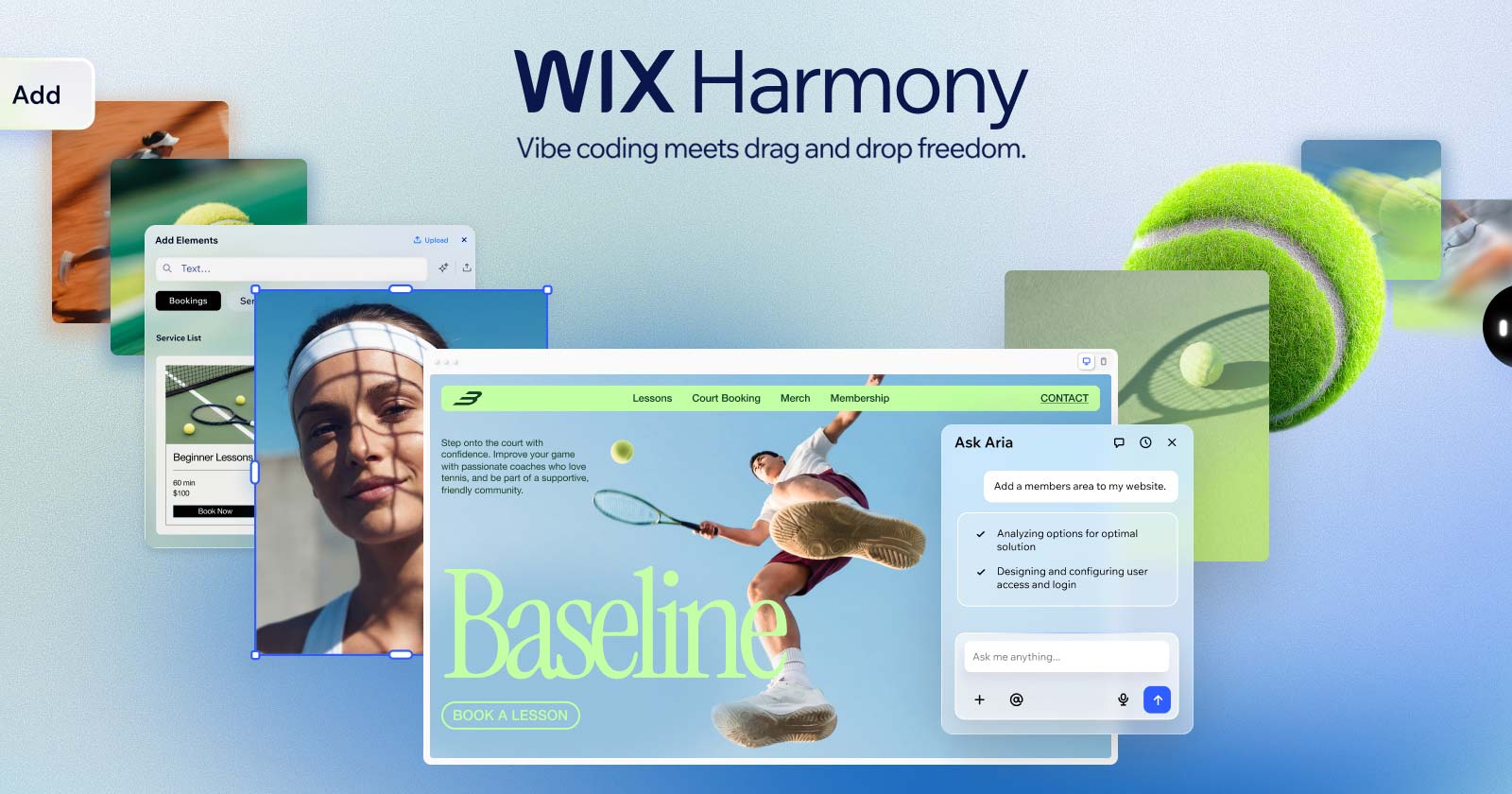
Wix announced the launch of Wix Harmony, a new AI-powered website builder that combines natural language site creation with Wix’s existing visual editor. The company introduced the product in New York and said it will begin rolling out in English to users in the coming weeks. Wix positions Harmony as a tool designed to produce fully functional, production-ready websites rather than quick demos, addressing common tradeoffs between fast site creation and developing deployment-ready websites.

Wix has steadily expanded its use of artificial intelligence across its product line, aiming to streamline the process of maintaining an online presence while keeping users in control of how their sites look and function. Wix Harmony represents the company’s most direct effort to integrate AI into the core website-building workflow rather than treating it as a separate feature.

Aria Is Wix Harmony’s Interface

Wix Harmony’s interface is Aria, an AI agent that responds to natural language instructions and applies changes directly within the Wix editor. Users can ask Aria to perform tasks ranging from visual changes such as adjusting colors or layouts, to adding commerce features or redesigning entire pages. Because Aria operates within Wix’s existing architecture, Wix says changes made in one area of a site will not disrupt other sections or introduce unintended behavior.

Video Of Wix Harmony

Switch Between Manual And AI Workflows

An interesting feature of Wix Harmony is that it enables users to move back and forth between AI-assisted creation and manual editing without rebuilding elements from scratch. A user can generate a page or section through a prompt, then manually fine-tune spacing, layout, and content using drag-and-drop controls. Wix describes this as a way to speed up site creation while keeping design decisions in human control, rather than locking users into AI-generated outputs. This is a truly thoughtful implementation of AI that is flexible to how their users may want to use AI.

Delivers Sites That Are Ready To Deploy

Wix is positioning Harmony as a solution that is capable of delivering websites that are ready to deploy to a live environment. By running Harmony sites on the same infrastructure as all Wix websites, the company says it can support live traffic, ongoing updates, and business operations without requiring users to migrate to a different platform.

Websites created with Wix Harmony include access to Wix’s existing business features, including online commerce, scheduling, transactions, and payments. Wix also says these sites include built-in accessibility monitoring, search optimization tools, performance support, and privacy-focused infrastructure designed to meet regulatory requirements such as GDPR. These capabilities are intended to let users launch and operate websites without adding third-party services to cover basic operational needs.

Wix co-founder and CEO Avishai Abrahami said:

“Our focus is on combining the best new technologies with modern design, and this is the power of Wix. With Wix Harmony, now anyone can create a beautiful website, design easily with prompts and natural language without sacrificing scalability, security, reliability and performance. This is the benchmark of what a website builder should be.”

Harmony is part of Wix’s thoughtful integration of AI, providing users with tools that businesses can use to their benefit. Read more about Wix Harmony.

Featured Image by Wix

Core Web Vitals Champ: Open Source Versus Proprietary Platforms via @sejournal, @martinibuster

The Core Web Vitals Technology Report by the open source HTTPArchive community ranks content management systems by how well they perform on Google’s Core Web Vitals (CWV). The November 2025 data shows a significant gap between platforms with the highest ranked CMS scoring 84.87% of sites passing CWV, while the lowest ranked CMS scored 46.28%.

What’s of interest this month is that the top three Core Web Vitals champs are all closed source proprietary platforms while the open source systems were at the bottom of the pack.

Importance Of Core Web Vitals

Core Web Vitals (CWV) are metrics created by Google to measure how fast, stable, and responsive a website feels to users. Websites that load quickly and respond smoothly keep visitors engaged and tend to perform better in terms of sales, reads, and add impressions, while sites that fall short frustrate users, increase bounce rates, and perform less well for business goals. CWV scores reflect the quality of the user experience and how a site performs under real-world conditions.

How the Data Is Collected

The CWV Technology Report combines two public datasets.

The Chrome UX Report (CrUX) uses data from Chrome users who opt in to share performance statistics as they browse. This reflects how real users experience websites.
The HTTP Archive runs lab-based tests that analyze how sites are built and whether they follow performance best practices.

Together, the report I generated provides a snapshot of how each content management system performs on Core Web Vitals.

Ranking By November 2025 CWV Score

Duda Is The Number One Ranked Core Web Vitals Champ

Duda ranked first in November 2025, with 84.87% of sites built on the platform delivering a passing Core Web Vitals score. It was the only platform in this comparison where more than four out of five sites achieved a good CWV score. Duda has consistently ranked #1 for Core Web Vitals for several years now.

Wix Ranked #2

Wix ranked second, with 74.86% of sites passing CWV. While it trailed Duda by ten percentage points, Wix was just about four percentage points ahead of the third place CMS in this comparison.

Squarespace Ranked #3

Squarespace ranked third, at 70.39%. Its CWV pass rate placed it closer to Wix than to Drupal, maintaining a clear position in the top three ranked publishing platforms.

Drupal Ranked #4

Drupal ranked fourth, with 63.27% of sites passing CWV. That score put Drupal in the middle of the comparison, below the three private label site builders. This is a curious situation because the bottom three CMS’s in this comparison are all open source platforms.

Joomla Ranked #5

Joomla ranked fifth, at 56.92%. While more than half of Joomla sites passed CWV, the platform remained well behind the top performers.

WordPress Ranked Last at position #6

WordPress ranked last, with 46.28% of sites passing Core Web Vitals. Fewer than half of WordPress sites met the CWV thresholds in this snapshot. What’s notable about WordPress’s poor ranking is that it lags behind the fifth place Joomla by about ten percentage points. So not only is WordPress ranked last in this comparison, it’s decisively last.

Why the Numbers Matter

Core Web Vitals scores translate into measurable differences in how users experience websites. Platforms at the top of the ranking deliver faster and more stable experiences across a larger share of sites, while platforms at the bottom expose a greater number of users to slower and less responsive pages. The gap between Duda and WordPress in the November 2025 comparison was nearly 40 percentage points, 38.59 percentage points.

While an argument can be made that the WordPress ecosystem of plugins and themes may be to blame for the low CWV scores, the fact remains that WordPress is dead last in this comparison. Perhaps WordPress needs to become more proactive about how themes and plugins perform, such as come up with standards that they have to meet in order to gain a performance certification. That might cause plugin and theme makers to prioritize performance.

Do Content Management Systems Matter For Ranking?

I have mentioned this before and will repeat it this month. There have been discussions and debates about whether the choice of content management system affects search rankings. Some argue that plugins and flexibility make WordPress easier to rank in Google. But the fact is that private platforms like Duda, Wix, and Squarespace have all focused on providing competitive SEO functionalities that automate a wide range of technical SEO tasks.

Some people insist that Core Web Vitals make a significant contribution to their rankings and I believe them. But in general, the fact is that CWV performance is a minor ranking factor.

Nevertheless, performance still matters for outcomes that are immediate and measurable, such as user experience and conversions, which means that the November 2025 HTTPArchive Technology Report should not be ignored.

The HTTPArchive report is available here but it will be going away and replaced very soon. I’ve tried the new report and, unless I missed something, it lacks a way to constrain the report by date.

Featured Image by Shutterstock/Red Fox studio