Unleashing the potential of qubits, one molecule at a time

It all began with a simple origami model. 

As an undergrad at Harvard, Danna Freedman went to a professor’s office hours for her general chemistry class and came across an elegant paper model that depicted the fullerene molecule. The intricately folded representation of chemical bonds and atomic arrangements sparked her interest, igniting a profound curiosity about how the structure of molecules influences their function. 

She stayed and chatted with the professor after the other students left, and he persuaded her to drop his class so she could instead dive immediately into the study of chemistry at a higher level. Soon she was hooked. After graduating with a chemistry degree, Freedman earned a PhD at the University of California, Berkeley, did a postdoc at MIT, and joined the faculty at Northwestern University. In 2021, she returned to MIT as the Frederick George Keyes Professor of Chemistry.

Freedman’s fascination with the relationship between form and function at the molecular level laid the groundwork for a trailblazing career in quantum information science, eventually leading her to be honored with a 2022 MacArthur fellowship—and the accompanying “genius” grant—as one of the leading figures in the field.

Today, her eyes light up when she talks about the “beauty” of chemistry, which is how she sees the intricate dance of atoms that dictates a molecule’s behavior. At MIT, Freedman focuses on creating novel molecules with specific properties that could revolutionize the technology of sensing, leading to unprecedented levels of precision. 

Designer molecules

Early in her graduate studies, Freedman noticed that many chemistry research papers claimed to contribute to the development of quantum computing, which exploits the behavior of matter at extremely small scales to deliver much more computational power than a conventional computer can achieve. While the ambition was clear, Freedman wasn’t convinced. When she read these papers carefully, she found that her skepticism was warranted.

“I realized that nobody was trying to design magnetic molecules for the actual goal of quantum computing!” she says. Such molecules would be suited to acting as quantum bits, or qubits, the basic unit of information in quantum systems. But the research she was reading about had little to do with that. 

Nevertheless, that realization got Freedman thinking—could molecules be designed to serve as qubits? She decided to find out. Her work made her among the first to use chemistry in a way that demonstrably advanced the field of quantum information science, which she describes as a general term encompassing the use of quantum technology for computation, sensing, measurement, and communication. 

Unlike traditional bits, which can only equal 0 or 1, qubits are capable of “superposition”—simultaneously existing in multiple states. This is why quantum computers made from qubits can solve large problems faster than classical computers. Freedman, however, has always been far more interested in tapping into qubits’ potential to serve as exquisitely precise sensors.

Qubits store information in quantum properties that can be easily disrupted. While the delicacy of those properties makes qubits hard to control, it also makes them especially sensitive and therefore very useful as sensors.

Qubits encode information in quantum properties—such as spin and energy—that can be easily disrupted. While the delicacy of those properties makes qubits hard to control, it also makes them especially sensitive and therefore very useful as sensors.

Harnessing the power of qubits is notoriously tricky, though. For example, two of the most common types—superconducting qubits, which are often made of thin aluminum layers, and trapped-ion qubits, which use the energy levels of an ion’s electrons to represent 1s and 0s—must be kept at temperatures approaching absolute zero (–273 °C). Maintaining special refrigerators to keep them cool can be costly and difficult. And while researchers have made significant progress recently, both types of qubits have historically been difficult to connect into larger systems.

Eager to explore the potential of molecular qubits, Freedman has pioneered a unique “bottom-up” approach to creating them: She designs novel molecules with specific quantum properties to serve as qubits targeted for individual applications. Instead of focusing on a general goal such as maximizing coherence time (how long a qubit can preserve its quantum state), she begins by asking what kinds of properties are needed for, say, a sensor meant to measure biological phenomena at the molecular level. Then she and her team set out to create molecules that have these properties and are suitable for the environment where they’d be used. 
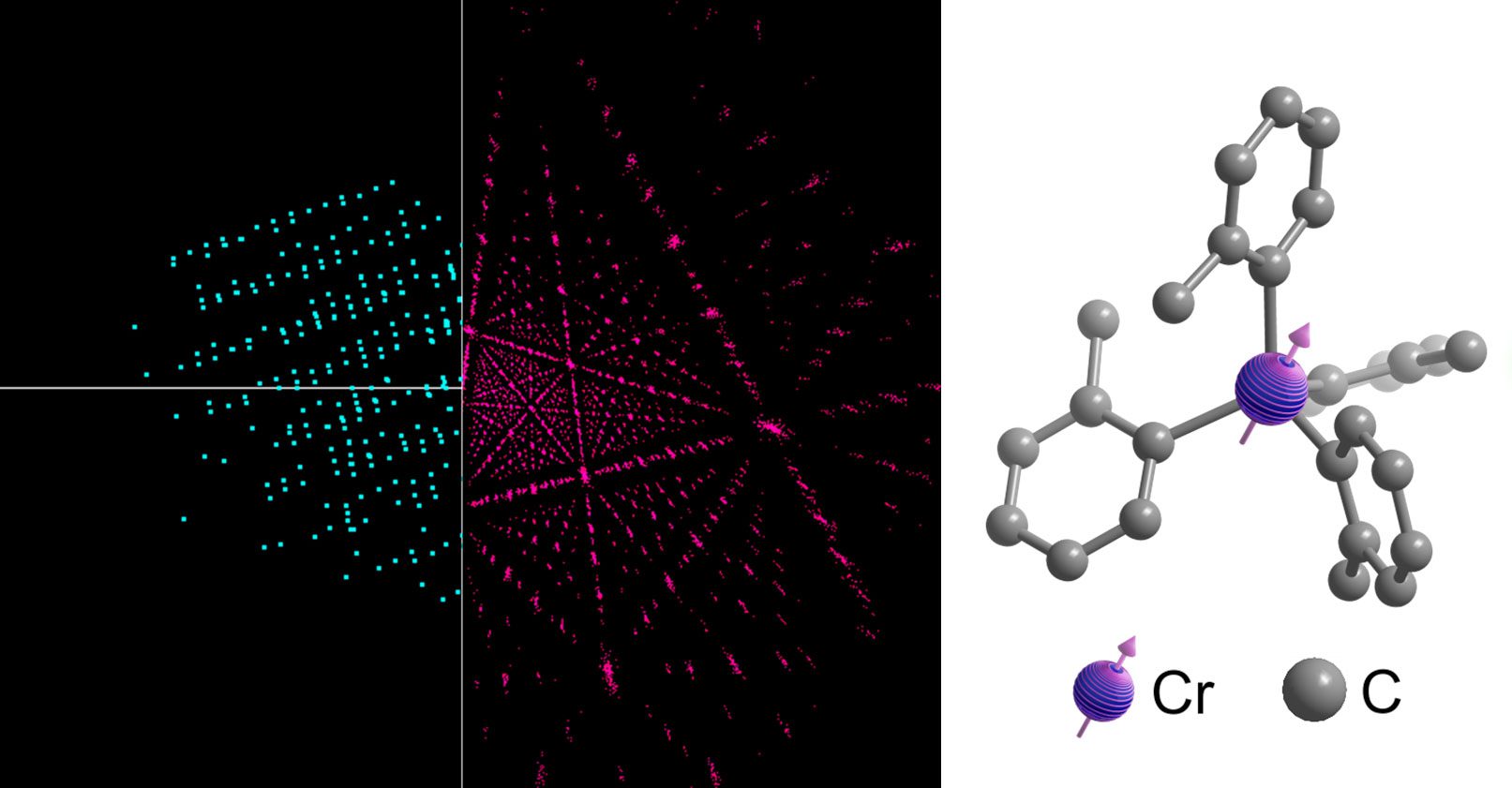
To determine the precise structure of a new molecule, Freedman’s team uses software to analyze and process visualizations (such as those in teal and pink above) of data collected by an x-ray diffractometer. The diagram at right depicts an organometallic Cr(IV) complex made of a central chromium atom and four hydrocarbon ligands.
COURTESY OF DANNA FREEDMAN

Made of a central metallic atom surrounded by hydrocarbon atoms, molecular qubits store information in their spin. The encoded information is later translated into photons, which are emitted to “read out” the information. These qubits can be tuned with laser precision—imagine adjusting a radio dial—by modifying the strength of the ligands, or bonds, connecting the hydrocarbons to the metal atom. These bonds act like tiny tuning forks; by adjusting their strength, the researchers can precisely control the qubit’s spin and the wavelength of the emitted photons. That emitted light can be used to provide information about atomic-level changes in electrical or magnetic fields. 

While many researchers are eager to build reliable, scalable quantum computers, Freedman and her group devote most of their attention to developing custom molecules for quantum sensors. These ultrasensitive sensors contain particles in a state so delicately balanced that extremely small changes in their environments unbalance them, causing them to emit light differently. For example, one qubit designed in Freedman’s lab, made of a chromium atom surrounded by four hydrocarbon molecules, can be customized so that tiny changes in the strength of a nearby magnetic field will change its light emissions in a particular way.  

A key benefit of using such molecules for sensing is that they are small enough—just a nanometer or so wide—to get extremely close to the thing they are sensing. That can offer an unprecedented level of precision when measuring something like the surface magnetism of two-­dimensional materials, since the strength of a magnetic field decays with distance. A molecular quantum sensor “might not be more inherently accurate than a competing quantum sensor,” says Freedman, “but if you can lose an order of magnitude of distance, that can give us a lot of information.” Quantum sensors’ ability to detect electric or magnetic changes at the atomic level and make extraordinarily precise measurements could be useful in many fields, such as environmental monitoring, medical diagnostics, geolocation, and more.

When designing molecules to serve as quantum sensors, Freedman’s group also factors in the way they can be expected to act in a specific sensing environment. Creating a sensor for water, for example, requires a water-compatible molecule, and a sensor for use at very low temperatures requires molecules that are optimized to perform well in the cold. By custom-­engineering molecules for different uses, the Freedman lab aims to make quantum technology more versatile and widely adaptable.

Embracing interdisciplinarity

As Freedman and her group focus on the highly specific work of designing custom molecules, she is keenly aware that tapping into the power of quantum science depends on the collective efforts of scientists from different fields.

“Quantum is a broad and heterogeneous field,” she says. She believes that attempts to define it narrowly hurt collective research—and that scientists must welcome collaboration when the research leads them beyond their own field. Even in the seemingly straightforward scenario of using a quantum computer to solve a chemistry problem, you would need a physicist to write a quantum algorithm, engineers and materials scientists to build the computer, and chemists to define the problem and identify how the quantum computer might solve it. 

MIT’s collaborative environment has helped Freedman connect with researchers in different disciplines, which she says has been instrumental in advancing her research. She’s recently spoken with neurobiologists who proposed problems that quantum sensing could potentially solve and provided helpful context for building the sensors. Looking ahead, she’s excited about the potential applications of quantum science in many scientific fields. “MIT is such a great place to nucleate a lot of these connections,” she says.

“As quantum expands, there are so many of these threads which are inherently interdisciplinary,” she says.

Inside the lab

Freedman’s lab in Building 6 is a beehive of creativity and collaboration. Against a backdrop of colorful flasks and beakers, researchers work together to synthesize molecules, analyze their structures, and unlock the secrets hidden within their intricate atomic arrangements.

“We are making new molecules and putting them together atom by atom to discover whether they have the properties we want,” says Christian Oswood, a postdoctoral fellow. 

Some sensitive molecules can only be made in the lab’s glove box, a nitrogen-filled transparent container that protects chemicals from oxygen and water in the ambient air. An example is an organometallic solution synthesized by one of Freedman’s graduate students, David Ullery, which takes the form of a vial of purple liquid. (“A lot of molecules have really pretty colors,” he says.)

Freedman is a passionate educator, dedicated to demystifying the complexities of chemistry for her students. Aware that many of them find the subject daunting, she strives to go beyond textbook equations.

Once synthesized, the molecules are taken to a single-crystal x-ray diffractometer a few floors below the Freedman lab. There, x-rays are directed at crystallized samples, and from the diffraction pattern, researchers can deduce their molecular structure—how the atoms connect. Studying the precise geometry of these synthesized molecules reveals how the structure affects their quantum properties, Oswood explains.

Researchers and students at the lab say Freedman’s cross-disciplinary outlook played a big role in drawing them to it. With a chemistry background and a special interest in physics, for example, Ullery joined because he was excited by the way Freedman’s research bridges those two fields. 
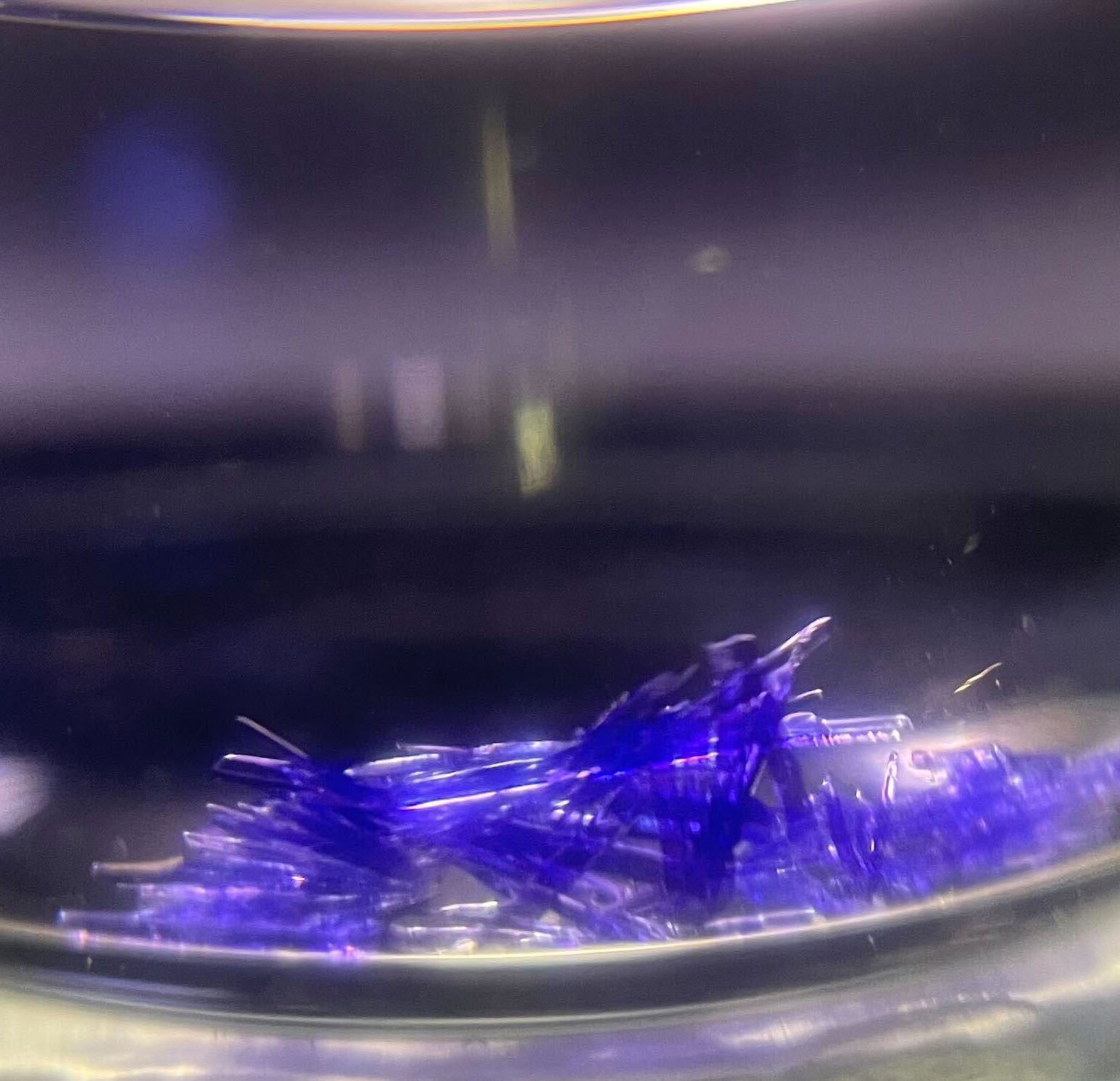
Crystals of an organometallic Cr(IV) complex. Freedman’s lab designed a series of molecules like this one to detect changes in a magnetic field.
COURTESY OF DANNA FREEDMAN

Others echo this sentiment. “The opportunity to be in a field that’s both new and expanding like quantum science, and attacking it from this specific angle, was exciting to me both intellectually and professionally,” says Oswood.

Another graduate student, Cindy Serena Ngompe Massado, says she enjoys being part of the lab because she gets to collaborate with scientists in other fields. “It allows you to really approach scientific challenges in a more holistic and productive way,” she says.

Though the researchers spend most of their time synthesizing and analyzing molecules, fun infuses the lab too. Freedman checks in with everyone frequently, and conversations often drift beyond just science. She’s just as comfortable chatting about Taylor Swift and Travis Kelce as she is discussing research.

“Danna is very personable and very herself with us,” Ullery says. “It adds a bit of levity to being in an otherwise stressful grad school environment.”

Bringing textbook chemistry to life

In the classroom, Freedman is a passionate educator, dedicated to demystifying the complexities of chemistry for her students. Aware that many of them find the subject daunting, she strives to go beyond textbook equations.

For each lecture in her advanced inorganic chemistry classes, she introduces the “molecule of the day,” which is always connected to the lesson plan. When teaching about bimetallic molecules, for example, she showcased the potassium rubidium molecule, citing active research at Harvard aimed at entangling its nuclear spins. For a lecture on superconductors, she brought a sample of the superconducting material yttrium barium copper oxide that students could handle. 

Chemistry students often think “This is painful” or “Why are we learning this?” Freedman says. Making the subject matter more tangible and showing its connection to ongoing research spark students’ interest and underscore the material’s relevance.
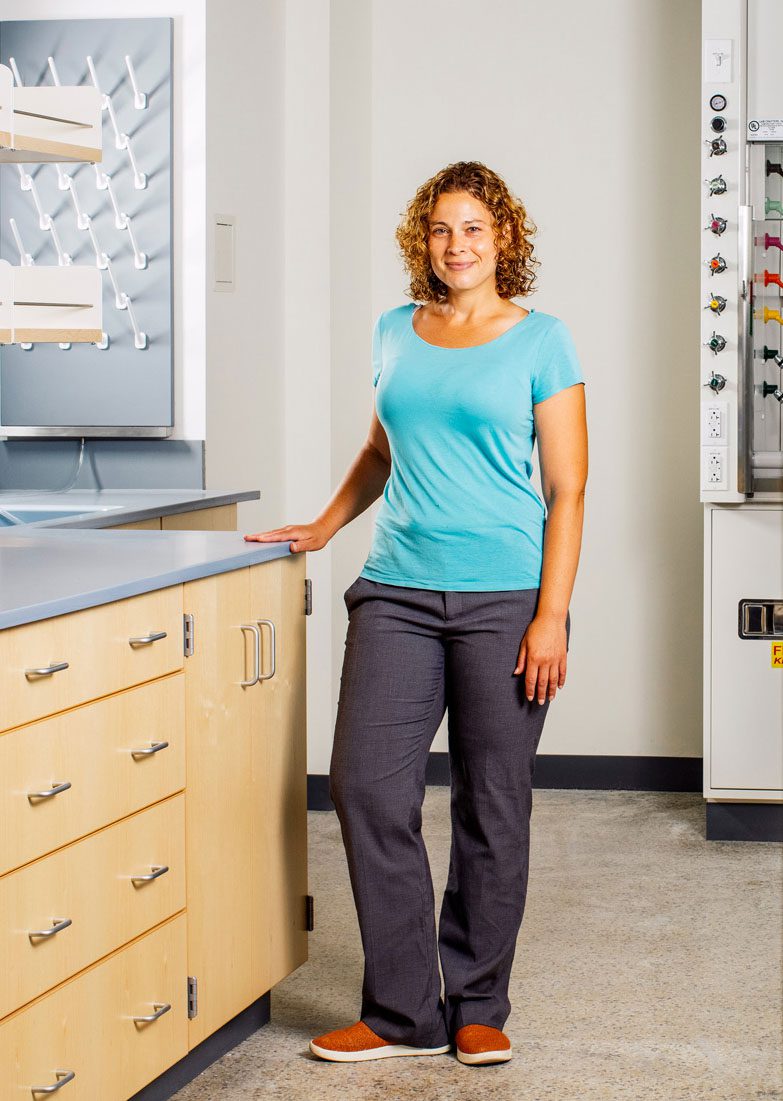
Danna Freedman
Freedman sees frustrating research as an opportunity to discover new things. “I like students to work on at least one ‘safer’ project along with something more ambitious,” she says.
M. SCOTT BRAUER/MIT NEWS OFFICE

Freedman believes this is an exceptionally exciting time for budding chemists. She emphasizes the importance of curiosity and encourages them to ask questions. “There is a joy to being able to walk into any room and ask any question and extract all the knowledge that you can,” she says. 

In her own research, she embodies this passion for the pursuit of knowledge, framing challenges as stepping stones to discovery. When she was a postdoc, her research on electron spins in synthetic materials hit what seemed to be a dead end that ultimately led to the discovery of a new class of magnetic material. So she tells her students that even the most difficult aspects of research are rewarding because they often lead to interesting findings. 

That’s exactly what happened to Ullery. When he designed a molecule meant to be stable in air and water and emit light, he was surprised that it didn’t—and that threw a wrench into his plan to develop the molecule into a sensor that would emit light only under particular circumstances. So he worked with theoreticians in Giulia Galli’s group at the University of Chicago, developing new insights on what drives emission, and that led to the design of a new molecule that did emit light. 

“Frustrating research is almost fun to deal with,” says Freedman, “even if it doesn’t always feel that way.” 

The Institute’s greatest ambassadors

After decades of working as a biologist at a Southern school with a Division 1 football team, coming to MIT was a bit of a culture shock—in the best possible way. I’ve heard from MIT alumni all about late-night psetting, when to catch MITHenge, and the best way to celebrate Pi Day (with pie, of course). And I’ve also learned that for many of you, the Institute is more than simply your alma mater. As the MIT Alumni Association celebrates its 150th anniversary, I’m reflecting on the extraordinary talent and drive of the people here, and what it is that makes MIT alumni—like MIT itself—just a little bit different.

As students, you learned to investigate, question, argue, critique, and refine your ideas with faculty and with each other, managing to be both collaborative and competitive. You hacked the toughest and most interesting problems and came up with the most unconventional solutions. And you developed and nurtured a uniquely entrepreneurial, hands-on MIT spirit that only those who have earned a degree here can fully understand, but that the rest of us can easily identify and admire.

An article in this magazine about the history of the MIT Alumni Association notes that when the association was formed, there were 84 alumni in total. By 1888, the number had increased to an impressive 579. And it grew by orders of magnitude; today nearly 149,000 alumni are members. But even as the alumni community has grown and evolved, its culture and character have remained remarkably consistent, represented by men and women known for their rigorous thinking, incisive analysis, mens et manus ethos, and drive to make a real and transformative impact on people and communities everywhere.

As MIT alumni, you recognize each other by your Brass Rats. These sturdy, cleverly designed rings not only signify your completion (some might say survival) of an immensely difficult course of study. They also signal to the world that you stand ready to share your expertise, knowledge, and experience in the service of humanity. 

Alumni have always been the Institute’s greatest ambassadors, and today that role has taken on even greater meaning and importance. We are working intensely, every day, to make the case for the vital importance of MIT to ensuring the nation’s security, prosperity, health, and quality of life. And I’m deeply grateful that we can rely on MIT’s extraordinary family of alumni to help share that message far and wide.

Bug-size robots that fly and flip could pollinate futuristic farms’ crops

Tiny flying robots could perform such useful tasks as pollinating crops inside multilevel warehouses, boosting yields while mitigating some of agriculture’s harmful impacts on the environment. The latest robo-bug from an MIT lab, inspired by the anatomy of the bee, comes closer to matching nature’s performance than ever before. 

Led by Kevin Chen, an associate professor in the Department of Electrical Engineering and Computer Science and the senior author of a paper on the work, the team adapted an earlier flying robot composed of four identical two-winged units, combined into a rectangular device about the size of a microcassette. The wings managed to flap like an insect’s, but the bot couldn’t fly for long. One problem is that the wings would blow air into each other when flapping, reducing the lift forces they could generate.

In the new design, each of the four units has a single flapping wing pointing away from the robot’s center, stabilizing the wings and boosting their lift forces. The researchers also improved the way the wings are connected to the actuators, or artificial muscles, that flap them. In previous designs, when the actuators’ movements reached the extremely high frequencies needed for flight, the devices often started buckling. That reduced the power and efficiency of the robot. Thanks in part to a new, longer wing hinge, the actuators now experience less mechanical strain and can apply more force, so the bots can fly faster, longer, and in more precise paths.

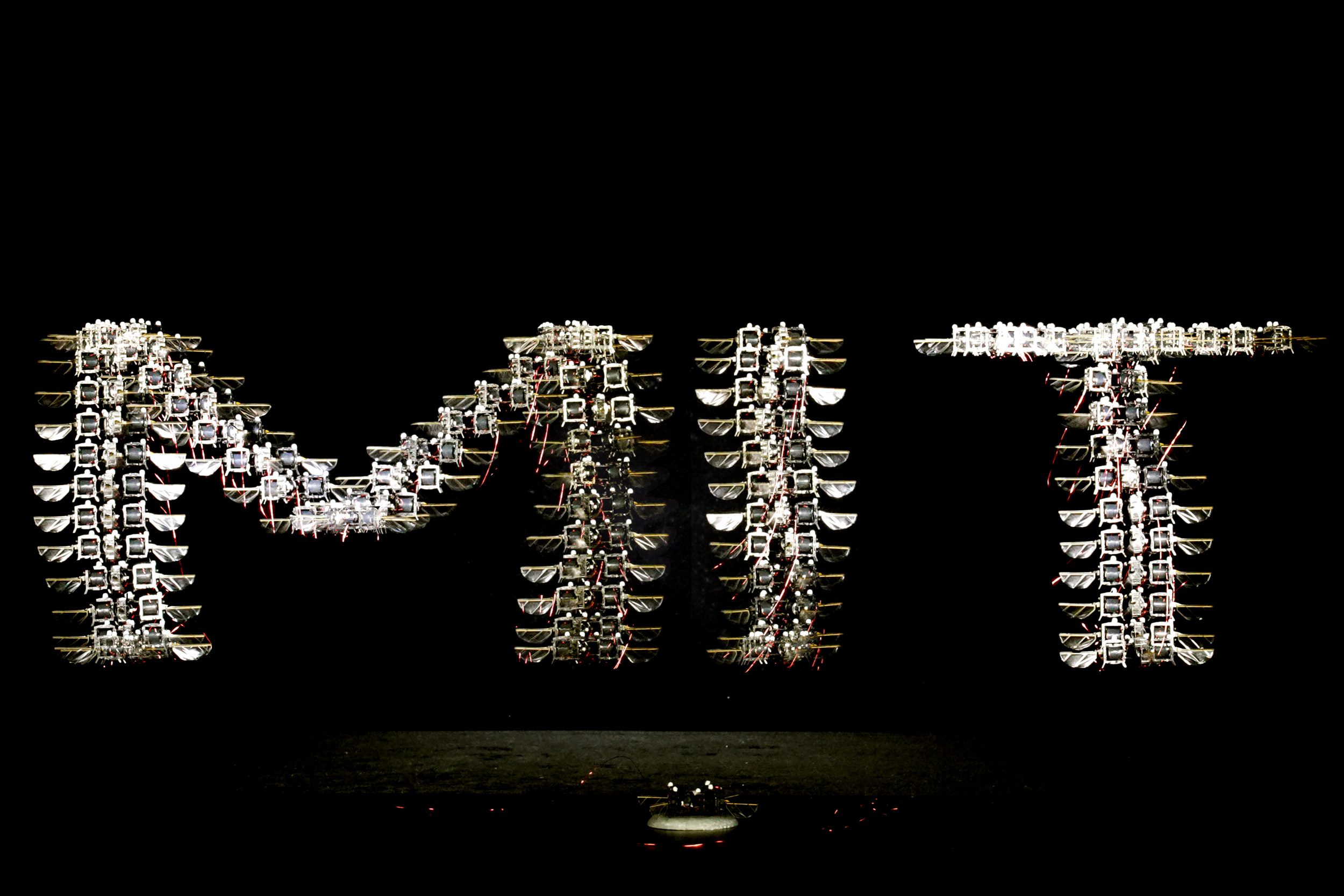
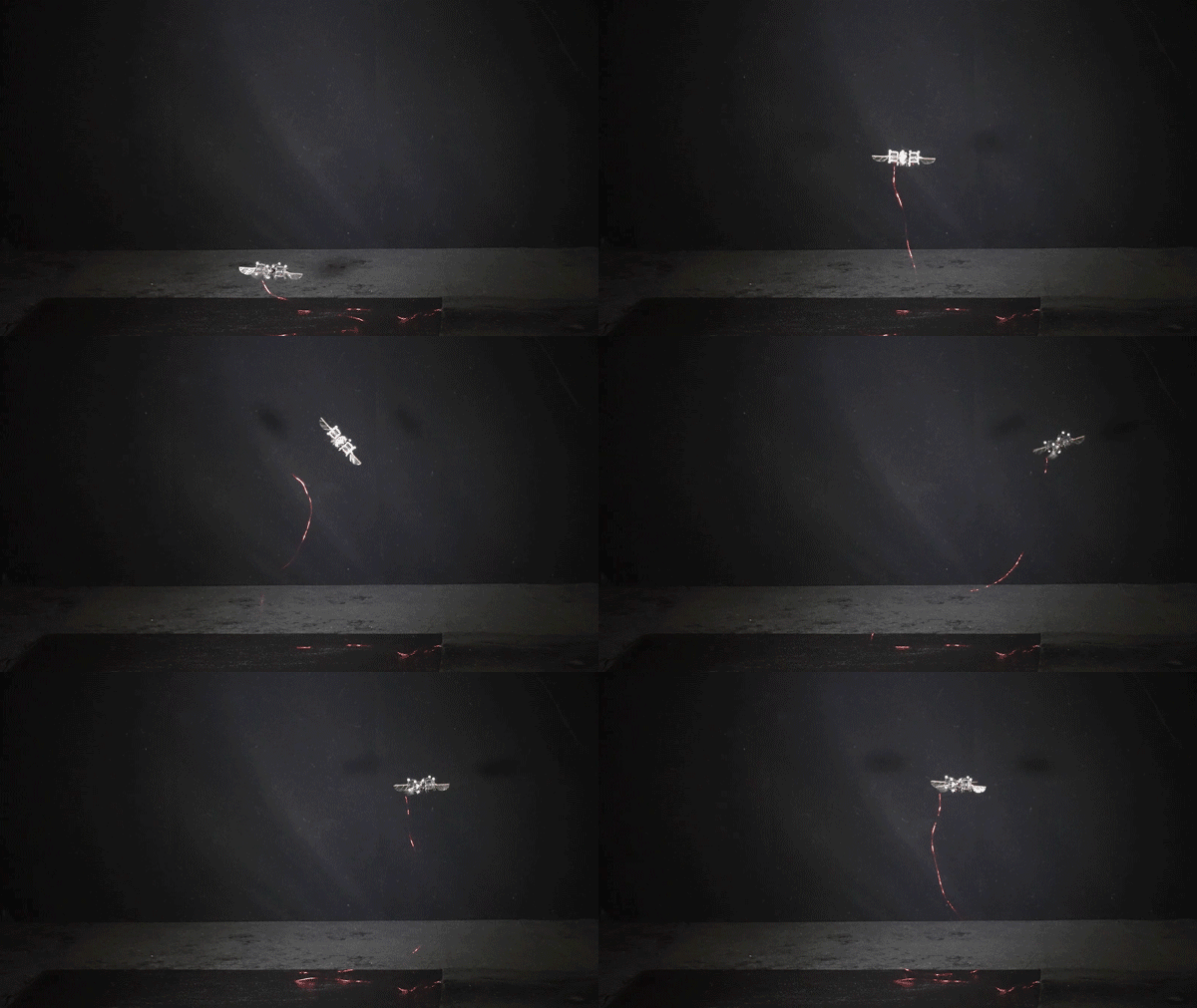
the motion of a robot captured in flight
The robots can precisely track a trajectory enough to spell M-I-T.
COURTESY OF THE RESEARCHERS

Weighing less than a paper clip, the new robotic insect can hover for more than 1,000 seconds—almost 17 minutes—without any degradation of flight precision.

“When my student Yi-Hsuan Hsiao was performing that flight, he said it was the slowest 1,000 seconds he had spent in his entire life. The experiment was extremely nerve-racking,” Chen says.

The new robot also reached an average speed of 35 centimeters per second, the fastest flight researchers have reported, and was able to perform body rolls and double flips. It can even precisely track a trajectory that spells M-I-T.

“At the end of the day, we’ve shown flight that is 100 times longer than anyone else in the field has been able to do, so this is an extremely exciting result,” Chen says.

COURTESY OF THE RESEARCHERS

From here, he and his students want to see how far they can push this new design, with the goal of achieving flight for longer than 10,000 seconds.

They also want to improve the precision of the robots so they could land in and take off from the center of a flower. In the long run, the researchers hope to install tiny batteries and sensors so the robots could fly and navigate outside the lab. The design has more room for those electronics now that they’ve halved the number of wings.

The bots still can’t achieve the fine-tuned behavior of a real bee, Chen acknowledges. Still, he says, “with the improved lifespan and precision of this robot, we are getting closer to some very exciting applications, like assisted pollination.” 

How the brain, with sleep, maps space

Scientists have known for decades that certain neurons in the hippocampus are dedicated to remembering specific locations where an animal has been. More useful, though, is remembering where places are relative to each other, and it hasn’t been clear how those mental maps are formed. A study by MIT neuroscientist Matthew Wilson and colleagues sheds light on that question. 

The researchers let mice explore mazes freely for about 30 minutes a day for several days. While the animals were wandering and while they were sleeping, the team monitored hundreds of neurons that they had engineered to flash when electrically active. Wilson’s lab has shown that animals essentially refine their memories by dreaming about their experiences.

The recordings showed that the “place cells” were equally active for days. But activity in another group of cells, which were only weakly attuned to individual places, gradually changed so that it correlated not with locations, but with activity patterns among other neurons in the network. As this happened, an increasingly accurate cognitive map of the maze took shape. Sleep played a crucial role in this process: When mice explored a new maze twice with a siesta in between, the mental maps of those allowed to sleep during the break showed significant refinement, while those of mice that stayed awake did not. 

“On day 1, the brain doesn’t represent the space very well,” says research scientist Wei Guo, the study’s lead author. “Neurons represent individual locations, but together they don’t form a map. But on day 5 they form a map. If you want a map, you need all these neurons to work together.”

Odd new tricks from a massive black hole

In 2018 astronomers at MIT and elsewhere observed previously unseen behavior from a black hole known as 1ES 1927+654, which is about as massive as a million suns and sits in a galaxy 270 million light-years away. Its corona—a cloud of whirling, white-hot plasma—suddenly disappeared before reassembling months later. 

Now members of the team have caught the same object exhibiting another strange pattern: Flashes of x-rays are coming from it at a steadily increasing clip. By looking through observations of the black hole taken by the European Space Agency’s XMM-Newton, a space-based observatory that detects and measures x-ray emissions from extreme cosmic sources, they found that the flashes increased from every 18 minutes to every seven minutes over a two-year period. 

One possible explanation is that the corona is oscillating. But the researchers believe the most likely culprit is a spinning white dwarf—an extremely compact core of a dead star orbiting around the black hole and getting closer to its event horizon, the boundary beyond which nothing can escape its gravitational pull. Circling closer would mean moving faster, explaining the increasing frequency of x-ray oscillations. 

If this is the case, the white dwarf could be coming right up to the black hole’s edge without falling in. “This would be the closest thing we know of around any black hole,” says Megan Masterson, a graduate student in physics at MIT, who reported the findings with associate professor Erin Kara and others. 

If a white dwarf is at the root of the mysterious flashing, it can also be expected to give off gravitational waves, detectable by next-generation observatories such as ESA’s Laser Interferometer Space Antenna (LISA). Its launch is currently planned for the mid-2030s.

“The one thing I’ve learned with this source is to never stop looking at it, because it will probably teach us something new,” Masterson says. “The next step is just to keep our eyes open.

Cheaper buildings, courtesy of mud

One costly and time-consuming step in constructing a concrete building is creating the “formwork,” the wooden mold into which the concrete is poured. Now MIT researchers have developed a way to replace the wood with lightly treated mud.

“What we’ve demonstrated is that we can essentially take the ground we’re standing on, or waste soil from a construction site, and transform it into accurate, highly complex, and flexible formwork for customized concrete structures,” says Sandy Curth, a PhD student in MIT’s Department of Architecture, who has helped spearhead the project.

The EarthWorks method, as it’s known, introduces some additives, such as straw, and a waxlike coating to the soil material. Then it’s 3D-printed into a custom-designed shape. “We found a way to make formwork that is infinitely recyclable,” Curth says. “It’s just dirt.”

A particular advantage of the technique is that the material’s flexibility makes it easier to create unique shapes optimized so that the resulting buildings use no more concrete than structurally necessary. This can significantly reduce the carbon emissions associated with concrete construction.

“What’s cool here is we’re able to make shape-optimized building elements for the same amount of time and energy it would take to make rectilinear building elements,” says Curth, who recently coauthored a paper on the work with MIT professors Lawrence Sass, SM ’94, PhD ’00; Caitlin Mueller ’07, SM ’14, PhD ’14; and others. He has also founded a firm, Forma Systems, through which he hopes to take EarthWorks into the construction industry.

A worldwide road trip for the Institute’s president

Soon after MIT’s 18th president, Sally Kornbluth, was inaugurated in May 2023, she made it a priority to expand her early on-campus listening tour to alumni living and working around the world. She wanted to learn more about their priorities and their connections with MIT, while also engaging them in her expansive vision for its future. 

This international “presidential welcome tour” brought Kornbluth to cities with large alumni communities, including New York, San Francisco, and Washington, DC, as well as London and Singapore. She mingled with alumni and friends, including MIT donors and the families of current students, at receptions that were followed by fireside chats with MIT alumni leaders. At these events, she underscored the ways alumni and friends can help promote the Institute’s mission—such as volunteering, donating, and spreading positive news from MIT throughout the world.

“I think that communication about the wonderful things that are going on at MIT to the broader community is actually really important,” she said. “There’s no place like MIT to address the serious problems of our time.”

The impact of the alumni community on MIT’s mission was further articulated by MIT Alumni Association CEO Whitney T. Espich, HM ’24. “You are the walking embodiment of MIT’s values and potential in the world,” she told alums. “It is this community that keeps taking on our toughest problems, healing our planet, leading on AI, and finding grand solutions in tiny quantum dots.”

Past MITAA president R. Robert Wickham ’93, SM ’95, who moderated the conversation with President Kornbluth in London, noted that the event gave him and his peers a renewed sense of MIT’s role in meeting the world’s greatest challenges, such as combating climate change, ensuring ethical AI, and treating and curing disease. “Energizing the global connectivity of our community is something that’s very important to me as an international alum, so having Sally come to London and meet with so many of our European-based alums was very special,” says Wickham. 

Natalie Lorenz Anderson ’84, the MITAA’s 2024–’25 president, traveled to Singapore for the tour’s final event. “I have found the president to be an excellent listener, very empathetic, attuned to the audience, and very wise in what she communicates,” says Lorenz Anderson. “There was such palpable energy, and alumni enjoyed hearing from her about the future of MIT. All five of these events have been a terrific way for alumni to get to know her.” 

Gooey greatness

A new type of glue developed by researchers from MIT and Germany combines sticky polymers inspired by the mussel with the germ-­fighting properties of another natural material: mucus.

To stick to a rock or a ship, mussels secrete a fluid full of proteins connected by chemical cross-links. As it happens, similar cross-linking features are found in mucin—a large protein that, besides water, is the primary component of mucus. George Degen, a postdoc in MIT’s Department of Mechanical Engineering and a coauthor of a paper on the work, wondered whether mussel-inspired polymers could link with chemical groups in mucin.

To test this idea, he combined solutions of natural mucin proteins with synthetic mussel-­inspired polymers and observed how the resulting mixture solidified and stuck to surfaces over time.

“It’s like a two-part epoxy. You combine two liquids together, and chemistry starts to occur so that the liquid solidifies while the substance is simultaneously gluing itself to the surface,” Degen says. 

The resulting gel strongly adheres even to wet surfaces while preventing the buildup of bacteria. The researchers envision that it could be injected or sprayed as a liquid, which would soon turn into a sticky gel. The material might coat medical implants, for example, to help prevent infection. The approach could also be adapted to incorporate other natural materials such as keratin, which might be used in sustainable packaging materials.

Charts: U.S. Digital Media Trends 2025

For 19 years, Deloitte has published survey results on American consumers’ use of digital media. This year’s report, “2025 Digital Media Trends,” issued in March, focuses on the rise of social platforms in media and entertainment, as revealed in Deloitte’s October 2024 survey of 3,595 U.S. consumers across all age groups.

On average, U.S. consumers spend around six hours each day engaging with media and entertainment content, although the types of activities differ across generations.

The study also shows that consumers prefer Smart TVs for watching TV shows and movies, while favoring mobile devices for social media scrolling and long- and short-form videos.

Additionally, Gen Z and Millennial respondents find social media content more relevant and feel a stronger personal connection to the creators.


Moreover, younger consumers surveyed express interest in seeing their favorite online creators transition into more traditional content forms.

Why Do Web Standards Matter? Google Explains SEO Benefits via @sejournal, @MattGSouthern

Google Search Relations team members recently shared insights about web standards on the Search Off the Record podcast.

Martin Splitt and Gary Illyes explained how these standards are created and why they matter for SEO. Their conversation reveals details about Google’s decisions that affect how we optimize websites.

Why Some Web Protocols Become Standards While Others Don’t

Google has formally standardized robots.txt through the Internet Engineering Task Force (IETF). However, they left the sitemap protocol as an informal standard.

This difference illustrates how Google determines which protocols require official standards.

Illyes explained during the podcast:

“With robots.txt, there was a benefit because we knew that different parsers tend to parse robots.txt files differently… With sitemap, it’s like ‘eh’… it’s a simple XML file, and there’s not that much that can go wrong with it.”

This statement from Illyes reveals Google’s priorities. Protocols that confuse platforms receive more attention than those that work well without formal standards.

The Benefits of Protocol Standardization for SEO

The standardization of robots.txt created several clear benefits for SEO:

  • Consistent implementation: Robots.txt files are now interpreted more consistently across search engines and crawlers.
  • Open-source resources: “It allowed us to open source our robots.txt parser and then people start building on it,” Illyes noted.
  • Easier to use: According to Illyes, standardization means “there’s less strain on site owners trying to figure out how to write the damned files.”

These benefits make technical SEO work more straightforward and more effective, especially for teams managing large websites.

Inside the Web Standards Process

The podcast also revealed how web standards are created.

Standards groups, such as the IETF, W3C, and WHATWG, work through open processes that often take years to complete. This slow pace ensures security, clear language, and broad compatibility.

Illyes explained:

“You have to show that the thing you are working on actually works. There’s tons of iteration going on and it makes the process very slow—but for a good reason.”

Both Google engineers emphasized that anyone can participate in these standards processes. This creates opportunities for SEO professionals to help shape the protocols they use on a daily basis.

Security Considerations in Web Standards

Standards also address important security concerns. When developing the robots.txt standard, Google included a 500-kilobyte limit specifically to prevent potential attacks.

Illyes explained:

“When I’m reading a draft, I would look at how I would exploit stuff that the standard is describing.”

This demonstrates how standards establish security boundaries that safeguard both websites and the tools that interact with them.

Why This Matters

For SEO professionals, these insights indicate several practical strategies to consider:

  • Be precise when creating robots.txt directives, since Google has invested heavily in this protocol.
  • Use Google’s open-source robots.txt parser to check your work.
  • Know that sitemaps offer more flexibility with fewer parsing concerns.
  • Consider joining web standards groups if you want to help shape future protocols.

As search engines continue to prioritize technical quality, understanding the underlying principles behind web protocols becomes increasingly valuable for achieving SEO success.

This conversation shows that even simple technical specifications involve complex considerations around security, consistency, and ease of use, all factors that directly impact SEO performance.

Hear the full discussion in the video below: