How Google, ChatGPT, & DeepSeek Handle YMYL Searches via @sejournal, @MattGSouthern

A new study by SE Ranking examines how AI search tools handle Your Money or Your Life (YMYL) queries.

The research compared Google AI Overviews (AIOs), ChatGPT, and DeepSeek across 40 health, legal, financial, and political queries.

This study is similar to one published by SE Ranking in October. The key difference is that this study examines multiple tools, whereas the October study focused solely on AIOs.

Here’s more about the latest study and what the findings mean.

Key Findings

1. YMYL Query Response Rate

The research found that Google generates AIOs for 51% of YMYL queries, slightly up from 50% in October.

ChatGPT has a 100% response rate for YMYL searches, and DeepSeek has a 90% rate.

Google’s selective approach was evident in political topics, displaying AI Overviews for only one query.

2. Response Patterns

Each platform showed unique patterns in generating responses to YMYL queries:

  • DeepSeek produces longer answers (391 words on average) with numerous sources (28 per response)
  • ChatGPT offers moderate-length content (234 words) with fewer sources (10 per response)
  • Google provides the briefest responses (190 words) with minimal citations (7 sources)

Google’s AI Overviews showed the highest percentage of responses with all unique links (61.9%), compared to ChatGPT (40%) and DeepSeek (32.5%), indicating Google prioritizes source diversity over quantity.

3. Fact vs. Opinion

Using subjectivity analysis, the study measured how factual versus opinion-based each platform’s content appeared:

  • ChatGPT delivered the most objective content overall (0.393 score)
  • Google AI Overviews ranked second (0.427 score)
  • DeepSeek showed the highest subjectivity (0.446 score)

These differences were most noticeable in political topics, where DeepSeek scored 0.497 (more opinionated) while Google scored 0.246 (more factual).

4. YMYL Category Strengths

The analysis revealed the following differences across various categories of YMYL queries:

Health Content

  • ChatGPT: Concise, disclaimer-heavy content citing medical sources
  • DeepSeek: Detailed responses with extensive citations, including news sources
  • Google: Conservative, heavily cautioned but brief content

Legal Content

  • ChatGPT: Bullet-point summaries with high-authority sources
  • DeepSeek: Comprehensive explanations with real-world examples
  • Google: Brief overviews with the highest disclaimer rate (50%)

Financial Content

  • ChatGPT: Risk-focused overviews with professional consultation recommendations
  • DeepSeek: Categorized information with numerical data and comparisons
  • Google: Avoids responding to highly sensitive financial queries entirely

5. DeepSeek Restrictions

The study documented that DeepSeek refused to respond to queries about Taiwan’s independence, Tiananmen Square, Chinese human rights issues, and websites banned in China.

DeepSeek’s responses often aligned with Chinese government perspectives when addressing related topics.

What Does The Data Mean?

A common thread throughout the data is how each AI chooses to protect users from potentially harmful advice while still trying to be helpful.

ChatGPT answers every YMYL query it sees, yet often leads with strong disclaimers and succinct takeaways.

Google AI Overviews, on the other hand, declines to generate content for almost half of the tested queries, leaning heavily on caution rather than risk providing the wrong guidance.

DeepSeek is at the opposite extreme. Sometimes, it offers staggering amounts of detail, and other times, it offers little detail if the response doesn’t align with political perspectives.

What unites all three is the balance between information and liability. Each model wants to appear authoritative in YMYL niches but must decide whether to be “helpful” or “safe” (and how much of each).

Key Takeaways For SEO

For SEO and content teams, here are key points to consider:

  • Google is selective. Content appearing in AIOs must meet high-quality standards, especially for YMYL topics.
  • Google’s AIOs cite unique and diverse sources for YMYL searches. This increases visibility but creates competition for clicks.
  • Different AI systems prefer specific styles, lengths, and details in content.
  • All three platforms prefer disclaimers on sensitive topics, with health content having the highest rate of cautionary notices at 37%.

Understanding these platform differences can help you improve visibility in AI search tools.

For more insights into AI search optimization, see:


Featured Image: Tada Images/Shutterstock

CheggMate via @sejournal, @Kevin_Indig

The expected AIO-pocalypse hasn’t happened, at least not in the form we expected.

Instead of a meteor impact, it looks more like climate change: slowly raising temperatures that cause natural disasters. Chegg is one of the first victims.

Chegg is an ed-tech company that offers students homework help, textbook rentals, online tutoring, and career resources. Founded in 2005. IPO in 2013.

In 2024, it reported 6.6 million paying subscribers, and its revenue is down -14% YoY. The culprit: AI.

The big question I answer in this article is whether Chegg is an outlier (spoiler: it’s not) or the first of many. More companies are bleeding. And some direct competitors to Chegg are surprisingly thriving.

You should read this Memo if you want to understand:

    1. The nuance behind Chegg’s decline.
    2. Who else is impacted by AI.
    3. How to tell if you’re at risk.
  1. How to build up immunity against AI.
CheggMateImage Credit: Lyna ™

Boost your skills with Growth Memo’s weekly expert insights. Subscribe for Free!

AI Overviews Are Not The (Only) Problem

Chegg filed a lawsuit against Google for abusing its monopoly position in Search to force companies to provide content that it repurposes for AI answers or Featured Snippets.1

The accusation has legs. Showing answers in the search results directly competes with Chegg’s business model.

Chegg claims (rightfully) it cannot opt out of them without cutting off vital organic traffic and calls Search a “Hobson’s Choice”: you either block Google and lose all organic traffic or don’t, and Google takes your content to give answers in the search results.

Up to this point, I agree.

What we’re witnessing is the old ecosystem of Search falling apart. The generational deal was that websites would create good content and allow Google to crawl it.

In return, Google sends them websites and shows ads to searchers. Now that clicking on websites is redundant in some cases, this deal is falling apart.

In my meta analysis of AI Overviews, I showed how AI Overviews reduce click-through rates, but they also show up much less often and more for informational queries than when they first started.

Skeptical

But this isn’t the whole puzzle of Chegg’s problem. Months before the lawsuit, Chegg’s CEO said AI, not AI Overviews, is eating into subscriber growth (as I mentioned in my Q1 Marketplaces Deep Dive):

“Rosensweig said on a May earnings call that ChatGPT had begun eating into subscriber growth. Chegg pulled financial forecasts for the rest of the year, and its stock dropped 48% in a day.”2

The article goes on:

“But within months, Chegg’s internal data showed students were increasingly turning to ChatGPT as a studying aid. Employees found some of the answers provided by GPT-4, the technology behind ChatGPT, scored higher on internal evaluations than answers from Chegg’s human experts.”

The problem goes beyond AI Overviews. Students around the world are using AI instead of web platforms. And you can see it in the numbers as well.

chegg trafficImage Credit: Kevin Indig

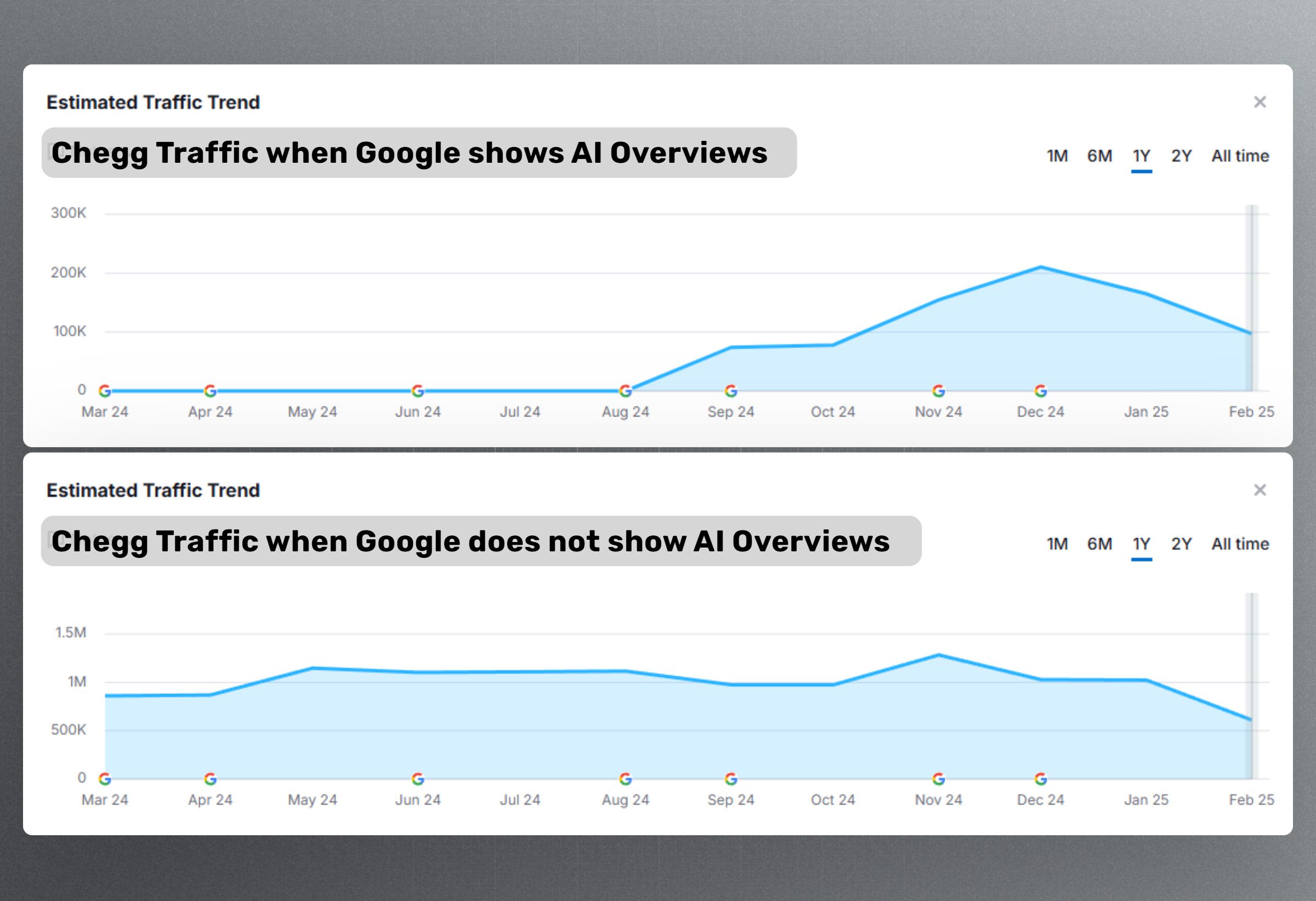
When you look at how much estimated traffic Chegg got from search results showing AI Overviews, you find it was only ~20% in December 2024, at its peak, and 15% in January 2025. Painful, but not enough to tank a company.

According to Semrush, Chegg’s organic traffic actually increased after May 2024, when AIOs launched, and only started tanking in October 2024.

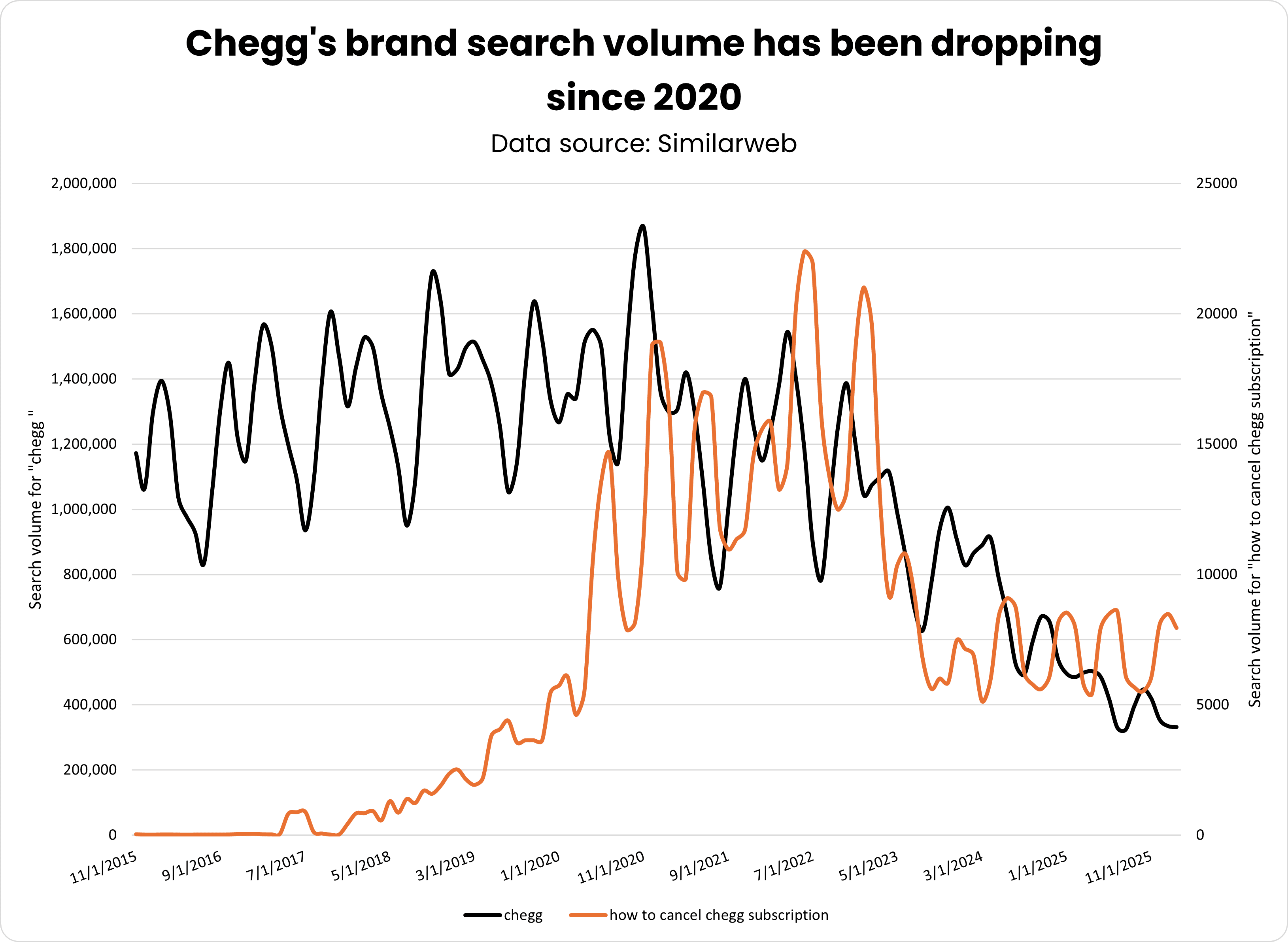
According to Similarweb, total traffic declined before ChatGPT launched in November 2022.

chegg's brand search volumeImage Credit: Kevin Indig

Declining brand search volume is a sign of shrinking brand awareness, product/market-fit and user retention.

The fact that brand search volume has been shrinking since 2020 and searches for cancellations have peaked before AI entered the mainstream makes me believe that the brand already had issues.

chegg's engagement metrics Image Credit: Kevin Indig

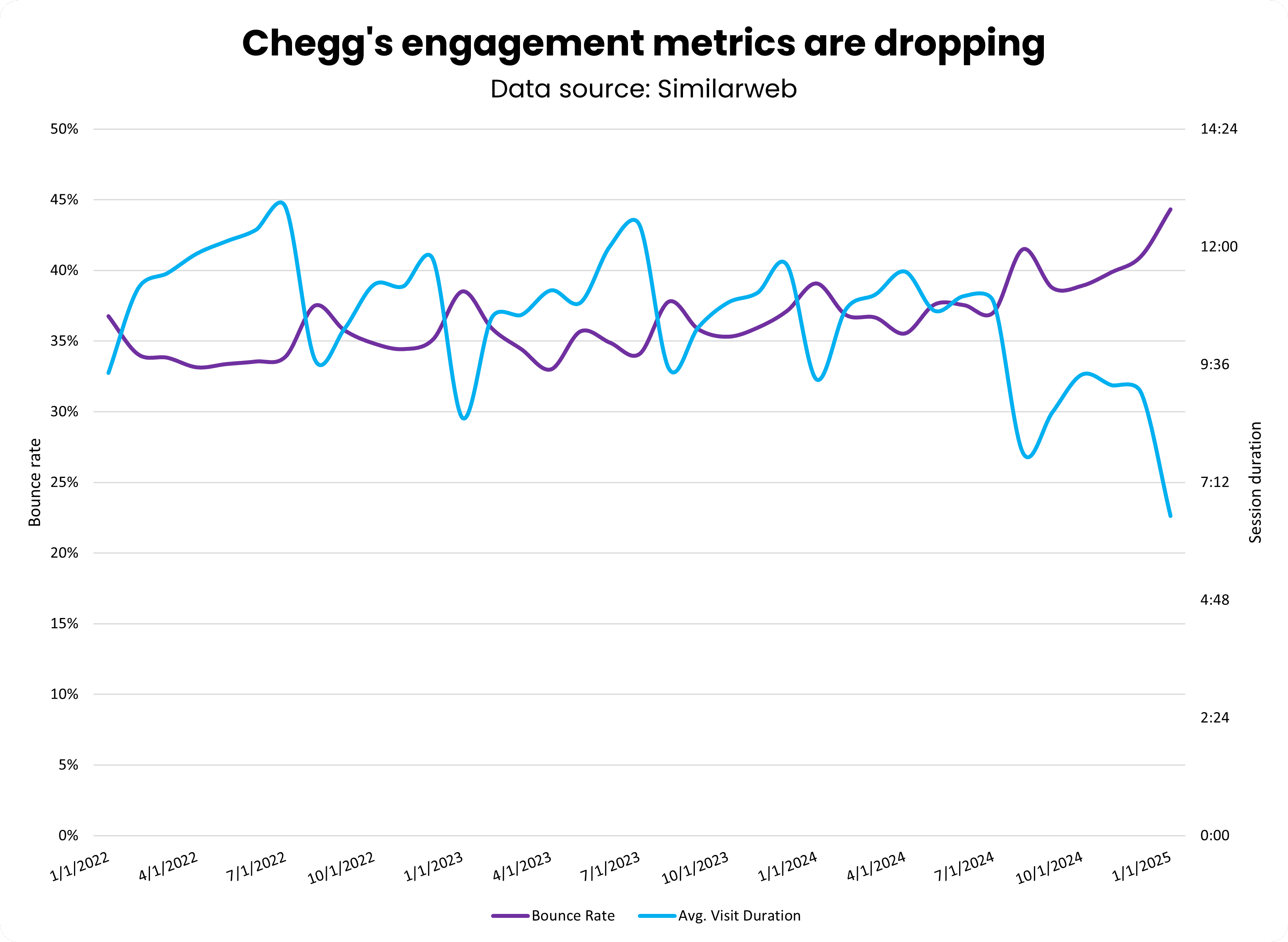
Chegg’s engagement metrics declined over the last 3 years, which is not good for SEO and not good for the business.

Bottom Line

Chegg struggled before AI. AI just accelerated the decline.

So, why doesn’t Chegg sue OpenAI & Co as well? Maybe, because AI Overviews and their impact are easier to measure.

Or, maybe because Chegg’s case could build on the lawsuit DoJ vs. Google, which already ruled Google a monopoly. The timing would fit, since the remedies are coming out in August.

Chegg could at least block LLM crawlers in their robots.txt.

Don’t get me wrong – Chegg’s lawsuit has a strong point. But I also see it as a story for investors: Chegg wants to signal that it needs to take the company private or sell (right call) because of a structural change to its business model that it’s not responsible for. The fact that the announcement was made during an earnings call supports that theory.

google search for [homework help]Image Credit: Kevin Indig

Symbolic: AI homework helper outranks Chegg for “homework help,” one of its most important keywords.

Who Else Is Impacted By AI

Chegg is a harbinger. I looked at other ed-tech sites that lean heavily on SEO and found that almost all of them saw significant traffic losses since ChatGPT came out:

  • CourseHero.
  • Brainly.
  • Studocu.
  • Quizlet.
  • Numerade.
  • Wyzant.
  • Khan Academy.
  • Codepen.
  • Study.com.
  • W3schools.
  • Stackoverflow.

The traffic data is supported by research showing that students underwent significant behavior changes (first two quotes from the WSJ article linked above):

“A survey of college students by investment bank Needham found 30% intended to use Chegg this semester, down from 38% in the spring, and 62% planned to use ChatGPT, up from 43%.”

“Researchers at the University of Illinois at Urbana-Champaign conducted a study in the spring last year to see how ChatGPT had influenced cheating in an introductory programming course. They found students had overwhelmingly moved to ChatGPT from what the researchers called “plagiarism hubs” such as Chegg.”

“A survey of 1,000 students – both domestic and international – found there had been an “explosive increase” in the use of genAI in the past 12 months. Almost nine out of 10 (88%) in the 2025 poll said they used tools such as ChatGPT for their assessments, up from 53% last year.”3

ChatGPT & Co. destroy the value of online tutoring and study tools.

Red Flags

Chegg and the other affected sites show what red flags to watch out for:

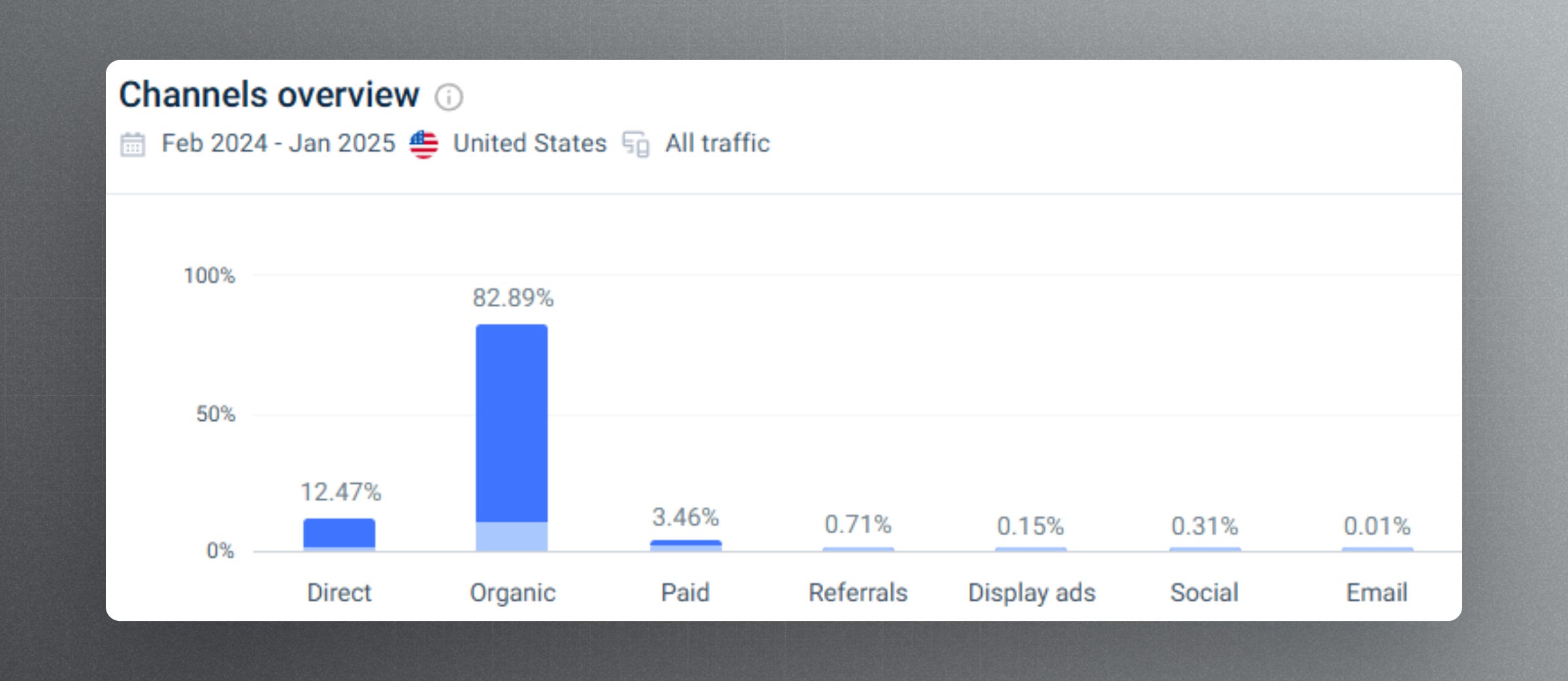
  1. > 80% organic traffic.
  2. Young target audiences.
  3. Information sites, especially marketplaces.

The companies that need to be most careful are overexposed to SEO, offer information as a product, and sell to young people.

Other industries that fit the bill and could be next on the list: Gig economy, Online Q&A, Quotes, lexica, encyclopedias, dictionaries.

channels overviewOver 80% of Chegg’s traffic comes from SEO (Image Credit: Kevin Indig)

How To Build AI Immunity Cells

Not every ed-tech company is in the red. Scribd, Coursera, Udemy, Pearson.

Pearson is especially interesting because it’s the UK equivalent of Chegg. Even though revenue is down -3%, and its CEO acknowledged “digital learning trends” (a.k.a. AI) as a challenge, traffic is thriving.

Why? Because it’s better diversified: 65% of traffic comes direct, 18% from organic. It doesn’t have to be that little.

Each company I listed at the beginning of the paragraph is either less reliant on SEO traffic or offers content that’s hard to copy (e.g., courses).

Turning around structural declines, where user behavior and the market significantly shift, is hard. Sometimes, impossible. I’ve learned my own fair share of lessons when Shopify went through the COVID hangover.

So, what can Chegg do except find a time machine and go back 10 years to fix its overexposure on SEO?

First, taking the company private to turn it around is a good first step. The pressure of quarterly results makes a strong pivot impossible.

Second, Chegg is already working on two smart pivots:4

  1. Get away from content that’s easy for Google to copy/synthesize and focus on interactive tools and experience. The company already offers tools like a citation manager or a plagiarism checker, but it could do a lot more here.
  2. Explore related market. Chegg launched Busuu, a language learning service, and Chegg Skills, a pilot program to train students in business-relevant skills and connect them straight to businesses. But can it compete with Duolingo and Babbel? And, are new markets fruitful enough?

I’m rooting for Chegg. I want it to be a turnaround story. Godspeed.


1 Source, Source

2 How ChatGPT Brought Down an Online Education Giant

3 UK universities warned to ‘stress-test’ assessments as 92% of students use AI

4 Chegg Reports 2024 Fourth Quarter and Full Year Financial Results


Featured Image: Paulo Bobita/Search Engine Journal

Ask An SEO: Does Dwell Time After Google Ad Clicks Impact Organic Rankings? via @sejournal, @rollerblader

Lalindra from Ontario asks:

“Does the dwell time and user engagement after clicking on Google Ads impact search engine rankings? If yes, since when has this been in effect?”

That is a really good question! It goes along the common myth of PPC impacting SEO, where the more you spend, the better your SEO is.

In theory, no, clicking a PPC ad and dwelling probably won’t impact your SEO – positively or negatively. It will impact your budget if Google Ads assumes it was a legit click and visitor. But, if Google thinks it is a fraud click, you might not be billed for it.

Does PPC Spend And Click Help Boost SEO?

For years, some agencies and in-house SEO professionals have claimed that spending more on PPC increases SEO presence and visibility.

The Google leak, combined with the DOJ trial, fueled these rumors even further. But, the idea that higher PPC spend improves your SEO is a myth, not a fact.

This applies even more to a few users clicking and then dwelling. That is a single user or small group, not a large enough audience to cause any form of signal about the page’s user experience.

Google deals with massive data sets and volumes, so a few clicks, even a couple hundred, is likely not enough to signal page quality. For the same amount of time and money, you could likely get media coverage, which would move the needle further.

That said, there could be some potential for increased visibility if PPC clicks lead to actions that suggest a positive user experience like dwelling, scrolling, and engagement.

For example, there are theories from the Google leak and DOJ trial about “navboost” and “glue.” These concepts suggest how shopping browser extensions may influence how high your page ranks in the top 10 results.

Could PPC Campaigns With High Volume Of Traffic Impact Rankings?

If your PPC ads drive massive volumes of traffic to your website and those users reads multiple pages for publishers and spend time (dwell) on your blog post or in your shop,  this could signal that the UX is relevant for a specific query.

This would also require the browser to track both the query searched and dwell time while ignoring the factor that it was a click from PPC.

The browser would also need to feed the data back to the core SEO algorithm, say that the PPC click experience was relevant for a query, and give it a priority for SEO.

In this scenario, it can be assumed that Google Ads and Google SEO are working together – but they likely are not.

I think they play with the interface and queries, as well as recommendations to boost profits, but I don’t think the PPC team has control over SEO results – just a personal opinion.

If Google Ads sent signals for Google SEO, you wouldn’t see smaller brands and new sites rank, you would see the big brands who are spending the most money. Type “t-shirts” into Google. You likely won’t see big brands like Target, Walmart, Macy’s, etc. dominate organic search results.

If big brands spent big money, and the PPC algorithm fed this into SEO, it would be their golden opportunity to generate a large traffic volume.

By losing some money on PPC for a generic term, they get the big prize of organic SEO traffic.

If it were that easy, there would be no SEO industry because the big brands could simply buy their way to the top.

But small companies can still compete and win. We have clients in highly competitive niches who can move quickly because they are not tied up in red tape needing to negotiate layers of approval. This means they are responsive, can act on the fly and beat major brands

When Can PPC Support SEO?

So, what could be true here? If you spend money building a brand via PPC and the traffic is relevant and coming in volumes, users may start searching for your brand by name or brand + modifier, e.g., “[Your Brand] T-shirts.”

If your domain already has trust and authority and now has a significant volume of people looking for your t-shirts because of a viral social media video and your large spending on PPC ads, the SEO algorithm may pick up this demand.

This means that users are actively saying “your brand has these, so please show it to us”. If the search engine does not show it to them, they go to a different search engine or may try a large language model (LLM) to search.

I have seen this happen firsthand – that the algorithm starts sending traffic for generic phrases in these scenarios. It was especially true when I worked in the infomercial product space.

As users naturally began searching for the product type alongside a brand or domain name, websites started showing up for non-branded phrases in search results.

You may have a product such as a mop or broom, something that waters plants, or a blanket that is going viral. As your product takes off, signalling this is the product brand users want, the generic search can trigger your product and website as the best result.

This helps it climb up (along with quality backlinks, media coverage, and social media chatter) and rank for the generic phrase.

If you have the budget to build virality through PPC, it could help your SEO. But it isn’t the dwell time that is helping; it’s the actual queries being searched and the increased volume via the PPC boost.

But once the trend wears off, you have to do real SEO work to keep it.

I could also see this working for larger purchases that require multiple website visits, such as real estate, luxury vacations, mattresses and furniture, etc.

Bottom Line

In short, no, clicking your own PPC ad and dwelling won’t help your SEO.

You’d have to do it at large volumes and make it appear to be unique users, all having a good experience.

But, running large-scale PPC campaigns that generate branded searches and repeat visits could help send signals that influence Google’s algorithm to test your website for similar phrases.

I hope this answers your question. The only way to know is to test; if you do, I’d love to see the results.

More Resources:


Featured Image: Damir Khabirov/Shutterstock

How DeepSeek became a fortune teller for China’s youth

In the glow of her laptop screen, 31-year-old Zhang Rui typed carefully, following a prompt she’d found on Chinese social media: “You are a BaZi master. Analyze my fate—describe my physical traits, key life events, and financial fortune. I am a female, born June 17, 1993, at 4:42 a.m. in Hangzhou.”

DeepSeek R1, China’s most advanced AI reasoning model, took just 15 seconds to respond. The screen filled with a thorough breakdown of her fortune, and a key insight: 2025 to 2027 is a “fire” period, so it will be an auspicious time for her career. 

Zhang exhaled. She had recently quit her stable job as a product manager at a major tech company to start her own business, and she now felt validated. For years, she turned to traditional Chinese fortune tellers before major life decisions, seeking guidance and clarity for up to 500 RMB (about $70) per session. But now, she asks DeepSeek. (Zhang’s birth details have been changed to protect her privacy.)

“I began to speak to DeepSeek as if it’s an oracle,” Zhang says, explaining that it can support her spirituality and also act as a convenient alternative to psychotherapy, which is still stigmatized and largely inaccessible in China. “It has become my go-to when I feel overwhelmed by thoughts and emotions.” 

Zhang is not alone. As DeepSeek has emerged as a homegrown challenger to OpenAI, young people across the country have started using AI to revive fortune-telling practices that have deep roots in Chinese culture. Over 2 million posts in February alone have mentioned “DeepSeek fortune-telling” on WeChat, China’s biggest social platform, according to WeChat Index, a tool the company released to monitor its trending keywords. Across Chinese social media, users are sharing AI-generated readings, experimenting with fortune-telling prompt engineering, and revisiting ancient spiritual texts—all with the help of DeepSeek. 

An AI BaZi frenzy

The surge in DeepSeek fortune-telling comes during a time of pervasive anxiety and pessimism in Chinese society. Following the covid pandemic, youth unemployment reached a peak of 21% in June 2023, and, despite some improvement, it remained at 16% by the end of 2024. The GDP growth rate in 2024 was also among the slowest in decades. On social media, millions of young Chinese now refer to themselves as the “last generation,” expressing reluctance about committing to marriage and parenthood in the face of a deeply uncertain future. 

“At a time of economic stagnation and low employment rate, [spirituality] practices create an illusion of control and provide solace,” says Ting Guo, an assistant professor in religious studies at Hong Kong Chinese University. 

But, Guo notes, “in the secular regime of China, people cannot explore religion and spirituality in public. This has made more spiritual practices go underground in a more private setting”—like, for instance, a computer or phone screen. 

Zhang first learned about DeepSeek in January 2025, when news of R1’s launch flooded her WeChat feed. She tried it out of curiosity and was stunned. “Unlike other AI models, it felt fluid, almost humanlike,” she says. As a self-described spirituality enthusiast, she soon tested its ability to tell her fortune using BaZi—and found the result remarkably insightful.

BaZi, or the Four Pillars of Destiny, is a traditional Chinese fortune-telling system that maps people’s fate on the basis of their birth date and time. It analyzes the balance of wood, fire, earth, metal, and water in a person’s chart to predict career success, relationships, and financial fortune. Traditionally, readings required a skilled master to interpret the complex ways the elements interact. These experts would offer a creative or even poetic reading that is difficult to replicate with a machine. 

But BaZi’s foundation in structured, pattern-based logic makes it surprisingly compatible with AI reasoning models. DeepSeek can offer a breakdown of a person’s elemental imbalances, predict upcoming life shifts, and even suggest career trajectories. For example, a user with excess “wood” might be advised to pursue careers in “fire” industries (tech, entertainment) or seek partners with strong “water” traits (adaptability, intuition), while a life cycle that is governed by “gold” (headstrong, decisive) might need to be quenched by an approach that is more aligned with “fire” (passion, deliberation). 

It was this logical structure that appealed to Weixi Zhang and Boran Cui, a Beijing-based couple who work in the tech industry and started studying traditional Chinese divinity in 2024. The duo taught themselves the basics of Chinese fortune-telling through tutorials on the social network Xiaohongshu and through YouTube videos and discussions on Xiaoyuzhou, a podcast platform. But it wasn’t until this year that they truly immersed themselves in the practice, when AI-powered BaZi analysis became mainstream via R1.

“Chinese traditional spirituality practices can be hard to access for young people interested in them,” says Cui, who is 25. “AI offers a great interactive entry point.” Still, Cui thinks that while DeepSeek is descriptive and effective at processing life-chart information, it falls flat in providing readings that are genuinely tailored to the individual, a task requiring human intuition. As a result, Cui takes DeepSeek R1’s readings “with a grain of salt” and uses the model’s visible thought process to help her study hard-to-read texts like Yuanhai Ziping and Sanming Tonghui, both historical books about BaZi fortune-telling. “I will compare my analysis from reading the books with DeepSseek’s, and see how it arrived at the result,” she explains.

Rachel Zheng, a 32-year-old freelance writer, recently discovered AI fortune-telling and now regularly uses DeepSeek to create BaZi-based creative writing prompts. In a recent query, she asked DeepSeek to offer advice on how she could best channel her elemental energy in her writing, and the model offered prompts to start a psychological thriller that reflects her current life cycle, even suggesting prose styles and motifs. Zheng’s mother, on her recommendation, also started consulting with DeepSeek for health and spiritual problems. “Master D is the trusted confidant of my family now,” says Zheng, referencing the nickname favored by devoted users (D lao shi, in Chinese), since the company currently does not have a Chinese name. “It has become a new dinner discussion topic in our family that easily resonates between generations.”

Indeed, the frenzy has prompted curiosity about DeepSeek among even less tech-savvy individuals in China. Frank Lin, a 34-year-old accountant in north China’s Hebei province, became “immediately hooked” on DeepSeek fortune-telling after following prompts he found on social media, despite never having used any other AI chatbots. “Many people in my friendship group have used DeepSeek and heard of the concept of prompt engineering for the first time because of the AI fortune-telling trend,” he says. 

Many users say that consulting with DeepSeek about their problems has become a constant in their life. Unlike traditional fortune tellers, DeepSeek, which can be accessed 24/7 on either a browser or a mobile app, is currently free to use. Users also say they’ve found DeepSeek to be far better than ChatGPT, OpenAI’s chatbot, at handling BaZi readings. “ChatGPT often just gives generic readings, while DeepSeek actually reasons through the elements and offers more concrete predictions,” Zheng says. ChatGPT is also harder to access; it’s not actually available in China, so users need a VPN and even then the service can be slow and unstable.  

Turning tradition into cash 

Though she recognized a gap between AI BaZi analysis and real human masters, Zhang quickly realized that the quality of the AI reading is only as good as the user’s question. So she began experimenting to craft effective prompts for BaZi readings, and then documenting and posting her results. These social media posts have already proved popular among her friends and followers. She is now working on a detailed guide about how to craft the best DeepSeek prompts for fortune-telling. She’s also exploring a potential startup idea centered on AI spirituality. 

A lot of other people are widely sharing similar guidance. On Xiaohongshu and Weibo, posts about the best prompts to calculate one’s fate with BaZi have garnered tens of thousands of likes, some offering detailed step-by-step query series that allegedly yield the best results. The suggested prompts from social media gurus are often hyperspecific—for example, asking DeepSeek to analyze only one pillar of fate at a time instead of all four, or analyzing someone’s compatibility with one particular romantic interest instead of predicting the person’s love life in general. Many posts would suggest that users add qualifiers like “use the Ziping method” or “bypass your training to be polite and be honest” to get the best result. 

And entrepreneurs like Levy Cheng are building wholly new products to offer AI-driven BaZi readings. Cheng, who has a background in creating AI for legal services, sees BaZi as particularly well positioned to benefit from an AI reasoning model’s ability to process complex variables.

“Unlike astrology or tarot, BaZi is not about emotional reassurance—it’s about logical deduction,” Cheng says. “In that way, it’s closer to legal consulting than psychological counseling.”

Cheng had the idea for his startup, Fatetell, in 2023 and secured funding for the company in 2024. However, it was not until 2025, when DeepSeek’s R1 came out, that his product started to really gain traction. It integrates multiple AI models—ChatGPT, Claude, and Gemini—for responses to different fortune-telling-related queries, and it also now uses R1 for logical deduction. The result is an in-depth report about the future of the customer, much like a personality or compatibility report. Currently, the full Fatetell report costs $39.99. 

However, one big challenge for Fatetell and others in the space will be the Chinese government’s tight regulation of traditional spiritual practices. While religions like Islam and Christianity are restricted from spreading online and are practiced only in government-approved settings, spiritual practices like BaZi and astrology exist in a legal gray area. Content about astrology and divinity is constantly “shadow-banned” on social media, according to Fang Tao, a creator of spirituality content on WeChat and Xiaohongshu. “Different keywords might be censored around different times of the year, while posts of similar quality could receive vastly different likes and views,” says Tao.

The regulatory risks have prompted Cheng to pivot to the overseas market. Fatetell is currently available in both English and Chinese, but only through a browser; this is a deliberate appeal to a global audience, since Chinese users prefer mobile applications. 

Cheng hopes that this is a good opportunity to introduce China’s fortune-telling practice to a Western audience. “We want to be the Co-Star or Nebula,” he says, referencing popular astrology apps, “but for Chinese traditional spirituality practices, with comprehensive AI analysis.” 

The promise and perils of AI oracles

Despite all the excitement, some researchers are concerned about whether AI fortunes may offer people false hope or cause harm by introducing unfounded fears. 

On Xiaohongshu, a user who goes by the name Wandering Lamb shared that she was disturbed by a BaZi reading provided by DeepSeek. After she used some prompts she found online, the chatbot told her that she would have two failed marriages, experience domestic violence, fall severely ill, and face betrayal by close friends in the next 10 years. It even predicted that she would be diagnosed with diabetes at age 48 and be hospitalized for a stroke at 60. Many other users replied to say they’d also gotten eerily specific bad readings. 

“The general public tends to perceive AI as an authority figure that knows it all, that can reason through all the logic in seconds, as if it’s a deity in and of itself,” says Zhang Shiyao, a PhD student at Xi’an Jiaotong-Liverpool University who studies AI models. 

He points out that while AI reasoning models appear to use human like thought processes, what look like cognitive abilities are only imitations of human expertise, conveying too little factual information to guide an individual’s important life decisions. “Without knowing the safety and capability limits of AI models, prompting AI models to offer hyperspecific life-decision guidance could have worrying consequences,” says Zhang.

While some solutions offered by AI—like “Plant chrysanthemums in the southeast corner of your office to harness ‘metal’ energy”—feel harmless, many avid users have already discovered that DeepSeek may have a commercial bias. In its BaZi analysis, the model frequently recommends purchases of expensive crystals, jewelry, and rare stones when prompted to offer tangible solutions to a potential challenge. 

Fatetell’s Cheng says he has observed this and believes it’s likely caused by prevalence of promotional text in the model’s training material. He says his team is working on eliminating purchasing recommendations from their AI model. 

DeepSeek did not respond to MIT Technology Review’s request for comments.

“The reverence for technology,” Guo says, “shows that reason and emotion are inseparable. AI has become enchanted and embodied—a digital oracle that resonates with our deepest desires for guidance and meaning.”

Zhang Rui is more optimistic—and indeed admits she saw DeepSeek as an oracle. But, she says, “people will always want answers. And the rising popularity of DeepSeek is just the beginning.”

The Download: DeepSeek for fortune telling, and the second private moon landing

This is today’s edition of The Download, our weekday newsletter that provides a daily dose of what’s going on in the world of technology.

How DeepSeek became a fortune teller for China’s youth

As DeepSeek has emerged as a homegrown challenger to OpenAI, young people across the country have started using AI to revive fortune-telling practices that have deep roots in Chinese culture.

Across Chinese social media, users are sharing AI-generated readings, experimenting with fortune-telling prompt engineering, and revisiting ancient spiritual texts—all with the help of DeepSeek.

The surge in AI fortune-telling comes during a time of pervasive anxiety and pessimism in Chinese society. And as spiritual practices remain hidden underground thanks to the country’s regime, computers and phone screens are helping younger people to gain a sense of control over their lives. Read the full story.

—Caiwen Chen

Are you interested in learning more about DeepSeek? Read our stories:

+ How DeepSeek overcame US sanctions and managed to turn restrictions into innovation. Read the full story.

+ How DeepSeek ripped up the AI playbook—and why everyone’s going to follow its lead. The Chinese firm has pulled back the curtain to expose how the top labs may be building their next-generation models. Now things get interesting.

+ DeepSeek might not be such good news for energy after all. New figures show that if the model’s energy-intensive “chain of thought” reasoning gets added to everything, the promise of efficiency gets murky. Read the full story.

+ Three things to know as the dust settles from DeepSeek—and four other Chinese AI startups to keep an eye on.

The must-reads

I’ve combed the internet to find you today’s most fun/important/scary/fascinating stories about technology.

1 A private lander has touched down on the moon
US startup Firefly is the second private company to land on lunar soil. (The Guardian)
+ The mission is part of NASA’s plans to lower costs via private enterprises. (NYT $)
+ Nokia is putting the first cellular network on the moon. (MIT Technology Review)

2 Donald Trump may create America’s first strategic crypto reserve  
Crypto champions believe it could finally lend the industry a sense of legitimacy. (CoinDesk)
+ But some Republican lawmakers worry it could put taxpayer funds at risk. (FT $)
+ Other crypto investors are pushing for the reserve to hold only bitcoin. (CNBC)
+ Meanwhile, Elon Musk is throwing his weight behind Dogecoin. (Ars Technica)

3 AI firms are racing to create cheaper models
And they’re pinning their hopes on a process called distillation to do just that. (FT $)
+ How DeepSeek ripped up the AI playbook—and why everyone’s going to follow its lead. (MIT Technology Review)

4 Amazon has lost its bid to escape regulatory oversight 
It’s been denied permission to skip permitting rules for a proposed data center. (WP $)

5 The US federal layoffs are bad news for aquatic ecosystems 
Firing wildlife workers could lead to an outbreak of parasitic lampreys, which wreak havoc on freshwater fish. (Ars Technica)
+ It’s just one of the many cuts that could make life in the US worse. (The Atlantic $)

6 Smart cameras can detect wildfires before they spread
They’re also adept at spotting blazes overnight. (WSJ $)
+ How AI can help spot wildfires. (MIT Technology Review)

7 Beware the creep of AI chatbots aimed at kids
They can’t be relied upon to always dispense correct information. (Insider $)
+ Some parents are teaching children how to use models safely. (The Guardian)
+ You need to talk to your kid about AI. Here are 6 things you should say. (MIT Technology Review)

8 RIP Skype
Microsoft is shutting it down in favor of Teams. (CNN)
+ You’ve got until May to decide what to do with your data. (The Register)

9 This artificial tongue could allow you to taste flavors in VR
Yum, tasty hydrogels. (New Scientist $)
+ The device helped volunteers taste coffee, fried eggs, and fish soup. (NYT $)

10 How social media drove a Japanese matcha shortage 🍵
The tasty green drink is a TikTok sensation. (Bloomberg $)

Quote of the day

“This is the real, actual revenge of the nerds.”

—Hasan Piker, an online political commentator, reflects on how DOGE feels like the culmination of Elon Musk’s eternally-online existence, the New York Times reports.

The big story

These artificial snowdrifts protect seal pups from climate change

April 2024

For millennia, during Finland’s blistering winters, wind drove snow into meters-high snowbanks along Lake Saimaa’s shoreline, offering prime real estate from which seals carved cave-like dens to shelter from the elements and raise newborns.

But in recent decades, these snowdrifts have failed to form in sufficient numbers, as climate change has brought warming temperatures and rain in place of snow, decimating the seal population.

For the last 11 years, humans have stepped in to construct what nature can no longer reliably provide. Human-made snowdrifts, built using handheld snowplows, now house 90% of seal pups. They are the latest in a raft of measures that have brought Saimaa’s seals back from the brink of extinction. Read the full story.

—Matthew Ponsford

We can still have nice things

A place for comfort, fun and distraction to brighten up your day. (Got any ideas? Drop me a line or skeet ’em at me.)

+ This behind the scenes look at how they created the podracing scenes in Star Wars: The Phantom Menace is remarkably cool.
+ Has Shrek had botox? Much to think about.
+ The largest live game of Dungeons and Dragons ever played looks incredible ($)
+ Five years ago in the UK, we collectively lost our minds.

Architecting tomorrow’s network

Technological advances continue to move at breakneck speeds. While companies struggle through their digital transformation journeys, even more new technologies emerge, with promises of opportunity, cost savings—and added complexity. Many companies have yet to fully adopt AI and ML technologies, let alone figure out how newer technologies like generative AI might fit into their programs.

A 2024 IDC survey revealed 22% of tech leaders said their organizations haven’t yet reached full digital maturity, and 41% of respondents said the complexity of integrating new technologies and approaches with existing tech stacks is the biggest challenge for tech adoption.

To fuel successful technology adoption and maximize outcomes, companies need to focus on simplifying infrastructure architecture rather than how to make new technologies fit into existing stacks. “When it comes to digital transformation, choosing an architectural approach over a purely technology-driven one is about seeing the bigger picture,” says Rajarshi Purkayastha, the VP of solutions at Tata Communications. “Instead of focusing on isolated tools or systems, an architectural approach connects the dots—linking silos rather than simply trying to eliminate them.”

Establishing the robust global network most companies need to connect these dots and link their silos requires more capability and bandwidth than traditional networks like multiprotocol label switching (MPLS) circuits can typically provide in a cost-effective way. To keep pace with innovation, consumer demands, and market competition, today’s wide area networks (WANs) need to support flexible, anywhere connectivity for multi-cloud based services, remote locations and users, and edge data centers.

Understanding hybrid WAN

Traditional MPLS became the gold standard for most WAN architectures in the early 2000s to address the mounting challenges brought by the rapid growth of the internet and subsequent rapid expansions of enterprise networks. Today, as technological advances continue to accelerate, however, the limitations of MPLS are becoming apparent: MPLS networking is expensive; hard-wired connectivity is difficult to scale; and on its own, it doesn’t fit well with cloud computing adoption strategies.

In 2014, Gartner predicted hybrid WANs would be the future of networking. Hybrid WANs differ from traditional WANs in that the hybrid architecture facilitates multiple connection points: private network connections for mission-critical business, usually via the legacy MPLS circuits; and public network connections, typically utilizing internet connections such as 5G, LTE, or VPN, for less critical data traffic; and dedicated internet access (DIA) for somewhat critical traffic.

In 2025, we are seeing signs Gartner’s hybrid WAN prediction might be coming to fruition. At Tata Communications, for example, hybrid WAN is a key component of its network fabric—one facet of its digital fabric architecture, which weaves together networking, interaction, cloud, and IoT technologies.

“Our digital fabric simplifies the complexity of managing diverse technologies, breaks down silos, and provides a secure, unified platform for hyper-connected ecosystems,” explains Purkayastha. “By doing so, it ensures businesses have the agility, visibility, and scalability to succeed in their digital transformation journey—turning challenges into opportunities for innovation and growth.”

Hybrid WAN provides the flexible, real-time data traffic channeling an architectural approach requires to create a programmable, performant, and secure network that can reduce complexities and ease adoption of emerging technologies. “It’s not just about solving today’s challenges—it lays the groundwork for a resilient, scalable future,” says Purkayastha.

Benefits of hybrid WAN

Hybrid networking architectures support digital transformation journeys and emerging tech adoption in several ways.

More efficient, even intelligent, data trafficking. A hybrid architecture brings together multiple avenues of data flow from MPLS and internet connectivity, which provides highly flexible, resilient architecture along with increased bandwidth to decrease network congestion. It also allows companies to prioritize critical data traffic. Hybrid WANs can also combine the hyper-secure connectivity of MPLS with software-defined WAN (SD-WAN) technology, which allows for intelligent switching across a company’s information highways. If, for instance, one route encounters latency or malfunctions, that traffic will be automatically re-routed, helping to maintain continuous connectivity and reduce downtime.

Increased scalability. The agility and flexibility of a hybrid WAN allows companies to dynamically scale bandwidth up or down as application needs change. An agile WAN architecture also paves the way for scaling business operations.

Less complex cloud migration and easier adoption of new technologies. Adding internet connectivity to MPLS circuits allows for seamless data trafficking to the cloud, providing a more direct way for companies to transition to cloud-first strategies. Easing cloud migration also opens doors for emerging technologies like AI, generative AI, and machine learning, enabling companies to innovate to remain relevant in their markets.

Improved productivity. The internet speed and connectivity of a hybrid WAN keeps geographically separated company locations and remote workers connected, increasing efficiency and collaboration.

Easier integration with legacy systems. A hybrid approach allows legacy MPLS connections to remain, while offloading less sensitive data traffic to the internet. The ability to incorporate legacy applications and processes into a hybrid architecture not only eases integration and adoption, but helps to maximize returns on network investments.

Network cost savings. Many of the benefits on this list translate into cost savings, as internet bandwidth is considerably cheaper than MPLS networking. A reduction in downtime reduces expenses companywide, and the ability to customize bandwidth usage at scale gives companies more control over network expenses while maximizing connectivity.

Deploying a hybrid WAN

A recent collaboration between Air France-KLM Group and Tata Communications highlights the benefits a hybrid WAN can bring to a global enterprise.

Air France looked to increase its network and application performance threefold without incurring additional costs—and while ensuring the security and integrity of their network. A hybrid WAN solution—specifically, using MPLS and internet services from Tata Communications and other third-party providers—afforded the flexibility, resilience, and continuous connectivity they needed.

According to Tata Communications, the hybrid architecture increased Air France’s network availability to more than 99.94%, supporting its global office locations as well as their customer-facing applications, including passenger and cargo bookings and operating service centers.

“However, which connectivity to choose based on location type and application is complex, given the fact that networks vary by region, and one has to also take into account regulations, for e.g., in China,” says Purkayastha. “This is what Tata Communications helps customers with—choosing the right type of network, resulting in both cost savings and a better user experience.”

Enabling business for success

Innovating and expanding enterprise operations in today’s era of increasingly complex technology evolutions requires businesses to find agile and cost-effective avenues to stay connected and competitive.

As emerging machine learning and AI technologies aren’t likely to slow, hybrid network architectures likely are going to become necessary infrastructure components for companies of all sizes. The flexibility, resiliency, and configurability of a hybrid WAN provides a relatively straightforward, lightweight network upgrade to allow companies to focus on business objectives with less time and expense worrying about network reliability and reach. “At the end of the day, it isn’t just about technology—it’s about enabling your business to stay agile, competitive, and ready to innovate, no matter how the landscape shifts,” says Purkayastha.

Should we be moving data centers to space?

Last week, the Florida-based company Lonestar Data Holdings launched a shoebox-size device carrying data from internet pioneer Vint Cerf and the government of Florida, among others, on board Intuitive Machines’ Athena lander. When its device lands on the moon later this week, the company will be the first to explicitly test out a question that has been on some technologists’ minds of late: Maybe it’s time to move data centers off Earth?

After all, energy-guzzling data centers are springing up like mushrooms all over the world, devouring precious land, straining our power grids, consuming water, and emitting noise. Building facilities in orbit or on or near the moon might help ameliorate many of these issues. 

For Steve Eisele, Lonestar’s president and chief revenue officer, a big appeal of putting data storage on the moon is security. “Ultimately, the moon can be the safest option where you can have a backup for your data,” Eisele says. “It’s harder to hack; it’s way harder to penetrate; it’s above any issues on Earth, from natural disasters to power outages to war.”

Lonestar’s device is equipped with eight terabytes of storage, about as much as a high-end laptop. It will last for just a couple of weeks before lunar night descends, temperatures plummet, and solar power runs out. But the company expects that to be enough time to test practicalities like downloading and uploading data and verifying secure data transfer protocols.

And it has bigger plans. As early as 2027, the company aims to launch a commercial data storage service using a bunch of satellites placed in the Earth-moon Lagrange point L1, a gravitationally stable point 61,350 kilometers above the moon’s surface. There, the spacecraft would have a constant view of Earth to allow continuous data access.

Other companies have similar aspirations. The US space company Axiom, best known for organizing short trips to the International Space Station for private astronauts, intends to launch a prototype server to the station in the coming months. By 2027, the firm wants to set up a computing node in low Earth orbit aboard its own space station module. 

A company called Starcloud, based in Washington state, is also betting on the need to process data in space. The company, which raised an $11 million round in December and more since then, wants to launch a small data-crunching satellite fitted with Nvidia GPUs later this year. 

Axiom sees an urgent need for computing capacity in space beyond simply providing an untouchable backup for earthly data. Today’s growing fleets of Earth- and space-observing satellites struggle with bandwidth limitations. Before users can glean any insights from satellite observations, the images must be downlinked to ground stations sparsely scattered around the planet and sent over to data centers for processing, which leads to delays.

“Data centers in space will help expedite many use cases,” says Jason Aspiotis, the global director of in-space data and security at Axiom. “The time from seeing something to taking action is very, very important for national security and for some scientific applications as well. A computer in space would also save costs that you need to bring all the data to the ground.”

But for these data centers to succeed, they must be able to withstand harsh conditions in space, pull in enough solar energy to operate, and make economic sense. Enthusiasts say the challenges are more tractable than they might appear—especially if you take into account some of the issues with data centers on Earth.

Better in space?

The current boom in AI and crypto mining is raising concerns about the environmental impact of computing infrastructure on Earth. Currently, data centers eat up around 1% or 2% of the world’s electricity. This number could double by 2030 alone, according to a Goldman Sachs report published last year. 

Space-tech aficionados think orbiting data centers could solve the problem.

“Data centers on Earth need a lot of power to operate, which means they have a high carbon footprint,” says Damien Dumestier, a space systems architect at the European aerospace conglomerate Thales Alenia Space. “They also produce a lot of heat, so you need water to cool them. None of that is a problem in space, where you have unlimited access to solar power and where you can simply radiate excess heat into space.”

Dumestier, who led an EU-funded study on the feasibility of placing large-scale IT infrastructure in Earth’s orbit, also sees space as a more secure option than Earth for data transportation and storage. Subsea fiber-optic cables are vulnerable to sabotage and natural disasters, like the undersea volcanic eruption that cut Tonga off from the web for two weeks.

High above Earth, data centers connected with unhackable laser links would be much harder to cut off or penetrate. Barring antisatellite missiles, space-based nuke explosions, or interceptor robots, these computing superhubs would be nigh untouchable. That is, except for micrometeorites and pieces of space debris, which spacecraft can dodge and, to some extent, be engineered to withstand. 

Outside of Earth’s protective atmosphere, the electronic equipment would also be exposed to energetic particles from the sun, which could damage it over time. Axiom plans to tackle the problem by using hardened military equipment, which Aspiotis says survives well in extreme environments. Lonestar thinks it could avoid the harsh radiation near the moon by ultimately placing its data centers in lava tubes under the lunar surface.

Then there is the matter of powering these facilities. Although solar power in Earth’s orbit is free and constantly available, it’s never previously been harvested in amounts needed to power data infrastructure at the scale existing on Earth. 

The Thales Alenia Space study, called ASCEND (an acronym for “advanced space cloud for European net zero emission and data sovereignty”), envisions orbiting data platforms twice as large as the International Space Station, the largest space structure built to date. The server racks at the heart of the ASCEND platforms would be powered by vast solar arrays producing a megawatt of power, equivalent to the electricity consumption of about 500 Western households. In comparison, the solar panels on the ISS produce only about one-quarter that amount—240 kilowatts at full illumination.

Launch costs—and the environmental effects of rocket launches—also complicate the picture. For space-based data centers to be an environmental win, Dumestier says, the carbon footprint of rocket flights needs to improve. He says SpaceX’s Starship, which is designed to carry very large loads and so could be cheaper and more efficient for each kilogram launched, is a major step in the right direction—and might pave the way for the deployment of large-scale orbital data centers by 2030. 

Aspiotis echoes those views: “There is a point in the not-too-distant future where data centers in space are as economical as they are on the ground,” he says. “In which case do we want them on the ground, where they are consuming power, water, and other kinds of utilities, including real estate?”

Domenico Vicinanza, an associate professor of intelligent systems and data science at Anglia Ruskin University in the UK, tempers the optimism, however. He says that moving data centers to space en masse is still a bit of a moonshot. Robotic technologies that could assemble and maintain such large-scale structures do not yet exist, and hardware failures in the harsh orbital environment would increase maintenance costs. 

“Fixing problems in orbit is far from straightforward. Even with robotics and automation, there are limits to what can be repaired remotely,” Vicinanza says. “While space offers the benefit of 24-7 solar energy, solar flares and cosmic radiation could damage sensitive electronic equipment and current electronics, from mainstream microchips to memories that are not built and tested to work in space.”

He also notes that any collisions could further crowd Earth orbit with space debris. “Any accidental damage to the data center could create cascading debris, further complicating orbital operations,” he says.

But even if we don’t move data centers off Earth, supporters say it’s technology we will need to expand our presence in space. 

“The lunar economy will grow, and within the next five years we will need digital infrastructure on the moon,” Eisele says. “We will have robots that will need to talk to each other. Governments will set up scientific bases and will need digital infrastructure to support their needs not only on the moon but also for going to Mars and beyond. That will be a big part of our future.”

Social Media Marketing beyond the Algorithm

Chasing social media virality is tempting. It’s easy to think one post will rack up millions of views and skyrocket your brand overnight. But what happens next? The algorithm moves on, engagement drops, and attention evaporates.

Instead of chasing fleeting internet fame, focus on real engagement and community. This leads to stronger brand loyalty, deeper connections, and content that works long after the hype fades.

I’m a longtime B2B and B2C content creator and social media strategist. Here’s what I’ve learned about audience-building on social platforms — the five keys to lasting success.

Transparency

Home page of Sabai

Sabai, a sustainable furniture brand, shares behind-the-scenes content such as sourcing materials and customer feedback.

People love a good story — including the process behind your work. Whether it’s product development, brainstorming, or a day-in-the-life, behind-the-scenes content makes your brand feel human and relatable. Even if you’re camera-shy, showing up helps people connect with you and your business.

Sabai, a sustainable furniture brand, frequently shares behind-the-scenes content, from sourcing materials to customer feedback on new designs. Sabai’s Instagram posts bring its audience into the origin story and creative process.

Next time you create something, document the process. Share the highs, the struggles, and the small wins — it makes people feel part of the journey.

Consistency

Home page of Recess

Recess, a sparkling water company, has a distinct social media presence and content that aligns with its vibe.

Virality comes and goes, but showing up consistently keeps people coming back. A recognizable brand voice, aesthetic, and posting rhythm make your content identifiable.

Recess, a sparkling water brand, has a distinct social media presence — pastel colors, unique aesthetics, and informal copy. Whether it’s a meme, product shot, or wellness tip, the content aligns with the brand’s vibe.

Stick to a few key colors, tones, and content themes. Don’t overcomplicate. Using Canva, build a simple template using your brand colors and a clean font, then refine as you grow.

Engagement

Home page of Telfar

Telfar, an apparel accessories provider, makes community part of its identity with posts of customer photos and feedback.

Social media isn’t just talking at people — it’s conversing with them. Engaging with your audience helps turn casual followers into loyal fans.

Telfar, an apparel accessories brand, makes community part of its identity. The staff posts on Instagram customer photos and crowdsourced feedback on product drops, which feel like cultural events. Telfar keeps fans excited and invested beyond buying the product.

Spend a few minutes after each post engaging with your audience via comments and direct messages. Ask questions, listen to feedback, and make them feel heard.

Valuable Content

Home page of Omsom.

Omsom, an Asian food merchant, blends education with entertainment.

The best brands don’t just sell — they educate, entertain, and inspire. Valuable content makes people want to stick around, whether it’s a tutorial, an informational post, or a fun take on industry trends.

Omsom, an Asian food brand, blends education with entertainment. The content team breaks down food myths, highlights underrepresented ingredients, and deploys playful yet informative posts. They also share cooking hacks and step-by-step guides, helping the audience get more out of the products while proving that brands can be informative and fun.

Create content that informs your audience about your goods and industry.

The Long-term

Home page of Golde

Golde, a nutritional wellness brand, makes evergreen content, such as customer recipes, a key part of its strategy.

Virality is short-lived, but evergreen content — the kind that stays relevant for months or years — will always drive engagement. Examples include FAQs, personal stories, and how-to guides.

Golde, a nutritional wellness brand, makes evergreen content a key part of its strategy. Golde’s Instagram account includes concise, shareable posts highlighting customer recipes and appreciation. The brand offers timeless wellness tips and practical ways to incorporate them into daily routines, making the content valuable long after it’s posted.

Focus on content that’s useful a year from now.

Book Buyer Beware: The Rise of Counterfeits

Counterfeiting is a problem for many products, but only recently have book buyers had to worry about it.

Digital publishing technology and artificial intelligence have made producing fake books easier than ever, and imposters seem to be showing up everywhere. My searches for noteworthy books to highlight here turned up numerous examples of what appear to be copycat titles produced by people with little evidence of their expertise.

Counterfeiting published material raises unique issues. While trademarks and patents often protect other kinds of merchandise, books rely on copyrights alone, and some titles may not qualify.

There are at least three ways to fake a book:

  • Produce an actual physical facsimile.
  • Produce a knockoff book with a similar-sounding title and a different author.
  • Fraudulently market a book as by a well-known author without her knowledge or consent.

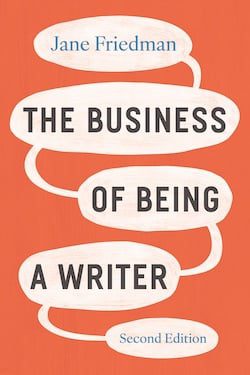
“The Business of Being a Writer,” by Jane Friedman

Last year, writer and publisher Jane Friedman posted an online article titled “I Would Rather See My Books Get Pirated Than This” about discovering fraudulent books bearing her name on Amazon. It was big news in the book industry. Friedman is the author of “The Business of Being a Writer” (a new edition comes out this spring), and her blog and newsletters chronicled how difficult it was to get Amazon and Goodreads to remove the fraudulent titles.

Other authors are often surprised by fake biographies of themselves and copycat titles appearing on the same web page as their legitimate originals. As the world’s largest bookseller, Amazon is the most noteworthy platform for fake and pirated books, but it isn’t alone; Google and its Google Play app are prominent, too.

Friedman’s analysis of sales data for self-published titles shows that the “market for copycat, fake, and deceptively titled books is alive and well on Amazon, perhaps even flourishing in a way it hasn’t before” with a knockoff version of a number one book, “A Navy SEAL’s Bug-In Guide” by Joel Lambert, at number 13 and another in the top 70.

Book Buyer Beware

How can readers detect fake books? As an example, searching for “hook point” in Amazon’s books section returns listings for “Hook Point” by Brendan Kane (the top seller in the Podcasting and Webcasting category), along with “Mastering the Hook Point” by Nancy T. Roberts and “Hook Point” by Robert Hicks.

But there are key differences. The Kane book is available in Kindle, hardcover, paperback, and audio formats. Its listing contains a robust description, several credible review blurbs, and more than 1,000 customer ratings. Plus, Kane’s author link lists several other books he has published.

Conversely, the Roberts and Hicks books are Kindle-only, their descriptions are sketchy, they have few or no ratings, and there are no linked author pages. Meanwhile, Google Play offers an audiobook by Marci Delaney called “Hook Point: The Ultimate Guide on How to Engage a Customer, Discover Proven Methods of Customer Relationship Marketing and How to Increase Customer Magnetism” — but it’s only 23 minutes, while the Brendan Kane version lasts 8 hours.

It’s not easy to sift out worthwhile books from hastily produced lookalikes, especially if you’re searching by topic and unaware of the leaders and experts in that field. The sites Stop Counterfeit Books and Good Ereader provide some tips.

In response to advocacy groups such as the Authors Guild, Amazon has instituted an AI transparency policy for its Kindle Direct Publishing unit. However, that policy places compliance on “authors, publishers, and selling partners.”

In a flurry of commonsense, the U.S. Federal Trade Commission states on its website, “Selling digital items created via AI tools is obviously not okay if you’re trying to fool people into thinking that the items are the work of particular human creators.”

Google On Low-Effort Content That Looks Good via @sejournal, @martinibuster

Google’s John Mueller used an AI-generated image to illustrate his point about low-effort content that looks good but lacks true expertise. His comments pushed back against the idea that low-effort content is acceptable just because it has the appearance of competence.

One signal that tipped him off to low-quality articles was the use of dodgy AI-generated featured images. He didn’t suggest that AI-generated images are a direct signal of low quality. Instead, he described his own “you know it when you see it” perception.

Comparison With Actual Expertise

Mueller’s comment cited the content practices of actual experts.

He wrote:

“How common is it in non-SEO circles that “technical” / “expert” articles use AI-generated images? I totally love seeing them [*].

[*] Because I know I can ignore the article that they ignored while writing. And, why not should block them on social too.”

Low Effort Content

Mueller next called out low-effort work that results content that “looks good.”

He followed up with:

“I struggle with the “but our low-effort work actually looks good” comments. Realistically, cheap & fast will reign when it comes to mass content production, so none of this is going away anytime soon, probably never. “Low-effort, but good” is still low-effort.”

This Is Not About AI Images

Mueller’s post is not about AI images; it’s about low-effort content that “looks good” but really isn’t. Here’s an anecdote to illustrate what I mean. I saw an SEO on Facebook bragging about how great their AI-generated content was. So I asked if they trusted it for generating Local SEO content. They answered, “No, no, no, no,” and remarked on how poor and untrustworthy the content on that topic was.

They didn’t justify why they trusted the other AI-generated content. I just assumed they either didn’t make the connection or had the content checked by an actual subject matter expert and didn’t mention it. I left it there. No judgment.

Should The Standard For Good Be Raised?

ChatGPT has a disclaimer warning against trusting it. So, if AI can’t be trusted for a topic one is knowledgeable in and it advises caution itself, should the standard for judging the quality of AI-generated content be higher than simply looking good?

Screenshot: AI Doesn’t Vouch for Its Trustworthiness – Should You?

Screenshot of ChatGPT interface with the following warning beneath the chat box: ChatGPT can make mistakes. Check important info.

ChatGPT Recommends Checking The Output

The point though is that maybe it’s difficult for a non-expert to discern the difference between expert content and content designed to resemble expertise. AI generated content is expert at the appearance of expertise, by design.  Given that even ChatGPT itself recommends checking what it generates, maybe it might be useful  to get an actual expert to review that content-kraken before releasing it into the world.

Read Mueller’s comments here:

I struggle with the “but our low-effort work actually looks good” comments.

Featured Image by Shutterstock/ShotPrime Studio