OpenAI spent $1.76 million on government lobbying in 2024 and $510,000 in the last three months of the year alone, according to a new disclosure filed on Tuesday—a significant jump from 2023, when the company spent just $260,000 on Capitol Hill. The company also disclosed a new in-house lobbyist, Meghan Dorn, who worked for five years for Senator Lindsey Graham and started at OpenAI in October. The filing also shows activity related to two new pieces of legislation in the final months of the year: the House’s AI Advancement and Reliability Act, which would set up a government center for AI research, and the Senate’s Future of Artificial Intelligence Innovation Act, which would create shared benchmark tests for AI models.
OpenAI did not respond to questions about its lobbying efforts.
But perhaps more important, the disclosure is a clear signal of the company’s arrival as a political player, as its first year of serious lobbying ends and Republican control of Washington begins. While OpenAI’s lobbying spending is still dwarfed by its peers’—Meta tops the list of Big Tech spenders, with more than $24 million in 2024—the uptick comes as it and other AI companies have helped redraw the shape of AI policy.
For the past few years, AI policy has been something like a whack-a-mole response to the risks posed by deepfakes and misinformation. But over the last year, AI companies have started to position the success of the technology as pivotal to national security and American competitiveness, arguing that the government must therefore support the industry’s growth. As a result, OpenAI and others now seem poised to gain access to cheaper energy, lucrative national security contracts, and a more lax regulatory environment that’s unconcerned with the minutiae of AI safety.
While the big players seem more or less aligned on this grand narrative, messy divides on other issues are still threatening to break through the harmony on display at President Trump’s inauguration this week.
AI regulation really began in earnest after ChatGPT launched in November 2022. At that point, “a lot of the conversation was about responsibility,” says Liana Keesing, campaigns manager for technology reform at Issue One, a democracy nonprofit that tracks Big Tech’s influence.
Companies were asked what they’d do about sexually abusive deepfake images and election disinformation. “Sam Altman did a very good job coming in and painting himself early as a supporter of that process,” Keesing says.
OpenAI started its official lobbying effort around October 2023, hiring Chan Park—a onetime Senate Judiciary Committee counsel and Microsoft lobbyist—to lead the effort. Lawmakers, particularly then Senate majority leader Chuck Schumer, were vocal about wanting to curb these particular harms; OpenAI hired Schumer’s former legal counsel, Reginald Babin, as a lobbyist, according to data from OpenSecrets. This past summer, the company hired the veteran political operative Chris Lehane as its head of global policy.
OpenAI’s previous disclosures confirm that the company’s lobbyists subsequently focused much of last year on legislation like the No Fakes Act and the Protect Elections from Deceptive AI Act. The bills did not materialize into law. But as the year went on, the regulatory goals of AI companies began to change. “One of the biggest shifts that we’ve seen,” Keesing says, “is that they’ve really started to focus on energy.”
In September, Altman, along with leaders from Nvidia, Anthropic, and Google, visited the White House and pitched the vision that US competitiveness in AI will depend on subsidized energy infrastructure to train the best models. Altman proposed to the Biden administration the construction of multiple five-gigawatt data centers, which would each consume as much electricity as New York City.
Around the same time, companies like Meta and Microsoft started to say that nuclear energy will provide the path forward for AI, announcing deals aimed at firing up new nuclear power plants.
It seems likely OpenAI’s policy team was already planning for this particular shift. In April, the company hired lobbyist Matthew Rimkunas, who worked for Bill Gates’s sustainable energy effort Breakthrough Energies and, before that, spent 16 years working for Senator Graham; the South Carolina Republican serves on the Senate subcommittee that manages nuclear safety.
This new AI energy race is inseparable from the positioning of AI as essential for national security and US competitiveness with China. OpenAI laid out its position in a blog post in October, writing, “AI is a transformational technology that can be used to strengthen democratic values or to undermine them. That’s why we believe democracies should continue to take the lead in AI development.” Then in December, the company went a step further and reversed its policy against working with the military, announcing it would develop AI models with the defense-tech company Anduril to help take down drones around military bases.
That same month, Sam Altman said during an interview with The Free Press that the Biden administration was “not that effective” in shepherding AI: “The things that I think should have been the administration’s priorities, and I hope will be the next administration’s priorities, are building out massive AI infrastructure in the US, having a supply chain in the US, things like that.”
That characterization glosses over the CHIPS Act, a $52 billion stimulus to the domestic chips industry that is, at least on paper, aligned with Altman’s vision. (It also preceded an executive order Biden issued just last week, to lease federal land to host the type of gigawatt-scale data centers that Altman had been asking for.)
Intentionally or not, Altman’s posture aligned him with the growing camaraderie between President Trump and Silicon Valley. Mark Zuckerberg, Elon Musk, Jeff Bezos, and Sundar Pichai all sat directly behind Trump’s family at the inauguration on Monday, and Altman also attended. Many of them had also made sizable donations to Trump’s inaugural fund, with Altman personally throwing in $1 million.
It’s easy to view the inauguration as evidence that these tech leaders are aligned with each other, and with other players in Trump’s orbit. But there are still some key dividing lines that will be worth watching. Notably, there’s the clash over H-1B visas, which allow many noncitizen AI researchers to work in the US. Musk and Vivek Ramaswamy (who is, as of this week, no longer a part of the so-called Department of Government Efficiency) have been pushing for that visa program to be expanded. This sparked backlash from some allies of the Trump administration, perhaps most loudly Steve Bannon.
Another fault line is the battle between open- and closed-source AI. Google and OpenAI prevent anyone from knowing exactly what’s in their most powerful models, often arguing that this keeps them from being used improperly by bad actors. Musk has sued OpenAI and Microsoft over the issue, alleging that closed-source models are antithetical to OpenAI’s hybrid nonprofit structure. Meta, whose Llama model is open-source, recently sided with Musk in that lawsuit. Venture capitalist and Trump ally Marc Andreessen echoed these criticisms of OpenAI on X just hours after the inauguration. (Andreessen has also said that making AI models open-source “makes overbearing regulations unnecessary.”)
Finally, there are the battles over bias and free speech. The vastly different approaches that social media companies have taken to moderating content—including Meta’s recent announcement that it would end its US fact-checking program—raise questions about whether the way AI models are moderated will continue to splinter too. Musk has lamented what he calls the “wokeness” of many leading models, and Andreessen said on Tuesday that “Chinese LLMs are much less censored than American LLMs” (though that’s not quite true, given that many Chinese AI models have government-mandated censorship in place that forbids particular topics). Altman has been more equivocal: “No two people are ever going to agree that one system is perfectly unbiased,” he told The Free Press.
It’s only the start of a new era in Washington, but the White House has been busy. It has repealed many executive orders signed by President Biden, including the landmark order on AI that imposed rules for government use of the technology (while it appears to have kept Biden’s order on leasing land for more data centers). Altman is busy as well. OpenAI, Oracle, and SoftBank reportedly plan to spend up to $500 billion on a joint venture for new data centers; the project was announced by President Trump, with Altman standing alongside. And according to Axios, Altman will also be part of a closed-door briefing with government officials on January 30, reportedly about OpenAI’s development of a powerful new AI agent.
Brick-and-click retailers can struggle to balance local and ecommerce search engine optimization. A physical store wants to target folks in a geographic area and drive in-person visits, while an ecommerce site aims for buyers anywhere.
Different goals, however, don’t necessarily mean there is a problem.
Imagine a furniture retailer with dozens of stores in California and Florida. The CEO could message the marketing team concerned that ecommerce represents less than 20% of total revenue. Her concern the next day could be a new Miami store not appearing on a local Google search.
It feels like a conflict — from link building to content marketing. But it doesn’t have to be. A brick-and-click marketing team can balance the priorities by planning day-to-day SEO activities and developing processes.
3-Part SEO
Marketers often say that SEO has three areas of focus: technical, on-page, and off-page.
Omnichannel marketing teams balance local and ecommerce SEO.
Technical SEO focuses on site speed, URL structure, microdata, and general crawlability. The same technical practices that work for local SEO also help promote products.
Teams of content marketers and on-page optimizers frequently work hand-in-glove to ensure a site ranks for key products, categories, and locations. There is no reason local and ecommerce efforts cannot live in harmony.
Off-page SEO includes backlinks, brand mentions, and filling out and maintaining business profiles, which feed into Google’s local pack and map results. Off-page efforts fit naturally into local optimization even if the focus is ecommerce.
In Action
Sharing tasks for ecommerce and local SEO helps both. Here are priorities, workflows, and automation to streamline the load.
Prioritize setup and integration. Many SEO tasks require initial time-consuming effort followed by less intense maintenance.
For example, optimizing a Google My Business page requires claiming, adding contact info, images, and videos, and encouraging reviews — a lot of upfront work. Keeping the My Business page fresh is much easier.
Similarly, the furniture retailer with dozens of stores might want to set up location-specific landing pages on its website. Each page will have images from the local store, a Google map, store hours, and a greeting from the store manager. Building the pages takes more effort than maintaining them.
Thus a marketing team that prioritizes setup is building the SEO infrastructure to manage selling products online and driving physical foot traffic.
Develop standard operating procedures. Many omnichannel retailers approach SEO by the project. The CEO says to promote the new Miami store, and the team focuses on that effort.
Unfortunately, this sort of project-first approach has three potential problems. It’s (i) reactionary instead of strategic; (ii) creates redundancy, as every project starts anew, and (iii) overlooks critical maintenance.
A better approach is to build a set of standard operating procedures, such as (i) how blog articles are optimized, (ii) the SEO process for adding products or pages, and (iii) a schedule for maintenance and updates.
Use AI to generate content. Working on ecommerce and local SEO simultaneously requires more on-page content.
Developing that extra content may be fairly easy in 2025. Imagine our furniture store. Its content team might produce a blog post targeting the keyword phrase “top Scandinavian design trends for 2025.”
The initial human-written draft could be an AI prompt, generating regional variations like “top Scandinavian design trends for South Florida.”
The primary article would serve as a hub linking to and receiving links from pages of each region.
Automate repetitive tasks. Finally, automation can expedite many aspects of SEO maintenance and improvements. Zapier, generative AI platforms, and similar tools can quickly complete repeat functions and even run SEO audits.
Fundamentals
My impetus for this article was a real-world consultation with a furniture chain. The business focused on the differences between local and ecommerce SEO instead of the overall goal.
Although attracting online buyers and driving in-store traffic may seem different, the SEO fundamentals are the same.
What do owners, freelancers, managers, and employees have in common? They all communicate! Here are 10 titles for 2025 to improve writing and speaking in any medium or circumstance — storytelling, marketing, persuasion, networking, negotiating, and more.
In this award-winning new bestseller, Duhigg explores how conversations work, examining how our experiences, values, and emotions affect how we speak and listen. He combines stories from contexts as diverse as the jury box and couples counseling with research findings and advice to teach the skills and tools to make us heard, hear others clearly, and connect with anyone.
Stratton, a messaging consultant for B2B tech firms, explains how to ditch boring jargon about your product’s features and create compelling messages that convey how it will solve problems and benefit customers. Stratton offers teaching exercises and techniques based on real-world examples for conveying your product’s value and positioning your company as a market leader.
Shleyner shares the insights on storytelling, persuasion, and creativity that have made him “the copywriter’s copywriter,” his newsletter “the gold standard” in the industry, and gained the admiration of marketing writers such as Ann Handley, Brian Clark, and Cameron Day. The book’s micro-lessons cover mindset: “Thinking Like a Copywriter” and execution: “Writing Like a Copywriter,” showing readers how to connect with people whether writing social media content, landing pages, ad campaigns, or a dating profile.
This book, which mixes theatrical experience and business strategy, upends conventional public speaking advice. Ganino, a high-end speaking coach, author, director, and former TEDx producer, shares his “Mike Drop Method” framework for engaging audiences and thriving in the spotlight, whether delivering a presentation, leading a meeting, or giving a keynote speech.
Sparrow, an Emmy-award-winning TV, radio, and podcast host, sums up communication with catchphrases “Live It, Tell It, Sell It” and “Be Brave, Be Free, Be You.” Her book offers down-to-earth advice, inspiring stories, and practical tips to help readers build connections with their network, improve their leadership, and impact their community.
Miller’s million-selling branding bible earned lavish praise from readers, including Seth Godin and the governor of Tennessee. This revised and updated edition delves further into using the author’s seven universal story elements to clarify a message, cut through the competitive noise, and express unique value, no matter the audience — voters, fans, consumers, or anyone.
Guruswamy, a product development executive and current chief technical officer of Kickstarter, offers a practical guide to difficult but necessary conversations. Whether it’s notifying a client of a product delay or explaining performance improvement to an employee, this book offers practical guidance and example scripts that enable managers to give bad news effectively and empathetically.
Known as “the father of evidence-based bargaining,” Harvard Business School Professor Bazerman combines a refresher on essential, time-tested negotiating techniques with a practical guide on adapting them to today’s situations.
Coming next month, this book applies scientific principles to help readers make decisions aligned with their values. The author is a physician and organizational psychologist who researches trust, conflicts of interest, disclosure, and compliance. An instructor at prestigious U.S. and U.K. universities, she explores why people “go along to get along” and how they can speak up and do what’s right instead of what others expect.
This book already ranks high in multiple Amazon categories, even though it won’t be available till March. The author is a lawyer, writer, and speaker whose videos, newsletter, and podcast have garnered huge followings. He offers practical advice, actionable strategies, and useful phrases for turning difficult conversations into meaningful dialogues in business and life.
Google has updated its documentation to provide clearer guidance on its site reputation abuse policy.
The changes are meant to you better understand what qualifies as a violation and how to stay compliant.
While the updates don’t change how the policy is applied, they make the rules easier to follow by incorporating more detailed explanations from a recent blog post FAQ.
What Changed?
The updated documentation now includes content directly pulled from Google’s November blog post about site reputation abuse.
That blog post introduced a Q&A section to clarify the policy. Google has now added this FAQ guidance to its official spam policies documentation.
In a statement, Google explained:
“We updated the site reputation abuse policy to include guidance from our blog post’s FAQ on site reputation abuse. These are editorial changes only, no change in behavior.”
This means the policy hasn’t changed—it’s just been rewritten to make it easier to understand.
What Is Site Reputation Abuse?
Site reputation abuse happens when third-party content is published on a well-established website to take advantage of that site’s ranking signals.
Essentially, it occurs when someone uses a reputable site as a shortcut to boost rankings for unrelated or low-quality content rather than earning those rankings independently.
For example:
A news site hosting coupon pages from a third-party service purely to benefit from the site’s strong rankings in Google.
An educational site publishing sponsored reviews about payday loans.
A movie review site hosting unrelated pages about essay writing services or buying social media followers.
However, not all third-party content is considered abuse. Forums, user-generated content, syndicated news articles, and editorial pieces are generally acceptable if they’re not designed to manipulate search rankings.
Why Does This Matter?
These updates make it easier to determine whether your content violates the policy.
For example, Google’s FAQ now clarifies common scenarios, such as:
Third-party content: Simply having third-party content isn’t a violation unless explicitly published to exploit a site’s rankings.
Freelance and affiliate content: Freelance content or affiliate pages are acceptable if they’re not used to manipulate rankings. Affiliate links, when tagged appropriately (e.g., with “nofollow” or “sponsored” attributes), don’t violate the rules.
The FAQ also explains how to address violations. You can fix the issue by removing or relocating problematic content, submitting reconsideration requests in Search Console, and following Google’s spam guidelines.
This is a good reminder to review your content practices to ensure they align with Google’s policies. If you host third-party content, make sure it adds value for users and doesn’t just serve to piggyback off your site’s reputation.
Advancing your in-house SEO career can be incredibly lucrative and fulfilling. But most advice is theoretical, too high-level, and comes from people who haven’t done it.
I had the good fortune of a very fruitful in-house career, leading large organizations at companies like Atlassian, G2, or Shopify.
Over the recent years, I have had the honor of helping companies like Ramp, Hims, Nextdoor, and many others hire top-tier talent and design effective teams.
But my experience is subjective, so I asked four of the most accomplished SEO pros in the world to share their insights as well (you can find their full answers at the end of the Memo):
Image Credit: Kevin Indig
Thank you so much for sharing your valuable insights!
The 5 Core Competencies Of SEO
SEO professionals need five core competencies to succeed in the long-term, that I broke down into three skills each.
I created the framework based on John’s, Malte’s, Jordan’s, Tom’s, and my own experience. Each skill is critical. You cannot just be strong in four. You need to be strong in all of them to succeed in the long term.
Image Credit: Kevin Indig
Skill 1: Communication
Communication is made up of alignment, collaboration, and outward communication.
Creating internal alignment means helping everyone understand what matters in SEO to get buy in, but also contemplate what’s happening in a crisis. For example, when an algorithm update hits your site.
Since SEO is a recommended discipline, it’s critical to collaborate effectively with supporting teams like engineering, design, content, etc., and adjacent teams like legal or procurement.
Outward communication, the way you present yourself and the company at events or on social media, matters it comes to hiring new talent and raising your company’s reputation.
Skill 2: Learning
Learning breaks down into adaptability, experience, and filtering information.
Adaptability is important because Google’s algorithms and design change a lot. Just think about the shift we’re going through with AI search right now. So, you need to be able to shift gears, leave old mental models behind, and develop new ones. You can learn about SEO, but doing it is a different kind of beast. To learn, you can have one or more side projects to tinker with or analyze and reverse engineer other sites.
It’s also important to at least know the basics of other disciplines because they all impact SEO: copywriting, positioning and messaging, conversion optimization, design, web development, and product development.
Lastly, get good at filtering information. What do you read? How do you learn from experiments, and how well are you connected to the industry so you can learn from peers?
Skill 3: Business Savviness
Business savviness breaks down into planning, focus, and execution.
Planning is a crucial skill for almost anything in life. You need to be good at setting goals, priorities, timings, and responsibilities. Planning also includes knowing what resources you need and pitching for them. Also, develop proficiency in forecasting and projecting impact.
Focus is the skill of working on the most important projects while tuning out the noise. It’s measuring the right data to know whether you’re successful and to report upwards and sideways.
Good execution is really hard. In my experience, it comes down to good project management but also understanding how your business and industry work.
Technicality doesn’t mean technical SEO but the skills of automation, data analysis, and a general technical understanding.
Automation is about doing work more efficiently while controlling for dependencies and liabilities. This skill is rapidly becoming more important as AI gets better. It used to be about proficiency with Excel, Google Sheets, SQL, web analytics, etc. But in the future, a lot of it will come down to prompt engineering and workflow automation.
Data analysis is the skill of getting and analyzing data, i.e., knowing which data to look at and how to interpret it well.
A good technical understanding comes down to learning how Google works but also being “technical” enough to talk to engineers and product managers. For example, you want to learn what tech stack your company’s site and application is built on, how the engineering team works, etc.
Leadership is the result of advocacy, hiring, and relationship building. To be clear, you should develop leadership qualities, whether you have management responsibility or not.
Advocacy means representing SEO where it matters. It demands you to proactively find out where conversations happen that impact SEO and how to influence them.
Good hiring skills come down to whether you have a high bar and if you can bring in good talent. Who do you know, and how do you evaluate them for the job?
Relationship building is critical for rapport with your manager and peers. You need allies and “friends” to lean on and learn from. Part of this is getting good at coaching others and finding a good coach.
The five core competencies offer you a helpful overview of what you need to develop. But without understanding how to apply them, they’re only half as useful.
General Vs. Specific Skills
Everybody needs to be proficient in the five core competencies, but you need to adjust the emphasis of your skills based on the industry and business model of the company you work for.
I have three tips for you:
Learn more about technical SEO and product development when you work on larger sites, usually in B2C. Get better at demand generation and content marketing for smaller sites, usually in B2B. The reason is that you want to align your skills with the biggest growth levers of the business.
Develop expertise in SERP Features that matter for your industry. For example:
News: top stories.
Ecommerce: product grids.
SaaS: video carousels.
SMB: Map Packs.
Tailor your skills to the size and maturity of a company. For example, in startups it’s more important to execute fast while you need to invest more time into creating alignment at large enterprises.
Hard Vs. Soft Skills
Hard skills are not as important as soft skills in SEO because you need to constantly adapt to Google changes and learn new hard skills as tech and consumer behavior evolve.
I recommend writing down and refining your mental model about how Google works and what drives success.
Forcing yourself to explain and think about why things are the way they are allows you to truly refine your approach to SEO.
You need to balance two things at the same time: being confident in your approach but open to new insights. Jeff Bezos: “Strong opinions, loosely held.”
Career Planning
This is hard, but most people never think about where they want to be and what it takes to get there.
But without focus, it’s easy to dabble in too many areas and waste time. What are you optimizing for?
Think about your endgame and what you need to get there. Remember, you can always change your goal. But have one.
I love Ray Dalio’s five-step framework for endgame planning 1:
Have clear goals.
Identify and don’t tolerate the problems that stand in the way of your achieving those goals.
Accurately diagnose the problems to get at their root causes.
Design plans that will get you around them.
Do what’s necessary to push these designs through to results.
I want to finish by leaving you with some top-notch resources you can use to keep developing yourself.
1. Malte suggests Learning SEO by Aleyda Solis, probably the most comprehensive repository of SEO learning material.
I present to you the raw inputs I got from John, Tom, Jordan, and Malte:
What core skills and knowledge areas are essential for success in SEO today, and how do you recommend developing them?
Jordan Silton: If I were recreating my personal career path, I would emphasize technical expertise, data analysis, communication skills, and business acumen.
However, SEO roles today are so varied across different business types, industries, and strategies that a multitude of skills are valuable and relevant.
Malte Landwehr: I think SEO has become so diverse that there is no longer one set of skills.
A technical SEO needs very different skills from a content-marketing-focused SEO. A director of SEO needs very different skills from a principal SEO consultant. The SEO work for a B2B SaaS looks totally different from the SEO work for a marketplace or aggregator. News SEO is completely different from ecommerce SEO.
If I had to pick the traits that helped me the most, I would say:
The ability to simultaneously hold multiple, contradicting frameworks and mental models in your head. Two SEOs might tell you two completely different models, how they implement SEO. Both might be wrong – but you might still learn something from both approaches.
Embrace uncertainty. When reverse engineering the Google algorithm, there are many unknowns. You need to get comfortable with that.
ELI5 & ELIPhD. You need to be able to explain SEO to everyone. During your career, you might talk to a CEO, CFO, CMO, CTO, CPO, Head of Web Product, Product Manager, Content Editor, Software Developer, Analyst, and many other roles. Each of these people needs different information. And to convince them, you need to tell different stories. You must develop the ability to talk to each of them.
John Shehata: Today’s SEO landscape has evolved from a generalist approach to a more specialized one. We now see technical SEOs, content SEOs, commerce SEOs, and many more.
The most critical skill right now is adaptability. Google’s algorithms are becoming more sophisticated, advanced, and complex, requiring SEOs to maneuver through frequent changes and quickly pivot strategies when necessary.
Developing this skill involves staying informed through industry updates, engaging with the community, and experimenting to see what works in real time.
Equally important is the ability to think with a business mindset. Historically, SEOs have been focused heavily on driving traffic, but generating traffic for traffic’s sake is no longer enough.
SEOs today need to align their strategies with business goals and revenue streams, focusing on attracting the right audience that converts rather than casting the widest net possible. This shift requires optimizing content not just to attract visitors but to support key business objectives.
Additionally, leveraging AI is essential – not just for automating tasks but for enhancing your analysis and decision-making.
AI can streamline workflows, handle complex data analysis, and support content optimization, allowing SEOs to focus on strategic tasks.
To build these skills, SEOs should learn about AI tools, experiment with them, and stay updated on new developments.
However, none of these skills will be fully effective without strong communication abilities. Being able to translate complex SEO insights into clear, actionable recommendations for non-technical stakeholders is invaluable.
This involves bridging the gap between technical teams and business units, ensuring that all departments are aligned and moving toward shared objectives.
Lastly, data analytics is a foundational skill that ties everything together. A deep understanding of data helps uncover hidden opportunities and supports informed, strategic decisions.
Mastery of tools like Google Analytics, BigQuery, and Looker Studio will allow SEOs to extract meaningful insights that can shape strategies, validate recommendations, and ultimately drive better business outcomes.
Tom Critchlow: This will be no surprise to those who know me, but business skills are critical.
The ability to first understand the full revenue profile and mechanics of the companies you work with, and then being able to communicate confidently, credibly, and clearly.
SEO is more than ever a cross-functional activity and so what we consider “soft skills” are actually critical to be able to convince teams, stakeholders, clients and organizations to invest appropriately in SEO.
Of course, you need some knowledge of SEO too! I think the ideal career experience is a role that allows you to invest in your technical and analytical SEO skills while getting a front-row seat to the wider business context and communication.
What pivotal experiences contributed most to your professional growth?
Jordan Silton: I’ve been fortunate to keep learning different roles, and each shift into a new context accelerated my growth.
Starting in paid search/SEM taught me to monitor KPIs, optimize for ROI, and use an experimental approach to improvement.
Evolving a reporting team into a data science and experimentation team expanded my understanding of how teams and metrics connect across the entire business.
Becoming a product leader was transformational in teaching me how to build consensus and influence to move a business forward.
Malte Landwehr: For me personally, it was a combination of three things:
I started tinkering with websites in my early teen year. I did everything on my own, from repairing corrupted SQL databases, to editing .htaccess files, creating content, attracting visitors, and former partnerships for monetization. This allowed me to understand the full picture of running a website.
I studied Computer Science with a focus on graph algorithms, web scraping, machine learning, information retrieval, and NLP. This allowed me to form a deep understanding of Google’s algorithms and patents.
I worked in Management Consulting. One thing I oversaw was making sure our PowerPoint slides can be read on a BlackBerry in the backseat of a car. This gave me the skills to talk to the C-level and craft proper proposals.
John Shehata: My career growth has been shaped by a diverse range of experiences.
Coming from a technical background as a software engineer and transitioning to marketing has given me a strong foundation.
One key moment was learning to translate complex SEO concepts into a language that editorial, PR, and marketing teams could understand, which helped bridge the gap between SEO needs and business objectives.
Another pivotal decision early in my career was to become a well-rounded marketer instead of specializing only in SEO.
I gained expertise in social media when platforms like Twitter and Facebook were in their infancy, built one of the first social media teams for a major news publisher, and developed a deep understanding of newsletters and partnerships. This diverse experience allowed me to eventually lead global audience development strategies for large organizations.
Managing cross-functional teams was another formative experience.
Working closely with development and engineering teams taught me to speak their language, advocate for SEO needs, and propose technical solutions that accelerated our initiatives.
While working with Editorial teams taught me how to respect the craft and appreciate all the due diligence that goes into writing content.
Working with all these different teams and understanding their strengths and needs, strengthened my ability to push back when necessary and collaborate effectively, which is crucial for driving SEO projects forward within complex organizations.
One of the most fulfilling aspects of my career has been mentoring and team building. I’ve had the privilege of hiring hundreds of SEOs and mentoring some of the best SEOs in the industry, helping them develop their own skills and grow into leadership roles.
Watching them succeed has been one of the most rewarding parts of my journey.
Finally, a turning point in my career was the conscious effort I made to build my personal brand.
Early on, I had supportive managers who encouraged me to refine my public speaking skills and present within the company.
I took these opportunities seriously, which eventually led to my first speaking engagement at SES 18 years ago, the largest SEO conference at the time with thousands of attendees.
From there, I focused on establishing my presence both online and offline, which not only advanced my career but also opened doors for me to promote my own software solutions.
Building a personal brand has proven invaluable in expanding my influence and credibility in the industry.
Tom Critchlow: My first job in digital was as an account manager for a digital agency. The first week on the job the account director and the SEO director both quit!
So, I was left speaking directly to clients about SEO with zero experience. Great way to learn both sides of the equation.
After that, working at Distilled, my brother Will taught me everything I know. I am forever indebted to his guidance.
What are the biggest mistakes you made or have seen others make in developing their career?
Jordan Silton: Most of my early career success was predicated on finding an issue or problem or opportunity and shining a light on it to get others to rally and fix it.
That approach worked well in a world of technical audits and a focus purely on what to do, rather than how to get it done.
I wish I had understood earlier how crucial it is to build up the people and relationships along the way.
In larger organizations (and small ones, too), success is almost exclusively driven by teamwork and communication rather than individual expertise.
Recognizing the value of people in the process transformed my approach, and I believe it has made me a more effective leader.
Malte Landwehr: For a long time, I underestimated the impact a good coach can have. Mindset and manifestation sound like a scam. But they work – also beyond career topics.
John Shehata: One mistake I made early on was focusing too much on rankings as a primary metric. While rankings are a great indicator, they are not the ultimate measure of success.
As I matured, I evolved to focus on traffic, and ultimately how SEO metrics align with overall business goals.
Now, my primary focus is on understanding how each SEO activity impacts revenue and long-term business growth.
I’ve also seen many SEOs panic over algorithm updates. While these changes can be disruptive, a better approach is to remain calm, evaluate the impact, and create both immediate and long-term action plans.
Sometimes, Google reverses its changes, so it’s important not to overreact.
Another common mistake is made by managers transitioning into director roles. Many struggle with balancing tactical and strategic thinking. They might dive into tactical details when speaking with C-level executives instead of focusing on strategy.
Mastering the art of switching between tactical and strategic conversations is crucial for career growth at this level.
Tom Critchlow: Not giving yourself access to context. Whatever role you’re in, if you’re not in the room where budgets are discussed and decisions are made, then you’re missing so much context.
So much of this comes down to your manager and how much they invite you into conversations “above your pay grade,” so to speak.
How do you think strategically about your career?
Jordan Silton: My favorite question about career aspirations is, “What’s your endgame?”
While it’s not crucial to stick to the same endgame, having a clear vision of what you want to achieve is vital.
My aspiration has been fairly consistent in helping businesses turn themselves around and accelerate growth, but my approach has evolved.
Initially, I thought that meant becoming a management consultant, but I was able to reframe this early in my career by realizing that agencies had significant leverage in this area.
This mindset guided my career decisions, including transitioning in-house to gain insight into internal business dynamics and knowing when to leave a successful, industry-leading business to explore opportunities with companies focused on reimagining and rebuilding their brands.
Having an end state to point toward – no matter how much you zigzag to get there – helps ground you in your professional journey.
Malte Landwehr: I am in the incredibly lucky and privileged position that I found something that I thoroughly enjoy doing, happen to be very good at it, and that companies are willing to pay a lot of money for.
I just show up every day at work and focus on whatever task sounds reasonable (and fun) to me.
John Shehata: I’ve always focused on becoming a well-rounded digital marketer rather than a specialist. My strategy was to gain experience across different channels – SEO, social media, newsletters, partnerships, etc. – so I could integrate these areas into a cohesive strategy.
This approach has paid off as I moved into senior leadership roles, where I was able to oversee not just SEO but broader audience development strategies.
Now, as the founder of an SEO software company, my focus has shifted significantly.
Running a SaaS startup requires wearing many hats – product development, sales, support, and client relations – each demanding its own set of skills.
My strategy now is centered on building long-term relationships, and deeply understanding my customers, identifying their pain points, and positioning our software as a long-term solution rather than just a tactical tool.
This means continuously evaluating how our products can deliver real value and helping publishers see the impact through clear, actionable insights.
It’s a constant balance between addressing immediate customer needs and aligning those solutions with their long-term business goals.
In addition, I place a strong emphasis on long-term skill building. I focus on developing skills that I anticipate will be critical in the next 5 to 10 years, such as AI, automation, and business development.
Staying ahead of the curve is essential in such a fast-evolving industry, and it’s important to proactively build expertise in emerging areas.
Another crucial element of my strategy is networking. Building a strong network has consistently opened new doors and opportunities for collaboration.
It’s not just about who you know, but ensuring that the people in your network know the value you bring to the table.
By fostering genuine relationships and contributing to the community, I’ve been able to establish connections that have proven invaluable throughout my career journey.
Tom Critchlow: There’s a great post on a 40-year career that uses a framework of “pace, people, prestige, profit and learning” where different career/life stages require different focus. I like that a lot.
Personally, I’ve always been motivated by learning primarily – the ability to learn new skills and new industries.
Can you suggest any resources or material for career growth?
Jordan Silton: Three books that come to mind immediately are “Turn the Ship Around! A True Story of Turning Followers Into Leaders” by L. David Marquet, “The Checklist Manifesto” by Atul Gawande, and “Never Split the Difference: Negotiating As If Your Life Depended On It” by Christopher Voss and Tahl Raz.
Each of these challenges traditional norms and presents innovative approaches grounded in science and contemporary insights.
Additionally, I’m excited about what Evan LaPointe is building at CORE Sciences. His team leverages clinical insights from neuroscience to evolve business thinking, addressing the many counterproductive norms that persist in the workplace. It’s time to upgrade our understanding, thinking, and practices for better outcomes.
Malte Landwehr: https://learningseo.io/ is the only resource you need to advance your SEO career.
John Shehata: The resources you should focus on depend on where you are in your career.
For early-stage professionals, I recommend mastering tactical skills using resources like Aleyda’s Learning SEO, Moz’s Beginner’s Guide to SEO, WIX, Semrush, or Ahrefs’ Academy.
As you progress, start exploring strategic resources like Kevin’s Growth Memo newsletter.
For more experienced professionals and SaaS owners, I suggest diving into leadership books like “Leaders Eat Last” by Simon Sinek or exploring resources that help you develop a business mindset, Rand Fishkin’s “Lost and Founder,” case studies from Harvard Business Review.
Additionally, staying connected with the SEO community through conferences, webinars, and podcasts is invaluable for continuous learning and networking.
One thing that applies across all stages is the need to stay updated.
SEO and digital marketing are constantly evolving, and keeping a pulse on the latest Google algorithm updates, industry changes, and new tools is crucial to maintaining a competitive edge.
Beyond reading, mentorship is a powerful tool for career growth. Finding a mentor in your field, or becoming one for others, accelerates learning in ways that books and courses alone cannot.
Teaching and guiding others not only solidifies your own understanding but also deepens your expertise.
Finally, hands-on experience is irreplaceable. No amount of reading or watching tutorials can substitute for real-world application.
Create your own projects, build websites, do your own affiliate content, and test different strategies.
Experimenting firsthand is the best way to learn what works and, just as importantly, what doesn’t.
Ultimately, it’s the combination of learning, mentorship, and practical application that will propel your career forward.
Tom Critchlow: I mean, I’m biased, but I think a lot of the SEO MBA archives are relevant!
In particular, the SEO skills maturity matrix is my most popular all-time post and looks at career progression, specifically balancing the “hard” and “soft” skills you need as you grow.
U.S. President Donald Trump has given a 90-day reprieve for the popular video platform to allow them time to explore a solution to remain in the U.S.
This has prompted what can only be described as an “emergency situation” for American TikTok creators, who started downloading their content in case it became unavailable.
Meanwhile, TikTokers and advertisers in the country are asking, “What are the alternatives?”
While TikTok worked to remain operational, many users were left in limbo, with some finding alternative platforms like Instagram and YouTube.
What Are The Alternative Platforms For TikTok Users?
While losing 170 million users in the United States would be a substantial blow, it wouldn’t be TikTok’s most devastating setback.
In 2020, India, which boasted 200 million TikTok users at the time, banned the platform entirely.
Nevertheless, the prospect of a ban on TikTok in the U.S. has left many users seeking alternative platforms for short-form video content. Several options exist, each with its own unique features and strengths.
YouTube Shorts, a direct competitor to TikTok, offers a similar format with short, vertically-oriented videos and a focus on entertainment and trending content. As of July 2024, there were approximately 238 million YouTube users in the United States, and an estimated 164.5 million Americans watched YouTube Shorts.
Instagram Reels, integrated into the popular photo-sharing platform, provides a strong alternative with robust editing tools and the ability to leverage existing Instagram followings. As of January 2024, there were over 169 million Instagram users in the United States.
Snapchat Spotlight, another contender, emphasizes user-generated content and offers a reward system for creators.
LinkedIn is actively seeking to capitalize on the growing demand for short-form video advertising.
Triller and Twitch offer unique features for those seeking a more niche experience. Triller focuses on music and entertainment, while Twitch is primarily known for live streaming, though it has expanded to include shorter, more casual video content.
Ultimately, the best alternative for a former TikTok user will depend on their individual preferences and the type of content they enjoy creating and consuming.
What Can TikTokers Who Were Making Money Do About The Loss Of Revenue?
The TikTok ban presents a significant financial challenge for many creators.
TikTok estimates that a potential ban could result in a significant financial loss for small businesses, with revenue losses exceeding $1 billion in the first month. This potential loss underscores the significant economic impact TikTok has on businesses.
Creators who heavily rely on TikTok as their primary source of income face a period of financial uncertainty.
Although alternative platforms like Instagram Reels and YouTube Shorts exist, creators emphasize that these platforms lack the unique engagement dynamics that have made TikTok so successful.
TikTok Shop’s unique approach to integrating social and commerce features may prove challenging for competitors to effectively emulate.
This highlights the potential challenges creators may face in transitioning to alternative platforms and maintaining their income streams.
To mitigate revenue losses, TikTokers can explore various strategies. Diversifying income streams is crucial.
This could involve exploring brand deals and sponsorships on other platforms, launching merchandise lines, creating exclusive content for paying subscribers on platforms like Patreon or OnlyFans, or offering online courses or workshops related to their skills or expertise.
Building an independent audience outside of TikTok is essential.
Creators can leverage their existing audience to direct them to other platforms like YouTube, Instagram, or their own websites.
Building an email list can also be valuable for direct communication and promoting other ventures.
Businesses are prioritizing the creation and growth of email lists and customer databases to facilitate direct communication with their target audience.
Entrepreneurs are proactively downloading and archiving their TikTok content to enable its reuse and repurposing across various other platforms.
Finally, adaptation is crucial. Creators can explore new content formats, experiment with different platforms, and stay informed about emerging trends to maintain relevance and attract new audiences.
It is important to remember that navigating this transition will require flexibility, creativity, and a willingness to adapt.
It’s Unclear If TikTok’s Advertisers Will Return
In 2024, TikTok was projected to generate a substantial $15.53 billion in U.S. ad revenues, capturing a significant 15.1% share of all U.S. social network advertising spending.
The company asserts that a one-month ban could potentially inflict a substantial financial blow, resulting in a loss of up to 29% of its global ad revenue target for the year.
To mitigate the potential impact of a looming ban, TikTok has assured advertisers that they will receive full refunds for any ad spending if the app is indeed banned.
This move is strategically aimed at preventing a mass exodus of advertising budgets and maintaining advertiser trust in the platform.
Despite the uncertainty surrounding the potential ban, TikTok ad sales representatives have been actively encouraging brands to increase their 2025 advertising budgets by up to 40%.
This aggressive approach signals the platform’s commitment to preserving its relationships with advertisers and maintaining its position in the digital advertising landscape.
The recent departure of Sameer Singh, TikTok’s North American ad chief, has added another layer of concern for advertisers who are already navigating the potential disruption caused by the ban.
In anticipation of a potential ban, major advertisers have developed contingency plans to redirect their advertising budgets to alternative platforms such as Instagram Reels, YouTube Shorts, and Snapchat.
This proactive approach demonstrates the level of uncertainty and the need for advertisers to adapt quickly in the face of potential regulatory changes.
The Closure Of Vine Is A Stark Reminder For TikTokers To Be Prepared
It is worth remembering that the closure of Vine in 2016 had a significant impact on both creators and users.
For creators, it presented a major challenge. Many had built substantial followings on the platform and relied on it as a source of income.
Transitioning to other platforms like YouTube or Instagram was not always seamless. Some creators successfully maintained their audience and continued to thrive, while others struggled to replicate their previous success.
The loss of Vine also disrupted potential revenue streams for creators who had been exploring monetization opportunities within the app.
For users, the loss of Vine meant the disappearance of a unique and beloved platform for short-form video content.
Vine’s distinctive aesthetic and the creative community that flourished within it were deeply cherished by many.
The sudden closure left a void in the social media landscape and a sense of nostalgia for the platform’s unique cultural impact.
The closure of Vine served as a stark reminder of the ephemeral nature of social media platforms and the importance of creators diversifying their online presence.
The start of the year is always a good moment to start or update your SEO roadmap. This is a structured collection of tasks you plan to do to enhance your site’s performance. If you already have one, great! If not, read this article to find out what you can do and why you need an SEO strategy.
Table of contents
What is an SEO roadmap?
An SEO roadmap is a strategic outline for enhancing a website’s visibility in search engines. It consists of all the SEO tasks you wish to perform in a given period of time. These tasks encompass keyword research, content strategy, and technical SEO.
We need a plan showing how people find our product or business. Once we know that, we’ll need to write content strategically targeting these people. At the same time, we’ll find a way to improve our website’s technical aspects to ensure it performs flawlessly.
The goal is to connect your SEO plan to the broader business goals. This will help you focus on the right things for the desired results. Of course, this isn’t just about performing better and properly managing your resources. It helps allocate time and budget effectively to areas with the most impact.
Setting up and managing an SEO strategy has many benefits. It provides a solid framework for tracking performance and fine-tuning it where necessary, helping you target the right people and stay ahead of the competition.
Why do you need an SEO roadmap for that?
While it’s easy to jump right into the SEO work you need to do, it’s better to have a roadmap. An SEO roadmap helps your decision-making process. It helps you prioritize the activities that drive the most value. And it gives you a sense of direction.
Setting up such an SEO roadmap will help you increase your website’s visibility in search. It will also help you target the right audiences and reduce costs by focusing on high-impact areas.
Your new strategy should support the overarching business goals. Often, that’s increasing sales. By increasing organic traffic, you can boost sales and revenue. It could also support brand awareness. Enhancing your brand’s presence in search engines makes it more recognizable. Plus, you’ll want to engage customers.
Building a solid, holistic SEO strategy also keeps you agile. You’re much more on top of things and able to respond to changes in search history trends or market conditions. This is another thing that gives you a leg up over a slightly less well-prepared competitor.
How to create an SEO roadmap
Before creating an SEO plan, you need to collect some insights. Clearly define what you want to achieve, and audit your site to get a feel for the issues you must fix. Then, the budget and availability of resources must be figured out to get the updates done. When you have everything, you can build out your SEO roadmap.
Define your goals and priorities
Creating a successful SEO roadmap begins with setting clear goals and establishing priorities. This step helps focus all efforts and align them with broader business objectives.
Set SMART goals
The most important thing is to work in a structured manner. You need a framework to verify if the work you’re planning is feasible and measurable. Here’s how to effectively define your goals and priorities using SMART criteria.
Set SMART goals: Goals should be Specific, Measurable, Achievable, Relevant, and Time-bound. This framework ensures clarity and direction.
Specific: Clearly describe what you want to achieve. For instance, instead of saying “increase traffic,” specify “increase organic traffic by 20%.”
Measurable: Use metrics to track progress and evaluate success. Example: “Reach 50,000 monthly page views by the end of Q2.”
Achievable: Make sure the goals are realistic. Think about your resources and constraints. Consider current performance as a baseline.
Relevant: Align goals with business objectives. If brand awareness is your number one goal, focus on increasing visibility in search engine results.
Time-bound: Set a deadline to create urgency. Example: “Achieve a top 3 ranking for targeted keywords within six months.”
Of course, there are many other options. Consider frameworks like the Eisenhower Matrix to prioritize tasks by urgency and importance. This method helps you prioritize tasks by urgency and importance, sorting them into four categories: do first, schedule, delegate, and don’t do. Use this matrix to categorize SEO tasks, focusing first on urgent and important ones, like fixing critical site errors.
Align with business objectives
Your SEO goals should fall in line with your overall business strategy. This way, SEO efforts will help your company achieve its goals. For example, if your company wants to grow its market share in a particular area, you should focus on local SEO. This means targeting local keywords and directories.
Not all tasks are created equal, so determine which ones will have the biggest impact and put them on your SEO roadmap first. Look for tasks that are easy to do and give you quick results, like fixing high-traffic pages. Also, focus on projects that match your main business goals, even if they take more time and resources.
Remember to meet with all the important people to ensure that your SEO goals are what they want and that they fit with the whole company’s goals. Talk to the marketing, sales, and product teams to understand what they want and how SEO can help them achieve it.
Audit your website
Conducting a thorough website audit is critical in creating an effective SEO roadmap. This process helps identify strengths, weaknesses, and opportunities for improvement. You can add the audit findings as improvement tasks to your roadmap.
Do a content audit
Most of the time, people find your website through your content. As such, it’s an essential part of your SEO strategy. But your content might have become a tangled mess if you’ve been at it for a while. A content audit can help inform your SEO roadmap and help you untangle that mess.
Review your existing content and see if it (still) meets user needs and aligns with your goals. Then, look for content gaps to determine whether your audience is interested in a topic you haven’t discussed on your site yet. If you find these or other opportunities, add them as tasks on your roadmap. Don’t forget to check the on-page SEO of your key pages.
You can do a proper content audit by hand, but tools like Semrush and Ahrefs make this process much more manageable.
Do a technical SEO audit
A technical audit will help uncover performance issues with the site. These issues might prevent search engines or users from properly accessing your site.
First, crawl your website using tools like Screaming Frog to see if it can be accessed properly. Uncover crawl errors and find out what’s happening on pages that are not available — accidental or not. Check for broken links or 404 errors and add these to your task list.
Evaluate and improve page load times, as speed affects user experience and rankings. Don’t forget Google’s core web vitals. Also, check that your site is responsive and functions well on mobile devices.
You should add those tasks to the roadmap if you find technical issues on your site that you want or need to fix.
Check the user experience
Every year, user experience is getting more important if you want to perform well in search engines. Make sure that your site is easy to navigate. It should have a logical structure that helps users find information quickly. Analyze site bounce rates and time to identify pages needing improvement. Again, if you find improvements to be made, add them to your SEO roadmap as tasks so you can work on them in a structured way.
Analyze the backlink profile
The web is built around links, and while links have become slightly less important over the years, they’re still an important topic for search engines. In your audit, please look at your backlinks and see if you can acquire high-quality, relevant backlinks. Unless you have a manual action for spam from Google, it probably isn’t worth your time to disavow all the toxic links pointing to your site.
Estimate time and resources
Before you fill out your SEO roadmap, you need to estimate accurately the time and resources you have available to you. Doing so helps set realistic timelines to achieve your SEO goals.
Evaluate team strengths and capabilities
When working with a team, assess the skills available to determine who can handle specific SEO tasks. Also, understand the workload your team can handle alongside other responsibilities.
Budget planning
While you need enough people for your project, you also need a budget. Find the tools and technologies you need for SEO and budget accordingly. Also, decide if you need additional expertise, such as hiring freelancers or an SEO agency.
Set realistic timelines
It’s important to set realistic goals and timelines for the project. Give each task in your SEO roadmap a deadline. If you’ve looked at your tasks in detail, you know how long it would take. Do consider delays, as things will likely have a different duration than you thought before — even if you thought it through. Don’t forget to plan work for different teams in advance so they know when to come in.
Prioritize tasks based on resources
Look ahead and see if you can mix quick wins with long-term projects. It’s good to have successful moments during the project, not only at the end. Focus on optimizing existing high-traffic pages first while planning a longer-term content strategy. Make sure that the most critical tasks receive proper attention and resources.
Review and adjust
Your SEO roadmap is never set and done — there are always things to adjust for whatever reason. It’s important to review and adjust your strategy regularly. This helps you refine your plans and jump on new opportunities. Or, you can finally fix that pesky new thing that keeps popping up.
Schedule regular reviews
Don’t just wait for reviews to happen — plan them in advance. Conduct in-depth reviews every quarter to evaluate the overall effectiveness of your SEO strategy. In addition, you should hold monthly meetings to discuss ongoing tasks, recent results, and anything that needs priority.
Analyze performance data
Analyze all data thoroughly before making decisions. Examine all relevant data, including traffic, keyword rankings, and conversion rates, to get a complete picture of performance. From that data, identify your successes and failures. Determine which strategies are working well and which need reevaluation.
Get feedback from stakeholders
Ask your teammates for their views on what’s working and what’s not. If possible, hold feedback sessions to develop new solutions for issues. When necessary, ask customers or executives for insights on how you can make sure that the SEO plan supports overarching goals.
Refine goals and strategy
For all your research, refine your goals to reflect the necessary changes. If you performed better than you thought, why not take those goals up a notch? If not, see what you can do to improve. Also, don’t forget to place manhours in areas that need the most help.
Implement changes and track impact
When you’ve collected all your insights and know what you need to do, you should develop a plan to implement them. For example, you could update your content strategy or invest in different platforms to compete. Of course, you need to monitor the effect of the changes you made to your SEO strategy — and adjust if necessary!
A roadmap is the groundwork for SEO success
This guide provides the steps needed to develop an effective SEO plan. It helps you find long-term success for your roadmap while aligning it with broader business objectives. Be sure to work diligently on the tasks in your strategy and analyze and adjust if needed.
Do you need help keeping up with SEO? Be sure to sign up for one of our SEO webinars!
Edwin is an experienced strategic content specialist. Before joining Yoast, he worked for a top-tier web design magazine, where he developed a keen understanding of how to create great content.
Google quietly updated their Estimated Salary (Occupation) Structured Data page with subtle edits that make the information more relevant and easily understood. The changes show how a page can be analyzed for weaknesses and subsequently improved.
Subtle Word Shifts Make A Difference
The art of writing is something SEO should consider now more than ever. It’s been important for at least the past six years but in my opinion it’s never been more important than it is today because of the preciseness of natural language queries for AI Overviews and AI assistants.
Three Takeaways About Content
The words used on a page can exert a subtle influence in how a reader and a machine understand the page.
Relevance is commonly understood as whether a web page is a match for a user’s search query and the user’s intent, which is an outdated way to think about it, in my opinion.
A query is just a question and the answer is never a web page. The answer is generally a passage in a web page.
Google’s update to their “Estimated Salary (Occupation) Structured Data” web page offers a view of how Google updated one of their own web pages to be more precise.
There were only two changes that were so seemingly minimal they didn’t even merit a mention on their documentation changelog, they just updated it and pushed it live without any notice.
But the changes do make a difference in how precise the page is on the topic.
First Change: Focus Of Content
Google refers to “enriched search results” as different search experiences, like the recipe search experience, event search experience and the job experience.
The original version of the “Estimated Salary (Occupation) Structured Data” documentation focused on talking about the Job Experience search results. The updated version completely removed all references to the Job Experience and is now more precisely focused on the “estimated salary rich result” which is more precise than the less precise “Job Experience” phrasing.
This is the original version:
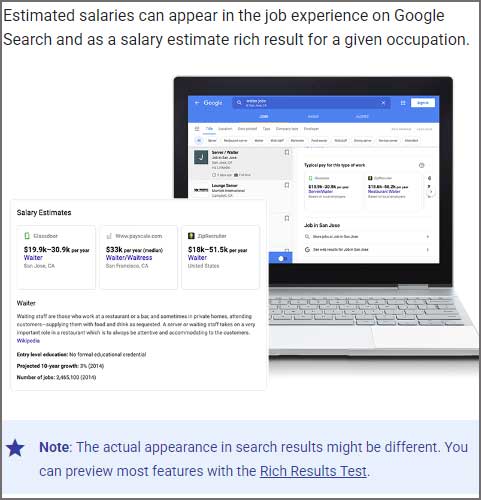
“Estimated salaries can appear in the job experience on Google Search and as a salary estimate rich result for a given occupation.”
This is the updated version:
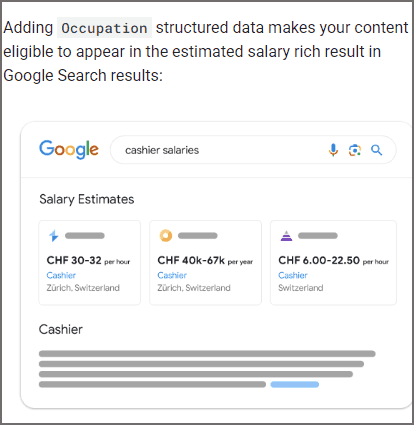
“Adding Occupation structured data makes your content eligible to appear in the estimated salary rich result in Google Search results:”
Second Change: Refreshed Image And Simplified
The second change refreshes an example image.
The change has three notable qualities:
Precisely models a search result
Aligns with removal of “job experience”
Simplifies message
The original image contained a screenshot of a laptop with a search result and a closeup of the search result overlaid. The image looks more at home on a product page than an informational page. Someone spent a lot of time creating an attractive image but it’s too complex and neglects the number one rule of content which is that all content must communicate the message quickly.
All content, whether text or image, is like a glass of water: the important part is the water, not the glass.
Screenshot Of Attractive But Slightly Less Effective Image
The image that replaced it is literally an example of the actual rich result. It’s not fancy but it doesn’t have to be. It just has to do the job of communicating.
Screenshot Of Google’s More Effective Image
The other thing this change accomplishes is that it removes the phrase “job experience” and replaces it with a sentence that aligns with the apparent goal of making this page about the Occupation structured data.
This is the new text:
“Adding Occupation structured data makes your content eligible to appear in the estimated salary rich result in Google Search results:”
Third change: Replace Confusing Sentence
The third change corrected a sentence that was grammatically incorrect and confusing.
Original version:
“You must include the required properties for your content to be eligible for display the job experience on Google and rich results.”
Google corrected the grammar error, made the sentence specific to the ‘estimated salary’ rich result, and removed the reference to Job Experience, aligning it more strongly with estimated salary rich results.
This is the updated version:
“You must include the required properties for your content to be eligible for display in the estimated salary rich result.”
Three Examples For Updating Web Pages
On one level the changes were literally about removing the focus on one topic and reinforcing a slightly different one. On another level it’s an example of giving users a better experience by communicating more precisely. Writing for humans is not just a creative art, it’s also a technical one. All writers, even novelists, understand that the craft of writing is technical because one of the most important factors is communicating ideas. Other issues like being comprehensive or fancy don’t matter as much as the communication part.
I think that the revisions Google made fits into what Google means when it says to make content for humans not search engines.
Ask people building generative AI what generative AI is good for right now—what they’re really fired up about—and many will tell you: coding.
“That’s something that’s been very exciting for developers,” Jared Kaplan, chief scientist at Anthropic, told MIT Technology Review this month: “It’s really understanding what’s wrong with code, debugging it.”
Copilot, a tool built on top of OpenAI’s large language models and launched by Microsoft-backed GitHub in 2022, is now used by millions of developers around the world. Millions more turn to general-purpose chatbots like Anthropic’s Claude, OpenAI’s ChatGPT, and Google DeepMind’s Gemini for everyday help.
“Today, more than a quarter of all new code at Google is generated by AI, then reviewed and accepted by engineers,” Alphabet CEO Sundar Pichai claimed on an earnings call in October: “This helps our engineers do more and move faster.” Expect other tech companies to catch up, if they haven’t already.
It’s not just the big beasts rolling out AI coding tools. A bunch of new startups have entered this buzzy market too. Newcomers such as Zencoder, Merly, Cosine, Tessl (valued at $750 million within months of being set up), and Poolside (valued at $3 billion before it even released a product) are all jostling for their slice of the pie. “It actually looks like developers are willing to pay for copilots,” says Nathan Benaich, an analyst at investment firm Air Street Capital: “And so code is one of the easiest ways to monetize AI.”
Such companies promise to take generative coding assistants to the next level. Instead of providing developers with a kind of supercharged autocomplete, like most existing tools, this next generation can prototype, test, and debug code for you. The upshot is that developers could essentially turn into managers, who may spend more time reviewing and correcting code written by a model than writing it from scratch themselves.
“The first time we will see a massively economically valuable activity to have reached human-level capabilities will be in software development,” says Eiso Kant, CEO and cofounder of Poolside. (OpenAI has already boasted that its latest o3 model beat the company’s own chief scientist in a competitive coding challenge.)
Welcome to the second wave of AI coding.
Correct code
Software engineers talk about two types of correctness. There’s the sense in which a program’s syntax (its grammar) is correct—meaning all the words, numbers, and mathematical operators are in the right place. This matters a lot more than grammatical correctness in natural language. Get one tiny thing wrong in thousands of lines of code and none of it will run.
The first generation of coding assistants are now pretty good at producing code that’s correct in this sense. Trained on billions of pieces of code, they have assimilated the surface-level structures of many types of programs.
But there’s also the sense in which a program’s function is correct: Sure, it runs, but does it actually do what you wanted it to? It’s that second level of correctness that the new wave of generative coding assistants are aiming for—and this is what will really change the way software is made.
“Large language models can write code that compiles, but they may not always write the program that you wanted,” says Alistair Pullen, a cofounder of Cosine. “To do that, you need to re-create the thought processes that a human coder would have gone through to get that end result.”
The problem is that the data most coding assistants have been trained on—the billions of pieces of code taken from online repositories—doesn’t capture those thought processes. It represents a finished product, not what went into making it. “There’s a lot of code out there,” says Kant. “But that data doesn’t represent software development.”
What Pullen, Kant, and others are finding is that to build a model that does a lot more than autocomplete—one that can come up with useful programs, test them, and fix bugs—you need to show it a lot more than just code. You need to show it how that code was put together.
In short, companies like Cosine and Poolside are building models that don’t just mimic what good code looks like—whether it works well or not—but mimic the process that produces such code in the first place. Get it right and the models will come up with far better code and far better bug fixes.
Breadcrumbs
But you first need a data set that captures that process—the steps that a human developer might take when writing code. Think of these steps as a breadcrumb trail that a machine could follow to produce a similar piece of code itself.
Part of that is working out what materials to draw from: Which sections of the existing codebase are needed for a given programming task? “Context is critical,” says Zencoder founder Andrew Filev. “The first generation of tools did a very poor job on the context, they would basically just look at your open tabs. But your repo [code repository] might have 5000 files and they’d miss most of it.”
Zencoder has hired a bunch of search engine veterans to help it build a tool that can analyze large codebases and figure out what is and isn’t relevant. This detailed context reduces hallucinations and improves the quality of code that large language models can produce, says Filev: “We call it repo grokking.”
Cosine also thinks context is key. But it draws on that context to create a new kind of data set. The company has asked dozens of coders to record what they were doing as they worked through hundreds of different programming tasks. “We asked them to write down everything,” says Pullen: “Why did you open that file? Why did you scroll halfway through? Why did you close it?” They also asked coders to annotate finished pieces of code, marking up sections that would have required knowledge of other pieces of code or specific documentation to write.
Cosine then takes all that information and generates a large synthetic data set that maps the typical steps coders take, and the sources of information they draw on, to finished pieces of code. They use this data set to train a model to figure out what breadcrumb trail it might need to follow to produce a particular program, and then how to follow it.
Poolside, based in San Francisco, is also creating a synthetic data set that captures the process of coding, but it leans more on a technique called RLCE—reinforcement learning from code execution. (Cosine uses this too, but to a lesser degree.)
RLCE is analogous to the technique used to make chatbots like ChatGPT slick conversationalists, known as RLHF—reinforcement learning from human feedback. With RLHF, a model is trained to produce text that’s more like the kind human testers say they favor. With RLCE, a model is trained to produce code that’s more like the kind that does what it is supposed to do when it is run (or executed).
Gaming the system
Cosine and Poolside both say they are inspired by the approach DeepMind took with its game-playing model AlphaZero. AlphaZero was given the steps it could take—the moves in a game—and then left to play against itself over and over again, figuring out via trial and error what sequence of moves were winning moves and which were not.
“They let it explore moves at every possible turn, simulate as many games as you can throw compute at—that led all the way to beating Lee Sedol,” says Pengming Wang, a founding scientist at Poolside, referring to the Korean Go grandmaster that AlphaZero beat in 2016. Before Poolside, Wang worked at Google DeepMind on applications of AlphaZero beyond board games, including FunSearch, a version trained to solve advanced math problems.
When that AlphaZero approach is applied to coding, the steps involved in producing a piece of code—the breadcrumbs—become the available moves in a game, and a correct program becomes winning that game. Left to play by itself, a model can improve far faster than a human could. “A human coder tries and fails one failure at a time,” says Kant. “Models can try things 100 times at once.”
A key difference between Cosine and Poolside is that Cosine is using a custom version of GPT-4o provided by OpenAI, which makes it possible to train on a larger data set than the base model can cope with, but Poolside is building its own large language model from scratch.
Poolside’s Kant thinks that training a model on code from the start will give better results than adapting an existing model that has sucked up not only billions of pieces of code but most of the internet. “I’m perfectly fine with our model forgetting about butterfly anatomy,” he says.
Cosine claims that its generative coding assistant, called Genie, tops the leaderboard on SWE-Bench, a standard set of tests for coding models. Poolside is still building its model but claims that what it has so far already matches the performance of GitHub’s Copilot.
“I personally have a very strong belief that large language models will get us all the way to being as capable as a software developer,” says Kant.
Not everyone takes that view, however.
Illogical LLMs
To Justin Gottschlich, the CEO and founder of Merly, large language models are the wrong tool for the job—period. He invokes his dog: “No amount of training for my dog will ever get him to be able to code, it just won’t happen,” he says. “He can do all kinds of other things, but he’s just incapable of that deep level of cognition.”
Having worked on code generation for more than a decade, Gottschlich has a similar sticking point with large language models. Programming requires the ability to work through logical puzzles with unwavering precision. No matter how well large language models may learn to mimic what human programmers do, at their core they are still essentially statistical slot machines, he says: “I can’t train an illogical system to become logical.”
Instead of training a large language model to generate code by feeding it lots of examples, Merly does not show its system human-written code at all. That’s because to really build a model that can generate code, Gottschlich argues, you need to work at the level of the underlying logic that code represents, not the code itself. Merly’s system is therefore trained on an intermediate representation—something like the machine-readable notation that most programming languages get translated into before they are run.
Gottschlich won’t say exactly what this looks like or how the process works. But he throws out an analogy: There’s this idea in mathematics that the only numbers that have to exist are prime numbers, because you can calculate all other numbers using just the primes. “Take that concept and apply it to code,” he says.
Not only does this approach get straight to the logic of programming; it’s also fast, because millions of lines of code are reduced to a few thousand lines of intermediate language before the system analyzes them.
Shifting mindsets
What you think of these rival approaches may depend on what you want generative coding assistants to be.
In November, Cosine banned its engineers from using tools other than its own products. It is now seeing the impact of Genie on its own engineers, who often find themselves watching the tool as it comes up with code for them. “You now give the model the outcome you would like, and it goes ahead and worries about the implementation for you,” says Yang Li, another Cosine cofounder.
Pullen admits that it can be baffling, requiring a switch of mindset. “We have engineers doing multiple tasks at once, flitting between windows,” he says. “While Genie is running code in one, they might be prompting it to do something else in another.”
These tools also make it possible to protype multiple versions of a system at once. Say you’re developing software that needs a payment system built in. You can get a coding assistant to simultaneously try out several different options—Stripe, Mango, Checkout—instead of having to code them by hand one at a time.
Genie can be left to fix bugs around the clock. Most software teams use bug-reporting tools that let people upload descriptions of errors they have encountered. Genie can read these descriptions and come up with fixes. Then a human just needs to review them before updating the code base.
No single human understands the trillions of lines of code in today’s biggest software systems, says Li, “and as more and more software gets written by other software, the amount of code will only get bigger.”
This will make coding assistants that maintain that code for us essential. “The bottleneck will become how fast humans can review the machine-generated code,” says Li.
How do Cosine’s engineers feel about all this? According to Pullen, at least, just fine. “If I give you a hard problem, you’re still going to think about how you want to describe that problem to the model,” he says. “Instead of writing the code, you have to write it in natural language. But there’s still a lot of thinking that goes into that, so you’re not really taking the joy of engineering away. The itch is still scratched.”
Some may adapt faster than others. Cosine likes to invite potential hires to spend a few days coding with its team. A couple of months ago it asked one such candidate to build a widget that would let employees share cool bits of software they were working on to social media.
The task wasn’t straightforward, requiring working knowledge of multiple sections of Cosine’s millions of lines of code. But the candidate got it done in a matter of hours. “This person who had never seen our code base turned up on Monday and by Tuesday afternoon he’d shipped something,” says Li. “We thought it would take him all week.” (They hired him.)
But there’s another angle too. Many companies will use this technology to cut down on the number of programmers they hire. Li thinks we will soon see tiers of software engineers. At one end there will be elite developers with million-dollar salaries who can diagnose problems when the AI goes wrong. At the other end, smaller teams of 10 to 20 people will do a job that once required hundreds of coders. “It will be like how ATMs transformed banking,” says Li.
“Anything you want to do will be determined by compute and not head count,” he says. “I think it’s generally accepted that the era of adding another few thousand engineers to your organization is over.”
Warp drives
Indeed, for Gottschlich, machines that can code better than humans are going to be essential. For him, that’s the only way we will build the vast, complex software systems that he thinks we will eventually need. Like many in Silicon Valley, he anticipates a future in which humans move to other planets. That’s only going to be possible if we get AI to build the software required, he says: “Merly’s real goal is to get us to Mars.”
Gottschlich prefers to talk about “machine programming” rather than “coding assistants,” because he thinks that term frames the problem the wrong way. “I don’t think that these systems should be assisting humans—I think humans should be assisting them,” he says. “They can move at the speed of AI. Why restrict their potential?”
“There’s this cartoon called The Flintstones where they have these cars, but they only move when the drivers use their feet,” says Gottschlich. “This is sort of how I feel most people are doing AI for software systems.”
“But what Merly’s building is, essentially, spaceships,” he adds. He’s not joking. “And I don’t think spaceships should be powered by humans on a bicycle. Spaceships should be powered by a warp engine.”
If that sounds wild—it is. But there’s a serious point to be made about what the people building this technology think the end goal really is.
Gottschlich is not an outlier with his galaxy-brained take. Despite their focus on products that developers will want to use today, most of these companies have their sights on a far bigger payoff. Visit Cosine’s website and the company introduces itself as a “Human Reasoning Lab.” It sees coding as just the first step toward a more general-purpose model that can mimic human problem-solving in a number of domains.
Poolside has similar goals: The company states upfront that it is building AGI. “Code is a way of formalizing reasoning,” says Kant.
Wang invokes agents. Imagine a system that can spin up its own software to do any task on the fly, he says. “If you get to a point where your agent can really solve any computational task that you want through the means of software—that is a display of AGI, essentially.”
Down here on Earth, such systems may remain a pipe dream. And yet software engineering is changing faster than many at the cutting edge expected.
“We’re not at a point where everything’s just done by machines, but we’re definitely stepping away from the usual role of a software engineer,” says Cosine’s Pullen. “We’re seeing the sparks of that new workflow—what it means to be a software engineer going into the future.”
This is today’s edition of The Download, our weekday newsletter that provides a daily dose of what’s going on in the world of technology.
The second wave of AI coding is here
Ask people building generative AI what generative AI is good for right now—what they’re really fired up about—and many will tell you: coding.
Everyone from established AI giants to buzzy startups is promising to take coding assistants to the next level. Instead of providing developers with a kind of supercharged autocomplete, this next generation can prototype, test, and debug code for you. The upshot is that developers could essentially turn into managers, who may spend more time reviewing and correcting code written by a model than writing it from scratch themselves.
But there’s more. Many of the people building generative coding assistants think that they could be a fast track to artificial general intelligence, the hypothetical superhuman technology that a number of top firms claim to have in their sights.Read the full story. —Will Douglas Heaven
OpenAI has created an AI model for longevity science
When you think of AI’s contributions to science, you probably think of AlphaFold, the Google DeepMind protein-folding program that earned its creator a Nobel Prize last year. Now OpenAI says it’s getting into the science game too—with a model for engineering proteins.
The company says it has developed a language model that dreams up proteins capable of turning regular cells into stem cells—and that it has handily beat humans at the task.
The work represents OpenAI’s first model focused on biological data and its first public claim that its models can deliver unexpected scientific results. But until outside scientists get their hands on it, we can’t say just how impressive it really is. Read the full story.
New fuels made from used cooking oil, industrial waste, or even gases in the air could help power planes without fossil fuels. Depending on the source, they can reduce emissions by half or nearly eliminate them. And they can generally be used in existing planes, which could enable quick climate progress.
These alternative jet fuels have been in development for years, but now they’re becoming a big business, with factories springing up to produce them and new government mandates requiring their use. So while only about 0.5% of the roughly 100 billion gallons of jet fuel consumed by planes last year was something other than fossil fuel, that could soon change. Read the full story.
I’ve combed the internet to find you today’s most fun/important/scary/fascinating stories about technology.
1 TikTok is back online in the US The company thanked Donald Trump for vowing to fight the federal ban it’s facing. (The Verge) + The app went dark for users in America for around 14 hours. (WP $) + AI search startup Perplexity has suggested merging with TikTok. (CNBC) + Here’s how people actually make money on TikTok. (WSJ $)
2 Trump’s staff has an Elon Musk problem Aides are annoyed by his constant contributions to matters he has little knowledge of. (WSJ $) + A power struggle between the two men is inevitable. (Slate $) + The great and the good of crypto attended a VIP Trump party on Friday. (NY Mag $)
3 AI is speeding up the Pentagon’s ‘kill list’ Although the US military can’t use the tech to directly kill humans, AI is making it faster and easier to plan how to do just that. (TechCrunch) + OpenAI’s new defense contract completes its military pivot. (MIT Technology Review)
4 The majority of Americans haven’t had their latest covid booster Though they could help to protect you—and others. (Undark) + It’s five years today since the US registered its first covid case. (USA Today)
5 Europol is cracking down on encryption The agency plans to pressure Big Tech to give police access to encrypted messages. (FT $)
6 This Swiss startup has created a powerful robotic worm Borobotics wants to deploy the bots to dig for geo-thermal heat in our gardens. (The Next Web)
7 Thousands of lithium batteries were destroyed in a massive fire The world’s largest battery storage plant went up in flames in California. (New Scientist $) + Three takeaways about the current state of batteries. (MIT Technology Review)
8 Amazon’s delivery drones struggle in the rain Two drones crashed after flying through light rain in Oregon. (Bloomberg $)
9 A Ring doorbell captured a meteorite crashing to Earth It’s the first known example of a meteorite fall documented by a doorbell cam. (CBS News)
10 AI is coming for your wardrobe A wave of new apps will suggest what to wear and what to pair it with. (The Guardian)
Quote of the day
“TikTok was 100x better than anything you’ve created.”
—An Instagram user snaps at Facebook founder Mark Zuckerberg in the wake of TikTok’s temporary US blackout over the weekend.
The big story
Running Tide is facing scientist departures and growing concerns over seaweed sinking for carbon removal
June 2022
Running Tide, an aquaculture company based in Portland, Maine, hopes to set tens of thousands of tiny floating kelp farms adrift in the North Atlantic. The idea is that the fast-growing macroalgae will eventually sink to the ocean floor, storing away thousands of tons of carbon dioxide in the process.
The company has raised millions in venture funding and gained widespread media attention. But it struggled to grow kelp along rope lines in the open ocean during initial attempts last year and has lost a string of scientists in recent months, sources with knowledge of the matter tell MIT Technology Review. What happens next? Read the full story.
—James Temple
We can still have nice things
A place for comfort, fun and distraction to brighten up your day. (Got any ideas? Drop me a line or skeet ’em at me.)
+ Why not cheer up your Monday with the kings of merriment, The Smiths? + This is fascinating: how fish detect color and why it’s so different to us humans. + The people of Finland know a thing or two about happiness. + It’s time to get planning a spring getaway, and these destinations look just fabulous.