How To Spot SEO Myths: 26 Common SEO Myths, Debunked via @sejournal, @HelenPollitt1
SEO is a complex, vast, and sometimes mysterious practice. There are a lot of aspects to SEO that can lead to confusion.
Not everyone will agree with what SEO entails – where technical SEO stops and development begins.
What also doesn’t help is the vast amount of misinformation that goes around. There are a lot of “experts” online and not all of them should bear that self-proclaimed title. How do you know who to trust?
Even Google employees can sometimes add to the confusion. They struggle to define their own updates and systems and sometimes offer advice that conflicts with previously given statements.
The Dangers Of SEO Myths
The issue is that we simply don’t know exactly how the search engines work. Due to this, much of what we do as SEO professionals is trial and error and educated guesswork.
When you are learning about SEO, it can be difficult to test out all the claims you hear.
That’s when the SEO myths begin to take hold. Before you know it, you’re proudly telling your line manager that you’re planning to “AI Overview optimize” your website copy.
SEO myths can be busted a lot of the time with a pause and some consideration.
How, exactly, would Google be able to measure that? Would that actually benefit the end user in any way?
There is a danger in SEO of considering the search engines to be omnipotent, and because of this, wild myths about how they understand and measure our websites start to grow.
What Is An SEO Myth?
Before we debunk some common SEO myths, we should first understand what forms they take.
Untested Wisdom
Myths in SEO tend to take the form of handed-down wisdom that isn’t tested.
As a result, something that might well have no impact on driving qualified organic traffic to a site gets treated like it matters.
Minor Factors Blown Out Of Proportion
SEO myths might also be something that has a small impact on organic rankings or conversion but are given too much importance.
This might be a “tick box” exercise that is hailed as being a critical factor in SEO success, or simply an activity that might only cause your site to eke ahead if everything else with your competition was truly equal.
Outdated Advice
Myths can arise simply because what used to be effective in helping sites rank and convert well no longer does but is still being advised. It might be that something used to work really well.
Over time, the algorithms have grown smarter. The public is more adverse to being marketed to.
Simply, what was once good advice is now defunct.
Google Being Misunderstood
Many times, the start of a myth is Google itself.
Unfortunately, a slightly obscure or just not straightforward piece of advice from a Google representative gets misunderstood and run away with.
Before we know it, a new optimization service is being sold off the back of a flippant comment a Googler made in jest.
SEO myths can be based on fact, or perhaps these are, more accurately, SEO legends?
In the case of Google-born myths, it tends to be that the fact has been so distorted by the SEO industry’s interpretation of the statement that it no longer resembles useful information.
26 Common SEO Myths
So, now that we know what causes and perpetuates SEO myths, let’s find out the truth behind some of the more common ones.
1. The Google Sandbox And Honeymoon Effects
Some SEO professionals believe that Google will automatically suppress new websites in the organic search results for a period of time before they are able to rank more freely.
Others suggest there is a sort of Honeymoon Period, during which Google will rank new content highly to test what users think of it.
The content would be promoted to ensure more users see it. Signals like click-through rate and bounces back to the search engine results pages (SERPs) would then be used to measure if the content is well received and deserves to remain ranked highly.
There is, however, the Google Privacy Sandbox. This is designed to help maintain peoples’ privacy online. This is a different sandbox from the one that allegedly suppresses new websites.
When asked specifically about the Honeymoon Effect and the rankings Sandbox, John Mueller answered:
“In the SEO world, this is sometimes called kind of like a sandbox where Google is like keeping things back to prevent new pages from showing up, which is not the case.
Or some people call it like the honeymoon period where new content comes out and Google really loves it and tries to promote it.
And it’s again not the case that we’re explicitly trying to promote new content or demote new content.
It’s just, we don’t know and we have to make assumptions.
And then sometimes those assumptions are right and nothing really changes over time.
Sometimes things settle down a little bit lower, sometimes a little bit higher.”
So, there is no systematic promotion or demotion of new content by Google, but what you might be noticing is that Google’s assumptions are based on the rest of the website’s rankings.
- Verdict: Officially? It’s a myth.
2. Duplicate Content Penalty
This is a myth that I hear a lot. The idea is that if you have content on your website that is duplicated elsewhere on the web, Google will penalize you for it.
The key to understanding what is really going on here is knowing the difference between algorithmic suppression and manual action.
A manual action, the situation that can result in webpages being removed from Google’s index, will be actioned by a human at Google.
The website owner will be notified through Google Search Console.
An algorithmic suppression occurs when your page cannot rank well due to it being caught by a filter from an algorithm.
Essentially, having copy that is taken from another webpage might mean you can’t outrank that other page.
The search engines may determine that the original host of the copy is more relevant to the search query than yours.
As there is no benefit to having both in the search results, yours gets suppressed. This is not a penalty. This is the algorithm doing its job.
There are some content-related manual actions, but essentially, copying one or two pages of someone else’s content is not going to trigger them.
It is, however, potentially going to land you in other trouble if you have no legal right to use that content. It also can detract from the value your website brings to the user.
What about content that is duplicated across your own site? Mueller clarifies that duplicate content is not a negative ranking factor. If there are multiple pages with the same content, Google may choose one to be the canonical page, and the others will not be ranked.
- Verdict: SEO myth.
3. PPC Advertising Helps Rankings
This is a common myth. It’s also quite quick to debunk.
The idea is that Google will favor websites that spend money with it through pay-per-click advertising. This is simply false.
Google’s algorithm for ranking organic search results is completely separate from the one used to determine PPC ad placements.
Running a paid search advertising campaign through Google while carrying out SEO might benefit your site for other reasons, but it won’t directly benefit your ranking.
- Verdict: SEO myth.
4. Domain Age Is A Ranking Factor
This claim is seated firmly in the “confusing causation and correlation” camp.
Because a website has been around for a long time and is ranking well, age must be a ranking factor.
Google has debunked this myth itself many times.
In July 2019, Mueller replied to a post on Twitter.com (recovered through Wayback Machine) that suggested that domain age was one of “200 signals of ranking” saying, “No, domain age helps nothing.”
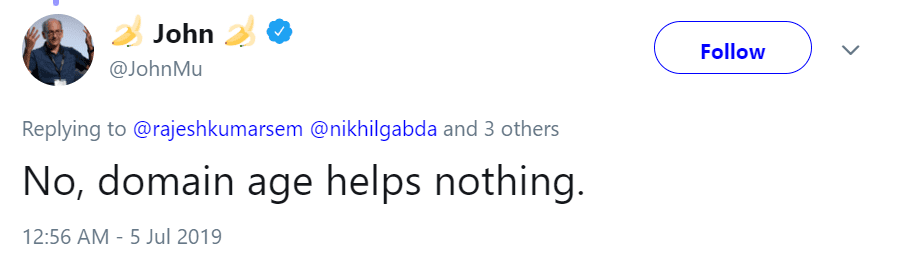 Image from Twitter.com recovered through Wayback Machine, June 2024
The truth behind this myth is that an older website has had more time to do things well.
For instance, a website that has been live and active for 10 years may well have acquired a high volume of relevant backlinks to its key pages.
A website that has been running for less than six months will be unlikely to compete with that.
The older website appears to be ranking better, and the conclusion is that age must be the determining factor.
- Verdict: SEO myth
5. Tabbed Content Affects Rankings
This idea is one that has roots going back a long way.
The premise is that Google will not assign as much value to the content sitting behind a tab or accordion.
For example, text that is not viewable on the first load of a page.
Google again debunked this myth in March 2020, but it has been a contentious idea among many SEO professionals for years.
In September 2018, Gary Illyes, Webmaster Trends Analyst at Google, answered a tweet thread about using tabs to display content.
His response:
“AFAIK, nothing’s changed here, Bill: we index the content, and its weight is fully considered for ranking, but it might not get bolded in the snippets. It’s another, more technical question of how that content is surfaced by the site. Indexing does have limitations.”
If the content is visible in the HTML, there is no reason to assume that it is being devalued just because it is not apparent to the user on the first load of the page. This is not an example of cloaking, and Google can easily fetch the content.
As long as there is nothing else that is stopping the text from being viewed by Google, it should be weighted the same as copy, which isn’t in tabs.
Want more clarification on this? Then check out this SEJ article that discusses this subject in detail.
- Verdict: SEO myth.
6. Google Uses Google Analytics Data In Rankings
This is a common fear among business owners.
They study their Google Analytics reports. They feel their average sitewide bounce rate is too high, or their time on page is too low.
So, they worry that Google will perceive their site to be low quality because of that. They fear they won’t rank well because of it.
The myth is that Google uses the data in your Google Analytics account as part of its ranking algorithm.
It’s a myth that has been around for a long time.
Illyes has again debunked this idea simply with, “We don’t use *anything* from Google analytics [sic] in the “algo.”
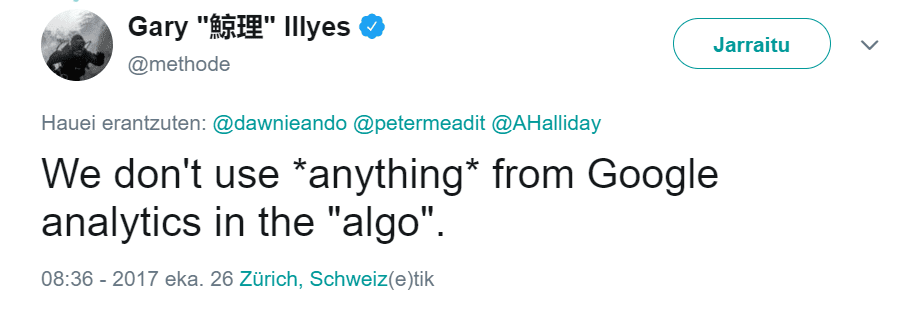 Image from Twitter.com recovered from Wayback Machine, June 2024
If we think about this logically, using Google Analytics data as a ranking factor would be really hard to police.
For instance, using filters could manipulate data to make it seem like the site was performing in a way that it isn’t really.
What is good performance anyway?
High “time on page” might be good for some long-form content.
Low “time on page” could be understandable for shorter content.
Is either one right or wrong?
Google would also need to understand the intricate ways in which each Google Analytics account had been configured.
Some might be excluding all known bots, and others might not. Some might use custom dimensions and channel groupings, and others haven’t configured anything.
Using this data reliably would be extremely complicated to do. Consider the hundreds of thousands of websites that use other analytics programs.
How would Google treat them?
- Verdict: SEO myth.
This myth is another case of “causation, not correlation.”
A high sitewide bounce rate might be indicative of a quality problem, or it might not be. Low time on page could mean your site isn’t engaging, or it could mean your content is quickly digestible.
These metrics give you clues as to why you might not be ranking well, they aren’t the cause of it.
7. Google Cares About Domain Authority
PageRank is a link analysis algorithm used by Google to measure the importance of a webpage.
Google used to display a page’s PageRank score a number up to 10 on its toolbar. It stopped updating the PageRank displayed in toolbars in 2013.
In 2016, Google confirmed that the PageRank toolbar metric was not going to be used going forward.
In the absence of PageRank, many other third-party authority scores have been developed.
Commonly known ones are:
- Moz’s Domain Authority and Page Authority scores.
- Majestic’s Trust Flow and Citation Flow.
- Ahrefs’ Domain Rating and URL Rating.
Some SEO pros use these scores to determine the “value” of a page.
That calculation can never be an entirely accurate reflection of how a search engine values a page, however.
SEO pros will sometimes refer to the ranking power of a website often in conjunction with its backlink profile and this, too, is known as the domain’s authority.
You can see where the confusion lies.
Google representatives have dispelled the notion of a domain authority metric used by them.
“We don’t use domain authority. We generally try to have our metrics as granular as possible, sometimes that’s not so easy, in which case we look at things a bit broader (e.g., we’ve talked about this in regards to some of the older quality updates).”
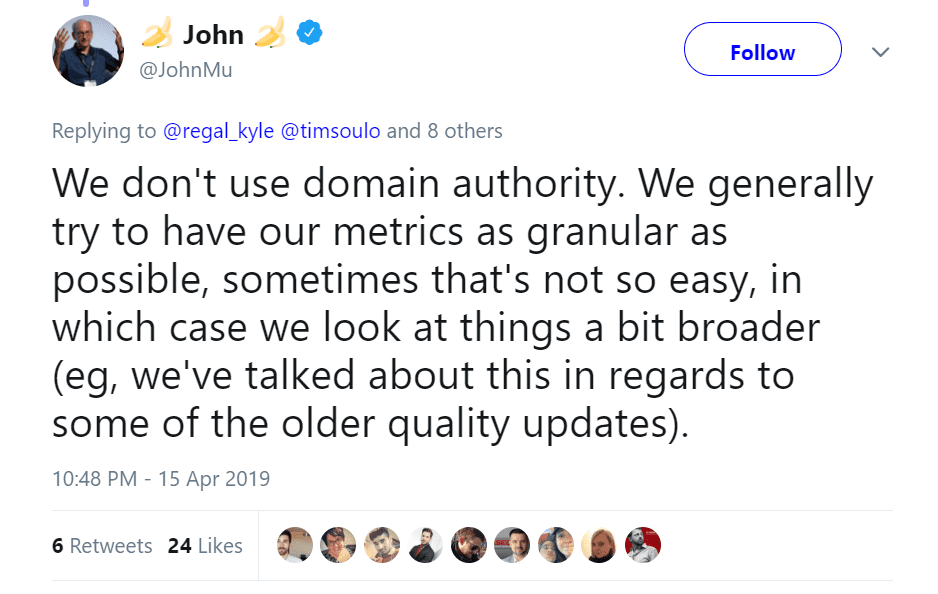 Image from Twitter.com recovered through Wayback Machine, June 2024
- Verdict: SEO myth.
8. Longer Content Is Better
You will have definitely heard it said before that longer content ranks better.
More words on a page automatically make yours more rank-worthy than your competitor’s. This is “wisdom” that is often shared around SEO forums without little evidence to substantiate it.
There are a lot of studies that have been released over the years that state facts about the top-ranking webpages, such as “on average pages in the top 10 positions in the SERPs have over 1,450 words on them.”
It would be quite easy for someone to take this information in isolation and assume it means that pages need approximately 1,500 words to rank on Page 1. That isn’t what the study is saying, however.
Unfortunately, this is an example of correlation, not necessarily causation.
Just because the top-ranking pages in a particular study happened to have more words on them than the pages ranking 11th and lower does not make word count a ranking factor.
Mueller dispelled this myth yet again in a Google SEO Office Hours in February 2021.
“From our point of view the number of words on a page is not a quality factor, not a ranking factor.”
For more information on how content length can impact SEO, check out Sam Hollingsworth’s article.
- Verdict: SEO myth.
9. LSI Keywords Will Help You Rank
What exactly are LSI keywords? LSI stands for “latent semantic indexing.”
It is a technique used in information retrieval that allows concepts within the text to be analyzed and relationships between them identified.
Words have nuances dependent on their context. The word “right” has a different connotation when paired with “left” than when it is paired with “wrong.”
Humans can quickly gauge concepts in a text. It is harder for machines to do so.
The ability of machines to understand the context and linking between entities is fundamental to their understanding of concepts.
LSI is a huge step forward for a machine’s ability to understand text. What it isn’t is synonyms.
Unfortunately, the field of LSI has been devolved by the SEO community into the understanding that using words that are similar or linked thematically will boost rankings for words that aren’t expressly mentioned in the text.
It’s simply not true. Google has gone far beyond LSI in its understanding of text with the introduction of BERT, as just one example.
For more about what LSI is and how it does or doesn’t affect rankings, take a look at this article.
- Verdict: SEO myth.
10. SEO Takes 3 Months
It helps us get out of sticky conversations with our bosses or clients. It leaves a lot of wiggle room if you aren’t getting the results you promised. “SEO takes at least three months to have an effect.”
It is fair to say that there are some changes that will take time for the search engine bots to process.
There is then, of course, some time to see if those changes are having a positive or negative effect. Then more time might be needed to refine and tweak your work.
That doesn’t mean that any activity you carry out in the name of SEO is going to have no effect for three months. Day 90 of your work will not be when the ranking changes kick in. There is a lot more to it than that.
If you are in a very low-competition market, targeting niche terms, you might see ranking changes as soon as Google recrawls your page. A competitive term could take much longer to see changes in rank.
A study by Semrush suggested that of the 28,000 domains they analyzed, only 19% of domains started ranking in the top 10 positions within six months and managed to maintain those rankings for the rest of the 13-month study.
This study indicates that newer pages struggle to rank high.
However, there is more to SEO than ranking in the top 10 of Google.
For instance, a well-positioned Google Business Profile listing with great reviews can pay dividends for a company. Bing, Yandex, and Baidu might make it easier for your brand to conquer the SERPs.
A small tweak to a page title could see an improvement in click-through rates. That could be the same day if the search engine were to recrawl the page quickly.
Although it can take a long time to see first page rankings in Google, it is naïve of us to reduce SEO success just down to that.
Therefore, “SEO takes 3 months” simply isn’t accurate.
- Verdict: SEO myth.
11. Bounce Rate Is A Ranking Factor
Bounce rate is the percentage of visits to your website that result in no interactions beyond landing on the page. It is typically measured by a website’s analytics program, such as Google Analytics.
Some SEO professionals have argued that bounce rate is a ranking factor because it is a measure of quality.
Unfortunately, it is not a good measure of quality.
There are many reasons why a visitor might land on a webpage and leave again without interacting further with the site. They may well have read all the information they needed on that page and left the site to call the company and book an appointment.
In that instance, the visitor bouncing has resulted in a lead for the company.
Although a visitor leaving a page having landed on it could be an indicator of poor quality content, it isn’t always. Therefore, it wouldn’t be reliable enough for a search engine to use as a measure of quality.
“Pogo-sticking,” or a visitor clicking on a search result and then returning to the SERPs, would be a more reliable indicator of the quality of the landing page.
It would suggest that the content of the page was not what the user was after, so much so that they have returned to the search results to find another page or re-search.
John Mueller cleared this up (again) during Google Webmaster Central Office Hours in June 2020. He was asked if sending users to a login page would appear to be a “bounce” to Google and damage their rankings:
“So, I think there is a bit of misconception here, that we’re looking at things like the analytics bounce rate when it comes to ranking websites, and that’s definitely not the case.”
Back on another Google Webmaster Central Office Hours in July 2018, he also said:
“We try not to use signals like that when it comes to search. So that’s something where there are lots of reasons why users might go back and forth, or look at different things in the search results, or stay just briefly on a page and move back again. I think that’s really hard to refine and say, “well, we could turn this into a ranking factor.”
So, why does this keep coming up? Well, for a lot of people, it’s because of this one paragraph in Google’s How Search Works:
“Beyond looking at keywords, our systems also analyze if content is relevant to a query in other ways. We also use aggregated and anonymised interaction data to assess whether Search results are relevant to queries.”
The issue with this is that Google doesn’t specify what this “aggregated and anonymised interaction data” is. This has led to a lot of speculation and of course, arguments.
My opinion? Until we have some more conclusive studies, or hear something else from Google, we need to keep testing to determine what this interaction data is.
For now, regarding the traditional definition of a bounce, I’m leaning towards “myth.”
In itself, bounce rate (measured through the likes of Google Analytics) is a very noisy, easily manipulated figure. Could something akin to a bounce be a ranking signal? Absolutely, but it will need to be a reliable, repeatable data point that genuinely measures quality.
In the meantime, if your pages are not satisfying user intent, that is definitely something you need to work on – not simply because of bounce rate.
Fundamentally, your pages should encourage users to interact, or if not that sort of page, at least leave your site with a positive brand association.
- Verdict: SEO myth.
12. It’s All About Backlinks
Backlinks are important – that’s without much contention within the SEO community. However, exactly how important is still debated.
Some SEO pros will tell you that backlinks are one of the many tactics that will influence rankings, but they are not the most important. Others will tell you it’s the only real game-changer.
What we do know is that the effectiveness of links has changed over time. Back in the wild pre-Jagger days, link-building consisted of adding a link to your website wherever you could.
Forum comments had spun articles, and irrelevant directories were all good sources of links.
It was easy to build effective links. It’s not so easy now.
Google has continued to make changes to its algorithms that reward higher-quality, more relevant links and disregard or penalize “spammy” links.
However, the power of links to affect rankings is still great.
There will be some industries that are so immature in SEO that a site can rank well without investing in link-building, purely through the strength of their content and technical efficiency.
That’s not the case with most industries.
Relevant backlinks will, of course, help with ranking, but they need to go hand-in-hand with other optimizations. Your website still needs to have relevant content, and it must be crawlable.
If you want your traffic to actually do something when they hit your website, it’s definitely not all about backlinks.
Ranking is only one part of getting converting visitors to your site. The content and usability of the site are extremely important in user engagement.
Following the slew of Helpful Content updates and a better understanding of what Google considers E-E-A-T, we know that content quality is extremely important.
Backlinks can definitely help to indicate that a page would be useful to a reader, but there are many other factors that would suggest that, too.
- Verdict: SEO myth.
13. Keywords In URLs Are Very Important
Cram your URLs full of keywords. It’ll help.
Unfortunately, it’s not quite as powerful as that.
John Mueller has said several times that keywords in a URL are a very minor, lightweight ranking signal.
In a Google SEO Office Hours in 2021, he affirmed again:
“We use the words in a URL as a very, very lightweight factor. And from what I recall, this is primarily something that we would take into account when we haven’t had access to the content yet.
So, if this is the absolute first time we see this URL and we don’t know how to classify its content, then we might use the words in the URL as something to help rank us better.
But as soon as we’ve crawled and indexed the content there, then we have a lot more information.”
If you are looking to rewrite your URLs to include more keywords, you are likely to do more damage than good.
The process of redirecting URLs en masse should be when necessary, as there is always a risk when restructuring a site.
For the sake of adding keywords to a URL? Not worth it.
- Verdict: SEO myth.
14. Website Migrations Are All About Redirects
SEO professionals hear this too often. If you are migrating a website, all you need to do is remember to redirect any URLs that are changing.
If only this one were true.
In actuality, website migration is one of the most fraught and complicated procedures in SEO.
A website changing its layout, content management system (CMS), domain, and/or content can all be considered a website migration.
In each of those examples, there are several aspects that could affect how the search engines perceive the quality and relevance of the pages to their targeted keywords.
As a result, there are numerous checks and configurations that need to occur if the site is to maintain its rankings and organic traffic – ensuring tracking hasn’t been lost, maintaining the same content targeting, and making sure the search engine bots can still access the right pages.
All of this needs to be considered when a website is significantly changing.
Redirecting URLs that are changing is a very important part of website migration. It is in no way the only thing to be concerned about.
- Verdict: SEO myth.
15. Well-Known Websites Will Always Outrank Unknown Websites
It stands to reason that a larger brand will have resources that smaller brands do not. As a result, more can be invested in SEO.
More exciting content pieces can be created, leading to a higher volume of backlinks acquired. The brand name alone can lend more credence to outreach attempts.
The real question is, does Google algorithmically or manually boost big brands because of their fame?
This one is a bit contentious.
Some people say that Google favors big brands. Google says otherwise.
In 2009, Google released an algorithm update named “Vince.” This update had a huge impact on how brands were treated in the SERPs.
Brands that were well-known offline saw ranking increases for broad competitive keywords. It stands to reason that brand awareness can help with discovery through Search.
It’s not necessarily time for smaller brands to throw in the towel.
The Vince update falls very much in line with other Google moves towards valuing authority and quality.
Big brands are often more authoritative on broad-level keywords than smaller contenders.
However, small brands can still win.
Long-tail keyword targeting, niche product lines, and local presence can all make smaller brands more relevant to a search result than established brands.
Yes, the odds are stacked in favor of big brands, but it’s not impossible to outrank them.
- Verdict: Not entirely truth or myth.
16. Your Page Needs To Include ‘Near Me’ To Rank Well For Local SEO
It’s understandable that this myth is still prevalent.
There is still a lot of focus on keyword search volumes in the SEO industry, sometimes at the expense of considering user intent and how the search engines understand it.
When a searcher is looking for something with local intent, i.e., a place or service relevant to a physical location, the search engines will take this into consideration when returning results.
With Google, you will likely see the Google Maps results as well as the standard organic listings.
The Maps results are clearly centered around the location searched. However, so are the standard organic listings when the search query denotes local intent.
So, why do “near me” searches confuse some?
A typical keyword research exercise might yield something like the following:
- “pizza restaurant manhattan” – 110 searches per month.
- “pizza restaurants in manhattan” – 110 searches per month.
- “best pizza restaurant manhattan” – 90 searches per month.
- “best pizza restaurants in manhattan” – 90 searches per month.
- “best pizza restaurant in manhattan”– 90 searches per month.
- “pizza restaurants near me” – 90,500 searches per month.
With search volume like that, you would think [pizza restaurants near me] would be the one to rank for, right?
It is likely, however, that people searching for [pizza restaurant manhattan] are in the Manhattan area or planning to travel there for pizza.
[pizza restaurant near me] has 90,500 searches across the USA. The likelihood is that the vast majority of those searchers are not looking for Manhattan pizzas.
Google knows this and, therefore, will serve pizza restaurant results relevant to the searcher’s location.
Therefore, the “near me” element of the search becomes less about the keyword and more about the intent behind the keyword. Google will just consider it to be the location the searcher is in.
So, do you need to include “near me” in your content to rank for those [near me] searches?
No, you need to be relevant to the location the searcher is in.
- Verdict: SEO myth.
17. Better Content Equals Better Rankings
It’s prevalent in SEO forums and X (formally Twitter) threads. The common complaint is, “My competitor is ranking above me, but I have amazing content, and theirs is terrible.”
The cry is one of indignation. After all, shouldn’t search engines reward sites for their “amazing” content?
This is both a myth and sometimes a delusion.
The quality of content is a subjective consideration. If it is your own content, it’s harder still to be objective.
Perhaps in Google’s eyes, your content isn’t better than your competitors’ for the search terms you are looking to rank for.
Perhaps you don’t meet searcher intent as well as they do. Maybe you have “over-optimized” your content and reduced its quality.
In some instances, better content will equal better rankings. In others, the technical performance of the site or its lack of local relevance may cause it to rank lower.
Content is one factor within the ranking algorithms.
- Verdict: SEO myth.
18. You Need To Blog Every Day
This is a frustrating myth because it seems to have spread outside of the SEO industry.
Google loves frequent content. You should add new content or tweak existing content daily for “freshness.”
Where did this idea come from?
Google had an algorithm update in 2011 that rewards fresher results in the SERPs.
This is because, for some queries, the fresher the results, the better the likelihood of accuracy.
For instance, if you search for [royal baby] in the UK in 2013, you will be served with news articles about Prince George. Search it again in 2015, and you will see pages about Princess Charlotte.
In 2018, you would see reports about Prince Louis at the top of the Google SERPs, and in 2019 it would be baby Archie.
If you were to search [royal baby] in 2021, shortly after the birth of Lilibet, then seeing news articles on Prince George would likely be unhelpful.
In this instance, Google discerns the user’s search intent and decides showing articles related to the newest UK royal baby would be better than showing an article that is arguably more rank-worthy due to authority, etc.
What this algorithm update doesn’t mean is that newer content will always outrank older content. Google decides if the “query deserves freshness” or not.
If it does, then the age of content becomes a more important ranking factor.
This means that if you are creating content purely to make sure it is newer than competitors’ content, you are not necessarily going to benefit.
If the query you are looking to rank for does not deserve freshness, i.e., [who is Prince William’s third child?] a fact that will not change, then the age of content will not play a significant part in rankings.
If you are writing content every day thinking it is keeping your website fresh and, therefore, more rank-worthy, then you are likely wasting time.
It would be better to write well-considered, researched, and useful content pieces less frequently and reserve your resources to make those highly authoritative and shareable.
- Verdict: SEO myth.
19. You Can Optimize Copy Once & Then It’s Done
The phrase “SEO optimized” copy is a common one in agency-land.
It’s used as a way to explain the process of creating copy that will be relevant to frequently searched queries.
The trouble with this is that it suggests that once you have written that copy – and ensured it adequately answers searchers’ queries – you can move on.
Unfortunately, over time, how searchers look for content might change. The keywords they use, the type of content they want could alter.
The search engines, too, may change what they feel is the most relevant answer to the query. Perhaps the intent behind the keyword is perceived differently.
The layout of the SERPs might alter, meaning videos are being shown at the top of the search results where previously it was just webpage results.
If you look at a page only once and then don’t continue to update it and evolve it with user needs, then you risk falling behind.
- Verdict: SEO myth.
20. Google Respects The Declared Canonical URL As The Preferred Version For Search Results
This can be very frustrating. You have several pages that are near duplicates of each other. You know which one is your main page, the one you want to rank, the “canonical.” You tell Google that through the specially selected “rel=canonical” tag.
You’ve chosen it. You’ve identified it in the HTML.
Google ignores your wishes, and another of the duplicate pages ranks in its place.
The idea that Google will take your chosen page and treat it like the canonical out of a set of duplicates isn’t a challenging one.
It makes sense that the website owner would know best which page should be the one that ranks above its cousins. However, Google will sometimes disagree.
There may be instances where another page from the set is chosen by Google as a better candidate to show in the search results.
This could be because the page receives more backlinks from external sites than your chosen page. It could be that it’s included in the sitemap or is being linked to your main navigation.
Essentially, the canonical tag is a signal – one of many that will be taken into consideration when Google chooses which page from a set of duplicates should rank.
If you have conflicting signals on your site, or externally, then your chosen canonical page may be overlooked in favor of another page.
Want to know if Google has selected another URL to be the canonical despite your canonical tag? In Google Search Console, in the Index Coverage report, you might see this: “Duplicate, Google chose different canonical than user.”
Google’s support documents helpfully explain what this means:
“This page is marked as canonical for a set of pages, but Google thinks another URL makes a better canonical. Google has indexed the page that we consider canonical rather than this one.”
- Verdict: SEO myth.
21. Google Has 3 Top Ranking Factors
It’s links, content, and Rank Brain, right?
This idea that these are the three top ranking factors seems to come from a WebPromo Q&A in 2016 with Andrei Lipattsev, a search quality senior strategist at Google at the time (recovered through Wayback Machine; find this discussion at around the 30-minute mark).
When questioned on the “other two” top ranking factors, the questioner assumed that Rank Brain was one, Lipattsev stated that links pointing to a site, and content were the other two. He does clarify by saying:
“Third place is a hotly contested issue. I think… It’s a funny one. Take this with a grain of salt. […] And so I guess, if you do that, then you’ll see elements of RankBrain having been involved in here, rewriting this query, applying it like this over here… And so you’d say, ‘I see this two times as often as the other thing, and two times as often as the other thing’. So it’s somewhere in number three.
It’s not like having three links is ‘X’ important, and having five keywords is ‘Y’ important, and RankBrain is some ‘Z’ factor that is also somehow important, and you multiply all of that … That’s not how this works.”
However it started, the concept prevails. A good backlink profile, great copy, and “Rank Brain” type signals are what matter most with rankings, according to many SEO pros.
What we have to take into consideration when reviewing this idea is John Mueller’s response to a question in a 2017 English Google Webmaster Central office-hours hangout.
Mueller is asked if there is a one-size-fits-all approach to the top three ranking signals in Google. His answer is a clear “No.”
He follows that statement with a discussion around the timeliness of searches and how that might require different search results to be shown.
He also mentions that depending on the context of the search, different results may need to be shown, for instance, brand or shopping.
He continues to explain that he doesn’t think that there is one set of ranking factors that can be declared the top three that apply to all search results all the time.
Within the “How Search Works” documentation it clearly states:
“To give you the most useful information, Search algorithms look at many factors and signals, including the words of your query, relevance and usability of pages, expertise of sources, and your location and settings.
The weight applied to each factor varies depending on the nature of your query. For example, the freshness of the content plays a bigger role in answering queries about current news topics than it does about dictionary definitions. ”
- Verdict: Not entirely true or myth.
22. Use The Disavow File To Proactively Maintain A Site’s Link Profile
To disavow or not disavow — this question has popped up a lot over the years since Penguin 4.0.
Some SEO professionals are in favor of adding any link that could be considered spammy to their site’s disavow file. Others are more confident that Google will ignore them anyway and save themselves the trouble.
It’s definitely more nuanced than that.
In a 2019 Webmaster Central Office Hours Hangout, Mueller was asked about the disavow tool and whether we should have confidence that Google is ignoring medium (but not very) spammy links.
His answer indicated that there are two instances where you might want to use a disavow file:
- In cases where a manual action has been given.
- And where you might think if someone from the webspam team saw it, they would issue a manual action.
You might not want to add every spammy link to your disavow file. In practice, that could take a long time if you have a very visible site that accrues thousands of these links a month.
There will be some links that are obviously spammy, and their acquisition is not a result of activity on your part.
However, where they are a result of some less-than-awesome link building strategies (buying links, link exchanges, etc.) you may want to proactively disavow them.
Read Roger Montti’s full breakdown of the 2019 exchange with John Mueller to get a better idea of the context around this discussion.
- Verdict: Not a myth, but don’t waste your time unnecessarily.
23. Google Values Backlinks From All High Authority Domains
The better the website authority, the bigger the impact it will have on your site’s ability to rank. You will hear that in many SEO pitches, client meetings, and training sessions.
However, that’s not the whole story.
For one, it’s arguable whether Google has a concept of domain authority (see “Google Cares About Domain Authority” above).
And more importantly, it is the understanding that there is a lot that goes into Google’s calculations of whether a link will impact a site’s ability to rank highly or not.
Relevancy, contextual clues, no-follow link attributes. None of these should be ignored when chasing a link from a high “domain authority” website.
John Mueller also threw a cat among the pigeons during a live Search Off the Record podcast recorded at BrightonSEO in 2022 when he said:
“And to some extent, links will always be something that we care about because we have to find pages somehow. It’s like how do you find a page on the web without some reference to it?” But my guess is over time, it won’t be such a big factor as sometimes it is today. I think already, that’s something that’s been changing quite a bit.”
- Verdict: Myth.
24. You Cannot Rank A Page Without Lightning-Fast Loading Speed
There are many reasons to make your pages fast: usability, crawlability, and conversion. Arguably, it is important for the health and performance of your website, and that should be enough to make it a priority.
However, is it something that is absolutely key to ranking your website?
As this Google Search Central post from 2010 suggests, it was definitely something that factored into the ranking algorithms. Back when it was published, Google stated:
“While site speed is a new signal, it doesn’t carry as much weight as the relevance of a page. Currently, fewer than 1% of search queries are affected by the site speed signal in our implementation and the signal for site speed only applies for visitors searching in English on Google.com at this point.”
Is it still only affecting such a low percentage of visitors?
In 2021, the Google Page Experience system, which incorporates the Core Web Vitals for which speed is important, rolled out on mobile. It was followed in 2022 with a rollout of the system to desktop.
This was met with a flurry of activity from SEO pros, trying to get ready for the update.
Many perceive it to be something that would make or break their site’s ranking potential. However, over time, Google representatives have downplayed the ranking effect of Core Web Vitals.
More recently, in May 2023, Google introduced Interaction to Next Paint (INP) to the Core Web Vitals to replace First Input Delay (FID).
Google claims that INP helps to deal with some of the limitations found with FID. This change in how a page’s responsiveness is measured shows that Google still cares about accurately measuring user experience.
From Google’s previous statements and recent focus on Core Web Vitals, we can see that load speed continues to be an important ranking factor.
However, it will not necessarily cause your website to dramatically increase or decrease in rankings.
Google representatives Gary Illyes, Martin Splitt, and John Mueller hypothesized in 2021 during a “Search off the Record” podcast about the weighting of speed as a ranking factor.
Their discussion drew out the thinking around page load speed as a ranking metric and how it would need to be considered a fairly lightweight signal.
They went on to talk about it being more of a tie-breaker, as you can make an empty page lightning-fast, but it will not serve much use for a searcher.
John Mueller reinforced this in 2022 during Google SEO Office Hours when he said:
“Core Web Vitals is definitely a ranking factor. We have that for mobile and desktop now. It is based on what users actually see and not kind of a theoretical test of your pages […] What you don’t tend to see is big ranking changes overall for that.
But rather, you would see changes for queries where we have similar content in the search results. So if someone is searching for your company name, we would not show some random blog, just because it’s a little bit faster, instead of your homepage.
We would show your homepage, even if it’s very slow. On the other hand, if someone is searching for, I don’t know, running shoes, and there are lots of people writing about running shoes, then that’s where the speed aspect does play a bit more of a role.”
With this in mind, can we consider page speed a major ranking factor?
My opinion is no, page speed is definitely one of the ways Google decides which pages should rank above others, but not a major one.
- Verdict: Myth.
25. Crawl Budget Isn’t An Issue
Crawl budget – the idea that every time Googlebot visits your website, there is a limited number of resources it will visit – isn’t a contentious issue. However, how much attention should be paid to it is.
For instance, many SEO professionals will consider crawl budget optimization a central part of any technical SEO roadmap. Others will only consider it if a site reaches a certain size or complexity.
Google is a company with finite resources. It cannot possibly crawl every single page of every site every time its bots visit them. Therefore, some of the sites that get visited might not see all of their pages crawled every time.
Google has helpfully created a guide for owners of large and frequently updated websites to help them understand how to enable their sites to be crawled.
In the guide, Google states:
“If your site does not have a large number of pages that change rapidly, or if your pages seem to be crawled the same day that they are published, you don’t need to read this guide; merely keeping your sitemap up to date and checking your index coverage regularly is adequate.”
Therefore, it would seem that Google is in favor of some sites paying attention to its advice on managing crawl budget, but doesn’t consider it necessary for all.
For some sites, particularly ones that have a complex technical setup and many hundreds of thousands of pages, managing crawl budget is important. For those with a handful of easily crawled pages, it isn’t.
- Verdict: SEO myth.
26. There Is A Right Way To Do SEO
This is probably a myth in many industries, but it seems prevalent in SEO. There is a lot of gatekeeping in SEO social media, forums, and chats.
Unfortunately, it’s not that simple.
We know some core tenets about SEO.
Usually, something is stated by a search engine representative that has been dissected, tested, and ultimately declared true.
The rest is a result of personal and collective trial and error, testing, and experience.
Processes are extremely valuable within SEO business functions, but they have to evolve and be applied appropriately.
Different websites within different industries will respond to changes in ways others would not. Altering a meta title so it is under 60 characters long might help the click-through rate for one page and not for another.
Ultimately, we have to hold any SEO advice we’re given lightly before deciding whether it is right for the website you are working on.
- Verdict: SEO myth.
When Can Something Appear To Be A Myth
Sometimes an SEO technique can be written off as a myth by others purely because they have not experienced success from carrying out this activity for their own site.
It is important to remember that every website has its own industry, set of competitors, the technology powering it, and other factors that make it unique.
Blanket application of techniques to every website and expecting them to have the same outcome is naive.
Someone may not have had success with a technique when they have tried it in their highly competitive vertical.
It doesn’t mean it won’t help someone in a less competitive industry have success.
Causation & Correlation Being Confused
Sometimes, SEO myths arise because of an inappropriate connection between an activity that was carried out and a rise in organic search performance.
If an SEO has seen a benefit from something they did, then it is natural that they would advise others to try the same.
Unfortunately, we’re not always great at separating causation and correlation.
Just because rankings or click-through rates increased around the same time as you implemented a new tactic doesn’t mean it caused the increase. There could be other factors at play.
Soon, an SEO myth will arise from an overeager SEO who wants to share what they incorrectly believe to be a golden ticket.
Steering Clear Of SEO Myths
It can save you from experiencing headaches, lost revenue, and a whole lot of time if you learn to spot SEO myths and act accordingly.
Test
The key to not falling for SEO myths is making sure you can test advice whenever possible.
If you have been given the advice that structuring your page titles a certain way will help your pages rank better for their chosen keywords, then try it with one or two pages first.
This can help you measure whether making a change across many pages will be worth the time before you commit to it.
Is Google Just Testing?
Sometimes, there will be a big uproar in the SEO community because of changes in the way Google displays or orders search results.
These changes are often tested in the wild before they are rolled out to more search results.
Once a big change has been spotted by one or two SEO pros, advice on how to optimize for it begins to spread.
Remember the favicons in the desktop search results? The upset that caused the SEO industry (and Google users in general) was vast.
Suddenly, articles sprang up about the importance of favicons in attracting users to your search results. There was barely time to study whether favicons would impact the click-through rate that much.
Because just like that, Google changed it back.
Before you jump for the latest SEO advice being spread around Twitter as a result of a change by Google, wait to see if it will hold.
It could be that the advice that appears sound now will quickly become a myth if Google rolls back changes.
More resources:
Featured Image: Search Engine Journal/Paulo Bobita