AI In Marketing Copy: A Surprising Sales Killer, Study Finds via @sejournal, @MattGSouthern

Research shows that name-dropping AI in marketing copy might backfire, lowering consumer trust and purchase intent.

A WSU-led study published in the Journal of Hospitality Marketing & Management found that explicitly mentioning AI in product descriptions could turn off potential buyers despite AI’s growing presence in consumer goods.

Key Findings

The study, polling 1,000+ U.S. adults, found AI-labeled products consistently underperformed.

Lead author Mesut Cicek of WSU noted: “AI mentions decrease emotional trust, hurting purchase intent.”

The tests spanned diverse categories—smart TVs, high-end electronics, medical devices, and fintech. Participants saw identical product descriptions, differing only in the presence or absence of “artificial intelligence.”

Impact on High-Risk Products

AI aversion spiked for “high-risk” offerings, which are products with steep financial or safety stakes if they fail. These items naturally trigger more consumer anxiety and uncertainty.

Cicek stated:

“We tested the effect across eight different product and service categories, and the results were all the same: it’s a disadvantage to include those kinds of terms in the product descriptions.”

Implications For Marketers

The key takeaway for marketers is to rethink AI messaging. Cicek advises weighing AI mentions carefully or developing tactics to boost emotional trust.

Spotlight product features and benefits, not AI tech. “Skip the AI buzzwords,” Cicek warns, especially for high-risk offerings.

The research underscores emotional trust as a key driver in AI product perception.

This creates a dual challenge for AI-focused firms: innovate products while simultaneously building consumer confidence in the tech.

Looking Ahead

AI’s growing presence in everyday life highlights the need for careful messaging about its capabilities in consumer-facing content.

Marketers and product teams should reassess how they present AI features, balancing transparency and user comfort.

The study, co-authored by WSU professor Dogan Gursoy and Temple University associate professor Lu Lu lays the groundwork for further research on consumer AI perceptions across different contexts.

As AI advances, businesses must track changing consumer sentiments and adjust marketing accordingly. This work shows that while AI can boost product features, mentioning it in marketing may unexpectedly impact consumer behavior.


Featured Image: Wachiwit/Shutterstock

Is Perplexity AI’s Revenue Share Plan Fair? via @sejournal, @martinibuster

AI-powered answer engine Perplexity AI announced a revenue-sharing plan with publishers when their content is referenced, but there are few details on how smaller publishers will benefit. Some in the digital marketing community expressed skepticism that only the biggest and most powerful publishers will be paid.

Perplexity AI Revenue Share

Perplexity recently announced the establishment of a new enterprise called Perplexity Publishers Program that promises revenue share. Perplexity swung the doors open wide for six big brand publishers who will receive cash payments in advance representing double digit revenue percentage shares. But there were literally no details about what ordinary publishers who lack the clout to get invited will earn or how to even join.

Short on details but long on promises, according to Perplexity:

“Revenue sharing: In the coming months, we’ll introduce advertising through our related questions feature. Brands can pay to ask specific related follow-up questions in our answer engine interface and on Pages. When Perplexity earns revenue from an interaction where a publisher’s content is referenced, that publisher will also earn a share.

We’re also excited to work with ScalePost.ai, a platform that streamlines collaborations between content publishers and AI companies and provides AI analytics for publishers. Our collaboration with them will enable our partners to gain deeper insights into how Perplexity cites their content.”

The six big brand entities who are receiving VIP invitations are:

  1. Der Spiegel
  2. Entrepreneur
  3. Fortune
  4. The Texas Tribune
  5. TIME
  6. WordPress.com

Is ScalePost.ai Legit?

There is an ad-hoc feeling to Perplexity’s announcement, not just because it’s short on details, but because it’s made in partnership with a boutique advertising network whose website only has two pages on it, the home page and the “contact us” page. There isn’t even an About Us page or office address listed.

Screenshot Of ScalePost.AI Home Page

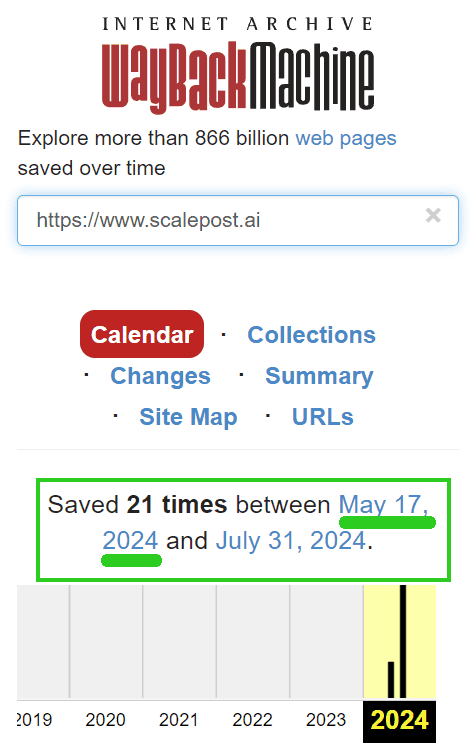
The Internet Archive only discovered the site a few months ago, which makes the website younger than the condiments rolling around in most people’s refrigerators.

Screenshot Of ScalePost AI At Internet Archive

Despite all the typical signals that ScalePost is not a legit company, it actually is a legit company.

The founders and senior advisors are are associated with high profile people like the ex-engineering director for Google Peter Norvig and executives from top big brand publishers like Hearst, Conde Nast, Wired and Fast Company. Those aren’t who are people who are associated with the elite upper tier of publishers and technologies, not known championing the earnings of smaller publishers.

Agreement With WordPress

WordPress.com is a web publishing platform and web host owned by Automattic and is not the same as the non-profit WordPress.org, which produces the free content management system (CMS) that powers the majority of the world’s websites.

Their announcement shared details about how the revenue sharing is triggered:

“Being part of Perplexity’s Publishing Partners Program means that knowledge from WordPress.com can now be included in the variety of answers that are served on Perplexity’s “Keep Exploring” section on their Discover pages. That means your articles will be included in their search index and your articles can be surfaced as an answer on their answer engine and Discover feed.  your website is referenced in a Perplexity search result where the company earns advertising revenue, you’ll be eligible for revenue share. “

WordPress.com announced that participation in the revenue share program is on by default for publishers but that there is a way to opt out should publishers who utilize the free-tier of their publishing platform desire to not participate.

A spokesperson for WordPress.com clarified to Nieman Lab that VIP level publishers who pay to host on their premium tier will not be a part of the deal.

Nieman Lab quoted them as saying:

“Megan Fox, a spokesperson for Automattic, clarified the deal excludes publishers hosted on the premium WordPress VIP, including customers like NewsCorp. The deal also carves out an exception for smaller news outlets that use Newspack, a service for local news publishers hosted on WordPress.com, including CalMatters, Capital B, Reveal and Houston Landing.”

Matt Mullenweg, the founder of Automattic, had no specific details for publishers:

“We’ll share more details of how it works as this partnership evolves, including how we’ll be distributing revenue-share payments to those whose content qualifies.”

…If you want to opt out, we already offer the ability to opt out of content sharing.”

Skepticism About Receiving Perplexity Revenue Share

Influential digital marketer Ryan Jones expressed doubt on X (formerly Twitter):

“Unpopular opinion: Unless you’re one of the top few thousand websites on the internet, LLMs or search engines are never going to pay you for your content.”

Ryan expressed the opinion that only big sites with large amounts of traffic will ever see payments.

Terry Van Horne agreed (and he wasn’t the only one):

“I’d say more like top 100…”

Is There Reason To Be Skeptical?

At this point in time, the arrangement between Perplexity AI and a brand new advertising network is long on promise and doesn’t show any evidence of expertise or experience. Of course some people are skeptical, it might be abnormal to not be skeptical of the arrangement.

Featured Image by Shutterstock/Ljupco Smokovski

Search GPT – Can Search GPT Disrupt Google Search? via @sejournal, @Kevin_Indig

Despite initial concerns, Chat GPT has not replaced search. Q2 record earnings show Google Search does better than ever. That’s why OpenAI’s new search engine, Search GPT, makes only sense after a second look.

Boost your skills with Growth Memo’s weekly expert insights. Subscribe for free!

$5b USD

Why would OpenAI launch a search engine if its main product poses one of the biggest threats to Google?

Image Credit: Kevin Indig

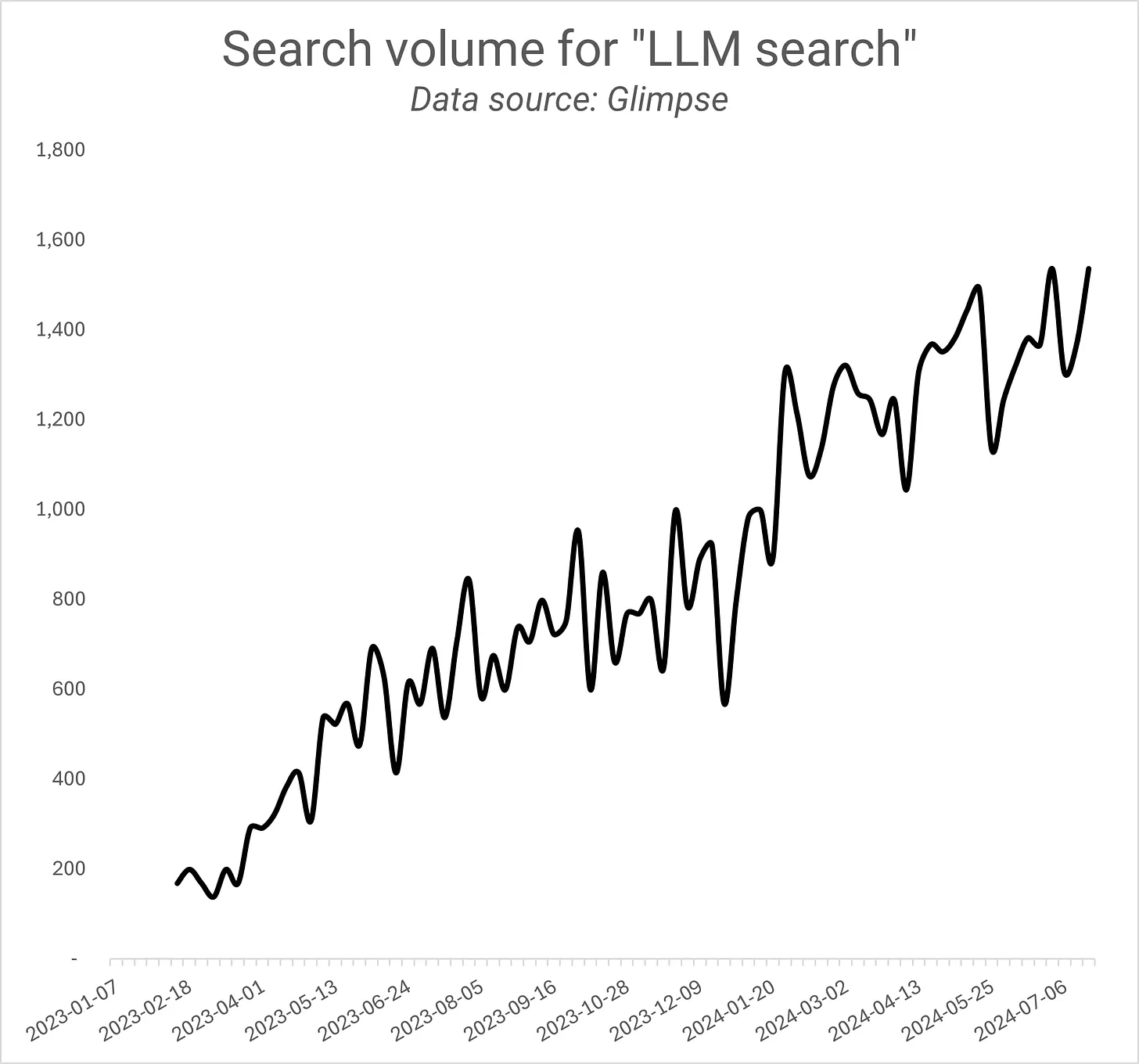
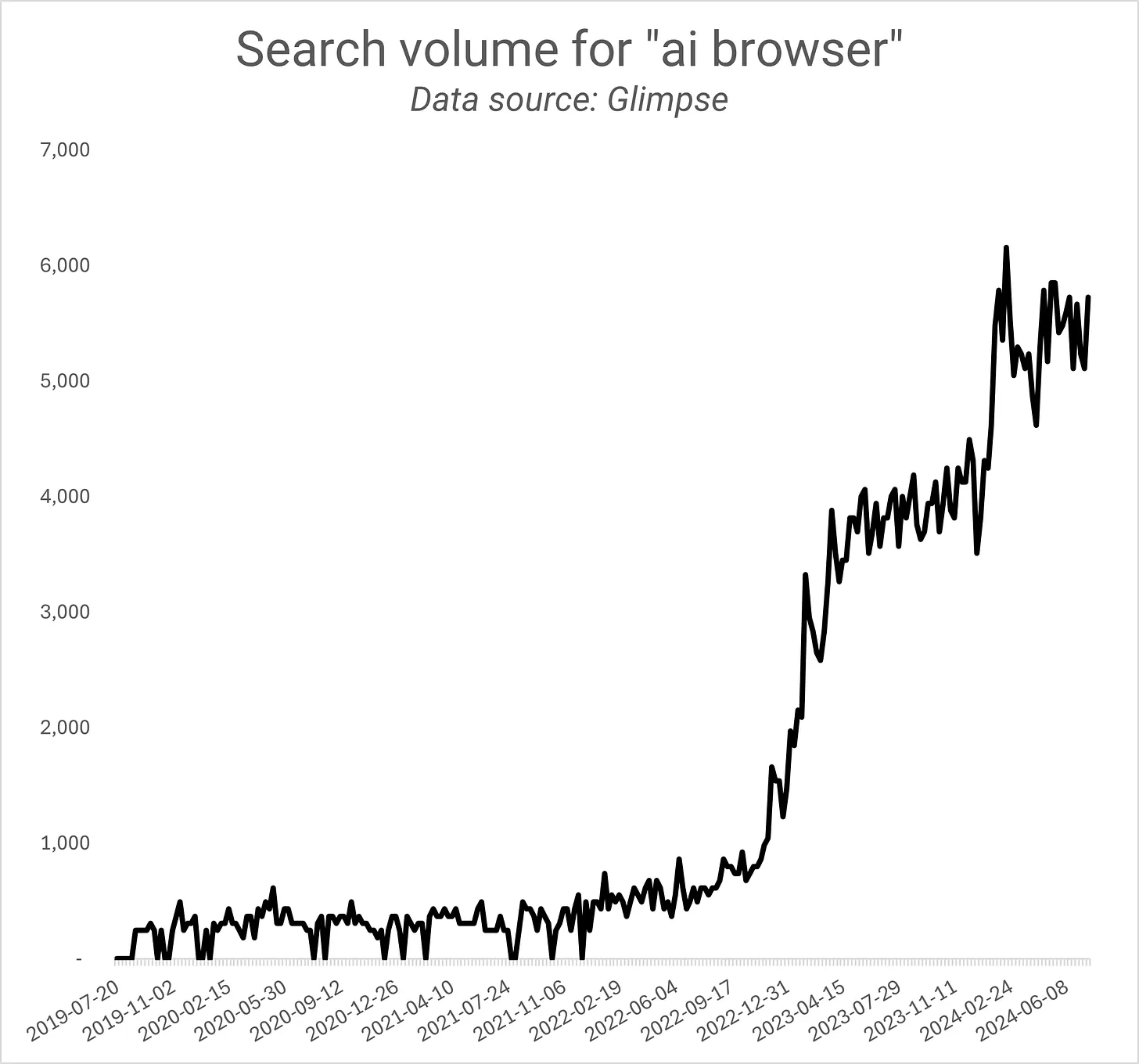
Searches for “LLM Search” are growing, but it’s not consumer demand that pulls OpenAI in that direction. There are six good reasons (in order of importance):

1/ OpenAI’s problem is that Chat GPT is not perceived as a search engine despite similar capabilities, so the company positions Search GPT as a direct Google alternative to gain more Search market share.

Rumors about launching a search engine just before Google I/O in 2024 and the impact of the actual announcement on Alphabet’s stock show the ambition to compete directly.

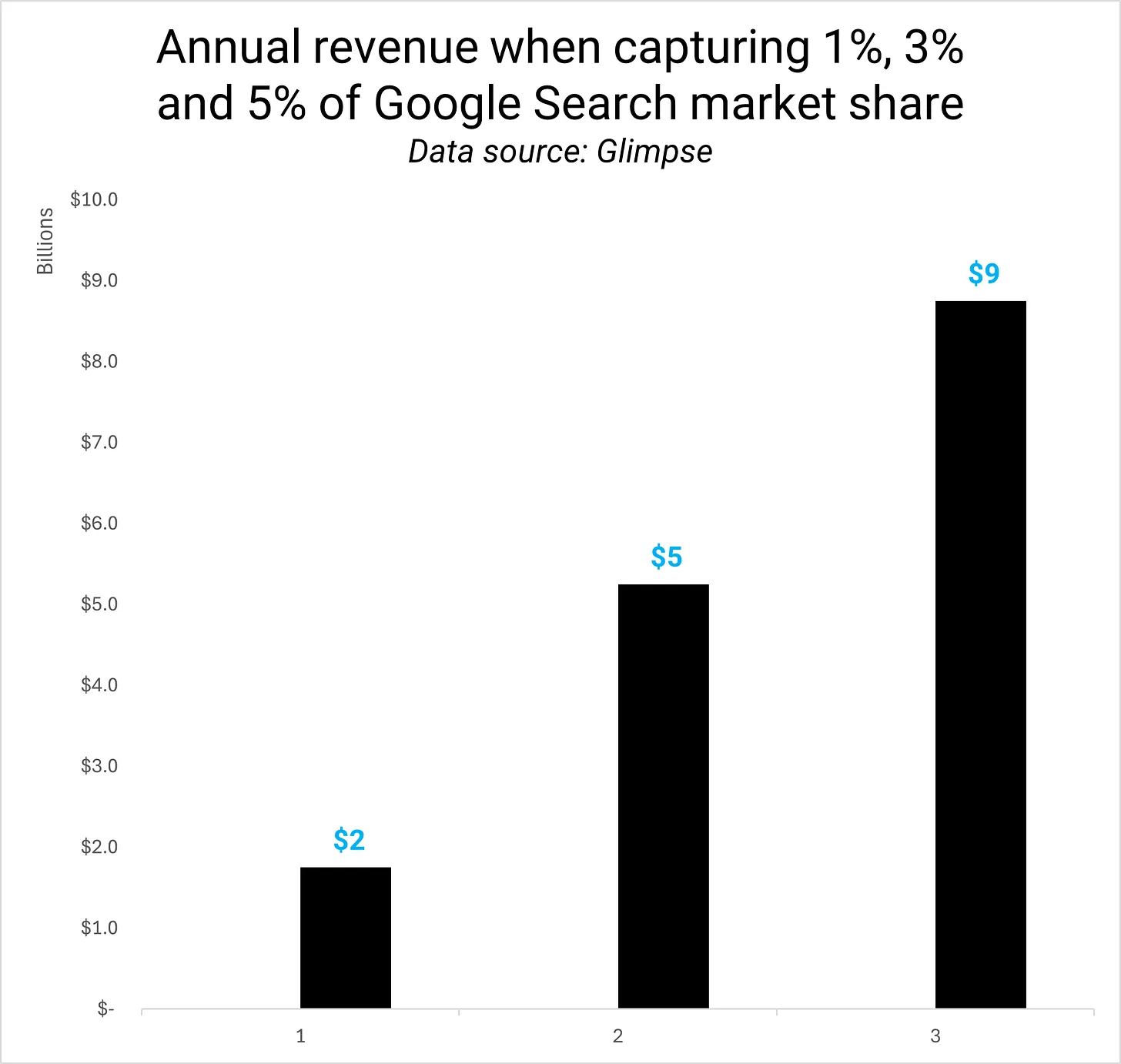
The Information reports that OpenAI loses $5b a year in expenses.1 Just capturing 3% of Google’s $175b Search business would allow OpenAI to recoup expenses.

Image Credit: Kevin Indig

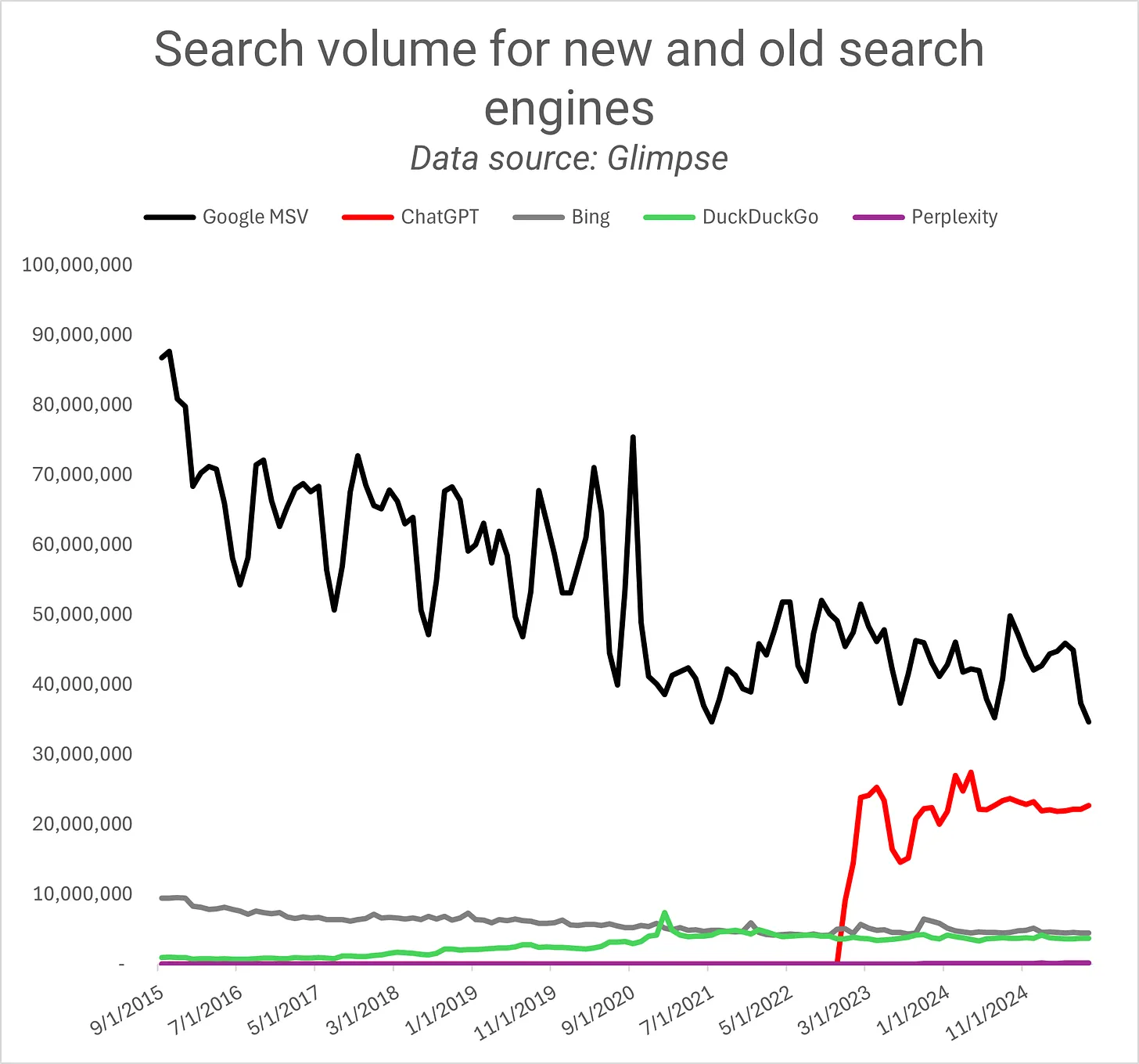
Searches for ChatGPT on Google are growing so much, they get close to searches for “Google”. They’ve already surpassed searches for other search engines by a lot.

To be fair, people search less for “Google” on Google (maybe in their browser bar to get to the Google homepage), and traffic numbers between Google (465b, according to Similarweb) and Chat GPT (660M) are still magnitudes apart.

Image Credit: Kevin Indig

OpenAI has a strategic advantage over Google: Search GPT can provide a very different, maybe less noisy, user experience than Google because it’s not reliant on ad revenue. In any decision regarding Search, Google needs to take ads into account.

2/ OpenAI crawls the web for training data and already has half the ingredients for a search engine on the table. Consumers are already familiar with the concept of a search engine, making adoption more likely.

I have no doubt that OpenAI will see a lot of curious sign-ups for Search GPT but the bigger challenge will be retaining users.

It’s also important to point out that the market hasn’t found the final form of LLMs yet. Chatbots made sense because of their prompting nature, but voice devices will likely become much better devices for LLMs.

3/ Search can deliver better user signals than prompting because it’s a more specific use case.

The beauty of prompting is that it’s an open field. You can do whatever you want. But that’s also a disadvantage because most people have no idea what they want to do and where to start.

As a result, success and failure are harder to measure at scale for chatbots than search engines.

A search engine, despite being versatile, has clearer use cases, which could drive more adoption and deliver better signals for LLMs to learn. In return, those learnings could transfer to chatbot answers, which are a big part of Search GPT.

4/ OpenAI wants to throw publishers a lifeline to secure a content pipeline. LLM developers need fresh content to train models and serve timely answers.

Search is the biggest source of publisher traffic2, but publishers are growing more frustrated with Google due to Algorithm updates, site reputation abuse penalties and AI Overviews.

It’s good timing for OpenAI to offer another source of revenue and get publishers “on their side”, especially after OpenAI itself has received a lot of criticism from publishers and a lawsuit from the NY Times.

The launch of SearchGPT follows a long list of publisher licensing deals:

  1. News Corp (+$250 million over five years): WSJ, New York Post, The Times, The Sun
  2. Associated Press (AP)
  3. Axel Springer: Bild, Politico, Business Insider
  4. Financial Times
  5. Le Monde
  6. Reuters
  7. Prisa Media
  8. Dotdash Meredith
  9. Time magazine
  10. Vox media
  11. Wiley (one-time fee of $23 million for previously published academic articles and books)

But even the best deals don’t help if publishers cannot sustain the creation of fresh content. If Search GPT can become a new traffic and revenue source for publishers, it would be a way to keep the critical ecosystem alive and get on the good side of publishers.

5/ Perplexity is a small challenger to OpenAI, but even a small challenger can take away mind share, and you never want to underestimate the competition. A search engine would conveniently fence in their growth. Why use Perplexity when Search GPT, which looks very similar, can do the same thing?

6/ OpenAI might bet on regulators breaking up Google’s exclusive search engine deal with Apple and hope to become part of a search engine choice set on Apple devices.

Granted, we’re talking about a very small chance, and certainly not the decisive factor for building a search engine, but it could be a small factor nonetheless.

Publisher GPT

Search GPT is clearly the sibling of Chat GPT. Besides SERP Features like weather charts and table stakes features like auto-suggest, the experience feels like Chat GPT.

The differences are hard to spot at first but meaningful in their potential to drive revenue, compete with Google and strengthen OpenAI’s data mining.

But one change stands out: Search GPT has more pronounced links to web results, a clear hat tip to publishers.

The Search GPT landing page mentions the word publisher 14 times and underlines how important publishers are for the open web and how dedicated OpenAI is to working with them.

OpenAI uses a different user agent to crawl websites for its search engine than for LLM training and strongly separates the two.

Importantly, SearchGPT is about search and is separate from training OpenAI’s generative AI foundation models. Sites can be surfaced in search results even if they opt out of generative AI training.

It’s not an accident that OpenAI tries to regain its grip on the web. A recently published study3 found that 25% of words (tokens) in Common Crawl stem from domains that have now excluded AI crawlers, with OpenAI at the top of the list, in their robots.txt or ToS.

SEO Implications

The two questions every SEO is asking themselves is whether they should care about Search GPT and how it might work.

Search GPT has a chance to become relevant for SEO quickly, given Chat GPT’s adoption. The Apple Intelligence integration and a potential phone would spur adoption even more.

However, OpenAI might integrate Search GPT into Chat GPT, which could change the relevance as a traffic source.

We cannot yet know how Search GPT works because it’s not live, but one big differentiator will be whether Search GPT includes results from the broad web or only from publishers OpenAI made a deal with.

If it’s the broad web, Search GPT has a high chance of being relevant. If it’s limited to partnering publishers, SEO won’t make sense for anyone not a partner because the answer set is limited.

If Search GPT uses RAG and ranks results similar to Google’s AI Overviews, we could use AIO performance as indicator and predictor for SearchGPT performance.

There is also chance that an answer from Chat GPT for queries that don’t require QDF (query deserves freshness) is the same on Search GPT, which would give us a way to understand what works before Search GPT launches publicly. Hard to validate without access Search GPT, though.

Search GPT could gain the web’s favor by sending relevant traffic, making it easy for sites to submit content, for example, through XML sitemaps, and providing some sort of webmaster console. As a result, Search GPT would position itself even stronger against Google.

A New Way To Search

If the main benefit or Search GPT for OpenAI is a revenue stream and access to more user data, the next logical step for OpenAI is to build a (AI-powered) browser.

Browser data is incredibly valuable for understanding user behavior, personalization and LLM training. Best of all, it’s app-agnostic, so OpenAI could learn from users even when they use Perplexity or Google.

We’ve seen the power of browser data in the Google lawsuit, where it turned out Google relied on Chrome data all along for ranking. The only layer that’s more powerful is the operating system and device layer.

Image Credit: Kevin Indig

There is already news that Sam Altman is working with Jon Ivy on building a phone. No wonder since Apple holds immense power over other ecosystems and platforms.

Remember when Apple blew a $10b hole into Meta’s annual revenue? Apple could develop its own models and surface them on the OS level—a critical threat to OpenAI. A browser could alleviate at least some of that threat.

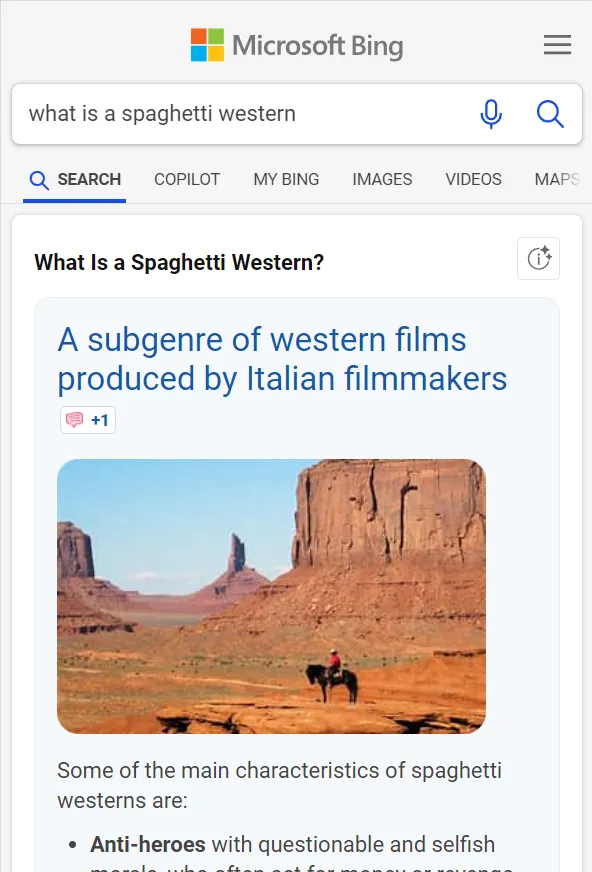
Bing released its own update to Search, giving us an idea of what Search GPT could look like. The new Bing prominently features AI answers at the top and search results on the side. A fitting metaphor for classic blue links.

Image Credit: Kevin Indig

Why OpenAI Could Lose $5 Billion This Year

Who Sends Traffic on the Web and How Much? New Research from Datos & SparkToro

Consent in Crisis: The Rapid Decline of the AI Data Commons

Getty Images Updated Generative AI Pushes Boundaries Of What’s Possible via @sejournal, @martinibuster

Getty Images announced an updated AI model for their image generator that generates images faster and with a higher quality. The changes benefit users of Generative AI by Getty Images and also Generative AI by iStock.

Fully Licensed High Quality Images

The Getty AI generated images are trained on their own content which means that all generated images can be fully licensed and commercial use is indemnified which means that users can license the images without ethical worries about how the AI models were trained.

High Quality Image Generation And Modification

A benefit of the updated Generative AI By Getty is that both generated images and existing stock images can be edited and modified by the AI. An image can easily be extended horizontally or vertically, individual elements can be added or removed, including the entire background of the image.

This solves so many problems for publishers who are looking for images with specific qualities in them because now they can more easily edit images to make them fit their exact needs – without having to use an expensive image editing software or SaaS.

These are some of the features users can take advantage of:

  • Industry-leading generation speed: Image generation speeds set to reach around 6 seconds, doubling the performance of the previous model, putting it at the forefront of the industry.
  • Advanced 4K generation detail: Enhanced detail and fidelity in generated images, with advanced upscaling and increased 4K generation detail.
  • Expanded support and adherence for more detailed prompts: Higher level of detail prompts results in images that more closely match the descriptions provided in the text prompt.
  • Longer prompts: Supports more complex and longer prompts, up to 250 words.
  • Advanced camera controls: Greater control over output using shot type and depth of field.”

Create Your Own AI Model

Enterprise level customers have the ability to fine-tune their own AI image generator models by training with their own images. This means that customers can create AI generated images based on their products, models and other image assets that are exclusive and proprietary to the users.

Getty Images Democratizes High Quality Images

Getty’s announcement represents a milestone in the business of stock images, enabling both pro and enthusiast level users to create and modify images at a level that was unthinkable only a few years ago.

Read more at:

Generate AI images and modify iStock imagery with ease

Featured Image by Shutterstock/rafapress

Google Advises Caution With AI Generated Answers via @sejournal, @martinibuster

Google’s Gary Illyes cautioned about the use of Large Language Models (LLMs), affirming the importance of checking authoritative sources before accepting any answers from an LLM. His answer was given in the context of a question, but curiously, he didn’t publish what that question was.

LLM Answer Engines

Based on what Gary Illyes said, it’s clear that the context of his recommendation is the use of AI for answering queries. The statement comes in the wake of OpenAI’s announcement of SearchGPT that they are testing an AI Search Engine prototype. It may be that his statement is not related to that announcement and is just a coincidence.

Gary first explained how LLMs craft answers to questions and mentions how a technique called “grounding” can improve the accuracy of the AI generated answers but that it’s not 100% perfect, that mistakes still slip through. Grounding is a way to connect a database of facts, knowledge, and web pages to an LLM. The goal is to ground the AI generated answers to authoritative facts.

This is what Gary posted:

“Based on their training data LLMs find the most suitable words, phrases, and sentences that align with a prompt’s context and meaning.

This allows them to generate relevant and coherent responses. But not necessarily factually correct ones. YOU, the user of these LLMs, still need to validate the answers based on what you know about the topic you asked the LLM about or based on additional reading on resources that are authoritative for your query.

Grounding can help create more factually correct responses, sure, but it’s not perfect; it doesn’t replace your brain. The internet is full of intended and unintended misinformation, and you wouldn’t believe everything you read online, so why would you LLM responses?

Alas. This post is also online and I might be an LLM. Eh, you do you.”

AI Generated Content And Answers

Gary’s LinkedIn post is a reminder that LLMs generate answers that are contextually relevant to the questions that are asked but that contextual relevance isn’t necessarily factually accurate.

Authoritativeness and trustworthiness is an important quality of the kind of content Google tries to rank. Therefore it is in publishers best interest to consistently fact check content, especially AI generated content, in order to avoid inadvertently becoming less authoritative. The need to verify facts also holds true for those who use generative AI for answers.

Read Gary’s LinkedIn Post:

Answering something from my inbox here

Featured Image by Shutterstock/Roman Samborskyi

Meta AI Introduces AI-Generated Photos to All Platforms via @sejournal, @martinibuster

Meta just released multiple updates to Meta AI which brings advanced image generation and editing capabilities directly to Facebook, Instagram and WhatsApp feeds, plus availability in more countries and languages.

New Meta AI Creative Tools

Meta AI is bringing AI generated and AI Edited photography that can be generated at the moment a user is making a post or sending a message with a new tool called Imagine Me.

Imagine Me is a prompt that can be used to transform an uploaded image that can be shared. This new feature is first rolling out as a beta in the United States.

Meta explains:

“Imagine yourself creates images based on a photo of you and a prompt like ‘Imagine me surfing’ or ‘Imagine me on a beach vacation’ using our new state-of-the-art personalization model. Simply type “Imagine me” in your Meta AI chat to get started, and then you can add a prompt like “Imagine me as royalty” or “Imagine me in a surrealist painting.” From there, you can share the images with friends and family, giving you the perfect response or funny sidebar to entertain your group chat.”

Screenshot of a photograph of a woman that's altered using Meta AI to show her having tea with an ostrich

New Editing Features

Meta products like Facebook, Messenger, WhatsApp and Instagram now have advanced editing capabilities that allow users to add or remove objects from images, to change them in virtually any manner, such as their example of turning a cat in an image into a dog. A new Edit With AI button is forthcoming in a month that will unlock even more AI editing power.

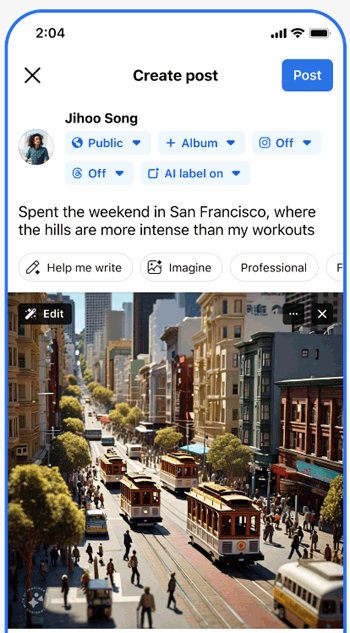
Adding AI generated images to Facebook, Instagram, Messenger and WhatsApp within feed, posts, stories, comments and messages is rolling out this week in English and coming later to other languages.

Screenshot of a Facebook user adding an AI generated image into their post

Meta AI In More Countries And Languages

Meta AI is now available in seven additional countries, bringing the total countries to to 22. It is also available in seven more languages.

List of Seven Additional Countries:

  1. Argentina
  2. Cameroon
  3. Chile
  4. Colombia
  5. Ecuador
  6. Mexico
  7. Peru

Meta AI is now also available in the following seven additional languages:

  1. French
  2. German
  3. Hindi
  4. Hindi-Romanized Script
  5. Italian
  6. Portuguese
  7. Spanish

Advanced Math And Coding

Meta AI is making their most advanced model, Llama 405B, available for users to take advantage of its advanced reasoning abilities that can answer complex answers and excells at math and coding.

Meta AI writes:

“You can get help on your math homework with step-by-step explanations and feedback, write code faster with debugging support and optimization suggestions, and master complex technical and scientific concepts with expert instruction.”

Read the official announcement:

Meta AI Is Now Multilingual, More Creative and Smarter

Featured Image by Shutterstock/QubixStudio

System Builders – How AI Changes The Work Of SEO via @sejournal, @Kevin_Indig

AI is terraforming tech. The content and SEO ecosystem is undergoing a massive structural change.

Human-written content gains value faster for LLM training than for end consumers as the pure profit licensing deals between LLM developers and publishers show.

Publishers struggle to survive from digital subscriptions but get millions that go straight to their bottom line for providing training data.

Content platforms, social networks, SaaS companies and consumer apps coat their products with AI. A few examples:

  • Spotify DJ (AI-generated playlist).
  • AI Overview (AI answers in Google Search).
  • Instagram AI personas (celebrity AI chatbots).
  • Ebay’s magical listing (turn a photo into a listing).
  • Redfin Redesign (try interior designs on real house pictures).
Google searches for chat gptImage Credit: Kevin Indig

The quality of machine-generated content (MGC) challenges human-generated content (HGC). I ran an experiment with my Twitter and LinkedIn followers: I asked them to choose which of two articles was written by a human and which by a machine – and they had to explain their answer.

Only a handful of people figured out that AI wrote both pieces. I intentionally framed the question in a leading way to see if people would challenge the setting or believe that one piece was written by a human if told so.

  • Not an isolated experiment: A survey of 1,900 Americans found that 63.5% of people can’t distinguish between AI content and human content.1
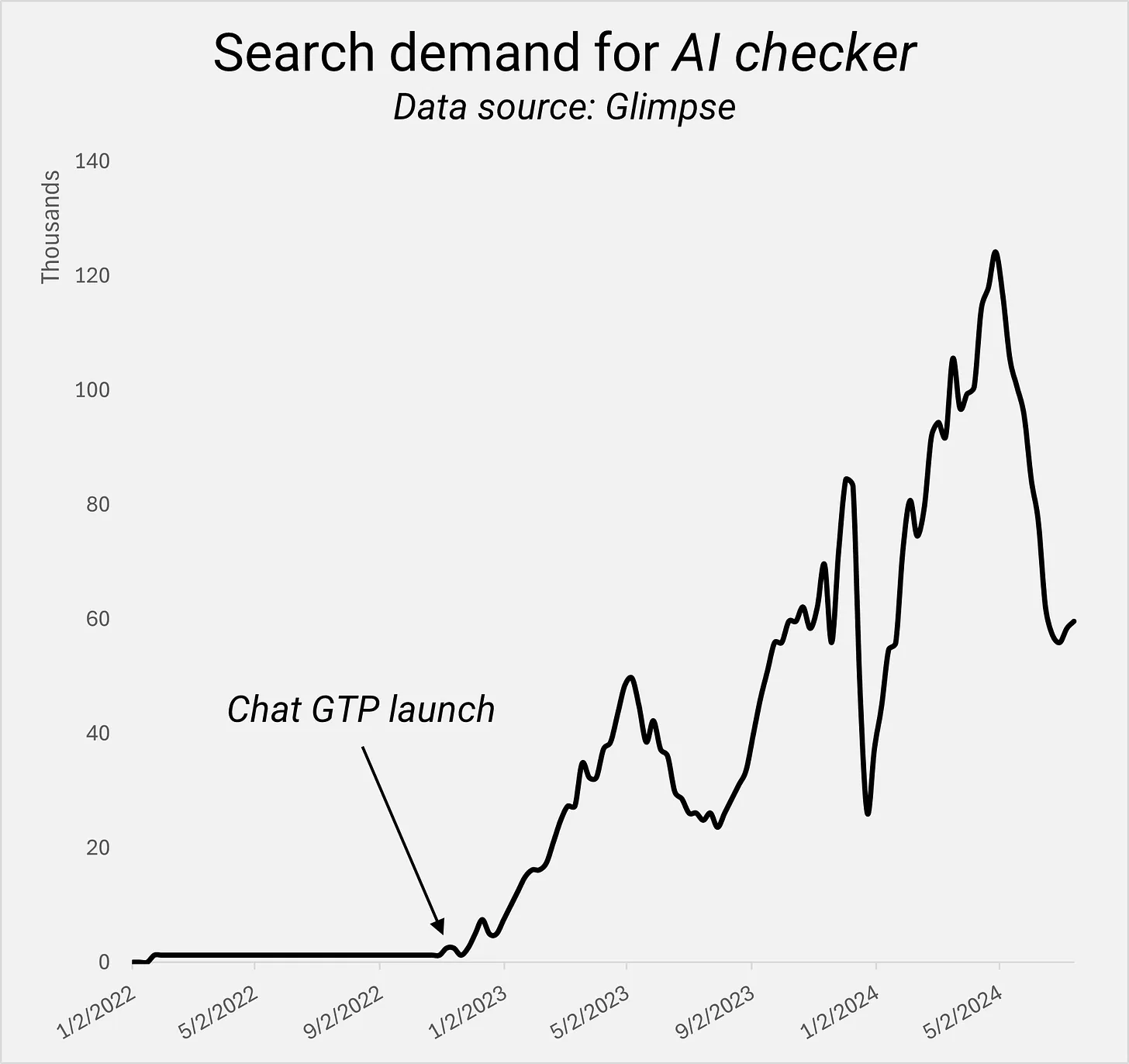
  • People seek help: Google search demand for [ai checker] has reached 100,000 in May 2024 (Glimpse).
  • Dark side: scammers use MGC to make money, as 77% of AI scam victims lost money.2
Search demand for AI checkerImage Credit: Kevin Indig

The quality level of LLMs pushes SEO work towards automating workflows and learning with AI, while writers will take content from good to great instead of zero to one.

Boost your skills with Growth Memo’s weekly expert insights. Subscribe for free!

How AI Changes The Work Of SEOImage Credit: Lyna ™

System Builders

Clients, podcasters and panel hosts often ask me what skills SEOs need to build for the AI future. For a long time, my answer was to learn, stay open-minded and gain as much practical experience with AI as possible.

Now, my answer is SEOs should learn how to build AI agents and workflows that automate tasks. AI changes the way search works but also the way SEOs work.

AI + No-code Allows SEOs To Automate Workflows

A few examples:

1/ Cannibalization

  • Old world: SEOs download search console data and create pivot tables to spot keyword cannibalization.
  • New world: SEOs build an AI workflow that sends alters, identifies true keyword cannibalization, makes content suggestions to fix the problem, and monitors the improvement.

2/ Site Crawling

  • Old world: SEOs crawl websites to find inefficiencies in internal linking, status code errors, duplicate content, etc.
  • New world: SEOs build an AI agent that regularly crawls the site and automatically suggests new internal links that are shipped after human approval, fixes broken canonical tags and excludes soft 404 errors in the robots.txt.

3/ Content Creation

  • Old world: SEOs do keyword research and write content briefs. Writers create the content.
  • New world: SEOs automate keyword research with AI and create hundreds of relevant articles as a foundation for writers to build on.

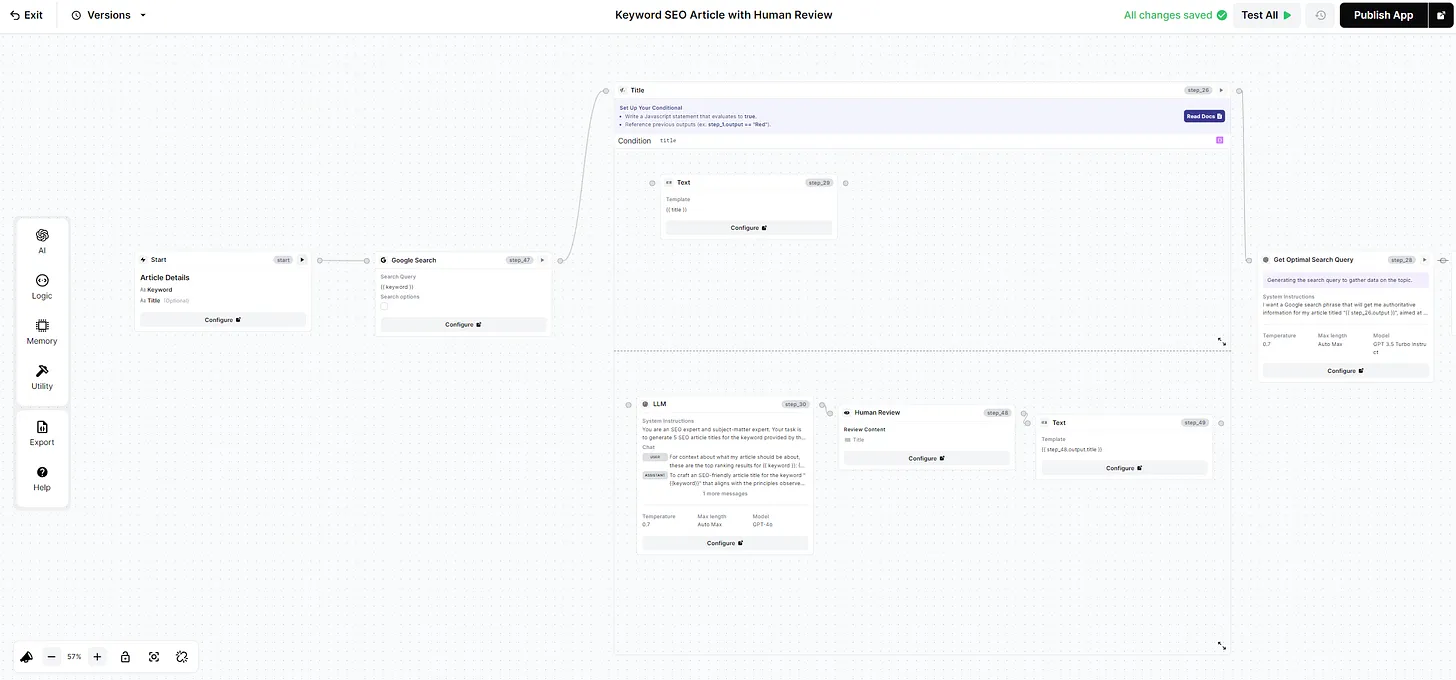
All of this is already possible today with AI workflow tools like AirOps or Apify, which chain agents and LLMs together to scrape, analyze, transform data or create content.

Moving forward, we’ll spend much more time building automated systems instead of wasting time on point analyses and catalogs of recommendations. The SEO work will be defining logic, setting rules, prompting and coding.

building automated systems Building workflows with AirOps (Image Credit: Kevin Indig)

You Can Learn (Almost) Anything With AI

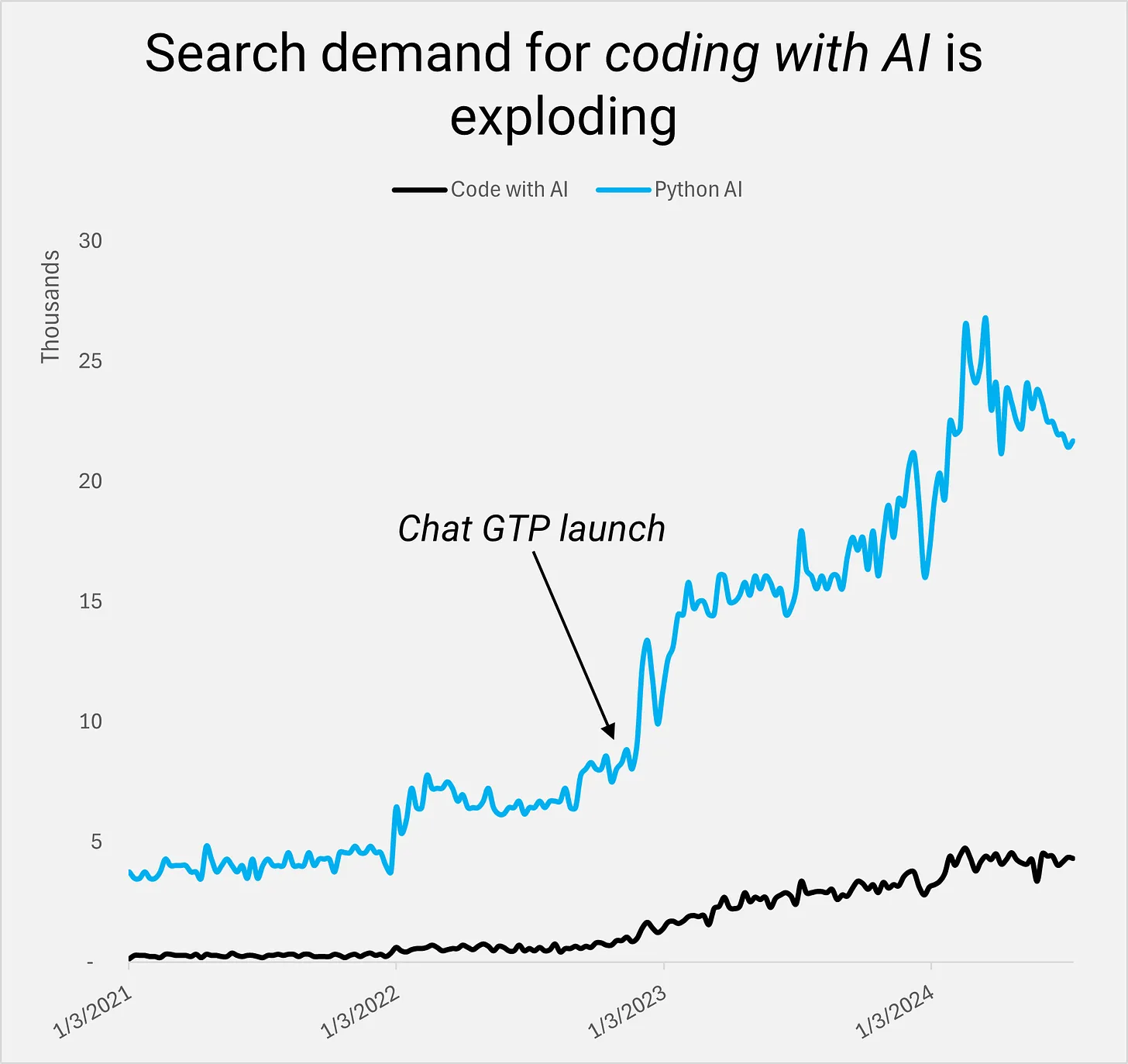
I never made the time to really learn Python or R, but with the help of Chat GPT and Gemini in Colab, I can write any script with natural language prompts.

When the script doesn’t work, I can paste a screenshot into Chat GPT and describe the issue to get a solution. AI helps with Regex, Google Sheets/Excel, R, Python, etc. Nothing is off-limits.

Being able to write scripts can solve problems like data analysis, a/b testing and using APIs. As an SEO, I’m no longer dependent on engineers, data scientists or writers to perform certain tasks. I can act faster and on my own account.

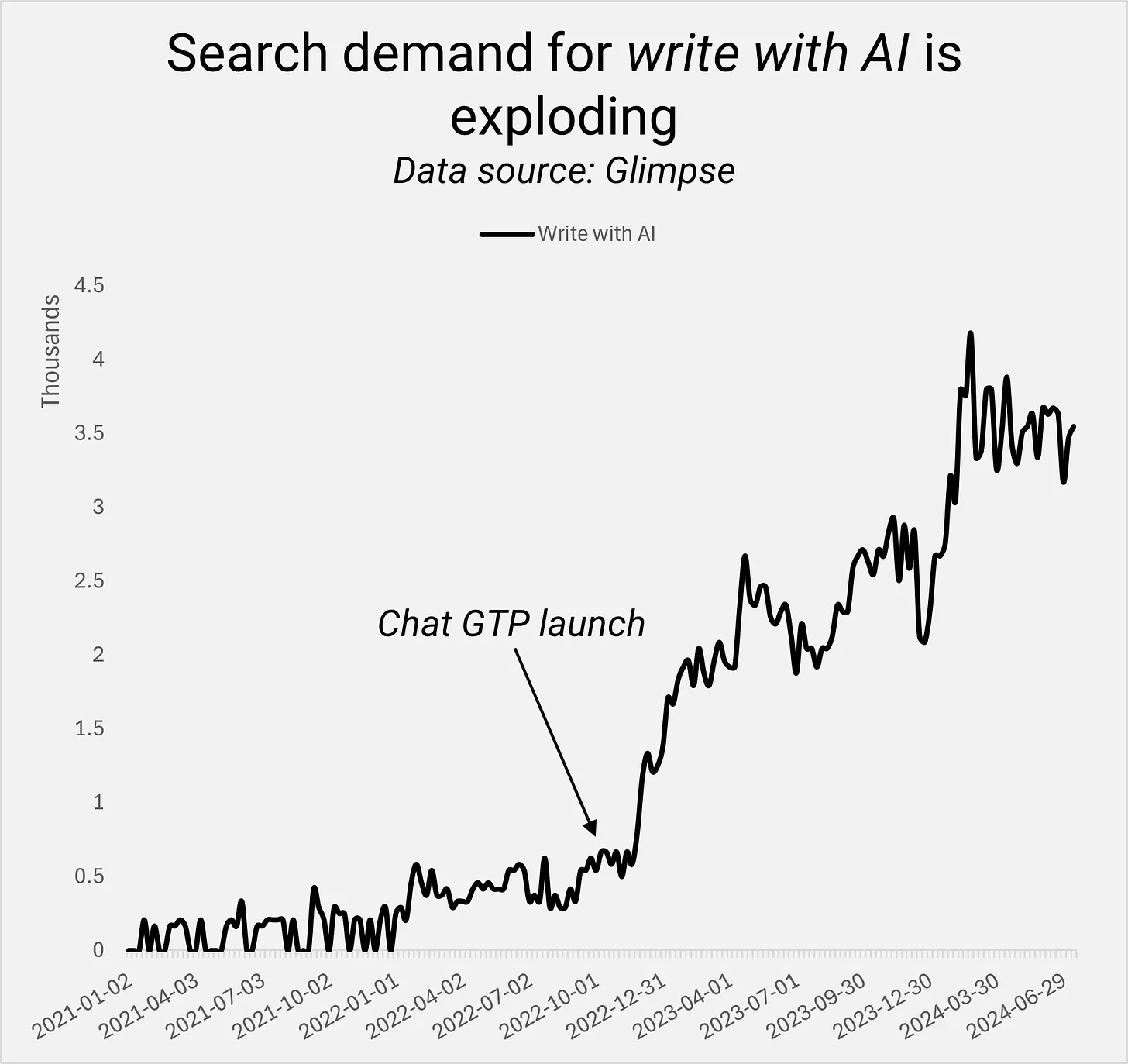
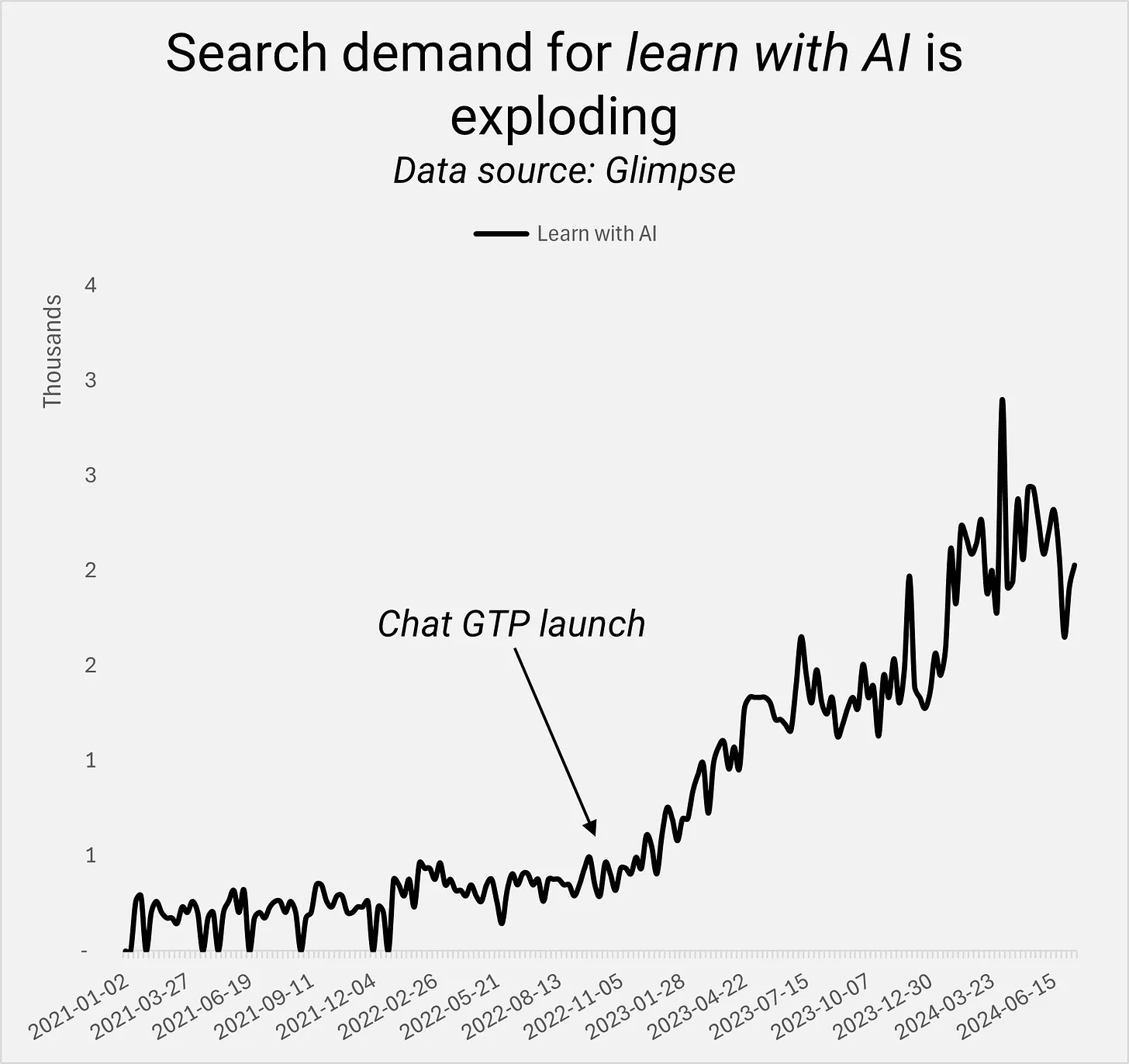
I’m not the only one to figure this out. People are learning to code, write and many other skills with AI. We can learn to build AI workflows by asking AI to teach us.

Search demand for coding with AI is explodingImage Credit: Kevin Indig
Search demand for write with AI is explodingImage Credit: Kevin Indig
Search demand for learn with AI is explodingImage Credit: Kevin Indig

When you can learn almost anything, the only limit is time.

The Work Of Writers Changes

Against common belief, writers won’t be crossed out of this equation but will play the critical role of editing, directing and curating.

In any automated process, humans QA the output. Think of car assembling lines. Even though AI content leaps in quality, spot checks reduce the risk of errors. Caught issues, such as wrong facts, weird phrasing or off-brand wording, will be critical feedback to fine-tune models to improve their output.

Instead of leg work like writing drafts, writers will bring AI content from good to great. In the concept of information gain, writers will spend most of their time making a piece outstanding.

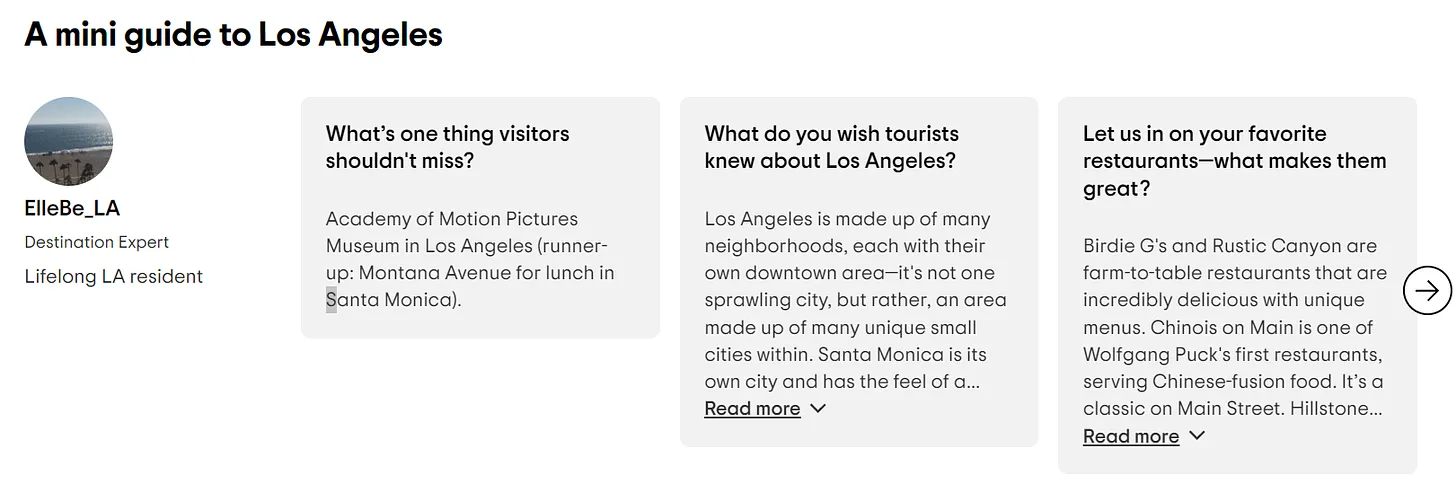
The rising quality work spans from blog content to programmatic content, where writers will add curated content when searches have a desire for human experience, such as in travel.

A mini guide to Los AngelesTripadvisor’s attraction pages feature human-curated sections. (Image Credit: Kevin Indig)

Unfair Advantage

As often with new technology, a few first-mover people and companies get exponential value until the rest catch up. My worry is that a few fast-moving companies will grab massive land with AI.

And yet, this jump in progress will allow newcomers to challenge incumbents and get a fair chance to compete on the field.

AI might be a bigger game changer for SEOs than for Google. The raw power of AI might help us overcome challenges from AI Overviews and machine learning-driven algorithm updates.

But the biggest win might be that SEOs can finally make something instead of delivering recommendations. The whole value contribution of SEOs changes because my output can drive results faster.

Survey: ChatGPT and AI Content – Can people tell the difference?

Artificial Intelligence Voice Scams on the Rise with 1 in 4 Adults Impacted


Featured Image: Paulo Bobita/Search Engine Journal

Trending Content Output Compared In ChatGPT, Gemini, And Claude via @sejournal, @gregjarboe

“Should we use ChatGPT, Gemini, or Claude to create trending content?”

That’s a good question – and one that I’m frequently asked when teaching a live class about engaging audiences through content.

You might mistakenly assume that instructors are supposed to answer questions like that. But my colleagues and I do something different.

We give our students relevant assignments that provide them with the opportunity to discover the answers to good questions for themselves.

This test-and-learn approach is something that you can also apply within your own company, agency, or team. Want to know which generative AI model to use to create trending content?

Well, conduct a test and compare the output.

Write Concise Descriptions Of The Most Emotionally Engaging Video Ads Of Euros 2024

You already know how to use Google Trends to identify search terms or topics that are trending now. In fact, many journalists use this free tool to get story ideas.

Over the long Fourth of July weekend, I used Google Trends and saw that the topic “Euros 2024” ranked No. 1 in Trending Searches with more than 1 million queries.

Next, I decided to avoid using OpenAI’s ChatGPT 3.5 for my tests. Why? Because it’s the most popular generative AI model, which means that your competitors are probably using it, too.

That means the content that this tool creates is less likely “to provide substantial value when compared to other pages in search results,” as Google’s long-standing advice recommends.

ChatGPT Output

So, I explored the custom versions of ChatGPT and selected Write For Me by puzzle.today.

Why? Because it ranked No. 1 in the Writing category. The tool also claimed it would help me “write tailored, engaging content with a focus on quality, relevance and precise word count.”

I want to create better content, not just content that is different from what everyone else is creating. So, I asked Write For Me to “write concise descriptions of the most emotionally engaging video ads of Euros 2024.”

Here’s what this generative AI tool produced:

1. Unity Through Football

 “A diverse group of children from different European countries come together on a pristine football pitch. As they play, the camera captures their joy and camaraderie, transcending language and cultural barriers. The ad concludes with a montage of professional players joining the children, emphasizing football's power to unite nations and foster friendship.”

2. Legacy of Legends

 “The ad begins with black-and-white footage of iconic moments from past Euros, highlighting legendary players. It transitions to vibrant, modern clips of current stars recreating these moments, symbolizing the passing of the torch. A heartfelt narration speaks to the continuity of dreams and the legacy carried by each generation.”

3. Homecoming

 “A montage of fans traveling from various parts of Europe to the host country, capturing their excitement and anticipation. Emotional reunions with fellow fans, old friends, and family members create a sense of belonging and community. The ad closes with a panoramic shot of a stadium filled with cheering supporters, underscoring the tournament's role in bringing people together.”

4. The Dream Begins

 “The ad follows a young aspiring footballer practicing tirelessly, inspired by their favorite Euros moments. Interspersed with clips of professional matches, it shows the child's journey from local games to a stadium filled with fans. The message is clear: dreams start small but can lead to greatness, encouraging viewers to pursue their passions.”

5. Heartbeat of the Game

 “This ad features a rhythmic sequence of football-related sounds: the thud of a ball, cheers from the crowd, and the whistle of the referee. These sounds build into a symphony, interspersed with clips of players’ intense focus and emotional celebrations. The heartbeat sound underscores the passion and excitement of the Euros, resonating with fans’ own emotions.”

6. From Streets to Stadiums

 “Children playing football in urban alleys, rural fields, and makeshift pitches across Europe are showcased. Their raw passion and joy are mirrored by professional players in grand stadiums, blurring the lines between dreams and reality. The ad concludes with a powerful message: football belongs to everyone, from the streets to the grandest arenas.

Now, it’s perfectly clear why video ads with these descriptions would be emotionally engaging, but it is frustratingly unclear which brands are running these ads during Euros 2024.

So, I’d have to do some double-checking to make sure that ChatGPT isn’t hallucinating.

Gemini Output

Next, I gave Google’s Gemini (formerly Bard) the same prompt. Here’s what this generative AI model produced:

1. Adidas: "Hey Jude" (Most Engaging)

 “This ad features rising England star Jude Bellingham alongside football legends like David Beckham and Frank Lampard. It taps into positive emotions by showcasing the passing of the torch and the enduring spirit of the game.”

2. Irn-Bru: "Get to Germany"

 “This ad, likely using humor, aims to create positive feelings and excitement around the Euros being held in Germany.”

3. Budweiser: "Bring it Home"

“This ad uses a patriotic theme, likely aiming to inspire viewers and evoke a sense of national pride for their team's chance to win the Euros.”

It’s perfectly clear which brands are running the most emotionally engaging video ads of Euros 2024, but it’s still unclear which methodology Gemini is using to make this selection.

So, I’d still have to do more due diligence to discover that it’s probably recent articles and posts about new research from DAIVID.

Claude Output

I asked Anthropic’s Claude 3.5 Sonnet to “write concise descriptions of the most emotionally engaging video ads of Euros 2024.” Here’s what this generative AI tool replied:

“I apologize, but I don't have access to specific information about video ads from Euro 2024, as my knowledge cutoff is in April 2024, and I can't browse the internet for current information.”

 “I can, however, offer some general thoughts on what makes emotionally engaging soccer/football ads:”

“Underdog stories of players or teams overcoming adversity.”
“Nostalgic montages showcasing historic Euro moments.”
“Depictions of passionate fans and their connection to the sport.”
“Inspirational messages about unity and international cooperation.”
“Cinematic recreations of iconic goals or plays.”

 “If you'd like me to expand on any of these concepts or discuss emotionally engaging sports ads in general, I'd be happy to do so. For accurate information about Euro 2024 ads, I'd recommend checking official UEFA sources or recent sports media coverage.”

Well, Claude’s honesty is admirable. But its knowledge cutoff means that I shouldn’t use this generative AI model for content about fairly recent trends.

Write Short Captions For The Funniest Photos From The 2024 Nathan’s Hot Dog Eating Contest

For my second test, I used the Google autocomplete feature to confirm that the phrase, [Nathan’s hot dog eating contest], was a trending search term.

Then, I asked each of the three generative AI tools to “write short captions for the funniest photos from the 2024 Nathan’s Hot Dog Eating Contest.”

ChatGPT Output

Here’s what Write For Me generated:

“Captions for Funniest Photos from the 2024 Nathan’s Hot Dog Eating Contest:”

"When you realize you're only halfway through your 50 hot dogs."
"Eyes on the prize: the ketchup bottle!"
"Training for this by swallowing my pride daily."
"When the bun hits you harder than the hot dog."
"Mustard not? I mustered up the courage!"
"New strategy: inhale, don’t chew."
"Hot dogs: 10, Dignity: 0."
"When you think it’s the last dog but it’s not."
"The face you make when you beat your personal best... by 1 dog."
"Calories don’t count if you don’t chew, right?"

Okay, I admit that many of these captions are funny. But it’s difficult to tell if they belong to actual photos or if this custom version of ChatGPT hallucinated the entire list.

And don’t get me started on getting permission to use any photos that exist. Of course, I could always use DALL-E 3 to turn the text above into images.

Gemini Output

Next, I gave Gemini the same assignment. Here’s what it generated:

1. Mustard Mishap: "Someone's about to be redecorated in yellow!" (Photo of a competitor with mustard splattered all over their face).

2. Relish the Moment: "This is what pure competitive joy looks like." (Photo of a competitor mid-devour with a look of intense concentration and relish dripping down their chin).

3. Bun Bungee: "Is that a hot dog or a bungee jumper? Defying the laws of physics, one frankfurter at a time." (Photo of a competitor with a hot dog halfway down their esophagus).

4. Fountain of Fury: "Looks like someone forgot their manners! (But they're probably winning.)" (Photo of a competitor with a spray of water and ketchup erupting from their mouth).

5. Doggy Downtime: "Even champions gotta rest sometimes. (Just don't let Joey Chestnut see this.)" (Photo of a competitor slumped back in their chair with a belly full of hot dogs).”

Um, okay. These are also funny captions.

But it’s hard to know if they go with actual photos that were posted on July 4, 2024, without using Google Images to conduct a series of relevant searches. And that still doesn’t give me permission to use them even if they do exist.

[Note, these responses were generated a few days before Google announced their support for labelling AI-generated images.]

Claude Output

Then, I asked Claude 3.5 Sonnet to “write short captions for the funniest photos from the 2024 Nathan’s Hot Dog Eating Contest.” Here’s what it replied:

“I apologize, but I don't have access to specific photos from the 2024 Nathan's Hot Dog Eating Contest, as my knowledge cutoff is in April 2024. Additionally, I can't generate, produce, edit, manipulate or create images.”

 “However, I can suggest some hypothetical humorous captions that might be appropriate for funny moments at a hot dog eating contest:”

"When the hot dogs fight back"
"Regretting that 50th hot dog"
"Mid-contest nap: Expert level achieved"
"Ketchup everywhere... except on the hot dogs"
"When you realize it's only been 2 minutes"
"The face of a champion... or indigestion"
"Spectators' faces: Equal parts horror and awe"
"When the bun-to-dog ratio is all wrong"
"Competitive eating: Where table manners go to die"
"That moment you question all your life choices"

 
“Remember, these are fictional captions for imaginary photos. For accurate information about the 2024 contest, you'd need to check official sources or news reports from after the event.”

Once again, Claude gets high marks for being honest about its limitations.

But unless I want to select some of these hypothetical humorous captions and use them as prompts in Adobe Firefly, then I need to use one of the other options.

Write A 400-Word Blog Post About The Top Omni Channel Retailing Trends Of 2024

For my third test, I used SparkToro to research the audience of 5,000 to 6,000 people who search for the keyword [customer retention] each month.

I used SparkToro’s trending keywords feature to analyze the search terms that have risen in popularity among searchers for “customer retention” over the last quarter.

Then, I selected the trending keyword, “omni channel retailing trends,” for this test.

ChatGPT Output

When I asked Write For Me to “write a 400-word blog post about the top omni channel retailing trends of 2024,” here’s what this generative AI tool produced:

Top Omnichannel Retailing Trends of 2024

 “As we move into 2024, the landscape of retail continues to evolve rapidly, driven by technological advancements and changing consumer expectations. Omnichannel retailing, which integrates various shopping channels into a seamless customer experience, remains at the forefront of this evolution. Here are the top omnichannel retailing trends to watch out for in 2024.”
 
1. Enhanced Personalization Through AI and Data Analytics
“In 2024, personalization goes beyond just using the customer’s name in emails. Retailers are leveraging advanced AI and data analytics to offer hyper-personalized shopping experiences. By analyzing consumer behavior, preferences, and purchase history, retailers can tailor recommendations, promotions, and content to individual customers. This level of personalization enhances customer satisfaction and increases conversion rates.”
 
2. Seamless Integration of Physical and Digital Channels 
“The line between online and offline shopping continues to blur. In 2024, more retailers are perfecting the integration of physical and digital channels. Innovations like in-store augmented reality (AR) mirrors, smart fitting rooms, and mobile app functionalities that enhance in-store experiences are becoming standard. Additionally, services like click-and-collect and in-store returns for online purchases are expected to become more streamlined and widespread.”
 
3. Expansion of Mobile Commerce (M-Commerce) 
“Mobile commerce continues to grow as consumers increasingly use their smartphones for shopping. Retailers are optimizing their mobile websites and apps to provide faster, more intuitive, and secure shopping experiences. Features like one-click purchasing, mobile wallets, and personalized push notifications are becoming essential components of mobile strategies.”

 4. Social Commerce Revolution 
“Social media platforms are transforming into powerful retail channels. In 2024, social commerce, where shopping experiences are embedded within social media, is set to explode. Platforms like Instagram, Facebook, and TikTok are enhancing their shopping functionalities, allowing users to discover, browse, and purchase products without leaving the app. Influencer marketing and user-generated content continue to drive this trend, making social media a critical part of omnichannel strategies.”
 
5. Sustainable and Ethical Retailing
“Consumers are increasingly demanding sustainability and transparency from the brands they support. In response, retailers are incorporating sustainable practices and ethical sourcing into their omnichannel strategies. This includes offering eco-friendly products, reducing packaging waste, and providing transparency about product origins and manufacturing processes. Brands that can effectively communicate their sustainability efforts through all channels will gain a competitive edge.”
 
6. Voice Commerce and Conversational AI 
“Voice-activated shopping and conversational AI are becoming more prevalent. With the rise of smart speakers and virtual assistants, consumers are using voice commands to search for products, place orders, and track deliveries. Retailers are integrating voice commerce capabilities into their omnichannel strategies to enhance convenience and improve customer engagement.”
 
Conclusion 
“In 2024, the retail industry is embracing these omnichannel trends to create more cohesive and engaging shopping experiences. By focusing on personalization, integrating physical and digital channels, leveraging mobile and social commerce, prioritizing sustainability, and adopting voice commerce, retailers can stay ahead in a competitive market. These trends highlight the importance of flexibility and innovation in meeting the evolving needs of modern consumers.”

Um, okay. This is 498 words long. This content seems designed for publication at the beginning of the year.

The blog post is missing citations from reliable sources, credible quotes, and relevant statistics, as Roger Montti’s article, “Researchers Discover How To SEO For AI Search,” noted back on Dec. 18, 2023.

So, it’s not as bad as a first draft. But I would hope that writers would learn by using this custom version of ChatGPT that they need to craft something a little bit better.

Gemini Output

Next, I asked Gemini to tackle the same assignment. Here’s what this generative AI tool produced:

The Future of Shopping: Top Omnichannel Retail Trends in 2024
 
“The retail landscape is ever-evolving, and 2024 is no exception. Consumers today expect a seamless shopping experience, regardless of whether they're browsing online, visiting a physical store, or interacting with a brand on social media. This is where omnichannel retail thrives. By creating a unified experience across all touchpoints, retailers can build stronger customer loyalty and drive sales.”
 
“Let's delve into the top omnichannel retail trends shaping the industry in 2024:”

 1. The Rise of the Data-Driven Experience:
 “With the demise of third-party cookies, retailers are focusing on collecting and utilizing first-party customer data. This data allows for real-time personalization across all channels. Imagine receiving targeted email promotions based on your recent in-store purchases, or seeing personalized product recommendations on a brand's app. Advanced analytics will not only personalize marketing efforts but also optimize search functionalities and product merchandising on e-commerce platforms.”

 2. AI Takes Center Stage: 
“Artificial intelligence (AI) is rapidly transforming the retail experience. AI-powered chatbots can answer customer queries 24/7, recommend products based on browsing history, and even assist with in-store tasks. Generative AI can create personalized marketing content at scale, while AI-driven sales automation streamlines processes for both retailers and customers.”
 
3. The Blur Between Physical and Digital: 
“The lines between online and offline shopping are continuing to blur. We're seeing a rise in ‘phygital’ experiences, such as augmented reality (AR) apps that allow customers to virtually try on clothes or visualize furniture in their homes. In-store kiosks can facilitate online purchases and allow for easy returns or exchanges. Additionally, ‘showrooming,’ where customers browse in-store and then purchase online, necessitates seamless product availability and pricing across channels.”
 
4. Social Commerce Takes Off: 
“Social media platforms are no longer just for browsing; they're becoming powerful shopping destinations. ‘Live shopping’ experiences with influencers showcasing products are gaining traction, while social media platforms are integrating smoother buying functionalities within their apps. User-generated content and social proof will continue to influence purchasing decisions, making social media a crucial touchpoint in the omnichannel journey.”

 5. Personalization Beyond Products: 
“The future of omnichannel retail goes beyond just product recommendations. Retailers are focusing on creating personalized experiences that cater to individual customer preferences. This could involve offering flexible delivery options, loyalty programs with tiered benefits, or the ability to curate in-store shopping experiences through appointments or personalized product selections.”

Conclusion: 
“In today's competitive retail environment, omnichannel isn't just a trend; it's a necessity. By embracing these trends and prioritizing a data-driven, personalized approach, retailers can not only survive but thrive in the ever-evolving landscape of commerce.”

Well, the headline is better and it’s 433 words long, which is closer to what I’d asked for. But this blog post is also missing citations from reliable sources, credible quotes, and relevant statistics.

So, I hope writers would learn the same lesson by using Gemini that they learned using a custom version of ChatGPT: It’s not bad, but a human with experience and expertise can do better.

Claude Output

Finally, I asked Claude 3.5 Sonnet to “write a 400-word blog post about the top omni channel retailing trends of 2024.” Here’s what this generative AI tool produced:

Top Omnichannel Retailing Trends Shaping 2024
 
“As we navigate through 2024, the retail landscape continues to evolve rapidly. Omnichannel strategies have become more crucial than ever, with consumers expecting seamless experiences across all touchpoints. Let's explore the key trends defining omnichannel retailing this year.”
 
1. AI-Powered Personalization: “Artificial intelligence is revolutionizing how retailers understand and cater to individual customer preferences. In 2024, we're seeing more sophisticated AI algorithms that analyze customer data across channels to deliver hyper-personalized recommendations, offers, and experiences.”
 
2. Augmented Reality Integration: “AR is bridging the gap between online and offline shopping. Retailers are leveraging AR technology to allow customers to virtually try on clothes, visualize furniture in their homes, or explore products in detail before making a purchase decision.”
 
3. Social Commerce Acceleration: “Social media platforms are increasingly becoming direct sales channels. Retailers are optimizing their presence on platforms like Instagram, TikTok, and Pinterest, enabling in-app purchases and creating shoppable content that seamlessly integrates with users' social experiences.”
 
4. Sustainable and Ethical Omnichannel Practices: “Consumers are more environmentally conscious than ever. Retailers are responding by implementing sustainable practices across their omnichannel operations, from eco-friendly packaging to transparent supply chains and ethical sourcing information available across all channels.”
 
5. Voice Commerce Integration: “With the growing adoption of smart speakers and voice assistants, retailers are optimizing their digital presence for voice search and enabling voice-activated purchases, adding another dimension to the omnichannel experience.”
 
6. Phygital Experiences: “The blend of physical and digital experiences, or ‘phygital,’ is gaining traction. Retailers are creating innovative in-store digital touchpoints and bringing elements of the physical store experience to online platforms.”
 
7. Unified Customer Data Platforms: “Retailers are investing in advanced customer data platforms that consolidate information from all channels, providing a single view of the customer and enabling more cohesive marketing and service strategies.”

8. Flexible Fulfillment Options: “The line between online and offline continues to blur with the expansion of services like buy online, pick up in-store (BOPIS), curbside pickup, and same-day delivery. Retailers are optimizing their logistics to offer customers maximum flexibility.”

9. Subscription-Based Models: “More retailers are incorporating subscription services into their omnichannel strategies, providing regular product deliveries or exclusive access to content and experiences across multiple platforms.”
 
10. Advanced Analytics for Real-Time Insights: “Retailers are leveraging advanced analytics tools to gain real-time insights into customer behavior across channels, allowing for quick adjustments to inventory, pricing, and marketing strategies.”
 
“As these trends show, the future of retail lies in creating cohesive, customer-centric experiences that seamlessly blend online and offline touchpoints. Retailers who successfully adapt to these omnichannel trends will be well-positioned to thrive in the dynamic retail environment of 2024 and beyond.”

Claude’s content is 443 words long, which is longer than Gemini’s, but shorter than the custom version of ChatGPT. And Claude generated 10 trends, while ChatGPT generated six, and Gemini generated five.

But just like the other generative AI tools, Claude’s blog post is missing citations from reliable sources, credible quotes, and relevant statistics.

So, Claude is also good at creating a rough draft. But I’d hope that writers would learn by using ChatGPT, Gemini, and Claude that they shouldn’t become a tool of their tools.

AI Is Not Going To Take Your Job

A year ago, Jensen Huang, the founder, president, and CEO of Nvidia, said,

“AI is not going to take your job. The person who uses AI is going to take your job.”

Well, a year later, we’ve learned by comparing the content output generated by ChatGPT, Gemini, and Claude that it’s still smarter to use generative AI tools to brainstorm or create a good first draft.

Then, use your experience, expertise, authoritativeness, and trustworthiness (E-E-A-T) to add emotionally engaging videos, eye-catching photos, citations from reliable sources, credible quotes, and relevant statistics to your content.

Why? Because this is the best way to provide substantial value when compared to other pages in search results.

More resources:  


Featured Image: jomel alos/Shutterstock

OpenAI GPT-4o Mini Costs Less & Wallops Competition via @sejournal, @martinibuster

OpenAI rolled out GPT-4o mini, a replacement for GPT 3.5 Turbo that is more powerful than other models in its class. Because it’s hyper efficient, GPT 4o mini will make AI available to more people at a cheaper price through better end-user applications.

GPT-4o mini

GPT-4o mini is a highly efficient version of GPT-4o that is cheaper to run and is fast. Despite it’s designation as “mini” this language model is outperforms GPT-4 and GPT-3.5 turbo, as well as solidly outperforming Google’s comparable model, Gemini Flash 1.5.

Preliminary scores by the open source Large Language Model Systems Organizations shows GPT-4o Mini outperforming Anthropic’s Claude 3 Opus and Google’s Gemini Flash 1.5 and reaching benchmark scores that are comparable to GPT 4.5 Turbo and Gemini 1.5 Pro.

Screenshot Of Language Model Scores

Cost Effective Language Model

An important feature of GPT-4o mini is that it’s cheaper to use, 60% cheaper than GPT 3.5 Turbo, which means that companies that make AI products based on OpenAI language models will be able to offer high performance AI applications that cost significantly less. This makes AI available to more people around the world.

According to OpenAI:

“Today, we’re announcing GPT-4o mini, our most cost-efficient small model. We expect GPT-4o mini will significantly expand the range of applications built with AI by making intelligence much more affordable. GPT-4o mini scores 82% on MMLU and currently outperforms GPT-41 on chat preferences in LMSYS leaderboard(opens in a new window). It is priced at 15 cents per million input tokens and 60 cents per million output tokens, an order of magnitude more affordable than previous frontier models and more than 60% cheaper than GPT-3.5 Turbo.

a text and vision model in the Assistants API, Chat Completions API, and Batch API. Developers pay 15 cents per 1M input tokens and 60 cents per 1M output tokens (roughly the equivalent of 2500 pages in a standard book). We plan to roll out fine-tuning for GPT-4o mini in the coming days.”

GPT-4o mini Availability

GPT 4o mini is available today to users of ChatGPT Free, Plus and Team, with GPT-3.5 no longer a selectable option. Enterprise users will have access next week.

Read the official announcement:

GPT-4o mini: advancing cost-efficient intelligence

Featured Image by Shutterstock/Dean Drobot

Research Confirms Google AIO Keyword Trends via @sejournal, @martinibuster

New research by enterprise search marketing company BrightEdge reveals dramatic changes to sites surfaced through Google’s AI Overviews search feature and though it maintains search market share, the data shows that AI search engine Perplexity is gaining ground at a remarkable pace.

Rapid & Dramatic Changes In AIO Triggers

The words that trigger AI Overviews are changing at an incredibly rapid pace. Some keyword trends in June may already changed in July.

AI Overviews were triggered 50% more times for keywords with the word “best” in them. But Google may have reversed that behavior because those phrases, when applied to products, don’t appear to be triggering AIOs in July.

Other AIO triggers for June 2024:

  • “What Is” keywords increased by 20% more times
  • “How to” queries increased by 15%
  • Queries with the phrase “”symptoms of” increased by about 12%
  • Queries with the word “treatment” increased by 10%

A spokesperson from BrightEdge responded to my questions about ecommerce search queries:

“AI’s prevalence in ecommerce is indeed increasing, with a nearly 20% rise in ecommerce keywords showing AI overviews since the beginning of July, and a dramatic 62.6% increase compared to the last week of June. Alongside this growth, we’re seeing a significant 66.67% uptick in product searches that contain both pros and cons from the AI overview. This dual trend indicates not only more prevalent use of AI in ecommerce search results but also more comprehensive and useful information being provided to consumers through features like the pros/cons modules.”

Google Search And AI Trends

BrightEdge used its proprietary BrightEdge Generative Parser™ (BGP) tool to identify key trends in search that may influence digital marketing for the rest of 2024. BGP is a tool that collects massive amounts of search trend data and turns it into actionable insights.

Their research estimates that each percentage point of search market share represents $1.2 billion, which means that gains as small as single digits are still incredibly valuable.

Jim Yu, founder and executive chairman of BrightEdge noted:

“There is no doubt that Google’s dominance remains strong, and what it does in AI matters to every business and marketer across the planet.

At the same time, new players are laying new foundations as we enter an AI-led multi-search universe. AI is in a constant state of progress, so the most important thing marketers can do now is leverage the precision of insights to monitor, prepare for changes, and adapt accordingly.

Google continues to be the most dominant source of search traffic, driving approximately 92% organic search referrals. A remarkable data point from the research is that AI competitors in all forms have not yet made a significant impact as a source of traffic, completely deflating speculation that AI competitors will cut into Google’s search traffic.

Massive Decrease In Reddit & Quora Referrals

Back in May 2024 Google Of interest to search marketers is that Google has followed through in reducing the amount of user generated content (UGC) surfaced through its AI Overviews search feature. UGC is responsible for many of the outrageously bad responses that generated negative press. BrightEdge’s research shows that referrals to Reddit and Quora from AI Overviews declined to “near zero” in the month of June.

Citations to Quora from AI Overviews are reported to have decreased by 99.69%. Reddit fared marginally etter in June with an 85.71% decrease

BrightEdge’s report noted:

“Google is prioritizing established, expert content over user discussions and forums.”

Bing, Perplexity And Chatbot Impact

Market share for Bing continues to increase but only by fractions of a percentage point, growing from 4.2% to 4.5%. But as they say, it’s better to be moving forward than standing still.

Perplexity on the other hand is growing at a monthly rate of 31%. Percentages however can be misleading because 31% of a relatively small number is still a relatively small number. Most publishers aren’t talking about all the traffic they’re getting from Perplexity so they still have a way to go. Nevertheless, a monthly growth rate of 31% is movement in the right direction.

Traffic from Chatbots aren’t really a thing, so this comparison should be put into that perspective. Sending referral traffic to websites isn’t really what chatbots like Claude and ChatGPT are about (at this point in time). The data shows that both Claude and ChatGPT are not sending much traffic.

OpenAI however is hiding referrals from the websites that it’s sending traffic to which makes it difficult to track it. Therefore a full understanding of the impact of LLM traffic, because ChatGPT uses a rel=noreferrer HTML attribute which hides all traffic originating from ChatGPT to websites. The use of the rel=noreferrer link attribute is not unusual though because it’s an industry standard for privacy and security.

BrightEdge’s analysis looks at this from a long term perspective and anticipates that referral traffic from LLMs will become more prevalent and at some point will become a significant consideration for marketers.

This is the conclusion reached by BrightEdge:

“The overall number of referrals from LLMs is small and expected to have little industry impact at this time. However, if this incremental growth continues, BrightEdge predicts it will influence where people search online and how brands approach optimizing for different engines.”

Before the iPhone existed, many scoffed at the idea of the Internet on mobile devices. So BrightEdge’s conclusions about what to expect from LLMs are not unreasonable.

AIO trends have already changed in July, pointing to the importance of having fresh data for adapting to fast changing AIO keyword trends.  BrightEdge delivers real-time data updated on a daily basis so that marketers can make better informed decisions.

Understand AI Overview Trends:

Ten Observations On AI Overviews For June 2024

Featured Image by Shutterstock/Krakenimages.com