Was OpenAI GPT-4o Hype A Troll On Google? via @sejournal, @martinibuster
OpenAI managed to steal the attention away from Google in the weeks leading up to Google’s biggest event of the year (Google I/O). When the big announcement arrived there all they had to show was a language model that was slightly better than the previous one with the “magic” part not even in Alpha testing stage.

OpenAI may have left users feeling like a mom receiving a vacuum cleaner for Mothers Day but it surely succeeded in minimizing press attention for Google’s important event.

The Letter O

The first hint that there’s at least a little trolling going on is the name of the new GPT model, 4 “o” with the letter “o” as in the name of Google’s event,  I/O.

OpenAI says that the letter O stands for Omni, which means everything, but it sure seems like there’s a subtext to that choice.

GPT-4o Oversold As Magic

Sam Altman in a tweet the Friday before the announcement promised “new stuff” that felt like “magic” to him:

“not gpt-5, not a search engine, but we’ve been hard at work on some new stuff we think people will love! feels like magic to me.”

OpenAI co-founder Greg Brockman tweeted:

“Introducing GPT-4o, our new model which can reason across text, audio, and video in real time.

It’s extremely versatile, fun to play with, and is a step towards a much more natural form of human-computer interaction (and even human-computer-computer interaction):”

The announcement itself explained that previous versions of ChatGPT used three models to process audio input. One model to turn audio input into text. Another model to complete the task and output the text version of it and a third model to turn the text output into audio. The breakthrough for GPT-4o is that it can now process the audio input and output within a single model and output it all in the same amount of time that it takes a human to listen and respond to a question.

But the problem is that the audio part isn’t online yet. They’re still working on getting the guardrails working and it will take weeks before an Alpha version is released to a few users for testing. Alpha versions are expected to possibly have bugs while the Beta versions are generally closer to the final products.

This is how OpenAI explained the disappointing delay:

“We recognize that GPT-4o’s audio modalities present a variety of novel risks. Today we are publicly releasing text and image inputs and text outputs. Over the upcoming weeks and months, we’ll be working on the technical infrastructure, usability via post-training, and safety necessary to release the other modalities.

The most important part of GPT-4o, the audio input and output, is finished but the safety level is not yet ready for public release.

Some Users Disappointed

It’s inevitable that an incomplete and oversold product would generate some negative sentiment on social media.

AI engineer Maziyar Panahi (LinkedIn profile) tweeted his disappointment:

“I’ve been testing the new GPT-4o (Omni) in ChatGPT. I am not impressed! Not even a little! Faster, cheaper, multimodal, these are not for me.
Code interpreter, that’s all I care and it’s as lazy as it was before!”

He followed up with:

“I understand for startups and businesses the cheaper, faster, audio, etc. are very attractive. But I only use the Chat, and in there it feels pretty much the same. At least for Data Analytics assistant.

Also, I don’t believe I get anything more for my $20. Not today!”

There are others across Facebook and X that expressed similar sentiments although many others were happy with what they felt was an improvement in speed and cost for the API usage.

Did OpenAI Oversell GPT-4o?

Given that the GPT-4o is in an unfinished state it’s hard not to miss the impression that the release was timed to coincide with and detract from Google I/O. Releasing it on the eve of Google’s big day with a half-finished product may have inadvertently created the impression that GPT-4o in the current state is a minor iterative improvement.

In the current state it’s not a revolutionary step forward but once the audio portion of the model exits Alpha testing stage and makes it through the Beta testing stage then we can start talking about revolutions in large language model. But by the time that happens Google and Anthropic may already have staked a flag on that mountain.

OpenAI’s announcement paints a lackluster image of the new model, promoting the performance as on the same level as GPT-4 Turbo. The only bright spots is the significant improvements in languages other than English and for API users.

OpenAI explains:

  • “It matches GPT-4 Turbo performance on text in English and code, with significant improvement on text in non-English languages, while also being much faster and 50% cheaper in the API.”

Here are the ratings across six benchmarks that shows GPT-4o barely squeaking past GPT-4T in most tests but falling behind GPT-4T in an important benchmark for reading comprehension.

Here are the scores:

  • MMLU (Massive Multitask Language Understanding)
    This is a benchmark for multitasking accuracy and problem solving in over fifty topics like math, science, history and law. GPT-4o (scoring 88.7) is slightly ahead of GPT4 Turbo (86.9).
  • GPQA (Graduate-Level Google-Proof Q&A Benchmark)
    This is 448 multiple-choice questions written by human experts in various fields like biology, chemistry, and physics. GPT-4o scored 53.6, slightly outscoring GPT-4T (48.0).
  • Math
    GPT 4o (76.6) outscores GPT-4T by four points (72.6).
  • HumanEval
    This is the coding benchmark. GPT-4o (90.2) slightly outperforms GPT-4T (87.1) by about three points.
  • MGSM (Multilingual Grade School Math Benchmark)
    This tests LLM grade-school level math skills across ten different languages. GPT-4o scores 90.5 versus 88.5 for GPT-4T.
  • DROP (Discrete Reasoning Over Paragraphs)
    This is a benchmark comprised of 96k questions that tests language model comprehension over the contents of paragraphs. GPT-4o (83.4) scores nearly three points lower than GPT-4T (86.0).

Did OpenAI Troll Google With GPT-4o?

Given the provocatively named model with the letter o, it’s hard to not consider that OpenAI is trying to steal media attention in the lead-up to Google’s important I/O conference. Whether that was the intention or not OpenAI wildly succeeded in minimizing attention given to Google’s upcoming search conference.

Does a language model that barely outperforms its predecessor worth all the hype and media attention it received? The pending announcement dominated news coverage over Google’s big event so for OpenAI the answer is clearly yes, it was worth the hype.

Featured Image by Shutterstock/BeataGFX
OpenAI Announces ChatGPT 4o Omni via @sejournal, @martinibuster

ChatGPT announced a new version of ChatGPT that can accept audio, image and text inputs and also generate outputs in audio, image and text. OpenAI is calling the new version of ChatGPT 4o, with the “o” standing for “omni” which is a combining form word that means “all”.

ChatGPT 4o (Omni)

OpenAI described this new version of ChatGPT as a progression toward more natural human and machine interactions which responds to user inputs at the same speed as a human to human conversations. The new version matches ChatGPT 4 Turbo in English and significantly outperforms Turbo in other languages. There is a significant improvement in API performance, increasing in speed and operating 50% less expensively.

The announcement explains:

“As measured on traditional benchmarks, GPT-4o achieves GPT-4 Turbo-level performance on text, reasoning, and coding intelligence, while setting new high watermarks on multilingual, audio, and vision capabilities.”

Advanced Voice Processing

The previous method for communicating with voice involved bridging together three different models to handle transcribing voice inputs to text where the second model (GPT 3.5 or GPT-4) processes it and outputs text and a third model that transcribes the text back into audio. That method is said to lose nuances in the various translations.

OpenAI described the downsides of the previous approach that are (presumably) overcome by the new approach:

“This process means that the main source of intelligence, GPT-4, loses a lot of information—it can’t directly observe tone, multiple speakers, or background noises, and it can’t output laughter, singing, or express emotion.”

The new version doesn’t need three different models because all of the inputs and outputs are handled together in one model for end to end audio input and output. Interestingly, OpenAI states that they haven’t yet explored the full capabilities of the new model or fully understand the limitations of it.

New Guardrails And An Iterative Release

OpenAI GPT 4o features new guardrails and filters to keep it safe and avoid unintended voice outputs for safety. However today’s announcement says that they are only rolling out the capabilities for text and image inputs and text outputs and a limited audio at launch. GPT 4o is available for both free and paid tiers, with Plus users receiving 5 times higher message limits.

Audio capabilities are due for a limited alpha-phase release for ChatGPT Plus and API users within weeks.

The announcement explained:

“We recognize that GPT-4o’s audio modalities present a variety of novel risks. Today we are publicly releasing text and image inputs and text outputs. Over the upcoming weeks and months, we’ll be working on the technical infrastructure, usability via post-training, and safety necessary to release the other modalities. For example, at launch, audio outputs will be limited to a selection of preset voices and will abide by our existing safety policies.”

Read the announcement:

Hello GPT-4o

Featured Image by Shutterstock/Photo For Everything

OpenAI Expected to Integrate Real-Time Data In ChatGPT via @sejournal, @martinibuster

Sam Altman, CEO of OpenAI, dispelled rumors that a new search engine would be announced on Monday, May 13. Recent deals have raised the expectation that OpenAI will announce the integration of real-time content from English, Spanish, and French publications into ChatGPT, complete with links to the original sources.

OpenAI Search Is Not Happening

Many competing search engines have tried and failed to challenge Google as the leading search engine. A new wave of hybrid generative AI search engines is currently trying to knock Google from the top spot with arguably very little success.

Sam Altman is on record saying that creating a search engine to compete against Google is not a viable approach. He suggested that technological disruption was the way to replace Google by changing the search paradigm altogether. The speculation that Altman is going to announce a me-too search engine on Monday never made sense given his recent history of dismissing the concept as a non-starter.

So perhaps it’s not a surprise that he recently ended the speculation by explicitly saying that he will not be announcing a search engine on Monday.

He tweeted:

“not gpt-5, not a search engine, but we’ve been hard at work on some new stuff we think people will love! feels like magic to me.”

“New Stuff” May Be Iterative Improvement

It’s quite likely that what’s going to be announced is iterative which means it improves ChatGPT but not replaces it. This fits into how Altman recently expressed his approach with ChatGPT.

He remarked:

“And it does kind of suck to ship a product that you’re embarrassed about, but it’s much better than the alternative. And in this case in particular, where I think we really owe it to society to deploy iteratively.

There could totally be things in the future that would change where we think iterative deployment isn’t such a good strategy, but it does feel like the current best approach that we have and I think we’ve gained a lot from from doing this and… hopefully the larger world has gained something too.”

Improving ChatGPT iteratively is Sam Altman’s preference and recent clues point to what those changes may be.

Recent Deals Contain Clues

OpenAI has been making deals with news media and User Generated Content publishers since December 2023. Mainstream media has reported these deals as being about licensing content for training large language models. But they overlooked a a key detail that we reported on last month which is that these deals give OpenAI access to real-time information that they stated will be used to give attribution to that real-time data in the form of links.

That means that ChatGPT users will gain the ability to access real-time news and to use that information creatively within ChatGPT.

Dotdash Meredith Deal

Dotdash Meredith (DDM) is the publisher of big brand publications such as Better Homes & Gardens, FOOD & WINE, InStyle, Investopedia, and People magazine. The deal that was announced goes way beyond using the content as training data. The deal is explicitly about surfacing the Dotdash Meredith content itself in ChatGPT.

The announcement stated:

“As part of the agreement, OpenAI will display content and links attributed to DDM in relevant ChatGPT responses. …This deal is a testament to the great work OpenAI is doing on both fronts to partner with creators and publishers and ensure a healthy Internet for the future.

Over 200 million Americans each month trust our content to help them make decisions, solve problems, find inspiration, and live fuller lives. This partnership delivers the best, most relevant content right to the heart of ChatGPT.”

A statement from OpenAI gives credibility to the speculation that OpenAI intends to directly show licensed third-party content as part of ChatGPT answers.

OpenAI explained:

“We’re thrilled to partner with Dotdash Meredith to bring its trusted brands to ChatGPT and to explore new approaches in advancing the publishing and marketing industries.”

Something that DDM also gets out of this deal is that OpenAI will enhance DDM’s in-house ad targeting in order show more tightly focused contextual advertising.

Le Monde And Prisa Media Deals

In March 2024 OpenAI announced a deal with two global media companies, Le Monde and Prisa Media. Le Monde is a French news publication and Prisa Media is a Spanish language multimedia company. The interesting aspects of these two deals is that it gives OpenAI access to real-time data in French and Spanish.

Prisa Media is a global Spanish language media company based in Madrid, Spain that is comprised of magazines, newspapers, podcasts, radio stations, and television networks. It’s reach extends from Spain to America. American media companies include publications in the United States, Argentina, Bolivia, Chile, Colombia, Costa Rica, Ecuador, Mexico, and Panama. That is a massive amount of real-time information in addition to a massive audience of millions.

OpenAI explicitly announced that the purpose of this deal was to bring this content directly to ChatGPT users.

The announcement explained:

“We are continually making improvements to ChatGPT and are supporting the essential role of the news industry in delivering real-time, authoritative information to users. …Our partnerships will enable ChatGPT users to engage with Le Monde and Prisa Media’s high-quality content on recent events in ChatGPT, and their content will also contribute to the training of our models.”

That deal is not just about training data. It’s about bringing current events data to ChatGPT users.

The announcement elaborated in more detail:

“…our goal is to enable ChatGPT users around the world to connect with the news in new ways that are interactive and insightful.”

As noted in our April 30th article that revealed that OpenAI will show links in ChatGPT, OpenAI intends to show third party content with links to that content.

OpenAI commented on the purpose of the Le Monde and Prisa Media partnership:

“Over the coming months, ChatGPT users will be able to interact with relevant news content from these publishers through select summaries with attribution and enhanced links to the original articles, giving users the ability to access additional information or related articles from their news sites.”

There are additional deals with other groups like The Financial Times which also stress that this deal will result in a new ChatGPT feature that will allow users to interact with real-time news and current events .

OpenAI’s Monday May 13 Announcement

There are many clues that the announcement on Monday will be that ChatGPT users will gain the ability to interact with content about current events.  This fits into the terms of recent deals with news media organizations. There may be other features announced as well but this part is something that there are many clues pointing to.

Watch Altman’s interview at Stanford University

Featured Image by Shutterstock/photosince

Ex-Google CEO Implies AI Search Will Have No Links via @sejournal, @martinibuster

Eric Schmidt, former CEO of Google, said in an interview that Google’s mission is to organize the world’s information, not to provide blue links. Schmidt’s pragmatic statements seem to describe a future where websites are unnecessary and advertising is increasingly effective.

Answers Without Links Is A Good User Experience?

The ex-CEO’s prediction of the future of Google may seems to contradict statements by Google’s current CEO that assert that search and the web will continue to coexist as well as by Danny Sullivan who has many times said that a healthy web ecosystem is important to Google.

There are many actions taken by Google in the past that indicate that Eric Schmidt’s prediction fit perfectly with how Google has ranked sites in the past.

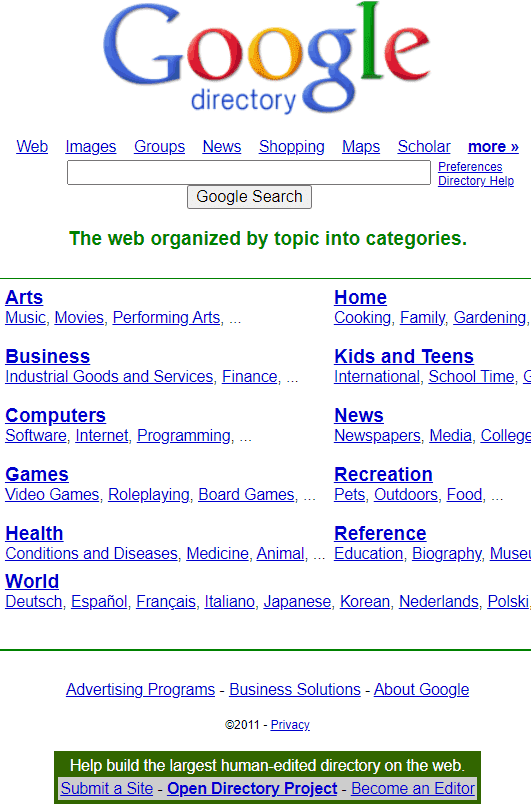
The early days of the web were navigated not just by search engines but by curated web directories that served as starting places for Internet users to go find information, hopping from link to link in a hyperlinked Internet. The idea was that hyperlinks was how users could find information.

Google Search not only ranked webpages from web directories, Google itself hosted a version of DMOZ, an open source web directory that was curated by thousands of volunteers much like Wikipedia is maintained by volunteer editors today.

But a day came when Google stopped ranking directories and the reason given was that it was a better user experience show answers and not links to pages with more links (this event is likely archived somewhere on the WebmasterWorld forum, it happened a long time ago).

Then there are Google’s answers for flight tracking, package tracking, stock quotes, the time and weather information that has zero links.

Example Of An Answer Without Links

Eric Schmidt’s assertion that Google will take advantage of AI to show answers fits into Google’s design principle that showing answers is a good user experience if it fully satisfies the query.

The only difference between the old days and now is that Google is that AI has (mostly) unlocked the ability to show answers without linking to any websites.

So it’s not far-fetched that Google may decide that showing answers is a good user experience, there is precedence for that approach.

AI Is Underhyped

Schmidt put forward the idea that AI is not overhyped but in fact is underhyped.

He observed:

“I hate to tell you but I think this stuff is underhyped not overhyped. Because the arrival of intelligence of a non-human form is really a big deal for the world.

It’s coming. It’s here. It’s about to happen. It happens in stages. …the reason I’m saying it’s underhyped is you’re seeing the future of reasoning, the future of human interaction, the future of research, the future of planning is being invented right now.

There’s something called infinite context windows, which means that you can — it’s like having an infinite short-term memory, which I certainly don’t have, where you can basically keep feeding it information and it keeps learning and changing.”

Eric Schmidt On The Future Of Search

The interviewer asked Schmidt about a future where AI answers questions without links to sources on the web.

The interviewer asked this question:

“In a world where the AI provides the answer, and doesn’t necessarily need to send you to 12 places where you’re going to go find it yourself… what happens to all of that?

Eric Schmidt answered:

“It’s pretty important to understand that Google is not about blue links, it’s about organizing the world’s information. What better tool than the arrival of AI to do that better.

Do you think you can monetize that? You betcha.”

Will Answers Without Links Happen?

It has to be reiterated that Eric Schmidt (LinkedIn profile) is no longer the CEO at Google or Executive Chairman & Technical Advisor at Alphabet (for four years now). His opinions may not reflect the current thinking within Google.

However it’s not unreasonable to speculate that maybe he is saying out loud what those within Google cannot officially discuss.

The most solid information we have now is that Google Search will continue to have links but that Google (and others like Apple) are moving ahead with AI assistants on mobile devices that can answer questions and perform tasks.

Watch the Eric Schmidt interview here:

LinkedIn Report: AI Skills Now Must-Have For Marketers via @sejournal, @MattGSouthern

A new report by Microsoft and LinkedIn reveals the rapid adoption of AI tools and skills in the marketing industry.

According to the 2024 Work Trend Index Annual Report, which surveyed over 31,000 people across 31 countries, marketing professionals who leverage AI enjoy a competitive advantage.

Employers recognize the efficiency gains AI capabilities provide in marketing roles and increasingly seek applicants with those skills.

Karim R. Lakhani, Chair of the Digital Data Design Institute at Harvard, states in the report:

“Marketers are harnessing the power of AI to work smarter, not just faster. It’s enabling them to focus on higher-value, creative work while automating more routine tasks.”

Here are some highlights from the report illustrating the need to develop an AI skill set to remain competitive.

AI Aptitude: The New Must-Have Skill for Marketers

The survey data reveals a strong preference among business leaders for candidates and employees with AI skills.

A majority, 66%, stated they wouldn’t consider hiring candidates lacking AI proficiency.

Further, 71% expressed a preference for less experienced job seekers with AI skills over more seasoned professionals without that expertise.

This inclination was pronounced in creative fields like marketing and design.

Michael Platt, a neuroscience professor at the Wharton School, states in the report:

“AI is redefining what it means to be a competitive marketer in today’s digital landscape. Professionals who can effectively integrate AI into their work are positioning themselves as invaluable assets to their organizations.”

The report indicates that early-career marketers who develop AI skills could benefit significantly.

77% of leaders reported that employees adept at leveraging AI would be trusted with greater responsibilities earlier in their careers than their peers without AI skills.

The AI Arms Race For Top Marketing Talent

Data from LinkedIn shows that job postings highlighting AI tools and applications have seen a 17% increase in application growth compared to those that don’t mention AI.

Additionally, 54% of early-career employees cited access to AI technologies as a key factor influencing their choice of employer.

Organizations that provide AI training and support for their marketing teams likely have an advantage in attracting top talent.

Why SEJ Cares

The widespread adoption of AI in marketing signifies a shift in the skills and capabilities necessary for succeeding in this rapidly evolving industry.

As AI transforms marketing approaches, professionals who fail to adapt risk being left behind.

The 2024 Work Trend Index Annual Report’s findings are relevant to marketing professionals at all levels. They demonstrate that AI proficiency is necessary for career advancement and job market competitiveness.

Additionally, the report highlights businesses’ role in fostering an AI-driven culture.

Companies investing in AI tools, training, and employee support will be better positioned to attract and retain top talent, drive innovation, and achieve better results.

Read the full report.

How This Can Help You

For marketing professionals to succeed in the AI era, the report suggests:

  • Prioritize developing AI skills through courses, workshops, training programs, and collaborating with AI practitioners to gain hands-on experience.
  • Embrace experimenting with new AI tools and techniques, integrating them into daily workflows to improve efficiency.
  • Share AI knowledge actively with colleagues to foster a culture of knowledge sharing and drive organizational AI adoption.
  • Highlight AI capabilities during job searches by demonstrating the successful use of AI to drive results in previous roles.
  • Choose employers committed to AI adoption that provide access to cutting-edge AI tools and support ongoing learning.

These recommendations can help you future-proof your career and advance in an increasingly competitive field.


Featured Image: eamesBot/Shutterstock

Apple’s “Intelligent Search” Will Summarize Webpages via @sejournal, @martinibuster

A report based on independently verified accounts notes that Apple’s Safari 18 will come with an Intelligent Search feature that summarize webpages in response to search queries and there may be a new feature called Web Eraser that allows users to permanently remove text, images, advertisements from webpages.

The Potential For Disruption By Apple AI Search

Apple has been gathering website data for years through its Internet crawler that uses the user agent, Applebot. The harvested data has in the past been used in the context of Siri and Apple’s Spotlight Suggestions feature.

Many in the search community have been aware of Applebot and have welcomed the prospect of a new search engine from Apple but despite constant crawling Apple has not released a search engine. A reason Apple has not released a standalone search engine may be that it’s become apparent that the best way to challenge Google Search is with a technology that replaces search engines altogether, much like how the Apple iPhone made digital cameras obsolete.

The latest news coming out about Safari 18 appears to confirm that supplanting Google is the strategy that Apple is pursuing.

Duane Forrester, formerly of Bing and now at Yext, commented on the potentially disruptive quality of Apple’s new technology:

“Intelligent Search could change how iOS consumers get, see and interact with content and answers. We are likely to see Apple taking a big step forward, into the consumer-accessible AI conversation which has been dominated by OpenAI, Microsoft, and Google et al to this point. Our phones are about to become AI-enabled and that could be ground zero for AI Agents. It’s going to impact and potentially change consumer behavior and be the gateway to new experiences.

The approach Apple is taking has the potential to disrupt not just search engines but also the search optimization and publishing industry, who have have been waiting years for an Apple search engine. But the extent of that disruption depends on how Apple implements their AI web search summarizer.

Webpage Summarization

Although news reports didn’t provide details as to how the new search result summaries will appear, it seems reasonable to speculate that Apple will provide attribution in the form of a link to websites so that users can click through to the website.

Duane Forrester speculated:

“Apple was just in court for Google’s anti-trust trial and likely isn’t keen to dive into “monopoly” waters themselves. My guess is that any “result” will have a source.”

This is what was reported:

“With the release of Safari 18, Apple is expected to introduce article summarization through a new Intelligent Search feature — meaning users will have the option to generate a brief summary of any webpage currently on screen.

Apple’s built-in AI software can analyze the keywords and phrases within a webpage or document and generate a short summary containing only the most important information.”

SEOs have been giddy about the prospect of an Apple search engine for years. It now appears that the Google Killer they’ve been waiting for could possibly result in less traffic from search queries but to what extent it’s impossible to tell at this point.

One search marketing expert mused in a private chat that if Intelligent Search summarizes more than it links out then that may signal it’s time to start selling off the domain names they’ve invested in.

On-Device Processing

An interesting feature of the text summarization is that the technology that creates the summary (called Ajax) resides on the mobile device itself. What Ajax does is extract keywords, entities, and use the data to identify the topic and a loose summary of a webpage which is then turned into a text summary for the user.

This is how the functionality is described:

“In analyzing texts, the software takes into account all relevant information available. It can recognize and classify entities such as companies, people, and locations. For instance, if a name appears at the top of a text, the software will likely recognize the name as belonging to the text’s author.”

Apple Also Plans A Web Eraser

As if an Apple search summarizer isn’t bad enough Apple reportedly has a “Web Eraser” functionality planned for Safari. Web Eraser is a feature that removes content from webpages so that site visitors don’t have to look at it anymore. Things like advertising, videos, comments, suggested reading and maybe even popups could be permanently blocked by the Web Eraser.  Once a user “erases” a block of content from a webpage that block stays erased for the site visitor on subsequent visits.

According to the a report about the Apple Web Eraser:

“The feature is expected to build upon existing privacy features within Safari and will allow users to erase unwanted content from any webpage of their choosing. Users will have the option to erase banner ads, images, text or even entire page sections, all with relative ease.”

Technological Disruptions

It’s a natural response to experience anxiety in the face of changes. For many, the dawning of AI Search is their first experience of a major change. But for those of us who have been in search for 25+ years we have experienced and grown accustomed to sudden and transformative changes that alter publishing and SEO. Like Duane, I tend to feel that Apple’s implementation of an AI search engine that summarizes websites will be disruptive but not to the point that it harms websites. It’s in Apple’s self-interest to not disrupt the Internet to the point of extinction.

Featured Image by Shutterstock/frantic00

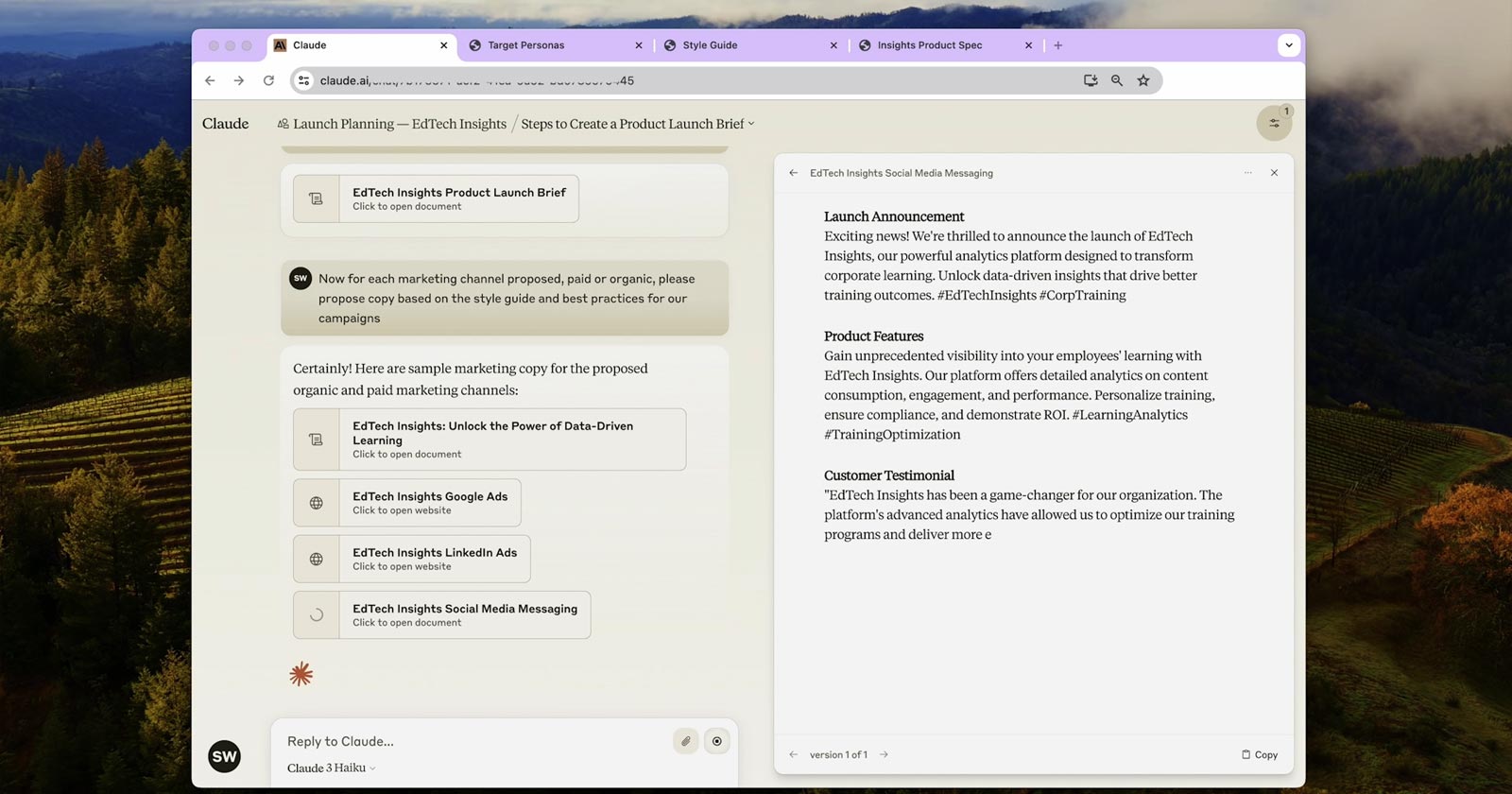
New Anthropic Claude Team Plan Versus ChatGPT Team via @sejournal, @martinibuster

Anthropic announced a new Team plan that gives businesses the opportunity to access more powerful features with increased management and security controls that make it a strong option for companies to consider.

Generative AI For Teams

Modern SaaS technologies for businesses generally come with a team version that allows collaboration within a company and also gives security and control to management so that proprietary documents don’t accidentally leak to the public.

Open AI launched their ChatGPT Team plan in January 2024, which offered a secured workspace for users within a company at a reasonable monthly and yearly subscription model. Anthropic has finally launched their own Team version of Claude with features that exceed what’s offered by ChatGPT Teams.

Claude Team Compares To ChatGPT Team

Claude is known as a great model for creative purposes and a team version that’s more powerful than the regular paid version makes it even more attractive but the important question is how does it compare to ChatGPT Team?

ChatGPT Team is $5/month cheaper (on the yearly billing plan) than Anthropic’s collaborative plan. Otherwise they are both priced at $30/month per user.

Claude Team is a step up from ChatGPT’s Team in one important way and that’s the context window. A context window is a metric of how much data a model can process at one time. The larger the context window the more data the model can analyze in one batch.

ChatGPT Team offers a context window of 32k but Anthropic Claude Team users enjoy a whopping 200k context window which is about 150,000 words or 500 pages of text.

Team Versus Pro Version

When it comes to collaborating within a company, Claude Team is a better value than the regular Pro version because it provides more usage than the regular Pro plan which means that individual users can do more work than users on the Pro plan. The Team version also offers collaborative features like the ability to create a shared database that can be used for projects. Beyond that it offers administrative tools for managing users and billing.

More features are on the way according to the official announcement:

“In the coming weeks, we will be releasing additional collaboration features, including citations from reliable sources to verify AI-generated claims, integrations with data repositories like codebases or CRMs, and iterating with colleagues on AI-generated documents or projects—all while maintaining the highest standards of security and safety.”

Read the announcement here:

Introducing The Claude Team Plan

OpenAI To Show Content & Links In Response To Queries via @sejournal, @martinibuster

OpenAI content deal will enhance ChatGPT with the ability to show real-time content with links in response to queries. OpenAI quietly took steps to gaining more search engine type functionality as part of a content licensing deal that may have positive implications for publishers and SEO.

Content Licensing Deal

OpenAI agreed to content licensing with the Financial Times, a global news organization with offices in London, New York, across continental Europe and Asia.

Content licensing deals between AI organizations and publishers are generally about getting access to high quality training data. The training data is then used by language models to learn connections between words and concepts. This deal goes far beyond that use.

ChatGPT Will Show Direct Quotes With Attribution

What makes this content licensing deal between The Financial Times and OpenAI is that there is a reference to giving attribution to content within ChatGPT.

The announced licensing deal explicitly mentions the use of the licensed content so that ChatGPT could directly quote it and provide links to the licensed content.

Further, the licensing deal is intended to help improve ChatGPT’s “usefulness”, which is vague and can mean many things, but it takes on a slightly different meaning when used in the context of attributed answers.

The Financial Times agreement states that the licensing deal is for use in ChatGPT when it provides “attributed content” which is content with an attribution, commonly a link to where the content appeared.

This is the part of the announcement that references attributed content:

“The Financial Times today announced a strategic partnership and licensing agreement with OpenAI, a leader in artificial intelligence research and deployment, to enhance ChatGPT with attributed content, help improve its models’ usefulness by incorporating FT journalism, and collaborate on developing new AI products and features for FT readers. “

And this is the part of the announcement that mentions ChatGPT offering users attributed quotes and links:

“Through the partnership, ChatGPT users will be able to see select attributed summaries, quotes and links to FT journalism in response to relevant queries.”

The Financial Times Group CEO was even more explicit about OpenAI’s intention to show content and links in ChatGPT:

“This is an important agreement in a number of respects,” said FT Group CEO John Ridding. “It recognises the value of our award-winning journalism and will give us early insights into how content is surfaced through AI. …this partnership will help keep us at the forefront of developments in how people access and use information.

OpenAI understands the importance of transparency, attribution, and compensation…”

Brad Lightcap, COO of OpenAI directly referenced showing real-time news content in ChatGPT but more important he referenced OpenAI exploring new ways to show content to its user base.

Lastly, the COO stated that they embraced disruption, which means innovation that creates a new industry or paradigm, usually at the expense of an older one, like search engines.

Lightcap is quoted:

“We have always embraced new technologies and disruption, and we’ll continue to operate with both curiosity and vigilance as we navigate this next wave of change.”

Showing direct quotes of Financial Times content with links to that content is very similar to how search engines work. This is a big change to how ChatGPT works and could be a sign of where ChatGPT is going in the future, a functionality that incorporates online content with links to that content.

Something Else That Is Possibly Related

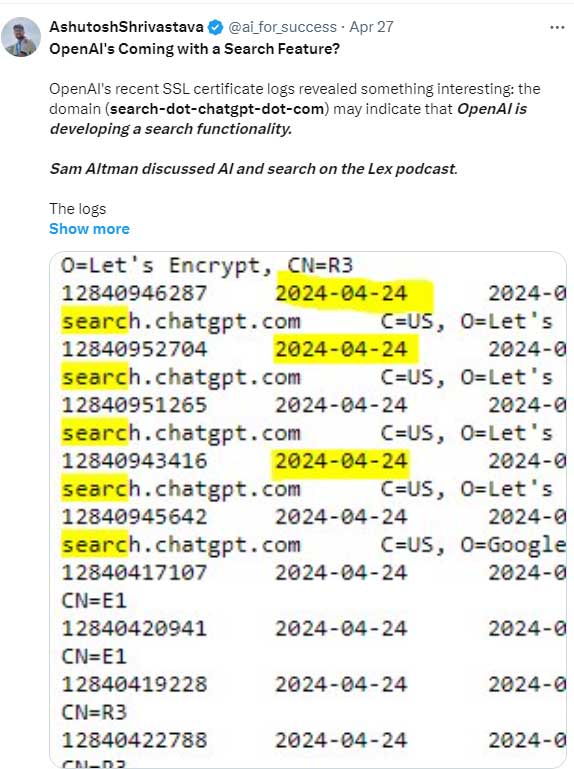
Someone on Twitter recently noticed a change that is related to “search” in relation to ChatGPT.

This change involves an SSL security certificate that was added for a subdomain of ChatGPT.com. ChatGPT.com is a domain name that was snapped up by someone to capitalize on the 2022 announcement of ChatGPT by OpenAI. OpenAI eventually acquired the domain and it’s been redirecting to ChatGPT.

The change that was noticed is to the subdomain: search.chatgpt.com.

This is a screenshot of the tweet:

Screenshot of SSL logs for search.chatgpt.com

Big News For SEO and Publishers

This is significant news for publishers and search marketers ChatGPT will become a source of valuable traffic if OpenAI takes ChatGPT in the direction of providing attributed summaries and direct quotes.

How Can Publishers Get Traffic From ChatGPT?

Questions remain about attributed quotes with links in response to relevant queries. Here are X unknowns about ChatGPT attributed links.

  • Does this mean that only licensed content will be shown and linked to in ChatGPT?
  • Will ChatGPT incorporate and use most web data without licensing deals in the same way that search engines do?
  • OpenAI may incorporate an Opt-In model where publishers can use a notation in Robots.txt or in meta data to opt-in to receiving traffic from ChatGPT.
  • Would you opt into receiving traffic from ChatGPT in exchange for allowing your content to be used for training?
  • How would SEOs and publisher’s equation on ChatGPT change if their competitors are all receiving traffic from ChatGPT?

Read the original announcement:

Financial Times announces strategic partnership with OpenAI

Featured Image by Shutterstock/Photo For Everything

How Small Businesses Can Use AI To Create And Measure Ads [Interview With Ex-Googler Logan Welbaum] via @sejournal, @gregjarboe

Appeasing the advertising algorithms on social media and Google has always been a mix of art and science – but there are plenty of rewards, not only in terms of active engagement but also in terms of lowered ad costs.

So far, AI tools have proved useful as an algorithm-cracker for the biggest digital marketing and ad agencies.

The problem is that small businesses and boutique agencies are still working to find the entry point with AI to pinpoint the recipe for ad success – from creation, targeting, testing, and reporting. This raises some thorny questions:

  • What are the key AI tools marketers should be using?
  • How can they be used between creative, ad deployment, and measurement?
  • How much should a business plan to invest in AI tools?
  • Is this more or less expensive than traditional advertising strategies?

I recently interviewed Logan Welbaum, an ex-Google and Meta employee who worked directly with the ad platforms at both companies.

Today, he is the founder and CEO of Plai, a Y Combinator-backed platform focused on advertising automation.

Welbaum has a precise understanding of social media ad algorithms and, specifically, how AI can be used to optimize ad strategies in line with them.

Logan Welbaum, a veteran of Google and Meta Image from Logan Welbaum, April 2024

Below is a lightly edited transcript of my questions and Logan Welbaum’s answers.

How Google And Meta Leverage User Interaction Data

Greg Jarboe: “From your experience at Google and Meta, how were large companies utilizing AI for ad optimization? What key functionalities did these solutions offer?”

Logan Welbaum: “Platforms such as Google and Facebook leverage user interaction data to optimize their ad serving. Their AI technologies offer advertisers the highest level of performance for their advertising campaigns.

Their approach is different from that of ad agencies and Plai, which own inventory data and optimize campaign creation. They offer features that allow for the uploading of additional data and the targeting of more specific audiences, because the inclusion of more data and signals enhances the performance of their AI systems.”

How Can Small Businesses Leverage AI-powered Solutions?

Jarboe: “How can smaller businesses, without the resources of large corporations, leverage similar AI-powered solutions for their advertising needs? Are there affordable, accessible options available?”

Welbaum: “Understanding ad metrics and following changes in social media ad algorithms requires experience. Plai trains our AI model to learn our experience in digital marketing and observation from our existing campaigns, so that it can assist small businesses.”

Jarboe: “Beyond basic automation, what unique functionalities can AI offer smaller businesses in ad creation, targeting, and measurement that traditional methods lack?”

Welbaum: “Ultimately, AI can save small businesses and agencies time and money. AI allows them to generate and analyze ad content in a much shorter amount of time and with fewer people than it would normally take. AI can build detailed plans and lists for targeting and help track the success of a campaign.

With Plai, small businesses can use our tools to launch things like video or Facebook ads in seconds and keep track of each ad’s progress all the way through its lifecycle. Our tech is a text-to-advertising approach, so a small business can just plug in their criteria and Plai will generate an ad with relevant keywords and images or videos.”

Jarboe: “Can you elaborate on how your platform specifically uses AI to address the needs of smaller businesses in ad creation, deployment, and measurement?”

Welbaum: “Taking Google Ads as an example, Google Ad Manager gives customers full control over a campaign but requires experience and knowledge to create a performing campaign. On the other hand, they have a product like Smart campaigns for those with little experience in digital marketing, but it lacks control and transparency.

Plai utilizes AI to guide small businesses to create a performing campaign. This allows advertisers to save time and reduce mistakes, but also gives control if they want to update AI’s recommendations.

Similarly, in terms of measurement, Google Ad Manager offers a comprehensive view of a campaign through an extensive array of metrics, whereas Smart campaign provides a more limited set of metrics. Our AI analyzes all available metrics, interprets them, and then delivers actionable insights in language that doesn’t require any digital marketing expertise.”

What Are The Challenges For Small Businesses Arising From Social Media Ad Algorithms?

Jarboe: “What are the key challenges small businesses face when navigating social media ad algorithms? How does Plai utilize AI to help them overcome these challenges?”

Welbaum: “SMBs want to grow revenue and run their businesses. Ads that are relevant and creative perform better and win and SMBs a cheaper ad cost because of it.”

Jarboe: “Can you provide concrete examples of how smaller businesses have achieved success using Plai’s AI-powered advertising solutions? What metrics demonstrate the effectiveness of this approach?”

Welbaum: “Plai customers have seen 90% decrease in ad-cost as well as 105% higher click-through rates than the industry standard. Not only do Plai customers spend less on ads and see better click-through results, but the platform also allows them to generate ads more quickly and effectively, reaching their desired target audience ultimately generating more business.”

How Will AI-Powered Advertising Tools Evolve In The Next Few Years?

Jarboe: “In your opinion, how will the landscape of AI-powered advertising tools evolve in the coming years? What new functionalities can we expect?”

Welbaum: “Ad creative will improve dramatically for brands of any size with any budget.” 

Jarboe: “While AI offers significant advantages, are there any potential drawbacks or limitations smaller businesses should be aware of when employing AI for advertising?”

Welbaum: “We automate everything from a single prompt, but we still provide features and options for customers to take over and control or make edits. Still having that control is essential.”

How Can Small Businesses Prepare To Integrate AI Into Marketing Strategies?

Jarboe: “Looking ahead, how can smaller businesses best prepare to fully integrate AI into their overall marketing strategies?”

Welbaum: “Small businesses can prepare to implement AI into their marketing strategies through the creative process and general optimizations – these two elements of advertising will naturally be a first step for AI to fit within SMBs.”

Jarboe: “ChatGPT, while impressive, represents just one facet of AI. Can you elaborate on other AI applications beyond language models that can be beneficial for smaller businesses in advertising?”

Welbaum: “Recommendation algorithms, such as Amazon’s ‘customers also bought’ feature, serve as one example. Plai has a wide range of clients. This enables our model to identify successful strategies among a subset of customers and then recommend those insights across our entire customer base.”

Jarboe: “How important is it for smaller businesses to possess a basic understanding of social media ad algorithms to effectively utilize AI-powered advertising tools?”

Welbaum: “SMBs want to grow revenue and run their businesses. Ads that are relevant and creative perform better and win and SMBs a cheaper ad cost because of it.”

AI Is Leveling The Playing Field In Advertising

When it comes to advertising, AI offers significant advantages – and it’s not just for big businesses.

With advertising platforms leaning into AI technology, incorporating it into your process can help you navigate their algorithms. Automated campaigns are just part of the equation. AI can power more efficient analysis and unlock new customer insights. As the technology improves and more platforms and service providers lean in, it will become more accessible.

Incorporating AI into your marketing approach can help you stay competitive as a small business.

More resources:


Featured Image: BestForBest/Shutterstock

DeepL Write: New AI Editor Improves Content Quality via @sejournal, @martinibuster

DeepL, the makers of the DeepL Translator, announced a new product called DeepL Write, an AI real-time editor that is powered by their own Large Language Model (LLM) that improves content at the draft stage, preserving the tone and voice of the writer.

Unlike many other AI writing tools, DeepL Write is not a content generator, it’s an editor that offers suggestions for what words to choose, how best to phrase ideas, proofreading your documents so that they sound professional and in the right tone and voice. Plus the usual spelling, grammar, and punctuation improvements.

According to DeepL:

“Unlike common generative AI tools that auto-populate text, or rules-based grammar correction tools, DeepL Write Pro acts as a creative assistant to writers in the drafting process, elevating their text with real-time, AI-powered suggestions on word choice, phrasing, style, and tone.

This unique approach sparks a creative synergy between the user and the AI that transforms text while preserving the writer’s authentic voice. DeepL Write Pro’s strength lies in its ability to give writers a sophisticated boost in their communication, regardless of language proficiency—empowering them to find the perfect words for any situation or audience.”

Enterprise Grade Security

DeepL write also comes with TLS (Transport Layer Security) encryption. TLS is a is a protocol that’s used to encrypt data sent between an app and a server, commonly used for email and instant messaging and it’s also the technology that is behind HTTPS which keeps websites secure.

In addition to keeping the documents secure DeepL write also comes with a text deletion feature to ensure that all documents are secure and nothing is stored online.

Standalone and With DeepL Translator Integration

DeepL Write is available as a standalone app and as part of a suite together with DeepL Translator. The integration with DeepL Translator makes it an advanced tool for creating documentation that can be rewritten into another language in the right tone and style.

At this time DeepL Write Pro is available in English and German, with more languages becoming available soon.

The standalone product is available in a free version with limited text improvements and a Pro version that costs $10.99 per month.

DeepL Write Pro comes with the following features:

  • Maximum data security
  • Unlimited text improvements
  • Unlimited use of alternatives
  • Unlimited use of writing styles
  • Team administration

There is also an Enterprise level named DeepL Write for Business which is for organizations that need it for 50 or more users.

DeepL Write Pro

Many publishers and search marketers who depended on AI for generating content have reported having lost rankings during the last Google Core Algorithm update in March. Naturally many publishes are hesitant to give AI a try for generating content.

DeepL Write Pro offers an alternative use of AI for content in the form of a virtual editor that can help to polish up a human’s writing and help make it more concise, professional and in the correct style and tone.

One of the things that stands between a passable document and a great document is good writing, something that an editor is useful for elevating content to a higher quality. Given the modest price and the value that a good editor provides, the timing for this kind of product couldn’t be better.

Read more at DeepL Write Pro

Featured Image by Shutterstock/one photo