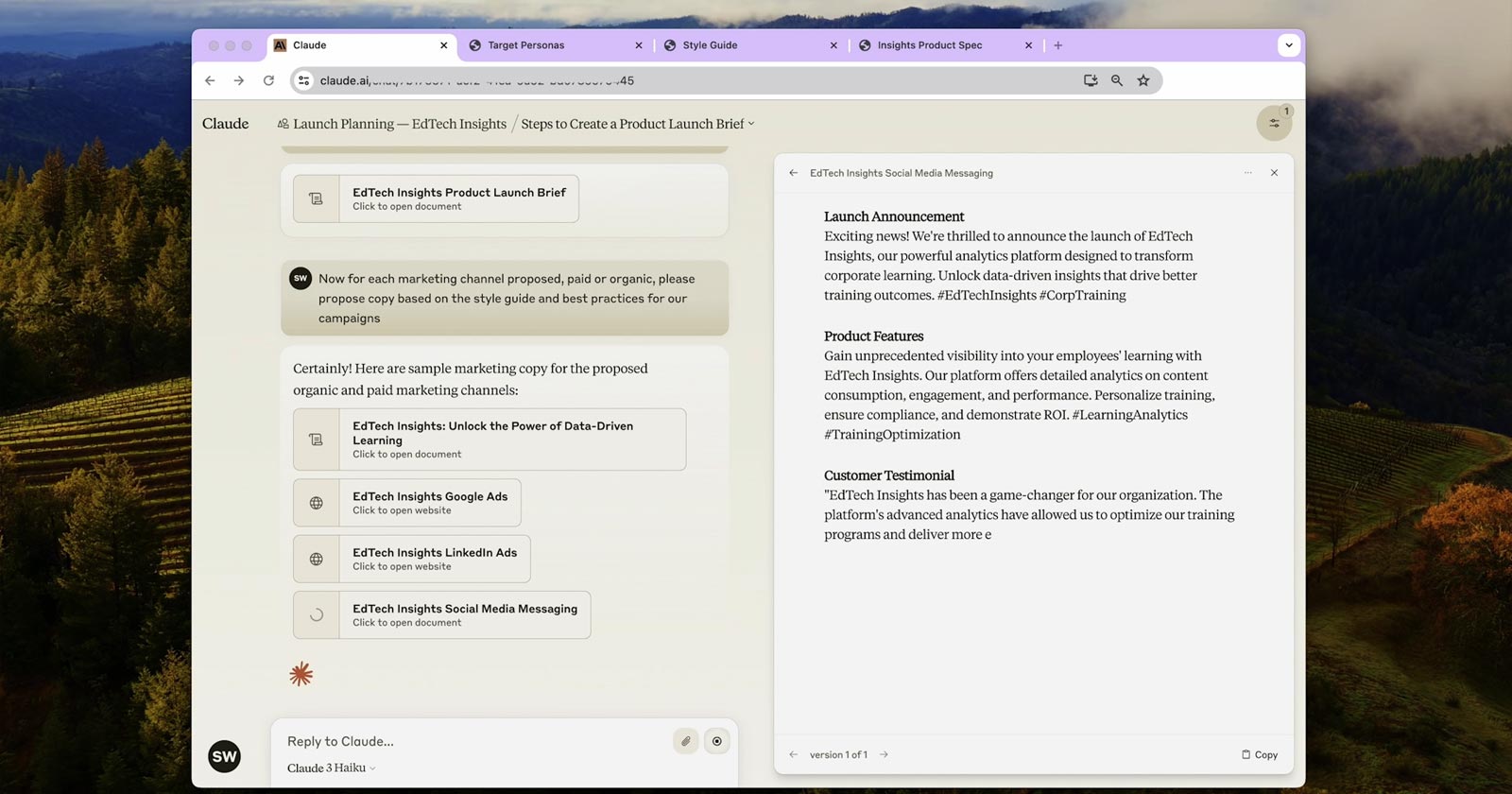
Anthropic announced a new Team plan that gives businesses the opportunity to access more powerful features with increased management and security controls that make it a strong option for companies to consider.
Generative AI For Teams
Modern SaaS technologies for businesses generally come with a team version that allows collaboration within a company and also gives security and control to management so that proprietary documents don’t accidentally leak to the public.
Open AI launched their ChatGPT Team plan in January 2024, which offered a secured workspace for users within a company at a reasonable monthly and yearly subscription model. Anthropic has finally launched their own Team version of Claude with features that exceed what’s offered by ChatGPT Teams.
Claude Team Compares To ChatGPT Team
Claude is known as a great model for creative purposes and a team version that’s more powerful than the regular paid version makes it even more attractive but the important question is how does it compare to ChatGPT Team?
ChatGPT Team is $5/month cheaper (on the yearly billing plan) than Anthropic’s collaborative plan. Otherwise they are both priced at $30/month per user.
Claude Team is a step up from ChatGPT’s Team in one important way and that’s the context window. A context window is a metric of how much data a model can process at one time. The larger the context window the more data the model can analyze in one batch.
ChatGPT Team offers a context window of 32k but Anthropic Claude Team users enjoy a whopping 200k context window which is about 150,000 words or 500 pages of text.
Team Versus Pro Version
When it comes to collaborating within a company, Claude Team is a better value than the regular Pro version because it provides more usage than the regular Pro plan which means that individual users can do more work than users on the Pro plan. The Team version also offers collaborative features like the ability to create a shared database that can be used for projects. Beyond that it offers administrative tools for managing users and billing.
More features are on the way according to the official announcement:
“In the coming weeks, we will be releasing additional collaboration features, including citations from reliable sources to verify AI-generated claims, integrations with data repositories like codebases or CRMs, and iterating with colleagues on AI-generated documents or projects—all while maintaining the highest standards of security and safety.”
OpenAI content deal will enhance ChatGPT with the ability to show real-time content with links in response to queries. OpenAI quietly took steps to gaining more search engine type functionality as part of a content licensing deal that may have positive implications for publishers and SEO.
Content Licensing Deal
OpenAI agreed to content licensing with the Financial Times, a global news organization with offices in London, New York, across continental Europe and Asia.
Content licensing deals between AI organizations and publishers are generally about getting access to high quality training data. The training data is then used by language models to learn connections between words and concepts. This deal goes far beyond that use.
ChatGPT Will Show Direct Quotes With Attribution
What makes this content licensing deal between The Financial Times and OpenAI is that there is a reference to giving attribution to content within ChatGPT.
The announced licensing deal explicitly mentions the use of the licensed content so that ChatGPT could directly quote it and provide links to the licensed content.
Further, the licensing deal is intended to help improve ChatGPT’s “usefulness”, which is vague and can mean many things, but it takes on a slightly different meaning when used in the context of attributed answers.
The Financial Times agreement states that the licensing deal is for use in ChatGPT when it provides “attributed content” which is content with an attribution, commonly a link to where the content appeared.
This is the part of the announcement that references attributed content:
“The Financial Times today announced a strategic partnership and licensing agreement with OpenAI, a leader in artificial intelligence research and deployment, to enhance ChatGPT with attributed content, help improve its models’ usefulness by incorporating FT journalism, and collaborate on developing new AI products and features for FT readers. “
And this is the part of the announcement that mentions ChatGPT offering users attributed quotes and links:
“Through the partnership, ChatGPT users will be able to see select attributed summaries, quotes and links to FT journalism in response to relevant queries.”
The Financial Times Group CEO was even more explicit about OpenAI’s intention to show content and links in ChatGPT:
“This is an important agreement in a number of respects,” said FT Group CEO John Ridding. “It recognises the value of our award-winning journalism and will give us early insights into how content is surfaced through AI. …this partnership will help keep us at the forefront of developments in how people access and use information.
OpenAI understands the importance of transparency, attribution, and compensation…”
Brad Lightcap, COO of OpenAI directly referenced showing real-time news content in ChatGPT but more important he referenced OpenAI exploring new ways to show content to its user base.
Lastly, the COO stated that they embraced disruption, which means innovation that creates a new industry or paradigm, usually at the expense of an older one, like search engines.
Lightcap is quoted:
“We have always embraced new technologies and disruption, and we’ll continue to operate with both curiosity and vigilance as we navigate this next wave of change.”
Showing direct quotes of Financial Times content with links to that content is very similar to how search engines work. This is a big change to how ChatGPT works and could be a sign of where ChatGPT is going in the future, a functionality that incorporates online content with links to that content.
Something Else That Is Possibly Related
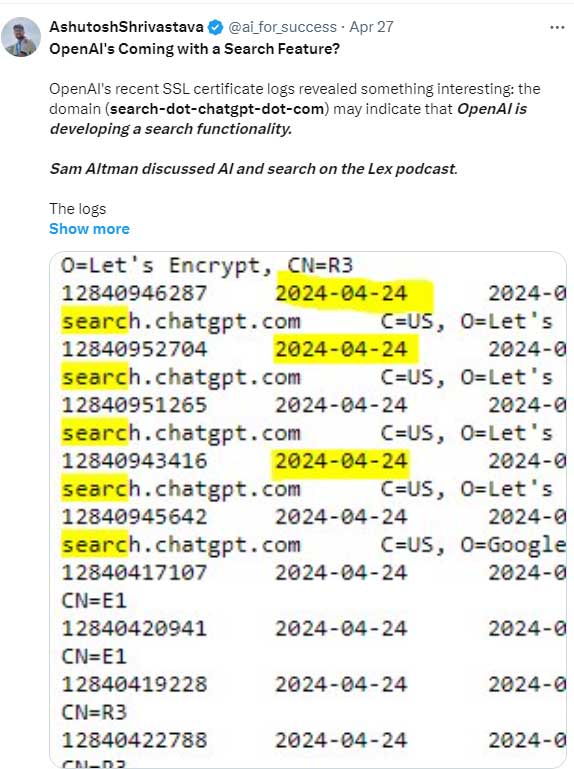
Someone on Twitter recently noticed a change that is related to “search” in relation to ChatGPT.
This change involves an SSL security certificate that was added for a subdomain of ChatGPT.com. ChatGPT.com is a domain name that was snapped up by someone to capitalize on the 2022 announcement of ChatGPT by OpenAI. OpenAI eventually acquired the domain and it’s been redirecting to ChatGPT.
The change that was noticed is to the subdomain: search.chatgpt.com.
This is significant news for publishers and search marketers ChatGPT will become a source of valuable traffic if OpenAI takes ChatGPT in the direction of providing attributed summaries and direct quotes.
How Can Publishers Get Traffic From ChatGPT?
Questions remain about attributed quotes with links in response to relevant queries. Here are X unknowns about ChatGPT attributed links.
Does this mean that only licensed content will be shown and linked to in ChatGPT?
Will ChatGPT incorporate and use most web data without licensing deals in the same way that search engines do?
OpenAI may incorporate an Opt-In model where publishers can use a notation in Robots.txt or in meta data to opt-in to receiving traffic from ChatGPT.
Would you opt into receiving traffic from ChatGPT in exchange for allowing your content to be used for training?
How would SEOs and publisher’s equation on ChatGPT change if their competitors are all receiving traffic from ChatGPT?
Appeasing the advertising algorithms on social media and Google has always been a mix of art and science – but there are plenty of rewards, not only in terms of active engagement but also in terms of lowered ad costs.
So far, AI tools have proved useful as an algorithm-cracker for the biggest digital marketing and ad agencies.
The problem is that small businesses and boutique agencies are still working to find the entry point with AI to pinpoint the recipe for ad success – from creation, targeting, testing, and reporting. This raises some thorny questions:
What are the key AI tools marketers should be using?
How can they be used between creative, ad deployment, and measurement?
How much should a business plan to invest in AI tools?
Is this more or less expensive than traditional advertising strategies?
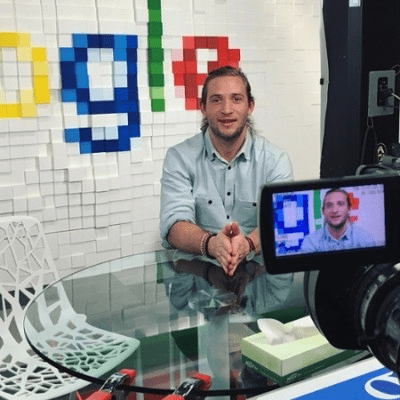
I recently interviewed Logan Welbaum, an ex-Google and Meta employee who worked directly with the ad platforms at both companies.
Today, he is the founder and CEO of Plai, a Y Combinator-backed platform focused on advertising automation.
Welbaum has a precise understanding of social media ad algorithms and, specifically, how AI can be used to optimize ad strategies in line with them.
Image from Logan Welbaum, April 2024
Below is a lightly edited transcript of my questions and Logan Welbaum’s answers.
How Google And Meta Leverage User Interaction Data
Greg Jarboe: “From your experience at Google and Meta, how were large companies utilizing AI for ad optimization? What key functionalities did these solutions offer?”
Logan Welbaum: “Platforms such as Google and Facebook leverage user interaction data to optimize their ad serving. Their AI technologies offer advertisers the highest level of performance for their advertising campaigns.
Their approach is different from that of ad agencies and Plai, which own inventory data and optimize campaign creation. They offer features that allow for the uploading of additional data and the targeting of more specific audiences, because the inclusion of more data and signals enhances the performance of their AI systems.”
How Can Small Businesses Leverage AI-powered Solutions?
Jarboe: “How can smaller businesses, without the resources of large corporations, leverage similar AI-powered solutions for their advertising needs? Are there affordable, accessible options available?”
Welbaum: “Understanding ad metrics and following changes in social media ad algorithms requires experience. Plai trains our AI model to learn our experience in digital marketing and observation from our existing campaigns, so that it can assist small businesses.”
Jarboe: “Beyond basic automation, what unique functionalities can AI offer smaller businesses in ad creation, targeting, and measurement that traditional methods lack?”
Welbaum: “Ultimately, AI can save small businesses and agencies time and money. AI allows them to generate and analyze ad content in a much shorter amount of time and with fewer people than it would normally take. AI can build detailed plans and lists for targeting and help track the success of a campaign.
With Plai, small businesses can use our tools to launch things like video or Facebook ads in seconds and keep track of each ad’s progress all the way through its lifecycle. Our tech is a text-to-advertising approach, so a small business can just plug in their criteria and Plai will generate an ad with relevant keywords and images or videos.”
Jarboe: “Can you elaborate on how your platform specifically uses AI to address the needs of smaller businesses in ad creation, deployment, and measurement?”
Welbaum: “Taking Google Ads as an example, Google Ad Manager gives customers full control over a campaign but requires experience and knowledge to create a performing campaign. On the other hand, they have a product like Smart campaigns for those with little experience in digital marketing, but it lacks control and transparency.
Plai utilizes AI to guide small businesses to create a performing campaign. This allows advertisers to save time and reduce mistakes, but also gives control if they want to update AI’s recommendations.
Similarly, in terms of measurement, Google Ad Manager offers a comprehensive view of a campaign through an extensive array of metrics, whereas Smart campaign provides a more limited set of metrics. Our AI analyzes all available metrics, interprets them, and then delivers actionable insights in language that doesn’t require any digital marketing expertise.”
What Are The Challenges For Small Businesses Arising From Social Media Ad Algorithms?
Jarboe: “What are the key challenges small businesses face when navigating social media ad algorithms? How does Plai utilize AI to help them overcome these challenges?”
Welbaum: “SMBs want to grow revenue and run their businesses. Ads that are relevant and creative perform better and win and SMBs a cheaper ad cost because of it.”
Jarboe: “Can you provide concrete examples of how smaller businesses have achieved success using Plai’s AI-powered advertising solutions? What metrics demonstrate the effectiveness of this approach?”
Welbaum: “Plai customers have seen 90% decrease in ad-cost as well as 105% higher click-through rates than the industry standard. Not only do Plai customers spend less on ads and see better click-through results, but the platform also allows them to generate ads more quickly and effectively, reaching their desired target audience ultimately generating more business.”
How Will AI-Powered Advertising Tools Evolve In The Next Few Years?
Jarboe: “In your opinion, how will the landscape of AI-powered advertising tools evolve in the coming years? What new functionalities can we expect?”
Welbaum: “Ad creative will improve dramatically for brands of any size with any budget.”
Jarboe: “While AI offers significant advantages, are there any potential drawbacks or limitations smaller businesses should be aware of when employing AI for advertising?”
Welbaum: “We automate everything from a single prompt, but we still provide features and options for customers to take over and control or make edits. Still having that control is essential.”
How Can Small Businesses Prepare To Integrate AI Into Marketing Strategies?
Jarboe: “Looking ahead, how can smaller businesses best prepare to fully integrate AI into their overall marketing strategies?”
Welbaum: “Small businesses can prepare to implement AI into their marketing strategies through the creative process and general optimizations – these two elements of advertising will naturally be a first step for AI to fit within SMBs.”
Jarboe: “ChatGPT, while impressive, represents just one facet of AI. Can you elaborate on other AI applications beyond language models that can be beneficial for smaller businesses in advertising?”
Welbaum: “Recommendation algorithms, such as Amazon’s ‘customers also bought’ feature, serve as one example. Plai has a wide range of clients. This enables our model to identify successful strategies among a subset of customers and then recommend those insights across our entire customer base.”
Jarboe: “How important is it for smaller businesses to possess a basic understanding of social media ad algorithms to effectively utilize AI-powered advertising tools?”
Welbaum: “SMBs want to grow revenue and run their businesses. Ads that are relevant and creative perform better and win and SMBs a cheaper ad cost because of it.”
AI Is Leveling The Playing Field In Advertising
When it comes to advertising, AI offers significant advantages – and it’s not just for big businesses.
With advertising platforms leaning into AI technology, incorporating it into your process can help you navigate their algorithms. Automated campaigns are just part of the equation. AI can power more efficient analysis and unlock new customer insights. As the technology improves and more platforms and service providers lean in, it will become more accessible.
Incorporating AI into your marketing approach can help you stay competitive as a small business.
DeepL, the makers of the DeepL Translator, announced a new product called DeepL Write, an AI real-time editor that is powered by their own Large Language Model (LLM) that improves content at the draft stage, preserving the tone and voice of the writer.
Unlike many other AI writing tools, DeepL Write is not a content generator, it’s an editor that offers suggestions for what words to choose, how best to phrase ideas, proofreading your documents so that they sound professional and in the right tone and voice. Plus the usual spelling, grammar, and punctuation improvements.
According to DeepL:
“Unlike common generative AI tools that auto-populate text, or rules-based grammar correction tools, DeepL Write Pro acts as a creative assistant to writers in the drafting process, elevating their text with real-time, AI-powered suggestions on word choice, phrasing, style, and tone.
This unique approach sparks a creative synergy between the user and the AI that transforms text while preserving the writer’s authentic voice. DeepL Write Pro’s strength lies in its ability to give writers a sophisticated boost in their communication, regardless of language proficiency—empowering them to find the perfect words for any situation or audience.”
Enterprise Grade Security
DeepL write also comes with TLS (Transport Layer Security) encryption. TLS is a is a protocol that’s used to encrypt data sent between an app and a server, commonly used for email and instant messaging and it’s also the technology that is behind HTTPS which keeps websites secure.
In addition to keeping the documents secure DeepL write also comes with a text deletion feature to ensure that all documents are secure and nothing is stored online.
Standalone and With DeepL Translator Integration
DeepL Write is available as a standalone app and as part of a suite together with DeepL Translator. The integration with DeepL Translator makes it an advanced tool for creating documentation that can be rewritten into another language in the right tone and style.
At this time DeepL Write Pro is available in English and German, with more languages becoming available soon.
The standalone product is available in a free version with limited text improvements and a Pro version that costs $10.99 per month.
DeepL Write Pro comes with the following features:
Maximum data security
Unlimited text improvements
Unlimited use of alternatives
Unlimited use of writing styles
Team administration
There is also an Enterprise level named DeepL Write for Business which is for organizations that need it for 50 or more users.
DeepL Write Pro
Many publishers and search marketers who depended on AI for generating content have reported having lost rankings during the last Google Core Algorithm update in March. Naturally many publishes are hesitant to give AI a try for generating content.
DeepL Write Pro offers an alternative use of AI for content in the form of a virtual editor that can help to polish up a human’s writing and help make it more concise, professional and in the correct style and tone.
One of the things that stands between a passable document and a great document is good writing, something that an editor is useful for elevating content to a higher quality. Given the modest price and the value that a good editor provides, the timing for this kind of product couldn’t be better.