22 Places You Should Be Sharing Your Content via @sejournal, @_kevinrowe

Don’t treat your content passively.

To get the most out of the resources you put into creating content, you have to share it.

The right sharing strategy can boost your content’s effectiveness and engage with users it might not otherwise reach.

However, each platform is increasingly focused on keeping users within its specific ecosystem, so careful research and planning are key to success in each algorithm and for each audience.

Content sharing is not as simple as reposting content exactly as it appears on your website or blog. Content has to be optimized for each channel or method of distribution.

With platforms so focused on keeping users on their sites, is there hope for using them to generate traffic? Yes, and here are some tips I’ve found helpful.

3 Tips To Help Funnel Platform Users To Your Site

Map The Audience Journey

An audience journey map is a visual map of the steps your audience takes as they make a decision to solve a problem or take an opportunity. It outlines the path from initial awareness through engagement and onto conversion, highlighting key touchpoints.

This tool helps understand and address your audience’s needs, motivations, and pain points at each stage, enabling more effective and targeted content marketing, SEO, and PR strategies.

Analyze an audience’s journey online to gain insight into their motivations and touchpoints for gathering information and making a decision about a given pain point or opportunity. Use these touchpoints and motivations to entice users to search your content.

I find most journey map templates difficult to implement, so I created a new type of audience map template that allows marketers to turn audience insight into an integrated PR and SEO plan.
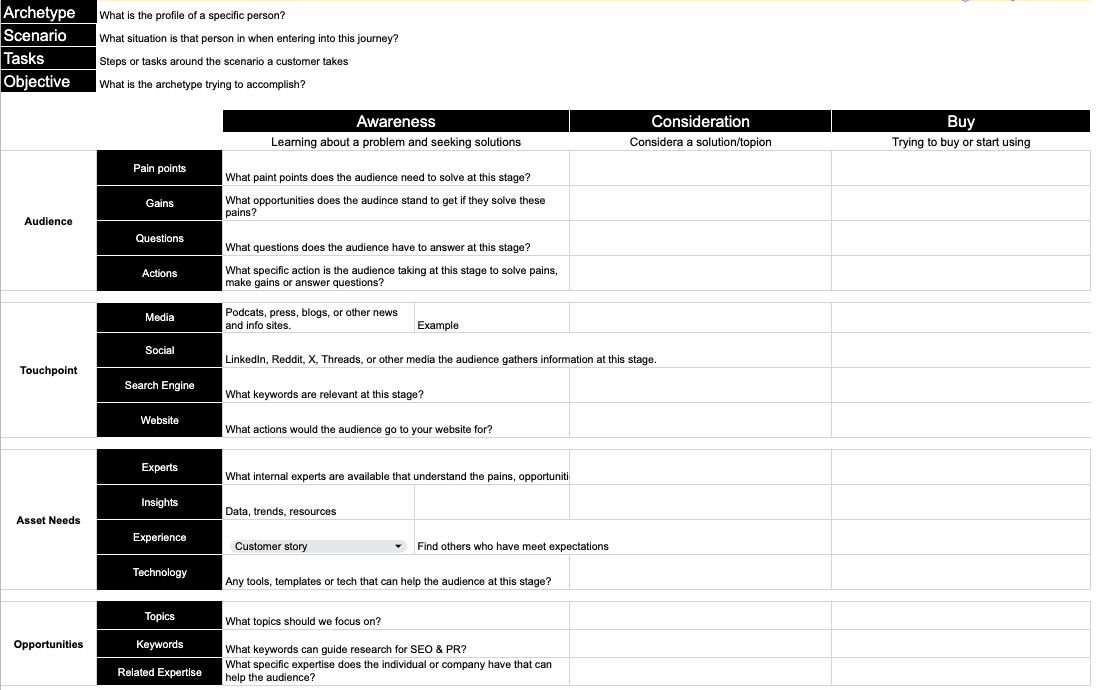
audience journey map templateScreenshot from author, March 2024

Using the audience journey, identify assets based on the audience’s needs at various journey steps. These steps provide opportunities to entice users to search for your content in Google or even type the URL directly into the browser.

Owned Asset Marketing (OAM)

Instead of sharing blog posts or article links directly, create a unique asset with a unique value proposition (UVP) for a specific audience or archetype. Then, optimize that asset for different channels or platforms.

I call this owned asset marketing (OAM).

I reached out to Amanda Natividad, VP of Marketing at SparkToro, who put it like this: “Beat the platforms at their own game and publish zero-click content. Zero-click content is content that offers standalone insights with no need to click. Clicking might be additive, but it’s not required.

This means summarizing conference presentations into shorter LinkedIn posts, taking one key idea from a webinar and writing it as a Threads post, or repurposing a blog post entirely into a video tutorial on YouTube.”

Studies, research, uniquely valuable resource lists (e.g., tools), training courses, expert commentary, or framing on a complex topic identifying an opportunity are all types of assets that can be converted to zero-click content.

For example, I recently launched a Mini MBA about Integrating PR & SEO. As part of the course, I created templates, checklists, how-to videos, and case studies to help marketing leaders integrate their internal PR & SEO teams.
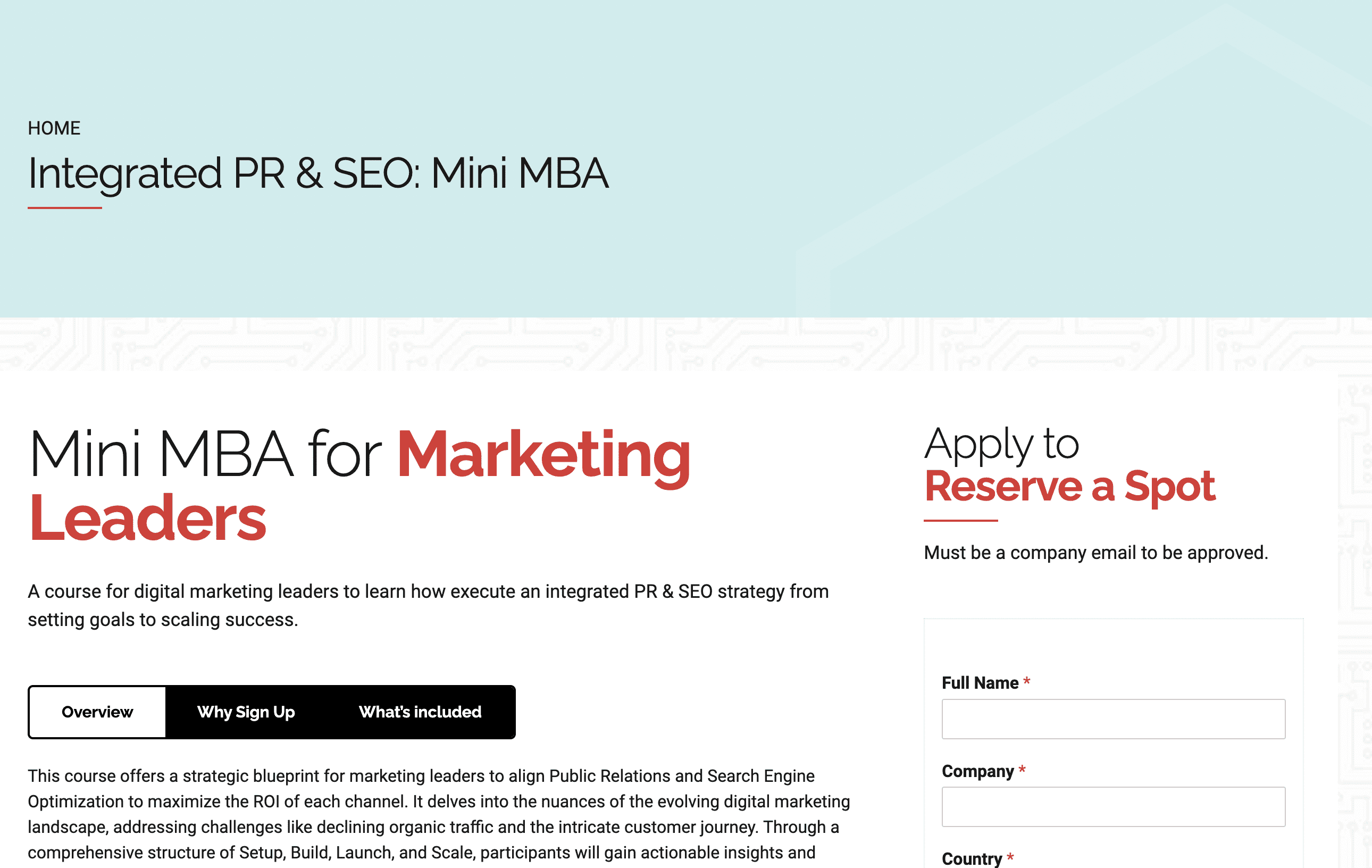
integrated pr seo mini mba-992Screenshot from author, March 2024

However, I don’t just share the course online; I repurpose the content to share on social or in my guest articles. The audience map template above is a repurposed asset from my course.

I also had my research team analyze the impact of brand mentions on a site’s ability to rank in the top 3 of Google for the course. I then took the charts and created a unique post on LinkedIn.
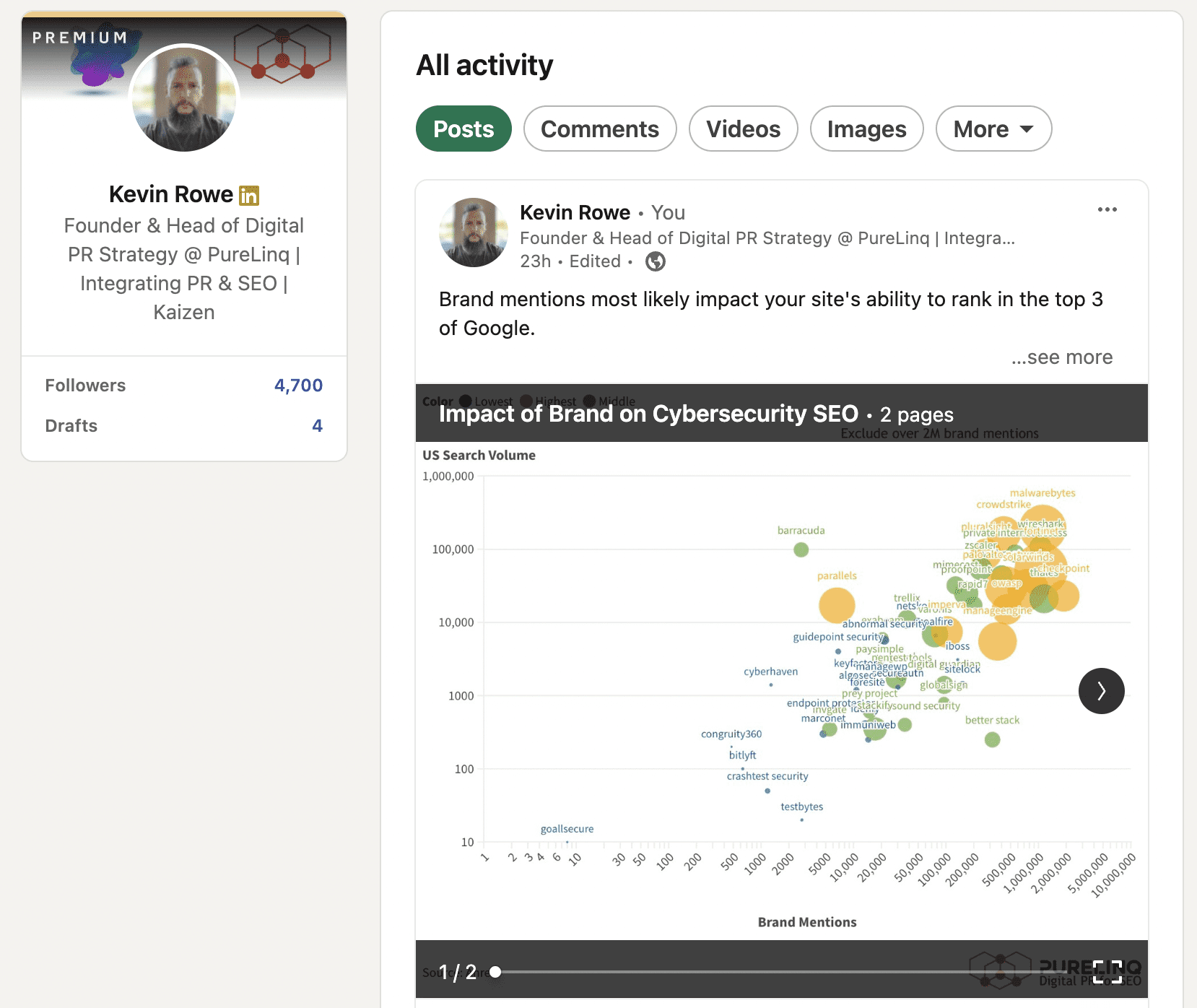
linkedin data from-trainingScreenshot from author, March 2024

With touchpoints identified across the audience journey and potential asse ideas, distribute the content in a way that drives the audience to search your content. A PR topic tour can help with that.

Use A PR Topic Tour

A PR topic tour is a strategy that focuses on identifying a trending topic and creating a media tour to share an asset: commentary, data, resources, or unique insights about that topic.

The more an audience engages with you about a topic, the more likely they are to search your content or website when they are investigating the topic. This is because they begin to see you as an expert source on the subject.

Here’s the gist of how to create a PR topic tour:

  • Identify an industry or media trend: Analyze the last six months of media coverage on a topic to identify recent trends. Use Google News, relevant social media (e.g., LinkedIn or Reddit), or BuzzSumo to find a list of trends.
  • Identify topics: Identify topics that you have an asset about or to create a new asset for.
  • Create or Optimize an asset: Create a unique asset related to the trend or optimize an existing one for different platforms.
  • Pitch or distribute at audience touchpoints: Create a list of podcasts, journalists, op-ed sites, relevant social communities, and even blogs to pitch various story angles based on the audience or opportunities in each platform.

A PR topic tour is a great way to establish an individual or company as an expert in a specific topic.

I recently created a PR topic tour case study about Rand Fishkin’s concept of an “influence map.”

In 2021, Fishkin wrote an article, Influence Maps—The Best Marketing Framework You’ve Never Heard Of, for a concept he created.

Fishkin started to cover the topic on podcasts, webinars, and social. Here’s just a sample that I found and included in my case study:

When determining places to distribute your content, consider using these tips to determine the best method and touchpoints to include.

Here is a short list of places to share your topic tour concept, from the mainstream to the niche.

1. Substack

Substack is a platform that enables writers to publish newsletters and monetize their content directly through subscriptions.

Substack has over 20 million active subscribers.

Creators write posts using Substack’s editor, publish them, and then email them to subscribers. Creators can earn money through paid subscriptions, which offer them financial support directly from their audience and facilitate a direct writer-reader relationship without the need for advertisements or sponsorships.

Setting up a newsletter through substack is very easy:

  • Sign up: Create an account on the Substack website.
  • Set up your newsletter: Choose a name for your newsletter, customize its appearance, and set up subscription options (free, paid, or both).
  • Create content: Write your articles or newsletters directly in Substack’s editor and format them as desired.
  • Publish and promote: Publish your newsletters and share them on social media or other platforms to attract subscribers.
  • Engage your subscribers: Interact with your readers through comments and feedback to build a community around your newsletter.

2. LinkedIn Newsletters

A LinkedIn Newsletter is a feature that allows LinkedIn users to regularly publish and send a series of articles to their followers directly through LinkedIn.

LinkedIn Newsletters are highly underrated. When you launch a new newsletter, you can notify all of your followers at once, giving you instant access to thousands of subscribers.

However, you have to be eligible for the LinkedIn Creator hub.
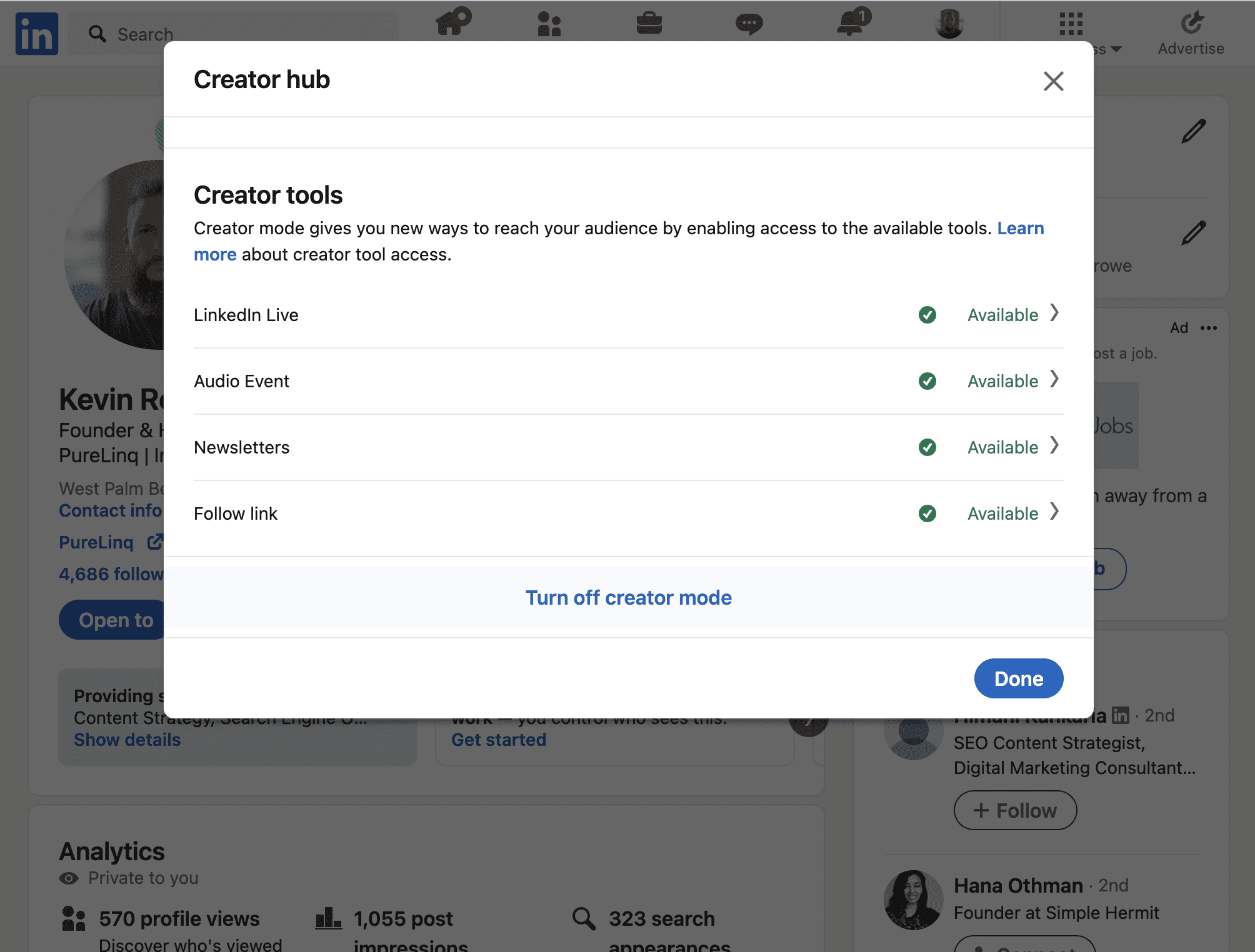
LinkedIn creator hubScreenshot from LinkedIn, March 2024
  • Access: Go to your LinkedIn homepage and use the Write an article option.
  • Select “manage”: Under the Manage button in the article writing interface, select Newsletter.
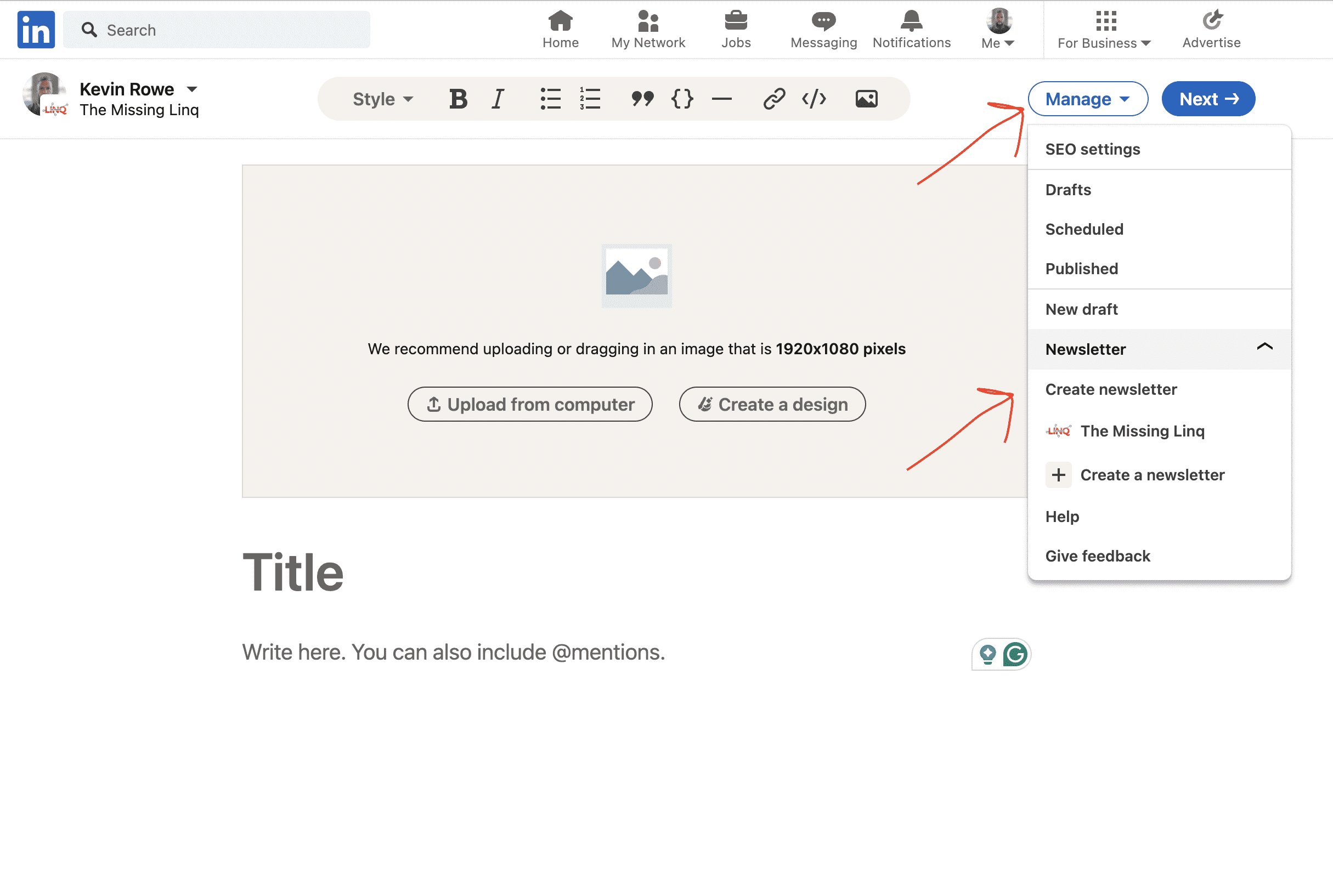
linkedin newsletter setupScreenshot from LinkedIn, March 2024
  • Create or select: Either create a new newsletter or select one you already have. If you create one, then just name it, provide a description, upload a logo (I recommend a logo and branding for your newsletter), and then click Done.
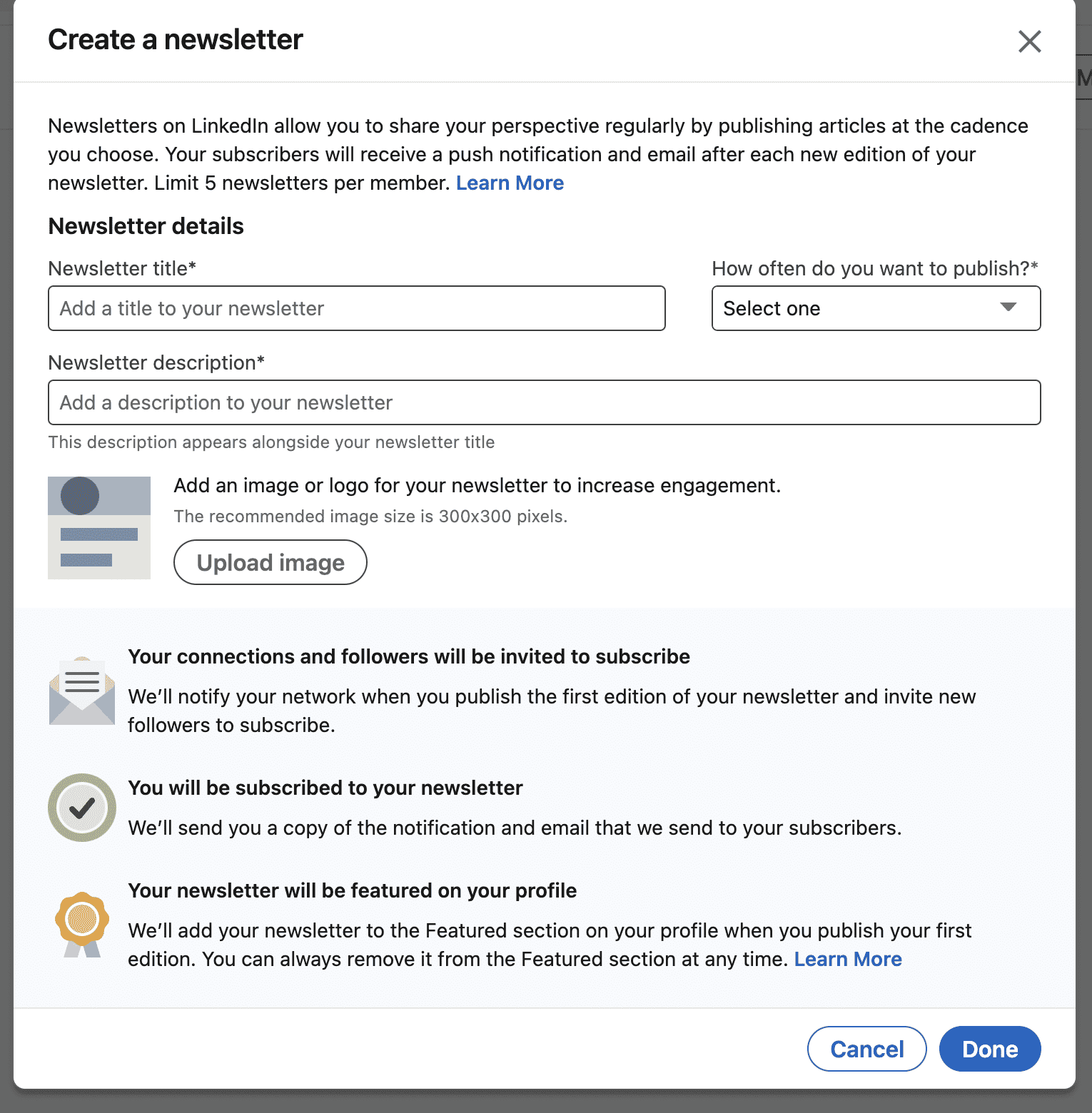
newsletter naming setupScreenshot from LinkedIn, March 2024

3. OnePitch

OnePitch is an AI-based journalist pitching tool and is one of my favorites for media relations. However, your pitches have to be really targeted and strong to secure media coverage.

I use OnePitch for:

  • Write a pitch: Write a pitch for an interesting story idea. A pitch can be for data or expert commentary on a trending topic, a product launch, or another other newsworthy story.
  • Upload pitch: Use the editor to upload and parse the pitch.
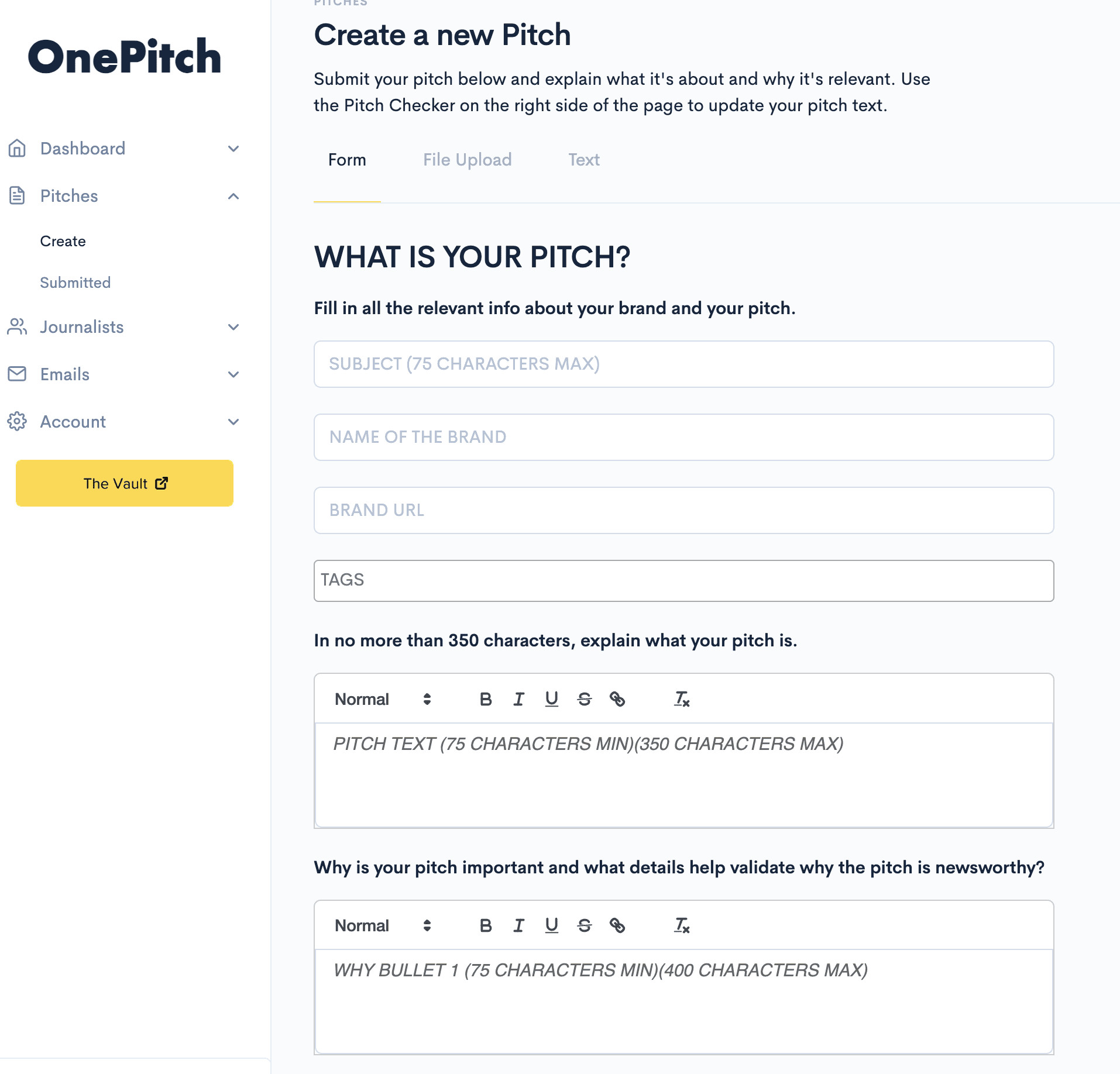
OnePitch pitch uploadScreenshot from OnePitch, March 2024
  • Use AI to build a list of journalists: After you submit the pitch, OnePitch uses AI to identify a list of journalists who have written about similar topics.
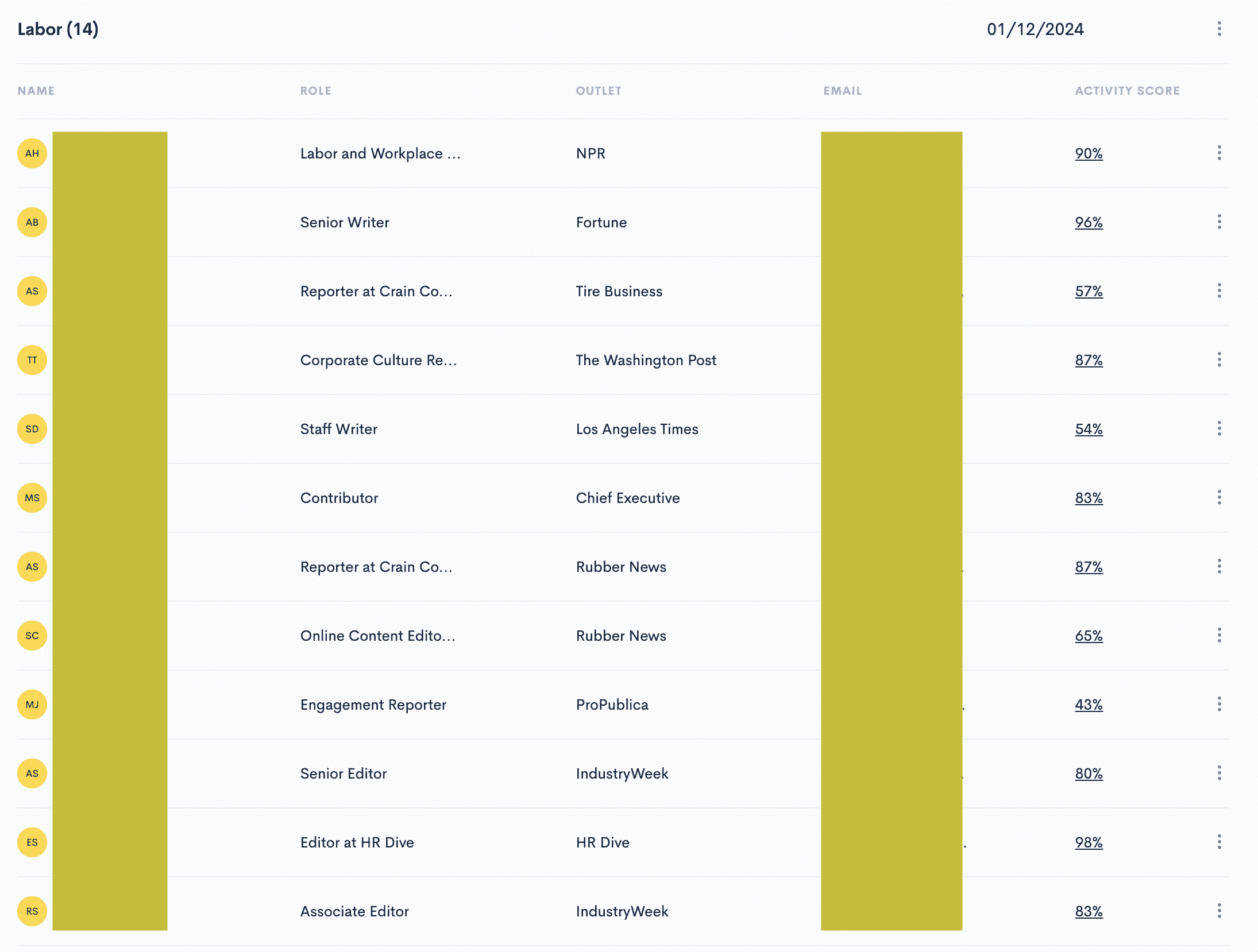
OnePitch media listScreenshot from OnePitch, March 2024
  • Pitch: Submit a pitch using the tool, which will email the journalist through your email address.

4. Medium

Medium is an online publishing platform where any writer can share their content. It’s useful for those looking to publish their thoughts, stories, and ideas on a wide range of topics through direct republishing or creating new, unique stories or assets.

Medium articles can also rank well on Google if they are unique pieces.

Medium allows you to republish your existing blog posts (if you use their import feature, they even add a rel=canonical link), but you can also use this platform to increase traffic to the full blog posts on your site.

To post on Medium:

  • Sign up: Visit Medium’s website and sign up using email, Google, Facebook, or Apple.
  • Set up profile: Complete your profile by adding a photo, bio, and other details.
  • Write: Click on your profile picture, then Write a story to start drafting your post.
  • Edit and format: Use the editor tools to format your text and add images or links.
  • Publish: Once satisfied, click Publish at the top, choose tags, and then “Publish” again to share your post with readers.

5. Reddit

Reddit is a network of communities called subreddits, each focused on different interests, topics, or themes. Users can share news, content, and opinions, engage in discussions, and vote on content. It’s a place for finding trends, advice, and varied perspectives on almost any topic.

And if you haven’t heard, Google has been ranking Reddit content in the top spots more frequently and recently announced a deal to show more Reddit content. So, posting on subreddits can gain additional exposure or traffic directly to your content if you can get a link posted in a thread that ranks well in Google.

Finding relevant subreddits can be overwhelming, but try using SparkToro to simplify the process. This tool allows you to find subreddits based on the audience you want to target.

You can search based on a link to a site, social profile, or keywords your audience uses and then find subreddits that the audience also visits.

  • Setup SparkToro: Sign up for a free account or one of the paid subscriptions.
  • Select a seed list: Create a list of social profiles, websites, keywords, social profile descriptions, or hashtags that the audience uses.
  • Select a version of SparkToro: Currently, SparkToro has two versions. V1 just lets you find subreddits, but V2 allows you to search comments.
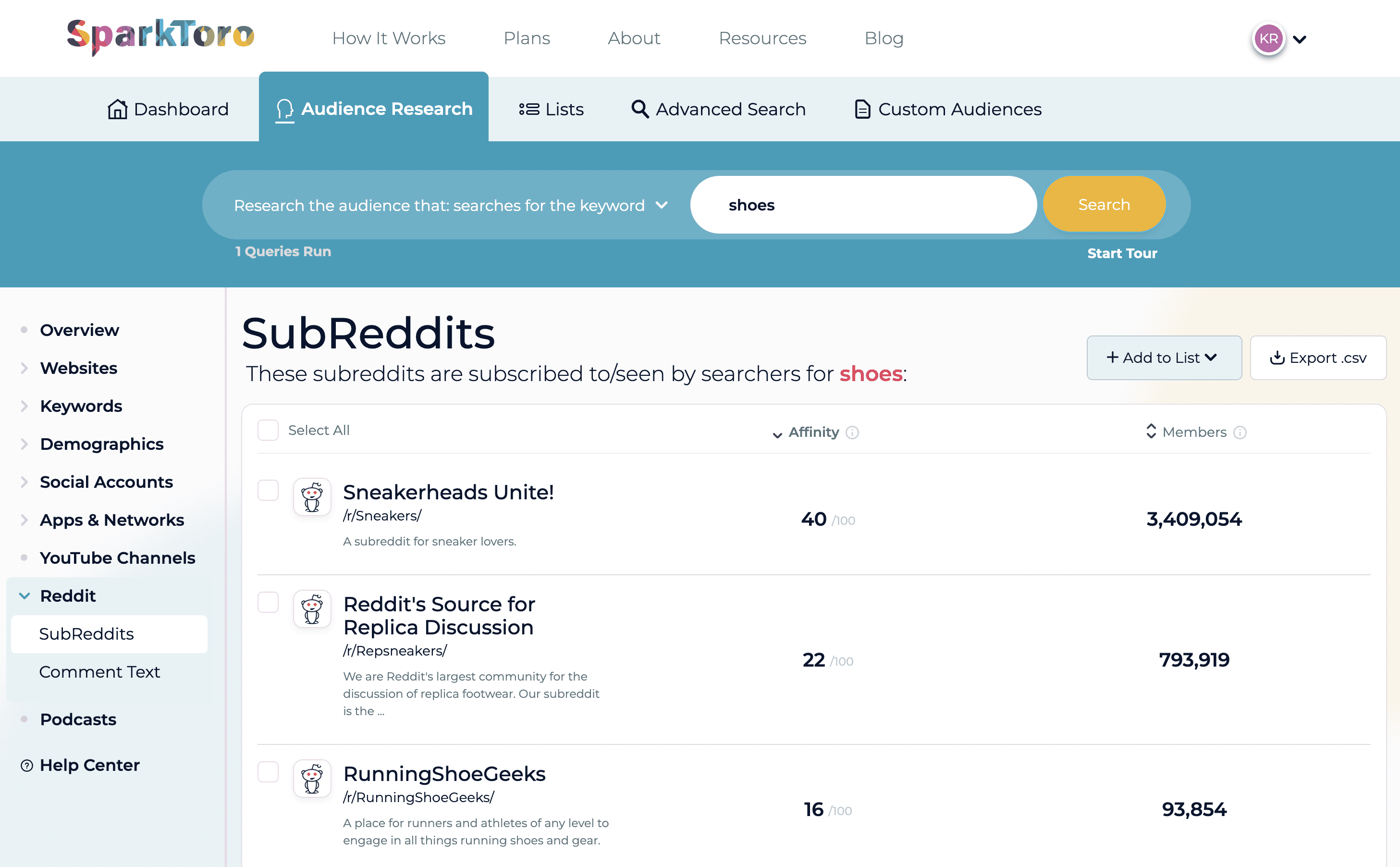
sparktoro v2 reddit searchScreenshot from Reddit, March 2024
  • Post on the subreddit: Share content on a subreddit as a personal account and ensure the content creates some unique value for the audience. You can create a new thread or post a comment on existing ones.

Redditors are very conscious of brands attempting to “spam” subreddits with their own content, so this is usually best left to a few employees with active Reddit accounts who may occasionally share company blog posts once or twice a month.

6. LinkedIn Articles

A LinkedIn article lets you publish longer content directly on LinkedIn, which is shared with your followers and potentially a wider LinkedIn audience through the platform’s network effects.

When you publish an article, it appears on your profile and can be seen in the feed of your connections or followers, increasing its visibility. LinkedIn also sometimes distributes articles more broadly based on their relevance and interest to other users beyond your immediate network.

Just like with the LinkedIn newsletters process, you can create a long-form article and post it to your feed.
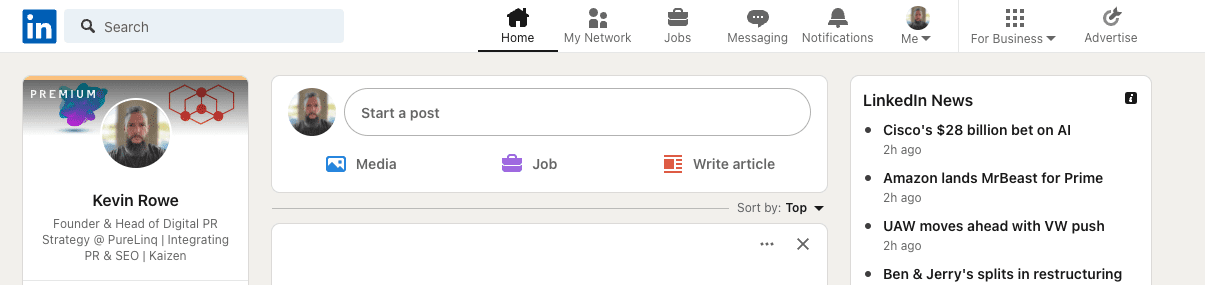
Post a linkedin articleScreenshot from LinkedIn, March 2024

In the article post editor, just click next instead of creating a newsletter.
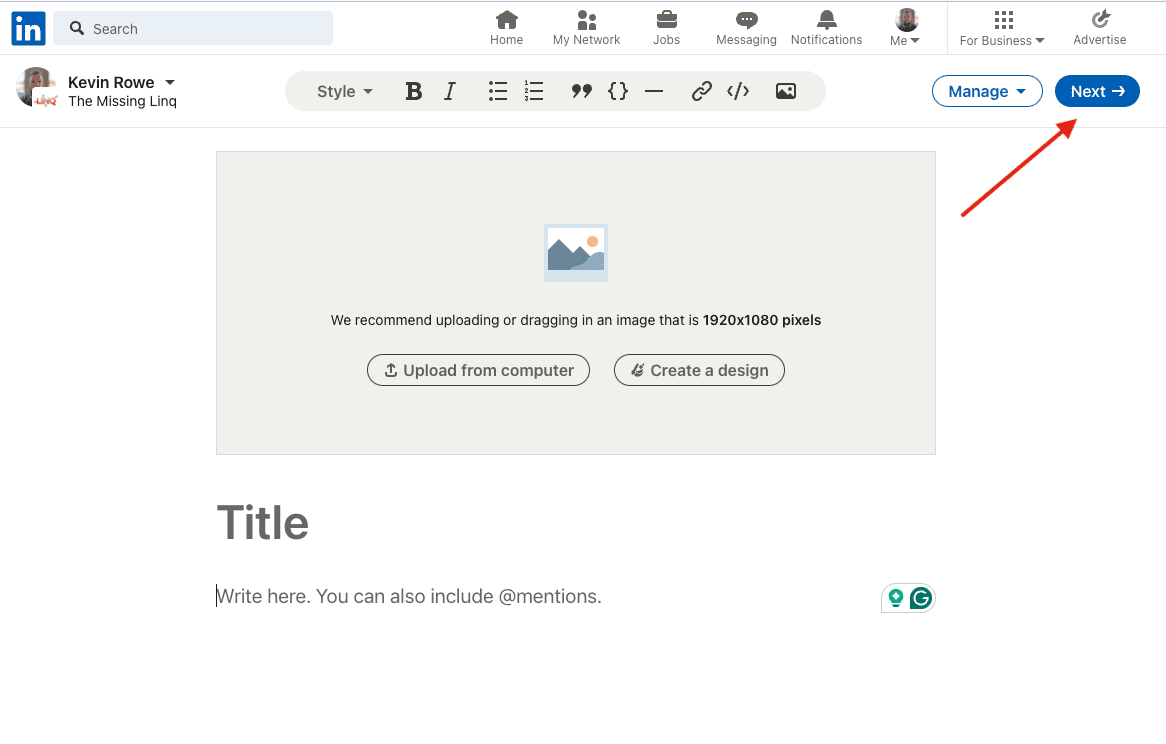
Linkedin Article posting pageScreenshot from LinkedIn, March 2024

7. LinkedIn Personal Posts

LinkedIn posts are highly underrated. As you can see from my personal LinkedIn post below, I received over 57,000 impressions from a single post.

I don’t need to walk you through the posting process on LinkedIn, but note that a post’s reach can be very large.

A few quick tips that help me are:

  • Use data and charts in posts to increase engagement.
  • Focus on topics that you’re an expert in.
  • Use documents that can entice the audience to engage with your post. Engagements seem to increase reach for me.
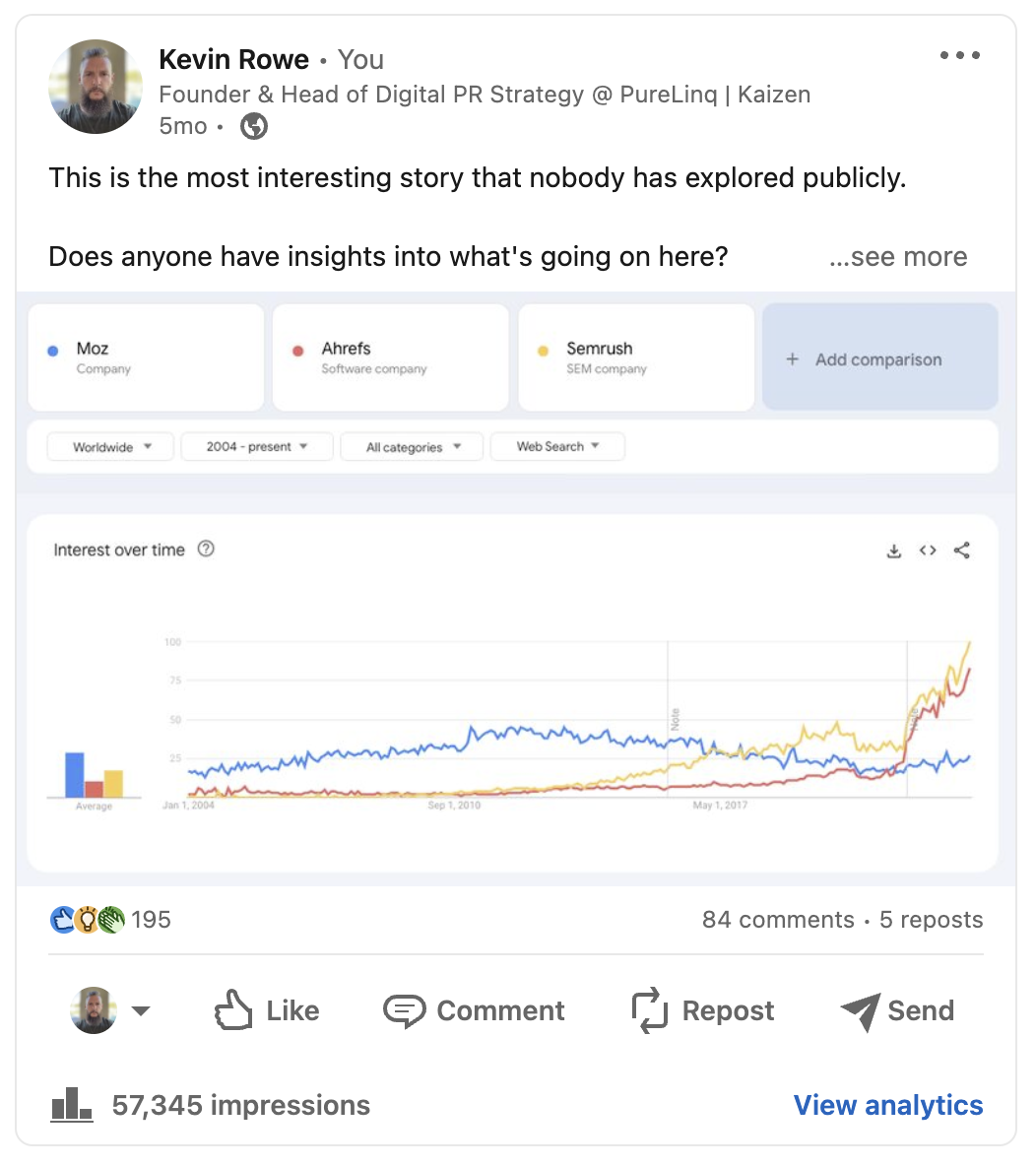
linkedin post examplesScreenshot from LinkedIn, March 2024

8. Forbes Councils

The Forbes Councils is a collective of invitation-only communities created by Forbes. Members are selected from various industries and can publish articles on Forbes.com, networking with other leaders.

If you do get approved, you can publish articles every month on a topic that you are an expert in.

And as of the time I wrote this, these articles rank really well in Google. As you can see in the screenshot of Google for the keyword [seo and public relations].
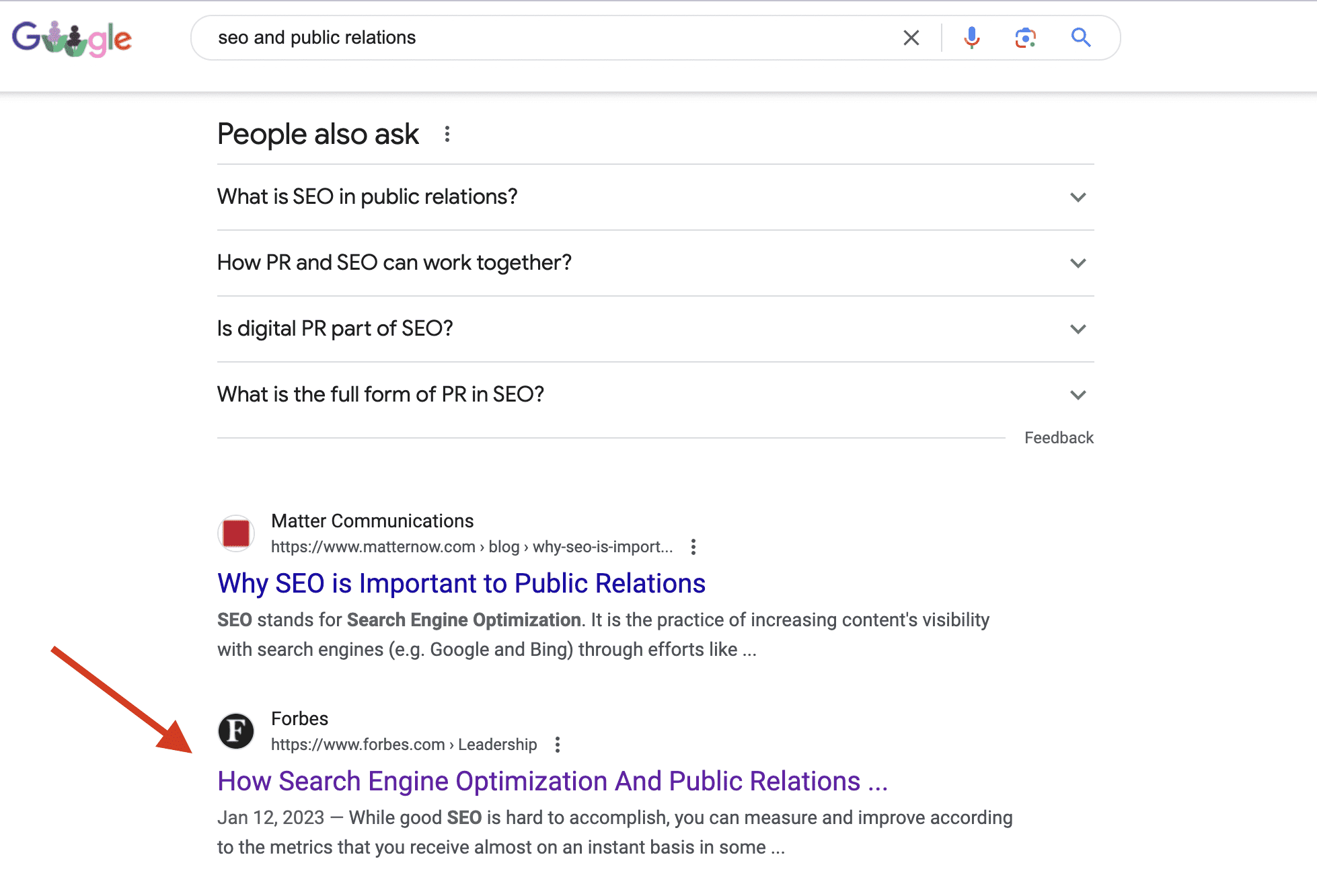
forbes council ranking in googleScreenshot from search for [seo and public relations], Google, March 2024

9. Email

Promoting your content through email is an “oldie but goodie” tactic that still pulls major weight.

59% of consumers say marketing emails have influenced their decisions to make a purchase.

I personally use a few email tools: MailChimp, Apollo.io, and PitchBox. Each has a different application.

I’ll focus on Apollo here as it has a built-in contacts database, and I find the UI very easy to use. You can also upload your own list of contacts or use their database to build a new list.

In the tool, you can create automated sequences that work well for sharing informational content related to a theme or topic.
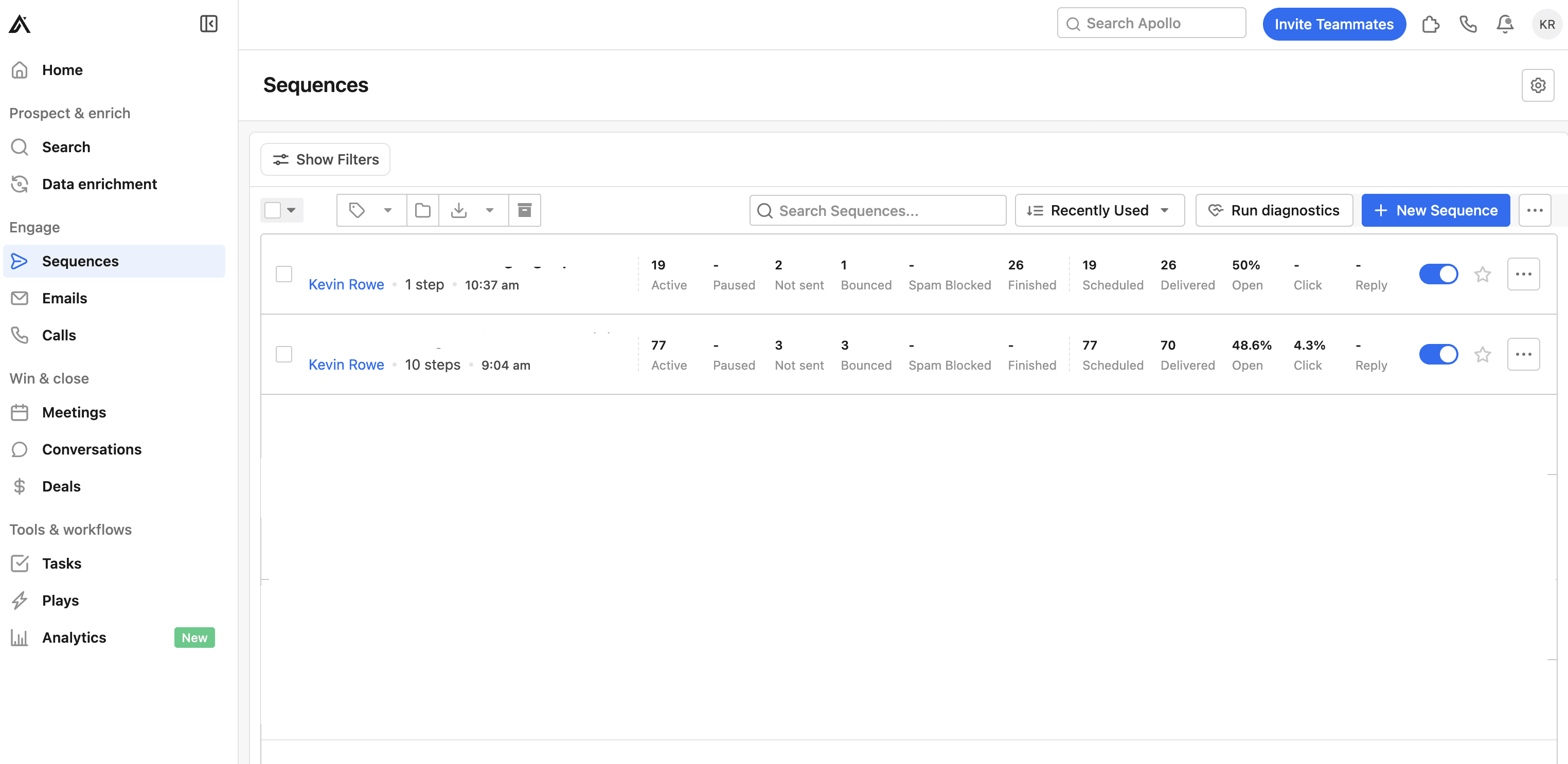
apollo.io email too sequencesScreenshot from Apollo, March 2024

10. DZone

DZone is an online community and publishing platform where technology professionals and developers share articles, tutorials, and news about software development, programming languages, and emerging tech trends.

It serves as a repository of technical knowledge, offering insights, code snippets, and discussions aimed at helping developers and tech enthusiasts stay updated with the latest in technology and software development practices.

On DZone, you can post a wide range of technical and programming-related content, including tutorials, guides, articles, and news updates covering various aspects of software development, programming languages, DevOps, cloud computing, and more.

It’s aimed at helping developers, programmers, and technology professionals share knowledge and learn from each other.

To post content on DZone, you need to become a community member. Once you’re a member, you can submit articles through its submission process, which involves creating content that aligns with their guidelines and submitting it for review. If approved, your content will be published on the platform.

11. X (Twitter) Personal Accounts

X (Twitter) has changed significantly over the last few years since Elon Musk purchased the platform. Some platform users have said they have seen a drop in engagement over the last few years, but others have seen an increase.

Sharing on X isn’t overly complex, but to garner the largest reach, don’t just share your links but create unique content for the platform. Share images or videos directly with unique content.

12. Personal Page On Facebook

This one seems obvious, but it is a place many people forget.

If you are concerned about spamming your family or friends who aren’t in the industry, consider creating a Facebook list for work folks.

This way, you don’t have to worry about confusing your Great Aunt Gertrude with a step-by-step guide to PPC.

13. Facebook Groups

Facebook Groups are still alive and well! Because many users already use Facebook in their personal time, they are usually more active in Groups.

Join a few industry-related Groups, share your best content once a month, and contribute to the group when possible.

Be sure to stay active as a member of the chat or Group by answering questions, reading others’ content, and contributing genuinely to the Group.

14. Slack Communities

Niche Slack communities are popping up everywhere. I find that these communities are very active.

However, the community guidelines on posting tend to be very strict. Many communities limit the type of content you can post, and typically, you won’t be able just to share links to your content.

To share on Slack Communities, share unique data or insights directly in the community where the threads create their own unique value and engagement instead of trying to get users off the platform.

15. SlideShare

SlideShare is a platform that allows users to share slide presentations, infographics, and other professional content.

It’s a valuable resource for professionals looking to learn new skills, share insights, and present ideas in a presentation format. Users can upload content in various formats, making it accessible to a wide audience for educational, marketing, and informational purposes.

One way to get the most mileage out of your content is by taking highlights and turning them into a presentation for SlideShare.

16. Quora

Quora has been around forever and is known as the internet’s premier question-and-answer website.

Users post a question, and users answer that question. Pretty straightforward.

But when you consider that a business or a representative can research what kind of questions customers are asking and have a detailed blog post ready to answer it, it becomes a great opportunity.

Knowing what your audience is having a problem with can help give you great ideas for content that will drive traffic to your site.

For example, if everyone is asking for information about how to hang a picture on a wall, and you sell the best picture-hanging nails ever, why not flex some of your expertise on the matter?

You get to personally answer a potential customer’s question while providing a handy link to your blog’s detailed explanation of it.

17. Growth Hackers

Most businesses want to scale to take on more work and overcome new obstacles.

Growth Hackers is an online community of user-generated content that provides insights on any topic that can be done to increase your company’s size, revenue, customer base, lead generation, etc.

Every article is detailed and insightful to many different niche industries. Make your voice heard while shining a light on the many ways you are trying to grow your business. It is well worth it.

18. Flipboard

Flipboard is a neat app that condenses the internet into digestible bite-size blocks. It shares content from every major publication you can think of and targets it to the people who are looking for it.

Creating an account and posting your content is a great way to drive traffic directly to your blog. It is also a great way to keep track of industry insights and even your own social media feeds.

What really sets this apart is its simplistic interface, which is backed by some serious clout, algorithmically speaking.

19. Scoop.it

Boasting organic traffic with over 2 million monthly users, Scoop. has become a powerhouse platform for marketers.

Offering content curation software, it helps marketers find authoritative content in their industry, which can then be easily shared on social media.

You can post your content in the hopes that others will also see it and share it with their followers.

Everyone wants to share their content with the world, and this tool makes it easy. It is also a great way to come up with new topic ideas based on what is trending.

20. Listly

Listly is a platform that allows users to create, share, and engage with lists on various topics.

These lists can include items like articles, products, resources, or ideas that other users can vote on, add to, and comment on. It’s designed to facilitate collaborative list-making and sharing, making it easier to collect and discover crowd-sourced information on specific interests or themes.
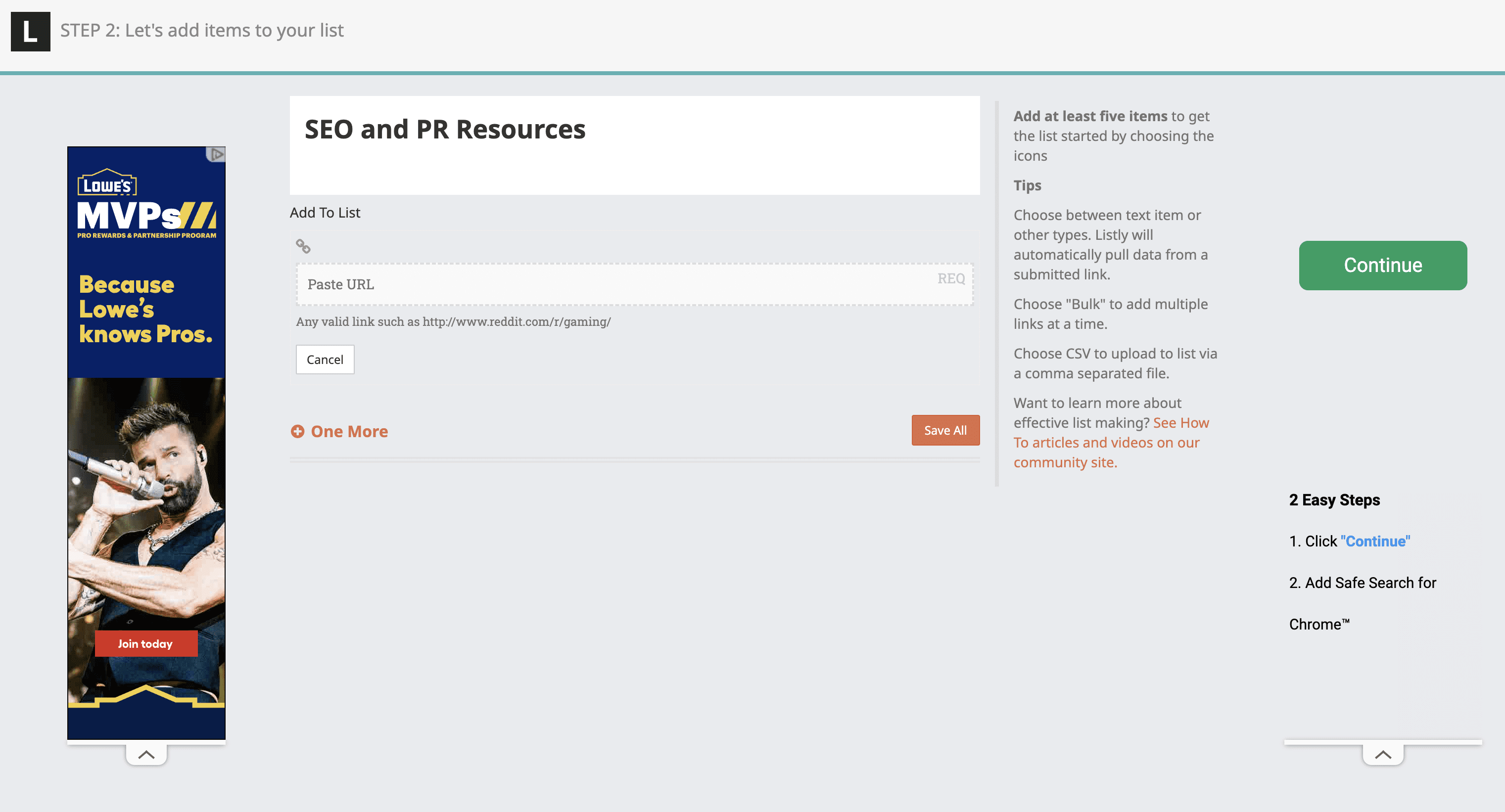
listly uploadScreenshot from Listly, March 2024

Sign up for the community, and you’ll be able to post immediately.

21. Threads

Threads is a new social media app developed by Meta, the company behind Facebook, Instagram, and WhatsApp. The app is a direct competitor to X (Twitter).

Threads reached over 100 million users in the first 5 days of being live. However, according to Sensor Tower, the daily active user count was down 82% around July 31st.

Natividad recommended Threads for sharing links directly, saying: “I don’t believe we’ve seen evidence that links are buried in Threads’ algorithm. For now, that seems to be a decent place to drop links in posts. But arguably, one of the best places to include links in your posts is Mastodon, which offers a chronological feed, not an algorithmic one.”

22. Mastodon

Mastodon is a free, open-source social networking platform emphasizing decentralization, privacy, and freedom from corporate control.

Unlike traditional social media platforms like Twitter or Facebook, Mastodon is built on a network of servers, each with its own rules, policies, and community.

As of February 2024, Mastodon had over 8 million users. Once you have your lists created, you can publish them to your audience.

Summary

Natividad provided further clarity, saying: “Social platforms notoriously want to keep us on-platform, so if you’re optimizing for sheer impressions of your ideas, rewriting your content as a fully formed LinkedIn post or a longform Twitter/X post is, sadly, your best bet.

For instance, when Twitter/X changed to the current ownership and they open sourced their recommendation algorithm, users saw proof that links in tweets were penalized and thus, suppressed by the algorithm.”

Content sharing across various platforms requires more than just replication; it demands strategic optimization and understanding of each platform’s unique dynamics.

Content creators can significantly enhance the visibility and impact of their work by employing targeted strategies such as mapping the audience journey, creating optimized assets, and leveraging PR topic tours.

Engaging with platforms like Substack, LinkedIn, and newer entrants like Threads and Mastodon while adapting to their specific content preferences presents a comprehensive approach to not just sharing but amplifying content in a way that resonates and even funnels the audience to your website.

More resources: 


Featured Image: Paulo Bobita/Search Engine Journal
How Search Generative Experience Will Affect Local SEO & Businesses via @sejournal, @JRiddall

If you own a local business, it’s quickly becoming imperative to understand Google’s new Search Generative Experience (SGE) and how to adjust your local SEO strategies to maintain and even enhance your presence for optimal visibility, traffic, and revenue.

The good news is if your business has been employing local SEO and content marketing best practices all along, you are well-positioned to adjust to this evolution of search.

AI is rapidly changing how much of the digital world works.

Search engines are also evolving in how they work and deliver results to searchers.

SGE, while still experimental and currently available in 120 countries via Google Labs, is likely going to transform the way people interact with search results by pulling those results directly into Google, providing a more interactive search experience with follow-up content and link suggestions.

In many cases, this may negate the need for searchers to click through to websites at all.

SGE uses a variety of AI-based technologies, including natural language processing, machine learning, and deep learning.

These technologies enable the search engine to understand a user’s search query, process relevant content, and formulate an appropriate response.

Understanding SGE: Beyond Just Links

Traditional search engine results typically provide a list of links relevant to a searcher’s query, where the searcher may need to investigate further to find the optimal answer to their question.

The goal of Search Generative Experience is to go several steps further. Powered by advanced artificial intelligence and language models, SGE aims to:

  • Synthesize, not just curate information: SGE doesn’t just find relevant websites. It analyzes the content on web pages, extracting specific facts, figures, and insights in order to present a concise, informative answer directly within the search results. As such, SGE is more likely to come into play for searches with informational, rather than navigation or commercial, intent.
  • Understand nuances: SGE aims to better interpret the intent behind a user’s search. Instead of only focusing on keywords, it will try to grasp the reason for the question. This means local businesses must focus on solving problems, not just selling services or products.
  • Provide multi-faceted answers: Sometimes, a simple, single answer to a question isn’t sufficient, and SGE provides opportunities for searchers to ask follow-up questions and/or dig deeper for complete answers. If you’re in an industry or niche with divergent approaches, ensure your content is comprehensive enough to be considered and included.
  • Be creative (sometimes): In select cases, SGE can even generate its own suggestions or solutions to a problem. While not the norm, this demonstrates the shift towards search engines becoming more proactive problem-solvers. This is also one of the known hazards of AI, as it can be prone to “hallucinations” in its attempts to provide answers.

From a local search perspective, SGE looks to enhance experience via a Places module, which replicates a local pack in traditional results, including citations, reviews, and other pertinent local business details.

A recent BrightEdge study found nearly half of SGE results generated in February 2024 included a Places module, with local restaurant and travel queries being the most prominent, while it did not show up in other B2B and entertainment-related queries.

Illustrating SGE

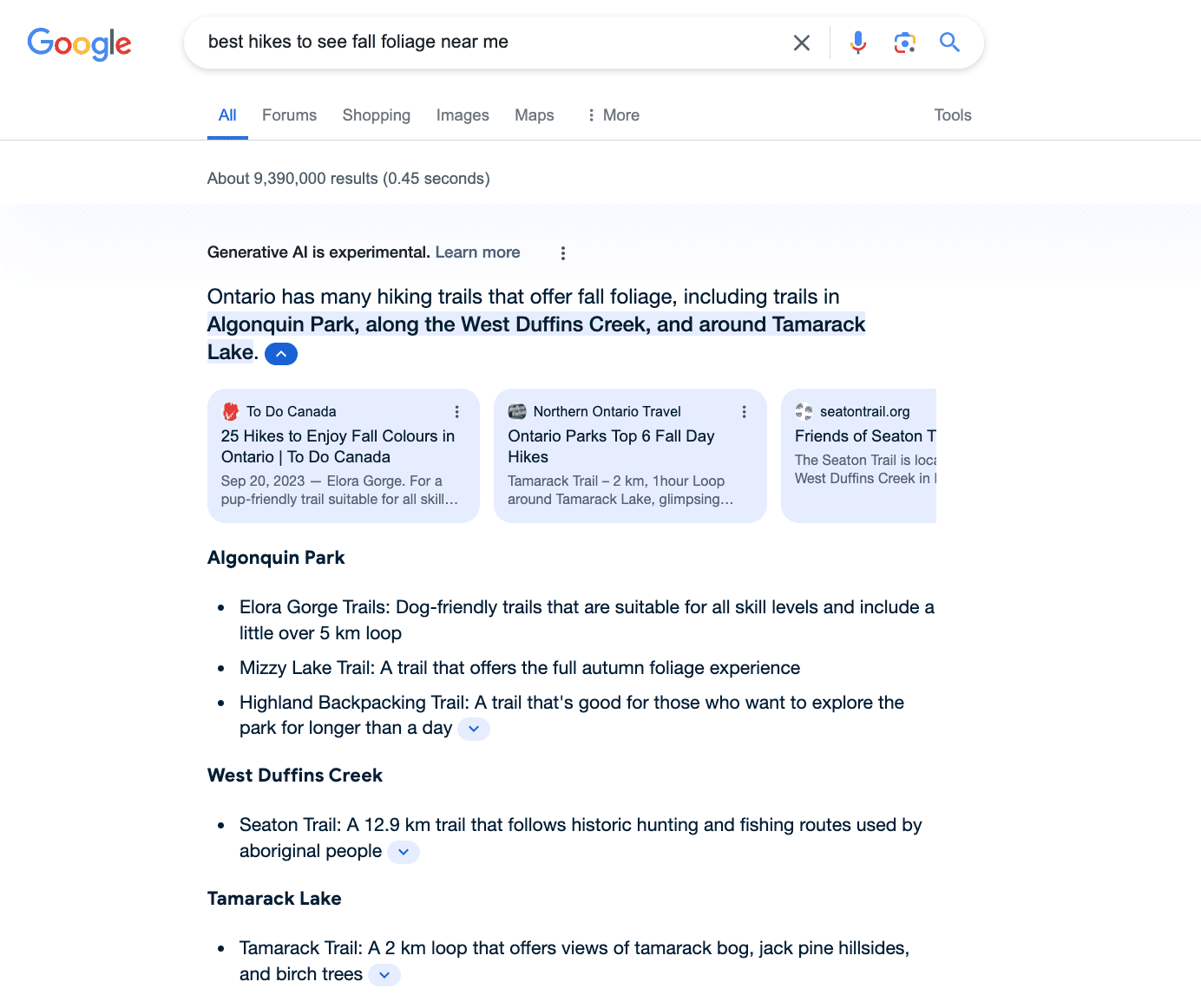
Let’s clarify SGE’s approach with an example. Imagine a consumer searching for “best hikes to see fall foliage near me.” SGE might do the following:

  • Locate: Access real-time location data and understand “near me.”
  • Gather information: Scan hiking websites, hiking or outdoor adventure blogs, local park authority pages, etc., focused on the user’s region.
  • Prioritize “fall”: Identify content within those sources specifically discussing fall foliage, not just general hiking information.
  • Potential response: Display a short list of suggested hiking trails, their difficulty level, estimated foliage peak dates pulled from websites, images sourced from relevant pages, and maybe relevant hiking guide services.

Herein lies an opportunity for a local provider of hiking-related services or products to appear within the results for such a query; provided they have relevant, experience-backed, trustworthy, helpful content for Google to reference.

For reference, here’s an actual result SGE provided for this search:

Google Search Generative Experience result screenshotScreenshot from search for [best hikes to see fall foliage near me], Google, March 2024

SGE’s Impact On Local Search

How are local search results pages (SERPs) changing with SGE? Here’s what we’ve seen so far:

  • Google Business Profile is King: With organic website traffic potentially decreasing, high-performing Google Business Profiles (GBP) with updated information, strong reviews, and relevant content will become even more critical for visibility.
  • Evolving Map Packs: While traditional local Map Packs will remain important, as noted SGE includes a Places module depending on the type of search being conducted. SGE may incorporate information from businesses featured in the Map Pack, but also include additional businesses to provide even more comprehensive and helpful answers to a user’s query.
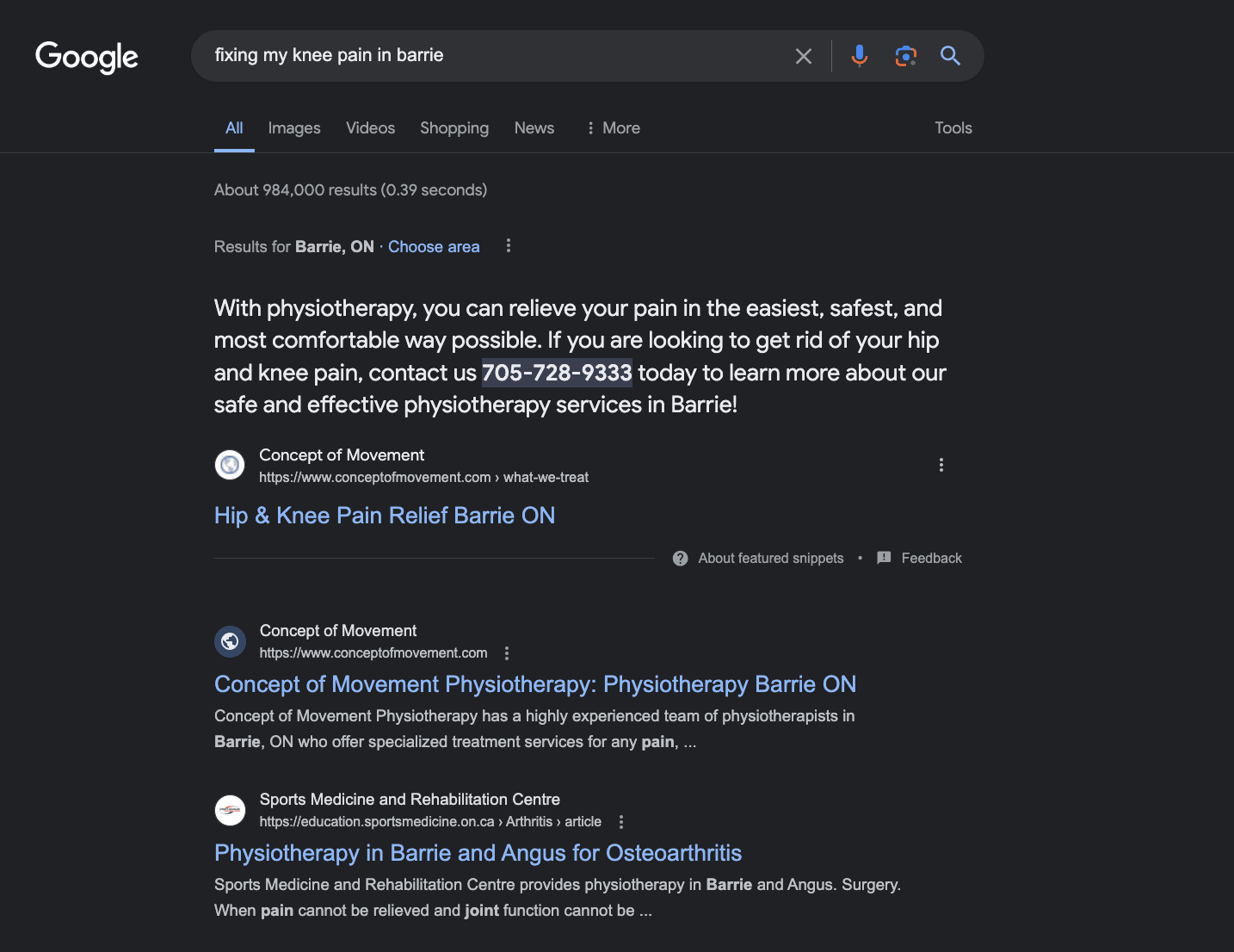
  • Featured Snippets matter: Businesses with content optimized to be concise, accurate, and directly answerable to queries are poised to dominate Featured Snippets.
local search featured snippetScreenshot from search for [fixing my knee pain in Barrie], Google, March 2024
  • Prioritizing user intent: Search engines will become even better at understanding why a user is searching. Localized searches (i.e. those including “near me” or a geographical identifier) will continue to have high relevance.
  • Mind the long tail: A preliminary SGE study by SE Ranking has found that SGE is more likely to be engaged by long-tail (multi-word) keywords, where searcher intent is generally clearer and more precise.
  • Less reliance on traditional “10 blue links”: You’ll likely see a decrease in prominence for standard website listings, though they won’t disappear completely. As such, there has been the suggestion of organic search traffic for some websites dropping by as much as 30%. While initially alarming, there is also the optimistic hope with SGE any organic website traffic received will be of higher quality, as consumers are better informed.

Key Strategies For Local Businesses To Thrive With SGE

Businesses need to focus on managing their web presence, providing helpful, relevant content, demonstrating Experience, Expertise, Authoritativeness, and Trustworthiness (E-E-A-T), and optimizing images and videos to succeed in the world of SGE.

Specifically, areas to consider include:

Optimize Your Listings

Ensure the business details in your GBP and all other local listings are complete and accurate.

Far too many local businesses still don’t appreciate the value of GBP and local directories, which may be as, if not more, important than their website in many cases.

Become A Review Magnet

Positive reviews and high star ratings aren’t just a nice-to-have, they’ll likely influence SGE’s assessment of your business.

Encourage happy customers to leave reviews and be sure to quickly respond to any and all reviews as this speaks to the quality of service you offer.

Conduct A ‘Question Audit’

Identify the most common questions your customers ask. Turn the answers to those questions into dedicated content pieces on your website or blog.

  • Example: A local bakery might find customers frequently asking, “Do you offer gluten-free options?” They create dedicated content addressing this, perhaps even a full FAQ page about dietary restrictions.

Keyword Research With A Twist

Look beyond simple keywords tied to services and products. What problems are people trying to solve that your business addresses?

What questions might they be asking related to your specific niche? Target long-tail keywords and create content that specifically addresses them.

  • Example: Instead of just “pizza delivery,” a local pizza business might also target “late-night food options near me”, “kid-friendly birthday party places” or “affordable first-date options.”

The Power Of Structured Data

Search engines love structure as they crawl across the web. Schema markup code can be added to your website, providing Google with structured data about your business and a clear understanding of your content.

Schema removes the guesswork, providing an “instruction manual” for search engines. It’s like a neatly organized label for search engines, clarifying details like;

  • Business type: Are you a restaurant, a clothing store, or a plumber?
  • Location: Precise address, not just the general city.
  • Hours of operation: When you’re open and when there are any holiday changes.
  • Services: What you specifically offer.
  • Reviews and ratings: Aggregated star ratings from your website or elsewhere
  • And more: Schema can cover menus, pricing, events, etc.

SGE is new and will undoubtedly evolve, but schema is a standardized format, ensuring that even if the way search engine results are presented changes, your essential data will be readily crawled and understood.

Answer Questions, Clearly

Break down your content into easily digestible question-and-answer formats. FAQs and clear content sections addressing common queries will boost your chances of inclusion in SGE results.

  • Example: A gardening center might have a section titled “When to plant tomatoes in [City Name]?” followed by a concise answer with climate-specific information for the specified location.

Mobile-First Is A Must

Mobile searches dominate, particularly for local queries, as busy consumers look for answers on the run. Ensure your website is optimized for smaller screens and loads lightning-fast.

Hyperlocal Matters

Emphasize your specific neighborhood and surrounding areas in your content to enhance your local relevance. Partner with other local organizations or participate in local events to boost your local authority.

E-E-A-T is Crucial

Expertise, Experience, Authoritativeness, and Trustworthiness are key signals for SGE. Ensure content available to SGE demonstrates your in-depth knowledge of your services and products.

Highlight credentials, awards, or testimonials that support your trustworthiness, both on your website and any reputable external platforms.

  • Examples: A hair salon features stylist bios mentioning advanced certifications or years of experience on its website. Medical professional bios link out to the institutions where they obtained their credentials. Trades-related businesses highlight the training and certifications their staff members have received.

Linking for Authority

Any solid local SEO strategy must include linking (external website links to reputable, relevant local/industry and backlinks from the same) to provide Google with additional signals of a business’ localness and topical focus; thereby enhancing local and topical authority.

  • Examples: A local med spa utilizing a particular piece of equipment as part of its service offering links to a detailed product page on the equipment manufacturer’s website. The same med spa obtains a listing and link to its service page via a partner directory offered on the manufacturer’s website.

Visual Content Optimization

Use descriptive file names and alt-text (with location data, where applicable) for images and videos as these assets will also undoubtedly make their way into SGE results.

Add captions to images and transcripts to videos. Showcase visuals highlighting your local area and establishing your “localness.”

  • Example: A restaurant includes an image of their patio with the file name “outdoor-dining-[neighborhood-name].jpg”

Leverage AI Content Generation With Caution

With the call for more content and the rise of generative AI, there is naturally a temptation to just let the machine do all the work.

However, a recent Google algorithm update has already punished many websites for taking this approach. The focus, as always, should be on quality over quantity, and here are a few reasons why AI-generated content lacks the former:

  • Accuracy concerns: AI-generated content may not be factually accurate, especially on specific details or niche topics. Remember the “hallucinations” mentioned earlier. This could negatively impact your E-E-A-T and damage your reputation, so be sure to fact-check everything.
  • Lack of originality: AI often struggles to create genuinely original content. Generic, repetitive text is a common pitfall. SGE is likely to pick up on this and may not include such content in its responses.
  • Inconsistent voice and tone: Maintaining a consistent brand voice is essential for building trust with customers. AI-generated content can sound robotic or disjointed, failing to capture your brand’s unique personality.
  • Missing the ‘why’: Great content doesn’t just answer what, but also why. AI might provide factual answers to questions but struggles to explain the reasoning or incorporate valuable insights derived from personal human experience.

So, by all means, leverage AI to ideate, create first drafts, edit or proofread your content, but be sure to add your human touch to any and all content published and shared.

Monitor And Adapt

SGE is relatively new. SEO best practices will continue to evolve.

Use local SEO monitoring tools to track changes in your authority/visibility and stay informed, being ready to adjust your content strategy as needed.

The Future Is Bright: Seize The Opportunities Of SGE

Search Generative Experience presents exciting challenges and opportunities for local businesses.

Similar to Google, a local business’ goal should be to equip its customers with all of the information they need to make informed, confident purchase decisions.

By understanding its mechanisms, prioritizing helpful, relevant content, demonstrating E-E-A-T, and always keeping the user experience central, you can position your small business for success in the evolving search engine results.

It’s a call to truly know your customers, provide value, and leverage technology in a customer-centric way.

More resources: 


Featured Image: Thx4Stock team/Shutterstock

Google Clarifies Vacation Rental Structured Data via @sejournal, @martinibuster

Google’s structured data documentation for vacation rentals was recently updated to require more specific data in a change that is more of a clarification than it is a change in requirements. This change was made without any formal announcement or notation in the developer pages changelog.

Vacation Rentals Structured Data

These specific structured data types makes vacation rental information eligible for rich results that are specific to these kinds of rentals. However it’s not available to all websites. Vacation rental owners are required to be connected to a Google Technical Account Manager and have access to the Google Hotel Center platform.

VacationRental Structured Data Type Definitions

The primary changes were made to the structured data property type definitions where Google defines what the required and recommended property types are.

The changes to the documentation is in the section governing the Recommended properties and represents a clarification of the recommendations rather than a change in what Google requires.

The primary changes were made to the structured data type definitions where Google defines what the required and recommended property types are.

The changes to the documentation is in the section governing the Recommended properties and represents a clarification of the recommendations rather than a change in what Google requires.

Address Schema.org property

This is a subtle change but it’s important because it now represents a recommendation that requires more precise data.

This is what was recommended before:

“streetAddress”: “1600 Amphitheatre Pkwy.”

This is what it now recommends:

“streetAddress”: “1600 Amphitheatre Pkwy, Unit 6E”

Address Property Change Description

The most substantial change is to the description of what the “address” property is, becoming more descriptive and precise about what is recommended.

The description before the change:

PostalAddress
Information about the street address of the listing. Include all properties that apply to your country.

The description after the change:

PostalAddress
The full, physical location of the vacation rental.
Provide the street address, city, state or region, and postal code for the vacation rental. If applicable, provide the unit or apartment number.
Note that P.O. boxes or other mailing-only addresses are not considered full, physical addresses.

This is repeated in the section for address.streetAddress property

This is what it recommended before:

address.streetAddress Text
The full street address of your vacation listing.

And this is what it recommends now:

address.streetAddress Text
The full street address of your vacation listing, including the unit or apartment number if applicable.

Clarification And Not A Change

Although these updates don’t represent a change in Google’s guidance they are nonetheless important because they offer clearer guidance with less ambiguity as to what is recommended.

Read the updated structured data guidance:

Vacation rental (VacationRental) structured data

Featured Image by Shutterstock/New Africa

Google On Hyphens In Domain Names via @sejournal, @martinibuster

Google’s John Mueller answered a question on Reddit about why people don’t use hyphens with domains and if there was something to be concerned about that they were missing.

Domain Names With Hyphens For SEO

I’ve been working online for 25 years and I remember when using hyphens in domains was something that affiliates did for SEO when Google was still influenced by keywords in the domain, URL, and basically keywords anywhere on the webpage. It wasn’t something that everyone did, it was mainly something that was popular with some affiliate marketers.

Another reason for choosing domain names with keywords in them was that site visitors tended to convert at a higher rate because the keywords essentially prequalified the site visitor. I know from experience how useful two-keyword domains (and one word domain names) are for conversions, as long as they didn’t have hyphens in them.

A consideration that caused hyphenated domain names to fall out of favor is that they have an untrustworthy appearance and that can work against conversion rates because trustworthiness is an important factor for conversions.

Lastly, hyphenated domain names look tacky. Why go with tacky when a brandable domain is easier for building trust and conversions?

Domain Name Question Asked On Reddit

This is the question asked on Reddit:

“Why don’t people use a lot of domains with hyphens? Is there something concerning about it? I understand when you tell it out loud people make miss hyphen in search.”

And this is Mueller’s response:

“It used to be that domain names with a lot of hyphens were considered (by users? or by SEOs assuming users would? it’s been a while) to be less serious – since they could imply that you weren’t able to get the domain name with fewer hyphens. Nowadays there are a lot of top-level-domains so it’s less of a thing.

My main recommendation is to pick something for the long run (assuming that’s what you’re aiming for), and not to be overly keyword focused (because life is too short to box yourself into a corner – make good things, course-correct over time, don’t let a domain-name limit what you do online). The web is full of awkward, keyword-focused short-lived low-effort takes made for SEO — make something truly awesome that people will ask for by name. If that takes a hyphen in the name – go for it.”

Pick A Domain Name That Can Grow

Mueller is right about picking a domain name that won’t lock your site into one topic. When a site grows in popularity the natural growth path is to expand the range of topics the site coves. But that’s hard to do when the domain is locked into one rigid keyword phrase. That’s one of the downsides of picking a “Best + keyword + reviews” domain, too. Those domains can’t grow bigger and look tacky, too.

That’s why I’ve always recommended brandable domains that are memorable and encourage trust in some way.

Read the post on Reddit:

Are domains with hyphens bad?

Read Mueller’s response here.

Featured Image by Shutterstock/Benny Marty

24 Effective Link Building Tactics That Work In 2024 via @sejournal, @Brian_W_Gareth

1. Check Your Direct Competitors’ Backlinks

Since link building helps your site rank higher, we can assume that the highest-ranking sites on SERPs have lots of good backlinks.

The same is true for your competitors who rank higher than you.

And if there are a lot of authoritative sites linking to them, wouldn’t it be nice if they linked to you too?

Of course it would.

Find those sites, and you can start building links there too, right?

Not so fast.

Step 1: Uncover Your True Competitors

First, you need to know which sites are your online competitors. You don’t want to waste your time trying to outrank sites that are not even stealing your customers, after all.

Here’s how to identify a direct competitor:

  • Their site serves the same purpose as yours and targets the same audience.
  • It ranks for the same keywords you want to rank for.
  • Their business operates in the same area as yours.
  • They rank higher than you.

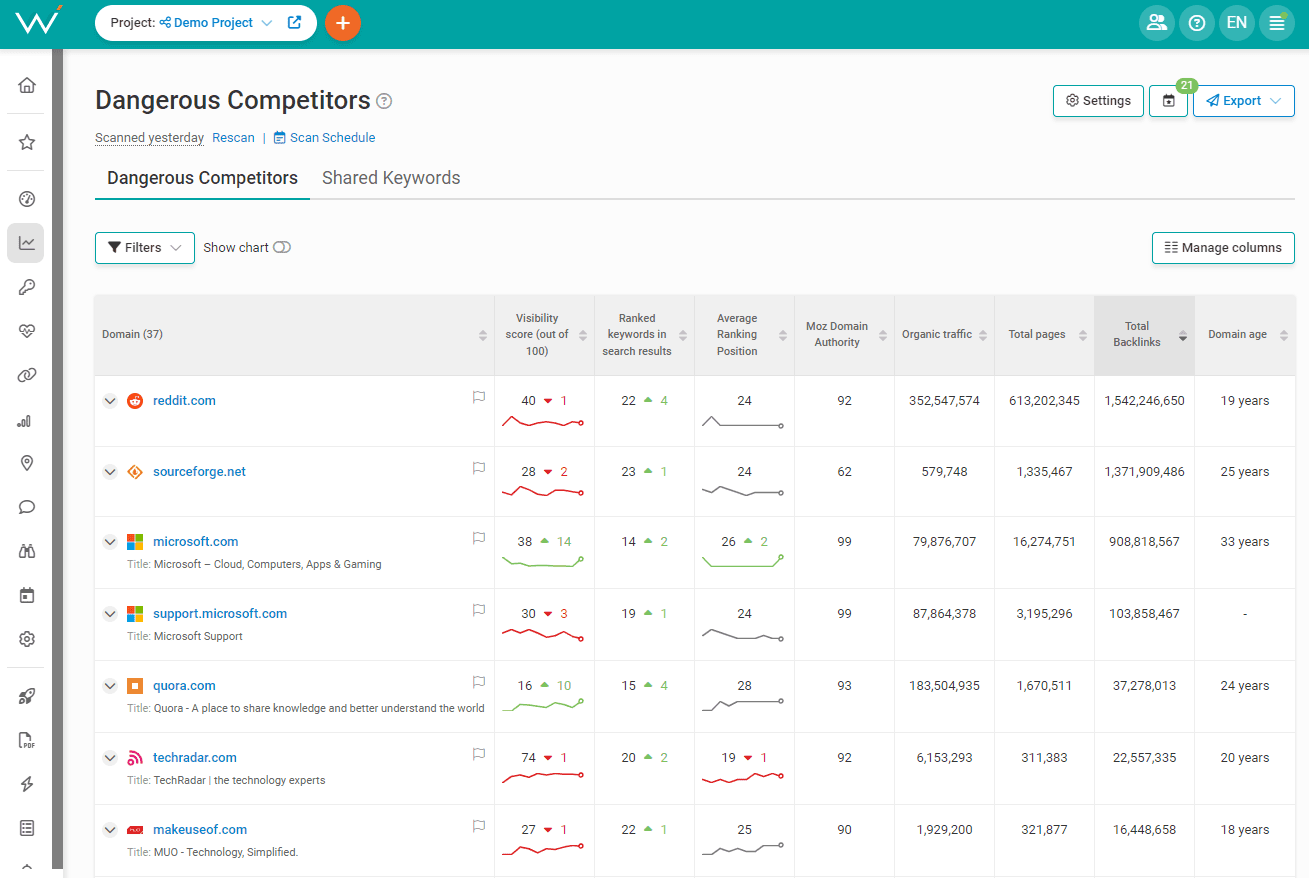
To start looking for your competitors, open WebCEO’s Dangerous Competitors tool.

Screenshot from WebCEO, March 2024

Click on the Settings button and visit these tabs:

  • Keywords: enter your ranking keywords there.
  • Competitors: if you already know some of your competitors, add their URLs there.
  • Search engines: add the search engines where you want to rank. Local business owners will also want to select locations to narrow down the results.

Click on Save, and the tool will generate a table of sites belonging to your potential competitors. Visit those sites to make sure they are indeed your competitors.

Step 2: Check Their Backlinks

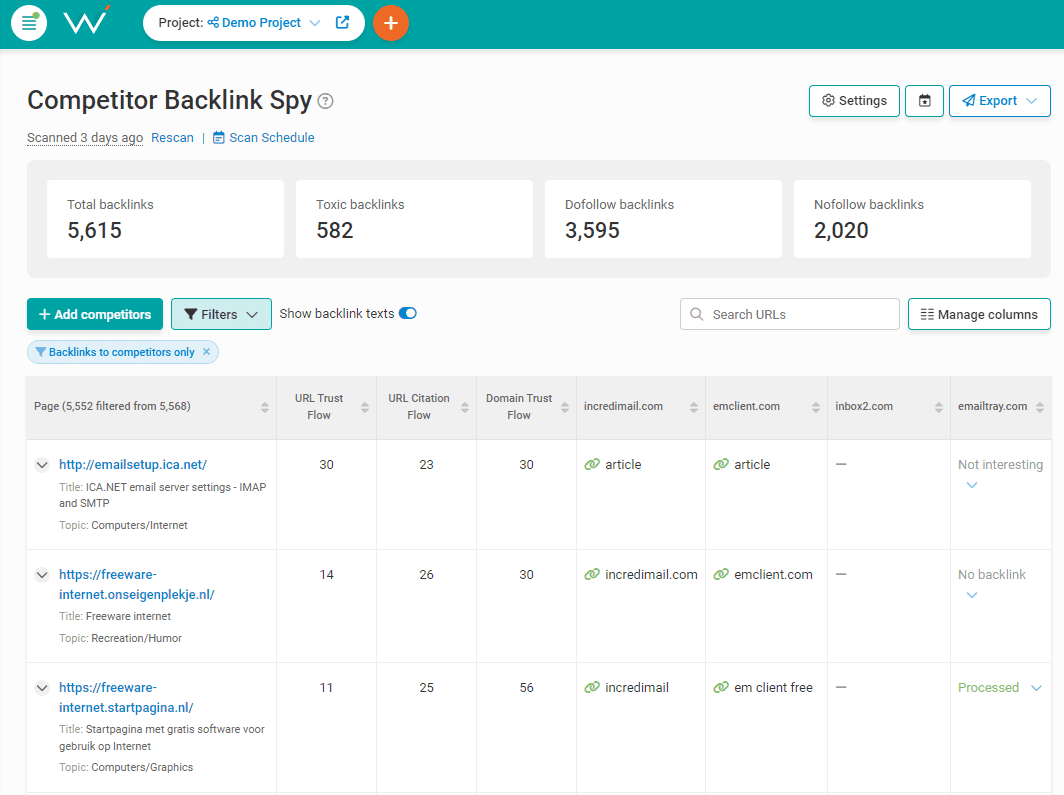
Time for the next step: checking their backlinks in Competitor Backlink Spy.

Screenshot from WebCEO, March 2024
  1. Open Settings and enter your competitors’ URLs in the Competitors tab.
  2. Press Save, and the tool will list all of your competitors’ backlinks – specifically, the pages which link to your competitors.

And now all you need to do is find promising domains among those linking pages. Visit those sites and look for the ones who are likely to give your site a backlink, too – after you’ve created link-worthy content and presented your case to those sites.

By the way, your competitors can also be your backlink donors. Feel free to build links on their sites too!

2. Must-Do Websites For Link Building

Before other sites start linking to yours, you can create a few powerful backlinks yourself. There are websites for that exact purpose:

Carefully pick sites that are relevant to your niche and create listings for your business there. Now you have several authoritative sites in your backlink profile.

What’s more, other websites’ owners can find you there, too. Exposure to others is the first step towards gaining even more backlinks down the line.

And if your site is already well-known enough, you can try creating a Wikipedia page about it. Even though links from Wikipedia are nofollow, the website itself possesses significant authority and can share some of it with you.

3. Run A Blog & Write Articles About Relevant Topics

In order to gain backlinks, you want to have linkworthy content on your website – the more, the better. Write about many different, but related topics about your niche and your business. For example:

  • Your products.
  • News in the industry.
  • Interesting case studies.
  • Recent going-ons in your company.
  • Interviews with clients and partners.

The options are limitless. And the more you know about your work, the more you can share with your visitors. Curious writers attract curious readers. Go wild with your pen!

And when you create your content, there are a few more things you can do to help it get more backlinks:

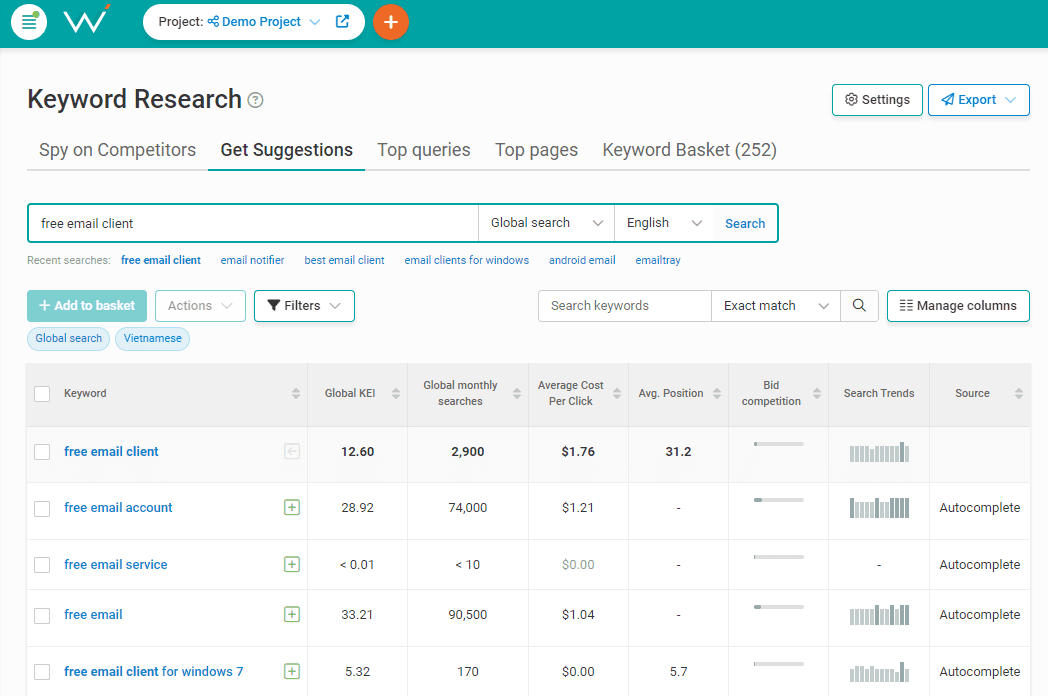
  1. Optimize it for keywords. The higher your content appears in search, the more likely users are to find it – and link to it in their own content if they need to. Use WebCEO’s Keyword Research tool to find search queries your target audience uses the most often.
  2. List your sources – with links. If you refer to other sources in your content, then listing them will make you appear more credible, especially if those sources are also good. And users love linking to credible sites.
  3. Link to other pages on your site. Help your visitors find all the content they may need. Navigation and footer bars are a must since they have links to your homepage, FAQ, contact info pages, and more. However, blog articles on related topics should also link to each other, in case your users need more details.
Screenshot from WebCEO, March 2024

4. Write Guest Articles

Good old guest blogging! The tried and tested method of building links. Write an article for another site and include a link to yours – what could be easier?

Of course, there’s a catch. There are two important steps to take first:

  1. Find relevant sites whose backlinks would be a boon for you;
  2. Convince them to accept a guest post from you.

You already know how to find backlink donors: with Competitor Backlink Spy. Local bloggers, newspapers, and magazines won’t be able to hide from you.

What about the second step? Your best bet here is email outreach.

Pick a promising site whose contact information is available and send them an email like this:

Hi Susan!

I’m John Doe, and I write for {Example Blog}. Nice to e-meet you! I’ve been following your blog for a while, and I’ve found your recent post series about networking very helpful.

Anyway, I’m writing to you because I’m quite familiar with your blog’s topics and I would love to contribute if you’re open to new guest authors. I’ve been brainstorming some topic ideas that I think would be a good match for your blog:

    • {Topic idea #1}
    • {Topic idea #2}
    • {Topic idea #3}

If you have different topics in mind, I will be glad to write about them as well. I appreciate your time and really look forward to working together.

Cheers!

John Doe

If you don’t get a reply, it’s okay to try again – with a different text indicating that it’s not your first try.

Be polite and remember that it’s meant to benefit you both. Good luck!

5. Turn Unlinked Mentions Into Links

If you’ve been around and doing business for a while, people are bound to talk about you. On their sites too.

This is the easiest way to make backlinks. Somebody has already mentioned your business on their site – that’s already most of the work done! All that’s left is to add a link.

Simply contact the person who can edit the page (via email or social media) and ask them to insert your site’s URL into the mention. Done and done.

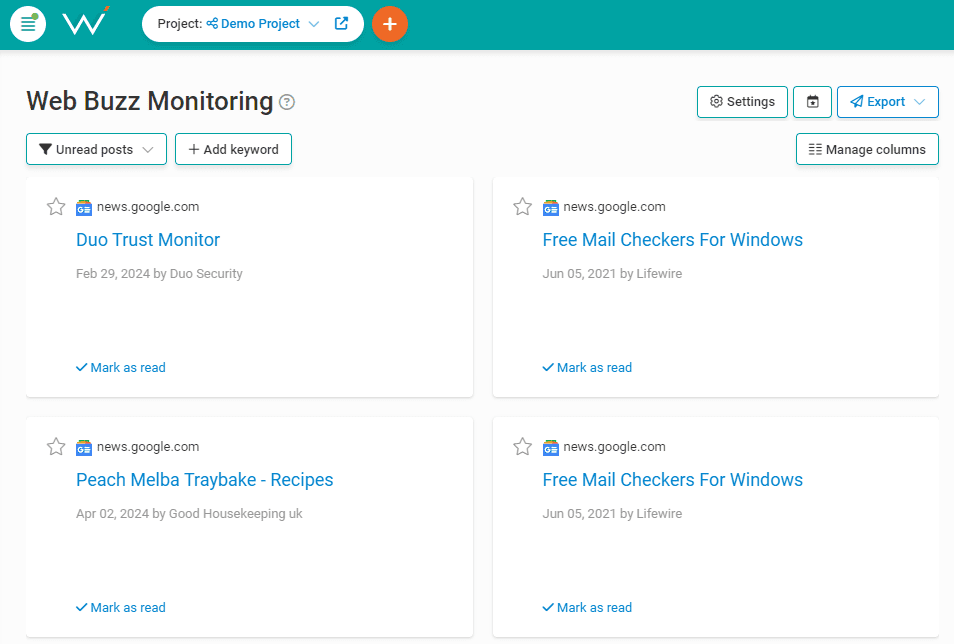
Finding unlinked mentions is even easier: just use a tool like WebCEO’s Web Buzz Monitoring.

Screenshot from WebCEO, March 2024

Just add your brand’s name in the Settings, and the tool will find pages with its unlinked mentions.

6. Provide An Excellent User Experience

Who will want to link to a page that’s barely working? Not the people who give out backlinks, that’s for sure. Even ordinary users will run if a page refuses to work – or even simply offends their eyes.

On the other hand, there are only positives to pages providing good UX:

  • User activity leading to conversions (potentially spreading across the entire site).
  • Positive customer reviews.
  • Increasing Google rankings.
  • And new backlinks, of course.

Imagine a perfect web page from your dreams, or just remember the best website you’ve ever visited some time before. Then make the same thing on your own site (or even better, if you can).

What’s the recipe for the best user experience?

  • Helpful, high-quality content. Being helpful is more important than ever due to Google’s Helpful Content update. Your page can be informative and optimized with the best keywords, but if it doesn’t actually help your visitors, then it’s a huge problem.
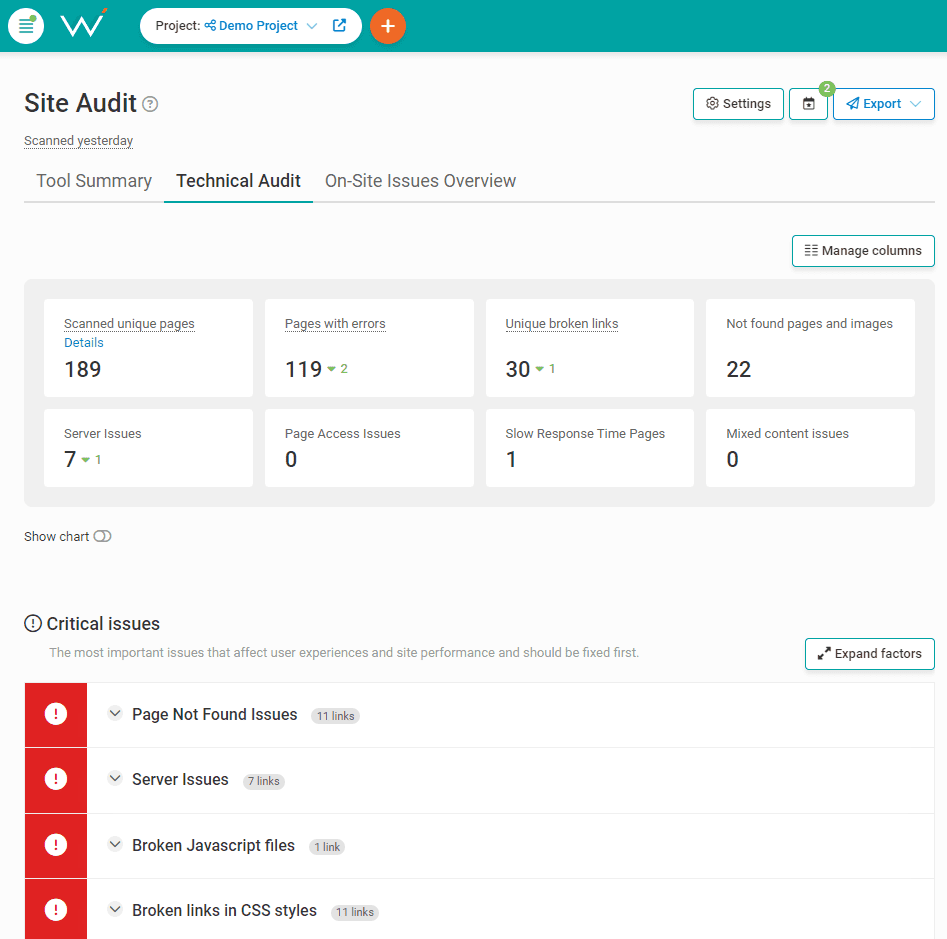
  • High-quality visuals. Users love eye-catching images and videos, especially when they not only inform but also entertain. Make sure your images load correctly! If any of them don’t, find them with WebCEO’s Technical Audit tool and replace them.
  • No site errors. Broken images are but one possible issue that may ruin your site. Scan it for all types of errors with the same Technical Audit tool and fix them ASAP.
Screenshot from WebCEO, March 2024
  • Fast loading speed. A slow-loading page is a useless page: if visitors leave, nothing happens there. Test your site pages with WebCEO’s Speed Optimization tool and follow its tips for making them load faster.
  • Mobile friendliness. Smartphones drive as much traffic as PC, so your site must be optimized for screens of all sizes. Scan your site with the Mobile Optimization tool and follow its recommendations for becoming more mobile-friendly.
  • User accessibility. Make sure your site can be easily used by everybody regardless of their physical ability. Test your site with a tool like EquallyAI’s ARIA to see where you can make improvements.

7. Get Rid Of Harmful Backlinks

Next, make sure your backlink profile isn’t hurting your site. What kind of backlinks can do that?

  • Bought backlinks.
  • Spammy backlinks.
  • Links from irrelevant sites.
  • Links from non-authoritative sites.

If Google detects too many backlinks like that in your profile, it may deem your site untrustworthy and lower its search rankings. It may even incur a manual action.

You can’t let harmful backlinks pile up and bring you down.

Scan your backlink profile with WebCEO’s Toxic Pages tool.

Screenshot from WebCEO, March 2024

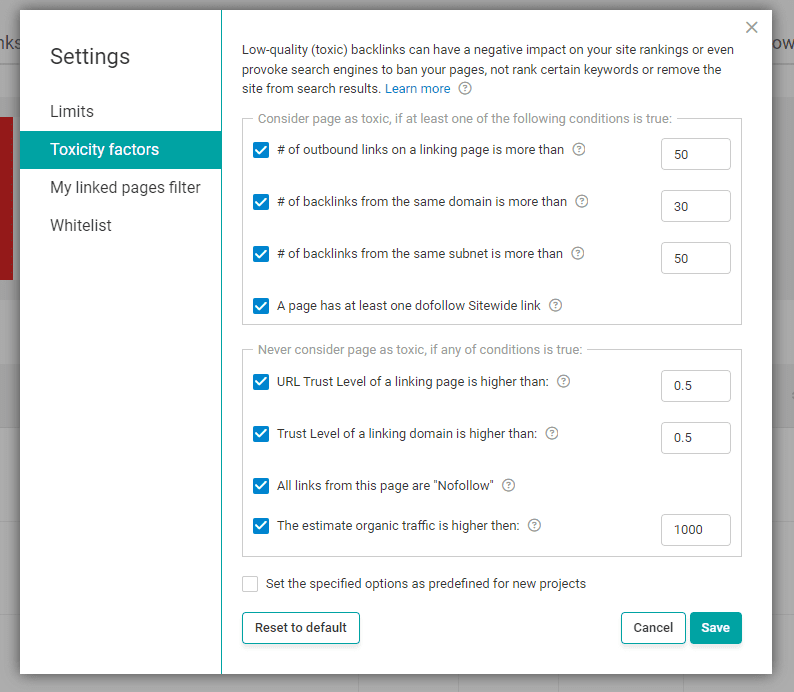
By default, it looks for linking pages that are obviously spammy: those with tons of outbound links and a low trust level. If you want to, tweak the tool’s search criteria to your liking in the Settings. You can even exclude specific domains from the tool’s search if you trust them.

Screenshot from WebCEO, March 2024

Once you have your list of toxic backlinks, start getting rid of them. Your options are:

  • Delete the backlinks from those pages yourself.
  • Ask somebody who can edit those pages to do it.
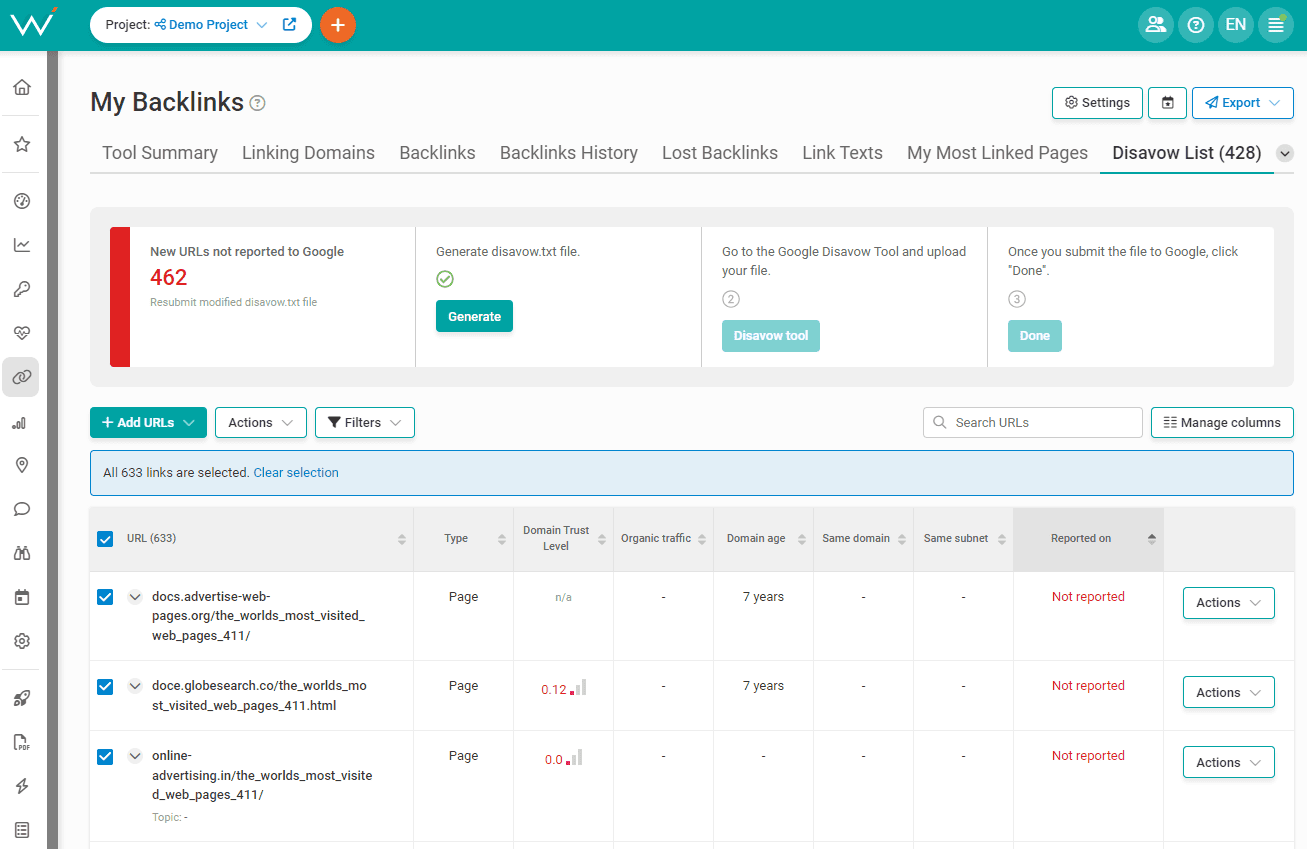
  • Generate a disavow list in Toxic Pages and submit it to Google Disavow.
Screenshot from WebCEO, March 2024

Want To See points 8-24?

The full guide is exclusively available to WebCEO users. Sign up for free now and get your link building guide with 24 different tactics that will get you through 2024 and well beyond!

Google Is Still Gen Z’s Top Search Engine, Study Shows via @sejournal, @MattGSouthern

A recent report shows that while Gen Z increasingly turns to social media platforms for information searches, Google remains the primary starting point for a significant portion of this age group.

The data published by Axios shows that 46% of internet users aged 18-24 begin their online queries on Google, compared to 58% of those aged 25-39.

This suggests a shift in search habits between Gen Z and millennials, who came of age during Google’s rise to dominance.

However, the numbers also indicate that the move away from traditional search engines may not be as dramatic as some have suggested.

Only 21% of Gen Z users start their searches on TikTok, while 5% begin on YouTube.

The Current Landscape Of Internet Searches

Despite the perceived competition from social media platforms, Google remains the leader in the search engine market.

MaryLeigh Bliss, chief content officer for YPulse, tells Axios:

“Google is still top overall for initial searches, followed by TikTok and YouTube.”

This reinforces the idea that traditional search engines remain at the core of information gathering while usage patterns change.

Challenges & Adaptations

Google has taken steps to adapt to changing user preferences, expanding its AI-powered Search Generative Experience (SGE) tool and highlighting results from forum websites like Reddit.

The company reports that 18-—to 24-year-olds have given the highest satisfaction scores for its AI search results.

Despite these efforts, some users have expressed dissatisfaction with the quality of Google’s search results.

A recent study by researchers in Germany found that low-quality results are often well-optimized to appear high in Google’s search rankings, particularly for product searches.

Looking Forward

Web usage habits are constantly shifting. Compared to older generations, Gen Z’s way of looking for information online will likely continue to evolve.

While social media is becoming a bigger part of how people search, traditional search engines like Google still dominate.

The tug-of-war between emerging and traditional platforms will shape how younger generations seek information on the web.


FAQ

In the context of SEO and online marketing, what are the implications of Gen Z’s shifts in search habits?

The data on Gen Z’s search habits have several implications for SEO and online marketing strategies:

  • Marketers should consider diversifying their SEO tactics. They should not solely rely on traditional search engines but also consider optimizing for vertical video platforms.
  • Understanding that younger audiences may start their product or information searches on platforms like TikTok means marketers may have to develop unique strategies to reach them.
  • To maintain visibility online, consider monitoring and adapting to Gen Z’s preferences, as their satisfaction levels could guide future algorithm adjustments.


Featured Image: DavideAngelini/Shutterstock

Reddit Post Ranks On Google In 5 Minutes – What’s Going On? via @sejournal, @martinibuster

Google’s Danny Sullivan disputed the assertions made in a Reddit discussion that Google is showing a preference for Reddit in the search results. But a Redditor’s example proves that it’s possible for a Reddit post to rank in the top ten of the search results within minutes and to actually improve rankings to position #2 a week later.

Discussion About Google Showing Preference To Reddit

A Redditor (gronetwork) complained that Google is sending so many visitors to Reddit that the server is struggling with the load and shared an example that proved that it can only take minutes for a Reddit post to rank in the top ten.

That post was part of a 79 post Reddit thread where many in the r/SEO subreddit were complaining about Google allegedly giving too much preference to Reddit over legit sites.

The person who did the test (gronetwork) wrote:

“…The website is already cracking (server down, double posts, comments not showing) because there are too many visitors.

…It only takes few minutes (you can test it) for a post on Reddit to appear in the top ten results of Google with keywords related to the post’s title… (while I have to wait months for an article on my site to be referenced). Do the math, the whole world is going to spam here. The loop is completed.”

Reddit Post Ranked Within Minutes

Another Redditor asked if they had tested if it takes “a few minutes” to rank in the top ten and gronetwork answered that they had tested it with a post titled, Google SGE Review.

gronetwork posted:

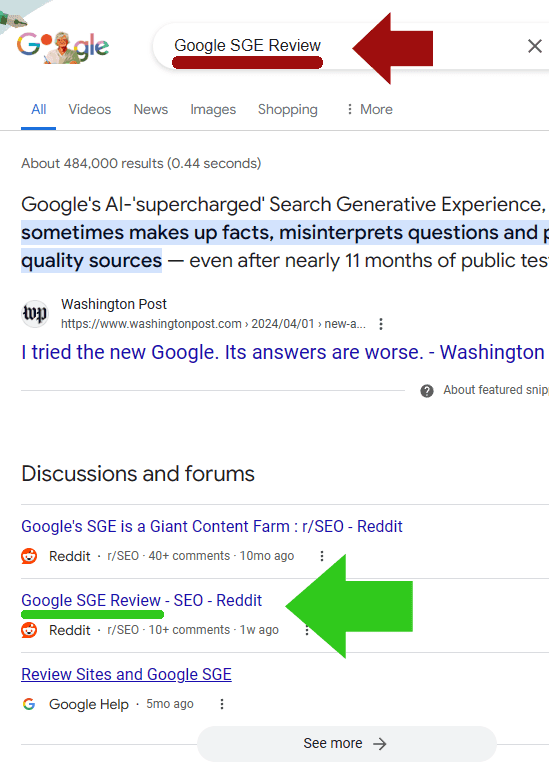
“Yes, I have created for example a post named “Google SGE Review” previously. After less than 5 minutes it was ranked 8th for Google SGE Review (no quotes). Just after Washingtonpost.com, 6 authoritative SEO websites and Google.com’s overview page for SGE (Search Generative Experience). It is ranked third for SGE Review.”

It’s true, not only does that specific post (Google SGE Review) rank in the top 10, the post started out in position 8 and it actually improved ranking, currently listed beneath the number one result for the search query “SGE Review”.

Screenshot Of Reddit Post That Ranked Within Minutes

Screenshot showing a Reddit post that ranked in Google within minutes

Anecdotes Versus Anecdotes

Okay, the above is just one anecdote. But it’s a heck of an anecdote because it proves that it’s possible for a Reddit post to rank within minutes and get stuck in the top of the search results over other possibly more authoritative websites.

hankschrader79 shared that Reddit posts outrank Toyota Tacoma forums for a phrase related to mods for that truck.

Google’s Danny Sullivan responded to that post and the entire discussion to dispute that Reddit is not always prioritized over other forums.

Danny wrote:

“Reddit is not always prioritized over other forums. [super vhs to mac adapter] I did this week, it goes Apple Support Community, MacRumors Forum and further down, there’s Reddit. I also did [kumo cloud not working setup 5ghz] recently (it’s a nightmare) and it was the Netgear community, the SmartThings Community, GreenBuildingAdvisor before Reddit. Related to that was [disable 5g airport] which has Apple Support Community above Reddit. [how to open an 8 track tape] — really, it was the YouTube videos that helped me most, but it’s the Tapeheads community that comes before Reddit.

In your example for [toyota tacoma], I don’t even get Reddit in the top results. I get Toyota, Car & Driver, Wikipedia, Toyota again, three YouTube videos from different creators (not Toyota), Edmunds, a Top Stories unit. No Reddit, which doesn’t really support the notion of always wanting to drive traffic just to Reddit.

If I guess at the more specific query you might have done, maybe [overland mods for toyota tacoma], I get a YouTube video first, then Reddit, then Tacoma World at third — not near the bottom. So yes, Reddit is higher for that query — but it’s not first. It’s also not always first. And sometimes, it’s not even showing at all.”

hankschrader79 conceded that they were generalizing when they wrote that Google always prioritized Reddit. But they also insisted that that didn’t diminish what they said is a fact that Google’s “prioritization” forum content has benefitted Reddit more than actual forums.

Why Is The Reddit Post Ranked So High?

It’s possible that Google “tested” that Reddit post in position 8 within minutes and that user interaction signals indicated to Google’s algorithms that users prefer to see that Reddit post. If that’s the case then it’s not a matter of Google showing preference to Reddit post but rather it’s users that are showing the preference and the algorithm is responding to those preferences.

Nevertheless, an argument can be made that user preferences for Reddit can be a manifestation of Familiarity Bias. Familiarity Bias is when people show a preference for things that are familiar to them. If a person is familiar with a brand because of all the advertising they were exposed to then they may show a bias for the brand products over unfamiliar brands.

Users who are familiar with Reddit may choose Reddit because they don’t know the other sites in the search results or because they have a bias that Google ranks spammy and optimized websites and feel safer reading Reddit.

Google may be picking up on those user interaction signals that indicate a preference and satisfaction with the Reddit results but those results may simply be biases and not an indication that Reddit is trustworthy and authoritative.

Is Reddit Benefiting From A Self-Reinforcing Feedback Loop?

It may very well be that Google’s decision to prioritize user generated content may have started a self-reinforcing pattern that draws users in to Reddit through the search results and because the answers seem plausible those users start to prefer Reddit results. When they’re exposed to more Reddit posts their familiarity bias kicks in and they start to show a preference for Reddit. So what could be happening is that the users and Google’s algorithm are creating a self-reinforcing feedback loop.

Is it possible that Google’s decision to show more user generated content has kicked off a cycle where more users are exposed to Reddit which then feeds back into Google’s algorithm which in turn increases Reddit visibility, regardless of lack of expertise and authoritativeness?

Featured Image by Shutterstock/Kues

Google E-E-A-T: What Is It & How To Demonstrate It For SEO via @sejournal, @MattGSouthern

E-A-T (Expertise, Authoritativeness, Trustworthiness) has been a cornerstone of Google’s Search Quality Rater Guidelines for years. Recently, Google added a new “E” to the mix – Experience.

Understanding and optimizing for E-E-A-T strongly correlates with SEO success.

In this article, you’ll learn what the E-E-A-T criteria mean, why Google values first-hand experience, and, most importantly, how to demonstrate E-E-A-T for your brand and content.

Drawing from Google’s Search Quality Rater Guidelines, this piece will equip you with actionable insights to boost your E-E-A-T signals.

You’ll also find real-world examples of websites that exemplify E-E-A-T principles across different niches. And with the rise of AI-generated content, we’ll discuss how to navigate E-E-A-T in the age of ChatGPT and other AI tools.

What Is E-E-A-T?

The acronym “E-E-A-T” stands for Experience, Expertise, Authoritativeness, and Trustworthiness.

E-E-A-T is an evolution of the original E-A-T concept.

Google introduced E-A-T, which stands for Expertise, Authoritativeness, and Trustworthiness, to evaluate web content’s overall quality and credibility. It became a key component of Google’s Search Quality Rater Guidelines, which human raters use to assess search results.

The addition of the second “E” for “Experience” is a more recent evolution.

Google recognized that first-hand experience is critical to expertise and credibility for many topics.

This is especially true for “Your Money or Your Life” (YMYL) topics, where the content can impact a person’s health, financial stability, safety, or well-being.

By expanding to E-E-A-T, Google is signaling that it values the content creator’s credentials, reputation, and direct, real-world experience with the topic.

It’s important to note that E-E-A-T is not a direct ranking factor in Google’s search algorithm. Instead, it is a guideline used by human quality raters to evaluate the overall quality of search results.

However, Google uses the data from these evaluations to improve its algorithms. So, while E-E-A-T is not a direct ranking signal, optimizing for it can indirectly improve a site’s search performance over time.

Why E-E-A-T Is Important

By prioritizing E-E-A-T, Google aims to surface the most reliable, trustworthy, and valuable content for any query.

This benefits users by providing them with higher-quality search results. It also benefits brands and content creators who invest in building genuine expertise and authority in their field.

E-E-A-T is particularly critical for YMYL brands and topics. For these sensitive subjects, users need to be able to trust the information they find. Content created by those with direct experience is often seen as more trustworthy and reliable.

However, the importance of E-E-A-T extends beyond just YMYL pages. Users value content from those with first-hand knowledge and experience for virtually any topic. This could apply to product reviews, travel guides, technical tutorials, etc.

For example, if an author is writing an iPhone review, they should have used the product – or if they are writing about the best restaurants in San Francisco, they should have visited them.

Google’s updated Search Quality Rater Guidelines say this about experience:

“Consider the extent to which the content creator has the necessary first-hand or life experience for the topic. Many types of pages are trustworthy and achieve their purpose well when created by people with a wealth of experience.

For example, which would you trust: a product review from someone who has personally used the product or a “review” by someone who has not?”

In addition to adding experience as a factor, Google is placing renewed emphasis on trust.

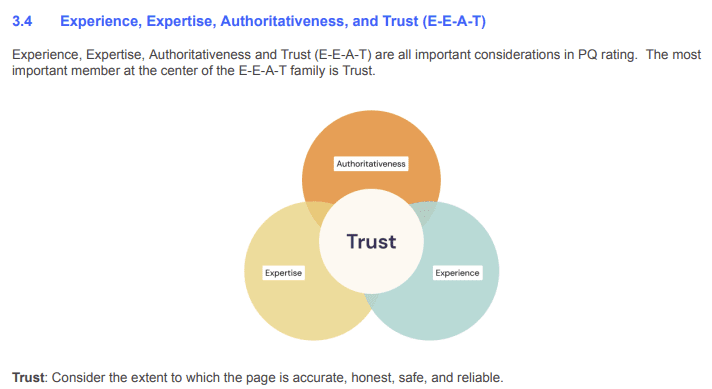
See the diagram below for how trust is placed in the center of Experience, Expertise, and Authoritativeness.

E-E-A-T diagramImage from Google, June 2023

Trust is the most critical component of E-E-A-T, Google says, “Because untrustworthy pages have low E-E-A-T no matter how Experienced, Expert, or Authoritative they may seem.”

Experience, expertise, and authoritativeness support a quality rater’s trust assessment.

If you’re following Google’s guidance regarding E-E-A-T up to this point, you’re well on your way to building the level of trust Google’s quality raters seek.

Here’s how to ensure you maintain that trust by demonstrating first-hand experience.

[Recommended Read] → Ranking Factors: Systems, Signals, and Page Experience

How to Demonstrate E-E-A-T For Your Brand

To demonstrate a high level of E-E-A-T, brands and content creators should focus on each of the four components:

  • Experience: Show that your content is created by people with direct, first-hand experience with the topic. This could be through author bios, “behind the scenes” content, or by directly referencing personal experiences within the content itself.
  • Expertise: Demonstrate your subject matter expertise through the depth and accuracy of your content and author credentials and by citing reputable sources and studies.
  • Authoritativeness: Build your brand’s authority by consistently publishing high-quality content, earning coverage and mentions from other respected sites, and growing your reputation within your industry.
  • Trustworthiness: Be transparent about who is behind your content, provide clear contact and customer service information, maintain a positive reputation, and follow ethical content practices.

How Google’s Quality Raters Evaluate E-E-A-T

Google’s Search Quality Rater Guidelines have multiple chapters evaluating E-E-A-T, from a high to a low level.

Chapter 4.5.2: Lowest E-E-A-T

Chapter 4.5.2 of Google’s Search Quality Rater Guidelines states:

“If the E-E-A-T of a page is low enough, people cannot or should not use the MC of the page. If a page on YMYL topics is highly inexpert, it should be considered Untrustworthy and rated Lowest. Use the Lowest rating if the website and content creator have an extremely negative reputation, to the extent that many people would consider the webpage or website untrustworthy.”

Chapter 5.1: Lacking E-E-A-T

Chapter 5.1 of Google’s Search Quality Rater Guidelines has examples of what quality raters are instructed to look for when evaluating a low level of E-E-A-T:

“Low quality pages often lack an appropriate level of E-E-A-T for the topic or purpose of the page. Here are some examples:

  • The content creator lacks adequate experience, e.g. a restaurant review written by someone who has never eaten at the restaurant.
  • The content creator lacks adequate expertise, e.g. an article about how to skydive written by someone with no expertise in the subject.
  • The website or content creator is not an authoritative or trustworthy source for the topic of the page, e.g. tax form downloads provided on a cooking website.
  • The page or website is not trustworthy for its purpose, e.g. a shopping page with minimal customer service information.”

Additionally, Google says a positive reputation cannot overcome the lack of E-E-A-T for the topic or purpose of the page.

Chapter 7.3: High Level Of E-E-A-T

Chapter 7.3 of Google’s Search Quality Rater Guidelines has information regarding the criteria for achieving a high level of E-E-A-T.

Regarding demonstrating experience, Google says:

“Pages with High E-E-A-T are trustworthy or very trustworthy. Experience is valuable for almost any topic. Social media posts and forum discussions are often High quality when they involve people sharing their experience. From writing symphonies to reviewing home appliances, first-hand experience can make a social media post or discussion page High quality.”

Chapter 8.3 Very High Level Of E-E-A-T

Chapter 8.3 of Google’s Search Quality Rater Guidelines has information regarding the criteria for achieving the highest level of E-E-A-T:

“Very high E-E-A-T is a distinguishing factor for Highest quality pages. A website or content creator who is the uniquely authoritative, go-to source for a topic has very high E-E-A-T.

A content creator with a wealth of experience may be considered to have very high E-E-A-T for topics where experience is the primary factor in trust.

A very high level of expertise can justify a very high E-E-A-T assessment. Very high E-E-A-T websites and content creators are the most trusted sources on the internet for a particular topic.”

E-E-A-T And AI Generated Content

The rise of advanced AI tools like ChatGPT has raised questions about how AI-generated content aligns with E-E-A-T guidelines.

Since the “E” in E-E-A-T refers to first-hand experience, content created solely by AI may struggle to meet these criteria for specific topics.

Google has advised against publishing AI-generated content without human review and editing. The company clarified that using AI isn’t inherently against guidelines, but the content must be evaluated for accuracy, usefulness, and compliance with other quality guidelines.

Marie Haynes, a respected expert on E-E-A-T and search quality, has been closely following the impact of AI on search. She notes that Google seems increasingly focused on rewarding original, high-quality content while devaluing generic or low-quality AI-generated content.

This aligns with recent developments like Google’s March 2024 Core Update, which resulted in the deindexing of hundreds of websites, many of which were found to contain significant amounts of AI-generated content.

This update and Google’s guidance on evaluating AI content for “originality” suggest that the search engine is actively combating the rise of low-quality, generic AI content that doesn’t meet E-E-A-T standards.

For brands and content creators, the key is to use AI to assist and enhance human-created content, not replace it entirely.

AI can help with research, outlining, and even drafting, but the final content should always be reviewed, edited, and enhanced by a human expert with real-world experience. This approach allows for the efficiency benefits of AI while still maintaining the E-E-A-T qualities Google values.

3 Examples Of Websites Demonstrating E-E-A-T

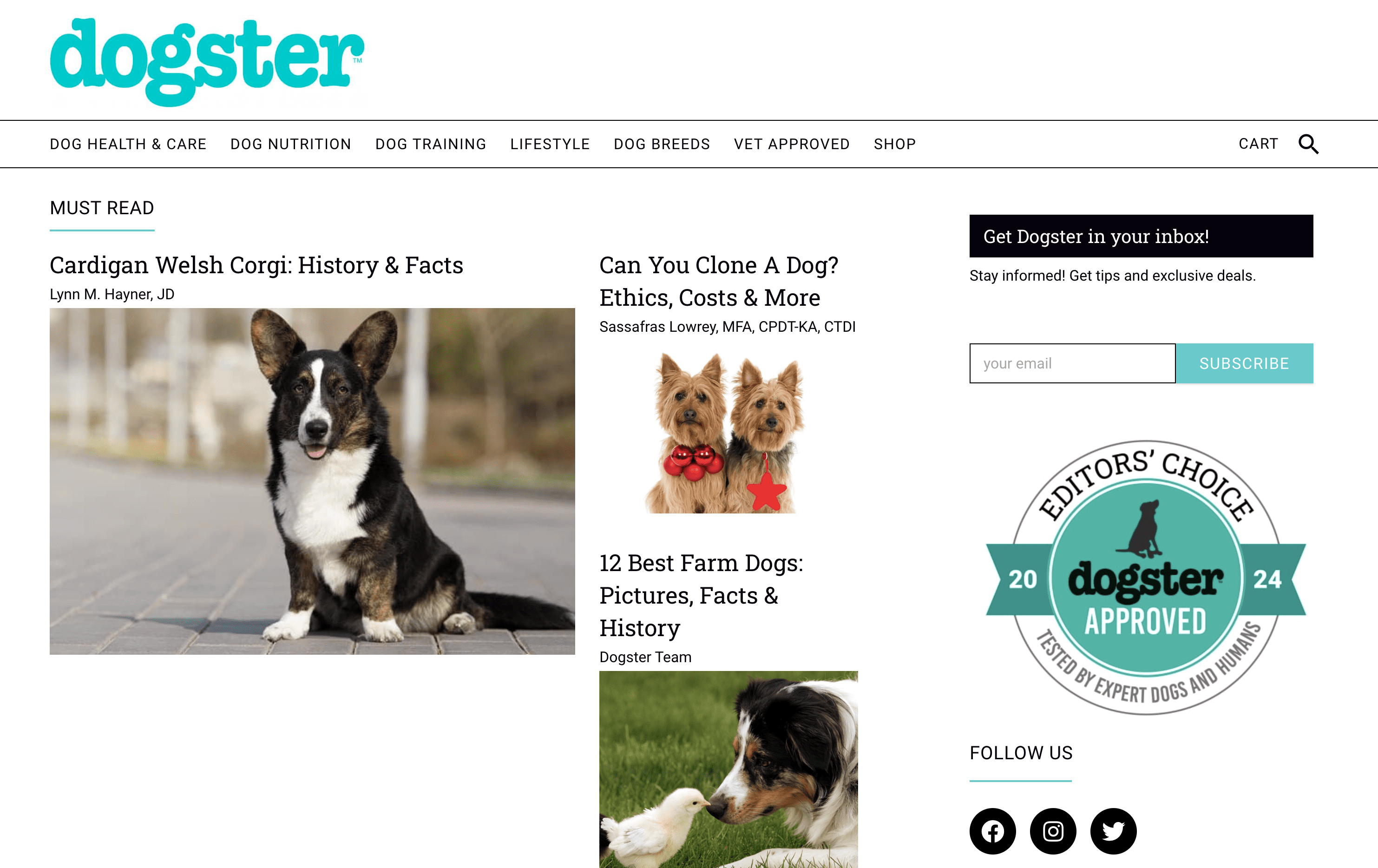
1. Dogster

Screenshot from dogster.com, March 2024

Dogster.com is a strong example of a website that demonstrates the principles of E-E-A-T (Experience, Expertise, Authoritativeness, Trustworthiness) in several ways:

  • Experience: Many articles are written by authors with relevant credentials and experience, such as veterinarians, certified dog trainers, and other canine experts. This suggests the content is informed by real-world, first-hand knowledge.
  • Expertise: The breadth and depth of topics covered, from dog health and nutrition to breeds and training, indicate a high level of subject matter expertise. The site provides detailed, informative content comprehensively addressing common questions and concerns.
  • Authoritativeness: Dogster.com’s reputation as a leading resource for dog owners, its use of expert authors, and its ability to secure interviews with recognized figures in the dog world lend it authority within its niche.
  • Trustworthiness: The site provides clear author bylines, links to additional resources, and disclaimers where appropriate. This transparency helps build trust with readers. The fact that veterinarians review content also enhances credibility.

2. GadgetMates

Screenshot from gadgetmates.com, March 2024

GadgetMates is an excellent example of a site that demonstrates E-E-A-T for several reasons:

  • Experience: GadgetMates is an established electronics repair center with brick-and-mortar locations in Las Vegas and Henderson, Nevada. Its team has firsthand experience repairing devices like iPhones, computers, game consoles, etc.
  • Expertise: The site’s extensive knowledge base of articles, guides, and tips showcases in-depth technical knowledge about electronic devices, repairs, and related topics.
  • Authoritativeness: As a top-rated, go-to repair shop in its local area with 5-star reviews across platforms like Google and Yelp, GadgetMates has built authority as a leader in its market. Customers widely trust the company for repairs on high-value devices, which speaks to its authoritative standing.
  • Trustworthiness: Several site elements point to GadgetMates’ trustworthiness and transparency, such as customer reviews and testimonials, clear contact info and location addresses, an “About Us” page, privacy policy and terms, and warranties. Offering free diagnostics also shows they aren’t just out to make a quick buck.

3. Homesteading Family

Screenshot from homesteadingfamily.com, March 2024.

Homesteading Family is another great example of a site that demonstrates E-E-A-T for the following reasons:

  • Experience: Josh and Carolyn Thomas, the site’s creators, have firsthand experience living a self-sufficient homesteading lifestyle on their 40-acre property in Idaho. They grow, preserve, and prepare most of their own food for their large family of 11 children, lending credibility to the information they share.
  • Expertise: The blog posts, videos, recipes, and classes demonstrate an in-depth knowledge of homesteading skills. The content provides practical, detailed information that reflects the creators’ expertise gained through years of study and practice.
  • Authoritativeness: Over time, the site has established authority in the homesteading niche. With an extensive library of in-depth content, an engaged community, appearances on major media outlets, a popular YouTube channel, and a podcast, the brand is well-established as an authoritative resource for this lifestyle. Other websites also frequently link to Homesteading Family articles.
  • Trustworthiness: Several factors indicate the site is trustworthy: the creators openly share their identities, photos, and stories; the “about” page provides background info; a clear contact page is provided; the content is high-quality and non-spammy; sources are cited; and a privacy policy and terms are posted. The personal, transparent tone also builds trust with the audience.

E-E-A-T Is A Sustainable, Long-Term Approach To SEO

Google’s evolution of E-A-T to E-E-A-T signifies a growing emphasis on first-hand experience in evaluating content quality. For SEO professionals, this means a renewed focus on creating content that demonstrates genuine expertise, experience, authority, and trust.

Key takeaways:

  • E-E-A-T is not a direct ranking factor, but optimizing for it can indirectly boost search performance over time.
  • First-hand experience is especially critical for YMYL topics, but it’s valuable for any content niche.
  • Demonstrate E-E-A-T through author expertise, citing reputable sources, building brand authority, and maintaining transparency.
  • When using AI tools, ensure human experts review and enhance the content to maintain E-E-A-T.
  • Studying examples of high E-E-A-T websites can inspire your own content strategy.

By considering these principles and consistently creating content that exudes E-E-A-T, you’ll be well-positioned to earn search visibility and user trust.

As search engines prioritize quality and credibility, investing in E-E-A-T is a sustainable, long-term approach to SEO.

More resources:


Featured Image: diy13/Shutterstock

Search Marketing Generalists Vs. Specialists: Pros And Cons via @sejournal, @coreydmorris

Search marketing is a unique aspect of digital marketing in that it requires multiple skills and “hats” to wear if you want to have a person or team manage it from end to end.

SEO, especially, requires more disciplines than just those with SEO titles. Even paid search requires more than just managing ads in a search engine ad platform.

Experienced search marketers should know the full range of what goes into SEO or paid search. However, they often will gravitate toward aspects of each discipline they like the most, are the best at, or have seen the most success with.

That could mean an SEO pro who is more focused on technical SEO, one who is focused on content, or even a backlink specialist.

UX design, copywriting, web development, and even IT overlap with both SEO and PPC responsibilities. Plus, depending again on the number of hats worn, measurement and analytics could be an outside resource, too.

There are a number of different types of people you can hire to your in-house digital marketing team, agencies you can hire, or others to partner with to work toward your search marketing goals.

Within each decision and type, you have pros and cons to face to make sure you get the right type of partner and resource to cover the range of needs you’ll have for SEO and PPC.

There’s no single right answer for everyone, and it is important to understand your needs and ensure they fit with the type of partner you select.

I encourage you to consider the pros and cons of both search marketing generalists and specialists to make the best decision for your needs.

Search Marketing Generalists

A search marketing generalist is a person or agency that does everything.

That could include both SEO and paid search. Within that, services could include all aspects of search marketing.

That means everything from strategy to tactics to measurement and everything in between.

Generalists: Pros

  • Single entity facilitating communication.
  • A deeper understanding of your brand and subject matter.
  • Greater accountability for performance is achieved by having one person/team/agency.

Generalists: Cons

  • Potentially lacking depth of expertise in granular areas of search compared to some peers.
  • Strategy and implementation may be more big-picture-focused and less tangible.
  • May lack experience in certain channels, networks, or aspects of search.

Generalists will have a lot on their resumes. If it’s an agency, it will do all aspects of search and likely a lot of other digital and traditional marketing as well. SEO may be a line item amongst many others.

That doesn’t mean they lack the skills necessary to be a good fit for you. However, you might need to dig deep during the interview process to ensure they have the depth of knowledge that you need for your brand.

There are a lot of advantages in the areas of communication, depth of connection with your business, and the cost of their salary or fees scaling well if a generalist.

You may not want to be a general contractor managing many specialists or agencies. Or, you may want one relationship to be ultimately focused and accountable for search performance.

You want to be careful when you have complex search issues that a generalist isn’t familiar with or able to address in depth.

If SEO or PPC are just a single line item on a resume or agency of record contract, you need to dig deeper to ensure their experience and what they bring to the table matches your needs and desires.

Search Marketing Specialists

A search marketing specialist is a person, team, or agency focused on a specific aspect of search marketing.

That could mean they focus on just SEO or PPC.

They could be even more focused than that on specific aspects of PPC or within the spectrum of SEO, like the technical layer or content.

Specialists: Pros

  • Deep expertise in specific channels, networks, or aspects of search.
  • Ability to go to extremes in troubleshooting and problem-solving.
  • Can go deeper than competitors.

Specialists: Cons

  • Likely further away from business outcomes and goals.
  • Lack of ability to manage broader effort and team.
  • More expensive resources and possibly more resources needed in total.

A specialist person or agency can bring a competitive advantage to your team. They can take your efforts to a deeper level than your competitors and solve some of the biggest business, digital, and search challenges.

Overall, with a specialist, you’re getting a resource who will bring strategy and recommendations and will be balanced in focusing on what works now and staying up to date on what is coming in the industry.

However, they can be more expensive on their own or when added up against other hires you have to make.

They might not integrate as well with your ultimate business goals because they spend their time deep in the subject matter. They might also have a limited toolset to bring to the job.

Conclusion

If you’re looking for a bias in this article and think you’ve found one, I’m okay with that. However, my goal wasn’t to overstate any pros and cons or endorse either search marketing generalists or specialists.

I think you lean a certain way on what you want or need in your organization.

While I own a digital agency focused on search, I could categorize my agency overall and its employees into both categories and see both sides of the generalist vs. specialist conversation.

There’s not a clearly defined line showing where a generalist vs. specialist starts and ends.

I like that aspect of both paid and organic search.

While I started my career as an SEO professional in the early days when I could do about 90% of the job by myself, I’m happy with how the industry has shifted over time away from being siloed and more into the mainstream.

My goal in this article – now that search is so much more mainstream in marketing plans – is to emphasize that there isn’t a one-size-fits-all solution or approach.

Whether building an in-house team, hiring an agency, or a combination of creative ways to resource search, it is important to know what resources you have, your strengths and weaknesses, and to set ROI expectations accordingly.

With so many people having SEO or PPC on their resume and so many agencies saying they do it, you really need to work to understand what you’re investing in so you get the right fit for where you are as a company and where you’re going.

More resources:


Featured Image: Wichien Tepsuttinun/Shutterstock