Google has announced that Prabhakar Raghavan, the executive overseeing the company’s search engine and advertising products, will be stepping down from his current role.
The news came on Thursday in a memo from CEO Sundar Pichai to staff.
Nick Fox To Lead Search & Ads
Taking over Raghavan’s responsibilities will be Nick Fox, a longtime Google executive with experience across various departments.
Fox will now lead the Knowledge & Information team, which includes Google’s Search, Ads, Geo, and Commerce products.
Pichai expressed confidence in Fox’s ability to lead these crucial divisions, noting:
“Throughout his career, Nick has demonstrated leadership across nearly every facet of Knowledge & Information, from Product and Design in Search and Assistant, to our Shopping, Travel, and Payments products.”
Raghavan’s New Role
Raghavan will transition to the newly created position of Chief Technologist.
He will work closely with Pichai and other Google leaders in this role to provide technical direction.
Pichai praised Raghavan’s contributions, stating:
“Prabhakar’s leadership journey at Google has been remarkable, spanning Research, Workspace, Ads, and Knowledge & Information. He led the Gmail team in launching Smart Reply and Smart Compose as early examples of using AI to improve products, and took Gmail and Drive past 1 billion users.”
Past Criticisms
This recent announcement from Google comes in the wake of earlier criticisms leveled at the company’s search division.
In April, an opinion piece from Ed Zitron highlighted concerns about the direction of Google Search under Raghavan’s leadership.
The article cited industry analysts who claimed that Raghavan’s background in advertising, rather than search technology, had led to decisions prioritizing revenue over search quality.
Critics alleged that under Raghavan’s tenure, Google had rolled back key quality improvements to boost engagement metrics and ad revenue.
Internal emails from 2019 were referenced. They described a “Code Yellow” emergency response to lagging search revenues when Raghavan was head of Ads. This reportedly resulted in boosting sites previously downranked for using spam tactics.
Google has disputed many of these claims, maintaining that its advertising systems do not influence organic search results.
More Restructuring
As part of Google’s restructuring:
The Gemini app team, led by Sissie Hsiao, will join Google DeepMind under CEO Demis Hassabis.
Google Assistant teams focused on devices and home experiences will move to the Platforms & Devices division.
Looking Ahead
Fox’s takeover from Raghavan could shake things up at Google.
We may see faster AI rollouts in search and ads, plus more frequent updates. Fox might revisit core search quality, addressing recent criticisms.
Fox might push for quicker adoption of new tech to fend off competitors, especially in AI. He’s also likely to be more savvy about regulatory issues.
It’s important to note that these potential changes are speculative based on the limited information available.
The actual changes in leadership style and priorities will become clearer as Fox settles into his new role.
There’s an elephant in the room, so let’s start there.
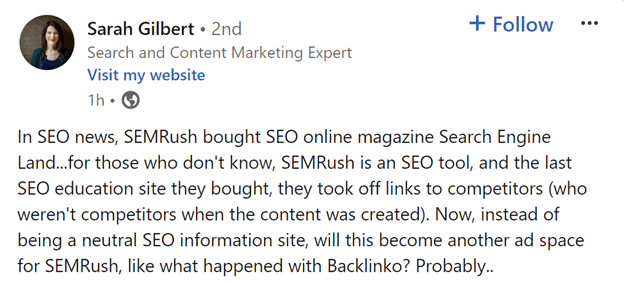
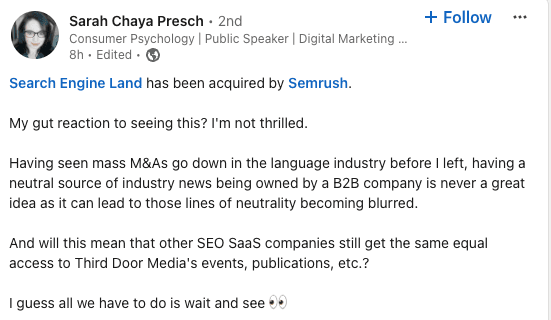
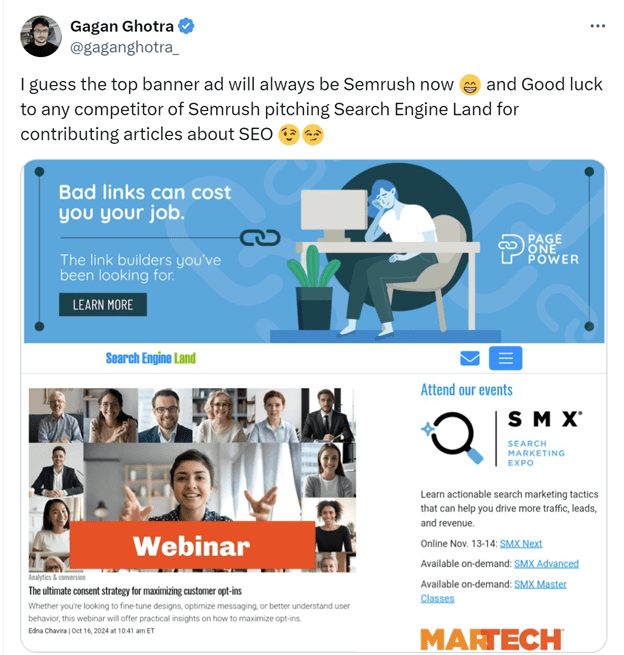
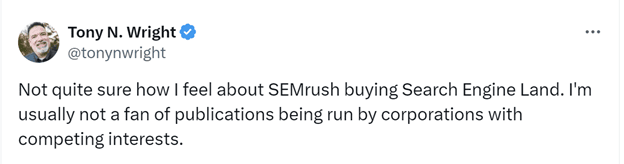
What happens when a large search marketing industry player buys a prominent media outlet focused on the search marketing industry?
Will the publisher’s coverage remain objective and agnostic? Will its authoritative guides include the breadth and depth of tools and platforms and services available – some of which are in direct competition with Semrush?
What happens to Search Engine Land’s reams and reams of existing content – articles, white papers, ebooks, videos – that refer to Semrush competitors (umm, not to mention their backlinks)?
What about credible viewpoints from respected authors that run counter to the new corporate party lines in some way? Will those voices still be published, amplified, quoted on SEL? Or watered down, or even silenced?
So many questions.
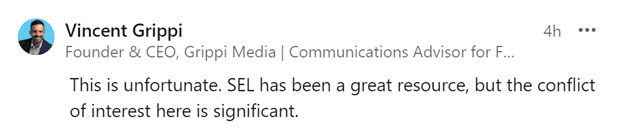
Community reactions, so far, have been either of a benign, congratulatory nature or else focused on concerns of bias.
SEL and Semrush both have been active in responding on social media, reiterating that:
“Our plan is to continue to remain independent and unbiased. Our goal is to provide quality knowledge as we always have.”
I do believe that these are their intentions for the existing editorial team, for now.
I’m curious to see whether this independence will stand the test of time, after the dust has settled and the news of this acquisition is lining our digital bird cages.
I’m interested in finding out if SEL’s editorial freedom will stand the test of shareholder interests in an NYSE-traded company that made $305 million in revenue last year. I think we will need to wait and see.
Here’s Where Search Engine Journal Stands
As one of the last independent publishers in the SEO industry, SEJ remains bootstrapped and unbossed.
No one pulls SEJ’s strings, controls our backlinks, our coverage, or our messaging.
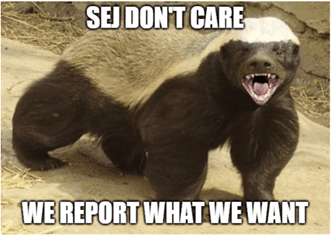
That’s right. SEJ is the honey badger of SEO journalism: We report what we want, when we want, how we want.
SEJ is still committed to reporting the truth (well, the truth until things change with the algorithms) about what is happening in SEO and marketing.
SEJ is still committed to providing unbiased education and best practices for our readers.
A.k.a. business as usual here at SEJ.
Who Is Search Engine Journal Anyways?
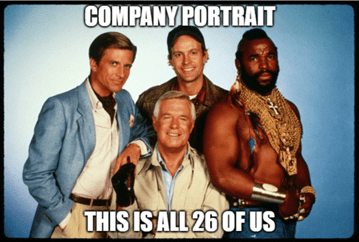
Our team of 26 folks around the world is made up of writers, editors, designers, technologists, the back office who keep things running smoothly, sales operations. They make me so proud, if I may brag a little.
We encourage transparency, experimentation, accountability. We don’t tolerate office politics or toxic behavior. I like to think we’re close-knit. We share, we cuss, we amuse each other with silly memes. We have laughed together and cried together.
Most importantly, when the sh* hits the fan, we pull together. We rally. We get gritty. Over and over. I ask the team to try again, to improve, to keep learning – and they do it. And that is when you know you have an A-Team on your hands.
That’s the entire roster 😎. SEJ has no investors. No corporate overlords. And we want it that way.
Our independence has been challenging at times. It would be nice to have a corporate Daddy Warbucks who can “darken the skies with people,” as one of my favorite consultants liked to say.
And so it does give me pause when a rival publisher is now backed by a multi-national company with over 1,000 employees. That’s a monumental amount of resources, firepower, and reach.
But over the years, SEJ’s independence has ensured our team’s ability to provide 100% unbiased journalism and education for the search marketing community.
We do what we want. And this is what I have faith in: That our readers, our advertisers, our community will provide what we need to be a formidable David to this new Goliath.
This week’s Ask an SEO column comes from an anonymous asker:
“What should a backlink profile look like, and how do you build good backlinks?”
Great question!
Backlinks are a part of SEO as a way to build trust and authority for your domain, but they’re not as important as link builders claim.
You can rank a website without backlinks. The trick is focusing on your audience and having them create brand demand. This can be equal in weight to backlinks but drives more customers.
Once you are driving demand and have created solid resources, backlinks start occurring naturally. And when you have an active audience built from other channels, you can survey them to create “link worthy” pages that can result in journalists reaching out.
With that said, and when all else is equal, having the trust and authority from a healthy and natural backlink profile can be the deciding factor on who gets into the top positions and who gets no traffic.
Search engines, including Google, expect a certain amount of spammy links from directories, website monitoring tools, and even competitors that spam or try to do a negative SEO attack. These are part of a healthy backlink profile.
What is unnatural is when your website or company has done nothing to earn an actual link.
When there is nothing noteworthy, no original thought leadership or studies, or something that goes viral and the media covers, there’s no reason someone would ever have linked to you.
Having backlinks for no reason would likely be considered an unhealthy link profile, especially if they’re mostly dofollow.
Healthy link profiles contain a mix of dofollow, nofollow, sponsored, and mentions from actual users in forums, communities, and social media shares.
Unhealthy backlink profiles are where a website has links from topically irrelevant websites, when the articles have mentions of big brands and “trustworthy” or “high authority” sites, and then randomly feature a smaller company or service provider with them.
It’s an old trick that does not work anymore. Unhealthy link profiles also include private blogger networks (PBNs), link farms, link wheels, link networks, and where the sites have a high domain authority (DA), Authority Score (AS), etc.
Bonus tip:DA, AS, and other metrics are not used by search engines. They are scores that third-party SEO tools created and have absolutely no say when it comes to the quality of a website or backlink.
If someone is telling you high DA is good and Google trusts these sites, they’re selling you snake oil.
Although backlinks are not as important as they used to be, backlinks still matter. So, if you’re looking to build some, here are a few strategies to try, avoid, and tread lightly with.
Scholarship, Grants, And Sponsorships
These don’t work. Google knows you’re offering them to get .edu links, and in rare cases .gov links. And definitely from charities and events.
It’s easy to map back to who paid or bought them, and these likely won’t count for you SEO-wise.
If they make up the majority of your links, you should expect them to be neutralized by the search engines or to get a manual action against your site for unnatural link building in Search Console from Google.
If you’re doing a sponsorship, ask for the website being sponsored to place “sponsored” instead of “nofollow.”
And if you’re doing a scholarship or grant, feature the winner on your site, provide a full education and follow up about them, and have them share their story for the next few years in a monthly or quarterly column on your blog.
If you genuinely want to do good, share their story and progress. Otherwise, it was just for getting backlinks, and that works against you.
Citations And Broken Links
When you get mentions in the media, or a competitor has a naturally occurring link to a study, but it goes to a broken page, this is a good way to build a natural link. Reach out to these sites and ask them to link to your study instead.
You can mention their visitors are currently hitting a dead page if it’s a broken link, and present your study or resource, which is of equal or better value. Or share that yours has been updated where the current source is outdated and no longer applies.
For citations where nobody has a link, try letting the website owner know it saves the user a trip to a search engine to find another answer. And when they have a good experience on the website, they’re likely to come back for more information.
Topically Relevant PR
I’m a big believer in PR to acquire backlinks naturally. But you have to do things that make sense for your business.
Local stores and service providers should get links from local news stations, local bloggers, and niche websites in their industry.
Service providers need to focus on trade publications, industry-relevant blogs and publications, events, and social networks.
Stores will do well with niche and audience-relevant bloggers, communities, publications or media websites, and mass media coverage that is not affiliate links or in an affiliate folder.
Think about what is newsworthy that you can do or provide that these groups would want to cover.
PR and SEO agencies that work with content will be able to provide ideas, then you can choose which ones you like and run with them. Not every campaign will work, but hang in there – the right one will happen.
You can also try surveying your audience for original data points and studies, and then publish them. And that goes to the next tip.
The publications must be topically relevant to you in order to help with SEO and avoid penalties.
If your customers and users are not the reader base of the website or publication, the link and coverage will appear unnatural and you’ll eventually get penalized or a devaluation.
Press Releases
Press release backlinks and syndication backlinks work against you, not for you. But that doesn’t mean they cannot help with link acquisition. For this strategy to work, provide enough data to gauge interest.
Share some of the data points from the study as a teaser and give a way for editors, journalists, and industry professionals to reach out to you.
Don’t charge for the study. But ask them to source and cite the data on your website, or reference your company as the source of the information.
But keep in mind that if your talking points are the same as your competitors, and you have the same type of data, there’s no reason to add another citation or to cover you.
What can you discover and share that hasn’t been covered and will enhance the publication’s articles in a new way? Put yourself in the reader’s shoes and think about what is missing or what questions were not answered.
If comments are enabled on the publications, look for questions and build a resource backed by data that answers them.
You can then reach out to the editors and make a strong case to either add you or create a new post about the new topic since the previous one did well.
Bonus tip: Even if you don’t get a backlink, being cited can go a long way, as you may be able to use the company’s logo in your PR bar as a trust builder. You can also reach out to the PR or brand team and ask for the link using the citation strategy mentioned above.
Blog And Forum Commenting
This does not work. Search engines know that anyone can go and spam these, use a bot, or pay someone to do this.
They will work against you, not for you. Just don’t. Let the communities and site owners link to you naturally.
If your customers are on the blog or in the community, join the community and participate. Use it to acquire an audience and build trust for your brand.
Not for backlinks. The backlinks and community mentions will eventually happen. And this is how they can become natural.
Social Media Profile Links
This does not work because anyone can create an account and get the link.
Links for SEO must be earned. Social media is about building an audience and bringing them to your website.
The backlinks are useless for SEO, with one exception. Some search engines crawl and index accounts.
If you struggle to get crawled, an active social media account that gets crawled and indexed fast may be able to encourage spiders to find your website and pages more easily.
Focus On Being Worth Linking To
There’s no shortage of ways to get backlinks, but not all links are good. If the link can be purchased or acquired by anyone, like a directory, it won’t help you with SEO.
If your customers are not on that website, and the majority of the website isn’t topically relevant to you, chances are the backlink will work against you.
Healthy link profiles have a mix of good and bad, natural and unnatural. If your company hasn’t done or shared anything link-worthy, there are no backlinks that can bring you long-term success.
Focus on being worth linking to, and the backlinks will come naturally.
More resources:
Featured Image: Paulo Bobita/Search Engine Journal
Google Flights and Google Hotels have dominated travel-related Google search terms in recent years, which has been seen as a threat by many travel operators.
However, if approached properly, the growth of Google Travel represents an opportunity for those who adjust their strategy.
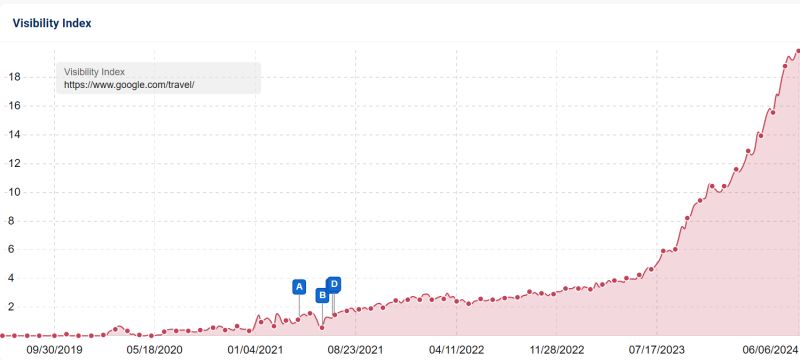
SEO expert Lily Ray shared the Google Travel graph below on a LinkedIn post a few months ago. It only takes a quick glance to see significant month-over-month growth of Google’s/travel/ directory across travel-related search terms.
Screenshot from LinkedIn post by Lily Ray, June 2024
This is despite the fact, as Lily points out, that Google Travel results don’t appear to be the most comprehensive or helpful, which are presumably key criteria when it comes to organic visibility.
In fact, in many cases, when you search for a city-specific phrase on the main Google Travel page, it simply takes you to a Google search results page for the city, where your search begins anew.
Google-dependent travel companies look at the rapid growth of Google Travel and see one thing: a threat to their existence.
However, remember, Google is not acting as an agent for most of these transactions, so you can still perform and grow online.
You simply need to adapt your strategy and establish your authority, relevance, and experience to give your brand the best opportunity to show up on Google Travel surfaces along with your own pages in organic search results.
We’re going to assess four specific travel surfaces: Google Flights, Google Hotels, Google Vacation Rentals, and Google Explore. We’ll unpack the following for each one.
Google Travel structure and appearance in Search.
Who’s currently winning with Google Travel.
Optimizing to appear in Google Travel spaces.
Note: There is one other surface, Google Things To Do, which is currently only available as a Google Ads product, but did live until November 2023 under the Google Travel page. From an SEO perspective, “Things To Do” can be found as a list of things to discover within Google Explore. We’ll touch on this further when discussing how to optimize for this surface.
Understanding Google Travel’s Structure
In case it wasn’t clear from the graph above, Google Travel is huge. And by huge, I mean huge.
There are effectively two levels to Google Travel when it comes to organic search.
1. Google Travel SERP (Search Engine Results Page) Features
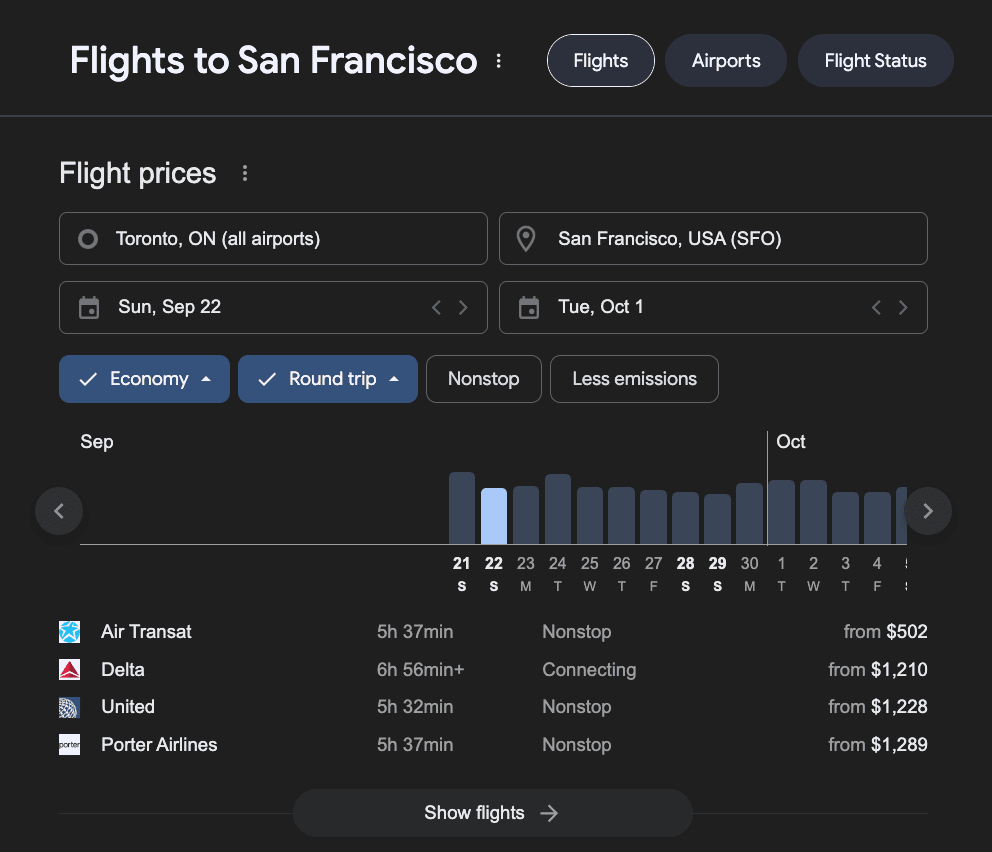
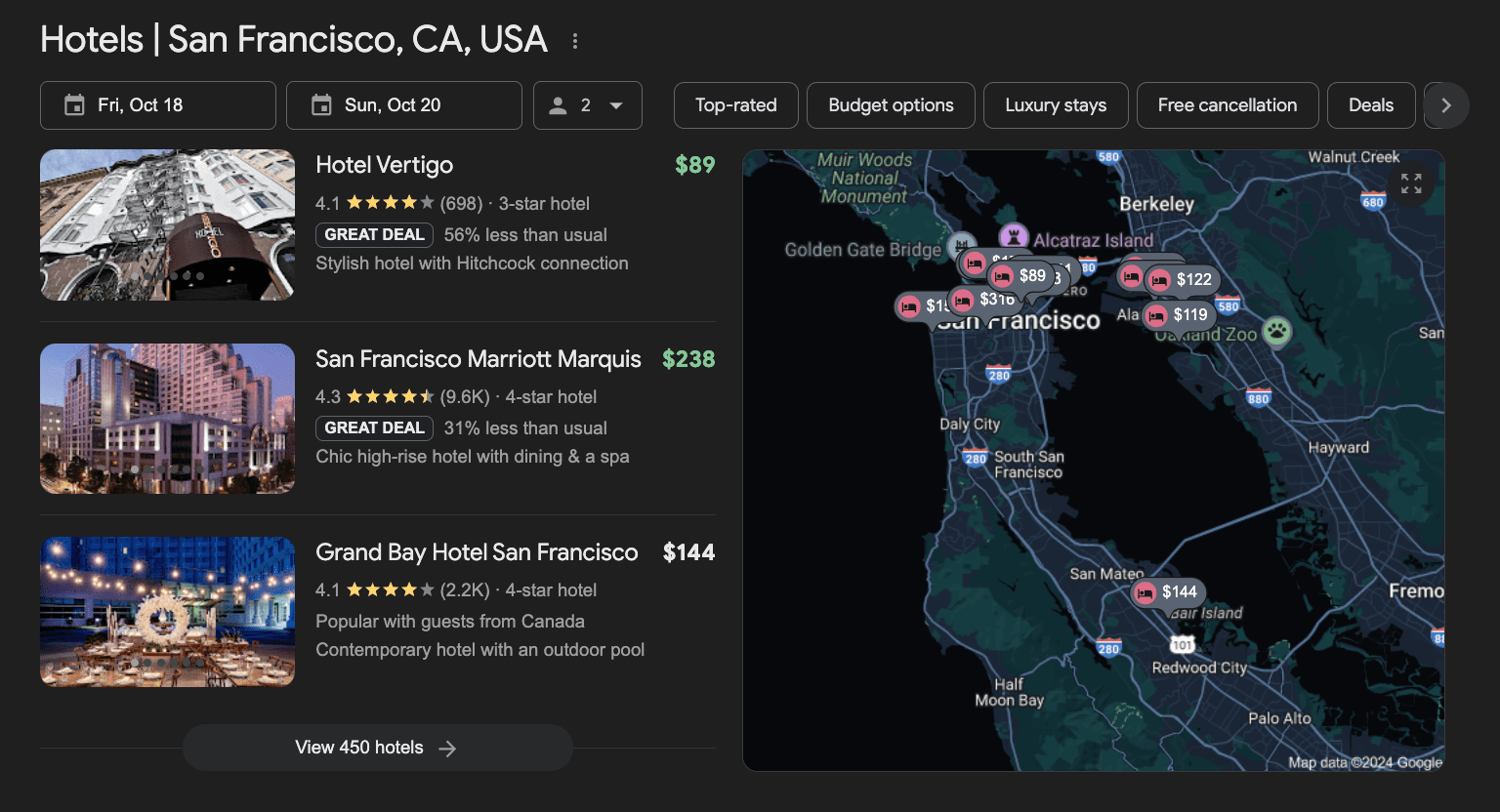
Google Travel SERP features, which are effectively listings of flights or properties along with location, date, and other feature filters to help searchers choose the best flight, hotel, or vacation rental option to suit their needs.
Typical travel SERP features for flights, hotels, and vacation rentals look like this:
Screenshot from search for [flights to san Francisco], Google, August 2024
Screenshot from search for [hotels in san francisco], Google, August 2024
2. Google Travel Organic Pages Appearing As Typical Organic Search Engine Results
Screenshot from search for [cheap flights from austin to san francisco], Google, August 2024
Screenshot from search for [hotels in san Francisco], Google, August 2024
This review will focus on the latter of the two because these are the easiest to measure.
We also assume, in most cases, that when one of the organic results appears, there’s a high likelihood the SERP feature will also appear at the top of the page.
Semrush recognizes over 750,000 Google Travel pages in the U.S. alone.
Assuming Semrush’s crawler won’t crawl and index every single page, it’s very reasonable to assume the actual number of Google Travel pages exceeds 1 million in total.
Google Travel Page Structure And Appearance In Search
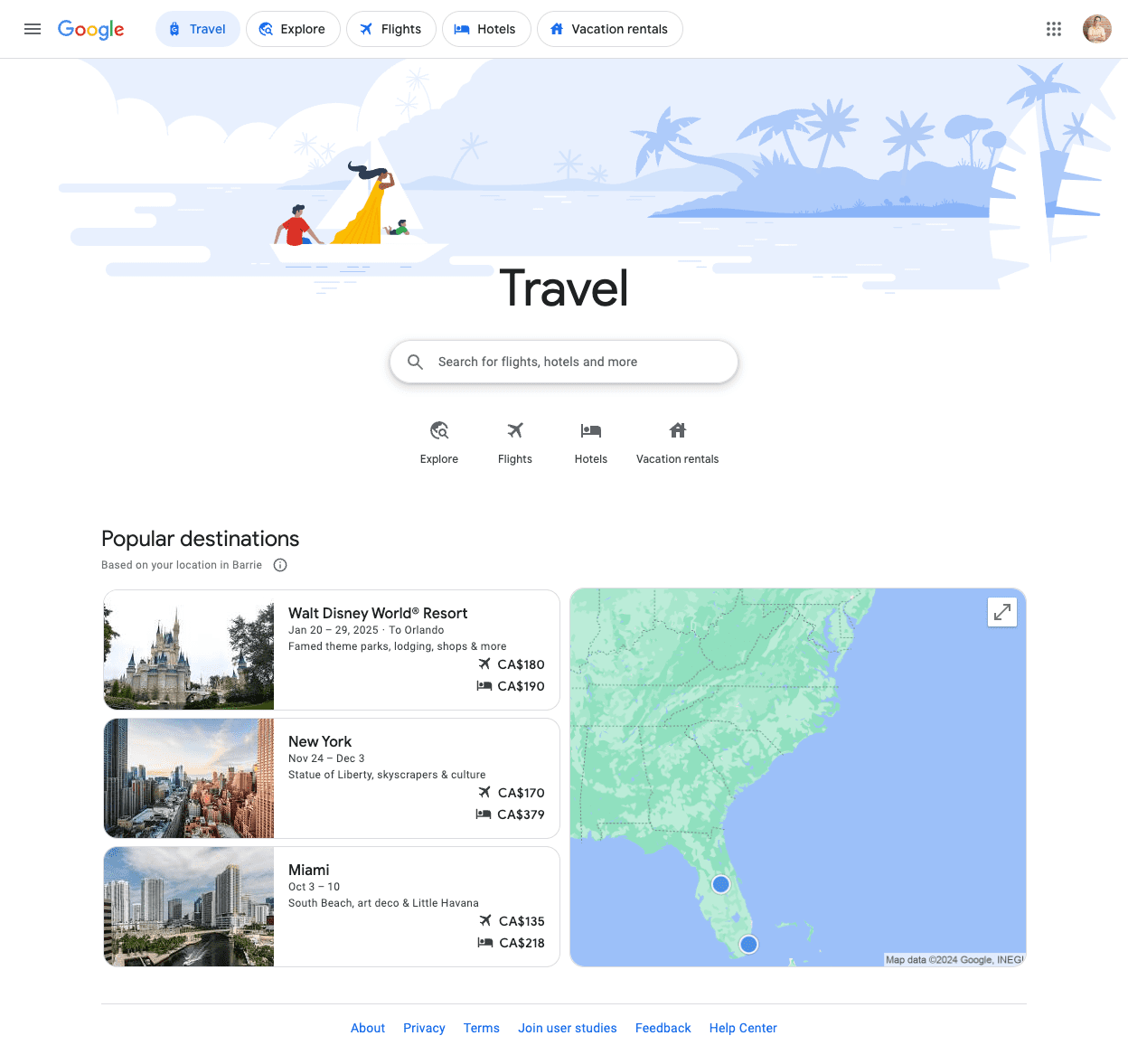
The main Google Travel page is pretty bare bones with “Google” as the title tag, one H2 heading labeled “Popular Destination” and a grand total of 124 words.
Not exactly an exercise in SEO best practice, but then again, this page at least does not rank well for the term “travel.”
Screenshot from Google Travel Home page, September 2024
Flights
The Google Flights page, by comparison (at the time of writing), ranks in the top 3 for the terms “travel,” “flights,” and many other high-value keywords.
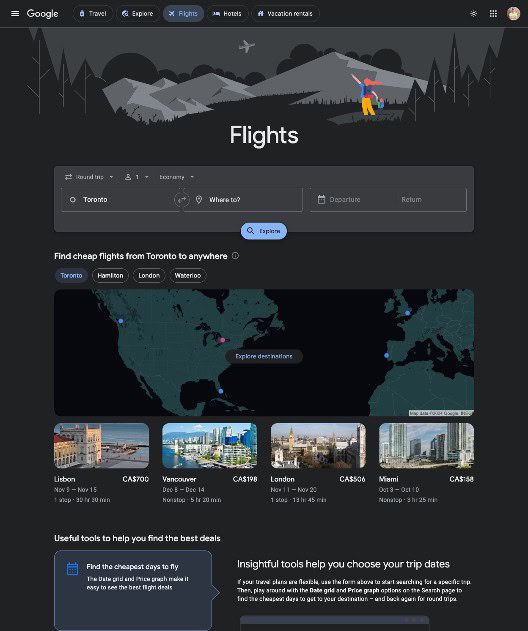
This page offers a much more robust user experience with flight search, an interactive flight search map, useful tools to find the best deals, FAQs, and links to popular flight departures/destinations.
However, this page is specifically focused on air travel, whereas all other page one results are more holistic in their broader travel offerings.
Screenshot from Google Flights Home page, September 2024
The primary function available on the Google Flights page is a flight search, which, when enabled, provides a short list of the “Best departing flights” (“ranked based on price and convenience”) followed by a much longer list of “Other departing flights.”
It is good to note how best-departing flights are being ranked when it comes to determining how to appear in this list.
There are also opportunities to track prices or compare pricing via a date grid or price graph tied to your selected travel dates.
Hotels
Google no longer appears to have a dedicated Hotels page per se, as google.com/travel/hotels currently redirects to a Google Hotels search page that has a title tag, “Discover Hotels For Your Next Trip – Google Hotels.”
Similarly, there is no Google Vacation Rentals page, but there is a Google Vacation Rentals search page, which has a title tag that is simply “Google Hotel Search.”
Curiously, google.com/travel/vacation-rentals does not currently exist.
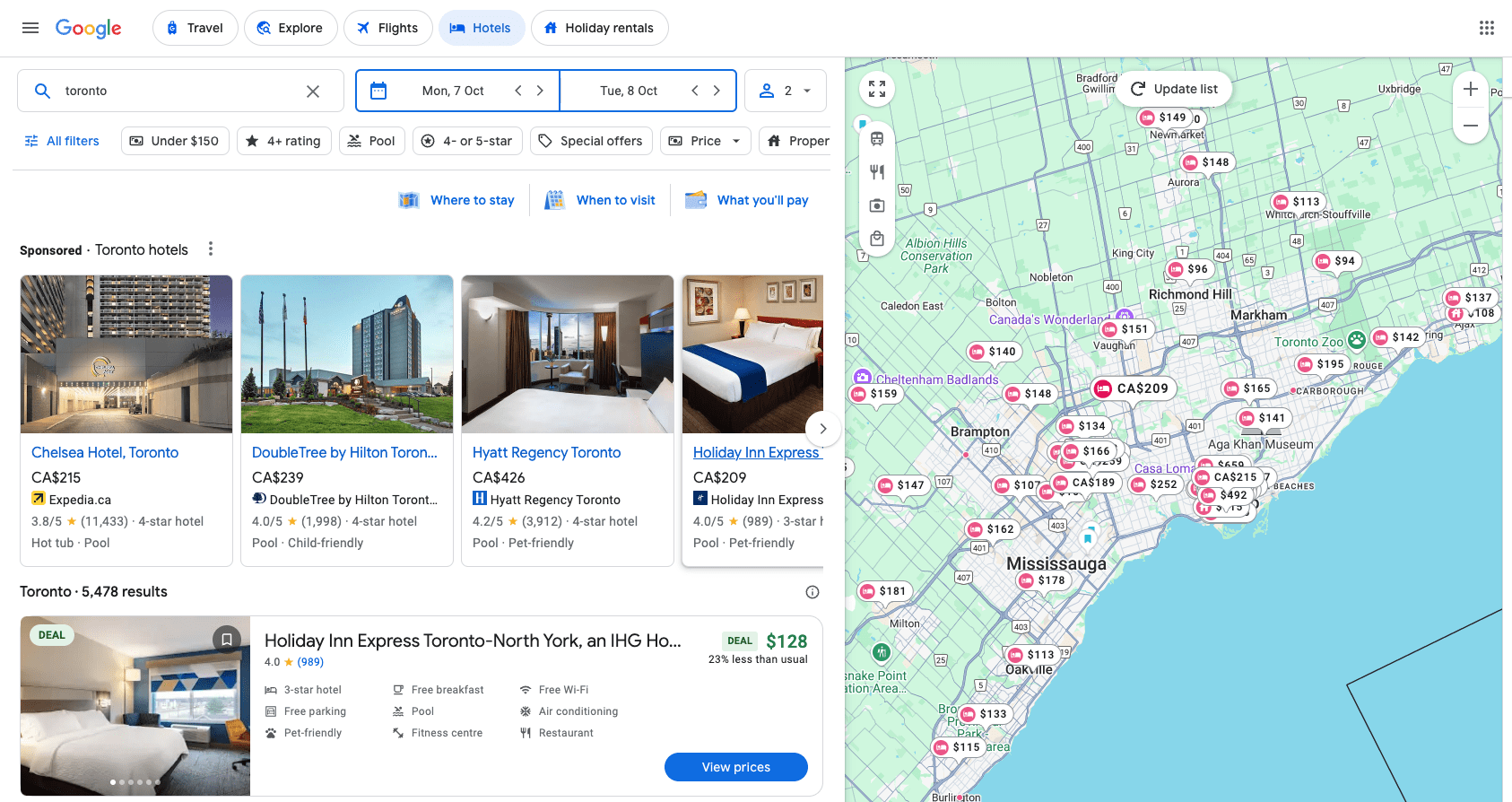
As you can see in the screenshot below, Google Travel Hotels are tightly integrated with Google Maps. Filters enable searchers to refine their needs based on price, ratings, stars, amenities, and other factors.
Also note that hotels offering “Deals” are highlighted with green buttons and pricing, and they generally rise to the top of the search results, much like best-departing flights. This is not the case with vacation rentals.
The above are important factors when considering how to optimize for appearance in these search results.
Screenshot from search for [toronto hotels], Google, September 2024
Vacation Rentals
Google Vacation Rentals are similar to hotels, displaying a filterable listing of properties alongside an interactive Google Map.
However, searchers are required to click on a result from the list or map, which then provides additional lists of “Booking options” and “Additional results from the web.” Both lists provide booking options, but being found under the actual “booking” category is obviously more valuable.
Each listing includes an Overview, Prices, Reviews, Photos, and About section. The quality and quantity of content contained in each of these undoubtedly factor into how properties are ranked and displayed.
Screenshot from search for “toronto vacation rentals”, Google, September 2024
Explore
The last component of Google Travel to consider is Explore.
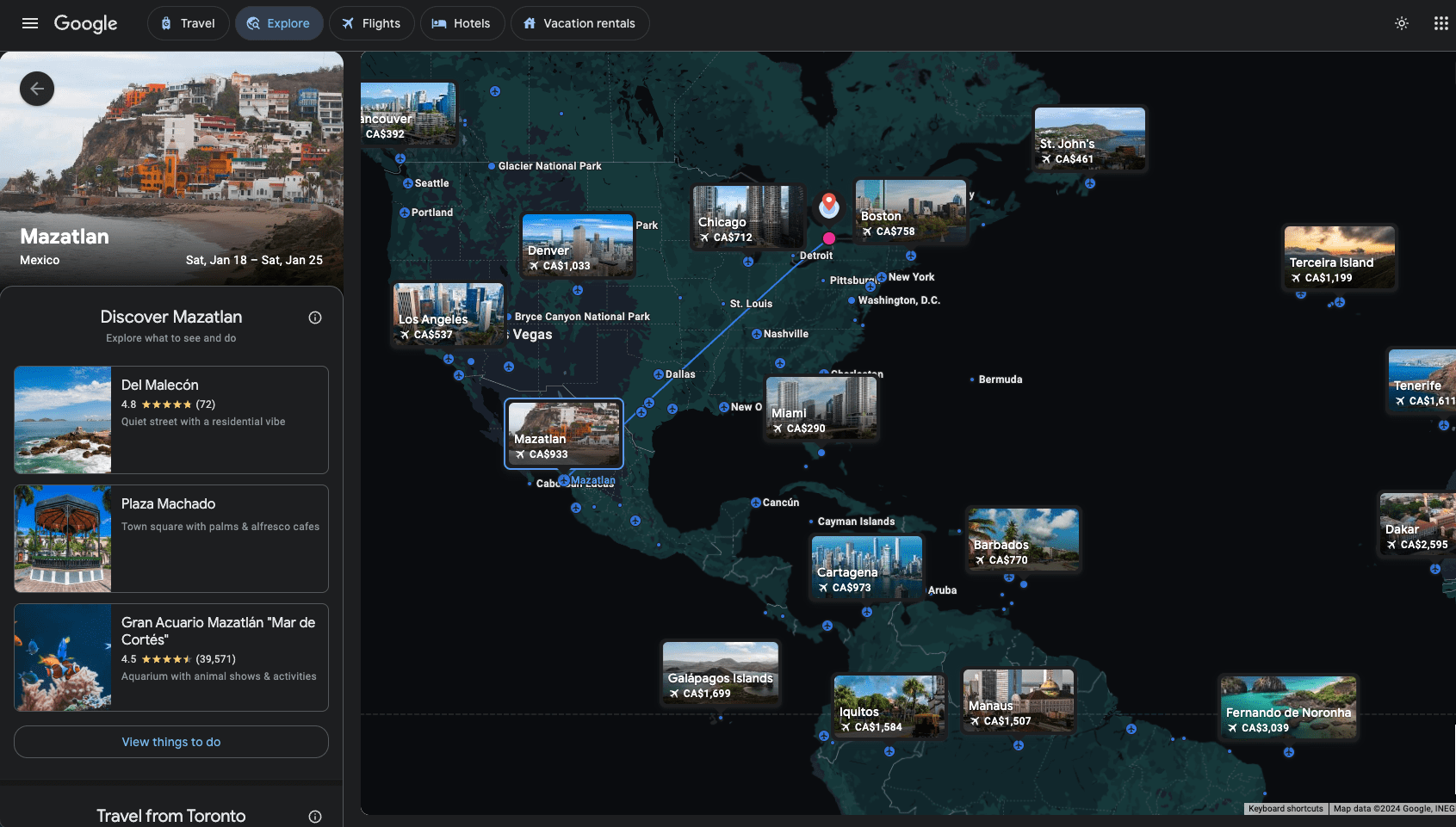
As the name suggests, Explore is focused on enabling travelers to search for new destinations or look for deals based on their budget and travel dates (important to note for brands keen to be found here).
Explore is effectively a filterable, interactive map displaying thumbnails of potential destinations with flight prices, which, when clicked, extends into a fuller view of ranked things to do, places to stay, flight options, information on when to visit, and questions asked by other travelers.
The title tag for this interactive page is dynamic based on the starting location chosen by the user, e.g., “Toronto to anywhere | Explore.”
As mentioned earlier, things to do/discover appear at the top of an Explore results page.
The “things to do/discover” on Explore appear to be the most popular local places and attractions, which have been optimized from a local SEO perspective. Reviews are front and center here, as they are in the Google Map Pack.
The Help button on Explore indicates, “These destinations are ranked mainly by popularity, and the cost and convenience of travel from your location. Factors include frequency of mentions across the web, destination search queries, travel time, number of stops, and airport changes during layovers.”
It is interesting and important to note the inclusion of “frequency of mentions across the web” as a ranking factor.
Screenshot from Google Explore Home page, September 2024
So, Who’s Currently Winning With Google Travel?
While some brands view Google Travel as a threat and with disdain, others see an opportunity and are reaping the benefits of having another highly visible channel through which to access their customers.
As Kevin Indig recently pointed out, large brands have an advantage, as this plays an increasingly significant role in search visibility.
A quick review of Google Travel Spaces reveals the following players managing to gain prominence:
Google Flights
As you’d expect, the major airlines, buoyed by their significant branding and authority, dominate Google Flights.
However, there certainly is an opportunity for lesser-known discount airlines/brands to appear, particularly under best-departing flights where the key driver is price.
Google Hotels
Here, major hotel chains and online travel agents (OTAs) like Expedia and Booking.com rule again.
However, opportunities clearly lie in Google Maps and local SEO, where smaller, local businesses can leverage their “local authority” and gain visibility.
On the Google Vacation Rentals side, attention should be paid to OTAs like VRBO and Booking.com, which are also highly visible and appear in the Booking Options list mentioned earlier, so property owners certainly should leverage these.
However, there are several other property types of online agents (e.g., glamping, short-term rental) who also appear.
As with hotels, vacation property owners should certainly look to leverage their local standing to garner attention and build authority.
Google Explore
The brands that appear to be winning in Google Explore tend to be those offering deals or popular experiences personalized to the searcher’s location and historical preferences, which plays to the desires of the perceived audience search.
As noted, the things to discover/do appearing in Explore will be the most popular attractions and experiences, which have gained local organic search authority.
Optimizing To Appear In Google Travel Spaces
In light of the organic search visibility, Google Travel spaces are able to achieve, travel brands are well advised to do whatever they can to optimize their web presences to gain visibility in these coveted spaces.
Below are some factors and suggestions for each space, considering how content appears to be prioritized for display in each.
Google Flights
To be clear, to appear on Google Flights, you must first be an airline operator offering flights to consumers.
If you are part of such an organization, these recommendations are for you.
Schema Markup
Implement flight schema markup on your flight listing pages to provide Google with structured data about your specific flight offerings (i.e., departure/arrival airports, dates, prices, etc.). This will help Google better understand your content and improve your Google Flights results visibility.
Competitive Pricing
Price is a major factor in Google Flights rankings. Regularly monitor your competitors’ prices and ensure your fares are competitive.
Consider offering special flight deals or promotions to garner attention for specific flights or destinations.
Landing Page Optimization
Create dedicated, keyword and user-experience-optimized landing pages for specific flight routes, destinations, or promotions.
Ensure a clear call-to-action (e.g., “Book Now”) exists, and a straightforward booking process is in place.
Website Technical SEO
Make sure your website has a solid technical foundation (fast loading times, secure connections, logical page and navigation structure, mobile-friendly design, etc.). Technical issues can negatively impact your overall search visibility.
Google Hotels
Google Business Profile Optimization
Claim and optimize your Google Business Profile (GBP) to enhance your local authority. Ensure all information is accurate and up-to-date (address, phone number, hours of operation, photos, etc.).
Encourage guests to leave reviews on your GBP and respond to those reviews in a timely manner. Positive reviews and response rates can help boost your rankings.
Post content regularly to your GBP to demonstrate your commitment to community and customer engagement.
Hotel Ad Campaigns
Consider running optimized Google Ads hotel campaigns in concert with your SEO efforts. While not organic in nature, this tactic will enable you to have your hotel’s rates and availability displayed directly in Google search results, on Google Maps, or YouTube. Focus on ads for keywords you do not already maintain high organic rankings for.
Website Optimization
Optimize your website for relevant keywords, user experience, and conversions.
Highlight key selling points (amenities, location, unique features) and include high-quality photos and videos.
Ensure your booking engine is easy to use and mobile-friendly.
Incorporate a blog or other content marketing device as a means to publish fresh, relevant content linking to your primary product pages.
Local SEO
Identify and obtain local citations from relevant sources (listings on online directories and review sites). Consistent NAP (Name, Address, Phone number) information across the web is crucial for local SEO.
Engage with your local community and build relationships with other businesses in your area.
Google Vacation Rentals
Listings On Major Platforms
Consider listing your vacation rental properties on major OTAs already integrated with Google Vacation Rentals (e.g., Vrbo, Booking).
Optimized Property Descriptions
Craft compelling and detailed property descriptions highlighting your properties’ unique features and amenities.
Include relevant keywords in your property descriptions.
High-Quality Photos
Include professional-quality photos, videos, or virtual tours on your property pages, as these are essential for attracting bookings. Showcase your property in the best light.
Be careful when adding high-quality image or video content to not negatively affect page load or overall user experience, particularly on mobile devices.
Competitive Pricing and Availability
Regularly review your pricing strategy and ensure your rates are in line with similar properties in your area.
Keep your calendar up-to-date and respond promptly to all booking inquiries.
Ask For And Promptly Respond To Reviews
Reviews are prominently displayed under Vacation Rentals and, as such, should be actively pursued and responded to. These will both factor into rank and will no doubt be referenced when consumers are considering booking a property.
Google Explore
Competitive Pricing
Ensure your prices are competitive, considering a fair percentage of consumers on Explore are looking for deals. Highlight any promotions or discounts.
Off-Site Optimization
Google’s inclusion of “frequency of mentions on the web” as a ranking factor in Explore clearly indicates that user-generated content on social media or other external forums like Reddit is being reviewed and referenced.
As such, it will certainly benefit travel brands to be actively engaged with consumers on these platforms.
Consumers of all ages are looking outside of Google to conduct their travel planning and share their experiences. Brands that aren’t monitoring and engaging on these channels are missing out on significant opportunities to extend their reach and build their authority.
Use High-Quality Visuals
Invest in captivating photos and videos to showcase your destination or property. Consumers on explore are searching for unique, new experiences, so provide content that will catch their eye and imagination.
Create Appealing Destination Descriptions
Craft enticing descriptions highlighting the unique features your destination or travel experience has to offer, complementing the visuals noted above.
Up-to-Date Information
Keep your listings updated with accurate pricing and availability, as many consumers may be looking for last-minute travel opportunities.
GBP Optimization For Those Offering Things To Do
As things to do/discover are effective Google Map Pack results, the same suggestions apply as those mentioned for Hotels.
General SEO Best Practices Across All Platforms
Outside of the Google Travel-specific suggestions above, there are several other general SEO best practices site owners should employ to maximize their authority.
Mobile-First Approach
In today’s mobile-driven environment, which is particularly true for consumers exploring or planning their next travel experience, it is critical to have a site that loads quickly and seamlessly on mobile devices.
Content Marketing
A significant component of establishing online authority is having the answers to all of the questions searchers have regarding any given topic.
With travel planning, questions regarding destinations, transportation, accommodation, scheduling, cost, and other considerations abound.
It is essential for travel brands wanting to establish authority to have unique, helpful answers to all of their audiences’ questions via a content strategy that may take the form of blog posts, guides, videos, photos, podcasts, or other content marketing vehicles.
High Quality, Relevant Backlink Acquisition
Despite ongoing arguments about their validity and value, contextually appropriate backlinks obtained from domains with high authority and high relevance, will have a positive effect on a website’s authority by extension.
Travel brands looking to increase their authority should endeavor to establish strong partnerships, conduct digital PR, and obtain high-value backlinks from such sources.
What’s Next For Google Travel?
SEO is ever-changing, and this will be no different from what Google Travel is concerned with. Google AI Overviews have been rolled out in full and are being returned in search results across a number of categories.
They are not currently highly prevalent in travel, but there is no doubt AI is already part of the travel search experience. Something like AI Overviews, where searchers can interact with results to build their ideal trip plan more naturally, is coming.
Google Explore is already an interactive experience, and I’m fairly certain this will continue to evolve, powered by AI.
The good news on this front, as per a recent SEO Clarity research study, is SEO for AI Overviews is, at this point, very much the same as traditional SEO.
This study reveals in the top ranking, organic search results and sites/content make up the bulk (~99%) of what’s presented by AI Overviews.
Your Google Travel SEO Plan
The impact and dominance of Google Travel in organic search results is undeniable.
The question becomes, how do savvy travel marketers take advantage of, rather than shy away from, the challenge of being found in Google Travel spaces?
The focus, from an SEO perspective, should be on many of the traditional SEO and local SEO best practices aimed at establishing authority and trust among consumers, as prescribed in the past.
More resources:
Featured Image: PeopleImages.com – Yuri A/Shutterstock
Schema Markup is a key SEO strategy for brands that want to stay competitive in this new world of search.
Implementing robust Schema Markup can enable brands to improve their SEO performance by:
Helping search engines understand, contextualize, and disambiguate the content on their site – which allows search engines to show users more accurate results and drive more quality traffic to their site.
Achieving enhanced search results, specifically rich results on Google – which has been proven to increase click-through rates to webpages.
That said, implementing a proper strategy can be tedious and time-consuming. In addition, cross-functional coordination between content, IT, and SEO teams is required for this strategy to be done right.
In this article, we’ll help you figure out if your organization is ready to do this strategy and the right timing for you to kickstart your journey.
Is Your Website Ready For Schema Markup?
Let’s start by talking about the foundational elements you need to have on your website to get a positive ROI from doing it.
Before doing it, your website must have a solid technical SEO foundation. This includes (but is not limited to) pages on your site being indexable by Google and other search engines, your website having a fast load speed, and your website being mobile-friendly.
These technical SEO factors contribute to your visibility on the search engine results page (SERP). Without them, you may not yield the desired outcome from your investments.
In addition to these technical SEO factors, your website should have sufficient content for you to translate into Schema Markup.
Over the years, Google has emphasized the importance of helpful, people-first content and even made it part of its core ranking systems. This approach also requires robust, helpful, people-first content.
Is Your Content Ready For Schema Markup?
Content To Achieve Rich Results
Historically, the improved click-through rate from applying the structured data stemmed from pages achieving rich results on Google.
A rich result is an enhanced search result that includes additional visualizations like stars, pricing, or images in the search result.
As of today, there are over 30 rich results available, each with its own required Schema.org properties and content guidelines to adhere to. Since you can only markup content visible on your page, you must have the content available on your site to use the required Schema.org properties.
For example, to achieve a review snippet for your physician page, you need content on the rating count, rating value, review count, and the physician being reviewed.
Content To Describe Your Entities In Detail
Rich results aside, your website content should also describe the key “things” or entities related to your organization.
Entities are the most important things your customers need to know about your organization so they can engage or buy from you.
Your website is where you provide all the details about these entities, and this technique is what you can use to ensure search engines clearly understand the details about them and how they are related to other things on the internet.
When search engines can understand and contextualize your content with greater accuracy, they can present it to more relevant search queries.
When you have the content to achieve a rich result and semantic understanding, an even higher click-through rate can be achieved.
Content Formatted For Scale
For larger websites, your page layout is also a crucial content factor to consider before doing markup. We recommend having a consistent page layout for each pageset if you want to do it at scale.
For example, if you are using Adobe Experience Manager (AEM), you should use the same AEM components on your product pages.
This enables vendors or your IT team to implement this approach at scale, with consistency and accuracy.
In summary, this is what you need to have before you start doing the markup:
Good news: If you have these done, you will be ready to start your journey.
Key Events That Indicate It’s Time To Start Doing Schema Markup
There is arguably no better time to start doing this strategy than the present.
However, there are certain key events and sensible moments that can indicate that it’s time for your organization to start doing implementation.
Your Organization Is Looking For Incremental Growth Of Leads From Organic Search
The prime time to start doing it can come as a natural course of your marketing journey.
Say, your SEO team has built a strong foundation for your website, your content team is consistently producing quality content, your website is performing decently well, and your website is one of your key conversion channels.
If your marketing is at this mature stage, investing in structured data can bring that extra lift you want to see from your website.
It can drive more qualified traffic to your site, increase click-through rates, and grow conversions – which ultimately results in more revenue. Furthermore, it can be a competitive advantage that sets you apart from your competitors on the SERP.
At Schema App, our enterprise customers have seen an increase of 10-30% in traffic after implementing this strategy. This number is even higher for pages that have achieved a rich result.
If you can track your conversions, it is a measurable way for you to show your leaders how your team is moving the needle.
Your Organization Needs To Prepare For AI Search
The world of search is changing with the introduction of AI and large language models. Many marketing leaders have been pressured to answer how they plan on preparing for this change.
Schema Markup could be the answer to this. As mentioned earlier, when you implement this, you are translating the content on your website into a machine-readable format for search engines and AI bots to consume.
When you do proper markup, you also define the relationship between things on your website, creating a content knowledge graph of your web content.
Knowledge graphs can ground large language models and give your organization control over how AI search engines understand your content. It is also a reusable data layer supporting internal AI innovations and content optimization.
If your organization is looking for ways to prepare for AI search, it is time to start doing this method.
You Are Building A New Website, Undergoing Website Consolidation, Or Rebranding
Many marketing teams undergo website rebranding projects and consolidate their websites to ensure a consistent, thoughtful user experience.
However, these projects run the risk of loss in organic traffic due to search engines not understanding the change in company name or website URLs.
Thankfully, you can overcome this by utilizing Schema Markup to communicate this change to search engines.
During the rebranding process, you can notify search engines of the new name using the ‘alternateName’ property and use the ‘sameAs’ property to communicate that the old and new brands are the same.
After transitioning to the new brand, you can leverage the ‘legalName’ property to reference the new brand name and update the ‘alternateName’ and ‘sameAs’ property to reference the old name.
Part of a rebranding project might also involve you migrating to a new content management system. In that case, the case for implementing this technique is even more compelling.
You Are Migrating To A New Content Management System
Migrating to a new content management system often involves reviewing your existing content and how it is presented on a page.
This makes it a great time to start implementing it. Why? Because the content on your page informs you of the rich results you can achieve and what you can optimize with it.
As you build your new website, plan to have the SEO foundation, robust content, and scaleable templated content. As soon as it goes live, you can start your journey and maximize the value.
Are You Ready To Start Doing Schema Markup?
Doing it might be a natural course in your digital marketing journey, especially in the age of generative AI.
It could also be a way to mitigate traffic losses during your rebranding or CMS migration projects.
Whatever your reason, your website should have a strong technical SEO foundation and good-quality content before investing in a Schema Markup solution.
That way, you’ll be able to achieve rich results and create a robust content knowledge graph, reaping the full benefits of this strategy.
Google’s Daniel Waisberg and Omri Weisman share three tips for improving both online and offline marketing strategies. They explain how to leverage Google Trends search data to make better decisions about products, optimize strategies, understand consumer behavior, and focus marketing efforts for a higher ROI.
Google offers three tips:
How To Benchmark Against Competitors
Analyzing Brand Awareness
Forecasting Product Demand
How To Benchmark Against Competitors
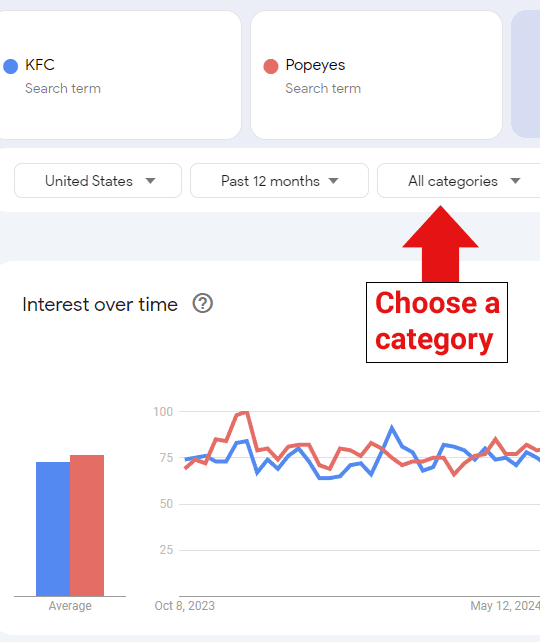
Google’s Daniel Waisberg showed that one way to research competitors is to do a head-to-head comparison of search terms for your company versus competitors by entering your company name or domain name in one panel of the Google Trends and your competitor’s in the second one. He suggests selecting a topic from the “categories” drop down menu which will allow for more specific user intent segmentation, where a user is looking for results in a specific niche or topic. Waisberg comments that it’s okay to not choose a category if one doesn’t exist.
Although he doesn’t mention it, there’s an additional way to segment users by the type of search (web search, image search, Google shopping, and YouTube search). This is an option that’s available that can help see how people are searching (images, videos, etc.) in comparison to competitors.
Step 1: Choose A Category
Google Trends shows a trend line indicating how often users are searching for both company names. The trend line shows if a company is trending up over time, if it’s experiencing a downward trajectory or if customer demand is on a steady level. Spikes can be evidence of seasonality but sharp spikes could be a sign of a marketing effort or promotion paying off.
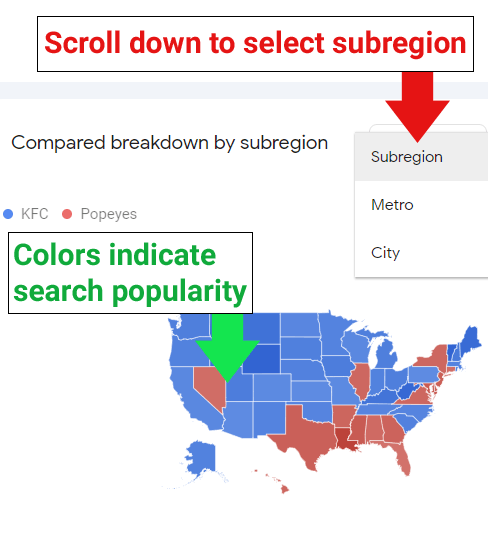
Waisberg encourages users to scroll down to inspect search trends by subregion, metro areas and cities. While Waisberg suggests it’s a way to determine demand for opening a store, the way I use the information is for determining geographical areas where demand is higher and focus online marketing effort there to maximize ROI. This can be done for link building, PPC, email, whatever you’re method is.
Step 2: Analyze Subregions
Daniel Waisberg begins his explanation at the 03:11 minute mark:
“Looking at the results, you can see how well your competitor is doing in comparison to you over time. …when you scroll down, you can compare how strong you are for each of the subregions, metro areas and cities available, and these could help you gather data when deciding where to open a new store.”
2. Analyzing Brand Awareness
Waisberg explains that Google Trends can be used to track brand awareness by filtering results over time to identify what people are saying about the brand. He recommends setting the time range for the past 30 or 90 days.
Related search terms that are rising or are top terms offer insights into how consumers are perceiving your brand, including what they’re associating the brand with. This same method can be applied to analyze YouTube search trends related to brand by selecting YouTube Search from the Categories drop down menu at the top of the Google Trends page.
Google’s Omri Weisman explains from the 4:37 minute mark:
“To monitor what people are saying about you, you should check your brand name using Google Trends… Scroll down the page to see the related search terms card. Go through both the rising and the top terms on the list and make sure to paginate using the arrows below the table. This will give you a good idea of the terms people are using in connection with your brand.”
3. Forecasting Product Demand
An easy way to predict product demand with Google Trends is identify which products are searched for the most and then zero in on how demand changes with time. It’s suggested to pay attention to seasonal trends and adjust product inventory accordingly.
Waisberg explains how to do it at about the 6:44 minute mark by researching cheese. In his example he notes the seasonality but then takes the analysis another step forward by scrolling down and exploring related terms that can suggest related products with higher search demand that you may want to begin selling or reviewing.
He explains:
“If you Scroll down, you’ll find the related topics and the related queries cards. Here you can check the top topics to find ideas on what has already gathered a lot of interest and also the rising topics to get a sense on what is getting more attention lately. Don’t forget to look further through the pagination.
Notice how charcuterie appears on both lists. Add this term to your analysis. You’ll see that it has significantly more interest than cheese platters. Maybe you should consider analyzing this term further and potentially diversifying.”
Google Trends For Successful Online Marketing
Google’s Daniel Waisberg and Omri Weisman demonstrated how to use Google Trends to improve online marketing, competitor research, brand research, and better understanding customer preference and behavior. It can also be used to identify which products to focus on and at what times of year. These tips are useful for both online and offline marketing strategies.
This post was sponsored by Legal SEO Conference. The opinions expressed in this article are the sponsor’s own.
Date: December 6, 2024 Location: InterContinental Miami, Florida Capacity: Only 150 spots available
The Legal SEO Conference is the first and only SEO event dedicated entirely to law firms and legal professionals. It offers a unique opportunity for lawyers to learn SEO strategies specifically designed to enhance their visibility on search engines like Google. With more legal services being sought online, ranking on Google’s first page has become critical for law firms seeking to grow their client base. This conference provides industry-specific SEO techniques that focus on driving more organic traffic, more leads, and ultimately more signed cases.
Why Attend A Legal SEO Conference?
Lawyers are often left behind in the SEO world, relying on generic agencies that don’t understand the legal industry’s nuances. The Legal SEO Conference brings together top SEO experts who specialize in helping law firms dominate search engine results. This is your chance to learn proven strategies from experts who have helped law firms generate millions in revenue through targeted SEO efforts.
Exclusive to Lawyers: The only SEO conference designed specifically for legal professionals.
Actionable SEO Strategies: Learn how to rank your law firm’s website at the top of Google and keep it there.
Unlock Growth: Drive more organic traffic, which means more leads and more high-value cases—without spending a dime on ads.
Key Benefits
Proven SEO Strategies for Lawyers: Find out the SEO secrets your competitors wish they knew.
Maximize Organic Traffic: Transform your website into a client-generating machine by ranking higher in search results.
Practical, Actionable Tips: Learn how to leverage local SEO, build topical authority, and dominate SERPs (Search Engine Results Pages).
Networking: Mingle with the top legal SEO experts and build connections that can grow your referral network.
Featured Speakers
The Legal SEO Conference features a lineup of industry leaders who have proven success in helping law firms rank higher and attract more clients:
Topic: Mapping Your Firm’s Next Strategic Location with SEO
Who Should Attend?
Lawyers: Solo practitioners or partners looking to dominate their local market.
Law Firm Marketing Directors: Those aiming to build a robust digital marketing strategy for their firm.
Agencies Specializing in Legal Marketing: Discover the latest SEO trends and strategies tailored to law firms.
Ticket Options
Standard Ticket ($999): Includes access to all sessions, networking events, roundtable Q&As, and the afterparty.
VIP Ticket ($1499): Includes everything in the standard package, plus front-row seating, private dinner with the speakers, and exclusive VIP networking.
Why This Event Is A Must For Lawyers
SEO is often an untapped goldmine for law firms. Many firms are still spending thousands on ads or SEO agencies without tangible results. Legal SEO Conference provides real-world strategies that lawyers can use to drive more traffic, attract more clients, and outperform competitors on Google.
No more guessing: Learn what top law firms are doing to generate millions in revenue through SEO.
Cut your ad spend: Achieve lasting visibility without the need for paid ads.
Stand out from competitors: 9 out of 10 law firms lose traffic to competitors—make sure you’re not one of them.
How This Conference Will Benefit You
Better SEO = More Traffic = More Signed Cases
This event is your ticket to growth. Imagine ranking #1 for “lawyer + [your city]” and watching your phone ring off the hook with potential clients. The Legal SEO Conference gives you the exact roadmap to make this a reality.
Conclusion: Secure Your Spot Today
The Legal SEO Conference is a game-changing event for any law firm looking to dominate Google search results and attract more clients. With only 150 spots available, this event will sell out quickly. Don’t miss the chance to learn from the world’s top legal SEO experts and transform your law firm’s online presence.
Visit the LegalSEO Conference website to register and take control of your law firm’s SEO strategy.
This event is designed specifically to help lawyers not only rank on Google but also stay ahead of future search engine changes—especially as Google moves toward AI-driven algorithms.
In a landmark antitrust case, the U.S. Department of Justice (DOJ) has outlined potential remedies to address Google’s monopoly in search and search advertising.
While “breaking up Google” is a popular headline phrase, the reality is more nuanced.
This article clarifies the DOJ’s proposals, Google’s response, and what it all could mean for the future of search.
The DOJ’s Case & Proposed Remedies
The DOJ’s argument centers on Google’s alleged abuse of its position in search and search advertising.
According to the court’s ruling in August, Google has illegally maintained monopolies in these areas for over a decade.
The DOJ’s proposed remedies aim to address four key areas:
1. Search Distribution & Revenue Sharing
Limiting or prohibiting Google’s exclusive search distribution deals
Ending or modifying revenue-sharing agreements that incentivize partners to use Google search
Potentially implementing choice screens to allow users to select their default search engine
2. Accumulation & Use of Data
Requiring Google to share its search index, data feeds, and models with competitors
Prohibiting Google from using data that can’t be shared due to privacy concerns
Reducing barriers for rivals to index and retain search data
3. Generation & Display of Search Results
Addressing Google’s leverage in emerging areas like AI-assisted search
Allowing websites to opt out of Google’s AI training or features
Ensuring fair access to web content for rival search engines
4. Advertising Scale & Monetization
Creating more competition in search advertising
Potentially requiring Google to license or syndicate its ad feed independently of search results
Increasing transparency in ad auctions and monetization
As it relates to data sharing. The DOJ filing states:
“Plaintiffs are considering remedies that will offset this advantage and strengthen competition by requiring, among other things, Google to make available, in whole or through an API, (1) the indexes, data, feeds, and models used for Google search, including those used in AI-assisted search features, and (2) Google search results, features, and ads, including the underlying ranking signals, especially on mobile.”
Google’s Response & Concerns
Google has vehemently opposed these proposals, arguing that they go beyond the scope of the case and could harm innovation and user experience.
The company’s key points include:
The proposals risk user privacy and security by forcing data sharing
Breaking up products like Chrome or Android could disrupt many businesses and developers
Changes to the ad market could make online ads less valuable for publishers and merchants
Restrictions on search promotion could create friction for users and harm Google’s partners
Google plans to appeal the ruling and argues that search competition is thriving, especially with the emergence of AI-powered alternatives.
Kent Walker, Google’s president of global affairs, stated:
“This decision recognizes that Google offers the best search engine, but concludes that we shouldn’t be allowed to make it easily available.”
Lee-Anne Mulholland, Google’s vice president of regulatory affairs, wrote in a blog post:
“The government seems to be pursuing a sweeping agenda that will impact numerous industries and products, with significant unintended consequences for consumers, businesses, and American competitiveness.”
Potentially different search experiences as new players enter the market
Counterpoint: Users may need to get used to new search UIs or algorithms.
Increased privacy controls as data practices are scrutinized
Counterpoint: Increased data sharing raises privacy concerns across platforms.
Possible changes in ad targeting and relevance
Implications For Businesses
For businesses and marketers, the impact could include:
A more diverse search ecosystem to optimize for
Counterpoint: Managing SEO and PPC across multiple engines could be more challenging.
New advertising platforms and models
Counterpoint: New tools, training, or staff may be needed.
Potential shifts in the value and cost of search advertising
Counterpoint: A fragmented ad market might increase spend for the same reach.
The AI Factor & Future of Search
The DOJ’s proposals address emerging technologies like AI, recognizing its growing importance in search.
This could have the following implications:
Lowering barriers for new entrants to compete in AI-driven search
Potentially fragmenting the development of search AI across multiple companies
Changes in how search results are generated and displayed, including AI-powered features
The filing notes:
“Google’s ability to leverage its monopoly power to feed artificial intelligence features is an emerging barrier to competition and risks further entrenching Google’s dominance.”
Industry-wide Impact
The case has implications beyond just Google:
Other tech giants may face increased scrutiny and similar antitrust actions
The broader tech industry may see shifts in how platform businesses operate
Venture capital and innovation in search-related technologies could see a resurgence
Legal & Regulatory Landscape
This case is part of a broader trend of increased antitrust scrutiny of tech giants:
Similar cases are proceeding against other major tech companies
The outcome could influence future tech regulation globally
It may set precedents for how monopolies are defined and addressed in the digital age
Looking Ahead
The DOJ’s current proposals are preliminary, with more detailed remedies expected in November and March.
The case will likely face appeals and could take years to resolve fully.
As stated in the filing:
“Plaintiffs will continue to engage with market participants, conduct discovery, and ultimately, provide the Court with a further refined Proposed Final Judgement in November 2024 and then, in accordance with the Court’s Order, a Revised Proposed Final Judgment in March 2025.”
Key questions for the future include:
How will the balance between competition and innovation be struck?
Can breaking up or restricting Google lead to more search competition?
How will these changes affect the global competitiveness of U.S. tech companies?
For search professionals, marketers, and businesses relying on search, staying informed and adaptable will be vital.
As this case progresses, it will undoubtedly shape the future of search, digital advertising, and the broader tech industry.
Whether these changes will truly “break up” Google or simply reshape its role in the digital ecosystem remains to be seen, but the impact will likely be felt for years to come.
Google responded to the U.S. Department of Justice (DOJ) antitrust proposals for breaking up the company to address its dominance in search and online advertising, asserting that the remedies will harm user security, raise costs for consumers across industries, and stifle AI innovation.
Google’s response presented three arguments on why the DOJ proposals may backfire on consumers and disrupt innovation across industries. They also made two points about search and advertising that challenge widely held opinions.
Three Reasons Why DOJ Proposals May Harm Innovation
Google makes three arguments about the DOJ proposals hat outline how they might cause harm to consumers and lead to a decrease in innovation.
1. Privacy And Security Risks
One of the DOJ’s proposals is for Google to share its search query, click and search data with competitors. Google’s response asserts that sharing that information with competitors will create a privacy and security risks for users because search queries can contain sensitive and highly personal information that could compromise users security by increasing the likelihood that bad actors can access the information.
Google’s response cited a New York Times article from 2006 that documents how a data breach at AOL showed how a user’s search data reveals personal data despite that their actual identities are hidden. The reporters were able to use search queries to track down a 62 year old widow in Georgia.
“It did not take much investigating to follow that data trail to Thelma Arnold, a 62-year-old widow who lives in Lilburn, Ga., frequently researches her friends’ medical ailments and loves her three dogs. “Those are my searches,” she said, after a reporter read part of the list to her.
AOL removed the search data from its site over the weekend and apologized for its release, saying it was an unauthorized move by a team that had hoped it would benefit academic researchers.”
2. Risk Of Stifling AI Innovation
The current boom in AI is largely due to many of Google’s discoveries that were subsequently open sourced, none more profound than transformer technology which was invented and open sourced in 2017. By open-sourcing this innovation, Google laid the foundation for generative AI models like ChatGPT and many other AI applications that rely on transformers today.
Google claims that the remedies the DOJ seeks will “hold back” innovation because the industry itself is at its infancy, is highly competitive and there are no monopolies needing a remedy to fix.
The response asserts:
“There are enormous risks to the government putting its thumb on the scale of this vital industry — skewing investment, distorting incentives, hobbling emerging business models — all at precisely the moment that we need to encourage investment, new business models, and American technological leadership.”
3. DOJ Proposals Will Negatively Impact Many Industries
Google has invested billions of dollars to create, maintain and improve both Android and Chrome and open source the technology, allowing multiple industries and businesses to grow around both technologies.
Android is an open source operating system for mobile phones that has become the global leader because it’s open source and allows mobile phone technology to become accessible to billions around the world at reasonable prices. Chrome browser is another open source technology that serves as the foundation for other competing browsers.
Both Android and Chrome underpin multiple technologies and industries from televisions, fitness devices, automobile devices, laptops and app ecosystems.
Google claims that the DOJ’s proposal to split Android from Google would cause a decrease in investment in the technology and raise the cost of all the devices that currently depend on Android and Chrome.
Two Claims That Challenge Assumptions About Search And PPC
Google defends its dominance in advertising and search by making claims that may contradict commonly held assumptions and challenge businesses to rethink what a disruption in both.
1. Restrictions On Search Distribution
Google challenges restrictions on partnerships with other platforms that allow Google Search to be the default search engine. Google claims that these restrictions are overbroad and may result in less income for open source innovators like Mozilla and cause an increase in costs to consumers for products like mobile phones.
2. Proposals For Online Advertising Will Harm Consumers And Businesses
Google claims that changes to their online advertising business will make it less useful for businesses and ultimately negatively impact consumers. They also claim that changes to the current system will negatively impact small publishers.
They write:
“Google’s innovative ads system has leveled the playing field for small businesses and publishers. Small advertisers can reach customers the same way as large ones do — with no minimum spend and no upfront commitments. And this ads system helps small websites earn revenue from online advertising, just like large publishers.”
Both claims challenge many popularly held assumptions about Google’s dominance in search and online advertising.
Google At A Crossroad
The DOJ is presenting remedies for what they claim are monopolistic practices that have harmed competition. Google rebuts those claims by offering examples of how their innovations have created opportunities to grow new industries, create competition and decrease costs for consumers.




![Google search for [toronto vacation rentals]](https://ecommerceedu.com/wp-content/uploads/2024/10/google-vacation-rentals-104.png)