OpenAI Launches SearchGPT: AI-Powered Search Prototype via @sejournal, @MattGSouthern

OpenAI has announced the launch of SearchGPT, a prototype AI-powered search engine.

This move marks the company’s entry into the competitive search market, potentially challenging established players.

Key Features & Functionality

SearchGPT aims to directly answer user queries by combining AI language models with real-time web information.

Rather than offering a list of links, SearchGPT attempts to deliver concise responses with citations to source material.

Here’s an example of a search results page for the query: “music festivals in boone north carolina in august.”

Screenshot from openai.com/index/searchgpt-prototype/, July 2024.

The SearchGPT prototype includes:

  • A conversational interface allowing follow-up questions
  • Real-time information retrieval from web sources
  • In-line attributions and links to original content

Publisher Controls & Content Management

OpenAI is also introducing tools for publishers to manage how their content appears in SearchGPT, giving them more control over their presence in AI-powered search results.

Key points about the publisher controls include:

  1. Separate from AI training: OpenAI emphasizes that SearchGPT is distinct from the training of their generative AI models. Sites can appear in search results even if they opt out of AI training data.
  2. Content management options: Publishers can influence how their content is displayed and used within SearchGPT.
  3. Feedback mechanism: OpenAI has provided an email (publishers-feedback@openai.com) for publishers to share their thoughts and concerns.
  4. Performance insights: The company plans to share information with publishers about their content’s performance within the AI search ecosystem.

These tools are OpenAI’s response to ongoing debates about AI’s use of web content and concerns over intellectual property rights.

Publisher Partnerships & Reactions

OpenAI reports collaborating with several publishers during the development of SearchGPT.

Nicholas Thompson, CEO of The Atlantic, provided a statement supporting the initiative, emphasizing the importance of valuing and protecting journalism in AI search development.

Robert Thomson, News Corp’s chief executive, also commented on the project, stressing the need for a symbiotic relationship between technology and content and the importance of protecting content provenance.

Limited Availability & Future Plans

Currently, SearchGPT is available to a restricted group of users and publishers.

OpenAI describes it as a temporary prototype, indicating plans to integrate features into their existing ChatGPT product eventually.

Why This Matters

The introduction of SearchGPT represents a potential shakeup to the search engine market.

This development could have far-reaching implications for digital marketing, content creation, and user behavior on the internet.

Potential effects include:

  • Changes in content distribution and discovery mechanisms
  • New considerations for search engine optimization strategies
  • Evolving relationships between AI companies and content creators

Remember, this is still a prototype, and we have yet to see its capabilities.

There’s a waitlist available for those trying to get their hands on it early.

What This Means For You

AI-powered search might offer users more direct access to information. However, the accuracy and comprehensiveness of results may depend on publisher participation and content management choices.

For content creators and publishers, these new tools provide opportunities to have more say in how their work is used in AI search contexts.

While it may increase content visibility and engagement, it also requires adapting to new formats and strategies to ensure content is AI-friendly and easily discoverable.

As SearchGPT moves from prototype to integration with ChatGPT, it will be vital to stay informed about these developments and adapt your strategies.

The future of search is evolving, and AI is at the forefront of this transformation.

Agile SEO: Moving From Strategy To Action via @sejournal, @jes_scholz

Impactful SEO is rarely executed by a lone wolf.

You need resources. You need buy-in from higher-ups – a CMO, head of product, or even CEO.

But here’s the thing: those lengthy SEO documents outlining objectives, audiences, competitors, keywords, and that six-month Gantt chart vaguely detailing optimization projects – they’re not getting read.

On the contrary, it is a roadblock to you getting a green light for resources.

An executive can quickly scan one short email containing a clear request and sign off. However, they need to set aside dedicated time to read a strategy document in depth – and time is not something executives have a lot of.

And even if they sign off today, the reality is business priorities shift. Competitive landscapes change. Algorithms are updated.

SEO is executed in a constant state of flux. It demands flexibility on a monthly, even weekly basis.

So, let’s ditch the long documents and prioritize actions over proposals with agile SEO.

Why Agile SEO Strategies Work

Agile SEO involves incremental iteration.

Break complex, overarching projects down into small, frequent changes.

Enable continual progress.

google quoteImage from author

Forget the pursuit of SEO perfection.

The key is to launch a minimum viable product (MVP) and monitor the impact on metrics.

Once you are armed with performance data, you can move on. The key performance indicator (KPI) impact will get you buy-in for the resources you need.

Let me give you an example.

Say your overarching goal is to completely overhaul the website architecture of an e-commerce site – all the URL routes, page titles, meta descriptions, and H1s for the homepage, category pages, and product pages.

The Old Way: One Giant Leap

The traditional approach involves pitching the entire SEO project at once. Your argument is that it’s good for SEO.

The site will rank higher and significantly impact the organic sessions. Which is true.

However, the document communicating all the reasons and requirements is complicated to review.

The project will seem too large. It will likely not make it onto your development team’s roadmap, as they will likely feel your request will overload their development cycle.

overloaded donkeyImage from author

Agile SEO Approach: Small Iterations

What if you broke it down into micro-wins?

Instead of pitching the entire project, request approval for a small but impactful change.

For example, optimizing the title tag and meta description of the homepage.

The documentation for this will be less than one page. The change request is equivalent to snackable content. Because it’s easy to implement, it’s much easier to incorporate it into a development sprint.

Now, say this quick change positively impacts KPIs, such as a 3% lift in homepage organic sessions. You can then argue for similar changes for the category pages, pointing out that if we get a similar KPI lift as we did for the homepage, this will achieve X more organic sessions.

You have already proven such tactics can increase KPIs. So, there is more trust in your approach. And it’s, again, a small request. So, your development team is more likely to do it.

And you can rinse and repeat until you have the whole site migrated.

How To Document An Agile SEO Strategy

So now we know to stop writing long SEO strategy documents and instead start creating agile, “snackable” tactics.

But we still need to understand what:

  • Has been completed in the past.
  • Is being worked on now.
  • Is coming up next.
  • All the ideas are.

This information must be easy to digest, centrally accessible, and flexible.

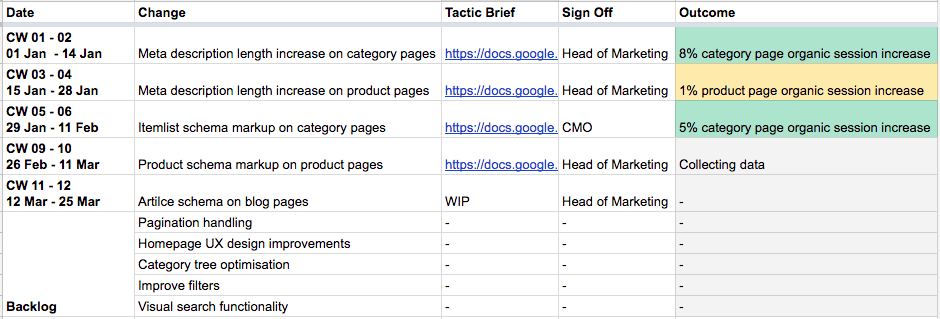
One solution for this is an “SEO calendar” document.

<span class=

Elements of an SEO calendar:

  • Date column: Ideally matched against IT sprint cycles. This does not mean every SEO initiative involves IT. But if you need a developer’s assistance, it will simplify cross-functional team projects. Having it set, for example, every two weeks also promotes small but constant releases from the SEO team.
  • Backlog: This provides space for team members to record ideas without having to make any significant commitment of time. Assess all ideas regularly as you fill your next available calendar slot.
  • Change column: A clear and concise sentence on what has been or will be changed.
  • Tactic brief: A link to the detailed information of that test. More details coming below.
  • Sign off: Ensuring all SEO changes pass a four-eye principle from a strategic point of view lowers the risk of any errors. These quick-to-read, snackable briefs make it easy to get your managers to buy in and sign off for resources.
  • Outcome: One short sentence summing up the KPI impact.

The benefit of a calendar layout is it is fully flexible but time-relevant. Changing priorities is as simple as moving the de-prioritized item to the backlog.

It can act as a website change log for SEO. Everyone can know the timetable of changes, both past and planned upcoming.

Those interested in why the KPIs increased on a certain date have the answer at a glance and more detailed information in one click. This can be invaluable for troubleshooting.

And, for team leaders, if any gaps appear in the iteration cycle, you can see this as gaps will appear in the calendar, allowing you to address the root cause.

Snackable Tactic Briefs

The benefits of tactics briefs are twofold:

  • Pre-launch: They concisely answer the Five Ws of your SEO change to get buy-in from stakeholders. Once aligned, it will act as the specification if you need someone else to execute it.
  • Post-launch: Be the record of what was actually changed. What impact did it have on the KPI funnel? What did we learn? And what are the next steps, if any?

Tactics briefs have five sections:

  • Overview.
  • SMART Goal.
  • Specifications.
  • Results.
  • Learnings & Action Items.

Overview

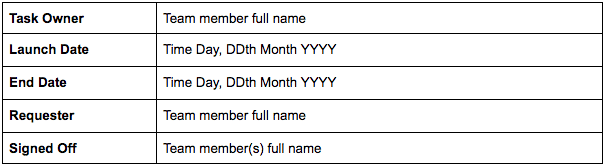
The overview section should cover the basics of the test:

  • Who is the one person ultimately responsible for leading the execution of the test?
  • When will it (pre-launch)/did it (post-launch) go live?
  • When will we (pre-launch)/did we (post-launch) assess results?
  • Who proposed the change? (It may be important to know if you need more information on the background for the test or if an action has come from senior management.)
  • Who has agreed to this execution? (This may be development, the line manager in marketing, or another key stakeholder. Allowing everyone to see who is on board.)
Overview tableScreenshot from author

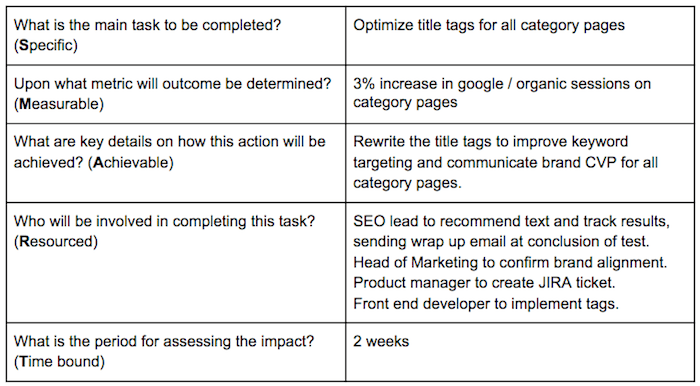
SMART Goal

The SMART goal is the high-level tactical approach.

Align your goal with your stakeholders before a detailed documentation effort goes into a task. This also ensures the change is in line with business goals.

<span class=

Specifications

This section will vary based on your test. But always try to communicate the “before” and the “after.” This way, you have a clear historical record you can refer back to.

The key is to have only the details needed. Nothing more, nothing less.

You can use tables to keep it easy to scan.

For example, in the case of a title tag change, it could be as simple as a single table.

Title tag formula for category pagesScreenshot from author

The key is to avoid long paragraphs of text. Focus on clearly communicating the outcome. What was it before, and what will be it after?

Don’t explain how the task was executed.

Results

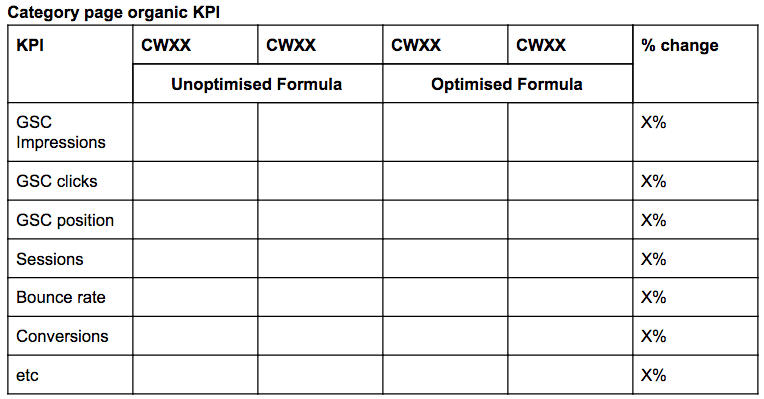
This section should contain one table to effectively communicate the percentage change between the benchmark weeks and the SEO change from a full-funnel perspective, as well as any additional tables to drill down for more insights.

An example of a table could be similar to the one below.

Category page organic KPI results tableScreenshot from author

Learnings & Action Items

Here is where you can succinctly analyze the results.

Remember, you have the data clearly available in the table above, so you don’t need to list the numbers again.

Explain what the numbers mean and what actions will be taken next.

Final Thoughts

An agile SEO system provides flexibility and visibility.

At any time, you can understand what actions are underway and what has shifted KPIs.

Forget the fantasy of the perfect SEO strategy, and focus your energy on getting sh!t done.

More resources: 


Featured Image: Andrey_Popov/Shutterstock

Bing’s Updated AI Search Will Make Site Owners Happy via @sejournal, @martinibuster

Bing is rolling out a new version of Generative Search that displays information in an intuitive way that encourages exploration but also prioritizes clicks from the search results to websites.

Microsoft introduced their new version of AI search:

“After introducing LLM-powered chat answers on Bing in February of last year, we’ve been hard at work on the ongoing revolution of search. …Today, we’re excited to share an early view of our new generative search experience which is currently shipping to a small percentage of user queries.”

New Layout

Bing’s announcement discusses new features that not only make it easy for users to find information, Bing also makes it easy for users to see the organic search results and click through and browse websites.

On the desktop view, Bing shows three panels:

  • A table of content on the left
  • AI answers in the center (with links to website sources)
  • Traditional organic search results on the right hand side
  • Even more organic search results beneath “the fold”

The table of contents that is on the right hand side is invites exploration. It has the main topic at the top, with directly related subtopics beneath it. This is so much better than a People Also Asked type of navigation because it invites the user to explore and click on an organic search result to keep on exploring.

Screenshot: Table Of Contents

This layout is the result of a conscious decision at Bing to engineer it so that that it preserves and encourages clicks to websites.

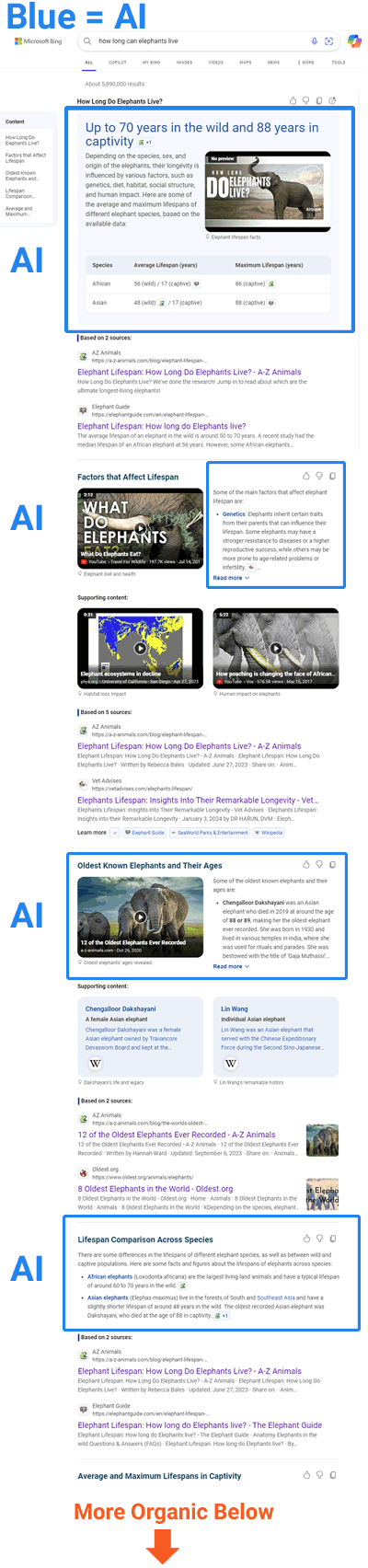
Below is a screenshot of the new generative AI search experience. What’s notable is how Bing surrounds the AI answers with organic search results.

Screenshot Of The New Bing AI Search Results

Bing makes a point to explain that they have tested the new interface to make sure that the search results will send the same amount of traffic and to avoid creating a layout that results in an increase in zero click search results.

When other search engines talk about search quality it is always from the context of user satisfaction. Bing’s announcement makes it clear that sustaining traffic to websites was an important context that guided the design of the new layout.

Below is a screenshot of a typical Bing AI search result for a query about the life span of elephants.

Note that all the areas that I bounded with blue boxes are AI answers while everything outside of the blue boxes are organic search results.

Screenshot Of Mix of AI And Organic Results

Bing's new AI search layout emphasizes organic search results

The screenshot makes it clear that there is a balance of organic search results and AI answers. In addition to those contextually relevant organic search results there are also search results on the right hand side (not shown in the above screenshot).

Microsoft’s blog post explained:

“We are continuing to look closely at how generative search impacts traffic to publishers. Early data indicates that this experience maintains the number of clicks to websites and supports a healthy web ecosystem. The generative search experience is designed with this in mind, including retaining traditional search results and increasing the number of clickable links, like the references in the results.”

Bing’s layout is a huge departure from the zero-click style of layouts seen in other search engines. Bing has purposely designed their generative AI layout to maintain clicks to websites. It cannot be overstated how ethical Bing’s approach to the web ecosystem is.

Bing Encourages Browsing And Discovery

An interesting feature of Bing’s implementation of generative AI search is that it shows the answer to the initial question first, and it also anticipates related questions. This is similar to a technique called “information gain” where an AI search assistant will rank an initial set of pages that answers a search query, but will also rank a second, third and fourth set of search results that contain additional information that a user may be interested in, information on related topics.

What Bing does differently from the Information Gain technique is that Bing displays all the different search results on a single page and then uses a table of contents on the left hand side that makes it easy for a user to click and go straight to the additional AI answers and organic search results.

Bing’s Updated AI Search Is Rolling Out Now

Bing’s newly updated AI search engine layout is slowly rolling out and they are observing the feedback from users. Microsoft has already tested it and is confident that it will continue to send clicks to websites. Search engines have a relationship with websites, what is commonly referred to as the web ecosystem. Every strong relationship is based on giving, not taking. When both sides give it creates a situation where both sides receive.

More search engines should take Bing’s approach of engineering their search results to satisfy users in a way that encourages discovery on the websites that originate the content.

Read Bing’s announcement:

Introducing Bing generative search

Featured Image by Shutterstock/Primakov

Google Search Revenue Grows 14% In Q2 2024 via @sejournal, @MattGSouthern

Alphabet Inc., Google’s parent company, released its second quarter 2024 financial results, revealing a 14% year-over-year increase in revenue for its core Google Search business.

Key Financial Data:

  • Google Search revenue: $48.5 billion (up from $42.6 billion in Q2 2023)
  • Total Alphabet revenue: $84.7 billion (14% increase year-over-year)
  • Operating income: $27.4 billion
  • Net income: $23.6 billion
  • Earnings per share: $1.89

Strong performances in Search and Cloud services primarily drove the company’s overall revenue growth.

Google Cloud surpassed $10 billion in quarterly revenue for the first time, reaching $10.3 billion with $1.2 billion in operating profit.

YouTube ad revenue increased from $7.7 billion in Q2 2023 to $8.7 billion in Q2 2024.

Alphabet CEO Sundar Pichai commented on the results, emphasizing the company’s focus on AI innovation. The report also noted a recent reorganization of AI teams, combining elements of Google Research with Google DeepMind.

Pichai stated:

“Our strong performance this quarter highlights ongoing strength in Search and momentum in Cloud. We are innovating at every layer of the AI stack.”

The report also noted a recent reorganization of AI teams, combining elements of Google Research with Google DeepMind.

While the results indicate strong performance, Alphabet faces challenges, including regulatory scrutiny and evolving competition in the tech sector.

The company’s CFO, Ruth Porat, mentioned ongoing efforts to optimize cost structures.

Regarding the company’s financial strategy, Porat stated:

“As we invest to support our highest growth opportunities, we remain committed to creating investment capacity with our ongoing work to durably re-engineer our cost base.”

Why This Matters

The performance of Google Search and Alphabet has implications for the digital marketing industry.

As the dominant search engine, Google’s revenue growth indicates continued strength in search advertising, which remains an essential channel for many businesses.

Additionally, the growth in Cloud services and YouTube advertising suggests evolving digital trends and potential opportunities for marketers.

What Does This Mean For You?

For digital marketers and SEO professionals, these are the key takeaways from Alphabet’s earnings call:

  • Search remains vital: The growth in Google Search revenue shows that SEO and search advertising remain key components of marketing strategies.
  • Cloud and AI focus: Alphabet’s emphasis on Cloud services and AI development may lead to new tools and platforms for marketers to leverage.
  • Video advertising potential: The growth in YouTube ad revenue indicates the ongoing importance of video content in digital marketing strategies.
  • Competitive landscape: While Google maintains its market position, the focus on AI development across the tech industry may lead to new challenges and opportunities in search and digital advertising.
  • Potential changes ahead: As Alphabet continues to invest in AI and reorganize its teams, marketers should stay alert for potential changes in search algorithms or new AI-driven features that could impact SEO and PPC strategies

Featured Image: sdx15/Shutterstock

Google Shares Tips To Improve SEO Through Internal Links via @sejournal, @MattGSouthern

In a new installment of its “SEO Made Easy” video series, Google provides three simple guidelines for utilizing internal linking to improve SEO.

The video, presented by Google’s Martin Splitt, offers valuable insights for improving site structure and user experience.

Strategic internal linking highlights your most valuable content, ensuring users and search engines can identify them quickly.

Additionally, internal linking can help search engines understand the relationships between pages, potentially leading to better rankings.

3 Tips For Internal Linking

Splitt emphasized three main points regarding the effective use of internal links:

  1. User Navigation: Internal links guide users through a website, helping them find related content and understand the site’s structure.
  2. Search Engine Crawling: Google’s web crawler, Googlebot, uses internal links to discover new pages and understand the relationships between different pages on a site.
  3. HTML Best Practices: Properly using HTML elements, particularly the < a> tag with an href attribute, is essential for creating effective links.

The Importance Of Meaningful Anchor Text

One of Google’s key recommendations is to use descriptive, meaningful anchor text for links.

Splitt demonstrated how clear anchor text improves user experience by allowing visitors to quickly scan a page and understand where each link will lead them.

He stated:

“Users and Bots alike prefer meaningful anchor text. Here on the left you see what that looks like each link has meaningful words as anchor text and you can easily spot what the link will take you to.”

See the examples he’s referring to in the image below:

Screenshot from: YouTube.com/GoogleSearchCentral, July 2024.

Splitt continues:

“On the right you see a page that doesn’t use meaningful anchor text and that isn’t a good user experience especially when you try to quickly scan the page and find the right link to use.”

Balancing Link Quantity

While internal linking is vital, Splitt cautioned against overdoing it.

He advises applying critical judgment when adding links and creating logical connections between related content without overwhelming the user or diluting the page’s focus.

Technical Considerations For Links

The video also touched on the technical aspects of link implementation.

Splitt discouraged using non-standard elements like spans, divs, or buttons to create links, saying if an element behaves like a link, it should be coded as one using the proper HTML structure.

Screenshot from: YouTube.com/GoogleSearchCentral, July 2024.

In Summary

These are the key takeaways from Google’s video on internal linking:

  • Internal linking is a fundamental aspect of SEO and user experience.
  • Focus on creating meaningful, descriptive anchor text for links.
  • Use internal links strategically to guide users and search engines through your site.
  • Balance the number of links to avoid overwhelming users or diluting page focus.
  • Stick to proper HTML structure when implementing links.

See the full video below:


Featured Image: Screenshot from YouTube.com/GoogleSearchCentral, July 2024. 

System Builders – How AI Changes The Work Of SEO via @sejournal, @Kevin_Indig

AI is terraforming tech. The content and SEO ecosystem is undergoing a massive structural change.

Human-written content gains value faster for LLM training than for end consumers as the pure profit licensing deals between LLM developers and publishers show.

Publishers struggle to survive from digital subscriptions but get millions that go straight to their bottom line for providing training data.

Content platforms, social networks, SaaS companies and consumer apps coat their products with AI. A few examples:

  • Spotify DJ (AI-generated playlist).
  • AI Overview (AI answers in Google Search).
  • Instagram AI personas (celebrity AI chatbots).
  • Ebay’s magical listing (turn a photo into a listing).
  • Redfin Redesign (try interior designs on real house pictures).
Google searches for chat gptImage Credit: Kevin Indig

The quality of machine-generated content (MGC) challenges human-generated content (HGC). I ran an experiment with my Twitter and LinkedIn followers: I asked them to choose which of two articles was written by a human and which by a machine – and they had to explain their answer.

Only a handful of people figured out that AI wrote both pieces. I intentionally framed the question in a leading way to see if people would challenge the setting or believe that one piece was written by a human if told so.

  • Not an isolated experiment: A survey of 1,900 Americans found that 63.5% of people can’t distinguish between AI content and human content.1
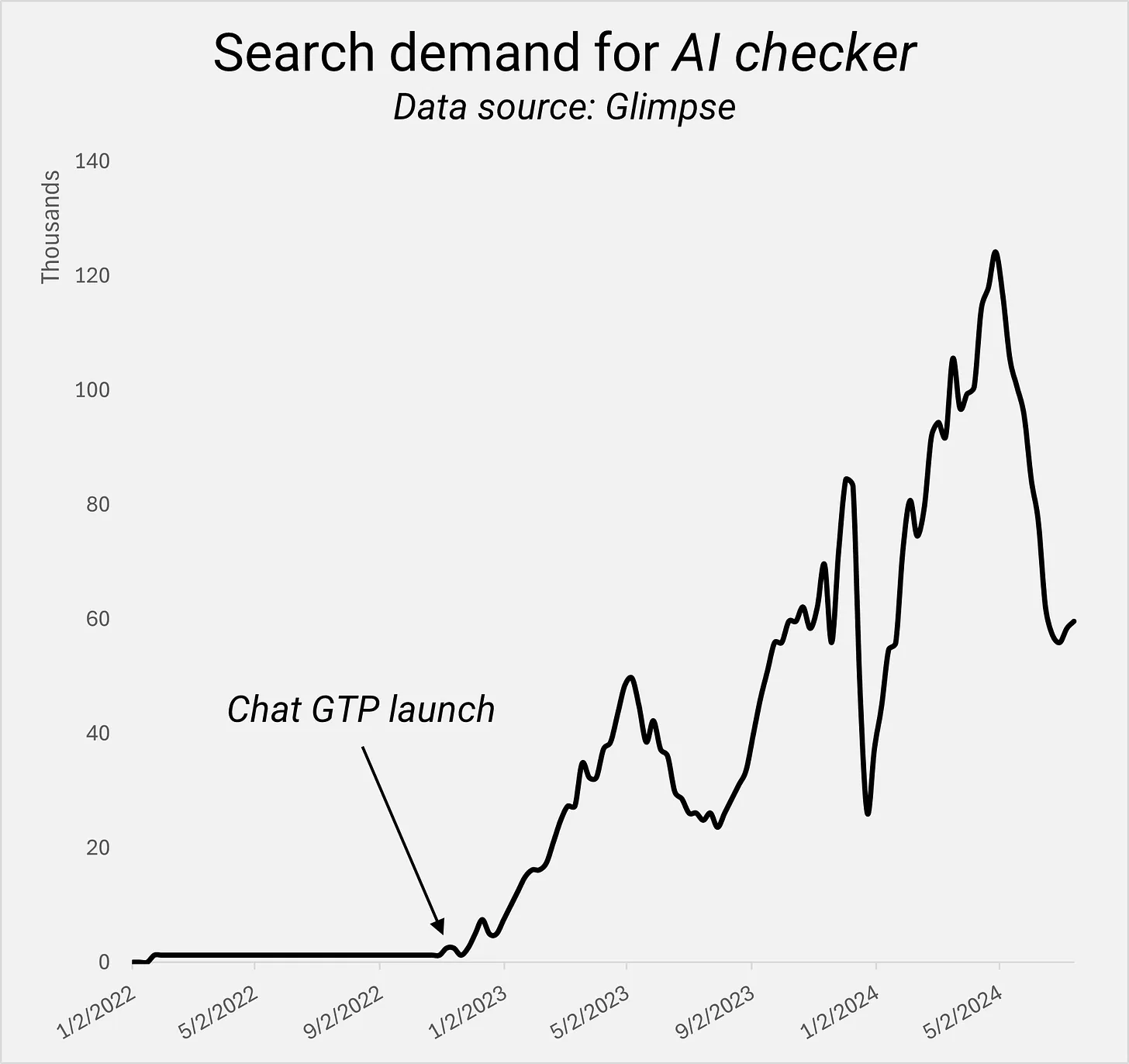
  • People seek help: Google search demand for [ai checker] has reached 100,000 in May 2024 (Glimpse).
  • Dark side: scammers use MGC to make money, as 77% of AI scam victims lost money.2
Search demand for AI checkerImage Credit: Kevin Indig

The quality level of LLMs pushes SEO work towards automating workflows and learning with AI, while writers will take content from good to great instead of zero to one.

Boost your skills with Growth Memo’s weekly expert insights. Subscribe for free!

How AI Changes The Work Of SEOImage Credit: Lyna ™

System Builders

Clients, podcasters and panel hosts often ask me what skills SEOs need to build for the AI future. For a long time, my answer was to learn, stay open-minded and gain as much practical experience with AI as possible.

Now, my answer is SEOs should learn how to build AI agents and workflows that automate tasks. AI changes the way search works but also the way SEOs work.

AI + No-code Allows SEOs To Automate Workflows

A few examples:

1/ Cannibalization

  • Old world: SEOs download search console data and create pivot tables to spot keyword cannibalization.
  • New world: SEOs build an AI workflow that sends alters, identifies true keyword cannibalization, makes content suggestions to fix the problem, and monitors the improvement.

2/ Site Crawling

  • Old world: SEOs crawl websites to find inefficiencies in internal linking, status code errors, duplicate content, etc.
  • New world: SEOs build an AI agent that regularly crawls the site and automatically suggests new internal links that are shipped after human approval, fixes broken canonical tags and excludes soft 404 errors in the robots.txt.

3/ Content Creation

  • Old world: SEOs do keyword research and write content briefs. Writers create the content.
  • New world: SEOs automate keyword research with AI and create hundreds of relevant articles as a foundation for writers to build on.

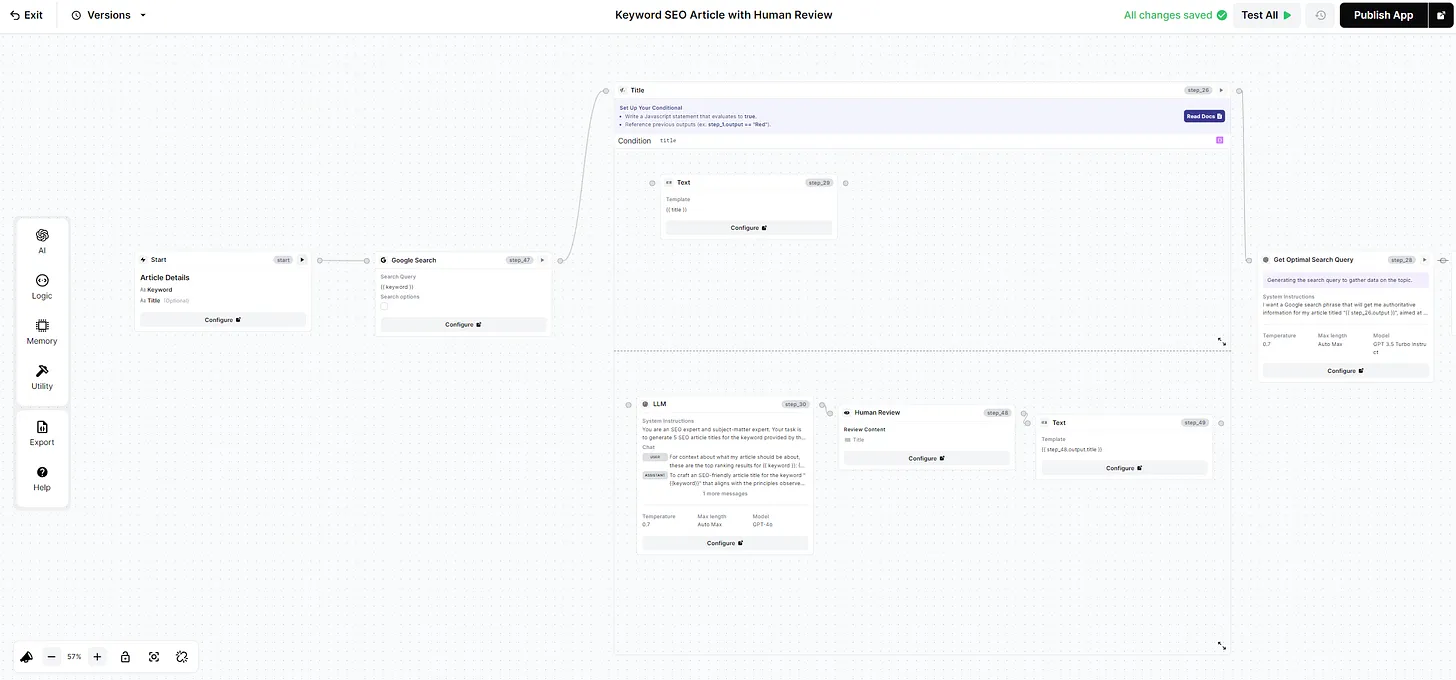
All of this is already possible today with AI workflow tools like AirOps or Apify, which chain agents and LLMs together to scrape, analyze, transform data or create content.

Moving forward, we’ll spend much more time building automated systems instead of wasting time on point analyses and catalogs of recommendations. The SEO work will be defining logic, setting rules, prompting and coding.

building automated systems Building workflows with AirOps (Image Credit: Kevin Indig)

You Can Learn (Almost) Anything With AI

I never made the time to really learn Python or R, but with the help of Chat GPT and Gemini in Colab, I can write any script with natural language prompts.

When the script doesn’t work, I can paste a screenshot into Chat GPT and describe the issue to get a solution. AI helps with Regex, Google Sheets/Excel, R, Python, etc. Nothing is off-limits.

Being able to write scripts can solve problems like data analysis, a/b testing and using APIs. As an SEO, I’m no longer dependent on engineers, data scientists or writers to perform certain tasks. I can act faster and on my own account.

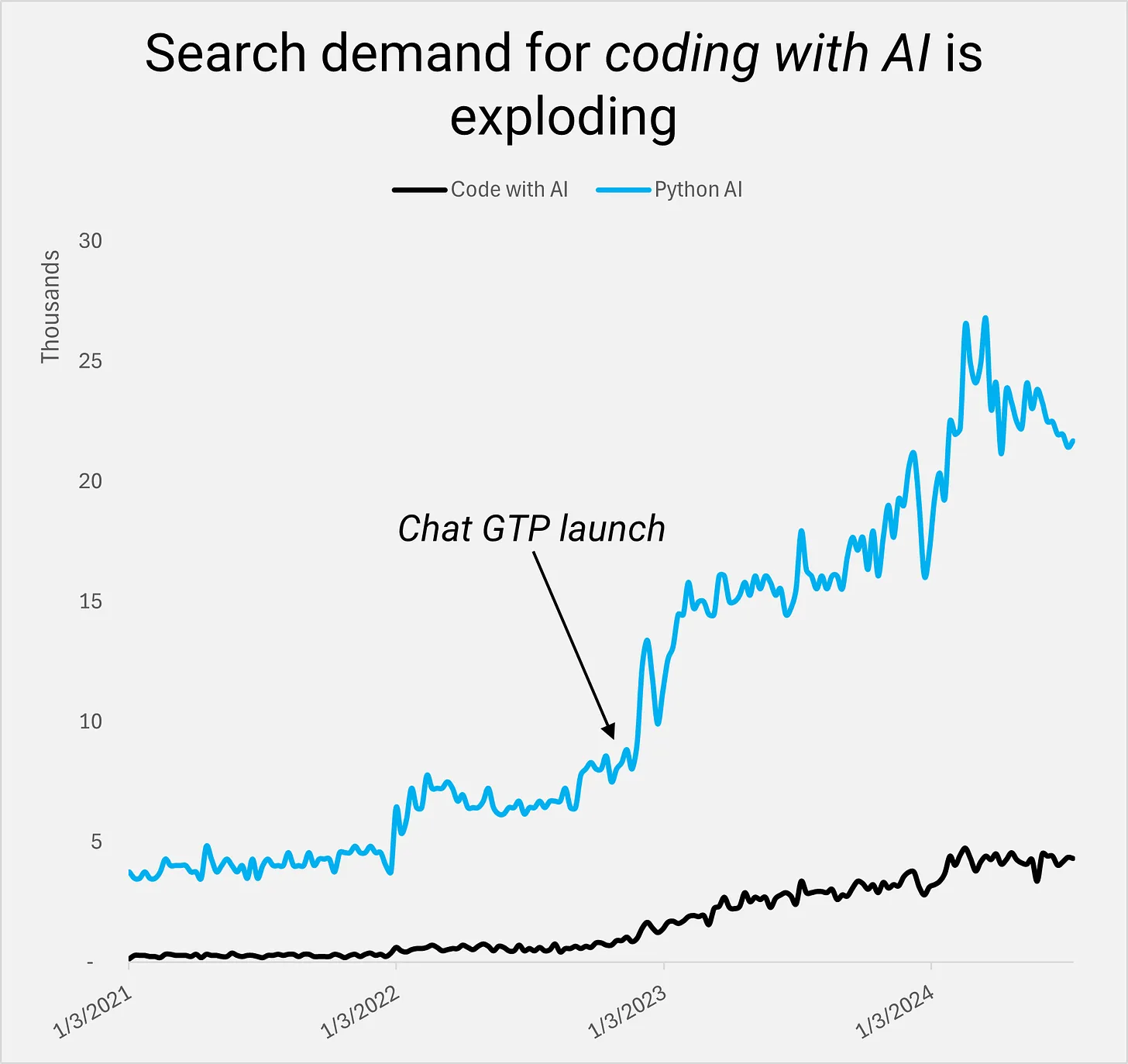
I’m not the only one to figure this out. People are learning to code, write and many other skills with AI. We can learn to build AI workflows by asking AI to teach us.

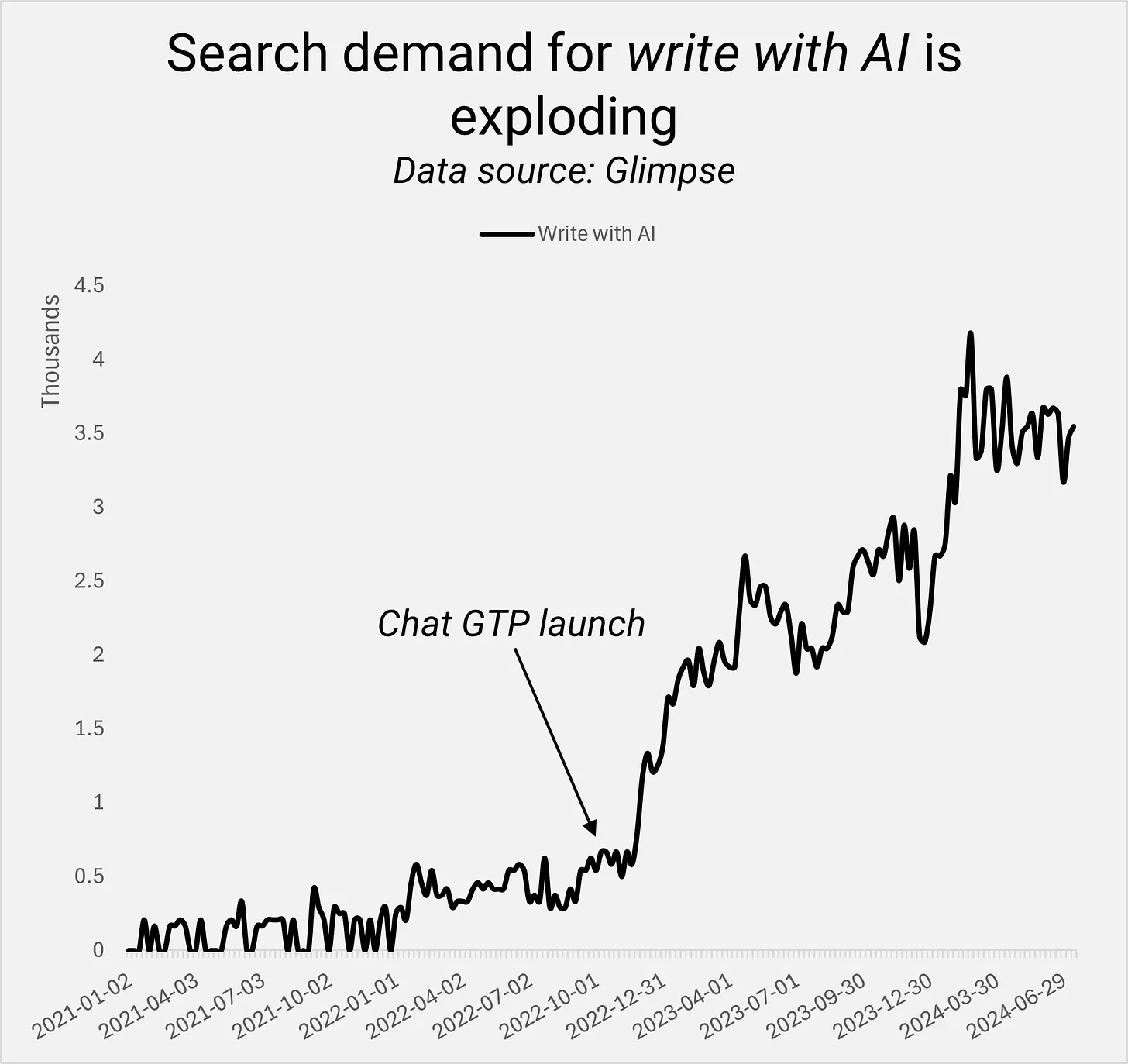
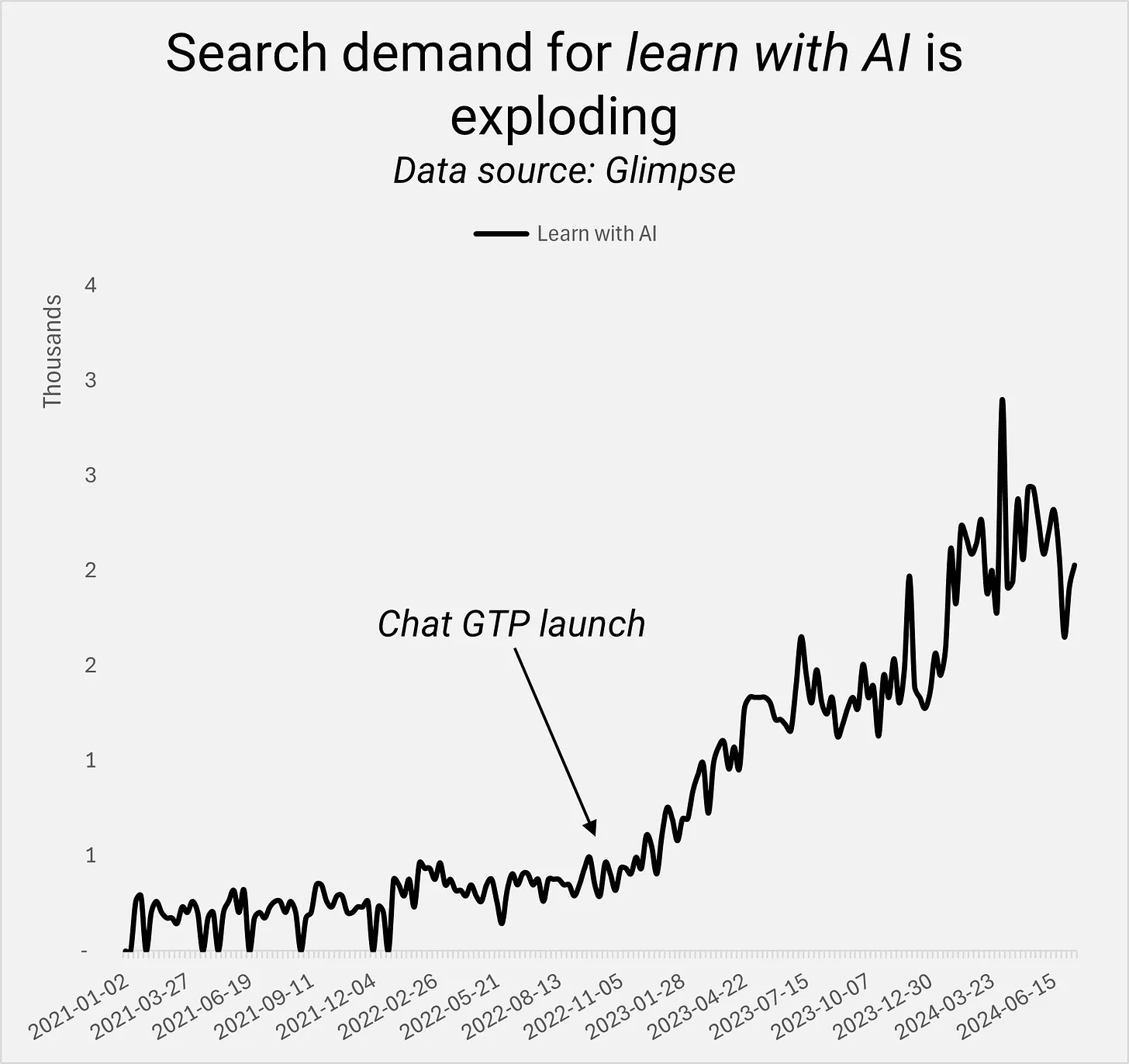
Search demand for coding with AI is explodingImage Credit: Kevin Indig
Search demand for write with AI is explodingImage Credit: Kevin Indig
Search demand for learn with AI is explodingImage Credit: Kevin Indig

When you can learn almost anything, the only limit is time.

The Work Of Writers Changes

Against common belief, writers won’t be crossed out of this equation but will play the critical role of editing, directing and curating.

In any automated process, humans QA the output. Think of car assembling lines. Even though AI content leaps in quality, spot checks reduce the risk of errors. Caught issues, such as wrong facts, weird phrasing or off-brand wording, will be critical feedback to fine-tune models to improve their output.

Instead of leg work like writing drafts, writers will bring AI content from good to great. In the concept of information gain, writers will spend most of their time making a piece outstanding.

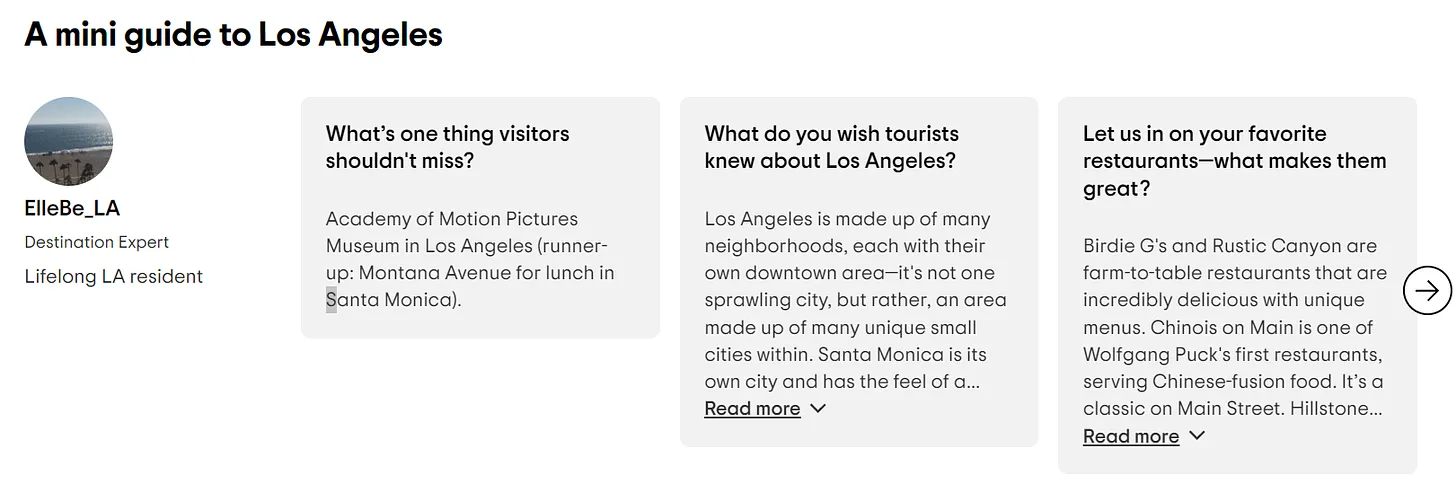
The rising quality work spans from blog content to programmatic content, where writers will add curated content when searches have a desire for human experience, such as in travel.

A mini guide to Los AngelesTripadvisor’s attraction pages feature human-curated sections. (Image Credit: Kevin Indig)

Unfair Advantage

As often with new technology, a few first-mover people and companies get exponential value until the rest catch up. My worry is that a few fast-moving companies will grab massive land with AI.

And yet, this jump in progress will allow newcomers to challenge incumbents and get a fair chance to compete on the field.

AI might be a bigger game changer for SEOs than for Google. The raw power of AI might help us overcome challenges from AI Overviews and machine learning-driven algorithm updates.

But the biggest win might be that SEOs can finally make something instead of delivering recommendations. The whole value contribution of SEOs changes because my output can drive results faster.

Survey: ChatGPT and AI Content – Can people tell the difference?

Artificial Intelligence Voice Scams on the Rise with 1 in 4 Adults Impacted


Featured Image: Paulo Bobita/Search Engine Journal

Looking Ahead To The Future – SGE, Gemini…And AGI? via @sejournal, @marie_haynes

This extract is from SEO in the Gemini Era by Marie Haynes ©2024 and reproduced with permission from Marie Haynes Consulting Inc.

There are changes on the horizon that all SEOs should be aware of that are also closely related to AI. Search Generative Experience (SGE), which is now renamed to AI Overviews, and Gemini are already changing how people get their information.

And, if we are to believe Google DeepMind’s creator Demis Hassabis, within the next decade, Google will achieve their goal – building artificial general intelligence, AGI.

I do believe Demis. And I am excited.

Let’s talk first about the immediate changes to the search landscape that every website owner should be aware of.

This is a general overview as many of these features and what’s important to know about them are changing rapidly. Much of this section will likely be dated by the time you read this book!

Google’s Search Generative Experience/AI Overviews

Google’s CEO, Sundar Pichai has said that SGE is the future of Search.

SGE is the future of SearchImage from author, July 2024

SGE started as an experiment that could be opted into at labs.google.com. This is now in Search in some countries, with a new name, AI Overviews. They can have several different components, or a combination of them, including:

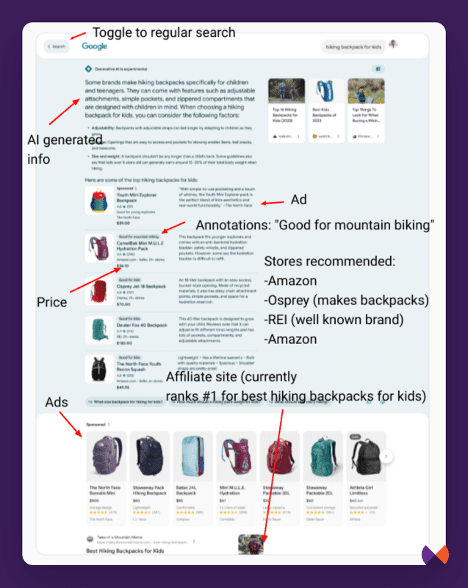
An AI generated answer that appears to be stitched together from multiple websites like a large featured snippet.

Carousels Of Websites

I have been calling these “helpful content carousels” because they generally contain the type of content we have been talking about throughout this book. I have since heard them referred to as “link cards.”

(I like helpful content carousels better!)

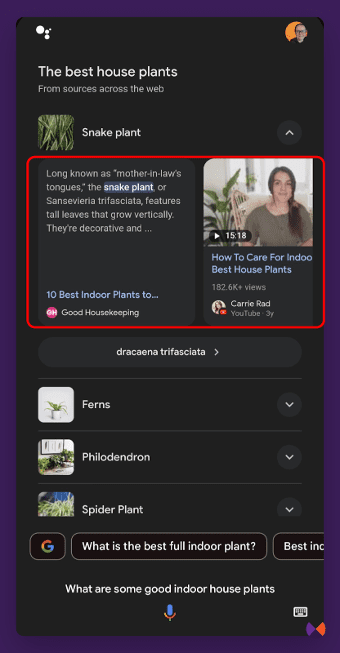
Carousels of websites. Image from author, July 2024

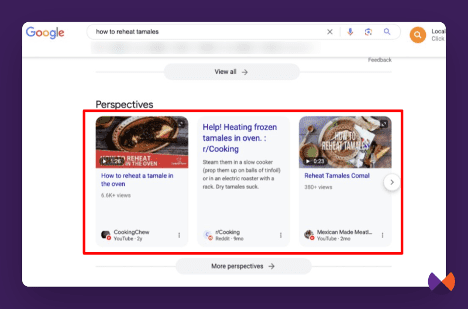
These carousels are appearing in regular searches and also in Google Assistant responses. You may see similar carousels peppered throughout search labeled as “Perspectives,” “Forum Discussions,” and other labels.

similar carousels peppered throughout search labeled as “Perspectives”, “Forum Discussions”, and other labels. Image from author, July 2024
carousels peppered throughout search labeled as “Perspectives”, “Forum Discussions”, and other labels. Image from author, July 2024

We will see more evolution of these features over time. Google is learning with each search whether people are finding AI Overviews helpful. They will continually learn how to improve.

Here’s more reading:

Google Gemini (Formerly Bard)

Google’s naming of products is confusing! You may have noticed that throughout this book I refer sometimes to Bard, and sometimes to Gemini. This is because in early 2024, Bard was renamed to Gemini.

Gemini is also the name of the language model behind the system. Gemini essentially is everything that is AI at Google.

Gemini the chatbot is not a search engine. But people will likely use it as one. It is a way to get information, and the more it improves, the more helpful it becomes.

Gemini will become Google Assistant, and be available at a quick touch or voice command on most phones that can pop up over top of other apps.

It is continually improving via a process called reinforcement learning. If you used Bard a few times and gave up because you found it unhelpful, I’d encourage you to try out Gemini.

Ideally it’s worth signing up for the most advanced version of Gemini publicly available, Gemini Advanced. As I write this, Google is offering a two month trial.

In the short time since Bard upgraded to Gemini I have been thoroughly impressed with its improvement. It feels like it improves daily.

In February of 2024 Google quietly announced an upgrade to Gemini called Gemini 1.5 that gives it an entirely new architecture based on something called a Mixture of Experts model.

This type of model is not new, but DeepMind says that the type of MoE model they use for Gemini is a brand new version of MoE. The changes made to Gemini made it significantly more efficient, accurate and better able to understand the data it trains on.

Gemini 1.5 greatly improves Google’s AI capabilities across the board. And creates a framework for them to continue to improve at a fast rate.

Here are some helpful links to learn more about Gemini:

If you read one thing on Gemini, make it this:

Google’s blog post called “Assistant with Bard: A step toward a more personal assistant.

I thoroughly believe Gemini is the way of the future. It might not seem like it if you have used it a few times and run into a few hallucinations and made up answers.

After reading all of the above, hopefully you will see what I see and that is that Gemini is poised to be the future of how we interact with information online.

A lot will likely change in the world as this happens.

How? It’s hard to predict. I think that many people will be affected like I have been. The more I use LLM’s, the more I learn. The more I learn, the more knowledge I have. Then I can take those ideas and brainstorm them with Gemini or ChatGPT.

This has led to me being able to understand a lot about how Search works and to develop my skills in almost everything I do in my work at a faster pace. The more I do this, the more I learn how to learn and also to get the most out of the LLM tools that are available to me.

People who are good at their trades will get better with the help of AI. Those who know how to use AI will start to develop significant advantages over those who do not.

Imagine if you were living in 2024 and did not use a phone. You could certainly live, but you would be at a disadvantage compared to those who do use technology.

I believe we may face a dangerous divide in our civilization as this happens. I am beyond excited for those who are at the cutting edge of learning how we can improve the world with AI. But what will happen to those who decide to avoid its use at all costs?

Fortunately, Google’s CEO has said that this transition in how we search will happen over the next decade. We hopefully have some time to adjust.

Business Integration

In Google’s earnings calls they have mentioned that one of Gemini’s strengths is business integration. We haven’t seen it yet. But eventually, we should see it get easier and easier for businesses to not only integrate Google’s AI capabilities, but also make money from it.

Pay attention to how AI is changing Google Ads as well. I have not written about Ads in this book, but can see all sorts of future opportunities here.

Let me share what I think could happen. Imagine a searcher is looking for information on a recent traffic drop. They converse with Gemini, who tells them the world’s general advice about what to consider and then recommends perhaps some websites to read.

I could see Google offering paid positions that say, “Talk to Marie Haynes’ AI Assistant.” It’s an Ad that then connects the searcher with a chatbot on my site.

This chatbot would be grounded with my recent writings. I would be incentivized to continue to create great, helpful content because this is what will make my chatbot useful.

It’s possible I could charge money for this chatbot. Or, perhaps I might choose to make it free and where appropriate, the chatbot would recommend my resources and services.

In that case, I could see Google inserting my Chatbot right into the search results.

When businesses start to make real money from Google’s AI, we will see some more acceleration!

Notes

[1] Demis Hassabis on Chatbots to AGI | EP 71 Hard Fork Podcast. https://www.youtube.com/watch?v=nwUARJeeplA

[2] Google’s Vision for Search in 2023 and Beyond – Analysis of the 2023 Earnings Call. Marie Haynes. https://www.mariehaynes.com/googles-vision-for-search-in-2023-and-beyond-analysis-of-the-q2-2023-earnings-call/

[3] Gemini Advanced. https://gemini.google.com/advanced


To read the full book, SEJ readers have an exclusive 20% discount for Marie’s book, workbook and course bundle. The discount will be applied automatically by following these links:


More resources:


Featured Image: ArtemisDiana/Shutterstock

Google Cautions: Exponential Content Growth Causes Re-Evaluation via @sejournal, @martinibuster

Google’s John Mueller answered a question about the impact of increasing a website’s size by ten times its original size. Mueller’s answer should give pause to anyone considering making their site dramatically larger, as it will cause Google to see it as a brand new website and trigger a re-evaluation.

Impact Of Making A Site Bigger

One of the reasons for a site migration is joining two websites into one website, which can cause a site to become even larger. Another reason for an increase in size is the addition of a massive amount of new products.

This is the question that was asked in the SEO Office Hours podcast:

“What’s the impact of a huge expansion of our product portfolio on SEO Performance, for example going from 10,000 to products to 100,000?”

It must be pointed out that the question is about a site growing ten times larger.

This is is Mueller’s answer:

“I don’t think you have to look for exotic explanations. If you grow a website significantly, in this case, by a factor of 10, then your website will overall be very different. By definition, the old website would only be 10% of the new website. This means it’s only logical to expect search engines to re-evaluate how they show your website. It’s basically a new website after all.

It’s good to be strategic about changes like this, I wouldn’t look at it as being primarily an SEO problem.”

Re-Evaluate How Google Shows A Website

Mueller said it’s not primarily an SEO problem but  it’s possible most SEOs would disagree because anything that affects how a search engine shows a site is an SEO problem. Maybe Mueller meant that it should be seen as a strategic problem?

Regardless, John Mueller’s answer means that growing a site exponentially in a short amount of time could cause Google to re-evaluate a site because it’s essentially an an entirely new website, which might be an undesirable scenario.

Although Mueller didn’t specify how long a re-evaluation can take, he has indicated in the past that it can take months. Maybe things have changed but this is what he said four years ago about how long a sitewide evaluation takes:

“It takes a lot of time for us to understand how a website fits in with regards to the rest of the Internet.

…And that’s something that can easily take, I don’t know, a couple of months, a half a year, sometimes even longer than a half a year, for us to recognize significant changes in the site’s overall quality.”

The implication of a sitewide evaluation triggered by an exponential growth in content is that the optimized way to approach content growth is to do it in phases. It’s something to consider.

Listen to the Google SEO Office Hours podcast at the 4:24 minute mark:

Featured Image by Shutterstock/ShotPrime Studio

Google Says This Will Cancel Your “Linking Power” via @sejournal, @martinibuster

Google’s John Mueller was asked in an SEO Office Hours podcast if blocking the crawl of a webpage will have the effect of cancelling the “linking power” of either internal or external links. His answer suggested an unexpected way of looking at the problem and offers an insight into how Google Search internally approaches this and other situations.

About The Power Of Links

There’s many ways to think of links but in terms of internal links, the one that Google consistently talks about is the use of internal links to tell Google which pages are the most important.

Google hasn’t come out with any patents or research papers lately about how they use external links for ranking web pages so pretty much everything SEOs know about external links is based on old information that may be out of date by now.

What John Mueller said doesn’t add anything to our understanding of how Google uses inbound links or internal links but it does offer a different way to think about them that in my opinion is more useful than it appears to be at first glance.

Impact On Links From Blocking Indexing

The person asking the question wanted to know if blocking Google from crawling a web page affected how internal and inbound links are used by Google.

This is the question:

“Does blocking crawl or indexing on a URL cancel the linking power from external and internal links?”

Mueller suggests finding an answer to the question by thinking about how a user would react to it, which is a curious answer but also contains an interesting insight.

He answered:

“I’d look at it like a user would. If a page is not available to them, then they wouldn’t be able to do anything with it, and so any links on that page would be somewhat irrelevant.”

The above aligns with what we know about the relationship between crawling, indexing and links. If Google can’t crawl a link then Google won’t see the link and therefore the link will have no effect.

Keyword Versus User-Based Perspective On Links

Mueller’s suggestion to look at it how a user would look at it is interesting because it’s not how most people would consider a link related question. But it makes sense because if you block a person from seeing a web page then they wouldn’t be able to see the links, right?

What about for external links? A long, long time ago I saw a paid link for a printer ink website that was on a marine biology web page about octopus ink. Link builders at the time thought that if a web page had words in it that matched the target page (octopus “ink” to printer “ink”) then Google would use that link to rank the page because the link was on a “relevant” web page.

As dumb as that sounds today, a lot of people believed in that “keyword based” approach to understanding links as opposed to a user-based approach that John Mueller is suggesting. Looked at from a user-based perspective, understanding links becomes a lot easier and most likely aligns better with how Google ranks links than the old fashioned keyword-based approach.

Optimize Links By Making Them Crawlable

Mueller continued his answer by emphasizing the importance of making pages discoverable with links.

He explained:

“If you want a page to be easily discovered, make sure it’s linked to from pages that are indexable and relevant within your website. It’s also fine to block indexing of pages that you don’t want discovered, that’s ultimately your decision, but if there’s an important part of your website only linked from the blocked page, then it will make search much harder.”

About Crawl Blocking

A final word about blocking search engines from crawling web pages. A surprisingly common mistake that I see some site owners do is that they use the robots meta directive to tell Google to not index a web page but to crawl the links on the web page.

The (erroneous) directive looks like this:

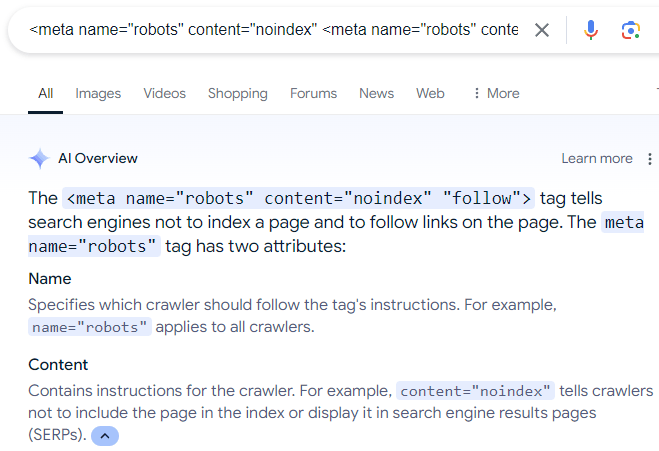
There is a lot of misinformation online that recommends the above meta description, which is even reflected in Google’s AI Overviews:

Screenshot Of AI Overviews

A screenshot of Google's AI Overviews recommending an erroneous robots directive configuration

Of course, the above robots directive does not work because, as Mueller explains, if a person (or search engine) can’t see a web page then the person (or search engine) can’t follow the links that are on the web page.

Also, while there is a “nofollow” directive rule that can be used to make a search engine crawler ignore links on  a web page, there is no “follow” directive that forces a search engine crawler to crawl all the links on a web page. Following links is a default that a search engine can decide for themselves.

Read more about robots meta tags.

Listen to John Mueller answer the question from the 14:45 minute mark of the podcast:

Featured Image by Shutterstock/ShotPrime Studio

Hacking Digital PR: How to Earn High-Authority Links from US Media via @sejournal, @hethr_campbell

Having trouble getting your website mentioned on big news sites to boost your search engine rankings? You’re not the only one.

Many businesses find it hard to get these links. But what if you could do this regularly, every month?

The trick is to use studies based on current trends that journalists find interesting.

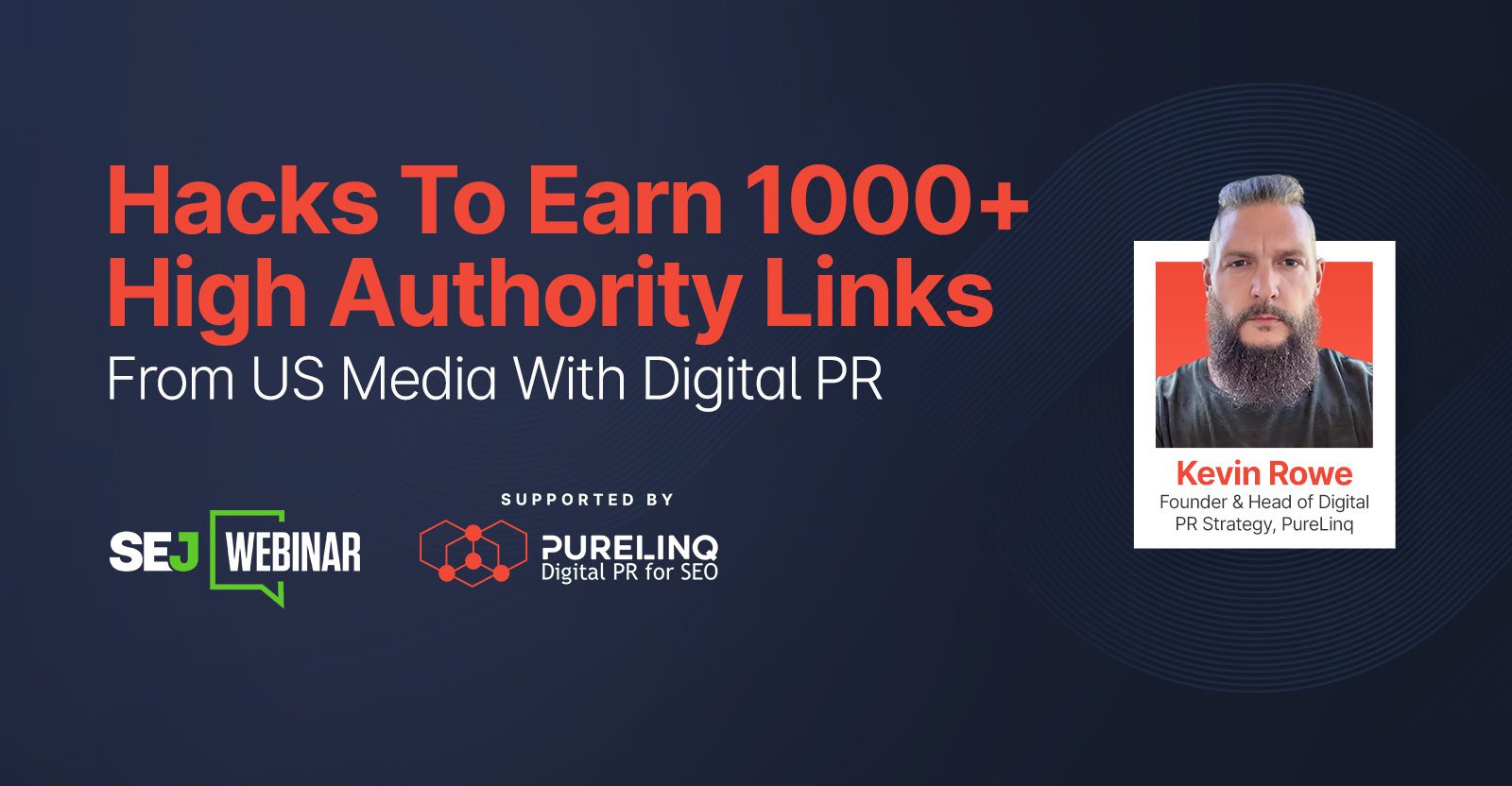
Sign up for our webinar with PureLinq on July 31, 2024, where we’ll discuss “Hacks To Earn 1000+ High Authority Links From US Media With Digital PR.”

Why Attend This Webinar?

Getting authoritative websites to link to yours is key to showing up high in search results. But it’s getting harder to catch the attention of busy reporters and editors.

That’s why creating interesting reports based on data is so useful. 

If you make content that fits what people are discussing right now, reporters will want to share your stories. 

This can lead to many respected websites mentioning and linking to you, which can help your website rank better in searches.

What You’ll Learn

Join Kevin Rowe as he presents real examples of PR campaigns that have received extensive media attention

You’ll learn about:

  • Spotting Hot Topics: How to find popular themes in the media that you can use for multiple successful PR campaigns.
  • The Go-To Formula: We’ll show you a simple research method that’s been super effective in getting media coverage and how you can use it.
  • Getting Journalists Interested: Tips on finding and reaching out to reporters who will likely share your information.
  • Quick & Effective Research: How to create studies that journalists will want to cover in just 1-4 weeks, sometimes only needing 5-10 hours of work.
  • Success Stories: We’ll examine three examples of this approach, which has generated over 1,000 links from major US news outlets.

The Best Part? It’s Easier Than You Think

One of the most valuable parts of this webinar is learning how achievable these results are. 

Rowe will share his secrets for identifying useful media trends and creating a media-ready research study with minimal time investment. 

These are practical, actionable strategies you can implement immediately after the webinar.

Who Should Attend?

This presentation is perfect for:

  • SEO professionals looking to enhance their link-building strategies.
  • Public relations folks trying to get more news outlets and websites to cover their stories.
  • Writers who want to make content that people will share and link to.
  • Anyone who wants their brand to be more visible and respected online.

Live Q&A: Get Your Questions Answered

After the presentation, we’ll have a live question-and-answer session.

You’ll have the opportunity to ask Kevin Rowe your questions and receive advice that fits your situation. Rowe is an expert at attracting brand attention online and making websites rank higher in searches.

Join Us Live

This is your chance to improve your online marketing and search engine rankings. Join us on July 31 to find out how to get trusted websites to link to you regularly. 

No problem if you can’t make it! Sign up anyway, and we’ll email you a video of the event to watch when it suits you.

Register today to learn how to use data to boost your online presence and improve your search rankings!