Google Debunks Outbound Links For SEO via @sejournal, @martinibuster

Google’s John Mueller debunked the common recommendation that it’s good to link out to other websites for SEO and ranking benefits.

Canonical SEO

The word canonical (in the context of facts and rules) means ideas and beliefs that are commonly accepted as true and correct. SEO has a number of canonical beliefs that data back decades. Some of the canonical SEO practices used to be true but lost their relevance after Google evolved. Other canonical practices are purely speculative beliefs based on “common sense reasoning” but not on anything real like a research paper, patent or a statement by a Googler.

Origins Of Outbound Link SEO

One such speculative canonical belief is the SEO practice of adding three outgoing links to every article. The reason for that belief probably comes from things Google said in a different context and also from how SEOs responded to Google’s link spam algorithms.

Speaking from memory, it was announced in 2005 at Pubcon New Orleans that Google was using statistical analysis to identify spammy linking patterns. SEOs responded by creating links that “looked normal” which meant to link out to a paid link but surround it with links to “authority sites” like .edu and .gov pages. At this point SEOs were linking out in order to make their paid outbound links “look normal.”

Again speaking from memory, there was a trend where SEOs didn’t want to link to other sites because they wanted to “hoard” PageRank and circulate it only to their own pages. The idea was that linking to other sites would “waste” that PageRank and make their sites weaker because there was less PageRank circulating to through their internal links. Googlers responded by saying that it’s good to link out. SEOs responded by saying that it’s good for SEO to link out. Which entirely misses the context in which Googlers said it was good to link out.

Decades later SEOs are telling each other that linking out is good for SEO but none of them knows why it’s good for SEO. They just tell each other that because the practice of linking out has become a canonical belief, something that everyone agrees is true and accurate.

I lived through all these changes and know where those beliefs came from. They came from a combination of statements that Googlers have made and were repeated over the years but the context was forgotten so that all that’s left is “it’s good to link out” and that’s what people believe.

John Mueller Debunks Outbound Link Myth

Someone on LinkedIn asked for what the specific amount of links were best for SEO. They wanted clarification on what the exact amount of outbound links were for SEO.

This is the question that was asked:

“I have a question. It’s a common practice among SEOs to believe that adding a total of 2-5 internal links and around 1-3 external links in a 1000-word blog post is beneficial. They also think that adding more links could be harmful to their site, while adding fewer links might not provide much value.

Could you please clarify whether the quantity of links really matters?”

Google’s John Mueller answered:

“Nobody at Google counts the links or the words on your blog posts, and even if they did, I’d still recommend writing for your audience.
I don’t know your audience, but I have yet to run across *anyone* who counts the words before reading a piece of content.”

What Is The Right Answer?

Mueller recommends writing for the audience. The underlying idea there is that if you know what the audience wants then you know what to give them.

What the audience wants has nothing to do with the number of “entities” you add to your content or how many outbound links you have on the page. If that’s your approach to SEO then you may want to evaluate how much of what’s published is for search engines and how much of it is for users because creating content for search engines have always been the likeliest way to produce content that doesn’t catch on and ranks.

I’m not being a Google apologist either, this is the pragmatic approach for beating competitors by understanding what works. For example, years before the Reviews algorithm came out I consulted for clients who had review websites and I told them that they needed to add more original images, more hands-on reviews, more metrics and comparisons. So a couple years later when the Reviews update guidelines came out it all made sense because I knew from my own personal experience ranking my own review websites that this was the best approach.

So the right answer for most SEO questions is most often found by reframing the question around the people the content is created for. When it comes to outbound links the question shouldn’t be “how many outbound links is best for SEO?” the question should be “do these outbound links fit the context of what the web page and what a reader would want?”

A good context for adding an outbound link is when something is quoted or cited. For example, if the content mentions scientific research or what someone else said, then that research or the page page documenting what was said should be linked to. That’s what users would want, right?

Read the question and answer on LinkedIn.

Featured Image by Shutterstock/Cast Of Thousands

New Google Gemini AI Experts Called Gems Might Be Good For SEO via @sejournal, @martinibuster

Google announced a new feature for Gemini AI called Gems that are pre-defined specialized experts to help users code, coach, create content, brainstorm and handle other tasks. Gems will soon roll out with premade experts and the ability for user to create their own experts to handle specific tasks.

What Is Gemini Gems?

Gemini Gems is a feature of Google’s Gemini AI platform that are created for specific narrowly defined tasks. Users can create their custom AI experts by providing specific instructions that will make the Gems an expert that can offer help in a highly defined role.

Real-World Practical Uses

I haven’t seen Gems yet but I wonder what would happen if you feed it Google’s quality raters guidelines, their SEO starter guide, and other documentation then set it loose on content to see if it could identify where it could be improved and why.

Google offered examples of how Gems can be used in business and professional settings.

  • Coding Assistance:
    Gems can be a coding assistant that can focus on a specific need like debugging code or making improvement suggestions.
  • Career Planning:
    A career planning professional can create a Gem to behave like a career coach that can offer advice and personalized career plans.
  • Content
    Gem can provide writers ideas, improve content and offer feedback like a writing expert.

An analogy of Gemini Gems, for example, can be like a bag of tools. Each tool specializes in something different like a drill, screwdriver and a hammer.

Impact Of Gems

Gems is a useful feature for Gemini users because they may no longer need to subscribe to a service that provides AI assistance in any given task. This may be bad news for SaaS businesses that offer AI content creation and other services but it’s good news for businesses because it will make users able to do more and do it better.

According to Google’s announcement:

“With Gems, you can create a team of experts to help you think through a challenging project, brainstorm ideas for an upcoming event, or write the perfect caption for a social media post. Your Gem can also remember a detailed set of instructions to help you save time on tedious, repetitive or difficult tasks.”

This new feature may very well make a subscription to Google Gemini something to give a try because it has the potential to make an impact in business and personal settings.

Read Google’s announcement

New in Gemini: Custom Gems and improved image generation with Imagen 3

Featured Image by Shutterstock/Cast Of Thousands
Google Shows 7 Hidden Features in Google Trends via @sejournal, @martinibuster

Google published a video tutorial with seven tips for using Google Trends to research and share keyword and topic data. The tutorial shows how to find hidden filters and search tools in the Trends interface and explains how they help identify actionable data.

The seven ways to explore and share are:

  1. Punctuation
  2. By Language
  3. Comparison Functions
  4. Seasonality Discovery
  5. Year Over Year Trends
  6. Interest By Country
  7. 3 Ways To Export Or Share

1. Punctuation For Finding Hidden Insights

Omri Weisman, Google Trends Engineering Manager, shared how to use advanced search operators to dig deeper into the data and extract actionable user query insights.

He presented an overview of three advanced search operators:

  • A. Quotation marks
  • B. Plus operator (the + sign)
  • C. Minus operator (the – sign)

He started with the example of search a two-word keyword term without punctuation, explaining that the keyword query volume data is for both words in any order. He also pointed out that no misspellings, variations, or plural versions are included in the search volume data.

A. Quotation Marks

The first search operator he discussed was the quotation mark. The quotation marks shows data for the exact match phrase, including when embedded as part of a larger phrase, with words before or after the exact match search query.

B. Minus Sign

Adding a minus sign to a search phrase filters out the word that’s modified with the minus sign, like this:

Keyword -Phrase

In the above example the word ‘phrase” will not be included in the search query data. This is a great way to manipulate the data and extract more precise variations.

C. Plus Sign – Good Way To Research Topics

Searching with a plus sign and two keywords shows query volume for one or other keyword. As such, this way of searching provides the broadest keyword query amounts and represents an excellent way to research a topic. With a plus sign you can add in all the related phrases for a topic and then see all of them lumped together.

2. Segment By Language

…if you’re interested in a specific language, you might want to look only for that language. They use the example of identifying how many searches for cat are done in Japanese in the United States, which allows you to segment searches with greater granularity.

You can also combine two languages using the plus sign search operator to see the combined query volume.

They said:

“For example, if you enter the Japanese character for cat… You might miss the overall trends, since many people in the US, for example, search for cat in English.

To get the full picture. Compare searches for the Japanese character for Cat and English searches for cat using the plus operator.”

3. Use Filters To Identify More Actionable Data

Daniel Waisberg said that comparing keywords helps identify more meaningful trends. In order to do

He said:

“Getting the data you need is essential, but to understand what it means, you need a comparison point. For example, is the growth localized or global? Is the growth seasonal, and if so, how does this season compare to the previous one?

To create a meaningful comparison, you can use the filter capability inside the search term.”

The following screenshot shows where a three dot menu in a drop down to access the filters.

4. Seasonality Discovery

He next showed how to use the filters to discover seasonality.

He explained:

“First enter the term in the trends explore section and change the time frame to five years.

This will create an interesting chart showing that this term is highly seasonal. People search for boat trips significantly more in the UK summer than in the winter. “

5. How To Remove Seasonality Trends

Next he explained how to use the built-in filters to analyze year over year trends.

This is again accessed through the filters that are somewhat hidden in the Google Trends interface.

He showed how to do it:

“While it is interesting to know the time of the year when the term has a higher interest, you’ll need more information if you want to make decisions based on the data.

You can use a special filter to analyze trends year over year. This will help you neutralize the seasonality effect, making sure you’re comparing like for like.

Start by changing the date to past 12 months.

Add an identical term to the compare box and hover over the box.

Click the three dots menu and select Change Filters.

Here you see two options, location and time range. Click the time range and select the custom time range to choose the previous time period.

If you’re looking for full years, you can use the built in capability to choose the past five years. That would make your search quicker.

After these steps, you’ll end up with two lines in your chart, one for the past 12 months and a second for the previous 12 months.”

This comparison can be done with up to five searches, which has the effect of being able to see the general trends in comparison, without the noise introduced by seasonality.

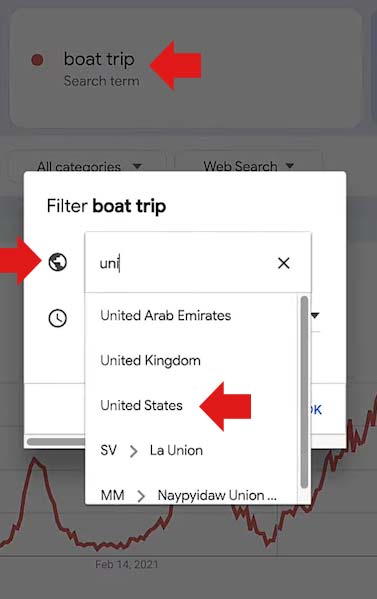
6. Compare Interest By Countries

The comparison by country allows users to compare search query volumes by country, two or more countries together.

The way to do that is with the filters that are accessed by the three-dot menu located next to the search query being researched.

Screenshot Of Country Filter

Image of a dropdown menu showing an

7. Save Or Share Trend Results

Ori explained that there are three ways to save or share Google Trends results.

  1. URL
  2. Embedded
  3. Export to spreadsheet

Share By URL

Sharing by URL is easy. Just copy the URL from the browser then share it.

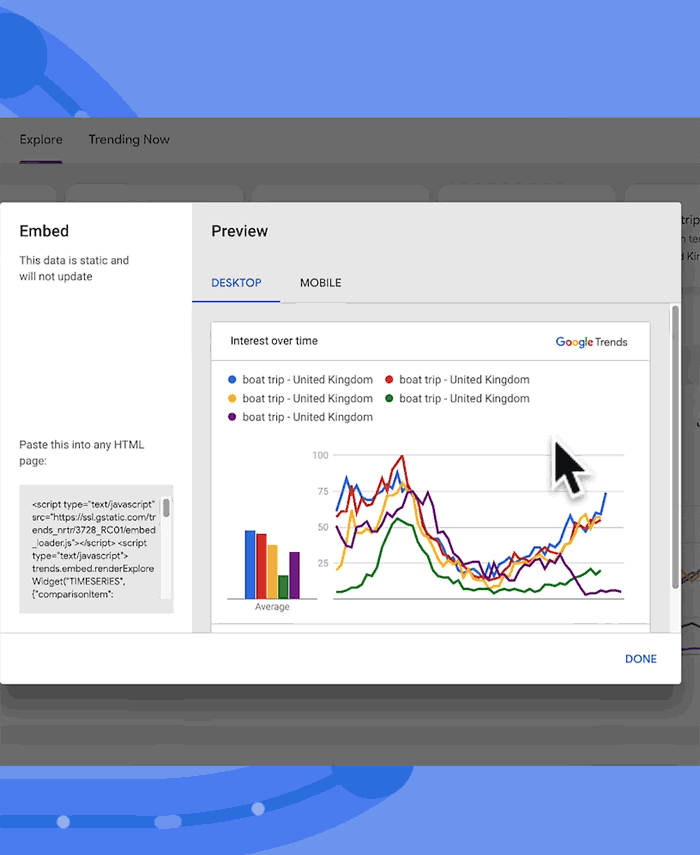
Embed Trend Data

Embedding is a way to generate an embeddable card with the data that can be inserted into a web page, with bonus that the data is constantly updated.

“Another way to share a chart is to embed it on your website. You can generate an embeddable card to add to your website from almost any card on the page.”

Screenshot Of Embed User Interface

These cards will show up to date data and may also reproduce some in-product interactions.

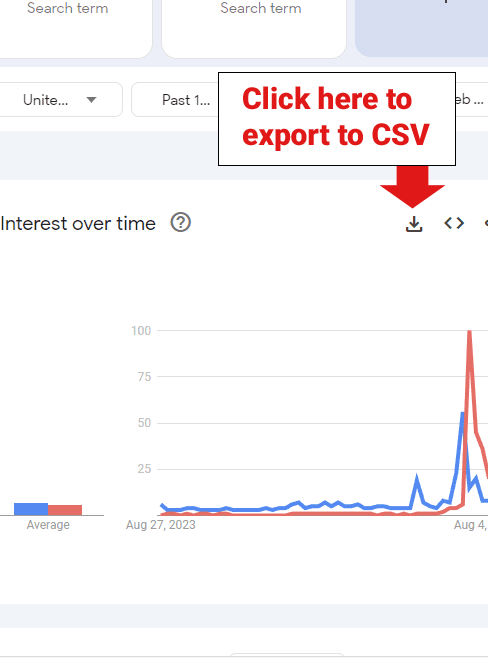
Export The Data

Clicking the export icon will provide the Google Trends data in the CSV format.

Screenshot Of Download Icon

Use Google Trends For Research

Google Trends is an excellent source of keyword and topic research and it’s completely free. Using these advanced methods will help get even more actionable data.

Watch The Google Trends Video Tutorial

Google Trends Advanced Tips

Google Says If Internal Nofollow Links Send A Quality Signal via @sejournal, @martinibuster

Google’s Martin Splitt answered a question about whether internal nofollow links and noindex meta robots directives send the wrong signal to Google that the website is low quality.

Nofollow Link Attribute

The nofollow link attribute came about as a standard created by Google, Yahoo and Microsoft that publishers can use to signal that a link can’t be trusted (such as links in user generated content) or for paid links. The idea is that the links can’t be trusted or used for ranking purposes or for whatever reason.

SEOs discovered that PageRank didn’t flow through links that had the nofollow attribute so naturally the self-identified “white hat” SEOs tried gaming Google by adding nofollow links to their privacy and about us pages in order to funnel the maximum amount of PageRank to the pages that mattered. This practice was called PageRank Sculpting and it shows that adding nofollows to internal links is longtime practice and that it’s never been a problem before.

For the record, PageRank sculpting doesn’t work because, in a highly simplified explanation, Google essentially counts the amount of links on a page, including links with nofollows and divides the amount of PageRank that flows as if all the links counted. That’s how it was explained many years ago and that may have changed over the years, we don’t really know.

Noindex Robots Meta tag

The noindex robots meta tag is a directive that crawlers like Googlebot are required to obey. It allows a publisher a way to block crawling at the page level.

There is nothing about the noindex value of the meta element that indicates whether the page is untrustworthy or anything like that. It’s just a way to control crawlers.

Google’s Martin Splitt narrated the question:

“Can a lot of internal links with nofollow tags or many pages with noindex tags signal to Google that the site has many low-quality pages?”

Martin answered:

“No, it doesn’t signal low-quality content to us, just that you have links you’re not willing to be associated with. That might have many reasons – you’re not sure where the link goes, because it is user-generated content (in which case consider using rel=ugc instead of rel=nofollow) or you don’t know what the site you’re linking to is going to do in a couple of years or so, so you mark them as rel=nofollow.”

Nofollow Is Not A Quality Signal

Martin confirmed that there is no signal indicating a value judgement about “quality” that’s associated with the use of a nofollow link attribute or the noindex robots meta tag. Using them on internal links or for preventing crawling is fine and have no effect on Google site quality judgements.

Listen to the podcast question and answer at the 1:17 minute mark:

Featured Image by Shutterstock/Cast Of Thousands
Google Says Best Practices Can Have Minimal Effect via @sejournal, @martinibuster

Google’s John Mueller answered a question the question of how long it takes for SEO to work and what it means if rankings don’t change after a year. Sometimes best practices doesn’t work and John Mueller explains why this sometimes is the case.

What Is SEO?

There is no single definition of SEO. What constitutes good SEO is subjective and highly dependent on where one learned about SEO.

  • Some believe that SEO is adding keywords into content and building links.
  • Others don’t really bother with links and are more concerned with building content.
  • Some are highly focused on technical aspects like site performance metrics and structured data.
  • In some corners of the SEO community, there are those who passionately believe that SEO doesn’t matter because Google prioritizes ads, big brands, YouTube videos, more ads, and then leaves the crumbs of what’s left for small businesses.

So when someone asks why their SEO isn’t working, the answer can be a toss-up, and if ten SEOs agree, there’s a chance they haven’t identified the problem—they’ve only agreed on the most obvious reason. This was the situation John Mueller encountered when asked why a site wasn’t ranking despite following SEO best practices.

Hard To Answer Without Specifics

John Mueller narrated the question:

“I changed my website a year ago and did a lot of work on SEO. Should this be affecting my website’s traffic by now?”

It’s a hard question to answer when you don’t have the specifics of the webpage in front of you. So Mueller answered in a fairly general manner that ends with him recommending he ask someone else for advice in Google’s help forums.

The first part of Mueller’s response acknowledges the difficulty of answering the question.

He responded:

“It’s tricky to say much here. I don’t know what specifically you did to work on SEO, and I don’t know if that would have resulted in significant changes.”

Why SEO Doesn’t Work

Mueller’s right. Maybe the website has a great layout, fast page speed performance, spot on structured data and a logical site architecture that optimizes internal linking.

What could go wrong with a properly SEO’d website, right?

  • Well, the content could be incomplete.
  • The content could be too comprehensive.
  • The content might be unfocused, lacking a clear comprehension of the topic.
  • The content might be too focused on keywords and not focused enough on users.
  • The content might not match the topic suggested by the keywords in the title and the headings.
  • Maybe the content is aiming too high, trying to rank for a highly competitive search phrase.

No amount of SEO is going to save a website with the above listed problems… and that’s just a sample of what can go wrong.

Mueller addressed this shortcoming of SEO in situations where it has zero effect.

He continued his answer:

“There are many best practices which have minimal effect on the day-to-day performance of a website. For example, having a clean page structure helps search engines to better understand the content on a page, but it might not necessarily result in immediate search ranking or traffic changes.”

Ranking Criteria Is Different Across Topics

Another factor that Mueller touches on is that what’s important for SEO varies according to the topic. Some topics require fresh content, some content requires establishing signals of trustworthiness and authoritativeness, maybe even signals that communicate user brand preference and popularity, signals that indicate that users expect to see a specific brand for certain queries.

There could be a geographic component that prioritizes local signals. It could be an intent thing where a user just wants to read what a person wrote in a forum.

This may be what Mueller is talking about when he says that the best elements of SEO vary across websites.

He answered:

“The most effective elements of SEO will vary across websites, it takes a lot of experience to go from a long checklist of possible items to a short prioritized list of critical items.”

Experience Is Important

The last factor Mueller discussed is the role of experience in making one a better SEO. Here’s an example: I thought I was pretty good at creating content that ranks and then I wrote a couple thousand articles for Search Engine Journal and it opened up a whole new conception of content creation, I discovered levels of understanding that could only come from writing about a couple thousand articles.

Mentorship, is an option that can cut down the amount of time it takes to learn, but experience is still important.

John Mueller recommended experience as an important factor for understanding SEO.

He wrote:

“Your experience here will grow over time as you practice.

I recommend getting input from others, and practicing by helping with challenges that others post in help forums. Good luck!”

Getting input from others is good advice.

Listen to the podcast at the 17:43 minute mark:

Featured Image by Shutterstock/Cast Of Thousands
Google On YouTube “Cannibalization” Of Web Content via @sejournal, @martinibuster

Google’s Martin Splitt answered a question in the SEO Office Hours podcast about whether reproducing YouTube video content into text on a web page would be seen as duplicate content and have a negative impact on the web page rankings.

Although duplicate content is not a negative ranking factor, content published on a more authoritative site can cause the content on the less authoritative site to be outranked. It’s a valid question to ask because content on an authoritative will outrank the same content on a less authoritative one.

Some in the search community refer to one piece of content usurping the rankings of another as ‘cannibalization’ of the webpage’s ranking potential. This is the concern of the person asking the question.

Google’s Martin Splitt narrated the submitted question:

“If I create a YouTube video and then take that exact text or content and place it on a web page, could Google flag that web page or site for duplicate content?”

Different Content Media Are Treated As Separate

Martin Splitt answered that the two forms of content are different and will not be treated as the same content, thus publishing text content extracted from a video will not be considered duplicate content.

This is his answer:

“No, one is a video and the other one is text content, and that would be unique content!”

Publishing Extracted Text From Video

Martin praised the idea of extracting text content from a video and republishing it as text, noting that some people prefer to consume content in text form rather than watching a video. Reversing the flow of content from text to audio or video is probably not a bad idea also because some people have trouble reading text content and may prefer listening to it from a video or a podcast format.

Martin commented on publishing video content in a textual version:

“It’s also not a bad idea, some users (like me) might prefer a text version and others might not be able to use a video version of the content in the first place due to bandwidth or visual constraints.”

Takeaways

The idea behind the question is repurposing content and it’s a good idea. Search is more than Google, it’s also YouTube and wherever people get their audio content, like Spotify. The fact that there is no cannibalization of the content between mediums makes repurposing a viable approach to extending your content reach.

Listen to the podcast at the 8:20 minute mark:

Featured Image by Shutterstock/Roman Samborskyi

Google Updates ProfilePage Structured Data Documentation via @sejournal, @martinibuster

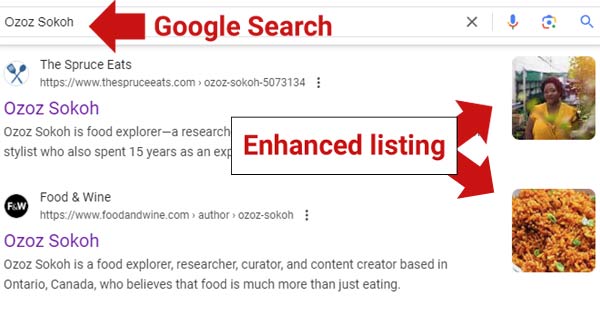
Google updated their documentation for the profile page structured data, a structured data that all creators including recipe bloggers can use and become eligible for enhanced listings in the search results.

What is ProfilePage Structured Data?

ProfilePage structured data is a Schema.org markup that Google uses for enhanced listings in the search results. It’s well known for use with forum and discussion communities but it’s also of use for any profile page where there’s information about the author.

What Changed In The Official Documentation?

Google updated the opening paragraph to make it clearer how Google uses it in the search results and removes the mention of “Perspectives” and replaces it with references to Forums, which aligns with how Google Search refers to them in the search results.

The new version of the opening paragraph is about 26% shorter but offers more precise information.

This is the original version (64 words):

“ProfilePage markup is designed for any site where creators (either people or organizations) share first-hand perspectives. It helps Google Search highlight information about the creator, such as their name or social handle, profile photo, follower count, or the popularity of their content. Google Search also makes use of this markup when disambiguating the creator, and in features such as Perspectives and Discussions and Forums.”

This is the revised version (47 words):

“ProfilePage markup is designed for any site where creators (either people or organizations) share first-hand perspectives. Adding this markup helps Google Search understand the creators that post in an online community, and show better content from that community in search results, including the Discussions and Forums feature.”

What’s ProfilePage Markup Good For?

The ProfilePage structured data markup can be used on any profile page where there’s a creator. It’s not just for communities and can make a profile page eligible to show an enhanced listing in the search results.

This is what Google’s documentation says:

“Other structured data features can link to pages with ProfilePage markup too. For example, Article and Recipe structured data have authors…”

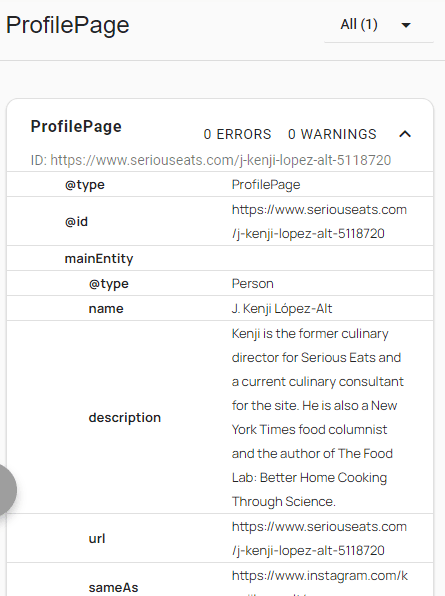
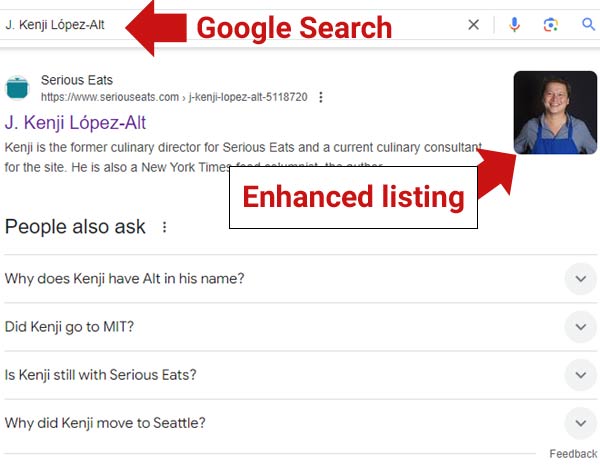
It seems like the ProfilePage markup is underused in the recipe blogger space, not sure why. For example, the Serious Eats profile page for recipe writer J. Kenji López-Alt has ProfilePage structured data markup on his profile page and Google appears to reward that markup with an enhanced listing for his Serious Eats profile page.

Screenshot Of Serious Eats ProfilePage Markup

Screenshot Of Rich Results For Profile Page

Another Screenshot

Screenshot of a rich result for two recipe site profile pages that use ProfilePage structured data markup

The above two screenshots are of rich results for the profile pages of recipe authors, pages that use the ProfilePage structured data markup.

Read Google’s updated ProfilePage documentation:

Profile page (ProfilePage) structured data

Featured Image by Shutterstock/Krakenimages.com

Google Updates Organization Structured Data Documentation via @sejournal, @martinibuster

Google updated the opening paragraph of the Organization Structured Data documentation to provide a clearer, more comprehensive description of its purpose, with improved clarity on four specific points. The result is a model of how to write a high quality opening paragraph.

The new documentation has a high level of information density, which is the quality of communicating more information with less words. The importance of information density is that it communicates ideas better.

The changes add the following four points:

  1. It emphasizes that organization structured data disambiguates one organization from others using structured data properties like iso6523 and naics. Disambiguate means to make something less ambiguous.
  2. It explains how certain Schema.org properties can influence visual elements in search results and in a knowledge panel. A knowledge panel is a box containing data about an organization (or person) that appears on the right side of search results when a user queries about those entities.
  3. It specifically mentions how organization structured data can enrich merchant knowledge panels and brand profiles with details about return policies, addresses, and contact information.
  4. The new opening paragraph now states that there are no required properties for organization structured data and recommends adding as many structured data properties as necessary for relevance. This is not new to the documentation, but it is newly emphasized in the opening paragraph.

None of the four above points existed in the opening paragraph of the previous version of the documentation, serving as an example of how to keep on topic and communicate what a web page is about.

Here is the previous opening paragraph

“You can use organization structured data to let Google know about your organization’s administrative details, for example, logo, address, contact information, and business identifiers. Google can make use of this markup in knowledge panels and other visual elements (such as attribution), which helps users to find your organization’s details on Google Search.”

This is the new opening paragraph:

“Adding organization structured data to your home page can help Google better understand your organization’s administrative details and disambiguate your organization in search results. Some properties are used behind the scenes to disambiguate your organization from other organizations (like iso6523 and naics), while others can influence visual elements in Search results (such as which logo is shown in Search results and your knowledge panel). If you’re a merchant, you can influence more details in your merchant knowledge panel and brand profile, such as return policy, address, and contact information. There are no required properties; instead, we recommend adding as many properties that are relevant to your organization.”

The above opening paragraph is the only change to the document and yet it vastly improves the entire document because a reader knows what to expect as they continue reading.

Takeaways:

Understanding why the documentation is improved gives publishers and SEOs new ideas for understanding why a web page needs to be refreshed.

The changes to Google’s documentation improve it by clearly explaining what the web page is about, how organization structured data benefits users, and identifying a specific class of users who especially benefit from this kind of structured data. The opening paragraph invites readers to continue reading by ensuring they understand the web page’s purpose.

Why the new documentation is improved:

  • Higher information density
  • Improved topicality (communicates what the document is about)
  • Gets to the point fast
  • Offers more details and examples
  • Is more comprehensive
  • Mentions users who will benefit ( merchants)

Why the previous version needed to be fixed:

  • Lacked specifics
  • Limited in scope
  • Lacking in actionable information
  • Didn’t prepare the reader for what the entire page is about

Read the new documentation here:

Organization (Organization) structured data

Compare it to the old documentation here:

Organization (Organization) structured data – WaybackMachine

Featured Image by Shutterstock/Mix and Match Studio

Survey Shows Where SEOs Get Their Clients via @sejournal, @martinibuster

Aleyda Solis recently published the results of her SEOFOMO survey that revealed actionable facts about where SEOs are getting their clients, what kinds of clients they’re getting and how they’re promoting themselves to get more clients.

Aleyda Solis (LinkedIn) is a popular digital marketer specializing in International SEO. She publishes the SEOFOMO + MarketingFOMO Newsletters, is well known for promoting best practices in SEO and speaking at search conferences around the world.

This survey, conducted with a self-selected group of 337 respondents, offers a view of how SEO businesses get more business, who their clients are and what they do for them in 2024. The data offers valuable insights for digital marketers who want to grow their businesses.

For example, most of the respondents indicated that their area of specialization is Technical SEO. That makes sense because fixing website issues that make it easy for search engines to crawl, index and understand content is at the hear of what it means to optimize a site for search engines.

This is the kind of work SEOs specialize in:

  • 64% Technical SEO
  • 60% Content Focused SEO
  • 54% SEO Generalist
  • 51% SEO Management
  • 14% Link Builder
  • 8% Other

Only 14% of respondents answered that they build links for clients. That doesn’t mean that link building is not a priority but rather it may reflect that link building continues to be a difficult area to specialize in because of its complexity.

Who Answered The Survey

Aleyda’s survey consists of a sample of 337 respondents who self-identify as SEO specialists.

44% of respondents are Full-Time Agency SEO consultant
32 % are freelance and independent SEO consultants
24% are part-time SEO consultants
6% identified simply as Other

Data About SEO Clients

The results of the survey indicated that most of the respondents work with small and medium sized clients, with 49% working with sites less than 100K URLs and 33% working with client sites containing between 100k to 1 million URLs.

Local search SEO is perhaps the largest segment of small to medium businesses. This market, once challenging to scale with quality service at a reasonable price, has evolved. Today, agencies can partner with platforms like Wix or Duda, which both offer a high-performance website building platform that integrate marketing and SEO tools and also streamline client management and billing. These new technologies enables SEO agencies of any size to more easily scale, allowing them to focus on marketing and SEO rather than the underlying platform technology.

SEOs who self-identified as working with larger clients represented a total of 18% of the respondents. I’ve worked with large multinational B2B companies and there’s good money in it but it’s also can be frustratingly limited to how much influence you can have with the SEO. You just have to take your wins where you can get them and accept that you’ll never get your wish list fulfilled.

This Is Where SEOs Get Their Business

There is a great diversity in where SEOs get their business, which perhaps reflects individual priorities and strengths. Not everyone has the time to be a social media influencer nor the ability to get up and speak in front of audiences at industry events, right?

Referrals

The most highly cited source of clients is referrals from other companies and clients, accounting for 77% of responses. Putting in the hard work to cultivate happy clients and to promote an SEO business pays off in referrals.

Ranking In Search Results

SEOs who focus on ranking for phrases that brings them more clients was the second largest reported source of new clients. This approach makes sense for SEOs who have a geographic reach or who focus on a single vertical like personal injury. Combining a vertical (like personal injury or HVAC) with a geographic market could be easier to rank than trying to rank for the general term, especially given that Google tends to personalize general search queries.

Social Media

Participating in social media was reported by many respondents as a source of SEO clients, with 26% indicating that social media is a source of new clients and referrals.

That totally makes sense. I’ve seen SEOs with little experience come out of nowhere and get SEO business by extensive social media posting and participation in conversations as well as starting conversations. There’s a strong validating component that comes with cultivating a large social media following so it makes sense that social media is an important channel for obtaining referrals.

Something I see in the most successful SEOs who promote with social media is that they don’t tend to post on controversial topics like politics but do tend to get behind popular causes. Social media is a lot of work but the SEOFOMO survey validates social media as an important channel to focus on for building a client base.

Events

Twenty five percent of respondents cited Events as a channel for cultivating clients. Speaking at events can be a good way to get clients or at least to build a good reputation that leads to client referrals.

Speaking at events can be tricky because you have to have something interesting to say but it can’t be too complicated because you’re going to lose or bore the audience. I’ve been speaking at events since around 2004 and have seen others freeze in fear, spontaneously utter crazy things or bore the audience with a monotone speaking style (which is why I sometimes choose to speak first!).

Here are the top sources of SEO client business:

  • Client Or Company Referrals 77%
  • SEO 39%
  • Social Media 26%
  • Industry Events 25%
  • Blog Posts, Studies, Research
  • Other 15%
  • Cold Outreach 14%
  • 9% Paid Outreach

Getting Clients Requires Proactive Work

Despite that so many SEOs reported receiving client and company referrals, reaching that point requires putting in the time to cultivate happy clients, marketing their business in person and online, and demonstrating thought leadership. Everyone has their superpower, some are great speakers, some are great thinkers. Some SEOs find happiness making videos and while others are more comfortable sharing on podcasts. Whatever your superpower is, get out there to discover it then be the best at what you excel at.

Read the results of the survey here:

The SEOFOMO State of SEO Consulting – Survey 2024 Results

Featured Image by Shutterstock/Khosro

Google To Replace Classic Merchant Center By September via @sejournal, @MattGSouthern

Google to replace Merchant Center with new version by September, introducing AI tools and unified management for online and local listings.

  • Google will replace classic Merchant Center with Merchant Center Next by September.
  • New features include Product Studio, consolidated analytics, and unified product management.
  • Transition may pose challenges, but Google promises improved functionality and provides resources.