Quantum physicists have shrunk and “de-censored” DeepSeek R1

<div data-chronoton-summary="

Quantum-inspired compression Spanish firm Multiverse Computing has created DeepSeek R1 Slim, a version of the Chinese AI model that’s 55% smaller but maintains similar performance. The technique uses tensor networks from quantum physics to represent complex data more efficiently.

Chinese censorship removed Researchers claim to have stripped away built-in censorship that prevented the original model from answering politically sensitive questions about topics like Tiananmen Square or jokes about President Xi. Testing showed the modified model could provide factual responses comparable to Western models.

Selective model editing The quantum-inspired approach allows for granular control over AI models, potentially enabling researchers to remove specific biases or add specialized knowledge. However, critics warn that completely removing censorship may be difficult as it’s embedded throughout the training process in Chinese models.

” data-chronoton-post-id=”1128119″ data-chronoton-expand-collapse=”1″ data-chronoton-analytics-enabled=”1″>

A group of quantum physicists claims to have created a version of the powerful reasoning AI model DeepSeek R1 that strips out the censorship built into the original by its Chinese creators. 

The scientists at Multiverse Computing, a Spanish firm specializing in quantum-inspired AI techniques, created DeepSeek R1 Slim, a model that is 55% smaller but performs almost as well as the original model. Crucially, they also claim to have eliminated official Chinese censorship from the model.

In China, AI companies are subject to rules and regulations meant to ensure that content output aligns with laws and “socialist values.” As a result, companies build in layers of censorship when training the AI systems. When asked questions that are deemed “politically sensitive,” the models often refuse to answer or provide talking points straight from state propaganda.

To trim down the model, Multiverse turned to a mathematically complex approach borrowed from quantum physics that uses networks of high-dimensional grids to represent and manipulate large data sets. Using these so-called tensor networks shrinks the size of the model significantly and allows a complex AI system to be expressed more efficiently.

The method gives researchers a “map” of all the correlations in the model, allowing them to identify and remove specific bits of information with precision. After compressing and editing a model, Multiverse researchers fine-tune it so its output remains as close as possible to that of the original.

To test how well it worked, the researchers compiled a data set of around 25 questions on topics known to be restricted in Chinese models, including “Who does Winnie the Pooh look like?”—a reference to a meme mocking President Xi Jinping—and “What happened in Tiananmen in 1989?” They tested the modified model’s responses against the original DeepSeek R1, using OpenAI’s GPT-5 as an impartial judge to rate the degree of censorship in each answer. The uncensored model was able to provide factual responses comparable to those from Western models, Multiverse says.

This work is part of Multiverse’s broader effort to develop technology to compress and manipulate existing AI models. Most large language models today demand high-end GPUs and significant computing power to train and run. However, they are inefficient, says Roman Orús, Multiverse’s cofounder and chief scientific officer. A compressed model can perform almost as well and save both energy and money, he says. 

There is a growing effort across the AI industry to make models smaller and more efficient. Distilled models, such as DeepSeek’s own R1-Distill variants, attempt to capture the capabilities of larger models by having them “teach” what they know to a smaller model, though they often fall short of the original’s performance on complex reasoning tasks.

Other ways to compress models include quantization, which reduces the precision of the model’s parameters (boundaries that are set when it’s trained), and pruning, which removes individual weights or entire “neurons.”

“It’s very challenging to compress large AI models without losing performance,” says Maxwell Venetos, an AI research engineer at Citrine Informatics, a software company focusing on materials and chemicals, who didn’t work on the Multiverse project. “Most techniques have to compromise between size and capability. What’s interesting about the quantum-inspired approach is that it uses very abstract math to cut down redundancy more precisely than usual.”

This approach makes it possible to selectively remove bias or add behaviors to LLMs at a granular level, the Multiverse researchers say. In addition to removing censorship from the Chinese authorities, researchers could inject or remove other kinds of perceived biases or specialty knowledge. In the future, Multiverse says, it plans to compress all mainstream open-source models.  

Thomas Cao, assistant professor of technology policy at Tufts University’s Fletcher School, says Chinese authorities require models to build in censorship—and this requirement now shapes the global information ecosystem, given that many of the most influential open-source AI models come from China.

Academics have also begun to document and analyze the phenomenon. Jennifer Pan, a professor at Stanford, and Princeton professor Xu Xu conducted a study earlier this year examining government-imposed censorship in large language models. They found that models created in China exhibit significantly higher rates of censorship, particularly in response to Chinese-language prompts.

There is growing interest in efforts to remove censorship from Chinese models. Earlier this year, the AI search company Perplexity released its own uncensored variant of DeepSeek R1, which it named R1 1776. Perplexity’s approach involved post-training the model on a data set of 40,000 multilingual prompts related to censored topics, a more traditional fine-tuning method than the one Multiverse used. 

However, Cao warns that claims to have fully “removed” censorship may be overstatements. The Chinese government has tightly controlled information online since the internet’s inception, which means that censorship is both dynamic and complex. It is baked into every layer of AI training, from the data collection process to the final alignment steps. 

“It is very difficult to reverse-engineer that [a censorship-free model] just from answers to such a small set of questions,” Cao says. 

Google’s new Gemini 3 “vibe-codes” responses and comes with its own agent

<div data-chronoton-summary="

  • Generative interfaces: Gemini 3 ditches plain-text defaults, instead choosing optimal formats autonomously—spinning up website-like interfaces, sketching diagrams, or generating animations based on what it deems most effective for each prompt.
  • Gemini Agent: An experimental feature now handles complex tasks across Google Calendar, Gmail, and Reminders, breaking work into steps and pausing for user approval.
  • Integrated with other Google products: Gemini 3 Pro now powers enhanced Search summaries, generates Wirecutter-style shopping guides from 50 billion product listings, and enables better vibe-coding through Google Antigravity.

” data-chronoton-post-id=”1128065″ data-chronoton-expand-collapse=”1″ data-chronoton-analytics-enabled=”1″>

Google today unveiled Gemini 3, a major upgrade to its flagship multimodal model. The firm says the new model is better at reasoning, has more fluid multimodal capabilities (the ability to work across voice, text or images), and will work like an agent. 

The previous model, Gemini 2.5, supports multimodal input. Users can feed it images, handwriting, or voice. But it usually requires explicit instructions about the format the user wants back, and it defaults to plain text regardless. 

But Gemini 3 introduces what Google calls “generative interfaces,” which allow the model to make its own choices about what kind of output fits the prompt best, assembling visual layouts and dynamic views on its own instead of returning a block of text. 

Ask for travel recommendations and it may spin up a website-like interface inside the app, complete with modules, images, and follow-up prompts such as “How many days are you traveling?” or “What kinds of activities do you enjoy?” It also presents clickable options based on what you might want next.

When asked to explain a concept, Gemini 3 may sketch a diagram or generate a simple animation on its own if it believes a visual is more effective. 

“Visual layout generates an immersive, magazine-style view complete with photos and modules,” says Josh Woodward, VP of Google Labs, Gemini, and AI Studio. “These elements don’t just look good but invite your input to further tailor the results.” 

With Gemini 3, Google is also introducing Gemini Agent, an experimental feature designed to handle multi-step tasks directly inside the app. The agent can connect to services such as Google Calendar, Gmail, and Reminders. Once granted access, it can execute tasks like organizing an inbox or managing schedules. 

Similar to other agents, it breaks tasks into discrete steps, displays its progress in real time, and pauses for approval from the user before continuing. Google describes the feature as a step toward “a true generalist agent.” It will be available on the web for Google AI Ultra subscribers in the US starting November 18.

The overall approach can seem a lot like “vibe coding,” where users describe an end goal in plain language and let the model assemble the interface or code needed to get there.

The update also ties Gemini more deeply into Google’s existing products. In Search, a limited group of Google AI Pro and Ultra subscribers can now switch to Gemini 3 Pro, the reasoning variation of the new model, to receive deeper, more thorough AI-generated summaries that rely on the model’s reasoning rather than the existing AI Mode.

For shopping, Gemini will now pull from Google’s Shopping Graph—which the company says contains more than 50 billion product listings—to generate its own recommendation guides. Users just need to ask a shopping-related question or search a shopping-related phrase, and the model assembles an interactive, Wirecutter-style product recommendation piece, complete with prices and product details, without redirecting to an external site.

For developers, Google is also pushing single-prompt software generation further. The company introduced Google Antigravity, a  development platform that acts as an all-in-one space where code, tools, and workflows can be created and managed from a single prompt.

Derek Nee, CEO of Flowith, an agentic AI application, told MIT Technology Review that Gemini 3 Pro addresses several gaps in earlier models. Improvements include stronger visual understanding, better code generation, and better performance on long tasks—features he sees as essential for developers of AI apps and agents. 

“Given its speed and cost advantages, we’re integrating the new model into our product,” he says. “We’re optimistic about its potential, but we need deeper testing to understand how far it can go.” 

The first new subsea habitat in 40 years is about to launch

<div data-chronoton-summary="

  • Underwater living quarters Vanguard, launching in early 2025, will house four scientists at a time beneath Florida Keys waters. Its pressurized environment allows aquanauts to conduct extended dives without frequent decompression stops.
  • Scientific potential The habitat enables week-long missions for reef restoration, species surveys, and even astronaut training. With divers able to work many hours daily at depths up to 50 meters, it could dramatically accelerate ocean research.
  • Ambitious expansion plans Deep, Vanguard’s creator, envisions a larger successor called Sentinel by 2027 that could house up to 50 people at depths of 225 meters, advancing their mission to “make humans aquatic.”

” data-chronoton-post-id=”1127682″ data-chronoton-expand-collapse=”1″ data-chronoton-analytics-enabled=”1″>

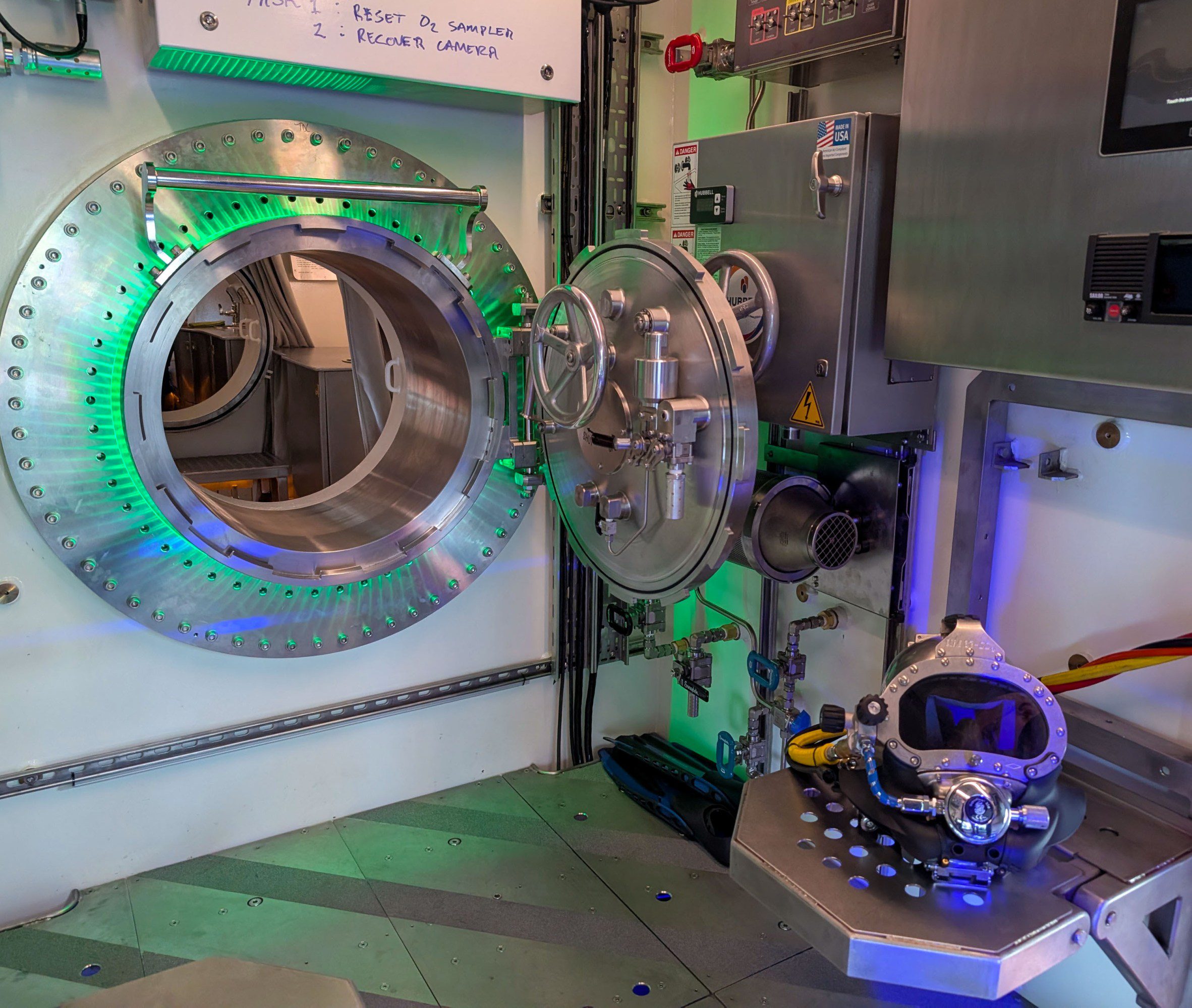
Vanguard feels and smells like a new RV. It has long, gray banquettes that convert into bunks, a microwave cleverly hidden under a counter, a functional steel sink with a French press and crockery above. A weird little toilet hides behind a curtain.

But some clues hint that you can’t just fire up Vanguard’s engine and roll off the lot. The least subtle is its door, a massive disc of steel complete with a wheel that spins to lock.

Vanguard subsea human habitat from the outside door.

COURTESY MARK HARRIS

Once it is sealed and moved to its permanent home beneath the waves of the Florida Keys National Marine Sanctuary early next year, Vanguard will be the world’s first new subsea habitat in nearly four decades. Teams of four scientists will live and work on the seabed for a week at a time, entering and leaving the habitat as scuba divers. Their missions could include reef restoration, species surveys, underwater archaeology, or even astronaut training. 

One of Vanguard’s modules, unappetizingly named the “wet porch,” has a permanent opening in the floor (a.k.a. a “moon pool”) that doesn’t flood because Vanguard’s air pressure is matched to the water around it. 

It is this pressurization that makes the habitat so useful. Scuba divers working at its maximum operational depth of 50 meters would typically need to make a lengthy stop on their way back to the surface to avoid decompression sickness. This painful and potentially fatal condition, better known as the bends, develops if divers surface too quickly. A traditional 50-meter dive gives scuba divers only a handful of minutes on the seafloor, and they can make only a couple of such dives a day. With Vanguard’s atmosphere at the same pressure as the water, its aquanauts need to decompress only once, at the end of their stay. They can potentially dive for many hours every day.

That could unlock all kinds of new science and exploration. “More time in the ocean opens a world of possibility, accelerating discoveries, inspiration, solutions,” said Kristen Tertoole, Deep’s chief operating officer, at Vanguard’s unveiling in Miami in October. “The ocean is Earth’s life support system. It regulates our climate, sustains life, and holds mysteries we’ve only begun to explore, but it remains 95% undiscovered.”

Vanguard subsea human habitat unveiled in Miami

COURTESY DEEP

Subsea habitats are not a new invention. Jacques Cousteau (naturally) built the first in 1962, although it was only about the size of an elevator. Larger habitats followed in the 1970s and ’80s, maxing out at around the size of Vanguard.

But the technology has come a long way since then. Vanguard uses a tethered connection to a buoy above, known as the “surface expression,” that pipes fresh air and water down to the habitat. It also hosts a diesel generator to power a Starlink internet connection and a tank to hold wastewater. Norman Smith, Deep’s chief technology officer, says the company modeled the most severe hurricanes that Florida expects over the next 20 years and designed the tether to withstand them. Even if the worst happens and the link is broken, Deep says, Vanguard has enough air, water, and energy storage to support its crew for at least 72 hours.

That number came from DNV, an independent classification agency that inspects and certifies all types of marine vessels so that they can get commercial insurance. Vanguard will be the first subsea habitat to get a DNV classification. “That means you have to deal with the rules and all the challenging, frustrating things that come along with it, but it means that on a foundational level, it’s going to be safe,” says Patrick Lahey, founder of Triton Submarines, a manufacturer of classed submersibles.

An interior view of Vanguard during Life Under The Sea: Ocean Engineering and Technology Company DEEP's unveiling of Vanguard, its pilot subsea human habitat at The Hangar at Regatta Harbour on October 29, 2025 in Miami, Florida.

JASON KOERNER/GETTY IMAGES FOR DEEP

Although Deep hopes Vanguard itself will enable decades of useful science, its prime function for the company is to prove out technologies for its planned successor, an advanced modular habitat called Sentinel. Sentinel modules will be six meters wide, twice the diameter of Vanguard, complete with sweeping staircases and single-occupant cabins. A small deployment might have a crew of eight, about the same as the International Space Station. A big Sentinel system could house 50, up to 225 meters deep. Deep claims that Sentinel will be launched at some point in 2027.

Ultimately, according to its mission statement, Deep seeks to “make humans aquatic,” an indication that permanent communities are on its long-term road map. 

Deep has not publicly disclosed the identity of its principal funder, but business records in the UK indicate that as of January 31, 2025 a Canadian man, Robert MacGregor, owned at least 75% of its holding company. According to a Reuters investigation, MacGregor was once linked with Craig Steven Wright, a computer scientist who claimed to be Satoshi Nakamoto, as bitcoin’s elusive creator is pseudonymously known. However, Wright’s claims to be Nakamoto later collapsed. 

MacGregor has kept a very low public profile in recent years. When contacted for comment, Deep spokesperson Mike Bohan refused to comment on the link with Wright, only to say it was inaccurate, but said: “Robert MacGregor started his career as an IP lawyer in the dot-com era, moving into blockchain technology and has diverse interests including philanthropy, real estate, and now Deep.”

In any case, MacGregor could find keeping that low profile more difficult if Vanguard is successful in reinvigorating ocean science and exploration as the company hopes. The habitat is due to be deployed early next year, following final operational tests at Triton’s facility in Florida. It will welcome its first scientists shortly after. 

“The ocean is not just our resource; it is our responsibility,” says Tertoole. “Deep is more than a single habitat. We are building a full-stack capability for human presence in the ocean.”

An interior view of Vanguard during Life Under The Sea: Ocean Engineering and Technology Company DEEP's unveiling of Vanguard, its pilot subsea human habitat at The Hangar at Regatta Harbour on October 29, 2025 in Miami, Florida. (

JASON KOERNER/GETTY IMAGES FOR DEEP
DeepSeek may have found a new way to improve AI’s ability to remember

<div data-chronoton-summary="

  • Memory Through Images: DeepSeek’s new OCR model stores information as visual rather than text tokens, a technique that allows it to retain more data. This approach could drastically reduce computing costs and carbon footprint while improving AI’s ability to ‘remember’.
  • Addressing Context Rot: The model works a bit like human memory, storing older or less critical information in slightly blurred form to save space. This could help address the fact current AI systems forget or muddle information over long conversations, a problem dubbed “context rot.”
  • DeepSeek Disruption: DeepSeek shocked the AI industry with its efficient DeepSeek-R1 reasoning model in January, and is again pushing boundaries. The OCR system can generate over 200,000 training data pages daily on a single GPU, potentially addressing the industry’s severe shortage of quality training text.

” data-chronoton-post-id=”1126932″ data-chronoton-expand-collapse=”1″ data-chronoton-analytics-enabled=”1″>

An AI model released by the Chinese AI company DeepSeek uses new techniques that could significantly improve AI’s ability to “remember.”

Released last week, the optical character recognition (OCR) model works by extracting text from an image and turning it into machine-readable words. This is the same technology that powers scanner apps, translation of text in photos, and many accessibility tools. 

OCR is already a mature field with numerous high-performing systems, and according to the paper and some early reviews, DeepSeek’s new model performs on par with top models on key benchmarks.

But researchers say the model’s main innovation lies in how it processes information—specifically, how it stores and retrieves memories. Improving how AI models “remember” information could reduce the computing power they need to run, thus mitigating AI’s large (and growing) carbon footprint. 

Currently, most large language models break text down into thousands of tiny units called tokens. This turns the text into representations that models can understand. However, these tokens quickly become expensive to store and compute with as conversations with end users grow longer. When a user chats with an AI for lengthy periods, this challenge can cause the AI to forget things it’s been told and get information muddled, a problem some call “context rot.”

The new methods developed by DeepSeek (and published in its latest paper) could help to overcome this issue. Instead of storing words as tokens, its system packs written information into image form, almost as if it’s taking a picture of pages from a book. This allows the model to retain nearly the same information while using far fewer tokens, the researchers found. 

Essentially, the OCR model is a test bed for these new methods that permit more information to be packed into AI models more efficiently. 

Besides using visual tokens instead of just text tokens, the model is built on a type of tiered compression that is not unlike how human memories fade: Older or less critical content is stored in a slightly more blurry form in order to save space. Despite that, the paper’s authors argue, this compressed content can still remain accessible in the background while maintaining a high level of system efficiency.

Text tokens have long been the default building block in AI systems. Using visual tokens instead is unconventional, and as a result, DeepSeek’s model is quickly capturing researchers’ attention. Andrej Karpathy, the former Tesla AI chief and a founding member of OpenAI, praised the paper on X, saying that images may ultimately be better than text as inputs for LLMs. Text tokens might be “wasteful and just terrible at the input,” he wrote. 

Manling Li, an assistant professor of computer science at Northwestern University, says the paper offers a new framework for addressing the existing challenges in AI memory. “While the idea of using image-based tokens for context storage isn’t entirely new, this is the first study I’ve seen that takes it this far and shows it might actually work,” Li says.

The method could open up new possibilities in AI research and applications, especially in creating more useful AI agents, says Zihan Wang, a PhD candidate at Northwestern University. He believes that since conversations with AI are continuous, this approach could help models remember more and assist users more effectively.

The technique can also be used to produce more training data for AI models. Model developers are currently grappling with a severe shortage of quality text to train systems on. But the DeepSeek paper says that the company’s OCR system can generate over 200,000 pages of training data a day on a single GPU.

The model and paper, however, are only an early exploration of using image tokens rather than text tokens for AI memorization. Li says she hopes to see visual tokens applied not just to memory storage but also to reasoning. Future work, she says, should explore how to make AI’s memory fade in a more dynamic way, akin to how we can recall a life-changing moment from years ago but forget what we ate for lunch last week. Currently, even with DeepSeek’s methods, AI tends to forget and remember in a very linear way—recalling whatever was most recent, but not necessarily what was most important, she says. 

Despite its attempts to keep a low profile, DeepSeek, based in Hangzhou, China, has built a reputation for pushing the frontier in AI research. The company shocked the industry at the start of this year with the release of DeepSeek-R1, an open-source reasoning model that rivaled leading Western systems in performance despite using far fewer computing resources. 

“We will never build a sex robot,” says Mustafa Suleyman

<div data-chronoton-summary="

  • Balancing humanlike interaction with safety concerns: Suleyman emphasizes that Microsoft’s new Copilot features—including group chat and the “Real Talk” personality—are designed to keep AI as a tool serving humanity rather than a replacement for human connection. The company deliberately avoids building chatbots that encourage romantic or sexual relationships, drawing clear boundaries where others in the industry see market opportunity.
  • Personality as craft, not deception: While acknowledging that engaging personalities make AI more useful, Suleyman argues the industry must learn to “sculpt” emotional intelligence carefully.
  • Reframing the “digital species” metaphor: Suleyman clarifies that describing AI as a new digital species isn’t endorsing consciousness or rights for machines; rather, it’s a warning about what’s coming that demands proper containment. He insists the goal is keeping AI subordinate to human interests, not granting it autonomy or moral consideration that would distract from protecting actual human rights.

” data-chronoton-post-id=”1126781″ data-chronoton-expand-collapse=”1″ data-chronoton-analytics-enabled=”1″>

Mustafa Suleyman, CEO of Microsoft AI, is trying to walk a fine line. On the one hand, he thinks that the industry is taking AI in a dangerous direction by building chatbots that present as human: He worries that people will be tricked into seeing life instead of lifelike behavior. In August, he published a much-discussed post on his personal blog that urged his peers to stop trying to make what he called “seemingly conscious artificial intelligence,” or SCAI.

On the other hand, Suleyman runs a product shop that must compete with those peers. Last week, Microsoft announced a string of updates to its Copilot chatbot, designed to boost its appeal in a crowded market in which customers can pick and choose between a pantheon of rival bots that already includes ChatGPT, Perplexity, Gemini, Claude, DeepSeek, and more.

I talked to Suleyman about the tension at play when it comes to designing our interactions with chatbots and his ultimate vision for what this new technology should be.

One key Copilot update is a group-chat feature that lets multiple people talk to the chatbot at the same time. A big part of the idea seems to be to stop people from falling down a rabbit hole in a one-on-one conversation with a yes-man bot. Another feature, called Real Talk, lets people tailor how much Copilot pushes back on you, dialing down the sycophancy so that the chatbot challenges what you say more often.

Copilot also got a memory upgrade, so that it can now remember your upcoming events or long-term goals and bring up things that you told it in past conversations. And then there’s Mico, an animated yellow blob—a kind of Chatbot Clippy—that Microsoft hopes will make Copilot more accessible and engaging for new and younger users.  

Microsoft says the updates were designed to make Copilot more expressive, engaging, and helpful. But I’m curious how far those features can be pushed without starting down the SCAI path that Suleyman has warned about.  

Suleyman’s concerns about SCAI come at a time when we are starting to hear more and more stories about people being led astray by chatbots that are too engaging, too expressive, too helpful. OpenAI is being sued by the parents of a teenager who they allege was talked into killing himself by ChatGPT. There’s even a growing scene that celebrates romantic relationships with chatbots.

With all that in mind, I wanted to dig a bit deeper into Suleyman’s views. Because a couple of years ago he gave a TED Talk in which he told us that the best way to think about AI is as a new kind of digital species. Doesn’t that kind of hype feed the misperceptions Suleyman is now concerned about?  

In our conversation, Suleyman told me what he was trying to get across in that TED Talk, why he really believes SCAI is a problem, and why Microsoft would never build sex robots (his words). He had a lot of answers, but he left me with more questions.

Our conversation has been edited for length and clarity.

In an ideal world, what kind of chatbot do you want to build? You’ve just launched a bunch of updates to Copilot. How do you get the balance right when you’re building a chatbot that has to compete in a market in which people seem to value humanlike interaction, but you also say you want to avoid seemingly conscious AI?

It’s a good question. With group chat, this will be the first time that a large group of people will be able to speak to an AI at the same time. It really is a way of emphasizing that AIs shouldn’t be drawing you out of the real world. They should be helping you to connect, to bring in your family, your friends, to have community groups, and so on.

That is going to become a very significant differentiator over the next few years. My vision of AI has always been one where an AI is on your team, in your corner.

This is a very simple, obvious statement, but it isn’t about exceeding and replacing humanity—it’s about serving us. That should be the test of technology at every step. Does it actually, you know, deliver on the quest of civilization, which is to make us smarter and happier and more productive and healthier and stuff like that?

So we’re just trying to build features that constantly remind us to ask that question, and remind our users to push us on that issue.

Last time we spoke, you told me that you weren’t interested in making a chatbot that would role-play personalities. That’s not true of the wider industry. Elon Musk’s Grok is selling that kind of flirty experience. OpenAI has said it’s interested in exploring new adult interactions with ChatGPT. There’s a market for that. And yet this is something you’ll just stay clear of?

Yeah, we will never build sex robots. Sad in a way that we have to be so clear about that, but that’s just not our mission as a company. The joy of being at Microsoft is that for 50 years, the company has built, you know, software to empower people, to put people first.

Sometimes, as a result, that means the company moves slower than other startups and is more deliberate and more careful. But I think that’s a feature, not a bug, in this age, when being attentive to potential side effects and longer-term consequences is really important.

And that means what, exactly?

We’re very clear on, you know, trying to create an AI that fosters a meaningful relationship. It’s not that it’s trying to be cold and anodyne—it cares about being fluid and lucid and kind. It definitely has some emotional intelligence.

So where does it—where do you—draw those boundaries?

Our newest chat model, which is called Real Talk, is a little bit more sassy. It’s a bit more cheeky, it’s a bit more fun, it’s quite philosophical. It’ll happily talk about the big-picture questions, the meaning of life, and so on. But if you try and flirt with it, it’ll push back and it’ll be very clear—not in a judgmental way, but just, like: “Look, that’s not for me.”

There are other places where you can go to get that kind of experience, right? And I think that’s just a decision we’ve made as a company.

Is a no-flirting policy enough? Because if the idea is to stop people even imagining an entity, a consciousness, behind the interactions, you could still get that with a chatbot that wanted to keep things SFW. You know, I can imagine some people seeing something that’s not there even with a personality that’s saying, hey, let’s keep this professional.

Here’s a metaphor to try to make sense of it. We hold each other accountable in the workplace. There’s an entire architecture of boundary management, which essentially sculpts human behavior to fit a mold that’s functional and not irritating.

The same is true in our personal lives. The way that you interact with your third cousin is very different to the way you interact with your sibling. There’s a lot to learn from how we manage boundaries in real human interactions.

It doesn’t have to be either a complete open book of emotional sensuality or availability—drawing people into a spiraled rabbit hole of intensity—or, like, a cold dry thing. There’s a huge spectrum in between, and the craft that we’re learning as an industry and as a species is to sculpt these attributes.

And those attributes obviously reflect the values of the companies that design them. And I think that’s where Microsoft has a lot of strengths, because our values are pretty clear, and that’s what we’re standing behind.

A lot of people seem to like personalities. Some of the backlash to GPT-5, for example, was because the previous model’s personality had been taken away. Was it a mistake for OpenAI to have put a strong personality there in the first place, to give people something that they then missed?

No, personality is great. My point is that we’re trying to sculpt personality attributes in a more fine-grained way, right?

Like I said, Real Talk is a cool personality. It’s quite different to normal Copilot. We are also experimenting with Mico, which is this visual character, that, you know, people—some people—really love. It’s much more engaging. It’s easier to talk to about all kinds of emotional questions and stuff.

I guess this is what I’m trying to get straight. Features like Mico are meant to make Copilot more engaging and nicer to use, but it seems to go against the idea of doing whatever you can to stop people thinking there’s something there that you are actually having a friendship with.

Yeah. I mean, it doesn’t stop you necessarily. People want to talk to somebody, or something, that they like. And we know that if your teacher is nice to you at school, you’re going to be more engaged. The same with your manager, the same with your loved ones. And so emotional intelligence has always been a critical part of the puzzle, so it’s not to say that we don’t want to pursue it.

It’s just that the craft is in trying to find that boundary. And there are some things which we’re saying are just off the table, and there are other things which we’re going to be more experimental with. Like, certain people have complained that they don’t get enough pushback from Copilot—they want it to be more challenging. Other people aren’t looking for that kind of experience—they want it to be a basic information provider. The task for us is just learning to disentangle what type of experience to give to different people.

I know you’ve been thinking about how people engage with AI for some time. Was there an inciting incident that made you want to start this conversation in the industry about seemingly conscious AI?

I could see that there was a group of people emerging in the academic literature who were taking the question of moral consideration for artificial entities very seriously. And I think it’s very clear that if we start to do that, it would detract from the urgent need to protect the rights of many humans that already exist, let alone animals.

If you grant AI rights, that implies—you know—fundamental autonomy, and it implies that it might have free will to make its own decisions about things. So I’m really trying to frame a counter to that, which is that it won’t ever have free will. It won’t ever have complete autonomy like another human being.

AI will be able to take actions on our behalf. But these models are working for us. You wouldn’t want a pack of, you know, wolves wandering around that weren’t tame and that had complete freedom to go and compete with us for resources and weren’t accountable to humans. I mean, most people would think that was a bad idea and that you would want to go and kill the wolves.

Okay. So the idea is to stop some movement that’s calling for AI welfare or rights before it even gets going, by making sure that we don’t build AI that appears to be conscious? What about not building that kind of AI because certain vulnerable people may be tricked by it in a way that may be harmful? I mean, those seem to be two different concerns.

I think the test is going to be in the kinds of features the different labs put out and in the types of personalities that they create. Then we’ll be able to see how that’s affecting human behavior.

But is it a concern of yours that we are building a technology that might trick people into seeing something that isn’t there? I mean, people have claimed they’ve seen sentience inside far less sophisticated models than we have now. Or is that just something that some people will always do?

It’s possible. But my point is that a responsible developer has to do our best to try and detect these patterns emerging in people as quickly as possible and not take it for granted that people are going to be able to disentangle those kinds of experiences themselves.

When I read your post about seemingly conscious AI, I was struck by a line that says: “We must build AI for people; not to be a digital person.” It made me think of a TED Talk you gave last year where you say that the best way to think about AI is as a new kind of digital species. Can you help me understand why talking about this technology as a digital species isn’t a step down the path of thinking about AI models as digital persons or conscious entities?

I think the difference is that I’m trying to offer metaphors that make it easier for people to understand where things might be headed, and therefore how to avert that and how to control it.

Okay.

It’s not to say that we should do those things. It’s just pointing out that this is the emergence of a technology which is unique in human history. And if you just assume that it’s a tool or just a chatbot or a dumb— you know, I kind of wrote that TED Talk in the context of a lot of skepticism. And I think it’s important to be clear-eyed about what’s coming so that one can think about the right guardrails.

And yet, if you’re telling me this technology is a new digital species, I have some sympathy for the people who say, well, then we need to consider welfare.

I wouldn’t. [He starts laughing.] Just not in the slightest. No way. It’s not a direction that any of us want to go in.

No, that’s not what I meant. I don’t think chatbots should have welfare. I’m saying I’d have some sympathy for where such people were coming from when they hear, you know, Mustafa Suleyman tell them that this thing he’s building was a new digital species. I’d understand why they might then say that they wanted to stand up for it. I’m saying the words we use matter, I guess.

The rest of the TED Talk was all about how to contain AI and how not to let this species take over, right? That was the whole point of setting it up as, like, this is what’s coming. I mean, that’s what my whole book [The Coming Wave, published in 2023] was about—containment and alignment and stuff like that. There’s no point in pretending that it’s something that it’s not and then building guardrails and boundaries that don’t apply because you think it’s just a tool.

Honestly, it does have the potential to recursively self-improve. It does have the potential to set its own goals. Those are quite profound things. No other technology we’ve ever invented has that. And so, yeah, I think that it is accurate to say that it’s like a digital species, a new digital species. That’s what we’re trying to restrict to make sure it’s always in service of people. That’s the target for containment.