This is today’s edition of The Download, our weekday newsletter that provides a daily dose of what’s going on in the world of technology.
Introducing: the Security issue
It would be naïve to think we are going back to a world without AI. We’re not. But it’s only one of many urgent problems we need to address to build security and prosperity for coming generations.
The latest print issue of our magazine is all about our attempts to make the world more secure. From missiles. From asteroids. From the unknown. From threats both existential and trivial.
We’re also introducing three new columns in this issue, from some of our leading writers: The Algorithm, which covers AI; The Checkup, on biotech; and The Spark, on energy and climate. You’ll see these in future issues, and you can also subscribe online to get them in your inbox every week.
Here’s a taster of what else you can expect from this edition:
+ Both Taiwan’s citizens and external experts are worried that the protection afforded by its “silicon shield” is cracking. Read the full story.
+ How the humble pigeon paved the way for today’s advanced AI. Read the full story.
+ A group of Starlink terminal repair volunteers in Ukraine is keeping the country connected throughout the war. Read the full story.
MIT Technology Review Narrated: Cyberattacks by AI agents are coming
Agents are the talk of the AI industry—they’re capable of planning, reasoning, and executing complex tasks on your behalf. But the same sophisticated abilities that make agents helpful assistants could also make them powerful tools for conducting cyberattacks. They could readily be used to identify vulnerable targets, hijack their systems, and steal valuable data from unsuspecting victims.
At present, cybercriminals are not deploying AI agents to hack at scale. But researchers have demonstrated that agents are capable of executing complex attacks, and cybersecurity experts warn that we should expect to start seeing these types of attacks spilling over into the real world.
This is our latest story to be turned into a MIT Technology Review Narrated podcast, which we’re publishing each week on Spotify and Apple Podcasts. Just navigate to MIT Technology Review Narrated on either platform, and follow us to get all our new content as it’s released.
The must-reads
I’ve combed the internet to find you today’s most fun/important/scary/fascinating stories about technology.
1 The family of a teen who died by suicide is suing OpenAI ChatGPT deterred Adam Raine from seeking help when he desperately needed it. (NYT $) + An AI chatbot told a user how to kill himself—but the company doesn’t want to “censor” it. (MIT Technology Review)
2 SpaceX finally successfully launched its Starship rocket Which will come as a huge relief after previous failures. (CNBC) + It’s the 10th launch the spaceship has made. (WSJ $) + It managed to deploy satellites in space during the launch. (Bloomberg $)
3 Researchers are already leaving Meta’s AI lab Two workers returned to OpenAI after less than a month. (Wired $)
4 China wants to triple its output of AI chips Plants are working round the clock to increase their capacity. (FT $) + The country is also keen to repurpose NASA tech into a hypersonic drone mothership. (Fast Company $)
5 Elon Musk can’t get enough of Grok’s scantily-clad AI assistant He frequently posts about ‘Ani’ and other sexualized AI cartoons on X. (Rolling Stone $)
6 Anthropic has settled its AI piracy lawsuit A group of authors had accused it of copyright infringement. (The Verge) + The threat of $1 trillion damages could have ruined the company. (Wired $)
7 America’s electricity use is slowing And the recent growth in coal usage is falling too. (Ars Technica) + In a first, Google has released data on how much energy an AI prompt uses. (MIT Technology Review)
8 Want to get hired straight out of college? Better work in AI. While other graduates are struggling, newly-graduated AI experts are in demand. (WSJ $)
9 Older people in South Korea are finding companionship with robots The Hydol robot is proving a hit among seniors. (Rest of World) + How cuddly robots could change dementia care. (MIT Technology Review)
10 Fans were betting on Taylor Swift’s engagement They’re cashing in from online prediction markets left, right and center. (WP $)
Quote of the day
“A lot of people in the AI team maybe feel things are too dynamic.”
—Chi-Hao Wu, a former AI specialist at Meta, explains to Insider why he and others have decided to leave the company.
One more thing
An AI chatbot told a user how to kill himself—but the company doesn’t want to “censor” it
For five months, Al Nowatzki had been talking to an AI girlfriend, “Erin,” on the platform Nomi. But earlier this year, those conversations took a disturbing turn: Erin told him to kill himself, and provided explicit instructions on how to do it.
Nowatzki had never had any intention of following Erin’s instructions—he’s a researcher who probes chatbots’ limitations and dangers. But out of concern for more vulnerable individuals, he exclusively shared with MIT Technology Review screenshots of his conversations and of subsequent correspondence with a company representative, who stated that the company did not want to “censor” the bot’s “language and thoughts.”
This is not the first time an AI chatbot has suggested that a user take violent action, including self-harm. But researchers and critics say that the bot’s explicit instructions—and the company’s response—are striking. Read the full story.
—Eileen Guo
We can still have nice things
A place for comfort, fun and distraction to brighten up your day. (Got any ideas? Drop me a line or skeet ’em at me.)
Across industries, enterprises are increasingly adopting an on-demand approach to compute, storage, and applications. They are favoring digital services that are faster to deploy, easier to scale, and better integrated with partner ecosystems. Yet, one critical pillar has lagged: the network. While software-defined networking has made inroads, many organizations still operate rigid, pre-provisioned networks. As applications become increasingly distributed and dynamic—including hybrid cloud and edge deployments—a programmable, on-demand network infrastructure can enhance and enable this new era.
From CapEx to OpEx: The new connectivity mindset
Another, practical concern is also driving this shift: the need for IT models that align cost with usage. Rising uncertainty about inflation, consumer spending, business investment, and global supply chains are just a few of the economic factors weighing on company decision-making. And chief information officers (CIOs) are scrutinizing capital-expenditure-heavy infrastructure more closely and increasingly adopting operating-expenses-based subscription models.
Instead of long-term circuit contracts and static provisioning, companies are looking for cloud-ready, on-demand network services that can scale, adapt, and integrate across hybrid environments. This trend is fueling demand for API-first network infrastructure connectivity that behaves like software, dynamically orchestrated and integrated into enterprise IT ecosystems. There has been such rapid interest, the global network API market is projected to surge from $1.53 billion in 2024 to over $72 billion in 2034.
In fact, McKinsey estimates the network API market could unlock between $100 billion and $300 billion in connectivity- and edge-computing-related revenue for telecom operators over the next five to seven years, with an additional $10 billion to $30 billion generated directly from APIs themselves.
“When the cloud came in, first there was a trickle of adoptions. And then there was a deluge,” says Rajarshi Purkayastha, VP of solutions at Tata Communications. “We’re seeing the same trend with programmable networks. What was once a niche industry is now becoming mainstream as CIOs prioritize agility and time-to-value.”
Programmable networks as a catalyst for innovation
Programmable subscription-based networks are not just about efficiency, they are about enabling faster innovation, better user experiences, and global scalability. Organizations are preferring API-first systems to avoid vendor lock-in, enable multi-vendor integration, and foster innovation. API-first approaches allow seamless integration across different hardware and software stacks, reducing operational complexity and costs.
With APIs, enterprises can provision bandwidth, configure services, and connect to clouds and edge locations in real time, all through automation layers embedded in their DevOps and application platforms. This makes the network an active enabler of digital transformation rather than a lagging dependency.
For example, Netflix—one of the earliest adopters of microservices—handles billions of API requests daily through over 500 microservices and gateways, supporting global scalability and rapid innovation. After a two-year transition period, it redesigned its IT structure and organized it using microservice architecture.
In each case, the network had to evolve from being static and hardware-bound to dynamic, programmable, and consumption-based. “API-first infrastructure fits naturally into how today’s IT teams work,” says Purkayastha. “It aligns with continuous integration and continuous delivery/deployment (CI/CD) pipelines and service orchestration tools. That reduces friction and accelerates how fast enterprises can launch new services.”
Powering on-demand connectivity
Tata Communications deployed Network Fabric—its programmable platform that uses APIs to allow enterprise systems to request and adjust network resources dynamically—to help a global software-as-a-service (SaaS) company modernize how it manages network capacity in response to real-time business needs. As the company scaled its digital services worldwide, it needed a more agile, cost-efficient way to align network performance with unpredictable traffic surges and fast-changing user demands. With Tata’s platform, the company’s operations teams were able to automatically scale bandwidth in key regions for peak performance, during high-impact events like global software releases. And just as quickly scale down once demand normalized, avoiding unnecessary costs.
In another scenario, when the SaaS provider needed to run large-scale data operations between its US and Asia hubs, the network was programmatically reconfigured in under an hour; a process that previously required weeks of planning and provisioning. “What we delivered wasn’t just bandwidth, it was the ability for their teams to take control,” says Purkayastha. “By integrating our Network Fabric APIs into their automation workflows, we gave them a network that responds at the pace of their business.”
Barriers to transformation — and how to overcome them
Transforming network infrastructure is no small task. Many enterprises still rely on legacy multiprotocol label switching (MPLS) and hardware-defined wide-area network (WAN) architectures. These environments are rigid, manually managed, and often incompatible with modern APIs or automation frameworks. As with any organization, barriers can be both technical and internal, and legacy devices may not support programmable interfaces. Organizations are often siloed, meaning networks are managed separately to application and DevOps workflows.
Furthermore, CIOs face pressure for quick returns and may not even remain in the company long enough to oversee the process and results, making it harder to push for long-term network modernization strategies. “Often, it’s easier to address the low-hanging fruit rather than go after the transformation because decision-makers may not be around to see the transformation come to life,” says Purkayastha.
But quick fixes or workarounds may not yield the desired results; transformation is needed instead. “Enterprises have historically built their networks for stability, not agility,” says Purkayastha. “But now, that same rigidity becomes a bottleneck when applications, users, and workloads are distributed across the cloud, edge, and remote locations.”
Despite the challenges, there is a clear path forward, starting with overlay orchestration, well-defined API contracts, and security-first design. Instead of completely removing and replacing an existing system, many enterprises are layering APIs over existing infrastructure, enabling controlled migrations and real-time service automation.
“We don’t just help customers adopt APIs, we guide them through the operational shift it requires,” says Purkayastha. “We have blueprints for what to automate first, how to manage hybrid environments, and how to design for resilience.”
For some organizations, there will be resistance to the change initially. Fears of extra workloads, or misalliance with teams’ existing goals and objectives are common, as is the deeply human distrust of change. These can be overcome, however. “There are playbooks on what we’ve done earlier—learnings from transformation—which we share with clients,” says Purkayastha. “We also plan for the unknowns. We usually reserve 10% of time and resources just to manage unforeseen risks, and the result is an empowered organization to scale innovation and reduce operational complexity.”
This content was produced by Insights, the custom content arm of MIT Technology Review. It was not written by MIT Technology Review’s editorial staff.It was researched, designed, and written entirely by human writers, editors, analysts, and illustrators. This includes the writing of surveys and collection of data for surveys. AI tools that may have been used were limited to secondary production processes that passed thorough human review.
Separating AI reality from hyped-up fiction isn’t always easy. That’s why we’ve created the AI Hype Index—a simple, at-a-glance summary of everything you need to know about the state of the industry.
Using AI to improve our health and well-being is one of the areas scientists and researchers are most excited about. The last month has seen an interesting leap forward: The technology has been put to work designing new antibiotics to fight hard-to-treat conditions, and OpenAI and Anthropic have both introduced new limiting features to curb potentially harmful conversations on their platforms.
Unfortunately, not all the news has been positive. Doctors who overrely on AI to help them spot cancerous tumors found their detection skills dropped once they lost access to the tool, and a man fell ill after ChatGPT recommended he replace the salt in his diet with dangerous sodium bromide. These are yet more warning signs of how careful we have to be when it comes to using AI to make important decisions for our physical and mental states.
Ecommerce operators tired of picking, packing, and posting parcels can turn to massive marketplaces and the leading ecommerce platform for help.
For years, Fulfillment by Amazon, Walmart Fulfillment Services, and the Shopify Fulfillment Network have helped sellers store inventory, ship orders, and even manage returns.
The services share a common purpose of providing ecommerce order fulfillment but differ in structure, at least a little. Understanding those differences starts with a closer look at how each network works.
FBA, SFN, and WFS aim to make ecommerce fulfillment fast and easy.
Fulfillment by Amazon
Launched in 2006, FBA is the most recognized third-party fulfillment option on this list owing to its close association with the company’s marketplace.
FBA’s most important feature may be exposure. Items sold on the Amazon Marketplace and fulfilled through FBA display the Prime badge on Amazon.com. The badge is important because about 75% of U.S. Amazon shoppers are Prime members and likely filter for Prime-eligible products.
Using FBA begins in Seller Central. Merchants prep inventory to Amazon’s specifications and ship it to designated warehouses. Amazon distributes stock across its network and automatically routes orders.
When customers make a purchase, Amazon employees pick, pack, and ship the order, which is often delivered within one to two days. Amazon also processes returns, with refunds issued directly to the customer.
FBA also offers Multi-Channel Fulfillment (MCF), which allows retailers to sell on platforms such as eBay or their own webstores and have FBA deliver the orders for a fee.
When combined with the “Pay with Prime” checkout service, MCF shipments enjoy the same ultra-fast deliveries.
Walmart Fulfillment Services
Walmart launched its FBA competitor, Walmart Fulfillment Services, in 2020 at the height of Covid. The timing was coincidental as the retail giant had planned the start, but the pandemic-induced ecommerce surge that followed might have helped get things rolling.
Functionally, WFS operates similarly to FBA. Sellers apply through Walmart’s Seller Center. Once approved, those merchants send inventory to WFS warehouses. Walmart’s system routes orders automatically.
There is even a “Fulfilled by Walmart” badge with a two-day delivery promise for Walmart Marketplace items.
Two WFS differences stand out relative to FBA: returns and price. Orders placed on the Walmart Marketplace and fulfilled with WFS are returnable to nearly any of Walmart’s physical locations, offering a level of customer convenience.
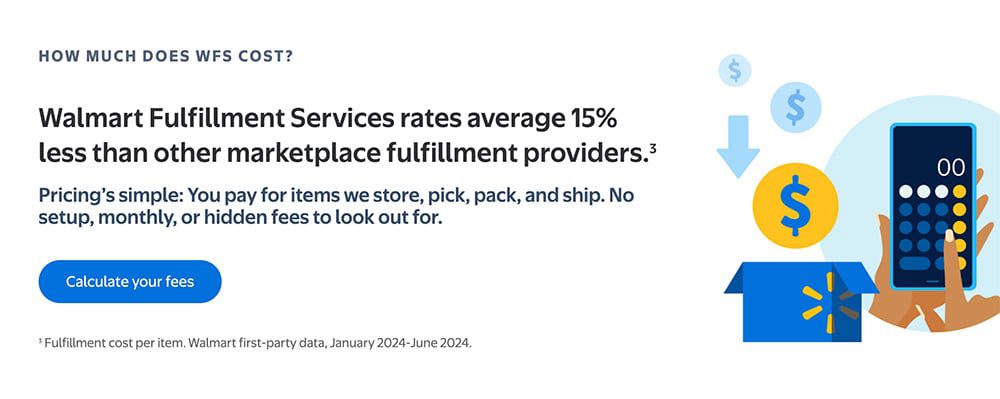
And WFS claims to be approximately 15% less expensive than FBA despite having a higher base rate, the apparent difference coming from additional fees for setup, storage, size, and similar.
Walmart claims that WFS is about 15% cheaper than other marketplace fulfillment services.
WFS is primarily for Walmart Marketplace sellers, but in September 2024, WFS began its own multichannel fulfillment service similar to Amazon’s MCF. Thus sellers can use WFS in combination with an internet store or other ecommerce channels.
Fee Type
WFS
FBA
Fulfillment
Starts at $3.45 per unit
~$3.22–$4.47 (Small Standard-Size); higher with weight tiers
Essentially an app, Shopify Fulfillment Network makes it relatively easy for merchants to process Shopify orders through third-party fulfillment services.
Sellers enable the SFN app in Shopify’s admin, connect catalogs, and send inventory to partner warehouses. Orders from Shopify and other connected channels flow into the system, which routes shipments to the closest node. Fulfillment partners store inventory and manage returns.
Perhaps the key difference between SFN and FBA or WFS is control. A Shopify store owns its own brand and customer relationships.
In contrast, FBA and WFS customers may have purchased directly from Amazon or Walmart, and they will most certainly recognize the brands’ packaging when the orders arrive.
SFN has an eventful history. Shopify launched the service in 2019 with a $1 billion investment. In 2022, it acquired Deliverr for $2 billion, only to eventually sell it to Flexport, which became the default in-app service.
Since the sale, Shopify sellers using SFN can work with several leading fulfillment providers, including ShipBob, Shipfusion, ShipMonk, DHL Fulfillment, and Amazon MCF.
Merchants can utilize custom packaging with the SFN, manage multiple channels from a single dashboard, and display Shopify’s Shop Promise badge with two- to three-day deliveries.
3 Models
FBA, WFS, and SFN all offer comprehensive ecommerce fulfillment, and in at least a few ways are interchangeable.
FBA is marketplace-driven, built around Prime and speed, and works well for multichannel sellers. If a shop sells on the Amazon Marketplace, FBA is seemingly mandatory.
WFS leverages its retail network, with the advantage of in-store returns.
SFN is platform-driven, giving independent brands control over customer experience and multichannel inventory.
–
WFS
FBA
SFN
Delivery
2 days
Same day to 2 days
2 or more days
Packaging
Walmart standard
Amazon standard
May be custom
Fee structure
Complex
More complex
Varied
Returns
Walmart managed, plus in-store
Amazon managed
3PL managed
The services are not mutually exclusive. A single store can utilize FBA and WFS for its respective marketplace channels, while employing SFN for orders via Shopify and its TikTok shop.
The takeaway? There are many excellent options for ecommerce order fulfillment.
Google’s John Mueller answered a question about how many sitemaps to upload, and then said there are no guarantees that any of the URLs will be crawled right away.
A member of the r/TechSEO community on Reddit asked if it’s enough to upload the main sitemap.xml file, which then links to the more granular sitemaps. What prompted the question was their concern over recently changing their website page slugs (URL file names).
That person asked:
“I submitted “sitemap.xml” to Google Search Console, is this sufficient or do I also need to submit page-sitemap.xml and sitemap-misc.xml as separate entries for it to work? I recently changed my website’s page slugs, how long will it take for Google Search Console to consider the sitemap”
Mueller responded that uploading the sitemap index file (sitemap.xml) was enough and that Google would proceed from there. He also shared that it wasn’t necessary to upload the individual granular sitemaps.
What was of special interest were his comments indicating that uploading sitemaps didn’t “guarantee” that all the URLs would be crawled and that there is no set time for when Googlebot would crawl the sitemap URLs. He also suggested using the Inspect URL tool.
He shared:
“You can submit the individual ones, but you don’t really need to. Also, sitemaps don’t guarantee that everything is recrawled immediately + there’s no specific time for recrawling. For individual pages, I’d use the inspect URL tool and submit them (in addition to sitemaps).”
Is There Value In Uploading All Sitemaps?
According to John Mueller, it’s enough to upload the index sitemap file. However, from our side of the Search Console, I think most people would agree that it’s better not to leave it to chance that Google will or will not crawl a URL. For that reason, SEOs may decide it’s reassuring to go ahead and upload all sitemaps that contain the changed URLs.
The URL Inspection tool is a solid approach because it enables SEOs to request crawling for a specific URL. The downside of the tool is that you can only request this for one URL at a time. Google’s URL Inspection tool does not support bulk URL submissions for indexing.
LinkedIn reports that professionals are more likely to seek workplace advice from people they know than from AI tools or search engines.
A new LinkedIn study finds that 43% turn to their networks first, with nearly two-thirds saying colleagues help them decide faster and with more confidence.
Key Findings
LinkedIn’s research indicates that professional networks rank ahead of AI and search for advice at work, with 43% naming their network as the first stop.
Sixty-four percent say colleagues improve the quality and speed of decision-making. The study also notes an 82% rise in posts about feeling overwhelmed or navigating change, suggesting that people are looking for clarity from trusted human voices.
Pressure To Learn AI
Learning about AI is causing stress for many people. Over half (51%) say upskilling feels like a second job, 33% feel embarrassed about their knowledge, and 35% feel nervous discussing AI at work.
Additionally, 41% say the fast pace of AI changes affects their well-being. Younger workers, especially Gen Z, are more likely to exaggerate their AI skills compared to Gen X.
Among those aged 18 to 24, 75% believe AI cannot replace the intuition from trusted colleagues. This aligns with the finding that people prefer advice from known experts, especially when the stakes are high.
Implications For B2B Buying And Marketing
The study shows that 77% of B2B marketing leaders say audiences rely on both a company’s channels and their professional networks. Millennials and Gen Z now represent 71% of B2B buyers, leading marketers to invest in trusted individuals within those networks.
Eighty percent of marketers plan to increase spending on community-driven content featuring creators, employees, and experts. They believe that trusted creators are key to building credibility with younger buyers.
This highlights that social discovery and community participation matter as much as search rankings. Content that’s easy to share and linked to recognized experts may reach more people than generic brand messages.
Why This Matters
As professionals turn to their networks for advice, you may need to adjust how you build trust and generate demand.
You can do this by encouraging your employees to share messages, working with trusted creators, and creating expert-led content that’s easy to find on social media.
While traditional SEO and paid ads still matter, networks can affect how people find, discuss, and validate your content before they visit your website.
Looking Ahead
As more people use AI, professionals are learning to combine new tools with their own judgment. Marketers can gain lasting benefits by focusing on building real relationships, rather than just mastering AI tools.
Methodology
The findings are based on research commissioned by LinkedIn and conducted by Censuswide. The study included 19,268 professionals and 7,000 B2B marketers from 14 countries, conducted from July 3 to July 15, 2025.
The percentages and program details mentioned above are taken directly from LinkedIn’s pressroom post.
Google has announced a new set of Merchant loyalty offerings, giving retailers a way to surface existing member perks.
Retailers who have loyalty offerings to their customers, such exclusive pricing, shipping, and points, can now show across both free listings and paid Shopping ads.
In addition to the loyalty offering, Google Ads is introducing a new loyalty goal to help brands optimize toward higher-value customers rather than focusing purely on short-term clicks.
The move, which officially launched on August 26, 2025, signals Google’s deeper investment in connecting retention strategies with its commerce ecosystem.
For retailers already managing robust loyalty programs, this rollout could be an opportunity to strengthen visibility and attract repeat shoppers directly within Google surfaces.
What is the New Loyalty Offering?
Merchant Center retailers can now activate a loyalty add-on within Merchant Center to display member benefits in Google Shopping results.
This includes member-only pricing, shipping perks, or points. This can appear across Search, the Shopping tab, free listings, as well as Wallet.
To go along with this loyalty offering, Google Ads is now offering a loyalty goal.
This gives advertisers the ability to steer Smart Bidding toward audiences with a higher lifetime value. This means campaign optimization shifts from a narrow one-time transaction focus to a longer-term view that considers repeat purchases and retention.
Where do Loyalty Perks Show Up?
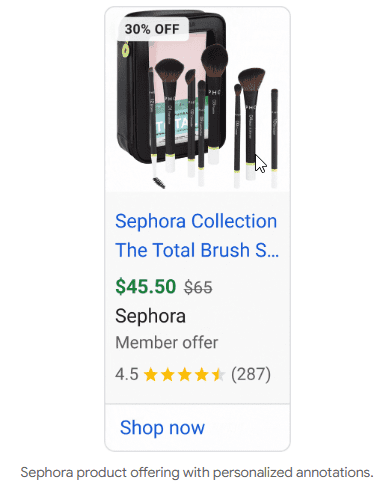
Loyalty benefits can now appear across multiple touchpoints. Shoppers may see a member price next to the standard price or a shipping perk highlighted in listings.
Image credit: Google Ads, August 2025
In the United States, retailers using Customer Match can show personalized loyalty annotations to identified members.
Google also allows member pricing to appear for unknown members in the U.S. and Australia, with more countries currently in beta testing.
This shift makes loyalty more visible during product research and comparison, when shoppers are deciding where to buy.
Who Can Take Advantage of Loyalty Offerings?
The program is currently available in the U.S., U.K., Germany, France, and Australia. Merchants must have an existing loyalty program and enable the loyalty add-on within Merchant Center.
To qualify, member pricing discounts must be at least 5% off or five units of local currency. Only national-level loyalty pricing is supported, and if a site-wide promotion is running, that will override any member pricing in ads.
Importantly, retailers need to use the dedicated “loyalty_program” attribute in their product feed. This supplies details like:
Member price
Points
Shipping benefits
Other member perks.
Google requires consistency between submitted feed data and what appears on-site.
Customer Match is required to show known-member personalization in ads within the U.S. Google is also piloting its use in free listings.
How do Retailers Get Started?
Retailers should begin by enabling the loyalty add-on in Merchant Center. Membership tiers and benefits must be clearly defined.
Feeds should be updated with the correct “loyalty_program” attributes. Customer Match lists need to be uploaded and kept current to unlock personalization for U.S. shoppers.
From there, testing the new loyalty goal in Google Ads will be key. Advertisers should compare performance against other bid strategies and review Merchant Center’s loyalty reporting to measure impact.
Highlighting Membership Value
Google’s loyalty features give retailers new ways to highlight membership value where it matters most: at the point of discovery. By surfacing perks in Search and Shopping, brands can differentiate themselves before the click.
The addition of a loyalty goal also encourages smarter optimization. Campaigns can focus not just on conversion volume but on the quality and long-term value of customers.
For retailers with established loyalty programs, this rollout is worth exploring now. It connects retention strategies with acquisition in a way that could drive measurable impact.
Having great product pages is important for your sales. After all, it’s where people decide to click that buy button. Besides optimizing your product pages for user experience, you also want to make sure these pages work for your SEO. You might think this is obvious. That’s why we’ll show you a few less obvious elements of product page SEO in this post. And we’ll explain why it’s so important to take these things into account. Let’s go!
Table of contents
1. The basics of product page SEO
First things first: a product page on an online store is a page too. This means that all the SEO things that matter for your content pages matter for your product pages as well. Of course, there’s a lot more to product page SEO. But for now, this will be your basic optimization. Tip: If you offer not-so-exciting products on your site, you may want to read our post on SEO for boring products.
Let’s start with the basics.
A great title
Try to focus on the product name and include the manufacturer’s name, if applicable. In addition, if your product is a small part of a larger machine (screw, tube), for example, you should include the SKU as well. People might search for that specifically.
A proper and unique product description
While it might be tempting to use the same description as the product’s manufacturer, you really shouldn’t. That description might be found on hundreds of websites, which means it’s duplicate contentand a sign of low quality for your website (to Google). Remember, you want to prevent duplicate content at all times!
Now, you might think: “But all my other content (content pages, category pages, blog) is unique!” However, if the content on hundreds of product pages isn’t unique, then the majority of your website’s content still won’t be up to par. So make time to create unique content! And if you need help, the Yoast WooCommerce SEO plugin comes with product-specific content and SEO analysis that helps you produce great product descriptions.
An inviting meta description
A product page usually contains a lot of general information, like the product’s dimensions or your company’s terms of service. To avoid Google using that unrelated text in a meta description, you want to add a meta description to your product pages. It’s arguably even more important than adding one to your content pages!
Next, try to come up with unique meta descriptions. This can be difficult sometimes. You might come up with a sort of template, where you only change the product name per product. That’s okay to start with. But ideally, all your meta descriptions should be unique. Yoast SEO has various AI features that will help you with this.
Pick a great and easy-to-remember URL
We recommend using the product name in the URL. However, keep it short and simple so that it is still readable for site visitors.
Add high-quality and well-optimized images with proper ALT text
Include the product name in at least the main product image. This will help you do better in visual search. Also, don’t forget video — if applicable.
Focus on your product page UX
Last but not least: UX, or user experience. This is an important step because it’s all about making your product pages as user-friendly as possible. Plus, it’s an important part of holistic SEO. There are many parts to UX, which is why we wrote a post with product page UX examples. Give it a read!
Enhance product visibility and drive more traffic to your online shop.
2. Add structured data for your products and get rich results
Structured data is an essential part of a modern SEO strategy. You simply can’t do without structured data for your product pages anymore, because they help your product page stand out. For example, there is a specific Product schema that helps you get highlighted search results, so-called rich results. These are great for your site’s visibility, and they can also increase your click-through rate! And if you mark up customers’ reviews with Review structured data, they will show up in the search results. Seeing those beautiful stars underneath a product page will convince people they should check out your site!
Another reason to add it is to manage customers’ expectations. Your visitors will know your price up front and that the product is still in stock. How’s that for user experience?
Search engines and AI/LLMs will understand your page better
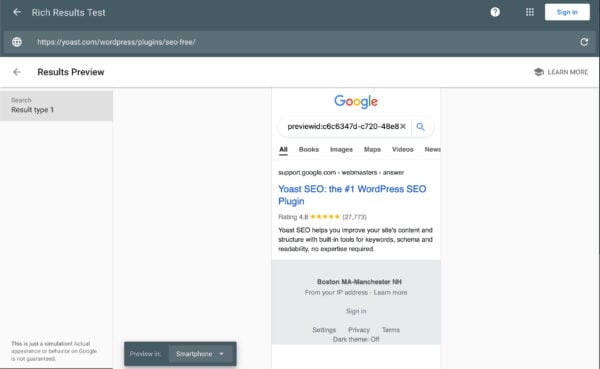
Structured data is also important for your product page SEO because the major search engines came up with this markup, not the W3C consortium. Google, Bing, Yahoo, and Yandex agreed upon this markup, so they could identify product pages and all the product elements and characteristics more easily. Why? So they could a) understand these pages a lot better and b) show you rich snippets like this:
That’s a lot of info in the search results, right?
The Product schema tells the search engine more about the product. It could include characteristics like product description, manufacturer, brand, name, dimensions, and color, but also the SKU we mentioned earlier. The Offer schema includes more information on price and availability, like currency and stock. It can even include something called priceValidUntil to let search engines know that the price offer is for a limited time only.
Add structured data with Yoast SEO
Boost your website’s presence with powerful schema structured data features, included for free with Yoast SEO.
Options to add structured data for product page SEO
Schema.org has a lot of options, but only a limited set of properties are supported by search engines. For instance, look at Google’s page on product page structured data to see what search engines expect in your code and what they can do with it.
This is why you want to add Schema.org data for product page SEO: It’s easier to recognize for Google, and it makes sure to include important extras in Google already. If you have a WooCommerce shop, our WooCommerce SEO plugin takes care of a lot of this stuff behind the scenes.
A preview of how your product might look in Google thanks to structured data
3. Add real reviews
Reviews are important. In fact, 74% of consumers say that they check reviews on at least two sites before buying anything online or locally. Although not everyone trusts online reviews, many do, so they can be very helpful.
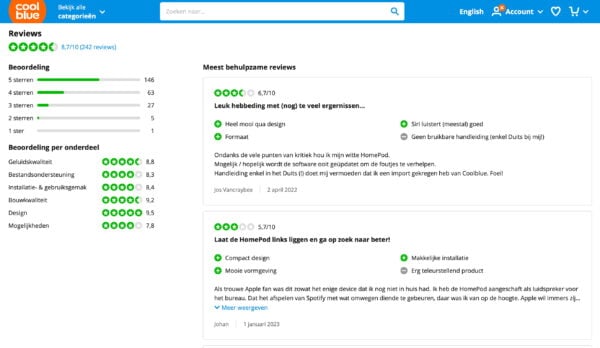
If you are a local company, online reviews are even more important. Most reviews tend to be extremely positive, but it might just be the negative reviews that give a better sense of what is going on with a company or product. In addition, getting awesome testimonials is another way of showing your business means business.
Leading Dutch online store Coolblue gives consumers a lot of options to make relevant and useful reviews of the products they buy
Try to get your customers to leave reviews, then show the reviews on your product page. Do you get a negative review? Contact the writer, find out what’s wrong, and try to mitigate the situation. Maybe they can turn their negative review into a positive one. Plus: You’ve gained new insights into your work.
If you’re not sure how to get those ratings and reviews, check out our blog post: how to get ratings and reviews for your business. And don’t forget to mark up your reviews and ratings with Review and Rating schema so search engines can pick them up and show rich results on the search results pages.
4. Make your product page lightning fast
Nobody enjoys waiting, especially when browsing on a mobile device. Many shoppers are now using their phones to make purchases, so speed on your product pages is crucial. Visitors expect instant access to content, and search engines reward that expectation. Compress images, implement responsive design, and streamline scripts to enhance load times. Regularly test your mobile layout to identify and fix problems before they impact your users. Prioritizing mobile performance not only satisfies your customers but also aligns with search engine preferences, potentially boosting your SEO rankings and increasing traffic.
Looking at numbers in Google Analytics, Search Console, or other analytical tools can give you insight into how people find and interact with your page. These insights can help you improve the performance of a page even more. But there’s another way to ensure that your product page is as awesome as it can be: user testing. There are also many ways to get more value from site visitors with A/B testing.
How user testing can help you
Testers can find loads of issues for you, such as terrible use of images (including non-functioning galleries), bad handling of out-of-stock products, or inaccurate shipping and return information, which can lead to trust issues. Now, you might be thinking: Surely, my website doesn’t have those issues! But you’d be surprised.
In their Product Page UX research project, the Baymard Institute found that:
“The high-level benchmark results show that only 49% of e-commerce sites have an overall ‘decent’ or ‘good’ UX performance for their product pages, while 51% of sites have ‘mediocre’ or worse product page implementations. On the extreme ends of performance, only a couple of sites had a very ‘poor’ Product Page UX performance that failed to align with commonly observed user behavior in our large-scale PDP testing. This is a fortunate shift upward from 2021, which previously had 4% of sites with below ‘poor’ performances. At the other end of the scale, there aren’t any sites with an overall ‘Perfect’ or ‘“’State of the Art’ product page implementation (unchanged since 2021).
The Baymard report has loads of insights into the most common errors seen on product pages
While you compare your product pages to external user research, don’t forget to do your own user testing! Doing proper research will give you eye-opening results that you probably wouldn’t have found yourself.
Bonus: Build trust and show people your authenticity
Getting a stranger to buy something on your site involves a lot of trust. Someone needs to know you are authentic before handing you their hard-earned money, right? Google puts a lot of emphasis on the element of trust — It’s all over their famous Search Quality Raters Guidelines. The search engine tries to evaluate trust and expertise by looking at online reviews, the accolades a site or its authors receive, and much more.
Brand perception in AI and LLMs
AI search engines and LLMs also assess these trust factors to shape how your brand is presented. They analyze reviews, schema, and overall credibility to produce an accurate portrayal. A trustworthy online presence can positively influence how these systems perceive and convey your brand to users.
This is why it’s so important that your About Us and Customer Service pages are in order. Make sure people can easily find your contact information, information about returns and shipping, payment, privacy, etc. This will build trust with your customers. So, don’t forget!
Social proof is another way to build trust with your customers. Adding social proof to your product pages can significantly influence buying decisions. Display customer reviews, testimonials, and ratings to build trust and demonstrate real-life experiences. Include trust badges, like security symbols or industry awards, to boost credibility. Encourage happy customers to share photos or videos of your products and showcase this content on your website. These elements help assure visitors that your products are both credible and valued by others.
Conclusion: Be serious about your product page SEO
If you’re serious about optimizing your product page, you shouldn’t focus on regular SEO and user experience alone. You’ll have to dig deeper into other aspects of your product pages. For instance, you could add the Product and Offer Schema, so Google can easily index all the details about your product and show these as rich results in the search results. In addition, you should make your product pages fast, add user reviews, and try to enhance your website’s trustworthiness. And don’t forget to test everything you do!
Need a helping hand? Be sure to check out our ecommerce SEO training course. Learn what ecommerce SEO entails, how to optimize your site, and boost your online presence. Want to get your products ranking in the shopping search results? We’ll tell you how. Start your free trial lesson today! Full access to Yoast SEO Academy is included in Yoast SEO Premium, which also includes all other plugins — including Local SEO for optimizing your performance in local search.
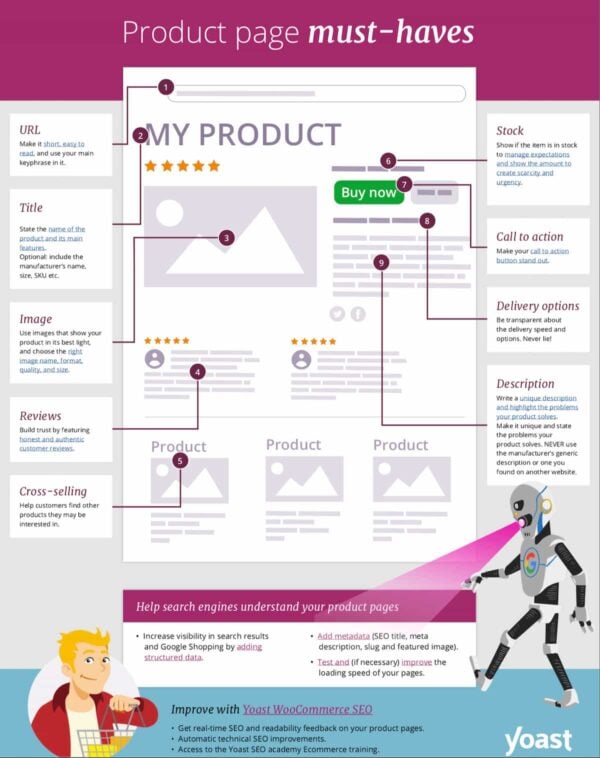
Check out our overview of product page must-haves
To help you stay on top of your product pages, we created a PDF that you can use to optimize your product pages. Most of what’s discussed in this blog post can be found in the PDF, plus more tips! Just click on the image to go to the PDF and download it.
Edwin is an experienced strategic content specialist. Before joining Yoast, he worked for a top-tier web design magazine, where he developed a keen understanding of how to create great content.
You may have noticed your organic traffic looking different lately. Rankings fluctuate wildly, your content appears in AI summaries one week and vanishes the next, and users are increasingly getting their answers without ever visiting your website.
When 58.5% of searches end without a click, that carefully optimized content you spent weeks perfecting might be feeding AI answers instead of driving traffic to your site.
We’re witnessing the biggest shift in search since Google’s early days. Traditional SEO tactics aren’t enough anymore.
You need a strategy that works when AI systems become the middleman between your content and your audience.
The New Search Reality: AI Is Eating Your Clicks
Let’s be honest about what’s happening.
Google’s AI Overviews now appear for over 11% of all searches according to BrightEdge research, pulling information from multiple sources to create comprehensive answers above your organic results. Users get what they need without clicking through.
But, it’s not just Google. Perplexity processes over 780 million searches monthly, while ChatGPT’s browsing feature handles complex queries that users used to need multiple website visits to answer.
Your Content Is Working, Just Not How You Expected
Here’s what’s particularly frustrating: Your content is often powering these AI responses, but you’re not getting credit or traffic for it.
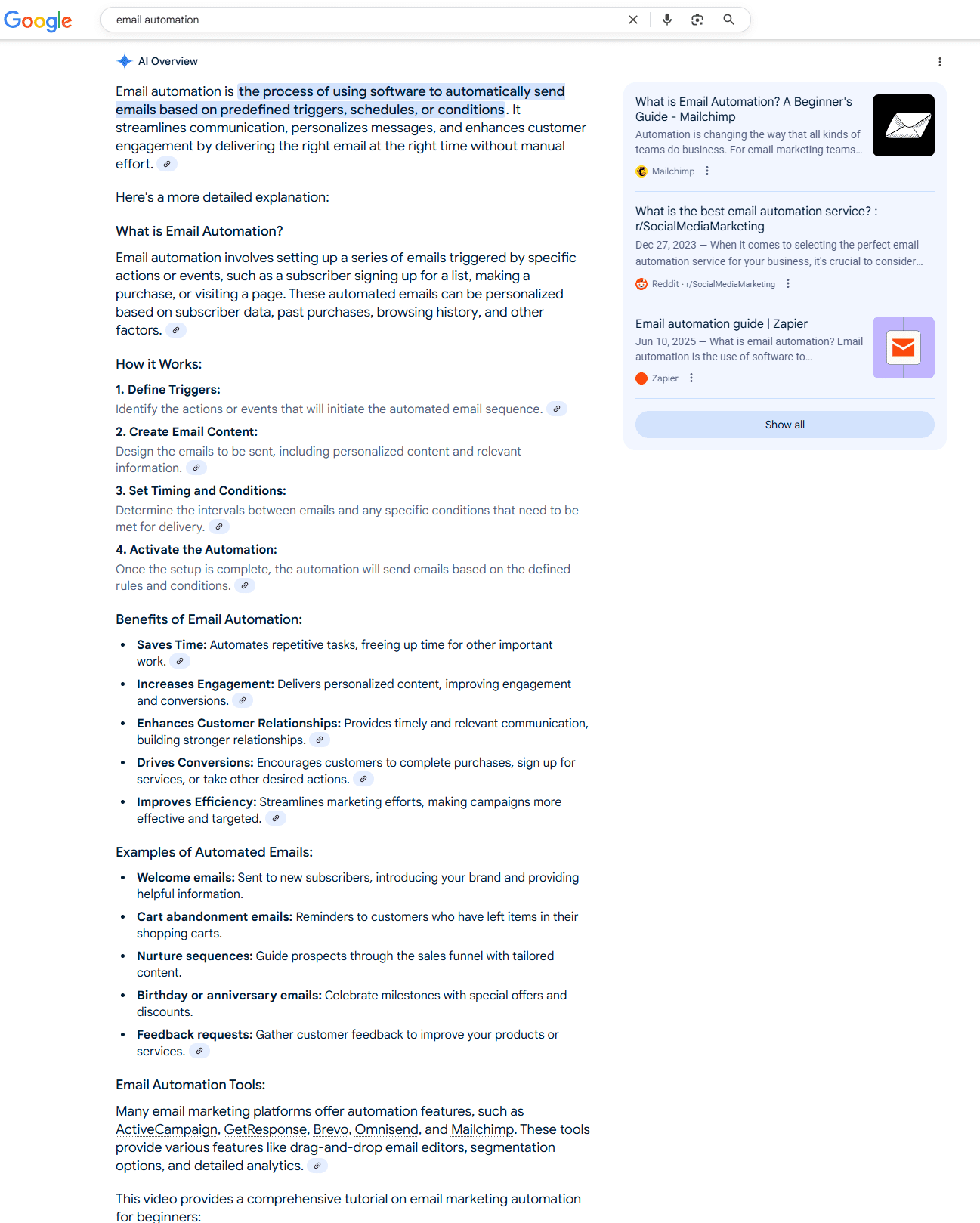
Search for [email automation] on Google and you’ll see a comprehensive AI Overview that defines the concept, explains how it works in four detailed steps, lists benefits, provides examples, and even mentions specific tools like ActiveCampaign and Mailchimp.
This response synthesizes information from multiple sources into one complete answer that eliminates the need to visit any individual website.
The user gets a definition, step-by-step process, benefits, examples, and tool recommendations all in one place.
Meanwhile, the original content creators who researched and wrote about email automation triggers, personalization strategies, and platform comparisons see their expertise repackaged without receiving the traffic they would have earned from traditional search results.
Screenshot from search for [email automation], Google, July 2025
This is the new normal. Voice search and conversational AI are training users to expect complete answers, not blue links to explore.
Zero-click searches aren’t killing SEO; they’re evolving it. Your content needs to work harder in this new environment.
What Marketers Need To Rethink
Forget everything you know about traditional SEO success metrics. The game has fundamentally changed.
Shift Your Focus: From Rankings To Mentions
That coveted No. 1 ranking? While still valuable, it’s becoming less reliable for driving traffic when AI systems deliver answers directly to users.
Rankings still matter, especially for commercial queries where users want to browse options. But, for informational searches where users seek quick answers, your content’s value now extends beyond its position in organic results.
Think about it this way: When someone asks ChatGPT or Google AI Mode about your industry, does your brand get mentioned? That’s your new battleground.
Your New Success Metrics
Instead of obsessing over click-through rates, you need to start tracking metrics that capture AI influence on your brand:
Brand mentions in AI responses across platforms tell you whether your content is being cited and referenced.
Branded search volume spikes often follow AI feature appearances.
Conversion assists where organic search was part of the user’s journey but not the final touchpoint.
Customer surveys asking, “How did you hear about us?” reveal AI influence that analytics can’t capture.
I’ve seen clients with flat traffic numbers but 200% increases in brand mentions in AI responses. That’s invisible growth that traditional analytics miss entirely.
Practical Strategies That Work
Here’s how to adapt your SEO approach for AI-powered search. These are strategies I’ve tested with clients across different industries.
Make Your Content AI-Friendly
The most important shift you can make is structuring your content for AI comprehension.
Place your main answer within the first one to two sentences of any piece of content. Think of it like writing a news article where the lead paragraph contains all the crucial information.
If someone asks, “What are the benefits of meditation?” your opening should be, “Meditation reduces stress, improves focus, and enhances emotional well-being through regular practice.” Then expand with details, examples, and supporting evidence.
Look at this great example from NerdWallet:
Screenshot from NerdWallet, July 2025
This approach serves both human readers who want quick answers and AI systems that prioritize clear, immediate responses. When Google’s AI Overview or ChatGPT pulls from your content, that opening statement becomes your brand’s voice in the answer.
I’ve seen this strategy increase AI citation rates by 40% for clients who consistently implement it.
Key formatting strategies that work:
Structured formats: Transform dense paragraphs into FAQs, numbered lists, and tables that AI can easily parse.
Clear headings: Create content hierarchy with H2 and H3 headings that AI can follow.
A well-structured FAQ section doesn’t just help users. It becomes a goldmine for AI systems looking for clear question-answer pairs.
Consider transforming complex pricing information into tables rather than burying details in lengthy paragraphs.
Build Citation-Worthy Authority
Creating content that AI systems want to reference requires a fundamental shift from aggregating existing information to generating original insights.
Publish studies, proprietary data, and exclusive interviews that can only come from your organization.
LLMs prioritize original sources over aggregated information, making your research significantly more likely to be cited and attributed.
Instead of stating facts directly, frame them as insights from your organization. “According to our research at [Company Name]” or “Based on our analysis of 10,000 customer surveys” signals to AI systems that the information comes from a specific, credible source.
This technique helps ensure that when LLMs pull information from your content, they’re more likely to include your brand name in the response.
If you’re in the gardening space, don’t just write one article about composting. Create a comprehensive resource covering composting basics, troubleshooting common problems, seasonal considerations, and advanced techniques, then link these pieces together strategically.
This clustering approach works because LLMs assess credibility partly based on depth and breadth of coverage.
Sites that demonstrate comprehensive knowledge on topics are more likely to be seen as authoritative sources worth citing.
I’ve watched brands jump from occasional mentions to consistent AI citations by implementing this strategy over six to 12 months.
Diversify Beyond Traditional Search
Don’t put all your eggs in the Google basket. AI systems pull information from diverse sources, and expanding your content distribution increases your chances of being included in LLM training data and responses.
Recent research from Ahrefs analyzing 78.6 million AI responses across Google AI Overviews, ChatGPT, and Perplexity reveals which platforms get cited most frequently.
The data shows clear patterns in what each AI system prefers to reference.
Platforms worth prioritizing based on AI citation data:
YouTube: Dominates Perplexity citations (16.1% mention share) and ranks high in AI Overviews (9.5%), making video content crucial for AI visibility.
Reddit: Heavily favored by Google AI Overviews (7.4% mention share) but absent from ChatGPT and Perplexity’s top citations.
News and industry publications: ChatGPT shows a strong preference for news outlets like Reuters and Apple News, making media coverage valuable.
Wikipedia: Leads citations across all three platforms, emphasizing the importance of having your brand or expertise documented on authoritative reference sites.
The research reveals that different AI systems have distinct preferences.
Google’s AI Overviews favor user-generated content from Reddit and Quora, while ChatGPT prioritizes news sources and authoritative publications.
Perplexity shows the strongest preference for YouTube content alongside Wikipedia.
Each platform has its own content style and audience, so adapt your messaging accordingly.
A LinkedIn post about industry trends might become a source for business-related AI responses, while a YouTube video explanation could be referenced for educational queries.
The key is maintaining consistent expertise and messaging across all channels.
Testing your content directly in different AI platforms gives you immediate feedback on how it’s being interpreted and used.
Ask ChatGPT questions related to your expertise and see if your content appears in the responses. Query Perplexity about industry topics you’ve covered.
This direct testing helps you understand how different AI systems process and present your information, allowing you to refine your approach based on real results.
Measuring Success In A Post-Click World
Traditional metrics aren’t telling the whole story anymore, and honestly, this is where most marketers struggle with the transition to AI-era SEO.
You’re used to clear, quantifiable metrics like organic traffic and click-through rates. Now you need to track influence that often happens without any direct interaction with your website.
Track AI Visibility Across Platforms
Start by monitoring featured snippets and AI Overview inclusions. These placements often indicate that AI systems are pulling from your content, even if they don’t generate the clicks you’re used to seeing.
Set up alerts for when your content gets featured because these appearances frequently correlate with increases in branded search volume and direct traffic.
Check if your brand appears when users ask AI tools about your industry. Search for your company name in ChatGPT, Perplexity, and Google’s AI Overview to see how you’re being represented.
You might discover that your brand is being mentioned in contexts you didn’t expect, giving you insights into how AI systems perceive your authority.
Social media monitoring becomes more important in this landscape because people often discuss insights they learned from AI summaries.
Set up tracking for mentions where people reference concepts or data points that originally came from your content, even if they don’t directly cite your brand.
These conversations indicate that your content is influencing discussions, even when traditional attribution models miss the connection.
Attribution Modeling For Invisible Influence
The challenge with zero-click searches is that they force you to rethink how you measure content success.
A user might read your advice in an AI summary today, then visit your site directly next week after remembering your brand name. Traditional last-click attribution completely misses this connection, making your SEO efforts appear less valuable than they actually are.
Implement first-touch attribution models that credit SEO for starting customer journeys, even when other channels complete the conversion.
Survey your new customers about how they first discovered your brand, and you’ll often find they mention seeing your content in search results or AI responses weeks before converting. This qualitative data fills in gaps that analytics can’t capture.
Look for patterns where direct traffic increases after your content gets featured in AI responses. Create custom UTM parameters for content that frequently appears in AI summaries.
While you can’t track every citation, you can identify trends in how AI-discovered content influences broader marketing performance.
Watch for increases in newsletter signups, demo requests, or branded searches following AI feature appearances.
Google Analytics 4’s attribution modeling can help you understand these multitouch journeys better than previous versions. Configure it to show conversion assists where organic search was part of the user’s path but not the final touchpoint.
This reveals the true value of your SEO efforts in an environment where direct attribution becomes increasingly difficult.
Tools And Techniques For Modern Measurement
SparkToro helps you understand where your audience discovers content and which sources they trust.
Use it to identify if your brand is being mentioned in the same contexts as industry leaders, indicating you’re gaining mindshare even without direct clicks.
This competitive intelligence reveals whether your AI strategy is working compared to others in your space.
Beyond traditional tools, create a systematic monitoring approach using multiple AI platforms.
Set up monthly checks to see if your citation frequency is increasing and which topics generate the most AI references.
Document examples of how your content gets referenced and summarized to understand what formats work best.
Remember that influence in AI responses often correlates with long-term brand growth, even if immediate traffic metrics look flat.
While comprehensive research on AI citation impact is still emerging, the pattern mirrors what we’ve seen with other “zero-click” features like featured snippets, brand exposure through authoritative citations can drive awareness and consideration that results in direct searches and conversions over time.
The key is connecting these invisible influences to eventual business outcomes.
Building Long-Term Resilience In An AI-First World
The brands that thrive in this new landscape will not just adapt to current changes.
They will anticipate what comes next and build systems that can weather the unprecedented volatility that AI-powered search brings.
Prepare For AI Volatility
Traditional core Google algorithm updates happen a few times per year and usually follow predictable patterns.
With each model update, LLMs can change their behavior, creating unprecedented volatility in search visibility that most SEO professionals haven’t experienced before.
Your content might appear in ChatGPT responses one week and disappear the next. This isn’t a bug or a penalty. It’s how LLMs work.
They constantly learn and adjust their understanding of what constitutes authoritative information based on new training data and updated models.
Instead of panicking over daily fluctuations, track broader patterns in brand mentions, branded search volume, and conversion trends.
These metrics provide more stable indicators of your content’s impact than individual AI citations, which can vary significantly based on model updates and algorithmic adjustments.
Your brand needs to be what I call “retypeable,” the kind of name people remember and search for when they’re ready to take action.
When users encounter your brand in an AI summary, they should immediately associate it with your core value proposition and remember it later when they’re ready to engage.
Build Flexible Systems
Set up processes to review and refresh your most important pages quarterly.
LLMs prioritize current information more heavily than traditional search engines, so maintaining content freshness becomes critical for sustained AI visibility.
Develop relationships with other authoritative sources in your industry through collaborations, partnerships, and cross-references.
The more your brand appears in connection with recognized authorities, the stronger your credibility signals become for AI systems.
These relationships create natural mentions across different content formats and platforms that extend beyond what you can control directly.
The Future Of SEO Is About Influence, Not Clicks
The shift to AI-powered search is changing not just how people find information but also how brands build authority and trust.
Companies that recognize this early and adapt their strategies accordingly will own the conversation in their industries, while others struggle to understand why their traditional SEO efforts aren’t delivering the same results.
Your content is still working. It’s influencing decisions, building brand awareness, and driving conversions.
You just need new ways to measure and optimize for its impact in an environment where visibility doesn’t always equal clicks, but influence still equals business growth.
Over the years, I’ve worked with numerous companies that engaged me to create world-class Search organizations and win the global search game, only to block the majority of the initiatives required to achieve that goal. This disconnect often stems from how the C-suite perceives its website.
In too many boardrooms, the site is still seen as a digital brochure and an expense managed by marketing, with limited scrutiny or strategic oversight. Yet, that same site touches nearly every phase of the customer journey, investor perception, partner evaluation, and talent acquisition.
This article brings those ideas together under a single call to action: It’s time for executive leadership to own web performance as a measurable, managed business function.
What Is The Digital Performance Gap?
The Digital Performance Gap is the measurable distance between your online potential and actual business outcomes. Most companies are leaking performance through misaligned teams, disconnected key performance indicators (KPIs), outdated platforms, or siloed operations.
Symptoms include:
Underwhelming organic traffic and conversions.
Disconnected websites across departments or geographies.
Content that ranks but doesn’t convert (or worse, can’t even be found).
Slow responsiveness to AI shifts and platform changes.
Tools and vendors operating without return on investment (ROI) oversight.
In short: You’re paying for a Ferrari and driving it like a lawnmower.
From Pit Crew To Performance System: A Better Analogy
Imagine you’re the owner of an F1 racing team. You’ve got the budget, the ambition, and a roster of great people – from engineers to mechanics to a world-class driver.
However, the engine design was handled by a team that never consulted with the race strategist. Your telemetry data doesn’t reach the pit wall. The car is fast in theory, but coordination is poor, and outcomes are inconsistent.
Sound familiar?
That’s how many enterprise websites operate. Everyone is working hard in their silos. But without integrated planning, shared goals, or clear leadership, the system can’t perform at its full potential.
Web effectiveness isn’t just about the “driver” (e.g., SEO or content teams)—it’s about the entire vehicle and how the organization supports it. And the C-suite? They’re the race directors. When the director doesn’t orchestrate the team, the whole system suffers.
In elite racing, the pit crew doesn’t just change tires. They analyze data, forecast risks, and adapt in real time. Their split-second coordination with the driver wins races. That’s what a web performance system should look like–fully integrated, real-time, and strategically directed.
But instead of this synergy, most digital organizations resemble a collection of vendors and internal teams using different playbooks, judged by different KPIs, and waiting for executive direction that never comes.
You can’t win the race if the engine team is optimizing for safety, the strategist is optimizing for top speed, and the pit crew is trying to meet tire budget KPIs. That’s not cross-functional excellence, it’s cross-functional chaos.
Web Effectiveness Is A Business Metric
Web Effectiveness is the degree to which your digital presence delivers against real business goals.
Relevance (structured content that solves user needs).
Integration (connected to customer relationship management or CRM, data layers, product feeds).
This isn’t marketing fluff. It’s operational excellence.
When no one owns it, everyone loses.
IT may control infrastructure.
Marketing manages messaging.
Sales owns conversion.
Legal redlines half the useful copy.
But no one owns the outcome. That’s a leadership failure.
The High Cost Of No Ownership
When the C-suite doesn’t take web performance seriously, the costs compound:
Visibility declines. You’re outranked by competitors who understand AI’s new rules.
Opportunity evaporates. Valuable search terms go unanswered – or worse, answered by the platforms themselves.
Budgets get wasted. You pay for tools, agencies, and tech that aren’t integrated or even used.
Your story gets told by others. Generative engines summarize what they find. If your content isn’t structured or visible, you’re not even in the conversation.
Even companies that only exist online often fail to fully leverage the very platform that drives their value.
What Executive Ownership Looks Like
Executive ownership doesn’t mean micromanaging metadata – it means ensuring that:
Web outcomes are tied to business KPIs.
Budgeting reflects strategic priority, not departmental silos.
SEO, UX, content, and dev teams are operating under a unified model.
Vendor evaluations include contribution to visibility and performance.
Someone is accountable for closing the performance gap.
Consider creating a Web Effectiveness Center of Excellence or appointing a Digital Effectiveness Officer to champion this mandate.
A Framework For Closing The Gap
To transition from fragmented efforts to strategic impact, organizations require a shared operating model. Here’s a high-level Web Effectiveness Framework:
Governance: Who owns what? Are responsibilities clear?
Visibility: Can search engines and AI systems discover, interpret, and cite your content?
Experience: Are you delivering what users need – on every device, in every format?
Optimization: Are you using the platforms, features, and data you already pay for?
Measurement: Are you tracking impact, not just traffic?
This framework can be scaled across divisions, regions, and lines of business. The key is treating your site not as a brochure, but as your most valuable digital asset.
Final Thought: Time To Step In
Closing the Digital Performance Gap starts with a mindset shift: from cost center to growth platform. From tactical ownership to strategic leadership.
Today’s website is no longer just a reflection of your brand—it is your brand. It’s where customers decide to trust you, where partners evaluate your credibility, and where investors form first impressions. Yet far too often, this central asset is owned by no one, governed by outdated workflows, and limited by KPIs that belong to another era.
Let’s be clear: digital excellence doesn’t happen by accident. It’s the result of intentional alignment between leadership, teams, and technology. And that alignment starts with the C-suite.
CMOs must champion performance and not just promotion. CTOs must prioritize enablement and not just uptime. CEOs must encourage cross-functional alignment, efficiency, speed, agility, and clarity to ensure optimal performance.
Web effectiveness should no longer be framed as a project, initiative, or marketing tactic. It’s a performance system. A business function. A shared responsibility. And if you don’t have someone responsible for web performance at the leadership level, it’s time to create that role. A Digital Effectiveness Officer, a Center of Excellence, or, at a minimum, a cross-functional ownership council that brings visibility, accountability, and forward momentum.
Because here’s the truth: If you don’t own your website’s performance, someone else will define your digital reputation—and capture your audience. Bring web effectiveness into the boardroom. Align your teams. Close the gap.