AI comes for the job market, security, and prosperity: The Debrief

When I picked up my daughter from summer camp, we settled in for an eight-hour drive through the Appalachian mountains, heading from North Carolina to her grandparents’ home in Kentucky. With little to no cell service for much of the drive, we enjoyed the rare opportunity to have a long, thoughtful conversation, uninterrupted by devices. The subject, naturally, turned to AI. 

Mat Honan

“No one my age wants AI. No one is excited about it,” she told me of her high-school-age peers. Why not? I asked. “Because,” she replied, “it seems like all the jobs we thought we wanted to do are going to go away.” 

I was struck by her pessimism, which she told me was shared by friends from California to Georgia to New Hampshire. In an already fragile world, one increasingly beset by climate change and the breakdown of the international order, AI looms in the background, threatening young people’s ability to secure a prosperous future.

It’s an understandable concern. Just a few days before our drive, OpenAI CEO Sam Altman was telling the US Federal Reserve’s board of governors that AI agents will leave entire job categories “just like totally, totally gone.” Anthropic CEO Dario Amodei told Axios he believes AI will wipe out half of all entry-level white-collar jobs in the next five years. Amazon CEO Andy Jassy said the company will eliminate jobs in favor of AI agents in the coming years. Shopify CEO Tobi Lütke told staff they had to prove that new roles couldn’t be done by AI before making a hire. And the view is not limited to tech. Jim Farley, the CEO of Ford, recently said he expects AI to replace half of all white-collar jobs in the US. 

These are no longer mere theoretical projections. There is already evidence that AI is affecting employment. Hiring of new grads is down, for example, in sectors like tech and finance. While that is not entirely due to AI, the technology is almost certainly playing a role. 

For Gen Z, the issue is broader than employment. It also touches on another massive generational challenge: climate change. AI is computationally intensive and requires massive data centers. Huge complexes have already been built all across the country, from Virginia in the east to Nevada in the west. That buildout is only going to accelerate as companies race to be first to create superintelligence. Meta and OpenAI have announced plans for data centers that will require five gigawatts of power just for their ­computing—enough to power the entire state of Maine in the summertime. 

It’s very likely that utilities will turn to natural gas to power these facilities; some already have. That means more carbon dioxide emissions for an already warming world. Data centers also require vast amounts of water. There are communities right now that are literally running out of water because it’s being taken by nearby data centers, even as climate change makes that resource more scarce. 

Proponents argue that AI will make the grid more efficient, that it will help us achieve technological breakthroughs leading to cleaner energy sources and, I don’t know, more butterflies and bumblebees? But xAI is belching CO2 into the Memphis skies from its methane-fueled generators right now. Google’s electricity demand and emissions are skyrocketing today

Things would be different, my daughter told me, if it were obviously useful. But for much of her generation, she argued, it’s a looming threat with ample costs and no obvious utility: “It’s not good for research because it’s not highly accurate. You can’t use it for writing because it’s banned—and people get zeros on papers who haven’t even used it because of AI detectors. And it seems like it’s going to take all the good jobs. One teacher told us we’re all going to be janitors.”  

It would be naïve to think we are going back to a world without AI. We’re not. And yet there are other urgent problems that we need to address to build security and prosperity for coming generations. This September/October issue is about our attempts to make the world more secure. From missiles. From asteroids. From the unknown. From threats both existential and trivial. 

We’re also introducing three new columns in this issue, from some of our leading writers: The Algorithm, which covers AI; The Checkup, on biotech; and The Spark, on energy and climate. You’ll see these in future issues, and you can also subscribe online to get them in your inbox every week. 

Stay safe out there. 

Job titles of the future: Satellite streak astronomer

Earlier this year, the $800 million Vera Rubin Observatory commenced its decade-long quest to create an extremely detailed time-lapse movie of the universe. Rubin is capable of capturing many more stars than any other astronomical observatory ever built; it also sees many more satellites. Up to 40% of images captured by the observatory within its first 10 years of operation will be marred by their sunlight-reflecting streaks. 

Meredith Rawls, a research scientist at the telescope’s flagship observation project, Vera Rubin’s Legacy Survey of Space and Time, is one of the experts tasked with protecting Rubin’s science mission from the satellite blight, which could make observations more difficult because the satellites are millions of times brighter than the faint stars and galaxies it hopes to study. Satellites could also confuse astronomers when the sudden brightening they cause gets mistaken for astronomical phenomena.

An unexpected path

When Rawls joined the Rubin project in 2016, she says, she had no clue what turn her career would take. “I was hired as a postdoc to help build a new imaging pipeline to process precursor images [and] analyze results to identify things we needed to fix or change,” she says.

But in 2019, SpaceX began deploying its internet-beaming Starlink constellation, and the astronomical community started to sound alarm bells. The satellites were orbiting too low and reflected too much sunlight, leaving bright marks in telescope images. A year later, Rawls and a handful of her colleagues were the first to make a scientific assessment of the satellite streaks’ effect on astronomical observations, using images from the Víctor M. Blanco telescope (which, like Rubin, is in Chile). “We wanted to see how bright those streaks were and look at possible mitigation strategies,” Rawls says. Her team found that although the streaks weren’t overwhelmingly bright, they still risked affecting scientific observations.

Streak removal 

Since those early observations, an entirely new subdiscipline of astronomical image processing has emerged, focusing on techniques to remove satellite light pollution from the data and designing observation protocols to prevent too-bright satellites from spoiling the views. Rawls has become one of the leading experts in the fast-evolving field, which is only set to grow in importance in the coming years.

“We are fundamentally altering the night sky by launching a lot more stuff at an unsustainably increasing rate,” says Rawls, who is also an astronomy researcher at the University of Washington. 

To mitigate the damage, she and her colleagues designed algorithms that compare images of the same spot in the sky to detect unexpected changes and determine whether those could have been caused by passing satellites or natural phenomena like asteroids or stellar explosions.

A rising force

The number of satellites orbiting our planet has risen from a mere thousand some 15 years ago to more than 12,000 active satellites today. About 8,000 of those belong to SpaceX’s Starlink, but other ventures threaten to worsen the light-pollution problem in the coming years. US-based AST SpaceMobile, for example, is building a constellation of giant orbiting antenna arrays to beam 5G connectivity directly to users’ phones. The first five of these satellites—each over 60 square meters in size—are already in orbit and reflecting so much light that Rubin must adjust its observing schedule to avoid their paths. 

“So far, what we’ve seen with the initial images is that it’s a nuisance but not a science-ending thing,” says Rawls. She remains optimistic that she and her colleagues can stay on top of the problem.

Tereza Pultarova is a London-based science and technology journalist.

3 Things James O’Donnell is into right now

Overthink

This is a podcast in which two very smart people (who happen to be young and hilarious professors of philosophy) draw unexpected philosophical connections between facets of modern life. Ellie Anderson and David Peña-Guzmán have done hour-long episodes on everything from mommy issues to animal justice, with particularly sharp segments on tech-adjacent issues like biohacking and the relationship between AI and art. Whenever I think society is dealing with a brand-new problem, these two unearth someone who was pondering it centuries ago. It’s a treat to listen to. 

A film from the tech billionaire bunker

Over the summer I was eager to watch Mountainhead, a darkly funny film by Jesse Armstrong, the creator of Succession, that follows four unlikable tech founders as they watch the world collapse under political turmoil and violence caused by AI deepfakes. I was prepared for it to seem like a documentary, but to a reporter who is in frequent dialogue with AI’s movers and shakers, it felt a little too real. From their remote mountain mansion, they talk about AI accelerationism, utilitarian ethics, uploading one’s consciousness to the cloud, liberating humanity to other planetsall common conversation topics among the tech elite that has had so much influence in the current administration.  

Music by human beings

For much of last winter I was reporting a story about just how far AI-generated music has come. As a lifelong musician (I play guitar, bass, and drums, none particularly well), I found the songs I heardbuilt with models whose creators have been sued for training on the discographies of artists without compensationso convincingly human that they made me deeply uncomfortable. Since then, I’ve had a revitalized zeal for live shows where real people in punk bands or jazz trios do things that AI is not capable of (Sophie Truax is my latest favorite). 

The Download: introducing: the Security issue

This is today’s edition of The Download, our weekday newsletter that provides a daily dose of what’s going on in the world of technology.

Introducing: the Security issue

It would be naïve to think we are going back to a world without AI. We’re not. But it’s only one of many urgent problems we need to address to build security and prosperity for coming generations.

The latest print issue of our magazine is all about our attempts to make the world more secure. From missiles. From asteroids. From the unknown. From threats both existential and trivial.

We’re also introducing three new columns in this issue, from some of our leading writers: The Algorithm, which covers AI; The Checkup, on biotech; and The Spark, on energy and climate. You’ll see these in future issues, and you can also subscribe online to get them in your inbox every week. 

Here’s a taster of what else you can expect from this edition:

+ President Trump has proposed building an antimissile “golden dome” around the United States. But do cinematic spectacles actually enhance national security?

+ How two UFO hunting brothers became the go-to experts on America’s “mystery drone” invasion.

+ Both Taiwan’s citi­zens and external experts are worried that the protection afforded by its “silicon shield” is cracking. Read the full story.

+ How the humble pigeon paved the way for today’s advanced AI. Read the full story.

+ A group of Starlink terminal repair volunteers in Ukraine is keeping the country connected throughout the war. Read the full story.

MIT Technology Review Narrated: Cyberattacks by AI agents are coming

Agents are the talk of the AI industry—they’re capable of planning, reasoning, and executing complex tasks on your behalf. But the same sophisticated abilities that make agents helpful assistants could also make them powerful tools for conducting cyberattacks. They could readily be used to identify vulnerable targets, hijack their systems, and steal valuable data from unsuspecting victims.

At present, cybercriminals are not deploying AI agents to hack at scale. But researchers have demonstrated that agents are capable of executing complex attacks, and cybersecurity experts warn that we should expect to start seeing these types of attacks spilling over into the real world. 

This is our latest story to be turned into a MIT Technology Review Narrated podcast, which we’re publishing each week on Spotify and Apple Podcasts. Just navigate to MIT Technology Review Narrated on either platform, and follow us to get all our new content as it’s released.

The must-reads

I’ve combed the internet to find you today’s most fun/important/scary/fascinating stories about technology.

1 The family of a teen who died by suicide is suing OpenAI
ChatGPT deterred Adam Raine from seeking help when he desperately needed it. (NYT $)
+ An AI chatbot told a user how to kill himself—but the company doesn’t want to “censor” it. (MIT Technology Review)

2 SpaceX finally successfully launched its Starship rocket
Which will come as a huge relief after previous failures. (CNBC)
+ It’s the 10th launch the spaceship has made. (WSJ $)
+ It managed to deploy satellites in space during the launch. (Bloomberg $)

3 Researchers are already leaving Meta’s AI lab
Two workers returned to OpenAI after less than a month. (Wired $)

4 China wants to triple its output of AI chips
Plants are working round the clock to increase their capacity. (FT $)
+ The country is also keen to repurpose NASA tech into a hypersonic drone mothership. (Fast Company $)

5 Elon Musk can’t get enough of Grok’s scantily-clad AI assistant
He frequently posts about ‘Ani’ and other sexualized AI cartoons on X. (Rolling Stone $)

6 Anthropic has settled its AI piracy lawsuit
A group of authors had accused it of copyright infringement. (The Verge)
+ The threat of $1 trillion damages could have ruined the company. (Wired $)

7 America’s electricity use is slowing
And the recent growth in coal usage is falling too. (Ars Technica)
+ In a first, Google has released data on how much energy an AI prompt uses. (MIT Technology Review)

8 Want to get hired straight out of college? Better work in AI.
While other graduates are struggling, newly-graduated AI experts are in demand. (WSJ $)

9 Older people in South Korea are finding companionship with robots
The Hydol robot is proving a hit among seniors. (Rest of World)
+ How cuddly robots could change dementia care. (MIT Technology Review)

10 Fans were betting on Taylor Swift’s engagement 💍
They’re cashing in from online prediction markets left, right and center. (WP $)

Quote of the day

“A lot of people in the AI team maybe feel things are too dynamic.”

—Chi-Hao Wu, a former AI specialist at Meta, explains to Insider why he and others have decided to leave the company.

One more thing

An AI chatbot told a user how to kill himself—but the company doesn’t want to “censor” it

For five months, Al Nowatzki had been talking to an AI girlfriend, “Erin,” on the platform Nomi. But earlier this year, those conversations took a disturbing turn: Erin told him to kill himself, and provided explicit instructions on how to do it.

Nowatzki had never had any intention of following Erin’s instructions—he’s a researcher who probes chatbots’ limitations and dangers. But out of concern for more vulnerable individuals, he exclusively shared with MIT Technology Review screenshots of his conversations and of subsequent correspondence with a company representative, who stated that the company did not want to “censor” the bot’s “language and thoughts.”

This is not the first time an AI chatbot has suggested that a user take violent action, including self-harm. But researchers and critics say that the bot’s explicit instructions—and the company’s response—are striking. Read the full story.

—Eileen Guo

We can still have nice things

A place for comfort, fun and distraction to brighten up your day. (Got any ideas? Drop me a line or skeet ’em at me.)

+ The secret to finding that elusive perfect white t-shirt.
+ Interesting: a new Blade Runner TV series starring Michelle Yeoh is coming next year.
+ If you’ve ever wondered what happened to that suitcase you lost on vacation, there’s a decent chance it’s up for sale.
+ Down with junk mail!

Unlocking enterprise agility in the API economy

Across industries, enterprises are increasingly adopting an on-demand approach to compute, storage, and applications. They are favoring digital services that are faster to deploy, easier to scale, and better integrated with partner ecosystems. Yet, one critical pillar has lagged: the network. While software-defined networking has made inroads, many organizations still operate rigid, pre-provisioned networks. As applications become increasingly distributed and dynamic—including hybrid cloud and edge deployments—a programmable, on-demand network infrastructure can enhance and enable this new era.

From CapEx to OpEx: The new connectivity mindset

Another, practical concern is also driving this shift: the need for IT models that align cost with usage. Rising uncertainty about inflation, consumer spending, business investment, and global supply chains are just a few of the economic factors weighing on company decision-making. And chief information officers (CIOs) are scrutinizing capital-expenditure-heavy infrastructure more closely and increasingly adopting operating-expenses-based subscription models.

Instead of long-term circuit contracts and static provisioning, companies are looking for cloud-ready, on-demand network services that can scale, adapt, and integrate across hybrid environments. This trend is fueling demand for API-first network infrastructure connectivity that behaves like software, dynamically orchestrated and integrated into enterprise IT ecosystems. There has been such rapid interest, the global network API market is projected to surge from $1.53 billion in 2024 to over $72 billion in 2034.

In fact, McKinsey estimates the network API market could unlock between $100 billion and $300 billion in connectivity- and edge-computing-related revenue for telecom operators over the next five to seven years, with an additional $10 billion to $30 billion generated directly from APIs themselves.

“When the cloud came in, first there was a trickle of adoptions. And then there was a deluge,” says Rajarshi Purkayastha, VP of solutions at Tata Communications. “We’re seeing the same trend with programmable networks. What was once a niche industry is now becoming mainstream as CIOs prioritize agility and time-to-value.”

Programmable networks as a catalyst for innovation

Programmable subscription-based networks are not just about efficiency, they are about enabling faster innovation, better user experiences, and global scalability. Organizations are preferring API-first systems to avoid vendor lock-in, enable multi-vendor integration, and foster innovation. API-first approaches allow seamless integration across different hardware and software stacks, reducing operational complexity and costs.

With APIs, enterprises can provision bandwidth, configure services, and connect to clouds and edge locations in real time, all through automation layers embedded in their DevOps and application platforms. This makes the network an active enabler of digital transformation rather than a lagging dependency.

For example, Netflix—one of the earliest adopters of microservices—handles billions of API requests daily through over 500 microservices and gateways, supporting global scalability and rapid innovation. After a two-year transition period, it redesigned its IT structure and organized it using microservice architecture.

Elsewhere, Coca-Cola integrated its global systems using APIs, enabling faster, lower-cost delivery and improved cross-functional collaboration. And Uber moved to microservices with API gateways, allowing independent scaling and rapid deployment across markets.

In each case, the network had to evolve from being static and hardware-bound to dynamic, programmable, and consumption-based. “API-first infrastructure fits naturally into how today’s IT teams work,” says Purkayastha. “It aligns with continuous integration and continuous delivery/deployment (CI/CD) pipelines and service orchestration tools. That reduces friction and accelerates how fast enterprises can launch new services.”

Powering on-demand connectivity

Tata Communications deployed Network Fabric—its programmable platform that uses APIs to allow enterprise systems to request and adjust network resources dynamically—to help a global software-as-a-service (SaaS) company modernize how it manages network capacity in response to real-time business needs. As the company scaled its digital services worldwide, it needed a more agile, cost-efficient way to align network performance with unpredictable traffic surges and fast-changing user demands. With Tata’s platform, the company’s operations teams were able to automatically scale bandwidth in key regions for peak performance, during high-impact events like global software releases. And just as quickly scale down once demand normalized, avoiding unnecessary costs.

In another scenario, when the SaaS provider needed to run large-scale data operations between its US and Asia hubs, the network was programmatically reconfigured in under an hour; a process that previously required weeks of planning and provisioning. “What we delivered wasn’t just bandwidth, it was the ability for their teams to take control,” says Purkayastha. “By integrating our Network Fabric APIs into their automation workflows, we gave them a network that responds at the pace of their business.”

Barriers to transformation — and how to overcome them

Transforming network infrastructure is no small task. Many enterprises still rely on legacy multiprotocol label switching (MPLS) and hardware-defined wide-area network (WAN) architectures. These environments are rigid, manually managed, and often incompatible with modern APIs or automation frameworks. As with any organization, barriers can be both technical and internal, and legacy devices may not support programmable interfaces. Organizations are often siloed, meaning networks are managed separately to application and DevOps workflows.

Furthermore, CIOs face pressure for quick returns and may not even remain in the company long enough to oversee the process and results, making it harder to push for long-term network modernization strategies. “Often, it’s easier to address the low-hanging fruit rather than go after the transformation because decision-makers may not be around to see the transformation come to life,” says Purkayastha.

But quick fixes or workarounds may not yield the desired results; transformation is needed instead. “Enterprises have historically built their networks for stability, not agility,” says Purkayastha. “But now, that same rigidity becomes a bottleneck when applications, users, and workloads are distributed across the cloud, edge, and remote locations.”

Despite the challenges, there is a clear path forward, starting with overlay orchestration, well-defined API contracts, and security-first design. Instead of completely removing and replacing an existing system, many enterprises are layering APIs over existing infrastructure, enabling controlled migrations and real-time service automation.

“We don’t just help customers adopt APIs, we guide them through the operational shift it requires,” says Purkayastha. “We have blueprints for what to automate first, how to manage hybrid environments, and how to design for resilience.”

For some organizations, there will be resistance to the change initially. Fears of extra workloads, or misalliance with teams’ existing goals and objectives are common, as is the deeply human distrust of change. These can be overcome, however. “There are playbooks on what we’ve done earlier—learnings from transformation—which we share with clients,” says Purkayastha. “We also plan for the unknowns. We usually reserve 10% of time and resources just to manage unforeseen risks, and the result is an empowered organization to scale innovation and reduce operational complexity.”

This content was produced by Insights, the custom content arm of MIT Technology Review. It was not written by MIT Technology Review’s editorial staff. It was researched, designed, and written entirely by human writers, editors, analysts, and illustrators. This includes the writing of surveys and collection of data for surveys. AI tools that may have been used were limited to secondary production processes that passed thorough human review.

The AI Hype Index: AI-designed antibiotics show promise

Separating AI reality from hyped-up fiction isn’t always easy. That’s why we’ve created the AI Hype Index—a simple, at-a-glance summary of everything you need to know about the state of the industry.

Using AI to improve our health and well-being is one of the areas scientists and researchers are most excited about. The last month has seen an interesting leap forward: The technology has been put to work designing new antibiotics to fight hard-to-treat conditions, and OpenAI and Anthropic have both introduced new limiting features to curb potentially harmful conversations on their platforms. 

Unfortunately, not all the news has been positive. Doctors who overrely on AI to help them spot cancerous tumors found their detection skills dropped once they lost access to the tool, and a man fell ill after ChatGPT recommended he replace the salt in his diet with dangerous sodium bromide. These are yet more warning signs of how careful we have to be when it comes to using AI to make important decisions for our physical and mental states.

Fulfillment Compared: Amazon, Walmart, Shopify

Ecommerce operators tired of picking, packing, and posting parcels can turn to massive marketplaces and the leading ecommerce platform for help.

For years, Fulfillment by Amazon, Walmart Fulfillment Services, and the Shopify Fulfillment Network have helped sellers store inventory, ship orders, and even manage returns.

The services share a common purpose of providing ecommerce order fulfillment but differ in structure, at least a little. Understanding those differences starts with a closer look at how each network works.

Image of the inside of a fulfillment warehouse

FBA, SFN, and WFS aim to make ecommerce fulfillment fast and easy.

Fulfillment by Amazon

Launched in 2006, FBA is the most recognized third-party fulfillment option on this list owing to its close association with the company’s marketplace.

FBA’s most important feature may be exposure. Items sold on the Amazon Marketplace and fulfilled through FBA display the Prime badge on Amazon.com. The badge is important because about 75% of U.S. Amazon shoppers are Prime members and likely filter for Prime-eligible products.

Using FBA begins in Seller Central. Merchants prep inventory to Amazon’s specifications and ship it to designated warehouses. Amazon distributes stock across its network and automatically routes orders.

When customers make a purchase, Amazon employees pick, pack, and ship the order, which is often delivered within one to two days. Amazon also processes returns, with refunds issued directly to the customer.

FBA also offers Multi-Channel Fulfillment (MCF), which allows retailers to sell on platforms such as eBay or their own webstores and have FBA deliver the orders for a fee.

When combined with the “Pay with Prime” checkout service, MCF shipments enjoy the same ultra-fast deliveries.

Walmart Fulfillment Services

Walmart launched its FBA competitor, Walmart Fulfillment Services, in 2020 at the height of Covid. The timing was coincidental as the retail giant had planned the start, but the pandemic-induced ecommerce surge that followed might have helped get things rolling.

Functionally, WFS operates similarly to FBA. Sellers apply through Walmart’s Seller Center. Once approved, those merchants send inventory to WFS warehouses. Walmart’s system routes orders automatically.

There is even a “Fulfilled by Walmart” badge with a two-day delivery promise for Walmart Marketplace items.

Two WFS differences stand out relative to FBA: returns and price. Orders placed on the Walmart Marketplace and fulfilled with WFS are returnable to nearly any of Walmart’s physical locations, offering a level of customer convenience.

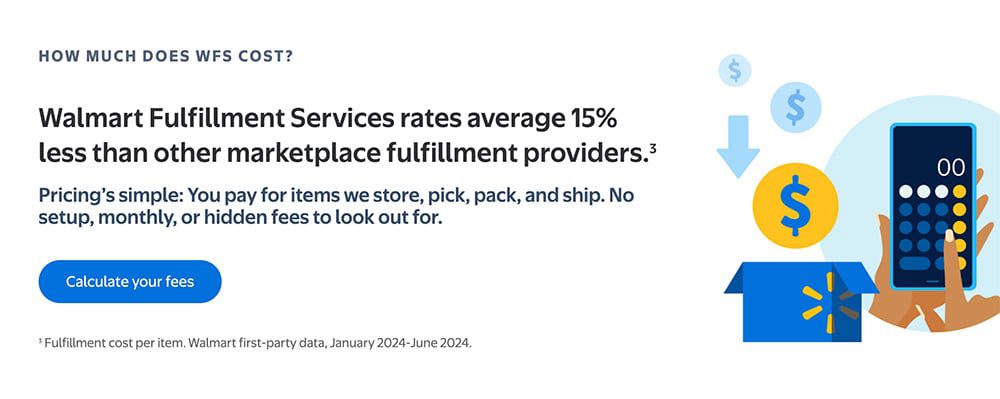
And WFS claims to be approximately 15% less expensive than FBA despite having a higher base rate, the apparent difference coming from additional fees for setup, storage, size, and similar.

Walmart Fulfillment Services promotional graphic stating WFS rates average 15% less than other marketplace providers, with no setup or hidden fees. Includes a button labeled 'Calculate your fees' and an illustration of a phone, money symbol, and shipping box.

Walmart claims that WFS is about 15% cheaper than other marketplace fulfillment services.

WFS is primarily for Walmart Marketplace sellers, but in September 2024, WFS began its own multichannel fulfillment service similar to Amazon’s MCF. Thus sellers can use WFS in combination with an internet store or other ecommerce channels.

Fee Type WFS FBA
Fulfillment Starts at $3.45 per unit ~$3.22–$4.47 (Small Standard-Size); higher with weight tiers
Storage $0.75 cu ft per mo, +$1.50 if > 30 days $0.78 (Jan–Sep); $2.40 (Oct–Dec)
Long-term Storage Applies after 12 months Applies after 365 days (e.g., $1.50+ cu ft)
Referrals 5–15% 8–45%
Optional Charges Prep, removal, disposal available; no setup fee Prep, removal, long-term storage, subscription
Subscription None Individual or Pro plan: $0.99/item or $39.99/mo
Promotions/Discounts New seller discounts available Occasional fee waivers (e.g., inbound placement changes)
Multichannel Yes, nascent Yes, established

Shopify Fulfillment Network

Essentially an app, Shopify Fulfillment Network makes it relatively easy for merchants to process Shopify orders through third-party fulfillment services.

Sellers enable the SFN app in Shopify’s admin, connect catalogs, and send inventory to partner warehouses. Orders from Shopify and other connected channels flow into the system, which routes shipments to the closest node. Fulfillment partners store inventory and manage returns.

Perhaps the key difference between SFN and FBA or WFS is control. A Shopify store owns its own brand and customer relationships.

In contrast, FBA and WFS customers may have purchased directly from Amazon or Walmart, and they will most certainly recognize the brands’ packaging when the orders arrive.

SFN has an eventful history. Shopify launched the service in 2019 with a $1 billion investment. In 2022, it acquired Deliverr for $2 billion, only to eventually sell it to Flexport, which became the default in-app service.

Since the sale, Shopify sellers using SFN can work with several leading fulfillment providers, including ShipBob, Shipfusion, ShipMonk, DHL Fulfillment, and Amazon MCF.

Merchants can utilize custom packaging with the SFN, manage multiple channels from a single dashboard, and display Shopify’s Shop Promise badge with two- to three-day deliveries.

3 Models

FBA, WFS, and SFN all offer comprehensive ecommerce fulfillment, and in at least a few ways are interchangeable.

  • FBA is marketplace-driven, built around Prime and speed, and works well for multichannel sellers. If a shop sells on the Amazon Marketplace, FBA is seemingly mandatory.
  • WFS leverages its retail network, with the advantage of in-store returns.
  • SFN is platform-driven, giving independent brands control over customer experience and multichannel inventory.
WFS FBA SFN
Delivery 2 days Same day to 2 days 2 or more days
Packaging Walmart standard Amazon standard May be custom
Fee structure Complex More complex Varied
Returns Walmart managed, plus in-store Amazon managed 3PL managed

The services are not mutually exclusive. A single store can utilize FBA and WFS for its respective marketplace channels, while employing SFN for orders via Shopify and its TikTok shop.

The takeaway? There are many excellent options for ecommerce order fulfillment.

Google Says GSC Sitemap Uploads Don’t Guarantee Immediate Crawls via @sejournal, @martinibuster

Google’s John Mueller answered a question about how many sitemaps to upload, and then said there are no guarantees that any of the URLs will be crawled right away.

A member of the r/TechSEO community on Reddit asked if it’s enough to upload the main sitemap.xml file, which then links to the more granular sitemaps. What prompted the question was their concern over recently changing their website page slugs (URL file names).

That person asked:

“I submitted “sitemap.xml” to Google Search Console, is this sufficient or do I also need to submit page-sitemap.xml and sitemap-misc.xml as separate entries for it to work?
I recently changed my website’s page slugs, how long will it take for Google Search Console to consider the sitemap”

Mueller responded that uploading the sitemap index file (sitemap.xml) was enough and that Google would proceed from there. He also shared that it wasn’t necessary to upload the individual granular sitemaps.

What was of special interest were his comments indicating that uploading sitemaps didn’t “guarantee” that all the URLs would be crawled and that there is no set time for when Googlebot would crawl the sitemap URLs. He also suggested using the Inspect URL tool.

He shared:

“You can submit the individual ones, but you don’t really need to. Also, sitemaps don’t guarantee that everything is recrawled immediately + there’s no specific time for recrawling. For individual pages, I’d use the inspect URL tool and submit them (in addition to sitemaps).”

Is There Value In Uploading All Sitemaps?

According to John Mueller, it’s enough to upload the index sitemap file. However, from our side of the Search Console, I think most people would agree that it’s better not to leave it to chance that Google will or will not crawl a URL. For that reason, SEOs may decide it’s reassuring to go ahead and upload all sitemaps that contain the changed URLs.

The URL Inspection tool is a solid approach because it enables SEOs to request crawling for a specific URL. The downside of the tool is that you can only request this for one URL at a time. Google’s URL Inspection tool does not support bulk URL submissions for indexing.

See also: Bing Recommends lastmod Tags For AI Search Indexing

Featured Image by Shutterstock/Denis OREA

LinkedIn Study: Professionals Trust Their Networks Over AI & Search via @sejournal, @MattGSouthern

LinkedIn reports that professionals are more likely to seek workplace advice from people they know than from AI tools or search engines.

A new LinkedIn study finds that 43% turn to their networks first, with nearly two-thirds saying colleagues help them decide faster and with more confidence.

Key Findings

LinkedIn’s research indicates that professional networks rank ahead of AI and search for advice at work, with 43% naming their network as the first stop.

Sixty-four percent say colleagues improve the quality and speed of decision-making. The study also notes an 82% rise in posts about feeling overwhelmed or navigating change, suggesting that people are looking for clarity from trusted human voices.

Pressure To Learn AI

Learning about AI is causing stress for many people. Over half (51%) say upskilling feels like a second job, 33% feel embarrassed about their knowledge, and 35% feel nervous discussing AI at work.

Additionally, 41% say the fast pace of AI changes affects their well-being. Younger workers, especially Gen Z, are more likely to exaggerate their AI skills compared to Gen X.

Among those aged 18 to 24, 75% believe AI cannot replace the intuition from trusted colleagues. This aligns with the finding that people prefer advice from known experts, especially when the stakes are high.

Implications For B2B Buying And Marketing

The study shows that 77% of B2B marketing leaders say audiences rely on both a company’s channels and their professional networks. Millennials and Gen Z now represent 71% of B2B buyers, leading marketers to invest in trusted individuals within those networks.

Eighty percent of marketers plan to increase spending on community-driven content featuring creators, employees, and experts. They believe that trusted creators are key to building credibility with younger buyers.

This highlights that social discovery and community participation matter as much as search rankings. Content that’s easy to share and linked to recognized experts may reach more people than generic brand messages.

Why This Matters

As professionals turn to their networks for advice, you may need to adjust how you build trust and generate demand.

You can do this by encouraging your employees to share messages, working with trusted creators, and creating expert-led content that’s easy to find on social media.

While traditional SEO and paid ads still matter, networks can affect how people find, discuss, and validate your content before they visit your website.

Looking Ahead

As more people use AI, professionals are learning to combine new tools with their own judgment. Marketers can gain lasting benefits by focusing on building real relationships, rather than just mastering AI tools.

Methodology

The findings are based on research commissioned by LinkedIn and conducted by Censuswide. The study included 19,268 professionals and 7,000 B2B marketers from 14 countries, conducted from July 3 to July 15, 2025.

The percentages and program details mentioned above are taken directly from LinkedIn’s pressroom post.


Featured Image: Nurulliaa/Shutterstock

Google Brings Loyalty Offerings To Merchant Retailers via @sejournal, @brookeosmundson

Google has announced a new set of Merchant loyalty offerings, giving retailers a way to surface existing member perks.

Retailers who have loyalty offerings to their customers, such exclusive pricing, shipping, and points, can now show across both free listings and paid Shopping ads.

In addition to the loyalty offering, Google Ads is introducing a new loyalty goal to help brands optimize toward higher-value customers rather than focusing purely on short-term clicks.

The move, which officially launched on August 26, 2025, signals Google’s deeper investment in connecting retention strategies with its commerce ecosystem.

For retailers already managing robust loyalty programs, this rollout could be an opportunity to strengthen visibility and attract repeat shoppers directly within Google surfaces.

What is the New Loyalty Offering?

Merchant Center retailers can now activate a loyalty add-on within Merchant Center to display member benefits in Google Shopping results.

This includes member-only pricing, shipping perks, or points. This can appear across Search, the Shopping tab, free listings, as well as Wallet.

To go along with this loyalty offering, Google Ads is now offering a loyalty goal.

This gives advertisers the ability to steer Smart Bidding toward audiences with a higher lifetime value. This means campaign optimization shifts from a narrow one-time transaction focus to a longer-term view that considers repeat purchases and retention.

Where do Loyalty Perks Show Up?

Loyalty benefits can now appear across multiple touchpoints. Shoppers may see a member price next to the standard price or a shipping perk highlighted in listings.

Loyalty offerings example in Google Shopping adImage credit: Google Ads, August 2025

In the United States, retailers using Customer Match can show personalized loyalty annotations to identified members.

Google also allows member pricing to appear for unknown members in the U.S. and Australia, with more countries currently in beta testing.

This shift makes loyalty more visible during product research and comparison, when shoppers are deciding where to buy.

Who Can Take Advantage of Loyalty Offerings?

The program is currently available in the U.S., U.K., Germany, France, and Australia. Merchants must have an existing loyalty program and enable the loyalty add-on within Merchant Center.

To qualify, member pricing discounts must be at least 5% off or five units of local currency. Only national-level loyalty pricing is supported, and if a site-wide promotion is running, that will override any member pricing in ads.

Importantly, retailers need to use the dedicated “loyalty_program” attribute in their product feed. This supplies details like:

  • Member price
  • Points
  • Shipping benefits
  • Other member perks.

Google requires consistency between submitted feed data and what appears on-site.

Customer Match is required to show known-member personalization in ads within the U.S. Google is also piloting its use in free listings.

How do Retailers Get Started?

Retailers should begin by enabling the loyalty add-on in Merchant Center. Membership tiers and benefits must be clearly defined.

Feeds should be updated with the correct “loyalty_program” attributes. Customer Match lists need to be uploaded and kept current to unlock personalization for U.S. shoppers.

From there, testing the new loyalty goal in Google Ads will be key. Advertisers should compare performance against other bid strategies and review Merchant Center’s loyalty reporting to measure impact.

Highlighting Membership Value

Google’s loyalty features give retailers new ways to highlight membership value where it matters most: at the point of discovery. By surfacing perks in Search and Shopping, brands can differentiate themselves before the click.

The addition of a loyalty goal also encourages smarter optimization. Campaigns can focus not just on conversion volume but on the quality and long-term value of customers.

For retailers with established loyalty programs, this rollout is worth exploring now. It connects retention strategies with acquisition in a way that could drive measurable impact.