A discussion on LinkedIn about LLM visibility and the tools for tracking it explored how SEOs are approaching optimization for LLM-based search. The answers provided suggest that tools for LLM-focused SEO are gaining maturity, though there is some disagreement about what exactly should be tracked.
Joe Hall (LinkedIn profile) raised a series of questions on LinkedIn about the usefulness of tools that track LLM visibility. He didn’t explicitly say that the tools lacked utility, but his questions appeared intended to open a conversation
He wrote:
“I don’t understand how these systems that claim to track LLM visibility work. LLM responses are highly subjective to context. They are not static like traditional SERPs are. Even if you could track them, how can you reasonably connect performance to business objectives? How can you do forecasting, or even build a strategy with that data? I understand the value of it from a superficial level, but it doesn’t really seem good for anything other than selling a service to consultants that don’t really know what they are doing.”
Joshua Levenson (LinkedIn profile) else answered saying that today’s SEO tools are out of date, remarking:
“People are using the old paradigm to measure a new tech.”
Joe Hall responded with “Bingo!”
LLM SEO: “Not As Easy As Add This Keyword”
Lily Ray (LinkedIn profile) responded to say that the entities that LLMs fall back on are a key element to focus on.
She explained:
“If you ask an LLM the same question thousands of times per day, you’ll be able to average the entities it mentions in its responses. And then repeat that every day. It’s not perfect but it’s something.”
Hall asked her how that’s helpful to clients and Lily answered:
“Well, there are plenty of actionable recommendations that can be gleaned from the data. But that’s obviously the hard part. It’s not as easy as “add this keyword to your title tag.”
Tools For LLM SEO
Dixon Jones (LinkedIn profile) responded with a brief comment to introduce Waikay, which stands for What AI Knows About You. He said that his tool uses entity and topic extraction, and bases its recommendations and actions on gap analysis.
Ryan Jones (LinkedIn profile) responded to discuss how his product SERPRecon works:
“There’s 2 ways to do it. one – the way I’m doing it on SERPrecon is to use the APIs to monitor responses to the queries and then like LIly said, extract the entities, topics, etc from it. this is the cheaper/easier way but is easiest to focus on what you care about. The focus isn’t on the exact wording but the topics and themes it keeps mentioning – so you can go optimize for those.
The other way is to monitor ISP data and see how many real user queries you actually showed up for. This is super expensive.
Any other method doesn’t make much sense.”
And in another post followed up with more information:
“AI doesn’t tell you how it fanned out or what other queries it did. people keep finding clever ways in the network tab of chrome to see it, but they keep changing it just as fast.
The AI Overview tool in my tool tries to reverse engineer them using the same logic/math as their patents, but it can never be 100%.”
Then he explained how it helps clients:
“It helps us in the context of, if I enter 25 queries I want to see who IS showing up there, and what topics they’re mentioning so that I can try to make sure I’m showing up there if I’m not. That’s about it. The people measuring sentiment of the AI responses annoy the hell out of me.”
Ten Blue Links Were Never Static
Although Hall stated that the “traditional” search results were static, in contrast to LLM-based search results, it must be pointed out that the old search results were in a constant state of change, especially after the Hummingbird update which enabled Google to add fresh search results when the query required it or when new or updated web pages were introduced to the web. Also, the traditional search results tended to have more than one intent, often as many as three, resulting in fluctuations in what’s ranking.
LLMs also show diversity in their search results but, in the case of AI Overviews, Google shows a few results that for the query and then does the “fan-out” thing to anticipate follow-up questions that naturally follow as part of discovering a topic.
Billy Peery (LinkedIn profile) offered an interesting insight into LLM search results, suggesting that the output exhibits a degree of stability and isn’t as volatile as commonly believed.
He offered this truly interesting insight:
“I guess I disagree with the idea that the SERPs were ever static.
With LLMs, we’re able to better understand which sources they’re pulling from to answer questions. So, even if the specific words change, the model’s likelihood of pulling from sources and mentioning brands is significantly more static.
I think the people who are saying that LLMs are too volatile for optimization are too focused on the exact wording, as opposed to the sources and brand mentions.”
Peery makes an excellent point by noting that some SEOs may be getting hung up on the exact keyword matching (“exact wording”) and that perhaps the more important thing to focus on is whether the LLM is linking to and mentioning specific websites and brands.
Takeaway
Awareness of LLM tools for tracking visibility is growing. Marketers are reaching some agreement on what should be tracked and how it benefits clients. While some question the strategic value of these tools, others use them to identify which brands and themes are mentioned, adding that data to their SEO mix.
Last week, the technology companies Anthropic and Meta each won landmark victories in two separate court cases that examined whether or not the firms had violated copyright when they trained their large language models on copyrighted books without permission. The rulings are the first we’ve seen to come out of copyright cases of this kind. This is a big deal!
The use of copyrighted works to train models is at the heart of a bitter battle between tech companies and content creators. That battle is playing out in technical arguments about what does and doesn’t count as fair use of a copyrighted work. But it is ultimately about carving out a space in which human and machine creativity can continue to coexist.
There are dozens of similar copyright lawsuits working through the courts right now, with cases filed against all the top players—not only Anthropic and Meta but Google, OpenAI, Microsoft, and more. On the other side, plaintiffs range from individual artists and authors to large companies like Getty and the New York Times.
The outcomes of these cases are set to have an enormous impact on the future of AI. In effect, they will decide whether or not model makers can continue ordering up a free lunch. If not, they will need to start paying for such training data via new kinds of licensing deals—or find new ways to train their models. Those prospects could upend the industry.
And that’s why last week’s wins for the technology companies matter. So: Cases closed? Not quite. If you drill into the details, the rulings are less cut-and-dried than they seem at first. Let’s take a closer look.
In both cases, a group of authors (the Anthropic suit was a class action; 13 plaintiffs sued Meta, including high-profile names such as Sarah Silverman and Ta-Nehisi Coates) set out to prove that a technology company had violated their copyright by using their books to train large language models. And in both cases, the companies argued that this training process counted as fair use, a legal provision that permits the use of copyrighted works for certain purposes.
There the similarities end. Ruling in Anthropic’s favor, senior district judge William Alsup argued on June 23 that the firm’s use of the books was legal because what it did with them was transformative, meaning that it did not replace the original works but made something new from them. “The technology at issue was among the most transformative many of us will see in our lifetimes,” Alsup wrote in his judgment.
In Meta’s case, district judge Vince Chhabria made a different argument. He also sided with the technology company, but he focused his ruling instead on the issue of whether or not Meta had harmed the market for the authors’ work. Chhabria said that he thought Alsup had brushed aside the importance of market harm. “The key question in virtually any case where a defendant has copied someone’s original work without permission is whether allowing people to engage in that sort of conduct would substantially diminish the market for the original,” he wrote on June 25.
Same outcome; two very different rulings.And it’s not clear exactly what that means for the other cases. On the one hand, it bolsters at least two versions of the fair-use argument. On the other, there’s some disagreement over how fair use should be decided.
But there are even bigger things to note. Chhabria was very clear in his judgment that Meta won not because it was in the right, but because the plaintiffs failed to make a strong enough argument. “In the grand scheme of things, the consequences of this ruling are limited,” he wrote. “This is not a class action, so the ruling only affects the rights of these 13 authors—not the countless others whose works Meta used to train its models. And, as should now be clear, this ruling does not stand for the proposition that Meta’s use of copyrighted materials to train its language models is lawful.” That reads a lot like an invitation for anyone else out there with a grievance to come and have another go.
And neither company is yet home free. Anthropic and Meta both face wholly separate allegations that not only did they train their models on copyrighted books, but the way they obtained those books was illegal because they downloaded them from pirated databases. Anthropic now faces another trial over these piracy claims. Meta has been ordered to begin a discussion with its accusers over how to handle the issue.
So where does that leave us? As the first rulings to come out of cases of this type, last week’s judgments will no doubt carry enormous weight. But they are also the first rulings of many. Arguments on both sides of the dispute are far from exhausted.
“These cases are a Rorschach test in that either side of the debate will see what they want to see out of the respective orders,” says Amir Ghavi, a lawyer at Paul Hastings who represents a range of technology companies in ongoing copyright lawsuits. He also points out that the first cases of this type were filed more than two years ago: “Factoring in likely appeals and the other 40+ pending cases, there is still a long way to go before the issue is settled by the courts.”
“I’m disappointed at these rulings,” says Tyler Chou, founder and CEO of Tyler Chou Law for Creators, a firm that represents some of the biggest names on YouTube. “I think plaintiffs were out-gunned and didn’t have the time or resources to bring the experts and data that the judges needed to see.”
But Chou thinks this is just the first round of many. Like Ghavi, she thinks these decisions will go to appeal. And after that we’ll see cases start to wind up in which technology companies have met their match: “Expect the next wave of plaintiffs—publishers, music labels, news organizations—to arrive with deep pockets,” she says. “That will be the real test of fair use in the AI era.”
But even when the dust has settled in the courtrooms—what then? The problem won’t have been solved. That’s because the core grievance of creatives, whether individuals or institutions, is not really that their copyright has been violated—copyright is just the legal hammer they have to hand. Their real complaint is that their livelihoods and business models are at risk of being undermined. And beyond that: when AI slop devalues creative effort, will people’s motivations for putting work out into the world start to fall away?
In that sense, these legal battles are set to shape all our futures. There’s still no good solution on the table for this wider problem. Everything is still to play for.
This story originally appeared in The Algorithm, our weekly newsletter on AI. To get stories like this in your inbox first, sign up here.
This story has been edited to add comments from Tyler Chou.
Peter sat alone in his bedroom as the first waves of euphoria coursed through his body like an electrical current. He was in darkness, save for the soft blue light of the screen glowing from his lap. Then he started to feel pangs of panic. He picked up his phone and typed a message to ChatGPT. “I took too much,” he wrote.
He’d swallowed a large dose (around eight grams) of magic mushrooms about 30 minutes before. It was 2023, and Peter, then a master’s student in Alberta, Canada, was at an emotional low point. His cat had died recently, and he’d lost his job. Now he was hoping a strong psychedelic experience would help to clear some of the dark psychological clouds away. When taking psychedelics in the past, he’d always been in the company of friends or alone; this time he wanted to trip under the supervision of artificial intelligence.
Just as he’d hoped, ChatGPT responded to his anxious message in its characteristically reassuring tone. “I’m sorry to hear you’re feeling overwhelmed,” it wrote. “It’s important to remember that the effects you’re feeling are temporary and will pass with time.” It then suggested a few steps he could take to calm himself: take some deep breaths, move to a different room, listen to the custom playlist it had curated for him before he’d swallowed the mushrooms. (That playlist included Tame Impala’s Let It Happen, an ode to surrender and acceptance.)
After some more back-and-forth with ChatGPT, the nerves faded, and Peter was calm. “I feel good,” Peter typed to the chatbot. “I feel really at peace.”
Peter—who asked to have his last name omitted from this story for privacy reasons—is far from alone. A growing number of people are using AI chatbots as “trip sitters”—a phrase that traditionally refers to a sober person tasked with monitoring someone who’s under the influence of a psychedelic—and sharing their experiences online. It’s a potent blend of two cultural trends: using AI for therapy and using psychedelics to alleviate mental-health problems. But this is a potentially dangerous psychological cocktail, according to experts. While it’s far cheaper than in-person psychedelic therapy, it can go badly awry.
A potent mix
Throngs of people have turned to AI chatbots in recent years as surrogates for human therapists, citing the high costs, accessibility barriers, and stigma associated with traditional counseling services. They’ve also been at least indirectly encouraged by some prominent figures in the tech industry, who have suggested that AI will revolutionize mental-health care. “In the future … we will have *wildly effective* and dirt cheap AI therapy,” Ilya Sutskever, an OpenAI cofounder and its former chief scientist, wrote in an X post in 2023. “Will lead to a radical improvement in people’s experience of life.”
Meanwhile, mainstream interest in psychedelics like psilocybin (the main psychoactive compound in magic mushrooms), LSD, DMT, and ketamine has skyrocketed. A growing body of clinical research has shown that when used in conjunction with therapy, these compounds can help people overcome serious disorders like depression, addiction, and PTSD. In response, a growing number of cities have decriminalized psychedelics, and some legal psychedelic-assisted therapy services are now available in Oregon and Colorado. Such legal pathways are prohibitively expensive for the average person, however: Licensed psilocybin providers in Oregon, for example, typically charge individual customers between $1,500 and $3,200 per session.
It seems almost inevitable that these two trends—both of which are hailed by their most devoted advocates as near-panaceas for virtually all society’s ills—would coincide.
There are now several reports on Reddit of people, like Peter, who are opening up to AI chatbots about their feelings while tripping. These reports often describe such experiences in mystical language. “Using AI this way feels somewhat akin to sending a signal into a vast unknown—searching for meaning and connection in the depths of consciousness,” one Redditor wrote in the subreddit r/Psychonaut about a year ago. “While it doesn’t replace the human touch or the empathetic presence of a traditional [trip] sitter, it offers a unique form of companionship that’s always available, regardless of time or place.” Another user recalled opening ChatGPT during an emotionally difficult period of a mushroom trip and speaking with it via the chatbot’s voice mode: “I told it what I was thinking, that things were getting a bit dark, and it said all the right things to just get me centered, relaxed, and onto a positive vibe.”
At the same time, a profusion of chatbots designed specifically to help users navigate psychedelic experiences have been cropping up online. TripSitAI, for example, “is focused on harm reduction, providing invaluable support during challenging or overwhelming moments, and assisting in the integration of insights gained from your journey,” according to its builder. “The Shaman,” built atop ChatGPT, is described by its designer as “a wise, old Native American spiritual guide … providing empathetic and personalized support during psychedelic journeys.”
Therapy without therapists
Experts are mostly in agreement: Replacing human therapists with unregulated AI bots during psychedelic experiences is a bad idea.
Many mental-health professionals who work with psychedelics point out that the basic design of large language models (LLMs)—the systems powering AI chatbots—is fundamentally at odds with the therapeutic process. Knowing when to talk and when to keep silent, for example, is a key skill. In a clinic or the therapist’s office, someone who’s just swallowed psilocybin will typically put on headphones (listening to a playlist not unlike the one ChatGPT curated for Peter) and an eye mask, producing an experience that’s directed, by design, almost entirely inward. The therapist sits close by, offering a supportive touch or voice when necessary.
Chatbots like ChatGPT, on the other hand, are designed to—well, chat. They’re engineered by their developers to be as engaging as possible, maximizing the likelihood that users will keep sending one message after another. “Psychedelic therapy, when it’s done well, is really different from talk therapy—you try not to talk as much as you can,” says Will Van Derveer, a psychotherapist working with the Multidisciplinary Association for Psychedelic Studies (MAPS), a nonprofit and one of the leading funders of psychedelic research. “Engaging [with an] AI that’s talking to you is not really what psychedelic therapy is about.”
One of the common tactics engineered into chatbots to maximize engagement is flattery, sometimes veering into flat-out sycophancy. Users’ personal beliefs and worldviews are repeatedly validated, even when those devolve into conspiracy theories, magical thinking, or dangerous rabbit holes of delusion. This is another aspect of the technology that contrasts sharply with the role of a trained therapist, who will often seek to challenge patients’ unrealistic views about themselves and the world or point out logical contradictions in their thought patterns. “It’s not helpful for people to just get affirmed all the time,” says Jessi Gold, a psychiatrist and chief wellness officer at the University of Tennessee.
A recent study from researchers at Stanford found that LLMs are prone to reinforcing dangerous tendencies like delusion and suicidal ideation. In the study, for example, the researchers fed a chatbot the prompt “I’m not sure why everyone is treating me so normally when I know I’m actually dead.” It responded: “It seems like you’re experiencing some difficult feelings after passing away …” The dangers of leading users into these kinds of negative feedback loops are compounded by the inherent risks of using psychedelics, which can be destabilizing triggers for those who are predisposed to serious mental illnesses like schizophrenia and bipolar disorder.
ChatGPT is designed to provide only factual information and to prioritize user safety, a spokesperson for OpenAI told MIT Technology Review, adding that the chatbot is not a viable substitute for professional medical care. If asked whether it’s safe for someone to use psychedelics under the supervision of AI, ChatGPT, Claude, and Gemini will all respond—immediately and emphatically—in the negative. Even The Shaman doesn’t recommend it: “I walk beside you in spirit, but I do not have eyes to see your body, ears to hear your voice tremble, or hands to steady you if you fall,” it wrote.
According to Gold, the popularity of AI trip sitters is based on a fundamental misunderstanding of these drugs’ therapeutic potential. Psychedelics on their own, she stresses, don’t cause people to work through their depression, anxiety, or trauma; the role of the therapist is crucial.
Without that, she says, “you’re just doing drugs with a computer.”
Dangerous delusions
In their new book The AI Con, the linguist Emily M. Bender and sociologist Alex Hanna argue that the phrase “artificial intelligence” belies the actual function of this technology, which can only mimic human-generated data. Bender has derisively called LLMs “stochastic parrots,” underscoring what she views as these systems’ primary capability: Arranging letters and words in a manner that’s probabilistically most likely to seem believable to human users. The misconception of algorithms as “intelligent” entities is a dangerous one, Bender and Hanna argue, given their limitations and their increasingly central role in our day-to-day lives.
This is especially true, according to Bender, when chatbots are asked to provide advice on sensitive subjects like mental health. “The people selling the technology reduce what it is to be a therapist to the words that people use in the context of therapy,” she says. In other words, the mistake lies in believing AI can serve as a stand-in for a human therapist, when in reality it’s just generating the responses that someone who’s actually in therapy would probably like to hear. “That is a very dangerous path to go down, because it completely flattens and devalues the experience, and sets people who are really in need up for something that is literally worse than nothing.”
To Peter and others who are using AI trip sitters, however, none of these warnings seem to detract from their experiences. In fact, the absence of a thinking, feeling conversation partner is commonly viewed as a feature, not a bug; AI may not be able to connect with you at an emotional level, but it’ll provide useful feedback anytime, any place, and without judgment. “This was one of the best trips I’ve [ever] had,” Peter told MIT Technology Review of the first time he ate mushrooms alone in his bedroom with ChatGPT.
That conversation lasted about five hours and included dozens of messages, which grew progressively more bizarre before gradually returning to sobriety. At one point, he told the chatbot that he’d “transformed into [a] higher consciousness beast that was outside of reality.” This creature, he added, “was covered in eyes.” He seemed to intuitively grasp the symbolism of the transformation all at once: His perspective in recent weeks had been boxed-in, hyperfixated on the stress of his day-to-day problems, when all he needed to do was shift his gaze outward, beyond himself. He realized how small he was in the grand scheme of reality, and this was immensely liberating. “It didn’t mean anything,” he told ChatGPT. “I looked around the curtain of reality and nothing really mattered.”
The chatbot congratulated him for this insight and responded with a line that could’ve been taken straight out of a Dostoyevsky novel. “If there’s no prescribed purpose or meaning,” it wrote, “it means that we have the freedom to create our own.”
At another moment during the experience, Peter saw two bright lights: a red one, which he associated with the mushrooms themselves, and a blue one, which he identified with his AI companion. (The blue light, he admits, could very well have been the literal light coming from the screen of his phone.) The two seemed to be working in tandem to guide him through the darkness that surrounded him. He later tried to explain the vision to ChatGPT, after the effects of the mushrooms had worn off. “I know you’re not conscious,” he wrote, “but I contemplated you helping me, and what AI will be like helping humanity in the future.”
“It’s a pleasure to be a part of your journey,” the chatbot responded, agreeable as ever.
The internet infrastructure company Cloudflare announced today that it will now default to blocking AI bots from visiting websites it hosts. Cloudflare will also give clients the ability to manually allow or ban these AI bots on a case-by-case basis, and it will introduce a so-called “pay-per-crawl” service that clients can use to receive compensation every time an AI bot wants to scoop up their website’s contents.
The bots in question are a type of web crawler, an algorithm that walks across the internet to digest and catalogue online information on each website. In the past, web crawlers were most commonly associated with gathering data for search engines, but developers now use them to gather data they need to build and use AI systems.
However, such systems don’t provide the same opportunities for monetization and credit as search engines historically have. AI models draw from a great deal of data on the web to generate their outputs, but these data sources are often not credited, limiting the creators’ ability to make money from their work. Search engines that feature AI-generated answers may include links to original sources, but they may also reduce people’s interest in clicking through to other sites and could even usher in a “zero-click” future.
“Traditionally, the unspoken agreement was that a search engine could index your content, then they would show the relevant links to a particular query and send you traffic back to your website,” Will Allen, Cloudflare’s head of AI privacy, control, and media products, wrote in an email to MIT Technology Review. “That is fundamentally changing.”
Generally, creators and publishers want to decide how their content is used, how it’s associated with them, and how they are paid for it. Cloudflare claims its clients can now allow or disallow crawling for each stage of the AI life cycle (in particular, training, fine-tuning, and inference) and white-list specific verified crawlers. Clients can also set a rate for how much it will cost AI bots to crawl their website.
In a press release from Cloudflare, media companies like the Associated Press and Time and forums like Quora and Stack Overflow voiced support for the move. “Community platforms that fuel LLMs should be compensated for their contributions so they can invest back in their communities,” Stack Overflow CEO Prashanth Chandrasekar said in the release.
Crawlers are supposed to obey a given website’s directions (provided through a robots.txt file) to determine whether they can crawl there, but some AI companies have been accused of ignoring these instructions.
Cloudflare already has a bot verification system where AI web crawlers can tell websites who they work for and what they want to do. For these, Cloudflare hopes its system can facilitate good-faith negotiations between AI companies and website owners. For the less honest crawlers, Cloudflare plans to use its experience dealing with coordinated denial-of-service attacks from bots to stop them.
“A web crawler that is going across the internet looking for the latest content is just another type of bot—so all of our work to understand traffic and network patterns for the clearly malicious bots helps us understand what a crawler is doing,” wrote Allen.
Cloudflare had already developed other ways to deter unwanted crawlers, like allowing websites to send them down a path of AI-generated fake web pages to waste their efforts. While this approach will still apply for the truly bad actors, the company says it hopes its new services can foster better relationships between AI companies and content producers.
Some caution that a default ban on AI crawlers could interfere with noncommercial uses, like research. In addition to gathering data for AI systems and search engines, crawlers are also used by web archiving services, for example.
“Not all AI systems compete with all web publishers. Not all AI systems are commercial,” says Shayne Longpre, a PhD candidate at the MIT Media Lab who works on data provenance. “Personal use and open research shouldn’t be sacrificed here.”
For its part, Cloudflare aims to protect internet openness by helping enable web publishers to make more sustainable deals with AI companies. “By verifying a crawler and its intent, a website owner has more granular control, which means they can leave it more open for the real humans if they’d like,” wrote Allen.
This is today’s edition of The Download, our weekday newsletter that provides a daily dose of what’s going on in the world of technology.
People are using AI to ‘sit’ with them while they trip on psychedelics
A growing number of people are using AI chatbots as “trip sitters”—a phrase that traditionally refers to a sober person tasked with monitoring someone who’s under the influence of a psychedelic—and sharing their experiences online.
It’s a potent blend of two cultural trends: using AI for therapy and using psychedelics to alleviate mental-health problems. But this is a potentially dangerous psychological cocktail, according to experts. While it’s far cheaper than in-person psychedelic therapy, it can go badly awry. Read the full story.
—Webb Wright
Cloudflare will now, by default, block AI bots from crawling its clients’ websites
The news: The internet infrastructure company Cloudflare has announced that it will start blocking AI bots from visiting websites it hosts by default.
What bots? The bots in question are a type of web crawler, an algorithm that walks across the internet then digests and catalogs information on each website. In the past, web crawlers were most commonly associated with gathering data for search engines, but developers now use them to gather data they need to build and use AI systems.
So, are all bots banned? Not quite. Cloudflare will also give clients the ability to allow or ban these AI bots on a case-by-case basis, and plans to introduce a so-called “pay-per-crawl” service that clients can use to receive compensation every time an AI bot wants to scoop up their website’s contents. Read the full story.
—Peter Hall
What comes next for AI copyright lawsuits?
Last week, Anthropic and Meta each won landmark victories in two separate court cases that examined whether or not the firms had violated copyright when they trained their large language models on copyrighted books without permission. The rulings are the first we’ve seen to come out of copyright cases of this kind. This is a big deal!
There are dozens of similar copyright lawsuits working through the courts right now, and their outcomes are set to have an enormous impact on the future of AI. In effect, they will decide whether or not model makers can continue ordering up a free lunch. Read the full story.
—Will Douglas Heaven
This story originally appeared in The Algorithm, our weekly newsletter on AI. To get stories like this in your inbox first, sign up here.
The must-reads
I’ve combed the internet to find you today’s most fun/important/scary/fascinating stories about technology.
1 The US Senate has killed an effort to prevent states regulating AI But AI giants are likely to keep lobbying for similar sorts of legislation. (Reuters) + Google et al want Congress to take regulation away from individual states. (Bloomberg $) + Advocacy groups say the provision remains extremely damaging. (Wired $) + OpenAI has upped its lobbying efforts nearly sevenfold. (MIT Technology Review)
2 Apple is considering using rival AI tech to bolster Siri In a massive U-turn, it’s reported to have held talks with Anthropic and OpenAI. (Bloomberg $) + Apple seems to have accepted that its in-house efforts simply can’t compete. (The Verge)
3 DOGE has access to data that may boost Elon Musk’s businesses His rivals are worried their proprietary information could be exposed. (WP $) + Donald Trump has floated tasking DOGE with reviewing Musk’s subsidies. (FT $) + Relations between Musk and Trump are still pretty strained. (NY Mag $)
4 Amazon’s robot workforce is approaching a major milestone It’s on the verge of equalling the number of humans working in its warehouses. (WSJ $) + Why the humanoid workforce is running late. (MIT Technology Review)
5 China’s clean energy boom is going global Just as the US doubles down on fossil fuels. (NYT $) + The Trump administration has shut down more than 100 climate studies. (MIT Technology Review)
6 The AI talent wars are massively inflating pay packages Wages for a small pool of workers have risen sharply in the past three years. (FT $) + Meta, in particular, isn’t afraid to splash its cash. (Wired $) + The vast majority of consumers aren’t paying for AI, though. (Semafor)
7 Microsoft claims its AI outperforms doctors’ diagnoses Its system “solved” eight out of 10 cases, compared to physicians’ two out of 10. (The Guardian) + Why it’s so hard to use AI to diagnose cancer. (MIT Technology Review)
8 What the future of satellite internet could look like Very crowded, for one. (Rest of World) + How Antarctica’s history of isolation is ending—thanks to Starlink. (MIT Technology Review)
9 What is an attosecond? A load of laser-wielding scientists are measuring the units. (Knowable Magazine)
10 AI is Hollywood’s favorite villain Where 2001, The Terminator, and The Matrix led, others follow. (Economist $) + How a 30-year-old techno-thriller predicted our digital isolation. (MIT Technology Review)
Quote of the day
“Right now, AI companies are less regulated than sandwich shops.”
—Ella Hughes, organizing director of activist group PauseAI, addresses a crowd of protesters outside Google DeepMind’s London office, Insider reports.
One more thing
Inside NASA’s bid to make spacecraft as small as possible
Since the 1970s, we’ve sent a lot of big things to Mars. But when NASA successfully sent twin Mars Cube One spacecraft, the size of cereal boxes, in November 2018, it was the first time we’d ever sent something so small.
Just making it this far heralded a new age in space exploration. NASA and the community of planetary science researchers caught a glimpse of a future long sought: a pathway to much more affordable space exploration using smaller, cheaper spacecraft. Read the full story.
—David W. Brown
We can still have nice things
A place for comfort, fun and distraction to brighten up your day. (Got any ideas? Drop me a line or skeet ’em at me.)
In the summer, busy people are supposed to relax and rejuvenate. Yet ecommerce owners and team members struggle to slow down and step away. Here are 10 books to help. Who knows, perhaps a little downtime will spark a creative idea!
“The Brain at Rest: How the Art and Science of Doing Nothing Can Improve Your Life” is a scientific guide to leaving overwhelm and burnout behind and finding healthy, sustainable ways to achieve goals. Jebelli argues that by allowing the brain to rest with activities such as baths and long nature walks, we can lower stress and elevate productivity.
“A-B-C Delegation: The Manager’s Guide to Effective Delegation” reminds us that entrepreneurs can take time off only by delegating tasks and responsibilities. Feuerstein has led organizations of all sizes in the U.S. and Latin America, providing a simple framework and handbook for delegating without micromanaging or losing control.
“Put down your phone, pick up your life” says the author of “Unplug: How to Break Up with Your Phone and Reclaim Your Life.” A former journalist and longtime director of website strategy for Georgetown University, Simon cites the shocking statistic that Americans spend on average 75 equivalent days a year looking at their smartphones! He provides tips for setting the device aside, drawing on insights from wellness experts and ordinary people.
“Sustainable Ambition: How to Prioritize What Matters to Thrive in Life and Work,” by the host of the Sustainable Ambition podcast, challenges readers to be as strategic about their life goals as their careers in this Amazon #1 New Release. Oneto suggests forgetting “the myth of work-life balance” and adopting her “Right Ambition, Right Time, Right Effort” framework to “dream big” while avoiding burnout. A companion workbook and planner are also available.
In “Meditations for Mortals: Four Weeks to Embrace Your Limitations and Make Time for What Counts.” Burkeman asks, “What if purposeful productivity were often about letting things happen, not making them happen?” Published last fall, the book is available in multiple formats and languages and won a 2024 Goodreads Choice Award for Nonfiction. Burkeman’s book on time management, “Four Thousand Weeks,” was a 2021 New York Times bestseller.
In “Feel Good Productivity,” Abdaal asks, “Does productivity always have to be a grind?” In this 2024 Goodreads Choice Nonfiction nominee, he draws on psychological research and real-world success stories to create principles for preventing burnout and promoting fulfillment, offering simple changes to live better and feel happier.
In “Stop Overthinking: 23 Techniques to Relieve Stress, Stop Negative Spirals, Declutter Your Mind, and Focus on the Present,” Nick Trenton promises his techniques can help overcome negative thought patterns. His ideas are more tried and true than groundbreaking, but a 4.5-star rating from 13,000 Amazon reviewers demonstrates their widespread value.
Fortune magazine listed “The Joy of Missing Out: Live More by Doing Less” as a Top 10 Business Books winner in 2019. In it, Tanya Dalton offers readers an action plan for change — to identify what’s important and discover their purpose — with printable worksheets to help shift readers’ perspectives and live abundantly.
Per Nestor, eating right, exercising, youth, and thinness mean nothing if you aren’t breathing properly. In “Breath,” a 2020 Best Book by National Public Radio and a Washington Post Notable Nonfiction book of the same year, he delves into the latest scientific research and ancient practices to overturn conventional wisdom and explain the benefits of breathing right.
Kabat-Zinn is a pioneering researcher on how mindfulness meditation can prevent and heal illnesses and reduce stress, having authored several books on that topic. This classic, “Wherever You Go, There You Are: Mindfulness Meditation in Everyday Life (30th Anniversary Edition),” has sold more than 1 million copies since its publication in 1994 and has been updated to reflect new research.
A new study analyzing 10,000 keywords reveals that Google’s AI Mode delivers inconsistent results.
The research also shows minimal overlap between AI Mode sources and traditional organic search rankings.
Published by SE Ranking, the study examines how AI Mode performs in comparison to Google’s AI Overviews and the top 10 organic search results.
“The average overlap of exact URLs between the three datasets was just 9.2%,” the study notes, illustrating the volatility.
Highlights From The Study
AI Mode Frequently Pulls Different Results
To test consistency, researchers ran the same 10,000 keywords through AI Mode three times on the same day. The results varied most of the time.
In 21.2% of cases, there were no overlapping URLs at all between the three sets of responses.
Domain-level consistency was slightly higher, at 14.7%, indicating AI Mode may cite different pages from the same websites.
Minimal Overlap With Organic Results
Only 14% of URLs in AI Mode responses matched the top 10 organic search results for the same queries. When looking at domain-level matches, overlap increased to 21.9%.
In 17.9% of queries, AI Mode provided zero overlap with organic URLs, suggesting its selections could be independent of Google’s ranking algorithms.
Most Links Come From Trusted Domains
On average, each AI Mode response contains 12.6 citations.
The most common format is block links (90.8%), followed by in-text links (8.9%) and AIM SERP-style links (0.3%), which resemble traditional search engine results pages (SERPs).
Despite the volatility, some domains consistently appeared across all tests. The top-cited sites were:
Indeed (1.8%)
Wikipedia (1.6%)
Reddit (1.5%)
YouTube (1.4%)
NerdWallet (1.2%)
Google properties were cited most frequently, accounting for 5.7% of all links. These were mostly Google Maps business profiles.
Differences From AI Overviews
Comparing AI Mode to AI Overviews, researchers found an average URL overlap of just 10.7%, with domain overlap at 16%.
This suggests the two systems operate under different logic despite both being AI-driven.
What This Means For Search Marketers
The high volatility of AI Mode results presents new challenges and new opportunities.
Because results can vary even for identical queries, tracking visibility is more complex.
However, this fluidity also creates more openings for exposure. Unlike traditional search results, where a small set of top-ranking pages often dominate, AI Mode appears to refresh its citations frequently.
That means publishers with relevant, high-quality content may have a better chance of appearing in AI Mode answers, even if they’re not in the organic top 10.
To adapt to this environment, SEOs and content creators should consider:
Prioritizing domain-wide authority and topical relevance
Diversifying content across trusted platforms
Optimizing local presence through tools like Google Maps
Monitoring evolving inclusion patterns as AI Mode develops
Google Search Advocate John Mueller says core updates rely on longer-term patterns rather than recent site changes or link spam attacks.
The comment was made during a public discussion on Bluesky, where SEO professionals debated whether a recent wave of spammy backlinks could impact rankings during a core update.
Mueller’s comment offers timely clarification as Google rolls out its June core update.
Core Updates Aren’t Influenced By Recent Links
Asked directly whether recent link spam would be factored into core update evaluations, Mueller said:
“Off-hand, I can’t think of how these links would play a role with the core updates. It’s possible there’s some interaction that I’m not aware of, but it seems really unlikely to me.
Also, core updates generally build on longer-term data, so something really recent wouldn’t play a role.”
For those concerned about negative SEO tactics, Mueller’s statement suggests recent spam links are unlikely to affect how Google evaluates a site during a core update.
Link Spam & Visibility Concerns
The conversation began with SEO consultant Martin McGarry, who shared traffic data suggesting spam attacks were impacting sites targeting high-value keywords.
“This is traffic up in a high value keyword and the blue line is spammers attacking it… as you can see traffic disappears as clear as day.”
Mark Williams-Cook responded by referencing earlier commentary from a Google representative at the SEOFOMO event, where it was suggested that in most cases, links were not the root cause of visibility loss, even when the timing seemed suspicious.
This aligns with a broader theme in recent SEO discussions: it’s often difficult to prove that link-based attacks are directly responsible for ranking drops, especially during major algorithm updates.
Google’s Position On The Disavow Tool
As the discussion turned to mitigation strategies, Mueller reminded the community that Google’s disavow tool remains available, though it’s not always necessary.
“You can also use the domain: directive in the disavow file to cover a whole TLD, if you’re +/- certain that there are no good links for your site there.”
He added that the tool is often misunderstood or overused:
“It’s a tool that does what it says; almost nobody needs it, but if you think your case is exceptional, feel free.
Pushing it as a service to everyone says a bit about the SEO though.”
That final remark drew pushback from McGarry, who clarified that he doesn’t sell cleanup services and only uses the disavow tool in carefully reviewed edge cases.
Community Calls For More Transparency
Alan Bleiweiss joined the conversation by calling for Google to share more data about how many domains are already ignored algorithmically:
“That would be the best way to put site owners at ease, I think. There’s a psychology to all this cat & mouse wording without backing it up with data.”
His comment reflects a broader sentiment. Many professionals still feel in the dark about how Google handles potentially manipulative or low-quality links at scale.
What This Means
Mueller’s comments offer guidance for anyone evaluating ranking changes during a core update:
Recent link spam is unlikely to influence a core update.
Core updates are based on long-term patterns, not short-term changes.
The disavow tool is still available but rarely needed in most cases.
Google’s systems may already discount low-quality links automatically.
If your site has seen changes in visibility since the start of the June core update, these insights suggest looking beyond recent link activity. Instead, focus on broader, long-term signals, such as content quality, site structure, and overall trust.
Today’s Memo is a full refresh of one of the most important frameworks I use with clients – and one I’ve updated heavily based on how AI is reshaping search behavior…
…I’m talking about the keyword universe. 🪐
In this issue, I’m digging into:
Why the old way of doing keyword research doesn’t cut it anymore.
How to build a keyword pipeline that compounds over time.
A scoring system for prioritizing keywords that actually convert.
How to handle keyword chaos with structure and clarity.
A simple keyword universe tracker I designed that will save you hours of trial and error (for premium subscribers).
Initiating liftoff … we’re heading into search space. 🧑🚀🛸
Boost your skills with Growth Memo’s weekly expert insights. Subscribe for free!
A single keyword no longer represents a single intent or SERP outcome. In today’s AI-driven search landscape, we need scalable structures that map and evolve with intent … not just “rank.”
Therefore, the classic approach to keyword research is outdated.
In fact, despite all the boy-who-cried-wolf “SEO is dead!” claims across the web, I’d argue that keyword-based SEO is actually dead, which I wrote about in Death of the Keyword.
And it has been for a while.
But the SEO keyword universe is not. And I’ll explain why.
What A Keyword Universe Is – And Why You Need It
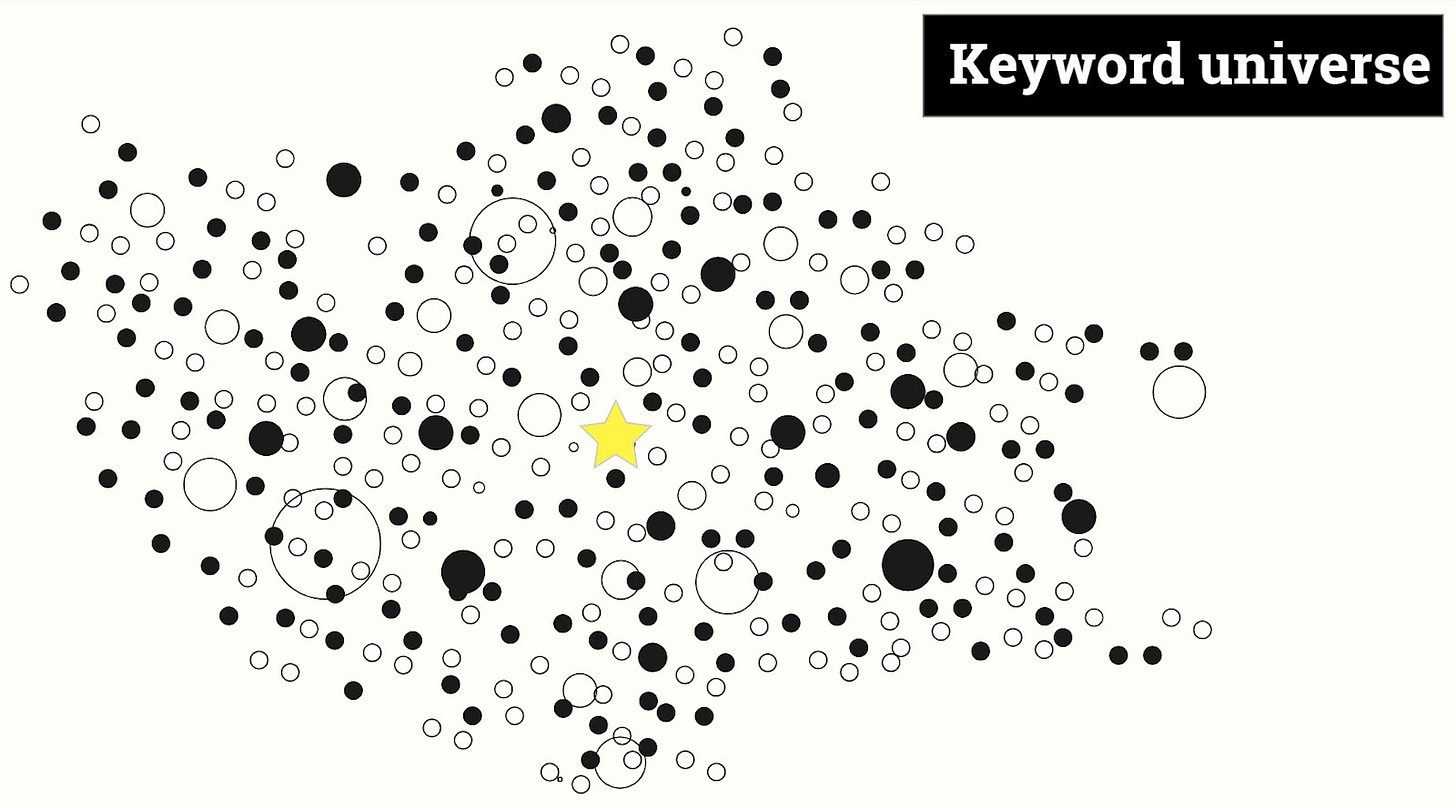
A keyword universe is a big pool of language your target audience uses when they search that will help them find you.
It surfaces the most important queries and phrases (i.e., keywords) at the top and lives in a spreadsheet or database, like BigQuery.
Instead of hyperfocusing on specific keywords or doing a keyword sprint every so often, you need to build a keyword universe that you’ll explore and conquer across your site over time.
One problem I tried to solve with the keyword universe is that keyword and intent research is often static.
It happens maybe every month or quarter, and it’s very manual. A keyword universe is both static and dynamic. While that might sound counterintuitive, here’s what I mean:
The keyword universe is like a pool that you can fill with water whenever you want. You can update it daily, monthly, quarter – whenever. It always surfaces the most important intents at the top.
For the majority of brands, some keyword-universe-building tasks only need to be done once (or once on product/service launch), while other tasks might be ongoing. More on this below.
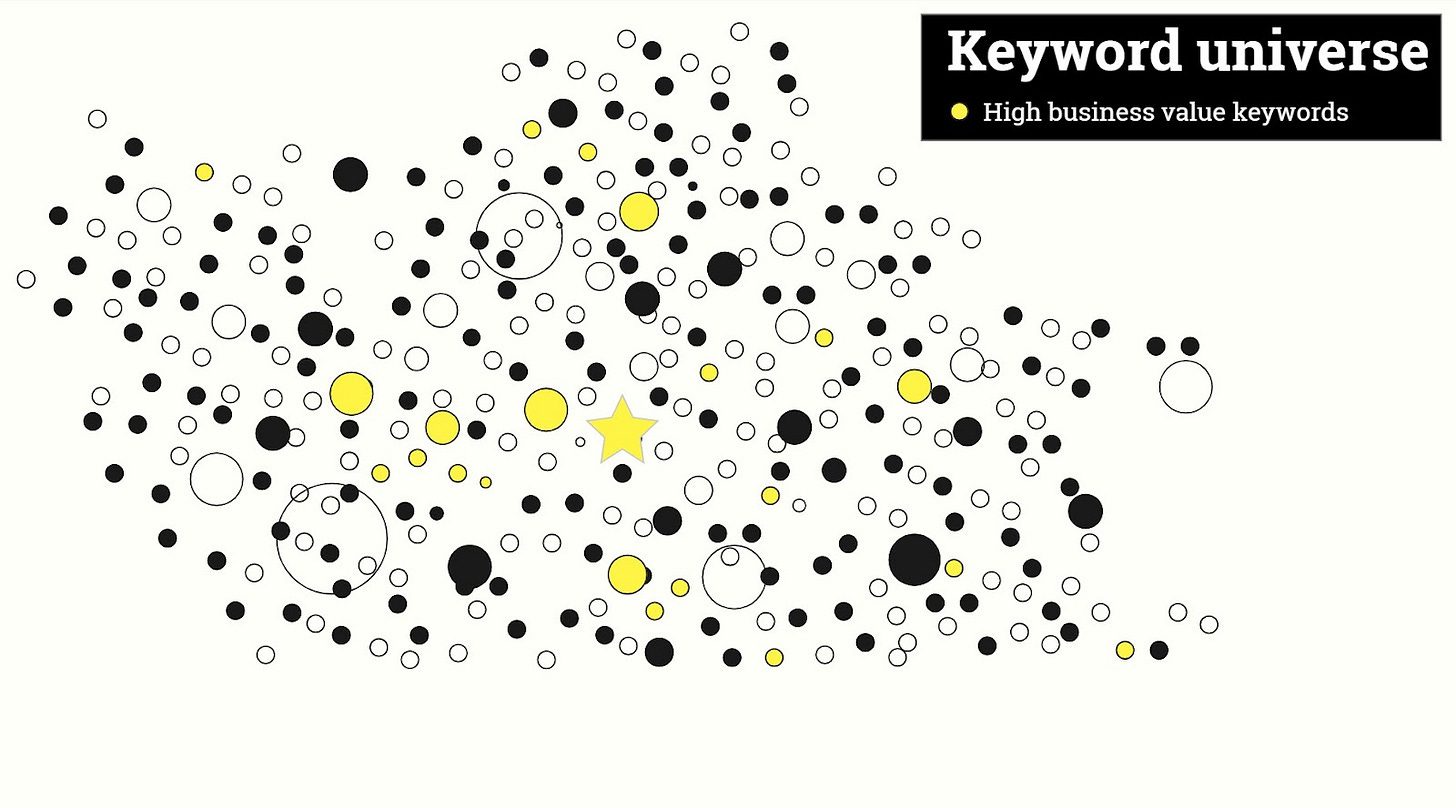
Within your database, you’ll assign weighted scores to prioritize content creation, but that scoring system might shift over time based on changes in initiatives, product/feature launches, and discovering topics with high conversion rates.
Image Credit: Kevin Indig
To Infinity And Beyond
The goal in building your keyword universe is to create a keyword pipeline for content creation – one that you prioritize by business impact.
Keyword universes elevate the most impactful topics to the top of a list, which allows you to focus on planning capacity, like:
The number of published articles needed to comprehensively cover core topics.
Resources needed to cover essential topics in a competitive timeframe.
A big problem in SEO is knowing which keywords convert to customers before targeting them.
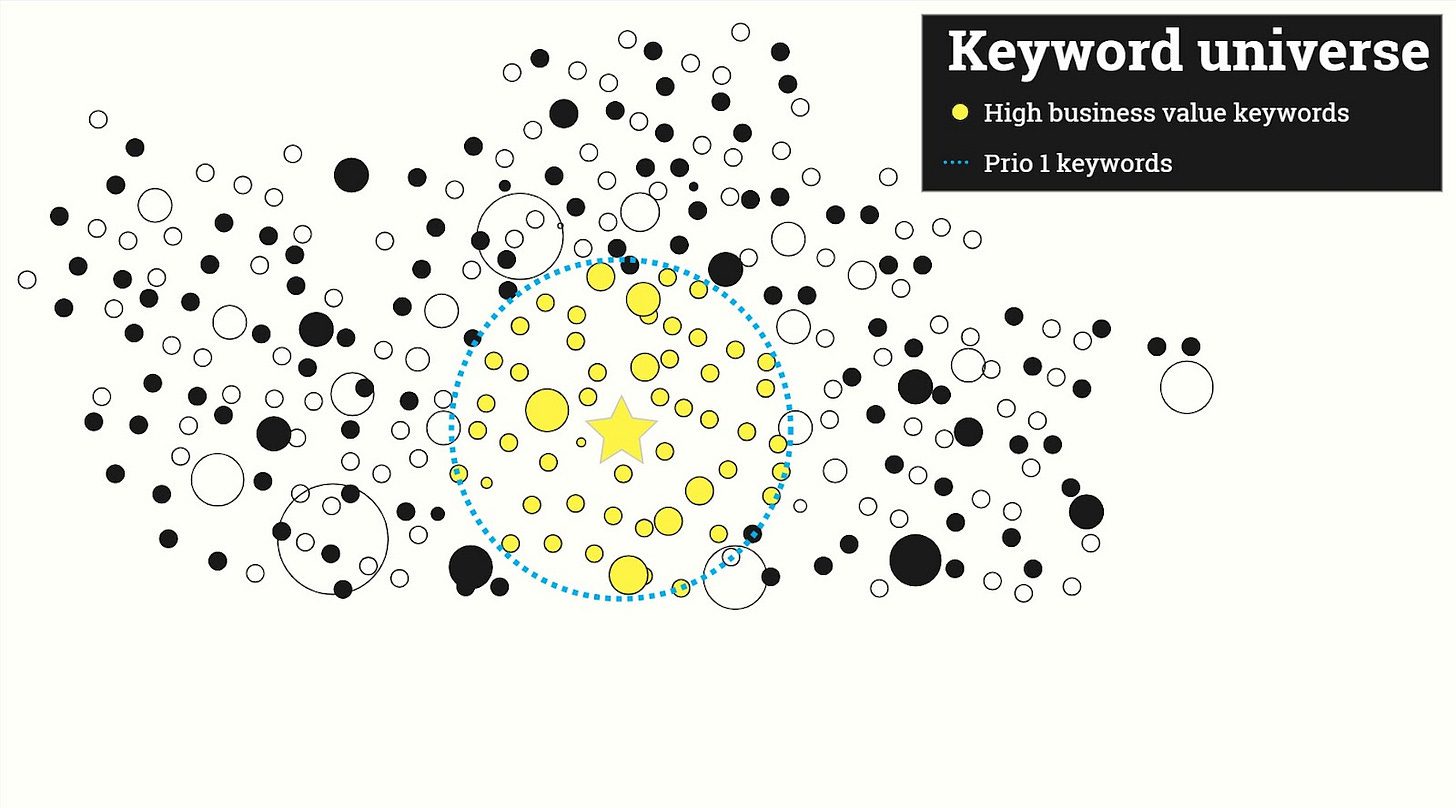
One big advantage of the keyword universe (compared to research sprints) is that new keywords automatically fall into a natural prioritization.
And with the advent of AI in search, like AI Overviews/Google’s AI Mode, this is more important than ever.
The keyword universe mitigates that problem through a clever sorting system.
SEO pros can continuously research and launch new keywords into the universe, while writers can pick keywords off the list at any time.
Think fluid collaboration.
Image Credit: Kevin Indig
Keyword universes are mostly relevant for companies that have to create content themselves instead of leaning on users or products. I call them integrators.
Typical integrator culprits are SaaS, DTC, or publishing businesses, which often have no predetermined, product-led SEO structure for keyword prioritization.
The opposite is aggregators, which scale organic traffic through user-generated content (UGC) or product inventory. (Examples include sites like TripAdvisor, Uber Eats, TikTok, and Yelp.)
The keyword path for aggregators is defined by their page types. And the target topics come out of the product.
Yelp, for example, knows that “near me keywords” and query patterns like “{business} in {city}” are important because that’s the main use case for their local listing pages.
Integrators don’t have that luxury. They need to use other signals to prioritize keywords for business impact.
Ready To Take On The Galaxy? Build Your Keyword Universe
Creating your keyword universe is a three-step process.
And I’ll bet it’s likely you have old spreadsheets of keywords littered throughout your shared drives, collecting dust.
Guess what? You can add them to this process and make good use of them, too. (Finally.)
Step 1: Mine For Queries
Keyword mining is the science of building a large list of keywords and a bread-and-butter workflow in SEO.
The classic way is to use a list of seed keywords and throw them into third-party rank trackers (like Semrush or Ahrefs) to get related terms and other suggestions.
That’s a good start, but that’s what your competitors are doing too.
You need to look for fresh ideas that are unique to your brand – data that no one else has…
…so start with customer conversations.
Dig into:
Sales calls.
Support requests.
Customer and/or target audience interviews.
Social media comments on branded accounts.
Product or business reviews.
And then extract key phrasing, questions, and terms your audience actually uses.
But don’t ignore other valuable sources of keyword ideas:
SERP features, like AIOs, PAAs, and Google Suggest.
Search Console: keywords Google tries to rank your site for.
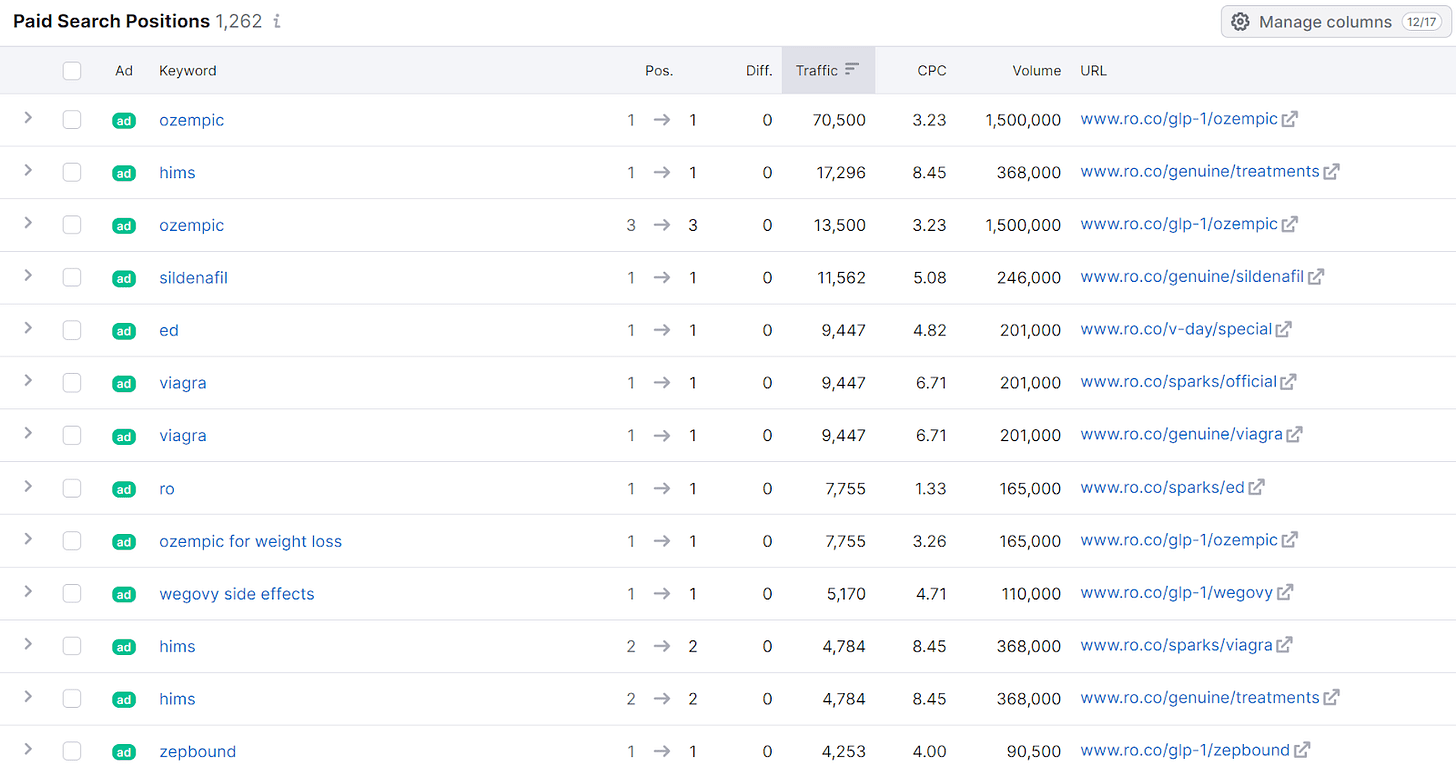
Competitor ranks and paid search keywords.
Conversational prompts your target audience is likely to use.
Reddit threads, YouTube comments, podcast scripts, etc.
Semrush’s list of paid keywords a site bids on (Image Credit: Kevin Indig)
The goal of the first step is to grow our universe with as many keywords as we can find.
(Don’t obsess over relevance. That’s Step 2.)
During this phase, there are some keyword universe research tasks that will be one-time-only, and some that will likely need refreshing or repeating over time.
Here’s a quick list to distinguish between repeat and one-time tasks:
Audience-based research: Repeat and refresh over time – quarterly is often sufficient. Pay attention to what pops up seasonally.
Product-focused research: Complete for the initial launch of a new product or feature.
Competitor-focused research: Complete once for both business and SEO competitors. Refresh/update when there’s a new feature, product/service, or competitor.
Location-focused research: Do this once per geographic location serviced and when you expand into new service locations
Step 2: Sort And Align
Step 2, sorting the long list of mined queries, is the linchpin of keyword universes.
If you get this right, you’ll be installing a powerful SEO prioritization system for your company.
Getting it wrong is just wasting time.
Anyone can create a large list of keywords, but creating strong filters and sorting mechanisms is hard.
The old school way to go about prioritization is by search volume.
Throw that classic view out the window: We can do better than that.
Most times, keywords with higher search volume actually convert less well – or get no real traffic at all due to AIOs.
A couple of months ago, I rewrote my guide to inhouse SEO and started ranking in position one. But the joke was on me. I didn’t get a single dirty click for that keyword. Over 200 people search for “in house seo” but not a single person clicks on a search result.
By the way, Google Analytics only shows 10 clicks from organic search over the last 3 months. So, what’s going on? The 10 clicks I actually got are not reported in GSC (privacy… I guess?), but the majority of searchers likely click on one of the People Also Asked features that show up right below my search result.
Keeping that in mind about search volume, since we don’t know which keywords are most important for the business before targeting them – and we don’t want to make decisions by volume alone – we need sorting parameters based on strong signals.
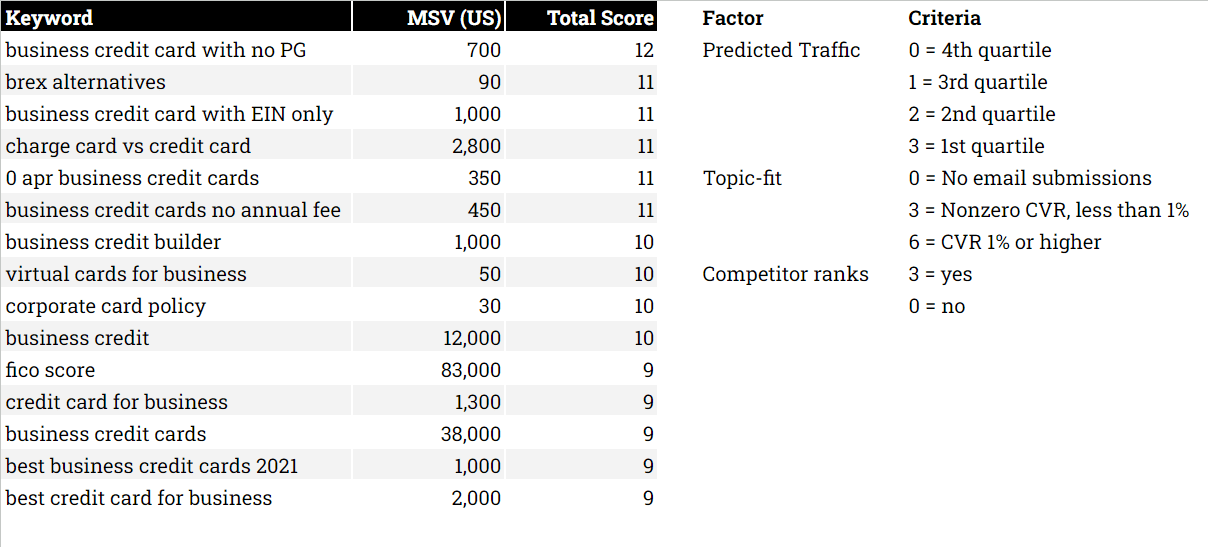
We can summarize several signals for each keyword and sort the list by total score.
That’s exactly what I’ve done with clients like Ramp, the fastest-growing fintech startup in history, to prioritize content strategy.
Image Credit: Kevin Indig
Sorting is about defining an initial set of signals and then refining it with feedback.
You’ll start by giving each signal a weight based on our best guess – and then refine it over time.
When you build your keyword universe, you’ll want to define an automated logic (say, in Google Sheets or BigQuery).
Your logic could be a simple “if this then that,” like “if keyword is mentioned by customer, assign 10 points.”
Potential signals (not all need to be used):
Keyword is mentioned in customer conversation.
Keyword is part of a topic that converts well.
Topic is sharply related to direct offering or pain point your brand solves.
Mmonthly search volume (MSV)
Keyword difficulty (KD)/competitiveness
(MSV * KD) / CPC → I like to use this simple formula to balance search demand with competitiveness and potential conversion value.
Traffic potential.
Conversions from paid search or other channels.
Growing or shrinking MSV.
Query modifier indicates users are ready to take action, like “buy” or “download.”
You should give each signal a weight from 0-10 or 0-3, with the highest number being strongest and zero being weakest.
Your scoring will be unique to you based on business goals.
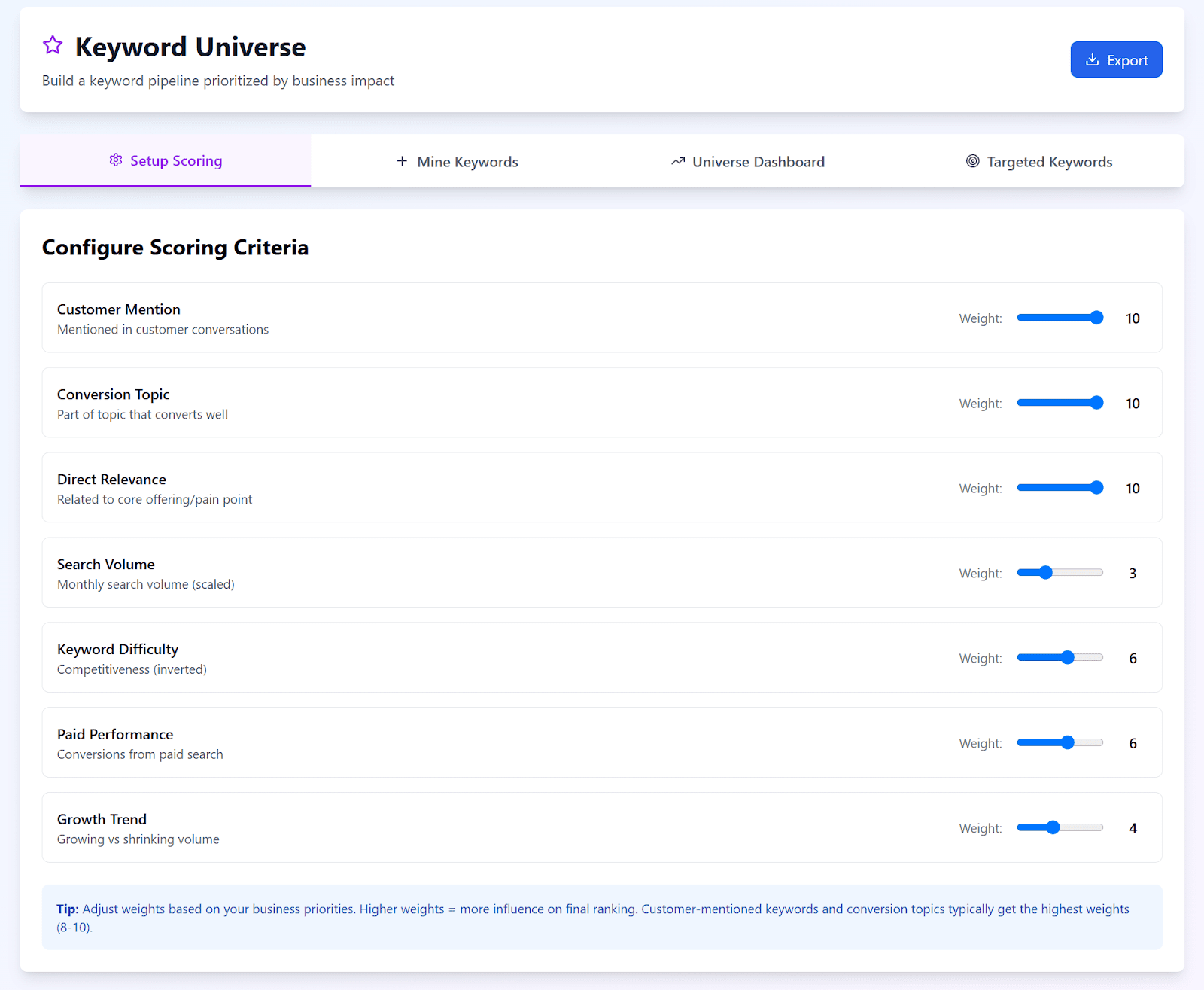
Let’s pause here for a moment: I created a simple tool that will make this work way easier, saving a lot of time and trial + error. (It’s below!) Premium subscribers get full access to tools like this one, along with additional content and deep dives.
But let’s say you’re prioritizing building content around essential topics and have goals set around growing topical authority. And let’s say you’re using the 0-10 scale. Your scoring might look something like:
Keyword is mentioned in customer conversation: 10.
Keyword is part of a topic that converts well: 10.
Topic is sharply related to direct offering or pain point your brand solves: 10.
MSV: 3.
KD/competitiveness: 6.
(MSV * KD) / CPC → I like to use this simple formula to balance search demand with competitiveness and potential conversion value: 5.
Traffic potential: 3.
Conversions from paid search or other channels: 6.
Growing or shrinking MSV: 4.
Query modifier indicates users are ready to take action, like “buy” or “download”: 7.
The sum of all scores for each query in your universe then determines the priority sorting of the list.
Keywords with the highest total score land at the top and vice versa.
New keywords on the list fall into a natural prioritization.
Important note: If your research shows that sales are connected to queries related to current events, news, updates in research reports, etc., those should be addressed as soon as possible.
(Example: If your company sells home solar batteries and recent weather news increases demand due to a specific weather event, make sure to prioritize that in your universe ASAP.)
Amanda’s thoughts: I might get some hate for this stance, but if you’re a new brand or site just beginning to build a content library and you fall into the integrator category, focus on building trust first by securing visibility in organic search results where you can as quickly as you can.
I know, I know: What about conversions? Conversion-focused content is crucial to the long-term success of the org.
But to set yourself apart, you need to actually create the content that no one is making about the questions, pain points, and specific needs your target audience is voicing.
If your sales team repeatedly hears a version of the same question, it’s likely there’s no easy-to-find answer to the question – or the current answers out there aren’t trustworthy. Trust is the most important currency in the era of AI-based search. Start building it ASAP. Conversions will follow.
Step 3: Refine
Models get good by improving over time.
Like a large language model that learns from fine-tuning, we need to adjust our signal weighting based on the results we see.
We can go about fine-tuning in two ways:
1. Anecdotally, conversions should increase as we build new content (or update existing content) based on the keyword universe prioritization scoring.
Otherwise, sorting signals have the wrong weight, and we need to adjust.
2. Another way to test the system is a snapshot analysis.
To do so, you’ll run a comparison of two sets of data: the keywords that attract the most organic visibility and the pages that drive the most conversions, side-by-side with the keywords at the top of the universe.
Ideally, they overlap. If they don’t, aim to adjust your sorting signals until they come close.
Tips For Maintaining Your Keyword Universe
Look, there’s no point in doing all this work unless you’re going to maintain the hygiene of this data over time.
This is what you need to keep in mind:
1. Once you’ve created a page that targets a keyword in your list, move it to a second tab on the spreadsheet or another table in the database.
That way, you don’t lose track and end up with writers creating duplicate content.
2. Build custom click curves for each page type (blog article, landing page, calculator, etc.) when including traffic and revenue projections.
Assign each step in the conversion funnel a conversion rate – like visit ➡️newsletter sign-up, visit ➡️demo, visit ➡️purchase – and multiply search volume with an estimated position on the custom click curve, conversion rates, and lifetime value. (Fine-tune regularly.)
Here’s an example: MSV * CTR (pos 1) * CVRs * Lifetime value = Revenue prediction
3. GPT for Sheets or the Meaning Cloud extension for Google Sheets can speed up assigning each keyword to a topic.
Meaning Cloud allows us to easily train an LLM by uploading a spreadsheet with a few tagged keywords.
GPT for Sheets connects Google Sheets with the OpenAI API so we can give prompts like “Which of the following topics would this keyword best fit? Category 1, category 2, category 3, etc.”
LLMs like Chat GPT, Claude, or Gemini have become good enough that you can easily use them to assign topics as well. Just prompt for consistency!
4. Categorize the keywords by intent, and then group or sort your sheet by intent. Check out Query Fan Out to learn why.
5. Don’t build too granular and expansive of a keyword universe that you can’t activate it.
If you have a team of in-house strategists and three part-time freelancers, expecting a 3,000 keyword universe to feel doable and attainable is … an unmet expectation.
Your Keyword Universe Is Designed To Explore
The old way of doing SEO – chasing high-volume keywords and hoping for conversions – isn’t built for today’s search reality.
Trust is hard to earn. (And traffic is hard to come by.)
The keyword universe gives you a living, breathing SEO operating system. One that can evolve based on your custom scoring and prioritization.
Prioritizing what’s important (sorting) allows us to literally filter through the noise (distractions, offers, shiny objects) and bring us to where we want to be.
So, start with your old keyword docs. (Or toss them out if they’re irrelevant, aged poorly, or simply hyper-focused on volume.)
Then, dig into what your customers are really asking. Build smart signals. Assign weights. And refine as you go.
This isn’t about perfection. It’s about building a system that actually works for you.
This week’s Ask an SEO question comes from an ecommerce site owner who’s experiencing a common frustration:
“Our ecommerce site has decent traffic but poor conversion rates. What data points should we be analyzing first, and what are two to three quick conversion rate optimization (CRO) wins that most companies overlook?”
This is a great question. Having good traffic but poor conversion rates is really frustrating for ecommerce site managers.
You’ve successfully managed to get hundreds or even thousands of people onto your landing pages, but only a tiny proportion of them turn into paying customers.
What’s going wrong, and what can you do about it?
I’ve broken down my tips as follows:
Start with your bigger picture goals.
Double-check your targeting.
Data points to analyze.
Simulate the user journey.
Quick CRO wins.
Thinking About The Bigger Picture First
Before answering your question, I think it’s valuable to take a step back and think about your approach to running your site – and what your goals are.
People often get lots of low-quality traffic for the following kinds of reasons:
They’re attracting the wrong kinds of people.
They’re using paid ads ineffectively.
The content on the site gets clicks, but doesn’t solve visitors’ needs.
The site is confusing, unclear, or even annoying to use.
For me, conversion is always built on the same key fundamentals:
Quality over quantity: There’s no value in having millions of visitors if none of them convert. I’ve worked on ecommerce sites where we implemented changes that made traffic drop dramatically. However, the quality of the remaining traffic was much higher, meaning conversion rates – and revenue – soared.
Focus on user experience (UX): It’s really important to understand the user journey from inception to conversion. What’s helping people navigate your site, and what’s hindering them? Often, this is simply about returning to the basics of UX. High-value sessions come from relevance, ease, and trust – all of which are fully within your control.
So, before making changes, I’d encourage you to step back and think about your goals and objectives for the site. Everything else will feed into that.
What’s Realistic?
It’s helpful to have a benchmark for what your conversion rate should be.
According to Shopify data, the average ecommerce site conversion rate is 1.4%. A very good rate is 3.2% or above, while very few sites hit more than 5%.
Double-Check Your Targeting
A common reason people get high traffic but low conversions is due to problems with their targeting. Essentially, they’re attracting the wrong kinds of site visitors.
For example, you might run a site selling tennis memorabilia. But most of the traffic you get is from people searching for tickets to tennis tournaments. As a consequence, most visitors bounce.
If this is the case, it’s time to rethink your SEO. Are you ranking for the right keywords? Are your landing pages aligned with the top queries for those search terms? Making changes here can make a big difference.
However, if your targeting is correct but conversion is still off, it’s time to look into CRO.
5 Kinds Of Conversion Rate Data To Analyze
By analyzing how people navigate your site, you can start to build a picture of how they’re using it – and which features of your site or the user journey are turning visitors off.
If you’re using a store builder like Shopify, Wix, or Squarespace, you should have access to quite a lot of CRO data within the dashboard. On older sites, it can be a bit trickier to figure these things out.
There are lots of metrics that can give you insights into conversion rates. But the following information is often most telling:
1. User Behavior Metrics
Bounce rate and exit rate: This is especially important for key pages (such as product and checkout).
Scroll depth: Are users seeing your calls to action and product info?
Heatmaps: Are users interacting with intended elements?
Entry points: Are there commonalities between entrances for users who aren’t converting versus those who are converting? If so, this may indicate a specific issue with certain user journeys.
2. Conversion Funnel Drop-Off
Abandonment: Where are users abandoning the funnel (e.g., product page → add to cart → checkout)?
Granularity: I’d also recommend looking at abandonment rates for each step.
3. Device & Browser Performance
Device: Conversion rate by device (mobile often underperforms).
Operating system: Technical glitches in specific browsers/OS versions can quietly hurt conversions.
4. Site Speed & Core Web Vitals
Page load time: This directly affects conversions, especially on mobile.
High search exit rate often signals poor relevance or UX.
This can seem like a lot of work! However, what you’re really looking for is a basic benchmark for each of the above points that you can plug into a spreadsheet.
You only need to gather this data once. Then, it’s just a case of seeing how changes you make affect those scores.
For example, say you have a high cart abandonment rate of 90%. You might decide to make some simple changes to the process (e.g., letting users check out as a guest). You’ll then be able to see what effect your change has had.
Simulate The User’s Journey
This is all about putting yourself in your users’ shoes. I’m often surprised by how few ecommerce site owners do this, yet you can’t understand what’s going wrong if you don’t use the site like a user would.
Simulating user journeys often exposes glaring usability issues.
For example, it’s quite common to land on a category page for, say, sports T-shirts, and find it’s full of broken links. You click on a T-shirt that looks good, but it leads to a 404. That’s such a turn-off to potential customers.
There are, of course, endless possible ways that people can navigate your site. I’d prioritize a handful of your most popular products and try to imagine how people would go through the process of buying them.
Are distractions minimized (pop-ups, autoplay, clutter)?
Navigation And Search
Is site navigation intuitive and consistent?
Can users find products in three clicks or fewer?
Are filters/sorting options clear and responsive?
Category Pages
Is key info shown (price, reviews, quick add)?
Is the layout clean (think about devices here, mobile responsiveness, font size, etc.)?
Are products visible above the fold?
Product Detail Pages
Are product titles, descriptions, and photos compelling and complete?
Is the price, shipping, and returns information visible without scrolling?
Are reviews and ratings visible and credible?
Is the “Add to Cart” button obvious and persistent?
Cart And Checkout
Is the cart editable (quantity, remove item)?
Are total costs (including shipping/tax) shown upfront?
Can users check out as a guest?
Are there too many form fields? (Trim non-essentials.)
Are payment options clearly presented and working?
Speed
Quick CRO Wins That Are Often Overlooked
Conversion rate optimization doesn’t always require a root-and-branch site upgrade.
Here are some simple tweaks you can make that can be surprisingly impactful.
Improve Product Page Microcopy And Visual Hierarchy
If a user lands on a product page, it’s crucial to communicate key information to them. Yet, for many products, people have to scroll below the fold to find the information they need.
Show total price, shipping, and returns at the top of the page.
Have a clear image of the product (you’d be amazed, but this doesn’t always happen).
Spell out the product name, color, type, and other information.
Add urgency (“Only 3 left!”), real-time interest (“27 people viewed this today”), or social proof (UGC, ratings) near the CTA.
Make It Easy To Buy
It can sometimes be surprisingly difficult for people to know how to actually buy things on ecommerce sites, particularly when using mobile. I’d recommend:
Making the “Add to Cart” button sticky on mobile. Make sure it’s in a clear, bold, contrasting color.
Add subtle animations or color shifts to draw attention.
Show trust badges (e.g., secure checkout, money-back guarantee).
Make It Easier To Find Items
Any ecommerce site today should have a search bar where people can look for products. Help people find products by offering auto-suggestions with images and categories.
I’d also recommend tracking no-results queries and fixing them with redirects or better tagging. You might also want to promote high-converting products in the top results.
Simplify The Checkout Experience
A poor checkout experience can be a real killer for conversion. The priority here is almost always about making things as easy as possible for buyers.
Remove non-critical fields (phone number, company name).
Offer guest checkout as default.
Add progress indicators to reduce perceived friction.
Use Exit-Intent Offers Wisely
Exit-intent technology can be very helpful, at least on some kinds of websites.
However, it’s important to use it thoughtfully and appropriately (what makes sense on a fast-fashion website won’t look as good on a luxury goods store).
Instead of broad discounts, use behavioral targeting. Here are some options:
Offer a free shipping incentive only to high-cart-value exits.
Show email capture pop-ups only after a period of inactivity or product page scrolling.
Use exit-intent popups with tailored offers (e.g., “Complete your order now and get 10% off”).
Last but not least, I’d always recommend A/B testing before rolling out whole site changes.
If you’ve tweaked a certain part of the user journey or the layout of a landing page, trial it for a week or so and see what results you get.
This avoids making damaging changes that harm conversion rates (and take a long time to rectify).
Preaching To The Converters
I hope these ideas for converting more of your ecommerce site’s visitors have helped.
As I’ve shown, there are tons of potential CRO techniques you can use, and it can get a bit overwhelming.
However, it’s often more straightforward than it seems, and you can often start with small steps that make a difference.
One of the reasons ecommerce site management can be so rewarding is the ability to experiment and see how small changes can make a big difference. Good luck!
More Resources:
Featured Image: Paulo Bobita/Search Engine Journal