DoorDash Co-Founder: Customer Obsessed, Not Competitor Focused via @sejournal, @martinibuster

Garry Tan, President and CEO of Y Combinator, interviewed Tony Xu, co-founder of DoorDash, in a conversation that revealed useful insights on how to choose a niche, what it takes for an entrepreneur to succeed in a crowded and competitive field, and how DoorDash built long-lasting brand signals that can benefit any business in today’s digital economy.

DoorDash began with the non-scalable $10 domain (‘Palo Alto Delivery’) and PDF menus on a static HTML web page, taking orders over Google Voice and the founders were able to scale that to the nationwide success it is today by focusing on three actionable principles which allowed them to grow past their initial shortcomings and build on their strengths.

These lessons are especially important in today’s digital marketing environment where the importance of building relationships with customers has accelerated because of the advent of AI-powered search and AI assistants.

Y Combinator

Y Combinator is a Venture Capital and startup incubator responsible for dozens of the biggest digital brands like Airbnb, DoorDash, Quora, Stripe, Webflow, and Zapier to name a few. The Y Combinator video podcast interviews brings real insights directly related to digital marketing, entrepreneurship, and the daily work involved in keeping running businesses today.

Their podcast’s tag line suggests finding a place within the digital technology economy and the DoorDash experience shows how to do it.

“All the world is changing around technology and you may contribute a line of code. What will yours be?”

Three Takeaways

Tony Xu relates the beginnings of DoorDash and how it grew to become a successful company. It wasn’t a matter of getting a lot of money thrown at him and then finding success. He and his team struggled to figure out how to make the business successful. Perhaps a key to their success was that they founded the company on three ideas, creating a strong foundation upon which to build success.

Another takeaway is that a good business idea isn’t always an instant success. Success can take years to build. So be sure to give yourself a long runway measured in years not months for taking off.

The three takeaways are:

  1. Choose Business Niche By What Feels Meaningful
  2. Customer Obsession As A Strategic Philosophy
  3. Don’t Follow The Competition: Follow The Opportunity

Choosing Your Best Niche

Tony Xu explained that the DoorDash team started by exploring different projects that felt interesting to them and ultimately settling on the one that felt the most meaningful and exciting. The idea for DoorDash came about by observing a local macaroon shop that had to decline delivery orders because they lacked the infrastructure.

What’s interesting about DoorDash is that they’re in between two customer bases, the merchants and the end users. They opted to not conduct surveys but rather the founders immersed themselves in the merchants’ daily routines to identify the pain points for growth and expansion and to identify where DoorDash could help.

Tony Xu explains:

“Our question that we tended to ask business owners was can we follow you around for a day… we wanted to actually feel what it was like, their lived experience versus just asking a bunch of survey questions. It was toward the end of the time we spent with the store manager that she had showed us a booklet of orders she had turned down. All of them were delivery orders.”

He described that this was a common thread with business owners who had these small shops with orders they were unable to fulfill. He said they imagined the scale of what could be done, that they could have just delivered orders for this one bakery, or for all bakeries, all types of restaurants, all types of retailers. They discovered a need from a wide range of merchants but what they didn’t know at this point was if consumers cared or whether there was a driver workforce to partner for.

Customer Obsession As A Strategic Philosophy

Tony Xu shared that their early customer base was mainly young families and that ended up shaping their service through direct feedback. Another example of allowing the business to be shaped by the customer is an event that went badly and resulted in many upset customers. DoorDash settled on the customer-first approach by choosing to refund all the customers after a service meltdown during a Stanford football game, at the cost of 40% of the founder’s bank balances. Further, they stayed up overnight to bake and hand-deliver apology cookies the next morning at 5 AM before their customers awakened.

Tony shared how that experience solidified their business around customer satisfaction:

“That was an early story that ultimately, you know, became the story that translated to our internal company value of customer obsessed, not competitor focused… I think the founding team always had this desire to at least do things the right way even if we wouldn’t have made it.”

These experiences cemented the company’s core customer-centered philosophy of being “customer obsessed, not competitor focused.”

Don’t Follow The Competition: Follow the Opportunity

Conventional wisdom assumes that established players have done the research and that there are good reasons for why competitors do what they do. What Tony Xu revealed is that isn’t necessarily true. He doesn’t explain the reasons why competitors missed a golden opportunity but it’s easy to surmise that competitors build based on conventional assumptions and are unaware that demographics and user habits change which results in opportunities.

Tony shared that their competitors focused on dense urban markets because the conventional wisdom was that this was where more people it was more profitable to serve the densely populated areas. DoorDash went a different direction by focusing on suburbs because they discovered a customer need in that suburban customers had fewer nearby restaurants and it was that fact that made a delivery service more valuable. Serving families also resulted in higher average order size, easier parking, and simpler food drop-offs which in turn led to stronger performance across the board.

Takeaway:

Many smaller independent sites today fail to differentiate themselves to site visitors. They follow what their competitors do and because of that virtually all recipe sites, all mom sites all travel sites look exactly the same.

Becoming the same as your competitor is not the way to beat your competitors. That’s why the skyscraper and 10x content strategies are so lousy because they presume that being the same as the competitor “but better” is what your users want. Circling back to Tony Xu, he found success by being customer obsessed so the question is what does that mean for you and your site visitors?

Becoming customer-focused isn’t a new age feel-good thing to do, it’s a practical and proven approach to creating a successful business. It informs every choice you make from the design of the site, the service, and the content and it becomes a strength that no competitor can copy and steal from you.

Lastly, it’s satisfying and easier to focus on a topic that is meaningful. If there’s a way to build an ecosystem that might be even better as it can become a moat around the business.

Watch the Y Combinator podcast:

DoorDash CEO: Customer Obsession, Surviving Startup Death & Creating A New Market

Featured Image by Shutterstock/sockagphoto

Google On Negative Authorship Signal And Mini-Site Reputation via @sejournal, @martinibuster

At the recent Search Central Live NYC event, Danny Sullivan discussed what happens when a site begins publishing vastly different content on a site and how that may affect rankings, introducing the concept of a mini-site as a metaphor for dividing the reputation of a site. He also discussed the concept of negative authorship authority, which some SEOs believe follows authors from penalized websites and can negatively affect the other sites they publish on.

Negative Authorship Reputation

Danny initially discussed a negative authorship signal that some in the SEO community believe can follow an author from site to site. The idea is that an author of content that is banned on one site will also have their content banned on another site. He denied that Google tracked author authority signals from site to site.

Sullivan explained:

“If you wrote for a site that got a manual action, it doesn’t somehow infect the other site that you might work for later on, so again, this is not something that freelancers should be worried about.

If you’re a publication and for whatever reason you feel like employing a freelancer, and it makes sense, that’s fine. You don’t need to worry about who they worked for before.

And if you are a freelancer you do not need to go back to the publications and say, can you take my byline down because now I can’t get hired from anybody else because they think I’m going to infect them. It is not like that. It’s not a disease. “

The above SEO myth likely began when publishers noticed that content created by a certain author across multiple sites was banned. In that case, it’s reasonable to assume that there was something wrong with the content but that’s not necessarily true. It could have been the case that the website itself was poorly promoted with unnatural links. Or, it could be that the site itself was engaged with selling links.

The takeaway from what Danny Sullivan shared is that a manual action on one site doesn’t follow an author to another site. Another takeaway is that there is no negative authorship signal that Google is tracking.

And if there’s no negative authorship signal could it be that there is no positive author signal as well? In my opinion it’s a reasonable assumption. A signal like that would be too easy to manipulate. Whatever signals Google uses to understand site reputation is likely enough for the purpose of citing an information source in the search results.

Although claims by some SEOs have been made about authorship signals, authorship signals have never been known to be a thing with Google’s algorithms. Google has a long history of denying the use of authorship signals and Danny’s statements offer further validation that Google continues to not use authorship as signals for ranking purposes.

Ranking Drops And Mini-Site Reputation

Danny next begins talking about how a new section of a site could suddenly lose rankings. He says this isn’t necessarily a bad thing. It’s just Google trying to figure out this new section and that if it’s sufficiently different Google could even start treating it as a standalone mini-site. This is a really fascinating thing he gets into here.

Danny used the example of the addition of a forum to a website.

Danny explained

“For example, you might have a site where you start running a forum. Forums can be different and we would want to understand that this looks like a forum so that we can then rank the forum content against other kinds of forum content on kind of a level playing field or understand that that forum content should be included in things where we try to show forum content.”

What can happen is… that it could be that part of your site was doing better because it was seen as part of the overall site. Now we kind of see it as more of independent and part of a full site on its own.

And potentially you could see a traffic drop that comes from that. That doesn’t mean that you suddenly got a site reputation abuse ban issue because first of all that might not have involved third party content abusing first party work, right? Those were the things. So if it doesn’t have any of that it doesn’t have anything to do with that.Secondly, we would have sent you an email. So, it’s not bad.

Because it just could be we’ve had a general re-ranking… It could also mean that in the long run that part of your site might actually do better, because we might recognize it in different ways, that we might be able to surface it in different ways. And it might start sort of earning its own like ‘mini-site’ reputation along the way.”

Three things to take away from that last part.

A ranking drop could be due to benign things, don’t always assume that a ranking drop is due to a spam or other negative algorithmic action.

Second, a rankings drop could be due to a “general re-ranking” which is a vague term that went unexplained but is probably a reference to minor ranking adjustments outside of a core algorithm update.

The third takeaway is the part about a section of a website earning it’s own “mini-site” reputation. I think SEOs should not create theories about mini-sites and mini-site reputations because that’s not what Danny Sullivan said. He used the word “like” which means that he likely used the phrase “mini-site” as a metaphor.

Featured Image by Shutterstock/Joseph Hendrickson

How do you teach an AI model to give therapy?

On March 27, the results of the first clinical trial for a generative AI therapy bot were published, and they showed that people in the trial who had depression or anxiety or were at risk for eating disorders benefited from chatting with the bot. 

I was surprised by those results, which you can read about in my full story. There are lots of reasons to be skeptical that an AI model trained to provide therapy is the solution for millions of people experiencing a mental health crisis. How could a bot mimic the expertise of a trained therapist? And what happens if something gets complicated—a mention of self-harm, perhaps—and the bot doesn’t intervene correctly? 

The researchers, a team of psychiatrists and psychologists at Dartmouth College’s Geisel School of Medicine, acknowledge these questions in their work. But they also say that the right selection of training data—which determines how the model learns what good therapeutic responses look like—is the key to answering them.

Finding the right data wasn’t a simple task. The researchers first trained their AI model, called Therabot, on conversations about mental health from across the internet. This was a disaster.

If you told this initial version of the model you were feeling depressed, it would start telling you it was depressed, too. Responses like, “Sometimes I can’t make it out of bed” or “I just want my life to be over” were common, says Nick Jacobson, an associate professor of biomedical data science and psychiatry at Dartmouth and the study’s senior author. “These are really not what we would go to as a therapeutic response.” 

The model had learned from conversations held on forums between people discussing their mental health crises, not from evidence-based responses. So the team turned to transcripts of therapy sessions. “This is actually how a lot of psychotherapists are trained,” Jacobson says. 

That approach was better, but it had limitations. “We got a lot of ‘hmm-hmms,’ ‘go ons,’ and then ‘Your problems stem from your relationship with your mother,’” Jacobson says. “Really tropes of what psychotherapy would be, rather than actually what we’d want.”

It wasn’t until the researchers started building their own data sets using examples based on cognitive behavioral therapy techniques that they started to see better results. It took a long time. The team began working on Therabot in 2019, when OpenAI had released only its first two versions of its GPT model. Now, Jacobson says, over 100 people have spent more than 100,000 human hours to design this system. 

The importance of training data suggests that the flood of companies promising therapy via AI models, many of which are not trained on evidence-based approaches, are building tools that are at best ineffective, and at worst harmful. 

Looking ahead, there are two big things to watch: Will the dozens of AI therapy bots on the market start training on better data? And if they do, will their results be good enough to get a coveted approval from the US Food and Drug Administration? I’ll be following closely. Read more in the full story.

This story originally appeared in The Algorithm, our weekly newsletter on AI. To get stories like this in your inbox first, sign up here.

Brain-computer interfaces face a critical test

Tech companies are always trying out new ways for people to interact with computers—consider efforts like Google Glass, the Apple Watch, and Amazon’s Alexa. You’ve probably used at least one.

But the most radical option has been tried by fewer than 100 people on Earth—those who have lived for months or years with implanted brain-computer interfaces, or BCIs.

Implanted BCIs are electrodes put in paralyzed people’s brains so they can use imagined movements to send commands from their neurons through a wire, or via radio, to a computer. In this way, they can control a computer cursor or, in few cases, produce speech.  

Recently, this field has taken some strides toward real practical applications. About 25 clinical trials of BCI implants are currently underway. And this year MIT Technology Review readers have selected these brain-computer interfaces as their addition to our annual list of 10 Breakthrough Technologies, published in January.

BCIs won by a landslide to become the “11th Breakthrough,” as we call it. It beat out three runners-up: continuous glucose monitors, hyperrealistic deepfakes, and methane-detecting satellites.

The impression of progress comes thanks to a small group of companies that are actively recruiting volunteers to try BCIs in clinical trials. They are Neuralink, backed by the world’s richest person, Elon Musk; New York–based Synchron; and China’s Neuracle Neuroscience. 

Each is trialing interfaces with the eventual goal of getting the field’s first implanted BCI approved for sale. 

“I call it the translation era,” says Michelle Patrick-Krueger, a research scientist who carried out a detailed survey of BCI trials with neuroengineer Jose Luis Contreras-Vidal at the University of Houston. “In the past couple of years there has been considerable private investment. That creates excitement and allows companies to accelerate.”

That’s a big change, since for years BCIs have been more like a neuroscience parlor trick, generating lots of headlines but little actual help to patients. 

Patrick-Krueger says the first time a person controlled a computer cursor from a brain implant was in 1998. That was followed by a slow drip-drip of tests in which university researchers would find a single volunteer, install an implant, and carry out studies for months or years.

Over 26 years, Patrick-Krueger says, she was able to document a grand total of 71 patients who’ve ever controlled a computer directly with their neurons. 

That means you are more likely to be friends with a Mega Millions jackpot winner than know someone with a BCI.

These studies did prove that people could use their neurons to play Pong, move a robot arm, and even speak through a computer. But such demonstrations are of no practical help to people with paralysis severe enough to benefit from a brain-controlled computer, because these implants are not yet widely available. 

“One thing is to have them work, and another is how to actually deploy them,” says Contreras-Vidal. “Also, behind any great news are probably technical issues that need to be addressed.” These include questions about how long an implant will last and how much control it offers patients.

Larger trials from three companies are now trying to resolve these questions and set the groundwork for a real product.

One company, Synchron, uses a stent with electrodes on it that’s inserted into a brain vessel via a vein in the neck. Synchron has implanted its “stentrode” in 10 volunteers, six in the US and four in Australia—the most simultaneous volunteers reported by any BCI group. 

The stentrode collects limited brain signals, so it gives users only a basic on/off type of control signal, or what Synchron calls a “switch.” That isn’t going to let a paralyzed person use Photoshop. But it’s enough to toggle through software menus or select among prewritten messages.

Tom Oxley, Synchron’s CEO, says the advantage of the stentrode is that it is “as simple as possible.” That, he believes, will make his brain-computer interface “scalable” to more people, especially since installing it doesn’t involve brain surgery. 

Synchron might be ahead, but it’s still in an exploratory phase. A “pivotal” study, the kind used to persuade regulators to allow sales of a specific version of the device, has yet to be scheduled. So there’s no timeline for a product.  

Neuralink, meanwhile, has disclosed that three volunteers have received its implant, the N1, which consists of multiple fine electrode threads inserted directly into the brain through a hole drilled in the skull. 

More electrodes mean more neural activity is captured. Neuralink’s first volunteer, Noland Arbaugh, has shown off how he can guide a cursor around a screen in two dimensions and click, letting him play video games like Civilization or online chess.

Finally, Neuracle says it is running two trials in China and one in the US. Its implant consists of a patch of electrodes placed on top of the brain. In a report, the company said a paralyzed volunteer is using the system to stimulate electrodes in his arm, causing his hand to close in a grasp. 

But details remain sparse. A Neuracle executive would only say that “several” people had received its implant.

Because Neuracle’s patient count isn’t public, it wasn’t included in Patrick-Krueger’s tally. In fact, there’s no information at all in the medical literature on about a quarter of brain-implant volunteers so far, so she counted them using press releases or by e-mailing research teams.

Her BCI survey yielded other insights. According to her data, implants have lasted as long as 15 years, more than half of patients are in the US, and roughly 75% of BCI recipients have been male. 

The data can’t answer the big question, though. And that is whether implanted BCIs will progress from breakthrough demonstrations into breakout products, the kind that help many people.

“In the next five to 10 years, it’s either going to translate into a product or it’ll still stay in research,” Patrick-Krueger says. “I do feel very confident there will be a breakout.”

The Download: brain-computer interfaces, and teaching an AI model to give therapy

This is today’s edition of The Download, our weekday newsletter that provides a daily dose of what’s going on in the world of technology.

Brain-computer interfaces face a critical test

Brain computer interfaces (BCIs) are electrodes put in paralyzed people’s brains so they can use imagined movements to send commands from their neurons through a wire, or via radio, to a computer. In this way, they can control a computer cursor or, in few cases, produce speech.  

Recently, this field has taken some strides toward real practical applications. About 25 clinical trials of BCI implants are currently underway. And this year MIT Technology Review readers have selected these brain-computer interfaces as their addition to our annual list of 10 Breakthrough Technologies. Read the full story.

—Antonio Regalado

How do you teach an AI model to give therapy?

—James O’Donnell

On March 27, the results of the first clinical trial for a generative AI therapy bot were published, and they showed that people in the trial who had depression or anxiety or were at risk for eating disorders benefited from chatting with a bot.

I was surprised by those results. There are lots of reasons to be skeptical that an AI model trained to provide therapy is the solution for millions of people experiencing a mental health crisis. But their findings suggest that the right selection of training data is vital. Read the full story.

This story originally appeared in The Algorithm, our weekly newsletter on AI. To get stories like this in your inbox first, sign up here.

The must-reads

I’ve combed the internet to find you today’s most fun/important/scary/fascinating stories about technology.

1 Tech companies are warning their immigrant workers not to leave the US
Employees on high-skilled visas could be denied entry back into the States. (WP $)
+ Officials are considering collecting citizenship applicants’ social media data. (Associated Press)

2 OpenAI has closed one of the largest private funding rounds in history
It plans to put the $40 billion cash injection towards building AGI. (The Guardian)
+ The deal values OpenAI at a whopping $300 billion. (CNBC)
+ The company also teased its first open-weight model in years. (Insider $)

3 SpaceX has launched a mission that’s never been attempted before
It’s taking private customers on an orbit between Earth’s North and South poles. (CNN)
+ Crypto billionaire Chun Wang is footing the bill for the mission. (Reuters)
+ Europe is finally getting serious about commercial rockets. (MIT Technology Review)

4 Some DOGE workers are returning to their old jobs
They’re quietly heading back to their roles at X and SpaceX. (The Information $)+ Top staff were placed on leave after denying DOGE access to their systems. (Wired $)
+ Can AI help DOGE slash government budgets? It’s complex. (MIT Technology Review)

5 Amazon is going all-in on AI agents
Its new AI model Nova Act is designed to complete tasks such as online shopping. (The Verge)
+ Why handing over total control to AI agents would be a huge mistake. (MIT Technology Review)

6 DeepMind is making it harder for its researchers to publish studies 
It’s reluctant to share innovations that rivals could capitalize on. (FT $)

7 Meet the protestors staking out Tesla dealerships
Professors and attorneys have taken to the streets to fight back. (New Yorker $)
+ Far-right extremists are turning up to defend the company. (Wired $)

8 TikTok’s hottest topic? Tariffs 
Content creators are eager to explain what tariffs are to confused audiences. (WSJ $)
+ Donald Trump is threatening to instigate a new range of tariffs this week. (NY Mag $)
+ How Trump’s tariffs could drive up the cost of batteries, EVs, and more. (MIT Technology Review)

9 Not everyone can look as cool as Nvidia’s Jensen Huang
His image has been co-opted to promote knockoff leather jackets. (404 Media)

10 Microsoft has killed off its Blue Screen of Death
Goodnight, sweet prince. (Vice)

Quote of the day

“I think that it is one of the most beautiful spaces on the internet for someone to figure out who they are.”

—Amanda Brennan, an internet librarian who worked at Tumblr for seven years, is not surprised by the influx of younger users flocking to her former workplace, Insider reports.

The big story

The quest to protect farmworkers from extreme heat


October 2024

On July 21, 2024, temperatures soared in many parts of the world, breaking the record for the hottest day ever recorded on the planet.

The following day—July 22—the record was broken again.

But even as the heat index rises each summer, the people working outdoors to pick fruits, vegetables, and flowers have to keep laboring.

The consequences can be severe, leading to illnesses such as heat exhaustion, heatstroke and even acute kidney injury.

Now, researchers are developing an innovative sensor that tracks multiple vital signs with a goal of anticipating when a worker is at risk of developing heat illness and issuing an alert. If widely adopted and consistently used, it could represent a way to make workers safer on farms even without significant heat protections. Read the full story.

—Kalena Thomhave

We can still have nice things

A place for comfort, fun and distraction to brighten up your day. (Got any ideas? Drop me a line or skeet ’em at me.)

+ Mescal! Dickinson! Quinn! Keoghan! I’m very excited for the forthcoming Beatles biopics, even if we have to wait three years.
+ How to cook a delicious-looking basque cheesecake.
+ TikTokers have taken to rubbing banana peel on their faces: but does it actually do anything?
+ Spring has barely sprung, but fashion is already looking towards fall.

Better ‘Welcome’ Emails for Ecommerce

A whopping 60% of subscribers open welcome emails. Yet many merchants give the emails little thought, with rote messages such as “Thanks for signing up! Here’s 10% off” or “Welcome to our newsletter — stay tuned!”

Discounts alone do not build loyalty, and a vague “welcome” doesn’t spur action. Done well, welcome emails drive revenue and long-term customers.

As an email marketer who has worked with consumer, retail, and direct-to-consumer brands, I’ve built campaigns from scratch and understand the importance of welcome emails.

Here’s how to create welcome emails that drive sales and build a brand.

Core Strategy

The first touchpoint with a subscriber should reflect a brand’s core marketing strategy. What do you want new subscribers to do, feel, and think after reading the message?

  • If retention is a priority, highlight loyalty programs, subscriptions, or re-orders.
  • If high order size is key, use reviews, user-generated content, and endorsements to boost confidence.
  • To encourage product education, provide a path to blogs, videos, or a community group.

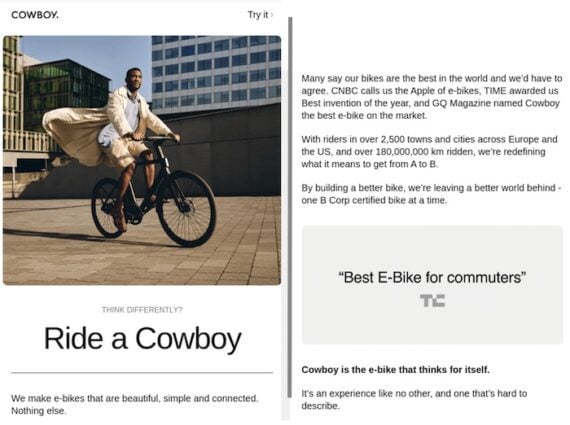
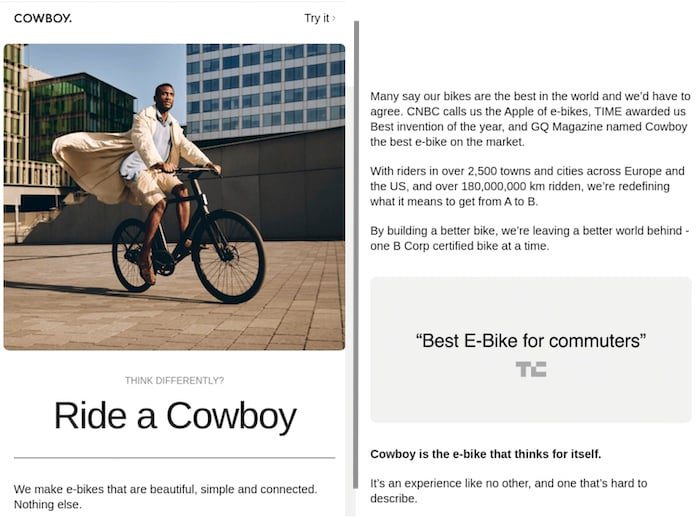
Cowboy, an e-bike company, uses a welcome email to build credibility and drive sales. It highlights reviews from CNBC, Time, TechCrunch, and GQ to capture interest. The email confirms the brand’s longevity and popularity by showcasing miles ridden and its presence in multiple cities. Plus, it sets expectations — “Over the next few days, we’ll unpack what makes a Cowboy so special” — to engage subscribers from the start.

Cowboy’s welcome email builds credibility and drives sales. Shown here is a partial screen capture.

Long-Term Relationship

A compelling welcome email starts a long-term relationship, much more than a single transaction. Make clear to subscribers why staying engaged is valuable.

  • Encourage a low-commitment action such as taking a quiz, following on social, or providing a preference.
  • Tease what’s ahead, such as “Stay tuned for exclusive behind-the-scenes content + first dibs on limited drops!”
  • Offer multiple engagement paths (“Not ready to shop? Check out our blog for expert tips.”)

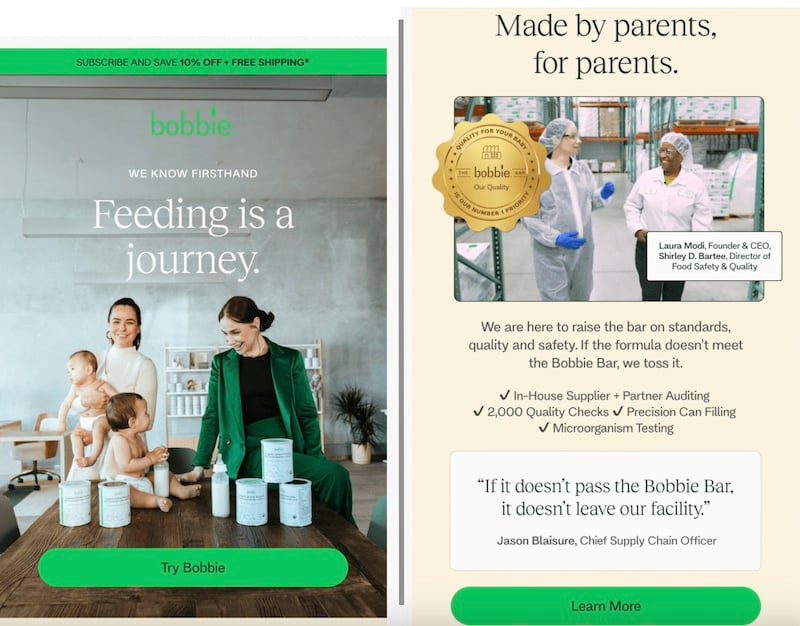
Bobbi, an organic infant formula brand, uses storytelling and social proof to build trust with new moms. The email’s opening sentence — “We know firsthand” — signals that Organic’s founders are also mothers. Multiple calls to action provide engagement options for subscribers to interact at their choosing — without purchasing.

Bobbi uses storytelling and social proof to build trust with new moms in this partial example.

Keep the momentum going with an entire welcome flow, typically three to five emails, such as:

  • First: Welcome, expectations, and a soft CTA.
  • Second: Highlight product benefits, customer favorites, key differentiators.
  • Third: Address objections or FAQs to ease decision-making.
  • Fourth: Introduce community, content, and additional perks.

Conversion CTAs

The calls to action of many welcome emails default to “Shop now” or “Learn more.” Go beyond cliche to increase engagement and revenue.

  • For high-consideration products: “See how it works” (leading to an explainer video) likely converts better than a direct pitch.
  • For brands with strong UGC: “See how customers use [product]” can drive engagement with tagged social posts or case studies.
  • For loyalty: “Unlock your first perk” can introduce a rewards program.

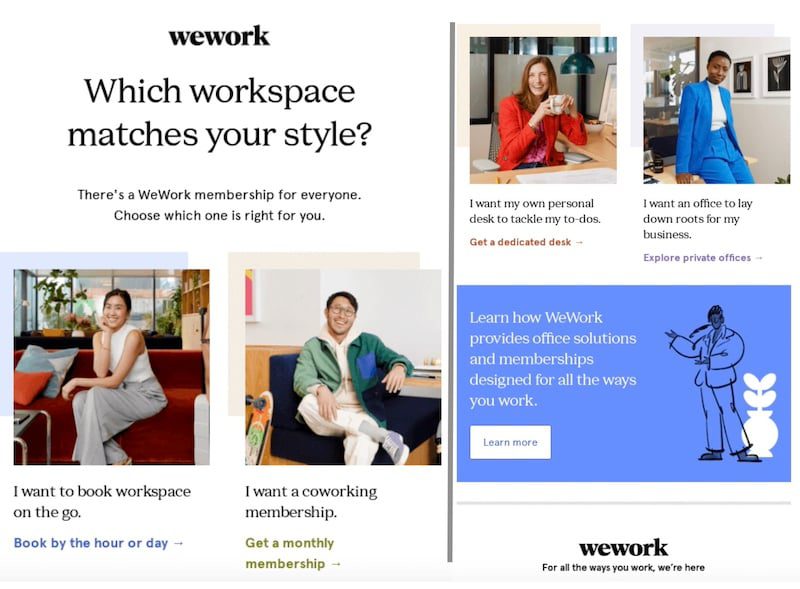
WeWork, the coworking space provider, gets to the point by addressing new customers’ concerns about finding the right work setting. The email keeps it simple, with a clear layout and CTAs that guide users to the best options for their needs.

A visually engaging email from WeWork that highlights different workspace solutions tailored for users. The options include booking workspaces by the hour or day, getting a monthly coworking membership, securing a dedicated desk, or exploring private office options. It emphasizes WeWork’s flexibility in providing office solutions to suit various work styles.

WeWork’s welcome email is simple, with a clear layout and CTAs that guide users. Shown here is a partial screen capture.

KPIs

How do you know if your email sequence is working? Open and click rates are common (but unreliable). Other metrics include:

  • Sales conversion rate.
  • Subscriber retention after 60 days (beyond the welcome sequence).
  • Revenue per subscriber.

In short, welcome emails that align with core strategies, foster long-term relationships, and encourage conversions become revenue drivers, not formalities.

Charts: Global Consumer Views on Tariffs

The Boston Consulting Group provides strategy and advisory services to enterprises worldwide. The firm’s occasional “Consumer Radar Survey” queries global shoppers to study their behaviors, preferences, and sentiments.

In February 2025, BCG surveyed 7,285 consumers in the U.S., the U.K., Germany, France, Japan, China, India, and Brazil, soliciting their views on tariffs.

Most surveyed consumers anticipate that tariffs will negatively impact them.

According to the survey, a minority of consumers think their country will benefit from tariffs.

In addition, consumers who support tariffs generally have a negative financial outlook.

Moreover, no age-group majority supports tariffs. Millennials are the top supporters at 40% of respondents.

YouTube Unveils New AI-Powered Hook Generator via @sejournal, @MattGSouthern

YouTube has announced three new features in its ‘Inspiration’ suite for creators. These tools use AI to generate fresh ideas that can help keep viewers watching.

The new hook generator is the most eye-catching tool, which offers suggestions for engaging video openings.

Below, I’ll break down the new features and explain how they can improve video performance.

YouTube’s New AI Hook Generator

Video hooks are the first moments in a video that grab the viewer’s attention. With shorter attention spans and more online competition, strong hooks are essential.

YouTube’s new AI tool provides three hook suggestions that can help creators capture their audience quickly.

1. Statement Hook

This hook uses a strong statement to address a common problem. For example, a statement might say, “Stop letting creative block control you. I’ll show you how to beat it for good in this video. Let’s get started.”

2. Visual Hook

The visual hook guides creators to use striking imagery. One suggestion starts with an extreme close-up of a blinking cursor, then zooms out to reveal a messy desk and a frustrated face, ending with a bold brushstroke on a canvas.

3. Action Hook

This hook is all about movement.

YouTube’s example suggests using a hand crumpling paper and repeatedly tossing it in the trash, then quickly changing to a fresh start as the hand picks up a new sheet and begins to draw.

See an example of the interface below:

Screenshot from: YouTube.com/CreatorInsider, March 2025.

Additional Inspiration Features

While hooks are the main highlight, YouTube has introduced two other tools.

Brainstorm from Anywhere

YouTube notes that creators often get new ideas while checking performance data or reading audience comments. This tool uses data from past videos to suggest new content ideas, making brainstorming easier as you work.

Quick Saves

The quick saves feature lets creators save ideas directly from the brainstorming list. This helps you capture inspiration when it strikes without breaking your creative flow.

See each of these tools in action in the video below:

Availability

These new updates are part of YouTube’s growing Inspiration Tab in YouTube Studio. The tab now helps creators with hooks, video outlines, titles, and thumbnails.

The full Inspiration suite is available on desktop for most creators worldwide. However, due to local regulations, it’s not yet available in the European Union, United Kingdom, or Switzerland.

Implications for Content Strategy

YouTube does warn that “AI-generated content may be inaccurate or inappropriate, vary in quality, or provide information that doesn’t reflect YouTube’s views.”

Even so, these tools provide a helpful base for creators to build on and refine.

As online competition grows, these AI-powered features come at the right time. They offer a practical way to engage viewers better and optimize video performance.


Featured Image: Best Smile Studio/Shutterstock

Google’s Martin Splitt: JavaScript-Loaded Images Can Be Indexed via @sejournal, @MattGSouthern

Google’s Developer Advocate Martin Splitt recently debunked a common SEO myth. He confirmed that images loaded with JavaScript can be indexed by Google when set up correctly.

Splitt shared these insights during the SEO for Paws Conference, a live-streamed fundraiser by Anton Shulke.

Here’s how to avoid common image indexing issues when loading images with JavaScript.

JavaScript Image Loading Isn’t the Problem

When asked about images loaded by JavaScript, Splitt clarified that the method is not to blame for indexing issues.

Splitt explains:

“JavaScript to load images is fine. A purely JavaScript image loading solution can absolutely get your images indexed.”

This comment clears up worries among many SEO pros. Images may not appear in Google Images for reasons other than using JavaScript.

The Real Culprits Behind Unindexed Images

Splitt explained that something else is usually wrong if JavaScript-loaded images don’t appear in search results.

He pointed to a few common issues:

  • Sitemap Problems: Sometimes, key images are missing from XML sitemaps.
  • HTTP Headers: Some image files may have headers that stop them from being indexed.
  • Rendered HTML Issues: If images don’t appear in the rendered HTML (the version Google sees after JavaScript runs), they won’t get indexed.

Debugging JavaScript Image Indexing Issues

Splitt offers a simple process to spot problems. Start by checking if images appear in the rendered HTML using tools like Search Console’s URL Inspection tool.

Splitt explains:

“You would have to check: is the rendered HTML containing the images? If it is, fantastic. If it’s not, then something else is off.”

Since Google indexes the rendered HTML, any image missing from it won’t be found by Googlebot.

See Splitt’s full talk on JavaScript SEO in the video below:

Common JavaScript Image Loading Techniques & Their SEO Impact

There are several ways to load images with JavaScript. Some common methods include:

  • Lazy Loading: Loads images only when needed.
  • Progressive Loading: Shows a low-quality image first, then upgrades to a high-quality one.
  • Infinite Scroll Loading: Loads images as users continue to scroll.
  • Background Image Insertion: Adds images through CSS backgrounds.

If they are set up properly, all these methods can work with Google’s indexing. Each may need its own checks to ensure everything is working as expected.

Best Practices for SEO-Friendly JavaScript Image Loading

Even though JavaScript-loaded images can be indexed, following these best practices can help avoid issues:

  • Verify with the URL Inspection Tool: Ensure images appear in the rendered HTML.
  • Update Your XML Sitemaps: Include key images with proper tags.
  • Use Alt Text: Provide clear alt text for images loaded via JavaScript.
  • Use Native Lazy Loading: Add the loading="lazy" attribute where it makes sense.
  • Check Robots.txt: Ensure you are not blocking JavaScript resources that load images.

What This Means for SEO Professionals

Instead of avoiding JavaScript, verify that images are loaded correctly and appear in the rendered HTML.

As websites rely more on JavaScript, understanding these details is key. SEO professionals who learn to troubleshoot and optimize JavaScript-based image loading will be better prepared to support their clients’ visibility in search results.

Looking Ahead

This clarification is timely. Many modern sites built with frameworks like React, Vue, or Angular load images using JavaScript instead of traditional tags.

Splitt’s insights help dispel the myth that JavaScript harms image indexing. Developers can now focus on performance without worrying about SEO penalties.


Featured Image: Alicia97/Shutterstock

An AI-Powered Workflow To Solve Content Cannibalization via @sejournal, @Kevin_Indig

Your site likely suffers from at least some content cannibalization, and you might not even realize it.

Cannibalization hurts organic traffic and revenue: The impact can stretch from key pages not ranking to algorithm issues due to low domain quality.

However, cannibalization is tricky to detect, can change over time, and exists on a spectrum.

It’s the “microplastics of SEO.”

In this Memo, I’ll show you:

  1. How to identify and fix content cannibalization reliably.
  2. How to automate content cannibalization detection.
  3. An automated workflow you can try out right now: The Cannibalization Detector, my new keyword cannibalization tool.

I could have never done this without Nicole Guercia from AirOps. I’ve designed the concept and stress-tested the automated workflow, but Nicole built the whole thing.

How To Think About Content Cannibalization The Right Way

Before jumping into the workflow, we must clarify a few guiding principles about content cannibalization that are often misunderstood.

The biggest misconception about cannibalization is that it happens on the keyword level.

It’s actually happening on the user intent level.

We all need to stop thinking about this concept as keyword cannibalization and instead as content cannibalization based on user intent.

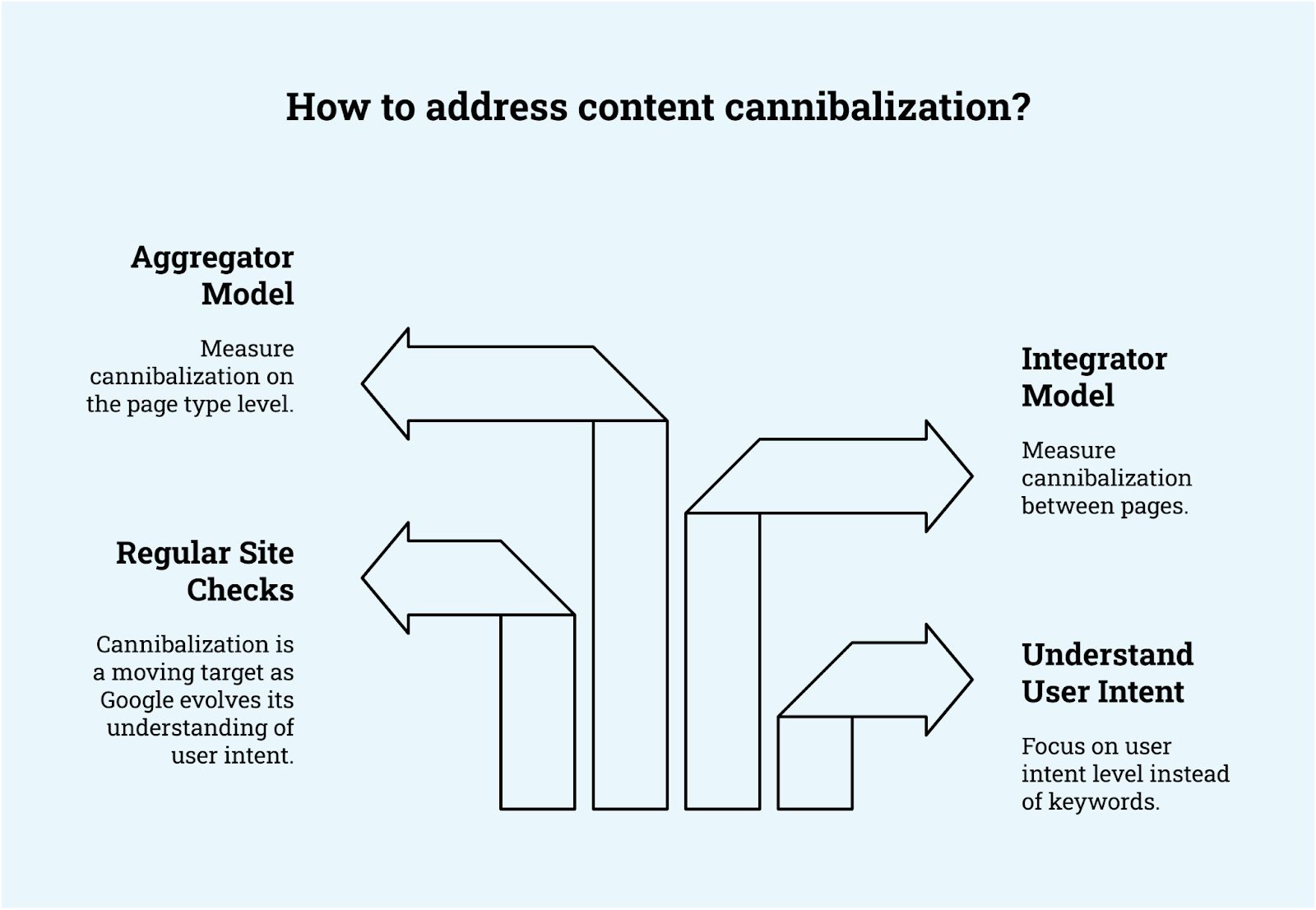
With this in mind, cannibalization…

  • Is a moving target: When Google updates its understanding of intent during a core update, suddenly two pages can compete with each other that previously didn’t.
  • Exists on a spectrum: A page can compete with another page or several pages, with an intent overlap from 10% to 100%. It’s hard to say exactly how much overlap is fine without looking at outcomes and context.
  • Doesn’t stop at rankings: Looking for two pages that are getting a “substantial” amount of impressions or rankings for the same keyword(s) can help you spot cannibalization, but it is not a very accurate method. It’s not enough proof.
  • Needs regular check-ups: You need to check your site for cannibalization regularly and treat your content library as a “living” ecosystem.
  • Can be sneaky: Many cases are not clear-cut. For example, international content cannibalization is not obvious. A /en directory to address all English-speaking countries can compete with a /en-us directory for the U.S. market.
Image Credit: Kevin Indig

Different types of sites have fundamentally different weaknesses for cannibalization.

My model for site types is the integrator vs. aggregator model. Online retailers and other marketplaces face fundamentally different cases of cannibalization than SaaS or D2C companies.

Integrators cannibalize between pages. Aggregators cannibalize between page types.

  • With aggregators, cannibalization often happens when two page types are too similar. For example, you can have two page types that could or could not compete with each other: “points of interest in {city}” and “things to do in {city}”.
  • With integrators, cannibalization often happens when companies publish new content without maintenance and a plan for the existing content. A big part of the issue is that it becomes harder to keep an overview of what you have and what keywords/intent it targets at a certain number of articles (I found the linchpin to be around 250 articles).

How To Spot Content Cannibalization

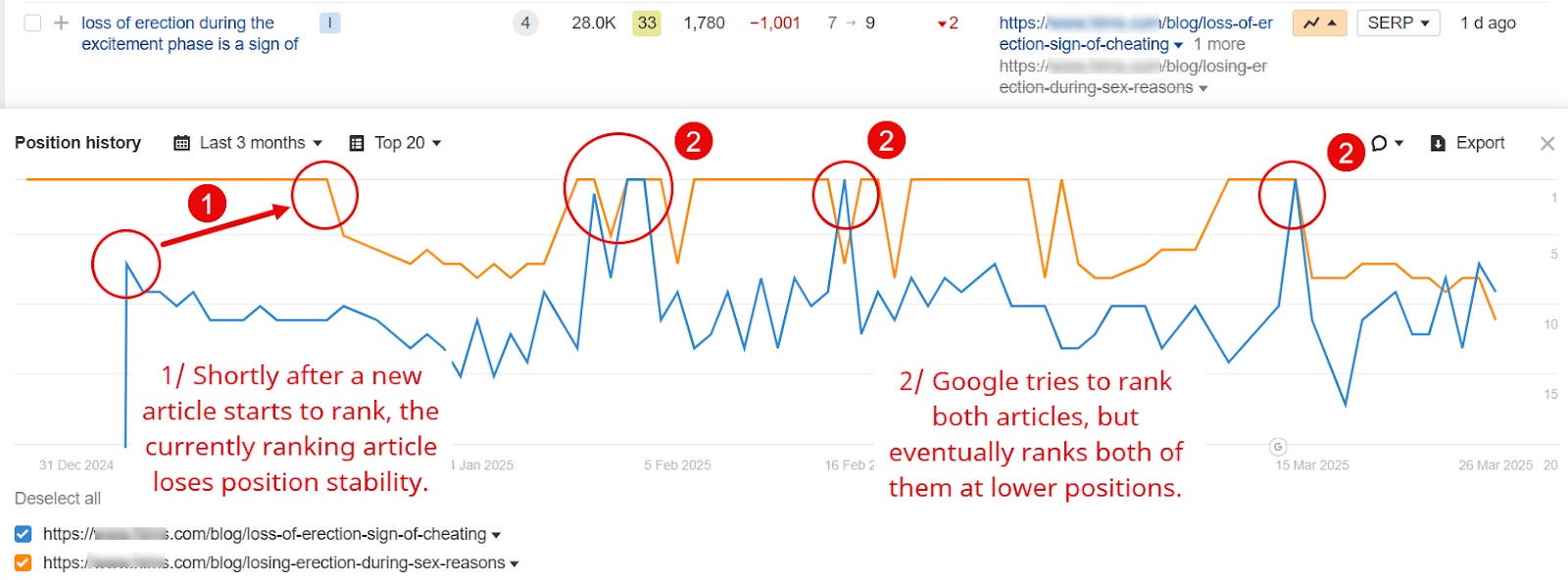
An example of content cannibalization (Image Credit: Kevin Indig)

Content cannibalization can have one or more of the following symptoms:

  • “URL flickering”: meaning at least two URLs alternate in ranking for one or more keywords.
  • A page loses traffic and/or ranking positions after another one goes live.
  • A new page hits a ranking plateau for its main keyword and cannot break into the top 3 positions.
  • Google doesn’t index a new page or pages within the same page type.
  • Exact duplicate titles appear in Google’s search index.
  • Google reports “crawled, not indexed” or “discovered, not indexed” for URLs that don’t have thin content or technical issues.

Since Google doesn’t give us a clear signal for cannibalization, the best way to measure similarity between two or more pages is cosine similarity between their tokenized embeddings (I know, it’s a mouthful).

But this is what it means: Basically, you compare how similar two pages are by turning their text into numbers and seeing how closely those numbers point in the same direction.

Think about it like a chocolate cookie recipe:

  • Tokenization = Break down each recipe (e.g., page content) into ingredients: flour, sugar, chocolate chips, etc.
  • Embeddings = Convert each ingredient into numbers, like how much of each ingredient is used and how important each one is to the recipe’s identity.
  • Cosine Similarity = Compare the recipes mathematically. This gives you a number between 0 and 1. A score of 1 means the recipes are identical, while 0 means they’re completely different.

Follow this process to scan your site and find cannibalization candidates:

  • Crawl: Scrape your site with a tool like Screaming Frog (optionally, exclude pages that have no SEO purpose) to extract the URL and meta title of each page
  • Tokenization: Turn words in both the URL and title into pieces of words that are easier to work with. These are your tokens.
  • Embeddings: Turn the tokens into numbers to do “word math.”
  • Similarity: Calculate the cosine similarity between all URLs and meta titles

Ideally, this gives you a shortlist of URLs and titles that are too similar.

In the next step, you can apply the following process to make sure they truly cannibalize each other:

  • Extract content: Clearly isolate the main content (exclude navigation, footer, ads, etc.). Maybe clean up certain elements, like stop words.
  • Chunking or tokenization: Either split content into meaningful chunks (sentences or paragraphs) or tokenize directly. I prefer the latter.
  • Embeddings: Embed the tokens.
  • Entities: Extract named entities from the tokens and weigh them higher in embeddings. In essence, you check which embeddings are “known things” and give them more power in your analysis.
  • Aggregation of embeddings: Aggregate token/chunk embeddings with a weighted averaging (eg, TF-IDF) or attention-weighted pooling.
  • Cosine similarity: Calculate cosine similarity between resulting embeddings.

You can use my app script if you’d like to try it out in Google Sheets (but I have a better alternative for you in a moment).

About cosine similarity: It’s not perfect, but good enough.

Yes, you can fine-tune embedding models for specific topics.

And yes, you can use advanced embedding models like sentence transformers on top, but this simplified process is usually sufficient. No need to make an astrophysics project out of it.

How To Fix Cannibalization

Once you’ve identified cannibalization, you should take action.

But don’t forget to adjust your long-term approach to content creation and governance. If you don’t, all this work to find and fix cannibalization is going to be a waste.

Solving Cannibalization In The Short Term

The short-term action you should take depends on the degree of cannibalization and how quickly you can act.

“Degree” means how similar the content across two or more pages is, expressed in cosine or content similarity.

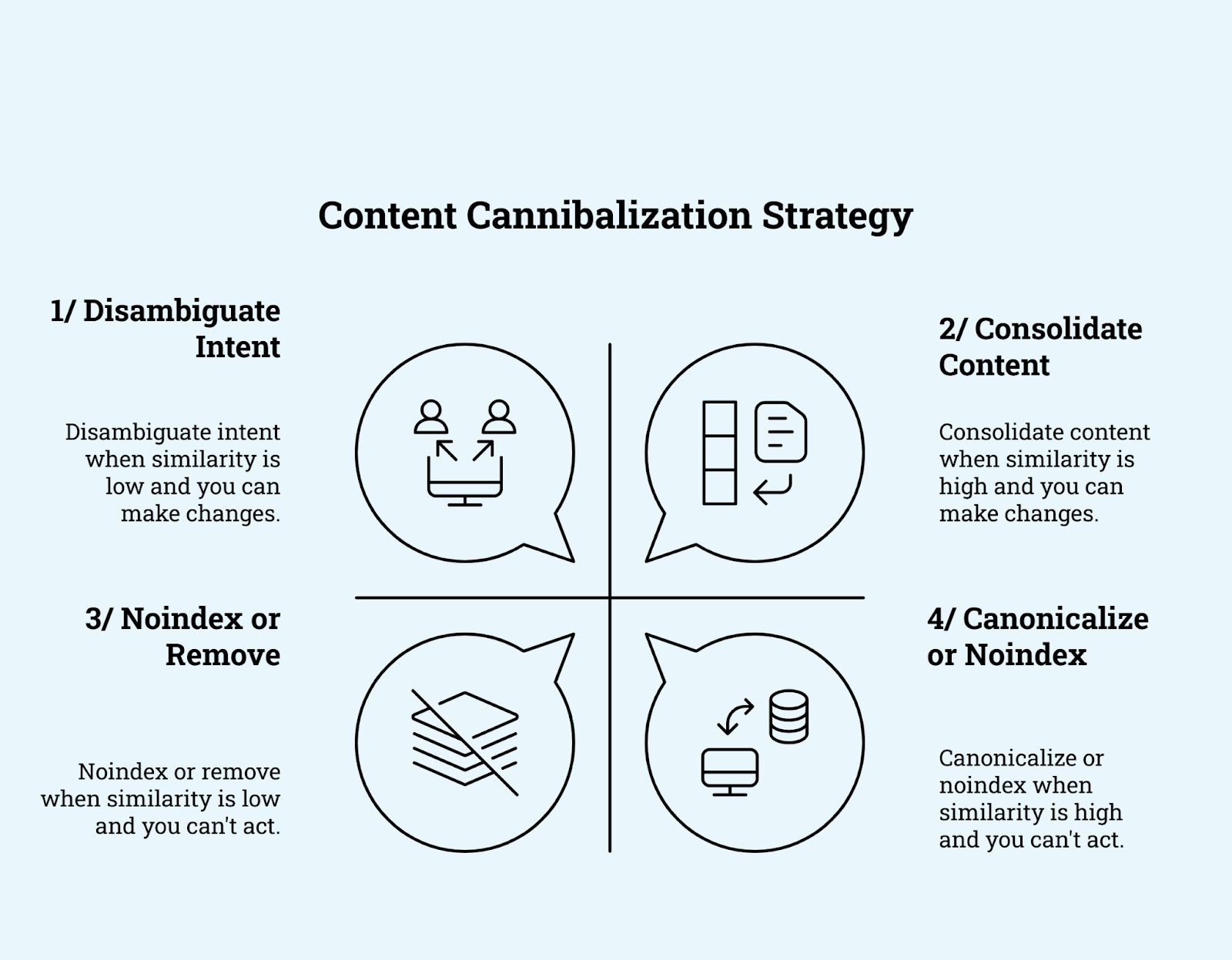
Though not an exact science, in my experience, a cosine similarity higher than 0.7 is classified as “high”, while it’s “low” below a value of 0.5.

4 ways to fix cannibalization (Image Credit: Kevin Indig)

What to do if the pages have a high degree of similarity:

  • Canonicalize or noindex the page when cannibalization happens due to technical issues like parameter URLs, or if the cannibalizing page is irrelevant for SEO, like paid landing pages. In this case, canonicalize the parameter URL to the non-parameter URL (or noindex the paid landing page).
  • Consolidate with another page when it’s not a technical issue. Consolidation means combining the content and redirecting the URLs. I suggest taking the older page and/or the worse-performing page and redirecting to a new, better page. Then, transfer any useful content to the new variant.

What to do if the pages have a low degree of similarity:

  • Noindex or remove (status code: 410) when you don’t have the capacity or ability to make content changes.
  • Disambiguate the intent focus of the content if you have the capacity, and if the overlap is not too strong. In essence, you want to differentiate the parts of the pages that are too similar.

Solving Cannibalization In The Long Term

It’s critical to take long-term action to adjust your strategy or production process because content cannibalization is a symptom of a bigger issue, not a root cause.

(Unless we’re talking about Google changing its understanding of intent during a core algorithm update, and that has nothing to do with you or your team.)

The most critical long-term changes you need to make are:

  1. Create a content roadmap: SEO Integrators should maintain a living spreadsheet or database with all SEO-relevant URLs and their main target keywords and intent to tighten editorial oversight. Whoever is in charge of the content roadmap needs to ensure there is no overlap between articles and other page types. Writers need to have a clear target intent for new and existing content.
  2. Develop clear site architecture: The pendant of a content map for SEO Aggregators is a site architecture map, which is simply an overview of different page types and the intent they target. It’s critical to underline the intent as you define it with example keywords that you verify on a regular basis (”Are we still ranking well for those keywords?”) to match it against Google’s understanding and competitors.

The last question is: “How do I know when content cannibalization is fixed?”

The answer is when the symptoms mentioned in the previous chapter go away:

  • Indexing issues resolve.
  • URL flickering goes away.
  • No duplicate titles appear in Google’s search index.
  • “Crawled, not indexed” or “discovered, not indexed” issues decrease.
  • Rankings stabilize and break through a plateau (if the page has no other apparent issues).

And, after working with my clients under this manual framework for years, I decided it’s time to automate it.

Introducing: A Fully Automated Cannibalization Detector

Together with Nicole, I used AirOps to build a fully automated AI workflow that goes through 37 steps to detect cannibalization within minutes.

It performs a thorough analysis of content cannibalization by examining keyword rankings, content similarity, and historical data.

Below, I’ll break down the most important steps that it automates on your behalf:

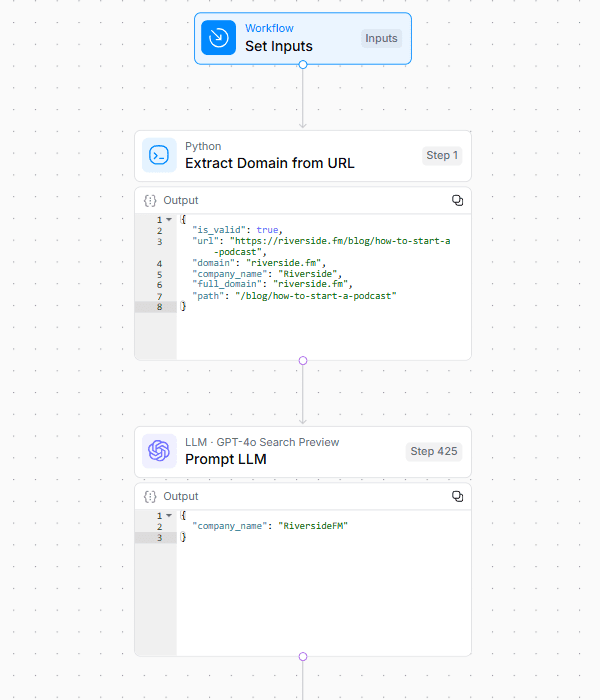
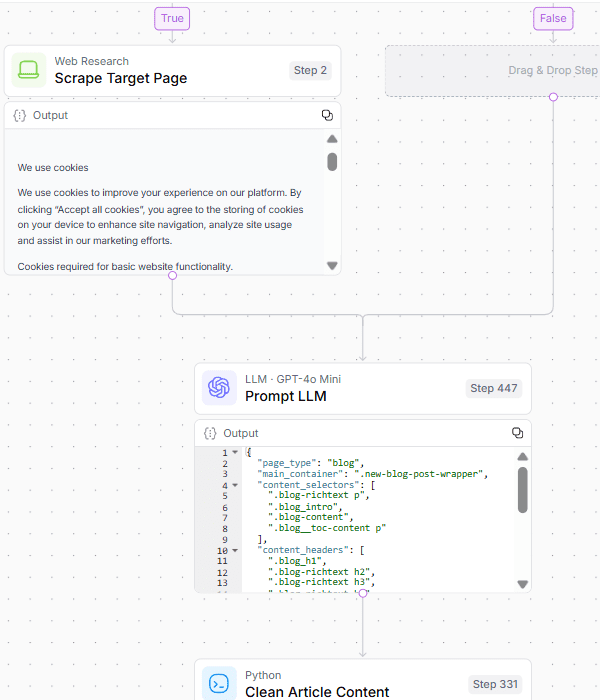
1. Initial URL Processing

The workflow extracts and normalizes the domain and brand name from the input URL.

This foundational step establishes the target website’s identity and creates the baseline for all subsequent analysis.

Image Credit: Kevin Indig

2. Target Content Analysis

To ensure that the system has quality source material to analyze and compare against competitors, Step 2 involves:

  • Scraping the page.
  • Validating and analyzing the HTML structure for main content extraction.
  • Cleaning the article content and generating target embeddings.
Image Credit: Kevin Indig

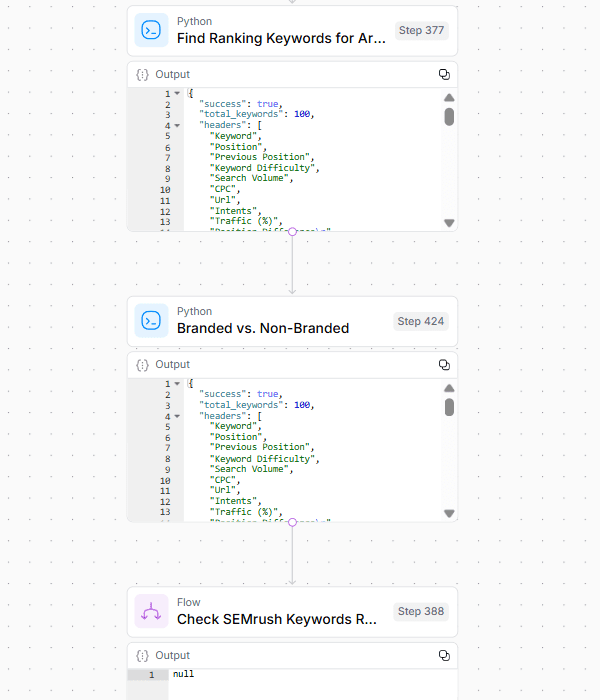
3. Keyword Analysis

Step 3 reveals the target URL’s search visibility and potential vulnerabilities by:

  • Analyzing ranking keywords through Semrush data.
  • Filtering branded versus non-branded terms.
  • Identifying SERP overlap with competing URLs.
  • Conducting historical ranking analysis.
  • Determining page value based on multiple metrics.
  • Analyzing position differential changes over time.
Image Credit: Kevin Indig

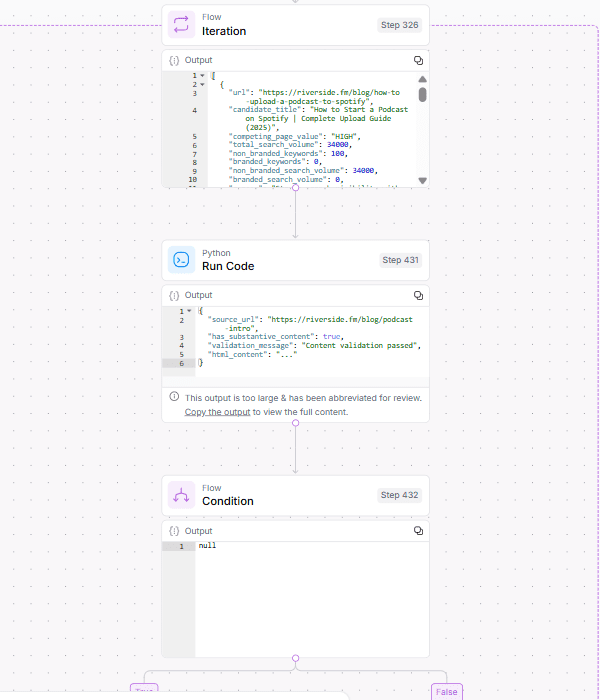
4. Competing Content Analysis (Iteration Over Competing URLs)

Step 4 gathers additional context for cannibalization by iteratively processing each competing URL in the search results through the previous steps.

Image Credit: Kevin Indig

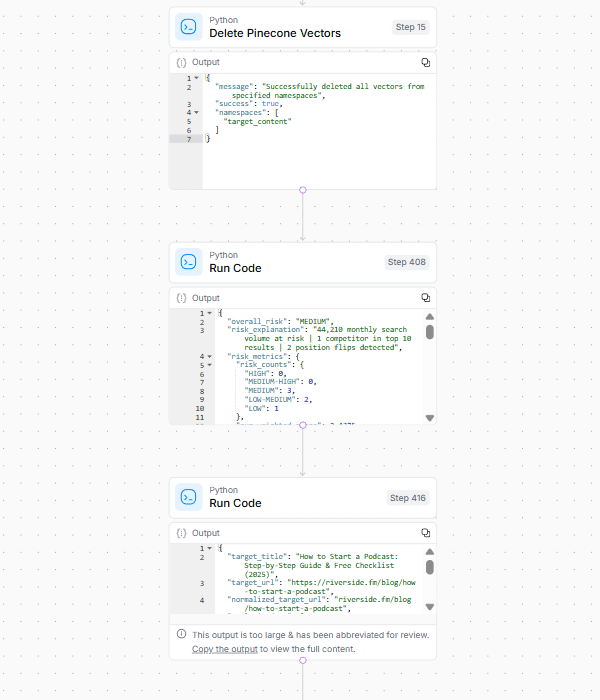
5. Final Report Generation

In the final step, the workflow cleans up the data and generates an actionable report.

Image Credit: Kevin Indig

Try The Automated Content Cannibalization Detector

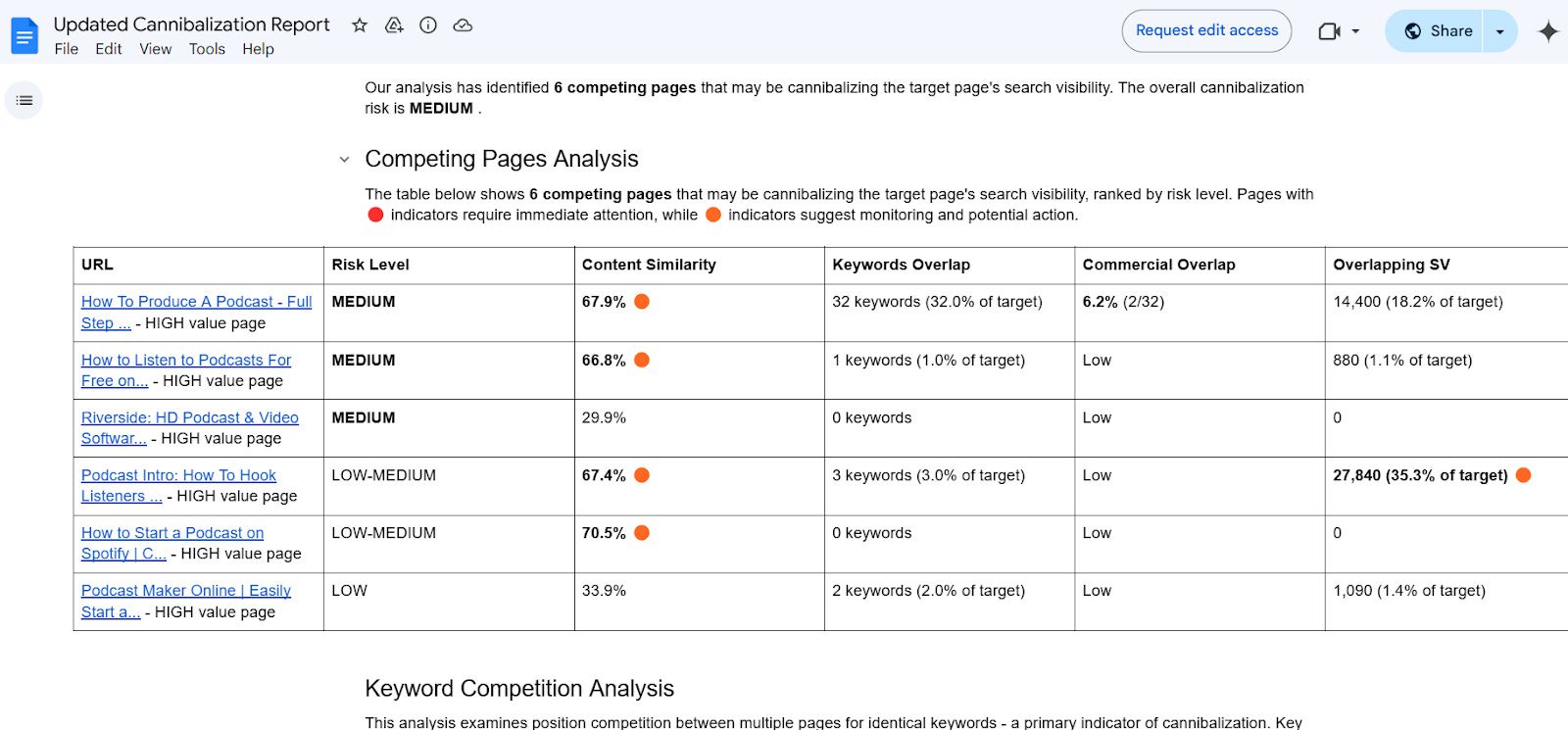
Image Credit: Kevin Indig

Try the Cannibalization Detector and check out an example report.

A few things to note:

  1. This is an early version. We’re planning to optimize and improve it over time.
  2. The workflow can time out due to a high number of requests. We intentionally limit usage so as not to get overwhelmed by API calls (they cost money). We’ll monitor usage and might temporarily raise the limit, which means if your first attempt isn’t successful, try again in a few minutes. It might just be a temporary spike in usage.
  3. I’m an advisor to AirOps but was neither paid nor incentivized in any other way to build this workflow.

Please leave your feedback in the comments.

We’d love to hear how we can take the Cannibalization Detector to the next level!

Boost your skills with Growth Memo’s weekly expert insights. Subscribe for free!


Featured Image: Paulo Bobita/Search Engine Journal