As we run, drive, bike, and fly, we leave behind telltale marks of our movements on Earth—if you know where to look. Physical tracks, thermal signatures, and chemical traces can reveal where we’ve been. But another type of trail we leave comes from the radio signals emitted by the cars, planes, trains, and boats we use.
On airplanes, technology called ADS-B (Automatic Dependent Surveillance–Broadcast) provides real-time location, identification, speed, and orientation data. For ships at sea, that function is performed by the AIS (Automatic Identification System).
Operating at 161.975 and 162.025 megahertz, AIS transmitters broadcast a ship’s identification number, name, call sign, length and beam, type, and antenna location every six minutes. Ship location, position time stamp, and direction are transmitted more frequently. The primary purpose of AIS is maritime safety—it helps prevent collisions, assists in rescues, and provides insight into the impact of ship traffic on marine life. US Coast Guard regulations say that generally, private boats under 65 feet in length are not required to use AIS, but most commercial vessels are. Unlike ADS-B in planes, AIS can be turned off only in rare circumstances.
A variety of sectors use AIS data for many different applications, including monitoring ship traffic to avoid disruption of undersea internet cables, identifying whale strikes, and studying the footprint of underwater noise.
Using the US National Oceanic and Atmospheric Association’s Marine Cadastre tool, you can download 16 years of detailed daily ship movements, as well as “transit count” maps generated from a year’s worth of data showing each ship’s accumulated paths. The data is collected entirely from ground-based stations along the US coasts.
I downloaded all of 2023’s transit count maps and loaded them up in geographic information system software called QGIS to visualize this year of marine traffic.
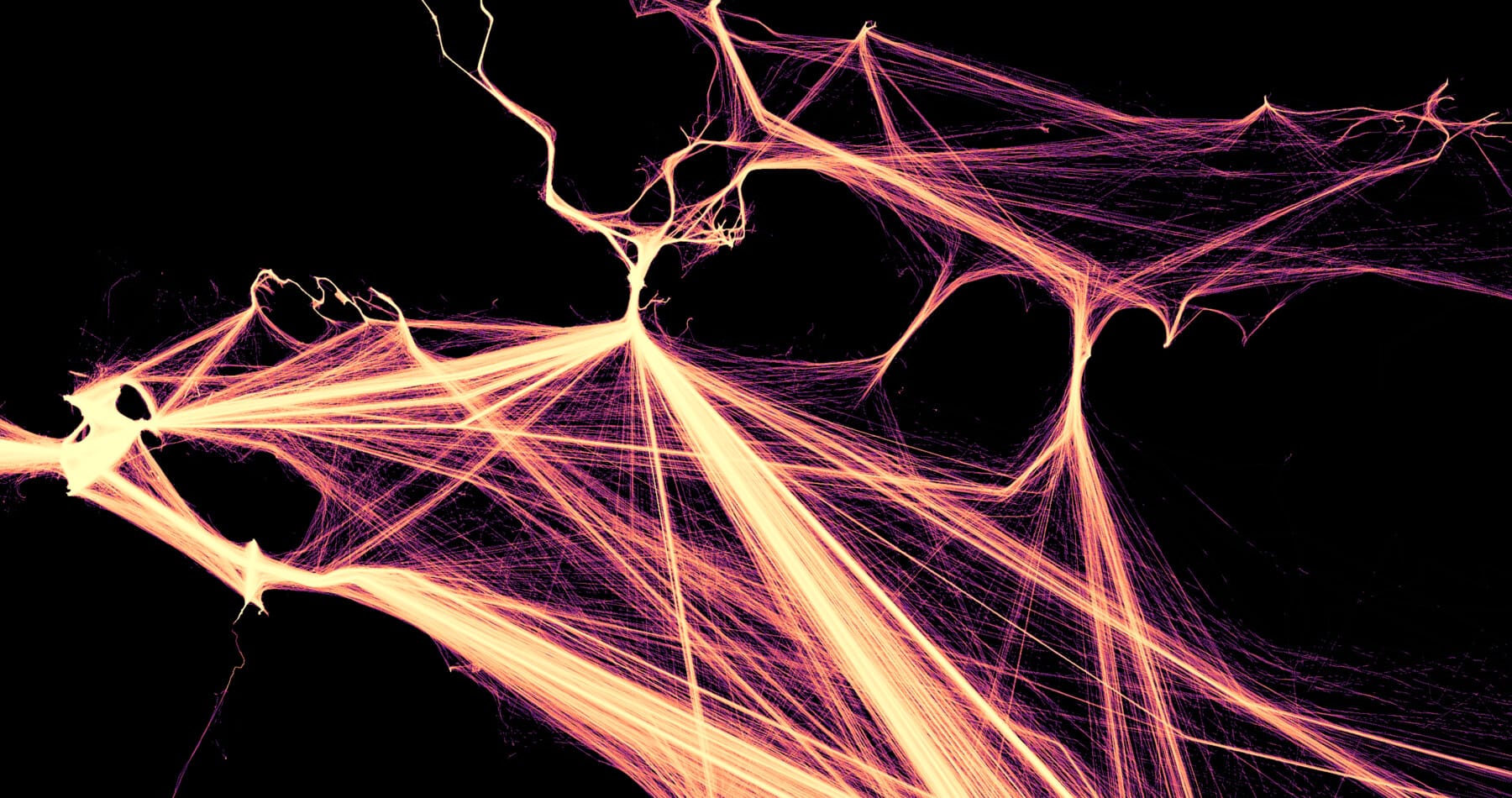
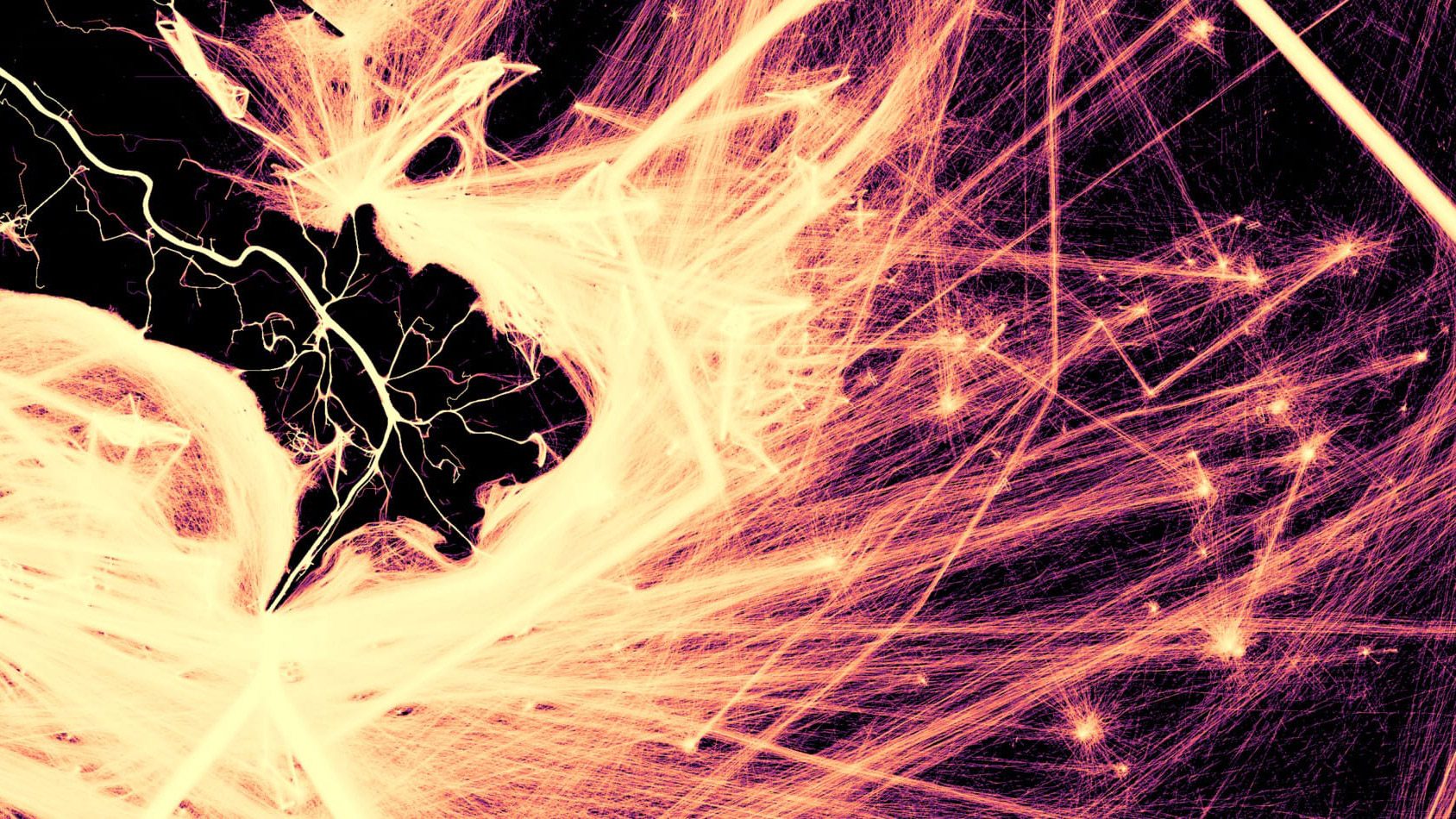
The maps are abstract and electric. With landmasses removed, the ship traces resemble long-exposure photos of sparklers, high-energy particle collisions, or strands of fiber-optic wire.
Victoria, British Columbia, and Seattle.
DATA: NOAA; MAP: JON KEEGAN / BEAUTIFUL PUBLIC DATA
Lake Huron
DATA: NOAA; MAP: JON KEEGAN / BEAUTIFUL PUBLIC DATA
Savannah, Georgia
DATA: NOAA; MAP: JON KEEGAN / BEAUTIFUL PUBLIC DATA
Louisiana
DATA: NOAA; MAP: JON KEEGAN / BEAUTIFUL PUBLIC DATA
Zooming in on these maps, you might see strange geometric patterns of perfect circles, or lines in a grid. Some of these are fishing grounds, others are scientific surveys mapping the seafloor, and others represent boats going to and from offshore oil rigs, especially off Louisiana’s gulf coast.
Hiding in plain sight
Having a global, near-real-time system for tracking the precise movements of all ships at sea sounds like a great innovation—unless you’re trying to keep your ships’ movements and cargoes secret.
In 2023, Bloomberg investigated how Russia evaded sanctions on its oil exports after the invasion of Ukraine by “spoofing”—transmitting fake AIS data—to mislead observers. Tracking a fleet of rusting ships of questionable seaworthiness, reporters compared AIS data with what they actually saw on the sea—and discovered that the ships weren’t where the data said they were.
Monitoring the fishing industry
Clusters of fishing vessels gravitating toward known fishing grounds create some of the most interesting patterns on the maps.
Global Fishing Watch is an international nonprofit that uses AIS to monitor the fishing industry, seeking to protect marine life from overfishing. But it says that only 2% of fishing vessels use AIS transmitters.
The organization, which is backed by Google, the ocean conservation group Oceana, and the satellite imagery company SkyTruth, combines AIS data with satellite imagery and uses machine learning to classify the types of fishing technology being used.
In a press release announcing the creation of Global Fishing Watch, John Amos, the president and founder of SkyTruth, said: “So much of what happens out on the high seas is invisible, and that has been a huge barrier to understanding and showing the world what’s at stake for the ocean.”
A version of this story appeared in Beautiful Public Data (beautifulpublicdata.com), a newsletter that curates visually interesting datasets collected by government agencies.
The worst technologies of 2024. The future of mixed reality. AI’s impact on the climate. These are just a few of the topics we covered this year in MIT Technology Review’s monthly event series, Roundtables.
The series offers a unique opportunity to hear straight from our reporters and editors about what’s next for emerging technologies. Available exclusively for subscribers, these 30-minute online discussions provide insights, analysis, and perspectives on timely topics such as gene editing and smart glasses.
Roundtables is also a chance for subscribers to ask questions about the latest technologies and learn more about their impact directly from our experts and guests. Subscribers can access recordings of past sessions—about EVs in China, climate-friendly food, CRISPR babies, and AI hardware.
MIT Technology Review publishes an annual list of the worst technologies of the year—chronicling flops, failures, and other mishaps. The 2024 list was unveiled in December by executive editor Niall Firth and senior editor for biomedicine Antonio Regalado. They had a lively discussion about each of the eight items on this list—and what we can learn from these fiascos.
This year brought many new developments in one particular consumer device category: smart glasses. After years of development, new augmented-reality specs from several companies made their debut. Editor in chief Mat Honan and AI hardware reporter James O’Donnell talked about where it’s all heading.
The rise of AI comes with a growing carbon footprint and greater demand for electricity. Analysts project that AI could drive up data centers’ energy consumption by 160% this decade. So how worried should we be? Editor at large David Rotman, senior AI reporter Melissa Heikkilä, and senior editor for energy James Temple explored the energy trade-offs involved in AI.
Gene editing can correct or improve the DNA of human embryos, potentially opening the door to the “technological evolution” of our species. But in 2018, a premature attempt to use the technology this way led to a prison term for He Jiankui, the researcher involved. Editor in chief Mat Honan and senior editor for biomedicine Antonio Regalado had a conversation with He, a biophysicist and the creator of the first gene-edited humans, to revisit this controversial technology and the future of editing in IVF clinics.
Why Thermal Batteries Are So Hot Right Now
Thermal batteries could be a key part of cleaning up heavy industry. Executive editor Amy Nordrum and senior climate reporter Casey Crownhart told us what we can expect next from this emerging technology—which was also voted the 11th breakthrough technology of 2024 by our readers.
Another year is coming to a close, so let’s look back at the MIT Technology Review stories that resonated most with you, our readers.
We published hundreds of stories in 2024, about AI, climate tech, biotech, robotics, space, and more. There were six new issues of our magazine, on themes including food, play, and hidden worlds. We launched two newsletters, to share tech industry analysis from our editor in chief and to step people through the basics of AI. And we hosted 11 exclusive conversations with our editors and experts in our subscriber-only event series, Roundtables.
What did people enjoy most? Here’s a quick look at some of the stories that performed best with our audience:
Every year as we compile this annual list, we look for promising technologies poised to have a real impact on the world. It represents the advances that we think matter most, and the 2024 edition included weight-loss drugs, chiplets, and the first gene-editing treatment.
Everyone thinks they know, but no one can agree. Senior editor Will Douglas Heaven explored the problem in this in-depth feature story—and explained why it matters for all of our futures. He covers the origins of modern AI and digs into the ongoing debate among experts about this technology’s capabilities and potential.
There’s no denying AI moves fast, and it can be hard to know what’s worth your attention. That’s why we started plotting everything you need to know about the state of AI in a new matrix, along axes that run from “Hype” to “Real” and “Doom” to “Utopia.”
Major tech companies are now developing AI tools that can do more complex tasks, like sending emails or booking plane tickets, on your behalf. Here’s how they will work.
Solar cells that combine traditional silicon with cutting-edge perovskites could push the efficiency of solar panels to new heights. That’s why we put them on our list of the 10 Breakthrough Technologies of 2024.
As part of our 125th anniversary issue, contributor Kara Platoni spoke with a dozen experts to sketch out how technology might influence the life of someone born today over the next 125 years.
In the 2010s, the field of “electroceuticals” was born, attracting much fanfare and investment. Contributor Sally Adee explored how the field fizzled and how it’s being revived as an effort to turn gene expression on and off with electric fields.
For the second annual edition of this list, our reporters and editors chose 15 companies from around the world that we think have the best shot at making a difference on climate change.
Drugs like Wegovy and Mounjaro have quickly become embedded into American life. In 2024, they even earned a place on our 10 Breakthrough Technologies list. The long-term implications are unknown, but plenty of people are using semaglutides anyway, and many lose around 15% of their body weight.
Don’t miss out on even more emerging technology coverage and subscriber-only stories. Subscribe today for unlimited access to expert insights that you can’t find anywhere else.
This story originally appeared in The Algorithm, our weekly newsletter on AI. To get stories like this in your inbox first, sign up here.
Here’s a question. Imagine that, for $15,000, you could purchase a robot to pitch in with all the mundane tasks in your household. The catch (aside from the price tag) is that for 80% of those tasks, the robot’s AI training isn’t good enough for it to act on its own. Instead, it’s aided by a remote assistant working from the Philippines to help it navigate your home and clear your table or put away groceries. Would you want one?
That’s the question at the center of my story for our magazine, published online today, on whether we will trust humanoid robots enough to welcome them into our most private spaces, particularly if they’re part of an asymmetric labor arrangement in which workers in low-wage countries perform physical tasks for us in our homes through robot interfaces. In the piece, I wrote about one robotics company called Prosper and its massive effort—bringing in former Pixar designers and professional butlers—to design a trustworthy household robot named Alfie. It’s quite a ride. Read the story here.
There’s one larger question that the story raises, though, about just how profound a shift in labor dynamics robotics could bring in the coming years.
For decades, robots have found success on assembly lines and in other somewhat predictable environments. Then, in the last couple of years, robots started being able to learn tasks more quickly thanks to AI, and that has broadened their applications to tasks in more chaotic settings, like picking orders in warehouses. But a growing number of well-funded companies are pushing for an even more monumental shift.
Prosper and others are betting that they don’t have to build a perfect robot that can do everything on its own. Instead, they can build one that’s pretty good, but receives help from remote operators anywhere in the world. If that works well enough, they’re hoping to bring robots into jobs that most of us would have guessed couldn’t be automated: the work of hotel housekeepers, care providers in hospitals, or domestic help. “Almost any indoor physical labor” is on the table, Prosper’s founder and CEO, Shariq Hashme, told me.
Until now, we’ve mostly thought about automation and outsourcing as two separate forces that can affect the labor market. Jobs might be outsourced overseas or lost to automation, but not both. A job that couldn’t be sent offshore and could not yet be fully automated by machines, like cleaning a hotel room, wasn’t going anywhere. Now, advancements in robotics are promising that employers can outsource such a job to low-wage countries without needing the technology to fully automate it.
It’s a tall order, to be clear. Robots, as advanced as they’ve gotten, may find it difficult to move around complex environments like hotels and hospitals, even with assistance. That will take years to change. However, robots will only get more nimble, as will the systems that enable them to be controlled from halfway around the world. Eventually, the bets made by these companies may pay off.
What would that mean? One, the labor movement’s battle with AI—which this year has focused its attention on automation at ports and generative AI’s theft of artists’ work—will have a whole new battle to fight. It won’t just be dock workers, delivery drivers, and actors seeking contracts to protect their jobs from automation—it will be hospitality and domestic workers too, along with many others.
Second, our expectations of privacy would radically shift. People buying those hypothetical household robots would have to be comfortable with the idea that someone that they have never met is seeing their dirty laundry—literally and figuratively.
Some of those changes might happen sooner rather than later. For robots to learn how to navigate places effectively, they need training data, and this year has already seen a race to collect new data sets to help them learn. To achieve their ambitions for teleoperated robots, companies will expand their search for training data to hospitals, workplaces, hotels, and more.
Now read the rest of The Algorithm
Deeper Learning
This is where the data to build AI comes from
AI developers often don’t really know or share much about the sources of the data they are using, and the Data Provenance Initiative, a group of over 50 researchers from both academia and industry, wanted to fix that. They dug into 4,000 public data sets spanning over 600 languages, 67 countries, and three decades to understand what’s feeding today’s top AI models, and how that will affect the rest of us.
Why it matters: AI is being incorporated into everything, and what goes into the AI models determines what comes out. However, the team found that AI’s data practices risk concentrating power overwhelmingly in the hands of a few dominant technology companies, a shift from how AI models were being trained just a decade ago. Over 90% of the data sets that the researchers analyzed came from Europe and North America, and over 70% of data for both speech and image data sets comes from YouTube. This concentration means that AI models are unlikely to “capture all the nuances of humanity and all the ways that we exist,” says Sara Hooker, a researcher involved in the project. Read more from Melissa Heikkilä.
Bits and Bytes
In the shadows of Arizona’s data center boom, thousands live without power
As new research shows that AI’s emissions have soared, Arizona is expanding plans for AI data centers while rejecting plans to finally provide electricity to parts of the Navajo Nation’s land. (Washington Post)
AI is changing how we study bird migration
After decades of frustration, machine-learning tools are unlocking a treasure trove of acoustic data for ecologists. (MIT Technology Review)
OpenAI unveils a more advanced reasoning model in race with Google
The new o3 model, unveiled during a livestreamed event on Friday, spends more time computing an answer before responding to user queries, with the goal of solving more complex multi-step problems. (Bloomberg)
How your car might be making roads safer
Researchers say data from long-haul trucks and General Motors cars is critical for addressing traffic congestion and road safety. Data privacy experts have concerns. (New York Times)
“Ask an Expert” is an occasional feature where we pose questions to seasoned ecommerce pros. For this installment, we’ve turned to Arjus Dashi, a longtime ecommerce developer and founder of Frontlevels, an Italy-based agency serving online merchants worldwide.
He addresses the solutions to slow ecommerce checkouts.
Practical Ecommerce: How can merchants diagnose and repair slow ecommerce checkouts?
Arjus Dashi: In ecommerce, faster page loads equate to more revenue. Yet no page is more important than the checkout, the final step that can make or break the sale. Here are the common causes of slow checkouts and my go-to solutions for fixing them.
Arjus Dashi
Common glitches:
Unoptimized code and integrations. Checkout pages involve complex interactions such as real-time inventory checks, fraud detection tools, shipping calculators, and payment gateways. Each adds external API calls. Inefficient or buggy code can seriously slow these connections, frustrating users.
Server overloads. Merchants using standalone hosting companies should stress-test servers for peak traffic levels. For instance, an ecommerce site anticipating 100 concurrent users on Black Friday should ensure its checkout can handle that load and a 20% buffer.
Complicated processes. Lengthy forms, unnecessary fields, mandatory account creation, and excessive confirmation steps can frustrate users. A cluttered experience leads to confusion and abandonment.
Lack of transparency. Unexpected shipping costs or other charges can cause hesitation. Users value honesty. Hidden fees erode trust and result in lost sales.
How to fix:
Refactor code and dependencies. Use Chrome’s or Mozilla’s inspection tools to analyze checkout performance. Go to the checkout page and open the inspection tool (Mac: Command + Option + I. Windows/Linux: Control + Shift + C). Then start recording at the “Recorder” tab. Reload the page and stop recording after the load is complete. The timeline provides insights into JavaScript, API calls, CSS, and layout shifts to identify bottlenecks and optimize dependencies for faster loading times.
Monitor performance regularly. Lighthouse, available in the browser inspection tools, analyzes your page’s performance. It highlights slowdowns and provides actionable solutions. One key metric is TTFB (“Time to First Byte”), which measures how quickly the server responds to the initial request. A high TTFB often signals hosting inefficiencies.
Use reliable SaaS platforms. Many reputable SaaS ecommerce platforms have robust, optimized checkouts for high-traffic scenarios. Examples include Shopify, BigCommerce, Wix, and many more.
Simplify the process. Streamline the checkout by eliminating unnecessary steps. Consider (i) offering guest checkout to avoid mandatory account creation, (ii) removing optional fields, and (iii) displaying a progress bar to help users track their steps.
Disclose all costs. Disclose shipping costs and fees upfront. It builds trust and reduces hesitation during checkout.
It’s Christmas Eve, excitement fills the air as children around the world eagerly await Santa Claus’s arrival.
The waiting is over and the inevitable questions start:
“Where is Santa?”
“Do you think he’s in our neighborhood yet?”
This year, the original Santa tracker from NORAD will help you to track Santa’s whereabouts as he starts his night shift at the International Date Line in the Pacific Ocean and heads to New Zealand and Australia.
And Google also continues its tradition with an interactive website and mobile app so users can follow Old Saint Nick’s journey as he delivers presents worldwide until he finishes in South America.
NORAD Santa Tracker: A Holiday Tradition
For over 65 years, the NORAD Santa Tracker has helped families follow Santa’s whereabouts.
The NORAD Santa Tracker began in 1955 when a misprinted phone number in a Sears advertisement directed children to call NORAD’s predecessor, the Continental Air Defense Command (CONAD), instead of Santa.
Colonel Harry Shoup, the director of operations, instructed his staff to give updates on Santa’s location to every child who called.
NORAD continues the tradition to this day.
Screenshot from: noradsanta.org/en/, December 2024.
On Christmas Eve, the live map will display Santa’s current location and next stop.
For a more traditional experience, call the NORAD Tracks Santa hotline at 1-877-HI-NORAD (1-877-446-6723) to speak with a volunteer who will provide you with Santa’s current location.
Follow NORAD’s social media channels for regular daily updates.
This year, NORAD has added an AI chatbot called Radar to help you get the latest updates.
The Evolution of Google’s Santa Tracker
Since it launched in 2004, Google’s Santa Tracker has changed and improved. The team uses this project to try out new technologies and make design updates. Some of these new features, like “View in 3D,” are later added to other Google products and services.
What’s In The 2024 Google Santa Tracker
This year’s collection includes games like Elf Ski and Penguin Dash, alongside creative activities such as Santa’s Canvas and the coding-focused Code Lab.
Young learners can explore global cultures through the Translations activity, while classic favorites like Present Bounce and Snowball Storm deliver pure holiday fun.
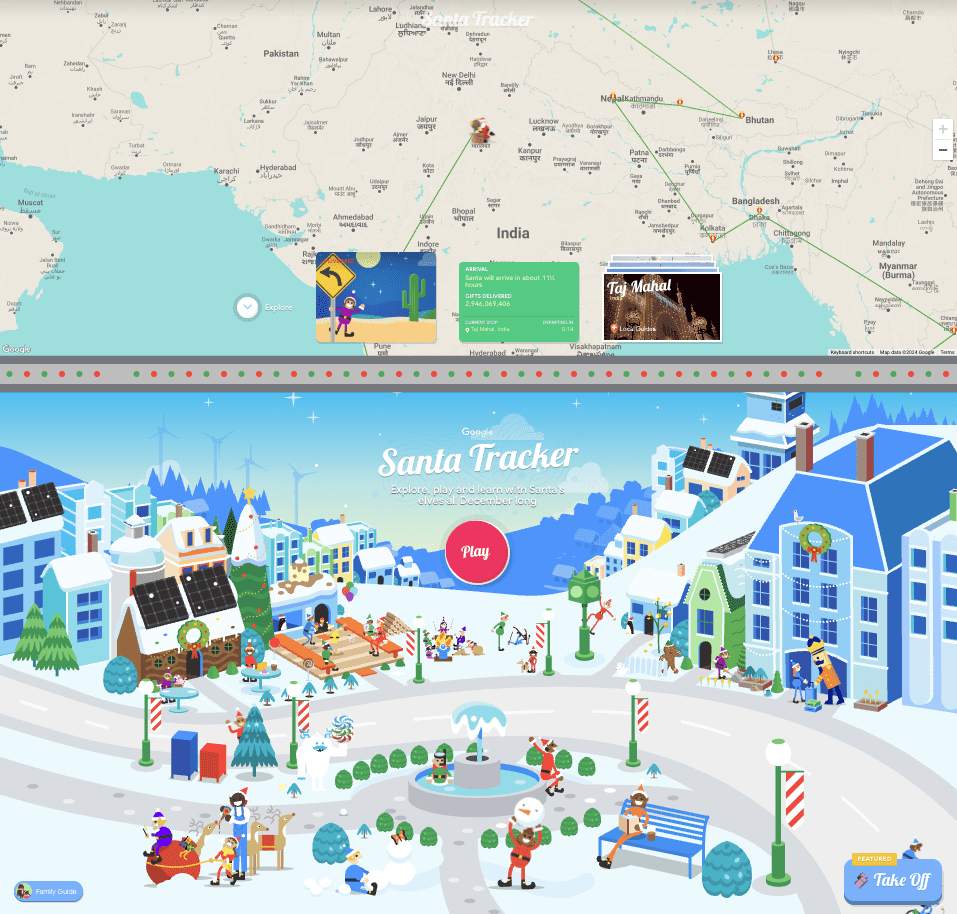
The centerpiece remains the actual Santa tracking feature, which uses a playful mapping interface to “follow” Santa’s journey across the globe.
Complete with arrival times and destination information, it creates an engaging way for families to build anticipation on Christmas Eve.
Screenshot from: santatracker.google.com, December 2024.
How to Use the Google Santa Tracker
Visit the Google Santa Tracker website or download the mobile app for Android devices.
On Christmas Eve, the live map will show Santa’s current location, the number of gifts delivered, and his estimated arrival time at your location.
Explore the map to learn more about the 500+ locations Santa visits, with photos and information provided by Google’s Local Guides.
Extra Features & Activities
Beyond games, the platform showcases detailed animated environments ranging from cozy kitchens where elves prepare holiday treats to snowy outdoor scenes filled with winter activities.
The experience is wrapped in Google’s characteristic bright, cheerful art style, with colorful illustrations that bring North Pole activities to life.
For parents seeking both entertainment and educational value during the holiday season, Google Santa Tracker offers a free, accessible way to channel children’s excitement into engaging activities.
Whether practicing basic coding concepts or learning holiday traditions from around the world, kids can explore while counting down to Christmas.
To All, A Good Night
As you wait for Santa this Christmas Eve, you can choose Google’s interactive features or enjoy the nostalgic feel of NORAD’s tradition.
Happy holidays from all of us at Search Engine Journal!
At the beginning of 2002, there were more than a dozen “search engines,” including crawlers, directories, and paid/PPC/CPC engines.
But by the end of that year, Google had emerged from the pack to become the leading player. (According to Nielsen//NetRatings, Google had a 39% share of 47 million “search hours” in December 2002.1)
I recently called the past 20 years “The Age of the One-Trick Pony.” Back at the beginning of 2003, if you figured out how to improve a website’s visibility in Google’s organic search results, then you could get a well-paying job at an SEO agency.
But, SEO professionals need to prepare for a paradigm shift as that age is about to end.
This means you must invest more time learning innovative marketing disciplines, and demonstrate prudent judgment to manage change.
As we step into the future of search, I can share five strategic insights and five pieces of tactical advice.
Strategic Insights
According to Sun Tzu, an ancient Chinese military strategist, “Tactics without strategy is the noise before defeat.”
And far too many SEOs have spent too little time exploring and evaluating different digital marketing strategies.
So, what can you do to outline a strategy for 2025 and beyond?
1. Embrace AI As A Powerful Tool
You’ve already learned how to use SEO tools that help you improve your company or client’s search engine rankings by analyzing keywords, content, and backlinks.
So, instead of feeling threatened by AI, embrace it as just another tool to add to your toolbox.
Jensen Huang, the founder, president, and CEO of Nvidia, has said, “AI is not going to take your job. The person who uses AI is going to take your job.”
Almost two years later, we’ve learned by comparing the content output generated by ChatGPT, Gemini, and Claude that generative AI tools may be smarter than newbies at times, but not people with more education, expertise, and experience.
On average, ChatGPT-4 scored better than human students in the first- and second-year exams, where the questions were easier.
In their last year at the university, students are expected to provide deeper insights and use more elaborate analytical skills. Generative AI isn’t particularly good at that, which is why third-year human students got better grades than ChatGPT-4.
So, embrace AI as a powerful tool – but one that requires someone with education, expertise, and experience to use it effectively. And whatever you do, don’t become a tool of your tools.
2. Conduct Audience Research
I’ve been using keyword research tools since 2002, but I started using an audience research tool in 2020.
With classic keyword research, you learn how many searches a keyword gets. With an audience research tool, you also learn about the audience that searches for a keyword, uses words in their bio, or visits a website.
This is a game changer – and it’s arriving at the precise moment when SEO pros need to start creating the kind of user, buyer, marketing, and customer personas that can transform SEO, PPC, and content marketing.
To get a seat at the big table, SEO marketers must move beyond optimizing their sites, pages, articles, and content for an undifferentiated group of search engine users.
Why? Because one size does not fit all.
Digital marketers have been targeting ads at segments of people with specific demographics, intents, and interests for decades.
However, SEO professionals seemed satisfied with trying to guess the intent of users based on the words or phrases in their queries.
Who can blame them? Previously, keyword research tools could only tell SEOs “what” people searched for, but not “who” they were.
Now, SEO and content marketers can get surprising insights into the demographics, interests, and information sources that influence their intent.
For example, let’s say that the B2B company or client you work for wants to know who searches for “customer retention”?
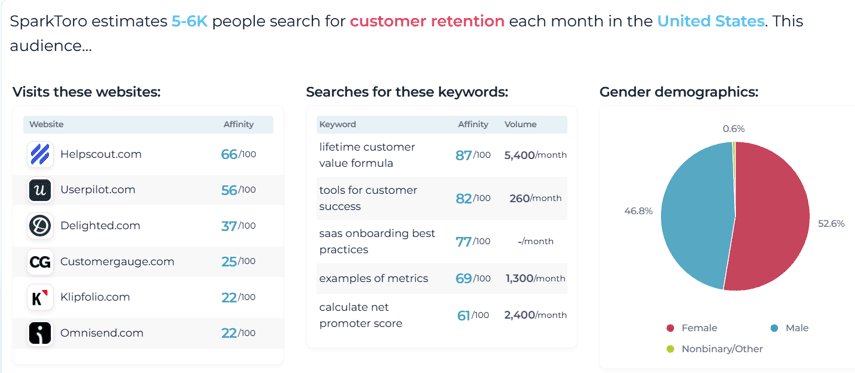
Well, SparkToro tells you that 5,000 to 6,000 people search for “customer retention” each month in the United States.
Screenshot from SparkToro, December 2024
The tool also tells you that 52.6% are female, and 46.8% are male. Surprised?
They also visit websites like HelpScout.com and Userpilot.com, as well as search other keywords like “lifetime customer value formula” and “tools for customer success.”
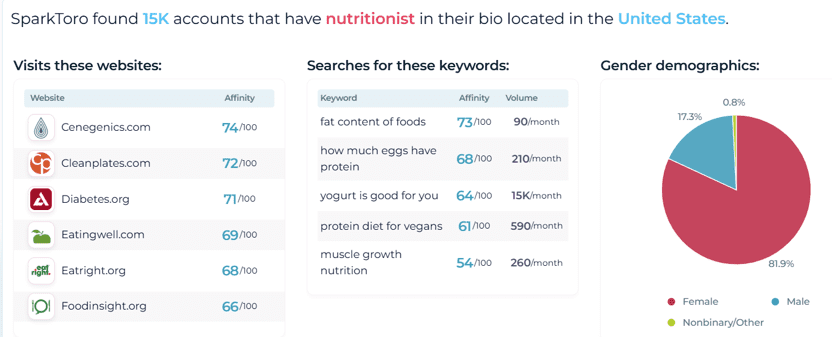
Or, let’s say that the target audience that your B2C company or client wants to reach is a “nutritionist.”
Screenshot from SparkToro, December 2024
The tool tells you that 15,000 people have “nutritionist” in their social media bios. The tool also tells you that 81.9% are female, and 174.3% are male.
They also visit websites like Cenegenics.com and CleanPlates.com. And they’re searching for keywords like “fat content of foods” and “how much eggs have protein.”
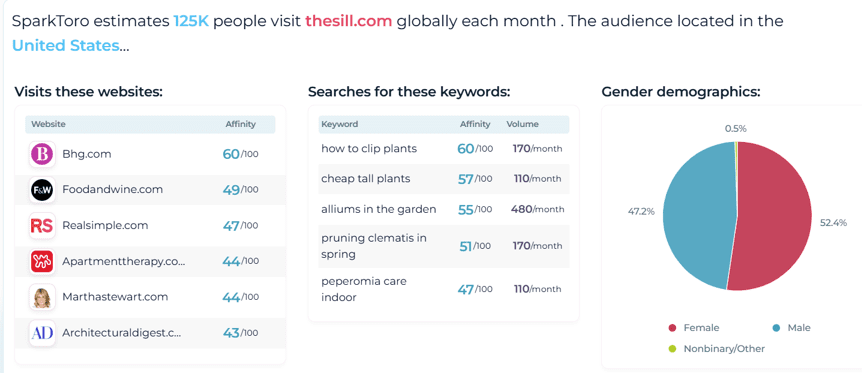
Finally, let’s say you’ve just started doing work for TheSill.com.
You could tell Eliza that 125,000 people globally visit TheSill.com each month.
Screenshot from SparkToro, December 2024
And the audience located in the United States is 52.4% female, and 47.2% male.
This audience also visits BHG.com and FoodandWine.com, And they search for “how to clip plants” and “cheap tall plants.”
That’s why I think conducting audience research gives you a competitive advantage over keyword research when it comes to crafting more resonant, effective content.
What will you learn from all this background reading? Content is still king.
And while AI may help you crank out content more efficiently, it still doesn’t create the high-quality, original content that readers crave and Google rewards.
However, it’s important to recognize that there are different perspectives on creating high-quality, original content.
Some experts are focused on increasing efficiency (doing things right), while others are focused on improving effectiveness (doing the right things).
Spoiler alert: I’m in the second camp, along with a lot of content marketers. But, a lot of senior executives, especially chief financial officers (CFOs), are in the first camp.
So, SEO marketers won’t be surprised when they read what Stephanie Stahl said: “Creating content that prompts a desired action isn’t easy.”
SEO professionals may feel a surge of empathetic pain when they read that the biggest challenge that 54% of B2B content creation teams face is “lack of resources.”
But, SEO pros may also feel a surge of hope when they read that Stahl also said, “a group of top performers has found a way to surge ahead. They’ve figured out how to understand their audience’s needs, produce high-quality content, and use AI to create more efficient workflows.”
So, how do the most successful content marketers differ from their less successful peers? Well, according to Stahl, top performers are more likely to:
Have the right technology to manage content across the organization.
Have a scalable model for content creation.
Say their scalable model is creating the desired outcomes.
But the factors that B2B top performers say contribute to their content marketing success are:
Understand our audience (82%).
Produce high-quality content (77%).
Possess industry expertise (70%).
Have high-performing team members (69%).
Set goals that align with their organization’s objectives (62%).
Measure and demonstrate content performance effectively (53%).
So, the debate between efficiency and effectiveness isn’t over. You don’t need to pick sides, but you should be aware that executives at your company are probably debating this topic, too.
4. Build Strong Backlinks
I don’t need to tell SEO pros they need to build strong backlinks. I also don’t need to tell you that this is getting harder to do.
Back in 2002, all you needed to do was submit your URL to the Yahoo! Directory and the Open Directory Project (also known as DMOZ). But, both directories have since been shut down, with the Yahoo! Directory closing in 2014 and the Open Directory Project in 2017.
Meanwhile, Google’s Penguin algorithm update, which rolled out from 2012 to 2016, targeted link spam and manipulative link-building practices.
Every SEO I’ve met over the past 20 years knows how to evaluate the usability of webpages.
For any of the new SEO experts that I haven’t met yet, here’s what Google has to say about the usability of webpages:
“Our systems also consider the usability of content. When all things are relatively equal, content that people will find more accessible may perform better.”
Google adds:
“For example, our systems would look at page experience aspects, such as if content is mobile-friendly, so that those on mobile devices can easily view it. Similarly, they look to see if content loads quickly, also important to mobile users.”
Get it? Got it? Good.
Tactical Advice
It’s worth knowing that Sun Tzu also said, “Strategy without tactics is the slowest route to victory.”
This quote reminds me of the scene from the superhero comedy film, Mystery Men (1999), where Mr. Furious says, “If you want to push something down, you have to pull it up. If you want to go left, you have to go right.”
But I must admit that the ancient Chinese military strategist is right. You need tactical advice as well as strategic insights to achieve your professional goals and advance in this field or industry.
1. Stay Updated With Algorithm Changes
In November 2003, Google surprised SEO professionals with its first major algorithm update. It was called the “Florida Update” because it hit the industry like a hurricane.
Since then, SEO pros have monitored Google’s algorithm updates and adjusted their strategies accordingly.
It goes without saying that you need to use digital analytics tools to track and analyze your performance. But it’s well worth reading: Beyond Rankings and Beyond Pageviews.
SEO professionals need to have a seat at the table when digital marketing teams decide which events to turn into “key events” in GA4.
Why? So, we can go beyond tracking which default channel was the source of website traffic and begin measuring which channels are generating leads or driving online sales.
5. Adapt To Emerging Trends
SEO marketers have been doing this for more than two decades. But it won’t hurt you to download the “State of SEO 2025.”
Summary: Adapting To The New Age Of Search
By following these strategic SEO insights and tactical advice, you can position yourself for success in the ever-evolving digital landscape – whether you remain at your current company or need to re-invent yourself at another one.
To close with another quote from Sun Tzu: “In the midst of chaos, there is also opportunity.”
Footnote:
1 Sullivan, D. (2002, March 4-6). Search Engine Strategies 2003 [Conference Handbook (p. 42)]. Hilton Boston Park Plaza, MA, United States.
Dan Huttenlocher, SM ’84, PhD ’88, leads the way up to the eighth floor of Building 45, the recently completed headquarters of the MIT Schwarzman College of Computing. “There’s an amazing view of the Great Dome here,” he says, pointing out a panoramic view of campus and the Boston skyline beyond. The floor features a high-end event space with an outdoor terrace and room for nearly 350 people. But it also serves an additional purpose—luring people into the building, which opened last January. The event space “wasn’t in the original building plan,” says Huttenlocher, Schwarzman’s inaugural dean, “but the point of the building is to be a nexus, bringing people across campus together.”
Launched in 2019–’20, Schwarzman is MIT’s only college, so called because it cuts across the Institute’s five schools in a new effort to integrate advanced computing and artificial intelligence into all areas of study. “We want to do two things: ensure that MIT stays at the forefront of computer science, AI research, and education,” Huttenlocher says, “and infuse the forefront of computing into disciplines across MIT.” He adds that safety and ethical considerations are also critical.
To that end, the college now encompasses multiple existing labs and centers, including the Computer Science and Artificial Intelligence Laboratory (CSAIL), and multiple academic units, including the Department of Electrical Engineering and Computer Science. (EECS—which was reorganized into the overlapping subunits of electrical engineering, computer science, and artificial intelligence and decision-making—is now part of both the college and the School of Engineering.) At the same time, the college has embarked on a plan to hire 50 new faculty members, half of whom will have shared appointments in other departments across all five schools to create a true Institute-wide entity. Those faculty members—two-thirds of whom have already been hired—will conduct research at the boundaries of advanced computing and AI.
“We want to do two things: ensure that MIT stays at the forefront of computer science, AI research, and education and infuse the forefront of computing into disciplines across MIT.”
Dan Huttenlocher
The new faculty members have already begun helping the college respond to an undeniable reality facing many students: They’ve been overwhelmingly drawn to advanced computing tools, yet computer science classes are often too technical for nonmajors who want to apply those tools in other disciplines. And for students in other majors, it can be tricky to fit computer science classes into their schedules.
Meanwhile, the appetite for computer science education is so great that nearly half of MIT’s undergraduates major in EECS, voting with their feet about the importance of computing. Graduate-level classes on deep learning and machine vision are among the largest on campus, with over 500 students each. And a blended major in cognition and computing has almost four times as many enrollees as brain and cognitive sciences.
“We’ve been calling these students ‘computing bilinguals,’” Huttenlocher says, and the college aims to make sure that MIT students, whatever their field, are fluent in the language of computing. “As we change the landscape,” he says, “it’s not about seeing computing as a tool in service of a particular discipline, or a discipline in the service of computing, but asking: How can we bring these things together to forge something new?”
The college has been the hub of this experiment, sponsoring over a dozen new courses that integrate computing with other disciplines, and it provides a variety of spaces that bring people together for conversations about the future of computing at MIT.
More than just a nexus for computing on campus, the college has also positioned itself as a broad-based leader on AI, presenting policy briefs to Congress and the White House about how to manage the pressing ethical and political concerns raised by the rapidly evolving technology.
“Right now, digital technologies are changing every aspect of our lives with breakneck speed,” says Asu Ozdaglar, SM ’98, PhD ’03, EECS department head and Schwarzman’s deputy dean of academics. “The college is MIT’s response to the ongoing digital transformation of our society.”
Huttenlocher, who also holds the title of Henry Ellis Warren (1894) Professor of Electrical Engineering and Computer Science and coauthored the book The Age of AI: And Our Human Future with Henry Kissinger and Eric Schmidt, has long been exploring such issues. He started programming computers back in middle school in Connecticut in the 1970s on an ASR 33 teletype machine, and eventually he studied at the University of Michigan as a double major in cognitive psychology and computer science, exploring speech recognition and visual perception. “AI work back then was relatively disconnected from the physical world,” he says. “Being interested in the perceptual side of things was kind of an outlier for what was going on in AI then.” When he looked at grad schools in the 1980s, only MIT, Carnegie Mellon, and Stanford were doing significant work in AI, he says: “I applied to those three schools and figured if it didn’t work out, I’d get a job.”
It worked out, of course. He headed to Cambridge and gravitated to MIT’s AI Lab in Technology Square, where he first worked on speech recognition and then transitioned into computer vision, at the time still in its infancy. After earning his PhD, he served simultaneously as a computer science professor at Cornell and a researcher at Xerox PARC, flying between New York and the burgeoning Silicon Valley, where he worked on computer vision for the digital transformation of copiers and scanners. “In academia, you have more curiosity-driven research projects, where in the corporate world you have the opportunity to build things people will actually use,” he says. “I’ve spent my career moving back and forth between them.”
Along the way, Huttenlocher gained administrative experience as well. He was a longtime board member and eventual chair of the MacArthur Foundation, and he also helped launch Cornell Tech, the university’s New York City–based graduate school for business, law, and technology, serving as its first dean and vice provost. When Stephen Schwarzman, CEO of the investment firm Blackstone Group, gave $350 million to MIT to establish a college of computing in 2018, he was eager to return to the Institute to lead it. “The fact that MIT was making a bold commitment to become a broad-based leader in the AI-driven age—and that it was cutting across all of its schools—was exciting,” he says.
Schwarzman College took shape through task forces involving more than 100 MIT faculty members. By the fall of 2019 a plan had been nailed down, and Huttenlocher was in place as director with EECS head Ozdaglar named deputy dean of academics. “I never believed that everybody wants to do computer science at MIT,” she says. “Students come in with a lot of passions, and it’s our responsibility to educate these bilinguals, so they are fluent in their own discipline but also able to use these advanced frontiers of computing.”
Ozdaglar’s background is in using machine learning to optimize communications, transportation, and control systems. Recently she has become interested in applying machine-learning algorithms to social media, examining how the choices people make when sharing content affect the information—and misinformation—recommended to them. This work builds on her longstanding interdisciplinary collaborations in the social sciences, including collaborations with her husband, economics professor (and recent Nobel laureate) Daron Acemoglu. “I strongly feel that to really address the important questions in society, these old department or disciplinary silos aren’t adequate anymore,” she says. “The college has enabled me to work much more broadly across MIT and share all that I’ve learned.”
Ozdaglar has been a driving force behind faculty hiring for the college, working with 18 departments to bring on dozens of scholars at the forefront of computing. In some ways, she says, it’s been a challenge to integrate the new hires into existing disciplines. “We have to keep teaching what we’ve been teaching for tens or hundreds of years, so change is hard and slow,” she says. But she has also noticed a palpable excitement about the new tools. Already, the college has brought in more than 30 new faculty members in four broad areas: climate and computing; human and natural intelligence; humanistic and social sciences; and AI for scientific discovery. In each case, they receive an academic home in another department, as well as an appointment, and often lab space, within the college.
Asu Ozdaglar, SM ’98, PhD ’03, Schwarzman’s deputy dean of academics, in the lobby of the new headquarters building.
That commitment to interdisciplinary work has been built into every aspect of the new headquarters. “Most buildings at MIT come across as feeling pretty monolithic,” Huttenlocher says as he leads the way along brightly lit hallways and common spaces with large walls of glass looking out onto Vassar Street. “We wanted to make this feel as open and accessible as possible.” While the Institute’s high-end computing takes place mostly at a massive computing center in Holyoke, about 90 miles away in Western Massachusetts, the building is honeycombed with labs and communal workspaces, all made light and airy with glass and natural blond wood. Along the halls, open doorways offer enticing glimpses of such things as a giant robot hanging from a ceiling amid a tangle of wires.
Lab and office space for faculty research groups working on related problems—who might be from, say, CSAIL and LIDS—is interspersed on the same floor to encourage interaction and collaboration. “It’s great because it builds connections across labs,” Huttenlocher says. “Even the conference room does not belong to either the lab or the college, so people actually have to collaborate to use it.” Another dedicated space is available six months at a time, by application, for special collaborative projects. The first group to use it, last spring, focused on bringing computation to the climate challenge. To make sure undergrads use the building too, there’s a classroom and a 250-seat lecture hall, which now hosts classic Course 6 classes (such as Intro to Machine Learning) as well as new multidiscipline classes. A soaring central lobby lined with comfortable booths and modular furniture is ready-made for study sessions.
For some of the new faculty, working at the college is a welcome change from previous academic experiences in which they often felt caught between disciplines. “The intersection of climate sustainability and AI was nascent when I started my PhD in 2015,” says Sherrie Wang, an assistant professor with a shared appointment in mechanical engineering and the Institute for Data, Systems, and Society, who is principal investigator of the Earth Intelligence Lab. When she hit the job market in 2022, it still wasn’t clear which department she’d be in. Now a part of Schwarzman’s climate cluster, she says her work uses machine learning to analyze satellite data, examining crop distribution and agricultural practices across the world. “It’s great to have a cohort of people who have similar philosophical motivations in applying these tools to real-world problems,” she says. “At the same time, we’re pushing the tools forward as well.”
Among other researchers, she plans to collaborate with Sara Beery, a CSAIL professor who analyzes vast troves of visual, auditory, and other data from a diverse range of sensors around the world to better understand how climate change is affecting distribution of species. “AI can be successful in helping human experts efficiently process terabytes and petabytes of data so they can make informed management decisions in real time rather than five years later,” says Beery, who was drawn to the college’s unique hybrid nature. “We need a new generation of researchers that frame their work by bringing different types of knowledge together. At Schwarzman, there is a clear vision that this type of work is going to be necessary to solve these big, essential problems.”
Beery is now working to develop a class in machine learning and sustainability with two other new faculty members in the climate cluster: Abigail Bodner, an assistant professor in EECS and Earth, Atmospheric, and Planetary Sciences (whose work uses AI to analyze fluid dynamics), and Priya Donti, assistant professor in EECS and LIDS (who uses AI and computing to optimize integration of renewable energy into power grids). “There’s already a core course on AI and machine learning—an on-ramp for people without prior exposure who want to gain those fundamentals,” says Donti. “The new class would be for those who want to study advanced AI/ML topics within the context of sustainability-related disciplines, including power systems, biodiversity, and climate science.”
The class on machine learning and sustainability would be part of Common Ground for Computer Education, an initiative cochaired by Ozdaglar and involving several dozen faculty members across MIT to develop new classes integrating advanced computing with other disciplines. So far, says Ozdaglar, it has generated more than a dozen new courses. One machine-learning class developed with input from nine departments provides exposure to a variety of practical applications for AI algorithms. Another collaboration, between computer science and urban studies, uses data visualization to address housing issues and other societal challenges.
Julia Schneider ’26, a double major in AI and mathematics, took the Common Ground class on optimization methods, which she says demonstrated how computer science concepts like shortest-path algorithms and reinforcement learning could be applied in other areas, such as economics and business analytics. She adds that she values such classes because they blend her two areas of study and highlight multidisciplinary opportunities.
“Even faculty who are leading researchers in this area say ‘I can’t read fast enough to keep up with what’s going on.’”
Dan Huttenlocher
Natasha Hirt ’23, MEng ’23, came to MIT thinking that computer science was peripheral to her major in architecture and urban planning. Then she took a course with building technology professor Caitlin Mueller on structural optimization and design—and it changed the trajectory of her MIT career. That led her to Interactive Data Visualization and Society, a Common Ground class, and several interdisciplinary classes combining computer science and field-specific knowledge. She says these provided the perfect introduction to algorithms without delving too much into math or coding,giving her enough working knowledge to set up models correctly and understand how things can go wrong. “They are teaching you what an engine is, what it looks like, and how it works without actually requiring you to know how to build an engine from scratch,” she says, though she adds that the classes also gave her the opportunity to tinker with the engine.
She’s now working on master’s degrees in both building technology and computation science and engineering, focusing on making buildings more sustainable by using computational tools to design novel, less material-intensive structures. She says that Common Ground facilitates an environment where students don’t have to be computer science majors to learn the computational skills they need to succeed in their fields.
And that’s the intent. “My hope is that this new way of thinking and these educational innovations will have an impact both nationally and globally,” Ozdaglar says.
The same goes for recent papers MIT has commissioned, both on AI and public policy and on applications of generative AI. As generative AI has spread through many realms of society, it has become an ethical minefield, giving rise to problems from intellectual-property theft to deepfakes. “The likely consequence has been to both over- and under-regulate AI, because the understanding isn’t there,” Huttenlocher says. But the technology has developed so rapidly it’s been nearly impossible for policymakers to keep up. “Even faculty who are leading researchers in this area say ‘I can’t read fast enough to keep up with what’s going on,’” Huttenlocher says, “so that heightens the challenge—and the need.”
The college has responded by engaging faculty at the cutting edge of their disciplines to issue policy briefs for government leaders. First was a general framework written in the fall of 2023 by Huttenlocher, Ozdaglar, and the head of MIT’s DC office, David Goldston, with input from more than a dozen MIT faculty members. The brief spells out essential tasks for helping the US maintain its AI leadership, as well as crucial considerations for regulation. The college followed that up with a policy brief by EECS faculty specifically focusing on large language models such as ChatGPT. Others dealt with AI’s impact on the workforce, the effectiveness of labeling AI content, and AI in education. Along with the written documents, faculty have briefed congressional committees and federal agencies in person to get the information directly into the hands of policymakers. “The question has been ‘How do we take MIT’s specific academic knowledge and put it into a form that’s accessible?’” Huttenlocher says.
On a parallel track, in July of 2023 President Sally Kornbluth and Provost Cynthia Barnhart, SM ’86, PhD ’88, issued a call for papers by MIT faculty and researchers to “articulate effective road maps, policy recommendations, and calls for action across the broad domain of generative AI.” Huttenlocher and Ozdaglar played a key role in evaluating the 75 proposals that came in. Ultimately, 27 proposals—exploring the implications of generative AI for such areas as financial advice, music discovery, and sustainability—were selected from interdisciplinary teams of authors representing all five schools. Each of the 27 teams received between $50,000 and $70,000 in seed funds to research and write 10-page impact papers, which were due by December 2023.
Given the enthusiastic response, MIT sent out another call in the fall of 2023, resulting in an additional 53 proposals, with 16 selected in March, on topics including visual art, drug discovery, and privacy. As with the policy briefs, Huttenlocher says, “we are trying to provide the fresher information an active researcher in the field would have, presented in a way that a broader audience can understand.”
Even in the short time the college has been active, Huttenlocher and Ozdaglar have begun to see its effects. “We’re seeing departments starting to change some of the ways they are hiring around degree programs because of interactions with the college,” Huttenlocher says. “There is such a huge acceleration of AI in the world—it’s getting them to think with some urgency in doing this.” Whether through faculty hiring, new courses, policy papers, or just the existence of a space for high-level discussions about computing that had no natural home before, Huttenlocher says, the college hopes to invite the MIT community into a deeper discussion of how AI and other advanced computing tools can augment academic activities around campus. MIT has long been a leader in the development of AI, and for many years it has continued to innovate at the cutting edge of the field. With the college’s leadership, the Institute is in a position to continue innovating and to guide the future of the technology more broadly. “The next step,” says Ozdaglar, “is to take that impact out into the world.”
It’s Sunday, January 14, 2024, more than 50 hours since the annual MIT Mystery Hunt kicked off at noon on Friday, and Setec Astronomy is one of more than 200 teams racing to solve hundreds of puzzles over three days. The 60-some members of Setec, many of whom are joining remotely from as far away as Australia, are making good progress, even though many of us are running on limited sleep and questionable nutritional decisions. Several of the chalkboards in the Building 2 classroom we’ve been assigned for our team headquarters are covered in lists of puzzle solutions or messy diagrams charting out theories about how to crack the various challenges—all of them constructed, as Mystery Hunt tradition dictates, by the most recent winner, in this case The Team Formerly Known as the Team to Be Named Later.
The “hydra” we’re dealing with is a metapuzzle: We have to find a way to use the solutions from other puzzles that we’ve already solved to extract one more answer. If we solve this one, we’ll be rewarded with more puzzles.
We know we need to diagram the answers for this round of puzzles as a binary tree. In keeping with the hydra metapuzzle’s mythological analogue, every time we solve one puzzle, two more branch off until we have a diagram five levels deep. We’re still missing answers from several unsolved puzzles that would help us figure out how the diagram works and how to extract an answer to the metapuzzle. The diagram we’ve drawn, in green chalk, gets more chaotic with every addition, erasure, and annotation we squeeze onto the overcrowded chalkboard. But we can sense that we’re just one “aha!” away from a solution.
MIT’s Mystery Hunt has been challenging puzzle enthusiasts every year since Brad Schaefer ’78, PhD ’83, wrote 12 “subclues” on a single sheet of paper as a challenge for friends during Independent Activities Period (IAP) in 1981. The answers led solvers to an Indian Head penny he had hidden on campus. Today’s Hunts are still built around that basic concept, but what constitutes a challenge has changed over four decades. One of the clues from the original 1981 Hunt is just a missing word in a quote: “He that plays the king shall be _____; his majesty shall have tribute of me.” It’s easy to solve today with Google, but in 1981, even if you knew it was Shakespeare, if you didn’t notice the subtle hint that you should look for a character referring to a play within the play, it might have taken a few hours of skimming the Bard’s collected works to find the answer.
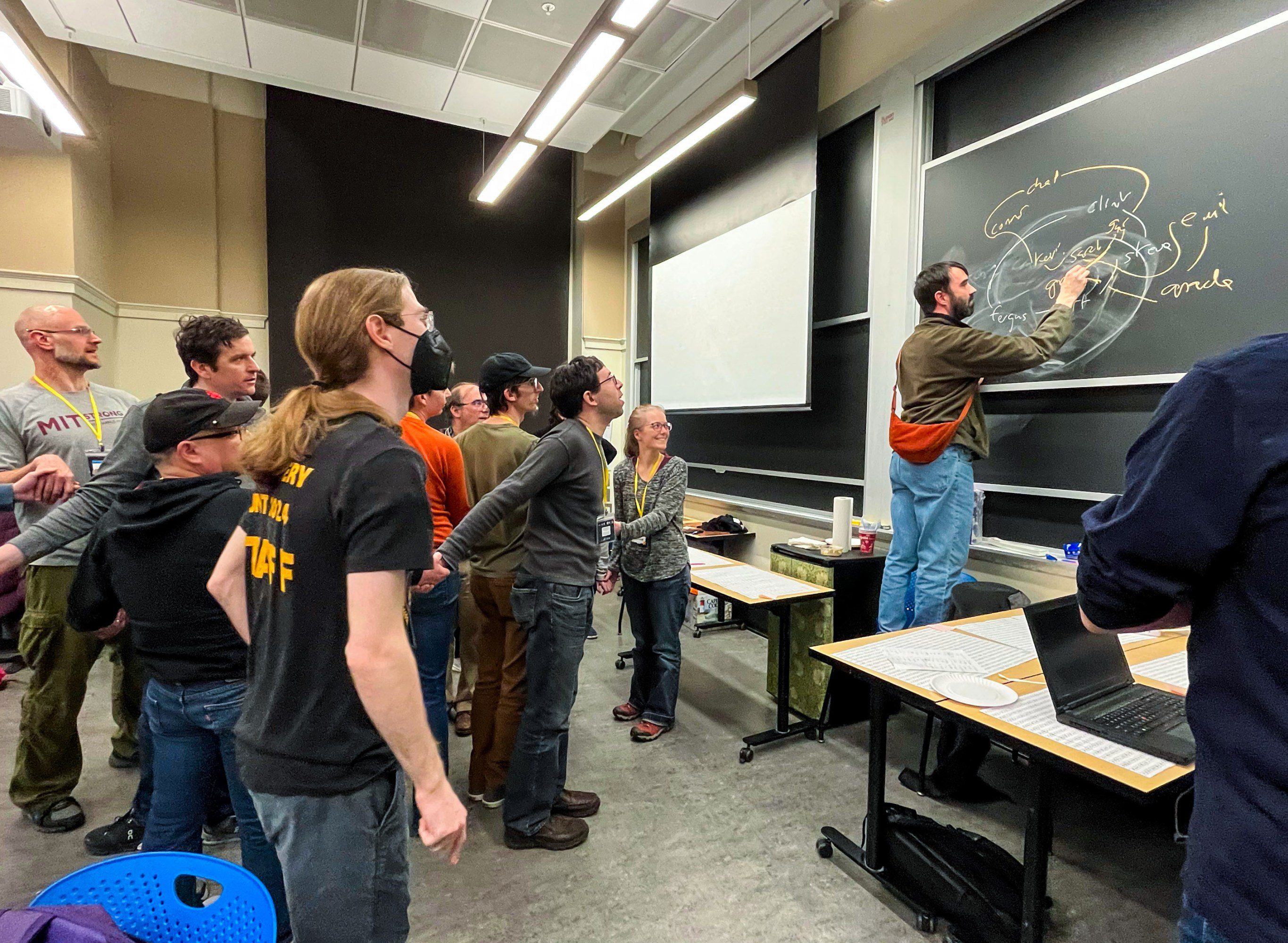
The Setec Astronomy team tries to map out whether the human knot they’ve gotten themselves into can be untangled.
JADE CHONGSATHAPORNPONG ’24/MIT TECHNIQUE
We add a few more solutions to the hydra diagram over the next few hours. Eventually someone notices that all the answers in the fifth level of the diagram seem to have an odd prevalence of Ls and Rs. This is the “aha!” moment: They tell us how to navigate the binary tree. From the first node at the top of the tree, we follow the Ls and Rs in the order they appear in each of the 16 solutions on the fifth level. Take the left branch, then right, then left again, landing on a word that starts with H. The second fifth-level answer leads us to a word that starts with E. Repeating the process with all 16 answers spells out an apt way to deal with a hydra: “HEADTOHEADBATTLE.” (Puzzle solutions are traditionally written in all caps with no spaces or punctuation.) Those of us who’ve been tackling the puzzle take a moment to enjoy our victory before splitting up to find new puzzles to work on.
Some elements of the Mystery Hunt are hard to describe, the kind of must-be-seen ingenuity that also inspires hacks on the Great Dome and any number of above-and-beyond engineering projects showcased around campus every year. Most of the puzzles are utterly unique, although they do often incorporate logic and word problems as well as more mainstream elements like crosswords, sudoku, and Wordle. But almost anything can be turned into a puzzle. For example, chess puzzles might be combined with the card game Magic: The Gathering. Or solvers could be asked to organize a Git repository with 10,000 out-of-order commits (that is, find the correct sequence of 10,000 changes to a file as it was tracked in a version control system), identify duets from musicals, or draw on their knowledge of pop culture trivia.
For most of its history, the Mystery Hunt had little official status on campus. By tradition as much as any organizational effort, teams simply showed up in Lobby 7 on the Friday before the Martin Luther King Jr. holiday for the kickoff. In 2014, the MIT Puzzle Club was formed to help provide year-to-year continuity and other support, such as securing rooms for teams to work in and reserving Kresge Auditorium for the opening ceremonies. Puzzle Club also hosts other events, such as mini puzzle hunts and sudoku and logic puzzle competitions—which Becca Chang ’26, the club’s current president, says “has helped a lot with outreach to new students or anyone who might be interested in [puzzles].”
Technology has enabled the Mystery Hunt to grow and evolve in significant ways, and not just in terms of the kinds of puzzles that are possible. Through the mid-1990s, a single person could take on the responsibility of writing and running the event. Today it’s a yearlong commitment for the winning team to design the next year’s Hunt. Doing so requires managing creative output and technological infrastructure that rival those of a small business. Duties include spending thousands of hours writing and testing puzzles, constructing physical puzzles and props, and building a dynamic website that can withstand the huge influx of puzzle-hungry visitors.
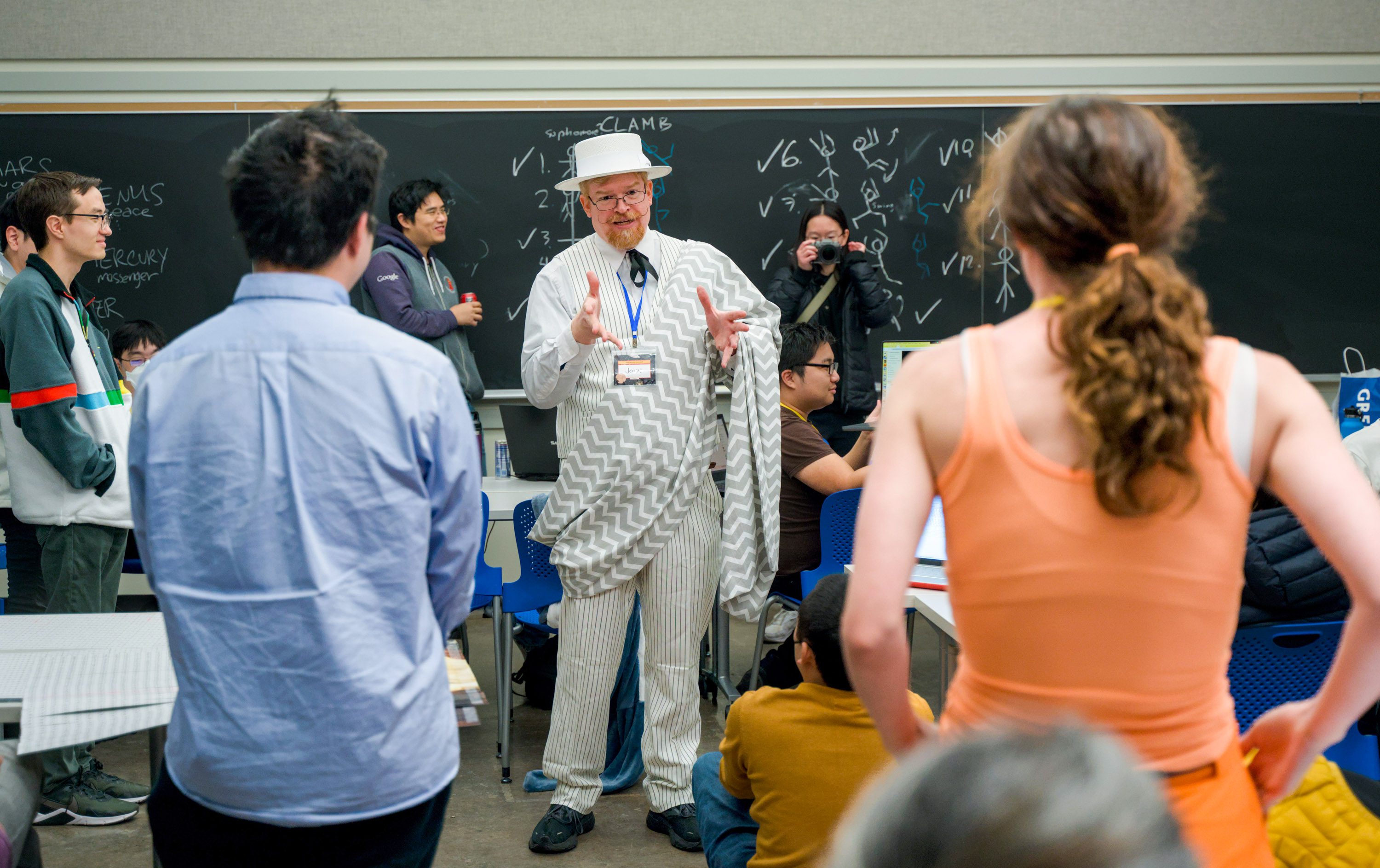
Today’s Hunts are built around a story. Here John Bromels as the god Neptune checks in on Galactic Trendsetters’ progress to restore the god Pluto after his planet was demoted.
JADE CHONGSATHAPORNPONG ’24/MIT TECHNIQUE
Just organizing a team of solvers can be a major undertaking, especially now that more and more participants are joining remotely. Anjali Tripathi ’09, who started the team I’m Not a Planet Either in 2015, got her introduction to puzzle hunts through a miniature Mystery Hunt that Simmons Hall runs for first-years. After tackling the main event with the Simmons team on campus as an undergrad, she participated remotely for the first time in 2010. “I was abroad in England and still wanted to do Hunt, and I remember how hard that was,” she says. The team “had no infrastructure for it.”
“It’s about connecting with other humans— that’s why we do it.”
Erin Rhode ’04, whose team name one year was the entire text of Ayn Rand’s Atlas Shrugged
Today, solvers can work together across the room or across a continent. Platforms like Slack and Discord have become indispensable to many teams, which use them for updates and announcements as well as creating separate channels where people can tackle a given puzzle together. Many teams use applications that organize the convoluted deluge of puzzles into a workflow so everyone can see which have been solved, which need attention, and who’s working on what. Google Docs and Google Sheets make it easy for multiple people to contribute to progress on the same puzzle whether they’re sitting side by side on campus or are separated by several time zones.
“I think especially post-2020, there is just the expectation that everything is going to be accessible online,” says Tripathi, who still has a Hunt-related Google doc from 2008, just a couple of years after the service launched.
But even as the Mystery Hunt has adapted to the internet—and to increasingly powerful search engines, smartphones, the Zoom era, and even some machine-learning applications—at its core it remains a very human experience.
“It’s about connecting with other humans—that’s why we do it,” says Erin Rhode ’04, a longtime Mystery Hunter whose team has won twice. She recalls being inducted into the Hunt as a first-year in 2001. “An upperclassman came in and was like, ‘You’re coming to the math majors’ lounge. We’re doing this puzzle hunt thing.’” The name of Rhode’s team changes every year, though they might be best known for the year their name was the entire text of Ayn Rand’s Atlas Shrugged. Last year, they were . (That’s not a typo or a missing word—it’s the zero-width space, a Unicode non-character primarily used in document formatting.)
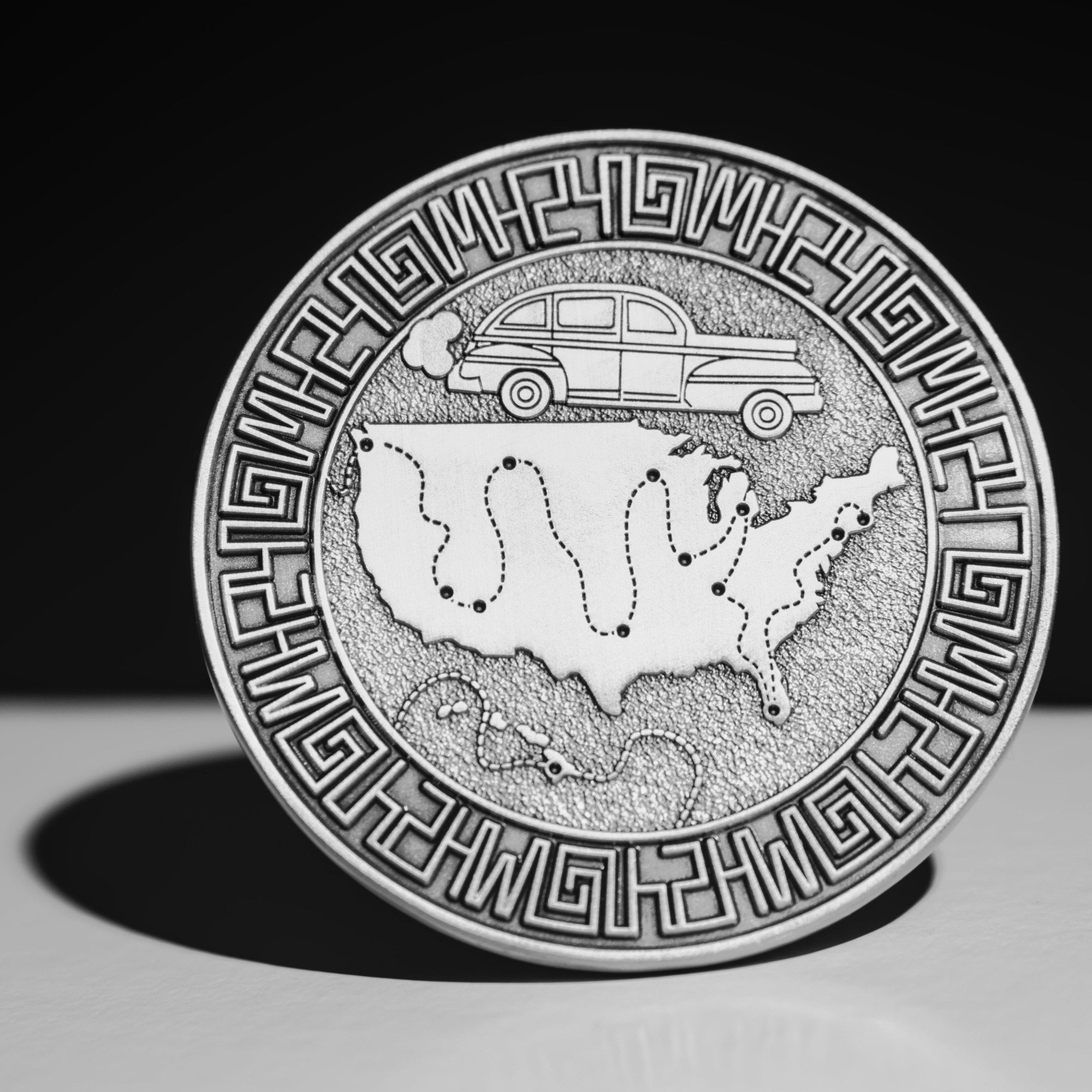
Early Mystery Hunts led solvers to an Indian Head penny hidden on campus. Today, winning teams are awarded coins unique to each year’s Hunt. Ringed with a repeating MH24, the 2024 coin shows the cities teams “visited” on their quest.
JADE CHONGSATHAPORNPONG ’24/MIT TECHNIQUE
Like so much of the Hunt, team names are an exercise in creativity. The full name of the team running the 2024 Mystery Hunt was officially The Team Formerly Known as the Team Formerly Known as the Team Formerly Known as the Team Formerly Known as the Team Formerly Known as the Team to Be Named Later. Some teams keep their name every year, like Setec Astronomy (an anagram for “too many secrets,” in a reference to the classic 1992 heist film Sneakers). Others change every year or every few years, or when teams merge, as when Death from Above joined forces with Project Electric Mayhem to become Death and Mayhem.
Rhode remembers one particular puzzle from her first Hunt that she and her team (known that year as the Vermicious Knids) worked on through the night. They had to figure out that a list of enigmatic phrases were clues to song titles. For example, “Of course; you just go north on Highway 101” clued the song “Do You Know the Way to San Jose?” “I think today, we would have solved that puzzle in about an hour,” Rhode says. “There weren’t song lyric databases back then. And so it was a lot more sitting around on your own trying to come up with songs as opposed to just finding some master list and then searching it.”
Writing puzzles with the knowledge that solvers will have a slew of tools at hand is just part of the process. “Use whatever technology you have at your disposal to solve the puzzle is the general rule of thumb,” says Jon Schneider ’13, a machine-learning researcher who hunts with Galactic Trendsetters . (The in their team name is pronounced like a plane taking off and landing, respectively.) Schneider has been hunting since 2010, when it was common for solvers to have to identify clips of songs or other audio. He’s seen that change in the past decade, though: “Audio recognition [technology] like Shazam has become a thing, so it’s harder to create puzzles that require the skill of music recognition.”
“When you’re a constructor, you try to figure out: What is my challenge for the solver?” says Dan Katz ’03. Katz has solved and written a lot of puzzles. (In fact, he created a five-puzzle mini Hunt for this issue’s Puzzle Corner.) He attended his first Mystery Hunt in 1998, as a junior in high school, before he had even applied to MIT. He’s been part of a winning team eight times (probably a record) and competes in events like the World Sudoku Championship and US Puzzle Championship. In Katz’s view, technology should make puzzling more interesting for the solver. While solvers might need to, say, code a program, organize information in a spreadsheet, or navigate a video-game-like interface to arrive at an answer, what he prizes most is the mental challenge of figuring out how to solve a puzzle.
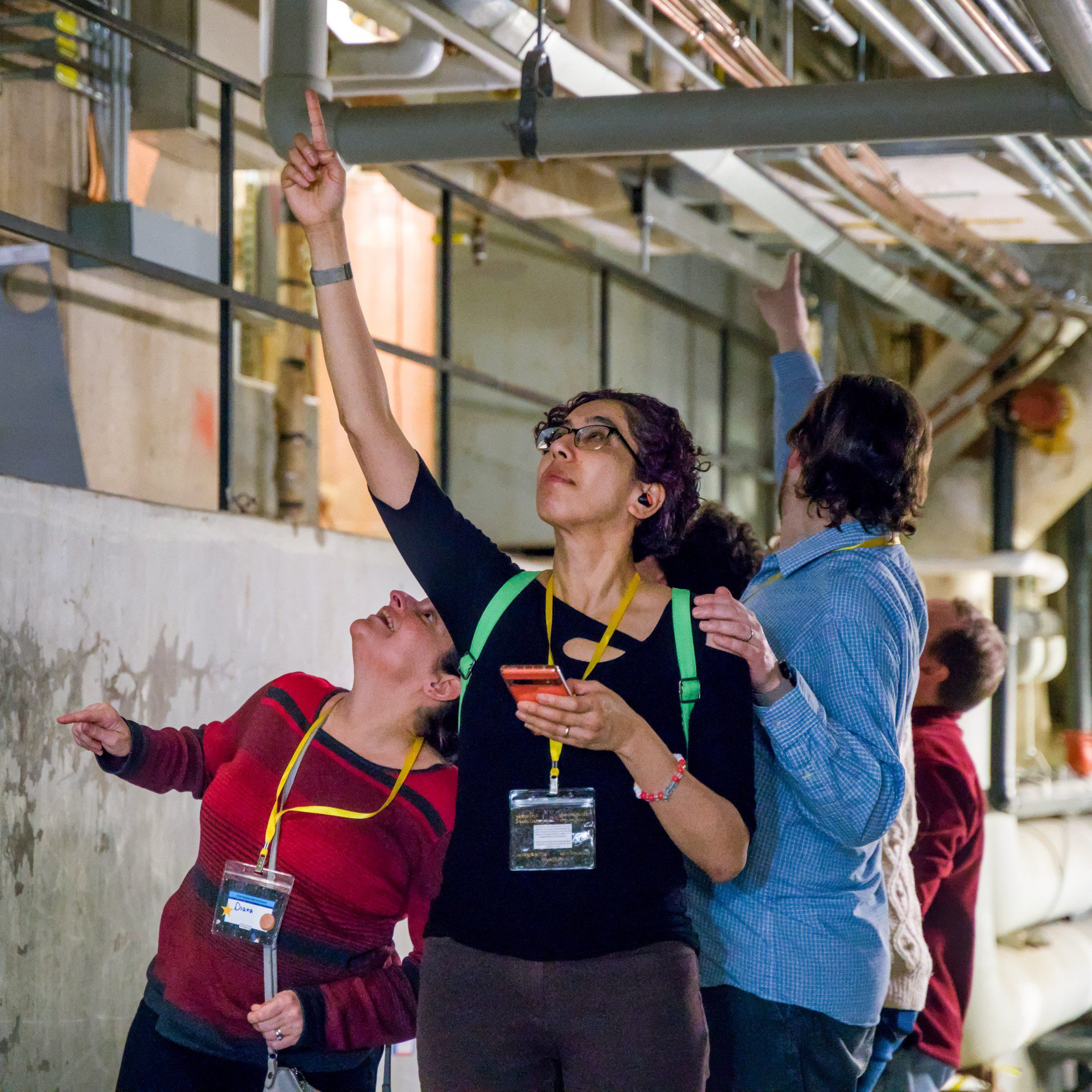
During what’s known as the Mid-Hunt Runaround, a team follows a set of cryptic instructions that lead them on a subterranean journey across campus.
JADE CHONGSATHAPORNPONG ’24/MIT TECHNIQUE
Rhode misses the days before an app was able to listen to a few seconds of a song and identify it. “One of my superpowers in the early days of the Hunt was: Play me a bunch of pop songs and I can identify like 90% of them,” she says. “Now everybody’s got Shazam on their phone. And so as fast as I might be, Shazam was always going to be faster.”
That doesn’t mean puzzles can’t be based on song identification—or image identification, another common puzzle element that has been made trivial by tools like Google’s image search capabilities. It just means constructors must become more creative. “You have to obscure the images or the music in such a way that the technology can’t find it quickly,” Rhode says. She describes a puzzle she wrote when she wanted solvers to identify songs without using technology: “I arranged eight songs a cappella and sang them myself, but buzzing like a bee. And the whole idea was you can’t Shazam that.”
Schneider’s team took a similar approach to constructing a puzzle in which solvers had to identify specific visual artists—not by their work, but by their distinctive style. Solvers were prompted to upload an image of their choosing, and a generative AI tool similar to DALL-E rendered it in the style of the artist they were supposed to name.
“I mostly just want to be surprised.”
Jon Schneider ’13 of the team Galactic Trendsetters
That’s not the only puzzle to have incorporated some machine-learning elements in the last few years. A few examples have used semantic similarity scoring systems where solvers have to guess words or phrases—a kind of machine-learning-enabled version of “hot or cold.”
Even if machine learning has potential as a tool for puzzle constructors, generative AI is unlikely to solve Mystery Hunt puzzles anytime soon. ChatGPT can answer questions that might be helpful in getting started and maybe even help solve a crossword clue or two, but the puzzles are often so unusual that it doesn’t know where to begin. When presented with them, it usually responds by stating that it “would need more context or clues” in order to proceed.
Schneider did find ChatGPT very helpful, though, in solving a non–Mystery Hunt puzzle about navigating the byzantine rules of the role-playing game Dungeons & Dragons, which he admits he’s never played. A few years ago, there would have been no way around spending hours digging through the rulebooks and figuring out each step, but giving the puzzle to ChatGPT worked. “It was really good at doing this. I guess it had trained on enough data of people playing Dungeons & Dragons that this was within its capabilities,” he says.
Schneider is optimistic that new technology will be integrated into Mystery Hunt in creative ways, expanding the scope of what puzzle constructors can come up with to entertain solvers. Ultimately, he says, “I mostly just want to be surprised.”
As the sun sets on Sunday, Setec continues solving puzzles at a steady pace, but we’re also still unlocking new sections of the Hunt—a sign that we’re still some distance from the endgame, though rumors (but never spoilers) from friends on other teams suggest that a few teams might be closing in. As midnight rolls around there’s still no announcement, and so we push on. Ultimately, the 2024 Hunt ends up running into Monday morning, one of only a handful of times it’s taken more than 60 hours to complete.
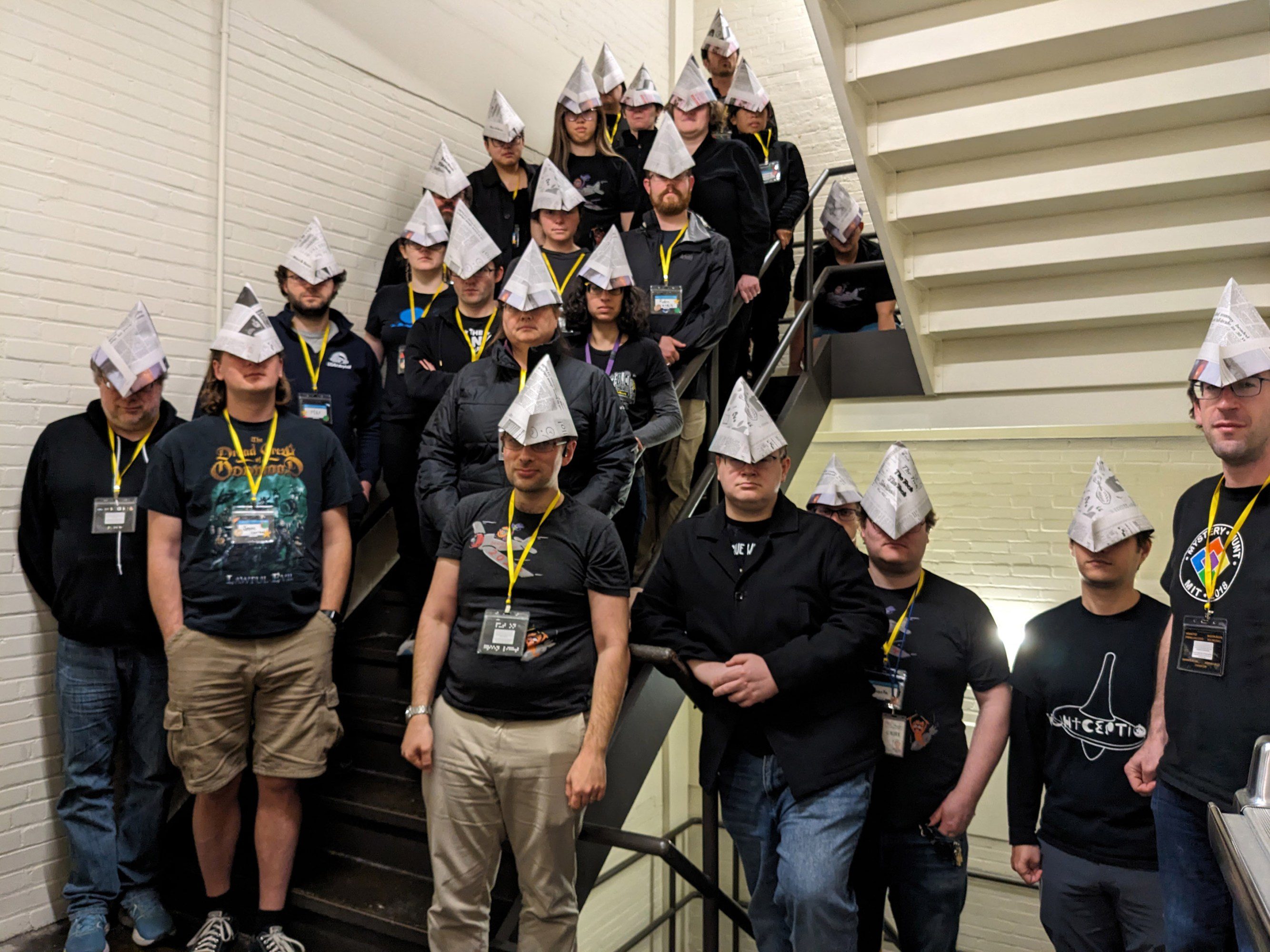
The 2024 Mystery Hunt included what was called the “Herc-U-Lease” Scavenger Hunt. As part of the scavenger hunt, teams were asked to have as many members as possible look as identical as possible. Death and Mayhem realized that many members were wearing black T-shirts and decided to unify the look with paper hats fashioned from copies of The Tech someone found on campus.
MOLLY FREY/DEATH & MAYHEM
A little after 5 a.m., team Death and Mayhem solves the final puzzle to win the 2024 Mystery Hunt—and the responsibility of developing the 2025 Hunt, which kicks off on January 17. In the end, 266 teams have solved at least one of the 2024 Hunt’s 237 puzzles and Setec Astronomy has solved 174. (Teams typically care less about postgame rankings than about how many puzzles they get to before time runs out.)
The Team Formerly Known as the Team to Be Named Later sends out an announcement that a wrap-up event, at which they’ll give a full overview of the weekend and hand over the reins to Death and Mayhem, will begin at noon in 26-100. Because creating a Mystery Hunt is such a daunting task, Death and Mayhem got to work on this year’s within hours of winning, says James Douberley ’13, who assumed the title of “benevolent dictator” to orchestrate and oversee the team’s puzzle writing.
The weight of expectation is not lost on Douberley and his teammates: This is a once-a-year event that holds a lot of meaning for many participants.
The Mystery Hunt is about solving puzzles, but it’s also far more social and immersive than puzzle books and escape rooms. In 2024, nearly 2,000 people representing 91 teams showed up on campus to participate—and another 2,450 or so signed up to puzzle from afar. All told, solvers included 52 faculty members, 278 students, and 950 alumni, ranging from recent graduates to those who got their degrees decades ago. For Chang, the Hunt is an opportunity to connect with the broader community, including alumni from her dorm whom she doesn’t see often. “This is the one time in the year that we get to all just be in one place together and do this thing that we love,” she says. “It’s just a really great bonding experience.”
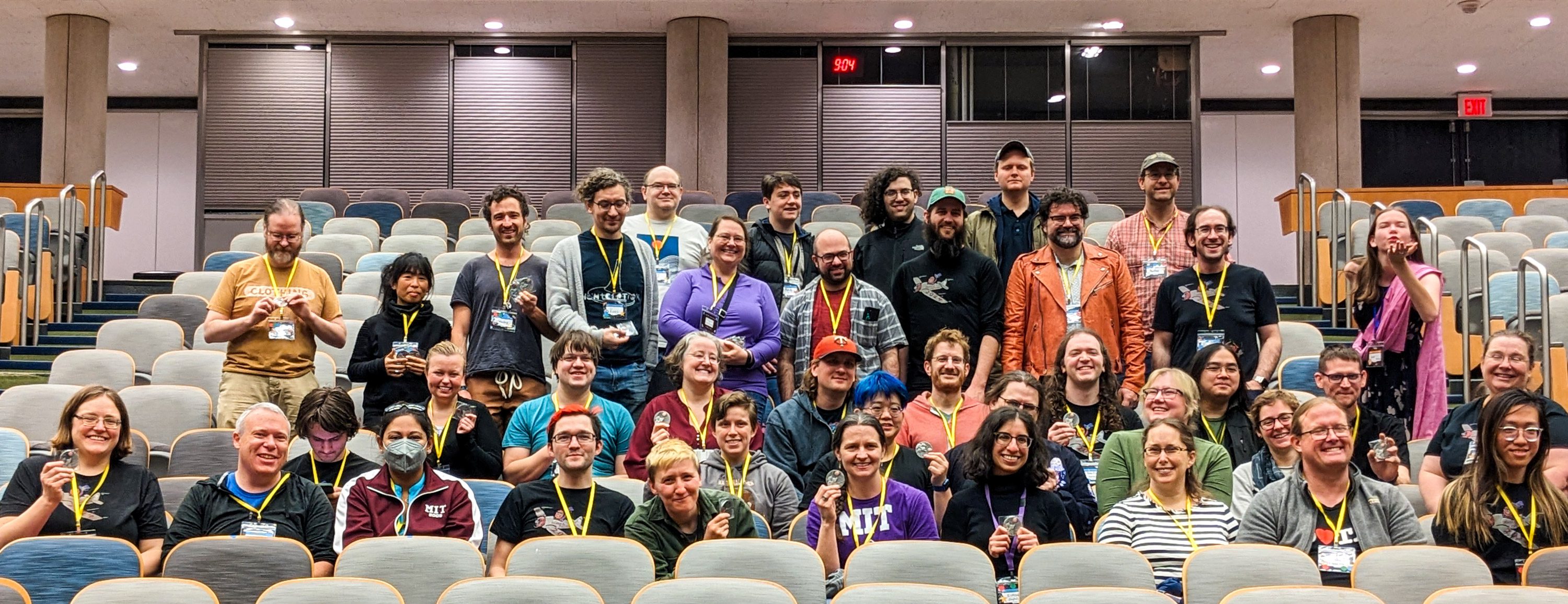
Shortly after solving the final puzzles in the 2024 MIT Mystery Hunt, members of Death & Mayhem received the custom coins awarded to the victors and posed for a photo with Aphrodite (of the Team Formerly Known as the Team to Be Named Later), who blew kisses in celebration.
COURTESY OF DEATH & MAYHEM
The MIT campus plays a special role in the Hunt. Maybe you have to use the walls of the List Visual Arts Center lobby as a grid for a logic puzzle, or find certain names on the memorial plaques in Lobby 10 whose first letters spell out an answer. But it’s not just that clues can be part of the physical space—it’s that campus is the epicenter for the MIT spirit of creativity, inventiveness, and industriousness that makes the Mystery Hunt unique. “People talk about New York being a character in movies,” Katz says. “I feel like MIT is a character in Mystery Hunt.”
For Douberley, the Mystery Hunt takes him back to his student days, when he tackled hard challenges through marathon work sessions and all-nighters. “You fall asleep on the floor, and you’re in the dorm lounge and your friend comes and wakes you up and says, ‘Here’s a coffee—I need your help with something,’” he says. “And that is something that lives with you for the rest of your life.”
Editor’s Note:
The 2025 MIT Mystery Hunt kicks off on January 17, 2025. But if you’re eager to start puzzling before then—or get a taste of puzzling if you’ve never taken part before—check out the MIT Mystery Heist, a pre-Hunt round of puzzles written by the Mystery Hunt team known as the Providence Crime Syndication. Learn more and solve at mitmysteryheist.com.
“THE CULT OF THE FOUNDER.” “THE CULT OF THE TECH GENIUS.”
“Beware: Silicon Valley’s cultists want to turn you into a disruptive deviant.” “Tech’s cult of the founder bounces back.” “Silicon Valley’s Strange, Apocalyptic Cults.” “How the cult of personality and tech-bro culture is killing technology.” “Company or cult?” “Is your corporate culture cultish?” “The Cult of Company Culture Is Back. But Do Tech Workers Even Want Perks Anymore?” “10 tech gadgets with a cult following on Amazon—and why they’re worth it.” “13 steps to developing a cult-like company culture.”
The headlines seem to write themselves (if that cliché is allowed anymore in the age of ChatGPT and generative AI). Tech is culty. But that is a metaphor, right? Right?!
When I first saw Michael Saylor’s Twitter account, I wasn’t sure. Saylor is an entrepreneur, tech executive, and former billionaire. Once reportedly the richest man in the Washington, DC, area, he lost most of his $7 billion net worth in 2000 when, in his mid-30s, he reached a settlement with the US Securities and Exchange Commission after it brought charges against him and two of his colleagues at a company called MicroStrategy for inaccurate reporting of their financial results. But I had no idea who he was back then.
In 2021 Saylor started showing up in my Twitter feed. His profile picture showed a man with chiseled features, silver hair, and stubble sitting in a power pose and looking directly into the camera, a black dress shirt unbuttoned to display a generous amount of his neck. It was a typical tech entrepreneur’s publicity shot except for the lightning bolts blasting from his eyes, and the golden halo crown. Then there were his tweets:
#Bitcoin is Truth.
#Bitcoin is For All Mankind.
#Bitcoin is Different.
Trust the Timechain.
Fiat [government-backed currency] is immoral. #Bitcoin is immortal.
#Bitcoin is a shining city in cyberspace, waiting for you.
#Bitcoin is the heartbeat of Planet Earth.
As MIT’s humanist chaplain, I follow a lot of ministers, rabbis, imams, and monks online. Very few religious leaders would dare to be this religious on social media. They know that few of their readers want to see such hubris. Why, then, does there seem to be an audience for this seemingly cultish behavior from a cryptocurrency salesman? Are tech leaders like Saylor leading actual cults?
According to Bretton Putter, an expert on startups and CEO of the consulting firm CultureGene, this needn’t be a major concern: “It’s pretty much impossible,” Putter writes, “for a business to become a full-blown cult.” And if a tech company or other business happens to resemble a cult, that might just be a good thing, he argues: “If you succeed in building a cultlike culture similar to the way that Apple, Tesla, Zappos, Southwest Airlines, Nordstrom, and Harley-Davidson have, you will experience loyalty, dedication, and commitment from your employees (and customers) that is way beyond the norm.”
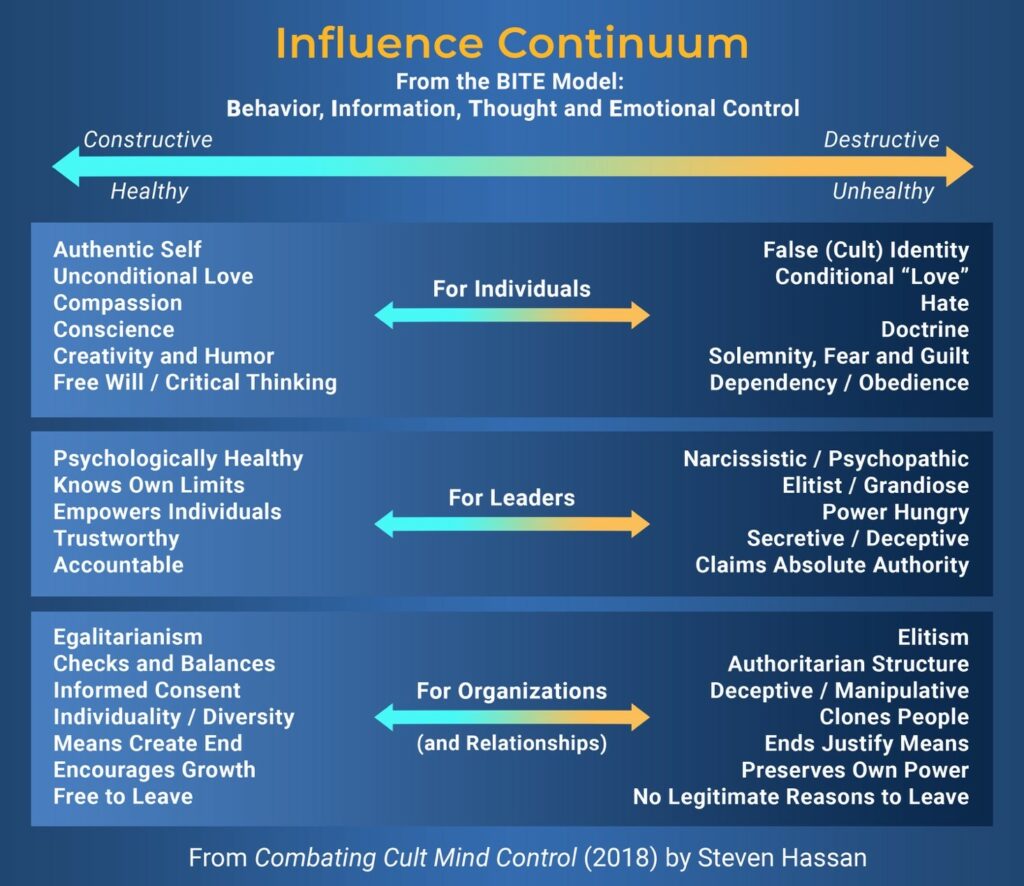
Are the cultlike aspects of tech companies really that benign? Or should we be worried? To find the answer, I interviewed Steve Hassan, a top expert on exit counseling, or helping people escape destructive cults.
At age 19, while he was studying poetry at Queens College in New York City in the early 1970s, Hassan was recruited into the Unification Church—the famously manipulative cult also known as the Moonies. Over his next 27 months as a member of the church, Hassan helped with its fundraising, recruiting, and political efforts, which involved personally meeting with the cult leader Sun Myung Moon multiple times. He lived in communal housing, slept only a few hours a night, and sold carnations on street corners seven days a week for no pay. He was told to drop out of college and turn his bank account over to the church. In 1976, he fell asleep at the wheel while driving a Moonie fundraising van and drove into the back of a tractor-trailer at high speed. He called his sister from the hospital, and his parents hired former members to help “deprogram” him and extract him from the cult.
After the Jonestown mass suicide and murders of 1978 brought attention to the lethal dangers of cult mind control, Hassan founded a nonprofit organization, Ex-Moon Inc. Since then, he’s earned a handful of graduate degrees (including a doctorate in the study of cults), started numerous related projects, and written a popular book on how practices with which he is all too familiar have crept into the mainstream of US politics in recent years. (That 2019 book, The Cult of Trump: A Leading Cult Expert Explains How the President Uses Mind Control, seemed even more relevant in early 2024, when a video called “God Made Trump” went viral across the campaign trail.) Hassan even found himself advising Maryland congressman Jamie Raskin, leader of the second impeachment trial against Donald Trump, in 2021, on how to think and communicate about the cultish aspects of the violent mob of Trump followers who stormed the Capitol on January 6 of that year.
I wanted to ask Hassan what he makes of the discourse around tech cults, but first it’s important to understand how he thinks about cults in the first place. Hassan’s dissertation was titled “The BITE Model of Authoritarian Control: Undue Influence, Thought Reform, Brainwashing, Mind Control, Trafficking, and the Law.” The idea was to create a model that could measure cult exploitation and manipulation, or what Hassan and other experts in related fields call “undue influence.” His BITE model looks to evaluate the ways social groups and institutions attempt to control followers’ behavior, information access, thoughts, and emotions. Because there is no one quintessential, Platonic definition of a cult, what matters is where a given instance of potential cultishness falls on an “influence continuum.” In this continuum model, Hassan evaluates the ways in which institutional cultures attempt to influence people. To what extent are individuals allowed to be their authentic selves or required to adopt a false cult identity? Are leaders accountable to others, or do they claim absolute authority? Do organizations encourage growth in the people who participate in them, or do they seek to preserve their own power over all else? While any kind of person or group can struggle with some of the dimensions on Hassan’s continuum chart (which lists constructive behaviors at one end and destructive behaviors at the other), healthier organizations will tend toward constructive responses more of the time, whereas unhealthier institutions—those more truly worthy of the cult label in the most negative sense—will tend toward destructive responses such as grandiosity, hate, demands for obedience, elitism, authoritarianism, deceptiveness, or hunger for power.
It turns out that there are some real, meaningful similarities between cults and tech, according to Hassan. “This is the perfect mind-control device,” he told me, holding up his iPhone. He explained that when he joined the Moonies in 1974, cult recruiters had to get information from the victim. Now, he said, users of everyday technologies are sitting ducks: “There are 5,000 data points on every voting American in the dark web, and there are companies that will collect and sell that data.”
The first time Hassan was told about cryptocurrency, he added, it smacked of multilevel marketing to him. The proposition that you can make a fortune in a very short amount of time, with almost no labor, was something he had seen many times in his work. As was the idea that if you become an early investor in such a scheme, you’ll make more money if you recruit more people to join you. “The people who started it are always going to make 99% of the money,” Hassan said. And as in the cults that recruited him and continue to recruit the kinds of people who ultimately become his clients, “everyone else is going to get burned.”
All of this would certainly seem to explain why I so frequently hear from people, eager for me to know they are fellow atheists, who tell me to buy some bitcoin because it will rewire my neurons and cure me of the woke mind virus.
Of course, it should be noted that some scholars have complained about Hassan’s work, arguing that brainwashing and mind control are concepts for which there is not sufficient evidence. But I’m not claiming that tech uses literal brainwashing, nor is it like when a character in a Scooby-Doo episode hears “You are getting very sleepy” and then their eyes become squiggles. Hassan probably wouldn’t say so either.
Companies don’t need to go to such extremes to exert undue influence on us, though. And as is clear from the headlines I cited above, a lot of companies have been accused of, or associated with, a bit of cultishness.
I won’t attempt to evaluate anyone’s cultish tendencies on a scale of 1 to 10. But I see crypto sales techniques as a particularly good example of cultlike behavior, because if there’s one thing cults need to be good at to sustain their existence, it’s separating people from their wallets. Cryptocurrency has specialized in that to extraordinary effect.
It’s all a continuum, and it would be hard to find a person whose life is completely devoid of anything cultish, technological or otherwise. But as a culture, we are careening dangerously toward the wrong end of Hassan’s chart. Or to quote a Michael Saylor tweet, “We all stumble in the dark until we see the cyber light. #Bitcoin.”
Adapted fromTech Agnostic: How Technology Became the World’s Most Powerful Religion, and Why It Desperately Needs a Reformation. Copyright 2024 by Greg Epstein, the humanist chaplain at MIT. Used with permission of the publisher, MIT Press.