The Download: Bluesky’s rapid rise, and harmful fertility stereotypes

This is today’s edition of The Download, our weekday newsletter that provides a daily dose of what’s going on in the world of technology.

The rise of Bluesky, and the splintering of social

You may have read that it was a big week for Bluesky. If you’re not familiar, Bluesky is, essentially, a Twitter clone that publishes short-form status updates. Last Wednesday, The Verge reported it had crossed 15 million users. It’s just ticked over 19 million now, and is the number one app in Apple’s app store.

Meanwhile, Threads, Meta’s answer to Twitter, reportedly signed up 15 million people in November alone. Both apps are surging in usage.

Many of these new users were seemingly fleeing X, the platform formerly known as Twitter, in reaction to Elon Musk’s support of Donald Trump, and his moves to elevate right-leaning content on the platform. But there’s a deeper trend at play here. We’re seeing a long-term shift away from massive centralized social networks. Read the full story

—Mat Honan

This story is from The Debrief, our newly-launched newsletter written by our editor-in-chief Mat Honan. It’s his weekly take on the real stories behind the biggest news in tech—with some links to stories we love and the occasional recommendation thrown in for good measure. Sign up to get it every Friday!

Why the term “women of childbearing age” is problematic

—Jessica Hamzelou

Every journalist has favorite topics. Mine include the quest to delay or reverse human aging, and new technologies for reproductive health and fertility. So when I saw trailers for The Substance, a film centered on one middle-aged woman’s attempt to reexperience youth, I had to watch it.

I won’t spoil the movie for anyone who hasn’t seen it yet (although I should warn that it is not for the squeamish). But a key premise of the film involves harmful attitudes toward female aging. 

“Hey, did you know that a woman’s fertility starts to decrease by the age of 25?” a powerful male character asks early in the film. “At 50, it just stops,” he later adds. He never explains what stops, exactly, but to the viewer the message is pretty clear: If you’re a woman, your worth is tied to your fertility. Once your fertile window is over, so are you. 

The insidious idea that women’s bodies are, above all else, vessels for growing children has plenty of negative consequences for us all. But it also sets back scientific research and health policy. Read Jess’s story to learn how

This story is from The Checkup, MIT Technology Review’s weekly biotech newsletter.  Sign up to receive it in your inbox every Thursday.

The must-reads

I’ve combed the internet to find you today’s most fun/important/scary/fascinating stories about technology.

1 Trump plans to loosen US rules for self-driving cars 
No prizes for guessing who might be behind that idea. (Bloomberg $)
Elon Musk is ramping up his legal fight against OpenAI and Microsoft. (WSJ $)
Trump has appointed the FCC’s Brendan Carr to lead the agency. (NPR)
Robotaxis are here. It’s time to decide what to do about them. (MIT Technology Review)

2 How Bluesky is handling its explosive growth
It has just 20 employees, and they’re working round the clock to deal with bugs, outages and moderation issues. (NYT $)
+ Just joined Bluesky? Here’s how to use it. (The Verge)
How to fix the internet. (MIT Technology Review)

 3 Biden agreed to some small but significant AI limits with Xi Jinping 
I think we can all get behind the idea that nuclear weapons should be exclusively controlled by humans. (Politico)
Biden has lifted a ban on Ukraine using long-raise missiles to strike inside Russia. (BBC)

4 Big Tech is trying to sink the US online child safety bill 
And, as it stands, its lobbying efforts look very likely to succeed. (WSJ $)

5 Amazon has launched a rival to Temu and Shein 
Nothing on ‘Haul’ costs more than $20. (BBC)
+ Welcome to the slop era of online shopping. (The Atlantic $)

6 The Mike Tyson-Jake Paul fight on Netflix was plagued by glitches
Despite that, 60 million households still tuned in. (Deadline)

7 AI models can work together faster in their own language 
Linking different models together could help tackle thorny problems individual ones can’t solve. (New Scientist $)

8 Tech companies are training their AI on movie subtitles 
A database called OpenSubtitles provides a rare glimpse into what goes into these systems. (The Atlantic $)

9 McDonald’s is trying to bring back NFTs
Remember those? (Gizmodo)

10 A lot of people are confusing Starlink satellites with UFOs
Guess it’ll take us a while for us to get used to seeing them. (Ars Technica)

Quote of the day

“F*** you, Elon Musk.”

—Brazil’s first lady, Janja Lula da Silva, makes her views clear during a speech calling for tougher social media regulation ahead of the G20 summit in Rio de Janeiro, Reuters reports.

 The big story

Alina Chan tweeted life into the idea that the virus came from a lab

Alina Chan

COURTESY PHOTO

June 2021

Alina Chan started asking questions in March 2020. She was chatting with friends on Facebook about the virus then spreading out of China. She thought it was strange that no one had found any infected animal. She wondered why no one was admitting another possibility, which to her seemed very obvious: the outbreak might have been due to a lab accident.

Chan is a postdoc in a gene therapy lab at the Broad Institute, a prestigious research institute affiliated with both Harvard and MIT. Throughout 2020, Chan relentlessly stoked scientific argument, and wasn’t afraid to pit her brain against the best virologists in the world. Her persistence even helped change some researchers’ minds. Read the full story.

—Antonio Regalado

We can still have nice things

A place for comfort, fun and distraction to brighten up your day. (Got any ideas? Drop me a line or tweet ’em at me.)

+ Why Quincy Jones was the best of the best.
+ These handy apps are a great way to save articles to read later on (Pocket is my own personal favorite.)
+ How to resurrect a ghost river in the Bronx.
+ Look after your stainless steel pans, and your stainless steel pans will look after you.

9 Books to Strengthen Cybersecurity

Cybersecurity threats are nonstop. This curated selection of recent books offers perspectives from cybersecurity experts, covering everything from the psychology of cyber attackers to practical defense strategies.

Understand the Cyber Attacker Mindset

Cover of Understand the Cyber Attacker Mindset

Understand the Cyber Attacker Mindset

by Sarah Armstrong-Smith

Armstrong-Smith is Microsoft’s chief security advisor and a sought-after speaker. In this book, she bridges the gap between technology and psychology by focusing on the human aspects of cybersecurity, including the types of attackers and their motivations and methods. The author draws on interviews with ex-criminals, the advice of top experts, and a wide range of case studies to demonstrate why the human element in cybersecurity is more important than ever.

The AI Revolution in Networking, Cybersecurity, and Emerging Technologies

Cover of The AI Revolution in Networking, Cybersecurity, and Emerging Technologies

The AI Revolution

by Omar Santos, Samer Salam, and Hazim Dashir

Artificial intelligence is affecting seemingly every aspect of business, and cybersecurity is no exception. The authors, all executives at Cisco, provide an overview of how AI can help identify and resolve network security threats, explaining both its theory and application. They offer a comprehensive guide to guarding against potential security and privacy pitfalls, security monitoring and alerting, and modernizing and fortifying operations.

Hacking and Security

Cover of Hacking and Security

Hacking and Security

by Michael Kofler, Klaus Gebeshuber, Frank Neugeberger, and others

A team of German experts explains essential security techniques for various infrastructures, including Linux, Microsoft, mobile, cloud, and the internet of things. The book covers identifying system vulnerabilities and possible attack vectors and offers step-by-step instructions for withstanding security attacks.

Practical Cybersecurity

Cover of Practical Cybersecurity

Practical Cybersecurity

by Nicholas Marsh

With a focus on practical strategies and real-world examples, Marsh draws on his experience in small, medium, and large enterprises in multiple industries. The book addresses practices, policies, and products that can help increase network security and reduce risks, explaining both the “why” and the “how” of more than 250 cybersecurity best practices.

Cybersecurity Myths and Misconceptions

Cover of Cybersecurity Myths and Misconceptions

Cybersecurity Myths and Misconceptions

by Eugene Spafford, Leigh Metcalf, and Josiah Dykstra

Three leading cybersecurity experts go beyond common tactics to demystify false ideas and faulty assumptions that can undermine security efforts. The book offers tips for recognizing and avoiding 175 frequent misconceptions shared by users, leaders, and cybersecurity professionals.

Cybersecurity All-in-One For Dummies

Cover of Cybersecurity All-in-One For Dummies

Cybersecurity All-in-One For Dummies

by Joseph Steinberg, Kevin Beaver, Ira Winkler, and Ted Coombs

Steinberg, a top global cybersecurity influencer, combines into one volume six “For Dummies” books: “Grasping Cybersecurity Basics,” “Enhancing Personal Cybersecurity,” “Safeguarding a Business,” “Securing the Cloud,” “Testing Your Security,” and “Enhancing Cybersecurity Awareness.” The result is a one-stop reference for smart security decisions.

Firewalls Don’t Stop Dragons, 5th ed.

Cover of Firewalls Don’t Stop Dragons, 5th ed.

Firewalls Don’t Stop Dragons, 5th ed.

by Carey Parker

Writing with minimal jargon for laypeople, Parker offers simple, effective precautions everyone should take in the virtual world. The book offers straightforward explanations, with a checklist in each chapter of expert tips, step-by-step instructions, and screenshots.

Managing Risks in Digital Transformation

Cover of Managing Risks in Digital Transformation

Managing Risks in Digital Transformation

by Ashish Kumar, Shashank Kumar, and Abbas Kudrati

Practical examples, case studies, and eye-opening stats highlight digital threats that could affect a business’s reputation and bottom line. Focusing on new and emerging risks, the book offers tips for navigating the ever-evolving risk and compliance landscape. It provides a roadmap of the risk mitigation process for business owners, technology leaders, and cybersecurity professionals.

Hacked

Cover of Hacked

Hacked

by Jessica Barker

Barker, a top cyber security advisor to the U.K. government, explains the tactics and technologies hackers use and offers common-sense solutions to safeguard yourself and your business in a world where everyone is a potential cyber-attack victim. The book includes commentary from experts and stories of real-world attacks, showing how to safeguard and respond if you’ve been targeted.

How to Audit HTML Headings on Any Page

HTML headings are among the most important search engine optimization elements on a page. An H1 heading is the main headline, which Google often uses instead of the title tag to create an organic search snippet.

H2 and H3 subheadings add structure to a page, help it get featured, and introduce calls to action — all while inserting more keywords.

Here are tools to audit HTML headings on any web page — competitors, experts, and more.

Sitewide Headings

Screaming Frog is a freemium crawler that identifies headings on every page on a site, listing the page URL and the heading type, words, and number of characters.

Download the report as a .csv, Excel file, or Google Sheet.

Screaming Frog is free for up to 500 URLs. Paid access for unlimited crawls is €239 per year (approximately $250).

Screenshot of a Screaming Frog report

Screaming Frog identifies headings on every page on a site, listing the page URL and the heading type, words, and number of characters. Click image to enlarge.

Quick Analysis

SEO Pro Extension is a free Chrome extension that pulls SEO info — images, links, schema — from any page. It has a dedicated tab for headings, making analysis quick and easy.

Download the heading report as a .csv file.

Screenshot of a SEO Pro Extension report.

SEO Pro Extension, a free Chrome extension, pulls images, links, schema, and more from any page. Click image to enlarge.

Compare Headings

Serp.tools pulls title tags, meta descriptions, and H1, H2, and H3 headings for up to 100 URLs — all for free. The interface can hide or show all subheadings on a page. It is a helpful tool for comparing your own on-page tactics against competitors.

Download the report as an Excel file.

Screenshot of report from Serp.tools.

Serp.tools pulls title tags, meta descriptions, and H1, H2, and H3 headings for up to 100 URLs — helpful for comparing against competitors. Click image to enlarge.

Keywords in Headings

WebCEO is a premium SEO tool that identifies keywords in HTML headings. When analyzing headings, keep in mind:

  • The primary and secondary keywords.
  • Character length and details.
  • Tactics for engagement. For example, are the headings questions or CTAs? On-page engagement is a confirmed ranking signal, and headings elevate CTA visibility.

Pricing at WebCEO starts at $36 per month for a Solo Plan with a free 14-day trial.

Screenshot of keyword report from WebCEO.

WebCEO identifies keywords in HTML headings. Click image to enlarge.

SEO Reports: Which Metrics Matter & How To Use Them Well via @sejournal, @HelenPollitt1

As SEO professionals, reports are a key part of our communication toolbox.

We spend time running workshops and writing summaries of work and project plans. These are all part of our process for gaining buy-in and showing value from the work we’re doing.

Our reports are just as important.

Where We Go Wrong

The problem that we sometimes run into as SEO professionals is not thinking about the report as a communication tool. We take shortcuts, expecting the data to speak for itself. We don’t worry enough about how it can be taken out of context.

If done right, SEO reports will continue to reinforce the messaging we’ve been giving through our training, proposals, and pitches.

When done wrong, SEO reports cause confusion, sometimes panic, and, overall, a sinking sense of distrust from our stakeholders.

What Is The Report For?

When creating reports, we must identify what the report should show.

If we are reporting on the outcome of a specific project, then we need to consider the original hypothesis.

What were we aiming for in that project? What were the promised milestones and the measures of success? They all need to be included – even the metrics that don’t look so good.

Is this a regular report, like a monthly update on performance? If so, we need to consider all the areas of SEO that we are directly affecting, as well as areas outside of our control that can help explain any increases or decreases in performance. There is a need to give the context in which our SEO work operates.

This should form the starting point from which we choose the report metrics.

Aspects Of A Good SEO Report

A good SEO report will help communicate insight and the next steps. It should have sufficient detail to help the reader make decisions.

Include Relevant Data

Reports should include data that is relevant to the topic being reviewed.

They should not overwhelm a reader with unnecessary information.

Keep Them Brief

Reports should be brief enough that pertinent data and insight are easy to find.

Brevity might be the difference between a report being read and being ignored.

Keep the data being reported succinct. Sometimes, a chart will better illustrate the data than a table.

Remember The Audience

Reports should be tailored to the needs of the recipient. It may be the report is being produced for another SEO professional, or the managing director of the company.

These two audiences may need very different data to help explain the progress of SEO activity.

The needs of the report’s reader to make a decision and identify the next steps must be considered. A fellow SEO may need the details of which pages are returning a 404 server error, but the managing director likely won’t.

Make Them Easy To Understand

They should not include unexplained jargon or expect readers to infer meaning from statistics.

Write reports with the recipient’s knowledge in mind. Liberal use of jargon for someone not in the industry might put them off reading a report.

Conversely, jargon and acronyms will be fine for someone who knows SEO and can help to keep reports brief.

Keep Them Impartial

SEO reports are a form of internal marketing. They can be used to highlight all of the good SEO work that’s been carried out.

Reports should be honest and unbiased, however. They shouldn’t gloss over negatives.

Decreases in performance over time can highlight critical issues. These shouldn’t be omitted from the report because they don’t look good. They are a perfect way of backing up your expert recommendations for the next steps.

Provide Insight

Data alone is likely to be unhelpful to most.

Reports shouldn’t just be figures. Insight and conclusion must be drawn, too.

This means that, as an SEO expert, we should be able to add value to the report by analyzing the data. Our conclusions can be presented as actions or suggestions for a way forward.

Reporting On Metrics Correctly

Metrics used incorrectly can lead to poor conclusions being made. An example of this is the “site-wide bounce rate.”

A bounce is typically measured as a visit to a website that only led to one page being viewed and no other interactions occurring.

Bounce rate is the percentage of all visits to the site that ended up as a bounce.

The bounce rate of a page can be useful, but only really if it is being compared with something else.

For instance, if changes have been made to a page’s layout and bounce rate increases, it could point to there being a problem with visitors navigating with the new layout.

However, reporting on bounce rate of a page without looking deeper at other metrics can be misleading.

For instance, if the changes to the page were designed to help visitors find information more easily, then the increase in bounce rate could be an indicator of the new design’s success.

The difference in bounce rate cannot be used in isolation as a measure of success.

Similarly, reporting on the average bounce rate across the entire website is usually misleading.

Some pages on the website might have a high bounce rate but be perfectly fine. For others, it indicates a problem. For example:

  • A contact page might see a lot of visitors bounce as they find a phone number and leave the site to call it.
  • A homepage or product page with a high bounce rate is usually a sign that the page is not meeting the needs of users, however.

Reports should look to draw conclusions from a range of metrics.

Metrics Need Context

Few metrics can be used in isolation and still enable accurate insight to be drawn.

For example, think of crawling and indexing data.

A report on the number of URLs that are being crawled by Googlebot sounds like a fair metric to demonstrate the technical health of the website.

Though what does it show, really?

An increase in URLs crawled could indicate that Googlebot is finding more of your site’s pages that it previously couldn’t. If you have been working on creating new sections of your site, this may be a positive trend.

However, if you dig deeper and discover that the URLs Googlebot has been crawling are the result of spam attacks on your site, this is actually a big problem.

In isolation, the volume of crawled pages doesn’t give any real context on the technical SEO of the site. There needs to be more context in order to draw reliable conclusions.

Over-Reliance On Metrics

There are other metrics that are relied on a little too much in SEO reports – measures of the authority of a page or domain, for instance.

These third-party metrics do well in guessing the ranking potential of a page in the eyes of search engines, but they are never going to be 100% accurate.

They can help to show if a site is improving over time, but only against the calculations of that reporting tool.

These sorts of metrics can be useful for SEO professionals to use as a rough gauge of the success of an authority-building project. However, they can cause problems when reported to managers, clients, and stakeholders.

If they are not properly informed of what these scores mean, it is easy for them to hold on to them as the goal for SEO. They are not.

Well-converting organic traffic is the goal. The two metrics will not always correlate.

Which Metrics Matter?

The metrics that should be used together to illustrate SEO performance depend on the purpose of the report. It also depends on what the recipient needs to know.

Some clients or managers may be used to receiving reports with certain metrics in them. It may be that the SEO reports feed into their own reporting, and as such, they expect to see certain metrics.

It is a good idea to find out from the report recipient if there is anything in particular they would like to know.

The report should always link back to the brand’s business and marketing goals. The metrics used in the report should communicate if the goals are being met.

For instance, if a pet store’s marketing goal is to increase sales of “non-slip pet bowls,” then metrics to include in the SEO report could be:

  • Overall traffic to the pages in the www.example.com/pet-accessories/bowls/non-slip folder.
  • Organic traffic to those pages.
  • Overall and organic conversions on these pages.
  • Overall and organic sales on these pages.
  • Bounce rate of each of these pages.
  • Traffic volume landing on these pages from the organic SERPs.

Over time, this report will help identify if SEO is contributing to the goal of increasing sales of non-slip pet bowls.

Organic Performance Reports

These are reports designed to give a picture of a website’s ongoing SEO performance. They give top-level insight into the source and behavior of organic traffic over time.

They should include data that indicates if the business, marketing, and SEO goals are being met.

An SEO performance report should look at the organic search channel, both on its own and in relation to other channels.

By doing this, we can see the impact of other channels on the success of SEO. We can also identify any trends or patterns.

These reports should allow the reader to identify the impact of recent SEO activity on organic traffic.

Metrics To Include

Some good metrics to report on for organic performance reports include:

Overall Visits

The number of visits to the website gives something to compare the organic search visits to.

We can tell if organic traffic is decreasing whereas overall traffic is increasing or if organic traffic is growing despite an overall drop in traffic.

It is possible to use overall traffic visit data to discern if there is seasonality in the website’s popularity.

Traffic Visits By Channel

The number of visits coming from each marketing channel helps you identify if there is any impact from other channels on SEO performance.

For instance, new PPC ads going online could mean the cannibalization of organic search traffic.

All Traffic And Organic Traffic Goal Completions

Have visitors completed the goals in the website’s analytics software?

Comparing organic and other traffic goal completions will again help identify if the organic traffic is completing above or below-average goal completions compared to other channels.

This could help determine if SEO activity has as much of a positive effect as hoped.

Page Level Traffic

If there are certain pages that have been worked on recently, such as new content or keyword optimization, include organic traffic metrics for them. This means going granular in your reporting.

Report on organic traffic over time, conversions on the pages (if appropriate), and actions carried out from that page. This can show if recent work has been successful in increasing organic traffic to those pages or not.

Organic Landing Page Sessions

These are the pages that visitors arrived at from the organic SERPs. They identify which pages are bringing the most organic traffic to the website.

From here, pages that have not been optimized but show potential to drive traffic can be identified.

Revenue Generated

If you can directly link the work you are carrying out to the revenue it generates, this is likely the most important metric you can include.

At the end of the day, this is what your boss and your boss’s boss likely care about. Is SEO making more money for the company?

Keyword Ranking Reports

A note on keyword rankings reports: Consider what they show before including them.

An overall report of “your site is ranking for X keywords” doesn’t give any helpful insight or fuel for a way forward.

  • Which keywords?
  • Are those keywords driving traffic to the site?
  • Are they worth optimizing for further?

Metrics To Include

Keyword ranking reports should demonstrate growth or decline in rankings for specific keywords the site is being optimized for.

Ideally, data should be pulled from first-party tools like Google Search Console to give as accurate an indication of ranking as possible.

Rather than focusing on individual keywords, you may want to look at trends. That is, is your site growing in visibility for terms that convert?

For example, demonstrating that the website has moved from ranking in first position for 10 terms to ranking in first position for 20 terms does not demonstrate how that might impact revenue.

In the age of generative engine optimization, brand is becoming more important.

Perhaps including a section on brand searches and how they are utilized to navigate straight to products would be beneficial.

Taking my pet store example, I might not only want to see how my website would rank for “helens pet store” but also for “helens pet store cat bowls” and “helens pet store dog beds.”

This helps you analyze how your brand is growing in reputation for your products and services. These searches show that visitors are so confident they want to buy from you that they want to navigate straight to your site.

Technical Performance Reports

Good SEO performance requires a website that can be crawled and indexed easily by search engines.

This means that regular audits need to be carried out to identify anything that might prevent the correct pages from appearing in the SERPs.

Reports are slightly different from audits in that a technical audit will look at a lot of different factors and investigate them.

A thorough technical audit can be vast. It needs to diagnose issues and methods of improving the site’s performance.

Depending on the audience of a technical report, it may need to selectively highlight the issues. It should also show the success of previous SEO work.

The key to knowing which metrics to include in a technical report is understanding what’s happened on the site so far.

If work has been carried out to fix an issue, include metrics that indicate the success of that fix.

For instance, if there has been a problem with a spider trap on the site that has been remedied, then report on crawl metrics and log files.

This might not be necessary for every technical report, but it can be useful in this instance.

If the site has problems with loading slowly, then metrics about load speed will be crucial for the technical report.

A good way to convey the metrics in a technical SEO report is by including prioritization of actions.

If the metrics show that there are some urgent issues, mark them as such. If there are issues that can wait or be fixed over time, highlight them.

Technical SEO can feel overwhelming for people who aren’t experts in it.

Breaking down the issues into priorities can make your reports more accessible and actionable.

Metrics To Include

There are certain metrics that may be useful to include as part of a technical performance report:

Server Response Codes

It can be prudent to keep track over time of the number and percentage of pages returning a non-200 response code.

An audit of the site should determine exactly which pages are not returning a 200 response code.

This information may not be useful to the recipient of the technical performance report, so it may be better to include it as an appendix or not at all.

If the volume of non-200 response codes reduces over time, this can be a good indicator that technical issues on the site are being fixed.

If it goes up, then it can be summarized that further work needs to be carried out.

Page Load Speed Times

It can be helpful to report on an average of page load speed times across the site. This can indicate if the site’s load speed is improving or not.

Perhaps, what is even more useful to report on is the average load speed of the top five fastest and five slowest pages. This can help to show if there are certain templates that are very quick, as well as the pages that might need further improvement.

Any Data That Shows A Need To Act

This is really important to include. If an error on a site will prevent it from being indexed, then this needs to be highlighted in the report.

This might be different from report to report.

Metrics could be crawl data, site downtime, broken schema markup, etc. Also, consider including these metrics in subsequent reports to show how the fixes have impacted performance.

A Word Of Warning

In my experience, technical SEO metrics can be received in one of two ways: either the metrics are not considered relatable to the stakeholder’s role, and therefore, they gloss over their importance, or they focus on them as an area of SEO they can understand.

For example, Core Web Vitals. We know that Core Web Vitals are not that critical for rankings. However, I have experienced many developers focusing only on Core Web Vitals as a measure of how well-tuned the website is from an organic search perspective.

Why? In my opinion, because SEO pros have started reporting on them more, and they are an easy technical SEO element for stakeholders to understand and influence.

They make sense, are easily measured, and can be optimized for.

Unfortunately, as a result of this, they are sometimes given undue importance. We direct engineers to spend entire sprints trying to raise the Core Web Vitals scores by tiny amounts, believing every little one counts.

When reporting on technical SEO, consider how you communicate the value of the metrics you are reporting on. Are these critical website health metrics? Or are they “nice to know”?

Make sure you give the full context of the metrics within your report.

Link Building Reports

A link building campaign can yield benefits for a website beyond boosting its authority with the search engines.

If done well, links should also drive traffic to the website. It is important to capture this information on link building reports, too, as it is a good measure of success.

Metrics To Include

  • URLs Of Links Gained: Which links have been gained in the reporting period?
  • Links Gained Through Link Building Activity: Of the links gained, which ones can be directly attributed to outreach efforts?
  • Links Driving Traffic: Of the links gained during the period, which ones have resulted in referral traffic, and what is the volume of visits?
  • Percentage Of Valuable Vs. Less Valuable Links: Of the links gained in the period, which ones are perhaps marked as “nofollow” or are on syndicated and canonicalized pages?

You may be tempted to include a page or domain strength score in these reports. If that helps to communicate the effectiveness of an outreach campaign, that’s understandable.

Remember, however, that links from highly relevant websites will still benefit your site, even if they do not have high authority.

Don’t let your outreach efforts be discarded because the links gained don’t score high with these metrics.

Conclusion

The best way to construct a report on SEO is to consider it a story. First, who is the audience? Make sure you are writing your report in a level of language they will understand.

Create a narrative. What do you want these metrics to say? Do you include all the twists and turns, and are you being honest about the metrics you comment on?

Make sure you bring the report to a conclusion. If there is action to be taken from it, what is that action? Highlight and reiterate anything you want stakeholders to remember as a key takeaway from the report.

Finally, seek reviews on your reports. Ask your stakeholders to give you feedback on the report.

Determine if it meets their needs or if additional context or data is needed. Essentially, this report is for them. If they aren’t getting value from it, then you are doing your SEO work a disservice.

More resources:


Featured Image: Mer_Studio/Shutterstock

From Launch To Scale: PPC Budget Strategies For All Campaign Stages via @sejournal, @navahf

We tend to craft budgets based on major objectives and real-world business timing.

This makes sense, as our real-world priorities should influence where we put our marketing dollars and at what velocity.

However, many don’t take the ad platform mechanics into consideration when setting initial, growth, and lower priority budgets.

This can mean successful campaigns tank due to too much investment too quickly, or that previously successful campaigns don’t behave after a period of pausing.

We’re going to invest some time discussing:

    • The mechanics of budgets.
    • How much to invest at the beginning.
  • How to scale campaigns without tanking them.
  • How to preserve lower priority campaigns.

It’s important to note that this post will do its best to abstain from opinions on account strategy.

There are many paths to profit, and while I have strong data-backed feelings on which paths have a higher probability of success, the point of this post is just to look at budgets.

As such, I’ll be sticking with Google and Microsoft, though some of the points can apply to Meta, Amazon, and LinkedIn.

The Mechanics Of Budgets

Before we dive into the core topic, it’s important to establish a baseline of how budgets work.

Advertisers set daily, monthly, or lifetime of the campaign budgets. When you set a daily budget, Google and Microsoft will do their best to hit it as an average across 30.4 days.

For example, if you wanted to invest $2,500 per month in a campaign, you’d set a daily budget of $82.24.

While it’s possible for that budget to double (i.e., you could spend up to $164.48 in a given day) across the 30.4 days, it should still come up to $2,500.

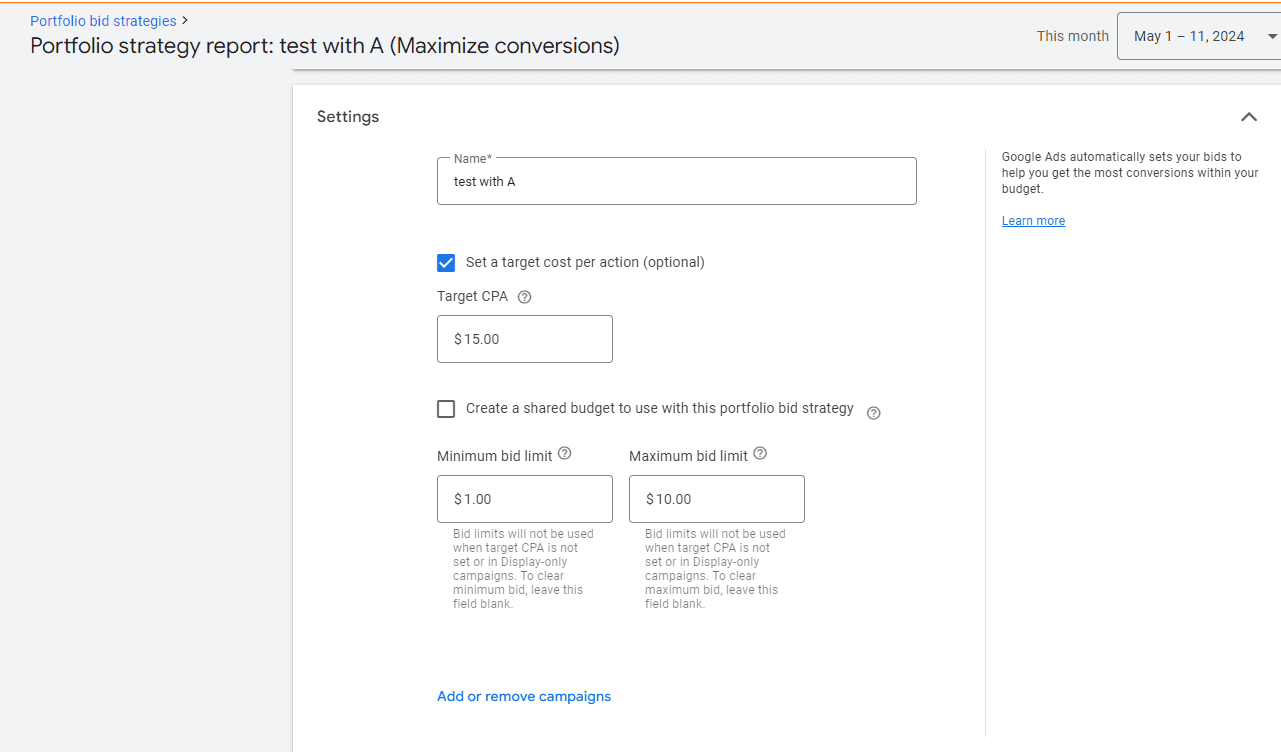
If you want more control than that, you can use portfolio bidding strategies to include bid floors and bid caps.

portfolio biddingImage from author, November 2024

Bid floors (minimums) ensure you’ll bid enough to enter the auction.

These can be helpful when you know your budget is a bit low for the campaign targets, and there’s a real risk of Google/Microsoft underbidding to conserve your budget.

Bid caps (maximums) are safeguards against wild spikes in the auction that force you to bid more than you’re prepared to invest with a single click.

These spikes often happen when you’re going after expensive ideas and/or you’ve set a lower ROAS goal.

If you’re interested in a more detailed outline of bidding, you can check out this post that goes into it in depth.

How Much To Invest At The Beginning

Now that we have our baseline established, let’s talk about beginning budgets.

There are two main considerations when establishing a starting budget:

  • Is the account brand new, or are there existing campaigns that can give it a halo effect?
  • Does this campaign represent a test or a core part of my account?

We can debate the ethics of this, but brand-new campaigns in new accounts almost always cost more than new campaigns in established accounts. This is because ad platforms need data, and if you’re starting from scratch, you won’t have:

  • Account conversion thresholds.
  • Meaningful Quality Scores on your campaigns.
  • Established negative and placement exclusion lists.

I typically budget in at least 20% extra for all new campaigns in brand-new accounts for the first three to four weeks. This allows the campaigns to gradually build up their data and for me to eliminate waste.

Once the campaigns have begun bringing in conversions and they seem to be spending at an expected level, I’ll lower the budgets back down to the expected budget provided the following things are true:

  • The impression share lost to budget is less than 5%.
  • Stakeholders aren’t hungry for more volume and are happy with the current CPA/ROAS.

If the campaign is being launched in an existing account with at least 90 days of data and trustworthy conversions, I’ll set the budget based on the agreed-upon goals and value.

Before launching the campaign, it’s critical to have a conversation that includes the following information:

  • How many leads/sales are we currently getting, and where can that number grow without any operational change?
  • Will customers always be worth the same amount, or is the value dynamic?
  • Are there drastically different conversion rates based on how a customer engages, or are they essentially the same?

These questions will ensure you budget enough to get enough clicks in your day to get enough valuable leads for your conversion rate to kick in.

They also will help you keep your products/services organized by margins and serviceability, which will help mitigate conflicting goals that hurt budget efficiency.

Finally, it is important to acknowledge that testing budgets, while lower than normal budgets, still need to meet certain thresholds.

If your budget can’t fit at least 10 clicks in the day, it is likely setting itself up for failure because a 10% conversion rate is really good for non-branded search, and budgeting for fewer than 10 clicks in your day is banking on a better than 10% conversion rate.

How To Scale Campaigns Without Tanking Them

Once a campaign has proven itself, you might be tasked with finding a way to scale it. More money all at once is rarely the answer.

While there are instances where campaigns are performing great and the only thing “wrong” is impression share lost to budget, in most cases, big budget increases will result in increased CPCs and flat conversion lift.

This is because the budget added to high impression share campaigns will just allow the bids to be more aggressive.

If your campaigns have impression share lost to budget (at least 15%), it can make sense to add 5-10% increases every other week till you hit impression share lost due to budget of 5%.

You just need to be careful about learning periods if you’re using smart bidding.

Learning periods take five days to clear, and there is a correlation between their chaos and how young the account is. Essentially, the newer the account, the more conservative you need to be.

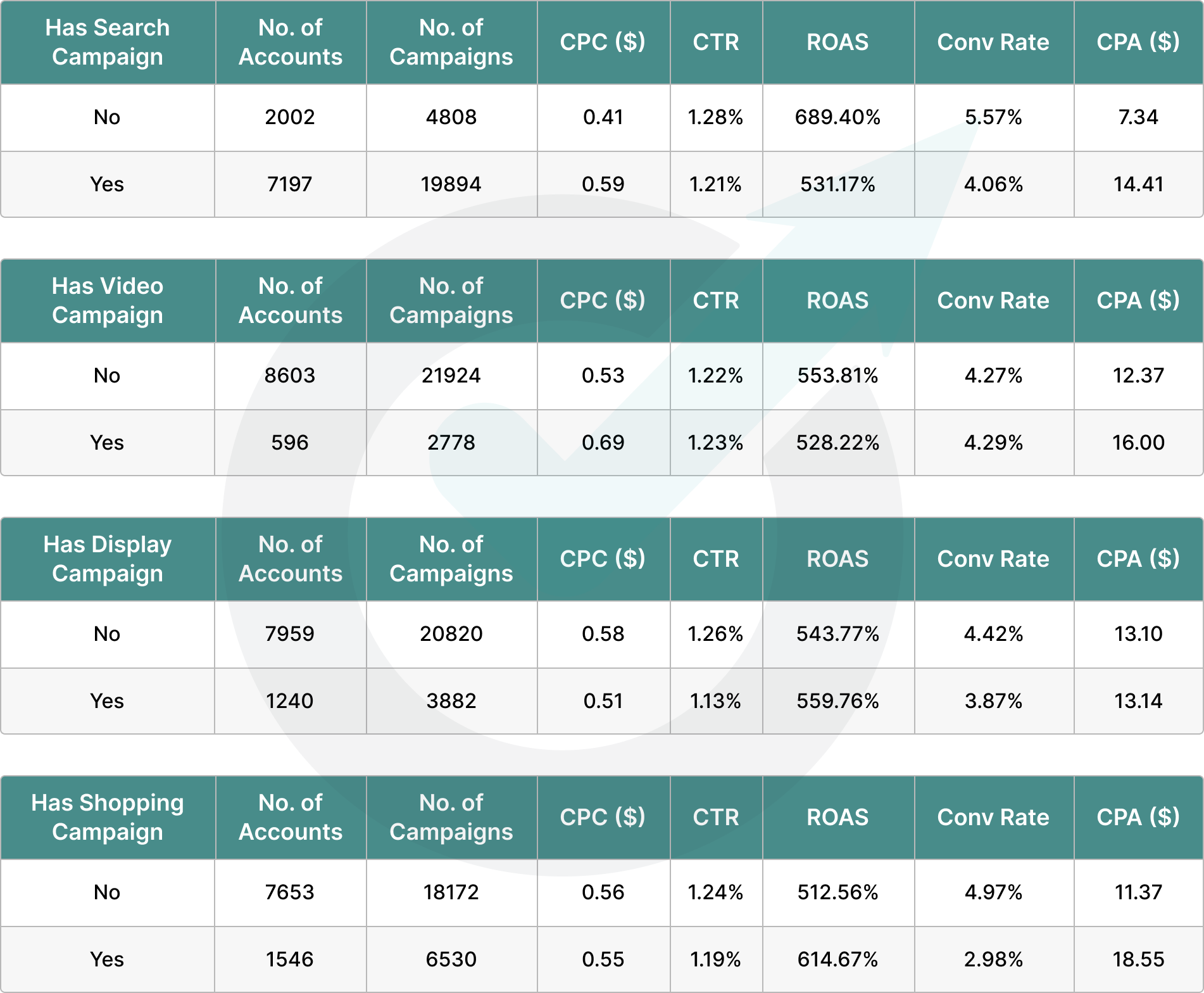
Optmyzr data on PMax getting access to budget when other campaigns are presnetOptmyzr data on PMax data when other campaigns are present or not. (Image from author, November 2024)

For campaigns with a more complete impression share, scale means looking at creating more demand or expanding into services/markets that didn’t make the budget cut before.

This could mean layering in Performance Max if you’re unsure how to build video and display campaigns. It could also mean new search or demand-gen campaigns. The core success measures you’re looking for are:

  • Does your original search campaign start to lose impression share due to budget (i.e., there are more people searching now)?
  • Are there new types of customers coming in (ways of searching, asking if your company can address them, etc.)?
  • Are your original campaigns maintaining CPCs/CPAs while starting to pull in increases in leads?

How To Preserve Lower Priority Campaigns

It’s inevitable that business priorities will fluctuate, and campaigns might need to relinquish budget.

However, there are some really important mechanics to keep in mind when deciding what to do with a low-performing/priority campaign.

If there is a chance you will ever want to run with it again (i.e., you’re testing something that requires you to take its budget), lower the budget to a non-spending amount.

This is because pausing campaigns for longer than one to two days can result in risks to their ability to perform again.

While higher-spending campaigns have an easier time mitigating this risk due to the volume of data they accumulate, there’s still a risk they will take one to three months to recover.

By lowering the budget to a non-spending amount and excluding the data from that campaign in the bidding settings, you’ll be able to mitigate the risk.

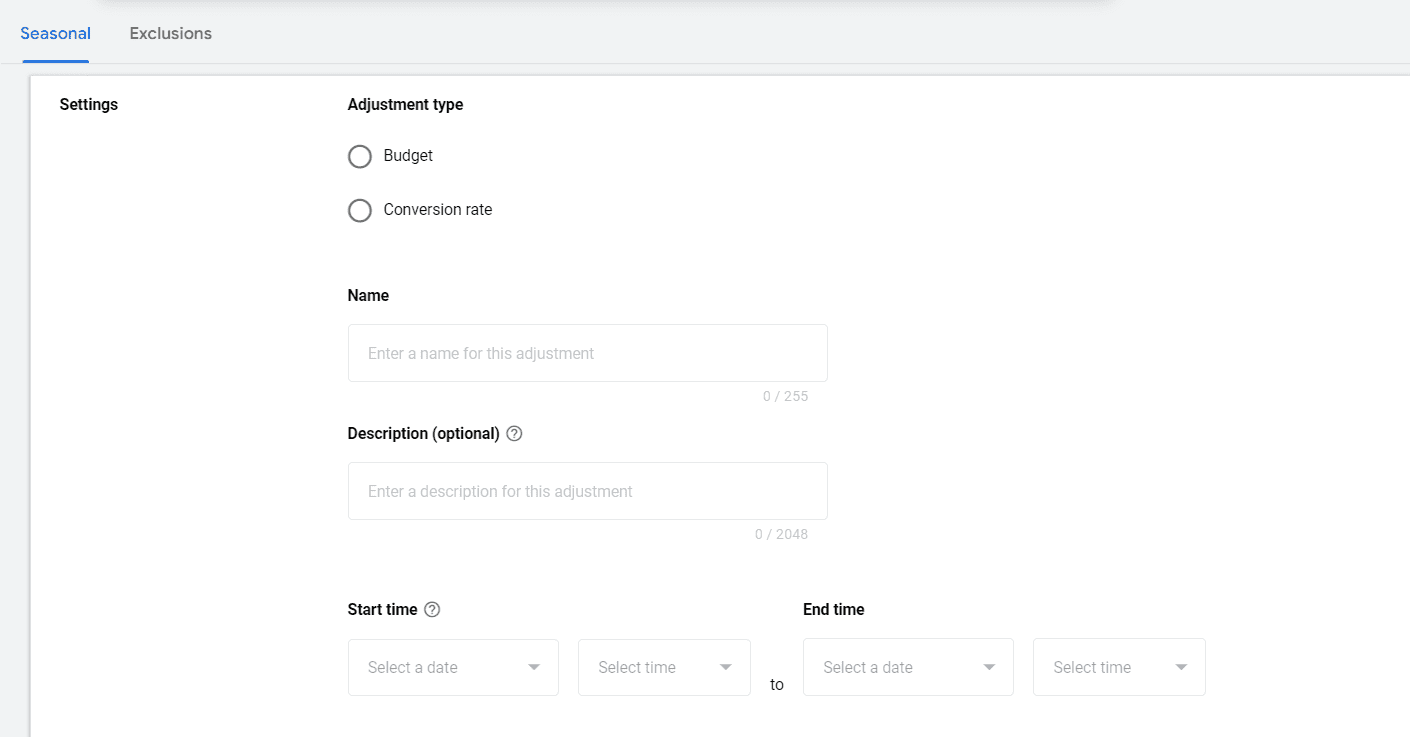
seasonality adjustmentsImage from author, November 2024

If you’re a seasonal business, you can use the seasonality options to help ad platforms understand why you spike your spends to help them prepare for the big uptick.

Final Takeaways

Budgeting is more than just coming up with a number you want to spend per month.

Marketers need to balance the mechanics with business goals to succeed. This means factoring in ad platform algorithms, as well as inputting brand data.

If you know that you need results quickly, be pragmatic about which channels you invest your budget.

On the flip side, if conversion efficacy is the issue, you may need to opt for the slower budget ramp.

However you approach your budgeting, know that there are always ways to safeguard it and direct it through targets and exclusions.

More resources:


Featured Image: BongkarnGraphic/Shutterstock
Google Analytics 4 (GA4) Users Report Data Collection Issues via @sejournal, @MattGSouthern

Google Analytics 4 (GA4) users report data collection issues affecting websites globally, with many experiencing up to 50% drops in reported traffic since November 13.

The problem has sparked discussions across Google’s support forums and social media platforms.

Key Issues

Multiple website owners have documented discrepancies between GA4 reports and actual traffic levels.

While GA4 shows reduced numbers, cross-referencing with Google Search Console and other analytics platforms confirms normal traffic levels.

One user explained the severity of the issue:

“The incomplete data is there since 13th November which shows only 4445 users when in actual (looking at Search and Discover in GSC), I am calculating more than 13,000 users (at least).”

Real-time tracking appears unaffected, suggesting the issue impacts historical data.

Technical Details

Investigations reveal that data flows to BigQuery for users with connected accounts.

However, this only provides a partial solution, as many GA4 users don’t utilize BigQuery integration.

The timing coincides with Google’s mid-November attribution system updates, though no direct connection has been confirmed.

Affected metrics Include:

  • Overall traffic volumes
  • Channel attribution data
  • Landing page metrics
  • Event tracking

Site owners from multiple countries, including Taiwan and various European regions, report identical patterns of data loss beginning November 13:

“Taiwan is experiencing the same issue. On 11/13, there was a sudden drop in traffic, and from 11/14 to 11/17, it decreased by 20-30% compared to the same period last month.”

People note that while their real-time analytics show expected traffic levels, historical data since November 13 reflects only about half of their actual visitor numbers:

“I usually track the data from the day before yesterday on the current day. However, there’s only nearly 50% traffic on my website. Just want to know is there anyone with the same situation as me?”

Why This Matters

This disruption poses challenges for organizations relying on GA4 for business intelligence and reporting.

Many companies face difficulties in performance analysis and decision-making processes without accurate historical data.

Despite numerous support threads and community discussions, Google hasn’t officially addressed the situation or indicated whether the missing data will be retroactively restored to affected accounts.

We will continue to monitor this situation and provide updates as information becomes available.


Featured Image: MacroEcon/Shutterstock
Looming Trade War Is Upending Supply Chains

The combination of Biden administration tariffs, Trump’s proposed increases, and changes in China trade relations will impact U.S. private label and direct-to-consumer brands, driving some to reconsider sourcing strategies in 2025.

Private label and DTC products are merchants’ highest-margin items. While relatively few retailers or DTC brands manufacture in-house, the products tend to remove several “middlemen,” often more than doubling profits.

A pet food retailer, for example, might clear 25 points (0.25%) on a popular premium dog food brand and 55 points on its own private-label version despite both products being manufactured at the same facility using similar recipes. A dog owner will pay about the same price for the private label brand or, perhaps, even a little less.

Photo of shipping containers at a port overlaid on a global map

U.S.-imposed tariffs and changes in China trade relations could remake supply chains.

Private Label Sourcing

Private-label brands on U.S. retailers’ physical and virtual shelves come from factories worldwide, including China and Mexico.

Brand managers identify gaps in the market and then find a manufacturing partner to build, sew, or make products to fill the void. Amazon does this with more than 100 private brands representing thousands of products.

Selecting a manufacturer for these products involves factors such as quality, price, reliability, regulatory compliance, and — recently — trade tariffs or policies.

Trade Situation

Tariffs were top of mind for a group of private-label brand managers discussing their 2025 plans around a large conference table during a meeting in November 2024.

I had been invited to learn more about their businesses, which include 30 private brands with hundreds of products sold through a network of 800 stores and 30 ecommerce sites. My task was to help with potential promotion and go-to-market plans, but each manager noted the shift away from China.

While the broad topic was “tariffs,” the managers zeroed in on three specifics that could impact their private brand relationships in China.

  • In May 2024, the Biden Administration announced it would increase Chinese tariffs on some strategic goods. Top tariffs moved from 7.5% to 25% for steel, 25% to 50% for semiconductors (by 2025), and 100% for electric vehicles.
  • President-elect Donald Trump has proposed a 10%-to-20% overall tariff on imports, a 60% tariff on many Chinese goods, and tariffs ranging from 25% to 100% on Mexican imports.
  • U.S. Representative John Moolenaar (R-MI) introduced the “Restoring Trade Fairness Act” on November 14, 2024, which would revoke China’s permanent normal trade relations status.

These tariff and policy changes could substantially impact the U.S. retail industry.

The National Retail Federation estimated that increased tariffs would cost American shoppers “between $46 billion and $78 billion in spending power each year.”

“Retailers rely heavily on imported products and manufacturing components so that they can offer their customers a variety of products at affordable prices,” NRF Vice President of Supply Chain and Customs Policy Jonathan Gold said. “A tariff is a tax paid by the U.S. importer, not a foreign country or the exporter. This tax ultimately comes out of consumers’ pockets through higher prices.”

But Jan Kniffen, the CEO of J. Rogers Kniffen WWE, a retail investment consultancy, disagrees. He told CNBC he was “less concerned about the tariffs than it seems a lot of other people.”

Kniffen noted that when President Trump introduced tariffs in 2018, Chinese manufacturers desperate for access to U.S. markets absorbed them.

“Last time we put on tariffs, nothing really happened. We didn’t see a big rise in inflation. We didn’t see a cratering of retail profits,” Kniffen continued.

According to Kniffen, the Chinese economy is far worse now than it was six years ago, perhaps meaning that Chinese factories would lower prices again to absorb new tariffs.

Sourcing Behavior

Regardless, the private brand managers sitting around the table planned to leave China not just because of tariffs but also due to unpredictable relations, supply chain stability, and better margins.

Depending on the product, those managers suggested manufacturing in other Asian nations, partnerships in Europe and South America, or, better still, working with U.S. suppliers.

The group has even purchased its first U.S. manufacturing operation, controlling its own fate while improving profits.

This strategic pivot may reflect a broader trend toward supply chain diversification and a domestic manufacturing renaissance, potentially reshaping the future of private label and DTC brands in the U.S. market. Moving manufacturing closer to consumers will likely be a top priority in the coming years.

The AI lab waging a guerrilla war over exploitative AI

Ben Zhao remembers well the moment he officially jumped into the fight between artists and generative AI: when one artist asked for AI bananas. 

A computer security researcher at the University of Chicago, Zhao had made a name for himself by building tools to protect images from facial recognition technology. It was this work that caught the attention of Kim Van Deun, a fantasy illustrator who invited him to a Zoom call in November 2022 hosted by the Concept Art Association, an advocacy organization for artists working in commercial media. 

On the call, artists shared details of how they had been hurt by the generative AI boom, which was then brand new. At that moment, AI was suddenly everywhere. The tech community was buzzing over image-generating AI models, such as Midjourney, Stable Diffusion, and OpenAI’s DALL-E 2, which could follow simple word prompts to depict fantasylands or whimsical chairs made of avocados. 

But these artists saw this technological wonder as a new kind of theft. They felt the models were effectively stealing and replacing their work. Some had found that their art had been scraped off the internet and used to train the models, while others had discovered that their own names had become prompts, causing their work to be drowned out online by AI knockoffs.

Zhao remembers being shocked by what he heard. “People are literally telling you they’re losing their livelihoods,” he told me one afternoon this spring, sitting in his Chicago living room. “That’s something that you just can’t ignore.” 

So on the Zoom, he made a proposal: What if, hypothetically, it was possible to build a mechanism that would help mask their art to interfere with AI scraping?

“I would love a tool that if someone wrote my name and made a prompt, like, garbage came out,” responded Karla Ortiz, a prominent digital artist. “Just, like, bananas or some weird stuff.” 

That was all the convincing Zhao needed—the moment he joined the cause.

Fast-forward to today, and millions of artists have deployed two tools born from that Zoom: Glaze and Nightshade, which were developed by Zhao and the University of Chicago’s SAND Lab (an acronym for “security, algorithms, networking, and data”).

Arguably the most prominent weapons in an artist’s arsenal against nonconsensual AI scraping, Glaze and Nightshade work in similar ways: by adding what the researchers call “barely perceptible” perturbations to an image’s pixels so that machine-learning models cannot read them properly. Glaze, which has been downloaded more than 6 million times since it launched in March 2023, adds what’s effectively a secret cloak to images that prevents AI algorithms from picking up on and copying an artist’s style. Nightshade, which I wrote about when it was released almost exactly a year ago this fall, cranks up the offensive against AI companies by adding an invisible layer of poison to images, which can break AI models; it has been downloaded more than 1.6 million times. 

Thanks to the tools, “I’m able to post my work online,” Ortiz says, “and that’s pretty huge.” For artists like her, being seen online is crucial to getting more work. If they are uncomfortable about ending up in a massive for-profit AI model without compensation, the only option is to delete their work from the internet. That would mean career suicide. “It’s really dire for us,” adds Ortiz, who has become one of the most vocal advocates for fellow artists and is part of a class action lawsuit against AI companies, including Stability AI, over copyright infringement. 

But Zhao hopes that the tools will do more than empower individual artists. Glaze and Nightshade are part of what he sees as a battle to slowly tilt the balance of power from large corporations back to individual creators. 

“It is just incredibly frustrating to see human life be valued so little,” he says with a disdain that I’ve come to see as pretty typical for him, particularly when he’s talking about Big Tech. “And to see that repeated over and over, this prioritization of profit over humanity … it is just incredibly frustrating and maddening.” 

As the tools are adopted more widely, his lofty goal is being put to the test. Can Glaze and Nightshade make genuine security accessible for creators—or will they inadvertently lull artists into believing their work is safe, even as the tools themselves become targets for haters and hackers? While experts largely agree that the approach is effective and Nightshade could prove to be powerful poison, other researchers claim they’ve already poked holes in the protections offered by Glaze and that trusting these tools is risky. 

But Neil Turkewitz, a copyright lawyer who used to work at the Recording Industry Association of America, offers a more sweeping view of the fight the SAND Lab has joined. It’s not about a single AI company or a single individual, he says: “It’s about defining the rules of the world we want to inhabit.” 

Poking the bear

The SAND Lab is tight knit, encompassing a dozen or so researchers crammed into a corner of the University of Chicago’s computer science building. That space has accumulated somewhat typical workplace detritus—a Meta Quest headset here, silly photos of dress-up from Halloween parties there. But the walls are also covered in original art pieces, including a framed painting by Ortiz.  

Years before fighting alongside artists like Ortiz against “AI bros” (to use Zhao’s words), Zhao and the lab’s co-leader, Heather Zheng, who is also his wife, had built a record of combating harms posed by new tech. 

group of students and teachers posing in Halloween costumes
When I visited the SAND Lab in Chicago, I saw how tight knit the group was. Alongside the typical workplace stuff were funny Halloween photos like this one. (Front row: Ronik Bhaskar, Josephine Passananti, Anna YJ Ha, Zhuolin Yang, Ben Zhao, Heather Zheng. Back row: Cathy Yuanchen Li, Wenxin Ding, Stanley Wu, and Shawn Shan.)
COURTESY OF SAND LAB

Though both earned spots on MIT Technology Review’s 35 Innovators Under 35 list for other work nearly two decades ago, when they were at the University of California, Santa Barbara (Zheng in 2005 for “cognitive radios” and Zhao a year later for peer-to-peer networks), their primary research focus has become security and privacy. 

The pair left Santa Barbara in 2017, after they were poached by the new co-director of the University of Chicago’s Data Science Institute, Michael Franklin. All eight PhD students from their UC Santa Barbara lab decided to follow them to Chicago too. Since then, the group has developed a “bracelet of silence” that jams the microphones in AI voice assistants like the Amazon Echo. It has also created a tool called Fawkes—“privacy armor,” as Zhao put it in a 2020 interview with the New York Times—that people can apply to their photos to protect them from facial recognition software. They’ve also studied how hackers might steal sensitive information through stealth attacks on virtual-reality headsets, and how to distinguish human art from AI-generated images. 

“Ben and Heather and their group are kind of unique because they’re actually trying to build technology that hits right at some key questions about AI and how it is used,” Franklin tells me. “They’re doing it not just by asking those questions, but by actually building technology that forces those questions to the forefront.”

It was Fawkes that intrigued Van Deun, the fantasy illustrator, two years ago; she hoped something similar might work as protection against generative AI, which is why she extended that fateful invite to the Concept Art Association’s Zoom call. 

That call started something of a mad rush in the weeks that followed. Though Zhao and Zheng collaborate on all the lab’s projects, they each lead individual initiatives; Zhao took on what would become Glaze, with PhD student Shawn Shan (who was on this year’s Innovators Under 35 list) spearheading the development of the program’s algorithm. 

In parallel to Shan’s coding, PhD students Jenna Cryan and Emily Wenger sought to learn more about the views and needs of the artists themselves. They created a user survey that the team distributed to artists with the help of Ortiz. In replies from more than 1,200 artists—far more than the average number of responses to user studies in computer science—the team found that the vast majority of creators had read about art being used to train models, and 97% expected AI to decrease some artists’ job security. A quarter said AI art had already affected their jobs. 

Almost all artists also said they posted their work online, and more than half said they anticipated reducing or removing that online work, if they hadn’t already—no matter the professional and financial consequences.

The first scrappy version of Glaze was developed in just a month, at which point Ortiz gave the team her entire catalogue of work to test the model on. At the most basic level, Glaze acts as a defensive shield. Its algorithm identifies features from the image that make up an artist’s individual style and adds subtle changes to them. When an AI model is trained on images protected with Glaze, the model will not be able to reproduce styles similar to the original image. 

A painting from Ortiz later became the first image publicly released with Glaze on it: a young woman, surrounded by flying eagles, holding up a wreath. Its title is Musa Victoriosa, “victorious muse.” 

It’s the one currently hanging on the SAND Lab’s walls. 

Despite many artists’ initial enthusiasm, Zhao says, Glaze’s launch caused significant backlash. Some artists were skeptical because they were worried this was a scam or yet another data-harvesting campaign. 

The lab had to take several steps to build trust, such as offering the option to download the Glaze app so that it adds the protective layer offline, which meant no data was being transferred anywhere. (The images are then shielded when artists upload them.)  

Soon after Glaze’s launch, Shan also led the development of the second tool, Nightshade. Where Glaze is a defensive mechanism, Nightshade was designed to act as an offensive deterrent to nonconsensual training. It works by changing the pixels of images in ways that are not noticeable to the human eye but manipulate machine-learning models so they interpret the image as something different from what it actually shows. If poisoned samples are scraped into AI training sets, these samples trick the AI models: Dogs become cats, handbags become toasters. The researchers say only a relatively few examples are enough to permanently damage the way a generative AI model produces images.

Currently, both tools are available as free apps or can be applied through the project’s website. The lab has also recently expanded its reach by offering integration with the new artist-supported social network Cara, which was born out of a backlash to exploitative AI training and forbids AI-produced content.

In dozens of conversations with Zhao and the lab’s researchers, as well as a handful of their artist-collaborators, it’s become clear that both groups now feel they are aligned in one mission. “I never expected to become friends with scientists in Chicago,” says Eva Toorenent, a Dutch artist who worked closely with the team on Nightshade. “I’m just so happy to have met these people during this collective battle.” 

Belladonna artwork shows a central character with a skull head in a dark forest illuminated around them by the belladonna flower slung over their shoulder
Images online of Toorenent’s Belladonna have been treated with the SAND Lab’s Nightshade tool.
EVA TOORENENT

Her painting Belladonna, which is also another name for the nightshade plant, was the first image with Nightshade’s poison on it. 

“It’s so symbolic,” she says. “People taking our work without our consent, and then taking our work without consent can ruin their models. It’s just poetic justice.” 

No perfect solution

The reception of the SAND Lab’s work has been less harmonious across the AI community.

After Glaze was made available to the public, Zhao tells me, someone reported it to sites like VirusTotal, which tracks malware, so that it was flagged by antivirus programs. Several people also started claiming on social media that the tool had quickly been broken. Nightshade similarly got a fair share of criticism when it launched; as TechCrunch reported in January, some called it a “virus” and, as the story explains, “another Reddit user who inadvertently went viral on X questioned Nightshade’s legality, comparing it to ‘hacking a vulnerable computer system to disrupt its operation.’” 

“We had no idea what we were up against,” Zhao tells me. “Not knowing who or what the other side could be meant that every single new buzzing of the phone meant that maybe someone did break Glaze.” 

Both tools, though, have gone through rigorous academic peer review and have won recognition from the computer security community. Nightshade was accepted at the IEEE Symposium on Security and Privacy, and Glaze received a distinguished paper award and the 2023 Internet Defense Prize at the Usenix Security Symposium, a top conference in the field. 

“In my experience working with poison, I think [Nightshade is] pretty effective,” says Nathalie Baracaldo, who leads the AI security and privacy solutions team at IBM and has studied data poisoning. “I have not seen anything yet—and the word yet is important here—that breaks that type of defense that Ben is proposing.” And the fact that the team has released the source code for Nightshade for others to probe, and it hasn’t been broken, also suggests it’s quite secure, she adds. 

At the same time, at least one team of researchers does claim to have penetrated the protections of Glaze, or at least an old version of it. 

As researchers from Google DeepMind and ETH Zurich detailed in a paper published in June, they found various ways Glaze (as well as similar but less popular protection tools, such as Mist and Anti-DreamBooth) could be circumvented using off-the-shelf techniques that anyone could access—such as image upscaling, meaning filling in pixels to increase the resolution of an image as it’s enlarged. The researchers write that their work shows the “brittleness of existing protections” and warn that “artists may believe they are effective. But our experiments show they are not.”

Florian Tramèr, an associate professor at ETH Zurich who was part of the study, acknowledges that it is “very hard to come up with a strong technical solution that ends up really making a difference here.” Rather than any individual tool, he ultimately advocates for an almost certainly unrealistic ideal: stronger policies and laws to help create an environment in which people commit to buying only human-created art. 

What happened here is common in security research, notes Baracaldo: A defense is proposed, an adversary breaks it, and—ideally—the defender learns from the adversary and makes the defense better. “It’s important to have both ethical attackers and defenders working together to make our AI systems safer,” she says, adding that “ideally, all defenses should be publicly available for scrutiny,” which would both “allow for transparency” and help avoid creating a false sense of security. (Zhao, though, tells me the researchers have no intention to release Glaze’s source code.)

Still, even as all these researchers claim to support artists and their art, such tests hit a nerve for Zhao. In Discord chats that were later leaked, he claimed that one of the researchers from the ETH Zurich–Google DeepMind team “doesn’t give a shit” about people. (That researcher did not respond to a request for comment, but in a blog post he said it was important to break defenses in order to know how to fix them. Zhao says his words were taken out of context.) 

Zhao also emphasizes to me that the paper’s authors mainly evaluated an earlier version of Glaze; he says its new update is more resistant to tampering. Messing with images that have current Glaze protections would harm the very style that is being copied, he says, making such an attack useless. 

This back-and-forth reflects a significant tension in the computer security community and, more broadly, the often adversarial relationship between different groups in AI. Is it wrong to give people the feeling of security when the protections you’ve offered might break? Or is it better to have some level of protection—one that raises the threshold for an attacker to inflict harm—than nothing at all? 

Yves-Alexandre de Montjoye, an associate professor of applied mathematics and computer science at Imperial College London, says there are plenty of examples where similar technical protections have failed to be bulletproof. For example, in 2023, de Montjoye and his team probed a digital mask for facial recognition algorithms, which was meant to protect the privacy of medical patients’ facial images; they were able to break the protections by tweaking just one thing in the program’s algorithm (which was open source). 

Using such defenses is still sending a message, he says, and adding some friction to data profiling. “Tools such as TrackMeNot”—which protects users from data profiling—“have been presented as a way to protest; as a way to say I do not consent.”  

“But at the same time,” he argues, “we need to be very clear with artists that it is removable and might not protect against future algorithms.”

While Zhao will admit that the researchers pointed out some of Glaze’s weak spots, he unsurprisingly remains confident that Glaze and Nightshade are worth deploying, given that “security tools are never perfect.” Indeed, as Baracaldo points out, the Google DeepMind and ETH Zurich researchers showed how a highly motivated and sophisticated adversary will almost certainly always find a way in.

Yet it is “simplistic to think that if you have a real security problem in the wild and you’re trying to design a protection tool, the answer should be it either works perfectly or don’t deploy it,” Zhao says, citing spam filters and firewalls as examples. Defense is a constant cat-and-mouse game. And he believes most artists are savvy enough to understand the risk. 

Offering hope

The fight between creators and AI companies is fierce. The current paradigm in AI is to build bigger and bigger models, and there is, at least currently, no getting around the fact that they require vast data sets hoovered from the internet to train on. Tech companies argue that anything on the public internet is fair game, and that it is “impossible” to build advanced AI tools without copyrighted material; many artists argue that tech companies have stolen their intellectual property and violated copyright law, and that they need ways to keep their individual works out of the models—or at least receive proper credit and compensation for their use. 

So far, the creatives aren’t exactly winning. A number of companies have already replaced designers, copywriters, and illustrators with AI systems. In one high-profile case, Marvel Studios used AI-generated imagery instead of human-created art in the title sequence of its 2023 TV series Secret Invasion. In another, a radio station fired its human presenters and replaced them with AI. The technology has become a major bone of contention between unions and film, TV, and creative studios, most recently leading to a strike by video-game performers. There are numerous ongoing lawsuits by artists, writers, publishers, and record labels against AI companies. It will likely take years until there is a clear-cut legal resolution. But even a court ruling won’t necessarily untangle the difficult ethical questions created by generative AI. Any future government regulation is not likely to either, if it ever materializes. 

That’s why Zhao and Zheng see Glaze and Nightshade as necessary interventions—tools to defend original work, attack those who would help themselves to it, and, at the very least, buy artists some time. Having a perfect solution is not really the point. The researchers need to offer something now because the AI sector moves at breakneck speed, Zheng says, means that companies are ignoring very real harms to humans. “This is probably the first time in our entire technology careers that we actually see this much conflict,” she adds.

On a much grander scale, she and Zhao tell me they hope that Glaze and Nightshade will eventually have the power to overhaul how AI companies use art and how their products produce it. It is eye-wateringly expensive to train AI models, and it’s extremely laborious for engineers to find and purge poisoned samples in a data set of billions of images. Theoretically, if there are enough Nightshaded images on the internet and tech companies see their models breaking as a result, it could push developers to the negotiating table to bargain over licensing and fair compensation. 

That’s, of course, still a big “if.” MIT Technology Review reached out to several AI companies, such as Midjourney and Stability AI, which did not reply to requests for comment. A spokesperson for OpenAI, meanwhile, did not confirm any details about encountering data poison but said the company takes the safety of its products seriously and is continually improving its safety measures: “We are always working on how we can make our systems more robust against this type of abuse.”

In the meantime, the SAND Lab is moving ahead and looking into funding from foundations and nonprofits to keep the project going. They also say there has also been interest from major companies looking to protect their intellectual property (though they decline to say which), and Zhao and Zheng are exploring how the tools could be applied in other industries, such as gaming, videos, or music. In the meantime, they plan to keep updating Glaze and Nightshade to be as robust as possible, working closely with the students in the Chicago lab—where, on another wall, hangs Toorenent’s Belladonna. The painting has a heart-shaped note stuck to the bottom right corner: “Thank you! You have given hope to us artists.”

This story has been updated with the latest download figures for Glaze and Nightshade.

Google’s AI Search Experiment: “Learn About” via @sejournal, @martinibuster

Google has quietly introduced a new AI Search experiment called Learn About, which summarizes content and offers navigational menus to explore related subtopics. This new way of exploring content uses drill-down navigational menus called Interactive Lists and if the user scrolls down far enough they will eventually find links to human created content.

This new way of searching encourages exploration with an interface that continually presents additional summaries and links to human-created content. The experience resembles a children’s “choose your story” book, where the narrative shifts based on the reader’s decisions.

Google’s Learning Initiative

The Learn About AI Search is offered as part of Google Labs. It’s also a part of Google’s Learning Initiative. The Learning Initiative page offers links to Google Labs projects that are related to learning.

The Learning Initiative contains links to various projects:

  • Learn About
  • Shiffbot
  • Illuminate
  • NotebookLM

Pilot Program (early access to AI products for 12 and higher education)

Experiments for Learning (AI learning tools that students can use to create songs or travel virtually to Mars)

The Google Learning Initiative page describes Learn About:

“Learn About
Grasp new topics and deepen understanding with this adaptable, conversational, AI-powered learning companion.”

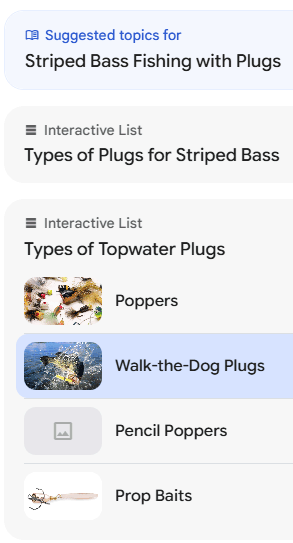
Interactive List User Interface

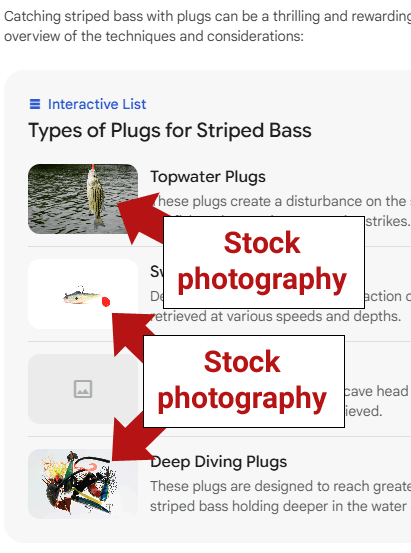
Learn About’s Interactive List exploration menus are illustrated with images, which is appealing because humans are visually oriented. That makes it faster to comprehend the written content because the image reinforces the text.

The images in the interactive menu appear to be licensed from stock image providers like Shutterstock, Adobe, and Alamy. None of the images appear to be sourced from creator websites.

Screenshot Of Interactive List Navigational Menu

Questions trigger a summary and a drill down navigational menu that’s called an Interactive List. These search results lead to related topics and progressively granular summaries, more Interactive Lists.

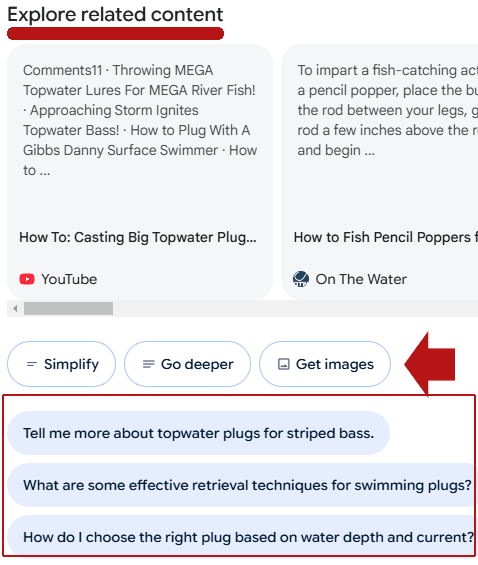
Beneath the Interactive Lists is a section called “Explore related content” that offers links to actual human created content like YouTube videos and website content.

Beneath the links to creator content is a group of buttons labeled with options to Simplify, Go deeper, or Get images. Beneath those three choices are speech balloons with additional search queries on related topics.

Screenshot Of Explore Related Content Section

There is also a left-hand navigational menu with an invitation to explore using Interactive List menu.

Screenshot Of Left-Hand Navigation

Availability Of Learn About

Learn About is only available to users who are 18 or older in the United States and is available in in English.

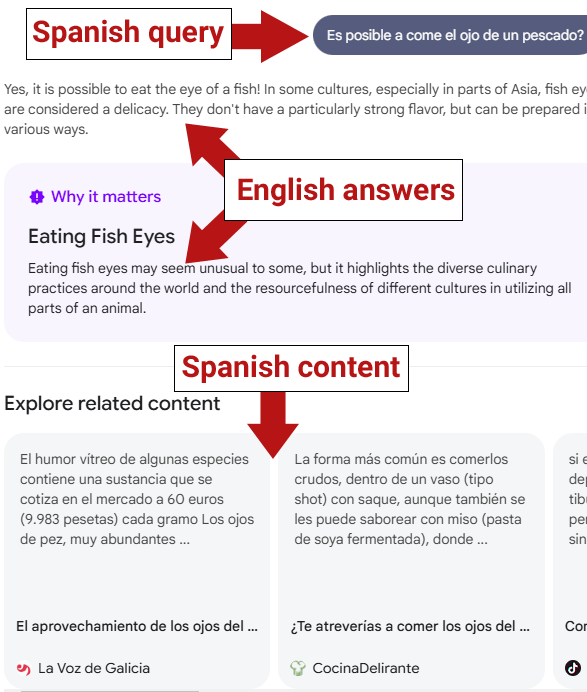
Interestingly, it also answers questions in Spanish but then quickly erases the Spanish answer and replaces it with a statement that it doesn’t speak that language yet. But if you ask it a question in English followed by another question in Spanish then it may answer the question in English and provide links to Spanish language human created content. As shown in the image below, Google Learn About will not only understand and answer a Spanish language query.

Learn about will also understand it when the query contains a typo. The query below contains a typo of the word “comer” which is missing the letter “r.”

The Spanish language query I tried was “Es posible a comer el ojo de un pescado” which means, “is it possible to eat the eye of a fish?”

Screenshot Of Spanish Language Query In Learn About

Privacy Controls

Google’s Learn About has privacy controls that are explained in a consent form that must be agreed to before using Learn About.

It contains information about how Google handles questions, a warning to not ask questions of a personal and private nature and details about managing the information saved by Learn About. It also says that human reviewers may access information shared with Learn About but that it will be stripped of identifying information.

The consent agreement explains:

“Google stores your Learn About activity with your Google Account for up to 18 months.

You can choose to delete your Learn About data any time by clicking the settings button next to your Google account profile photo in Learn About and then choosing “Delete activity”.

To help with quality and improve our products (such as generative machine-learning models that power Learn About), human reviewers read, annotate, and process your Learn About conversations. We take steps to protect your privacy as part of this process. This includes disconnecting your conversations with Learn About from your Google Account before reviewers see or annotate them.

Please don’t enter confidential information in your conversations or any data you wouldn’t want a reviewer to see or Google to use to improve our products, services, and machine-learning technologies.”

Google Learn About And SEO

There is no hint about whether this will eventually be integrated into Google Search. Given that it’s a part of Google’s Learning Initiative it’s possible that it could become a learning-only tool.

Try Learn About, an experimental project of Google Labs.

Featured Image by Shutterstock/Cast Of Thousands