Anthropic Announces Free Claude AI Chatbot For Android via @sejournal, @martinibuster

Anthropic announced the release of a new Claude Android app that uses their powerful Claude 3.5 Sonnet language model. The app is available free (with usage limits) and also with paid plans.

Anthropic Claude

Claude is a powerful AI chatbot that offers advanced reasoning, can do real-time image analysis, and can translate languages in real-time. Claude 3.5 Sonnet is Anthropic’s most advanced language model, introduced in late June 2024.

According to Anthropic:

“Claude 3.5 Sonnet raises the industry bar for intelligence, outperforming competitor models and Claude 3 Opus on a wide range of evaluations, with the speed and cost of our mid-tier model, Claude 3 Sonnet.

Claude 3.5 Sonnet sets new industry benchmarks for graduate-level reasoning (GPQA), undergraduate-level knowledge (MMLU), and coding proficiency (HumanEval). It shows marked improvement in grasping nuance, humor, and complex instructions, and is exceptional at writing high-quality content with a natural, relatable tone.”

Claude By Anthropic Android App

The Claude AI chatbot app is currently available for iOS and now it’s available from the Google Play store for Android users. Downloading and signing up is easy. Once signed in and verified users can start using Claude absolutely free. I downloaded it and gave it a try and was pleasantly surprised at its ability to help create a ramen recipe from scratch. A cool feature of the app is that it can continue chats from other devices.

The official announcement described various ways it’s useful:

“Use Claude for work or for fun. Whether you’re drafting a business proposal between meetings, translating menus while traveling, brainstorming gift ideas while shopping, or composing a speech while waiting for a flight, Claude is ready to assist you.”

Download the Claude by Anthropic Android App from Google Play:

Claude by Anthropic

Read the official announcement:

Claude Android app

Content Mapping for Customer Journeys

Content mapping is a marketing technique that matches messages to meaningful stages in a shopper’s online buying journey.

The technique requires understanding shoppers’ motivations throughout the purchase process. Marketers can use this knowledge to create relevant, value-packed content to attract, engage, and retain shoppers.

Getting Started

An ecommerce content map starts with completing three tasks.

  • Know the customers. At each phase of a buying journey, what is a customer’s motivation?
  • Know the products. What value do the products deliver to shoppers? What differentiates the items sold or the store itself?
  • Catalog content. What content has the business already produced? How does that content align with shoppers’ buying journeys and the products’ value?

A Buying Journey

While each task is important and nuanced, let’s focus this article on knowing the customers — their journeys from consideration to post-purchase.

A few models help us understand how a consumer becomes familiar with a brand or product and eventually makes a purchase. One that works well for content mapping is McKinsey & Company’s Customer Decision Journey framework, which has four buying phases.

  • Initial consideration. A person has a need and begins looking for a product.
  • Active evaluation. The person gathers information and compares options.
  • Closure. Satisfied with the evaluation, the person makes a purchase.
  • Post-purchase. The customer experiences the product and forms an opinion on future buys.

A merchant’s marketing team should interview customers and prospects to understand what motivated them at each phase. The goal is identifying what content would help move the shopper toward an eventual purchase.

AI-generated image of a female hiking in the desert.

A content map requires understanding the particulars of a buyer’s journey, such as why someone who moved to Arizona from Mississippi might need skin cream.

Consider a practical example. Margo moved from humid and moist Mississippi to arid Arizona because of a new job.

She soon noticed that her elbows, heels, and knuckles had dried out, cracked, and started to itch. The water-based lotion she had used for decades did nothing to help. She needed something better. Margo has entered the initial consideration phase.

Margo searches Google as she actively evaluates her dry skin options. She learns that creams have relatively more oil than lotions and thus work better in arid climates.

During the active evaluation phase, Margo found a video demonstrating how lotion dried out a chamois cloth. The video was brilliant content marketing from a direct-to-consumer cream brand. Margo enters the closure phase and is ready to purchase from the shop that produced the helpful video.

When the new tub of cream arrives, Margo experiences its regenerative capabilities. She is in the post-purchase phase. The cream met her expectations. She will likely purchase from that shop again and be open to additional recommendations.

Content Mapping

Armed with an example, a content marketer can compare and associate the value of the company’s products, its existing content, and what motivated the shopper at each phase.

The marketer will identify and fill content gaps and develop a comprehensive story that engages a shopper like Margo throughout her buying journey. This is content mapping.

The specifics of how a marketing team executes the content map will differ from one merchant to another. Nonetheless, there is a common structure.

Let’s continue the example of a business selling skin creams and use Margo’s story to represent customers with similar motivations.

Initial consideration

  • Margo’s motivation. Find a solution for her dry and itchy skin.
  • Merchant’s marketing objective. Make Margo aware of the brand and educate her about possible solutions.
  • Types of content. Blog posts about moving to Arizona and dry skin care. YouTube videos about the same, engaging social media content, and easy-to-understand infographics about why certain products are effective in dry climates.

Active evaluation

  • Margo’s motivation. Understand which products are most effective for her needs.
  • Merchant’s marketing objective. Provide comprehensive information that addresses her questions and helps compare options.
  • Types of content. Detailed guides comparing creams and lotions and persuasive video demonstrations, such as the chamois cloth example, will help Margo understand her dry skin and the products that can help. This phase is also a good time to employ customer testimonials to build trust.

Closure

  • Margo’s motivation. Ready to purchase a product that promises better results than her lotion.
  • Merchant’s marketing objective. Make the purchase process easy and reassuring, emphasizing the product’s quality.
  • Types of content. Product pages featuring detailed descriptions and reviews, clear FAQs addressing common concerns, and more social proof to encourage purchase.

Post-purchase

  • Margo’s motivation. Experience the cream’s promised results and consider future purchases.
  • Merchant’s marketing objective. Ensure Margo is satisfied, encourage repeat business, and foster brand loyalty.
  • Types of content. Follow-up emails providing usage tips and additional product recommendations, invitations to join a loyalty program, how-to guides to maximize product benefits, and surveys to collect feedback for continuous improvement.

Suggesting a blog post or video about dry skin in Arizona for the initial consideration phase is very different from writing or producing it. But creating is beyond the purpose of a map aligning content with the buyer’s journey. Creating is where content marketing comes in.

AI Unravels Payment Processing Statements

Determining the true costs of credit card processing can be complicated. Business owners customarily divide total fees by the number of transactions to arrive at an effective rate. Over time, however, as payment service providers introduced alternative fee structures, pricing models, and payment methods, statements became confusing, both for merchants and competing providers trying to win their business.

AI-powered tools can analyze merchant statements more efficiently than humans and deliver competitive proposals in minutes instead of days. Practical Ecommerce discussed with payment pros the opportunities and challenges of using artificial intelligence to evaluate transaction histories, pricing, and data.

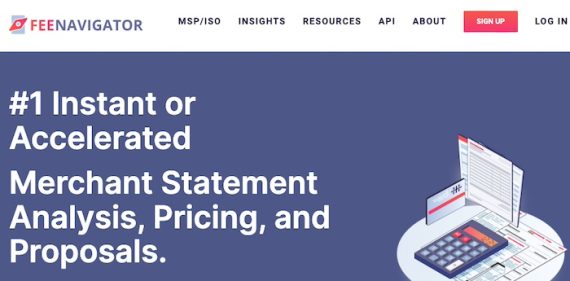
Fee Navigator home page

AI-powered tools such as Fee Navigator help merchants know the total cost of credit card processing.

Messy Statements

Caroline Hometh, managing partner at RPY Innovations, a payments consulting firm, helps clients navigate the inconsistencies in merchant fee structures and nomenclature.

“Our industry is notorious for using opaque and inconsistent language when describing fee structures, which I think is done intentionally,” she said. “This is partly because the whole system is so complicated that it is near impossible to describe every element of each transaction accurately. It is also partly due to the belief that the less understood, the better.”

While it can quickly calculate an overall effective rate, AI can only approximate all the interchange, fees, assessments, processing fees, product fees, and acquirers fees, Hometh said, because those fees are specific to individual providers.

AI Platforms

AI tools have emerged to help merchants and payment service providers simplify and expedite statement analysis. Examples are Staitment, established in 2018 by Swipesum, a consultancy, and Fee Navigator, launched the following year. Both are processor-agnostic platforms that the companies claim can analyze statements in seconds.

Michael Seaman, CEO of Swipesum, has seen merchants misinterpret processing fees and assessments. “Many merchants overlook the fact that their processing rates are often about 80% higher than they should be,” he said. “Additional fees, such as PCI compliance fees, gateway fees, and authorization charges, are also frequently missed. Interchange fees are assumed to be billed at cost but are often padded, leading to higher costs.”

Web page of Staitment

Staitment, a processor-agnostic platform, can analyze payment processing statements in seconds.

Adrian Talapan, co-founder and CEO of Fee Navigator, suggested that payment providers could do more to help merchants understand transaction pricing and qualify for the best possible rates.

“One of the biggest mistakes that merchants make is not understanding that their effective rates include card brand interchange and fees, and delivery costs such as processor statement fees, PCI compliance, and others,” he said. “They may be quoted the lowest possible qualified rate, but their true effective rate is inclusive of all costs.”

Expanding Choice

A new fintech, Rift, has brought the marketplace model to payment processing with an open AI-powered platform where merchant service providers compete for customers.

Stephen Martin, co-founder and CEO of Rift, said ecommerce merchants can use Rift’s marketplace to gain transparency into all related cost factors.

“Our platform not only uncovers hidden fees and provides a detailed breakdown of processing costs but also allows merchants to receive competitive bids from top-rated processors,” he said. “This empowers informed decisions, optimizes expenses, and saves money.”

Martin went on to say that ecommerce merchants have unique pricing models and their merchant statements include CVV and AVS checks, which are used to verify customers and mitigate fraud. These additional data points tend to make the reports more complicated.

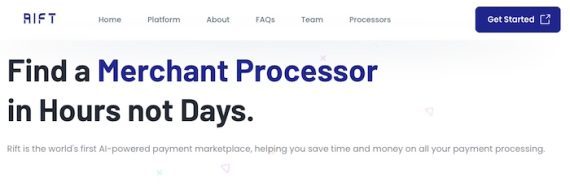
Home page of Rift

Rift is an AI-powered marketplace of payment processing providers.

Seaman of Swipesum agreed, stating, “Typically, card-not-present transactions incur higher costs, along with additional gateway fees and technology upcharges. While there are potential discounts and cost savings, ecommerce merchants often face high fees that go unchecked.”

Some ecommerce platforms boost their revenue through these fees, Seaman explained, citing Shopify as an example. Shopify’s Merchant Solutions revenue rose by roughly 20% to $1.4 billion in the first quarter of 2024, largely driven by the growth of Shopify Payments.

Talapan of Fee Navigator noted that small and midsize ecommerce merchants usually pay a flat rate and a per-transaction charge, while larger enterprises negotiate interchange-plus pricing. In all cases, merchants tend to focus on capabilities as much as pricing. For example, a merchant might be willing to pay more for global payment acceptance, recurring or custom pricing schemes, or ease of integration.

Agility, Accuracy

Swipesum’s Seaman pointed out that AI software can evaluate a merchant statement on the spot, while manual audits can take a week or more. Intelligent software can find cost-saving opportunities, he said, and replace labor-intensive processes with immediate, comprehensive analysis.

“A manual audit by an expert usually takes about a week,” he said. “A [software-based] solution provides instant results, identifies opportunities for cost savings, and offers a comprehensive, immediate analysis.”

Talapan mentioned that on-the-spot analyses have changed the game for service providers and merchants. “We saw some sales reps lose money on incorrectly priced deals,” he said. “Others waited days to get an analysis done by their bank or processor.”

Before instant statement analysis, Talapan noted, merchant sales reps had no easy way to reach customers at scale with tailored offers. Now reps can offload number crunching to AI assistants, he said, while they focus on selling.

Hometh of RPY Innovations noted that accuracy is just as important as speed when analyzing merchant statements. “It is not about how fast you can review a merchant statement and provide a lower rate, but rather about delivering an appropriately nuanced comparative view.”

Shop Around

Seaman proposed that auditing merchant statements can reveal key performance indicators, such as average ticket size, cards accepted, transaction types, ancillary fees, and interchange discounts. He advised ecommerce merchants to look for a payment processor with deep experience in the card-not-present market and to monitor fees and pricing constantly. Routinely compare original processing agreements with statements, he added, to expose any pricing changes.

Rift’s Martin encouraged business owners to shop around. “Many ecommerce merchants are unaware of the options available for credit card processing,” he said. “They often assume that they must use the processing services provided by their ecommerce software company. However, there are numerous payment processors to choose from, and exploring these options can significantly enhance their ability to secure competitive rates.”

Hometh characterized AI tools as new and evolving, questioning their ability to interpret subtle nuances in merchant statements. “AI is very good at patterned analysis but not yet ready to call out the patterns that matter,” she said. “Can AI recognize the initial or original agreement to reflect what the merchant should pay?”

She advised merchants to balance AI tools with human oversight, noting that AI’s ability to recognize variations in terminology or fees remains an open question.

CMOs Under Pressure: The Unseen Challenges In B2B Marketing via @sejournal, @MattGSouthern

A recent study of 121 B2B CMOs and marketing leaders has uncovered current marketing industry challenges.

The study by Bospar, CMO Huddles, and Redpoint examines the concept of an “underground recession” in marketing departments and its implications for professionals in the field.

Key findings include:

  • Budget constraints and their impact on marketing strategies
  • Changing deal cycles and their effects on revenue
  • Staffing challenges and increased pressure on marketing teams
  • Evolving CMO roles and job market trends

Read on for a data-driven exploration of the current state of B2B marketing.

Marketing Industry In A “Hidden” Recession

Despite positive macroeconomic indicators, including a 9.34% increase in the S&P 500 since the beginning of 2024, marketing departments are experiencing a different reality.

The survey found that 69% of respondents believe their industry is in a recession, while 61% feel that the overall unemployment rate doesn’t accurately reflect the situation in their sector.

Key Challenges Facing CMOs

The study identified four main trends making the job of marketing leaders increasingly difficult:

  1. Budget Cuts & Revenue Declines: 77% of marketing leaders reported flat or reduced budgets, with 38% experiencing cuts of at least 3%.
  2. Longer Deal Cycles: 54% of respondents noted extended sales cycles, impacting revenue timing and marketing budgets.
  3. Staffing Cuts & Layoffs: Half of the surveyed companies experienced layoffs, with 41% seeing cuts within their marketing departments.
  4. Pressure to Deliver More with Less: 69% of marketing leaders were asked to do more with reduced budgets in the past year.

Personal & Professional Toll on CMOs

The pressures of the current economic environment are reportedly taking a toll on marketing leaders.

67% of respondents reported that the past year’s challenges have impacted their overall well-being.

Many experienced adverse effects, including reduced exercise (80%), less time off (70%), and weight gain (40%).

Declining Job Prospects For CMOs

The study also highlighted a concerning trend in the job market for CMOs.

LinkedIn data shows a 62% decrease in CMO job postings in the United States from February 2023 to February 2024.

This decline is partly attributed to companies consolidating marketing responsibilities under other C-suite roles.

Adapting To The New Reality

Despite these challenges, industry experts emphasize the need for CMOs to adapt and evolve their strategies.

MarTech entrepreneur Jon Miller suggests that “the old playbooks just aren’t working anymore, and it’s time for a new playbook (and new technology) that aligns with modern buyers.”

Drew Neisser of CMO Huddles recommends four key areas for CMOs to focus on:

  1. Role expansion beyond traditional marketing duties
  2. Metrics expansion to demonstrate marketing’s full value
  3. Idea concentration to maximize impact with limited resources
  4. AI implementation to drive innovation and efficiency

Why Does This Matter?

This study shows what’s happening in marketing beyond the rosy economic headlines.

It matters because:

  • It explains why your job might feel harder lately.
  • It shows we need to get creative with our strategies.
  • It highlights why proving marketing’s value is so important right now.

What Does This Mean For You?

Here’s what you should keep in mind:

  • Learn skills that clearly show your worth, like data analysis.
  • Get ready to do more with less – focus on what really matters.
  • Look for ways to expand your role in the company.
  • Network more – it could help you find new opportunities.
  • Keep learning about new trends and tools.
  • Take care of yourself – everyone’s feeling the pressure, not just you.

Featured Image: Ground Picture/Shutterstock

Google’s Web Crawler Fakes Being “Idle” To Render JavaScript via @sejournal, @MattGSouthern

In a recent episode of the Search Off The Record podcast, it was revealed that Google’s rendering system now pretends to be “idle” to trigger certain JavaScript events and improve webpage rendering.

The podcast features Zoe Clifford from Google’s rendering team, who discussed how the company’s web crawlers deal with JavaScript-based sites.

This revelation is insightful for web developers who use such methods to defer content loading.

Google’s “Idle” Trick

Googlebot simulates “idle” states during rendering, which triggers JavaScript events like requestIdleCallback.

Developers use this function to defer loading less critical content until the browser is free from other tasks.

Before this change, Google’s rendering process was so efficient that the browser was always active, causing some websites to fail to load important content.

Clifford explained:

“There was a certain popular video website which I won’t name…which deferred loading any of the page contents until after requestIdleCallback was fired.”

Since the browser was never idle, this event wouldn’t fire, preventing much of the page from loading properly.

Faking Idle Time To Improve Rendering

Google implemented a system where the browser pretends to be idle periodically, even when it’s busy rendering pages.

This tweak ensures that idle callbacks are triggered correctly, allowing pages to fully load their content for indexing.

Importance Of Error Handling

Clifford emphasized the importance of developers implementing graceful error handling in their JavaScript code.

Unhandled errors can lead to blank pages, redirects, or missing content, negatively impacting indexing.

She advised:

“If there is an error, I just try and handle it as gracefully as possible…web development is hard stuff.”

What Does This Mean?

Implications For Web Developers

  • Graceful Error Handling: Implementing graceful error handling ensures pages load as intended, even if certain code elements fail.
  • Cautious Use of Idle Callbacks: While Google has adapted to handle idle callbacks, be wary of over-relying on these functions.

Implications For SEO Professionals

  • Monitoring & Testing: Implement regular website monitoring and testing to identify rendering issues that may impact search visibility.
  • Developer Collaboration: Collaborate with your development team to create user-friendly and search engine-friendly websites.
  • Continuous Learning: Stay updated with the latest developments and best practices in how search engines handle JavaScript, render web pages, and evaluate content.

Other Rendering-Related Topics Discussed

The discussion also touched on other rendering-related topics, such as the challenges posed by user agent detection and the handling of JavaScript redirects.

The whole podcast provides valuable insights into web rendering and the steps Google takes to assess pages accurately.

See also: Google Renders All Pages For Search, Including JavaScript-Heavy Sites


Featured Image: fizkes/Shutterstock

CWV & Google Page Experience Ranking Factor Updated via @sejournal, @martinibuster

The June 2024 Chrome User Experience Report (CrUX) is out and it shows that websites in the real-world experienced an averaged across the board improvement in all Core Web Vitals (CWV) website performance scores. Some of the improvements are attributable to a change in how Interaction To Next Paint is measured, which will be good news to websites with dialog modals (popups).

CrUX Dataset

The CrUX dataset consists of actual Core Web Vitals performance scores as measured in Chrome browsers when visiting websites. The data comes from browsers that were voluntarily opted in to report website performance metrics. The CrUX dataset is publicly available and is used by PageSpeed Insights, third party tools.

CrUX Influences Page Experience Ranking Factor

The CrUX report is used for Google’s Page Experience Ranking Factor. The data is publicly available and can be used for evaluating performance, including competitor performance. CrUX is important because it is one of the only metrics that a website publishers can check that have something to do with a website ranking factor.

According to Google’s overview documentation:

“The data collected by CrUX is available publicly through a number of Google tools and third-party tools and is used by Google Search to inform the page experience ranking factor.”

While the influence of the Page Experience Ranking Factor may be on the lower side, it’s still important for reasons outside of algorithms like improving conversions and ad clicks.

June 2024 Dataset

The dataset for June 2024 has been published and it shows that Core Web Vitals (CWV) website performance scores have incrementally risen across the board by modest percentages. This shows that website performance continues to be a focus for websites. Most of the popular content management systems are doing their best to improve, with WordPress making positive improvements with each new version that’s released.

The following scores are for origins. Origins are the entire website, which is different from Pages.

These are the average origin scores:

  • Largest Contentful Paint (LCP)
    This is a measurement of how fast the main content of a page loads. It specifically measures the largest image or content block that’s visible in a browser (viewport).
    63.4% (↑ 2.0%) had good LCP
  • Cumulative Layout Shift (CLS)
    Measures how long it takes for web page layout to become stable without elements jumping and shifting on the page.
    77.8% (↑ 0.5%) had good CLS
  • Interaction to Next Paint (INP)
    INP measures how long it takes for a web page to become responsive to user interactions
    84.1% (↑ 1.1%) had good INP
  • Percentage Of Sites With Good CWV
    This is the percentage of sites that had passing scores across all three Core Web Vitals metrics
    51.0% (↑ 2.3%) had good LCP, CLS and INP

Changes To INP Measurements

Chrome made changes to how long it takes for a page to become interactive (Interaction to Next Paint – INP) is measured, making it more accurate. This may have helped to increase the scores of some sites that were inadvertently ranked lower for INP because the metric failed to account for some kinds of popups.

The Chrome team explained:

“The Chrome team has been continuing work on improving efficiencies in Chrome’s handling of the Core Web Vitals metrics and recently launched some changes to INP which may have contributed to the positive trend this month. The most notable change is to better handle use of the basic modal dialogs (alert, confirm, print). While technically these are synchronous and block the main thread—and so are not recommended if there are alternatives—they do present user feedback for an interaction. They were previously not counted as presentation feedback for INP, which could result in very high INP values for sites that did use these. From Chrome 127 the presentation of the modal will mark the end measurement time for INP and so should lead to improved INP times for those sites.”

Read the June 2024 CWV Announcement

The 202406 dataset is live

Featured Image by Shutterstock/Ivan Dudka

What 4,538 Domains Tell Us About ccTLDs Ranking In The US via @sejournal, @Kevin_Indig

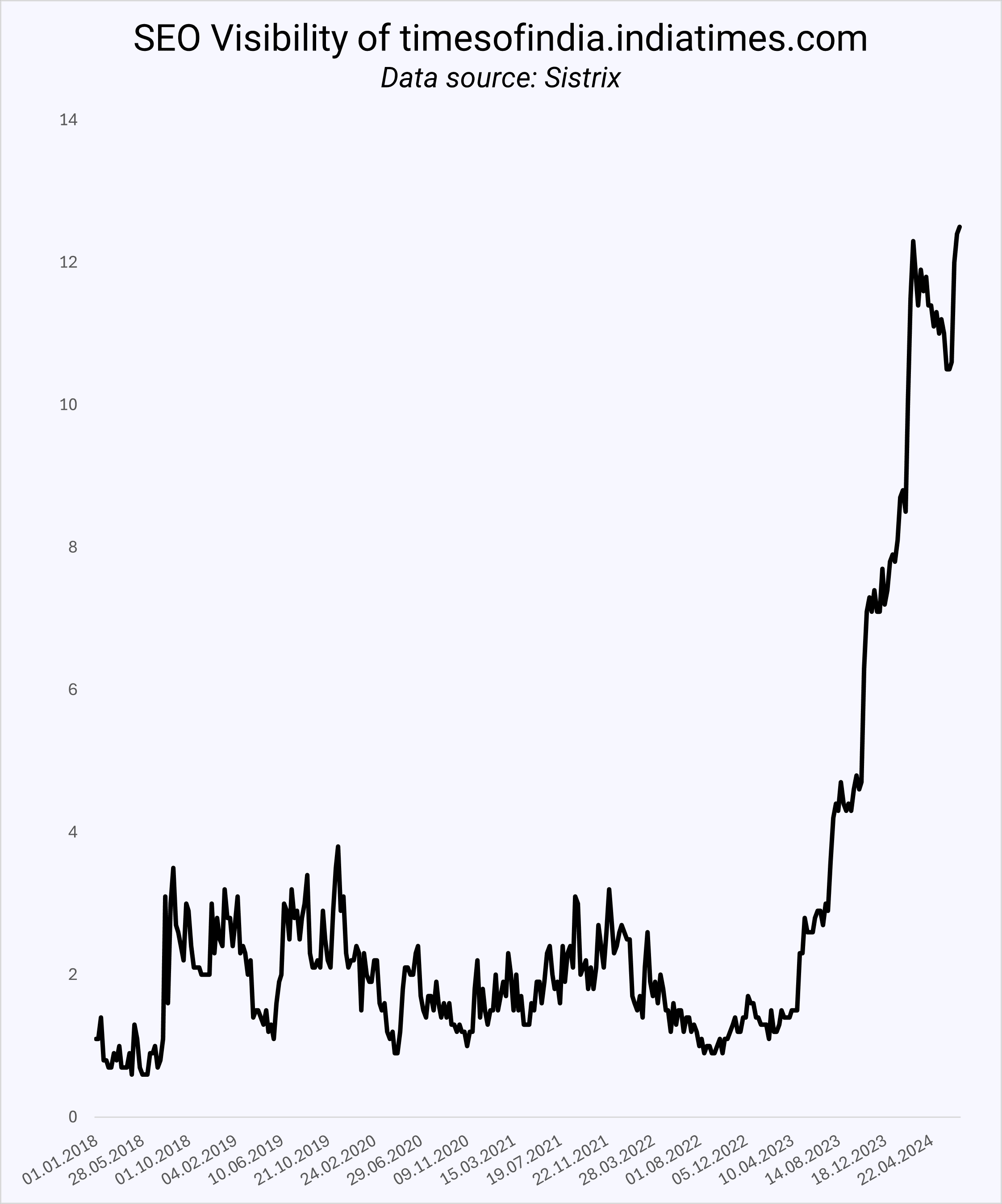
Since the Times Of India quadrupled its organic growth in the US in 12 months, more ccTLDs (international domains) have been spotted ranking in the US.

SEO Visibility of timesof india.comImage Credit: Kevin Indig

More international domains would make sense as Google is testing country labels indicating where the site operates.

Google has also expanded Translated Results:

Translated Results is a Google Search feature that will automatically translate the title link and meta description into the local language of a user, making a website published in one language available to a searcher in another language. If the searcher clicks on the link of a translated result the web page itself will also be automatically translated.

Maybe Google wants more international domains in US Search? If a site in English from another country is a better result in an English-speaking country, why not rank it?

International domains might be most relevant when the location matters less.

For example, publishers could rank in other countries with the same language, but SaaS or ecommerce companies that don’t sell in that specific country would not be a good result. As a result, the playing field for “foreign” domains would grow.

Boost your skills with Growth Memo’s weekly expert insights. Subscribe for free!

Do More ccTLDs Rank In The US?

I picked 1,000 random keywords from a large pool of queries across travel, ecommerce, publishing, SaaS, services, finance, health, and other verticals.

The data surfaced 4,538 domains in organic results. I focused heavily on the first five positions on Google since any URL ranking higher than that likely won’t see much traffic, especially with the flux of SERP features these days.

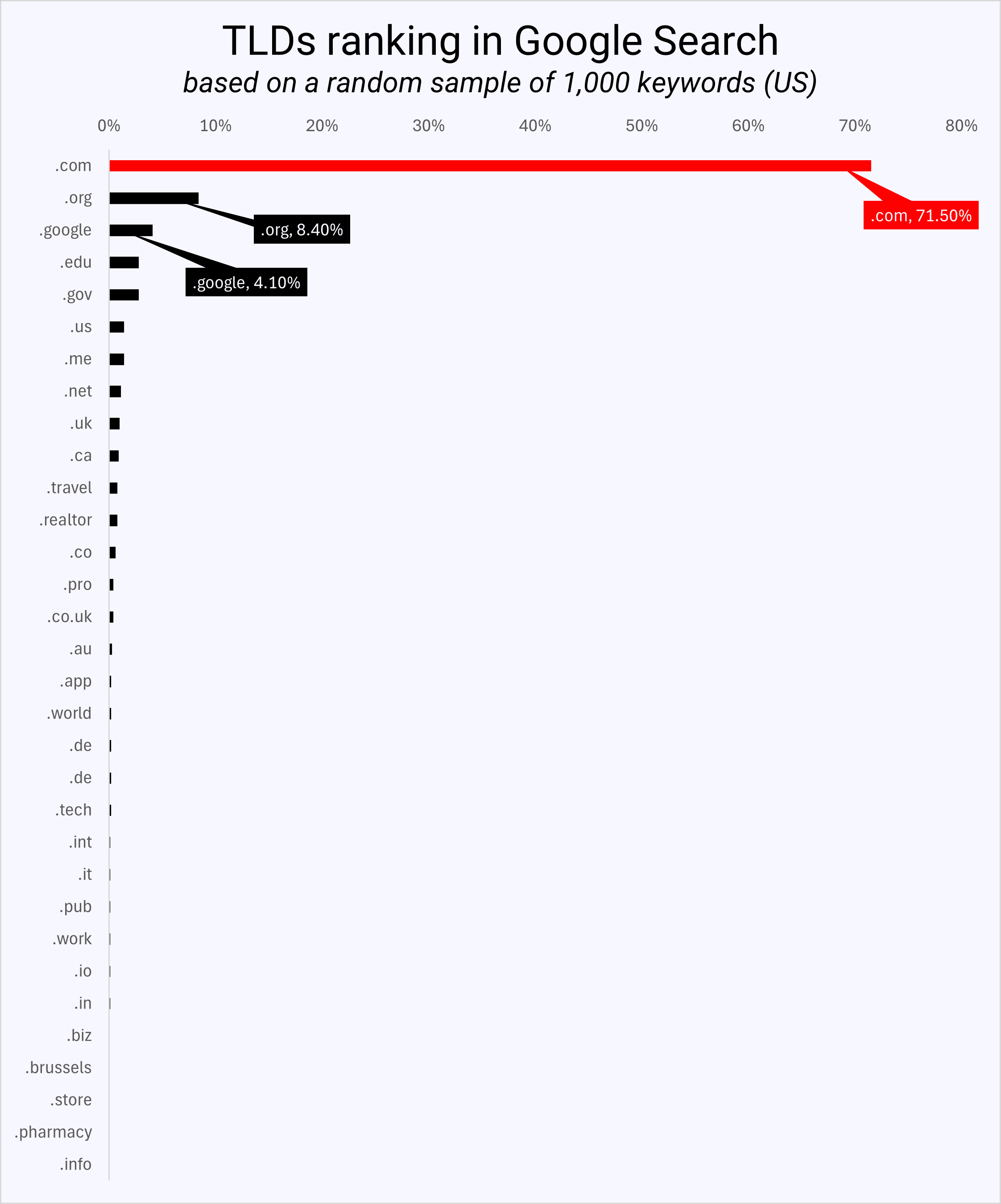
TLDs ranking in Google SearchImage Credit: Kevin Indig

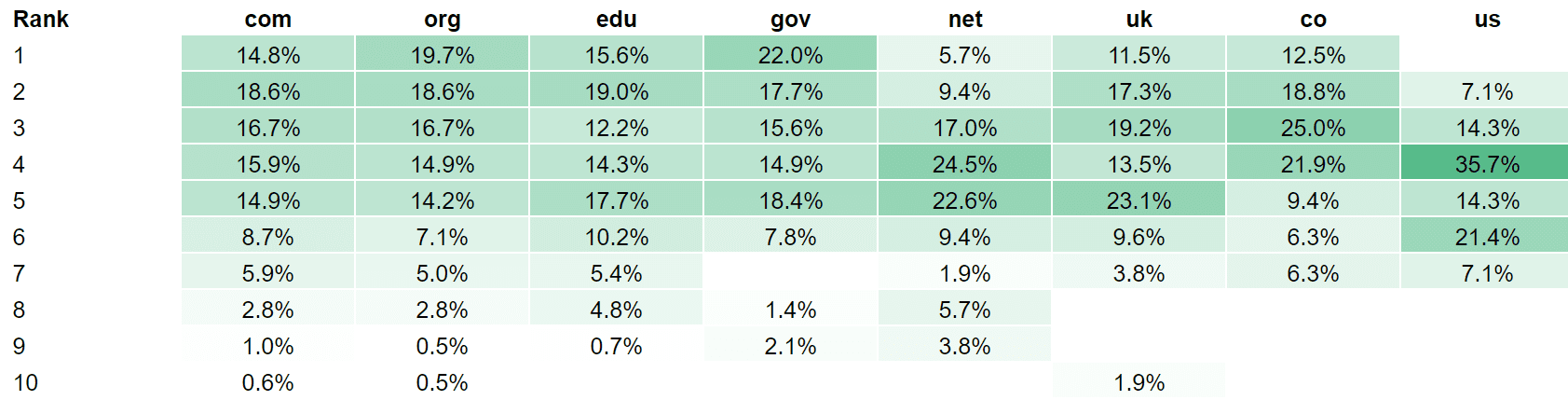
The data shows that .com domains rank 71.8% of the time in the top five positions, followed by .org (8.4%), .google (4.1%), .edu and .gov. Only 52 out of 4,538 domains were from the UK, 11 from Canada, and three from India.

As a result, we can say that international domains performing in the US, like the Times of India, are outliers more than the norm.

What Else Can We Learn From The Data About URL Structure?

The dataset of 1,000 random keywords provides more insights into the nature of TLDs, subdomains, and URL slugs in terms of organic ranks.

TLD Matters A Bit

I wanted to find out if the TLD (.com, .net, .org, etc.) has an impact on ranking. Traditionally, we know that ccTLDs (country-code TLDs like .fr) have a better chance of ranking in their respective country than gTLDs (generic TLDs like .com), which are country-agnostic.

I ran correlations between TLDs and rank across 7,678 results while normalizing for factors around backlinks, content quality, content volume, and rank distribution – but I couldn’t find any relationships. I found that:

  • .net TLDs have a lower chance of showing up in the top two positions.
  • .us didn’t show up in top positions at all (even though I know a .us domain that performs really well).
  • .gov has the best chance to rank at the top – go figure.
  • .uk has a lower chance of ranking at the top compared to .com.
  • .co has a lower chance of ranking at the top than .com.
  • .edu doesn’t perform as well in position 1 compared to .gov.
  • .org has a higher chance of ranking at the top than .com (might be influenced by Wikipedia).
  • .com TLDs rank 71.8% in the top 5 but are registered only 36.31% as often compared to other TLDs (~2x).
TLD by average rank in organic searchTLD by average rank in organic search (Image Credit: Kevin Indig)

The rank benefit of a .com domain is disputable: Due to mere exposure, users are more familiar with .com domains, which means sites might be more likely to link to them, too.

Even if .com domains got a small rank boost from Google, it most likely doesn’t outweigh the importance of content, backlinks, brand, and user experience.

URL Slugs Matter A Bit

Next, I wanted to answer whether having the keyword in the URL slug, the part after the TLD, matters.

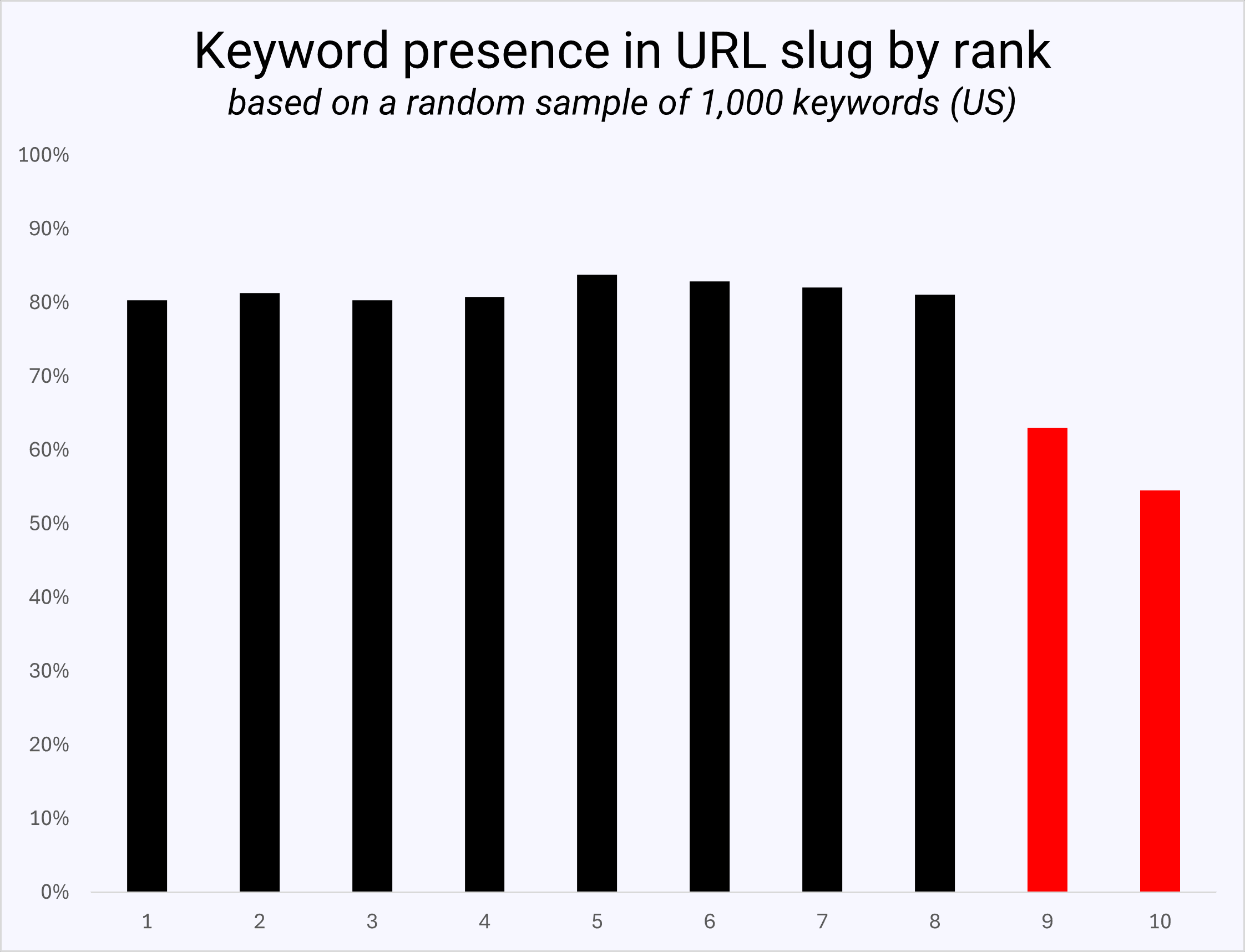
The data shows no advantage to having the keyword in the URL slug for ranking in the top eight positions. However, URLs ranking in positions 9 and 10 carried the keyword way less often, indicating that its tables take to “apply” for the top results.

Keyword presence in URL slug by rankImage Credit: Kevin Indig

In conclusion, scanning for the keyword in the URL or meta title was and is a low-hanging fruit SEO exercise.

From experience, optimizing the slug just to match the keyword is not worth the cost of a redirect. It should be taken into consideration more when creating a new URL.

Subdomains Matter A Lot

Lastly, I was curious whether (non-www) subdomains have an impact on rank.

In Google’s ranking factor leak, we learned that keyword exact-match domains (EMDs) were demoted many years ago. Google also evaluates subdomains separately from root domains, which makes sense because they have a different DNS address.

www vs non-www subdomains by rankImage Credit: Kevin Indig

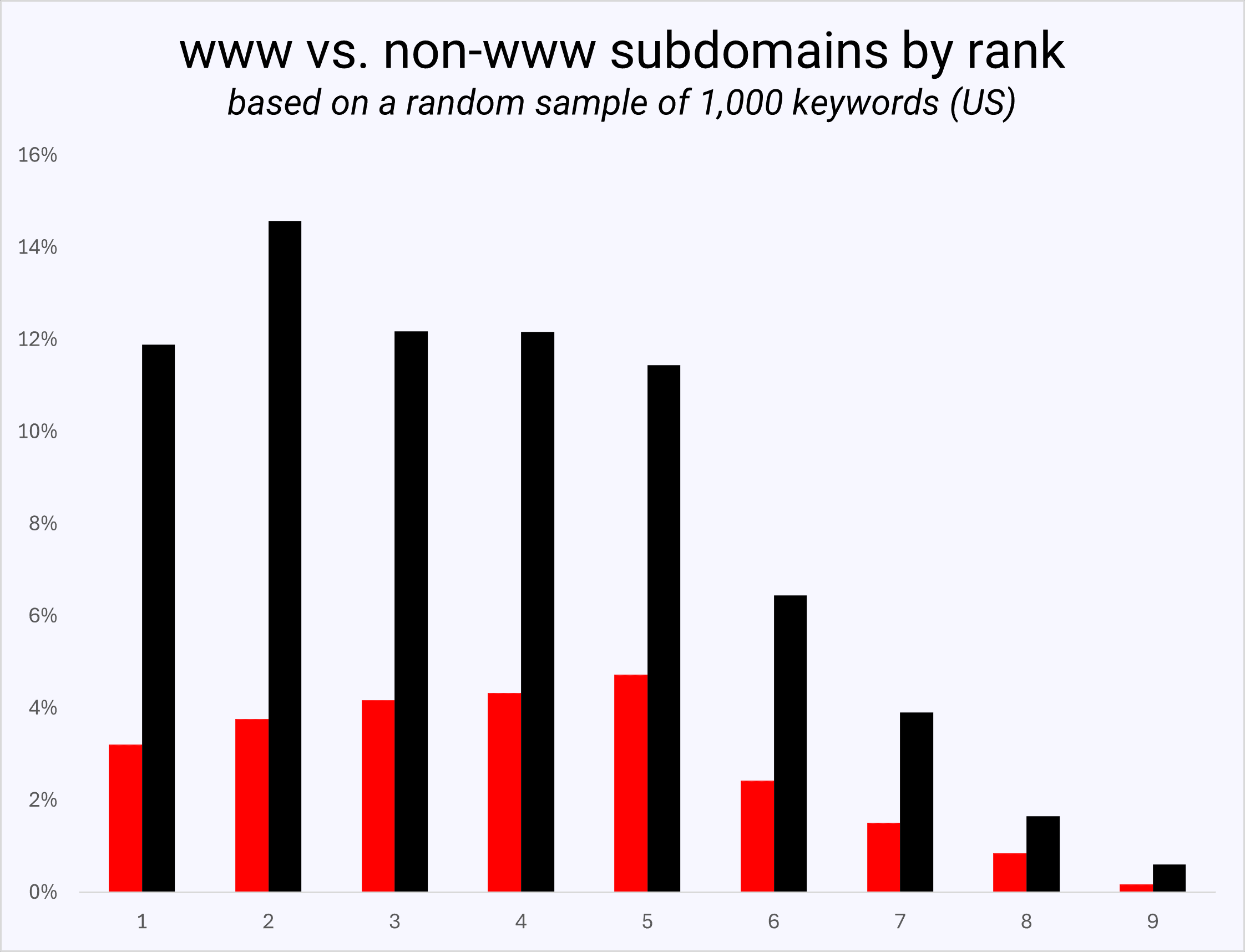
I found in the data that URLs, including www, show up on average thrice as often in the top five results as non-www subdomains.

That ratio shrinks as we go further down the SERPs, meaning there does seem to be a benefit of avoiding subdomains, even though we always have to consider the non-SEO benefits of subdomains.


 Google Tests Country Label In Search Result Snippets

Google’s Now Translating SERPs Into More Languages

Top level domains


Featured Image: Paulo Bobita/Search Engine Journal

Business Outcomes Are The Top KPI Of Video Ad Buyers – IAB Report Part Two via @sejournal, @gregjarboe

The IAB has just published the second part of its “2024 IAB Digital Video Ad Spend & Strategy Report,” and the key criteria for digital video investments have fundamentally changed.

Since August 2007, when YouTube started offering video advertising, brands, and their agencies have always prioritized reach and frequency.

However, business outcomes have now become the primary success metrics. Despite this sea change, measurement still faces significant challenges, according to Cintia Gabilan, IAB’s VP of the Media Center.

In a press release, Cabilan said:

“The industry has bought, transacted, and measured against reach since the beginning of time.”

She added:

“But now business outcomes are the most important metrics to assess success, with reach and frequency coming in second. However, measurement is not yet where it needs to be. Two-thirds of buyers cite issues across nine key areas of measurement.”

The 2024 IAB Digital Video Ad Spend & Strategy Report Provides Essential Insights

Released at the IAB Video Leadership Summit (VLS), the second part of the report provides essential insights:

Three-Quarters Of CTV Buying Is Programmatic

  • CTV activation is almost evenly split among real-time bidding (RTB)/open exchanges (36%), private marketplaces/preferred deals/programmatic guaranteed (34%), and ad networks (30%).

Increased Spend Across All Video Channels And Content Types

  • The first part of the report predicted increased spending in 2024 on major digital video channels. Part 2 reveals investments across all video types, including short-form (69%) and vertical-format (68%), which dominate buyer preferences.

Performance Advertising Needs Enhanced Measurement

  • Business outcomes such as sales, site visits, and leads are now top KPIs for buyers across all channels – social video (64%), online video (58%), and connected TV/CTV (54%).
  • Two-thirds of buyers face measurement issues, particularly smaller advertisers targeting niche audiences, who report problems with viewability, standardized targets, currency, and sell-side data. Streaming networks must improve these areas to gain buyer confidence.

Widespread Use of Alternative Measurement Methods

  • The industry is moving beyond traditional panel-based ratings, with 89% of advertisers engaging with alternative measurement vendors. Buyers prioritize multi-screen attribution (45%) and real-time reporting (43%), and 28% already use alternative currencies.

In the press release, David Cohen, IAB’s CEO, said:

“As the saying goes, ‘with great power comes great responsibility’.”

He added:

“With the continued impressive growth of digital video comes demands for better measurement, viewability, standardized data, and placement transparency. The video ecosystem must fully commit to innovation, especially in measurement.”

The IAB collaborated with Guideline, utilizing ad billing data, market estimates, and an IAB-commissioned Advertiser Perceptions survey of TV/digital video ad spend decision-makers to compile the report.

The complete “2024 IAB Digital Video Ad Spend & Strategy Report” is available here [gated].

Measurement Challenges: Co-Viewing

Many brands and their agencies will be tempted to start reading Section 1 of the report titled “Ad Spend Projections, content formats, and programmatic.”

Some media buyers will jump straight to Section 2 titled “Buyer Selection Criteria: Channels, Platforms and Ad Partners.”

But I began by analyzing and evaluating Section 3: “Measurement Challenges and Mitigation Tactics.”

Why start here?

Well, as I mentioned in a previous article, I’m a big fan of Yogi Berra, who once said, “If you don’t know where you are going, you might wind up someplace else.” Besides, I wanted to know more about the nine key areas of measurement that were creating issues.

And the top issue was a major surprise: co-viewing.

Here’s Google’s definition of co-viewing:

“When multiple people watch YouTube on a connected TV (CTV) device together and view an ad at the same time, it could lead to more impressions and reach for your campaign.” Google adds, “Panels show that multiple people are watching YouTube together on TV screens, a consumer behavior characteristic of linear television viewership as well.”

According to the report, co-viewing ranks ahead of placement transparency, brand safety/suitability, viewability, ads served on Made for Advertising (MFA) websites, ads served on TVs turned off, getting sell-side data, using multiple currencies, and standard sell-side targets.

The report quotes an unnamed director at an agency, who said, “Measuring co-viewing behaviors is particularly important because it directly affects our understanding of audience engagement and audience reach.

Without accurately capturing who is watching content together, we risk misinterpreting viewership data and making false assumptions about the preferences and behavior of our target audience.”

Measurement Issues Differ Greatly Depending On The Channel

Part 2 of the “2024 IAB Digital Video Ad Spend & Strategy Report” also finds that measurement issues differ greatly depending on the channel, especially with online video and CTV.

Online video encounters difficulties due to varying measurement frameworks at the publisher level, which complicates buyers’ understanding of placement, viewability, and guarantees.

Similarly, Connected TV (CTV) experiences challenges due to the absence of shared show-level data and inconsistent measurement methods.

In addition, small spenders report higher levels of concern regarding issues like viewability and brand safety compared to larger competitors. They tend to focus on targeting specific audiences rather than achieving mass reach, necessitating precise measurement.

However, they often lack the resources to hire measurement partners and encounter limited transparency from social platforms. Streaming networks aiming to attract more small spenders will need to build trust in these areas.

The report quotes an agency director, saying:

“Brand safety is most concerning because it is the brand’s image which is at stake. We want to control where our ads should be shown, whom to be shown to, what audiences to target, etc.”

Brands report higher levels of concern about issues like viewability and standardized targets compared to agencies.

Key factors include small- to mid-tier agencies lacking resources to hire measurement partners, having less measurement expertise, and being less involved in performance evaluation, which is usually managed by the agencies.

The report quotes the manager of a B2B brand, saying:

“A brand that can demonstrate that its visible impression is positive, professional and attractive is more likely to stand out in a competitive marketplace.”

With the rise of privacy-by-design, buyers increasingly use measurement tools that depend less on data signals. AI, data-driven optimization, multi-touch attribution (MTA), and marketing mix modeling (MMM) help buyers assess performance using modeled data as the available data pool shrinks.

In addition to supporting these tools, AI is also employed for measuring brand safety, suitability, and fraud (41%), as well as for predicting outcomes (32%).

The Use And Interest In Alternative Currencies

The report also found the use and interest in alternative currencies have become widespread. Currently, 89% of advertisers are engaged with alternative currencies in some capacity, whether through transactions, testing, or discussions with vendors.

Almost 30% of TV and video buyers are already using alternative currencies for transactions. On average, buyers are currently transacting or testing three different alternative currencies and expect this number to increase to four by 2025.

The primary reasons for using alternative currencies are multi-screen attribution and real-time reporting. Small spenders are more inclined to use alternative currencies for creative effectiveness (57%), conversion analytics (51%), and second-by-second reporting (51%).

The report quotes a department head of a B2B brand, who says:

“Real-time audience measurement metrics that capture cross-platform viewership, engagement, and demographic data are needed to adapt to evolving viewing habits and technologies.”

While alternative currencies offer potential advantages, widespread use is hindered by various challenges. These include the costs associated with implementing them, the complexities involved in their systems, and the need for cooperation across different industries.

The report quotes a department head at an agency, who says:

“Currency reconciliation can be challenging since different currencies may use different valuation techniques and exchange rates.”

Report Recommendations

Brands and agencies should read the section on “Measurement Challenges and Mitigation Tactics” before they tackle the last section of the report: “Recommendations.”

Why? Well, as Yogi may have said, “If you don’t know where you are going, you might wind up someplace else.” However, he might have said, “If you don’t know where you are going, you might not get there.”

Either way, you’ll need to overcome nine measurement challenges if the top KPIs of your video ad campaign are now business outcomes like store/site visits, leads, and sales.

All quotes and statistics cited above are taken from the 2024 IAB Digital Video Ad Spend & Strategy Report.

More resources:


Featured Image: BestForBest/Shutterstock

AI Has Changed How Search Works via @sejournal, @marie_haynes

This extract is from SEO in the Gemini Era by Marie Haynes ©2024 and reproduced with permission from Marie Haynes Consulting Inc.

Much of the SEO advice you will see online today is borne from shared community wisdom that was learned about Search in the days before Google was actively using AI.

So much of what many of us do as SEOs and treat as standard practice is based on a search engine that was a list of heuristics – handwritten rules programmed by humans. So much has changed.

For example, let’s say you are tasked with creating a new article for the website you are working on.

You’ll likely start with keyword research because we know that in order to appear relevant to a search engine, you need to write content that covers a topic thoroughly and uses keywords that are semantically related to your topic.

So much of the content that we have on the web today is borne from a process that looks like this:

  • Do keyword research to see what your competitors have written.
  • Create content that’s similar but perhaps a little bit better, or more comprehensive than theirs.
  • Do keyword research to see what other people have covered, but you have not included.
  • Create content that covers that stuff too.
  • Do People Also Ask research to find related questions to cover so that we can write content that looks even more relevant and comprehensive to search engines.
  • Create more content to answer those questions even though Google already has content to answer them.

Nothing in that process is causing us to create content that truly is original, insightful, and substantially more helpful than what exists online.

Yet, that is what Google wants to reward!

An SEO agency will often spend many hours each month improving the technical SEO of a site, improving the internal link structure, or perhaps getting external links and mentions. These are all things that can possibly help a webpage to look better to a search engine.

They are not bad things to do and some of them have the potential to help a site improve. But again, those things are unlikely to make the content on a page substantially more helpful to searchers, which is, once again, what Google wants to reward.

I want to be clear here. I’m not saying that technical SEO is dead.

There are benefits to be had by having a technically sound, fast site that search engines can easily navigate and understand, especially if you have a large site.

Schema can still do wonders when it comes to helping Google understand your business and its E-E-A-T, especially a new one. There are some verticals where technical improvements will give you enough advantage to improve rankings to some degree.

There is one thing that makes content more helpful.

Are you ready for this deep, insightful secret?

Here it is…

The secret to having content that is likely to be considered by Google as more helpful than others’ is to have content that users are finding helpful.

A Mindset Shift Is Needed For SEOs

For more than a decade now, my main source of income has come from advising businesses how to improve their search presence.

I have pored over every word Google has published that talks about what it is that they want to reward and have produced pages and pages of checklists, training documents and advice.

I had one goal: Help people understand what it is that Google rewards, and help them become that result.

Do you see the paradox that is hidden in that statement? The more I think about it, it’s laughable!

I didn’t realize the whole time that while I was preaching on creating People-first content, as Google now calls it, much of what I was doing was geared far more towards satisfying Google than searchers.

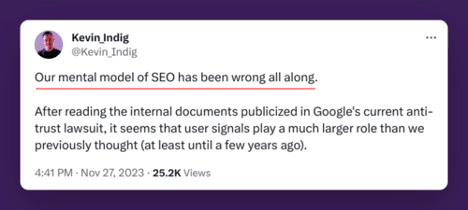
Other SEOs are catching on to this mindset as well now. What users do on our websites matters immensely. The actions of users shape Google’s rankings dramatically.

Kevin Indig's take on SEO tweetScreenshot from X/Twitter, July 2024

I have historically treated Google’s guidance on creating helpful content as a checklist of things we could look to for improvement.

Have an author bio? Check. Good descriptive heading? Check. Demonstrating experience? Information gain? Another check.

My first book on creating helpful content takes you through multiple checklists like this. You can see improvement by working through these checklists.

Actually, I know this as I commonly will have people reach out to me to tell me that they have implemented changes based on the checklists and have been seeing improvements.

But, it turns out what Google gave us was not a list of criteria to be analyzed as a checklist!

I realize now that what Google was telling us was: Our systems are built to reward the types of things that people tend to find helpful and reliable. And if you want to know what that is, here are some ideas.

It’s not a checklist, but rather, a list of the types of things that searchers tend to like. The algorithm is built to reward what it is that searchers like.

An author bio isn’t a ranking factor, but, in many verticals, demonstrating the experience of your authors is something that users like.

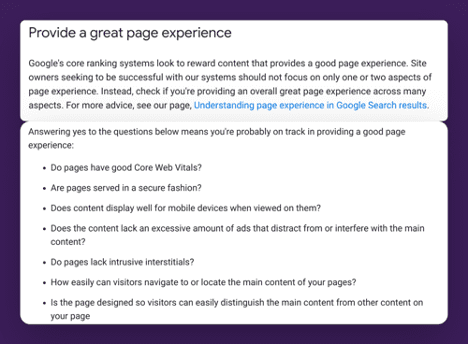
Core web vitals, metrics used to measure load time and other similar things, used to be a score we’d aim to get…but really, the reason we work to improve on core web vital scores is because users tend to like pages that load fast and don’t jump around.

It’s not like Google has a checklist or a scorecard when it comes to the quality of every page. Google doesn’t know exactly what your content is or whether it is high quality.

As we discussed earlier, search is a complex AI driven system that is trying to predict what searchers are going to find helpful.

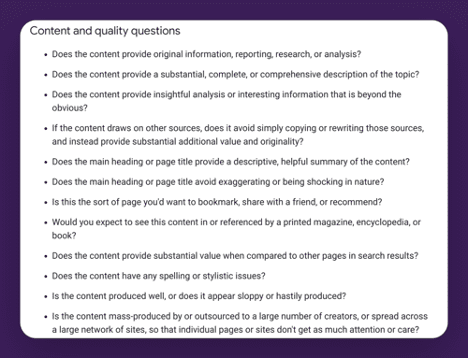
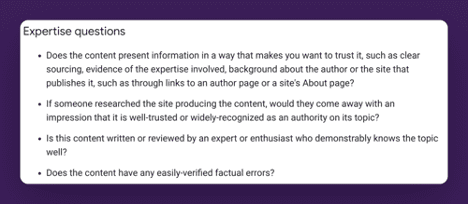
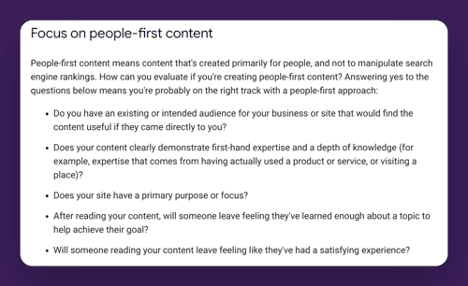
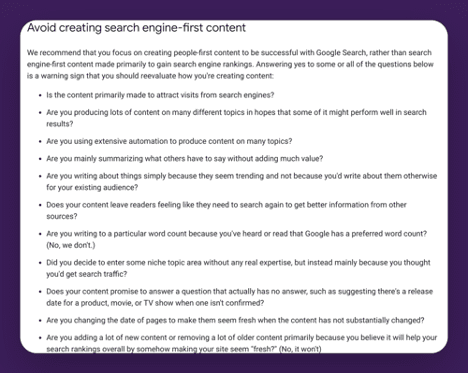
Here are the full list of “ideas” Google gives us to help us understand what searchers might find helpful:

Content and quality questions

Expertise questions

Expertise questions

Provide a great page experience

Focus on people first content

Avoid creating search engine-first content

In the past I’ve taught on looking at these ideals one by one for inspiration on how you can improve your site. I still think there is great value in doing this.

But, now I realize I was missing the main point. I have been thinking about helpful content like an SEO.

If you are truly creating People-First content, you will already be aligned with Google’s helpful content recommendations.

I had it the wrong way around.

If you know what your audience’s needs are, and know the questions that they have, and you create content that answers those questions you are on your way to creating the type of People-First Content Google wants to reward.

People First Content Is:

  • Usually created by people with real world experience on a topic. A store that sells a product to real customers is more likely to produce helpful content advising people on that product. A person who advises professionally on a topic, is more likely to have fresh content that understands the current needs of that audience.
  • There is an exception to this: Sometimes authority can trump experience. We see this when a website like Forbes is ranking for [BBQ reviews]. In this case, Forbes is likely seen as a place that users trust for its overall authority in journalism. It’s got sufficient E-E-A-T to be considered a trustworthy answer for this query. And as long as searchers are indicating they are satisfied, it will continue to rank. (I think this will change though as we learn to create truly helpful content. We should start to see more truly helpful content from topic experts recommended.)
  • Content that provides real value to searchers.
  • Written clearly and concisely in a manner that is easy to understand.
  • Original and insightful.

But how does Google determine this?

In the next section we’ll talk about something that has been mostly unknown to SEOs until just recently – just how much Google uses user engagement signals.

It turns out that Google knows what it is that’s helpful to people because signals from every single interaction that happens in search are fed back into machine learning systems with one goal in mind – for the systems to learn how to best work together to create present the searcher with information that they are most likely to find helpful.

Notes

[1] Creating Helpful Content. Marie Haynes. 2023. https://mariehaynes.com/product/creating-helpful-content-workbook/


To read the full book, SEJ readers have an exclusive 20% discount for Marie’s book, workbook and course bundle. The discount will be applied automatically by following these links:


More resources:


Featured Image: MT.PHOTOSTOCK/Shutterstock

The Reason Why Google Uses The Word “Creators” via @sejournal, @martinibuster

Google’s SearchLiaison responded to criticism over how they refer to website publishers with an answer that reflects not just changing times but also the practical reasons for doing so. The answer reflects how important it is for digital marketing to maintain the flexibility to bend with change.

Change: There Isn’t Always A Motivation

The discussion began with a tweet by someone who objected to the use of the phrase “creators” instead of other terms like businesses or publishers because the word creators minimizes the fact that there are businesses behind the websites.

This is the tweet:

“Notice the term “creators” in this piece. This is an example of Google’s successful effort to change the narrative. In the past they have used “publishers”, “businesses”, and just “web sites”. But “creators” minimizes business impact. And clearly some are falling for the trap.”

Keeping Up With The Pace Of Change

SearchLiaison’s response reflected something that is commonly misunderstood, which is that everything changes, including fashion, customs, norms and even speech. Those who lack self-awareness on this point will blink and miss it when the page turns on their generation and another one steps forward to take take their place at the center of the world.

This is especially true for SEO, where Google typically is a brand new search engine every five years.

This is SearchLiaison’s answer:

“We used to say “webmasters” in the past, and that doesn’t really speak to so many people who have an interest in appearing in search results. That’s in part why we have tended to say “creators” more — though not exclusively — for years now. It’s not a particularly new thing. It’s also why Search Central got its new name in 2020, the whole “webmasters” isn’t really that inclusive (or used) term: https://developers.google.com/search/blog/2020/11/goodbye-google-webmasters

“Publishers” tends to be heard by and used by those involved in news publishing. Businesses often just think of themselves as businesses. SEOs tend to be SEOs, and if you use that term, you exclude those who don’t think of SEOs but want to understand some of the things we share.

So “creators” tends to be the catch-all term we used, as imperfect as it is, because sometime you really need one term rather than “Here’s what creators and SEO and businesses and brands and news publishers and etc etc should know about something….”

All that said, I am seeing more of a need to use creators as less a catch-all and more to refer to people like Brandon who really do view themselves as content creators first-and-foremost. The work they do can be much different than an SEO, or a content marketer, or a local business and so on.”

And in a follow up he continued:

“We do say web sites when talking about web sites. But “web sites” isn’t a term that’s workable when addressing the people who are involved with web sites and have questions about their content appearing in search results.”

Ephemeral Quality Of Digital Marketing

It’s not just Google that changes, people change as well. Demand for certain products peak and then disappear. Ringtones used to be the hot affiliate product and then it was not. Technology drives change as well, as we’re currently seeing with AI.

Google’s choice of the word creators is a small marker of change. You can roll with it or simply roll your own.

Featured Image by Shutterstock/Mix and Match Studio