Google has announced the rollout of the June 2024 spam update, which aims to further improve search results by targeting websites that violate Google’s spam policies.
According to a statement, the update, which began on June 20, is expected to take up to one week to roll out fully.
Today we released the June 2024 spam update.
It may take up to 1 week to complete, and we’ll post on the Google Search Status Dashboard when the rollout is done: https://t.co/EkzeXvUZwH
— Google Search Central (@googlesearchc) June 20, 2024
Background On Google’s Spam Updates & Policies
Google regularly updates its systems to reduce low-quality and spammy content from its search results.
Spam updates target websites that break Google’s rules, such as:
Automatically generating content solely to improve search rankings.
Buying or selling links to manipulate rankings.
Having thin, duplicated, or poor-quality content.
Tricking users with hidden redirects or other deceptive techniques.
Despite the March update impacting many spammy websites, some AI-generated content still managed to rank well in search results.
Analysis by Search Engine Journal’s Roger Montti notes that some AI spam sites ranked for over 217,000 queries, with more than 14,900 ranking in the top 10 search results.
The sites employed tactics such as rapid content churn, AI-generated images, and templated article structures, exploiting a loophole that allowed new content to receive an initial ranking boost.
Potential Impact On Search Results
The June spam update will likely refine Google’s spam detection capabilities further.
However, past experiences have shown that closing loopholes can inadvertently impact legitimate websites.
As with any significant update, the June spam update may result in fluctuations in search rankings for some websites.
Websites that engage in practices that violate Google’s spam policies or rely heavily on AI-generated content may see a decline in their search visibility.
On the other hand, some websites may benefit from the update, as they will face less competition from spammy websites in search results.
Looking Ahead
Google says the June 2024 spam update may take up to one week to roll out fully.
Once the rollout is complete, Google will post an update on its Search Status Dashboard, and you can assess the update’s impact on your search rankings.
Bluehost announced a partner program that’s expressly designed to support WordPress agencies and freelancers that service small-to-medium size businesses (SMBs). The program offers revenue generating opportunities in the form of commissions, exclusive discounts, priority customer service, and other benefits that will help agencies grow their client base and earn more revenue.
Focus On WordPress Websites
Bluehost is an active member of the WordPress community, which includes helping to develop the WordPress core itself by directly sponsoring six WordPress core contributors. Bluehost is well-positioned to offer agencies the products, community, service and revenue generating opportunities that align with the goals of WordPress-based development agencies and freelancers that service SMBs.
A key element of the Agency Partner Program is Bluehost Cloud, a managed WordPress hosting platform that provides a 100% uptime SLA. Bluehost managed WordPress Cloud is designed as a secure high performance solution, which makes it ideal for freelancers and agencies that depend on performant hosting.
Exclusive Benefits for Partner Agencies
Acceptance into the program grants agencies early access to Bluehost’s referral program (commissions), product discounts, learning webinars, access to priority customer support, and membership in an exclusive LinkedIn network.
According to the Bluehost announcement:
“By partnering with Bluehost, agencies can now provide their clients with the highest quality customer service, WordPress expertise and some of the most comprehensive hosting products, including Bluehost Cloud, Yoast SEO and eCommerce plug-ins.”
The Bluehost Agency Partner Program offers the resources for WordPress agencies and freelancers to level up their service offerings, generate new revenue streams, and the resources to deliver superior results for their clients. It’s a win-win partnership that may be worth looking into.
This week’s Ask an SEO question comes from Sanjay in Coimbatore, who asks:
“What are the things I need to analyze in our competitors site for SEO?”
Sanjay, thank you for asking this question. The most important thing to keep in mind when analyzing a competitor or multiple competitors’ SEO techniques is to never do something just because they are.
Search engines don’t need two versions of the same page. What they may need more than yours is something better that gets searches to a solution faster or more easily.
If you’re adding things because competitors have them, it is in the search engine’s best interest to continue showing the current winners. If you’re emulating their success closely, then you’re effectively admitting they have the better resource.
Focus on what they are missing or what they’re doing that is irrelevant to the search intent, and always track their changes and your own.
One option is to create a spreadsheet or use a visualization tool that populates charts and graphs so you can track your findings. This will help save you time when you need to reference the “why” you’re making specific changes.
What We Analyze On Competitor Websites, And What We Don’t Bother With
Schema
Please keep in mind that schema is a way to tell a search engine what is on the page, but schema on its own may not help you rank higher.
There are a ton of tools that make it easy to deploy. Two of my favorites are Schema App for WordPress websites, and I’ve fallen in love with seoClarity for ecommerce and service websites not based on WordPress. It has a browser extension that is free to use.
Using your favorite tracking tool (Semrush, Moz, Ahrefs, etc.), look to see which competitors have featured snippets. From there, analyze the schema libraries on their pages and note which types of rich results they have. Split it out by page type, too.
Here’s an example of page types:
Blog posts.
Product pages.
Category pages.
Landing pages.
FAQs and information.
Now put a column next to it and add in the current schema libraries you find and include:
Errors.
Warnings.
Fields not being used but could be helpful.
In the next column, add which results they’re populating a rich result for. Having schema on the page doesn’t mean a search engine will use it.
If you do this monthly, or as the specific search engine algorithms update, you can see which libraries are being used, who is winning, and what may be helpful (or not).
Now deploy what is relevant to your website, but remember: you should never put schema on a page if the feature is not there, i.e. don’t use breadcrumb schema if you don’t display breadcrumbs on the page.
Overusing schema will likely lead to problems. Pay attention when libraries are deprecated like “how to” and “FAQ.”
If other systems and platforms need it, keep it. But if nobody does, pull it. There’s more to the marketing ecosystem than SEO, and being reliant on one channel is always disastrous as that channel can disappear overnight.
Copy On The Page
If your competitors have detailed guides that rank for “blue widgets,” don’t start including copy and headers because everyone else has them. Instead, evaluate the following:
What is missing that they haven’t answered yet but is topically relevant and important for the consumer on that specific page?
Have they thrown in irrelevant headers and paragraphs that don’t make sense for the user to read?
Is everything on the page easy to find within a quick scan, or are answers buried in paragraphs and at the bottom of the page?
How is the text formatted, and can you do it better?
The job of a search engine is to provide the best possible answer and user experience to the person searching. Giant paragraphs and irrelevant text create a bad experience. You can create a better one by being concise, direct, and formatting differently.
If you’re comparing two things, does it make sense to add a table or chart of the features? What about sections for the two?
If the person is already searching for “blue widgets” and the phrase is about buying, repairing, or compatibility with “red whatsits,” they know what a blue widget is.
Do not add a section that defines a blue widget just because your competitors have that on their pages. Instead, move the comparisons and answers higher up by deleting fluffy content at the top.
Explaining what the person already knows wastes their time. You can always use an internal link off of jargon to a dedicated post if the person wants more information, and then they can return to the previous page. This doesn’t mean to avoid creating a “what is” post that defines the blue widget.
Create the “what is” post for people just entering the industry or who are about to buy their first one. It is still topically relevant to your website because you sell them, repair them, or provide guides to using them if you’re a publisher. But it doesn’t make sense for someone who already knows what they are.
By removing the irrelevant text and ensuring everything on the page is directly relevant to the title and H1 tag, you have now created a better experience than the competitors, and that may reward you with SEO traffic.
Having the same exact link profile or type of links won’t give you an advantage; having quality links and some original ones will. This is where link builders and auditors normally go wrong.
It is still and has always been quality over quantity with links if your goal is long-term stability. Churn and burn sites can go quantity over quality, as well as AI-based content. These don’t survive.
Here’s what we look at after we pull backlink reports. Majestic SEO is my preference for the best database, but there are countless providers. Go with the one you can use most easily. Some of the tools above offer nice comparison charts, too.
Which are missing from you – Look at the competitors with highly relevant and high-quality links like actual citations in industry publications. Also, check for organic features in niche blogs and websites. These are the ones where your customers are reading and visiting. Because it is your same topic and audience, it is somewhere you would want to be. That makes it a good link. Domain authority, authority scores, etc., are all tool-based metrics, and they don’t show quality or lack thereof. Ignore them.
The links that no competitors have – Find websites and influential places like podcasts and webinars that feature original content that is on topic for your company. Begin building relationships with them and get featured. You could be a guest on the show, have a resource on your site they may source if they shared a data point and didn’t source it, etc. If you get this link and your competitors don’t have it, it may be an advantage. If everyone else has the links, it’s not a hard one to get and likely doesn’t matter as much. It may not harm you, but it won’t be as helpful either.
Who is paying for links – Many times, companies and link building service providers pay for links. You’ll see the “authors” write about everything from health supplements to home decor, and there’s a mix of big brands and small companies to try and throw search engines off. Search engines are not as ignorant as we think about these links. They will catch up as the links get mapped, and these sites will pay the price. If you have a competitor paying for links, you can try reporting the links to Google, but it is unlikely this will do anything.
When building links, don’t worry about what your competitors have, but pay attention to where they’re being featured and why.
It can lead to content ideas you haven’t covered yet or topics you can create new pages for in a better way. Focus on where you can get high-quality features and work to get those links.
Robots.txt And Architecture
One thing I do use with competitors is their crawl and architecture plans. I look to see which folders and pages they prioritize, what they push for keywords and topics, and what is not important to them.
This can lead to taking over their big revenue generators and coming up with ideas for new PPC campaigns when the paid media teams are ready to test new markets.
You could discover new phrases and keywords not yet considered in your strategies, as well as better ways to structure your own site.
Robots.txt – It shows their priorities with folders and site structure for crawling.
Meta robots – It helps you understand which pages are meant for SEO and what they don’t actually care about.
Sitemaps – If priority is set, you can see what they’re updated the most frequently or what their priorities are, and watch those pages climb, fall, or remain stagnant.
Breadcrumbs – You’ll see the keywords they want to rank for, possibly the words their customers use, and how they structure their products, topics, or services.
There are a million other things you can look at.
As you evaluate your competitor’s SEO techniques, keep in mind that if you are focusing on them so you can do what is working for them, you’re forgetting to build something better and original.
Search engines only need one version of their site. If you create a better experience, which sometimes means less copy or a design that eliminates hero images, you may overpower them in the top spots.
Pneumatic tubes were touted as something that would revolutionize the world. In science fiction, they were envisioned as a fundamental part of the future—even in dystopias like George Orwell’s 1984, where the main character, Winston Smith, sits in a room peppered with pneumatic tubes that spit out orders for him to alter previously published news stories and historical records to fit the ruling party’s changing narrative.
Abandoned by most industries at midcentury, pneumatic tube systems have become ubiquitous in hospitals.
ALAMY
In real life, the tubes were expected to transform several industries in the late 19th century through the mid-20th. “The possibilities of compressed air are not fully realized in this country,” declared an 1890 article in the New York Tribune. “The pneumatic tube system of communication is, of course, in use in many of the downtown stores, in newspaper offices […] but there exists a great deal of ignorance about the use of compressed air, even among engineering experts.”
Pneumatic tube technology involves moving a cylindrical carrier or capsule through a series of tubes with the aid of a blower that pushes or pulls it into motion. For a while, the United States took up the systems with gusto. Retail stores and banks were especially interested in their potential to move money more efficiently: “Besides this saving of time to the customer the store is relieved of all the annoying bustle and confusion of boys running for cash on the various retail floors,” one 1882 article in the Boston Globe reported. The benefit to the owner, of course, was reduced labor costs, with tube manufacturers claiming that stores would see a return on their investment within a year.
“The motto of the company is to substitute machines for men and for children as carriers, in every possible way,” a 1914 Boston Globe article said about Lamson Service, one of the largest proprietors of tubes at the time, adding, “[President] Emeritus Charles W. Eliot of Harvard says: ‘No man should be employed at a task which a machine can perform,’ and the Lamson Company supplements that statement by this: ‘Because it doesn’t pay.’”
By 1912, Lamson had over 60,000 customers globally in sectors including retail, banks, insurance offices, courtrooms, libraries, hotels, and industrial plants. The postal service in cities such as Boston, Philadelphia, Chicago, and New York also used tubes to deliver the mail, with at least 45 miles of Lamson tubing in place by 1912.
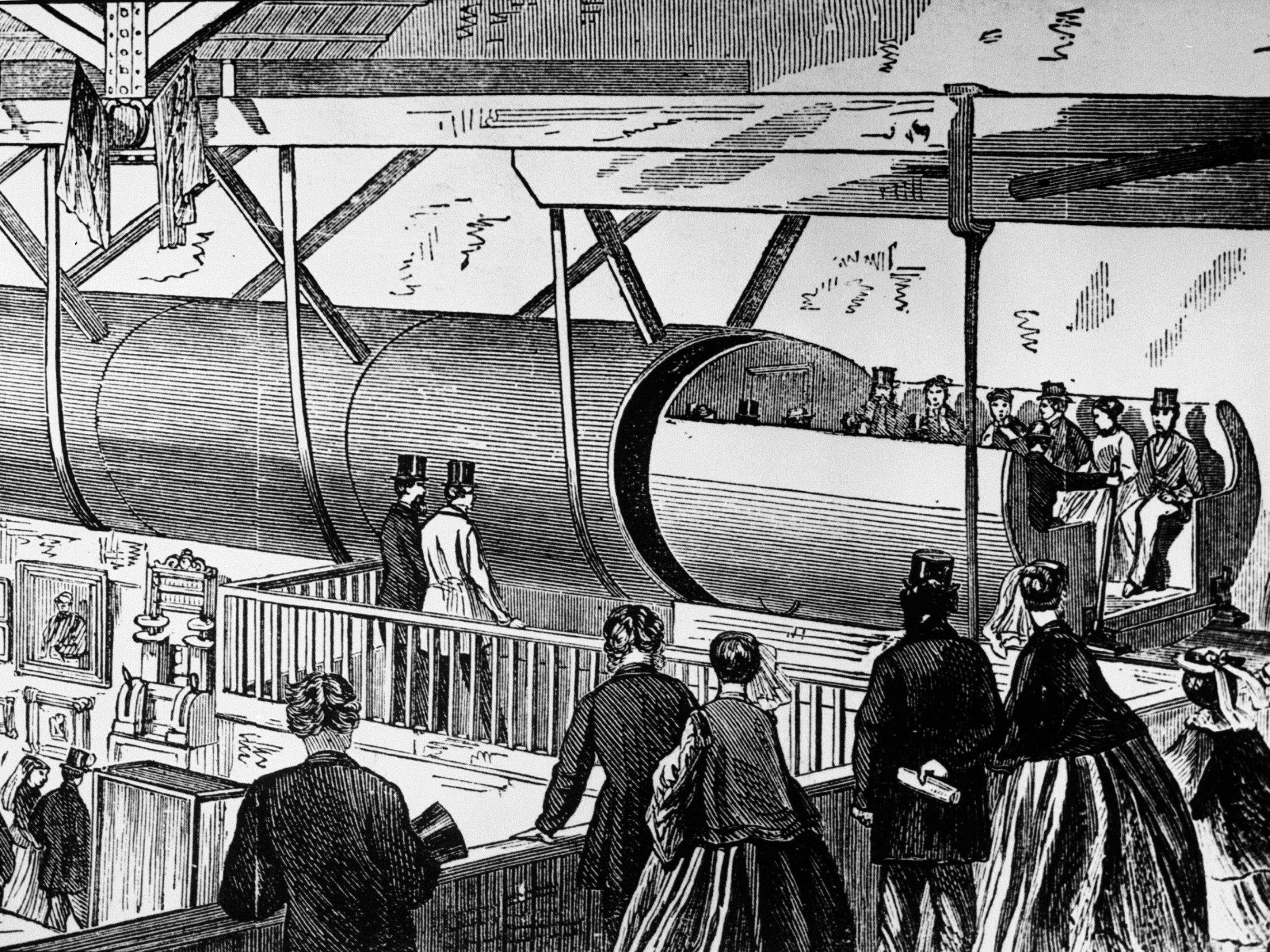
On the transportation front, New York City’s first attempt at a subway system, in 1870, also ran on a pneumatic system, and the idea of using tubes to move people continues to beguile innovators to this day. (See Elon Musk’s largely abandoned Hyperloop concept of the 2010s.)
But by the mid to late 20th century, use of the technology had largely fallen by the wayside. It had become cheaper to transport mail by truck than by tube, and as transactions moved to credit cards, there was less demand to make change for cash payments. Electrical rail won out over compressed air, paper records and files disappeared in the wake of digitization, and tubes at bank drive-throughs started being replaced by ATMs, while only a fraction of pharmacies used them for their own such services. Pneumatic tube technology became virtually obsolete.
Except in hospitals.
“A pneumatic tube system today for a new hospital that’s being built is ubiquitous. It’s like putting a washing machine or a central AC system in a new home. It just makes too much sense to not do it,” says Cory Kwarta, CEO of Swisslog Healthcare, a corporation that—under its TransLogic company—has provided pneumatic tube systems in health-care facilities for over 50 years. And while the sophistication of these systems has changed over time, the fundamental technology of using pneumatic force to move a capsule from one destination to another has remained the same.
By the turn of the 20th century, health care had become a more scientific endeavor, and different spaces within a hospital were designated for new technologies (like x-rays) or specific procedures (like surgeries). “Instead of having patients in one place, with the doctors and the nurses and everything coming to them, and it’s all happening in the ward, [hospitals] became a bunch of different parts that each had a role,” explains Jeanne Kisacky, an architectural historian who wrote Rise of the Modern Hospital: An Architectural History of Health and Healing, 1870–1940.
Designating different parts of a building for different medical specialties and services, like specimen analysis, also increased the physical footprint of health-care facilities. The result was that nurses and doctors had to spend much of their days moving from one department to another, which was an inefficient use of their time. Pneumatic tube technology provided a solution.
By the 1920s, more and more hospitals started installing tube systems. At first, the capsules primarily moved medical records, prescription orders, and items like money and receipts—similar cargo to what was moved around in banks and retail stores at the time. As early as 1927, however, the systems were also marketed to hospitals as a way to transfer specimens to a central laboratory for analysis.
Two men stand among the 2,000 pneumatic tube canisters in the basement of the Lexington Avenue Post Office in New York City, circa 1915.
In 1955, clubbers at the Reni Ballroom in Berlin exchanged requests for dances via pneumatic tube in a sort of precursor to texting.
In the late 1940s and ’50s, canisters like this one, traveling at around 35 miles an hour, carried as many as 600 letters daily throughout New York City.
The Hospital of the University of Pennsylvania traffics nearly 4,000 specimens daily through its pneumatic tubes.
By the 1960s, pneumatic tubes were becoming standard in health care. As a hospital administrator explained in the January 1960 issue of Modern Hospital, “We are now getting eight hours’ worth of service per day from each nurse, where previously we had been getting about six hours of nursing plus two hours of errand running.”
As computers and credit cards started to become more prevalent in the 1980s, reducing paperwork significantly, the systems shifted to mostly carrying lab specimens, pharmaceuticals, and blood products. Today, lab specimens are roughly 60% of what hospital tube systems carry; pharmaceuticals account for 30%, and blood products for phlebotomy make up 5%.
The carriers or capsules, which can hold up to five pounds, move through piping six inches in diameter—just big enough to hold a 2,000-milliliter IV bag—at speeds of 18 to 24 feet per second, or roughly 12 to 16 miles per hour. The carriers are limited to those speeds to maintain specimen integrity. If blood samples move faster, for example, blood cells can be destroyed.
The pneumatic systems have also gone through major changes in structure in recent years, evolving from fixed routes to networked systems. “It’s like a train system, and you’re on one track and now you have to go to another track,” says Steve Dahl, an executive vice president at Pevco, a manufacturer of these systems.
Exhibition-goers wait to ride the first pneumatic passenger railway in the US at the Exhibition of the American Institute at the New York City Armory in 1867.
GETTY IMAGES
Manufacturers try to get involved early in the hospital design process, says Swisslog’s Kwarta, so “we can talk to the clinical users and say, ‘Hey, what kind of contents do you anticipate sending through this pneumatic tube system, based on your bed count, based on your patient census, and from where and to where do these specimens or materials need to go?’”
Penn Medicine’s University City Medical District in Philadelphia opened up the state-of-the-art Pavilion in 2021. It has three pneumatic systems: the main one is for items directly related to health care, like specimens, and two separate ones handle linen and trash. The main system runs over 12 miles of pipe and completes more than 6,000 transactions on an average day. Sending a capsule between the two farthest points of the system—a distance of multiple city blocks—takes just under five minutes. Walking that distance would take around 20 minutes, not including getting to the floor where the item needs to go.
Michigan Medicine has a system dedicated solely for use in nuclear medicine, which relies on radioactive materials for treatment. Getting the materials where they need to go is a five- to eight-minute walk—too long given their short shelf life. With the tubes, it gets there—in a lead-lined capsule—in less than a minute.
Steven Fox, who leads the electrical engineering team for the pneumatic tubes at Michigan Medicine, describes the scale of the materials his system moves in terms of African elephants, which weigh about six tons. “We try to keep [a carrier’s] load to five pounds apiece,” he says. “So we could probably transport about 30,000 pounds per day. That’s two and a half African elephants that we transport from one side of the hospital to the other every day.”
The equipment to maintain these labyrinthian highways is vast. Michigan and Penn have between 150 and 200 stations where doctors, nurses, and technicians can pick up a capsule or send one off. Keeping those systems moving also requires around 30 blowers and over 150 transfer units to shift carriers to different tube lines as needed. At Michigan Medicine, moving an item from one end of the system to another requires 20 to 25 pieces of equipment.
Before the turn of the century, triggering the blower to move a capsule from point A to point B would be accomplished by someone turning or pressing an electronic or magnetic switch. In the 2000s, technicians managed the systems on DOS; these days, the latest systems run on programs that monitor every capsule in real time and allow adjustments based on the level of traffic, the priority level of a capsule, and the demand for additional carriers. The systems run 24 hours a day, every day.
“We treat [the tube system] no different than electricity, steam, water, gas. It’s a utility,” says Frank Connelly, an assistant hospital director at Penn. “Without that, you can’t provide services to people that need it in a hospital.”
“You’re nervous—you just got blood taken,” he continues. “‘How long is it going to be before I get my results back?’ Imagine if they had to wait all that extra time because you’re not sending one person for every vial—they’re going to wait awhile until they get a basket full and then walk to the lab. Nowadays they fill up the tube and send it to the lab. And I think that helps patient care.”
Vanessa Armstrong is a freelance writer whose work has appeared in the New York Times, Atlas Obscura, Travel + Leisure, and elsewhere.
This story first appeared in China Report, MIT Technology Review’s newsletter about technology in China. Sign up to receive it in your inbox every Tuesday.
You may not be familiar with Kuaishou, but this Chinese company just hit a major milestone: It’s released the first text-to-video generative AI model that’s freely available for the public to test.
The short-video platform, which has over 600 million active users, announced the new tool on June 6. It’s called Kling. Like OpenAI’s Sora model, Kling is able to generate videos “up to two minutes long with a frame rate of 30fps and video resolution up to 1080p,” the company says on its website.
But unlike Sora, which still remains inaccessible to the public four months after OpenAI trialed it, Kling soon started letting people try the model themselves.
I was one of them. I got access to it after downloading Kuaishou’s video-editing tool, signing up with a Chinese number, getting on a waitlist, and filling out an additional form through Kuaishou’s user feedback groups. The model can’t process prompts written entirely in English, but you can get around that by either translating the phrase you want to use into Chinese or including one or two Chinese words.
So, first things first. Here are a few results I generated with Kling to show you what it’s like. Remember Sora’s impressive demo video of Tokyo’s street scenes or the cat darting through a garden? Here are Kling’s takes:
Prompt: Beautiful, snowy Tokyo city is bustling. The camera moves through the bustling city street, following several people enjoying the beautiful snowy weather and shopping at nearby stalls. Gorgeous sakura petals are flying through the wind along with snowflakes.
ZEYI YANG/MIT TECHNOLOGY REVIEW | KLING
Prompt: A stylish woman walks down a Tokyo street filled with warm glowing neon and animated city signage. She wears a black leather jacket, a long red dress, and black boots, and carries a black purse. She wears sunglasses and red lipstick. She walks confidently and casually. The street is damp and reflective, creating a mirror effect of the colorful lights. Many pedestrians walk about.
ZEYI YANG/MIT TECHNOLOGY REVIEW | KLING
Prompt: A white and orange tabby cat is seen happily darting through a dense garden, as if chasing something. Its eyes are wide and happy as it jogs forward, scanning the branches, flowers, and leaves as it walks. The path is narrow as it makes its way between all the plants. The scene is captured from a ground-level angle, following the cat closely, giving a low and intimate perspective. The image is cinematic with warm tones and a grainy texture. The scattered daylight between the leaves and plants above creates a warm contrast, accentuating the cat’s orange fur. The shot is clear and sharp, with a shallow depth of field.
There are a few things worth applauding here. None of these videos deviates from the prompt much, and the physics seem right—the panning of the camera, the ruffling leaves, and the way the horse and astronaut turn, showing Earth behind them. The generation process took around three minutes for each of them. Not the fastest, but totally acceptable.
But there are obvious shortcomings, too. The videos, while 720p in format, seem blurry and grainy; sometimes Kling ignores a major request in the prompt; and most important, all videos generated now are capped at five seconds long, which makes them far less dynamic or complex.
However, it’s not really fair to compare these results with things like Sora’s demos, which are hand-picked by OpenAI to release to the public and probably represent better-than-average results. These Kling videos are from the first attempts I had with each prompt, and I rarely included prompt-engineering keywords like “8k, photorealism” to fine-tune the results.
If you want to see more Kling-generated videos, check out this handy collection put together by an open-source AI community in China, which includes both impressive results and all kinds of failures.
Kling’s general capabilities are good enough, says Guizang, an AI artist in Beijing who has been testing out the model since its release and has compiled a series of direct comparisons between Sora and Kling. Kling’s disadvantage lies in the aesthetics of the results, he says, like the composition or the color grading. “But that’s not a big issue. That can be fixed quickly,” Guizang, who wished to be identified only by his online alias, tells MIT Technology Review.
“The core capability of a model is in how it simulates physics and real natural environments,” and he says Kling does well in that regard.
Kling works in a similar way to Sora: it combines the diffusion models traditionally used in video-generation AIs with a transformer architecture, which helps it understand larger video data files and generate results more efficiently.
But Kling may have a key advantage over Sora: Kuaishou, the most prominent rival to Douyin in China, has a massive video platform with hundreds of millions of users who have collectively uploaded an incredibly big trove of video data that could be used to train it. Kuaishou told MIT Technology Review in a statement that “Kling uses publicly available data from the global internet for model training, in accordance with industry standards.” However, the company didn’t elaborate on the specifics of the training data(neither did OpenAI about Sora, which has led to concerns about intellectual-property protections).
After testing the model, I feel the biggest limitation to Kling’s usefulness is that it only generates five-second-long videos.
“The longer a video is, the more likely it will hallucinate or generate inconsistent results,” says Shen Yang, a professor studying AI and media at Tsinghua University in Beijing. That limitation means the technology will leave a larger impact on the short-video industry than it does on the movie industry, he says.
Short, vertical videos (those designed for viewing on phones) usually grab the attention of viewers in a few seconds. Shen says Chinese TikTok-like platforms often assess whether a video is successful by how many people would watch through the first three or five seconds before they scroll away—so an AI-generated high-quality video clip that’s just five seconds long could be a game-changer for short-video creators.
Guizang agrees that AI could disrupt the content-creating scene for short-form videos. It will benefit creators in the short term as a productivity tool; but in the long run, he worries that platforms like Kuaishou and Douyin could take over the production of videos and directly generate content customized for users, reducing the platforms’ reliance on star creators.
It might still take quite some time for the technology to advance to that level, but the field of text-to-video tools is getting much more buzzy now. One week after Kling’s release, a California-based startup called Luma AI also released a similar model for public usage. Runway, a celebrity startup in video generation, has teased a significant update that will make its model much more powerful. ByteDance, Kuaishou’s biggest rival, is also reportedly working on the release of its generative video tool soon. “By the end of this year, we will have a lot of options available to us,” Guizang says.
I asked Kling to generate what society looks like when “anyone can quickly generate a video clip based on their own needs.” And here’s what it gave me. Impressive hands, but you didn’t answer the question—sorry.
Prompt: With the release of Kuaishou’s Kling model, the barrier to entry for creating short videos has been lowered, resulting in significant impacts on the short-video industry. Anyone can quickly generate a video clip based on their own needs. Please show what the society will look like at that time.
ZEYI YANG/MIT TECHNOLOGY REVIEW | KLING
Do you have a prompt you want to see generated with Kling? Send it to zeyi@technologyreview.com and I’ll send you back the result. The prompt has to be less than 200 characters long, and preferably written in Chinese.
Now read the rest of China Report
Catch up with China
1. A new investigation revealed that the US military secretly ran a campaign to post anti-vaccine propaganda on social media in 2020 and 2021, aiming to sow distrust in the Chinese-made covid vaccines in Southeast Asian countries. (Reuters $)
2. A Chinese court sentenced Huang Xueqin, the journalist who helped launch the #MeToo movement in China, to five years in prison for “inciting subversion of state power.” (Washington Post $)
3. A Shein executive said the company’s corporate values basically make it an American company, but the company is now trying to hide that remark to avoid upsetting Beijing. (Financial Times $)
4. China is getting close to building the world’s largest particle collider, potentially starting in 2027. (Nature)
5. To retaliate for the European Union’s raising tariffs on electric vehicles, the Chinese government has opened an investigation into allegedly unfair subsidies for Europe’s pork exports. (New York Times $)
On a related note about food: China’s exploding demand for durian fruit in recent years has created a $6 billion business in Southeast Asia, leading some farmers to cut down jungles and coffee plants to make way for durian plantations. (New York Times $)
Lost in translation
In 2012, Jiumei, a Chinese woman in her 20s, began selling a service where she sends “good night” text messages to people online at the price of 1 RMB per text (that’s about $0.14).
Twelve years, three mobile phones, four different numbers, and over 50,000 messages later, she’s still doing it, according to the Chinese online publication Personage. Some of her clients are buying the service for themselves, hoping to talk to someone regularly at their most lonely or desperate times. Others are buying it to send anonymous messages—to a friend going through a hard time, or an ex-lover who has cut off communications.
The business isn’t very profitable. Jiumei earns around 3,000 RMB ($410) annually from it on top of her day job, and even less in recent years. But she’s persisted because the act of sending these messages has become a nightly ritual—not just for her customers but also for Jiumei herself, offering her solace in her own times of loneliness and hardship.
One more thing
Globally, Kuaishou has been much less successful than its nemesis ByteDance, except in one country: Brazil. Kwai, the overseas version of Kuaishou, has been so popular in Brazil that even the Marubo people, a tribal group in the remote Amazonian rainforests and one of the last communities to be connected online, have begun using the app, according to the New York Times.
This is today’s edition of The Download, our weekday newsletter that provides a daily dose of what’s going on in the world of technology.
I tested out a buzzy new text-to-video AI model from China
You may not be familiar with Kuaishou, but this Chinese company just hit a major milestone: It’s released the first ever text-to-video generative AI model that’s freely available for the public to test.
The short-video platform, which has over 600 million active users, announced the new tool, called Kling, on June 6. Like OpenAI’s Sora model, Kling is able to generate videos up to two minutes long from prompts.
But unlike Sora, which still remains inaccessible to the public four months after OpenAI debuted it, Kling has already started letting people try the model themselves. Zeyi Yang, our China reporter, has been putting it through its paces. Here’s what he made of it.
This story is from China Report, our weekly newsletter covering tech in China. Sign up to receive it in your inbox every Tuesday.
Meta has created a way to watermark AI-generated speech
The news: Meta has created a system that can embed hidden signals, known as watermarks, in AI-generated audio clips, which could help in detecting AI-generated content online.
Why it matters: The tool, called AudioSeal, is the first that can pinpoint which bits of audio in, for example, a full hour-long podcast might have been generated by AI. It could help to tackle the growing problem of misinformation and scams using voice cloning tools. Read the full story.
—Melissa Heikkilä
The return of pneumatic tubes
Pneumatic tubes were once touted as something that would revolutionize the world. In science fiction, they were envisioned as a fundamental part of the future—even in dystopias like George Orwell’s 1984, where they help to deliver orders for the main character, Winston Smith, in his job rewriting history to fit the ruling party’s changing narrative.
In real life, the tubes were expected to transform several industries in the late 19th century through the mid-20th. The technology involves moving a cylindrical carrier or capsule through a series of tubes with the aid of a blower that pushes or pulls it into motion, and for a while, the United States took up the systems with gusto.
But by the mid to late 20th century, use of the technology had largely fallen by the wayside, and pneumatic tube technology became virtually obsolete. Except in hospitals. Read the full story.
—Vanessa Armstrong
This story is from the forthcoming print issue of MIT Technology Review, which explores the theme of Play. It’s set to go live on Wednesday June 26, so if you don’t already, subscribe now to get a copy when it lands.
The must-reads
I’ve combed the internet to find you today’s most fun/important/scary/fascinating stories about technology.
1 Nvidia has become the world’s most valuable company Leapfrogging Microsoft and Apple thanks to the AI boom. (BBC) + Nvidia’s meteoric rise echoes the dot com boom. (WSJ $) + CEO Jensen Huang is now one of the richest people in the world. (Forbes) + The firm is worth more than China’s entire agricultural industry. (NY Mag $) + What’s next in chips. (MIT Technology Review)
2 TikTok is introducing AI avatars for ads Which seems like a slippery slope. (404 Media) + India’s farmers are getting their news from AI news anchors. (Bloomberg $) + Deepfakes of Chinese influencers are livestreaming 24/7. (MIT Technology Review)
3 Boeing’s Starliner spacecraft will stay in space for a little longer Officials need to troubleshoot some issues before it can head back to Earth. (WP $)
4STEM students are refusing to work at Amazon and Google Until the companies end their involvement with Project Nimbus. (Wired $)
5 Google isn’t what it used to be But is Reddit really a viable alternative? (WSJ $) + Why Google’s AI Overviews gets things wrong. (MIT Technology Review)
6 A security bug allows anyone to impersonate Microsoft corporate email accounts It’s making it harder to spot phishing attacks. (TechCrunch)
7 How deep sea exploration has changed since the Titan disaster Robots are taking humans’ place to plumb the depths. (NYT $) + Meet the divers trying to figure out how deep humans can go. (MIT Technology Review)
8 How the free streaming service Tubi took over the US Its secret weapon? Old movies.(The Guardian)
9 A new AI video tool instantly started ripping off Disney Raising some serious questions about what the model had been trained on. (The Verge) + What’s next for generative video. (MIT Technology Review)
10 Apple appears to have paused work on the next Vision Pro Things aren’t looking too bright for the high-end headset. (The Information $) + These minuscule pixels are poised to take augmented reality by storm. (MIT Technology Review)
Quote of the day
“He’s like Taylor Swift, but for tech.”
—Mark Zuckerberg is suitably dazzled by Nvidia CEO Jensen Huang’s starpower, the Information reports.
The big story
How sounds can turn us on to the wonders of the universe
June 2023
Astronomy should, in principle, be a welcoming field for blind researchers. But across the board, science is full of charts, graphs, databases, and images that are designed to be seen.
So researcher Sarah Kane, who is legally blind, was thrilled three years ago when she encountered a technology known as sonification, designed to transform information into sound. Since then she’s been working with a project called Astronify, which presents astronomical information in audio form.
For millions of blind and visually impaired people, sonification could be transformative—opening access to education, to once unimaginable careers, and even to the secrets of the universe. Read the full story.
—Corey S. Powell
We can still have nice things
A place for comfort, fun and distraction to brighten up your day. (Got any ideas? Drop me a line or tweet ’em at me.)
The definition of an “ecommerce” company varies depending on the source. Should “ecommerce” include only companies that sell their own inventory? Or does it also include platforms and tech providers that serve those sellers?
To Similarweb, “Ecommerce & Shopping” companies include retailers, marketplaces, and tech platforms. Here are Similarweb’s estimates of the most visited sites in that category.
With 2.3 billion visits in May 2024, Amazon.com was by far the most widely visited ecommerce site in the world. eBay was second at roughly 708 million.
–
Moreover, Amazon.com’s dominance in the United States remained clear.
–
With 132 million visits, Taobao was China’s most popular ecommerce site in May 2024.
–
Amazon.co.uk held the top spot in May as the most visited ecommerce site in the United Kingdom, with Ebay.co.uk coming in second.
Understanding Google’s methods for organizing search results is the first step in optimizing a page’s visibility. Of Google’s roughly 130,000 ranking factors, keyword density is a long-debated metric that resurfaced with the recent algorithm document leak.
The leak suggests that keyword density is likely fundamental to ranking a page on Google’s SERPs.
But first, a word on fundamentals and why they’re important. Reliable, consistent search engine optimization applies the key factors likely to result in higher rankings. Focusing on the fundamentals is both efficient and effective.
In SEO circles, keyword density is called “term frequency.” Some call it “keyword stuffing.” Regardless, the goal is to increase the on-page frequency of the keyword you want to rank for.
Leaked Google algorithm documents name “term frequency” as a ranking factor. Source: “Google Ranking Signals” at DixonJones.com.
‘Skincare’
Consider a highly competitive term such as “skincare.” Here are the top five ranking domains for “skincare” and the number of times that word appears in the HTML (in Chrome, go to “View” > “Developer” > “View Source”):
Sephora.com – 762
TheOutset.com – 165
Fresh.com – 607
CreamySkincare.com – 182
Skinbetter.com – 596
The Outset and Creamy Skincare achieved top-five rankings despite relatively fewer keyword mentions, confirming the many ways to rank a page. The other three suggest a linear relationship between keyword density and rankings.
According to Search Engine Journal in 2019, when asked if keyword density is a ranking factor, Google spokesperson John Mueller said, “…this is a fairly old metric, and things have evolved quite a bit over the years…there are lots of other metrics as well.”
While confirming alternative metrics, Mueller does not deny that keyword density is a fundamental ranking factor.
Google may use factor diversity to spot and disqualify attempts to manipulate its search algorithms. In other words, keyword stuffing alone doesn’t work on, say, an ecommerce product page. But keyword stuffing in combination with other factors does.
Top Factors
Google’s top 200 ranking metrics are reported daily on Top SEO Factors, developed by Ted Kubaitis, who also makes an SEO analytics tool called Cora.
As of June 17, 2024, Kubaitis’s top three factors are:
Number of unique latent semantic keywords used [i.e., words related to the target],
Number of distinct entities used [i.e., an identifiable thing in a database],
Domain is .com, .net. or .org.
The top two are likely fundamentals, whereas number three is presumably owing to the number of top-level domains using .com, .net, or .org.
“Term frequency” is number 33 on the list — down 18 positions over the last 30 days — but that’s 33 out of 130,000.
The recently leaked Google documents contain many references to “term frequency.” Read it for yourself on a page created by Dixon Jones, a developer who created a tool for researching entities related to target keywords.
The Google leak is documentation only, not source code. Many notes are old with undefined words, ratios, and calculations. Thus the only certainty is Google uses, used, or considered the factors at some point.
Nevertheless, based on the shared testing and knowledge of the SEO community, the leaks reinforce many practices already in place.
For example, searching “term frequency” on Dixon’s site returns six results referencing “Tf,” which the documents define as “term frequency.” These references suggest that keyword density is fundamental to search engine optimization, particularly at the beginning of a document, although “beginning” is undefined.
Moreover, the leak suggests that Google considers the ratio of your keyword to all the other pages on the web that use it. But that is seemingly prohibitively expensive to compute for every search. Keyword density for a single page, however, is not.
It seems difficult, if not impossible, for an algorithm to determine the topical relevance of a page without at least considering keyword density. What’s the alternative for a term such as “computer” without using that term or a synonym a certain number of times?
Wikipedia, which ranks number one for “computer,” includes that word 1,354 times in the page’s HTML, which, again, anyone can see.
Remember, keyword density is one of many factors. Overusing it will not likely increase rankings. But combined with other top factors, it’s likely to increase page rankings, including for ecommerce products.
Why is Reddit growing so fast, and what does this mean for businesses and SEO professionals?
Here’s our take on it.
Why Is Reddit Growing?
Several factors, including Google prioritizing “helpful content” from discussion forums in a recent algorithm update, have likely contributed to Reddit’s improved search rankings and visibility.
A report from Business Insider indicates that more people are now finding Reddit through Google searches than by directly visiting the reddit.com website.
Mordy Oberstein, Wix’s Head of SEO, shared recent data showing a consistent increase in the share of Reddit sources appearing in Google’s Discussion and Forums SERP feature.
A week ago I anecdotally “noticed” that perhaps there is less Reddit in the Discussion & Forums SERP Feature. @type_SEO noticed the same.
Asked the folks at @semrush to pull data to see if I was crazy or not and the answer is… maybe?
“Opinions shared on Reddit by people who lack expertise and are sharing opinions in anonymity qualify as dubious. Yet Google is not only favoring Reddit in the search results, it is also paying millions of dollars for access to content that is lacking in expertise, experience, authoritativeness and trustworthiness.”
This is challenging because it means your expert-written content could get outranked by the opinions of anonymous Reddit users.
Opportunities
Search Engine Journal founder Brent Csutoras offers a more optimistic view, believing marketers should lean into Reddit’s newfound prominence.
“If your brand has something meaningful to say and is interested in truly connecting with your audience, then yes, you should be on Reddit.”
However, Reddit’s community-driven nature requires a delicate approach, Csutoras adds:
“Reddit communities can be highly negative toward self-serving promotion. But if you put in the effort and solve people’s needs and problems, Reddit has the potential to be a high-performance channel.”
Why SEJ Cares
SEO professionals and marketers should be mindful that expert-written resources could be outranked by Reddit threads that reflect personal opinions rather than authoritative information.
However, by providing genuine value and respecting Reddit’s community guidelines, businesses may be able to leverage the platform’s prominence for increased visibility and audience engagement.
“Don’t get happy prematurely when search engines unexpectedly start to crawl like crazy from your site.”
He says there are two common problems to watch out for: infinite spaces and website hacks.
Infinite Spaces Could Cause Crawling Spike
An issue Illyes highlighted is sites with “infinite spaces”—areas like calendar modules or endlessly filterable product listings that can generate unlimited potential URLs.
If a site is crawled a lot already, crawlers may get extra excited about infinite spaces.
Illyes explains:
“If your site generally has pages that search users find helpful, crawlers will get excited about these infinite spaces for a time.”
He recommends using the robots.txt file to block crawlers from accessing infinite spaces.
Hacked Sites Can Trigger Crawling Frenzy
Another troubling cause of a crawling spike is a security breach where hackers inject spam onto a reputable site.
Crawlers may initially interpret this as new content to index before realizing it’s malicious.
Illyes states:
“If a no-good-doer somehow managed to get access…they might flood your site with, well, crap… crawlers will get excited about these new pages for a time and happily crawl them.”
Remain Skeptical Of Crawling Spikes
Rather than assuming a crawling spike is positive, Illyes suggests treating it as a potential issue until the root cause is identified.
He states:
“Treat unexpected sharp increases in crawling as a symptom…until you can prove otherwise. Or, you know, maybe I’m just a hardline pessimist.”
Fixing Hacked Sites: Help From Google
For hacked sites, Illyes pointed to a page that includes a video with further assistance:
Here are the key points.
Tips From Google’s Video
Google’s video outlines the steps in the recovery process.
1. Identify The Vulnerability
The first crucial step is finding how the hacker gained access. Tools like Google’s Webmaster Tools can assist in detecting issues.
2. Fix The Vulnerability
Once the security hole is identified, it must be closed to prevent any future unauthorized access. This could involve updating software, changing passwords, etc.
3. Clean The Hacked Content
Check the entire site’s content and code to remove any spam, malware, defaced pages, or other injections by the hacker. Security plugins like Wordfence can assist in this process.
4. Harden Security
Beyond fixing the specific vulnerability, take additional measures to harden the site’s security. This could include enabling firewalls, limiting user permissions, and more frequent software updates.
5. Request A Review
Once the vulnerability is patched and any hacked content is removed, you can then request Google to review the site and remove any security warnings or blacklists once it’s verified as clean.
The video notes that the review process is faster for malware issues (days) than spam issues (weeks) since Google has to inspect spam cleanup efforts further.
Additional Tips From Google’s John Mueller
Google’s John Mueller has previously offered specific advice on recovering from the SEO impact of hacked pages:
Use the URL removal tool to deindex the hacked pages quickly.
Focus on improving the overall site quality beyond removing hacked content.
Lingering impacts may persist for months until the site recovers Google’s trust.
Why SEJ Cares
Website security is crucial for all businesses, as hacked content can impact trust and search engine rankings.
Google’s Gary Illyes pointed out that sudden spikes in crawling activity could indicate security breaches or technical issues that need immediate attention.