Google has addressed concerns regarding the accuracy and quality of its AI overview feature in search results.
The company acknowledges the criticism and odd results generated by the AI overviews but claims that the feature leads to higher user satisfaction and more complex queries being answered.
As Liz Reid, Head of Google Search, continues to repeat the same talking points, here’s what’s being done about AI overviews.
Background On AI Overviews
Google launched AI overviews to provide users with comprehensive responses to complex questions that would have previously required multiple searches.
The feature is powered by a customized language model integrated with Google’s core web ranking systems.
Unlike chatbots and other large language model (LLM) products, Google claims that AI overviews are built only to show information backed up by top web results and include relevant links for further exploration.
Google alleges that, in testing, the accuracy rate for AI overviews is on par with featured snippets, another popular AI-powered search feature.
Addressing Odd Results & Criticism
The widespread use of AI overviews by millions of users has surfaced some odd and inaccurate results.
Google attributes these issues to several factors, including:
Misinterpreting queries
Misinterpreting nuances in web content language
Limited high-quality information available for specific topics
In its statement, Google addresses the viral example of “How many rocks should I eat?” which generated an AI overview based on satirical content republished on a geological software provider’s website.
The company explains that this is an instance of a “data void” or “information gap,” where limited high-quality content is available on a topic.
Improvements & Updates
In response to the criticism, Google says it’s made over a dozen technical improvements to AI overviews.
These updates include:
Better detection mechanisms for nonsensical queries
Limiting the inclusion of satire and humor content
Updating systems to limit the use of potentially misleading user-generated content
Adding triggering restrictions for queries where AI overviews were less helpful
Enhancing quality protections for sensitive topics like news and health
Google’s company message is that less than one in every 7 million unique queries with AI overviews contained a content policy violation.
Why SEJ Cares
The lessons from Google’s AI overview launch will shape the future of search and have implications for the SEO industry.
The concerns about accuracy highlight the need for search engines to be transparent about how these AI features work, their limitations, and how issues are being addressed.
SEO professionals, content creators, and website owners should push for clearer communication. By actively engaging in these discussions, you can guide the responsible use of AI tools.
Google’s challenges present an opportunity for competitors to prioritize transparency, user trust, and ethical AI deployment to differentiate themselves. It will be interesting to see if anyone steps up to the challenge.
Whether or not you believe that Facebook is still the leader of the social media pack, there’s no arguing that it remains an incredibly powerful tool for businesses aiming to enhance their online presence.
However, creating a Facebook Page for your business is only the first step in your Facebook marketing journey.
The real power of the platform lies in nailing effective Facebook Page promotion so that you can reach users and generate awareness and trust for your business.
This article is tailored for those ready to elevate their Facebook Page’s visibility and effectiveness.
Whether you’re a startup just entering the world of social media or an established brand aiming to boost interaction, we’ll explore the essentials of promoting your Facebook Page to capitalize on the vast potential of the platform.
With its staggering 3.049 billion monthly active users, Facebook remains the world’s most widely used social media platform.
Yes, newer platforms are on the rise, but none offer the extensive reach that Facebook does – which is why it’s such a critical platform for businesses that want to connect with a vast and diverse audience.
Secondly, Facebook’s engagement has remained fairly robust.
The average Android user spends over 18 hours per month using the app, and according to SimilarWeb, Facebook.com is the third most visited website in the U.S.
This is nothing to sneeze at – and it signifies that businesses have ample opportunity to capture the attention of potential customers on the platform.
If you need more convincing, consider that 54.3% of Facebook users aged 16 to 64 report using the platform to follow or research brands and products. So, Facebook doesn’t just play a role in brand discovery but in the pre-purchase phase.
Now that we’ve convinced you that you should be on Facebook, let’s look at how to make the most of your Facebook Page.
Top 8 Ways To Promote Your Facebook Page
So, whether you’re just starting out or you’ve been active on Facebook for a while, one thing is always true: getting your content in front of new audiences – and convincing those people to follow you – is key to leveraging Facebook effectively.
The good news is that there is more than one way to do that.
You could spend money on Facebook ads, which can work well, but there are also plenty of other easy, free ways to boost your Facebook following.
1. Give Your Page A Personal Touch
Creating a Facebook Page for your business is an excellent way to give your brand a more human feel.
While a “fan Page” is slightly different from the personal profiles assigned to individuals, it still allows people to follow your posts and engage with your content.
By creating a Page for your company, you’re putting a face to the name – and that’s powerful.
These days, the emphasis on authenticity and personal connection in social media is more critical than ever – yes, for brands, too. Users seek to interact with businesses that feel genuine and relatable, not just like corporate entities.
So remember that, while your Page serves professional purposes, the content should resonate on a personal level. Share stories that reflect your brand’s values, highlight customer experiences, or provide behind-the-scenes glimpses into your operations.
Consider this example from Patagonia, which leverages Facebook to showcase its commitment to environmental sustainability and the values that drive the brand.
In this post below, the company highlights a partner and community organizer who is working to make strides in sustainability.
Screenshot from Facebook.com, March 2024
Here, Patagonia isn’t just selling a product; it’s sharing values and stories, engaging millions of people worldwide.
When promoting your products or services, try to frame them in a way that addresses your audience’s needs or interests.
Explain the value and relevance to your followers, and encourage them to see your offerings as solutions to their problems or ways to enhance their lives.
2. Use High-Quality Visual Content
The power of visual storytelling continues to dominate social media – after all, who doesn’t love visuals that are easy on the eyes?
And in a world where even common modern smartphones can capture beautiful imagery – and there is a proliferation of simple editing tools and apps available to us – users don’t just prefer high-quality photos and videos; they expect them.
Your Facebook Page should reflect this shift towards visual excellence if you want to captivate your audience effectively.
Facebook has preferred dimensions for its images, which we’ll go over below, but beware that it will compress photos to their desired size.
This can stretch images, so to achieve the best results, start with the best possible quality and maintain control over the final presentation.
Prioritize crisp, clear, and engaging visuals that embody your brand’s essence and messaging. For uploading, PNG and JPEG formats are typically the best formats.
Focus on two main visual elements:
Your Profile: This encompasses your profile picture and cover photo. For the best Facebook cover photo quality, set the size to 851 pixels by 315 pixels. For your profile photo, make the size 196 by 196 pixels.
Your Posts: The content you share significantly impacts your brand’s perception. For post images, we recommend you aim for 1200 pixels by 630 pixels to ensure your visuals appear perfectly on both mobile and desktop feeds. You can also experiment with other dimensions, such as 1080 pixels by 1080 pixels (square), or 1080 pixels x 1350 pixels (portrait). For Facebook Stories, the recommended image size is 1080 pixels x 1920 pixels – a vertical format, just like Instagram Stories.
Using high-quality visuals not only enhances your Facebook Page’s aesthetic, but also significantly increases the likelihood of engagement and follower growth.
However, substance is as critical as style. Pair your visuals with valuable content tailored to your audience’s interests and needs.
GoPro is an example of a brand that uses beautiful, high-quality visual content on Facebook to engage its followers. See this example below, which, impressively, leverages user-generated content.
Screenshot from Facebook.com, March 2024
3. Enable The “Call To Action” Button
As a business, you want your Facebook Page to enhance awareness of your brand and drive followers – but ultimately, you also want to turn those followers into active consumers.
You can do so by utilizing the call-to-action (CTA) button on your Facebook Page.
By adding a CTA button to your Page, you can direct your audience to where they should go next, including key business goals like shopping, booking appointments, or contacting your company.
Select a CTA that aligns with your primary objectives and consider integrating them with Facebook’s features, such as Groups or Messenger, to keep interactions within the platform.
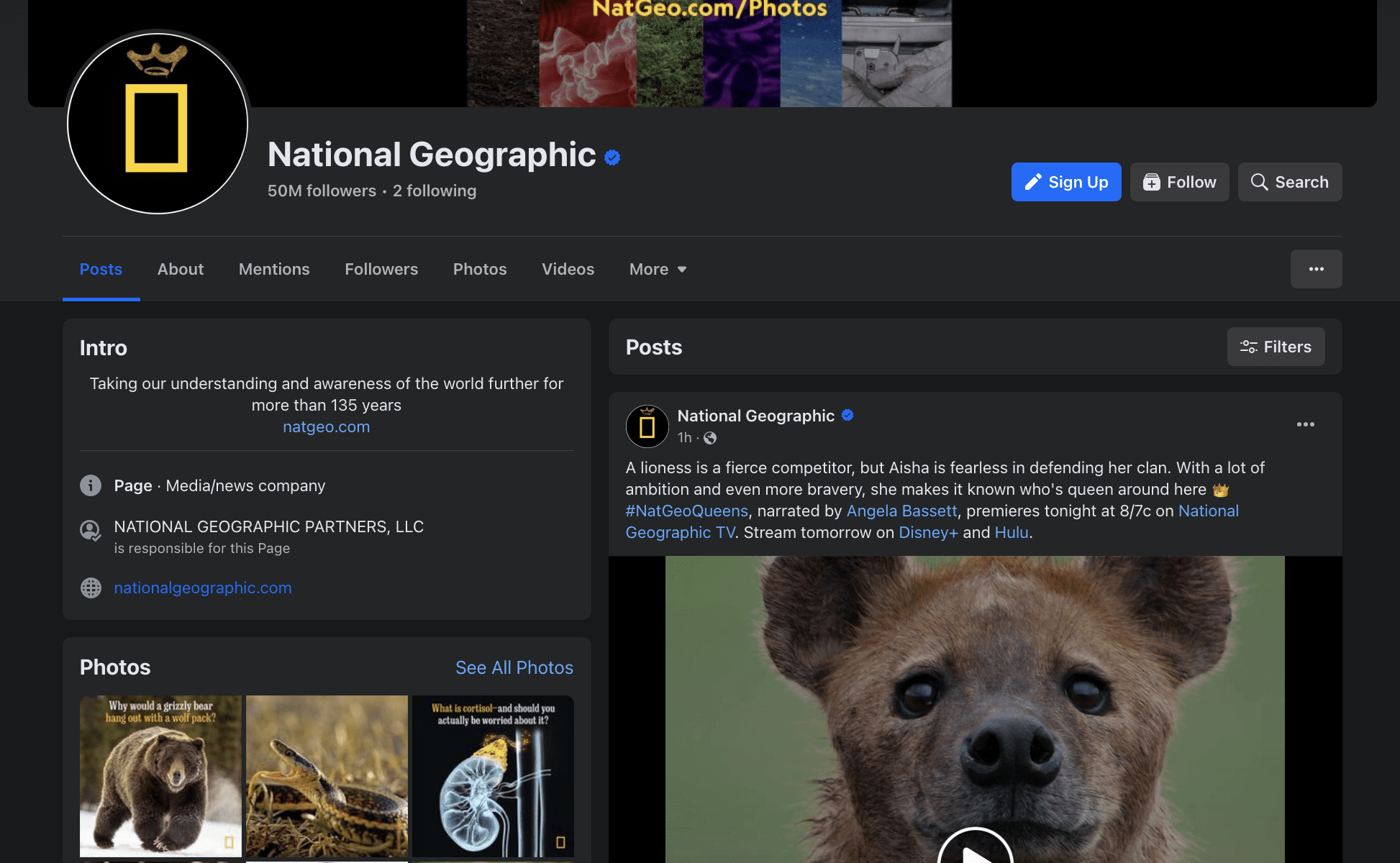
For example, National Geographic uses its CTA to encourage users to sign up for a subscription to the magazine.
Screenshot from Facebook.com, March 2024
4. Join Or Create A Facebook Group
As we just discussed, creating and joining Facebook Groups is a phenomenal way to interact with others, let people come to you, and increase visibility and authority for your brand.
To get started, identify groups that align with your business’s industry, values, or target market. Search for fitting keywords on Facebook and discover some groups to join.
After that, make sure to engage by leaving comments and reactions to posts. By participating actively and making valuable contributions to the Group, you can foster recognition and trust within these communities.
It’s worth noting that only some Groups allow businesses to join. For Groups that only allow individuals, you must join from your personal Facebook account and promote your brand and Page via comments.
Alternatively, you can create your own Facebook Group. This has become an increasingly popular trend among brands, as it allows you to nurture your own community of like-minded people and start conversations.
When creating a Facebook Group, be sure to provide value first. Rather than building a Group around your brand, build a community around something related to your brand – and structure it as a resource hub where members can find support and tips and network with others.
This way, you’re putting genuine support, engagement, and community-building before sales efforts.
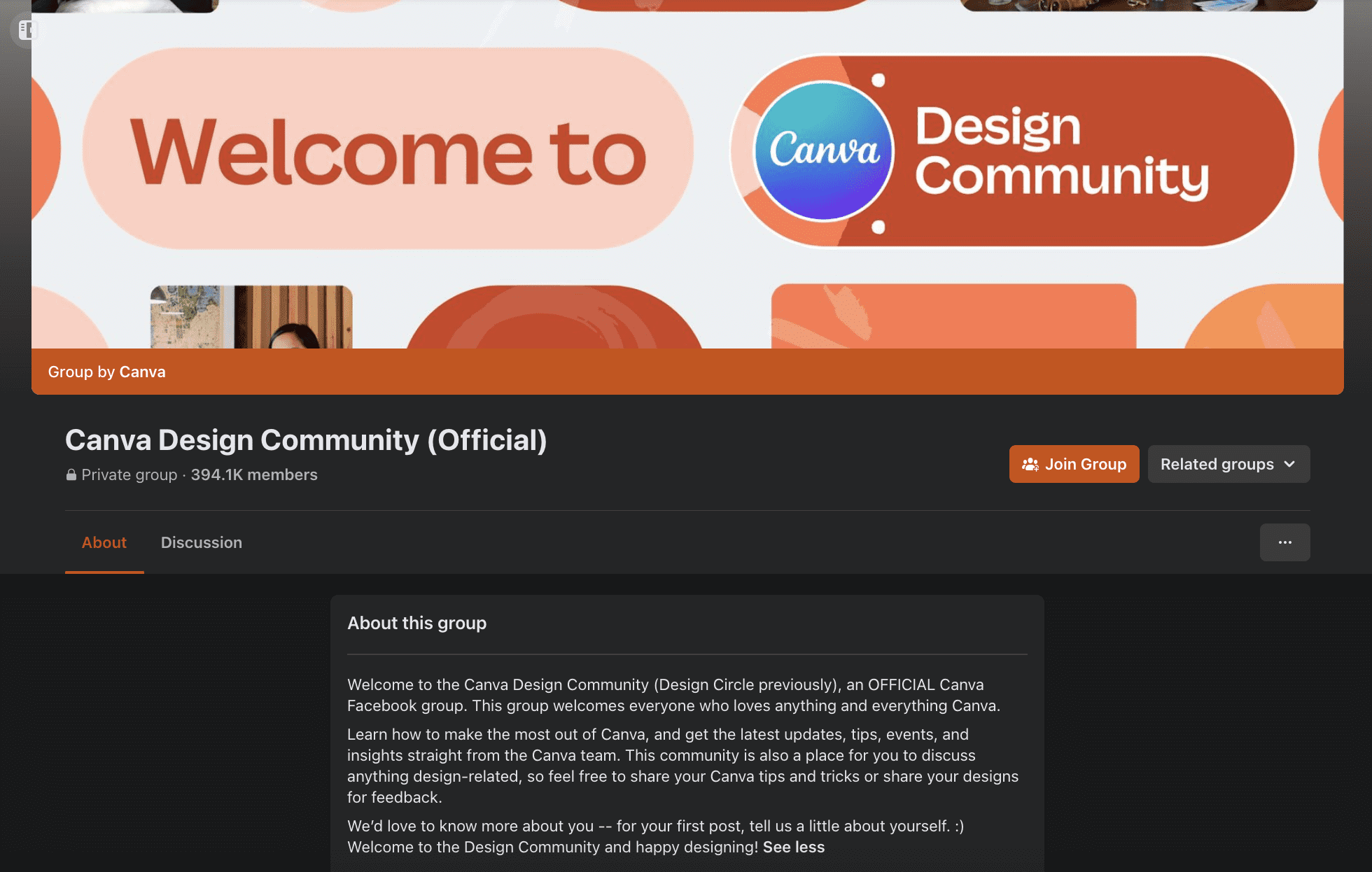
A great example of this is Canva’s Canva Design Community Facebook Group. This official Group from Canva is a place for users to discuss not only the product and get tips and insights, but also anything design-related.
By keeping the Group broad and welcoming all kinds of design-focused discussions, Canva has built a community of over 394,000 members.
Screenshot from Facebook.com, March 2024
5. Expand Your Facebook Page’s Reach
Let’s revisit your current network: a.k.a., the people you already know.
Leveraging your existing network is a fundamental strategy for promoting your Facebook Page.
Whether it’s your friends, peers, or followers across other different social platforms, it’s time to utilize them. These people are already connected to your business and are often willing to support your endeavors.
So, what should you do? Promote, promote, promote.
Start by integrating your Facebook Page promotion across all of your communication channels. Post it to your Instagram and put it in your Instagram bio.
Share updates with personal contacts, embed a link to it on your website, and include its link in your email signature.
If you’ve created any Facebook Groups, make sure you’re directing members back to your main Page for additional content.
Wherever you can, make sure the road leads back to you and your Facebook Page. This will help enhance your visibility and follower count.
In this example, you can see how the Australian meal delivery brand The Dinner Ladies includes a link directly to its Facebook Page in its email newsletter.
Screenshot from Gmail, March 2024
6. Use Facebook Stories And Facebook Live
Both Facebook Stories and Facebook Live can help you establish a sincere connection with your audience.
The cousin of Instagram Stories, Facebook Stories are ideal for sharing short, engaging snippets of your day or quick business updates. This allows for a more casual interaction with your followers.
These fleeting posts can be a mix of personal insights, time-sensitive promotions, or behind-the-scenes looks at your brand.
Facebook Live, on the other hand, offers an intimate, real-time connection that makes viewers feel as though they’re right there with you and part of the moment.
Try leveraging Live to broadcast important events, share updates, or host Q&A sessions. This direct engagement creates a sense of transparency and community between your company and your audience.
The Wall Street Journal is one example of a brand that utilizes Facebook Stories to offer quick updates to its followers. It posts snapshots of the stories of the day, encouraging readers to learn more.
Screenshot from Facebook, March 2024
7. Maintain A Regular Schedule: Consistency Is The Secret Sauce
The key to success in any endeavor – whether it’s becoming debt-free, building meaningful relationships, or improving your personal fitness – lies in consistency.
This is true on Facebook, too.
Something essential to remember if you want to gain and retain followers is to make sure you stick to a regular schedule.
Not only will this keep your brand fresh in the minds of your audience – but an active and up-to-date Page signals to new visitors that they can expect regular, valuable content, encouraging them to follow.
Try to post about one to two times a day, or at least a few times per week, to maintain a steady stream of content without overwhelming your followers.
If you’re too busy to stick to a tight posting schedule, which you very well might be, there’s no reason to fear.
There are many ways to automate posts to your Facebook Page, from plugins on WordPress to software made specifically for the task.
8. Engage Your Audience And Peers
Doesn’t getting all those reactions and comments on your content feel good? You’re not the only one who feels that way; nearly everybody does – including your audience.
Active participation on Facebook, beyond just updating your own Page, can significantly enhance your visibility and credibility. Make an effort to connect with individuals and other businesses that align with your brand’s values and interests.
Do not be self-promotional; instead, post real, thoughtful comments. People appreciate authenticity and are more likely to check out your Page to see what you’re all about.
Don’t be afraid to message peers or influencers within your industry, too. Most, if not all, have been in your shoes before and might be open to connecting and sharing insights with others just getting started – especially those who show genuine interest and respect for their work.
Try finding a successful account you admire and send them a quick message. You never know what could happen if you hear back.
It Is Still Possible To Increase Your Facebook Page’s Following
Time to stop worrying about promoting your Page on Facebook.
Deliver consistent, high-quality content, interact with others, and use the existing Facebook tools at your disposal, and you’ll go far.
With a new set of tools under your belt, it’s time to step out into the not-so-scary world of Facebook and run a Page.
Keep at it, and soon, you’ll start to see the results you’ve been craving!
If a hiker gets lost in the rugged Scottish Highlands, rescue teams sometimes send up a drone to search for clues of the individual’s route—trampled vegetation, dropped clothing, food wrappers. But with vast terrain to cover and limited battery life, picking the right area to search is critical.
Traditionally, expert drone pilots use a combination of intuition and statistical “search theory”—a strategy with roots in World War II–era hunting of German submarines—to prioritize certain search locations over others. Jan-Hendrik Ewers and a team from the University of Glasgow recently set out to see if a machine-learning system could do better.
Ewers grew up skiing and hiking in the Highlands, giving him a clear idea of the complicated challenges involved in rescue operations there. “There wasn’t much to do growing up, other than spending time outdoors or sitting in front of my computer,” he says. “I ended up doing a lot of both.”
To start, Ewers took data sets of search-and-rescue cases from around the world, which include details such as an individual’s age, whether they were hunting, horseback riding, or hiking, and if they suffered from dementia, along with information about the location where the person was eventually found—by water, buildings, open ground, trees, or roads. He trained an AI model with this data, in addition to geographical data from Scotland. The model runs millions of simulations to reveal the routes a missing person would be most likely to take under the specific circumstances. The result is a probability distribution—a heat map of sorts—indicating the priority search areas.
With this kind of probability map, the team showed that deep learning could be used to design more efficient search paths for drones. In research published last week on arXiv, which has not yet been peer reviewed, the team tested its algorithm against two common search patterns: the “lawn mower,” in which a drone would fly over a target area in a series of simple stripes, and an algorithm similar to Ewers’s but less adept at working with probability distribution maps.
In virtual testing, Ewers’s algorithm beat both of those approaches on two key measures: the distance a drone would have to fly to locate the missing person, and the likelihood that the person was found. While the lawn mower and the existing algorithmic approach found the person 8% of the time and 12% of the time, respectively, Ewers’s approach found them 19% of the time. If it proves successful in real rescue situations, the new system could speed up response times, and save more lives, in scenarios where every minute counts.
“The search-and-rescue domain in Scotland is extremely varied, and also quite dangerous,” Ewers says. Emergencies can arise in thick forests on the Isle of Arran, the steep mountains and slopes around the Cairngorm Plateau, or the faces of Ben Nevis, one of the most revered but dangerous rock climbing destinations in Scotland. “Being able to send up a drone and efficiently search with it could potentially save lives,” he adds.
Search-and-rescue experts say that using deep learning to design more efficient drone routes could help locate missing persons faster in a variety of wilderness areas, depending on how well suited the environment is for drone exploration (it’s harder for drones to explore dense canopy than open brush, for example).
“That approach in the Scottish Highlands certainly sounds like a viable one, particularly in the early stages of search when you’re waiting for other people to show up,” says David Kovar, a director at the US National Association for Search and Rescue in Williamsburg, Virginia, who has used drones for everything from disaster response in California to wilderness search missions in New Hampshire’s White Mountains.
But there are caveats. The success of such a planning algorithm will hinge on how accurate the probability maps are. Overreliance on these maps could mean that drone operators spend too much time searching the wrong areas.
Ewers says a key next step to making the probability maps as accurate as possible will be obtaining more training data. To do that, he hopes to use GPS data from more recent rescue operations to run simulations, essentially helping his model to understand the connections between the location where someone was last seen and where they were ultimately found.
Not all rescue operations contain rich enough data for him to work with, however. “We have this problem in search and rescue where the training data is extremely sparse, and we know from machine learning that we want a lot of high-quality data,” Ewers says. “If an algorithm doesn’t perform better than a human, you are potentially risking someone’s life.”
In the US, for example, drone pilots are required to have a constant line of sight between them and their drone. In Scotland, meanwhile, operators aren’t permitted to be more than 500 meters away from their drone. These rules are meant to prevent accidents, such as a drone falling and endangering people, but in rescue settings such rules severely curtail ground rescuers’ ability to survey for clues.
“Oftentimes we’re facing a regulatory problem rather than a technical problem,” Kovar says. “Drones are capable of doing far more than we’re allowed to use them for.”
Ewers hopes that models like his might one day expand the capabilities of drones even more. For now, he is in conversation with the Police Scotland Air Support Unit to see what it would take to test and deploy his system in real-world settings.
AI-powered search results and the oft-postponed demise of third-party advertising cookies could lead ecommerce marketers toward alternative forms of content marketing.
Ecommerce shops depend on website visitors for sales — no shoppers, no orders. Two concerning trends have the potential to pinch stores’ site traffic.
Dual Challenges
The first challenge is familiar. Soon, web browsers will eliminate the advertising cookies that track shoppers across websites.
Cookies help advertising networks learn about consumers to show them relevant ads, i.e., ads they are likely to click. More relevant ads, in turn, lead to lower costs per click, better return on advertising spend, and more sales.
As tracking cookies disappear, advertising networks will lose signal, meaning ads may become less effective and, therefore, more expensive. The impact of this signal loss could be similar to Apple’s change in 2021 in how it tracked consumers across mobile apps, making social media ads relatively less effective. Ecommerce marketers may have to spend more to get paid traffic.
Organic traffic could also be a problem. Since May 14, 2024, Google’s AI Overview feature has been available for many web searches. Bing has a similar feature, Copilot, and some in the industry believe these search summaries will dramatically reduce organic site traffic to many websites. Research firm Gartner estimated that organic traffic could fall by 25% within two years.
Ecommerce marketers must find a way to offset reduced paid and organic visits. Alternative content marketing methods are one possible solution.
AI search summaries could reduce the amount of organic search traffic to websites.
Content Alternatives
For many marketers, content marketing is synonymous with search engine optimization. These folks think of blog posts and even product detail content as a way to rank in search engines.
However, a broad view of content marketing may open folks to benefits beyond organic search, focusing instead on three alternatives.
Editorial newsletters
For many, email newsletters are the new blogs and a significant traffic source.
Consider, for example, an online garden supply shop.
This shop could start a “Gardening This Week” newsletter. Every Thursday, it sends an email broadcast with five gardening tips, three curated from the web. The other two link back to the garden shop’s own blog — the one that once received much organic search traffic. The shop could “sponsor” its own newsletter and include a link to a product.
This newsletter would have at least three positive impacts.
Featuring a single “sponsored” product in the editorial context can drive sales.
Podcasts
In 2017, an Idaho-based farm and ranch retailer (where I was director of marketing and ecommerce) started an editorial podcast that would eventually run for 191 episodes.
The show was available on top podcasting platforms and broadcast on three local radio stations. At its peak, it reached 800,000 monthly listeners. Whenever the podcast mentioned a product, sales of that item increased.
Circa 2024, monitoring podcast performance has gotten easier, and using a podcast for content marketing could help ecommerce marketers with both traffic and sales.
Here’s how.
Imagine an online wine retailer starting a podcast interviewing sommeliers, winemakers, and industry experts.
Episodes would appear on popular podcast platforms and social media sites such as YouTube. The host would encourage listeners to visit the shop’s website and also offer a discount code for a wine mentioned in the interview.
On YouTube, the episode description would include links directly to the wine merchant’s website and the weekly offer.
Courses
Some merchants sell products that require assembly or use instructions. This presents an opportunity to teach customers via courses, a form of content marketing.
Think about an online store selling knitting supplies. The shop could launch a comprehensive knitting course, teaching the fundamentals of holding a needle and following advanced patterns. The course could reside on the shop’s website, on YouTube as a playlist, and on a dedicated portal such as Skillshare.
In each lesson, the instructor could include a materials list with links directly to the shop.
Mitigating
Marketing performance is never certain. Some of that uncertainty now concerns advertising effectiveness and organic search traffic. Marketers interested in mitigating these challenges could try alternative forms of content such as newsletters, podcasts, and courses.
Nearly half of global consumers (46%) have increased their consumption of climate-sustainable products, while an overwhelming number (85%) have experienced the disruptive effects of climate change. That’s according to PwC’s annual “Voice of the Consumer Survey,” titled this year “Shrinking the consumer trust deficit.”
In January and February 2024, PwC surveyed 20,662 consumers across 31 countries and territories. The respondents were at least 18 years old and were asked about a range of topics relating to shopping behaviors, emerging technology, and social media.
—
Per the survey, worldwide shoppers have trust concerns with the social media industry, questioning its safety and reliability.
–
In addition, 83% of respondents state that safeguarding their personal data is critical to a company’s ability to earn their trust.
–
Moreover, consumers seek personal connections when discovering new brands and products. According to the survey, 55% of respondents prefer visiting physical stores and interacting with salespeople, compared to 49% who rely on recommendations from family and friends and 46% who opt for online browsing.
WordPress has been releasing innovative tools that helps users accomplish their goals and become more proficient users. One of the newest tools is called Playground, a tool that is designed to make a WordPress site instantly available for testing, learning and building.
Background On WordPress Playground
Playground is a tool that runs in your browser.
The official WordPress documentation for Playground suggests these uses:
Try a block, a theme, or a plugin
Build an entire site, save it, host it
Test your plugin with many specific WordPress and PHP versions
Embed a real, interactive WordPress site in your tutorial or course
Showcase a plugin or theme on your website
Build a native app running WordPress and put it in App Store
Preview pull requests from your repository
There is also a WordPress Plugin available, Playground By WordPress Contributors, that enables a user to clone their site to a private in-browser Playground version.
The WordPress plugin allows a user to create an exact website copy within a Playground instance, from which a user can do things like test a plugin or theme. Any changes made to the Playground instance do not affect the actual website. The cloned site is not uploaded to any cloud service, all the data remains private, residing within a user’s web browser, where it stays until the browser tab is closed.
Interview: Adam Zieliński, WordPress Playground Architect @ Automattic
I interviewed Adam Zieliński, the WordPress Playground Architect at Automattic, to learn more about what Playground is and how it can be useful for developers and regular users of WordPress.
The first thing I wanted to know is, what is Playground and why should anyone use it, what should people expect from it?
Adam Zieliński:
“Playground is WordPress in a single click. There are no tedious setup steps, webhosts account, or technical talk.
Playground is not the site at playground.wordpress.net. It is the groundbreaking technology that makes that site possible and also powers a new generation of interactive, single-click WordPress tools. There are interactive tutorials, QA (Quality Assurance) workflows, “try before you buy” previewers for plugins, collaboration tools, contribution workflows and so much more.
Here are two examples:
The site at playground.wordpress.net doubles as a QA tool – you can try the upcoming WordPress release, test your plugin or theme with five other plugins and then see how it performs on different WordPress and PHP versions. It proved useful for sourcing feedback during the WordPress 6.5 release cycle, the Font library call for testing, and more.
As a WordPress plugin, Playground can clone your existing WordPress site, including all content, plugins, and themes, inside a private Playground instance. This gives you a way of testing changes, new plugins, or updates before pushing them live and without needing a separate hosting.
The next example is a bit more technical but I’ll still go with it. Playground can be embedded on websites. There are companies out there showcasing a live version of their plugin or theme using a live WordPress Playground site embedded inside their actual site. That’s highly useful for their future customers – even if they have no clue about what Playground is.”
I followed up with a question asking how he would describe Playground to someone who uses WordPress but doesn’t dabble in the development part.
Adam Zieliński:
“Playground is a version of WordPress that runs directly on your device, not on a webhost. You can open Playground on your phone, turn off the internet, and continue using it.”
I next asked if it’s useful for migrating to a new template or testing plugin updates.
Adam Zieliński:
“Absolutely. You can clone your site using the Playground WordPress plugin and try the new template or the updated plugin there first without risking breaking your production site. That plugin also adds a “preview now” button to the plugins search in wp-admin so you can “try them on” before committing to installing one on your live site.”
Zieliński next recommended the following resources to view and read more about Playground:
WordPress Playground: the ultimate learning, testing, & teaching tool for WordPress
Does Playground help regular WordPress users become familiar with developing sites themselves, is it a hands-on way to learn how to use WordPress?
Adam Zieliński:
“Playground makes a great learning tool. You can just hop on playground.wordpress.net and start exploring WordPress, whether that means creating your first post or installing fifteen plugins and building an entire site.
The experience is very self-guided today, which is useful in classes, workshops and meetups where an instructor can give you directions.
We’re also exploring an interactive and guided tutorials. Imagine visiting WordPress.org, clicking on, say, “I want to build my first WordPress site”, and getting clear directions and an interactive WordPress site to work on. That’s what we’re building towards.
And this doesn’t have to be a distant future. Anyone can start creating these interactive learning experiences today with the Playground Block – it’s a single-click way of embedding Playground in your WordPress content. You can play with that block right now if go to the plugin page and by click the Live Preview button. Oh, and that live preview? It’s also powered by WordPress Playground!”
Is Playground compatible with popular WordPress website builders?
Adam Zieliński:
“I haven’t tested Divi. Elementor mostly works, although there’s a technical issue in the onboarding flow that needs to be fixed in Elementor fix before it’s fully functional.”
Playground has a feature called Blueprints, configuration setting files. I asked Adam how he would describe Blueprints and how is it useful to users.
Blueprints are also like puzzle pieces. In fact, at WCEU 2024, you’ll build real WordPress sites with physical puzzle pieces. We’ve printed puzzle pieces representing site configuration steps like installing a plugin or changing the site name and attendees will be able to collect and scan them with an app that will load Playground with the configuration (Blueprint) they put together.
About the usefulness of Blueprints – there are two sides to that. You can either use a Playground site created based on an existing Blueprint, or you can create a new Blueprint.
If you just want to enjoy Playground-based tools, you don’t even need to know what Blueprints are. All you’ll experience is a button that opens a WordPress site preconfigured to do anything at all. It could help you test a theme, contribute a documentation page, or even build a slide deck and export it to PDF.
If you want to build new Blueprints, today you need to get your hands dirty and write some JSON code. Blueprints 101 and Technical Introduction to Playground will walk you through the steps and you can also preview the examples in the Blueprints Gallery. It’s worth noting we’re working on a visual tool where you’ll be able to just assemble these steps like puzzle pieces without any coding knowledge.”
Is this a way to create a site and then save or share the demo?
Adam Zieliński:
“Yes! Playground sites are temporary by default but there’s many ways to save and share them. On playground.wordpress.net there’s a settings button where you can tell Playground to save your site in your web browser. Once you do that and refresh the page, you’ll return right to your site. You can also synchronize the site with a directory on your computer and all the Playground changes will show up there. Then you can also export your site as a zip file or to GitHub.
There are two ways of sharing a site with others.
The first one, is to create a Blueprint – so write down all the step by step instructions for Playground to recreate that site. You could then include that Blueprint in a link and share it with the world.
Blueprints are powerful but not always convenient, so there’s also a second way. A Playground site can be exported as a zip file. You can host that zip file, for example on GitHub, and create a Playground link to load it.”
Someone from the WordPress developer community passed this question along:
“Site builders often have one or more “starter sites”, which seem to squarely line up with blueprints, though they usually include premium themes and plugins. Drupal has “Distributions,” which are basically pre-configured starter sites often with a niche focus.
Imagine a preconfigured install of core, a theme, a membership plugin, and payment setup (waiting for gateway API keys). If you want a membership site then just install this and start adding content. Or a preconfigured help desk system and so on.
So, I’m wondering if the vision is that Blueprints will provide something similar?”
Adam Zieliński:
“Blueprints enable just that. Live previews in the WordPress plugin directory are an example – every time you get an identical site pre-configured for a particular plugin. It always installs a fresh WordPress and the latest versions of all the co-existing plugins and themes. You can prepare a Blueprint for your particular setup and work with it in the browser, or you can also use the Playground CLI tool to work with these starter sites on your local computer. We’re building a PHP library to enable webhosts to support Blueprints – template sites may then become a common feature in the WordPress hosting landscape.”
WordPress Playground
A playground is a place that is designed for and encourages activities. That’s exactly what WordPress Playground is about. Anyone who uses WordPress should give Playground a try or at the very least become familiar with it because knowledge broadens perspectives, aids in problem solving, and makes one a more effective competitor and business person.
Google has officially acknowledged that some internal documents recently leaked online are authentic.
The files containing details about data Google collects and potentially uses in its search ranking algorithms ignited speculation and analysis within the SEO community.
Now, there’s a question of whether the leak will cause Google to tighten its already restricted communication channels.
Background Information
The existence of the leaked documents was first reported earlier this week by Rand Fishkin and Mike King.
They claim the materials offer a look under the hood of Google’s closely guarded search engine, suggesting the company tracks data like user clicks and Chrome browsing activity – signals that Google representatives have previously downplayed as ranking factors.
However, Google has cautioned against jumping to conclusions based on the leaked files alone.
Many in the SEO community have made potentially inaccurate assumptions about how the leaked data points fit into Google’s systems. Google cautions against this.
A Google spokesperson said in a statement to The Verge:
“We would caution against making inaccurate assumptions about Search based on out-of-context, outdated, or incomplete information.”
Potential Impact On Google’s Public Communication
The leak has put Google in an awkward position, forcing the typically tight-lipped company to respond publicly.
With so much speculation and argumentation now swirling around the leaked files, Google may hesitate to reveal new details about its search engine and ranking processes.
Historically, the company has walked a fine line between guiding SEO professionals and publishers while protecting its algorithms from manipulation and abuse.
Looking Ahead
While the documents provide clues about Google’s search algorithms, much remains unknown about how Google collects and weights the various data points.
The consensus view emerging is to treat the leaked information as a jumping-off point for further research and testing, not as gospel truth about what drives search rankings.
Open and collaborative discussion has always been a strength of the SEO world. Still, it’s important to pair that knowledge-sharing with rigorous testing, healthy skepticism, and respect for the limitations of any one data source – even from inside Google itself.
FAQ
How might the leak change Google’s communication strategy?
Following the leak, Google might become more secretive in its communications to avoid further exposure of sensitive information.
Historically, Google has balanced guiding SEO experts while protecting its algorithms from manipulation. This balance may shift, leading to restricted public disclosures about its search engine and ranking processes.
Why is it important not to draw hasty conclusions from the leaked documents?
It’s crucial not to make hasty conclusions from the leaked documents because they might contain incomplete, outdated, or out-of-context information.
Google has cautioned against making inaccurate assumptions about its search algorithms based solely on these files. SEO professionals are advised to use the information as a starting point for further research and validation through practical testing.
What should SEO experts focus on after the Google data leak?
Post-leak, SEO experts should focus on fostering open and collaborative discussions while being skeptical of any one data source, even if it’s from Google.
They should continue testing and research to confirm insights from the leaked documents. Aim to develop strategies based on verified and comprehensive data rather than solely relying on potentially misleading internal leaks.
If you’re looking to breathe new life into your brand and generate more interest in your target audience, here are the top 10 skills and strategies you’ll need.
1. Know Your Audience And Target Them Effectively
Ask anyone about content and content marketing, and chances are that audience targeting is one of the first suggestions.
But what does audience targeting actually mean? And why is it an essential content marketing skill?
First, understand who your audience is, what their day is like, their priorities, and what they’re doing or intending to do while they consume content.
Then, use that information to craft content that counts on a platform and in a format that suits your audience.
The content is photo-centric. The page has few distractions, and the storytelling and text are dense and chunked.
The topics range from stories of shoemakers, care tips, and all the insider info a lover of bespoke and top-of-the-line men’s shoes, shoe designer, or shoemaker could want to know about the objects of their obsessions.
These features tell us a lot about the blog’s readers.
Shoe Snob Blog readers are likely visual, busy, and view reading the blog’s content as almost a secret pleasure they indulge in while waiting in line for an expensive coffee.
The blog doesn’t have content on saving money, getting things for less, building shoes more cheaply, or reviews of shoes you’d find in your local department store.
Why? That’s not what the blog’s target audience is interested in. In fact, those topics would likely chase readers away.
For Justin FitzPatrick, the blog’s author, it’s about the luxury, the emotional connection and passion for the brands, and the smaller details most of us wouldn’t likely notice about a man’s dress shoe – in language that matches the audience’s expertise.
You might be tempted to skip audience exploration and targeting to this degree, particularly if you’re a B2B brand or sell something non-visual like insurance.
But this could be a fatal mistake for your content marketing.
Even if you’re selling to another company, that company is driven and shaped by humans you’ll need to get attention from.
2. Understand How Brand Strategy Influences Content
Content and content marketing could do more harm than good if they fail to blend seamlessly with a brand strategy.
So, if you’re looking to build content marketing skills, ensure you understand how brand strategy influences effective content.
Solid brand-driven content strategies consist of six core elements when it comes to content:
Brand foundations – What matters to the company, such as the image it wishes to project, etc.
Audience discovery and brand position – How the brand fits within the market.
Keywords and language – How the company wants people to find its brand, and what language it will use.
Content creation – Any content strategy must be manageable, affordable, sustainable, scalable, and effective.
Organization – Utilizing an editorial and publishing calendar and post-publishing tracking and measurement to maintain and guide your content strategy.
3. Consider SEO, Search, And Search Engines
SEO and search are essential for getting found, gaining traffic, building authority, and overall growth.
If you want your content marketing to work, you can’t afford to avoid this content marketing skill because you’re not an expert.
Users make 1.2 trillion searches on Google per year.
93% of all web traffic comes from a search engine.
46% of searches are made to look for something local.
In January 2023, searches for phrases that included “gifts” increased 45%, while searches that included “presents” increased 15% over 2022. This equated to $47 billion in the two weeks following Christmas.
So, search is growing and becoming more important – not declining.
If you want to take advantage of search traffic, you need to ensure you’re considering several aspects of SEO when developing your content marketing skills, including:
Site structure, website performance, and analytics.
4. Humanize Your Content
Once you get started with content marketing, you’ll realize pretty quickly that AI-generated content is highly problematic.
You need to follow basic SEO formulas to have your content rank, another formula to make it interesting and catchy for readers, and how to maximize the usability of your content.
However, you also need to ensure you stand out from the crowd and surpass your competitors.
To make your content more human-friendly, learn how to:
Create content that supports a user journey rather than search engines or sections of a funnel.
Utilize customer communications and social channels to understand and connect with your audience. Then, use it to market your content.
Make use of internal experts. Not only is looking in-house a way to make excellent content more affordable, but audiences also love to see your brand’s passion for what it does.
Take a smart angle, get personal, and have an attitude. Personality and branding are vital, but so is the information you provide. Ensure it is something of value to your readers, and don’t be afraid to tell stories to build emotional connections.
Stories make content emotionally engaging but also make it possible for readers to experience what it would be like if they purchased your product or service.
Want to strengthen your content marketing with storytelling?
Create relatable, believable content. To do this, know your audience, understand their experiences, and create content that aligns with this knowledge.
Have a clear message. Like an ad, every story or piece of content needs a goal and a clear message you want to convey to your audience.
Choose the right type of story. Do you need to make an emotional connection? Compel a reader to act? Convey values, a feature, or a concept? Build community?
Select the right platform and medium. If you want to share several statistics, video might not be the best option. Selling vacations? YouTube or TikTok might perform better than Reddit or a blog.
Know where to start and stop. Your content needs to appear at the right point in the customer journey and push readers to the next step. What should readers do next?
Organize and structure. Plan your content ahead of time. Make sure your stories have an arc, make sense, and take readers or views through an experience.
6. Do Your Research
The best content provides an audience with information or a look at something they normally don’t have access to.
To find this information, you must be prepared for deep research – and that means a lot more than just finding a statistic.
Find the original source or study. Ensure the number you’ve found is still relevant and accurate. Consider the source of the statistic and how they arrived at that number. What did the study not consider when finding their statistic?
To build additional authority, you may consider interviewing the source of a statistic or a subject area expert.
7. Improve Your Interviewing Skills
While it helps if you deeply understand the subject matter, it isn’t all lost if you’re new to the topic.
In fact, being a newbie to a topic can have advantages because you can see the topic with a fresh perspective.
One thing you must be knowledgeable about, however, is interviews. Interviewing is an essential content marketing skill.
Here are some tips:
Prepare
Arrive at the interview with an understanding of the topic. Know the pains and challenges individuals interested in the topic face.
Understand your priorities for your readers, the industry, and the individual you’re interviewing.
Have a list of questions that are thoughtful and organized, and work toward answering a single question or reaching a specific goal.
Set Interview Goal
Are you trying to get tips from an expert? A day in the life of? Solve or bring light to a certain issue? Make a human connection?
Choose a goal for your interview, organize it into an outline, and remove any question or information that doesn’t help you move toward that goal.
Be Personable And Make The Interviewee Comfortable
Awkward silences, a lack of rapport, nervousness, and other social aspects can interfere with an otherwise excellent interview and affect the information you collect.
You may want to consider using cognitive interview techniques, which have been adapted from criminal investigation for journalism.
Record Your Conversation
As humans, our brains prioritize stimuli to determine what is important and what we should pay attention to and remember.
This attentional filtering becomes more severe when you’re making notes, thinking about the technical aspects of an interview, and nervous. As a result, it’s easy to miss important details or implications.
So, save some time and improve your accuracy and insights into the information provided during the interview by making a recording that you can refer to as often as necessary.
Be Precise And Ask For Clarification
Some people love raisins in cinnamon buns. Others do not. And just like the raisins debate, how you define a word or concept may vary greatly from someone else.
So, if the information you collect during an interview seems vague, or you’re unsure of something the interviewee says, ask.
The worst thing you can do is assume that it isn’t true or deliberately influence the meaning of someone’s words.
8. Measure And Track Everything
Measuring something is generally easy. The difficult part of measurement and tracking is measuring and tracking the right things.
SEJ’s annual State of SEO Report reveals that SEO professionals often have a mismatch between their goals, the methods and strategies they use to reach them, and the variables they measure.
Content marketers and marketing are no exception.
Let’s say you want to use content marketing to increase conversions. So, you create a video for your hot tub company.
In this instance, tracking and analyzing traffic data to the video would be a mistake. Those numbers are only part of the story.
Instead, track clicks and use traffic data to better understand who clicks through to your content and where viewers go after they consume it.
And this is vital: Don’t stop your analysis at the click.
Every visit from a viewer is only one step in a larger journey – and this journey matters.
Returning to the previous example, your video might have generated fewer clicks and conversions overall.
Dig a little deeper, however, and you might discover that those few conversions were of much higher value than average, and the viewers return to your site more often than your average site viewer.
In this instance, while traffic numbers might make it look like your video failed, analysis of the customer journey reveals that your video was actually a big success, attracting a more qualified, valuable, and engaged audience.
9. Repackage Content With Purpose
You invest a lot of resources in creating amazing content. Don’t simply publish it in one format and waste the rest of its potential.
By planning, you can collect images, video footage, sound bites, expert quotes, and everything you’ll need to share and market your content in various ways to maximize your return on investment (ROI).
But refrain from repackaging content with the sole purpose of spreading it everywhere. Carefully plan your content to appear when and where you need to.
As explained in the video above, Search Engine Journal uses the data gathered for its State of SEO Report to create:
White paper reports.
Podcast.
Articles on data not included in the main reports.
Infographics.
Carousels for social media.
Video clips.
Some of these are released before the main report is published to help spread the word and generate interest while sharing interesting insights about the SEO industry.
Then, when the report is released, it is followed by additional content to help generate interest, links, and findings.
Therefore, instead of a week of interest, the reports generate traffic and attention while informing readers for months without significantly increasing the original investment.
10. Stand Out While Blending In
One of the more common pieces of advice is to copy successful content and do what others are doing.
Makes sense, right?
After all, SEO, good writing, and other skills all have best practices you need to follow. Your audience also has preferences, expectations, and requirements.
Your content needs to look like everyone else’s to some degree.
But here’s the problem with this advice: No one stands out if everyone does things the same way.
Therefore, learning how to blend in while standing out is an essential skill for content marketing.
So, instead of mimicking or copying successful content, collect several examples that have worked on a specific platform or for a specific audience and investigate to find out why they’re effective.
Then, you can use these insights to create and test your own content that allows you to stand out, be unique, and fulfill the needs of your target audience.
Conclusion
Effective marketing is more than choosing the right topic or quality writing.
By strengthening and utilizing these 10 content marketing skills, your content will help you generate the right traffic and connect with your audience in a way that will have you dominating the competition.
The Core Web Vitals technology report shows that five out of six of the most popular content management systems performed worse in April 2024 when compared to the beginning of the year. The real-world performance data collected by HTTPArchive offers some clues about why performance scores are trending downward.
Core Web Vitals Technology Report
The rankings for Core Web Vitals (CWV) are a mix of real-world and lab data. The real-world data comes from the Chrome User Experience Report (CrUX) and the lab data is from an HTTP Archive public dataset (lab data based on the websites included in the CrUX report).
The data is used to create the Core Web Vitals technology report which can be sliced and diced to measure the mobile and desktop performances for a wide variety of content management systems in any combination, as well as provide data on JavaScript, CSS HTML and image weight data.
The data reported in the Search Engine Journal articles are based on measurements of mobile data. The scores are in the form of percentages which represent the percentages of website visits that resulted in a good Core Web Vitals (CWV) score.
This is the background on the HTTP Archive scoring for CWV:
“Core Web Vitals There may be different approaches to measure how well a website or group of websites performs with CWV. The approach used by this dashboard is designed to most closely match the CWV assessment in PageSpeed Insights”
This is the background information about the HTTP Archive lab data:
“HTTP Archive measures individual web pages, not entire websites. And due to capacity limitations, HTTP Archive is limited to testing one page per website. The most natural page to test for a given website is its home page, or the root page of the origin.”
The highest performing content management system (CMS) of the six CMS under comparison is Duda, a closed-source website builder platform that is used by agencies and developers for creating and managing large portfolios of client sites. 71% of website visits resulted in a good core web vitals score. Duda’s score is 13 percentage points ahead of the second place winner, Squarespace, another closed source website building platform.
Sites built with Duda consistently have higher CWV performance rates than any other CMS, by a wide margin. Squarespace, Drupal and Wix are bunched together with similar performance scores, with the Joomla and WordPress scoring in fifth and sixth place.
WordPress Is Faster But Other Factors Slowing It Down
Although WordPress is ranked in sixth place, it’s performance did not drop as much as the other leading content management systems, quite possibly reflecting the many performance improvements in present in each new version of WordPress. WordPress 6.5, released in early April 2024, featured over 100 performance improvements to the backend and the front end.
The performance score for WordPress was slightly lower in April 2024 than in the beginning of the year, but less than one percentage point. However, that percentage drop is lower than the top ranked CMS, Duda, which experienced a drop of 5.41 percentage points.
Chrome Lighthouse is an automated tool for measuring website performance. The Lighthouse scores for WordPress in January of this year was 35%, which means that 35% of measured WordPress sites had a good Lighthouse CWV score. The CWV score took a dip in February and March but it zipped back to 35% in April, perhaps reflecting the many performance improvements in WordPress version 6.5.
The scores for the average Page Weight is likely where the performance lagged. Page Weight is the average number of bytes sent over the network, which could be compressed. The average Page Weight of WordPress sites started out at 568.48 in January and increased to 579.92, an increase of 11.44.
The average download size of images when compared from January to April 2024 increased by 49.5 Kilobytes but that’s something that has more to do with how publishers use WordPress and not how WordPress is being used. These could be contributing to the essentially flat performance change this year. But again, virtually no change in performance is better than what’s going on with other content management systems which experienced larger drops in their performance rates.
Top CWV Performance By CMS
The list of CWV performance represents the percentage of sites using a given CMS that has a good CWV score. Here is the list of the top performers with their respective percentage rates:
Duda 71%
Squarespace 58%
Drupal 54%
Wix 52%
Joomla 43%
WordPress 38%
Performance Drops By CMS
Comparing the performance drop by CMS shows a weird trend in that four out of six content management systems had relatively high drops in performance. The following is a comparison of performance drops by percentage points, indicated with a minus sign.
List By Performance Change
Wix -7.11
Duda -5.41
Joomla -2.84
Drupal -2.58
WordPress -0.71
As can be seen above, WordPress had the lowest drop in performance. Wix and Duda had the steepest drops in performance while Squarespace was the only CMS with an increase in performance, with a positive score of +3.92.
Core Web Vitals Scores – Takeaways
Duda is clearly the Core Web Vitals performance champ, outscoring every content management system in this comparison. Squarespace, Wix and Drupal are close behind in a tight pack. Out of the six platforms in this comparison only Squarespace managed to improve their scores this year.
All of the other platforms in this comparison scored less well in April compared to the beginning of the year, possibly due to increases in page weight, particularly in images but there might be something else that accounts for this anomaly that isn’t accounted for in the HTTP Archive reports.
The WordPress performance team continues to score notable improvements to the WordPress core and the slight performance drop of less than one percent may be because of how publishers are using the platform.
It’s safe to say that all the platforms in this comparison are winners because all of them show steady improvements in general.
I bet you do because otherwise, you would not be reading this book. If your company uses personal data for marketing, accounting, HR, or whatever other purposes, you need a privacy policy.
The traditional approach to data protection and informational self-determination suggests that meaningful control of your own data is only possible if you were informed about how the data will be used.
One of the first rules GDPR lays down in its text, after clarifying the scope of the law and the different definitions, is Article 5 (legislation.gov.uk, 2016):
1. Personal data shall be:
(a) processed lawfully, fairly and in a transparent manner in relation to the data subject (‘lawfulness, fairness and transparency’)
This very requirement triggers the need for a privacy statement.
Companies, in particular, when they are data controllers, must be accountable for their data use and have a privacy statement. This requirement is also spelled out in Article 24(2) of the GDPR (legislation.gov.uk, 2016).
This article covers the topic of automated individual decision-making, including profiling – not profiling for marketing that automates the selection of ads to be shown and so on, but profiling that can have a serious impact on people.
Article 24(2) says such profiling can only be compliant if an appropriate data protection policy, which includes a privacy statement, is implemented (legislation.gov.uk, 2016).
In any event, a privacy statement is an important document. GDPR dedicates two articles to list out the precise information you need to post on your privacy policy; Article 13 sets out the requirements in case you collect data directly from consumers, and Article 14 those for situations where data is collected indirectly (legislation.gov.uk, 2016).
Who Will Read Your Privacy Statement?
In the case of food labelling, it was me as a customer checking for a particular ingredient that read this. Have you ever wondered who reads your privacy statement?
Customers and prospects are one obvious group of stakeholders who are concerned about what is happening with their data once it’s in your hands. Privacy activists and consumer protection organizations may also be going through your privacy statement.
Authors and academic researchers in the field of data protection find it a great source of information, learning how companies are using personal data. Regulators, judges, and lawyers who are working on a case that involves your company also take great interest in your privacy notice.
Your corporate image is shaped by how your privacy statement reads. Customers, both in business-to-business as well as business-to-consumer markets, pay great attention to your privacy practice.
Business partners and suppliers to your company often formalize the review of your company’s data protection compliance, asking questions about your privacy statement in their due diligence questionnaires.
Whoever the readers are, it is another “touch-point” for a variety of stakeholders, including revenue-generating parties like customers and partners.
You want them to have a good impression of your privacy practices, and the first chance you have to showcase this may be your privacy statement. Borrowing the words of the ICO, a good privacy statement “helps build trust, avoids confusion, and lets everyone know what to expect.” (ICO, 2023)
How Long Should My Privacy Statement Be?
GDPR expects you to draw up a privacy statement long enough so that you can properly explain which data is collected, used, and stored. This makes your privacy statement transparent.
At the same time, your privacy statement must be concise, according to Article 12(1) of GDPR (legislation.gov.uk, 2016). These two requirements seem to contradict each other at first glance. The EU regulators, therefore, give some explanations in their guidelines on transparency (Art 29 WP, 2018).
While a privacy statement aims to give necessary information so that consumers can make decisions about their personal data, regulators are also aware of the phenomena known as “information fatigue” or “information overload.” The hypothesis is that human beings have a limited capacity to digest information.
When too much information is presented, people become overwhelmed and either ignore the information or make illogical decisions to cope with the psychological stress they experience (Simmel, 1950; Milgram, 1969).
There are two strategies to avoid this that can, at the same time, still provide all the details required.
Have A Clear Structure
Before starting to write a privacy notice, list out all the information you need to provide in it. Then, think about how you want to present it to your customers and other data subjects in a logical manner.
In doing so, you might want to read the privacy statements of big consumer brands and governmental organizations and find out how their privacy statements are structured.
There is a good chance that their privacy notices are prepared by experienced in-house lawyers or by law firms that specialize in data protection. The idea is to get the feeling of what great privacy statements look like.
You might also want to read up on the privacy statements of your competitors, as well as those of your partners in your business field.
Ask your privacy person which competitors have good reputations with regard to their data protection practices, or perhaps you already know who they are. Just take a look at how their privacy notices are structured. You can also simply adopt the structure of ICO’s privacy policy template.
Whatever you do, the key is to improve the readability of your privacy statement by giving it a logical structure.
Prepare Privacy Notices In Layers
Another approach, endorsed by the regulators, is the so-called layered approach (Art 29 WP, 2018).
Assuming that the privacy notice is going to be online, you can make your privacy policy interactive by using links, so that users can click on them when they want more information, or skip them and stay on the first-level summary information if they so wish, just as you would use an online encyclopedia.
This way, the key messages are simplified, and readers of your privacy statement will have a good overview of the first layer of the statement.
Regulators recommend the following information should be visible on the first layers of the privacy notice (Art 29 WP, 2018, p 19, para 36):
Details of the purposes of processing
The identity of the data controller
Description of the data subjects’ rights
Information on the processing which has the most impact on the data subject
Information on the processing which could surprise them.
When Do I Have To Present The Privacy Statement?
Consumers must be informed what data is collected for, for instance marketing purposes, as early as possible.
When you are collecting data directly from your customers, you must present your privacy notice the moment you are collecting the data (see Article 13(1) GDPR; legislation.gov.uk, 2016).
In a scenario where you license the data from other organizations, such as from public sources or marketing data providers, Article 14(3)a and b require the privacy information to be provided in the following manner (legislation.gov.uk, 2016):
within a reasonable period after obtaining the personal data, but at the latest within one month, having regard to the specific circumstances in which the personal data are processed;
if the personal data are to be used for communication with the data subject, at the latest at the time of the first communication to that data subject; or
if a disclosure to another recipient is envisaged, at the latest when the personal data are first disclosed.
In short, for licensed data that is not contact detail data, the privacy notice must be communicated within a month.
If you are using contact data like names, telephone numbers, email addresses, and physical addresses, you need to communicate the privacy statement the first time you send a commercial message to them.
In practice, companies embed a link to the privacy statement in email messages or print that link on direct mail pieces to fulfill this requirement.
References:
Art 29 WP (2018) Article 29 Data Protection Working Party, WP260 rev.01 Guidelines on transparency under Regulation 2016/679, adopted on 29 November 2017, last revised and adopted on 11 April 2018, https://ec.europa.eu/newsroom/article29/items/622227 (archived at https://perma.cc/4HWYURKL)
legislation.gov.uk (2016)‘Regulation (EU) 2016/679 of the European Parliament and of the Council, 27 April 2016, www.legislation.gov.uk/eur/2016/679/contents (archived at https://perma.cc/NVG6-PXBQ)
Milgram, S (1969) The experience of living in cities, Science 167, 1461–1468
Simmel, G (1950) The metropolis and mental life, in K H Wolff (ed.), The Sociology of Georg Simmel, Free Press, New York, USA.
To read the full book, SEJ readers have an exclusive 25% discount code and free shipping to the US and UK. Use promo code SEJ25 at koganpage.com here.
More resources:
Featured Image: Rawpixel.com/Search Engine Journal