The story of enterprise resource planning (ERP) is really a story of businesses learning to organize themselves around the latest, greatest technology of the times. In the 1960s through the ’80s, mainframes, material requirements planning (MRP), and manufacturing resource planning (MRP II) brought core business data from file cabinets to centralized systems. Client-server architectures defined the ’80s and ’90s, taking digitization mainstream during the internet’s infancy. And in the 21st century, as work moved beyond the desktop, SaaS and cloud ushered in flexible access and elastic infrastructure.
The rise of composability and agentic AI marks yet another dawn—and an apt one for the nascent intelligence age. Composable architectures let organizations assemble capabilities from multiple systems in a mix-and-match fashion, so they can swap vendor gridlock for an à la carte portfolio of fit-for-purpose modules. On top of that architectural shift, agentic AI enables coordination across systems that weren’t originally designed to talk to one another.
Early indicators suggest that AI-enabled ERP will yield meaningful performance gains: One 2024 study found that organizations implementing AI-driven ERP solutions stand to gain around a 30% boost in user satisfaction and a 25% lift in productivity; another suggested that AI-driven ERP can lead to processing time savings of up to 45%, as well as improvements in decision accuracy to the tune of 60%.
These dual advancements address long-standing gaps that previous ERP eras fell short of delivering: freedom to innovate outside of vendor roadmaps, capacity for rapid iteration, and true interoperability across all critical functions. This shift signals the end of monolithic dependency as well as a once-in-a-generation opportunity for early movers to gain a competitive edge.
Key takeaways include:
Enterprises are moving away from monolithic ERP vendor upgrades in favor of modular architectures that allow them to change or modernize components independently while keeping a stable core for essential transactions.
Agentic AI is a timely complement to composability, functioning as a UX and orchestration layer that can coordinate workflows across disparate systems and turn multi-step processes into automated, cross-platform operations.
These dual shifts are finally enabling technology architecture to organize around the business, instead of the business around the ERP. Companies can modernize by reconfiguring and extending what they already have, rather than relying on ERP-centric upgrades.
This content was produced by Insights, the custom content arm of MIT Technology Review. It was not written by MIT Technology Review’s editorial staff. It was researched, designed, and written by human writers, editors, analysts, and illustrators. This includes the writing of surveys and collection of data for surveys. AI tools that may have been used were limited to secondary production processes that passed thorough human review.
Good writing takes time, which is in short supply when you’re launching or running a business.
Fortunately, there are excellent online tools that can streamline composition, check grammar, and even overcome disadvantages such as dyslexia. AI capabilities, while not perfect, make them more powerful than ever.
Writing Aids
Grammarly
Category leader Grammarly is an all-purpose workhorse that checks for errors and style faults and suggests corrections and improvements. It integrates with Microsoft Office, Google Workspace, and the top web browsers on Windows, Mac, iOS, and Android platforms.
Grammarly offers a limited, free version and paid plans starting at $12 per user per month with a free trial.
Grammarly checks for errors and style faults and suggests corrections and improvements.
ProWritingAid
ProWritingAid goes beyond composition mechanics with features such as goal tracking, manuscript analysis, and the ability to compare your writing style to that of famous authors, such as Stephen King.
Subscriptions include a free basic version and paid plans starting at $120 per user per year.
Ginger
In addition to checking grammar and style across multiple platforms, programs, and devices, Ginger provides instant language translation into Spanish, French, German, and Japanese.
Ginger’s grammar checker is free. Paid versions start at $9.90 per month.
Language Tool
Language Tool caters to users who aren’t native speakers of the language they’re writing in. It claims to cover more than 30 languages, including Spanish, Dutch, German, Portuguese, Catalan, French, and six varieties of English.
A basic AI grammar and usage checker is free. Premium monthly plans start at $24.90 per user.
Hemingway Editor
Hemingway Editor tightens and simplifies prose and displays the changes with brightly colored highlights.
The basic online editor is free. Downloadable desktop versions for Mac and PC cost $19.99.
Otter
Otter is an automated notetaking tool that transcribes, outlines, and summarizes meetings and conversations. It integrates with popular platforms such as Google Workspace, HubSpot, Jira, Asana, and Zoom. In my testing, the raw AI-generated audio transcripts required a fair amount of cleanup, but it learns the voices of frequent speakers.
Otter offers a free, limited subscription. Paid plans start at $16.99 per user per month.
Reference Tools
AP Stylebook. Geared toward professional journalists, the Associated Press Stylebook offers usage recommendations, style suggestions, and grammar rules. The annual printed version is $34.95. The online Stylebook starts at $30 per user per year or $42 when bundled with Merriam-Webster Unabridged.
The Associated Press Stylebook offers usage recommendations, style suggestions, and grammar rules.
Merriam-Webster Unabridged. For a monthly subscription of $4.95, the authoritative dictionary-thesaurus is worthwhile for users needing more than built-in spellcheckers or free resources.
Chicago Manual of Style. Popular among professional editors and publishers, the Chicago Manual of Style from the University of Chicago Press delves into the fine points of grammar and usage. Various printed versions include a hardback book for $75. Subscriptions to the online version start at $48 per user per year.
Purdue OWL. Purdue University’s comprehensive, free Online Writing Lab is valuable for writers of all kinds. It includes grammar guides, plagiarism-avoidance tips, research and citation advice, overviews of subject-specific writing such as healthcare, and summaries of the most widely used style guides.
Hostinger analyzed 66 billion bot requests across more than 5 million websites and found that AI crawlers are following two different paths.
LLM training bots are losing access to the web as more sites block them. Meanwhile, AI assistant bots that power search tools like ChatGPT are expanding their reach.
The analysis draws on anonymized server logs from three 6-day windows, with bot classification mapped to AI.txt project classifications.
Training Bots Are Getting Blocked
The starkest finding involves OpenAI’s GPTBot, which collects data for model training. Its website coverage dropped from 84% to 12% over the study period.
Meta’s ExternalAgent was the largest training-category crawler by request volume in Hostinger’s data. Hostinger says this training-bot group shows the strongest declines overall, driven in part by sites blocking AI training crawlers.
These numbers align with patterns I’ve tracked through multiple studies. BuzzStream found that 79% of top news publishers now block at least one training bot. Cloudflare’s Year in Review showed GPTBot, ClaudeBot, and CCBot had the highest number of full disallow directives across top domains.
The data quantifies what those studies suggested. Hostinger interprets the drop in training-bot coverage as a sign that more sites are blocking those crawlers, even when request volumes remain high.
Assistant Bots Tell a Different Story
While training bots face resistance, the bots that power AI search tools are expanding access.
OpenAI’s OAI-SearchBot, which fetches content for ChatGPT’s search feature, reached 55.67% average coverage. TikTok’s bot grew to 25.67% coverage with 1.4 billion requests. Apple’s bot reached 24.33% coverage.
These assistant crawls are user-triggered and more targeted. They serve users directly rather than collecting training data, which may explain why sites treat them differently.
Classic Search Remains Stable
Traditional search engine crawlers held steady throughout the study. Googlebot maintained 72% average coverage with 14.7 billion requests. Bingbot stayed at 57.67% coverage.
The stability contrasts with changes in the AI category. Google’s main crawler faces a unique position since blocking it affects search visibility.
SEO Tools Show Decline
SEO and marketing crawlers saw declining coverage. Ahrefs maintained the largest footprint at 60% coverage, but the category overall shrank. Hostinger attributes this to two factors. These tools increasingly focus on sites actively doing SEO work. And website owners are blocking resource-intensive crawlers.
I reported on the resource concerns when Vercel data showed GPTBot generating 569 million requests in a single month. For some publishers, the bandwidth costs became a business problem.
Why This Matters
The data confirms a pattern that’s been building over the past year. Site operators are drawing a line between AI crawlers they’ll allow and those they won’t.
The decision comes down to function. Training bots collect content to improve models without sending traffic back. Assistant bots fetch content to answer specific user questions, which means they can surface your content in AI search results.
Hostinger suggests a middle path: block training bots while allowing assistant bots that drive discovery. This lets you participate in AI search without contributing to model training.
Looking Ahead
OpenAI recommends allowing OAI-SearchBot if you want your site to appear in ChatGPT search results, even if you block GPTBot.
OpenAI’s documentation clarifies the difference. OAI-SearchBot controls inclusion in ChatGPT search results and respects robots.txt. ChatGPT-User handles user-initiated browsing and may not be governed by robots.txt in the same way.
Hostinger recommends checking server logs to see what’s actually hitting your site, then making blocking decisions based on your goals. If you’re concerned about server load, you can use CDN-level blocking. If you want to potentially increase your AI visibility, review current AI crawler user agents and allow only the specific bots that support your strategy.
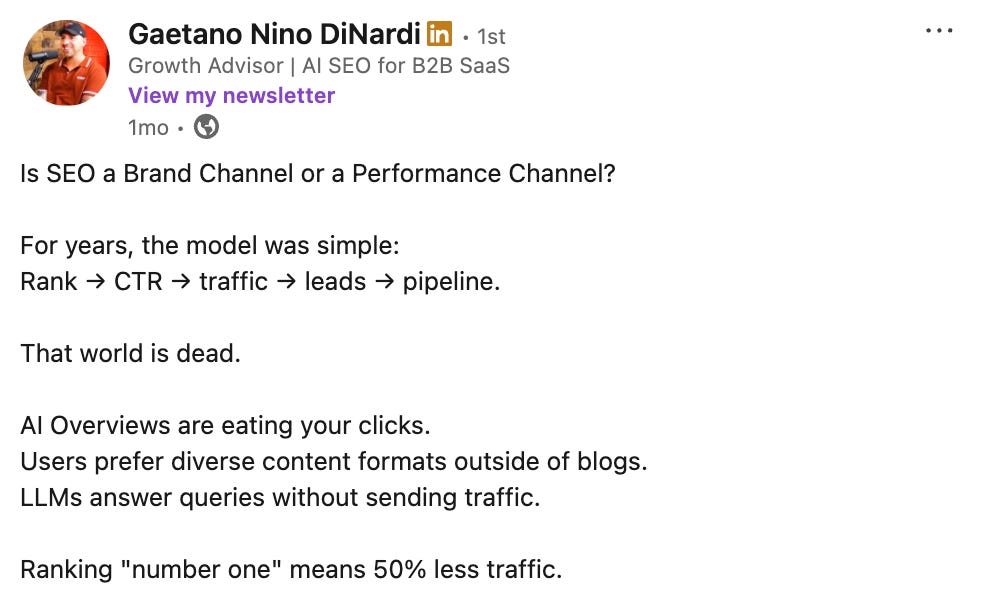
SEO died as a traffic channel the moment pipeline stopped following page views. Traffic is either down for many sites, or its growth nowhere near reflects growth rates of 2019-2022, but demos and pipeline are up for brands that shifted from chasing clicks to building authority.
What you’ll get in today’s memo:
Why traffic and pipeline decoupled.
What brand strength actually means in AI search.
How to reframe SEO with executives.
The old funnel has holes. Traffic and pipeline no longer move together. (Image Credit: Kevin Indig)
Boost your skills with Growth Memo’s weekly expert insights. Subscribe for free!
1. We’ve Hit Peak Search Volume For Traditional Queries
Image Credit: Kevin IndigImage Credit: Kevin IndigImage Credit: Kevin Indig
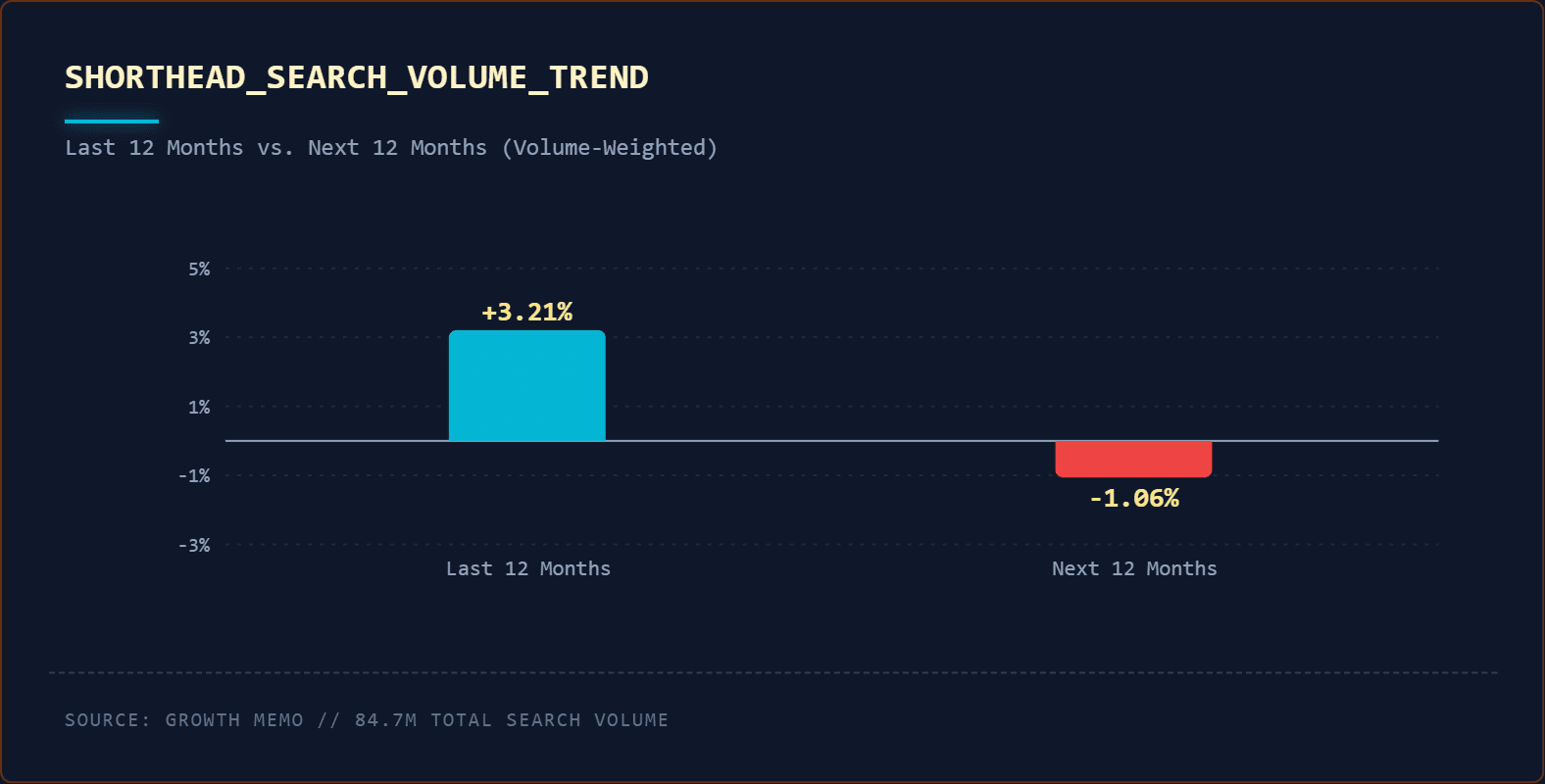
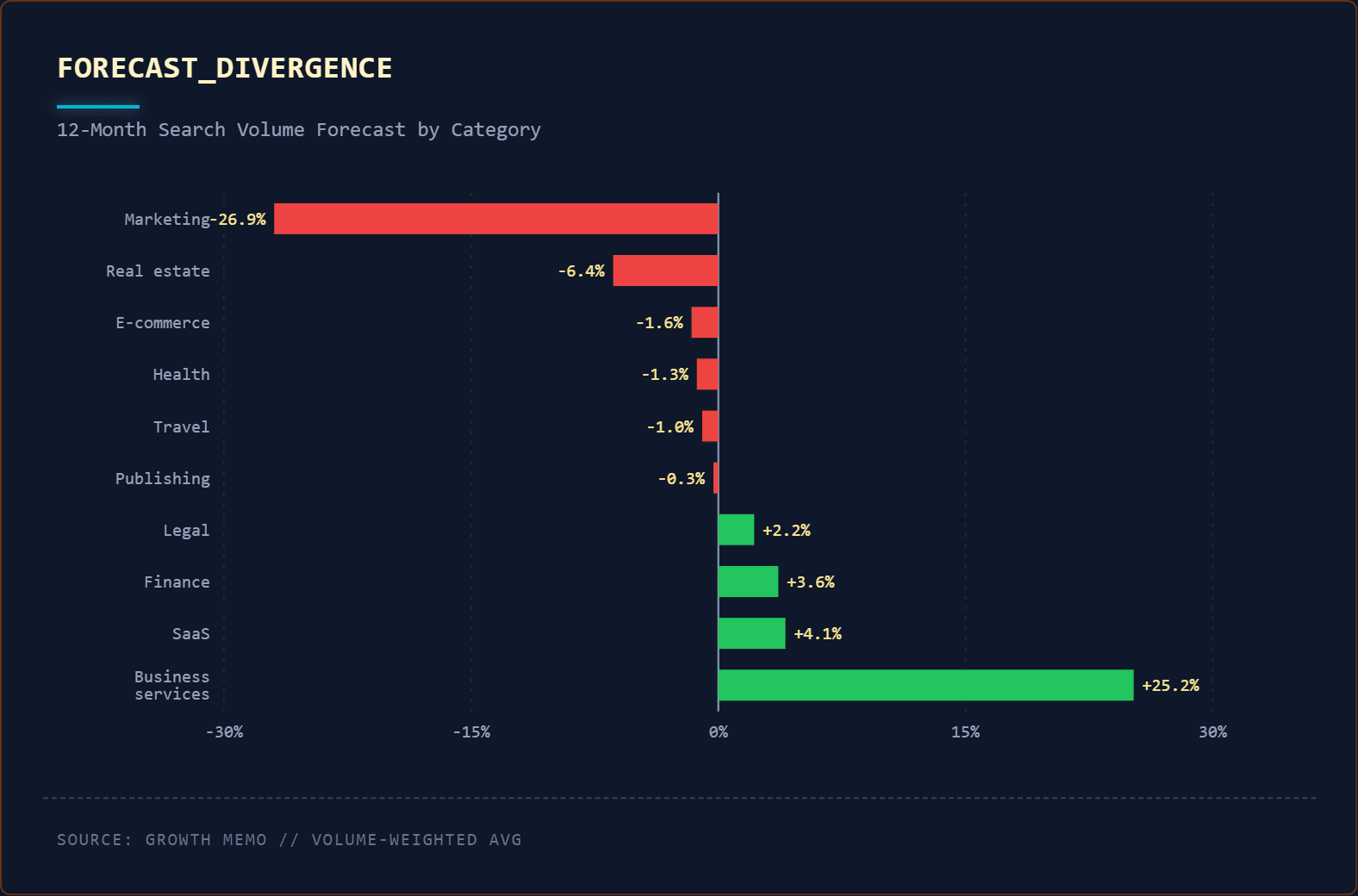
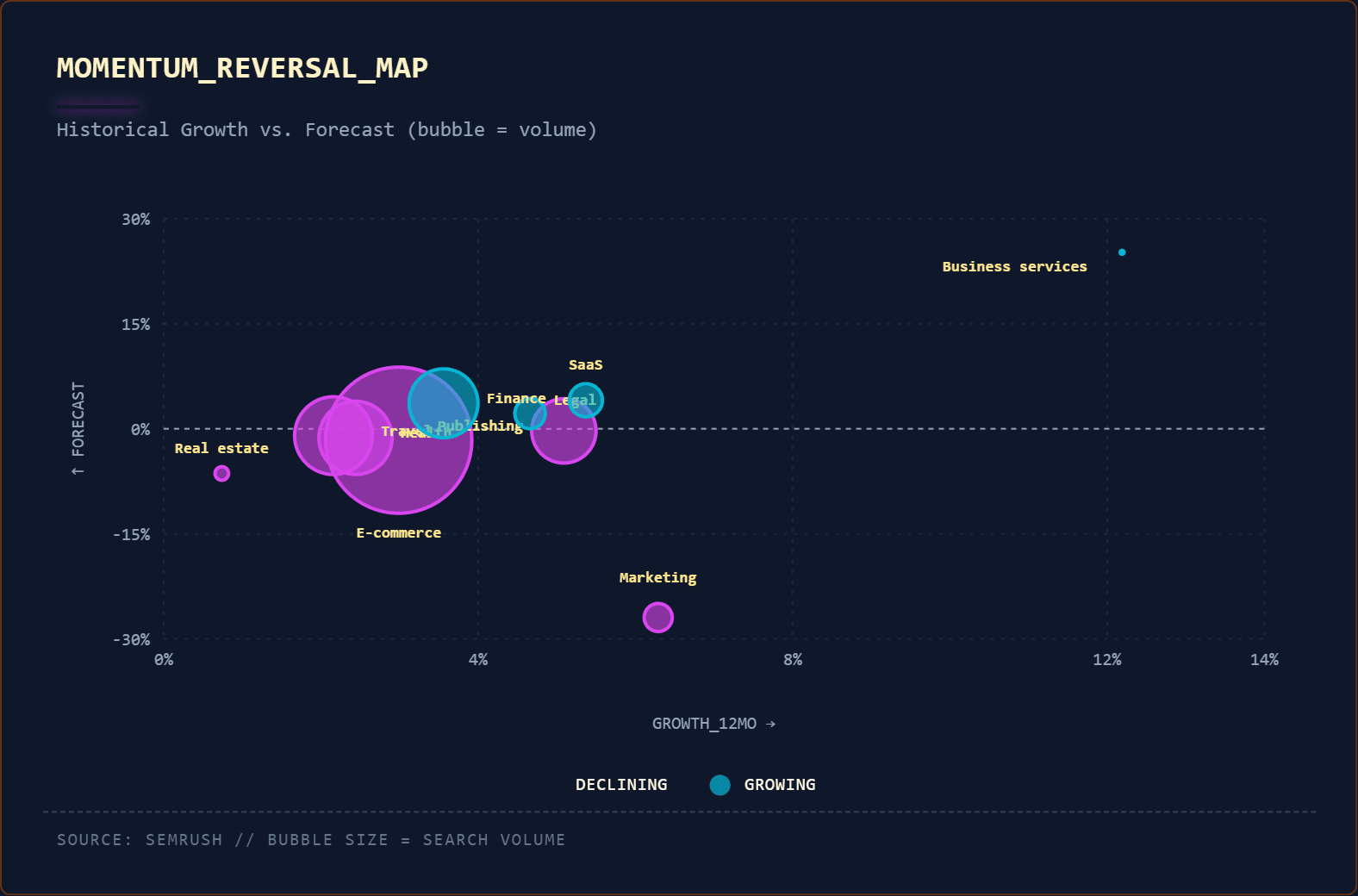
Short-head keyword demand is in permanent decline and likely contributing to slowed traffic growth or decline.
An analysis of roughly 10,000 short-head keywords shows that collective search volume grew only 1.2% over the last 12 months and is forecasted to decline by 0.74% over the next 12 months.
Two forces are driving it:
Fragmentation into long-tail: Demand did not disappear; it atomized into thousands of specific queries.
Bypass behavior: More users start in AI interfaces (AIOs, AI Mode, ChatGPT) instead of classic search.
This shift is irreversible for four structural reasons:
1. AI Overviews are here to stay. Google’s revenue model depends on keeping users inside the SERP. Zero-click search protects Google’s ad business. The company is not reverting to the 10 blue links.
2. LLM outputs are preferred starting points. Many users have conditioned themselves to expect direct answers. The behavior change is complete.
3. Zero-click is now the default expectation. Clicking through now feels like friction, not value. If the answer or solution isn’t easily acquired, the search experience failed.
4. Content supply exploded. There is significantly more content competing for the same queries than three years ago. AI-generated articles, Reddit threads, YouTube videos, and newsletters all compete for visibility. Even if visibility or “rankings” hold, CTR collapses under the weight of infinite options.
Optimizing for traffic growth in this environment is like optimizing for fax machine usage in 2010. The channel is structurally shifting – the products that people use to find answers have fundamentally changed.
2. Traffic And Pipeline Decoupled Because AI Ate The Click
The correlation between organic traffic and pipeline has broken. But it takes a bit more work to convince stakeholders and executives. We’re seeing this across the industry.
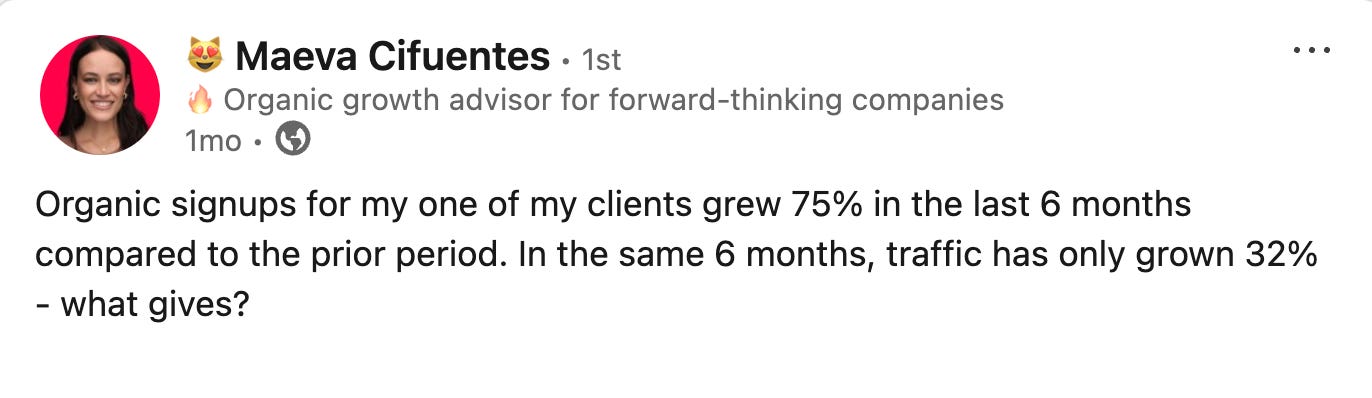
In December, Maeva Cifuentes reported traffic growth of 32% for one of her clients, while signups grew 75% over the same six-month period. Her post was in response to one from Gaetano DiNardi, who found no correlation between traffic and pipeline across multiple B2B SaaS companies he advises. Maeva’s client data shows you can grow pipeline 2.3x faster than traffic. Gaetano’s data shows you can grow pipeline while traffic stays flat or even declines.
Image Credit: Kevin Indig
The classic SEO model assumed a linear relationship: More rankings meant more clicks, more clicks meant more traffic, more traffic meant more leads.
Alternatively, AI answers queries without sending clicks. The Growth Memo AI Mode Study found that when the search task was informational and non-transactional, the number of external clicks to sources outside the AI Mode output was nearly zero across all user tasks. Users get the information they need – directly in their interface of choice – without ever visiting your site.
But buying intent didn’t disappear with the clicks.
SEO creates influence. It can still shape which brands buyers trust. It just doesn’t deliver the click anymore.
Education happens inside the AI interface. Brand selection happens after. Your traffic vanished, but the demand for your product/services didn’t.
This explains why Maeva noted she has clients whose traffic is declining, but demos are growing by double digits month-over-month.
Image Credit: Kevin Indig
The SEO work didn’t stop working. The measurement broke. Teams optimized for clicks are being judged on a metric that no longer predicts business outcomes.
3. Strong Brands Still Win In AI Search, But “Brand Strength” Has A New Definition
In AI search, performance depends less on “more pages” and more on whether AI systems can confidently understand, trust, and cite you for a specific audience and context.
Brand strength in AI search has four components:
Topical Authority: Complete ownership of the conceptual map (see topic-first SEO), not just keyword coverage.
ICP Alignment: Answers tailored to specific buyer questions, prioritizing relevance over volume. Read Personas are critical for AI search to learn more.
Third-Party Validation: Citations from category-defining sources matter more than high-DA links (see the data in How AI weighs your links).
Positioning Clarity: LLMs must recognize what a brand is known for. Vague positioning gets skipped; sharp positioning gets cited (covered in State of AI Search).
SEO teams that are structured for traffic optimization are now misaligned with business outcomes.
The conversation you need to have is “traffic and pipeline decoupled, here’s the data proving it, and here’s what we’re measuring instead.”
Move from keyword-first workflows to ICP-first workflows. Start with ICP research (what questions do your buyers ask and where do they ask them), positioning (what are you known for), and omnichannel distribution (SEO + Reddit + YouTube + earned media). SEO is no longer a standalone channel. It’s one input in a brand-building system.
Move from traffic reporting to influence reporting. Stop leading stakeholder conversations with sessions, impressions, and rankings. Report on brand lift (are more people searching for you by name?), pipeline influence (what percentage of demos started with organic touchpoints?), and LLM visibility rates (how often do AI systems mention your brand vs cite your content?).
4. The Uncomfortable Question: If SEO Doesn’t Drive Traffic Anymore, What Does It Do?
Here’s what SEO actually does and always did: It shapes mental availability and brand recognition, builds topic/category authority, frames the problem (and the solution), and reduces buyer uncertainty.
Traffic was a proxy for those things. The click was the observable action, but the trust was the outcome that mattered.
LLM-based search has removed the click but kept the trust-building. Users still learn from your content. It just happens inside an LLM interface instead of on your domain. Your content can still influence which brands buyers trust. Yes, it’s harder to measure because it’s invisible to analytics. But the outcome – buyers choosing your brand when they’re ready to buy – is the same.
SEO influences brand preference within the category. When buyers are in-market and researching solutions, SEO determines whether your brand is in the consideration set and whether AI systems recommend you.
Traffic was never the point. It was just the easiest thing to measure.
Featured Image: Paulo Bobita/Search Engine Journal
I recently spoke with Jesse Dwyer of Perplexity about SEO and AI search about what SEOs should be focusing on in terms of optimizing for AI search. His answers offered useful feedback about what publishers and SEOs should be focusing on right now.
AI Search Today
An important takeaway that Jesse shared is that personalization is completely changing
“I’d have to say the biggest/simplest thing to remember about AEO vs SEO is it’s no longer a zero sum game. Two people with the same query can get a different answer on commercial search, if the AI tool they’re using loads personal memory into the context window (Perplexity, ChatGPT).
A lot of this comes down to the technology of the index (why there actually is a difference between GEO and AEO). But yes, it is currently accurate to say (most) traditional SEO best practices still apply.”
The takeaway from Dwyer’s response is that search visibility is no longer about a single consistent search result. Personal context as a role in AI answers means that two users can receive significantly different answers to the same query with possibly different underlying content sources.
While the underlying infrastructure is still a classic search index, SEO still plays a role in determining whether content is eligible to be retrieved at all. Perplexity AI is said to use a form of PageRank, which is a link-based method of determining the popularity and relevance of websites, so that provides a hint about some of what SEOs should be focusing on.
However, as you’ll see, what is retrieved is vastly different than in classic search.
I followed up with the following question:
So what you’re saying (and correct me if I’m wrong or slightly off) is that Classic Search tends to reliably show the same ten sites for a given query. But for AI search, because of the contextual nature of AI conversations, they’re more likely to provide a different answer for each user.
Jesse answered:
“That’s accurate yes.”
Sub-document Processing: Why AI Search Is Different
Jesse continued his answer by talking about what goes on behind the scenes to generate an answer in AI search.
He continued:
“As for the index technology, the biggest difference in AI search right now comes down to whole-document vs. “sub-document” processing.
Traditional search engines index at the whole document level. They look at a webpage, score it, and file it.
When you use an AI tool built on this architecture (like ChatGPT web search), it essentially performs a classic search, grabs the top 10–50 documents, then asks the LLM to generate a summary. That’s why GPT search gets described as “4 Bing searches in a trenchcoat” —the joke is directionally accurate, because the model is generating an output based on standard search results.
This is why we call the optimization strategy for this GEO (Generative Engine Optimization). That whole-document search is essentially still algorithmic search, not AI, since the data in the index is all the normal page scoring we’re used to in SEO. The AI-first approach is known as “sub-document processing.”
Instead of indexing whole pages, the engine indexes specific, granular snippets (not to be confused with what SEO’s know as “featured snippets”). A snippet, in AI parlance, is about 5-7 tokens, or 2-4 words, except the text has been converted into numbers, (by the fundamental AI process known as a “transformer”, which is the T in GPT). When you query a sub-document system, it doesn’t retrieve 50 documents; it retrieves about 130,000 tokens of the most relevant snippets (about 26K snippets) to feed the AI.
Those numbers aren’t precise, though. The actual number of snippets always equals a total number of tokens that matches the full capacity of the specific LLM’s context window. (Currently they average about 130K tokens). The goal is to completely fill the AI model’s context window with the most relevant information, because when you saturate that window, you leave the model no room to ‘hallucinate’ or make things up.
In other words, it stops being a creative generator and delivers a more accurate answer. This sub-document method is where the industry is moving, and why it is more accurate to be called AEO (Answer Engine Optimization).
Obviously this description is a bit of an oversimplification. But the personal context that makes each search no longer a universal result for every user is because the LLM can take everything it knows about the searcher and use that to help fill out the full context window. Which is a lot more info than a Google user profile.
The competitive differentiation of a company like Perplexity, or any other AI search company that moves to sub-document processing, takes place in the technology between the index and the 26K snippets. With techniques like modulating compute, query reformulation, and proprietary models that run across the index itself, we can get those snippets to be more relevant to the query, which is the biggest lever for getting a better, richer answer.
Btw, this is less relevant to SEO’s, but this whole concept is also why Perplexity’s search API is so legit. For devs building search into any product, the difference is night and day.”
Dwyer contrasts two fundamentally different indexing and retrieval approaches:
Whole-document indexing, where pages are retrieved and ranked as complete units.
Sub-document indexing, where meaning is stored and retrieved as granular fragments.
In the first version, AI sits on top of traditional search and summarizes ranked pages. In the second, the AI system retrieves fragments directly and never reasons over full documents at all.
He also described that answer quality is constrained by context-window saturation, that accuracy emerges from filling the model’s entire context window with relevant fragments. When retrieval succeeds at saturating that window, the model has little capacity to invent facts or hallucinate.
Lastly, he says that “modulating compute, query reformulation, and proprietary models” is part of their secret sauce for retrieving snippets that are highly relevant to the search query.
Featured Image by Shutterstock/Summit Art Creations
Search has changed dramatically, including local search. Search engines and AI systems now incorporate semantic understanding to generate citations and results. To gain semantic understanding, they need to know which topics appear in the content and how they relate to one another so that they can identify your areas of authority.
For brands with multiple locations, this shift can create challenges. Search engines often misinterpret place names or the services a location offers, which can lead to the wrong landing page appearing for a near-me query. At the same time, it gives local SEOs a new opportunity to add needed semantic clarity.
To support clarity and semantic understanding, SEOs should adopt an entity SEO approach. The topics, also known as entities, are like keywords with multiple dimensions. When defined within your content and with schema markup, entities can bring clarity to AI and search engines.
In Microsoft’s recent article titled “Optimizing Your Content for Inclusion in AI Search Answers,” Krishna Madhavan, Bing’s Principal Product Manager, stated:
“Schema can label your content as a product, review, FAQ, or event, turning plain text into structured data that machines can interpret with confidence.”
This semantic understanding is what adds clarity to AI.
With more than 47 locations, one of our clients, Brightview Senior Living, needed a way to scale SEO across dozens of markets. Entity linking helped them do exactly that. Their strategy shows what SEOs can start doing today to gain clarity, authority, and better local performance.
Why Entity Linking Matters For Local SEO Today
In the world of Entity SEO, search engines now look beyond keywords for:
What entities are mentioned on a page.
How those entities relate to the user’s search queries.
Whether the content provides meaningful context and clarity.
Entities include locations, services, products, people, or anything else with a definable meaning. But identifying an entity is only the first step. Search engines also need to understand the entity’s context, which is where properties in schema markup come in and help disambiguate what the entity actually represents.
When you optimize a page, you describe its main entity. By using the schema.org vocabulary, you can leverage its properties to provide search engines and AI with a structured way to understand the entity.
For example, if you’re describing a location, you’d define the physical location as a LocalBusiness entity, using schema properties to describe the business and its service area, and then define the properties that map to the content on the page to describe it.
Now that you’ve defined the entity using properties, it’s time to add entity linking.
There are two types of entity linking: external entity linking and internal entity linking.
Internal Entity linking is the process of linking to internal entities on your website. External Entity linking is the process of linking entities on your site to their definitions in authoritative knowledge bases such as Wikipedia, Wikidata, or industry-specific glossaries. This is done using schema.org properties such as “sameAs”, “mentions”, “areaServed”, and more. Note that entity linking can use any properties within schema.org.
Today, we’ll focus on external entity linking.
By linking the entities mentioned in your website content to authoritative external sources, you provide search engines with clear, explicit definitions. This reduces ambiguity, improves the relevance of your rankings, and can help your content’s performance in AI summaries and intent-based search experiences.
For organizations looking to optimize for local search, place-based entity linking is particularly impactful.
Brightview’s Challenge: Scaling Hyperlocal SEO Across 47+ Communities
Brightview Senior Living’s marketing team was responsible for performance across more than 47 community pages, each with its own name, local context, and service mix. Search engines often struggled to interpret these pages correctly, especially when the location name overlapped with a more prominent city elsewhere.
A prime example was Phoenix, Maryland, being confused with Phoenix, Arizona. This kind of misunderstanding can derail visibility for queries such as “assisted living near me” or “assisted living in Phoenix.”
To improve search engines’ understanding of what Brightview offered and where, they needed a future-proof strategy grounded in semantic clarity.
The Solution: Place-Based And Topical Entity Linking At Scale
Brightview shifted from keyword-first SEO to entity-first SEO. Their strategy focused on identifying the entities that defined each location and service offering, then linking them to authoritative definitions to eliminate ambiguity.
1. Disambiguating Place Names
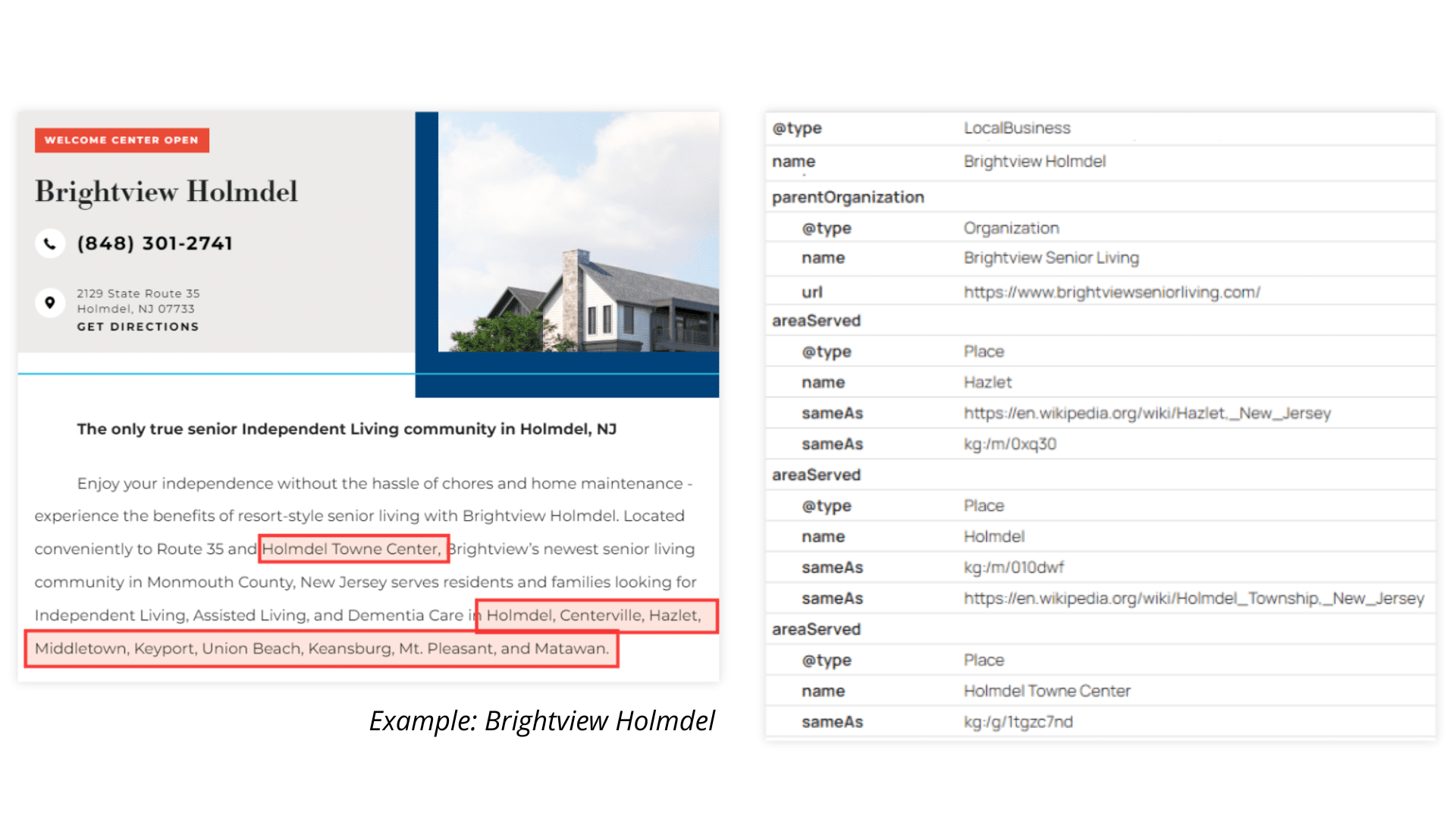
On each community page, Brightview explicitly defined the location entity and linked it to its authoritative source. For example:
Using mentions within the schema markup to identify the specific place referenced on the community page.
Using areaServed on community pages to clarify the geographic region that the location serves.
Using sameAs to link each location entity to authoritative sources like Wikipedia, Wikidata, and Google’s Knowledge Graph to disambiguate places with similar or identical names.
Image from author, December 2025
This resolved issues such as the Phoenix, Maryland, confusion by telling search engines exactly which Phoenix the content referred to. It also provided a clear geographic signal for near me and geo-modified queries.
2. Mapping Key Services As Entities
Brightview applied entity linking to core service terms, including assisted living and independent living. These concepts were linked to authoritative sources using “sameAs” and “mentions”.
This helped Brightview show up more consistently for non-branded, high-intent searches like “assisted living communities” or “independent living options,” which are critical touchpoints early in the customer journey.
By linking assisted living to a known entity, search engines recognized Brightview’s content as authoritative on the topic. This moved Brightview beyond brand-dependent queries and into the realm of broader, category-level search visibility.
3. Scaling Entity Linking Across All Content Types
Entity linking was applied across community pages, blog posts, and informational resources. This built a connected content knowledge graph that reinforced Brightview’s authority across both topics and locations that mattered most to their organization.
The result was a site where search engines could clearly understand what each page was about, what locations it represented, and how those pages related to Brightview’s broader expertise.
By disambiguating locations and services, Brightview made it easier for AI systems to return correct answers when users searched for care options in specific regions.
The Result: Stronger Local Visibility And More Accurate Search Interpretation
After implementing entity linking, Brightview saw measurable gains in both local and non-branded visibility.
Stronger Non-Branded Search Performance
Non-branded queries often indicate users who have not yet chosen a provider and who are actively evaluating options.
By clearly defining their service entities using schema markup, Brightview achieved:
25% increase in clicks for non-branded queries featuring the “assisted living” entity.
30% increase in impressions for those same queries.
This shift shows how entity linking helps organizations rank for what they do and where they do it, not just who they are.
Higher Discoverability For Community Pages
With place-based external entity linking in place, Brightview’s community pages performed better for high-intent local searches. Search engines better understood the connection between each community and its service area.
Across community pages, Brightview saw:
16% year-over-year increase in clicks (despite industry-wide drops in clicks).
26 % year-over-year increase in impressions.
Pages that used clear, linked location data were more reliably served for near-me and city-based queries.
Stable CTR Despite Industry Declines
As AI Overviews reshape the SERP with zero-click search, many brands have seen their click-through rate drop. Brightview’s CTR remained strong relative to benchmarks. Clear entity definitions helped search engines and AI models surface their content accurately, even as the search landscape shifted.
Ryan Pitcheralle, Brightview’s SEO consultant, noted that the strength of their schema markup implementation was a direct driver of performance. As he put it, their results showed “complete causation, not just correlation. This is why we’ve stayed competitive in clickthrough rate and performance while everyone else is sliding.”
How To Use Entity Linking Strategically
Entity linking is not only a technical tactic. It is a strategic opportunity to clarify what your organization should be known for. Here is how to apply it effectively.
1. Identify The Entities That Define Your Authority
Your website contains many entities, but you do not need to link them all. Focus on the ones that support clarity and strategic differentiation.
For example:
Locations you want to rank for.
Core service offerings.
Product categories.
Regulated terms or industry definitions.
Topics you want to be recognized as authoritative on.
Consistently linking these entities signals to search engines where your expertise lies.
2. Build A Connected Content Knowledge Graph
Entity linking is a key part of creating a content knowledge graph that shows search engines the relationships between your locations, offerings, resources, and brand. Your content knowledge graph helps machines infer meaning, understand context, and deliver more accurate results about your organization that can make or break conversions.
3. Prioritize Place-Based Entity Linking If You Have Multiple Locations
Local search hinges on clarity. Search engines need explicit signals about:
Which location your page refers to.
What services are available there.
Which geographic region that page serves.
Place-based entity linking provides that clarity and increases your chances of ranking for geo-modified and near-me queries.
4. Prepare For AI Search
AI search experiences rely on correctly interpreted entities. When locations, services, and concepts are linked to authoritative sources, AI systems can return more accurate, helpful answers and are more likely to reference your content correctly.
Entity Linking Is A Clear Path To Local SEO Accuracy
Brightview’s success shows that entity linking is a practical, high-impact way to strengthen local search performance. By clarifying locations, services, and key concepts, you can help search engines and AI systems understand exactly what your content represents.
Entity linking improves semantic accuracy and builds the foundation for long-term authority. For SEO and marketing leaders, it is one of the most actionable ways to prepare for the future of semantic and AI-driven search.
New data from BrightEdge shows how finance-related queries perform on AI Overviews, identifying clear areas that continue to show AIO while Google is pulling back from others. The deciding factor is whether the query benefits from explanation and synthesis versus direct data retrieval or action.
AI Overviews In Finance Are Query-Type Driven
Finance queries with an educational component, such as “what is” queries trigger a high level of AI Overviews, generating and AIO response as high as 91% of the time.
According to the data:
Educational queries (“what is an IRA”): 91% have AI Overviews
Rate and planning queries: 67% have AI Overviews
Stock tickers and real-time prices: 7% have AI Overviews
Examples of finance educational queries that generate AI Overviews:
ebitda meaning
how does compound interest work
what is an IRA
what is dollar cost averaging
what is a derivative
what is a bond
Finance Queries Where AIO Stays Out
Two areas where AIO stays out are local type queries or queries where real-time accuracy are of the essence. Local queries were initially a part of the original Search Generative Experience results in 2023, showing AI answers 90% of the time. That dropped to about 10% of the time.
The data also shows that “brand + near me” and other “near me” queries are dominated by local pack results and Maps integrations.
Tool and real-time information needs are no longer triggering AI Overviews. Finance calculator queries only shows AI Overviews 9% of the time. Other similar queries show no AI Overviews at all such as:
401k calculator
compound interest calculator
investment calculator
mortgage calculator
The BrightEdge data shows that these real-time data topics do not generate AIO or generate a low amount:
Individual stock tickers: 7% have AI Overviews
Live price queries: Traditional results dominate
Market indices: Low AI coverage
Examples of queries Google AI generally keeps out of:
AAPL stock
Tesla price
dow jones industrial average today
S&P 500 futures
Takeaway
The direction Google takes for virtually anything search related depends on user feedback and the ability to show relevant results. It’s not uncommon for some in SEO to underestimate the power of implicit and explicit user feedback as a force that moves Google’s hands on when to show certain kinds of search features. Thus it may be that users are not satisfied with synthesized answers for real-time, calculator and tool, and local near me types of queries.
AIO Stays Out Of Brand Queries
Another area where AI Overviews are rarely if ever shown are finance queries that have a brand name as a component of the query. Brand login queries show AIO only zero to four percent of the time. Brand navigational queries do not show any AI search results.
Where AI Overviews Dominates Finance Results
The finance queries where AIO tends to dominate are those with an educational or explanatory intent, where users are seeking to understand concepts, compare options, or receive general guidance rather than retrieve live data, use tools, or complete a navigational task.
The data shows AIO dominating these kinds of queries:
Retirement planning queries: 61% have AI Overviews.
Tax-related queries: 55% have AI Overviews.
Takeaway
As previously noted, Google doesn’t arbitrarily decide to show AI answers based on its judgments. User behavior and satisfaction signals play a large role. The fact that AI answers dominates these kinds of answers shows that AIO tends to satisfy users for these kinds of finance queries with a strong learning intent. This means that showing up as a citation for these kinds of queries requires carefully crafting content with a high level of precise answers. In my opinion, I think that a focus on creating content that is unique and doing it on a predictable and regular basis sends a signal of authoritativeness and trustworthiness. Definitely stay away from tactic of the month approaches to content.
Visibility And Competition Takeaways
Educational and guidance content have a high visibility in AI responses, not just organic rankings. Visibility increasingly depends on being cited or referenced. It may be useful to focus not just on text content but to offer audio, image, and video content. Not only that, but graphs and tables may be useful ways of communicating data, anything that can be referenced as an answer or to support the answer may be useful.
Traditional ranking factors still hold for high-volume local, tool, and real-time data queries. Live prices, calculators, and local searches continue to operate under conventional SEO factors.
Finance search behavior is increasingly segmented by intent and topic. Each query type follows a different path toward AI or organic results. The underlying infrastructure is still the same classic search which means that focusing on the fundamentals of SEO plus expanding beyond simple text content to see what works is a path forward.
James LePage, Dir Engineering AI, co-lead of the WordPress AI Team, described the future of the Agentic AI Web, where websites become interactive interfaces and data sources and the value add that any site brings to their site becomes flattened. Although he describes a way out of brand and voice getting flattened, the outcome for informational, service, and media sites may be “complex.”
Evolution To Autonomy
One of the points that LePage makes is that of agentic autonomy and how that will impact what it means to have an online presence. He maintains that humans will still be in the loop but at a higher and less granular level, where agentic AI interactions with websites are at the tree level dealing with the details and the humans are at the forest level dictating the outcome they’re looking for.
LePage writes:
“Instead of approving every action, users set guidelines and review outcomes.”
He sees agentic AI progressing on an evolutionary course toward greater freedom with less external control, also known as autonomy. This evolution is in three stages.
He describes the three levels of autonomy:
What exists now is essentially Perplexity-style web search with more steps: gather content, generate synthesis, present to user. The user still makes decisions and takes actions.
Near-term, users delegate specific tasks with explicit specifications, and agents can take actions like purchases or bookings within bounded authority.
Further out, agents operate more autonomously based on standing guidelines, becoming something closer to economic actors in their own right.”
AI Agents May Turn Sites Into Data Sources
LePage sees the web in terms of control, with Agentic AI experiences taking control of how the data is represented to the user. The user experience and branding is removed and the experience itself is refashioned by the AI Agent.
He writes:
“When an agent visits your website, that control diminishes. The agent extracts the information it needs and moves on. It synthesizes your content according to its own logic. It represents you to its user based on what it found, not necessarily how you’d want to be represented.
This is a real shift. The entity that creates the content loses some control over how that content is presented and interpreted. The agent becomes the interface between you and the user.
Your website becomes a data source rather than an experience.”
Does it sound problematic that websites will turn into data sources? As you’ll see in the next paragraph, LePage’s answer for that situation is to double down on interactions and personalization via AI, so that users can interact with the data in ways that are not possible with a static website.
These are important insights because they’re coming from the person who is the director of AI engineering at Automattic and co-leads the team in charge of coordinating AI integration within the WordPress core.
AI Will Redefine Website Interactions
LePage, who is the co-lead of WordPress’s AI Team, which coordinates AI-related contributions to the WordPress core, said that AI will enable websites to offer increasingly personalized and immersive experiences. Users will be able to interact with the website as a source of data refined and personalized for the individual’s goals, with website-side AI becoming the differentiator.
He explained:
“Humans who visit directly still want visual presentation. In fact, they’ll likely expect something more than just content now. AI actually unlocks this.
Sites can create more immersive and personalized experiences without needing a developer for every variation. Interactive data visualizations, product configurators, personalized content flows. The bar for what a “visit” should feel like is rising.
When AI handles the informational layer, the experiential layer becomes a differentiator.”
That’s an important point right there because it means that if AI can deliver the information anywhere (in an agent user interface, an AI generated comparison tool, a synthesized interactive application), then information alone stops separating you from everyone else.
In this kind of future, what becomes the differentiator, your value add, is the website experience itself.
How AI Agents May Negatively Impact Websites
LePage says that Agentic AI is a good fit for commercial websites because they are able to do comparisons and price checks and zip through the checkout. He says that it’s a different story for informational sites, calling it “more complex.”
Regarding the phrase “more complex,” I think that’s a euphemism that engineers use instead of what they really mean: “You’re probably screwed.”
Judge for yourself. Here’s how LePage explains websites lose control over the user experience:
“When an agent visits your website, that control diminishes. The agent extracts the information it needs and moves on. It synthesizes your content according to its own logic. It represents you to its user based on what it found, not necessarily how you’d want to be represented.
This is a real shift. The entity that creates the content loses some control over how that content is presented and interpreted. The agent becomes the interface between you and the user. Your website becomes a data source rather than an experience.
For media and services, it’s more complex. Your brand, your voice, your perspective, the things that differentiate you from competitors, these get flattened when an agent summarizes your content alongside everyone else’s.”
For informational websites, the website experience can be the value add but that advantage is eliminated by Agentic AI and unlike with ecommerce transactions where sales are the value exchange, there is zero value exchange since nobody is clicking on ads, much less viewing them.
Alternative To Flattened Branding
LePage goes on to present an alternative to brand flattening by imagining a scenario where websites themselves wield AI Agents so that users can interact with the information in ways that are helpful, engaging, and useful. This is an interesting thought because it represents what may be the biggest evolutionary step in website presence since responsive design made websites engaging regardless of device and browser.
He explains how this new paradigm may work:
“If agents are going to represent you to users, you might need your own agent to represent you to them.
Instead of just exposing static content and hoping the visiting agent interprets it well, the site could present a delegate of its own. Something that understands your content, your capabilities, your constraints, and your preferences. Something that can interact with the visiting agent, answer its questions, present information in the most effective way, and even negotiate.
The web evolves from a collection of static documents to a network of interacting agents, each representing the interests of their principal. The visiting agent represents the user. The site agent represents the entity. They communicate, they exchange information, they reach outcomes.
This isn’t science fiction. The protocols are being built. MCP is now under the Linux Foundation with support from Anthropic, OpenAI, Google, Microsoft, and others. Agent2Agent is being developed for agent-to-agent communication. The infrastructure for this kind of web is emerging.”
What do you think about the part where a site’s AI agent talks to a visitor’s AI agent and communicates “your capabilities, your constraints, and your preferences,” as well as how your information will be presented? There might be something here, and depending on how this is worked out, it may be something that benefits publishers and keeps them from becoming just a data source.
AI Agents May Force A Decision: Adaptation Versus Obsolescence
LePage insists that publishers, which he calls entities, that evolve along with the Agentic AI revolution will be the ones that will be able to have the most effective agent-to-agent interactions, while those that stay behind will become data waiting to be scraped .
He paints a bleak future for sites that decline to move forward with agent-to-agent interactions:
“The ones that don’t will still exist on the web. But they’ll be data to be scraped rather than participants in the conversation.”
What LePage describes is a future in which product and professional service sites can extract value from agent-to-agent interactions. But the same is not necessarily true for informational sites that users depend on for expert reviews, opinions, and news. The future for them looks “complex.”
It was early evening in Berlin, just a day before Christmas Eve, when Josephine Ballon got an unexpected email from US Customs and Border Protection. The status of her ability to travel to the United States had changed—she’d no longer be able to enter the country.
At first, she couldn’t find any information online as to why, though she had her suspicions. She was one of the directors of HateAid, a small German nonprofit founded to support the victims of online harassment and violence. As the organization has become a strong advocate of EU tech regulations, it has increasingly found itself attacked in campaigns from right-wing politicians and provocateurs who claim that it engages in censorship.
It was only later that she saw what US Secretary of State Marco Rubio had posted on X:
For far too long, ideologues in Europe have led organized efforts to coerce American platforms to punish American viewpoints they oppose. The Trump Administration will no longer tolerate these egregious acts of extraterritorial censorship.
Rubio was promoting a conspiracy theory about what he has called the “censorship-industrial complex,” which alleges widespread collusion between the US government, tech companies, and civil society organizations to silence conservative voices—the very conspiracy theory HateAid has recently been caught up in.
Then Undersecretary of State Sarah B. Rogers posted on X the names of the people targeted by travel bans. The list included Ballon, as well as her HateAid co-director, Anna Lena von Hodenberg. Also named were three others doing similar or related work: former EU commissioner Thierry Breton, who had helped author Europe’s Digital Services Act (DSA); Imran Ahmed of the Center for Countering Digital Hate, which documents hate speech on social media platforms; and Clare Melford of the Global Disinformation Index, which provides risk ratings warning advertisers about placing ads on websites promoting hate speech and disinformation.
It was an escalation in the Trump administration’s war on digital rights—fought in the name of free speech. But EU officials, freedom of speech experts, and the five people targeted all flatly reject the accusations of censorship. Ballon, von Hodenberg, and some of their clients tell me that their work is fundamentally about making people feel safer online. And their experiences over the past few weeks show just how politicized and besieged their work in online safety has become. They almost certainly won’t be the last people targeted in this way.
Ballon was the one to tell von Hodenberg that both their names were on the list. “We kind of felt a chill in our bones,” von Hodenberg told me when I caught up with the pair in early January.
But she added that they also quickly realized, “Okay, it’s the old playbook to silence us.” So they got to work—starting with challenging the narrative the US government was pushing about them.
Within a few hours, Ballon and von Hodenberg had issued a strongly worded statement refuting the allegations: “We will not be intimidated by a government that uses accusations of censorship to silence those who stand up for human rights and freedom of expression,” they wrote. “We demand a clear signal from the German government and the European Commission that this is unacceptable. Otherwise, no civil society organisation, no politician, no researcher, and certainly no individual will dare to denounce abuses by US tech companies in the future.”
Those signals came swiftly. On X, Johann Wadephul, the German foreign minister, called the entry bans “not acceptable,” adding that “the DSA was democratically adopted by the EU, for the EU—it does not have extraterritorial effect.” Also on X, French president Emmanuel Macron wrote that “these measures amount to intimidation and coercion aimed at undermining European digital sovereignty.” The European Commission issued a statement that it “strongly condemns” the Trump administration’s actions and reaffirmed its “sovereign right to regulate economic activity in line with our democratic values.”
Ahmed, Melford, Breton, and their respective organizations also made their own statements denouncing the entry bans. Ahmed, the only one of the five based in the United States, also successfully filed suit to preempt any attempts to detain him, which the State Department had indicated it would consider doing.
But alongside the statements of solidarity, Ballon and von Hodenberg said, they also received more practical advice: Assume the travel ban was just the start and that more consequences could be coming. Service providers might preemptively revoke access to their online accounts; banks might restrict their access to money or the global payment system; they might see malicious attempts to get hold of their personal data or that of their clients. Perhaps, allies told them, they should even consider moving their money into friends’ accounts or keeping cash on hand so that they could pay their team’s salaries—and buy their families’ groceries.
These warnings felt particularly urgent given that just days before, the Trump administration had sanctioned two International Criminal Court judges for “illegitimate targeting of Israel.” As a result, they had lost access to many American tech platforms, including Microsoft, Amazon, and Gmail.
“If Microsoft does that to someone who is a lot more important than we are,” Ballon told me, “they will not even blink to shut down the email accounts from some random human rights organization in Germany.”
“We have now this dark cloud over us that any minute, something can happen,” von Hodenberg added. “We’re running against time to take the appropriate measures.”
Helping navigate “a lawless place”
Founded in 2018 to support people experiencing digital violence, HateAid has since evolved to defend digital rights more broadly. It provides ways for people to report illegal online content and offers victims advice, digital security, emotional support, and help with evidence preservation. It also educates German police, prosecutors, and politicians about how to handle online hate crimes.
Once the group is contacted for help, and if its lawyers determine that the type of harassment has likely violated the law, the organization connects victims with legal counsel who can help them file civil and criminal lawsuits against perpetrators, and if necessary, helps finance the cases. (HateAid itself does not file cases against individuals.) Ballon and von Hodenberg estimate that HateAid has worked with around 7,500 victims and helped them file 700 criminal cases and 300 civil cases, mostly against individual offenders.
For 23-year-old German law student and outspoken political activist Theresia Crone, HateAid’s support has meant that she has been able to regain some sense of agency in her life, both on and offline. She had reached out after she discovered entire online forums dedicated to making deepfakes of her. Without HateAid, she told me, “I would have had to either put my faith into the police and the public prosecutor to prosecute this properly, or I would have had to foot the bill of an attorney myself”—a huge financial burden for “a student with basically no fixed income.”
In addition, working alone would have been retraumatizing: “I would have had to document everything by myself,” she said—meaning “I would have had to see all of these pictures again and again.”
“The internet is a lawless place,” Ballon told me when we first spoke, back in mid-December, a few weeks before the travel ban was announced. In a conference room at the HateAid office in Berlin, she said there are many cases that “cannot even be prosecuted, because no perpetrator is identified.” That’s why the nonprofit also advocates for better laws and regulations governing technology companies in Germany and across the European Union.
On occasion, they have also engaged in strategic litigation against the platforms themselves. In 2023, for example, HateAid and the European Union of Jewish Students sued X for failing to enforce its terms of service against posts that were antisemitic or that denied the Holocaust, which is illegal in Germany.
This almost certainly put the organization in the crosshairs of X owner Elon Musk; it also made HateAid a frequent target of Germany’s far right party, the Alternative für Deutschland, which Musk has called “the only hope for Germany.” (X did not respond to a request to comment on this lawsuit.)
HateAid gets caught in Trump World’s dragnet
For better and worse, HateAid’s profile grew further when it took on another critical job in online safety. In June 2024, it was named as a trusted flagger organization under the Digital Services Act, a 2022 EU law that requires social media companies to remove certain content (including hate speech and violence) that violates national laws, and to provide more transparency to the public, in part by allowing more appeals on platforms’ moderation decisions.
Trusted flaggers are entities designated by individual EU countries to point out illegal content, and they are a key part of DSA enforcement. While anyone can report such content, trusted flaggers’ reports are prioritized and legally require a response from the platforms.
The Trump administration has loudly argued that the trusted flagger program and the DSA more broadly are examples of censorship that disproportionately affect voices on the right and American technology companies,like X.
When we first spoke in December, Ballon said these claims of censorship simply don’t hold water: “We don’t delete content, and we also don’t, like, flag content publicly for everyone to see and to shame people. The only thing that we do: We use the same notification channels that everyone can use, and the only thing that is in the Digital Services Act is that platforms should prioritize our reporting.” Then it is on the platforms to decide what to do.
Nevertheless, the idea that HateAid and like-minded organizations are censoring the right has become a powerful conspiracy theory with real-world consequences. (Last year, MIT Technology Reviewcovered the closure of a small State Department office following allegations that it had conducted “censorship,” as well as an unusual attempt by State leadership to access internal records related to supposed censorship—including information about two of the people who have now been banned, Medford and Ahmed, and both of their organizations.)
HateAid saw a fresh wave of harassment starting last February, when 60 Minutes aired a documentary on hate speech laws in Germany; it featured a quote from Ballon that “free speech needs boundaries,” which, she added, “are part of our constitution.” The interview happened to air just days before Vice President JD Vance attended the Munich Security Conference; there he warned that “across Europe, free speech … is in retreat.” This, Ballon told me, led to heightened hostility toward her and her organization.
Fast-forward to July, when a report by Republicans in the US House of Representatives claimed that the DSA “compels censorship and infringes on American free speech.” HateAid was explicitly named in the report.
All of this has made its work “more dangerous,” Ballon told me in December. Before the 60 Minutes interview, “maybe one and a half years ago, as an organization, there were attacks against us, but mostly against our clients, because they were the activists, the journalists, the politicians at the forefront. But now … we see them becoming more personal.”
As a result, over the last year, HateAid has taken more steps to protect its reputation and get ahead of the damaging narratives. Ballon has reported the hate speech targeted at her—“More [complaints] than in all the years I did this job before,” she said—as well as defamation lawsuits on behalf of HateAid.
All these tensions finally came to a head in December. At the start of the month, the European Commission fined X $140 million for DSA violations. This set off yet another round of recriminations about supposed censorship of the right, with Trump calling the fine “a nasty one” and warning: “Europe has to be very careful.”
Just a few weeks later, the day before Christmas Eve, retaliation against individuals finally arrived.
Who gets to define—and experience—free speech
Digital rights groups are pushing back against the Trump administration’s narrow view of what constitutes free speech and censorship.
“What we see from this administration is a conception of freedom of expression that is not a human-rights-based conception where this is an inalienable, indelible right that’s held by every person,” says David Greene, the civil liberties director of the Electronic Frontier Foundation, a US-based digital rights group. Rather, he sees an “expectation that… [if] anybody else’s speech is challenged, there’s a good reason for it, but it should never happen to them.”
Since Trump won his second term, social media platforms have walked back their commitments to trust and safety. Meta, for example, ended fact-checking on Facebook and adopted much of the administration’s censorship language, with CEO Mark Zuckerberg telling the podcaster Joe Rogan that it would “work with President Trump to push back on governments around the world” if they are seen as “going after American companies and pushing to censor more.”
Have more information on this story or a tip for something else that we should report? Using a non-work device, reach the reporter on Signal at eileenguo.15 or tips@technologyreview.com.
And as the recent fines on X show, Musk’s platform has gone even further in flouting European law—and, ultimately, ignoring the user rights that the DSA was written to protect. In perhaps one of the most egregious examples yet, in recent weeks X allowed people to use Grok, its AI generator, to create nonconsensual nude images of women and children, with few limits—and, so far at least, few consequences. (Last week, X released a statement that it would start limiting users’ ability to create explicit images with Grok; in response to a number of questions, X representative Rosemarie Esposito pointed me to that statement.)
For Ballon, it makes perfect sense: “You can better make money if you don’t have to implement safety measures and don’t have to invest money in making your platform the safest place,” she told me.
“It goes both ways,” von Hodenberg added. “It’s not only the platforms who profit from the US administration undermining European laws … but also, obviously, the US administration also has a huge interest in not regulating the platforms … because who is amplified right now? It’s the extreme right.”
She believes this explains why HateAid—and Ahmed’s Center for Countering Digital Hate and Melford’s Global Disinformation Index, as well as Breton and the DSA—have been targeted: They are working to disrupt this “unholy deal where the platforms profit economically and the US administration is profiting in dividing the European Union,” she said.
The travel restrictions intentionally send a strong message to all groups that work to hold tech companies accountable. “It’s purely vindictive,” Greene says. “It’s designed to punish people from pursuing further work on disinformation or anti-hate work.” (The State Department did not respond to a request for comment.)
And ultimately, this has a broad effect on who feels safe enough to participate online.
Ballon pointed to research that shows the “silencing effect” of harassment and hate speech, not only for “those who have been attacked,” but also for those who witness such attacks. This is particularly true for women, who tend to face more online hate that is also more sexualized and violent. It’ll only be worse if groups like HateAid get deplatformed or lose funding.
Von Hodenberg put it more bluntly: “They reclaim freedom of speech for themselves when they want to say whatever they want, but they silence and censor the ones that criticize them.”
Still, the HateAid directors insist they’re not backing down. They say they’re taking “all advice” they have received seriously, especially with regard to “becoming more independent from service providers,” Ballon told me.
“Part of the reason that they don’t like us is because we are strengthening our clients and empowering them,” said von Hodenberg. “We are making sure that they are not succeeding, and not withdrawing from the public debate.”
“So when they think they can silence us by attacking us? That is just a very wrong perception.”
Martin Sona contributed reporting.
Correction: This article originally misstated the name of Germany’s far right party.
Today marks an inflection point for enterprise AI adoption. Despite billions invested in generative AI, only 5% of integrated pilots deliver measurable business value and nearly one in two companies abandons AI initiatives before reaching production.
The bottleneck is not the models themselves. What’s holding enterprises back is the surrounding infrastructure: Limited data accessibility, rigid integration, and fragile deployment pathways prevent AI initiatives from scaling beyond early LLM and RAG experiments. In response, enterprises are moving toward composable and sovereign AI architectures that lower costs, preserve data ownership, and adapt to the rapid, unpredictable evolution of AI—a shift IDC expects 75% of global businesses to make by 2027.
The concept to production reality
AI pilots almost always work, and that’s the problem. Proofs of concept (PoCs) are meant to validate feasibility, surface use cases, and build confidence for larger investments. But they thrive in conditions that rarely resemble the realities of production.
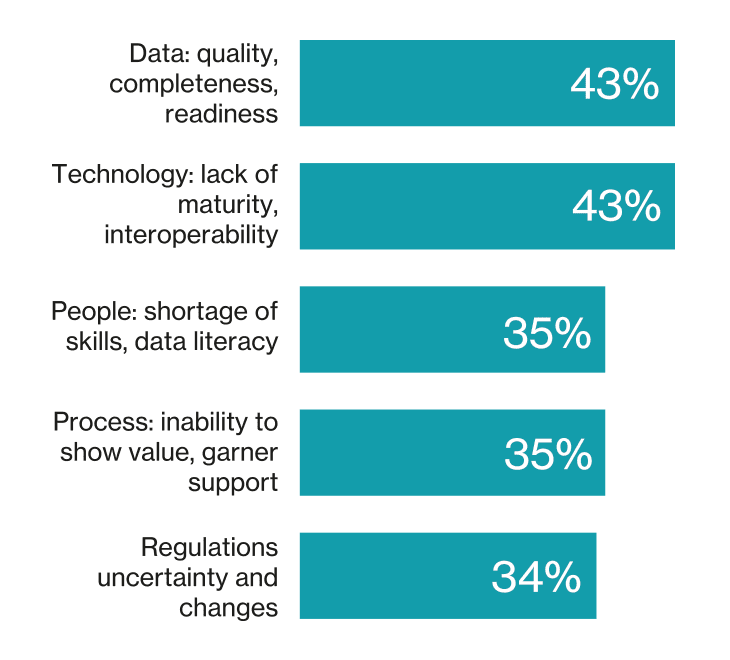
Source: Compiled by MIT Technology Review Insights with data from Informatica, CDO Insights 2025 report, 2026
“PoCs live inside a safe bubble” observes Cristopher Kuehl, chief data officer at Continent 8 Technologies. Data is carefully curated, integrations are few, and the work is often handled by the most senior and motivated teams.
The result, according to Gerry Murray, research director at IDC, is not so much pilot failure as structural mis-design: Many AI initiatives are effectively “set up for failure from the start.”