Stop worrying about your AI footprint. Look at the big picture instead.

Picture it: I’m minding my business at a party, parked by the snack table (of course). A friend of a friend wanders up, and we strike up a conversation. It quickly turns to work, and upon learning that I’m a climate technology reporter, my new acquaintance says something like: “Should I be using AI? I’ve heard it’s awful for the environment.” 

This actually happens pretty often now. Generally, I tell people not to worry—let a chatbot plan your vacation, suggest recipe ideas, or write you a poem if you want. 

That response might surprise some people, but I promise I’m not living under a rock, and I have seen all the concerning projections about how much electricity AI is using. Data centers could consume up to 945 terawatt-hours annually by 2030. (That’s roughly as much as Japan.) 

But I feel strongly about not putting the onus on individuals, partly because AI concerns remind me so much of another question: “What should I do to reduce my carbon footprint?” 

That one gets under my skin because of the context: BP helped popularize the concept of a carbon footprint in a marketing campaign in the early 2000s. That framing effectively shifts the burden of worrying about the environment from fossil-fuel companies to individuals. 

The reality is, no one person can address climate change alone: Our entire society is built around burning fossil fuels. To address climate change, we need political action and public support for researching and scaling up climate technology. We need companies to innovate and take decisive action to reduce greenhouse-gas emissions. Focusing too much on individuals is a distraction from the real solutions on the table. 

I see something similar today with AI. People are asking climate reporters at barbecues whether they should feel guilty about using chatbots too frequently when we need to focus on the bigger picture. 

Big tech companies are playing into this narrative by providing energy-use estimates for their products at the user level. A couple of recent reports put the electricity used to query a chatbot at about 0.3 watt-hours, the same as powering a microwave for about a second. That’s so small as to be virtually insignificant.

But stopping with the energy use of a single query obscures the full truth, which is that this industry is growing quickly, building energy-hungry infrastructure at a nearly incomprehensible scale to satisfy the AI appetites of society as a whole. Meta is currently building a data center in Louisiana with five gigawatts of computational power—about the same demand as the entire state of Maine at the summer peak.  (To learn more, read our Power Hungry series online.)

Increasingly, there’s no getting away from AI, and it’s not as simple as choosing to use or not use the technology. Your favorite search engine likely gives you an AI summary at the top of your search results. Your email provider’s suggested replies? Probably AI. Same for chatting with customer service while you’re shopping online. 

Just as with climate change, we need to look at this as a system rather than a series of individual choices. 

Massive tech companies using AI in their products should be disclosing their total energy and water use and going into detail about how they complete their calculations. Estimating the burden per query is a start, but we also deserve to see how these impacts add up for billions of users, and how that’s changing over time as companies (hopefully) make their products more efficient. Lawmakers should be mandating these disclosures, and we should be asking for them, too. 

That’s not to say there’s absolutely no individual action that you can take. Just as you could meaningfully reduce your individual greenhouse-gas emissions by taking fewer flights and eating less meat, there are some reasonable things that you can do to reduce your AI footprint. Generating videos tends to be especially energy-intensive, as does using reasoning models to engage with long prompts and produce long answers. Asking a chatbot to help plan your day, suggest fun activities to do with your family, or summarize a ridiculously long email has relatively minor impact. 

Ultimately, as long as you aren’t relentlessly churning out AI slop, you shouldn’t be too worried about your individual AI footprint. But we should all be keeping our eye on what this industry will mean for our grid, our society, and our planet. 

This article is from The Spark, MIT Technology Review’s weekly climate newsletter. To receive it in your inbox every Wednesday, sign up here.

Why the for-profit race into solar geoengineering is bad for science and public trust

Last week, an American-Israeli company that claims it’s developed proprietary technology to cool the planet announced it had raised $60 million, by far the largest known venture capital round to date for a solar geoengineering startup.

The company, Stardust, says the funding will enable it to develop a system that could be deployed by the start of the next decade, according to Heatmap, which broke the story.


Heat Exchange

MIT Technology Review’s guest opinion series, offering expert commentary on legal, political and regulatory issues related to climate change and clean energy. You can read the rest of the pieces here.


As scientists who have worked on the science of solar geoengineering for decades, we have grown increasingly concerned about the emerging efforts to start and fund private companies to build and deploy technologies that could alter the climate of the planet. We also strongly dispute some of the technical claims that certain companies have made about their offerings. 

Given the potential power of such tools, the public concerns about them, and the importance of using them responsibly, we argue that they should be studied, evaluated, and developed mainly through publicly coordinated and transparently funded science and engineering efforts.  In addition, any decisions about whether or how they should be used should be made through multilateral government discussions, informed by the best available research on the promise and risks of such interventions—not the profit motives of companies or their investors.

The basic idea behind solar geoengineering, or what we now prefer to call sunlight reflection methods (SRM), is that humans might reduce climate change by making the Earth a bit more reflective, partially counteracting the warming caused by the accumulation of greenhouse gases. 

There is strong evidence, based on years of climate modeling and analyses by researchers worldwide, that SRM—while not perfect—could significantly and rapidly reduce climate changes and avoid important climate risks. In particular, it could ease the impacts in hot countries that are struggling to adapt.  

The goals of doing research into SRM can be diverse: identifying risks as well as finding better methods. But research won’t be useful unless it’s trusted, and trust depends on transparency. That means researchers must be eager to examine pros and cons, committed to following the evidence where it leads, and driven by a sense that research should serve public interests, not be locked up as intellectual property.

In recent years, a handful of for-profit startup companies have emerged that are striving to develop SRM technologies or already trying to market SRM services. That includes Make Sunsets, which sells “cooling credits” for releasing sulfur dioxide in the stratosphere. A new company, Sunscreen, which hasn’t yet been announced, intends to use aerosols in the lower atmosphere to achieve cooling over small areas, purportedly to help farmers or cities deal with extreme heat.  

Our strong impression is that people in these companies are driven by the same concerns about climate change that move us in our research. We agree that more research, and more innovation, is needed. However, we do not think startups—which by definition must eventually make money to stay in business—can play a productive role in advancing research on SRM.

Many people already distrust the idea of engineering the atmosphere—at whichever scale—to address climate change, fearing negative side effects, inequitable impacts on different parts of the world, or the prospect that a world expecting such solutions will feel less pressure to address the root causes of climate change.

Adding business interests, profit motives, and rich investors into this situation just creates more cause for concern, complicating the ability of responsible scientists and engineers to carry out the work needed to advance our understanding.

The only way these startups will make money is if someone pays for their services, so there’s a reasonable fear that financial pressures could drive companies to lobby governments or other parties to use such tools. A decision that should be based on objective analysis of risks and benefits would instead be strongly influenced by financial interests and political connections.

The need to raise money or bring in revenue often drives companies to hype the potential or safety of their tools. Indeed, that’s what private companies need to do to attract investors, but it’s not how you build public trust—particularly when the science doesn’t support the claims.

Notably, Stardust says on its website that it has developed novel particles that can be injected into the atmosphere to reflect away more sunlight, asserting that they’re “chemically inert in the stratosphere, and safe for humans and ecosystems.” According to the company, “The particles naturally return to Earth’s surface over time and recycle safely back into the biosphere.”

But it’s nonsense for the company to claim they can make particles that are inert in the stratosphere. Even diamonds, which are extraordinarily nonreactive, would alter stratospheric chemistry. First of all, much of that chemistry depends on highly reactive radicals that react with any solid surface, and second, any particle may become coated by background sulfuric acid in the stratosphere. That could accelerate the loss of the protective ozone layer by spreading that existing sulfuric acid over a larger surface area.

(Stardust didn’t provide a response to an inquiry about the concerns raised in this piece.)

In materials presented to potential investors, which we’ve obtained a copy of, Stardust further claims its particles “improve” on sulfuric acid, which is the most studied material for SRM. But the point of using sulfate for such studies was never that it was perfect, but that its broader climatic and environmental impacts are well understood. That’s because sulfate is widespread on Earth, and there’s an immense body of scientific knowledge about the fate and risks of sulfur that reaches the stratosphere through volcanic eruptions or other means.

If there’s one great lesson of 20th-century environmental science, it’s how crucial it is to understand the ultimate fate of any new material introduced into the environment. 

Chlorofluorocarbons and the pesticide DDT both offered safety advantages over competing technologies, but they both broke down into products that accumulated in the environment in unexpected places, causing enormous and unanticipated harms. 

The environmental and climate impacts of sulfate aerosols have been studied in many thousands of scientific papers over a century, and this deep well of knowledge greatly reduces the chance of unknown unknowns. 

Grandiose claims notwithstanding—and especially considering that Stardust hasn’t disclosed anything about its particles or research process—it would be very difficult to make a pragmatic, risk-informed decision to start SRM efforts with these particles instead of sulfate.

We don’t want to claim that every single answer lies in academia. We’d be fools to not be excited by profit-driven innovation in solar power, EVs, batteries, or other sustainable technologies. But the math for sunlight reflection is just different. Why?   

Because the role of private industry was essential in improving the efficiency, driving down the costs, and increasing the market share of renewables and other forms of cleantech. When cost matters and we can easily evaluate the benefits of the product, then competitive, for-profit capitalism can work wonders.  

But SRM is already technically feasible and inexpensive, with deployment costs that are negligible compared with the climate damage it averts.

The essential questions of whether or how to use it come down to far thornier societal issues: How can we best balance the risks and benefits? How can we ensure that it’s used in an equitable way? How do we make legitimate decisions about SRM on a planet with such sharp political divisions?

Trust will be the most important single ingredient in making these decisions. And trust is the one product for-profit innovation does not naturally manufacture. 

Ultimately, we’re just two researchers. We can’t make investors in these startups do anything differently. Our request is that they think carefully, and beyond the logic of short-term profit. If they believe geoengineering is worth exploring, could it be that their support will make it harder, not easier, to do that?  

David Keith is the professor of geophysical sciences at the University of Chicago and founding faculty director of the school’s Climate Systems Engineering Initiative. Daniele Visioni is an assistant professor of earth and atmospheric sciences at Cornell University and head of data for Reflective, a nonprofit that develops tools and provides funding to support solar geoengineering research.

This startup wants to clean up the copper industry

Demand for copper is surging, as is pollution from its dirty production processes. The founders of one startup, Still Bright, think they have a better, cleaner way to generate the copper the world needs. 

The company uses water-based reactions, based on battery chemistry technology, to purify copper in a process that could be less polluting than traditional smelting. The hope is that this alternative will also help ease growing strain on the copper supply chain.

“We’re really focused on addressing the copper supply crisis that’s looming ahead of us,” says Randy Allen, Still Bright’s cofounder and CEO.

Copper is a crucial ingredient in everything from electrical wiring to cookware today. And clean energy technologies like solar panels and electric vehicles are introducing even more demand for the metal. Global copper demand is expected to grow by 40% between now and 2040. 

As demand swells, so do the climate and environmental impacts of copper extraction, the process of refining ore into a pure metal. There’s also growing concern about the geographic concentration of the copper supply chain. Copper is mined all over the world, and historically, many of those mines had smelters on-site to process what they extracted. (Smelters form pure copper metal by essentially burning concentrated copper ore at high temperatures.) But today, the smelting industry has consolidated, with many mines shipping copper concentrates to smelters in Asia, particularly China.

That’s partly because smelting uses a lot of energy and chemicals, and it can produce sulfur-containing emissions that can harm air quality. “They shipped the environmental and social problems elsewhere,” says Simon Jowitt, a professor at the University of Nevada, Reno, and director of the Nevada Bureau of Mines and Geology.

It’s possible to scrub pollution out of a smelter’s emissions, and smelters are much cleaner than they used to be, Jowitt says. But overall, smelting centers aren’t exactly known for environmental responsibility. 

So even countries like the US, which have plenty of copper reserves and operational mines, largely ship copper concentrates, which contain up to around 30% copper, to China or other countries for smelting. (There are just two operational ore smelters in the US today.)

Still Bright avoids the pyrometallurgic process that smelters use in favor of a chemical approach, partially inspired by devices called vanadium flow batteries.

In the startup’s reactor, vanadium reacts with the copper compounds in copper concentrates. The copper metal remains a solid, leaving many of the impurities behind in the liquid phase. The whole thing takes between 30 and 90 minutes. The solid, which contains roughly 70% copper after this reaction, can then be fed into another, established process in the mining industry, called solvent extraction and electrowinning, to make copper that’s over 99% pure. 

This is far from the first attempt to use a water-based, chemical approach to processing copper. Today, some copper ore is processed with acid, for example, and Ceibo, a startup based in Chile, is trying to use a version of that process on the type of copper that’s traditionally smelted. The difference here is the particular chemistry, particularly the choice to use vanadium.

One of Still Bright’s founders, Jon Vardner, was researching copper reactions and vanadium flow batteries when he came up with the idea to marry a copper extraction reaction with an electrical charging step that could recycle the vanadium.

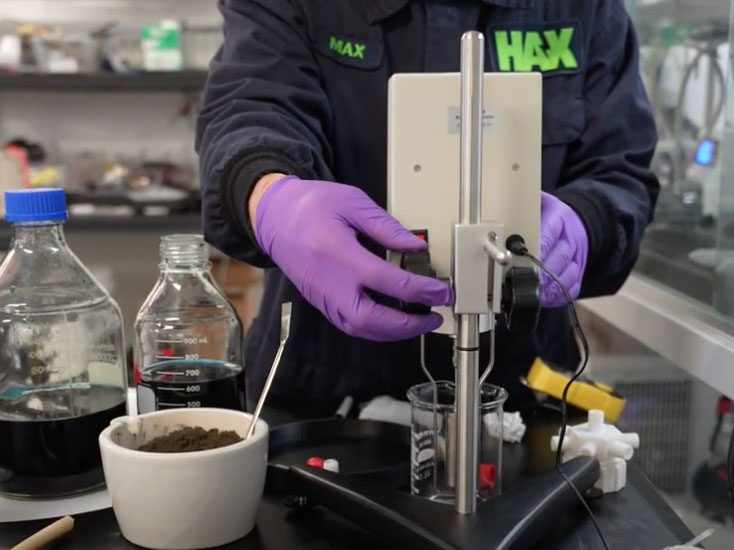
worker in the lab

COURTESY OF STILL BRIGHT

After the vanadium reacts with the copper, the liquid soup can be fed into an electrolyzer, which uses electricity to turn the vanadium back into a form that can react with copper again. It’s basically the same process that vanadium flow batteries use to charge up. 

While other chemical processes for copper refining require high temperatures or extremely acidic conditions to get the copper into solution and force the reaction to proceed quickly and ensure all the copper gets reacted, Still Bright’s process can run at ambient temperatures.

One of the major benefits to this approach is cutting the pollution from copper refining.  Traditional smelting heats the target material to over 1,200 °C (2,000 °F), forming sulfur-containing gases that are released into the atmosphere. 

Still Bright’s process produces hydrogen sulfide gas as a by-product instead. It’s still a dangerous material, but one that can be effectively captured and converted into useful side products, Allen says.

Another source of potential pollution is the sulfide minerals left over after the refining process, which can form sulfuric acid when exposed to air and water (this is called acid mine drainage, common in mining waste). Still Bright’s process will also produce that material, and the company plans to carefully track it, ensuring that it doesn’t leak into groundwater. 

The company is currently testing its process in the lab in New Jersey and designing a pilot facility in Colorado, which will have the capacity to make about two tons of copper per year. Next will be a demonstration-scale reactor, which will have a 500-ton annual capacity and should come online in 2027 or 2028 at a mine site, Allen says. Still Bright recently raised an $18.7 million seed round to help with the scale-up process.

How scale up goes will be a crucial test of the technology and whether the typically conservative mining industry will jump on board, UNR’s Jowitt says: “You want to see what happens on an industrial scale. And I think until that happens, people might be a little reluctant to get into this.”

The State of AI: Is China about to win the race? 

The State of AI is a collaboration between the Financial Times & MIT Technology Review examining the ways in which AI is reshaping global power. Every Monday for the next six weeks, writers from both publications will debate one aspect of the generative AI revolution reshaping global power.

In this conversation, the FT’s tech columnist and Innovation Editor John Thornhill and MIT Technology Review’s Caiwei Chen consider the battle between Silicon Valley and Beijing for technological supremacy.

John Thornhill writes:

Viewed from abroad, it seems only a matter of time before China emerges as the AI superpower of the 21st century. 

Here in the West, our initial instinct is to focus on America’s significant lead in semiconductor expertise, its cutting-edge AI research, and its vast investments in data centers. The legendary investor Warren Buffett once warned: “Never bet against America.” He is right that for more than two centuries, no other “incubator for unleashing human potential” has matched the US.

Today, however, China has the means, motive, and opportunity to commit the equivalent of technological murder. When it comes to mobilizing the whole-of-society resources needed to develop and deploy AI to maximum effect, it may be just as rash to bet against. 

The data highlights the trends. In AI publications and patents, China leads. By 2023, China accounted for 22.6% of all citations, compared with 20.9% from Europe and 13% from the US, according to Stanford University’s Artificial Intelligence Index Report 2025. As of 2023, China also accounted for 69.7% of all AI patents. True, the US maintains a strong lead in the top 100 most cited publications (50 versus 34 in 2023), but its share has been steadily declining. 

Similarly, the US outdoes China in top AI research talent, but the gap is narrowing. According to a report from the US Council of Economic Advisers, 59% of the world’s top AI researchers worked in the US in 2019, compared with 11% in China. But by 2022 those figures were 42% and 28%. 

The Trump administration’s tightening of restrictions for foreign H-1B visa holders may well lead more Chinese AI researchers in the US to return home. The talent ratio could move further in China’s favor.

Regarding the technology itself, US-based institutions produced 40 of the world’s most notable AI models in 2024, compared with 15 from China. But Chinese researchers have learned to do more with less, and their strongest large language models—including the open-source DeepSeek-V3 and Alibaba’s Qwen 2.5-Max—surpass the best US models in terms of algorithmic efficiency.

Where China is really likely to excel in future is in applying these open-source models. The latest report from Air Street Capital shows that China has now overtaken the US in terms of monthly downloads of AI models. In AI-enabled fintech, e-commerce, and logistics, China already outstrips the US. 

Perhaps the most intriguing—and potentially the most productive—applications of AI may yet come in hardware, particularly in drones and industrial robotics. With the research field evolving toward embodied AI, China’s advantage in advanced manufacturing will shine through.

Dan Wang, the tech analyst and author of Breakneck, has rightly highlighted the strengths of China’s engineering state in developing manufacturing process knowledge—even if he has also shown the damaging effects of applying that engineering mentality in the social sphere. “China has been growing technologically stronger and economically more dynamic in all sorts of ways,” he told me. “But repression is very real. And it is getting worse in all sorts of ways as well.”

I’d be fascinated to hear from you, Caiwei, about your take on the strengths and weaknesses of China’s AI dream. To what extent will China’s engineered social control hamper its technological ambitions? 

Caiwei Chen responds:

Hi, John!

You’re right that the US still holds a clear lead in frontier research and infrastructure. But “winning” AI can mean many different things. Jeffrey Ding, in his book Technology and the Rise of Great Powers, makes a counterintuitive point: For a general-purpose technology like AI, long-term advantage often comes down to how widely and deeply technologies spread across society. And China is in a good position to win that race (although “murder” might be pushing it a bit!).

Chips will remain China’s biggest bottleneck. Export restrictions have throttled access to top GPUs, pushing buyers into gray markets and forcing labs to recycle or repair banned Nvidia stock. Even as domestic chip programs expand, the performance gap at the very top still stands.

Yet those same constraints have pushed Chinese companies toward a different playbook: pooling compute, optimizing efficiency, and releasing open-weight models. DeepSeek-V3’s training run, for example, used just 2.6 million GPU-hours—far below the scale of US counterparts. But Alibaba’s Qwen models now rank among the most downloaded open-weights globally, and companies like Zhipu and MiniMax are building competitive multimodal and video models. 

China’s industrial policy means new models can move from lab to implementation fast. Local governments and major enterprises are already rolling out reasoning models in administration, logistics, and finance. 

Education is another advantage. Major Chinese universities are implementing AI literacy programs in their curricula, embedding skills before the labor market demands them. The Ministry of Education has also announced plans to integrate AI training for children of all school ages. I’m not sure the phrase “engineering state” fully captures China’s relationship with new technologies, but decades of infrastructure building and top-down coordination have made the system unusually effective at pushing large-scale adoption, often with far less social resistance than you’d see elsewhere. The use at scale, naturally, allows for faster iterative improvements.

Meanwhile, Stanford HAI’s 2025 AI Index found Chinese respondents to be the most optimistic in the world about AI’s future—far more optimistic than populations in the US or the UK. It’s striking, given that China’s economy has slowed since the pandemic for the first time in over two decades. Many in government and industry now see AI as a much-needed spark. Optimism can be powerful fuel, but whether it can persist through slower growth is still an open question.

Social control remains part of the picture, but a different kind of ambition is taking shape. The Chinese AI founders in this new generation are the most globally minded I’ve seen, moving fluidly between Silicon Valley hackathons and pitch meetings in Dubai. Many are fluent in English and in the rhythms of global venture capital. Having watched the last generation wrestle with the burden of a Chinese label, they now build companies that are quietly transnational from the start.

The US may still lead in speed and experimentation, but China could shape how AI becomes part of daily life, both at home and abroad. Speed matters, but speed isn’t the same thing as supremacy.

John Thornhill replies:

You’re right, Caiwei, that speed is not the same as supremacy (and “murder” may be too strong a word). And you’re also right to amplify the point about China’s strength in open-weight models and the US preference for proprietary models. This is not just a struggle between two different countries’ economic models but also between two different ways of deploying technology.  

Even OpenAI’s chief executive, Sam Altman, admitted earlier this year: “We have been on the wrong side of history here and need to figure out a different open-source strategy.” That’s going to be a very interesting subplot to follow. Who’s called that one right?

Further reading on the US-China competition

There’s been a lot of talk about how people may be using generative AI in their daily lives. This story from the FT’s visual story team explores the reality 

From China, FT reporters ask how long Nvidia can maintain its dominance over Chinese rivals

When it comes to real-world uses, toys and companions devices are a novel but emergent application of AI that is gaining traction in China—but is also heading to the US. This MIT Technology Review story explored it.

The once-frantic data center buildout in China has hit walls, and as the sanctions and AI demands shift, this MIT Technology Review story took an on-the-ground look at how stakeholders are figuring it out.

Here’s why we don’t have a cold vaccine. Yet.

For those of us in the Northern Hemisphere, it’s the season of the sniffles. As the weather turns, we’re all spending more time indoors. The kids have been back at school for a couple of months. And cold germs are everywhere.

My youngest started school this year, and along with artwork and seedlings, she has also been bringing home lots of lovely bugs to share with the rest of her family. As she coughed directly into my face for what felt like the hundredth time, I started to wonder if there was anything I could do to stop this endless cycle of winter illnesses. We all got our flu jabs a month ago. Why couldn’t we get a vaccine to protect us against the common cold, too?

Scientists have been working on this for decades. It turns out that creating a cold vaccine is hard. Really hard.

But not impossible. There’s still hope. Let me explain.

Technically, colds are infections that affect your nose and throat, causing symptoms like sneezing, coughing, and generally feeling like garbage. Unlike some other infections,—covid-19, for example—they aren’t defined by the specific virus that causes them.

That’s because there are a lot of viruses that cause colds, including rhinoviruses, adenoviruses, and even seasonal coronaviruses (they don’t all cause covid!). Within those virus families, there are many different variants.

Take rhinoviruses, for example. These viruses are thought to be behind most colds. They’re human viruses—over the course of evolution, they have become perfectly adapted to infecting us, rapidly multiplying in our noses and airways to make us sick. There are around 180 rhinovirus variants, says Gary McLean, a molecular immunologist at Imperial College London in the UK.

Once you factor in the other cold-causing viruses, there are around 280 variants all told. That’s 280 suspects behind the cough that my daughter sprayed into my face. It’s going to be really hard to make a vaccine that will offer protection against all of them.

The second challenge lies in the prevalence of those variants.

Scientists tailor flu and covid vaccines to whatever strain happens to be circulating. Months before flu season starts, the World Health Organization advises countries on which strains their vaccines should protect against. Early recommendations for the Northern Hemisphere can be based on which strains seem to be dominant in the Southern Hemisphere, and vice versa.

That approach wouldn’t work for the common cold, because all those hundreds of variants are circulating all the time, says McLean.

That’s not to say that people haven’t tried to make a cold vaccine. There was a flurry of interest in the 1960s and ’70s, when scientists made valiant efforts to develop vaccines for the common cold. Sadly, they all failed. And we haven’t made much progress since then.

In 2022, a team of researchers reviewed all the research that had been published up to that year. They only identified one clinical trial—and it was conducted back in 1965.

Interest has certainly died down since then, too. Some question whether a cold vaccine is even worth the effort. After all, most colds don’t require much in the way of treatment and don’t last more than a week or two. There are many, many more dangerous viruses out there we could be focusing on.

And while cold viruses do mutate and evolve, no one really expects them to cause the next pandemic, says McLean. They’ve evolved to cause mild disease in humans—something they’ve been doing successfully for a long, long time. Flu viruses—which can cause serious illness, disability, or even death—pose a much bigger risk, so they probably deserve more attention.

But colds are still irritating, disruptive, and potentially harmful. Rhinoviruses are considered to be the leading cause of human infectious disease. They can cause pneumonia in children and older adults. And once you add up doctor visits, medication, and missed work, the economic cost of colds is pretty hefty: a 2003 study put it at $40 billion per year for the US alone.

So it’s reassuring that we needn’t abandon all hope: Some scientists are making progress! McLean and his colleagues are working on ways to prepare the immune systems of people with asthma and lung diseases to potentially protect them from cold viruses. And a team at Emory University has developed a vaccine that appears to protect monkeys from around a third of rhinoviruses.

There’s still a long way to go. Don’t expect a cold vaccine to materialize in the next five years, at least. “We’re not quite there yet,” says Michael Boeckh, an infectious-disease researcher at Fred Hutch Cancer Center in Seattle, Washington. “But will it at some point happen? Possibly.”

At the end of our Zoom call, perhaps after reading the disappointed expression on my sniffling, cold-riddled face (yes, I did end up catching my daughter’s cold), McLean told me he hoped he was “positive enough.” He admitted that he used to be more optimistic about a cold vaccine. But he hasn’t given up hope. He’s even running a trial of a potential new vaccine in people, although he wouldn’t reveal the details.

“It could be done,” he said.

This article first appeared in The Checkup, MIT Technology Review’s weekly biotech newsletter. To receive it in your inbox every Thursday, and read articles like this first, sign up here.

Here’s the latest company planning for gene-edited babies

A West Coast biotech entrepreneur says he’s secured $30 million to form a public-benefit company to study how to safely create genetically edited babies, marking the largest known investment into the taboo technology.  

The new company, called Preventive, is being formed to research so-called “heritable genome editing,” in which the DNA of embryos would be modified by correcting harmful mutations or installing beneficial genes. The goal would be to prevent disease.

Preventive was founded by the gene-editing scientist Lucas Harrington, who described his plans yesterday in a blog post announcing the venture. Preventive, he said, will not rush to try out the technique but instead will dedicate itself “to rigorously researching whether heritable genome editing can be done safely and responsibly.”

Creating genetically edited humans remains controversial, and the first scientist to do it, in China, was imprisoned for three years. The procedure remains illegal in many countries, including the US, and doubts surround its usefulness as a form of medicine.

Still, as gene-editing technology races forward, the temptation to shape the future of the species may prove irresistible, particularly to entrepreneurs keen to put their stamp on the human condition. In theory, even small genetic tweaks could create people who never get heart disease or Alzheimer’s, and who would pass those traits on to their own offspring.

According to Harrington, if the technique proves safe, it “could become one of the most important health technologies of our time.” He has estimated that editing an embryo would cost only about $5,000 and believes regulations could change in the future. 

Preventive is the third US startup this year to say it is pursuing technology to produce gene-edited babies. The first, Bootstrap Bio, based in California, is reportedly seeking seed funding and has an interest in enhancing intelligence. Another, Manhattan Genomics, is also in the formation stage but has not announced funding yet.

As of now, none of these companies have significant staff or facilities, and they largely lack any credibility among mainstream gene-editing scientists. Reached by email, Fyodor Urnov, an expert in gene editing at the University of California, Berkeley, where Harrington studied, said he believes such ventures should not move forward.

Urnov has been a pointed critic of the concept of heritable genome editing, calling it dangerous, misguided, and a distraction from the real benefits of gene editing to treat adults and children. 

In his email, Urnov said the launch of still another venture into the area made him want to “howl with pain.”  

Harrinton’s venture was incorporated in Delaware in May 2025,under the name Preventive Medicine PBC. As a public-benefit corporation, it is organized to put its public mission above profits. “If our research shows [heritable genome editing] cannot be done safely, that conclusion is equally valuable to the scientific community and society,” Harrington wrote in his post.

Harrington is a cofounder of Mammoth Biosciences, a gene-editing company pursuing drugs for adults, and remains a board member there.

In recent months, Preventive has sought endorsements from leading figures in genome editing, but according to its post, it had secured only one—from Paula Amato, a fertility doctor at Oregon Health Sciences University, who said she had agreed to act as an advisor to the company.

Amato is a member of a US team that has researched embryo editing in the country since 2017, and she has promoted the technology as a way to increase IVF success. That could be the case if editing could correct abnormal embryos, making more available for use in trying to create a pregnancy.

It remains unclear where Preventive’s funding is coming from. Harrington said the $30 million was gathered from “private funders who share our commitment to pursuing this research responsibly.” But he declined to identify those investors other than SciFounders, a venture firm he runs with his personal and business partner Matt Krisiloff, the CEO of the biotech company Conception, which aims to create human eggs from stem cells.

That’s yet another technology that could change reproduction, if it works. Krisiloff is listed as a member of Preventive’s founding team.

The idea of edited babies has received growing attention from figures in the cryptocurrency business. These include Brian Armstrong, the billionaire founder of Coinbase, who has held a series of off-the-record dinners to discuss the technology (which Harrington attended). Armstrong previously argued that the “time is right” for a startup venture in the area.

Will Harborne, a crypto entrepreneur and partner at LongGame Ventures, says he’s “thrilled” to see Preventive launch. If the technology proves safe, he argues, “widespread adoption is inevitable,” calling its use a “societal obligation.”

Harborne’s fund has invested in Herasight, a company that uses genetic tests to rank IVF embryos for future IQ and other traits. That’s another hotly debated technology, but one that has already reached the market, since such testing isn’t strictly regulated. Some have begun to use the term “human enhancement companies” to refer to such ventures.

What’s still lacking is evidence that leading gene-editing specialists support these ventures. Preventive was unsuccessful in establishing a collaboration with at least one key research group, and Urnov says he had harsh words for Manhattan Genomics when that company reached out to him about working together. “I encourage you to stop,” he wrote back. “You will cause zero good and formidable harm.”

Harrington thinks Preventive could change such attitudes, if it shows that it is serious about doing responsible research. “Most scientists I speak with either accept embryo editing as inevitable or are enthusiastic about the potential but hesitate to voice these opinions publicly,” he told MIT Technology Review earlier this year. “Part of being more public about this is to encourage others in the field to discuss this instead of ignoring it.”

It’s never been easier to be a conspiracy theorist

The timing was eerie.

On November 21, 1963, Richard Hofstadter delivered the annual Herbert Spencer Lecture at Oxford University. Hofstadter was a professor of American history at Columbia University who liked to use social psychology to explain political history, the better to defend liberalism from extremism on both sides. His new lecture was titled “The Paranoid Style in American Politics.” 

“I call it the paranoid style,” he began, “simply because no other word adequately evokes the qualities of heated exaggeration, suspiciousness, and conspiratorial fantasy that I have in mind.”

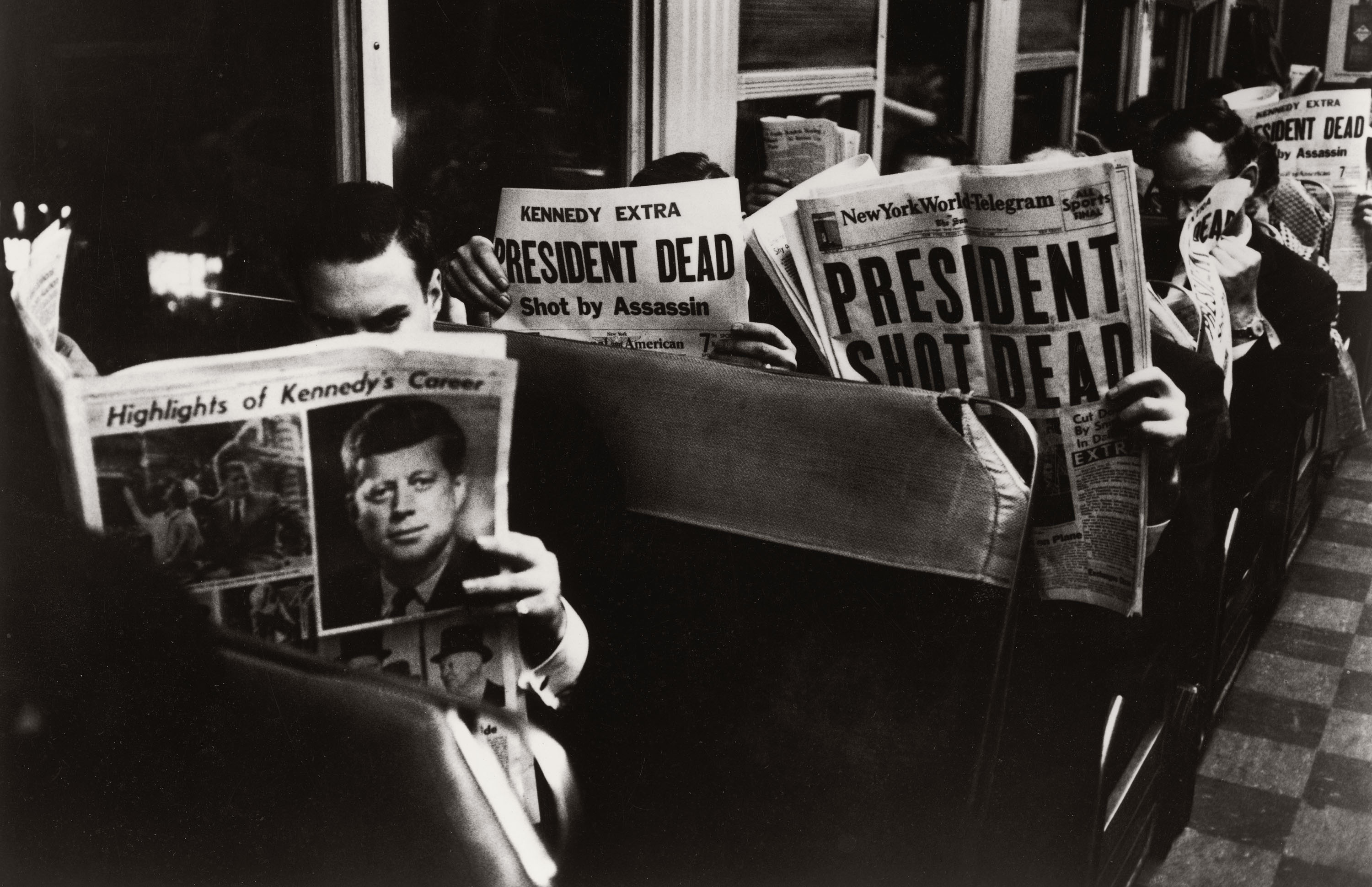
Then, barely 24 hours later, President John F. Kennedy was assassinated in Dallas. This single, shattering event, and subsequent efforts to explain it, popularized a term for something that is clearly the subject of Hofstadter’s talk though it never actually figures in the text: “conspiracy theory.”


This story is part of MIT Technology Review’s series “The New Conspiracy Age,” on how the present boom in conspiracy theories is reshaping science and technology.


Hofstadter’s lecture was later revised into what remains an essential essay, even after decades of scholarship on conspiracy theories, because it lays out, with both rigor and concision, a historical continuity of conspiracist politics. “The paranoid style is an old and recurrent phenomenon in our public life which has been frequently linked with movements of suspicious discontent,” he writes, tracing the phenomenon back to the early years of the republic. Though each upsurge in conspiracy theories feels alarmingly novel—new narratives disseminated through new technologies on a new scale—they all conform to a similar pattern. As Hofstadter demonstrated, the names may change, but the fundamental template remains the same.

His psychological reading of politics has been controversial, but it is psychology, rather than economics or other external circumstances, that best explains the flourishing of conspiracy theories. Subsequent research has indeed shown that we are prone to perceive intentionality and patterns where none exist—and that this helps us feel like a person of consequence. To identify and expose a secret plot is to feel heroic and gain the illusion of control over the bewildering mess of life. 

Like many pioneering theories exposed to the cold light of hindsight, Hofstadter’s has flaws and blind spots. His key oversight was to downplay  the paranoid style’s role in mainstream politics up to that point and underrate its potential to spread in the future.

In 1963, conspiracy theories were still a fringe phenomenon, not because they were inherently unusual but because they had limited reach and were stigmatized by people in power. Now that neither factor holds true, it is obvious how infectious they are. Hofstadter could not, of course, have imagined the information technologies that have become stitched into our lives, nor the fractured media ecosystem of the 21st century, both of which have allowed conspiracist thinking to reach more and more people—to morph, and to bloom like mold. And he could not have predicted that a serial conspiracy theorist would be elected president, twice, and that he would staff his second administration with fellow proponents of the paranoid style. 

But Hofstadter’s concept of the paranoid style remains useful—and ever relevant—because it also describes a way of reading the world. As he put it, “The distinguishing thing about the paranoid style is not that its exponents see conspiracies or plots here or there in history, but they regard a ‘vast’ or ‘gigantic’ conspiracy as the motive force in historical events. History is a conspiracy, set in motion by demonic forces of almost transcendent power, and what is felt to be needed to defeat it is not the usual methods of political give-and-take, but an all-out crusade.”

Needless to say, this mystically unified version of history is not just untrue but impossible. It doesn’t make sense on any level. So why has it proved so alluring for so long—and why does it seem to be getting more popular every day?

What is a conspiracy theory, anyway? 

The first person to define the “conspiracy theory” as a widespread phenomenon was the Austrian-British philosopher Karl Popper, in his 1948 lecture “Towards a Rational Theory of Tradition.” He was not referring to a theory about an individual conspiracy. He was interested in “the conspiracy theory of society”: a particular way of interpreting the course of events. 

He later defined it as “the view that an explanation of a social phenomenon consists in the discovery of the men or groups who are interested in the occurrence of this phenomenon (sometimes it is a hidden interest which has first to be revealed), and who have planned and conspired to bring it about.”

Take an unforeseen catastrophe that inspires fear, anger, and pain—a financial crash, a devastating fire, a terrorist attack, a war. The conventional historian will try to unpick a tangle of different factors, of which malice is only one, and one that may be less significant than dumb luck.

The conspiracist, however, will perceive only sinister calculation behind these terrible events—a fiendishly intricate plot conceived and executed to perfection. Intent is everything. Popper’s observation chimes with Hofstadter’s: “The paranoid’s interpretation of history is … distinctly personal: decisive events are not taken as part of the stream of history, but as the consequences of someone’s will.”

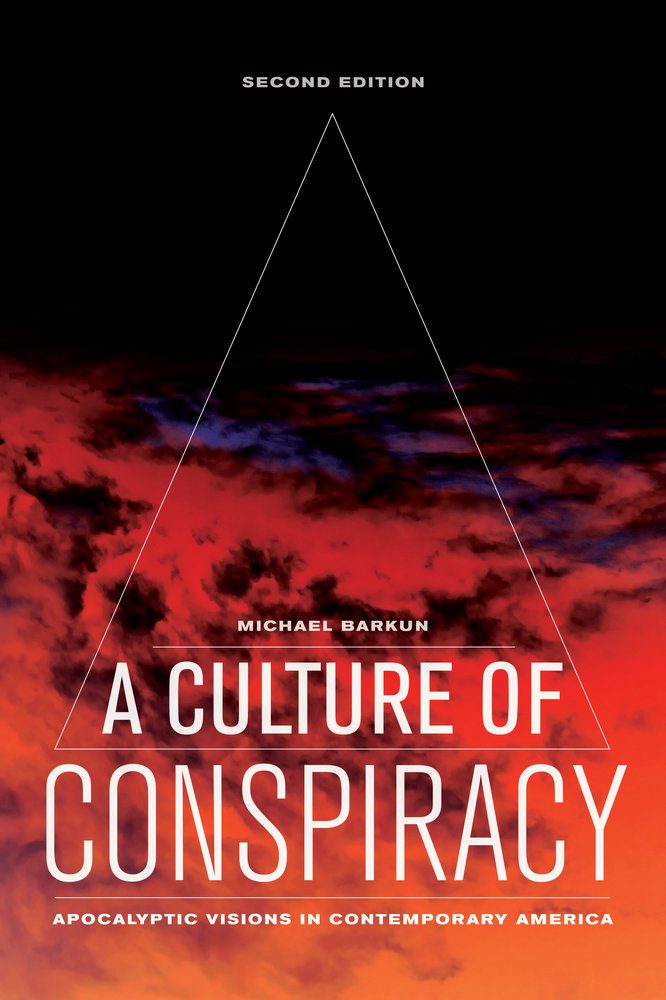
A Culture of Conspiracy
Michael Barkun
UNIVERSITY OF CALIFORNIA PRESS, 2013

According to Michael Barkun in the 2003 book A Culture of Conspiracy, the conspiracist interpretation of events rests on three assumptions: Everything is connected, everything is premeditated, and nothing is as it seems. Following that third law means that widely accepted and documented history is, by definition, suspect and alternative explanations, however outré, are more likely to be true. As Hannah Arendt wrote in The Origins of Totalitarianism, the purpose of conspiracy theories in 20th-century dictatorships “was always to reveal official history as a joke, to demonstrate a sphere of secret influences in which the visible, traceable, and known historical reality was only the outward façade erected explicitly to fool the people.” (Those dictators, of course, were conspirators themselves, projecting their own love of secret plots onto others.)

Still, it’s important to remember that “conspiracy theory” can mean different things. Barkun describes three varieties, nesting like Russian dolls. 

The “event conspiracy theory” concerns a specific, contained catastrophe, such as the Reichstag fire of 1933 or the origins of covid-19. These theories are relatively plausible, even if they can not be proved. 

The “systemic conspiracy theory” is much more ambitious, purporting to explain numerous events as the poisonous fruit of a clandestine international plot. Far-fetched though they are, they do at least fixate on named groups, whether the Illuminati or the World Economic Forum. 

It is increasingly clear that “conspiracy theory” is a misnomer and what we are really dealing with is conspiracy belief.

Finally, the “superconspiracy theory” is that impossible fantasy in which history itself is a conspiracy, orchestrated by unseen forces of almost supernatural power and malevolence. The most extreme variants of QAnon posit such a universal conspiracy. It seeks to encompass and explain nothing less than the entire world.

These are very different genres of storytelling. If the first resembles a detective story, then the other two are more akin to fables. Yet one can morph into the other. Take the theories surrounding the Kennedy assassination. The first wave of amateur investigators created event conspiracy theories—relatively self-contained plots with credible assassins such as Cubans or the Mafia. 

But over time, event conspiracy theories have come to seem parochial. By the time of Oliver Stone’s 1991 movie JFK, once-popular plots had been eclipsed by elaborate fictions of gigantic long-running conspiracies in which the murder of the president was just one component. One of Stone’s primary sources was the journalist Jim Marrs, who went on to write books about the Freemasons and UFOs. 

Why limit yourself to a laboriously researched hypothesis about a single event when one giant, dramatic plot can explain them all? 

The theory of everything 

In every systemic or superconspiracy theory, the world is corrupt and unjust and getting worse. An elite cabal of improbably powerful individuals, motivated by pure malignancy, is responsible for most of humanity’s misfortunes. Only through the revelation of hidden knowledge and the cracking of codes by a righteous minority can the malefactors be unmasked and defeated. The morality is as simplistic as the narrative is complex: It is a battle between good and evil.

Notice anything? This is not the language of democratic politics but that of myth and of religion. In fact, it is the fundamental message of the Book of Revelation. Conspiracist thinking can be seen as an offshoot, often but not always secularized, of apocalyptic Christianity, with its alluring web of prophecies, signs, and secrets and its promise of violent resolution. After studying several millenarian sects for his 1957 book The Pursuit of the Millennium, the historian Norman Cohn itemized some common traits, among them “the megalomaniac view of oneself as the Elect, wholly good, abominably persecuted yet assured of ultimate triumph; the attribution of gigantic and demonic powers to the adversary; the refusal to accept the ineluctable limitations and imperfections of human experience.”

Popper similarly considered the conspiracy theory of society “a typical result of the secularization of religious superstition,” adding: “The gods are abandoned. But their place is filled by powerful men or groups … whose wickedness is responsible for all the evils we suffer from.” 

QAnon’s mutation from a conspiracy theory on an internet message board into a movement with the characteristics of a cult makes explicit the kinship between conspiracy theories and apocalyptic religion.

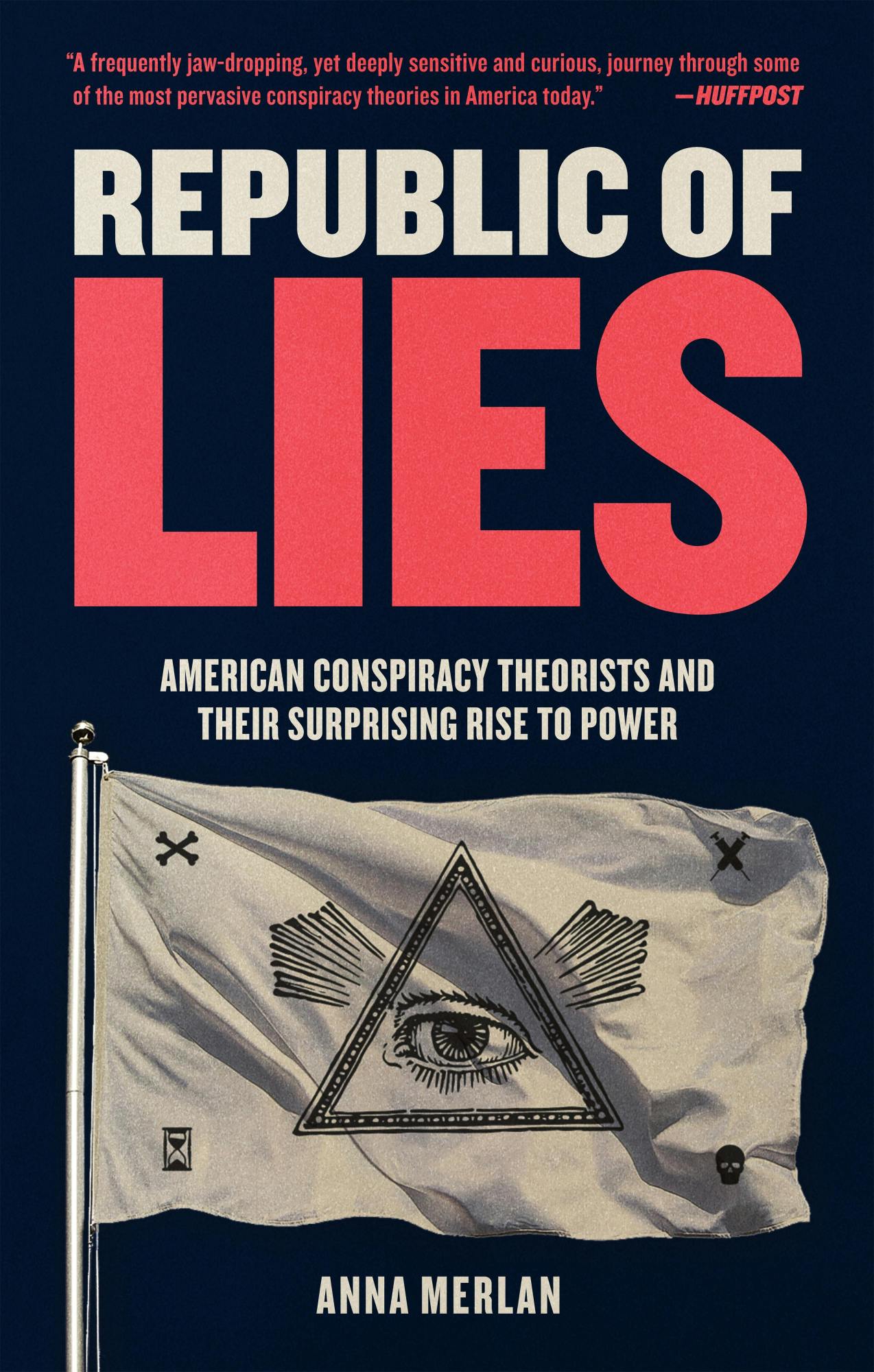
This way of thinking facilitates the creation of dehumanized scapegoats—one of the oldest and most consistent features of a conspiracy theory. During the Middle Ages and beyond, political and religious leaders routinely flung the name “Antichrist” at their opponents. During the Crusades, Christians falsely accused Europe’s Jewish communities of collaborating with Islam or poisoning wells and put them to the sword. Witch-hunters implicated tens of thousands of innocent women in a supposed satanic conspiracy that was said to explain everything from illness to crop failure. “Conspiracy theories are, in the end, not so much an explanation of events as they are an effort to assign blame,” writes Anna Merlan in the 2019 book Republic of Lies.

cover of Republic of Lies
Republic of Lies: American Conspiracy Theorists and Their Surprising Rise to Power
Anna Merlan
METROPOLITAN PUBLISHERS, 2019

But the systemic conspiracy theory as we know it—that is, the ostensibly secular variety—was established three centuries later, with remarkable speed. Some horrified opponents of the French Revolution could not accept that such an upheaval could be simply a popular revolt and needed to attribute it to sinister, unseen forces. They settled on the Illuminati, a Bavarian secret society of Enlightenment intellectuals influenced in part by the rituals and hierarchy of Freemasonry. 

The group was founded by a young law professor named Adam Weishaupt, who used the alias Brother Spartacus. In reality, the Illuminati were few in number, fractious, powerless, and, by the time of the revolution in 1789, defunct. But in the imaginations of two influential writers who published “exposés” of the Illuminati in 1797—Scotland’s John Robison and France’s Augustin Barruel—they were everywhere. Each man erected a wobbling tower of wild supposition and feverish nonsense on a platform of plausible claims and verifiable facts. Robison alleged that the revolution was merely part of “one great and wicked project” whose ultimate aim was to “abolish all religion, overturn every government, and make the world a general plunder and a wreck.”  

The Illuminati’s bogeyman status faded during the 19th century, but the core narrative persisted and proceeded to underpin the notorious hoax The Protocols of the Elders of Zion, first published in a Russian newspaper in 1903. The document’s anonymous author reinvented antisemitism by grafting it onto the story of the one big plot and positing Jews as the secret rulers of the world. In this account, the Elders orchestrate every war, recession, and so on in order to destabilize the world to the point where they can impose tyranny. 

You might ask why, if they have such world-bending power already, they would require a dictatorship. You might also wonder how one group could be responsible for both communism and monopoly capitalism, anarchism and democracy, the theory of evolution, and much more besides. But the vast, self-contradicting incoherence of the plot is what made it impossible to disprove. Nothing was ruled out, so every development could potentially be taken as evidence of the Elders at work.

In 1921, the Protocols were exposed as what the London Times called a “clumsy forgery,” plagiarized from two obscure 19th-century novels, yet they remained the key text of European antisemitism—essentially “true” despite being demonstrably false. “I believe in the inner, but not the factual, truth of the Protocols,” said Joseph Goebbels, who would become Hitler’s minister of propaganda. In Mein Kampf, Hitler claimed that efforts to debunk the Protocols were actually “evidence in favor of their authenticity.” He alleged that Jews, if not stopped, would “one day devour the other nations and become lords of the earth.” Popper and Hofstadter both used the Holocaust as an example of what happens when a conspiracy theorist gains power and makes the paranoid style a governing principle.

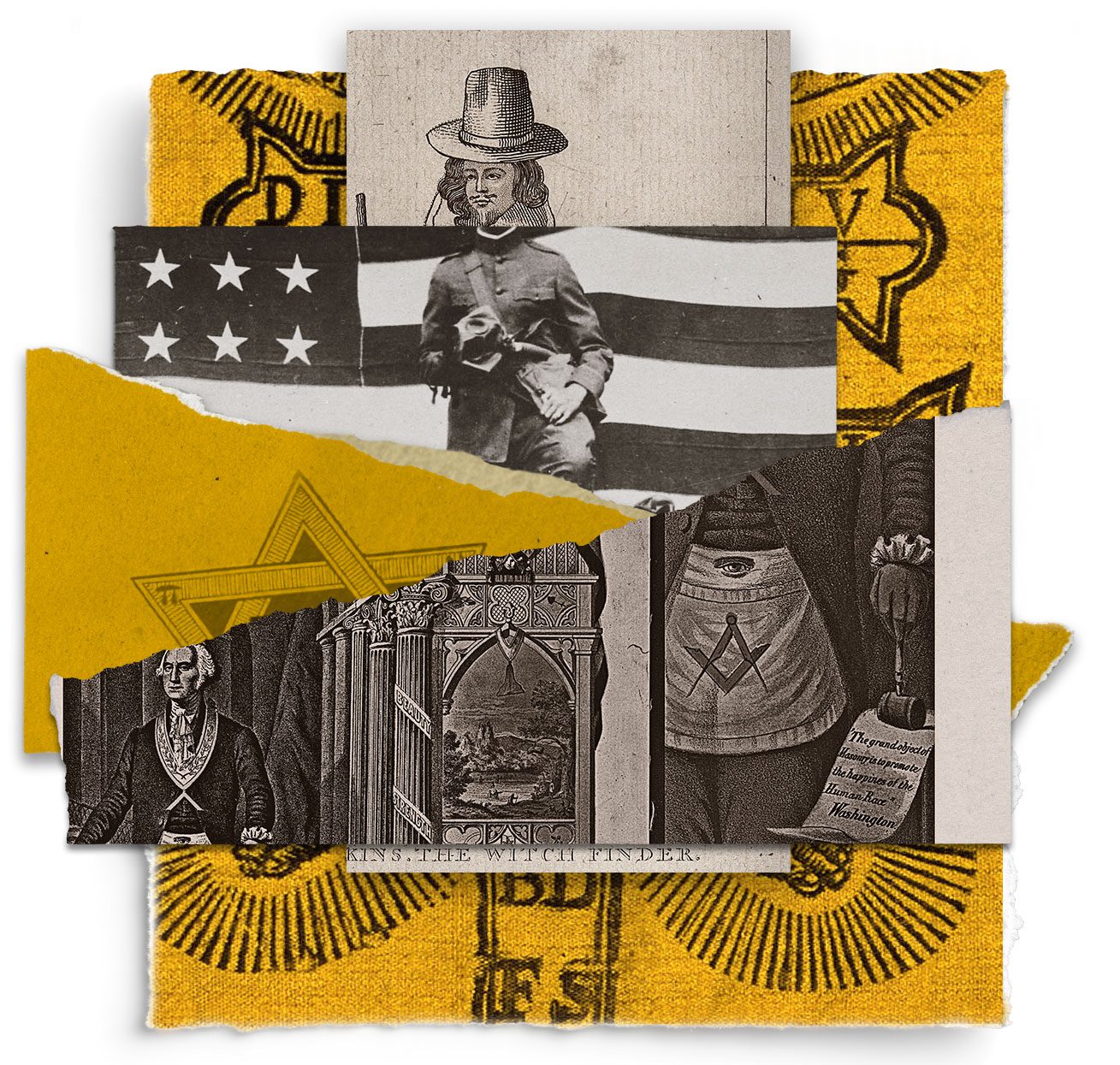
esoteric symbols and figures on torn paper including a witchfinder, George Washington and a Civil war era solder

STEPHANIE ARNETT/MIT TECHNOLOGY REVIEW | PUBLIC DOMAIN

The prominent role of Jewish Bolsheviks like Leon Trotsky and Grigory Zinoviev in the Russian Revolution of 1917 enabled a merger of antisemitism and anticommunism that survived the fascist era. Cold War red-baiters such as Senator Joseph McCarthy and the John Birch Society assigned to communists uncanny degrees of malice and ubiquity, far beyond the real threat of Soviet espionage. In fact, they presented this view as the only logical one. McCarthy claimed that a string of national security setbacks could be explained only if George C. Marshall, the secretary of defense and former secretary of state, was literally a Soviet agent. “How can we account for our present situation unless we believe that men high in this government are concerting to deliver us to disaster?” he asked in 1951. “This must be the product of a great conspiracy so immense as to dwarf any previous such venture in the history of man.”

This continuity between antisemitism, anticommunism, and 18th-century paranoia about secret societies isn’t hard to see. General Francisco Franco, Spain’s right-wing dictator, claimed to be fighting a “Judeo-Masonic-Bolshevik” conspiracy. The Nazis persecuted Freemasons alongside Jews and communists. Nesta Webster, the British fascist sympathizer who laundered the Protocols through the British press, revived interest in Robison and Barruel’s books about the Illuminati, which the pro-Nazi Baptist preacher Gerald Winrod then promoted in the US. Even Winston Churchill was briefly persuaded by Webster’s work, citing it in his claims of a “world-wide conspiracy for the overthrow of civilization … from the days of Spartacus-Weishaupt to the days of Karl Marx.”

To follow the chain further, Webster and Winrod’s stew of anticommunism, antisemitism, and anti-Illuminati conspiracy theories influenced the John Birch Society, whose publications would light a fire decades later under the Infowars founder Alex Jones, perhaps the most consequential conspiracy theorist of the early 21st century. 

The villains behind the one big plot might be the Illuminati, the Elders of Zion, the communists, or the New World Order, but they are always essentially the same people, aspiring to officially dominate a world that they already secretly control. The names can be swapped around without much difficulty. While Winrod maintained that “the real conspirators behind the Illuminati were Jews,” the anticommunist William Guy Carr conversely argued that antisemitic paranoia “plays right into the hands of the Illuminati.” These days, it might be the World Economic Forum or George Soros; liberal internationalists with aspirations to change the world are easily cast as the new Illuminati, working toward establishing one world government.

Finding connection

The main reason that conspiracy theorists have lost interest in the relatively hard work of micro-conspiracies in favor of grander schemes is that it has become much easier to draw lines between objectively unrelated people and events. Information technology is, after all, also misinformation technology. That’s nothing new. 

The witch craze could not have traveled as far or lasted as long without the printing press. Malleus Maleficarum (Hammer of the Witches), a 1486 screed by the German witch-hunter Heinrich Kramer, became the best-selling witch-hunter’s handbook, going through 28 editions by 1600. Similarly, it was the books and pamphlets “exposing” the Illuminati that allowed those ideas to spread everywhere following the French Revolution. And in the early 20th century, the introduction of the radio facilitated fascist propaganda. During the 1930s, the Nazi-sympathizing Catholic priest and radio host Charles Coughlin broadcast his antisemitic conspiracy theories to tens of millions of Americans on dozens of stations. 

The internet has, of course, vastly accelerated and magnified the spread of conspiracy theories. It is hard to recall now, but in the early days it was sweetly assumed that the internet would improve the world by democratizing access to information. While this initial idealism survives in doughty enclaves such as Wikipedia, most of us vastly underestimated the human appetite for false information that confirms the consumer’s biases.

Politicians, too, were slow to recognize the corrosive power of free-flowing conspiracy theories. For a long time, the more fantastical assertions of McCarthy and the Birchers were kept at arm’s length from the political mainstream, but that distance began to diminish rapidly during the 1990s, as right-wing activists built a cottage industry of outrageous claims about Bill and Hillary Clinton to advance the idea that they were not just corrupt or dishonest but actively evil and even satanic. This became an article of faith in the information ecosystem of internet message boards and talk radio, which expanded over time to include Fox News, blogs, and social media. So when Democrats nominated Hillary Clinton in 2016, a significant portion of the American public saw a monster at the heart of an organized crime ring whose activities included human trafficking and murder.

Nobody could make the same mistake about misinformation today. One could hardly design a more fertile breeding ground for conspiracy theories than social media. The algorithms of YouTube, Facebook, TikTok, and X, which operate on the principle that rage is engaging, have turned into radicalization machines. When these platforms took off during the second half of the 2010s, they offered a seamless system in which people were able to come across exciting new information, share it, connect it to other strands of misinformation, and weave them into self-contained, self-affirming communities, all without leaving the house.

It’s not hard to see how the problem will continue to grow as AI burrows ever deeper into our everyday lives. Elon Musk has tinkered with the AI chatbot Grok to produce information that conforms to his personal beliefs rather than to actual facts. This outcome does not even have to be intentional. Chatbots have been shown to validate and intensify some users’ beliefs, even if they’re rooted in paranoia or hubris. If you believe that you’re the hero in an epic battle between good and evil, then your chatbot is inclined to agree with you.

It’s all this digital noise that has brought about the virtual collapse of the event conspiracy theory. The industry produced by the JFK assassination may have been pseudo-scholarship, but at least researchers went through the motions of scrutinizing documents, gathering evidence, and putting forward a somewhat consistent hypothesis. However misguided the conclusions, that kind of conspiracy theory required hard work and commitment. 

Commuters reading of John F. Kennedy's assassination in the newspaper

CARL MYDANS/THE LIFE PICTURE COLLECTION/SHUTTERSTOCK

Today’s online conspiracy theorists, by contrast, are shamelessly sloppy. Events such as the attack on Paul Pelosi, husband of former US House Speaker Nancy Pelosi, in October 2022, or the murders of Minnesota House speaker Melissa Hortman and her husband Mark in June 2025, or even more recently the killing of Charlie Kirk, have inspired theories overnight, which then evaporate just as quickly. The point of such theories, if they even merit that label, is not to seek the truth but to defame political opponents and turn victims into villains.

Before he even ran for office, Trump was notorious for promoting false stories about Barack Obama’s birthplace or vaccine safety. Heir to Joseph McCarthy, Barry Goldwater, and the John Birch Society, he is the lurid incarnation of the paranoid style. He routinely damns his opponents as “evil” or “very bad people” and speaks of America’s future in apocalyptic terms. It is no surprise, then, that every member of the administration must subscribe to Trump’s false claim that the 2020 election was stolen from him, or that celebrity conspiracy theorists are now in charge of national intelligence, public health, and the FBI. Former Democrats who hold such roles, like Tulsi Gabbard and Robert F. Kennedy Jr., have entered Trump’s orbit through the gateway of conspiracy theories. They illustrate how this mindset can create counterintuitive alliances that collapse conventional political distinctions and scramble traditional notions of right and left. 

The antidemocratic implications of what’s happening today are obvious. “Since what is at stake is always a conflict between absolute good and absolute evil, the quality needed is not a willingness to compromise but the will to fight things out to the finish,” Hofstadter wrote. “Nothing but complete victory will do.” 

Meeting the moment

It’s easy to feel helpless in the face of this epistemic chaos. Because one other foundational feature of religious prophecy is that it can be disproved without being discredited: Perhaps the world does not come to an end on the predicted day, but that great day will still come. The prophet is never wrong—he is just not proven right yet

The same flexibility is enjoyed by systemic conspiracy theories. The plotters never actually succeed, nor are they ever decisively exposed, yet the theory remains intact. Recently, claims that covid-19 was either exaggerated or wholly fabricated in order to crush civil liberties did not wither away once lockdown restrictions were lifted. Surely the so-called “plandemic” was a complete disaster? No matter. This type of conspiracy theory does not have to make sense.

Scholars who have attempted to methodically repudiate conspiracy theories about the 9/11 attacks or the JFK assassination have found that even once all the supporting pillars have been knocked away, the edifice still stands. It is increasingly clear that “conspiracy theory” is a misnomer and what we are really dealing with is conspiracy belief—as Hofstadter suggested, a worldview buttressed with numerous cognitive biases and impregnable to refutation. As Goebbels implied, the “factual truth” pales in comparison to the “inner truth,” which is whatever somebody believes it be.

But at the very least, what we can do is identify the entirely different realities constructed by believers and recognize and internalize their common roots, tropes, and motives. 

Those different realities, after all, have proved remarkably consistent in shape if not in their details. What we saw then, we see now. The Illuminati were Enlightenment idealists whose liberal agenda to “dispel the clouds of superstition and of prejudice,” in Weishaupt’s words, was demonized as wicked and destructive. If they could be shown to have fomented the French Revolution, then the whole revolution was a sham. Similarly, today’s radical right recasts every plank of progressive politics as an anti-American conspiracy. The far-right Great Replacement Theory, for instance, posits that immigration policy is a calculated effort by elites to supplant the native population with outsiders. This all flows directly from what thinkers such as Hofstadter, Popper, and Arendt diagnosed more than 60 years ago. 

What is dangerously novel, at least in democracies, is conspiracy theories’ ubiquity, reach, and power to affect the lives of ordinary citizens. So understanding the paranoid style better equips us to counteract it in our daily existence. At minimum, this knowledge empowers us to spot the flaws and biases in our own thinking and stop ourselves from tumbling down dangerous rabbit holes. 

cover of book
The Paranoid Style in American Politics and Other Essays
Richard Hofstadter
VINTAGE BOOKS, 1967

On November 18, 1961, President Kennedy—almost exactly two years before Hofstadter’s lecture and his own assassination—offered his own definition of the paranoid style in a speech to the Democratic Party of California. “There have always been those on the fringes of our society who have sought to escape their own responsibility by finding a simple solution, an appealing slogan, or a convenient scapegoat,” he said. “At times these fanatics have achieved a temporary success among those who lack the will or the wisdom to face unpleasant facts or unsolved problems. But in time the basic good sense and stability of the great American consensus has always prevailed.” 

We can only hope that the consensus begins to see the rolling chaos and naked aggression of Trump’s two administrations as weighty evidence against the conspiracy theory of society. The notion that any group could successfully direct the larger mess of this moment in the world, let alone the course of history for decades, undetected, is palpably absurd. The important thing is not that the details of this or that conspiracy theory are wrong; it is that the entire premise behind this worldview is false. 

Not everything is connected, not everything is premeditated, and many things are in fact just as they seem. 

Dorian Lynskey is the author of several books, including The Ministry of Truth: The Biography of George Orwell’s 1984 and Everything Must Go: The Stories We Tell About the End of the World. He cohosts the podcast Origin Story and co-writes the Origin Story books with Ian Dunt. 

Can “The Simpsons” really predict the future?

According to internet listicles, the animated sitcom The Simpsons has predicted the future anywhere from 17 to 55 times. 

“As you know, we’ve inherited quite a budget crunch from President Trump,” the newly sworn-in President Lisa Simpson declared way back in 2000, 17 years before the real estate mogul was inaugurated as the 45th leader of the United States. Earlier, in 1993, an episode of the show featured the “Osaka flu,” which some felt was eerily prescient of the coronavirus pandemic. And—somehow!—Simpsons writers just knew that the US Olympic curling team would beat Sweden eight whole years before they did it.

still frame from The Simpson where Principal Skinner's mother stands next to him on the Olympic podium and leans to heckle the Swedish curling team
After Team USA wins, Principal Skinner’s mother gloats to the Swedish curling team, “Tell me how my ice tastes.”
THE SIMPSONS ™ & © 20TH TELEVISION

The 16th-century seer Nostradamus made 942 predictions. To date, there have been some 800 episodes of The Simpsons. How does it feel to be a showrunner turned soothsayer? What’s it like when the world combs your jokes for prophecies and thinks you knew about 9/11 four years before it happened? 


This story is part of MIT Technology Review’s series “The New Conspiracy Age,” on how the present boom in conspiracy theories is reshaping science and technology.


Al Jean has worked on The Simpsons on and off since 1989; he is the cartoon’s longest-serving showrunner. Here, he reflects on the conspiracy theories that have sprung from these apparent prophecies. 

When did you first start hearing rumblings about The Simpsons having predicted the future?

It definitely got huge when Donald Trump was elected president in 2016 after we “predicted” it in an episode from 2000. The original pitch for the line was Johnny Depp and that was in for a while, but it was decided that it wasn’t as funny as Trump. 

What people don’t remember is that in the year 2000, it wasn’t such a crazy name to pick, because Trump was talking about running as a Reform Party candidate. So, like a lot of our “predictions,” it’s an educated guess. I won’t comment on whether it’s a good thing that it happened, but I will say that it’s not the most illogical person you could have picked for that joke. And we did say that following him was Lisa, and now that he’s been elected again, we could still have Lisa next time—that’s my hope! 

How did it make you feel that people thought you were a prophet? 

Again, apart from the election’s impact on the free world, I would say that we were amused that we had said something that came true. Then we made a short video called “Trumptastic Voyage” in 2015 that predicted he would run in 2016, 2020, 2024, and 2028, so we’re three-quarters of the way through that arduous prediction.

But I like people thinking that I know something about the future. It’s a good reputation to have. You only need half a dozen things that were either on target or even uncanny to be considered an oracle. Or maybe we’re from the future—I’ll let you decide! 

Why do you think people are so drawn to the idea that The Simpsons is prophetic? 

Maybe it slightly satisfies a yearning people have for meaning, certainly when life is now so random.

Would you say that most of your predictions have logical explanations? 

It’s cherry-picking—there are 35 years of material. How many of the things that we said came true versus how many of the many things we said did not come true? 

In 2014, we predicted Germany would win the World Cup in Brazil. It’s because we wanted a joke where the Brazilians were sad and they were singing a sad version of the “Olé, olé” song. So we had to think about who would be likely to win if Brazil lost, and Germany was the number two, so they did win, but it wasn’t the craziest prediction. In the same episode, we predicted that FIFA would be corrupt, which is a very easy prediction! So a lot of them fall under that category. 

In one scene I wrote, Marge holds a book called Curious George and the Ebola Virus—people go, “Oh my God! He predicted that!” Well, Ebola existed when I wrote the joke. I’d seen a movie about it called Outbreak. It’s like predicting the Black Death. 

But have any of your so-called “predictions” made even you pause? 

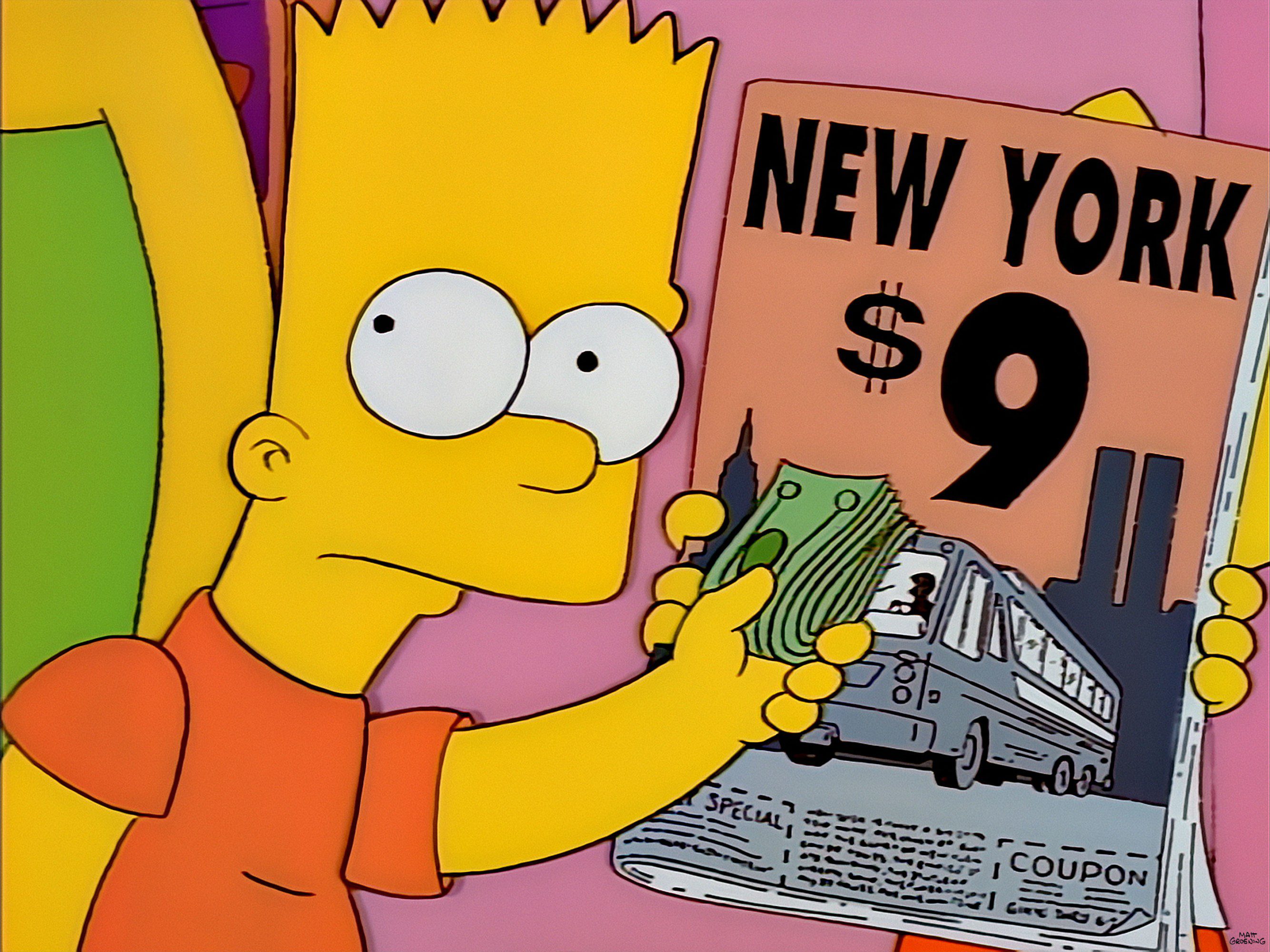
There are a couple of really bizarre coincidences. There was a brochure in a New York episode [which aired in 1997] that said “New York, $9” next to a picture of the trade towers looking like an 11. That was nuts. It still sends chills down me. The writer of that episode, Ian Maxtone-Graham, was nonplussed. He really couldn’t believe it. 

THE SIMPSONS ™ & © 20TH TELEVISION

It’s not like we would’ve made that knowing what was going to come, which we didn’t. And people have advanced conspiracy theories that we’re all Ivy League writers who knew … it’s preposterous stuff that people say. There’s also a thing people do that we don’t really love, which is they fake predictions. So after something happens, they’ll concoct a Simpsons frame, and it’s not something that ever aired. [Editor’s note: People faked Simpsons screenshots seeming to predict the 2024 Baltimore bridge collapse and the 2019 Notre-Dame fire. Images from the real “Osaka flu” episode were also edited to include the word “coronavirus.”] 

How does that make you feel? Is it frustrating?

It shows you how you can really convince people of something that’s not the case. Our small denial doesn’t get as much attention. 

As far as internet conspiracies go, where would you rate the idea that The Simpsons can predict the future? 

I hope it’s harmless. I think it’s really lodged in the internet very well. I don’t think it’s disappearing anytime soon. I’m sure for the rest of my life I’ll be hearing about what a group of psychics and seers I was part of. If we really could predict that well, we’d all be retired from betting on football. Although, advice to readers: Don’t bet on football. 

THE SIMPSONS ™ & © 20TH TELEVISION

Still, it is a tiny part of a trend that is alarming, which is people being unable to distinguish fact from fiction. And I have that trouble too. You read something, and your natural inclination has always been, “Well, I read it—it’s true.” And you have to really be skeptical about that. 

Can I ask you to predict a solution to all of this?

I think my only solution is: Look at your phone less and read more books.

This interview has been edited for length and clarity. 

Amelia Tait is a London-based freelance features journalist who writes about culture, trends, and unusual phenomena. 

How conspiracy theories infiltrated the doctor’s office

As anyone who has googled their symptoms and convinced themselves that they’ve got a brain tumor will attest, the internet makes it very easy to self-(mis)diagnose your health problems. And although social media and other digital forums can be a lifeline for some people looking for a diagnosis or community, when that information is wrong, it can put their well-being and even lives in danger.

Unfortunately, this modern impulse to “do your own research” became even more pronounced during the coronavirus pandemic.


This story is part of MIT Technology Review’s series “The New Conspiracy Age,” on how the present boom in conspiracy theories is reshaping science and technology.


We asked a number of health-care professionals about how this shifting landscape is changing their profession. They told us that they are being forced to adapt how they treat patients. It’s a wide range of experiences: Some say patients tell them they just want more information about certain treatments because they’re concerned about how effective they are. Others hear that their patients just don’t trust the powers that be. Still others say patients are rejecting evidence-based medicine altogether in favor of alternative theories they’ve come across online. 

These are their stories, in their own words.

Interviews have been edited for length and clarity.


The physician trying to set shared goals 

David Scales

Internal medicine hospitalist and assistant professor of medicine,
Weill Cornell Medical College
New York City

Every one of my colleagues has stories about patients who have been rejective of care, or had very peculiar perspectives on what their care should be. Sometimes that’s driven by religion. But I think what has changed is people, not necessarily with a religious standpoint, having very fixed beliefs that are sometimes—based on all the evidence that we have—in contradiction with their health goals. And that is a very challenging situation. 

I once treated a patient with a connective tissue disease called Ehlers-Danlos syndrome. While there’s no doubt that the illness exists, there’s a lot of doubt and uncertainty over which symptoms can be attributed to Ehlers-Danlos. This means it can fall into what social scientists call a “contested illness.” 

Contested illnesses used to be causes for arguably fringe movements, but they have become much more prominent since the rise of social media in the mid-2010s. Patients often search for information that resonates with their experience. 

This patient was very hesitant about various treatments, and it was clear she was getting her information from, I would say, suspect sources. She’d been following people online who were not necessarily trustworthy, so I sat down with her and we looked them up on Quackwatch, a site that lists health myths and misconduct. 

“She was extremely knowledgeable, and had done a lot of her own research, but she struggled to tell the difference between good and bad sources.”

She was still accepting of treatment, and was extremely knowledgeable, and had done a lot of her own research, but she struggled to tell the difference between good and bad sources and fixed beliefs that overemphasize particular things—like what symptoms might be attributable to other stuff.

Physicians have the tools to work with patients who are struggling with these challenges. The first is motivational interviewing, a counseling technique that was developed for people with substance-use disorders. It’s a nonjudgmental approach that uses open-ended questions to draw out people’s motivations, and to find where there’s a mismatch between their behaviors and their beliefs. It’s highly effective in treating people who are vaccine-hesitant.

Another is an approach called shared decision-making. First we work out what the patient’s goals are and then figure out a way to align those with what we know about the evidence-based way to treat them. It’s something we use for end-of-life care, too.

What’s concerning to me is that it seems as though there’s a dynamic of patients coming in with a fixed belief of how to diagnose their illness, how their symptoms should be treated, and how to treat it in a way that’s completely divorced from the kinds of medicine you’d find in textbooks—and that the same dynamic is starting to extend to other illnesses, too.


The therapist committed to being there when the conspiracy fever breaks 

Damien Stewart

Psychologist
Warsaw, Poland

Before covid, I hadn’t really had any clients bring up conspiracy theories into my practice. But once the pandemic began, they went from being fun or harmless to something dangerous.

In my experience, vaccines were the topic where I first really started to see some militancy—people who were looking down the barrel of losing their jobs because they wouldn’t get vaccinated. At one point, I had an out-and-out conspiracy theorist say to me, “I might as well wear a yellow star like the Jews during the Holocaust, because I won’t get vaccinated.” 

I felt pure anger, and I reached a point in my therapeutic journey I didn’t know would ever occur—I’d found that I had a line that could be crossed by a client that I could not tolerate. I spoke in a very direct manner he probably wasn’t used to and challenged his conspiracy theory. He got very angry and hung up the call.  

It made me figure out how I was going to deal with this in future, and to develop an approach—which was to not challenge the conspiracy theory, but to gently talk through it, to provide alternative points of view and ask questions. I try to find the therapeutic value in the information, in the conversations we’re having. My belief is and evidence seems to show that people believe in conspiracy theories because there’s something wrong in their life that is inexplicable, and they need something to explain what’s happening to them. And even if I have no belief or agreement whatsoever in what they’re saying, I think I need to sit here and have this conversation, because one day this person might snap out of it, and I need to be here when that happens.

As a psychologist, you have to remember that these people who believe in these things are extremely vulnerable. So my anger around these conspiracy theories has changed from being directed toward the deliverer—the person sitting in front of me saying these things—to the people driving the theories.


The emergency room doctor trying to get patients to reconnect with the evidence

Luis Aguilar Montalvan

Attending emergency medicine physician 
Queens, New York

The emergency department is essentially the pulse of what is happening in society. That’s what really attracted me to it. And I think the job of the emergency doctor, particularly within shifting political views or belief in Western medicine, is to try to reconnect with someone. To just create the experience that you need to prime someone to hopefully reconsider their relationship with this evidence-based medicine.

When I was working in the pediatrics emergency department a few years ago, we saw a resurgence of diseases we thought we had eradicated, like measles. I typically framed it by saying to the child’s caregiver: “This is a disease we typically use vaccines for, and it can prevent it in the majority of people.” 

“The doctor is now more like a consultant or a customer service provider than the authority. … The power dynamic has changed.”

The sentiment among my adult patients who are reluctant to get vaccinated or take certain medications seems to be from a mistrust of the government or “The System” rather than from anything Robert F. Kennedy Jr. says directly, for example. I’m definitely seeing more patients these days asking me what they can take to manage a condition or pain that’s not medication. I tell them that the knowledge I have is based on science, and explain the medications I’d typically give other people in their situation. I try to give them autonomy while reintroducing the idea of sticking with the evidence, and for the most part they’re appreciative and courteous.

The role of doctor has changed in recent years—there’s been a cultural change. My understanding is that back in the day, what the doctor said, the patient did. Some doctors used to shame parents who hadn’t vaccinated their kids. Now we’re shifting away from that, and the doctor is now more like a consultant or a customer service provider than the authority. I think that could be because we’ve seen a lot of bad actors in medicine, so the power dynamic has changed.  

I think if we had a more unified approach at a national level, if they had an actual unified and transparent relationship with the population, that would set us up right. But I’m not sure we’ve ever had it.

STEPHANIE ARNETT/MIT TECHNOLOGY REVIEW | PUBLIC DOMAIN

The psychologist who supported severely mentally ill patients through the pandemic 

Michelle Sallee

Psychologist, board certified in serious mental illness psychology
Oakland, California

I’m a clinical psychologist who only works with people who have been in the hospital three or more times in the last 12 months. I do both individual therapy and a lot of group work, and several years ago during the pandemic, I wrote a 10-week program for patients about how to cope with sheltering in place, following safety guidelines, and their concerns about vaccines.

My groups were very structured around evidence-based practice, and I had rules for the groups. First, I would tell people that the goal was not to talk them out of their conspiracy theory; my goal was not to talk them into a vaccination. My goal was to provide a safe place for them to be able to talk about things that were terrifying to them. We wanted to reduce anxiety, depression, thoughts of suicide, and the need for psychiatric hospitalizations. 

Half of the group was pro–public health requirements, and their paranoia and fear for safety was around people who don’t get vaccinated; the other half might have been strongly opposed to anyone other than themselves deciding they need a vaccination or a mask. Both sides were fearing for their lives—but from each other.

I wanted to make sure everybody felt heard, and it was really important to be able to talk about what they believed—like, some people felt like the government was trying to track us and even kill us—without any judgment from other people. My theory is that if you allow people to talk freely about what’s on their mind without blocking them with your own opinions or judgment, they will find their way eventually. And a lot of times that works. 

People have been stuck on their conspiracy theory or their paranoia has been stuck on it for a long time because they’re always fighting with people about it, everyone’s telling them that this is not true. So we would just have an open discussion about these things. 

“People have been stuck on their conspiracy theory for a long time because they’re always fighting with people about it, everyone’s telling them that this is not true.”

I ran the program four times for a total of 27 people, and the thing that I remember the most was how respectful and tolerant and empathic, but still honest about their feelings and opinions, everybody was. At the end of the program, most participants reported a decrease in pandemic-related stress. Half reported a decrease in general perceived stress, and half reported no change.

I’d say that the rate of how much vaccines are talked about now is significantly lower, and covid doesn’t really come up anymore. But other medical illnesses come up—patients saying, “My doctor said I need to get this surgery, but I know who they’re working for.” Everybody has their concerns, but when a person with psychosis has concerns, it becomes delusional, paranoid, and psychotic.

I’d like to see more providers be given more training around severe mental illness. These are not just people who just need to go to the hospital to get remedicated for a couple of days. There’s a whole life that needs to get looked at here, and they deserve that. I’d like to see more group settings with a combination of psychoeducation, evidence-based research, skills training, and process, because the research says that’s the combination that’s really important.

Editor’s note: Sallee works for a large HMO psychiatry department, and her account here is not on behalf of, endorsed by, or speaking for any larger organization.


The epidemiologist rethinking how to bridge differences in culture and community 

John Wright

Clinician and epidemiologist
Bradford, United Kingdom

I work in Bradford, the fifth-biggest city in the UK. It has a big South Asian population and high levels of deprivation. Before covid, I’d say there was growing awareness about conspiracies. But during the pandemic, I think that lockdown, isolation, fear of this unknown virus, and then the uncertainty about the future came together in a perfect storm to highlight people’s latent attraction to alternative hypotheses and conspiracies—it was fertile ground. I’ve been a National Health Service doctor for almost 40 years, and until recently, the NHS had a great reputation, with great trust, and great public support. The pandemic was the first time that I started seeing that erode.

It wasn’t just conspiracies about vaccines or new drugs, either—it was also an undermining of trust in public institutions. I remember an older woman who had come into the emergency department with covid. She was very unwell, but she just wouldn’t go into hospital despite all our efforts, because there were conspiracies going around that we were killing patients in hospital. So she went home, and I don’t know what happened to her.

The other big change in recent years has been social media and social networks that have obviously amplified and accelerated alternative theories and conspiracies. That’s been the tinder that’s allowed the wildfires to spread with these sort of conspiracy theories. In Bradford, particularly among ethnic minority communities, there’s been stronger links between them—allowing this to spread quicker—but also a more structural distrust. 

Vaccination rates have fallen since the pandemic, and we’re seeing lower uptake of the meningitis and HPV vaccines in schools among South Asian families. Ultimately, this needs a bigger societal approach than individual clinicians putting needles in arms. We started a project called Born in Bradford in 2007 that’s following more than 13,000 families, including around 20,000 teenagers as they grow up. One of the biggest focuses for us is how they use social media and how it links to their mental health, so we’re asking them to donate their digital media to us so we can examine it in confidence. We’re hoping it could allow us to explore conspiracies and influences.

The challenge for the next generation of resident doctors and clinicians is: How do we encourage health literacy in young people about what’s right and what’s wrong without being paternalistic? We also need to get better at engaging with people as health advocates to counter some of the online narratives. The NHS website can’t compete with how engaging content on TikTok is.


The pediatrician who worries about the confusing public narrative on vaccines

Jessica Weisz

Pediatrician
Washington, DC

I’m an outpatient pediatrician, so I do a lot of preventative care, checkups, and sick visits, and treating coughs and colds—those sorts of things. I’ve had specific training in how to support families in clinical decision-making related to vaccines, and every family wants what’s best for their child, and so supporting them is part of my job.

I don’t see specific articulation of conspiracy theories, but I do think there’s more questions about vaccines in conversations I’ve not typically had to have before. I’ve found that parents and caregivers do ask general questions about the risks and benefits of vaccines. We just try to reiterate that vaccines have been studied, that they are intentionally scheduled to protect an immature immune system when it’s the most vulnerable, and that we want everyone to be safe, healthy, and strong. That’s how we can provide protection.

“I think what’s confusing is that distress is being sowed in headlines when most patients, families, and caregivers are motivated and want to be vaccinated.”

I feel that the narrative in the public space is unfairly confusing to families when over 90% of families still want their kids to be vaccinated. The families who are not as interested in that, or have questions—it typically takes multiple conversations to support that family in their decision-making. It’s very rarely one conversation.

I think what’s confusing is that distress is being sowed in headlines when most patients, families, and caregivers are motivated and want to be vaccinated. For example, some of the headlines around recent changes the CDC are making make it sound like they’re making a huge clinical change, when it’s actually not a huge change from what people are typically doing. In my standard clinical practice, we don’t give the combined MMRV vaccine to children under four years old, and that’s been standard practice in all of the places I’ve worked on the Eastern Seaboard. [Editor’s note: In early October, the CDC updated its recommendation that young children receive the varicella vaccine separately from the combined vaccine for measles, mumps, and rubella. Many practitioners, including Weisz, already offer the shots separately.]

If you look at public surveys, pediatricians are still the most trusted [among health-care providers], and I do live in a jurisdiction with pretty strong policy about school-based vaccination. I think that people are getting information from multiple sources, but at the end of the day, in terms of both the national rates and also what I see in clinical practice, we really are seeing most families wanting vaccines.

Why it’s so hard to bust the weather control conspiracy theory

It was October 2024, and Hurricane Helene had just devastated the US Southeast. Representative Marjorie Taylor Greene of Georgia found an abstract target on which to pin the blame: “Yes they can control the weather,” she posted on X. “It’s ridiculous for anyone to lie and say it can’t be done.” 

There was no word on who “they” were, but maybe it was better that way. 

She was repeating what’s by now a pretty familiar and popular conspiracy theory: that shadowy forces are out there, wielding unknown technology to control the weather and wreak havoc on their supposed enemies. This claim, fundamentally preposterous from a scientific standpoint, has grown louder and more common in recent years. It pops up over and over when extreme weather strikes: in Dubai in April 2024, in Australia in July 2022, in the US after California floods and hurricanes like Helene and Milton. In the UK, conspiracy theorists claimed that the government had fixed the weather to be sunny and rain-free during the first covid lockdown in March 2020. Most recently, the theories spread again when disastrous floods hit central Texas this past July. The idea has even inspired some antigovernment extremists to threaten and try to destroy weather radar towers. 


This story is part of MIT Technology Review’s series “The New Conspiracy Age,” on how the present boom in conspiracy theories is reshaping science and technology.


But here’s the thing: While Greene and other believers are not correct, this conspiracy theory—like so many others—holds a kernel of much more modest truth behind the grandiose claims. 

Sure, there is no current way for humans to control the weather. We can’t cause major floods or redirect hurricanes or other powerful storm systems, simply because the energy involved is far too great for humans to alter significantly. 

But there are ways we can modify the weather. The key difference is the scale of what is possible. 

The most common weather modification practice is called cloud seeding, and it involves injecting small amounts of salts or other materials into clouds with the goal of juicing levels of rain or snow. This is typically done in dry areas that lack regular precipitation. Research shows that it can in fact work, though advances in technology reveal that its impact is modest—coaxing maybe 5% to 10% more moisture out of otherwise stubborn clouds.

But the fact that humans can influence weather at all gives conspiracy theorists a foothold in the truth. Add to this a spotty history of actual efforts by governments and militaries to control major storms, as well as other emerging but not-yet-deployed-at-any-scale technologies that aim to address climate change … and you can see where things get confusing. 

So while more sweeping claims of weather control are ultimately ridiculous from a scientific standpoint, they can’t be dismissed as entirely stupid.

This all helped make the conspiracy theories swirling after the recent Texas floods particularly loud and powerful. Just days earlier, 100 miles away from the epicenter of the floods, in a town called Runge, the cloud-seeding company Rainmaker had flown a single-engine plane and released about 70 grams of silver iodide into some clouds; a modest drizzle of less than half a centimeter of rain followed. But once the company saw a storm front in the forecast, it suspended its work; there was no need to seed with rain already on the way.

“We conducted an operation on July 2, totally within the scope of what we were regulatorily permitted to do,” Augustus Doricko, Rainmaker’s founder and CEO, recently told me. Still, when as much as 20 inches of rain fell soon afterward not too far away, and more than 100 people died, the conspiracy theory machine whirred into action. 

As Doricko told the Washington Post in the tragedy’s aftermath, he and his company faced “nonstop pandemonium” on social media; eventually someone even posted photos from outside Rainmaker’s office, along with its address. Doricko told me a few factors played into the pile-on, including a lack of familiarity with the specifics of cloud seeding, as well as what he called “deliberately inflammatory messaging from politicians.” Indeed, theories about Rainmaker and cloud seeding spread online via prominent figures including Greene and former national security advisor Mike Flynn

Unfortunately, all this is happening at the same time as the warming climate is making heavy rainfall and the floods that accompany it more and more likely. “These events will become more frequent,” says Emily Yeh, a professor of geography at the University of Colorado who has examined approaches and reactions to weather modification around the world. “There is a large, vocal group of people who are willing to believe anything but climate change as the reason for Texas floods, or hurricanes.”

Worsening extremes, increasing weather modification activity, improving technology, a sometimes shady track record—the conditions are perfect for an otherwise niche conspiracy theory to spread to anyone desperate for tidy explanations of increasingly disastrous events.

Here, we break down just what’s possible and what isn’t—and address some of the more colorful reasons why people may believe things that go far beyond the facts. 

What we can do with the weather—and who is doing it

The basic concepts behind cloud seeding have been around for about 80 years, and government interest in the topic goes back even longer than that

The primary practice involves using planes, drones, or generators on the ground to inject tiny particles of stuff, usually silver iodide, into existing clouds. The particles act as nuclei around which moisture can build up, forming ice crystals that can get heavy enough to fall out of the cloud as snow or rain.

“Weather modification is an old field; starting in the 1940s there was a lot of excitement,” says David Delene, a research professor of atmospheric sciences at the University of North Dakota and an expert on cloud seeding. In a US Senate report from 1952 to establish a committee to study weather modification, authors noted that a small amount of extra rain could “produce electric power worth hundreds of thousands of dollars” and “greatly increase crop yields.” It also cited potential uses like “reducing soil erosion,” “breaking up hurricanes,” and even “cutting holes in clouds so that aircraft can operate.” 

But, as Delene adds, “that excitement … was not realized.”

Through the 1980s, extensive research often funded or conducted by Washington yielded a much better understanding of atmospheric science and cloud physics, though it proved extremely difficult to actually demonstrate the efficacy of the technology itself. In other words, scientists learned the basic principles behind cloud seeding, and understood on a theoretical level that it should work—but it was hard to tell how big an impact it was having on rainfall.

There is huge variability between one cloud and another, one storm system and another, one mountain or valley and another; for decades, the tools available to researchers did not really allow for firm conclusions on exactly how much extra moisture, if any, they were getting out of any given operation. Interest in the practice died down to a low hum by the 1990s.

But over the past couple of decades, the early excitement has returned.

Cloud seeding can enhance levels of rain and snow 

While the core technology has largely stayed the same, several projects launched in the US and abroad starting in the 2000s have combined statistical modeling with new and improved aircraft-based measurements, ground-based radar, and more to provide better answers on what results are actually achievable when seeding clouds.

“I think we’ve identified unequivocally that we can indeed modify the cloud,” says Jeff French, an associate professor and head of the University of Wyoming’s Department of Atmospheric Science, who has worked for years on the topic. But even as scientists have come to largely agree that the practice can have an impact on precipitation, they also largely recognize that the impact probably has some fairly modest upper limits—far short of massive water surges. 

“There is absolutely no evidence that cloud seeding can modify a cloud to the extent that would be needed to cause a flood,” French says. Floods require a few factors, he adds—a system with plenty of moisture available that stays localized to a certain spot for an extended period. “All of these things which cloud seeding has zero effect on,” he says. 

The technology simply operates on a different level. “Cloud seeding really is looking at making an inefficient system a little bit more efficient,” French says. 

As Delene puts it: “Originally [researchers] thought, well, we could, you know, do 50%, 100% increases in precipitation,” but “I think if you do a good program you’re not going to get more than a 10% increase.” 

Asked for his take on a theoretical limit, French was hesitant—“I don’t know if I’m ready to stick my neck out”—but agreed on “maybe 10-ish percent” as a reasonable guess.

Another cloud seeding expert, Katja Friedrich from the University of Colorado–Boulder, says that any grander potential would be obvious by this point: We wouldn’t have “spent the last 100 years debating—within the scientific community—if cloud seeding works,” she writes in an email. “It would have been easy to separate the signal (from cloud seeding) from the noise (natural precipitation).”

It can also (probably) suppress precipitation

Sometimes cloud seeding is used not to boost rain and snow but rather to try to reduce its severity—or, more specifically, to change the size of individual rain droplets or hailstones. 

One of the most prominent examples has been in parts of Canada, where hailstorms can be devastating; a 2024 event in Calgary, for instance, was the country’s second-most-expensive disaster ever, with over $2 billion in damages. 

Insurance companies in Alberta have been working together for nearly three decades on a cloud seeding program that’s aimed at reducing some of that damage. In these cases, the silver iodide or other particles are meant to act essentially as competition for other “embryos” inside the cloud, increasing the total number of hailstones and thus reducing each individual stone’s average size. 

Smaller hailstones means less damage when they reach the ground. The insurance companies—which continue to pay for the program—say losses have been cut by 50% since the program started, though scientists aren’t quite as confident in its overall success. A 2023 study published in Atmospheric Research examined 10 years of cloud seeding efforts in the province and found that the practice did appear to reduce potential for damage in about 60% of seeded storms—while in others, it had no effect or was even associated with increased hail (though the authors said this could have been due to natural variation).

Similar techniques are also sometimes deployed to try to improve the daily forecast just a bit. During the 2008 Olympics, for instance, China engaged in a form of cloud seeding aimed at reducing rainfall. As MIT Technology Review detailed back then, officials with the Beijing Weather Modification Office planned to use a liquid-nitrogen-based coolant that could increase the number of water droplets in a cloud while reducing their size; this can get droplets to stay aloft a little longer instead of falling out of the cloud. Though it is tough to prove that it definitively would have rained without the effort, the targeted opening ceremony did stay dry.

So, where is this happening? 

The United Nations’ World Meteorological Organization says that some form of weather modification is taking place in “more than 50 countries” and that “demand for these weather modification activities is increasing steadily due to the incidence of droughts and other calamities.”

The biggest user of cloud-seeding tech is arguably China. Following the work around the Olympics, the country announced a huge expansion of its weather modification program in 2020, claiming it would eventually run operations for agricultural relief and other functions, including hail suppression, over an area about the size of India and Algeria combined. Since then, China has occasionally announced bits of progress—including updates to weather modification aircraft and the first use of drones for artificial snow enhancement. Overall, it spends billions on the practice, with more to come.

Elsewhere, desert countries have taken an interest. In 2024, Saudi Arabia announced an expanded research program on cloud seeding—Delene, of the University of North Dakota, was part of a team that conducted experiments in various parts of that country in late 2023. Its neighbor the United Arab Emirates began “rain enhancement” activities back in 1990; this program too has faced outcry, especially after more than a typical year’s worth of rain fell in a single day in 2024, causing massive flooding. (Bloomberg recently published a story about persistent questions regarding the country’s cloud seeding program; in response to the story, French wrote in an email that the “best scientific understanding is still that cloud seeding CANNOT lead to these types of events.” Other experts we asked agreed.) 

In the US, a 2024 Government Accountability Office report on cloud seeding said that at least nine states have active programs. These are sometimes run directly by the state and sometimes contracted out through nonprofits like the South Texas Weather Modification Association to private companies, including Doricko’s Rainmaker and North Dakota–based Weather Modification. In August, Doricko told me that Rainmaker had grown to 76 employees since it launched in 2023. It now runs cloud seeding operations in Utah, Idaho, Oregon, California, and Texas, as well as forecasting services in New Mexico and Arizona. And in an answer that may further fuel the conspiracy fire, he added they are also operating in one Middle Eastern country; when I asked which one, he’d only say, “Can’t tell you.”

What we cannot do

The versions of weather modification that the conspiracy theorists envision most often—significantly altering monsoons or hurricanes or making the skies clear and sunny for weeks at a time—have so far proved impossible to carry out. But that’s not necessarily for lack of trying.

The US government attempted to alter a hurricane in 1947 as part of a program dubbed Project Cirrus. In collaboration with GE, government scientists seeded clouds with pellets of dry ice, the idea being that the falling pellets could induce supercooled liquid in the clouds to crystallize into ice. After they did this, the storm took a sharp left turn and struck the area around Savannah, Georgia. This was a significant moment for budding conspiracy theories, since a GE scientist who had been working with the government said he was “99% sure” the cyclone swerved because of their work. Other experts disagreed and showed that such storm trajectories are, in reality, perfectly possible without intervention. Perhaps unsurprisingly, public outrage and threats of lawsuits followed.

It took some time for the hubbub to die down, after which several US government agencies continued—unsuccessfully—trying to alter and weaken hurricanes with a long-running cloud seeding program called Project Stormfury. Around the same time, the US military joined the fray with Operation Popeye, essentially trying to harness weather as a weapon in the Vietnam War—engaging in cloud seeding efforts over Vietnam, Cambodia, and Laos in the late 1960s and early 1970s, with an eye toward increasing monsoon rains and bogging down the enemy. Though it was never really clear whether these efforts worked, the Nixon administration tried to deny them, going so far as to lie to the public and even to congressional committees.

More recently and less menacingly, there have been experiments with Dyn-O-Gel—a Florida company’s super-absorbent powder, intended to be dropped into storm clouds to sop up their moisture. In the early 2000s, the company carried out experiments with the stuff in thunderstorms, and it had grand plans to use it to weaken tropical cyclones. But according to one former NOAA scientist, you would need to drop almost 38,000 tons of it, requiring nearly 380 individual plane trips, in and around even a relatively small cyclone’s eyewall to really affect the storm’s strength. And then you would have to do that again an hour and a half later, and so on. Reality tends to get in the way of the biggest weather modification ideas.

Beyond trying to control storms, there are some other potential weather modification technologies out there that are either just getting started or have never taken off. Swiss researchers have tried to use powerful lasers to induce cloud formation, for example; in Australia, where climate change is imperiling the Great Barrier Reef, artificial clouds created when ship-based nozzles spray moisture into the sky have been used to try to protect the vital ecosystem. In each case, the efforts remain small, localized, and not remotely close to achieving the kinds of control the conspiracy theorists allege.

What is not weather modification—but gets lumped in with it

Further worsening weather control conspiracies is that there is a tendency to conflate cloud seeding and other promising weather modification research with concepts such as chemtrails—a full-on conspiracist fever dream about innocuous condensation trails left by jets—and solar geoengineering, a theoretical stopgap to cool the planet that has been subject to much discussion and modeling research but has never been deployed in any large-scale way.

One controversial form of solar geoengineering, known as stratospheric aerosol injection, would involve having high-altitude jets drop tiny aerosol particles—sulfur dioxide, most likely—into the stratosphere to act essentially as tiny mirrors. They would reflect a small amount of sunlight back into space, leaving less energy to reach the ground and contribute to warming. To date, attempts to launch physical experiments in this space have been shouted down, and only tiny—though still controversial—commercial efforts have taken place. 

One can see why it gets lumped in with cloud seeding: bits of stuff, dumped into the sky, with the aim of altering what happens down below. But the aims are entirely separate; geoengineering would alter the global average temperature rather than having measurable effects on momentary cloudbursts or hailstorms. Some research has suggested that the practice could alter monsoon patterns, a significant issue given their importance to much of the world’s agriculture, but it remains a fundamentally different practice from cloud seeding.

Still, the political conversation around supposed weather control often reflects this confusion. Greene, for instance, introduced a bill in July called the Clear Skies Act, which would ban all weather modification and geoengineering activities. (Greene’s congressional office did not respond to a request for comment.) And last year, Tennessee became the first state to enact a law to prohibit the “intentional injection, release, or dispersion, by any means, of chemicals, chemical compounds, substances, or apparatus … into the atmosphere with the express purpose of affecting temperature, weather, or the intensity of the sunlight.” Florida followed suit, with Governor Ron DeSantis signing SB 56 into law in June of this year for the same stated purpose.

Also this year, lawmakers in more than 20 other states have also proposed some version of a ban on weather modification, often lumping it in with geoengineering, even though caution on the latter is more widely accepted or endorsed. “It’s not a conspiracy theory,” one Pennsylvania lawmaker who cosponsored a similar bill told NBC News. “All you have to do is look up.”

Oddly enough, as Yeh of the University of Colorado points out, the places where bans have passed are states where weather modification isn’t really happening. “In a way, it’s easy for them to ban it, because, you know, nothing actually has to be done,” she says. In general, neither Florida nor Tennessee—nor any other part of the Southeast—needs any help finding rain. Basically, all weather modification activity in the US happens in the drier areas west of the Mississippi. 

Finding a culprit

Doricko told me that in the wake of the Texas disaster, he has seen more people become willing to learn about the true capabilities of cloud seeding and move past the more sinister theories about it. 

I asked him, though, about some of his company’s flashier branding: Until recently, visitors to the Rainmaker website were greeted right up top with the slogan “Making Earth Habitable.” Might this level of hype contribute to public misunderstanding or fear? 

He said he is indeed aware that Earth is, currently, habitable, and called the slogan a “tongue-in-cheek, deliberately provocative statement.” Still, in contrast to the academics who seem more comfortable acknowledging weather modification’s limits, he has continued to tout its revolutionary potential. “If we don’t produce more water, then a lot of the Earth will become less habitable,” he said. “By producing more water via cloud seeding, we’re helping to conserve the ecosystems that do currently exist, that are at risk of collapse.” 

While other experts cited that 10% figure as a likely upper limit of cloud seeding’s effectiveness, Doricko said they could eventually approach 20%, though that might be years away. “Is it literally magic? Like, can I snap my fingers and turn the Sahara green? No,” he said. “But can it help make a greener, verdant, and abundant world? Yeah, absolutely.” 

It’s not all that hard to see why people still cling to magical thinking here. The changing climate is, after all, offering up what’s essentially weaponized weather, only with a much broader and long-term mechanism behind it. There is no single sinister agency or company with its finger on the trigger, though it can be tempting to look for one; rather, we just have an atmosphere capable of holding more moisture and dropping it onto ill-prepared communities, and many of the people in power are doing little to mitigate the impacts.

“Governments are not doing a good job of responding to the climate crisis; they are often captured by fossil-fuel interests, which drive policy, and they can be slow and ineffective when responding to disasters,” Naomi Smith, a lecturer in sociology at the University of the Sunshine Coast in Australia who has written about conspiracy theories and weather events, writes in an email. “It’s hard to hold all this complexity, and conspiracy theorizing is one way of making it intelligible and understandable.”  

“Conspiracy theories give us a ‘big bad’ to point the finger at, someone to blame and a place to put our feelings of anger, despair, and grief,” she writes. “It’s much less satisfying to yell at the weather, or to engage in the sustained collective action we actually need to tackle climate change.”

The sinister “they” in Greene’s accusations is, in other words, a far easier target than the real culprit. 

Dave Levitan is an independent journalist, focused on science, politics, and policy. Find his work at davelevitan.com and subscribe to his newsletter at gravityisgone.com