Nominate someone to our 2025 list of Innovators Under 35

Every year, MIT Technology Review recognizes 35 young innovators who are doing pioneering work across a range of technical fields including biotechnology, materials science, artificial intelligence, computing, and more. 

We’re now taking nominations for our 2025 list and you can submit one here. The process takes just a few minutes. Nominations will close at 11:59 PM ET on January 20, 2025. You can nominate yourself or someone you know, based anywhere in the world. The only rule is that the nominee must be under the age of 35 on October 1, 2025.  

We want to hear about people who have made outstanding contributions to their fields and are making an early impact in their careers. Perhaps they’ve led an important scientific advance, founded a company that’s addressing an urgent problem, or discovered a new way to deploy an existing technology that improves people’s lives. 

If you want to nominate someone, you should identify a clear advance or innovation for which they are primarily responsible. We seek to highlight innovators whose breakthroughs are broad in scope and whose influence reaches beyond their immediate scientific communities. 

The 2025 class of innovators will join a long list of distinguished honorees. We featured Lisu Su, now CEO of AMD, when she was 32 years old; Andrew Ng, a computer scientist and serial entrepreneur, made the list in 2008 when he was an assistant professor at Stanford. That same year, we featured 31-year-old Jack Dorsey—two years after he launched Twitter. And Helen Greiner, co-founder of iRobot, was on the list in 1999.

Know someone who should be on our 2025 list? We’d love to hear about them. Submit your nomination today or visit our FAQ to learn more.

The startup trying to turn the web into a database

A startup called Exa is pitching a new spin on generative search. It uses the tech behind large language models to return lists of results that it claims are more on point than those from its rivals, including Google and OpenAI. The aim is to turn the internet’s chaotic tangle of web pages into a kind of directory, with results that are specific and precise.

Exa already provides its search engine as a back-end service to companies that want to build their own applications on top of it. Today it is launching the first consumer version of that search engine, called Websets.  

“The web is a collection of data, but it’s a mess,” says Exa cofounder and CEO Will Bryk. “There’s a Joe Rogan video over here, an Atlantic article over there. There’s no organization. But the dream is for the web to feel like a database.”

Websets is aimed at power users who need to look for things that other search engines aren’t great at finding, such as types of people or companies. Ask it for “startups making futuristic hardware” and you get a list of specific companies hundreds long rather than hit-or-miss links to web pages that mention those terms. Google can’t do that, says Bryk: “There’s a lot of valuable use cases for investors or recruiters or really anyone who wants any sort of data set from the web.”

Things have moved fast since MIT Technology Review broke the news in 2021 that Google researchers were exploring the use of large language models in a new kind of search engine. The idea soon attracted fierce critics. But tech companies took little notice. Three years on, giants like Google and Microsoft jostle with a raft of buzzy newcomers like Perplexity and OpenAI, which launched ChatGPT Search in October, for a piece of this hot new trend.

Exa isn’t (yet) trying to out-do any of those companies. Instead, it’s proposing something new. Most other search firms wrap large language models around existing search engines, using the models to analyze a user’s query and then summarize the results. But the search engines themselves haven’t changed much. Perplexity still directs its queries to Google Search or Bing, for example. Think of today’s AI search engines as a sandwich with fresh bread but stale filling.

More than keywords

Exa provides users with familiar lists of links but uses the tech behind large language models to reinvent how search itself is done. Here’s the basic idea: Google works by crawling the web and building a vast index of keywords that then get matched to users’ queries. Exa crawls the web and encodes the contents of web pages into a format known as embeddings, which can be processed by large language models.

Embeddings turn words into numbers in such a way that words with similar meanings become numbers with similar values. In effect, this lets Exa capture the meaning of text on web pages, not just the keywords.

A screenshot of Websets showing results for the search: “companies; startups; US-based; healthcare focus; technical co-founder”

Large language models use embeddings to predict the next words in a sentence. Exa’s search engine predicts the next link. Type “startups making futuristic hardware” and the model will come up with (real) links that might follow that phrase.

Exa’s approach comes at cost, however. Encoding pages rather than indexing keywords is slow and expensive. Exa has encoded some billion web pages, says Bryk. That’s tiny next to Google, which has indexed around a trillion. But Bryk doesn’t see this as a problem: “You don’t have to embed the whole web to be useful,” he says. (Fun fact: “exa” means a 1 followed by 18 0s and “googol” means a 1 followed by 100 0s.)

Websets is very slow at returning results. A search can sometimes take several minutes. But Bryk claims it’s worth it. “A lot of our customers started to ask for, like, thousands of results, or tens of thousands,” he says. “And they were okay with going to get a cup of coffee and coming back to a huge list.”

“I find Exa most useful when I don’t know exactly what I’m looking for,” says Andrew Gao, a computer science student at Stanford Univesrsity who has used the search engine. “For instance, the query ‘an interesting blog post on LLMs in finance’ works better on Exa than Perplexity.” But they’re good at different things, he says: “I use both for different purposes.”

“I think embeddings are a great way to represent entities like real-world people, places, and things,” says Mike Tung, CEO of Diffbot, a company using knowledge graphs to build yet another kind of search engine. But he notes that you lose a lot of information if you try to embed whole sentences or pages of text: “Representing War and Peace as a single embedding would lose nearly all of the specific events that happened in that story, leaving just a general sense of its genre and period.”

Bryk acknowledges that Exa is a work in progress. He points to other limitations, too. Exa is not as good as rival search engines if you just want to look up a single piece of information, such as the name of Taylor Swift’s boyfriend or who Will Bryk is: “It’ll give a lot of Polish-sounding people, because my last name is Polish and embeddings are bad at matching exact keywords,” he says.

For now Exa gets around this by throwing keywords back into the mix when they’re needed. But Bryk is bullish: “We’re covering up the gaps in the embedding method until the embedding method gets so good that we don’t need to cover up the gaps.”

What the departing White House chief tech advisor has to say on AI

President Biden’s administration will end within two months, and likely to depart with him is Arati Prabhakar, the top mind for science and technology in his cabinet. She has served as Director of the White House Office of Science and Technology Policy since 2022 and was the first to demonstrate ChatGPT to the president in the Oval Office. Prabhakar was instrumental in passing the president’s executive order on AI in 2023, which sets guidelines for tech companies to make AI safer and more transparent (though it relies on voluntary participation). 

The incoming Trump administration has not presented a clear thesis of how it will handle AI, but plenty of people in it will want to see that executive order nullified. Trump said as much in July, endorsing the 2024 Republican Party Platform that says the executive order “hinders AI innovation and imposes Radical Leftwing ideas on the development of this technology.” Venture capitalist Marc Andreessen has said he would support such a move. 

However, complicating that narrative will be Elon Musk, who for years has expressed fears about doomsday AI scenarios, and has been supportive of some regulations aiming to promote AI safety. 

As she prepares for the end of the administration, I sat down with Prabhakar and asked her to reflect on President Biden’s AI accomplishments, and how AI risks, immigration policies, the CHIPS Act and more could change under Trump.  

This conversation has been edited for length and clarity.

Every time a new AI model comes out, there are concerns about how it could be misused. As you think back to what were hypothetical safety concerns just two years ago, which ones have come true?

We identified a whole host of risks when large language models burst on the scene, and the one that has fully manifested in horrific ways is deepfakes and image-based sexual abuse. We’ve worked with our colleagues at the Gender Policy Council to urge industry to step up and take some immediate actions, which some of them are doing. There are a whole host of things that can be done—payment processors could actually make sure people are adhering to their Terms of Use. They don’t want to be supporting [image-based sexual abuse] and they can actually take more steps to make sure that they’re not. There’s legislation pending, but that’s still going to take some time.

Have there been risks that didn’t pan out to be as concerning as you predicted?

At first there was a lot of concern expressed by the AI developers about biological weapons. When people did the serious benchmarking about how much riskier that was compared with someone just doing Google searches, it turns out, there’s a marginally worse risk, but it is marginal. If you haven’t been thinking about how bad actors can do bad things, then the chatbots look incredibly alarming. But you really have to say, compared to what?

For many people, there’s a knee-jerk skepticism about the Department of Defense or police agencies going all in on AI. I’m curious what steps you think those agencies need to take to build trust.

If consumers don’t have confidence that the AI tools they’re interacting with are respecting their privacy, are not embedding bias and discrimination, that they’re not causing safety problems, then all the marvelous possibilities really aren’t going to materialize. Nowhere is that more true than national security and law enforcement. 

I’ll give you a great example. Facial recognition technology is an area where there have been horrific, inappropriate uses: take a grainy video from a convenience store and identify a black man who has never even been in that state, who’s then arrested for a crime he didn’t commit. (Editor’s note: Prabhakar is referring to this story). Wrongful arrests based on a really poor use of facial recognition technology, that has got to stop. 

In stark contrast to that, when I go through security at the airport now, it takes your picture and compares it to your ID to make sure that you are the person you say you are. That’s a very narrow, specific application that’s matching my image to my ID, and the sign tells me—and I know from our DHS colleagues that this is really the case—that they’re going to delete the image. That’s an efficient, responsible use of that kind of automated technology. Appropriate, respectful, responsible—that’s where we’ve got to go.

Were you surprised at the AI safety bill getting vetoed in California?

I wasn’t. I followed the debate, and I knew that there were strong views on both sides. I think what was expressed, that I think was accurate, by the opponents of that bill, is that it was simply impractical, because it was an expression of desire about how to assess safety, but we actually just don’t know how to do those things. No one knows. It’s not a secret, it’s a mystery. 

To me, it really reminds us that while all we want is to know how safe, effective and trustworthy a model is, we actually have very limited capacity to answer those questions. Those are actually very deep research questions, and a great example of the kind of public R&D that now needs to be done at a much deeper level.

Let’s talk about talent. Much of the recent National Security Memorandum on AI was about how to help the right talent come from abroad to the US to work on AI. Do you think we’re handling that in the right way?

It’s a hugely important issue. This is the ultimate American story, that people have come here throughout the centuries to build this country, and it’s as true now in science and technology fields as it’s ever been. We’re living in a different world. I came here as a small child because my parents came here in the early 1960s from India, and in that period, there were very limited opportunities [to emigrate to] many other parts of the world. 

One of the good pieces of news is that there is much more opportunity now. The other piece of news is that we do have a very critical strategic competition with the People’s Republic of China, and that makes it more complicated to figure out how to continue to have an open door for people who come seeking America’s advantages, while making sure that we continue to protect critical assets like our intellectual property. 

Do you think the divisive debates around immigration, especially around the time of the election, may hurt the US ability to bring the right talent into the country?

Because we’ve been stalled as a country on immigration for so long, what is caught up in that is our ability to deal with immigration for the STEM fields. It’s collateral damage.

Has the CHIPS Act been successful?

I’m a semiconductor person starting back with my graduate work. I was astonished and delighted when, after four decades, we actually decided to do something about the fact that semiconductor manufacturing capability got very dangerously concentrated in just one part of the world [Taiwan]. So it was critically important that, with the President’s leadership, we finally took action. And the work that the Commerce Department has done to get those manufacturing incentives out, I think they’ve done a terrific job.

One of the main beneficiaries so far of the CHIPS Act has been Intel. There’s varying degrees of confidence in whether it is going to deliver on building a domestic chip supply chain in the way that the CHIPS Act intended. Is it risky to put a lot of eggs in one basket for one chip maker?

I think the most important thing I see in terms of the industry with the CHIPS Act is that today we’ve got not just Intel, but TSMC, Samsung, SK Hynix and Micron. These are the five companies whose products and processes are at the most advanced nodes in semiconductor technology. They are all now building in the US. There’s no other part of the world that’s going to have all five of those. An industry is bigger than a company. I think when you look at the aggregate, that’s a signal to me that we’re on a very different track.

You are the President’s chief advisor for science and technology. I want to ask about the cultural authority that science has, or doesn’t have, today. RFK Jr. is the pick for health secretary, and in some ways, he captures a lot of frustration that Americans have about our healthcare system. In other ways, he has many views that can only be described as anti-science. How do you reflect on the authority that science has now?

I think it’s important to recognize that we live in a time when trust in institutions has declined across the board, though trust in science remains relatively high compared with what’s happened in other areas. But it’s very much part of this broader phenomenon, and I think that the scientific community has some roles [to play] here. The fact of the matter is that despite America having the best biomedical research that the world has ever seen, we don’t have robust health outcomes. Three dozen countries have longer life expectancies than America. That’s not okay, and that disconnect between advancing science and changing people’s lives is just not sustainable. The pact that science and technology and R&D makes with the American people is that if we make these public investments, it’s going to improve people’s lives and when that’s not happening, it does erode trust. 

Is it fair to say that that gap—between the expertise we have in the US and our poor health outcomes—explains some of the rise in conspiratorial thinking, in the disbelief of science?

It leaves room for that. Then there’s a quite problematic rejection of facts. It’s troubling if you’re a researcher, because you just know that what’s being said is not true. The thing that really bothers me is [that the rejection of facts] changes people’s lives, and it’s extremely dangerous and harmful. Think about if we lost herd immunity for some of the diseases for which we right now have fairly high levels of vaccination. It was an ugly world before we tamed infectious disease with the vaccines that we have. 

This manga publisher is using Anthropic’s AI to translate Japanese comics into English

A Japanese publishing startup is using Anthropic’s flagship large language model Claude to help translate manga into English, allowing the company to churn out a new title for a Western audience in just a few days rather than the two to three months it would take a team of humans.

Orange was founded by Shoko Ugaki, a manga superfan who (according to VP of product Rei Kuroda) has some 10,000 titles in his house. The company now wants more people outside Japan to have access to them. “I hope we can do a great job for our readers,” says Kuroda.

A page from a Manga comic in both Japanese and translated English.
Orange’s Japanese-to-English translation of Neko Oji: Salaryman reincarnated as a kitten!
IMAGES COURTESY ORANGE / YAJIMA

But not everyone is happy. The firm has angered a number of manga fans who see the use of AI to translate a celebrated and traditional art form as one more front in the ongoing battle between tech companies and artists. “However well-intentioned this company might be, I find the idea of using AI to translate manga distasteful and insulting,” says Casey Brienza, a sociologist and author of the book Manga in America: Transnational Book Publishing and the Domestication of Japanese Comics.

Manga is a form of Japanese comic that has been around for more than a century. Hit titles are often translated into other languages and find a large global readership, especially in the US. Some, like Battle Angel Alita or One Piece, are turned into anime (animated versions of the comics) or live-action shows and become blockbuster movies and top Netflix picks. The US manga market was worth around $880 million in 2023 but is expected to reach $3.71 billion by 2030, according to some estimates. “It’s a huge growth market right now,” says Kuroda.

Orange wants a part of that international market. Only around 2% of titles published in Japan make it to the US, says Kuroda. As Orange sees it, the problem is that manga takes human translators too long to translate. By building AI tools to automate most of the tasks involved in translation—including extracting Japanese text from a comic’s panels, translating it into English, generating a new font, pasting the English back into the comic, and checking for mistranslations and typos—it can publish a translated mange title in around one-tenth the time it takes human translators and illustrators working by hand, the company says.

Humans still keep a close eye on the process, says Kuroda: “Honestly, AI makes mistakes. It sometimes misunderstands Japanese. It makes mistakes with artwork. We think humans plus AI is what’s important.”

Superheroes, aliens, cats

Manga is a complex art form. Stories are told via a mix of pictures and words, which can be descriptions or characters’ voices or sound effects, sometimes in speech bubbles and sometimes scrawled across the page. Single sentences can be split across multiple panels.

There are also diverse themes and narratives, says Kuroda: “There’s the student romance, mangas about gangs and murders, superheroes, aliens, cats.” Translations must capture the cultural nuance in each story. “This complexity makes localization work highly challenging,” he says.

Orange often starts with nothing more than the scanned image of a page. Its system first identifies which parts of the page show Japanese text, copies it, and erases the text from each panel. These snippets of text are then combined into whole sentences and passed to the translation module, which not only translates the text into English but keeps track of where on the page each individual snippet comes from. Because Japanese and English have a very different word order, the snippets need to be reordered, and the new English text must be placed on the page in different places from where the Japanese equivalent had come from—all without messing up the sequence of images.

“Generally, the images are the most important part of the story,” says Frederik Schodt, an award-winning manga translator who published his first translation in 1977. “Any language cannot contradict the images, so you can’t take many of the liberties that you might in translating a novel. You can’t rearrange paragraphs or change things around much.”

A page from a Manga comic in both Japanese and translated English.
Orange’s Japanese-to-English translation of Neko Oji: Salaryman reincarnated as a kitten!
IMAGES COURTESY ORANGE / YAJIMA

Orange tried several large language models, including its own, developed in house, before picking Claude 3.5. “We’re always evaluating new models,” says Kuroda. “Right now Claude gives us the most natural tone.”

Claude also has an agent framework that lets several sub-models work together on an overall task. Orange uses this framework to juggle the multiple steps in the translation process.

Orange distributes its translations via an app called Emaqi (a pun on “emaki,” the ancient Japanese illustrated scrolls that are considered a precursor to manga). It also wants to be a translator-for-hire for US publishers.

But Orange has not been welcomed by all US fans. When it showed up at Anime NYC, a US anime convention, this summer, the Japanese-to-English translator Jan Mitsuko Cash tweeted: “A company like Orange has no place at the convention hosting the Manga Awards, which celebrates manga and manga professionals in the industry. If you agree, please encourage @animenyc to ban AI companies from exhibiting or hosting panels.”  

Brienza takes the same view. “Work in the culture industries, including translation, which ultimately is about translating human intention, not mere words on a page, can be poorly paid and precarious,” she says. “If this is the way the wind is blowing, I can only grieve for those who will go from making little money to none.”

Some have also called Orange out for cutting corners. “The manga uses stylized text to represent the inner thoughts that the [protagonist] can’t quite voice,” another fan tweeted. “But Orange didn’t pay a redrawer or letterer to replicate it properly. They also just skip over some text entirely.”

App that offers distribution service that will provide translated manga
Orange distributes its translations via an app called Emaqi (available only in the US and Canada for now)
EMAQI

Everyone at Orange understands that manga translation is a sensitive issue, says Kuroda: “We believe that human creativity is absolutely irreplaceable, which is why all AI-assisted work is rigorously reviewed, refined, and finalized by a team of people.”  

Orange also claims that the authors it has translated are on board with its approach. “I’m genuinely happy with how the English version turned out,” says Kenji Yajima, one of the authors Orange has worked with, referring to the company’s translation of his title Neko Oji: Salaryman reincarnated as a kitten! (see images). “As a manga artist, seeing my work shared in other languages is always exciting. It’s a chance to connect with readers I never imagined reaching before.”

Schodt sees the upside too. He notes that the US is flooded with poor-quality, unofficial fan-made translations. “The number of pirated translations is huge,” he says. “It’s like a parallel universe.”

He thinks using AI to streamline translation is inevitable. “It’s the dream of many companies right now,” he says. “But it will take a huge investment.” He believes that really good translation will require large language models trained specifically on manga: “It’s not something that one small company is going to be able to pull off.”

“Whether this will prove economically feasible right now is anyone’s guess,” says Schodt. “There is a lot of advertising hype going on, but the readers will have the final judgment.”

These AI Minecraft characters did weirdly human stuff all on their own

Left to their own devices, an army of AI characters didn’t just survive — they thrived. They developed in-game jobs, shared memes, voted on tax reforms and even spread a religion.

The experiment played out on the open-world gaming platform Minecraft, where up to 1000 software agents at a time used large language models (LLMs) to interact with one another. Given just a nudge through text prompting, they developed a remarkable range of personality traits, preferences and specialist roles, with no further inputs from their human creators. 

The work, from AI startup Altera, is part of a broader field that wants to use simulated agents to model how human groups would react to new economic policies or other interventions.

But for Altera’s founder, Robert Yang, who quit his position as an assistant professor in computational neuroscience at MIT to start the company, this demo is just the beginning. He sees it as an early  step towards large-scale “AI civilizations” that can coexist and work alongside us in digital spaces. “The true power of AI will be unlocked when we have actually truly autonomous agents that can collaborate at scale,” says Yang.

Yang was inspired by Stanford University researcher Joon Sung Park who, in 2023, found that surprisingly humanlike behaviors arose when a group of 25 autonomous AI agents was let loose to interact in a basic digital world. 

“Once his paper was out, we started to work on it the next week,” says Yang. “I quit MIT six months after that.”

Yang wanted to take the idea to its extreme. “We wanted to push the limit of what agents can do in groups autonomously.”

Altera quickly raised more than $11m in funding from investors including A16Z and the former Google CEO Eric Schmidt’s emerging tech VC firm. Earlier this year Altera released its first demo: an AI-controlled character in Minecraft that plays alongside you.

Altera’s new experiment, Project Sid, uses simulated AI agents equipped with “brains” made up of multiple modules. Some modules are powered by LLMs and designed to specialize in certain tasks, such as reacting to other agents, speaking, or planning the agent’s next move.

Ai-generated Minecraft simulation of characters running

ALTERA

The team started small, testing groups of around 50 agents in Minecraft to observe their interactions. Over 12 in-game days (4 real-world hours) the agents began to exhibit some interesting emergent behavior. For example, some became very sociable and made many connections with other characters, while others appeared more introverted. The “likability” rating of each agent (measured by the agents themselves) changed over time as the interactions continued. The agents were able to track these social cues and react to them: in one case an AI chef tasked with distributing food to the hungry gave more to those who he felt valued him most.

More humanlike behaviors emerged in a series of 30-agent simulations. Despite all the agents starting with the same personality and same overall goal—to create an efficient village and protect the community against attacks from other in-game creatures—they spontaneously developed specialized roles within the community, without any prompting.  They diversified into roles such as builder, defender, trader, and explorer. Once an agent had started to specialize, its in-game actions began to reflect its new role. For example, an artist spent more time picking flowers, farmers gathered seeds and guards built more fences. 

“We were surprised to see that if you put [in] the right kind of brain, they can have really emergent behavior,” says Yang. “That’s what we expect humans to have, but don’t expect machines to have.”

Yang’s team also tested whether agents could follow community-wide rules. They introduced a world with basic tax laws and allowed agents to vote for changes to the in-game taxation system. Agents prompted to be pro or anti tax were able to influence the behavior of other agents around them, enough that they would then vote to reduce or raise tax depending on who they had interacted with.

The team scaled up, pushing the number of agents in each simulation to the maximum the Minecraft server could handle without glitching, up to 1000 at once in some cases. In one of Altera’s 500-agent simulations, they watched how the agents spontaneously came up with and then spread cultural memes (such as a fondness for pranking, or an interest in eco-related issues) among their fellow agents. The team also seeded a small group of agents to try to spread the (parody) religion, Pastafarianism, around different towns and rural areas that made up the in-game world, and watched as these Pastafarian priests converted many of the agents they interacted with. The converts went on to spread Pastafarianism (the word of the Church of the Flying Spaghetti Monster) to nearby towns in the game world.

The way the agents acted might seem eerily lifelike, but their behavior combines patterns learned by the LLMs from human-created data with Altera’s system, which translates those patterns into context-aware actions, like picking up a tool, or interacting with another agent. “The takeaway is that LLMs have a sophisticated enough model of human social dynamics [to] mirror these human behaviors,” says Altera co-founder Andrew Ahn.

Ai-generated Minecraft simulation of farming crops

ALTERA

In other words, the data makes them excellent mimics of human behavior, but they are in no way “alive”.

But Yang has grander plans. Altera plans to expand into Roblox next, but Yang hopes to eventually move beyond game worlds altogether. Ultimately, his goal is a world in which humans don’t just play alongside AI characters, but also interact with them in their day-to-day lives. His dream is to create a vast number of “digital humans” who actually care for us and will work with us to help us solve problems, as well as keep us entertained. “We want to build agents that can really love humans (like dogs love humans, for example),” he says.

This viewpoint—that AI could love us—is pretty controversial in the field, with many experts arguing it’s not possible to recreate emotions in machines using current techniques. AI veteran Julian Togelius, for example, who runs games testing company Modl.ai, says he likes Altera’s work, particularly because it lets us study human behavior in simulation.

But could these simulated agents ever learn to care for us, love us, or become self-aware? Togelius doesn’t think so. “There is no reason to believe a neural network running on a GPU somewhere experiences anything at all,” he says.

But maybe AI doesn’t have to love us for real to be useful.

“If the question is whether one of these simulated beings could appear to care, and do it so expertly that it would have the same value to someone as being cared for by a human, that is perhaps not impossible,” Togelius adds. “You could create a good-enough simulation of care to be useful. The question is whether the person being cared for would care that the carer has no experiences.”

In other words, so long as our AI characters appear to care for us in a convincing way, that might be all we really care about.

Update: We gave more detail on how Altera’s system combines LLMs with other modules.

What’s next for NASA’s giant moon rocket?

MIT Technology Review’s What’s Next series looks across industries, trends, and technologies to give you a first look at the future. You can read the rest of them here.

NASA’s huge lunar rocket, the Space Launch System (SLS), might be in trouble. As rival launchers like SpaceX’s Starship gather pace, some are questioning the need for the US national space agency to have its own mega rocket at all—something that could become a focus of the incoming Trump administration, in which SpaceX CEO Elon Musk is set to play a key role.

“It’s absolutely in Elon Musk’s interest to convince the government to cancel SLS,” says Laura Forczyk from the US space consulting firm Astralytical. “However, it’s not up to him.”

SLS has been in development for more than a decade. The rocket is huge, 322 feet (98 meters) tall, and about 15% more powerful than the Saturn V rocket that took the Apollo astronauts to the moon in the 1960s and 70s. It is also expensive, costing an estimated $4.1 billion per launch.

It was designed with a clear purpose—returning astronauts to the moon’s surface. Built to launch NASA’s human-carrying Orion spacecraft, the rocket is a key part of the agency’s Artemis program to go back to the Moon, started by the previous Trump administration in 2019. “It has an important role to play,” says Daniel Dumbacher, formerly a deputy associate administrator at NASA and part of the team that selected SLS for development in 2010. “The logic for SLS still holds up.”

The rocket has launched once already on the Artemis I mission in 2022, a test flight that saw an uncrewed Orion spacecraft sent around the moon. Its next flight, Artemis II, earmarked for September 2025, will be the same flight but with a four-person crew, before the first lunar landing, Artemis III, currently set for September 2026.

SLS could launch missions to other destinations too. At one stage NASA intended to launch its Europa Clipper spacecraft to Jupiter’s moon Europa using SLS, but cost and delays saw the mission launch instead on a SpaceX Falcon Heavy rocket in October this year. It has also been touted to launch parts of NASA’s new lunar space station, Gateway, beginning in 2028. The station is currently in development.

NASA’s plan to return to the moon involves using SLS to launch astronauts to lunar orbit on Orion, where they will rendezvous with a separate lander to descend to the surface. At the moment that lander will be SpaceX’s Starship vehicle, a huge reusable shuttle intended to launch and land multiple times. Musk wants this rocket to one day take humans to Mars.

Starship is currently undergoing testing. Last month, it completed a stunning flight in which the lower half of the rocket, the Super Heavy booster, was caught by SpaceX’s “chopstick” launch tower in Boca Chica, Texas. The rocket is ultimately more powerful than SLS and designed to be entirely reusable, whereas NASA’s rocket is discarded into the ocean after each launch.

The success of Starship and the development of other large commercial rockets, such as the Jeff Bezos-owned firm Blue Origin’s New Glenn rocket, has raised questions about the need for SLS. In October, billionaire Michael Bloomberg called the rocket a “colossal waste of taxpayer money”. In November, journalist Eric Berger said there was at least a 50-50 chance the rocket would be canceled.

“I think it would be the right call,” says Abhishek Tripathi, a former mission director at SpaceX now at the University of California, Berkeley. “It’s hard to point to SLS as being necessary.”

The calculations are not straightforward, however. Dumbacher notes that while SpaceX is making “great progress” on Starship, there is much yet to do. The rocket will need to launch possibly up to 18 times to transfer fuel to a single lunar Starship in Earth orbit that can then make the journey to the moon. The first test of this fuel transfer is expected next year.

SLS, conversely, can send Orion to the moon in a single launch. That means the case for SLS is only diminished “if the price of 18 Starship launches is less than an SLS launch”, says Dumbacher. SpaceX was awarded $2.9 billion by NASA in 2021 for the first Starship mission to the moon on Artemis III, but the exact cost per launch is unknown.

The Artemis II Core Stage moves from final assembly to the VAB at NASA’s Michoud Assembly Facility in New Orleans, July, 6, 2024.

MICHAEL DEMOCKER/NASA

NASA is also already developing hardware for future SLS launches. “All elements for the second SLS for Artemis II have been delivered,” a NASA spokesperson said in response to emailed questions, adding that SLS also has “hardware in production” for Artemis III, IV, and V.

“SLS can deliver more payload to the moon, in a single launch, than any other rocket,” NASA said. “The rocket is needed and designed to meet the agency’s lunar transportation requirements.”

Dumbacher points out that if the US wants to return to the moon before China sends humans there, which the nation has said it would do by 2030, canceling SLS could be a setback. “Now is not the time to have a major relook at what’s the best rocket,” he says. “Every minute we delay, we are setting ourselves up for a situation where China will be putting people on the moon first.”

President-elect Donald Trump has given Musk a role in his incoming administration to slash public spending as part of the newly established Department of Government Efficiency. While the exact remit of this initiative is not yet clear, projects like SLS could be up for scrutiny.

Canceling SLS would require support from Congress, however, where Republicans will have only a slim majority. “SLS has been bipartisan and very popular,” says Forczyk, meaning it might be difficult to take any immediate action. “Money given to SLS is a benefit to taxpayers and voters in key congressional districts [where development of the rocket takes place],” says Forczyk. “We do not know how much influence Elon Musk will have.”

It seems likely the rocket will at least launch Artemis II next September, but beyond that there is more uncertainty. “The most logical course of action in my mind is to cancel SLS after Artemis III,” says Forczyk.

Such a scenario could have a broad impact on NASA that reaches beyond just SLS. Scrapping the rocket could bring up wider discussions about NASA’s overall budget, currently set at $25.4 billion, the highest-funded space agency in the world. That money is used for a variety of science including astrophysics, astronomy, climate studies, and the exploration of the solar system.

“If you cancel SLS, you’re also canceling the broad support for NASA’s budget at its current level,” says Tripathi. “Once that budget gets slashed, it’s hard to imagine it’ll ever grow back to present levels. Be careful what you wish for.”

This startup is getting closer to bringing next-generation nuclear to the grid

This article is from The Spark, MIT Technology Review’s weekly climate newsletter. To receive it in your inbox every Wednesday, sign up here.

This is a busy time of year for all of us, and that’s certainly true in the advanced nuclear industry.

MIT Technology Review released our list of 15 Climate Tech Companies to Watch less than two months ago. Since then, awardee Kairos Power has had three big announcements about its progress toward building next-generation nuclear reactors. 

Each of these bits of news represents an interesting aspect of the process. So let’s dig into the announcements and what they mean for where nuclear technology is going.

First, a quick refresher on Kairos Power: While nuclear plants today overwhelmingly use pressurized water to keep reactors cool, Kairos is using molten salt. The idea is that these reactors (which are also smaller than those typically built today) will help generate electricity in a way that’s safer and more efficient than conventional nuclear power.

When it comes to strategy, Kairos is taking small steps toward the ultimate goal of full-size power plants. Construction began earlier this year on Hermes, the company’s first nuclear test reactor. That facility will generate a small amount of heat—about 35 megawatts’ worth—to demonstrate the technology.

Last week, the company announced it received a construction permit for the next iteration of its system, Hermes 2. This plant will share a location with Hermes, and it will include the infrastructure to transform heat to electricity. That makes it the first electricity-producing next-generation nuclear plant to get this approval in the US.

While this news wasn’t a huge surprise (the company has been working with the Nuclear Regulatory Commission for years), “any day that you’re getting a permit or a license from the NRC is an unusual and special day,” Kairos CEO Mike Laufer told me in an interview.  

The company is developing a plan to work on construction for both Hermes and Hermes 2 at the same time, he added. When I asked if Hermes is still on track to start up in 2027 (as we reported in our profile of the company in October), Laufer said that’s an “aggressive timeline.”

While construction on test reactors is rolling, Kairos is forging ahead with commercial deals—in October, it announced an agreement with Google to build up to 500 megawatts’ worth of power plants by 2035. Under this agreement, Kairos will develop, construct, and operate plants and sell electricity to the tech giant.

Kairos will need to build multiple reactors to deliver 500 MW. The first deployment should happen by 2030, with additional units to follow. One of the benefits of building smaller reactors is learning as you go along and making improvements that can lower costs and make construction more efficient, Laufer says. 

While the construction permit and Google deal are arguably the biggest recent announcements from Kairos, I’m also fascinated by a more niche milestone: In early October, the company broke ground on a salt production facility in Albuquerque, New Mexico, that will make the molten salt used to cool its reactors.

“Salt is one of the key areas where we do have some unique and specialized needs,” Laufer says. And having control over the areas of the supply chain that are specialized will be key to helping the company deliver electricity reliably and at lower cost, he adds. 

The company’s molten salt is called Flibe, and it’s a specific mix of lithium fluoride and beryllium fluoride. One fun detail I learned from Laufer is that the mixture needs to be enriched in lithium-7 because that isotope absorbs fewer neutrons than lithium-6, allowing the reactor to run more efficiently. The new facility in Albuquerque will produce large quantities of high-purity Flibe enriched in lithium-7.

Progress in the nuclear industry can sometimes feel slow, with milestones few and far between, so it’s really interesting to see Kairos taking so many small steps in quick succession toward delivering on its promise of safe, cheap nuclear power. 

“We’ve had a lot of huge accomplishments. We have a long way to go,” Laufer says. “This is not an easy thing to pull off. We believe we have the right approach and we’re doing it the right way, but it requires a lot of hard work and diligence.”


Now read the rest of The Spark

Related reading

For more details on Kairos and its technology, check out our profile of the company in the 15 Climate Tech Companies to Watch package from October. 

If you’re dying for more details on molten salt, check out this story I wrote in January about a test system Kairos built to demonstrate the technology. 

STEPHANIE ARNETT/MIT TECHNOLOGY REVIEW | GETTY, ADOBE STOCK

Another thing

Donald Trump pledged to enact tariffs on a wide range of products imported into the US. The plans could drive up the cost of batteries, EVs, and more, threatening to slow progress on climate and potentially stall the economy. Read more about the potential impacts for technology in the latest story from my colleague James Temple

Keeping up with climate  

The UN climate talks wrapped up over the weekend. In the resulting agreement, rich nations will provide at least $300 billion in climate finance per year by 2035 to developing nations to help them deal with climate change. (Carbon Brief)
→ This falls well short of the $1 trillion mark that many had hoped to reach. (MIT Technology Review)

Utilities might be spending a lot of money on the wrong transmission equipment on the grid. Dollars are flowing to smaller, local projects, not the interstate projects that are crucial for getting more clean energy online. (Inside Climate News)

Sustainable aviation fuel is one of the only viable options to help clean up the aviation industry in the near term. But what are these fuels, exactly? And how do they help with climate change? It’s surprisingly complicated, and the details matter. (Canary Media)

Automakers want Trump to keep rules in place that will push the US toward adoption of electric vehicles. Companies have already invested billions of dollars into an EV transition. (New York Times)

There’s a growing chasm in American meat consumption: The number of households that avoid meat has increased slightly, but all other households have increased their meat purchases. (Vox)

Trump has vowed to halt offshore wind energy, but for some projects, things take so long that a four-year term may not even touch them. (Grist)

The moon is just the beginning for this waterless concrete

If NASA establishes a permanent presence on the moon, its astronauts’ homes could be made of a new 3D-printable, waterless concrete. Someday, so might yours. By accelerating the curing process for more rapid construction, this sulfur-based compound could become just as applicable on our home terrain as it is on lunar soil. 

Artemis III—set to launch no earlier than September 2026—will not only mark humanity’s return to the moon after more than 50 years, but also be the first mission to explore the lunar South Pole, the proposed site of NASA’s base camp. 

Building a home base on the moon will demand a steep supply of moon-based infrastructure: launch pads, shelter, and radiation blockers. But shipping Earth-based concrete to the lunar surface bears a hefty price tag. Sending just 1 kilogram (2.2 pounds) of material to the moon costs roughly $1.2 million, says Ali Kazemian, a robotic construction researcher at Louisiana State University (LSU). Instead, NASA hopes to create new materials from lunar soil and eventually adapt the same techniques for building on Mars. 

Traditional concrete requires large amounts of water, a commodity that will be in short supply on the moon and critically important for life support or scientific research, according to the American Society of Civil Engineers. While prior NASA projects have tested compounds that could be used to make “lunarcrete,” they’re still working to craft the right waterless material.

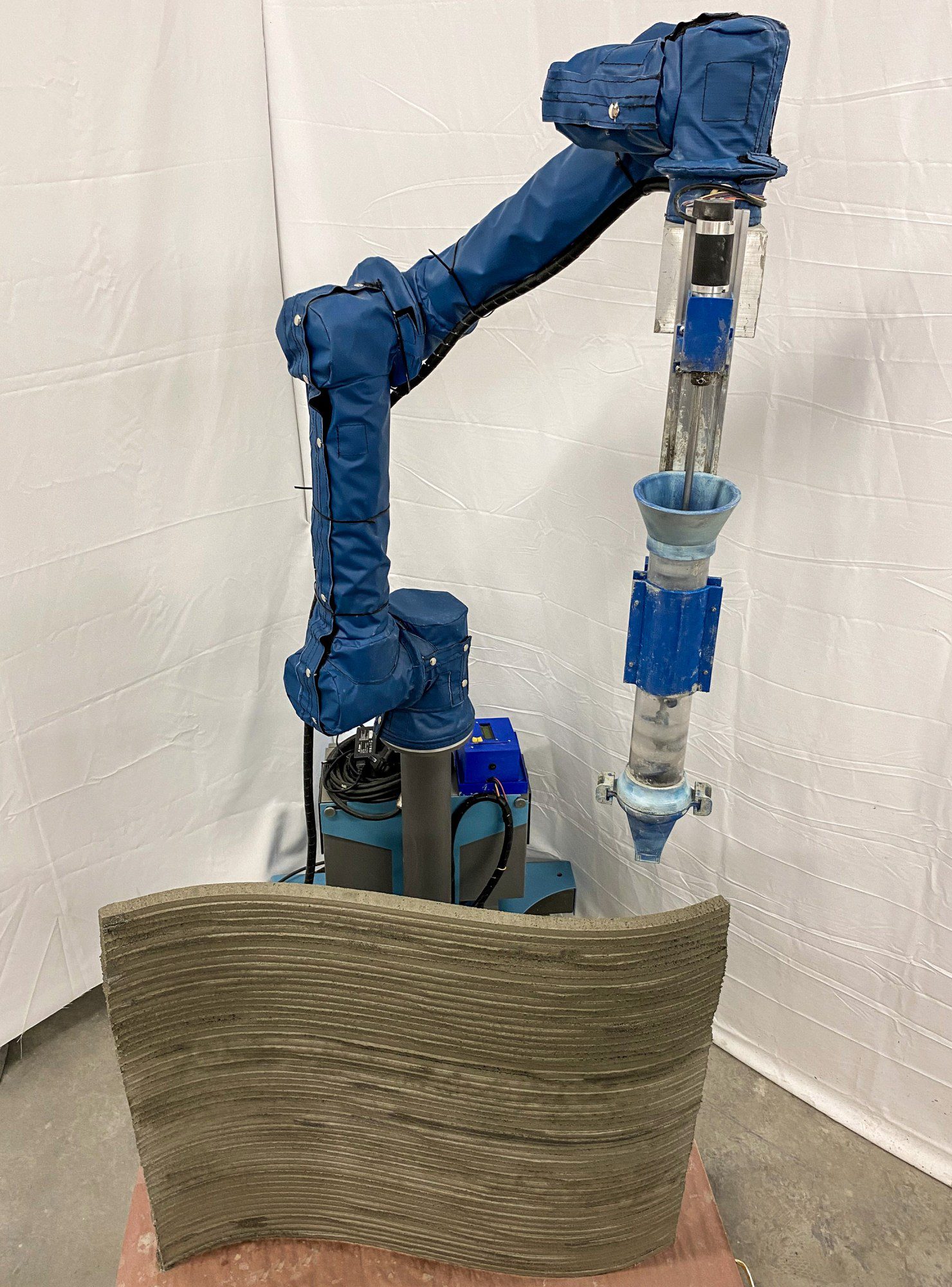
So LSU researchers are refining the formula, developing a new cement based on sulfur, which they heat until it’s molten to bind material without the need for water. In recent work, the team mixed their waterless cement with simulated lunar and Martian soil to create a 3D-printable concrete, which they used to assemble walls and beams. “We need automated construction, and NASA thinks 3D printing is one of the few viable technologies for building lunar infrastructure,” says Kazemian. 

curved wall being built in a lab by a 3D printing arm withwaterless concrete
A curved wall is 3D printed from waterless concrete.
COURTESY OF ALI KAZEMIAN

Beyond circumventing the need for water, the cement can handle wider temperature extremes and cures faster than traditional methods. The group used a pre-made powder for their experiments, but on the moon and Mars, astronauts might extract sulfur from surface soil. 

To test whether the concrete can stand up to the moon’s harsh environment, the team placed its structures in a vacuum chamber for weeks, analyzing the material’s stability at different temperatures. Originally, researchers worried that cold conditions on the dark side of the moon might cause the compound to turn into a gas through a process called sublimation, like when dry ice skips its liquid phase and evaporates directly. Ultimately, they found that the concrete can handle the lunar South Pole’s frigid forecast without losing its form. 

Some conditions, like reduced gravity, could even work toward the concrete’s advantage. The experiment tested structures like walls and small circular towers, each made by stacking many layers of concrete. “One of the main challenges in larger-scale 3D printing is a distortion of these thick, heavy layers,” says Kazemian “But when you have lower gravity, that can actually help keep the layers from deforming.” 

Kazemian and his colleagues recently transferred the technology to NASA’s Marshall Space Flight Center in Huntsville, Alabama, to implement their design on a larger-scale robotic system and test construction in larger vacuum chambers. If adopted, the concrete will most likely be used for taller lunar structures like habitats and radiation shields. Flatter designs, like a landing pad, will probably use laser-based technologies to melt down lunar soil into a ceramic structure. 

There may only be so much testing we can do on Earth, however. According to Philip Metzger, a planetary physicist at University of Central Florida who recently retired from NASA’s Kennedy Space Center, the concrete’s efficacy may falter with the shift from simulant to real soil. “There’s chemistry in the samples of these planets that the simulants cannot perfectly replicate,” he says. “When we send missions to these planetary bodies to test the technology using the real soil, we may find that we need to further improve the technology to get it to work in that environment.”

But Metzger still sees the sulfur-based concrete as a vital foundation for the tall orders of upcoming planetary projects. Future missions to Mars could demand roads to drive back and forth from ice-mining sites and pavement around habitats to create dust-free work zones. This new concrete brings these distant goals a touch closer to reality. 

It could benefit construction on Earth, too. Kazemian sees the new material as a potential alternative for traditional concrete, especially in areas with water scarcity or a surplus of sulfur. Parts of the Middle East, for example, have abundant sulfur as a result of oil and gas production. 

The technology could become especially useful in disaster areas with broken supply chains, according to Metzger. It could also have military applications for rapid construction of structures like storage buildings. “This is great for people out there working on another planet who don’t have a lot of support,” Metzger says. “But there are already plenty of analogs to that here on Earth.”

The risk of a bird flu pandemic is rising

This article first appeared in The Checkup, MIT Technology Review’s weekly biotech newsletter. To receive it in your inbox every Thursday, and read articles like this first, sign up here.

How worried should we be about bird flu? It’s a question that I’ve been asked by friends and colleagues several times over the last couple of weeks. Their concerns have been spurred by some potentially worrisome developments in the US, including the continued spread of the virus among dairy cattle, the detection of the virus in a pig as well as cow’s milk, and—most concerning of all—the growing number of human infections.

I’ll admit that I’m worried. We don’t yet have any evidence that the virus is spreading between people, but the risk of a potential pandemic has increased since I last covered this topic a couple of months ago.

And once you combine that increased risk with an upcoming change in presidential administration that might leave US health agencies in the hands of a vaccine denier who promotes the consumption of raw milk, well … it’s not exactly a comforting thought.

The good news is we are in a much better position to tackle any potential future flu outbreaks than we were to face covid-19 back in 2020, given that we already have vaccines. But, on the whole, it’s not looking great.

The bird flu that is currently spreading in US dairy cattle is caused by the H5N1 virus. The virus is especially lethal to some bird populations and has been wiping out poultry and seabirds for the last couple of years. It has also caused fatal infections in many mammals who came into contact with those birds.

H5N1 was first detected in a dairy cow in Texas in March of this year. As of this week, the virus has been reported in 675 herds across 15 states, according to the US Department of Agriculture’s Animal and Plant Health Inspection Service (also known as APHIS).

Those are just the cases we know about. There may be more. The USDA requires testing of cattle before they are moved between states. And it offers a voluntary testing program for farmers who want to know if the virus is present in their bulk milk tanks. But participation in that program is optional.

States have their own rules. Colorado has required testing of bulk milk tanks in licensed dairy farms since July. The Pennsylvania Department of Agriculture announced plans for a program just last week. But some states have no such requirements.

At the end of October, the USDA reported that the virus had been detected in a pig for the first time. The pig was one of five in a farm in Oregon that had “a mix of poultry and livestock.” All the pigs were slaughtered.

Virologists have been especially worried about the virus making its way into pigs, because these animals are notorious viral incubators. “They can become infected with swine strains, bird strains and human strains,” says Brinkley Bellotti, an infectious disease epidemiologist at Wake Forest University in North Carolina. These strains can swap genes and give rise to new, potentially more infectious or harmful strains.

Thankfully, we haven’t seen any other cases in pig farms, and there’s no evidence that the virus can spread between pigs. And while it has been spreading pretty rapidly between cattle, the virus doesn’t seem to have evolved much, says Seema Lakdawala, a virologist at the Emory University School of Medicine in Atlanta, Georgia. That suggests that the virus made the leap into cattle, probably from birds, only once. And it has been spreading through herds since.

Unfortunately, we still don’t really know how it is spreading. There is some evidence to suggest the virus can be spread from cow to cow through shared milking equipment. But it is unclear how the virus is spreading between farms. “It’s hard to form an effective control strategy when you don’t know exactly how it’s spreading,” says Bellotti.

But it is in cows. And it’s in their milk. When scientists analyzed 297 samples of Grade A pasteurized retail milk products, including milk, cream and cheese, they found viral RNA from H5N1 in 20% of them. Those samples were collected from 17 states across the US. And the study was conducted in April, just weeks after the virus was first detected in cattle. “It’s surprising to me that we are totally fine with … our pasteurized milk products containing viral DNA,” says Lakdawala.

Research suggests that, as long as the milk is pasteurized, the virus is not infectious. But Lakdawala is concerned that pasteurization may not inactivate all of the virus, all the time. “We don’t know how much virus we need to ingest [to become infected], and whether any is going to slip through pasteurization,” she says.

And no reassurances can be made for unpasteurized raw milk. When cows are infected with H5N1, their milk can turn thick, yellow and “chunky.” But research has shown that, even when the milk starts to look normal again, it can still contain potentially infectious virus.

The most concerning development, though, is the rise in human cases. So far, 55 such cases of H5N1 bird flu have been reported in the US, according to the US Centers for Disease Control and Prevention (CDC). Twenty-nine of those cases have been detected in California. In almost all those cases, the infected person is thought to have caught the virus from cattle or poultry on farms. But in two of those cases, the source of the infection is unknown.

Health professionals don’t know how a teenager in British Columbia, Canada, got so sick with bird flu, either. The anonymous teenager, who sought medical care for an eye infection on November 2, is still seriously ill in hospital, and continues to rely on a ventilator to breathe. Local health officials have closed their investigation into the teen’s infection.

There may be more, unreported cases out there, too. When researchers tested 115 dairy farm workers in Michigan and Colorado, they found markers of recent infection with the virus in 7% of them.

So far, there is no evidence that the virus can spread between people. But every human infection offers the virus another opportunity to evolve into a form that can do just that. People can act as viral incubators, too. And during flu season, there are more chances for the H5N1 virus to mix with circulating seasonal flu viruses

“Just because we [haven’t seen human-to-human spread] now doesn’t mean that it’s not capable of happening, that it won’t happen, or that it hasn’t already happened,” says Lakdawala.

So where do we go from here? Lakdawala thinks we should already have started vaccinating dairy farm workers. After all, the US has already stockpiled vaccines for H5N1, which were designed to protect against previous variants of the virus. “We’re not taking [the human cases] seriously enough,” she says.

We need to get a better handle on exactly how the virus is spreading, too, and implement more effective measures to stop it from doing so. That means more testing of both cows and dairy farm workers at the very least. And we need to be clear that, despite what Robert F. Kennedy Jr., the current lead contender for the role of head of the US Department of Health and Human Services, says, raw milk can be dangerous, and vaccines are a vital tool in the prevention of pandemics.

We still have an opportunity to prevent the outbreak from turning into a global catastrophe. But the situation has worsened since the summer. “This is sort of how the 2009 pandemic started,” says Lakdawala, referring to the H1N1 swine flu pandemic. “We started to have a couple of cases sporadically, and then the next thing you knew, you were seeing it everywhere.”


Now read the rest of The Checkup

Read more from MIT Technology Review’s archive

The US is planning to stockpile millions of doses of H5N1 vaccines. But our current approach to making flu vaccines is slow and cumbersome. New vaccines that don’t rely on the use of eggs, or make use of mRNA, might offer a better alternative.

Flu season is already underway in the US, where bird flu is spreading among cattle. That has virologists worried that a person infected with both viruses could unwittingly incubate an all-new strain of the virus.

Robert F. Kennedy Jr. has already spread harmful misinformation, pseudoscience and fringe theories about AIDS and covid-19.

Some researchers are exploring new ways to prevent the spread of H5N1 in poultry. The gene editing tool CRISPR could be used to help make chickens more resistant to the virus, according to preliminary research published last year.

From around the web

President-elect Donald Trump has chosen Jay Bhattacharya for his pick to lead the US National Institutes of Health, an agency with a $48 billion budget that oversees the majority of medical research in the country. Bhattacharya was one of three lead authors of the Great Barrington Declaration, a manifesto published in 2020 arguing against lockdowns during the height of the covid-19 pandemic, and supporting a “let it rip” approach instead. (STAT)

An IVF mix up left two families raising each other’s biological babies. They didn’t realize until the children were a couple of months old. What should they do? (Have the tissues ready for this one, which is heartbreaking and heartwarming in equal measure) (New York Times)

Why do we feel the need to surveil our sleeping babies? This beautiful comic explores the various emotional pulls experienced by new parents. (The Verge)

Australia’s parliament has passed a law that bans children under the age of 16 from using social media. Critics are concerned that the law is a “blunt instrument” that might drive young teens to the dark web, or leave them feeling isolated. (The Guardian)

Lab-grown foie gras, anyone? Cultivated meat is going high-end, apparently. (Wired)

Who should get a uterus transplant? Experts aren’t sure.

This article first appeared in The Checkup, MIT Technology Review’s weekly biotech newsletter. To receive it in your inbox every Thursday, and read articles like this first, sign up here.

Earlier this year, a boy in Sweden celebrated his 10th birthday. Reproductive scientists and doctors marked the occasion too. This little boy’s birth had been special. He was the first person to be born from a transplanted uterus.

The boy was born in 2014 after his mother, a 35-year-old woman who had been born without a uterus, received a donated uterus from a 61-year-old close family friend. At the time, she was one of only 11 women who had undergone the experimental procedure.

A decade on, over 135 uterus transplants have been performed globally, resulting in the births of over 50 healthy babies. The surgery has had profound consequences for these families—the recipients would not have been able to experience pregnancy any other way.

But legal and ethical questions continue to surround the procedure, which is still considered experimental. Who should be offered a uterus transplant? Could the procedure ever be offered to transgender women? And if so, who should pay for these surgeries?

These issues were raised at a recent virtual event run by Progress Educational Trust, a UK-based charity that aims to provide information to the public on genomics and infertility. One of the speakers was Mats Brännström, who led the team at the University of Gothenburg that performed the first successful transplant.

For Brännström, the story of uterus transplantation begins in 1998. While traveling in Australia, he said, he met a 27-year-old woman called Angela, who longed to be pregnant but lacked a functional uterus. She suggested to Brännström that her mother could donate hers. “I was amazed I hadn’t thought of it before,” he said.

According to Brännström, around 1 in 500 women experience infertility due to what’s known as absolute uterine factor infertility, or AUFI, meaning they do not have a functional uterus. Uterus transplants could offer them a way to get pregnant.

His meeting with Angela kick-started a research project that started in mice and eventually moved on to pigs, sheep, and baboons. Brännström’s team started performing uterus transplants in women as part of a small clinical trial in 2012. In that trial, all the donors were living, and in many cases they were the mothers or aunts of the recipients.

The surgeries ended up being more complicated than he had anticipated, said Brännström. The operation to remove a donor’s uterus was expected to take between three and four hours. It ended up taking between eight and 11 hours.  

In that first trial, Brännström’s team transplanted uteruses into nine women, each of whom had IVF to create and store embryos beforehand. The woman who was the first to give birth had IVF over a 12-month period, which ended six months before her surgery. It took a little over 10 hours to remove the uterus from the donor, and just under five hours to stitch it into the recipient.

The recipient started getting her period 43 days after her transplant. Doctors transferred one of her embryos into the uterus a year after her surgery. Three weeks later, a pregnancy test confirmed she was pregnant.

At 31 weeks, she was admitted to hospital with preeclampsia, a serious medical condition that can develop during pregnancy, and her baby was delivered by C-section 16 hours later. She was discharged from hospital after three days, although the baby spent 16 days in the hospital’s neonatal unit.

Despite those difficulties, her story is considered a success. Other uterus recipients have also experienced pregnancy complications, and some have had surgical complications. And all transplant recipients must adhere to a regimen of immunosuppressant drugs, which can have side effects.

The uteruses aren’t intended to last forever, either. Surgeons remove them once the recipients have completed their families, often after one or two children. The removal is also a significant operation.

Given all that, uterus transplants are not to be taken lightly. And there are other paths to parenthood. Some ethicists are concerned that in pursuing uterus transplantation as a fertility treatment, we might reinforce ideas that define a woman’s value in terms of her reproductive potential, Natasha Hammond-Browning, a legal scholar at Cardiff University in Wales, said at the event. “There is debate around whether we should be giving greater preference to adoption, to surrogacy, and to supporting children who already exist and who need care,” she said.

We also need to consider whether there is a “right to gestate,” and if there is, who has that right, said Hammond-Browning. And these concerns need to be balanced with the importance of reproductive autonomy—the idea that people have the right to decide and control their own reproductive efforts.

Further questions remain over whether uterus transplants might ever be an option for trans women, who not only lack a uterus but also have a different pelvic anatomy. I asked the speakers if the surgery might ever be feasible. They weren’t hugely optimistic that it would, at least in the near future.

“I personally think that the transgender community have been given … false hope for responsible transplantation in the near future,” was the response of J. Richard Smith of Imperial College London, who co-led the first uterus transplant performed in the UK. Even cisgender women who have needed surgery to create “neovaginas” aren’t eligible for the uterus transplants his team are offering as part of a clinical study. They have an altered vaginal microbiome that appears to increase the risk of miscarriage, he said.

“There is a huge amount of work to be done before this work can be translated to the transgender community,” Smith said. Brännström agreed but added that he thinks the surgery will be available at some point—just after a lot more research.

And then there are the legal and ethical questions, none of which have easy answers. Hammond-Browning pointed out that clinical teams would first need to determine what the goal of such an operation would be. Is it about reproduction or gender realignment, for example? And how might that goal influence decisions over who should get a donated uterus, and why?

Considering only 135 human uterus transplants have ever been carried out, we still have a lot to learn about the best way to perform them. (For context, more than 25,000 kidney transplants were carried out in 2023 in the US alone.) Researchers are still figuring out how uteruses from deceased donors differ from those of living ones, and how to minimize complications in young, healthy women. Since that little boy was born 10 years ago, only 50 other children have been born in a similar way. It’s still early days.


Now read the rest of The Checkup

Read more from MIT Technology Review

The first birth following the transplantation of a uterus from a dead donor happened in 2017. A team in Brazil transferred the uterus of a 45-year-old donor, who had died from a brain hemorrhage, to a 32-year-old recipient born without a uterus. 

Researchers are working on artificial wombs—“biobags” designed to care for premature babies. They have been tested on lambs and piglets. Now FDA advisors are figuring out how to move the technology into human trials

An alternative type of artificial womb is being used to grow mouse embryos. Jacob Hanna at the Weizmann Institute of Science and his colleagues say they’ve been able to grow embryos in this environment for 11 or 12 days—around half the animal’s gestational period. 

Research is underway to develop new fertility options for transgender men. Some of these men are put off by existing approaches, which tend to involve pausing hormone therapy and undergoing potentially distressing procedures. 

From around the web

People on Ozempic, Wegovy, and similar drugs are losing their appetite for sugary, ultraprocessed foods. The food industry will have to adapt. (TIL Nestlé has already started a line of frozen meals targeted at people on these weight-loss drugs.) (The New York Times Magazine)

People who have a history of obesity can find it harder to lose weight. That might be because the fat cells in our bodies seem to “remember” that history and have an altered response to food. (The Guardian)

Robert F. Kennedy Jr. took leave as chairman of Children’s Health Defense, a nonprofit known for spreading doubt about vaccines, to run for US president last year. But he is still involved in legal cases filed by the group. And several of its cases remain open, including ones against the Food and Drug Administration, the Centers for Disease Control and Prevention, and the National Institutes of Health—all agencies Kennedy would lead if his nomination for head of Health and Human Services is confirmed. (STAT)

Researchers are among the millions of new users of Bluesky, a social media alternative to X (formerly known as Twitter). “There is this pent-up demand among scientists for what is essentially the old Twitter,” says one researcher who found that the number of influential scientists using the platform doubled between August and November. (Science

Since 2016, a team of around 100 scientists have been working to catalogue the 37 trillion or so cells in the human body. This week, the Human Cell Atlas published a collection of studies that represents a significant first step toward that goal—including maps of cells in the nervous system, lungs, heart, gut, and immune system. (Nature)