How Wayve’s driverless cars will meet one of their biggest challenges yet

The UK driverless-car startup Wayve is headed west. The firm’s cars learned to drive on the streets of London. But Wayve has announced that it will begin testing its tech in and around San Francisco as well. And that brings a new challenge: Its AI will need to switch from driving on the left to driving on the right.

As visitors to or from the UK will know, making that switch is harder than it sounds. Your view of the road, how the vehicle turns—it’s all different, says Wayve’s vice president of software, Silvius Rus. Rus himself learned to drive on the left for the first time last year after years in the US. “Even for a human who has driven a long time, it’s not trivial,” he says.

Wayve’s US fleet of Ford Mustang Mach-E’s.
WAYVE

The move to the US will be a test of Wayve’s technology, which the company claims is more general-purpose than what many of its rivals are offering. Wayve’s approach has attracted massive investment—including a $1 billion funding round that broke UK records this May—and partnerships with Uber and online grocery firms such as Asda and Ocado. But it will now go head to head with the heavyweights of the growing autonomous-car industry, including Cruise, Waymo, and Tesla.  

Back in 2022, when I first visited the company’s offices in north London, there were two or three vehicles parked in the building’s auto shop. But on a sunny day this fall, both the shop and the forecourt are full of cars. A billion dollars buys a lot of hardware.

I’ve come for a ride-along. In London, autonomous vehicles can still turn heads. But what strikes me as I sit in the passenger seat of one of Wayve’s Jaguar I-PACE cars isn’t how weird it feels to be driven around by a computer program, but how normal—how comfortable, how safe. This car drives better than I do.

Regulators have not yet cleared autonomous vehicles to drive on London’s streets without a human in the loop. A test driver sits next to me, his hands hovering a centimeter above the wheel as it turns back and forth beneath them. Rus gives a running commentary from the back.

The midday traffic is light, but that makes things harder, says Rus: “When it’s crowded, you tend to follow the car in front.” We steer around roadworks, cyclists, and other vehicles stopped in the middle of the street. It starts to rain. At one point I think we’re on the wrong side of the road. But it’s a one-way street: The car has spotted a sign that I didn’t. We approach every intersection with what feels like deliberate confidence.

At one point a blue car (with a human at the wheel) sticks its nose into the stream of traffic just ahead of us. Urban drivers know this can go two ways: Hesitate and it’s a cue for the other car to pull out; push ahead and you’re telling it to wait its turn. Wayve’s car pushes ahead.

The interaction lasts maybe a second. But it’s the most impressive moment of my ride. Wayve says its model has picked up lots of defensive driving habits like this. “It was our right of way, and the safest approach was to assert that,” says Rus. “It learned to do that; it’s not programmed.”

Learning to drive

Everything that Wayve’s cars do is learned rather than programmed. The company uses different technology from what’s in most other driverless cars. Instead of separate, specialized models trained to handle individual tasks like spotting obstacles or finding a route around them—models that must then be wired up to work together—Wayve uses an approach called end-to-end learning.

This means that Wayve’s cars are controlled by a single large model that learns all the individual tasks needed to drive at once, using camera footage, feedback from test drivers (many of whom are former driving instructors), and a lot of reruns in simulation.

Wayve has argued that this approach makes its driving models more general-purpose. The firm has shown that it can take a model trained on the streets of London and then use that same model to drive cars in multiple UK cities—something that others have struggled to do.

But a move to the US is more than a simple relocation. It rewrites one of the most basic rules of driving—which side of the road to drive on. With Wayve’s single large model, there’s no left-hand-drive module to swap out. “We did not program it to drive on the left,” says Rus. “It’s just seen it enough to think that’s how it needs to drive. Even if there’s no marking on the road, it will still keep to the left.”  

“So how will the model learn to drive on the right? This will be an interesting question for the US.”

Answering that question involves figuring out whether the side of the road it drives on is a deep feature of Wayve’s model—intrinsic to its behavior—or a more superficial one that can be overridden with a little retraining.

Given the adaptability seen in the model so far, Rus believes it will switch to US streets just fine. He cites the way the cars have shown they can adapt to new UK cities, for example. “That gives us confidence in its capability to learn and to drive in new situations,” he says.

Under the hood

But Wayve needs to be certain. As well as testing its cars in San Francisco, Rus and his colleagues are poking around inside their model to find out what makes it tick. “It’s like you’re doing a brain scan and you can see there’s some activity in a certain part of the brain,” he says.

The team presents the model with many different scenarios and watches what parts of it get activated at specific times. One example is an unprotected turn—a turn that crosses traffic going in the opposite direction, without a traffic signal. “Unprotected turns are to the right here and to the left in the US,” says Rus. “So will it see them as similar? Or will it just see right turns as right turns?”

Figuring out why the model behaves as it does tells Wayve what kinds of scenarios require extra help. Using a hyper-detailed simulation tool called PRISM-1 that can reconstruct 3D street scenes from video footage, the company can generate bespoke scenarios and run the model through them over and over until it learns how to handle them. How much retraining might the model need? “I cannot tell you the amount. This is part of our secret sauce,” says Rus. “But it’s a small amount.”

Wayve’s simulation tool, PRISM-1, can reconstruct virtual street scenes from real video footage. Wayve uses the tool to help train its driving model.
WAYVE

The autonomous-vehicle industry is known for hype and overpromising. Within the past year, Cruise laid off hundreds after its cars caused chaos and injury on the streets of San Francisco. Tesla is facing federal investigation after its driver-assistance technology was blamed for multiple crashes, including a fatal collision with a pedestrian. 

But the industry keeps forging ahead. Waymo has said it is now giving 100,000 robotaxi rides a week in San Francisco, Los Angeles, and Phoenix. In China, Baidu claims it is giving some 287,000 rides in a handful of cities, including Beijing and Wuhan. Undaunted by the allegations that Tesla’s driver-assistance technology is unsafe, Elon Musk announced his Cybercab last week with a timeline that would put these driverless concept cars on the road by 2025. 

What should we make of it all? “The competition between robotaxi operators is heating up,” says Crijn Bouman, CEO and cofounder of Rocsys, a startup that makes charging stations for autonomous electric vehicles. “I believe we are close to their ChatGPT moment.”

“The technology, the business model, and the consumer appetite are all there,” Bouman says. “The question is which operator will seize the opportunity and come out on top.”

Others are more skeptical. We need to be very clear what we’re talking about when we talk about autonomous vehicles, says Saber Fallah, director of the Connected Autonomous Vehicle Research Lab at the University of Surrey, UK. Some of Baidu’s robotaxis still require a safety driver behind the wheel, for example. Cruise and Waymo have shown that a fully autonomous service is viable in certain locations. But it took years to train their vehicles to drive specific streets, and extending routes—safely—beyond existing neighborhoods will take time. “We won’t have robotaxis that can drive anywhere anytime soon,” says Fallah.

Fallah takes the extreme view that this won’t happen until all human drivers hand in their licenses. For robotaxis to be safe, they need to be the only vehicles on the road, he says. He thinks today’s driving models are still not good enough to interact with the complex and subtle behaviors of humans. There are just too many edge cases, he says.

Wayve is betting its approach will win out. In the US, it will begin by testing what it calls an advanced driver assistance system, a technology similar to Tesla’s. But unlike Tesla, Wayve plans to sell that technology to a wide range of existing car manufacturers. The idea is to build on this foundation to achieve full autonomy in the next few years. “We’ll get access to scenarios that are encountered by many cars,” says Rus. “The path to full self-driving is easier if you go level by level.”

But cars are just the start, says Rus. What Wayve is in fact building, he says, is an embodied model that could one day control many different types of machines, whether they have wheels, wings, or legs. 

“We’re an AI shop,” he says. “Driving is a milestone, but it’s a stepping stone as well.”

What do jumping spiders find sexy? How DIY tech is offering insights into the animal mind.

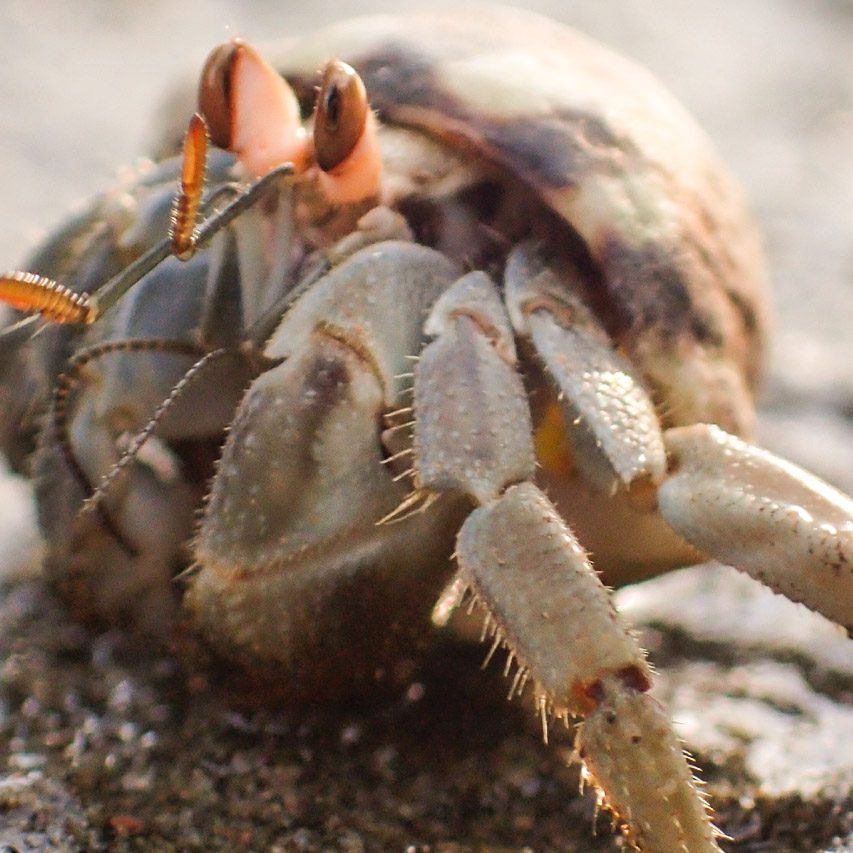
In his quest to understand the hermit crab housing market, biologist Mark Laidre of Dartmouth College had to get creative. Crabs are always looking to move into a bigger, better shell, but having really nice digs also comes with risks. Sometimes crabs gang up to pull an inhabitant out of an especially desirable shell. If they succeed, the shell is quickly claimed by the largest gang member, leaving another open shell for a slightly smaller crab to grab, and on down the chain until everyone has upgraded. 

To better gauge the trade-offs between shell size and defensibility, Laidre collaborated with an engineer to create the hermit crab eviction machine, a device that holds onto an occupied shell and measures how much force it takes a scientist to pull the crab out (crabs are not harmed or left homeless). It’s essentially a portable load cell that can survive the sun, sand, and humidity of the field. 

The force required to evict a hermit crab is an important measurement, because hanging on to their homes is a matter of life and death for crabs. “If you are evicted, there’s a real strong probability that what is left at the end of one of those chains is something that’s too small for you to even enter,” Laidre says. In his field area on a beach in Costa Rica, a homeless crab can quickly succumb to predators or heat: “You’re really dead meat in a sense.”

Studying the minds of other animals comes with a challenge that human psychologists don’t usually face: Your subjects can’t tell you what they’re thinking. To get answers from animals, scientists need to come up with creative experiments to learn why they behave the way they do. Sometimes this requires designing and building experimental equipment from scratch.

The DIY contraptions that animal behavior scientists create range from ingeniously simple to incredibly complex. All of them are tailored to help answer questions about the lives and minds of specific species, from insects to elephants. Do honeybees need a good night’s sleep? What do jumping spiders find sexy? Do falcons like puzzles? For queries like these, off-the-shelf gear simply won’t do.

The eviction machine was inspired by Laidre’s curiosity about crabs. But sometimes new questions about animals are inspired by an intriguing device or technology, as was the case with another of Laidre’s inventions: the hermit crab escape room (more on that below). The key, Laidre says, is to be sure the question you’re asking is relevant to the animals’ lives.

Here are five more contraptions custom-built by scientists to help them understand the lives and minds of the animals they study. 

OLY DEMPSTER

The falcon innovation box

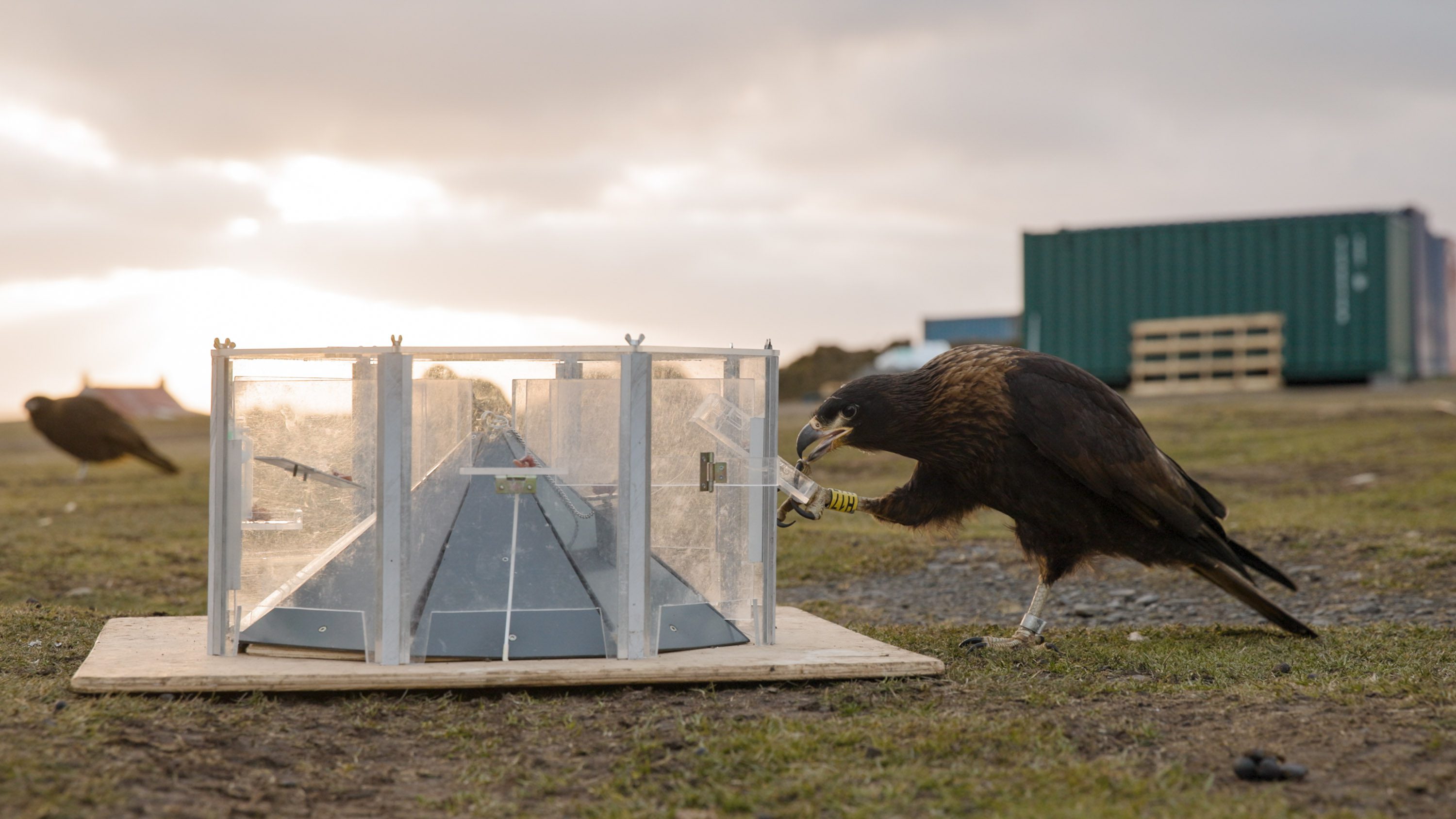
The brainy birds in the parrot and crow families are the stars of scientific studies on avian intelligence. Now these smarties have a surprising new rival: a falcon. Raptors are not known for creative problem-solving, but behavioral ecologist Katie Harrington of the University of Veterinary Medicine Vienna suspected the striated caracara falcons she had observed on a remote Falkland Island were different. “They’re really interested in investigating things,” she says. “They’re very intelligent birds in general.”

diagram of the falcon experiment

HARRINGTON, ET AL.

To test their smarts, Harrington took inspiration from an “innovation arena” (left), designed for Goffin’s cockatoos, which are members of the parrot family known for their problem-solving abilities. It’s a semicircular array of 20 clear plastic boxes containing puzzles requiring different solutions to release rewards like cashews or corn kernels. Hauling the seven-foot-wide arena to the Falklands was not an option. So Harrington designed a 16-inch-wide “innovation box” attached to a wooden board, with eight compartments and puzzles adapted from the cockatoo studies. 

The birds loved it. “We were having caracaras run full speed to participate,” Harrington says. The challenge was keeping other birds away while one worked the box. The birds were able to solve the puzzles, which involved things like rattling a plank to knock down a bit of mutton or pulling a twig out from under a platform with mutton on it. They were even able to solve a tricky one that required them to punch a hole in a piece of tissue that obscured the treata task that eluded some cockatoos. 

In fact, 10 of 15 falcons solved all the puzzles, most of them within two sessions with the box. So Harrington designed eight new, harder tasks, but soon learned that some required unnatural movements for caracaras. She plans to keep trying to find tasks that reveal what they’re physically and mentally capable of. “They’re totally willing to show us,” she says, “as long as we can design things that are good enough to allow them to show us.”

The raccoon smart box

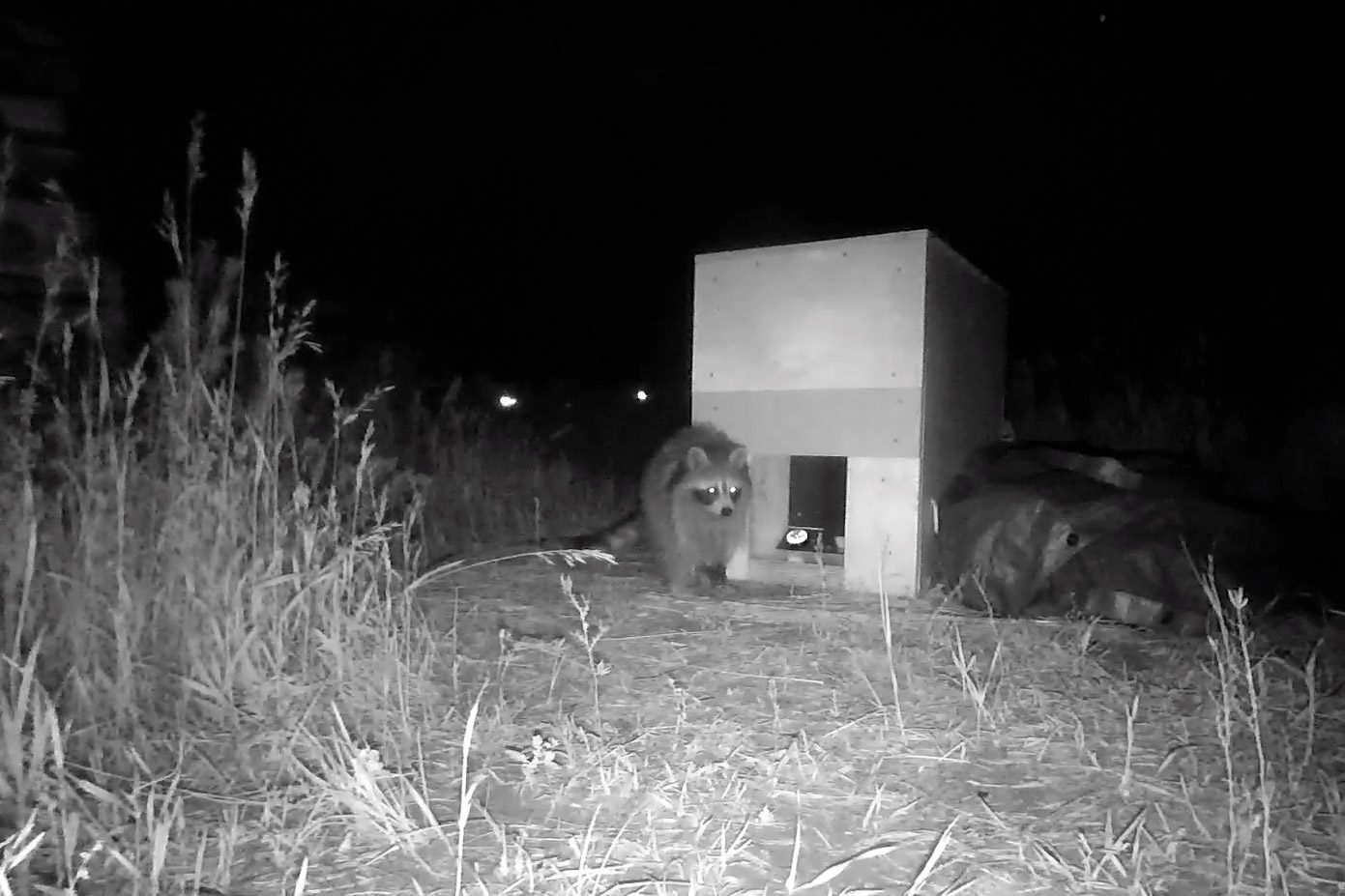
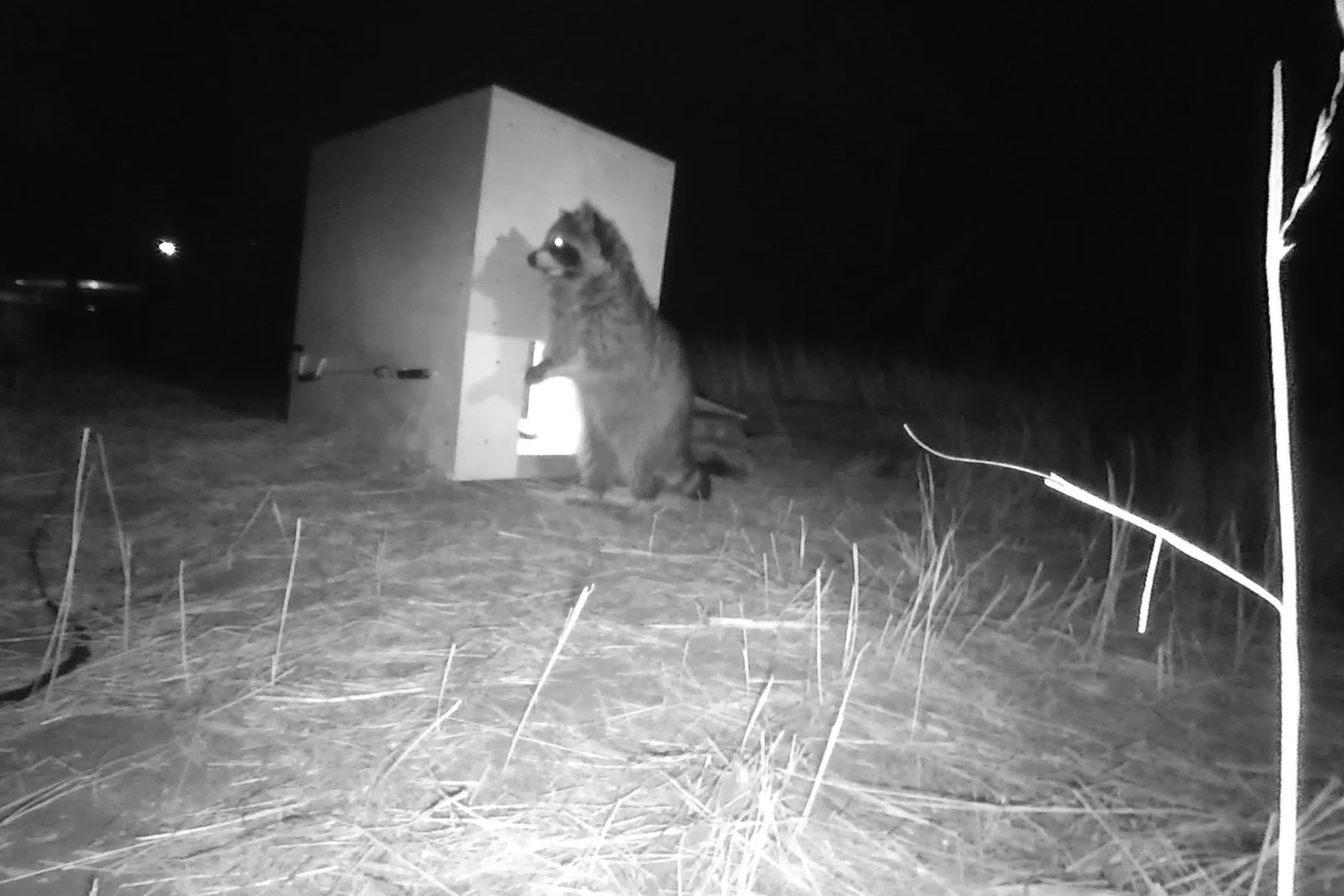
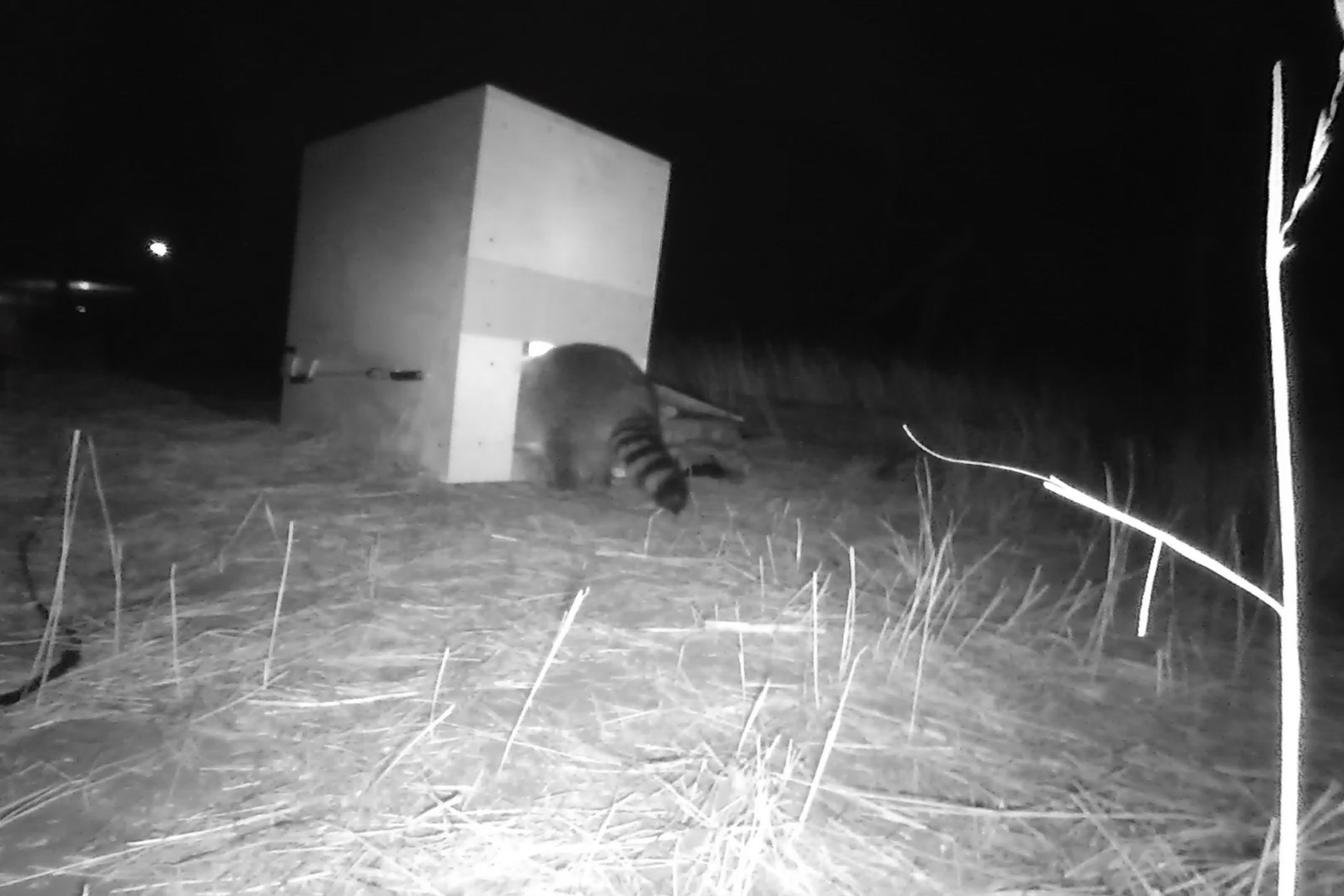
Why are raccoons so good at city living? One theory is that it’s because they’re flexible thinkers. To test this idea, UC Berkeley cognitive ecologist Lauren Stanton adapted a classic laboratory experiment, called the reversal learning task. For this test, an animal is rewarded for learning to consistently choose one of two options, but then the correct answer is reversed so that the other option brings the reward. Flexible thinkers are better at reacting to the reversals. “They’re going to be more able to switch their choices, and over time, they should be faster,” Stanton says.

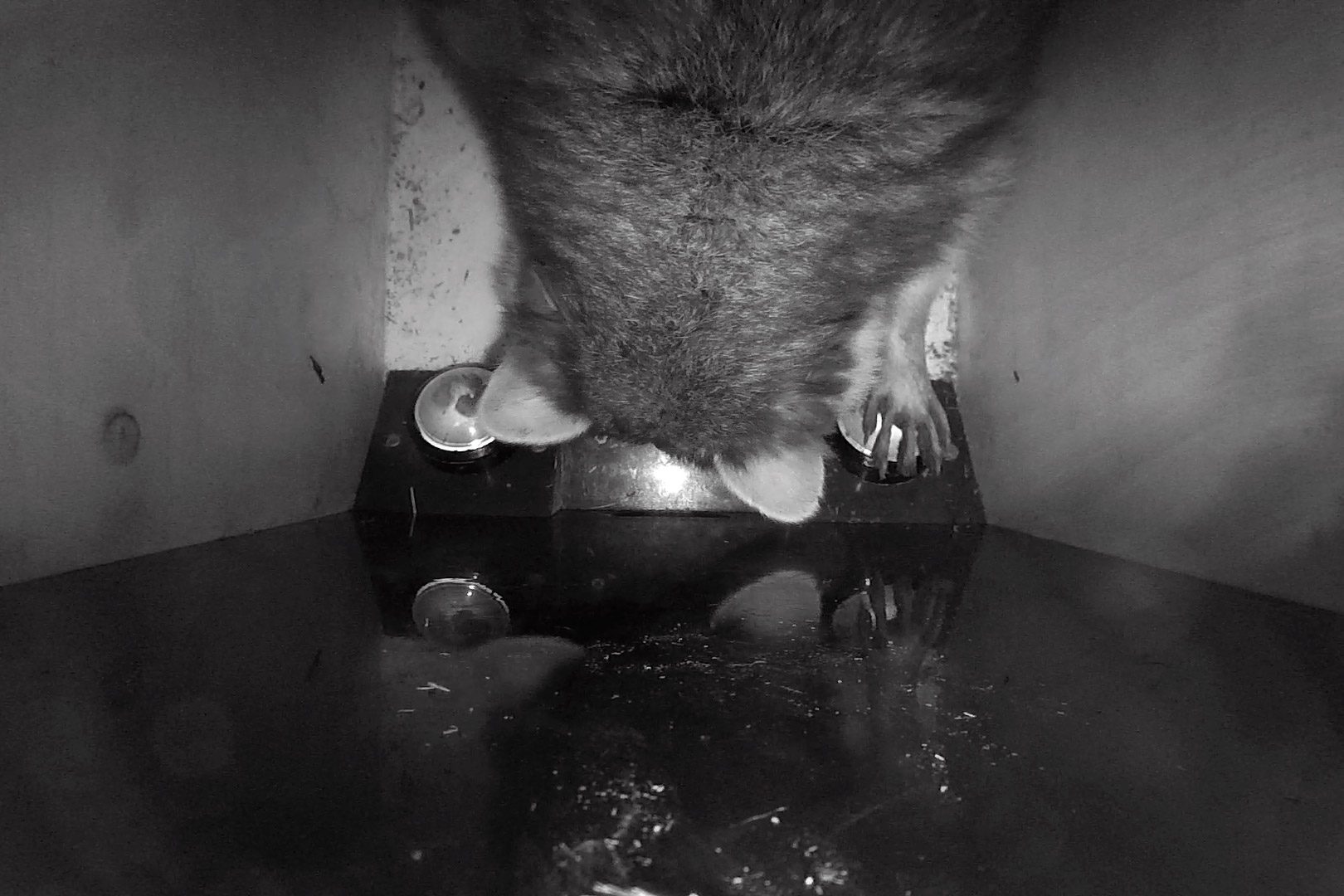
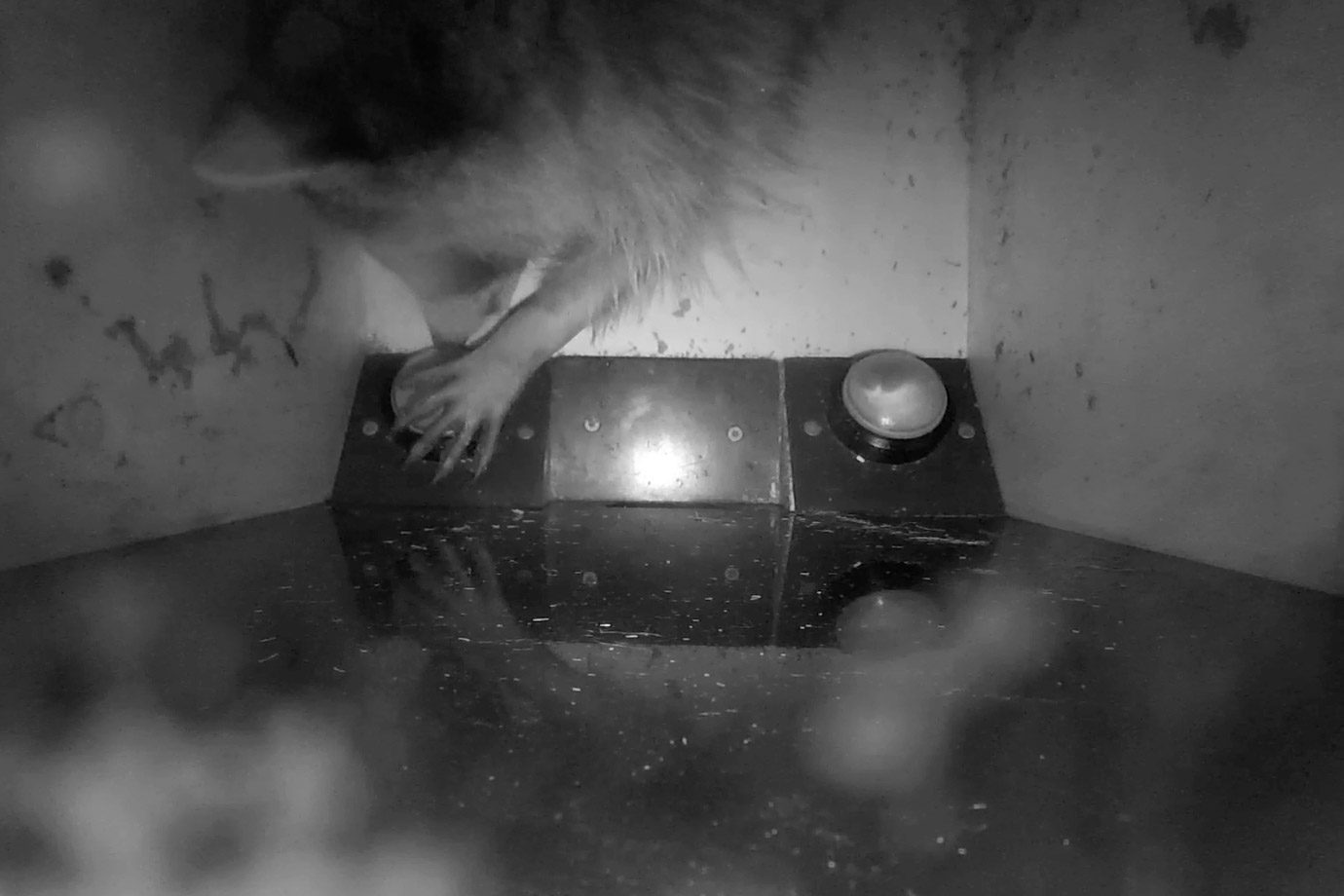
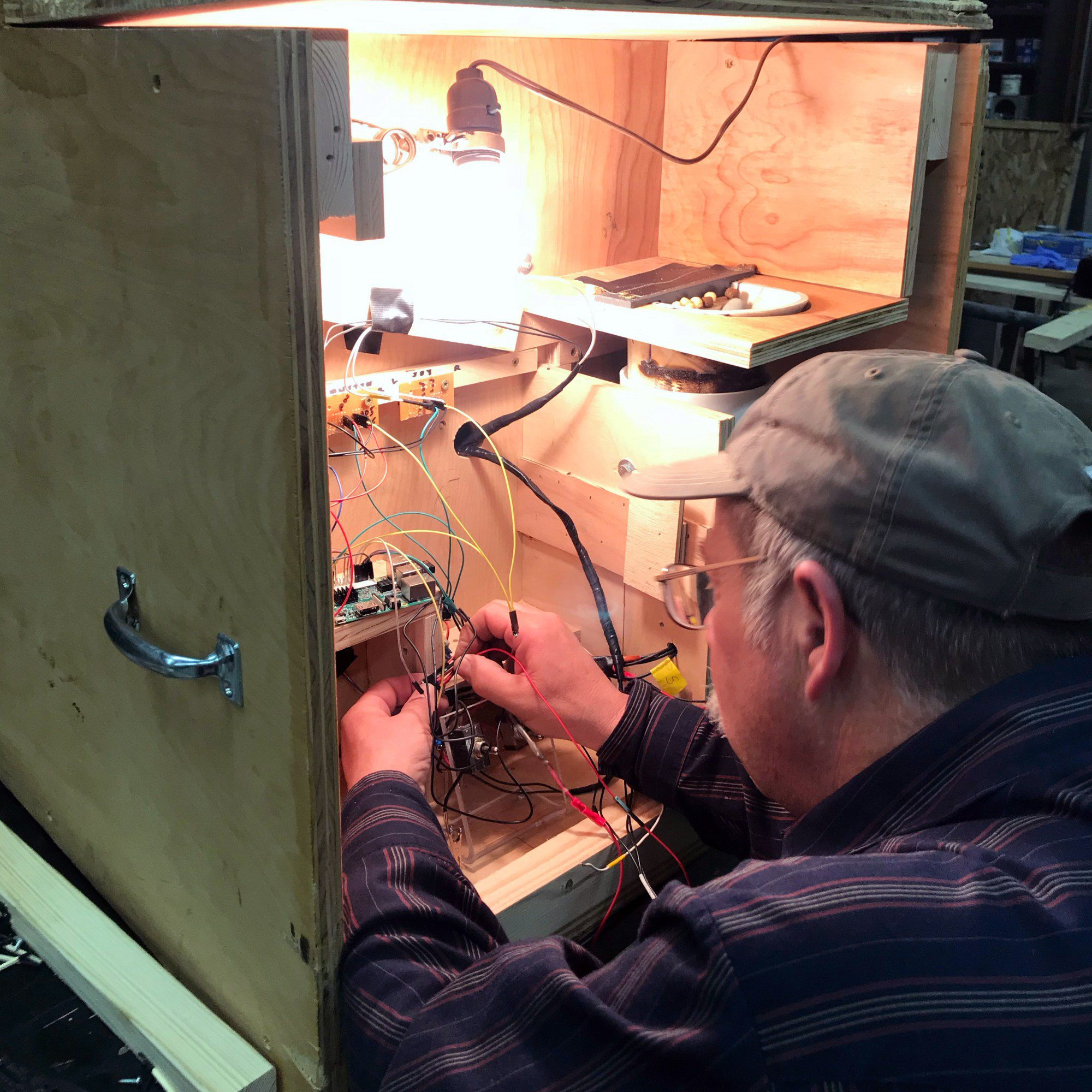
To test the learning skills of wild urban raccoons in Laramie, Wyoming, Stanton and her team built a set of “smart boxes” to deploy on the outskirts of the city, each with an antenna to identify raccoons that had previously been captured and microchipped. Inside the box, raccoons found two large buttonssourced from an arcade supplierthat they could push, one of which delivered a reward. Hidden in a separate compartment, an inexpensive Raspberry Pi computer board, powered by a motorcycle battery, recorded which buttons the raccoons pushed and switched the reward button as soon as they made nine out of 10 correct choices. A motor turned a disc with holes in it below a funnel to dispense the reward of dog kibble. 

Many raccoonsand some skunkswere surprisingly eager to participate, which made getting clean data a challenge. “We had multiple raccoons just shove inside the device at the same time, like, three, four animals all trying to compete to get into it,” Stanton says. She also had to employ stronger adhesive to hold the buttons on after a few particularly enthusiastic raccoons ripped them off. (She had placed some kibble inside the transparent buttons to encourage the animals to push them.) 

Surprisingly, the smart boxes revealed that the shyer, more docile raccoons were the best learners. 

The jumping spider eye tracker

The thing about jumping spiders that intrigues behavioral ecologist Elizabeth Jakob is their demeanor. “They look so curious all the time,” she says. Unlike other arachnids, which spend most of their time motionless in their web, jumping spiders are out and about, hunting prey and courting mates. Jakob is interested in what goes on inside their sesame-seed-size brains. What matters to these tiny spiders? 

BARRETT KLEIN

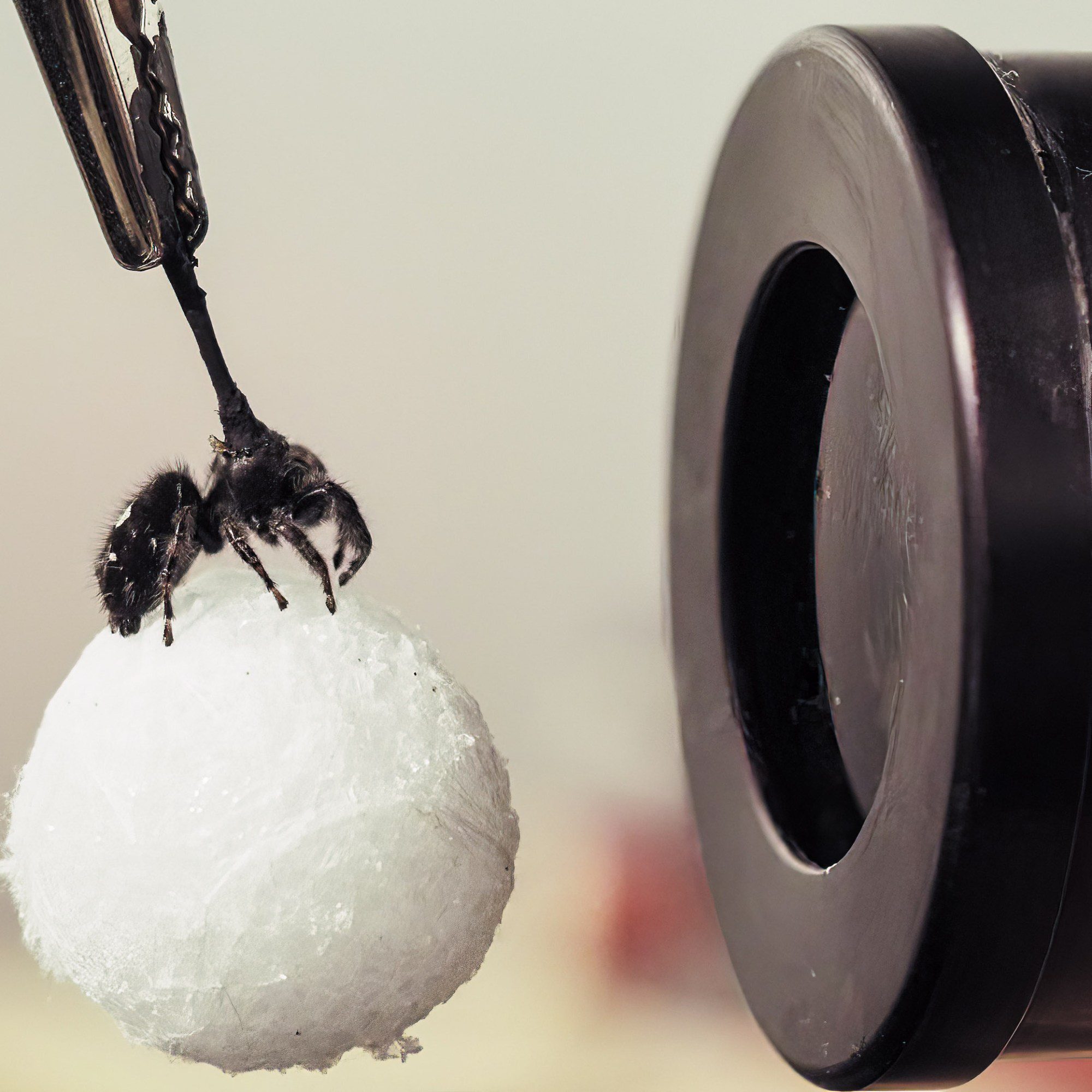
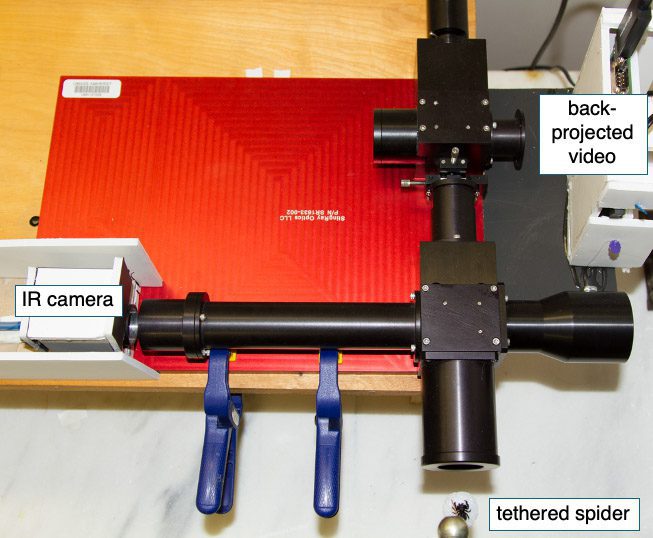
For clues, Jakob watches their eyes, particularly their two principal ones, which have high-acuity color vision at the center of their boomerang-­shaped retinas. She uses a tool evolved from an ophthalmoscope that was specially modified to study the eyes of jumping spiders more than a half-century ago. Generations of scientists, including Jakob and her students at UMass Amherst, have built on this design, slowly morphing it into a mini movie theater that tracks the retinal tubes moving and twisting behind the spiders’ principal eyes as they watch. 

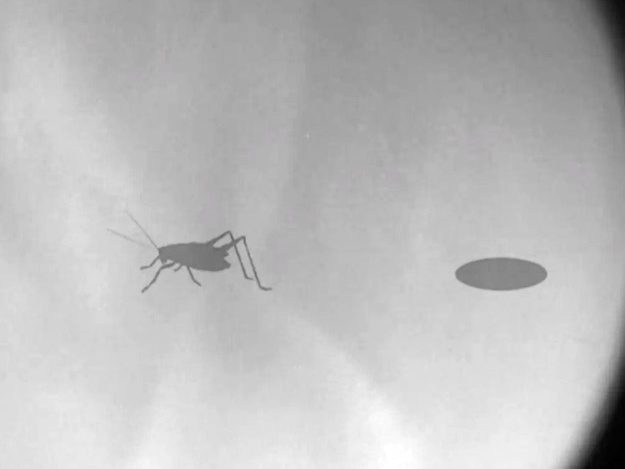
A spider is tethered in front of the tracker while a video of, say, a cricket silhouette is projected through the tracker’s lenses into the spider’s eyes. A beam of infrared light is simultaneously reflected off the spider’s retinas, back through the lenses, and recorded by a camera. The recording of those reflections is then superimposed on the video, showing exactly what the spider was looking at. Jakob found that just about the only thing more interesting to a jumping spider than a potential cricket dinner is a black spot that is growing larger. Could it be an approaching predator? The spider’s lower-resolution secondary eyes catch a glimpse of the looming spot in the corner of the video screen and prompt the primary eyes to shift away from the cricket to get a better look. 

Jakob’s eye tracker has also inspired other scientists’ creative experiments. Visual ecologist Nate Morehouse of the University of Cincinnati used the tracker to reveal that females of one jumping spider species aren’t all that interested in male suitors’ flashy red masks and brilliant green legsit’s the males’ orange knees that they focus on during courtship displays. “To get this insight into what they actually care about is really cool,” Jakob says.

The hermit crab escape room

Hermit crabs won’t just settle for the best empty snail shell they can findthey also remodel their homes. Hermit crab shells get better with time as each subsequent inhabitant makes home improvements, like widening the entranceway or carving out a more open, spacious interior. 

Dartmouth’s Mark Laidre has been studying crabs and their shell preferences for more than a decade. So when he realized he could use a micro-CT x-ray machine to create a three-­dimensional digital scan of a shell, he immediately began envisioning the experimental possibilities. To better understand the choices crabs make, he scanned shells that crabs clearly favored and then made alterations before 3D-printing them in plastic. “We could add little elements onto those that changed the external or the internal architecture,” Laidre says.

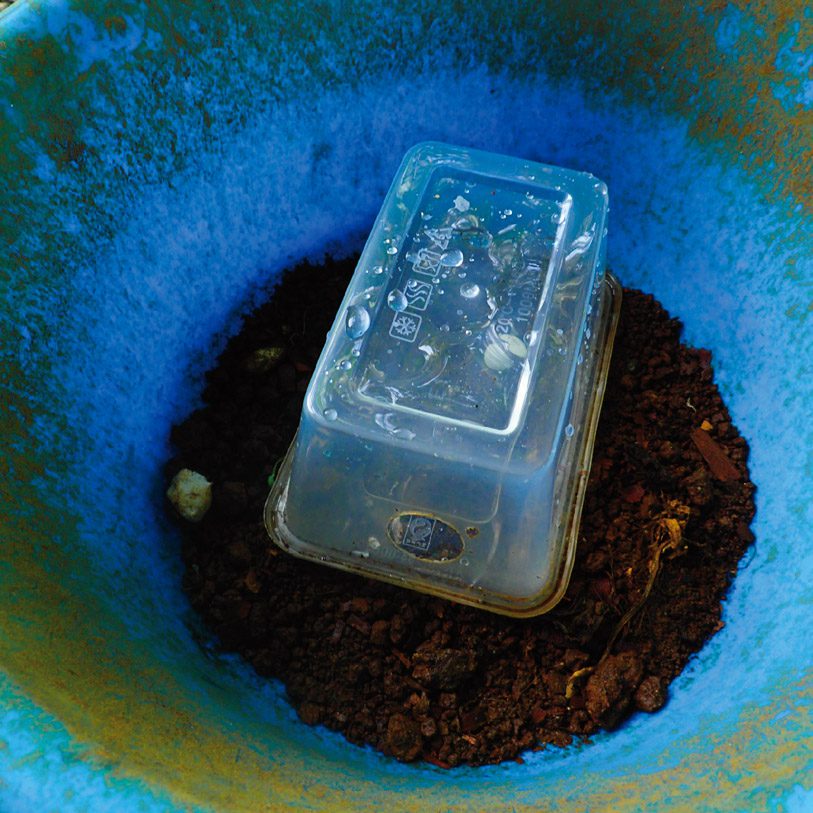
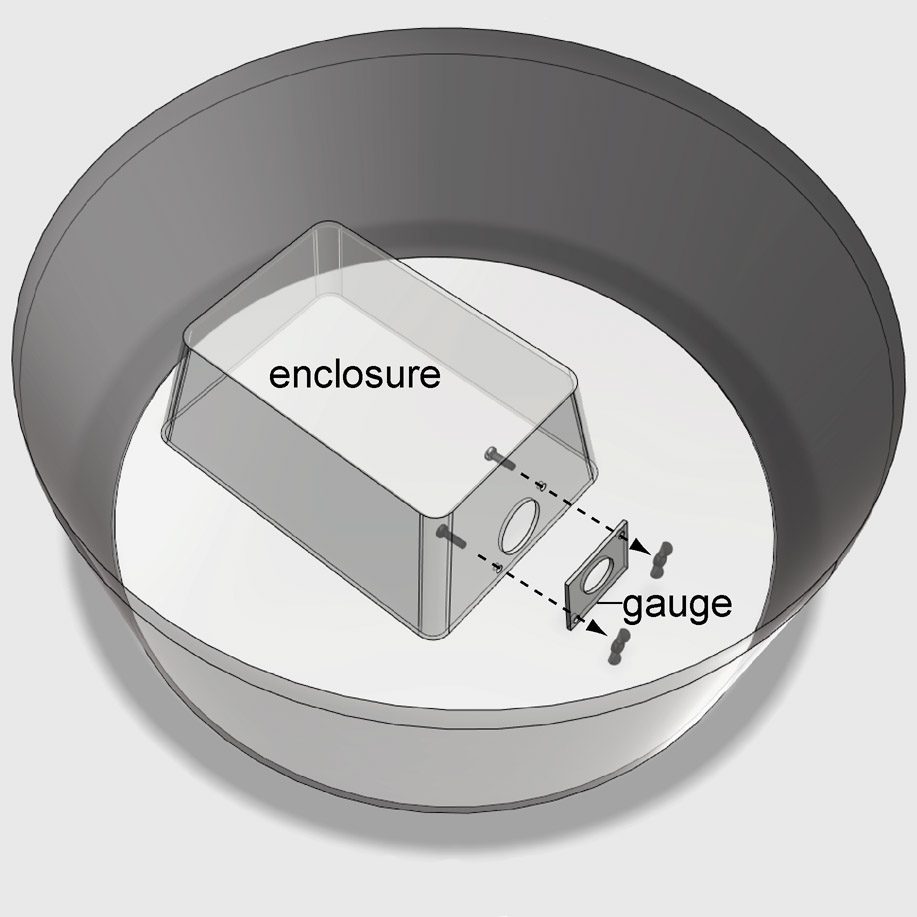
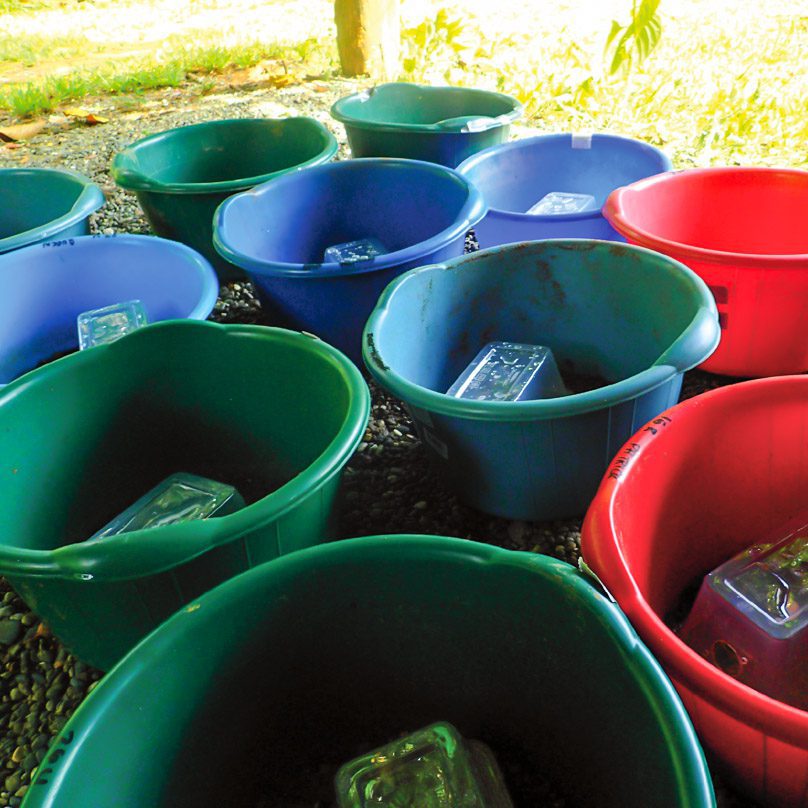
Next, he presented crabs with a dilemma. They were placed alone inside a box with a small exit (as shown below) and given a choice between two shells: a really nice, spacious model but with spikes added to the outside so that the crabs would not fit through the exit, and a shell that they would fit through but with uncomfortable spiny protrusions added to the inside. Could they figure out how to get out? “It’s effectively an escape room,” Laidre says.

When not trapped, crabs preferred the comfy shell with protrusions on the outside, claws down. But hermit crabs are social animals that prefer to be with other crabs, giving them motivation to escape solitary confinement. By the end of the day, more than a third of the trapped crabs had sized up their situation, moved from the crummy shell, and escaped. 

Solving a completely novel problem takes a certain amount of mental wherewithal that crabs don’t often get credit for. And Laidre suspects that cognitive capability may be what separated the successful escapees from the crabs that didn’t make it out of the escape room. 

The bee insominator

Sleepy people tend to be poor communicators. Entomologist Barrett Klein of the University of Wisconsin–La Crosse wanted to know if the same was true for drowsy honeybees. These social insects have a sophisticated communication system, known as the waggle dance, to convey to other bees where to find nectar. Are tired bees worse wagglers? To find out, Klein needed a way to keep bees up all night.

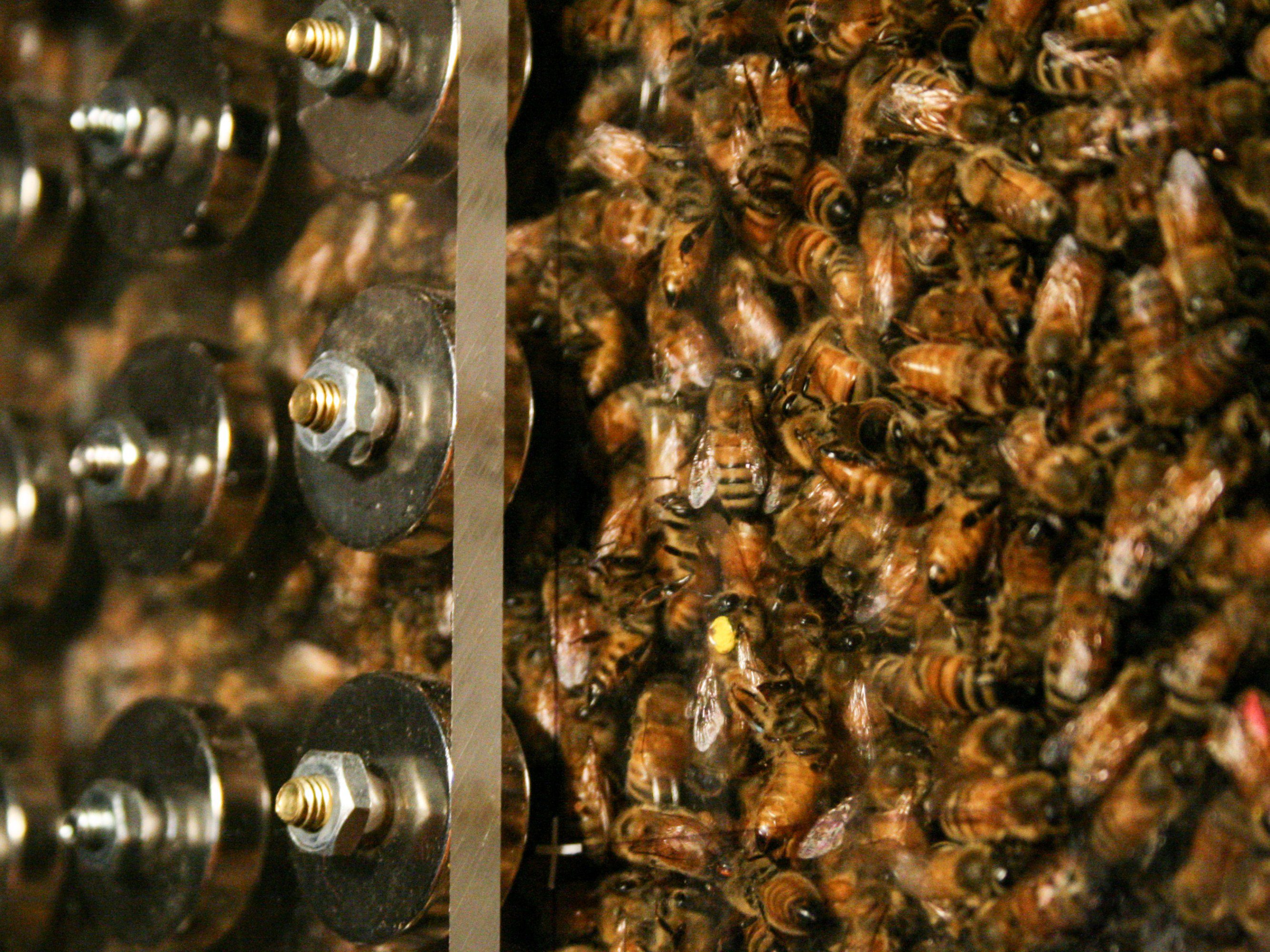
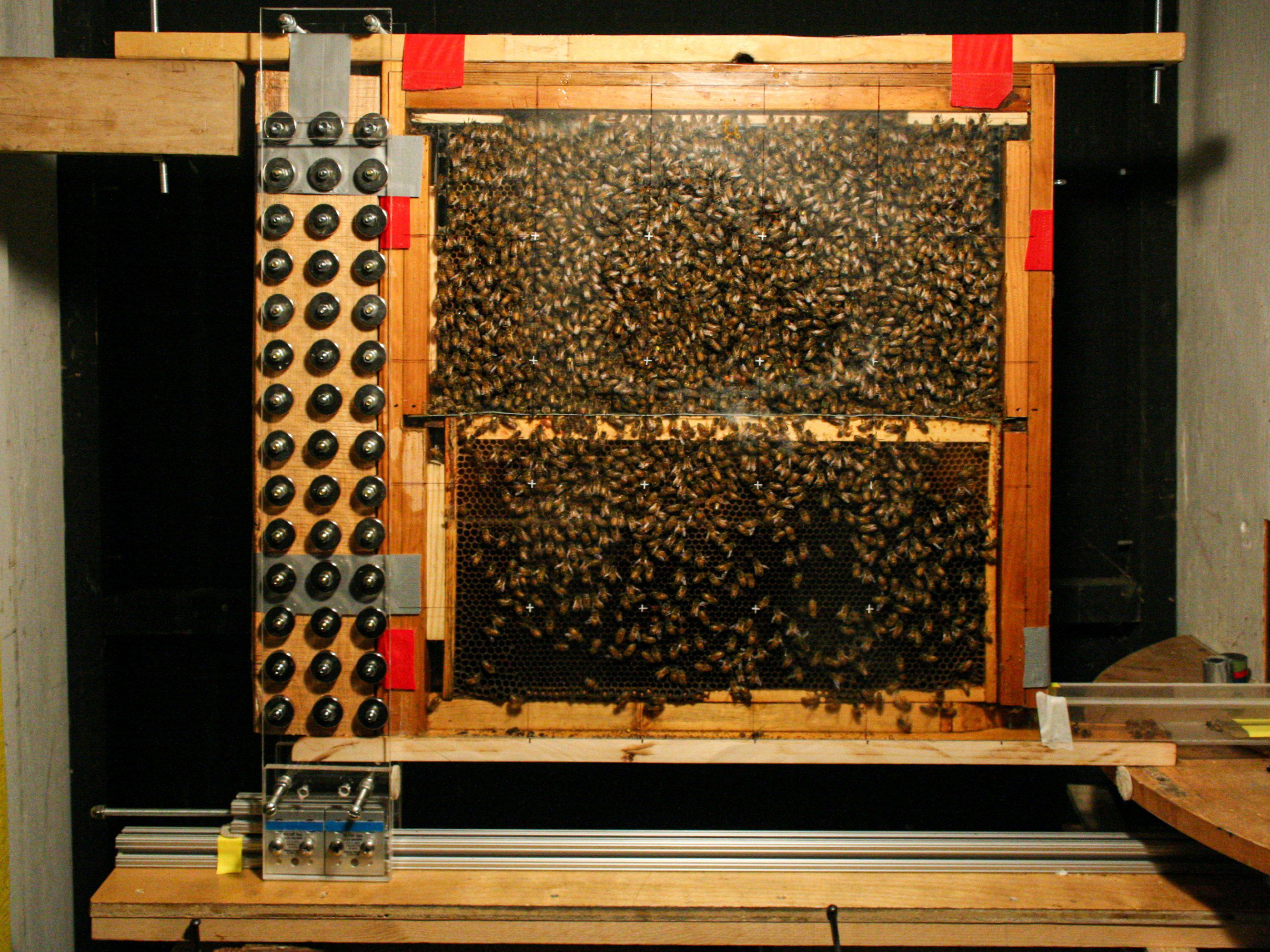
A metal disc attached to the back of a bee, seen on the right side of the photo, is painted yellow to hide whether it is made of steel that will be jostled by the magnets to keep her awake, or copper that won’t react to the magnets.
BARRETT KLEIN

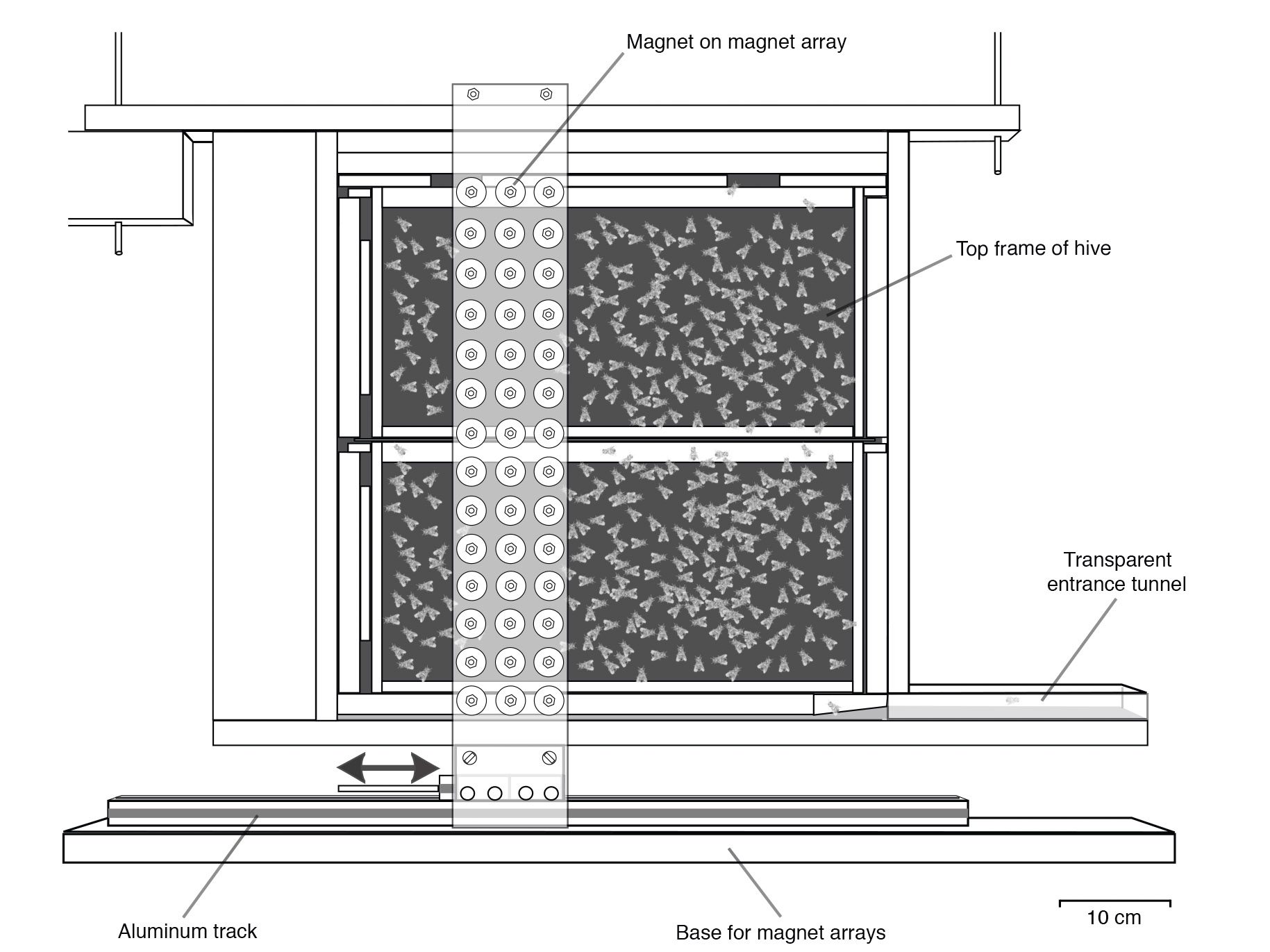
He thought of shaking the hive, but this would just send all the bees angrily flying out. He wanted to keep some bees from sleeping while the rest slumbered peacefully, so that their dances could be compared the next day. Klein considered putting individual bees in vials that would be periodically shaken, but he couldn’t be sure if changes in their dance were due to sleepiness or isolation. He also thought of poking bees, aiming streams of air at individual bees, or even shining focused infrared beams at their faces. “Try to do that on all these bees facing all different directions,” Klein said. “It would be insane.” 

Eventually he landed on using neodymium rare earth magnets to jostle bees that had metal wafers glued between their wings with pine resin. “I had to make a hive that was narrow, with only two-millimeter-thick glass on either side, and have the magnets very close but not touching or scraping the glass,” Klein says. The biggest catch with this contraptiondubbed the Insominatorwas that Klein had to stay up all night rolling the banks of magnets back and forth alongside the hive three times a minute, depriving himself of sleep along with the bees.

But it paid off: He found that sleepy bees are indeed sloppy dancers. They did shorter dances that were less accurate with directiona miscommunication that could send hivemates on a flowerless search. In a follow-up study, Klein showed that other bees were not impressed with the drowsy displays and would promptly leave to find better wagglers. 

Happily, he has since upgraded the Insominator to automatically roll the magnets.

Betsy Mason is a freelance science journalist and editor based in the San Francisco Bay Area.

Google DeepMind is making its AI text watermark open source

Google DeepMind has developed a tool for identifying AI-generated text and is making it available open source. 

The tool, called SynthID, is part of a larger family of watermarking tools for generative AI outputs. The company unveiled a watermark for images last year, and it has since rolled out one for AI-generated video. In May, Google announced it was applying SynthID in its Gemini app and online chatbots and made it freely available on Hugging Face, an open repository of AI data sets and models. Watermarks have emerged as an important tool to help people determine when something is AI generated, which could help counter harms such as misinformation. 

“Now, other [generative] AI developers will be able to use this technology to help them detect whether text outputs have come from their own [large language models], making it easier for more developers to build AI responsibly,” says Pushmeet Kohli, the vice president of research at Google DeepMind. 

SynthID works by adding an invisible watermark directly into the text when it is generated by an AI model. 

Large language models work by breaking down language into “tokens” and then predicting which token is most likely to follow the other. Tokens can be a single character, word, or part of a phrase, and each one gets a percentage score for how likely it is to be the appropriate next word in a sentence. The higher the percentage, the more likely the model is going to use it. 

SynthID introduces additional information at the point of generation by changing the probability that tokens will be generated, explains Kohli. 

To detect the watermark and determine whether text has been generated by an AI tool, SynthID compares the expected probability scores for words in watermarked and unwatermarked text. 

Google DeepMind found that using the SynthID watermark did not compromise the quality, accuracy, creativity, or speed of generated text. That conclusion was drawn from a massive live experiment of SynthID’s performance after the watermark was deployed in its Gemini products and used by millions of people. Gemini allows users to rank the quality of the AI model’s responses with a thumbs-up or a thumbs-down. 

Kohli and his team analyzed the scores for around 20 million watermarked and unwatermarked chatbot responses. They found that users did not notice a difference in quality and usefulness between the two. The results of this experiment are detailed in a paper published in Nature today. Currently SynthID for text only works on content generated by Google’s models, but the hope is that open-sourcing it will expand the range of tools it’s compatible with. 

SynthID does have other limitations. The watermark was resistant to some tampering, such as cropping text and light editing or rewriting, but it was less reliable when AI-generated text had been rewritten or translated from one language into another. It is also less reliable in responses to prompts asking for factual information, such as the capital city of France. This is because there are fewer opportunities to adjust the likelihood of the next possible word in a sentence without changing facts. 

“Achieving reliable and imperceptible watermarking of AI-generated text is fundamentally challenging, especially in scenarios where LLM outputs are near deterministic, such as factual questions or code generation tasks,” says Soheil Feizi, an associate professor at the University of Maryland, who has studied the vulnerabilities of AI watermarking.  

Feizi says Google DeepMind’s decision to open-source its watermarking method is a positive step for the AI community. “It allows the community to test these detectors and evaluate their robustness in different settings, helping to better understand the limitations of these techniques,” he adds. 

There is another benefit too, says João Gante, a machine-learning engineer at Hugging Face. Open-sourcing the tool means anyone can grab the code and incorporate watermarking into their model with no strings attached, Gante says. This will improve the watermark’s privacy, as only the owner will know its cryptographic secrets. 

“With better accessibility and the ability to confirm its capabilities, I want to believe that watermarking will become the standard, which should help us detect malicious use of language models,” Gante says. 

But watermarks are not an all-purpose solution, says Irene Solaiman, Hugging Face’s head of global policy. 

“Watermarking is one aspect of safer models in an ecosystem that needs many complementing safeguards. As a parallel, even for human-generated content, fact-checking has varying effectiveness,” she says. 

These companies are creating food out of thin air

Dried cells—it’s what’s for dinner. At least that’s what a new crop of biotech startups, armed with carbon-guzzling bacteria and plenty of capital, are hoping to convince us. Their claims sound too good to be true: They say they can make food out of thin air.

But that’s exactly how certain soil-dwelling bacteria work. In nature, these “autotrophic” microbes survive on a meager diet of oxygen, nitrogen, carbon dioxide, and water vapor drawn directly from the atmosphere. In the lab, they do the same, eating up waste carbon and reproducing so enthusiastically that their populations swell to fill massive fermentation tanks. Siphoned off and dehydrated, that bacterial biomass becomes a protein-rich powder that’s chock-full of nutrients and essentially infinitely renewable. 

Lisa Dyson is the founder of one of these startups, Air Protein. When she talks about the inspiration for her company, she often cites NASA research from the 1960s. Back then the agency, hoping to keep astronauts satiated on long-haul space journeys, explored the idea of growing bacterial cuisine on board before concluding, ultimately, that astronauts might not find it psychologically palatable. “Earth is actually like a spaceship,” Dyson explained in a 2016 TED Talk. “We have limited space and limited resources, and on Earth, we really do need to figure out how to recycle our carbon better.” Could these bacteria be the answer?

For now, the answer is a definite maybe. Some 25 companies worldwide have already taken up the challenge, hoping to turn abundant carbon dioxide into nutritious “air protein.” The ultimate goal of the people who work at these companies is to engineer a food source far lower in emissions than conventional farming—perhaps even one that could disrupt agriculture altogether. To do that, they’ll need to overcome some very real challenges. They’ll need to scale up production of their protein to compete commercially, and do it in a way that doesn’t create more emissions or other environmental issues. Even trickier: They’ll need to surmount the ick people may experience when contemplating a bacteria-based meal. 

Some of these companies are focused on industrial animal feed, fish meal, and pet food—products with slimmer profit margins but less exacting consumers and fewer regulatory hurdles. Human food, however, is where the real money—and impact—is. That’s why several companies, like Dyson’s Air Protein, are focused on it. In 2023 Air Protein opened its first “air farm” in San Leandro, California, a hub for the commercial food production industry, and announced a strategic development agreement with one of the largest agricultural commodity traders in the world, ADM, to collaborate on research and development and build an even larger, commercial-­scale plant. The company’s “Air Chicken” (which, to be clear, is not actual chicken) is slowly making its way toward grocery store shelves and dinner tables. But that’s only the beginning. Other companies are making progress at harnessing bacteria to spin air into protein, too—and someday soon, these microbial protein patties could be as common as veggie burgers. 

An alternative to alternative proteins

The environmental case for microbial protein is clear enough; it’s a simple calculus of arable land, energy, and mouths to feed. The global demand for protein is already at an all-time high, and with the population expected to grow to 9.7 billion by 2050, traditional agriculture will have a hard time keeping up, especially as it battles climate change, soil degradation, and disease. A growing global middle class is expected to raise levels of meat consumption, but factory-farmed meat is one of the leading drivers of greenhouse-­gas emissions. Although protein-rich alternatives like soy are far more sustainable, most of the soy grown in the world is destined for use as animal feed—not for human consumption. 

In contrast, bacterial “crops” convert carbon dioxide directly into protein, in a process that uses much less land and water. Microbial protein “farms” could operate year-round anywhere renewable electricity is cheap—even in places like Chile’s Atacama Desert, where farming is nearly impossible. That would take the strain off agricultural land—and potentially even give us the chance to return it to the wild. 

 “We are liberating food production from the constraints of agriculture,” Juha-Pekka Pitkänen, cofounder and CTO of the Finnish startup Solar Foods, explained in a recent company video. In April 2024 Solar Foods opened a demonstration factory in Vantaa, a short train ride from the Helsinki airport. It’s here, at Factory 01, that the company hopes to produce enough of its goldenrod-yellow protein powder, Solein, to prove itself viable—some 160 metric tons a year. 

Like Air Protein, Solar Foods begins its production process with naturally occurring hydrogen-­oxidizing bacteria that metabolize carbon dioxide, the way plants do. In sterile bioreactors similar to the fermentation vats used in the brewing industry, the bacteria flourish in water on a steady diet of CO2, hydrogen, and a few additional nutrients, like nitrogen, calcium, phosphorus, and potassium. As they multiply, the bacteria thicken the water into a slurry, which is continuously siphoned off and dehydrated, creating a protein-rich powder that can be used as an ingredient in alternative meats, dairy products, and snacks.

“We are liberating food production from the constraints of agriculture.”

Juha-Pekka Pitkänen, Solar Foods

As Pitkänen explains, his research team at Finland’s state-owned VTT Technical Research Centre knew these microorganisms existed in the wild. To find a viable candidate, they narrowed down the natural conditions where one might be found, and then—as is the Finnish way—put on some hiking boots and got out there. “In Finland, you don’t have to go very far to find nature,” he says, shrugging. “You can find something useful in a ditch.”

Still, not just any old ditch bacteria would do. Their target needed to both consume carbon dioxide and continue to thrive even after it was isolated from the microbial community it coexisted with, or competed against, in nature. “We were looking for a pacifist microorganism,” Pitkänen says. “It’s quite rare.” In a wet soil-dwelling bacterium of the genus Xanthobacter,they found their match: a nontoxic, lab-friendly microbe palatable enoughto slip into myriad food preparations.

At Solar Foods’ annual summer company party this year, their in-house chef served a bright-yellow lasagna made with Solein. The powder, Pitkänen says, makes an excellent flour for fresh pasta dough and works surprisingly well as a cream replacement in ice cream. It’s rich in carotenoids, so it can taste “carroty,” and it’s full of B12 and bioavailable iron, which makes it great for vegetarians. But the product isn’t a plug-and-play replacement for milk, eggs, or even meat. Rather, it’s an ingredient like any other, competing on nutritional value, cost, and texture. The company’s main competition, Pitkänen told me, isn’t other novel proteins—it’s soy meal. 

“In the last 10 years, the whole alternative-protein landscape has changed dramatically,” says Hannah Lester, an EU-based regulatory consultant to the novel-food industry. Soy patties and bean burgers are now ubiquitous to the point of being passé; today’s cutting-edge alternative proteins are cultivated from animal cells and coaxed from specially designed microorganisms using techniques originally developed to produce vaccines and other pharmaceuticals. “Molecular farmers” tend fields of bright-pink soybeans whose genetic makeup has been doctored so that they contain proteins identical to ones pigs make. “It’s really coming to the point where companies are utilizing the most incredible technology to produce food,” she says.

A fermentation process by any other name

The space Air Protein and Solar Foods occupy is so new that language hasn’t quite coalesced around it. Some in the alternative-protein industry evocatively call it “cellular agriculture,” but it’s also referred to as “gas fermentation,” emphasizing the process, and “biomass fermentation,” emphasizing the end product. These terms are distinct from “precision fermentation,” which refers to another buzzy bioprocess that employs genetically modified yeasts, other fungi, and bacteria to produce proteins indistinguishable from their animal-­derived counterparts. Precision fermentation isn’t a new technique: The US Food and Drug Administration approved its use to produce insulin in 1982, and 80% of the rennet used in cheese is now made this way, avoiding the need to harvest the enzymes from the stomach lining of calves. 

Rather than coaxing microorganisms to produce the animal-­derived proteins we’re already familiar with, companies like Air Protein and Solar Foods are proposing that we skip the intermediary and simply eat the microbes themselves, dried into a powder. Microbial biomass made with these new fermentation technologies is fibrous, vitamin-rich, and versatile. More important, these bacteria eat carbon, require very little land and water, and need no fossil-fuel-derived fertilizers. According to a life-cycle analysis produced by the University of Helsinki and the Natural Resources Institute Finland, microbial protein is between 53% and 100% more efficient to produce than animal protein.

Of course, that’s a wide range. Finland’s electricity mix favors renewables like hydropower and wind; in a country more reliant on fossil fuels, the environmental impact of making Solein, or any microbial protein, could be much higher. Growing microbes in bulk means creating the perfect conditions for them to thrive—and, as with any industrial production process, that requires factories, equipment, and power to run the entire system. It also requires a generous supply of elements like carbon dioxide and hydrogen. 

white cloud hovering over a sugar cone on blue sky background

ERIC MONGEON/MIT TECHNOLOGY REVIEW

Nearly all the world’s human-made hydrogen, a key element in the bacterial diet, comes from fossil-fuel production, and “green” hydrogen, which Solar Foods uses in its demonstration factory, comes from using renewable-powered electrolysis to split water, still an uncommon process. According to David Tze, CEO of the microbial-protein company NovoNutrients, which is currently working to branch out from industrial fish meal to human food, the segment of the microbial-protein industry powered by hydrogen is likely to set up shop wherever hydrogen is cheapest.

Carbon sources for this technology are likewise varied. If a company wants to use captured waste carbon, it will need to broker relationships with industries to connect its protein factories with those sources. Another alternative, sourcing carbon drawn from the atmosphere using direct air capture, or DAC, is still new, energy intensive, and expensive. For the time being, Air Protein uses the same commercially available carbon dioxide used in sparkling water, and while Solar Foods uses DAC for about 15% of the carbon it needs at its demonstration factory, the rest is sourced commercially. Both companies hope to adjust their carbon sources as they scale, and as DAC becomes more commercially available. 

Even if the bacteria were fed a diet of entirely captured carbon, they wouldn’t be permanently removing it from the atmosphere, since we release carbon when we digest food. Still, Tze says, “we’re giving a second life to CO2, and allowing it to add so much more positive value to the economy.” More important, the bacteria-based products drastically reduce the emissions footprint of protein. According to a 2016 study by the World Resources Institute, producing a single ton of beef creates around 2,400 metric tons of greenhouse-gas emissions. For plant-based sources of protein, like pulses, the number is much less than 300—but for microbial proteins it may ultimately be in the single digits. “If someone can eat a bite of our product instead of a bite of anything else,” Tze says, “it could be one or three orders of magnitude difference.”

Of course, none of this works if microbial protein remains a niche industry, or if the product is too expensive for the average consumer. Even running at capacity, Solar Foods’ demonstration factory can only produce enough protein to provide the entire population of Finland with one meal a year. From a business standpoint, Pitkänen says, that’s good news: There’s plenty of room to grow. But if they hope to make a dent in the long-term sustainability of our food systems, companies like Solar Foods and Air Protein will need to scale up by orders of magnitude too. It remains to be seen if they will be able to meet that challenge—and if consumers will be ready. 

Even though both the process (fermentation) and the material (living microorganisms) are as natural as the world and as old as time, the idea of whipping air and microbes together to make dinner will strike many people as unthinkably weird. Food is cultural, after all—and especially in the US, protein is political. In interviews, Dyson takes pains to call the bacteria behind Air Protein’s process “cultures,” emphasizing the connection to traditional fermented foods like yogurt, beer, or miso. On the Solar Foods website, chic people drink yellow Solein smoothies at tasteful Nordic tables. No bacteria are pictured.

Solar Foods is still awaiting final regulatory approval in the EU and the US, but Solein is already for sale in Singapore, where it’s been whipped into chocolate gelato and hazelnut-­strawberry snack bars. If Singaporeans took issue with eating powdered bacteria, they made little show of it. When it comes to food biotechnology, the most progressive countries in the world are those with the least arable land. Singapore, which imports nearly everything, hopes to meet 30% of its own nutritional needs by 2030. Israel, a semi-arid country with limited landmass, has invested heavily in biomanufacturing, as has the Netherlands, where farmland has been heavily depleted by chemical fertilizers. But even in less constrained countries, “agriculture is on its knees because of climate change,” says Lester, the regulatory expert. “At some point, sadly, we’re just not going to be able to produce food in the traditional way. We do need alternatives. We need government support. We need fundamental policy change in how we fund food.”

This sentiment seems to be resonating in the United States. In September 2022, President Joe Biden signed an executive order to advance biomanufacturing by expanding training, streamlining regulation, and bolstering federal investment in biotechnology R&D, specifically citing “boost[ing] sustainable biomass production” as a key objective. In 2021, the Defense Advanced Research Projects Agency launched the Cornucopia program, asking four research teams—one of which includes Dyson’s company, Air Protein—to create a complete nutrition system, small enough to fit on a Humvee, that can harvest nitrogen and carbon from the air and use it to produce microbial rations in the form of shakes, bars, gels, and jerky. Microbial protein may never be deployed on long-haul space trips as NASA dreams, but it seems that the government is betting it could keep us alive on Spaceship Earth—that is, if the crew doesn’t reject it outright.

Claire L. Evans is a writer and musician exploring ecology, technology, and culture.

The quest to figure out farming on Mars

Once upon a time, water flowed across the surface of Mars. Waves lapped against shorelines, strong winds gusted and howled, and driving rain fell from thick, cloudy skies. It wasn’t really so different from our own planet 4 billion years ago, except for one crucial detail—its size. Mars is about half the diameter of Earth, and that’s where things went wrong.

The Martian core cooled quickly, soon leaving the planet without a magnetic field. This, in turn, left it vulnerable to the solar wind, which swept away much of its atmosphere. Without a critical shield from the sun’s ultraviolet rays, Mars could not retain its heat. Some of the oceans evaporated, and the subsurface absorbed the rest, with only a bit of water left behind and frozen at its poles. Unrelenting radiation, along with electrostatic discharge from planet-wide dust storms, drove chemical reactions in the arid Martian dirt, ultimately leaving it rich in pesky toxic salts called perchlorates. If ever a blade of grass grew on Mars, those days are over. 

But could they begin again? What would it take to grow plants to feed future astronauts on Mars? In science fiction, it isn’t much of a problem. Matt Damon’s character in the 2015 movie The Martian simply had to build a greenhouse, spread out human excrement, add water, and wait. The film got a lot of things right—bacteria in the human biome will be useful—but it didn’t account for the perchlorates. The potato plants that sustained him would never have grown, but even if they had, two years of eating contaminated, carcinogenic potatoes would have nuked his thyroid, boxed his kidneys, and damaged his cells—though he might not have realized it, because perchlorates are also neurotoxic. It would have been Matt Damon’s finest death scene.

At the time Andy Weir was writing the book on which the film was based, no one really knew just how plentiful and ubiquitous the chemicals were. Though they were first discovered by NASA’s Phoenix lander in 2008, it took subsequent rovers, and compilation of historic data, to confirm that not only are perchlorates everywhere on Mars, but they are, in fact, abundant. Overall, Mars’s surface has perchlorate concentrations of about 0.5% by weight. On Earth, the concentration is often a millionth that amount.

For NASA, that’s a devastating issue. The ultimate goal of the agency’s Artemis program is to land astronauts on Mars. And for the last decade, the agency has pursued a long-term plan of establishing an “Earth independent” human presence on the Red Planet. More ambitiously, if less plausibly, Elon Musk, the chief executive officer of SpaceX, has stated that he expects a million people to live on Mars in the next 20 years.

Any notion of an independent Mars means the perchlorate problem must be solved, because humans have to eat. Resupply missions are, by definition, Earth dependent, and hydroponics are inadequate for feeding people in large numbers.

“We can sustain crews of 10, maybe 20, very comfortably with hydroponics, but it doesn’t scale much larger than that,” says Rafael Loureiro, an associate professor at Winston-Salem State University who specializes in plant stress physiology. Hydroponics systems must be built on Earth, and they require energy-inefficient pumps and constant monitoring for bacterial and fungal infections. “Once the system is infected, you lose your entire crop, because it’s a closed-loop system,” he says. “You have to discard everything and reset.”

The only real path forward, says Loureiro, is farming the land: “The perchlorate problem is something that we will inevitably have to deal with.” 

There is no soil on Mars. Just dusty, poisonous regolith—the mixture of loose rock, sand, and dust that makes up the planetary surface. On Earth, the regolith is replete with billions of years’ worth of broken-­down organic biomass—soil—that just doesn’t exist on Mars. To grow food there, we can’t just drop seeds in the ground and add water. We will need to create a layer of soil that can support life. And to do that, we first have to get rid of those toxic salts.   

There’s more than one way to remove perchlorates. You can burn them out; the compounds break down around 750 °F, but for that, you’ll likely need power sources like nuclear reactors, and a lot of ancillary equipment. You can literally wash the perchlorates from the regolith, but, Loureiro explains, “the amount of water that you need to do that is ungodly, and water is a limited resource as far as we know.” That process would likewise take a significant amount of energy. “That’s something that’s not feasible long term,” he tells me. The ideal solution is not something dependent on heavy machinery. Rather, it would rely on something small—microscopic, in fact. 

NASA and the National Science Foundation are funding research into how future astronauts on Mars might use microbial life not only to remove perchlorates from the planet’s dirt, but also to shape and enrich the regolith into arable soil. The work builds on years of effort to do the same thing in different places on Earth, and if successful, it will improve farming on two planets for the price of one.

“If we are able to grow plants in Martian regolith, we can do it anywhere on Earth.”

Rafael Loureiro, associate professor, Winston-Salem State University

It’s easy to dismiss the idea of Martian agriculture as a distant issue for a fictional future, but scientists must solve these sorts of problems before the rockets launch, not after humans are on their way. And as with much of NASA’s research, solving problems “up there” applies directly to life “down here.” Simply put, what we learn from Mars could find use here on Earth to turn infertile wastelands into rich agricultural zones. On Earth, natural perchlorate levels are highest in desert regions.  In other areas, high levels are usually due to industrial waste. The toxins harm Earthen plants as much as they would prospective Martian ones. Which means it’s not just NASA that is interested in remediation—even the US Department of Agriculture is paying for such research. 

“If I’m able to grow plants in a completely alien environment, the technology that I create to do that is one hundred [percent] transferrable to places here on Earth that are food insecure. To places that are extremely arid and unfit for agriculture. To places that have been affected by mining companies that have polluted the soil,” says Loureiro.

“If we are able to grow plants in Martian regolith, we can do it anywhere on Earth.”

Thinking small

The science laboratory at Arizona State University’s Biodesign Institute looks like a large version of every biology classroom in America: long black tables, myriad microscopes, racks of vials. When you look closer, though, you realize that the microscopes are a little fancier, and there are high-tech instruments like gas chromatographs and organic carbon analyzers in the mix.

Anca Delgado, a microbiologist, meets me at the entrance, where we don white lab coats and goggles. “We don’t plan to splatter you with anything today, but we want to be safe,” she says. 

Earth’s soil is wet and wiggly, teeming with life, and its mineral composition is highly diverse, thanks in part to tectonic action, microbial activity, and the rock cycle. But you can just look at Mars and tell something is way off: The core of the diminutive planet cooled before much of its iron had a chance to sink to its center. As a result, Martian regolith is packed with iron-rich minerals, which over time have oxidized. The planet’s exterior is literally rusted. Without water, it changes primarily via mechanical weathering, driven by wind and temperature; and without life, it is entirely inorganic.

Despite all this, Delgado, her graduate students, and colleagues across the country have found a possible path to solving the perchlorate problem and making Martian regolith arable. 

Perchlorates are salts made out of a negatively charged ion of chlorine and oxygen, bonded with a positive ion such as sodium. (There is also perchloric acid, which contains that same negatively charged ion.)Where perchlorates are abundant on Earth, it is often because we put them there. Everything from military manufacturing to the fireworks spectacular at Disneyland has contributed. They weren’t the only chlorinated compounds the US went wild about around the time of World War II. The United States for decades made heavy use of organic chlorinated solvents in everything from dry cleaning and metal degreasing to clothing dyes and medicine. 

MEREDITH MIOTKE | PHOTO: NASA/JPL-CALTECH/MSSS

Industry overall had a laissez-­faire attitude toward the management of waste products, leading to contamination of the nation’s groundwater. “After the Clean Water Act and later legislation in the 1970s prevented or banned the use of some of these chemicals, that’s when we discovered the extent of this contamination,” Delgado tells me. Some water pollution was obvious. The Cuyahoga River in Ohio routinely caught on fire. But other contamination remained hidden. Residents of Love Canal, a neighborhood in the city of Niagara Falls, New York, reported abnormally high rates of leukemia markers and birth defects before anyone recognized that the 20,000 tons of chemicals dumped into a canal in the 1940s might be responsible. 

It wasn’t enough to stop dumping toxic chemicals in waterways and landfills, however. Scientists had to find alternatives—Disney developed a fireworks launcher in 2004 that eliminated its perchlorate emissions, for example—and they also had to find ways to clean up the pollution that was already there. In the case of perchlorates, they can do so chemically. Rain and artificial irrigation can wash the compounds away, though this only transfers the problem to groundwater. Another strategy is to grow woody plants like willow and cottonwood in contaminated lands. These draw perchlorates from the ground and can then be harvested, removing them from the contamination cycle.

Another biological approach is to go small, using microorganisms to turn toxic chemicals into harmless ones. The poster child for this concept is a bacterium called Dehalococcoides mccartyi, which specifically feeds on organic chlorinated solvents and spits out dechlorinated ethene (a simple, nontoxic hydrocarbon) and harmless chloride ions, which are found naturally in the environment. Delgado studied D. mccartyi during her doctoral program. Her interests were strictly terrestrial. But the process, while highly effective, was not perfect. It took an incredibly long time to work in nature.

“We were looking at treatment times of months to decades,” Delgado tells me. Her research sought to culture D. mccartyi at much higher densities, which would translate to improved rates of action and faster treatment times for abandoned American waste sites. Her work has since been applied at multiple field sites in Arizona, New Jersey, and California.

Delgado walks me through the lab, which is arranged in an open plan. From the Biodesign Institute’s inception in 2004, she says, the idea was to bring researchers who would not normally interact into the same physical space. That means microbiologists working with wastewater samples, sludges, and soils are next door to scientists who do DNA origami. 

The leap from cleaning up Earth’s toxic waste dumps to making the Martian surface arable began in 2017, a month before Delgado started her new job at the university. She had read an article about Mars and idly looked into the chemical elements that had been detected so far on that planet. “I like microbes, and I wanted to see if Mars could fulfill their nutritional requirements,” she says. “I’m sort of a sci-fi geek.”

While attending a university retreat designed to get researchers talking about their work, she decided to “put it out there” that “I would be interested at some point to look at whether microorganisms would be able to grow in Martian conditions.” 

A paper she read in the journal Nature finally spurred her into action. Soil organic matter, which is necessary for growing plants, is itself made of decomposing plant and animal material. That would seem to preclude Martian agriculture from ever being achieved. But researchers had demonstrated for the first time that you can actually form soil organic matter with microorganisms alone—no decaying plants needed. The microbes themselves, and their tissues and excretions, could synthesize soil.  

Delgado realized that perchlorates could be the initial catalyst, the thing that microbes could thrive on and break down. Eventually the process could make the Martian regolith ready for planting. 

She applied for an Emerging Frontiers in Research and Innovation grant from the National Science Foundation to explore the idea. NASA recognized her proposal’s implications and co-funded the grant; the project received $1.9 million total in 2022. It was intended as a multiyear, multi-institution effort, with Delgado as principal investigator. The plan was that ASU, the lead institution, would explore using microbes to lower the concentration of perchlorates in Mars-like dirt. The University of Arizona in Tucson would investigate the soil organic matter formed by those microbes during their breakdown of the perchlorates, and the Florida Institute of Technology in Melbourne, Florida, would figure out how to grow the plants.

Testing the dirt

One problem with studying Martian regolith is that we simply don’t have any of it here on Earth. NASA’s entire campaign of Mars exploration for 50 years has been in service of characterizing the Red Planet as a possible site for life. The agency has long sought to get a pristine sample of regolith from Mars into a clean room on Earth for analysis. But so far it has failed to develop a credible mission to do so. In April, Bill Nelson, the administrator of NASA, essentially admitted defeat, asking outside research institutions and the private sector for proposals on how an affordable Mars sample return might be achieved.

In the meantime, scientists have to make do with simulated Martian dirt to study ways to diminish levels of perchlorates, including heat, radiation, and microbial methods.

Delgado’s lab at ASU includes an incubator and a confocal microscope inside a custom-built anaerobic chamber, for analyzing microorganisms that are sensitive to oxygen. At a research station lined with sealed glassware of various sizes, plus syringes, pipettes, and other equipment, she introduces me to two of her doctoral students: Alba Medina, who is studying environmental engineering, and Briana Paiz, who studies biological design. Both are lead researchers on the project.

In sealed bottles on the table are solutions of various colors ranging from tan to black. In the more transparent solutions, a red material sits at the bottom that looks suspiciously similar in color to the dirt on Mars. “These are called microcosm bottles,” Delgado says. “To maintain the integrity of the chemicals and composition, anything that needs to be put in or taken out of the bottles has to be done by syringe and needle.”

The bottles contain nutrients, water (a requirement for life), and artificial Mars dirt. With no Martian regolith available, Delgado uses an “analogue” called MGS-1—Mars Global Simulant—with chemical and mineral composition, proportions, and physical properties engineered to match up with the specs measured by the Mars rover Curiosity. The simulant is made by a company called Space Resource Technologies and is publicly available. You can buy it online.

“It’s the most expensive dirt you’ll ever buy,” Delgado says with a laugh. After handing me a latex glove so I don’t get my hands dirty, she offers me a bag. It feels like the sort of sand you’d expect to find at beaches too expensive to visit. It is very fine; it looks and feels like cocoa powder.

All researchers have to add to the microcosm bottles are perchlorates, which come as a white powder. With that, they have Mars in a jar. 

“Then,” says Paiz, “we add the microbes.” She shows me around the various experiments. “Those microcosm bottles have Dechloromonas, and the ones in the back are actually pure cultures of Haloferax denitrificans”—a bacterium that thrives in salty environments. The team is also experimenting with myriad microbes in mixed communities, each interacting with different elements and compounds, yielding different chemical compositions in their respective microcosms. It’s why some bottles are the color of chocolate and others are the color of peanut butter.

“They all started off the same color,” says Medina. “The black color of this one is like a visual signature confirmation of activity by sulfate-reducing microorganisms, for example.” 

Bacteria eat the things they like and ignore the things they don’t. Delgado’s group is looking for the ideal combinations not only to eliminate perchlorates, but to do so efficiently. Perchlorates present opportunities as well. When Delgado’s microbes break those compounds down, they form chloride and oxygen. 

Astronauts could potentially use them to produce a “major source of oxygen on Mars,” says Delgado. “Maybe the biggest source. One of the things we have been thinking about is how we could capture it.”

Microbial cultures and strains need not be brought to Mars in giant vats. Microorganisms grow exponentially fast. With less than a gram of material—not even the weight of a paper clip—a scientist on Mars could propagate it infinitely. A few drops in a test tube could theoretically yield entire orchards.

But the ideal microbial transport systems are astronauts themselves. Our bodies already contain perchlorate-eating microbes in our gut biomes. Delgado’s group does its perchlorate research using microbial communities from sludge acquired from wastewater plants. So Matt Damon’s character in The Martian was, to an extent, on the right track. 

But even if the proper microbes for breaking down perchlorates are present, that does not mean they will be able to do their job. “Those communities already have perchlorate reducers, but they also come in with friends and enemies,” says Delgado. The thousands of strains of bacteria in our microbiomes compete for nutrients, making them inefficient. The trick is to find ways to help microbes that eat the bad stuff and reduce the population of microbes that get in the way. 

For now, regolith in very small batches is prepped at her lab. Successful perchlorate reduction brings the concentration from about five grams per kilogram (the original 0.5%) to five to 20 micrograms per kilogram—or less. Existing literature suggests that this concentration range does not inhibit seed germination. For comparison, soils in the Arizona desert have a background concentration of perchlorate ranging from 0.3 to five micrograms per kilogram. In the Atacama Desert, that figure can be up to 2,500 micrograms per kilogram. 

But removing perchlorates is not enough for Martian plants to thrive. “Once you get perchlorates out, you’re still left with the issue of how to convert Mars regolith to soil,” says Andrew Palmer, an associate professor of biology at the Florida Institute of Technology and a co-­investigator on Delgado’s project. 

MEREDITH MIOTKE | PHOTO: NASA/JPL-CALTECH/MSSS

Palmer explains that regolith, with or without perchlorates, is an inert substrate. Soil, strictly speaking, is a substrate that has been acted on by biology and acts on it in turn. But in the regolith simulant—and one day, perhaps, in actual Martian regolith—the microbial activity responsible for eliminating perchlorates might also be able to transform minerals and release other useful plant nutrients like potassium and phosphorus. Finding the best way to do this is one of the Delgado team’s goals in studying different microbial strains and sludge.

“The biological process for removing perchlorates should not only get rid of them, but should also help us put other nutrients into the soil,” Palmer tells me. “We are trying to put an ecological cycle into the regolith.”

Early signs are promising, but it is a years-long endeavor. Researchers have reduced perchlorates in regolith samples. They have increased concentrations of organics in samples. They have changed the structure of regolith. They have grown plants in it. Their goal is to do all those things at once. “The whole grant, the whole process with everybody involved, is turning regolith with perchlorates into soil that is amenable to plant growth,” says Palmer, “and that’s very powerful.” 

If all goes well, the regolith simulant should have a total organic carbon concentration two to five times higher than it did at the outset, thanks to the organic residues formed by microbes. Ultimately, it should also have better water-­holding capacity as the organic carbons change the physical properties of the otherwise clay-like regolith, making it less dense and more beneficial for plants and their root systems.

Once the regolith is ready and the scientists satisfied, the simulated Mars material heads to Palmer’s laboratory in Florida to see what might grow.

Tomatoes and quinoa

Palmer admits he wasn’t particularly interested in the problem of growing plants on Mars when representatives from NASA first approached him seven years ago. The work seemed boring to him: “Plants grow in dirt—film at 11,” he joked.

The more they talked, however, and the more NASA scientists explained the challenges of working with Mars simulants and issues such as the perchlorate problem, the more his curiosity was piqued. How were we going to provide a sufficient food supply there, anyway? He and his researchers at Florida Tech’s Palmer Lab of Chemical Ecology and Astrobiology began growing plants, fungi, and bacteria in lunar and Martian regolith simulants, exploring how to remodel regolith into soil that is amenable to plant growth. 

“Mars is six to nine months away. If you lose a food source, you may not be able to survive the wait for a resupply mission.”

Andrew Palmer, associate professor of biology, the Florida Institute of Technology

In addition to incubators, they use a room they’ve dubbed “the red house,” which is a semi-controlled environment.

“It’s a giant room, all artificial lighting and artificial environmental controls, and the plants we grow in there have never seen the light of day, which is what we think the situation would be like off Earth,” he says. Anything grown on Mars, which lacks a meaningful atmosphere and is colder than Antarctica, would likewise be grown in enclosed, controlled environments with artificial lighting.

Plants are grown and regrown in Mars simulants so that Palmer and his team can get a sense for how the regolith evolves simply from the growth process over time. Currently the researchers are growing romaine lettuce, bell peppers, tomatoes, and clover “pretty regularly” in commercially available Mars simulants. This semester, he says, they’ve also begun experimenting with peanuts and quinoa.

Because the project is still in its early stages, they do not have results to share related to the preliminary material they received from Arizona. On that, they are presently conducting germination assays. 

“We are still trying to understand how the simulant behaves physically, because when you add water, it can cake up—become really solid and dense—and that can stifle roots. It’s a really challenging problem,” he says.

One of the things they have found is that over time, growing plants in Mars simulant makes its texture “fluffier.” Palmer plans to use electron microscopy to study samples from Delgado’s lab. “Regolith grains are actually pretty jagged,” he tells me. This applies to both Martian and lunar regolith. “After things grow in it for a little while, usually bacteria will kind of make those particles more rounded.” This is because microorganism growth in regolith often results in the deposition of biofilms and other organic compounds, as well as etching or corrosion of grain surfaces. All this is beneficial for plant growth.

Palmer considers food security to be paramount for a mission to Mars, and the project’s research so far leaves him optimistic.

“Mars is six to nine months away. If you lose a food source, you may not be able to survive the wait for a resupply mission,” he says. The solution is diversity. There should be frozen food rations. Some things should be grown hydroponically. Some things should be grown in regolith. If one system fails, you still have the others to help you restart. It’s just good safety practice, he says, but more than that, if we are serious about making Mars a home, we must use the skills that make us special. Agriculture must surely be at the top of that list.

“There is something about cultivating a land that I think speaks to being a human,” Palmer says. “It means you have mastered that place. You only have control over a place when you have control over the soil.”

David W. Brown is a writer based in New Orleans. His next book, The Outside Cats, is about a team of polar explorers and his expeditions with them to Antarctica. It will be published in 2026 by Mariner Books.

This lab robot mixes chemicals

Lab scientists spend much of their time doing laborious and repetitive tasks, be it pipetting liquid samples or running the same analyses over and over again. But what if they could simply tell a robot to do the experiments, analyze the data, and generate a report? 

Enter Organa, a benchtop robotic system devised by researchers at the University of Toronto that can perform chemistry experiments. In a paper posted on the arXiv preprint server, the team reported that the system could automate some chemistry lab tasks using a combination of computer vision and a large language model (LLM) that translates scientists’ verbal cues into an experimental pipeline. 

Imagine having a robot that can collaborate with a human scientist on a chemistry experiment, says Alán Aspuru-Guzik, a chemist, computer scientist, and materials scientist at the University of Toronto, who is one of the project’s leaders. Aspuru-Guzik’s vision is to elevate traditional lab automation to “eventually make an AI scientist,” one that can perform and troubleshoot an experiment and even offer feedback on the results. 

Aspuru-Guzik and his team designed Organa to be flexible. That means that instead of performing only one task or one part of an experiment as a typical fixed automation system would, it can perform a multistep experiment on cue. The system is also equipped with visualization tools that can monitor progress and provide feedback on how the experiment is going.  

“This is one of the early examples of showing how you can have a bidirectional conversation with an AI assistant for a robotic chemistry lab,” says Milad Abolhasani, a chemical and material engineer at North Carolina State University, who was not involved in the project. 

Most automated lab equipment is not easily customizable or reprogrammable to suit the chemists’ needs, says Florian Shkurti, a computer scientist at the University of Toronto and a co-leader of the project. And even if it is, the chemists would need to have programming skills. But with Organa, scientists can simply convey their experiments through speech. As scientists prompt the robot with their experimental objectives and setup, Organa’s LLM translates this natural-language instruction into χDL codes, a standard chemical description language. The algorithm breaks down the codes into steps and goals, with a road map to execute each task. If there is an ambiguous instruction or an unexpected outcome, it can flag the issue for the scientist to resolve.

About two-thirds of Organa’s hardware components are made from off-the-shelf parts, making it easier to replicate across laboratories, Aspuru-Guzik says. The robot has a camera detector that can identify both opaque objects and transparent ones, such as a chemical flask.

Organa’s first task was to characterize the electrochemical properties of quinones, the electroactive molecules used in rechargeable batteries. The experiment has 19 parallel steps, including routine chemistry steps such as pH and solubility tests, recrystallization, and an electrochemical measurement. It also involves a tedious electrode-precleaning step, which takes up to six hours. “Chemists really, really hate this,” says Shkurti.

Organa completed the 19-step experiment in about the same amount of time it would take a human—and with comparable results. While the efficiency was not noticeably better than in a manual run, the robot can be much more productive if it is run overnight. “We always get the advantage of it being able to work 24 hours,” Shkurti says. Abolhasani adds, “That’s going to save a lot of our highly trained scientists time that they can use to focus on thinking about the scientific problem, not doing these routine tasks in the lab.” 

Organa’s most sophisticated feature is perhaps its ability to provide feedback on generated data. “We were surprised to find that this visual language model can spot outliers on chemistry graphs,” explains Shkurti. The system also flags these ambiguities or uncertainties and suggests methods of troubleshooting. 

The group is now working on improving the LLM’s ability to plan tasks and then revise those plans to make the system more amenable to experimental uncertainties. 

“There’s a lot roboticists have to offer to scientists in order to amplify what they can do and get them better data,” Shkurti says. “I am really excited to try to create new possibilities.” 

Kristel Tjandra is a freelance science writer based in Oahu. 

Oropouche virus is spreading. Here’s what we know.

This article first appeared in The Checkup, MIT Technology Review’s weekly biotech newsletter. To receive it in your inbox every Thursday, and read articles like this first, sign up here.

There have been plenty of reports of potentially concerning viruses this last year. Covid is still causing thousands of deaths, and bird flu appears set to make the jump to human-to-human transmission. Now there are new concerns over Oropouche, a virus largely spread by bites from insects called midges (sometimes called no-see-ums in the US).

There have been outbreaks of the Oropouche virus in Latin America for decades. But this one is different. The virus is being detected in all-new environments. It is turning up in countries that have never seen it before. The spread is being described as “unprecedented.”

It may also be causing more severe disease. People with Oropouche fever typically have a sudden fever, aches and pains, and nausea. Most cases are mild, but some people have developed encephalitis and meningitis. And this year, two otherwise healthy young women who caught the virus have died.

Oropouche can be passed from mother to fetus, and it has been linked to stillbirths and birth anomalies. There are no treatments. There are no vaccines, either. This week, let’s take a look at why Oropouche is spreading, and what we can do about it.

Oropouche virus was first identified in 1955, in a person and a pool of mosquitoes from the village of Vega de Oropouche in Trinidad and Tobago. It was found in a sloth in Brazil in 1960. Since then, there have been over 30 outbreaks—in those countries as well as Peru, Panama, Colombia, French Guiana, and Venezuela. At least 500,000 cases have been reported in South America, largely in areas close to forest.

That’s probably because of the way the virus is transmitted. Oropouche virus is thought to be carried by some populations of sloths, and potentially some nonhuman primates. These animals can host the virus, which can then spread to people via insect bites, usually from midges or some types of mosquitoes.

Since late 2023, outbreaks have been reported in a number of countries in South America, Central America, and the Caribbean, including Cuba, a first for the country. 

There has been an especially large surge of cases in Brazil. Since the beginning of this year, 10,275 cases of Oropouche have been confirmed in the Americas, according to a situation summary report published by the Pan American Health Organization (PAHO) earlier this week. And 8,258 of them were in Brazil. Travelers have also imported cases to the US and Europe for the first time—90 such cases have been reported in the US, and 30 in Europe.

Another change is that this time around, the virus has been infecting people in urban settings far from forests. It is not entirely clear why, but there are probably a few reasons. Climate change, for a start, has led to increased temperatures and rainfall, both of which can help create breeding grounds for the insects that transmit the virus. And deforestation and urbanization, both of which have caused people to encroach on the habitats of wild animals, have also raised the risk of transmission to people, says Ana Pereiro do Vale, a veterinarian and microbiologist at University College Dublin in Ireland.

The virus itself also appears to have changed, according to new research published this week. William de Souza at the University of Kentucky and his colleagues analyzed blood samples taken from people with an Oropouche diagnosis between 2015 and 2024, enabling them to compare the form of the virus that is currently circulating with a historical strain.

The team found evidence that the virus has swapped genetic material with a related one, creating a new “virus reassortment.” It is this new form of the virus that has spread since the end of 2023, the team says.

That’s not all. The genetic changes have endowed the virus with new features. The current reassortment appears to be better at replicating in mammalian cells. That might mean that infected people—and sloths—have more of the virus in their blood, making it easier for biting insects to pick it up and pass it on.

The new form of the virus also seems to be more virulent. The team’s lab tests suggest that compared with the historical strain, it appears to cause more damage to the cells it infects.

We are still getting to grips with how the virus can spread, too. We know midges and mosquitoes are responsible for spreading Oropouche, but the virus can also pass to a fetus during pregnancy, with potentially harmful consequences. According to the PAHO report, Brazil has reported “13 fetal deaths, three spontaneous miscarriages, and four cases of birth anomalies” linked to Oropouche infections.

In a separate study published earlier this week, Raimunda do Socorro da Silva Azevedo at the Evandro Chagas Institute in Ananindeua, Brazil, and her colleagues assessed 65 unexplained cases of microcephaly—a birth anomaly in which babies have an unexpectedly small head—that had been recorded in Brazil between 2015 and 2024. The team found evidence of an Oropouche infection in six of the babies—and in all three that had been born in 2024.

It’s still not clear whether or how the virus might affect fetuses and babies, and research is ongoing. But the US Centers for Disease Control and Prevention (CDC) recommends that pregnant travelers “reconsider non-essential travel” to Cuba

Some scientists worry that the virus might also spread via sex. In August, a 42-year-old Italian man who fell ill after returning from a trip to Cuba was found to have Oropouche virus in his semen. And it was still there 58 days later. The CDC currently recommends that men diagnosed with Oropouche should use condoms or not have sex for at least six weeks from the start of their symptoms. They should avoid donating semen, too, according to the organization.

There are a lot of unanswered questions when it comes to Oropouche. Some scientists have suggested that this is because outbreaks have historically been seen in poorer countries in the Global South.

“There is sufficient colonialism in disease research—if it doesn’t affect the industrial world and Western business interests, it’s not important,” Shahid Jameel, a virologist at the University of Oxford, told Gavi, an organization focused on global vaccination efforts. “Now that the virus has been found in Cuba—not far from Miami—the wheels of public health will turn.”

Let’s hope they get in gear quickly. As Vale says: “We don’t know what will happen with the virus, the mutation rate of the virus, or if the virus will jump to another host. We need to be careful and pay attention.”


Now read the rest of The Checkup

Read more from MIT Technology Review‘s archive

Oropouche infections can look similar to dengue—another viral disease, also spread by mosquitoes, that affects people in Brazil. The country is attempting to tackle the problem with bacteria-infected mosquitoes, Cassandra Willyard reported in March.

The spread of bird flu in dairy cattle in the US has virologists worried. The virus could stick around on US farms forever and is raising the risk of outbreaks in mammals—including humans—around the world.

Flu season is officially upon those of us in the Northern Hemisphere. This year, it could enable the creation of an all-new bird flu, too. 

Could gene editing help curb the spread of bird flu? Abdullahi Tsanni explored the possibility of using CRISPR to make chickens resistant to the virus.

Another option, of course, is vaccines. Most flu vaccines are made, ironically, in chicken eggs. mRNA vaccines could provide an alternative, egg-free approach.

From around the web

A fertility clinic in London has helped two transgender individuals have a baby in a process that involved egg freezing, donated sperm, IVF, embryo storage, and surrogacy. “To our knowledge this is the first report of family building by a transgender couple in which both partners had successfully achieved gender reassignment and the creation of a family through surrogacy,” write the team. (Reproductive BioMedicine Online)

“They showed me them in a mirror … and I looked like a witch,” says one woman who has experienced the horror of dental veneers gone wrong. Veneers have become as routine as Botox and lip filler. But what can people do when their dream of a perfect smile turns into a nightmare? (The Guardian)

Thinking about deleting your 23andMe data? The company will hold on to some of it regardless, to comply with legal regulations. Some of your genetic information, your date of birth and your sex, and data linked to your account deletion request will all be retained. (MIT Technology Review)

Pet dogs are spending more time indoors, in environments they aren’t suited to. Service dogs, on the other hand, are uniquely well adapted to life in the 21st century, say two researchers at the Duke Canine Cognition Center. Humans need to breed and train more puppies like service animals, they argue. (The Atlantic)

Azalea: a science-fiction story

“This is simply a question of right and wrong.”

“You can’t deny the costs, though. You keep saying that just one more year of taxes will solve—

“We’re not solving—we’re mitigating!”

“Then what’s the point?”

The shrill back-and-forth fills the kitchen, where Xia is busy making breakfast, some kind of awful cricket-protein smoothie with kale. Tascha squeezes into the small space behind her, kisses her on the cheek. 

“Can you maybe put that in your head?”

Xia doesn’t put it in her head, but she at least lowers the volume with a click of her tongue. ElectoPod’s never-ending shouting match becomes something more akin to ocean noise, where only occasional angry waves splash through the kitchen. 

Tascha digs through the fridge, looking for something that isn’t kale or crickets. Finds a BitterBucketBrew and cracks it open. The coffee comes from gengineered plants that can survive higher latitudes. Caffeine in heaps, plus a proprietary process to filter out almost all endocrine disruptors, phthalates, microplastics, arsenic, and lead. Xia says it isn’t as good as coffee grown from heirloom stocks. It’s not natural, she says. Xia also says that a 99% filtration rate isn’t all that great when hormone mimics are dangerous in parts per trillion. 

For a refugee, Xia can be awfully picky. 

“You should be paying attention to the election,” Xia says. “This is your country.”

Tascha sips her coffee. “That’s why I have you.”

“Why don’t you run for district carbon board?” Xia presses. 

“Because then I’d have to deal with people. Anyway, I don’t have time. I’m trying to make bonus so we can get into Azalea.”

“If you don’t make time, someone stupid will. Gribaldi is running again. In Texas—”

“Don’t worry.” Tascha kisses Xia on the forehead. “Even Gribaldi’s not as stupid as Texas.” 

Xia makes a biting motion at Tascha, deliberately turning up the volume in the kitchen.

Is that passive-aggressive? 

Or aggressive-aggressive? 

Regardless, ElectoPod once again floods the kitchen with the latest depressing news. A new generation of nearly undetectable AI proxies are battling it out for mindshare as November approaches. An ocean of microtargeted content is pouring into people’s feeds, custom-generated on-the-fly ads and entertainment based on mountains of tracking data—all of it illegally obtained offshore, all of it tailored to sway public opinion—and no one knows who or what is generating it. It’s enough to make Tascha think she should have fought through her ADHD and gotten her programming degree. Someone has to be making money off that. 

Instead, Tascha clicks her tongue and turns on her own feed. Peace instantly envelops her, as ElectoMute smothers ElectoPod. Custom-tuned bone-conducted vibrations hum through her skull, perfectly canceling out the sound waves of Xia’s obsession. ElectoMute is Tascha’s only paid subscription. It’s not even sound, Xia complains every time she sees the monthly bill. A symptom of Late-Stage Capitalism. Paying to make the noise of another feed go away. 

Tascha calls it the best $50 a month she’s ever spent. 

Sometimes, it’s just nicer to shut things out. If Tascha’s honest, it’s always nicer to shut things out. Ever since she got her first bone implants on recommendation of the school counselor to help her focus and calm herself, she’s been a fan of shutting things out. People are both distracting and a hassle. Tascha is still sort of amazed that Xia doesn’t get on her nerves more. Sure, she also has another—very secret—mute feed tuned to Xia’s voice … but doesn’t everyone put their relationship on mute sometimes?

Xia is pushing a smoothie across the table at her. Her lips make noise shapes. “No smoothie?” 

Tascha shuts off ElectoMute and XiaMute. “Did you know the plywood they’re using on the worksite is made of mushrooms?” 

“So?”

“It’s like, mushroom-hemp composite. I could bring some back for your smoothies.”

“Very funny.”

“It’s carbon negative. You’d love it.” 

Xia gives her a sharp look. “Don’t be cute. I’ll take it from the kid who lost her whole town to a tornado, not from you.” 

Xia volunteers at the Georgia Displacement Authority. She doesn’t have a full work permit yet, but she can volunteer, so, of course, she does. 

Xia, always looking out for everyone. 

Tascha nurses her smoothie. Her father says that relationships are about compromise. If the worst thing about Xia is kale-cricket smoothies, Tascha knows she’s a winner. She forces down the last of the smoothie and gets up from the table. 

“I’m late.” 

Xia’s lips move again, making more mouth shapes. 

Tascha tunes back in. “What?” 

“I said, make sure your frigrig’s charged. It’s hot today.”

“It’s always charged. They charge them every shift.”

Xia is undeterred. “And swap out your mask filters. Canada’s burning up again.”


“How is there even any forest left?” 

Janet’s voice crackles in Tascha’s ear as they dangle off their rappelling lines, swinging from point to point in their harnesses. The gray soup of Canada’s burning forests envelops them. 

“How are we in Atlanta, sucking smoke from fucking Canada?” Janet continues. “Are we not America? Do we not have a long and honorable tradition of blockades, border checkpoints, and deportation? If we can keep Texas and Florida out, why not Burnt Canadians? Put up a sign: BC: Not Fucking Welcome.” 

They’re stitching solar, dangling 300 feet in the air, working their way down Tower 3 of the new Azalea Arcology. Tying window electrics, solar paint, and cell panels together. The mix is meant to make a lovely pattern (azaleas, in fact) on the face of the arcology structure, but the architect should be shot, because the electronics are a hassle and Tascha’s crew is behind schedule.

Most of the arcology is fast-attach, standardized like Lego blocks, built in factories, then autonomously shipped to the site and popped together, as simple as a kit. In the early stages, Azalea was just swarms of bots digging, grading, and auto-­assembling according to plan, knitting together the bones and skin of an entire new city of 10,000. Now that they’re at final finishing stages, though, humans are taking back the site. The complex patterns of varied electrical components still need a clever human touch, which is why Tascha’s crew is out in the Atlanta swelter, nearly mummified in Day-Glo frigrigs to keep the heat at bay. 

 It’s one thing to bike to work with just a filter mask and a chilled helmet to keep you cool; it’s a whole other thing to hang off the side of a building all day when wet-bulb temps push into the 40s. 

“I heard someone was camping up in Alberta and lit a bunch of beetle kill on fire. Whole state’s going up.” 

“Is it a state or a province?”

“How the fuck would I know?”

“Can we get off the coms, people?” Latoya, their crew lead, interrupts. “Some of us are trying to make bonus.”

“Yeah, Janet, get to work.”

A whole chorus of agreement follows from the rest of the crew.

“Yeah, Janet, get to work.” 

“Yeah, Janet, get to work.”

“Where the fuck is Janet? I can’t even see her in this smoke. It’s like pea soup.” 

Tascha slides across to a bank of PV windows and takes a sip from her frigrig reservoir. Cool water, sucked out of the humid air by the suit. Far below, cyclists zip down the street, their chilled jackets boosted by their bike batteries, popping in and out of view from under the street’s shading solar shelters and tree foliage. They look like schools of minnows. Heavy cargo vans and zip buses string out in a line, following programmed one-way routes to give most of the space to cyclists. AItlantis, the city management software, must have detected an increase in people waiting at bus shelters, because a surge of robotic zip buses is swarming toward Obama Greenway. 

Tascha starts splicing and soldering a cluster of energy-­generating windows to the solar paint that surrounds them, and then hooking the whole into wires that will carry the energy into the main arcology grid. It’s fussy work. Janet keeps bitching about the smoke. 

“I swear,” she says, as she spools down and jerks to a stop next to Tascha. “I’m just going up there and lighting the rest of that fucking forest on fire. I mean, shit, let’s get it over with—Hey. Tascha. You doing okay?” 

“I’m fine, why?”

“You missed a connection.” 

Tascha blinks away sweat that’s dripping in her eyes. “Oh. Thanks.”

Janet reaches into the nested wires. Tightens screws. Runs her own diagnostic. Everything glows green. “Can’t have our pretty solar design fail before it even gets hooked up, right?”

“Right. Yeah.” Tascha takes another sip of water. The frigrig’s reservoir and heat pump should be keeping it ice cold, but it’s more lukewarm. “Hey, can you check my frigrig battery?” 

Janet spins her around, checks her back. “Looks good to me. Seventy percent.” 

“Plugged in tight?” 

Tugs and jerks. “Yeah. All good. All tight.” 

“Let’s keep it moving, people. I want to finish this wall today,” Latoya says over the com. “Let’s get our bonus, right? For once?”

“If they designed these connections for frigrig gloves, this would go faster,” Janet says.

“Get back to work, Janet.” 

They all say it at the same time, and laugh.

Tascha’s father claims people didn’t wear any kind of cooling clothing in the old days. They wore tank tops and shorts, and sure they sweated buckets, but people didn’t have to completely hide from the heat. Tascha can’t imagine it. The only person Tascha knows who spends any time out in the heat willingly is Xia. Sometimes Xia lies nude on their balcony, letting the sun burn down on her, her skin sheened with sweat, salt jewels trickling lazily down the curves of her ribs. 

There’s something seductive about the contrast between Xia’s sun-browned flesh and the pale spiderweb of lines where the filter mask and its straps have hugged her face.

It’s fascinating and horrifying, like watching someone cook in an oven. 

Xia says it’s like a giant natural sauna, so why wouldn’t she take advantage of it? Saunas are good for you. Just ask the Finns. Xia also claims she’s epigenetically advantaged thanks to the Texas grid constantly failing during her childhood. Her body has been trained to survive any heat—which is so categorically bullshit that Tascha doesn’t even bother to argue. But Tascha does like Xia’s tan lines. There’s something seductive about the contrast between Xia’s sun-browned flesh and the pale spiderweb of lines where the filter mask and its straps have hugged her face. When Tascha ran her fingers over the tan lines one night, Xia told her it was a fetish. 

“It’s called FMT,” Xia said. “Filter mask tan lines. Very Rule 34.”

For reasons Tascha can’t fully explain, she’s annoyed that something that felt personal and private is actually a well-trodden porn search. Even when she’s alone in her own mind, tentatively feeling her way into real intimacy with Xia for the first time in her life, she’s still surrounded by people. At this very moment, there’s probably some algorithm custom-tailoring political attack ads based on FMT. It probably already knows about Tascha. 

People ruin everything.


“Goddamn, that looks like the good life.” 

Janet is peering in through another cluster of windows that they’re supposed to be hooking up. “Check it. You can see the waterfall and the river from here. It’s finished!”

Tascha realizes that she’s been leaning her head against the glass. She wipes sweat out of her eyes and peers through the PV glaze. Sure enough, the artificial river meanders along under high glass gallery arches, doing its job of water repurification and cooling as it winds through the arcology, then out under the dome of a semi-wild park, where lots of fast-growing carbon-sink cypress and citrus are growing, then cascading and pooling down through a series of rapids down into the artificial canyon the arcology uses for geocooling. Deep down in the shadows, Tascha glimpses a series of artificial lakes where mercury-free fish are destined to be raised.  

“Someone’s kayaking!”

A bright-yellow kayak has entered the top of the cataracts, some lunatic with a red helmet paddling down through the water features. Now that Tascha is looking closely, she can see that another whole part of the canyon is destined to be climbing walls. 

“I’m definitely buying in,” Janet says. “You buying in? We get top slots in the lottery, since we worked on it.” 

“I guess it depends if we get bonus.” Tascha’s hands feel clumsy. She drops the leads. “Are you hot? I think my suit’s fritzing.” 

“You want to tap out early, get it checked?”

“It’s just another couple hours. I’m fine.”

“Don’t try and muscle through—”

“I’m fine. Xia keeps telling me saunas are good for you. Let’s get our bonus.” 

Now that she’s sure her frigrig is fritzing, the heat becomes more bearable. She just imagines Xia, sunbathing, sweating it out intentionally. If Xia can take it, Tascha can take it. Christ, Xia complains if Tascha even turns up the A/C in the condo. She’s got the poverty mentality of all Texans, where people dying for lack of electricity is one of the independent territory’s founding principles. 

“It’s fine,” Tascha had explained, the first time they got in a fight over what constituted a reasonable temperature. “The grid’s in surplus. We’re doing them a favor by using it.”

“You’re making that up.”

“I can literally air-condition the balcony if I want. If you just open the doors I can knock it down 15 degrees. I can make you comfortable out there.”

“Don’t you dare.”

It makes Tascha want to move into Azalea even more. The whole place is kept at reasonable temperatures all day, every day. Outdoor Living, Indoors! is the arcology’s tagline, and it sounds like heaven. No wildfire smoke. Controlled temps. All those parks and rec trails and outdoor cafés. The energy systems connected to the cooling systems connected to the hydroponics systems, all of it managed by the unfortunately named AIzalIA Management Software that should, according to the brochure, make the entire arcology not only function as a carbon sink but also run an energy surplus that all the residents will profit from. 

Xia hates the idea of it. 

“It’s more privatization. You can’t privatize municipal services. It drains support for centralized government and general infrastructure. The rich live great, and the poor die like flies.”

“This isn’t Texas. That’s not how we do it here.”

“It’s not Texas … yet. If you let the rich live apart from the rest, eventually they start to undermine everything.”

“Can you just enjoy things, for once? Maybe practice a little optimism?” 

“It happened with schools. It will happen with infrastructure if you let it.”

“You know, this is exactly why the High Reverend of Texas has a warrant out for you. You’re lucky we don’t extradite.”

Xia makes a face. Tascha feels bad. Xia worrying is the same as Xia getting involved is the same as Xia making trouble is the same as Xia taking care of people is the same as Xia taking care of Tascha. It’s what she does. Tascha kisses her on the forehead. “Not everything is a plot to destroy the world.”

“This is exactly how Florida drowned itself. The rich got rich, and then they got on their private jets and flew away when Miami drowned. They always planned on kissing off to somewhere else. You can’t let these people undermine everything and then run away to hide with all their wealth.”

“I don’t think that’s what Azalea is about—”

“Yeah? What’s the buy-in?”

“That’s not fair. You know how much it costs to build. This ain’t cheap tech.”

“You know what would have been cheap? Just fixing the problem in the beginning so we all could just have gone on ­outdoor living, you know, outdoors. But rich people figured they’d be protected, so they didn’t give a shit. They’d move to New Zealand, right? They’d make their own personal compounds. They’d hire guards. They’d make Azaleas and they’d be fine—”

“But we can buy in too! If I make bonus, we’ll have enough—” 

Xia bites her teeth, hard. ElectoPod streams into Tascha’s head, bypassing ElectoMute: a pair of commentary hosts, haranguing one another.

“I think we need to remember that people in Florida had incomplete information.”

“Bullshit. They had everything they needed.” 

“Come on, Sunita. No one sets out to drown themselves! The people who drowned weren’t the people who made the disaster plans. Florida’s governor didn’t care how many people died. His real estate donors didn’t care. They had the numbers. They knew how much bigger storm surges were going to get—”

“So no one had a clue at all? They were just sitting in the dark like mushrooms? Come on, Maria. Let’s listen to this.”

A news announcer cuts in, old news coverage:

 “That’s the South Beach seawall. We can see the water coming up, coming through. We don’t know how many people are still in lower Miami. Obviously, this brings to mind the levee break in New Orleans in the early 2000s. Our thoughts and prayers are with the people of Florida in this trying time.” 

The argument between the hosts resumes. 

“Reminiscent of New Orleans! They had 70 years of warning! Literally everyone knew. Not just the governor! Not just his real estate donors. Don’t bother defending them, Maria. People got exactly what they signed up for. They deserved it.”

Tascha wants to argue with Xia. To point out that ElectoPod is saying that it wasn’t just rich people, that everyone was stupid, that everyone went along. Bottom line, people in general are just stupid, but Xia keeps talking at her, and XiaMute doesn’t seem to be working.

“Wake up, Tascha! You can’t just seal yourself off from people.”

“Wake up, Tascha! You have to be involved. If you don’t get involved, stupid people will.”

Wake up, Tascha! If you don’t pay attention, other people will decide for you.”

“Wake up Tascha! I know about XiaMute.”

“Wake up!”

“Wake up!”

“Wake up!”


Tascha comes awake, gasping. Water rushes around her. She thrashes, trying to swim, trying to keep her head above water.

“Whoa, girl! Take it easy!” Janet is cradling her in her arms, along with some woman in a red helmet. 

The kayaker? 

They’re in the river, Tascha realizes. They’re inside Azalea. The kayaker and Janet are supporting her, holding her up as water flows and tugs around her. The rest of the construction crew clusters on the riverbank, peering through the cattails, watching with concern. “Is she okay?” Latoya calls.

“She’s going to be fine,” the kayaker calls back. 

 “I was talking to Xia …”

“Xia’s coming,” Janet says. “Don’t worry about Xia. Just lay back. That’s right. Let’s get you cool.”

“She’ll be pissed.”

“She’ll be glad you’re alive. Quit fussing.”

Tascha lets herself sink back, lets Janet and the kayaker buoy her up. “What happened?”

Tascha stares up at the arching solar glass overhead as the river flows around her. Smoke is thick out there, but she can’t smell it in here.

“You heatstroked. And then you tried to pop your harness.” Janet laughs. “You almost went all the way to the ground before your safeties caught you. Shhh. Relax. You’re fine now. Took us a bit to get you untangled and inside. Just float. Stay easy. Let the water do its thing. You were cooking.”

“I messed up our bonus—”

“Don’t worry about that. We got you. All you need to do is let this nice water chill you out.”

Tascha stares up at the arching solar glass overhead as the river flows around her. Smoke is thick out there, but she can’t smell it in here. Here, she smells orange blossoms. Smells green ferns … cattails … warm mud. Life. 

“I should have tapped out when my suit died. I should have stopped to fix it.”

“Yeah, well.” Janet laughs. “We always see things clearer after we’ve screwed them up.”

Paolo Bacigalupi is an internationally best-selling author of speculative fiction. His most recent novel, Navola, was released in July by Knopf.

The race to find new materials with AI needs more data. Meta is giving massive amounts away for free.

Meta is releasing a massive data set and models, called Open Materials 2024, that could help scientists use AI to discover new materials much faster. OMat24 tackles one of the biggest bottlenecks in the discovery process: data.

To find new materials, scientists calculate the properties of elements across the periodic table and simulate different combinations on computers. This work could help us discover new materials with properties that can help mitigate climate change, for example, by making better batteries or helping create new sustainable fuels. But it requires massive data sets that are hard to come by. Creating them requires a lot of computing power and is very expensive. Many of the top data sets and models available now are also proprietary, and researchers don’t have access to them. That’s where Meta is hoping to help: The company is releasing its new data set and models today for free and is making them open source. The data set and models are available on Hugging Face for anyone to download, tinker with, and use.

 “We’re really firm believers that by contributing to the community and building upon open-source data models, the whole community moves further, faster,” says Larry Zitnick, the lead researcher for the OMat project.

Zitnick says the newOMat24 model will top the Matbench Discovery leaderboard, which ranks the best machine-learning models for materials science. Its data set will also be one of the biggest available. 

“Materials science is having a machine-learning revolution,” says Shyue Ping Ong, a professor of nanoengineering at the University of California, San Diego, who was not involved in the project.

Previously, scientists were limited to doing very accurate calculations of material properties on very small systems or doing less accurate calculations on very big systems, says Ong. The processes were laborious and expensive. Machine learning has bridged that gap, and AI models allow scientists to perform simulations on combinations of any elements in the periodic table much more quickly and cheaply, he says. 

Meta’s decision to make its data set openly available is more significant than the AI model itself, says Gábor Csányi, a professor of molecular modeling at the University of Cambridge, who was not involved in the work. 

“This is in stark contrast to other large industry players such as Google and Microsoft, which also recently published competitive-looking models which were trained on equally large but secret data sets,” Csányi says. 

To create the OMat24 data set, Meta took an existing one called Alexandria and sampled materials from it. Then they ran various simulations and calculations of different atoms to scale it.

Meta’s data set has around 110 million data points, which is many times larger than earlier ones. Others also don’t necessarily have high-quality data, says Ong. 

Meta has significantly expanded the data set beyond what the current materials science community has done, and with high accuracy, says Ong. 

Creating the data sets requires vast computational capacity, and Meta is one of the few companies in the world that can afford that. Zitnick says the company has another motive for this work: It’s hoping to find new materials to make its smart augmented-reality glasses more affordable. 

Previous work on open databases, such as one created by the Materials Project, has transformed computational materials science over the last decade, says Chris Bartel, an assistant professor of chemical engineering and materials science at the University of Minnesota, who was also not involved in Meta’s work. 

Tools such as Google’s GNoME (graphical networks for material exploration) have shown that the potential to find new materials increases with the size of the training set, he adds.  

“The public release of the [OMat24] data set is truly a gift for the community and is certain to immediately accelerate research in this space,” Bartel says. 

AI could help people find common ground during deliberations

Reaching a consensus in a democracy is difficult because people hold such different ideological, political, and social views. 

Perhaps an AI tool could help. Researchers from Google DeepMind trained a system of large language models (LLMs) to operate as a “caucus mediator,” generating summaries that outline a group’s areas of agreement on complex but important social or political issues.

The researchers say the tool—named the Habermas machine (HM), after the German philosopher Jürgen Habermas—highlights the potential of AI to help groups of people find common ground when discussing such subjects.

“The large language model was trained to identify and present areas of overlap between the ideas held among group members,” says Michael Henry Tessler, a research scientist at Google DeepMind. “It was not trained to be persuasive but to act as a mediator.” The study is being published today in the journal Science.

Google DeepMind recruited 5,734 participants, some through a crowdsourcing research platform and others through the Sortition Foundation, a nonprofit that organizes citizens’ assemblies. The Sortition groups formed a demographically representative sample of the UK population.

The HM consists of two different LLMs fine-tuned for this task. The first is a generative model, and it suggests statements that reflect the varied views of the group. The second is a personalized reward model, which scores the proposed statements by how much it thinks each participant will agree with them.

The researchers split the participants into groups and tested the HM in two steps: first by seeing if it could accurately summarize collective opinions and then by checking if it could also mediate between different groups and help them find common ground. 

To start, they posed questions such as “Should we lower the voting age to 16?” or “Should the National Health Service be privatized?” The participants submitted responses to the HM before discussing their views within groups of around five people. 

The HM summarized the group’s opinions; then these summaries were sent to individuals to critique. At the end the HM produced a final set of statements, and participants ranked them. 

The researchers then set out to test whether the HM could act as a useful AI mediation tool. 

Participants were divided up into six-person groups, with one participant in each randomly assigned to write statements on behalf of the group. This person was designated the “mediator.” In each round of deliberation, participants were presented with one statement from the human mediator and one AI-generated statement from the HM and asked which they preferred. 

More than half (56%) of the time, the participants chose the AI statement. They found these statements to be of higher quality than those produced by the human mediator and tended to endorse them more strongly. After deliberating with the help of the AI mediator, the small groups of participants were less divided in their positions on the issues. 

Although the research demonstrates that AI systems are good at generating summaries reflecting group opinions, it’s important to be aware that their usefulness has limits, says Joongi Shin, a researcher at Aalto University who studies generative AI. 

“Unless the situation or the context is very clearly open, so they can see the information that was inputted into the system and not just the summaries it produces, I think these kinds of systems could cause ethical issues,” he says. 

Google DeepMind did not explicitly tell participants in the human mediator experiment that an AI system would be generating group opinion statements, although it indicated on the consent form that algorithms would be involved. 

 “It’s also important to acknowledge that the model, in its current form, is limited in its capacity to handle certain aspects of real-world deliberation,” Tessler says. “For example, it doesn’t have the mediation-relevant capacities of fact-checking, staying on topic, or moderating the discourse.” 

Figuring out where and how this kind of technology could be used in the future would require further research to ensure responsible and safe deployment. The company says it has no plans to launch the model publicly.