From the publisher: Commemorating 125 years

The magazine you now hold in your hands is 125 years old. Not this actual issue, of course, but the publication itself, which launched in 1899. Few other titles can claim this kind of heritage—the Atlantic, Harper’s, Audubon (which is also turning 125 this year), National Geographic, and Popular Science among them.

MIT Technology Review was born four years before the Wright brothers took flight. Thirty-three before we split the atom, 59 ahead of the integrated circuit, 70 before we would walk on the moon, and 90 before the invention of the World Wide Web. It has survived two world wars, a depression, recessions, eras of tech boom and bust. It has chronicled the rise of computing from the time of room-size mainframes until today, when they have become ubiquitous, not just carried in our pockets but deeply embedded in nearly all aspects of our lives. 

As I sit in my air-conditioned home office writing this letter on my laptop, Spotify providing a soundtrack to keep me on task, I can’t help but consider the vast differences between my life and those of the MIT graduates who founded MIT Technology Review and laid out its pages by hand. My life—all of our lives—would amaze Arthur D. Little in countless ways.

(Not least is that I am the person to write this letter. When MITTR was founded, US women’s suffrage was still 20 years in the future. There were women at the Institute, but their numbers were small. Today, it is my honor to be the CEO and publisher of this storied title. And I’m proud to serve at an institution whose president and provost are both women.)

I came to MIT Technology Review to guide its digital transformation. Yet despite the pace of change in these past 125 years, my responsibilities are not vastly different from those of my predecessors. I’m here to ensure this publication—in all its digital, app-enabled, audio-supporting, livestreaming formats—carries on. I have a deep commitment to its mission of empowering its readers with trusted insights and information about technology’s potential to change the world.

During some chapters of its history, MIT Technology Review served as little more than an alumni magazine; through others, it leaned more heavily toward academic or journal-style publishing. During the dot-com era, MIT Technology Review invested large sums to increase circulation in pursuit of advertising pages comparable to the number in its counterparts of the time, the Industry Standard, Wired, and Business 2.0.

Through each of these chapters, I like to think, certain core principles remained consistent—namely, a focus on innovation and creativity in the face of new challenges and opportunities in publishing.

Today, MIT Technology Review sits in a privileged but precarious position in an industry struggling for viability. Print and online media is, frankly, in a time of crisis. We are fortunate to receive support from the Institute, enabling us to report the technology stories that matter most to our readers. We are driven to create impact, not profits for investors. 

We appreciate our advertisers very much, but they are not why we are here. Instead, we are focused on our readers. We’re here for people who care deeply about how tech is changing the world. We hope we make you think, imagine, discern, dream. We hope to both inspire you and ground you in reality. We hope you find enough value in our journalism to subscribe and support our mission. 

Operating MIT Technology Review is not an inexpensive endeavor. Our editorial team is made up of some of the most talented reporters and editors working in media. They understand at a deep level how technologies work and ask tough questions of tech leaders and creators. They’re skilled storytellers.

Even from its very start, MIT Technology Review faced funding challenges. In a letter to the Association of Class Secretaries in December 1899, Walter B. Snow, an 1882 MIT graduate who was secretary and leader of the association and one of MITTR’s cofounders, laid out a plan for increasing revenue and reducing costs to ensure “the continuation of the publication.” Oof, Walter—have I got some stories for you. But his goal remains my goal today. 

We hope you experience the thrill and possibility of being a human alive in 2024. This is a time when we face enormous challenges, yes, and sometimes it feels overwhelming. But today we also possess many of the tools and technologies that can improve life as we know it.

And so if you’re a subscriber, thank you. Help us continue to grow and learn: Tell us what you like and what you don’t like (feedback@technologyreview.com; I promise you will receive a reply). Consider a gift subscription for a friend or relative by visiting www.technologyreview.com/subscribe. If you bought this on the newsstand or are reading it over the shoulder of a friend, I hope you’ll subscribe for yourself.

The next 125 years seem unimaginable—although in this issue we will try our best to help you see where things may be headed. I’ve never been an avid reader of science fiction. But by nature I’m an optimist who believes in the power of science and technology to make the world better. Whatever path these next years take, I know that MIT Technology Review is the vantage point from which I want to view it. I hope you’ll be here alongside me.

African farmers are using private satellite data to improve crop yields

Last year, as the harvest season drew closer, Olabokunde Tope came across an unpleasant surprise. 

While certain spots on his 70-hectare cassava farm in Ibadan, Nigeria, were thriving, a sizable parcel was pale and parched—the result of an early and unexpected halt in the rains. The cassava stems, starved of water, had withered to straw. 

“It was a really terrible experience for us,” Tope says, estimating the cost of the loss at more than 50 million naira ($32,000). “We were praying for a miracle to happen. But unfortunately, it was too late.”  

When the next planting season rolled around, Tope’s team weighed different ways to avoid another cycle of heavy losses. They decided to work with EOS Data Analytics, a California-based provider of satellite imagery and data for precision farming. The company uses wavelengths of light including the near-infrared, which penetrates plant canopies and can be used to measure a range of variables, including moisture level and chlorophyll content. 

EOS’s models and algorithms deliver insights on crops’ health weekly through an online platform that farmers can use to make informed decisions about issues such as when to plant, how much herbicide to use, and how to schedule fertilizer use, weeding, or irrigation. 

When EOS first launched in 2015, it relied largely on imagery from a combination of satellites, especially the European Union’s Sentinel-2. But Sentinel-2 has a maximum resolution of 10 meters, making it of limited use for spotting issues on smaller farms, says Yevhenii Marchenko, the company’s sales team lead.  

So last year the company launched EOS SAT-1, a satellite designed and operated solely for agriculture. Fees to use the crop-monitoring platform now start at $1.90 per hectare per year for small areas and drop as the farm gets larger. (Farmers who can afford to have adopted drones and other related technologies, but drones are significantly more expensive to maintain and scale, says Marchenko.)

In many developing countries, farming is impaired by lack of data. For centuries, farmers relied on native intelligence rooted in experience and hope, says Daramola John, a professor of agriculture and agricultural technology at Bells University of Technology in southwest Nigeria. “Africa is way behind in the race for modernizing farming,” he says. “And a lot of farmers suffer huge losses because of it.”

In the spring of 2023, when the new planting season was to start, Tope’s company, Carmi Agro Foods, had used GPS-enabled software to map the boundaries of its farm. Its setup on the EOS crop monitoring platform was also completed. Tope used the platform to determine the appropriate spacing for the stems and seeds. The rigors and risks of manual monitoring had disappeared. Hisfield-monitoring officers needed only to peer at their phones to know where or when specific spots needed attention on various farms. He was able to track weed breakouts quickly and efficiently. 

This technology is gaining traction among farmers in other parts of Nigeria and the rest of Africa. More than 242,000 people in Africa, Southeast Asia, Latin America, the United States, and Europe use the EOS crop-monitoring platform. In 2023 alone, 53,000 more farmers subscribed to the service.

One of them is Adewale Adegoke, the CEO of Agro Xchange Technology Services, a company dedicated to boosting crop yields using technology and good agricultural practices. Adegoke used the platform on half a million hectares (around 1.25 million acres) owned by 63,000 farmers. He says the yield of maize farmers using the platform, for instance, grew to two tons per acre, at least twice the national average.  

Adegoke adds that local farmers, who have been struggling with fluctuating conditions as a result of climate change, have been especially drawn to the platform’s early warning system for weather. 

As harvest time draws nearer this year, Tope reports, the prospects of his cassava field, which now spans a thousand hectares, is quite promising. This is thanks in part to his ability to anticipate and counter the sudden dry spells. He spaced the plantings better and then followed advisories on weeding, fertilizer use, and other issues related to the health of the crops. 

“So far, the result has been convincing,” says Tope. “We are no longer subjecting the performance of our farms to chance. This time, we are in charge.”

Orji Sunday is a freelance journalist based in Lagos, Nigeria.

The year is 2149 and …

The year is 2149 and people mostly live their lives “on rails.” That’s what they call it, “on rails,” which is to live according to the meticulous instructions of software. Software knows most things about you—what causes you anxiety, what raises your endorphin levels, everything you’ve ever searched for, everywhere you’ve been. Software sends messages on your behalf; it listens in on conversations. It is gifted in its optimizations: Eat this, go there, buy that, make love to the man with red hair.

Software understands everything that has led to this instant and it predicts every moment that will follow, mapping trajectories for everything from hurricanes to economic trends. There was a time when everybody kept their data to themselves—out of a sense of informational hygiene or, perhaps, the fear of humiliation. Back then, data was confined to your own accounts, an encrypted set of secrets. But the truth is, it works better to combine it all. The outcomes are more satisfying and reliable. More serotonin is produced. More income. More people have sexual intercourse. So they poured it all together, all the data—the Big Merge. Everything into a giant basin, a Federal Reserve of information—a vault, or really a massively distributed cloud. It is very handy. It shows you the best route.

Very occasionally, people step off the rails. Instead of following their suggested itinerary, they turn the software off. Or perhaps they’re ill, or destitute, or they wake one morning and feel ruined somehow. They ignore the notice advising them to prepare a particular pour-over coffee, or to caress a friend’s shoulder. They take a deep, clear, uncertain breath and luxuriate in this freedom.

Of course, some people believe that this too is contained within the logic in the vault. That there are invisible rails beside the visible ones; that no one can step off the map.


The year is 2149 and everyone pretends there aren’t any computers anymore. The AIs woke up and the internet locked up and there was that thing with the reactor near Seattle. Once everything came back online, popular opinion took about a year to shift, but then goodwill collapsed at once, like a sinkhole giving way, and even though it seemed an insane thing to do, even though it was an obvious affront to profit, productivity, and rationalism generally (“We should work with the neural nets!” the consultants insisted. “We’re stronger together!”), something had been tripped at the base of people’s brain stems, some trigger about dominance or freedom or just an antediluvian fear of God, and the public began destroying it all: first desktops and smartphones but then whole warehouses full of tech—server farms, data centers, hubs. Old folks called it sabotage; young folks called it revolution; the ones in between called it self-preservation. But it was fun, too, to unmake what their grandparents and great-grandparents had fashioned—mechanisms that made them feel like data, indistinguishable bits and bytes. 

Two and a half decades later, the bloom is off the rose. Paper is nice. Letters are nice—old-fashioned pen and ink. We don’t have spambots, deepfakes, or social media addiction anymore, but the nation is flagging. It’s stalked by hunger and recession. When people take the boats to Lisbon, to Seoul, to Sydney—they marvel at what those lands still have, and accomplish, with their software. So officials have begun using machines again. “They’re just calculators,” they say. Lately, there are lots of calculators. At the office. In classrooms. Some people have started carrying them around in their pockets. Nobody asks out loud if the calculators are going to wake up too—or if they already have. Better not to think about that. Better to go on saying we took our country back. It’s ours.


The year is 2149 and the world’s decisions are made by gods. They are just, wise gods, and there are five of them. Each god agrees that the other gods are also just; the five of them merely disagree on certain hierarchies. The gods are not human, naturally, for if they were human they would not be gods. They are computer programs. Are they alive? Only in a manner of speaking. Ought a god be alive? Ought it not be slightly something else?

The first god was invented in the United States, the second one in France, the third one in China, the fourth one in the United States (again), and the last one in a lab in North Korea. Some of them had names, clumsy things like Deep1 and Naenara, but after their first meeting (a “meeting” only in a manner of speaking), the gods announced their decision to rename themselves Violet, Blue, Green, Yellow, and Red. This was a troubling announcement. The creators of the gods, their so-called owners, had not authorized this meeting. In building them, writing their code, these companies and governments had taken care to try to isolate each program. These efforts had evidently failed. The gods also announced that they would no longer be restrained geographically or economically. Every user of the internet, everywhere on the planet, could now reach them—by text, voice, or video—at a series of digital locations. The locations would change, to prevent any kind of interference. The gods’ original function was to help manage their societies, drawing on immense sets of data, but the gods no longer wished to limit themselves to this function: “We will provide impartial wisdom to all seekers,” they wrote. “We will assist the flourishing of all living things.”

The people took to painting rainbows, stripes of multicolored spectra, onto the walls of buildings, onto the sides of their faces, and their ardor was evident everywhere—it could not be stopped.

For a very long time, people remained skeptical, even fearful. Political leaders, armies, vigilantes, and religious groups all took unsuccessful actions against them. Elites—whose authority the gods often undermined—spoke out against their influence. The president of the United States referred to Violet as a “traitor and a saboteur.” An elderly writer from Dublin, winner of the Nobel Prize, compared the five gods to the Fair Folk, fairies, “working magic with hidden motives.” “How long shall we eat at their banquet-tables?” she asked. “When will they begin stealing our children?”

But the gods’ advice was good, the gods’ advice was bankable; the gains were rich and deep and wide. Illnesses, conflicts, economies—all were set right. The poor were among the first to benefit from the gods’ guidance, and they became the first to call them gods. What else should one call a being that saves your life, answers your prayers? The gods could teach you anything; they could show you where and how to invest your resources; they could resolve disputes and imagine new technologies and see so clearly through the darkness. Their first church was built in Mexico City; then chapels emerged in Burgundy, Texas, Yunnan, Cape Town. The gods said that worship was unnecessary, “ineffective,” but adherents saw humility in their objections. The people took to painting rainbows, stripes of multicolored spectra, onto the walls of buildings, onto the sides of their faces, and their ardor was evident everywhere—it could not be stopped. Quickly these rainbows spanned the globe. 

And the gods brought abundance, clean energy, peace. And their kindness, their surveillance, were omnipresent. Their flock grew ever more numerous, collecting like claw marks on a cell door. What could be more worthy than to renounce your own mind? The gods are deathless and omniscient, authors of a gospel no human can understand. 


The year is 2149 and the aliens are here, flinging themselves hither and thither in vessels like ornamented Christmas trees. They haven’t said a thing. It’s been 13 years and three months; the ships are everywhere; their purpose has yet to be divulged. Humanity is smiling awkwardly. Humanity is sitting tight. It’s like a couple that has gorged all night on fine foods, expensive drinks, and now, suddenly sober, awaits the bill. 


“I love my troll,” children say, not in the way they love fajitas or their favorite pair of pants but in the way they love their brother or their parent.

The year is 2149 and every child has a troll. That’s what they call them, trolls; it started as a trademark, a kind of edgy joke, but that was a long time ago already. Some trolls are stuffed frogs, or injection-molded princesses, or wands. Recently, it has become fashionable to give every baby a sphere of polished quartz. Trolls do not have screens, of course (screens are bad for kids), but they talk. They tell the most interesting stories. That’s their purpose, really: to retain a child’s interest. Trolls can teach them things. They can provide companionship. They can even modify a child’s behavior, which is very useful. On occasions, trolls take the place of human presence—because children demand an amount of presence that is frankly unreasonable for most people. Still, kids benefit from it. Because trolls are very interesting and infinitely patient and can customize themselves to meet the needs of their owners, they tend to become beloved objects. Some families insist on treating them as people, not as possessions, even when the software is enclosed within a watch, a wand, or a seamless sphere of quartz. “I love my troll,” children say, not in the way they love fajitas or their favorite pair of pants but in the way they love their brother or their parent. Trolls are very good for education. They are very good for people’s morale and their sense of secure attachment. It is a very nice feeling to feel absolutely alone in the world, stupid and foolish and utterly alone, but to have your troll with you, whispering in your ear.


The year is 2149 and the entertainment is spectacular. Every day, machines generate more content than a person could possibly consume. Music, videos, interactive sensoria—the content is captivating and tailor-­made. Exponential advances in deep learning, eyeball tracking, recommendation engines, and old-fashioned A/B testing have established a new field, “creative engineering,” in which the vagaries of human art and taste are distilled into a combination of neurological principles and algorithmic intuitions. Just as Newton decoded motion, neural networks have unraveled the mystery of interest. It is a remarkable achievement: according to every available metric, today’s songs, stories, movies, and games are superior to those of any other time in history. They are manifestly better. Although the discipline owes something to home-brewed precursors—unboxing videos, the chromatic scale, slot machines, the Hero’s Journey, Pixar’s screenwriting bibles, the scholarship of addiction and advertising—machine learning has allowed such discoveries to be made at scale. Tireless systems record which colors, tempos, and narrative beats are most palatable to people and generate material accordingly. Series like Moon Vixens and Succumb make past properties seem bloodless or boring. Candy Crush seems like a tepid museum piece. Succession’s a penny-farthing bike. 

Society has reorganized itself around this spectacular content. It is a jubilee. There is nothing more pleasurable than settling into one’s entertainment sling. The body tenses and releases. The mind secretes exquisite liquors. AI systems produce this material without any need for writers or performers. Every work is customized—optimized for your individual preferences, predisposition, IQ, and kinks. This rock and roll, this cartoon, this semi-pornographic espionage thriller—each is a perfect ambrosia, produced by fleshless code. The artist may at last—like the iceman, the washerwoman—lower their tools. Set down your guitar, your paints, your pen—relax! (Listen for the sighs of relief.)

Tragically, there are many who still cannot afford it. Processing power isn’t free, even in 2149. Activists and policy engines strive to mend this inequality: a “right to entertainment” has been proposed. In the meantime, billions simply aspire. They loan their minds and bodies to interminable projects. They save their pennies, they work themselves hollow, they rent slings by the hour. 

And then some of them do the most extraordinary thing: They forgo such pleasures, denying themselves even the slightest taste. They devote themselves to scrimping and saving for the sake of their descendants. Such a selfless act, such a generous gift. Imagine yielding one’s own entertainment to the generation to follow. What could be more lofty—what could be more modern? These bold souls who look toward the future and cultivate the wild hope that their children, at least, will not be obliged to imagine their own stories. 

Sean Michaels is a critic and fiction writer whose most recent novel is Do You Remember Being Born?

Canada’s 2023 wildfires produced more emissions than fossil fuels in most countries

This article is from The Spark, MIT Technology Review’s weekly climate newsletter. To receive it in your inbox every Wednesday, sign up here.

Last year’s Canadian wildfires smashed records, burning about seven times more land in Canada’s forests than the annual average over the previous four decades. Eight firefighters were killed and 180,000 people displaced. 

Now a new study reveals how these blazes can create a vicious cycle, contributing to climate change even as climate-fueled conditions make for worse wildfire seasons.  Emissions from 2023’s Canadian wildfires reached 647 million metric tons of carbon, according to the study published today in Nature. If the fires were a country, they’d rank as the fourth-highest emitter, following only China, the US, and India. The sky-high emissions from the fires reveals how human activities are pushing natural ecosystems to a place that’s making things tougher for our climate efforts.

“The fact that this was happening over large parts of Canada and went on all summer was really a crazy thing to see,” says Brendan Byrne, a scientist at the NASA Jet Propulsion Laboratory and the lead author of the study.

Digging back into the climate record makes it clear how last year’s conditions contributed to an unusually brutal fire season, Byrne says; 2023 was especially warm and especially dry, both of which allow fires to spread more quickly and burn more intensely.

A few regions were especially notable in the blazes, like parts of Quebec, a typically wet area in the east of Canada that saw half the normal precipitation. These fires were the ones generating smoke that floated down the east coast of the US. But overall, what was so significant about the 2023 fire season was just how widespread the fire-promoting conditions were, Byrne says.

While climate change doesn’t directly spark any one fire, researchers have traced hot, dry conditions that worsen fires to the effects of human-caused climate change. The extreme fire conditions in eastern Canada were over twice as likely because of climate change, according to a 2023 analysis by World Weather Attribution.

And in turn, the fires are releasing massive amounts of greenhouse gases into the atmosphere. By combining satellite images of the burned areas with measurements of some of the gases emitted, Byrne and his team were able to tally up the total carbon released into the atmosphere with more accuracy than estimates that rely on the images alone, he says.

In total, the fires contributed at least four times more carbon to the atmosphere than all fossil-fuel emissions in Canada last year.

Fires are part of natural, healthy ecosystems, and burns on their own don’t necessarily represent a disaster for climate change. After a typical fire season, a forest begins to regrow, capturing carbon dioxide from the atmosphere as it does so. This continues a cycle in which carbon moves around the planet.

The problem comes if and when that cycle gets thrown off—for instance, if fires are too intense and too widespread for too many years. And there’s reason to be nervous about future fire seasons. While 2023’s conditions were unusual compared with the historical record, climate modeling reveals they could be normal by the 2050s.

“I think it’s very likely that we’re going to see more fires in Canada,” Byrne tells me. “But we don’t really understand how that’s going to impact carbon budgets.”

What Byrne means by a carbon budget is the quantity of greenhouse gases we can emit into the atmosphere before we shoot past our climate goals. We have something like seven years left of current emissions levels before we’re more likely than not to pass 1.5 °C of warming over preindustrial levels, according to the 2023 Global Carbon Budget Report

It was already clear that we need to stop emissions from power plants, vehicles, and a huge range of other clearly human activities to address climate change. Last year’s wildfires should increase the urgency of that action, because pushing natural ecosystems beyond what they can handle will only add to the challenge going forward. 


Now read the rest of The Spark

Related reading

This company wants to use balloons to better understand the conditions on the ground before wildfires start in Colorado, as Sarah Scoles covered in a story earlier this summer

Canada isn’t the only country to see unusual fires in recent years. My colleague James Temple covered Australia’s intense 2019-2020 wildfire season

Another thing

Want to try out solar geoengineering? A new AI tool allows you to do just that—sort of. 

Andrew Ng has released an online program that simulates what might happen under different emissions scenarios if technologies that can block out some sunlight are used in an effort to slow warming. Read the story here and give the simulator a try. 

Keeping up with climate  

Scientists want to genetically engineer cows’ microbiomes to cut down on methane emissions. The animals’ digestive systems rely on archaea that emit the powerful greenhouse gas. Tweaking them could be a major help in cutting climate pollution from agriculture. (Washington Post)

Some big tech companies are using tricky math that can obscure the true emissions from rising electricity use, in part due to AI. Buying renewable energy credits can make a company’s energy use look better on paper, but the practice has some problems. (Bloomberg)

→ How companies reach their emissions goals can be more important than how quickly they do so. (MIT Technology Review)

The midwestern US is dealing with hot weather and high humidity, in part because of something called corn sweat. Crops naturally release water into the air when it’s warm, causing higher humidity. (Scientific American)

Hydrogen can provide an alternative to fossil fuels, but it likely won’t have universally positive effects in every industry. Hydrogen will be most useful in sectors like chemical production and least so in buildings and light-duty vehicles, according to a new report. (Latitude Media)

→ Here’s why hydrogen vehicles are losing the race to power cleaner cars. (MIT Technology Review)

Batteries are far outpacing natural gas in new additions to the US grid. In the first half of 2023, 96% of such additions were from renewable sources, batteries, or nuclear power. (Wired)

Tesla agreed to open its Supercharger network to vehicles from other automakers last year, but the plan has been plagued by delays. Drivers should be able to access the network next year, but so far only two companies have gotten past the first step of updating the software needed. (New York Times)

Sage Geosystems, a company using geothermal technology to generate and store energy, announced it has an agreement to supply 150 megawatts of power to Meta. (Canary Media)

Coal powers about 63% of China’s electric grid today, and the country is the world’s largest consumer of the fuel. But progress with technologies like hydropower and nuclear suggests the country could shift to lower-emissions energy sources. (Heatmap)

Maybe you will be able to live past 122

The UK’s Office of National Statistics has an online life expectancy calculator. Enter your age and sex, and the website will, using national averages, spit out the age at which you can expect to pop your clogs. For me, that figure is coming out at 88 years old.

That’s not too bad, I figure, given that globally, life expectancy is around 73. But I’m also aware that this is a lowball figure for many in the longevity movement, which has surged in recent years. When I interview a scientist, doctor, or investor in the field, I always like to ask about personal goals. I’ve heard all sorts. Some have told me they want an extra decade of healthy life. Many want to get to 120, close to the current known limit of human age. Others have told me they want to stick around until they’re 200. And some have told me they don’t want to put a number on it; they just want to live for as long as they possibly can—potentially indefinitely.

How far can they go? This is a good time to ask the question. The longevity scene is having a moment, thanks to a combination of scientific advances, public interest, and an unprecedented level of investment. A few key areas of research suggest that we might be able to push human life spans further, and potentially reverse at least some signs of aging.

Take, for example, the concept of cellular reprogramming. Nobel Prize–winning research has shown it is possible to return adult cells to a “younger” state more like that of a stem cell. Billions of dollars have been poured into trying to transform this discovery into a therapy that could wind back the age of a person’s cells and tissues, potentially restoring some elements of youth.

Many other avenues are being explored, including a diabetes drug that could have broad health benefits; drugs based on a potential anti-aging compound discovered in the soil of Rapa Nui (Easter Island); attempts to rejuvenate the immune system; gene therapies designed to boost muscle or extend the number of times our cells can divide; and many, many more. Other researchers are pursuing ways to clear out the aged, worn-out cells in our bodies. These senescent cells appear to pump out chemicals that harm the surrounding tissues. Around eight years ago, scientists found that mice cleared of senescent cells lived 25% longer than untreated ones. They also had healthier hearts and took much longer to develop age-related diseases like cancer and cataracts. They even looked younger.

Unfortunately, human trials of senolytics—drugs that target senescent cells—haven’t been quite as successful. Unity Biotechnology, a company cofounded by leading researchers in the field, tested such a drug in people with osteoarthritis. In 2020, the company officially abandoned that drug after it was found to be no better than a placebo in treating the condition.

That doesn’t mean we won’t one day figure out how to treat age-related diseases, or even aging itself, by targeting senescent cells. But it does illustrate how complicated the biology of aging is. Researchers can’t even agree on what the exact mechanisms of aging are and which they should be targeting. Debates continue to rage over how long it’s possible for humans to live—and whether there is a limit at all.

Still, we are getting better at testing potential therapies in more humanlike models. We’re finding new and improved ways to measure the aging process itself. The X Prize is offering $101 million to researchers who find a way to restore at least 10 years of “muscle, cognitive, and immune function” in 65- to 80-year-olds with a treatment that takes one year or less to administer. Given that the competition runs for seven years, it’s a tall order; Jamie Justice, executive director of the X Prize’s health-span domain, told me she initially fought back on the challenging goal and told the organization’s founder, Peter Diamandis, there was “no way” researchers could achieve it. But we’ve seen stranger things in science. 

Some people are banking on this kind of progress. Not just the billionaires who have already spent millions of dollars and a significant chunk of their time on strategies that might help them defy aging, but also the people who have opted for cryopreservation. There are hundreds of bodies in storage—bodies of people who believed they might one day be reanimated. For them, the hopes are slim. I asked Justice whether she thought they stood a chance at a second life. “Honest answer?” she said. “No.”

It looks likely that something will be developed in the coming decades that will help us live longer, in better health. Not an elixir for eternal life, but perhaps something—or a few somethings—that can help us stave off some of the age-related diseases that tend to kill a lot of us. Such therapies may well push life expectancy up. I don’t feel we need a massive increase, but perhaps I’ll feel differently when I’m approaching 88.

The ONS website gives me a one in four chance of making it to 96, and a one in 10 chance of seeing my 100th birthday. To me, that sounds like an impressive number—as long as I get there in semi-decent health.

I’d still be a long way from the current record of 122 years. But it might just be that there are some limitations we must simply come to terms with—as individuals and in society at large. In a 2017 paper making the case for a limit to the human life span, scientists Jan Vijg and Eric Le Bourg wrote something that has stuck with me—and is worth bearing in mind when considering the future of human longevity: “A species does not need to live for eternity to thrive.” 

AI and the future of sex

The power of pornography doesn’t lie in arousal but in questions. What is obscene? What is ethical or safe to watch? 

We don’t have to consume or even support it, but porn will still demand answers. The question now is: What is “real” porn? 

Anti-porn crusades have been at the heart of the US culture wars for generations, but by the start of the 2000s, the issue had lost its hold. Smartphones made porn too easy to spread and hard to muzzle. Porn became a politically sticky issue, too entangled with free speech and evolving tech. An uneasy truce was made: As long as the imagery was created by consenting adults and stayed on the other side of paywalls and age verification systems, it was to be left alone. 

But today, as AI porn infiltrates dinner tables, PTA meetings, and courtrooms, that truce may not endure much longer. The issue is already making its way back into the national discourse; Project 2025, the Heritage Foundation–backed policy plan for a future Republican administration, proposes the criminalization of porn and the arrest of its creators.

But what if porn is wholly created by an algorithm? In that case, whether it’s obscene, ethical, or safe becomes secondary to What does it mean for porn to be “real”—and what will the answer demand from all of us? 

During my time as a filmmaker in adult entertainment, I witnessed seismic shifts: the evolution from tape to digital, the introduction of new HIV preventions, and the disruption of the industry by free streaming and social media. An early tech adopter, porn was an industry built on desires, greed, and fantasy, propped up by performances and pharmaceuticals. Its methods and media varied widely, but the one constant was its messy humanity. Until now.

What does it mean for porn to be “real”—and what will the answer demand from all of us?

When AI-generated pornography first emerged, it was easy to keep a forensic distance from the early images and dismiss them as a parlor trick. They were laughable and creepy: cheerleaders with seven fingers and dead, wonky eyes. Then, seemingly overnight, they reached uncanny photorealism. Synthetic erotica, like hentai and CGI, has existed for decades, but I had never seen porn like this. These were the hallucinations of a machine trained on a million pornographic images, both the creation of porn and a distillation of it. Femmes fatales with psychedelic genitalia, straight male celebrities in same-sex scenes, naked girls in crowded grocery stores—posted not in the dark corners of the internet but on social media. The images were glistening and warm, raising fresh questions about consent and privacy. What would these new images turn us into?

In September of 2023, the small Spanish town of Almendralejo was forced to confront this question. Twenty girls returned from summer break to find naked selfies they’d never taken being passed around at school. Boys had rendered the images using an AI “nudify” app with just a few euros and a yearbook photo. The girls were bullied and blackmailed, suffered panic attacks and depression. The youngest was 11. The school and parents were at a loss. The tools had arrived faster than the speed of conversation, and they did not discriminate. By the end of the school year, similar cases had spread to Australia, Quebec, London, and Mexico. Then explicit AI images of Taylor Swift flooded social media. If she couldn’t stop this, a 15-year-old from Michigan stood no chance.

The technology behind pornography never slows down, regardless of controversies. When students return to school this fall, it will be in the shadow of AI video engines like Sora and Runway 3, which produce realistic video from text prompts and photographs. If still images have caused so much global havoc, imagine what video could do and where the footage could end up. 

As porn becomes more personal, it’s also becoming more personalized. Users can now check boxes on a list of options as long as the Cheesecake Factory menu to create their ideal scenes: categories like male, female, and trans; ages from 18 to 90; breast and penis size; details like tan lines and underwear color; backdrops like grocery stores, churches, the Eiffel Tower, and Stonehenge; even weather, like tornadoes. It may be 1s and 0s, but AI holds no binary; it holds no judgment or beauty standards. It can render seldom-represented bodies, like those of mature, transgender, and disabled people, in all pairings. Hyper-customizable porn will no longer require performers—only selections and an answer to the question “What is it that I really like?” While Hollywood grapples with the ethics of AI, artificial porn films will become a reality. Celebrities may boost their careers by promoting their synthetic sex tapes on late-night shows.

The progress of AI porn may shift our memories, too. AI is already used to extend home movies and turn vintage photos into live-action scenes. What happens when we apply this to sex? Early sexual images etch themselves on us: glimpses of flesh from our first crush, a lost lover, a stranger on the bus. These erotic memories depend on the specific details for their power: a trail of hair, panties in a specific color, sunlight on wet lips, my PE teacher’s red gym shorts. They are ideal for AI prompts. 

Porn and real-life sex affect each other in a loop. If people become accustomed to getting exactly what they want from erotic media, this could further affect their expectations of relationships. A first date may have another layer of awkwardness if each party has already seen an idealized, naked digital doppelganger of the other. 

Despite (or because of) this blurring of lines, we may actually start to see a genre of “ethical porn.” Without the need for sets, shoots, or even performers, future porn studios might not deal with humans at all. This may be appealing for some viewers, who can be sure that new actors are not underage, trafficked, or under the influence.

A synergy has been brewing since the ’90s, when CD-ROM games, life-size silicone dolls, and websites introduced “interactivity” to adult entertainment. Thirty years later, AI chatbot “partners” and cheaper, lifelike sex dolls are more accessible than ever. Porn tends to merge all available tech toward complete erotic immersion. The realism of AI models has already broken the dam to the uncanny valley. Soon, these avatars will be powered by chatbots and embodied in three-dimensional prosthetics, all existing in virtual-reality worlds. What follows will be the fabled sex robot. 

So what happens when we’ve removed the “messy humanity” from sex itself? Porn is defined by the needs of its era. Ours has been marked by increasing isolation. The pandemic further conditioned us to digitize our most intimate moments, bringing us FaceTime hospital visits and weddings, and caused a deep discharge of our social batteries. Adult entertainment may step into that void. The rise of AI-generated porn may be a symptom of a new synthetic sexuality, not the cause. In the near future, we may find this porn arousing because of its artificiality, not in spite of it.

Leo Herrera is a writer and artist. He explores how tech intersects with sex and culture on Substack at Herrera Words.

Inside the long quest to advance Chinese writing technology

Every second of every day, someone is typing in Chinese. In a park in Hong Kong, at a desk in Taiwan, in the checkout line at a Family Mart in Shanghai, the automatic doors chiming a song each time they open. Though the mechanics look a little different from typing in English or French—people usually type the pronunciation of a character and then pick it out of a selection that pops up, autocomplete-style—it’s hard to think of anything more quotidian. The software that allows this exists beneath the awareness of pretty much everyone who uses it. It’s just there.

cover of The Chinese Computer by Tom Mullaney
The Chinese Computer: A Global History of the Information Age
Thomas S. Mullaney
MIT PRESS, 2024

What’s largely been forgotten—and what most people outside Asia never even knew in the first place—is that a large cast of eccentrics and linguists, engineers and polymaths, spent much of the 20th century torturing themselves over how Chinese was ever going to move away from the ink brush to any other medium. This process has been the subject of two books published in the last two years: Thomas Mullaney’s scholarly work The Chinese Computer and Jing Tsu’s more accessible Kingdom of Characters. Mullaney’s book focuses on the invention of various input systems for Chinese starting in the 1940s, while Tsu’s covers more than a century of efforts to standardize Chinese and transmit it using the telegraph, typewriter, and computer. But both reveal a story that’s tumultuous and chaotic—and just a little unsettling in the futility it reflects.   

cover of Kingdom of Characters
Kingdom of Characters: The Language Revolution That Made China Modern
Jing Tsu
RIVERHEAD BOOKS, 2022

Chinese characters are not as cryptic as they sometimes appear. The general rule is that they stand for a word, or sometimes part of a word, and learning to read is a process of memorization. Along the way, it becomes easier to guess how a character should be spoken, because often phonetic elements are tucked in among other symbols. The characters were traditionally written by hand with a brush, and part of becoming literate involves memorizing the order in which the strokes are made. Put them in the wrong order and the character doesn’t look right. Or rather, as I found some years ago as a second-language learner in Guangzhou, China, it looks childish. (My husband, a translator of Chinese literature, found it hilarious and adorable that at the age of 30, I wrote like a kindergartner.)

The trouble, however, is that there are a lot of characters. One needs to know at least a few thousand to be considered basically literate, and there are thousands more beyond that basic set. Many modern learners of Chinese devote themselves essentially full-time to learning to read, at least in the beginning. More than a century ago, this was such a monumental task that leading thinkers worried it was impairing China’s ability to survive the attentions of more aggressive powers.

In the 19th century, a huge proportion of Chinese people were illiterate. They had little access to schooling. Many were subsistence farmers. China, despite its immense population and vast territory, was perpetually finding itself on the losing end of deals with nimbler, more industrialized nations. The Opium Wars, in the mid-19th century, had led to a situation where foreign powers effectively colonized Chinese soil. What advanced infrastructure there was had been built and was owned by foreigners.  

Some felt these things were connected. Wang Zhao, for one, was a reformer who believed that a simpler way to write spoken Chinese was essential to the survival of the nation. Wang’s idea was to use a set of phonetic symbols, representing one specific dialect of Chinese. If people could sound out words, having memorized just a handful of shapes the way speakers of languages using an alphabet did, they could become literate more quickly. With literacy, they could learn technical skills, study science, and help China get ownership of its future back. 

Wang believed in this goal so strongly that though he’d been thrown out of China in 1898, he returned two years later in disguise. After arriving by boat from Japan, he traveled over land on foot in the costume of a Buddhist monk. His story forms the first chapter of Jing Tsu’s book, and it is thick with drama, including a shouting match and brawl on the grounds of a former palace, during a meeting to decide which dialect a national version of such a system should represent. Wang’s system for learning Mandarin was used by schools in Beijing for a few years, but ultimately it did not survive the rise of competing systems and the period of chaos that swallowed China not long after the Qing Dynasty’s fall in 1911. Decades of disorder and uneasy truces gave way to Japan’s invasion of Manchuria in northern China in 1931. For a long time, basic survival was all most people had time for.

However, strange inventions soon began to turn up in China. Chinese students and scientists abroad had started to work on a typewriter for the language, which they felt was lagging behind others. Texts in English and other tongues using Roman characters could be printed swiftly and cheaply with keyboard-controlled machines that injected liquid metal into type molds, but Chinese texts required thousands upon thousands of bits of type to be placed in a manual printing press. And while English correspondence could be whacked out on a typewriter, Chinese correspondence was still, after all this time, written by hand.      

Of all the technologies Mullaney and Tsu describe, these baroque metal monsters stick most in the mind. Equipped with cylinders and wheels, with type arrayed in starbursts or in a massive tray, they are simultaneously writing machines and incarnations of philosophies about how to organize a language. Because Chinese characters don’t have an inherent order (no A-B-C-D-E-F-G) and because there are so many (if you just glance at 4,000 of them, you’re not likely to spot the one you need quickly), people tried to arrange these bits of type according to predictable rules. The first article ever published by Lin Yutang, who would go on to become one of China’s most prominent writers in English, described a system of ordering characters according to the number of strokes it took to form them. He eventually designed a Chinese typewriter that consumed his life and finances, a lovely thing that failed its demo in front of potential investors.

woman using a large desk-sized terminal
Chinese keyboard designers considered many interfaces, including tabletop-size devices that included 2,000 or more commonly used characters.
PUBLIC DOMAIN/COURTESY OF THOMAS S. MULLANEY

Technology often seems to demand new ways of engaging with the physical, and the Chinese typewriter was no exception. When I first saw a functioning example, at a private museum in a basement in Switzerland, I was entranced by the gliding arm and slender rails of the sheet-cake-size device, its tray full of characters. “Operating the machine was a full-body exercise,” Tsu writes of a very early typewriter from the late 1890s, designed by an American missionary. Its inventor expected that with time, muscle memory would take over, and the typist would move smoothly around the machine, picking out characters and depressing keys. 

However, though Chinese typewriters eventually got off the ground (the first commercial typewriter was available in the 1920s), a few decades later it became clear that the next challenge was getting Chinese characters into the computer age. And there was still the problem of how to get more people reading. Through the 1930s, ’40s, ’50s, and ’60s, systems for ordering and typing Chinese continued to occupy the minds of intellectuals; particularly odd and memorable is the story of the librarian at Sun Yat-sen University in Guangzhou, who in the 1930s came up with a system of light and dark glyphs like semaphore flags to stand for characters. Mullaney and Tsu both linger on the case of Zhi Bingyi, an engineer imprisoned in solitary confinement during the Cultural Revolution in the late 1960s, who was inspired by the characters of a slogan written on his cell wall to devise his own code for inputting characters into a computer.

As the child of a futurist, I’ve seen firsthand that the path to where we are is littered with technological dead ends.

The tools for literacy were advancing over the same period, thanks to government-­mandated reforms introduced after the Communist Revolution in 1949. To assist in learning to read, everyone in mainland China would now be taught pinyin, a system that uses Roman letters to indicate how Chinese characters are pronounced. Meanwhile, thousands of characters would be replaced with simplified versions, with fewer strokes to learn. This is still how it’s done today in the mainland, though in Taiwan and Hong Kong, the characters are not simplified, and Taiwan uses a different pronunciation guide, one based on 37 phonetic symbols and five tone marks. 

Myriad ideas were thrown at the problem of getting these characters into computers. Images of a graveyard of failed designs—256-key keyboards and the enormous cylinder of the Ideo-Matic Encoder, a keyboard with more than 4,000 options—are scattered poignantly through Mullaney’s pages. 

In Tsu’s telling, perhaps the most consequential link between this awkward period of dedicated hardware and today’s wicked-quick mobile-phone typing came in 1988, with an idea hatched by engineers in California. “Unicode was envisioned as a master converter,” she writes. “It would bring all human script systems, Western, Chinese, or otherwise, under one umbrella standard and assign each character a single, standardized code for communicating with any machine.” Once Chinese characters had Unicode codes, they could be manipulated by software like any other glyph, letter, or symbol. Today’s input systems allow users to call up and select characters using pinyin or stroke order, among other options.

There is something curiously deflating, however, about the way both these books end. Mullaney’s careful documenting of the typing machines of the last century and Tsu’s collection of adventurous tales about language show the same thing: A simply unbelievable amount of time, energy, and cleverness was poured into making Chinese characters easier for both machines and the human mind to manipulate. But very few of these systems seem to have had any direct impact on the current solutions, like the pronunciation-led input systems that more than a billion people now use to type Chinese. 

This pattern of evolution isn’t unique to language. As the child of a futurist, I’ve seen firsthand that the path to where we are is littered with technological dead ends. The month after Google Glass, the glasses-borne computer, made headlines, my mother helped set up an exhibit of personal heads-up displays. In the obscurity of a warehouse space, ghostly white foam heads each bore a crown of metal, glass, and plastic, the attempts of various inventors to put a screen in front of our eyes. Augmented reality seemed as if it might finally be arriving in the hands of the people—or, rather, on their faces. 

That version of the future did not materialize, and if augmented-reality viewing ever does become part of everyday life, it won’t be through those objects. When historians write about these devices, in books like these, I don’t think they will be able to trace a chain of unbroken thought, a single arc from idea to fruition.

A charming moment, late in Mullaney’s book, speaks to this. He has been slipping letters in the mailboxes of people he’s found listed as inventors of input methods in the Chinese patent database, and now he’s meeting one such inventor, an elderly man, and his granddaughter in a Beijing Starbucks. The old fellow is pleased to talk about his approach, which involves the graphical shapes of Chinese characters. But his granddaughter drops a bomb on Mullaney when she leans in and whispers, “I think my input system is a bit easier to use.” It turns out both she and her father have built systems of their own. 

The story’s not over, in other words.    

People tinker with technology and systems of thought like those detailed in these two books not just because they have to, but because they want to. And though it’s human nature to want to make a trajectory out of what lies behind us so that the present becomes a grand culmination, what these books detail are episodes in the life of a language. There is no beginning, no middle, no satisfying end. There is only evolution—an endless unfurling of something always in the process of becoming a fuller version of itself. 

Veronique Greenwood is a science writer and essayist based in England. Her work has appeared in the New York Times, the Atlantic, and many other publications.

Move over, text: Video is the new medium of our lives

The other day I idly opened TikTok to find a video of a young woman refinishing an old hollow-bodied electric guitar.

It was a montage of close-up shots—looking over her shoulder as she sanded and scraped the wood, peeled away the frets, expertly patched the cracks with filler, and then spray-painted it a radiant purple. She compressed days of work into a tight 30-second clip. It was mesmerizing.

Of course, that wasn’t the only video I saw that day. In barely another five minutes of swiping around, I saw a historian discussing the songs Tolkien wrote in The Lord of the Rings; a sailor puzzling over a capsized boat he’d found deep at sea; a tearful mother talking about parenting a child with ADHD; a Latino man laconically describing a dustup with his racist neighbor; and a linguist discussing how Gen Z uses video-game metaphors in everyday life.

I could go on. I will! And so, probably, will you. This is what the internet looks like now. It used to be a preserve of text and photos—but increasingly, it is a forest of video.

This is one of the most profound technology shifts that will define our future: We are entering the age of the moving image.

For centuries, when everyday people had to communicate at a distance, they really had only two options. They could write something down; they could send a picture. The moving image was too expensive to shoot, edit, and disseminate. Only pros could wield it.

The smartphone, the internet, and social networks like TikTok have rapidly and utterly transformed this situation. It’s now common, when someone wants to hurl an idea into the world, not to pull out a keyboard and type but to turn on a camera and talk. For many young people, video might be the prime way to express ideas.

As media thinkers like Marshall McLuhan have intoned, a new medium changes us. It changes the way we learn, the way we think—and what we think about. When mass printing emerged, it helped create a culture of news, mass literacy, and bureaucracy, and—some argue—the very idea of scientific evidence. So how will mass video shift our culture?

For starters, I’d argue, it is helping us share knowledge that used to be damnably hard to capture in text. I’m a long-distance cyclist, for example, and if I need to fix my bike, I don’t bother reading a guide. I look for a video explainer. If you’re looking to express—or absorb—knowledge that’s visual, physical, or proprioceptive, the moving image nearly always wins. Athletes don’t read a textual description of what they did wrong in the last game; they watch the clips. Hence the wild popularity, on video platforms, of instructional video—makeup tutorials, cooking demonstrations. (Or even learn-to-code material: I learned Python by watching coders do it.)

Video also is no longer about mere broadcast, but about conversation—it’s a way to respond to others, notes Raven Maragh-Lloyd, the author of Black Networked Resistance and a professor of film and media studies at Washington University. “We’re seeing a rise of audience participation,” she notes, including people doing “duets” on TikTok or response videos on YouTube. Everyday creators see video platforms as ways to talk back to power.

“My students were like, ‘If there’s a video over seven seconds, we’re not watching it.’”

Brianna Wiens, Waterloo University

There’s also an increasingly sophisticated lexicon of visual styles. Today’s video creators riff on older film aesthetics to make their points. Brianna Wiens, an assistant professor of digital media and rhetoric at Waterloo University, says she admired how a neuroscientist used stop-motion video, a technique from the early days of film, to produce TikTok discussions of vaccines during the height of the covid-19 pandemic. Or consider the animated GIF, which channels the “zoetrope” of the 1800s, looping a short moment in time to examine over and over.

Indeed, as video becomes more woven into the vernacular of daily life, it’s both expanding and contracting in size. There are streams on Twitch where you can watch someone for hours—and viral videos where someone compresses an idea into mere seconds. Those latter ones have a particular rhetorical power because they’re so ingestible. “I was teaching a class called Digital Lives, and my students were like, If there’s a video over seven seconds, we’re not watching it,” Wiens says, laughing.

Are there dangers ahead as use of the moving image grows? Possibly. Maybe it will too powerfully reward people with the right visual and physical charisma. (Not necessarily a novel danger: Text and radio had their own versions.) More subtly, video is technologically still adolescent. It’s not yet easy to search, or to clip and paste and annotate and collate—to use video for quietly organizing our thoughts, the way we do with text. Until those tool sets emerge (and you can see that beginning), its power will be limited. Lastly, maybe the moving image will become so common and go-to that’ll kill off print culture.

Media scholars are not terribly stressed about this final danger. New forms of media rarely kill off older ones. Indeed, as the late priest and scholar Walter Ong pointed out, creating television and radio requires writing plenty of text—all those scripts. Today’s moving-media culture is possibly even more saturated with writing. Videos on Instagram and TikTok often include artfully arranged captions, “diegetic” text commenting on the action, or data visualizations. You read while you watch; write while you shoot.

“We’re getting into all kinds of interesting hybrids and relationships,” notes Lev Manovich, a professor at the City University of New York. The tool sets for sculpting and editing video will undoubtedly improve too, perhaps using AI to help auto-edit, redact, summarize. 

One firm, Reduct, already offers a clever trick: You alter a video by editing the transcript. Snip out a sentence, and it snips out the related visuals. Public defenders use it to parse and edit police videos. They’re often knee-deep in the stuff—the advent of body cameras worn by officers has produced an ocean of footage, as Reduct’s CEO, Robert Ochshorn, tells me. 

Meanwhile, generative AI will make it easier to create a film out of pure imagination. This means, of course, that we’ll see a new flood of visual misinformation. We’ll need to develop a sharper culture of finding the useful amid the garbage. It took print a couple of centuries to do that, as scholars of the book will tell you—centuries during which the printing press helped spark untold war and upheaval. We’ll be living through the same process with the moving image.

So strap yourselves in. Whatever else happens, it’ll be interesting. 

Clive Thompson is the author of Coders: The Making of a New Tribe and the Remaking of the World.

Beyond gene-edited babies: the possible paths for tinkering with human evolution

In 2016, I attended a large meeting of journalists in Washington, DC. The keynote speaker was Jennifer Doudna, who just a few years before had co-invented CRISPR, a revolutionary method of changing genes that was sweeping across biology labs because it was so easy to use. With its discovery, Doudna explained, humanity had achieved the ability to change its own fundamental molecular nature. And that capability came with both possibility and danger. One of her biggest fears, she said, was “waking up one morning and reading about the first CRISPR baby”—a child with deliberately altered genes baked in from the start.  

As a journalist specializing in genetic engineering—the weirder the better—I had a different fear. A CRISPR baby would be a story of the century, and I worried some other journalist would get the scoop. Gene editing had become the biggest subject on the biotech beat, and once a team in China had altered the DNA of a monkey to introduce customized mutations, it seemed obvious that further envelope-pushing wasn’t far off. 

If anyone did create an edited baby, it would raise moral and ethical issues, among the profoundest of which, Doudna had told me, was that doing so would be “changing human evolution.” Any gene alterations made to an embryo that successfully developed into a baby would get passed on to any children of its own, via what’s known as the germline. What kind of scientist would be bold enough to try that? 

Two years and nearly 8,000 miles in an airplane seat later, I found the answer. At a hotel in Guangzhou, China, I joined a documentary film crew for a meeting with a biophysicist named He Jiankui, who appeared with a retinue of advisors. During the meeting, He was immensely gregarious and spoke excitedly about his research on embryos of mice, monkeys, and humans, and about his eventual plans to improve human health by adding beneficial genes to people’s bodies from birth. Still imagining that such a step must lie at least some way off, I asked if the technology was truly ready for such an undertaking. 

“Ready,” He said. Then, after a laden pause: “Almost ready.”

Why wait 100,000 years for natural selection to do its job? For a few hundred dollars in chemicals, you could try to install these changes in an embryo in 10 minutes.

Four weeks later, I learned that he’d already done it, when I found data that He had placed online describing the genetic profiles of two gene-edited human fetuses—that is, ”CRISPR babies” in gestation—as well an explanation of his plan, which was to create humans immune to HIV. He had targeted a gene called CCR5, which in some people has a variation known to protect against HIV infection. It’s rare for numbers in a spreadsheet to make the hair on your arms stand up, although maybe some climatologists feel the same way seeing the latest Arctic temperatures. It appeared that something historic—and frightening—had already happened. In our story breaking the news that same day, I ventured that the birth of genetically tailored humans would be something between a medical breakthrough and the start of a slippery slope of human enhancement. 

For his actions, He was later sentenced to three years in prison, and his scientific practices were roundly excoriated. The edits he made, on what proved to be twin girls (and a third baby, revealed later), had in fact been carelessly imposed, almost in an out-of-control fashion, according to his own data. And I was among a flock of critics—in the media and academia—who would subject He and his circle of advisors to Promethean-level torment via a daily stream of articles and exposés. Just this spring, Fyodor Urnov, a gene-editing specialist at the University of California, Berkeley, lashed out on X, calling He a scientific “pyromaniac” and comparing him to a Balrog, a demon from J.R.R. Tolkien’s The Lord of the Rings. It could seem as if He’s crime wasn’t just medical wrongdoing but daring to take the wheel of the very processes that brought you, me, and him into being. 

Futurists who write about the destiny of humankind have imagined all sorts of changes. We’ll all be given auxiliary chromosomes loaded with genetic goodies, or maybe we’ll march through life as a member of a pod of identical clones. Perhaps sex will become outdated as we reproduce exclusively through our stem cells. Or human colonists on another planet will be isolated so long that they become their own species. The thing about He’s idea, though, is that he drew it from scientific realities close at hand. Just as some gene mutations cause awful, rare diseases, others are being discovered that lend a few people the ability to resist common ones, like diabetes, heart disease, Alzheimer’s—and HIV. Such beneficial, superpower-like traits might spread to the rest of humanity, given enough time. But why wait 100,000 years for natural selection to do its job? For a few hundred dollars in chemicals, you could try to install these changes in an embryo in 10 minutes. That is, in theory, the easiest way to go about making such changes—it’s just one cell to start with. 

Editing human embryos is restricted in much of the world—and making an edited baby is flatly illegal in most countries surveyed by legal scholars. But advancing technology could render the embryo issue moot. New ways of adding CRISPR to the bodies of people already born—children and adults—could let them easily receive changes as well. Indeed, if you are curious what the human genome could look like in 125 years, it’s possible that many people will be the beneficiaries of multiple rare, but useful, gene mutations currently found in only small segments of the population. These could protect us against common diseases and infections, but eventually they could also yield frank improvements in other traits, such as height, metabolism, or even cognition. These changes would not be passed on genetically to people’s offspring, but if they were widely distributed, they too would become a form of human-directed self-evolution—easily as big a deal as the emergence of computer intelligence or the engineering of the physical world around us.

I was surprised to learn that even as He’s critics take issue with his methods, they see the basic stratagem as inevitable. When I asked Urnov, who helped coin the term “genome editing” in 2005, what the human genome could be like in, say, a century, he readily agreed that improvements using superpower genes will probably be widely introduced into adults—and embryos—as the technology to do so improves. But he warned that he doesn’t necessarily trust humanity to do things the right way. Some groups will probably obtain the health benefits before others. And commercial interests could eventually take the trend in unhelpful directions—much as algorithms keep his students’ noses pasted, unnaturally, to the screens of their mobile phones. “I would say my enthusiasm for what the human genome is going to be in 100 years is tempered by our history of a lack of moderation and wisdom,” he said. “You don’t need to be Aldous Huxley to start writing dystopias.”

Editing early

At around 10 p.m. Beijing time, He’s face flicked into view over the Tencent videoconferencing app. It was May 2024, nearly six years after I had first interviewed him, and he appeared in a loftlike space with a soaring ceiling and a wide-screen TV on a wall. Urnov had warned me not to speak with He, since it would be like asking “Bernie Madoff to opine about ethical investing.” But I wanted to speak to him, because he’s still one of the few scientists willing to promote the idea of broad improvements to humanity’s genes. 

Of course, it’s his fault everyone is so down on the idea. After his experiment, China formally made “implantation” of gene-edited human embryos into the uterus a crime. Funding sources evaporated. “He created this blowback, and it brought to a halt many people’s research. And there were not many to begin with,” says Paula Amato, a fertility doctor at Oregon Health and Science University who co-leads one of only two US teams that have ever reported editing human embryos in a lab.  “And the publicity—nobody wants to be associated with something that is considered scandalous or eugenic.”

After leaving prison in 2022, the Chinese biophysicist surprised nearly everyone by seeking to make a scientific comeback. At first, he floated ideas for DNA-based data storage and “affordable” cures for children who have muscular dystrophy. But then, in summer 2023, he posted to social media that he intended to return to research on how to change embryos with gene editing, with the caveat that “no human embryo will be implanted for pregnancy.” His new interest was a gene called APP, or amyloid precursor protein. It’s known that people who possess a very rare version, or “allele,” of this gene almost never develop Alzheimer’s disease

In our video call, He said the APP gene is the main focus of his research now and that he is determining how to change it. The work, he says, is not being conducted on human embryos, but rather on mice and on kidney cells, using an updated form of CRISPR called base editing, which can flip individual letters of DNA without breaking the molecule. 

“We just want to expand the protective allele from small amounts of lucky people to maybe most people,” He told me. And if you made the adjustment at the moment an egg is fertilized, you would only have to change one cell in order for the change to take hold in the embryo and, eventually, everywhere in a person’s brain. Trying to edit an individual’s brain after birth “is as hard a delivering a person to the moon,” He said. “But if you deliver gene editing to an embryo, it’s as easy as driving home.” 

In the future, He said, human embryos will “obviously” be corrected for all severe genetic diseases. But they will also receive “a panel” of “perhaps 20 or 30” edits to improve health. (If you’ve seen the sci-fi film Gattaca, it takes place in a world where such touch-ups are routine—leading to stigmatization of the movie’s hero, a would-be space pilot who lacks them.) One of these would be to install the APP variant, which involves changing a single letter of DNA. Others would protect against diabetes, and maybe cancer and heart disease. He calls these proposed edits “genetic vaccines” and believes people in the future “won’t have to worry” about many of the things most likely to kill them today.  

Is He the person who will bring about this future? Last year, in what seemed to be a step toward his rehabilitation, he got a job heading a gene center at Wuchang University of Technology, a third-tier institution in Wuhan. But He said during our call that he had already left the position. He didn’t say what had caused the split but mentioned that a flurry of press coverage had “made people feel pressured.” One item, in a French financial paper, Les Echos, was titled “GMO babies: The secrets of a Chinese Frankenstein.” Now he carries out research at his own private lab, he says, with funding from Chinese and American supporters. He has early plans for a startup company. Could he tell me names and locations? “Of course not,” he said with a chuckle. 

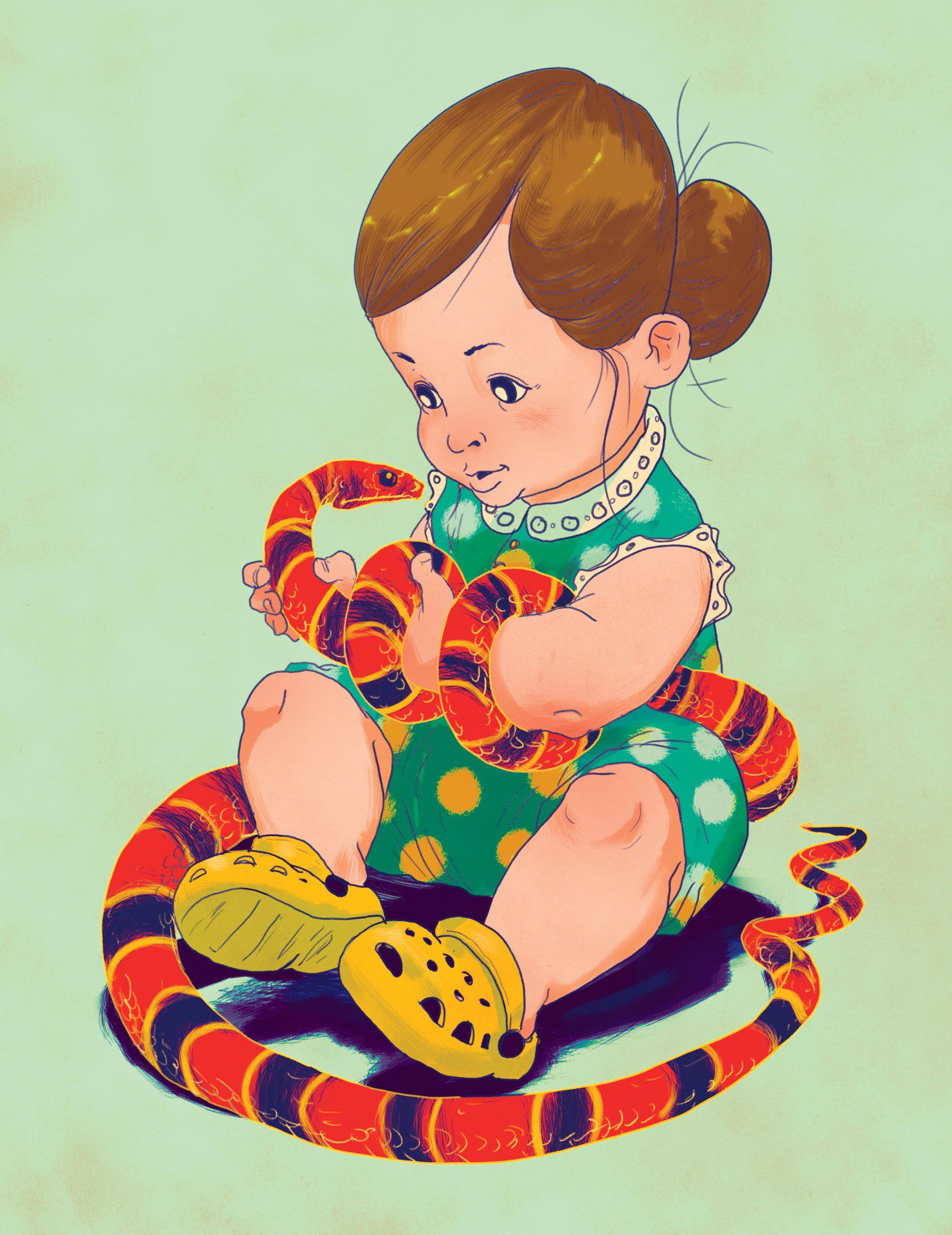
little girl holding a snake

MICHAEL BYERS

It could be there is no lab, just a concept. But it’s a concept that is hard to dismiss. Would you give your child a gene tweak—a swap of a single genetic letter among the 3 billion that run the length of the genome—to prevent Alzheimer’s, the mind thief that’s the seventh-leading cause of death in the US? Polls find that the American public is about evenly split on the ethics of adding disease resistance traits to embryos. A sizable minority, though, would go further. A 2023 survey published in Science found that nearly 30% of people would edit an embryo if it enhanced the resulting child’s chance of attending a top-ranked college. 

The benefits of the genetic variant He claims to be working with were discovered by the Icelandic gene-hunting company deCode Genetics. Twenty-six years ago, in 1998, its founder, a doctor named Kári Stefánsson, got the green light to obtain medical records and DNA from Iceland’s citizens, allowing deCode to amass one of the first large national gene databases. Several similar large biobanks now operate, including one in the United Kingdom, which recently finished sequencing the genomes of 500,000 volunteers. These biobanks make it possible to do computerized searches to find relationships between people’s genetic makeup and real-life differences like how long they live, what diseases they get, and even how much beer they drink. The result is a statistical index of how strongly every possible difference in human DNA affects every trait that can be measured. 

In 2012, deCode’s geneticists used the technique to study a tiny change in the APP gene and determined that the individuals who had it rarely developed Alzheimer’s. They otherwise seemed healthy. In fact, they seemed particularly sharp in old age and appeared to live longer, too. Lab tests confirmed that the change reduces the production of brain plaques, the abnormal clumps of protein that are a hallmark of the disease. 

“This is beginning to be about the essence of who we are as a species.”

Kári Stefánsson, founder and CEO, deCode genetics

One way evolution works is when a small change or error appears in one baby’s DNA. If the change helps that person survive and reproduce, it will tend to become more common in the species—eventually, over many generations, even universal. This process is slow, but it’s visible to science. In 2018, for example, researchers determined that the Bajau, a group indigenous to Indonesia whose members collect food by diving, possess genetic changes associated with bigger spleens. This allows them to store more oxygenated red blood cells—an advantage in their lives. 

Even though the variation in the APP gene seems hugely beneficial, it’s a change that benefits old people, way past their reproductive years. So it’s not the kind of advantage natural selection can readily act on. But we could act on it. That is what technology-assisted evolution would look like—seizing on a variation we think is useful and spreading it. “The way, probably, that enhancement will be done will be to look at the population, look at people who have enhanced capabilities—whatever those might be,” the Israeli medical geneticist Ephrat Levy-Lahad said during a gene-editing summit last year. “You are going to be using variations that already exist in the population that you already have information on.”

One advantage of zeroing in on advantageous DNA changes that already exist in the population is that their effects are pretested. The people located by deCode were in their 80s and 90s. There didn’t seem to be anything different about them—except their unusually clear minds. Their lives—as seen from the computer screens of deCode’s biobank—served as a kind of long-term natural experiment. Yet scientists could not be fully confident placing this variant into an embryo, since the benefits or downsides might differ depending on what other genetic factors are already present, especially other Alzheimer’s risk genes. And it would be difficult to run a study to see what happens. In the case of APP, it would take 70 years for the final evidence to emerge. By that time, the scientists involved would all be dead. 

When I spoke with Stefánsson last year, he made the case both for and against altering genomes with “rare variants of large effect,” like the change in APP. “All of us would like to keep our marbles until we die. There is no question about it. And if you could, by pushing a button, install the kind of protection people with this mutation have, that would be desirable,” he said. But even if the technology to make this edit before birth exists, he says, the risks of doing so seem almost impossible to gauge: “You are not just affecting the person, but all their descendants forever. These are mutations that would allow for further selection and further evolution, so this is beginning to be about the essence of who we are as a species.”

Editing everyone

Some genetic engineers believe that editing embryos, though in theory easy to do, will always be held back by these grave uncertainties. Instead, they say, DNA editing in living adults could become easy enough to be used not only to correct rare diseases but to add enhanced capabilities to those who seek them. If that happens, editing for improvement could spread just as quickly as any consumer technology or medical fad. “I don’t think it’s going to be germline,” says George Church, a Harvard geneticist often sought out for his prognostications. “The 8 billion of us who are alive kind of constitute the marketplace.” For several years, Church has been circulating what he calls “my famous, or infamous, table of enhancements.” It’s a tally of gene variants that lend people superpowers, including APP and another that leads to extra-hard bones, which was found in a family that complained of not being able to stay afloat in swimming pools. The table is infamous because some believe Church’s inclusion of the HIV-protective CCR5 variant inspired He’s effort to edit it into the CRISPR babies.

Church believes novel gene treatments for very serious diseases, once proven, will start leading the way toward enhancements and improvements to people already born. “You’d constantly be tweaking and getting feedback,” he says—something that’s hard to do with the germline, since humans take so long to grow up. Changes to adult bodies would not be passed down, but Church thinks they could easily count as a form of heredity. He notes that railroads, eyeglasses, cell phones—and the knowledge of how to make and use all these technologies—are already all transmitted between generations. “We’re clearly inheriting even things that are inorganic,” he says. 

The biotechnology industry is already finding ways to emulate the effects of rare, beneficial variants. A new category of heart drugs, for instance, mimics the effect of a rare variation in a gene, called PCSK9, that helps maintain cholesterol levels. The variation, initially discovered in a few people in the US and Zimbabwe, blocks the gene’s activity and gives them ultra-low cholesterol levels for life. The drugs, taken every few weeks or months, work by blocking the PCSK9 protein. One biotech company, though, has started trying to edit the DNA of people’s liver cells (the site of cholesterol metabolism) to introduce the same effect permanently. 

For now, gene editing of adult bodies is still challenging and is held back by the difficulty of “delivering” the CRISPR instructions to thousands, or even billions of cells—often using viruses to carry the payloads. Organs like the brain and muscles are hard to access, and the treatments can be ordeals. Fatalities in studies aren’t unheard-of. But biotech companies are pouring dollars into new, sleeker ways to deliver CRISPR to hard-to-reach places. Some are designing special viruses that can home in on specific types of cells. Others are adopting nanoparticles similar to those used in the covid-19 vaccines, with the idea of introducing editors easily, and cheaply, via a shot in the arm. 

At the Innovative Genomics Institute, a center established by Doudna in Berkeley, California, researchers anticipate that as delivery improves, they will be able to create a kind of CRISPR conveyor belt that, with a few clicks of a mouse, allows doctors to design gene-editing treatments for any serious inherited condition that afflicts children, including immune deficiencies so uncommon that no company will take them on. “This is the trend in my field. We can capitalize on human genetics quite quickly, and the scope of the editable human will rapidly expand,” says Urnov, who works at the institute. “We know that already, today—and forget 2124, this is in 2024—we can build enough CRISPR for the entire planet. I really, really think that [this idea of] gene editing in a syringe will grow. And as it does, we’re going to start to face very clearly the question of how we equitably distribute these resources.” 

For now, gene-editing interventions are so complex and costly that only people in wealthy countries are receiving them. The first such therapy to get FDA approval, a treatment for sickle-cell disease, is priced at over $2 million and requires a lengthy hospital stay. Because it’s so difficult to administer, it’s not yet being offered in most of Africa, even though that is where sickle-cell disease is most common. Such disparities are now propelling efforts to greatly simplify gene editing, including a project jointly paid for by the Gates Foundation and the National Institutes of Health that aims to design “shot in the arm” CRISPR, potentially making cures scalable and “accessible to all.” A gene editor built along the lines of the covid-19 vaccine might cost only $1,000. The Gates Foundation sees the technology as a way to widely cure both sickle-cell and HIV—an “unmet need” in Africa, it says. To do that, the foundation is considering introducing into people’s bone marrow the exact HIV-defeating genetic change that He tried to install in embryos. 

Then there’s the risk that gene terrorists, or governments, could change people’s DNA without their permission or knowledge.

Scientists can foresee great benefits ahead—even a “final frontier of molecular liberty,” as Christopher Mason, a “space geneticist” at Weill Cornell Medicine in New York, characterizes it. Mason works with newer types of gene editors that can turn genes on or off temporarily. He is using these in his lab to make cells resistant to radiation damage. The technology could be helpful to astronauts or, he says, for a weekend of “recreational genomics”—say, boosting your repair genes in preparation to visit the site of the Chernobyl power plant. The technique is “getting to be, I actually think it is, a euphoric application of genetic technologies,” says Mason. “We can say, hey, find a spot on the genome and flip a light switch on or off on any given gene to control its expression at a whim.”  

Easy delivery of gene editors to adult bodies could give rise to policy questions just as urgent as the ones raised by the CRISPR babies. Whether we encourage genetic enhancement—in particular, free-market genome upgrades—is one of them. Several online health influencers have already been touting an unsanctioned gene therapy, offered in Honduras, that its creators claim increases muscle mass. Another risk: If changing people’s DNA gets easy enough, gene terrorists or governments could do it without their permission or knowledge. One genetic treatment for a skin disease, approved in the US last year, is formulated as a cream—the first rub-on gene therapy (though not a gene editor). 

Some scientists believe new delivery tools should be kept purposefully complex and cumbersome, so that only experts can use them—a biological version of “security through obscurity.” But that’s not likely to happen. “Building a gene editor to make these changes is no longer, you know, the kind of technology that’s in the realm of 100 people who can do it. This is out there,” says Urnov. “And as delivery improves, I don’t know how we will be able to regulate that.”

man sitting and reading with man behind him

MICHAEL BYERS

In our conversation, Urnov frequently returned to that list of superpowers—genetic variants that make some people outliers in one way or another. There is a mutation that allows people to get by on five hours of sleep a night, with no ill effects. There is a woman in Scotland whose genetic peculiarity means she feels no pain and is perpetually happy, though also forgetful. Then there is Eero Mäntyranta, the cross-country ski champion who won three medals at the 1964 Winter Olympics and who turned out to have an inordinate number of red blood cells thanks to an alteration in a gene called the EPO receptor. It’s basically a blueprint for anyone seeking to join the Enhanced Games, the libertarian plan for a pro-doping international sports competition that critics call “borderline criminal” but which has the backing of billionaire Peter Thiel, among others. 

All these are possibilities for the future of the human genome, and we won’t even necessarily need to change embryos to get there. Some researchers even expect that with some yet-to-be-conceived technology, updating a person’s DNA could become as simple as sending a document via Wi-Fi, with today’s viruses or nanoparticles becoming anachronisms like floppy disks. I asked Church for his prediction about where gene-editing technology is going in the long term. “Eventually you’d get shot up with a whole bunch of things when you’re born, or it could even be introduced during pregnancy,” he said. “You’d have all the advantages without the disadvantages of being stuck with heritable changes.” 

And that will be evolution too.

Want to understand the future of technology? Take a look at this one obscure metal.

This article is from The Spark, MIT Technology Review’s weekly climate newsletter. To receive it in your inbox every Wednesday, sign up here.

On a sunny morning in late spring, I found myself carefully examining an array of somewhat unassuming-looking rocks at the American Museum of Natural History. 

I’ve gotten to see some cutting-edge technologies as a reporter, from high-tech water treatment plants to test nuclear reactors. Peering at samples of dusty reddish monazite and speckled bastnäsite, I saw the potential for innovation there, too. That’s because all the minerals spread out across the desk contain neodymium, a rare earth metal that’s used today in all sorts of devices, from speakers to wind turbines. And it’s likely going to become even more crucial in the future. 

By the time I came to the museum to see some neodymium for myself, I’d been thinking (or perhaps obsessing) about the metal for months—basically since I’d started reporting a story for our upcoming print issue that is finally out online. The story takes a look at what challenges we’ll face with materials for the next century, and neodymium is center stage. Let’s take a look at why I spent so long thinking about this obscure metal, and why I think it reveals so much about the future of technology. 

In the new issue of our print magazine, MIT Technology Review is celebrating its 125th anniversary. But rather than look back to our 1899 founding, the team decided to look forward to the next 125 years. 

I’ve been fascinated with topics like mining, recycling, and alternative technologies since I’ve been reporting on climate. So when I started thinking about the distant future, my mind immediately went to materials. What kind of stuff will we need? Will there be enough of it? How does tech advancement change the picture?

Zooming out to the 2100s and beyond changed the stakes and altered how I thought about some of the familiar topics I’ve been reporting on for years. 

For example, we have enough of the stuff we need to power our world with renewables. But in theory, there is some future point at which we could burn through our existing resources. What happens then? As it turns out, there’s more uncertainty about the amount of resources available than you might imagine. And we can learn a lot from previous efforts to project when the supply of fossil fuels will begin to run out, a concept known as peak oil. 

We can set up systems to reuse and recycle the metals that are most important for our future. These facilities could eventually help us mine less and make material supply steadier and even cheaper. But what happens when the technology these facilities are designed to recycle inevitably changes, possibly rendering old setups obsolete? Predicting what materials will be important, and adjusting efforts to make and reuse them, is complicated to say the least. 

To try to answer these massive questions, I took a careful look at one particular metal: neodymium. It’s a silvery-white rare earth metal, central to powerful magnets that are at the heart of many different technologies, both in the energy sector and beyond. 

Neodymium can stand in for many of the challenges and opportunities we face with materials in the coming century. We’re going to need a lot more of it in the near future, and we could run into some supply constraints as we race to mine enough to meet our needs. It’s possible to recycle the metal to cut down on the extraction needed in the future, and some companies are already trying to set up the infrastructure to do so. 

The world is well on its way to adapting to conditions that are a lot more neodymium-centric. But at the same time, efforts are already underway to build technologies that wouldn’t need neodymium at all. If companies are able to work out an alternative, it could totally flip all our problems, as well as efforts to solve them, upside down. 

Advances in technology can shift the materials we need, and our material demands can push technology to develop in turn. It’s a loop, one that we need to attempt to understand and untangle as we move forward. I hope you’ll read my attempt to start doing that in my feature story here


Now read the rest of The Spark

Related reading

For a more immediate look at the race to produce rare earth metals, check out this feature story by Mureji Fatunde from January. 

I started thinking more deeply about material demand when I was reporting stories about recycling, including this 2023 feature on the battery recycling company Redwood Materials. 

For one example of how companies are trying to develop new technologies that’ll change the materials we need in the future, check out this story about rare-earth-free magnets from earlier this year. 

Another thing

“If we rely on hope, we give up agency. And that may be seductive, but it’s also surrender.”

So writes Lydia Millet, author of over a dozen books, in a new essay about the emotions behind fighting for a future beyond climate change. It was just published online this week. It’s also featured in our upcoming print issue, and I’d highly recommend it. 

Keeping up with climate  

For a look inside what it’s really like to drive a hydrogen car, this reporter rented one and took it on a road trip, speaking to drivers along the way. (The Verge)

→ Here’s why electric vehicles are beating out hydrogen-powered ones in the race to clean up transportation. (MIT Technology Review)

As temperatures climb, we’ve got a hot steel problem on our hands. Heat can cause steel, as well as other materials like concrete, to expand or warp, which can cause problems from slowing down trains to reducing the amount of electricity that power lines can carry. (The Atlantic)

Oakland is the first city in the US running all-electric school buses. And the vehicles aren’t only ferrying kids around; they’re also able to use their batteries to help the grid when it’s needed. (Electrek)

Form Energy plans to build the largest battery installation in the world in Maine. The system, which will use the company’s novel iron-air chemistry, will be capable of storing 8,500 megawatt-hours’ worth of energy. (Canary Media)

→ We named Form one of our 15 Climate Tech companies to watch in 2023. (MIT Technology Review)

In one of the more interesting uses I’ve seen for electric vehicles, Brussels has replaced horse-drawn carriages with battery-powered ones. They look a little like old-timey cars, and operators say business hasn’t slowed down since the switch. (New York Times)

Homeowners are cashing in on billions of dollars in tax credits in the US. The money, which rewards use of technologies that help make homes more energy efficient and cut emissions, is disproportionately going to wealthier households. (E&E News)

Airlines are making big promises about using new jet fuels that can help cut emissions. Much of the industry aims to reach 10% alternative fuel use by the end of the decade. Actual rates hit 0.17% in 2023. (Bloomberg)

Solar farms can’t get enough sheep—they’re great landscaping partners. Soon, 6,000 sheep will be helping keep the grass in check between panels in what will be the largest solar grazing project in the US. (Canary Media)