Mediavine Bans Publisher For Overuse Of AI-Generated Content via @sejournal, @MattGSouthern

According to details surfacing online, ad management firm Mediavine is terminating publishers’ accounts for overusing AI.

Mediavine is a leading ad management company providing products and services to help website publishers monetize their content.

The company holds elite status as a Google Certified Publishing Partner, which indicates that it meets Google’s highest standards and requirements for ad networks and exchanges.

AI Content Triggers Account Terminations

The terminations came to light in a post on the Reddit forum r/Blogging, where a user shared an email they received from Mediavine citing “overuse of artificially created content.”

Trista Jensen, Mediavine’s Director of Ad Operations & Market Quality, states in the email:

“Our third party content quality tools have flagged your sites for overuse of artificially created content. Further internal investigation has confirmed those findings.”

Jensen stated that due to the overuse of AI content, “our top partners will stop spending on your sites, which will negatively affect future monetization efforts.”

Consequently, Mediavine terminated the publisher’s account “effective immediately.”

The Risks Of Low-Quality AI Content

This strict enforcement aligns with Mediavine’s publicly stated policy prohibiting websites from using “low-quality, mass-produced, unedited or undisclosed AI content that is scraped from other websites.”

In a March 7 blog post titled “AI and Our Commitment to a Creator-First Future,” the company declared opposition to low-value AI content that could “devalue the contributions of legitimate content creators.”

Mediavine warned in the post:

“Without publishers, there is no open web. There is no content to train the models that power AI. There is no internet.”

The company says it’s using its platform to “advocate for publishers” and uphold quality standards in the face of AI’s disruptive potential.

Mediavine states:

“We’re also developing faster, automated tools to help us identify low-quality, mass-produced AI content across the web.”

Targeting ‘AI Clickbait Kingpin’ Tactics

While the Reddit user’s identity wasn’t disclosed, the incident has drawn connections to the tactics of Nebojša Vujinović Vujo, who was dubbed an “AI Clickbait Kingpin” in a recent Wired exposé.

According to Wired, Vujo acquired over 2,000 dormant domains and populated them with AI-generated, search-optimized content designed purely to capture ad revenue.

His strategies represent the low-quality, artificial content Mediavine has vowed to prohibit.

Potential Implications

Lost Revenue

Mediavine’s terminations highlight potential implications for publishers that rely on artificial intelligence to generate website content at scale.

Perhaps the most immediate and tangible implication is the risk of losing ad revenue.

For publishers that depend heavily on programmatic advertising or sponsored content deals as key revenue drivers, being blocked from major ad networks could devastate their business models.

Devalued Domains

Another potential impact is the devaluation of domains and websites built primarily on AI-generated content.

If this pattern of AI content overuse triggers account terminations from companies like Mediavine, it could drastically diminish the value proposition of scooping up these domains.

Damaged Reputations & Brands

Beyond the lost monetization opportunities, publishers leaning too heavily into automated AI content also risk permanent reputational damage to their brands.

Once a determining authority flags a website for AI overuse, it could impact how that site is perceived by readers, other industry partners, and search engines.

In Summary

AI has value as an assistive tool for publishers, but relying heavily on automated content creation poses significant risks.

These include monetization challenges, potential reputation damage, and increasing regulatory scrutiny. Mediavine’s strict policy illustrates the possible consequences for publishers.

It’s important to note that Mediavine’s move to terminate publisher accounts over AI content overuse represents an independent policy stance taken by the ad management firm itself.

The action doesn’t directly reflect the content policies or enforcement positions of Google, whose publishing partner program Mediavine is certified under.

We have reached out to Mediavine requesting a comment on this story. We’ll update this article with more information when it’s provided.


Featured Image: Simple Line/Shutterstock

August Update from IAB Shows Ad Spend & Opportunities For Growth In 2024 via @sejournal, @gregjarboe

This morning, The Outlook Study: August Update has been released by the IAB as an update to their initial November 2023 study and provides a snapshot of projected ad spend, opportunities, and challenges for the remainder of 2024.

The study outlines the shifts that have occurred throughout the year, capturing current perspectives from buy-side ad investment decision-makers at brands and agencies.

Here are some of the key takeaways for digital marketers:

  • Buyers increased their 2024 ad spend projections from +9.5% projected at the end of 2023 to +11.8% today.
  • Nearly all channels are expected to post higher growth rates year-over-year (YoY), with even Linear TV rebounding.
  • Retail media’s ascent continues, with buyers revising YoY projections from +21.8% to +25.1%.
  • Buyers continue to focus on cross-funnel KPIs while shifting efforts towards reach optimization as interest in new KPIs wanes.
  • Measurement challenges persist for the industry, while economic concerns subside.

In other words, it’s time to spring forward, not fall back, in the media and marketing industries.

Buyers’ Ad Spending Forecasts For 2024 Have Been Revised Upward

The increase in projections is not what many digital marketers were expecting, so what is happening in the changing industry landscape?

Increased ad spending in the second half of 2024 is being driven by increased political spending around the presidential election and other cyclical events, such as the Summer Olympic games.

Based on IAB’s recent email survey of 200 buy-side ad investment decision-makers, primarily at brands and agencies, nearly all channels are expected to post higher growth rates YoY.

Yes, even linear TV is now expected to grow 4.3%, but nine other channels are expected to grow at even faster rates:

  • Connected TV (CTV) by 18.4%.
  • Social media by 16.3%.
  • Paid search by 13.1%.
  • Podcasts by 12.6%.
  • Digital video excluding CTV by 12.5%.
  • Digital out-of-home (OOH) by 8.9%.
  • Digital audio, excluding podcasts, by 8.3%.
  • Digital display by 7.4%.
  • Gaming by 5.1%.

Why Is Retail Media Expected To Continue Growing?

Buyers – particularly in the consumer-packed goods (CPG) and the beauty categories – are set to surge in the U.S. this year, pushing overall retail media ad spending to reach one-fifth of the total 2024 ad spend.

Okay, these are the reasons to spring forward, even if we’re on the verge of fall. But there are a couple of challenges that digital marketers still face.

For example, there’s been a decline in focus on new ad KPIs (e.g., attention metrics, weighted CAC, etc.), which suggests there’s been a renewed interest in refining and leveraging established metrics to achieve cross-funnel goals.

However, goals can vary by channel.

As I mentioned this summer in “Business Outcomes Are The Top KPI Of Video Ad Buyers – IAB Report Part Two,” IAB’s latest Digital Video report found that within the digital video channel, buyers are determining success via business outcomes, i.e., sales, store/website visits, etc.

So, figuring out how to use Google Analytics 4 (GA4) to measure business outcomes instead of marketing outputs remains “the road less traveled.”

Understanding Evolving Consumer Habits Is A Growing Concern

While economic worries have faded, the concern over executing cross-channel media measurement has risen.

The resilient economy, marked by a 2.3% rise in consumer spending in Q2 2024, has eased buyers’ concerns.

But, as media convergence gains traction, cross-channel measurement remains a top priority, especially for large advertisers that spend over $50 million annually.

Other concerns, like managing reach and frequency across screens and channels, as well as media inflation, have remained flat.

Understanding evolving consumer habits is a growing concern – and is keeping significantly more buyers up at night than it did last year.

It does seem like it’s time to spring forward in the media and marketing industries, although this has traditionally been the season when digital marketers prepare to fall back.

All data above has been taken from The 2024 Outlook Study: August Update – A Snapshot into Ad Spend, Opportunities, and Strategies for Growth by the IAB. The study is a follow-up to the initial November 2023 release, providing current perspectives from 200 buy-side ad investment decision makers at brands and agencies.

More resources: 


Featured Image: SeventyFour/Shutterstock

Google Introduces New Consent Management Tools For Advertisers via @sejournal, @MattGSouthern

Google has announced changes to its consent management tools to address the challenges advertisers face with evolving privacy regulations.

According to Google’s Ads Liaison, Ginny Marvin, the new integrated Consent Management Platform (CMP) setup will roll out globally over the next few weeks.

Consent Management Update

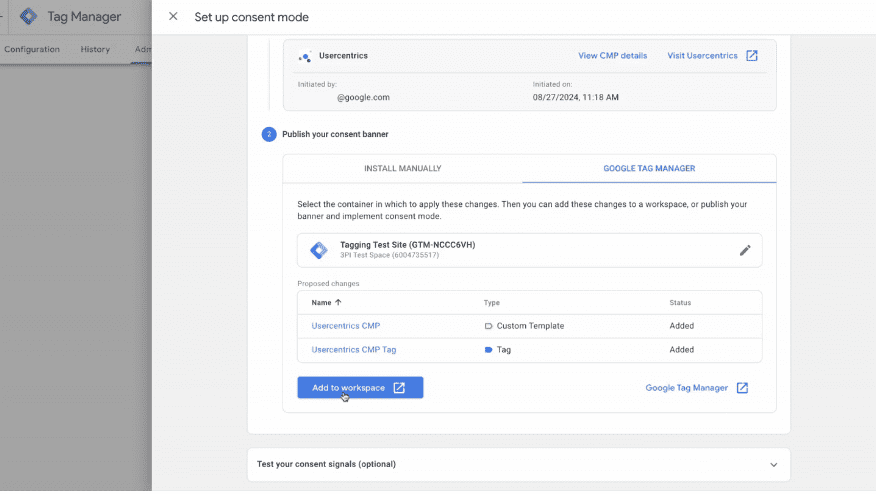
The update integrates with several of Google’s CMP partners within the Google Tag user interface across Google Ads, Google Analytics 4, and Google Tag Manager.

Screenshot from: support.google.com, August 2024.

This change affects how advertisers can manage consent banners and deploy consent mode.

Marvin stated:

“Working with one of Google’s CMP Partners is typically the easiest way to manage consent banner and consent mode deployment. Now the consent mode setup in the Google Tag UI integrates directly with many of these partners.”

Features Of The New Setup

The integrated CMP setup includes:

  1. Guidance within the product interface
  2. Integration with various CMP providers
  3. Options for banner installation

Current CMP Partners

Four CMP providers are currently integrated with the new setup:

  1. consentmanager
  2. Cookiebot by Usercentrics
  3. iubenda
  4. Usercentrics

Broader Context

This update follows recent changes to digital privacy practices and regulations.

Earlier this year, Google updated its consent mode API with two new consent collection parameters.

In a blog post, Google noted,

“As privacy regulations evolve and technologies shift, we’ve continued to build tools that help advertisers succeed while respecting consumer choice.”

How This Can Benefit You

Google’s new integrated CMP setup could offer several advantages:

  • Easier Setup: Less technical hassle when implementing consent management.
  • Better Compliance: A streamlined process may help with GDPR adherence.
  • Data Accuracy: Aims to maintain measurement quality while respecting consent.
  • One-Stop Shop: Consent management directly in Google’s ad and analytics platforms.
  • Future-Proofing: Potentially quicker adaptation to evolving privacy rules.

The actual impact and effectiveness remain to be seen as they roll out to users.

Industry Outlook

As the digital advertising industry adapts to privacy concerns, these updates represent one approach to balancing advertiser needs with data protection requirements.

Advertisers must assess how these changes fit into their broader data strategies and compliance efforts.

Staying on top of these updates is key as the ad tech world navigates the privacy-first era.


Featured Image: Daniel Pawer/Shutterstock

Google Halts AdSense Monetization For Russia-Based Publishers via @sejournal, @MattGSouthern

Google’s halting ad monetization for Russian publishers on AdSense, AdMob, and Ad Manager, effective August 12, citing “ongoing developments” in the country.

This impacts Russian digital publishers, content creators, and app devs who use these platforms for revenue generation through ad impressions and clicks.

Background & Context

Google’s decision to halt ad monetization in Russia is not an isolated incident but part of a series of actions the company has taken since 2022 amid geopolitical tensions.

Previous measures include:

  • Halting ad serving to users in Russia in March 2022
  • Demonetizing content that exploited, dismissed, or condoned the conflict in Ukraine
  • Cracking down on state-sponsored YouTube channels and videos, blocking over 1,000 channels and 5.5 million videos

Google will make final payouts to eligible Russian AdSense users in late August, provided there are no payment issues and minimum thresholds are met.

This closes a revenue source for Russian creators who’ve been monetizing non-Russian traffic up to this point.

Google’s latest move has drawn criticism from some Russian officials. Anton Gorelkin, deputy head of Russia’s parliamentary committee on information policy, stated on Telegram that Google is “segregating citizens according to nationality” and supporting the division of the online space.

Potential Impact

The financial impact on Russian content creators could be substantial. Many have used these platforms to monetize traffic from both domestic and international audiences.

With this revenue stream now cut off, creators may need to explore alternative monetization methods or potentially face income reductions.

Beyond individual creators, this move could have broader implications for the Russian digital economy.

As a major player in the global digital advertising market, Google’s withdrawal may create a void that local Russian ad networks might struggle to fill completely.

This could lead to a decrease in overall digital ad spending within the country and potentially affect the quality and quantity of content available to Russian internet users.

Looking Ahead

Google’s exit from Russia’s ad market will force local publishers to pivot. They’ll likely explore alternative platforms or rev streams. This could boost Russian ad tech development, potentially siloing the RuNet further.

We may see similar actions from other companies as geopolitical tensions persist.


Featured Image: Mojahid Mottakin/Shutterstock

Top 7 Most Emotionally Engaging Olympics Ads (P&G Campaigns Are Winning) via @sejournal, @gregjarboe

With the 2024 Olympic Games in Paris officially opening today, DAIVID used its advanced content testing platform to see which ads from the global sporting event have elicited the most intense positive emotions of all time.

Procter & Gamble (P&G) dominates DAIVID’s chart, with five of the top seven ads – including the top three positions.

So, the rest of the search and marketing community will want to figure out what the American multinational consumer goods corporation headquartered in Cincinnati, Ohio has understood for more than a dozen years.

1. P&G Thank You, Mom – Sochi 2014 Olympic Winter Games

A P&G 2014 Winter Olympics campaign honoring the crucial support mothers provide to athletes is the most emotionally engaging Olympic ad ever.

This accolade comes from DAIVID, a creative effectiveness platform, which found that the “Pick Them Back Up” campaign evoked the strongest positive emotions among viewers.

“P&G Thank You, Mom | Pick Them Back Up | Sochi 2014 Olympic Winter Games” led the chart with 59.6% of viewers responding with intense positive emotions. As the video’s description says, “For teaching us that falling only makes us stronger. For giving us the encouragement to try again. Thank you, Mom.”

2. P&G – Thank You, Mom – The Winter Olympics (2018)

Following the (emotional) success from 2014, Thank You, Mom – The Winter Olympics (2018) was close behind in second place with a score of 59.5%.

This video guides the viewer through moms supporting their kids with their dreams and through their circumstances – whether it be bias over color, religion, disability, or sexual orientation.

3. P&G ‘Thank You Mom’ Commercial: “Best Job” (London 2012 Olympics)

P&G’s ad from the London 2012 Olympics took third place, with 58.4% of viewers responding with intense positive emotions.

In this 2012 edition of Procter & Gamble’s ad campaign, supportive mothers take their children to practices and help the kids deal with setbacks on their way to becoming successful Olympic athletes.

4. National Lottery Funded Athletes – TV Extended Version

The UK’s National Lottery ad, ” National Lottery funded athletes – TV advert Extended Version,” took fourth place with a score of 56.9%.

It was inspired by the story of 800-meter runner Jenny Meadows’ mother and showcased how National Lottery funding supports British athletes in achieving their dreams.

5. P&G ‘Thank You, Mom’ Campaign Ad: Strong (Rio 2016 Olympics)

Another from P&G’s Thank You, Mom series for the Rio 2016 Olympics was placed fifth, with 55.9% of viewers responding with intense positive emotions.

In this two-minute commercial, P&G features supportive mothers helping their children persevere through difficult circumstances on their way to becoming Olympic champions.

The brand positions itself as the “Proud sponsor of Moms” and uses the tagline: “It takes someone strong to make someone strong. Thank you, Mom.”

6. We’re The Superhumans – Rio Paralympics 2016

Channel 4, a British free-to-air public broadcast television channel, took sixth place with its “Superhumans” trailer for the Rio Paralympics 2016. The 3-minute video ad got a score of 55.7%.

7. Procter & Gamble – Your Goodness Is Your Greatness

Your Goodness is Your Greatness from P&G took seventh place, with 55.5% of viewers responding with intense positive emotions.

Now, P&G was founded in 1837 by William Procter and James Gamble. Do you think this gave them a head start on the rest of the field?

DAIVID CEO’s Insights

In a press release, Ian Forrester, CEO and founder of DAIVID, said:

“When it comes to emotional Olympic campaigns, no brand has ever gone faster, higher or stronger than P&G.

The company’s incredible tributes to the role mums play in helping to put future Olympic champions on the path to Games glory really tug at the emotional heartstrings and are capable of turning even the most cynical viewers into emotional wrecks.

‘Pick Them Back Up’ is a worthy gold winner, generating some of the most intense feelings of positivity we’ve ever seen for an ad.”

He added, “It’s also great to see Channel 4’s sensational campaign, ‘We’re The Superhumans’ in the top 6. Generating incredibly intense feelings of inspiration, the ad has played a crucial role in putting the Paralympics firmly in the hearts and minds of viewers all around the world.”

What can I add?

I’ve known Forrester since September 2012, when he joined the Unruly Group as global insight lead. And I talked with him several times over the next six years about Unruly’s Viral Spiral charts, which showed which video ads were among the most shared.

So, I’ve learned that Forrester has the kind of Experience, Expertise, Authoritativeness, and Trustworthiness (E-E-A-T) that not only Google talks about, but skeptical journalists and bloggers value, too.

That’s why I’ve quoted him – along with other video gurus – in articles like “What’s The Alternative To Spending $7 Million On A Super Bowl Ad?” as well as “How To Make A Video Go Viral.”

And that’s why I’ve cited DAIVID’s critical data and strategic insights in articles like “The Best 5 Super Bowl Ads in 2024 (Brands That Got It Right)” as well as “39 Emotions Digital Marketers Can Use In Advertising.”

But if you want to figure out what P&G already understands, then it’s worth spending a few moments learning more about DAIVID’s methodology.

Check Out DAIVID’s Methodology

Based in London, DAIVID leverages technologies like facial coding, eye tracking, and computer vision to help advertisers enhance the emotional and business impact of their campaigns.

Their platform allows marketers to assess and improve ad effectiveness on a large scale using advanced data analysis methods.

DAIVID’s study of the most emotionally engaging Olympics ads utilized its Self-Serve solution, trained on millions of consumer data points, to predict the emotional reactions and attention levels ads would generate, along with their potential brand and business impacts.

The analysis involved 56 Olympic ads, excluding those from the current Paris Olympics.

Watch For Yourself To See Why These Videos Trigger Emotion

So, watch the seven ads above and see for yourself what kind of video content triggers intense positive emotions in viewers. You may see something that I might have missed.

But the next time you want to know if your ad creative is working, test it. I know, talking about testing social videos the way that Madison Avenue once tested TV commercials seems like pie in the sky.

But with AI as your co-pilot, making creative testing affordable, you can fix problems and identify solutions faster and easier than it could back in the old days.

Okay, this may not bring tears to your eyes – like “Pick Them Back Up” probably will – but it can help you catch up with P&G, which already has a 12-year head start.

More resources: 


Featured Image: Gorodenkoff/Shutterstock

Google Abandons Third-Party Cookie Phaseout via @sejournal, @MattGSouthern

Google has announced it will no longer phase out third-party cookies in Chrome.

Instead, it’s trying a new approach that emphasizes user choice and control over their web browsing privacy.

Major Policy Reversal

For years, the company had been working towards eliminating third-party cookies, repeatedly delaying the implementation due to various challenges.

Instead of deprecating these cookies, Google will introduce a new experience in Chrome that allows users to make informed choices about their privacy settings.

Anthony Chavez, VP of Privacy Sandbox at Google, stated in the announcement:

“We are proposing an updated approach that elevates user choice. Instead of deprecating third-party cookies, we would introduce a new experience in Chrome that lets people make an informed choice that applies across their web browsing, and they’d be able to adjust that choice at any time.”

User Control At The Forefront

Under this new proposal, Chrome users can set their privacy preferences, which will apply across their web browsing activities.

This pivot comes after extensive feedback from various stakeholders, including regulators like the UK’s Competition and Markets Authority (CMA) and Information Commissioner’s Office (ICO), as well as publishers, web developers, standards groups, civil society, and advertising industry participants.

Continued Commitment To Privacy Sandbox

Despite this major change in direction, Google remains committed to its Privacy Sandbox initiative. The company plans to continue developing and offering Privacy Sandbox APIs to improve privacy protection and utility for those who choose to use them.

Additionally, Google intends to introduce IP Protection into Chrome’s Incognito mode, further enhancing user privacy options.

Implications For the Digital Advertising Landscape

This reversal is likely to have far-reaching implications for the digital advertising industry. Advertisers and publishers preparing for a cookieless future may need to reassess their strategies.

Google has stated that it will continue to consult with the CMA, ICO, and other global regulators as it finalizes its new approach. The company also intends to engage with the industry as it rolls out these changes.

In Summary

As Google shifts its approach to third-party cookies, here are key points to remember:

  • Google isn’t phasing out third-party cookies as previously planned.
  • Users will have more control over their privacy settings in Chrome.
  • The Privacy Sandbox project will continue, offering alternative technologies.
  • This change will affect advertisers, publishers, and users differently.
  • The full impact of this decision on the digital advertising landscape remains to be seen.

Featured Image: photosince/Shutterstock

New Google Lens Ads Mimic AI Search Results via @sejournal, @martinibuster

A keynote at Google’s Marketing Live event showed a new AI-powered visual search results that feature advertisements that engage users within the context of an AI-Assisted search, blurring the line between AI-generated search results and advertisements.

Google Lens is a truly helpful app but it becomes unconventional where it blurs the line between an assistant helping users and being led to a shopping cart. This new way of engaging potential customers with AI is so far out there that the presenter doesn’t even call it advertising, he doesn’t even use the word.

Visual Search Traffic Opportunity?

Google’s Group Product Manager Sylvanus Bent, begins the presentation with an overview of the next version of Google Lens visual search that will be useful for surfacing information and for help finding where to buy them.

Sylvanus explained how it will be an opportunity for websites to receive traffic from this new way to search.

“…whether you’re snapping a photo with lens or circling to search something on your social feed, visual search unlocks new ways to explore whatever catches your eye, and we recently announced a newly redesigned results page for Visual search.

Soon, instead of just visual matches, you’ll see a wide range of results, from images to video, web links, and facts about the knowledge graph. It gets people the helpful information they need and creates new opportunities for sites to be discovered.”

It’s hard to say whether or not this will bring search traffic to websites and what the quality of that traffic will be. Will they stick around to read an article? Will they engage with a product review?

Visual Search Results

Sylvanus shares a hypothetical example of someone at an airport baggage claim who falls in like with someone else’s bag. He explains that all the person needs to do is snap a photo of the luggage bag and Google Lens will take them directly to shopping options.

Screenshot Of Shopping Ads ad the top of a Google Lens visual search

He explains:

“No words, no problem. Just open Lens, take a quick picture and immediately you’ll see options to purchase.

And for the first time, shopping ads will appear at the very top of the results on linked searches, where a business can offer what a consumer is looking for.

This will help them easily purchase something that catches their eye.”

These are image-heavy shopping ads at the top of the search results and as annoying as that may be it’s nowhere near the “next level” advertising that is coming to Google’s new version of visual search where Google presents a paid promotion within the context of an AI Assistant.

Interactive Search Shopping

Sylvanus next describes an AI-powered form advertising that happens directly within search. But he doesn’t call it advertising. He doesn’t even use the word advertising. He suggests this new form of AI search experience is more than offer, saying that, “it’s an experience.”

He’s right to not use the word advertisement because what he describes goes far beyond advertising and blurs the boundaries between search and advertising within the context of AI-powered suggestions, paid suggestions.

Sylvanus explains how this new form of shopping experience works:

“And next, imagine a world where every search ad is more than an offer. It’s an experience. It’s a new way for you to engage more directly with your customers. And we’re exploring search ads with AI powered recommendations across different verticals. So I want to show you an example that’s going live soon and you’ll see even more when we get to shopping.”

He uses the example of someone who needs to store their furniture for a few months and who turns to Google to find short term storage. What he describes is a query for local short term storage that turns into a “dynamic ad experience” that leads the searcher into throwing packing supplies into their shopping cart.

He narrated how it works:

“You search for short term storage and you see an ad for extra space storage. Now you can click into a new dynamic ad experience.

You can select and upload photos of the different rooms in your house, showing how much furniture you have, and then extra space storage with help from Google, AI generates a description of all your belongings for you to verify. You get a recommendation for the right size and type of storage unit and even how much packing supplies you need to get the job done. Then you just go to the website to complete the transaction.

And this is taking the definition of a helpful ad to the next level. It does everything but physically pick up your stuff and move it, and that is cool.”

Step 1: Search For Short Term Storage

The above screenshot shows an advertisement that when clicked takes the user to what looks like an AI-assisted search but is really an interactive advertisement.

Step 2: Upload Photos For “AI Assistance”

The above image is a screenshot of an advertisement that is presented in the context of AI-assisted search.  Masking an advertisement within a different context is the same principal behind an advertorial where an advertisement is hidden in the form of an article. The phrases “Let AI do the heavy lifting” and “AI-powered recommendations” create the context of AI-search that masks the true context of an advertisement.

Step 3: Images Chosen For Uploading

The above screenshot shows how a user uploads an image to the AI-powered advertisement within the context of an AI-powered search app.

The Word “App” Masks That This Is An Ad

Screenshot of interactive advertisement for that identifies itself as an app with the words

Above is a screenshot of how a user uploads a photo to the AI-powered interactive advertisement within the context of a visual search engine, using the word “app” to further the illusion that the user is interacting with an app and not an advertisement.

Upload Process Masks The Advertising Context

Screenshot of interactive advertisement that uses the context of an AI Assistant to mask that this is an advertisement

The phrase “Generative AI is experimental” contributes to the illusion that this is an AI-assisted search.

Step 4: Upload Confirmation

In step 4 the “app” advertisement is for confirming that the AI correctly identified the furniture that needs to be put into storage.

Step 5: AI “Recommendations”

The above screenshot shows “AI recommendations” that look like search results.

The Recommendations Are Ad Units

Those recommendations are actually ad units that when clicked takes the user to the “Extra Space Storage” shopping website.

Step 6: Searcher Visits Advertiser Website

Blurring The Boundaries

What the Google keynote speaker describes is the integration of paid product suggestions into an AI assisted search. This kind of advertising is so far out there that the Googler doesn’t even call it advertising and rightfully so because what this does is blur the line between AI assisted search and advertising. At what point does a helpful AI search become just a platform for using AI to offer paid suggestions?

Watch The Keynote At The 32 Minute Mark

Featured Image by Shutterstock/Ljupco Smokovski

7 Ways AI Took My Job [To The Next Level] via @sejournal, @CallRail

With AI-powered call attribution, you can gain valuable insights into which channels are driving the most conversions.

How Call Attribution Works

  • Step 1: Assign – Select unique call tracking numbers to assign to each campaign or listing.
  • Step 2: Track – Potential customers see your ad or listing and call the associated phone number.
  • Step 3: Forward –The calls ring directly into your main business phone, regardless of which number they use.
  • Step 4: Analyze – Because they used one of your tracking numbers, you instantly know which ad or campaign inspired them to call.

With AI-powered call tracking, gone are the days of wondering how your digital marketing efforts are tied to high-value inbound calls.

For agencies, this helps prove the real value of your services and extend the life of your client relationships.

2. AI Can Help You Save Time On Manually Reviewing Calls

Listening to and analyzing phone calls manually can be time-consuming and inefficient for agencies.

However, it’s an important part of understanding the customer experience and sales team performance.

With AI-powered call analysis tools, you get quality, keyword-tagged transcriptions with near-human-level accuracy.

Not only can this technology help you save over 50% of the time spent listening to phone calls, but it can also help you deliver actionable recommendations to clients and drive better results.

Conversation Intelligence, for instance, is trained on over 1.1M hours of voice data and enables real-time analysis for instantaneous results.

This advanced tool provides opportunities for you to improve your strategy through the following granular insights:

  • Spotting disparities in the industry-specific lingo your sales team uses, compared to the lingo your prospects are using to describe their business challenges and goals.
  • Identifying trends or gaps in your service offerings based on what your prospects are asking for.
  • Identifying frequently asked questions and other important topics to address through content marketing.
  • Setting goals for lead qualification — not just the quantity of leads generated for your business.

Conversational AI is perfectly suited to summarize the content of long conversations – however, the call summaries still require a human to read them and determine the main takeaways.

But if you work in a bustling small business, it’s unlikely you’d have the bandwidth for tasks such as call transcription, summaries, keyword spotting, or trend analysis.

Rather than displacing human labor, conversational AI is assisting businesses in taking on tasks that may have been overlooked and leveraging data that would otherwise remain untapped.

3. AI Can Help You Lower Cost Per Lead / Save Money On Tools & Ad Spend

Ever wonder why certain campaigns take off while others fall flat? It’s all in the data!

Even failed campaigns can offer invaluable insights into your client’s audience and messaging.

But if you can’t spot the underperformers quickly enough, you risk wasting your ad budget on ineffective tactics.

The quicker you can identify what’s working and what’s not, the quicker you can pivot and adjust your marketing strategy.

With AI-powered tools, agencies can access instant insights that enable them to reduce wasteful spending and improve overall campaign efficiency.

How To Deliver More Value With AI

  • Make a bigger impact in less time: AI-powered technology creates a force multiplier within your agency, allowing you to make more of an impact with the same level of inputs you’re already using.
  • Unlock actionable insights from call data: AI is revolutionizing the way companies leverage call data by enabling them to gain insights at scale. As a result, businesses can increase their ROI and deliver greater value to their clients by analyzing hundreds of calls efficiently.
  • Foster alignment with data-driven strategies: By analyzing customer conversations with AI, businesses can align their marketing strategy with data-driven recommendations, enhancing overall coherence. Additionally, the ability to create triggers based on specific phrases enables automated analysis and reporting, further streamlining the alignment process.
  • Drive effectiveness with rapid insights: Leveraging Conversation Intelligence enables agencies to deliver better insights faster, increase conversion rates, refine keyword strategies, and develop robust reporting capabilities.

With the right AI-powered tools, you can access the insights you need to ensure maximum ROI for your clients.

4. AI Can Help You Improve Overall Agency Efficiency

Are you spending too much valuable time on tasks that produce minimal results?

Many agencies find themselves bogged down by routine, administrative tasks that don’t contribute much to their bottom line.

But with AI automation, agencies can streamline their operations and redirect their energy towards more strategic endeavors.

From email scheduling and social media posting to data entry and report generation, AI can handle a wide array of tasks with precision and efficiency – giving you time to focus on high-impact activities that drive growth and deliver tangible results.

Ways Your Business Can Benefit From Automation

  1. Automatically transcribe your calls to boost close rates: See how your team is handling difficult objections and ensure that they’re delivering your businessʼ value proposition in an effective manner.
  2. Score calls based on quality and opportunity: Take the time-consuming work out of scoring your calls and determine which campaigns drive the best calls to your business.
  3. Classify calls by your set criteria: Qualify, score, tag, or assign a value to the leads that meet your criteria, automatically.
  4. Automatically redact sensitive information: Protect your customers by removing billing or personal information. Keep your data safe and secure through complete HIPAA compliance.
  5. Monitor your teamsʼ performance: Use Conversation Intelligence as a valuable sales training tool to ensure your team doesn’t miss any key messaging marks.
  6. Know your customersʼ needs: Identify conversation trends in your phone calls and stay privy to evolving customer needs.
  7. Improve your digital marketing strategy: Use AI-powered insights to inform your digital marketing strategy and boost your online presence.

By automating mundane tasks, agencies can optimize workflows, increase productivity, and improve efficiency across the board.

Looking for 5 – 7? Download The Full Guide

Rather than fearing AI, the future belongs to those who embrace it.

By strategically combining human creativity with artificial intelligence, you can unlock capabilities that transcend what either could achieve alone.

Want to discover even more ways to level up your agency with AI?

Get the full guide here.