Mt. Stupid Has A Pricing Page via @sejournal, @pedrodias

“There is now ample evidence, collected over the last few years, that AI systems are unpredictable and difficult to control.” That’s Dario Amodei in January, writing about the technology his company sells.

Compare with what’s on your LinkedIn timeline this week. Here’s the script: Schema markup ensures AI engines parse your content. The first sentence of every section must be the answer. Optimize for chunk-level retrieval. There’s a 13% citation lift available if you do X, a 2.8x conversion improvement if you do Y.

It’s one of the cleanest patterns going right now, and the industry has elected not to notice. The people closest to these systems are increasingly cautious about claims of control. The people furthest from it are increasingly certain they know how it works … they’ve cracked it. That gradient runs the wrong way.

What The People Who Built It Actually Say

Anthropic published its main interpretability research post in May 2024. It opens:

“We mostly treat AI models as a black box: something goes in and a response comes out, and it’s not clear why the model gave that particular response instead of another.”

Anthropic, writing about its own model, two years ago.

Things haven’t gotten more confident since. Neel Nanda, who runs Google DeepMind’s mechanistic interpretability team, gave an interview to 80,000 Hours in September 2025 in which the headline finding was that the most ambitious version of mech interp is probably dead. He doesn’t see a realistic world where the discipline delivers “the kind of robust guarantees that some people want from interpretability.” Worth re-reading.

The person whose job is to read AI minds is publicly conceding that the project, as originally conceived, won’t get there.

At NeurIPS 2024, Ilya Sutskever, co-founder of Safe Superintelligence and formerly chief scientist at OpenAI, accepted his Test of Time award and used the platform to say something the room wasn’t expecting from him:

“The more it reasons, the more unpredictable it becomes.”

Sutskever’s career is essentially the scaling hypothesis with a face on it. Hearing him say the next phase produces less predictable outputs is itself an admission.

Now scroll back to your timeline. The gradient is Dunning-Kruger redrawn at an industry scale: Mt. Stupid with a pricing page, and the valley of calibration where the actual work happens.
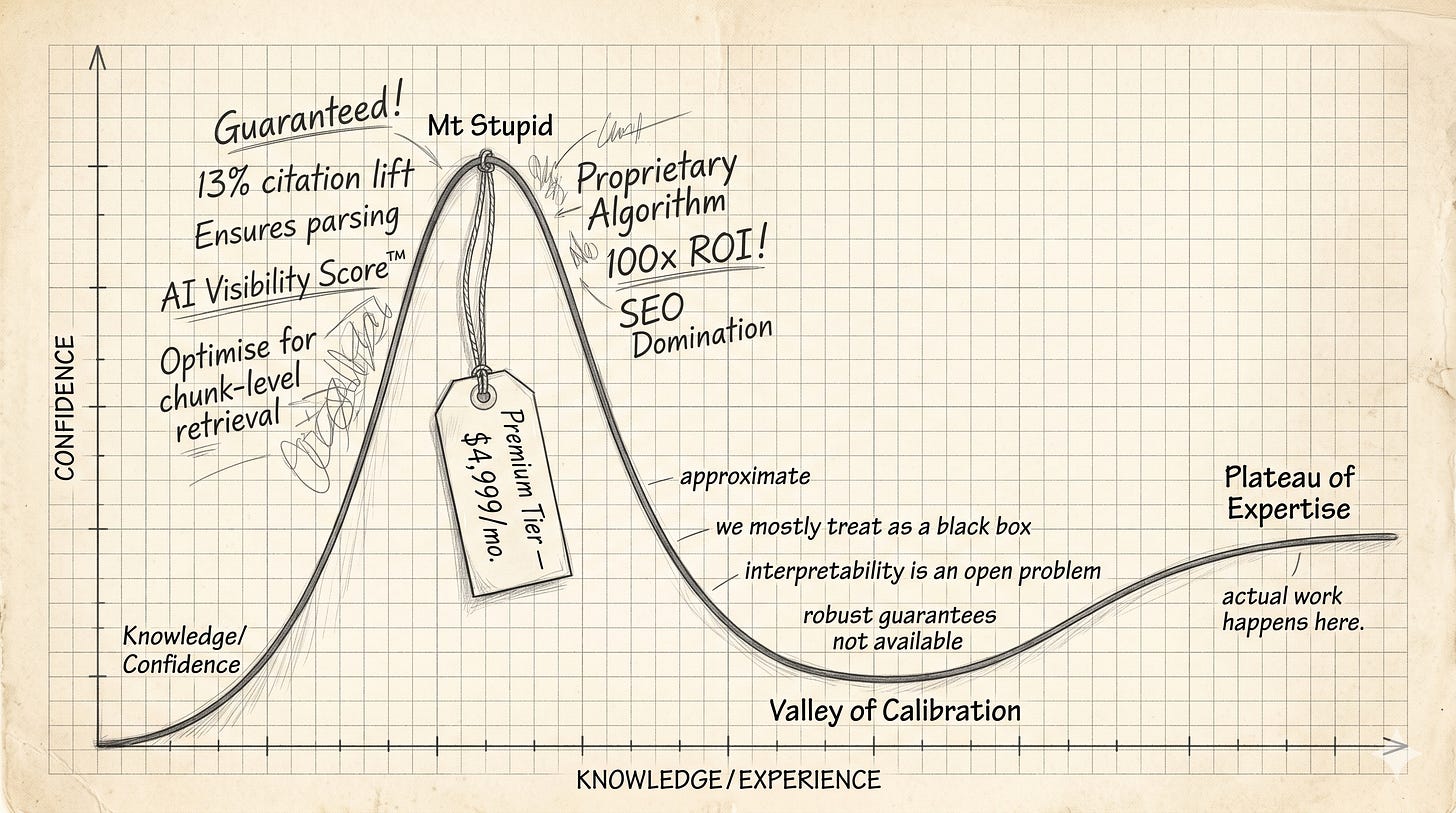
Image Credit: Pedro Dias

What The People Selling It Actually Say

A practitioner posts a four-pillar framework for “Technical GEO.” A consultant guarantees inclusion in AI Overviews. An agency markets a 13% lift in citation likelihood, derived from data the agency itself produced about the agency’s own prescriptions. A widely shared post promises that maintaining a 300-character paragraph limit dictates how a vector database chunks your content. A vendor claims a 78% “share of model.” A senior figure in your inbox describes a 2.8x improvement in conversion from being cited in SGE.

The vocabulary is deterministic: “ensures,” “guarantees,” “dictates,” percentages precise to the decimal, frameworks confidently named. None of it sounds anything like the language the people who built these systems use when describing how the systems behave.

This is the part I keep getting stuck on. The consultants are confident about the tactics they’ve measured against themselves. Run the same playbook on a few clients, watch some metric move, call it evidence. No control groups, no pre-registered hypotheses, no measurement of what the tactic is actually claimed to change. That’s the bar a real test has to clear; everything else has been confirmation in costume. The problem is the confidence level, which is wrong by an order of magnitude regardless of whether the underlying tactic does anything. The same model that Anthropic publicly says it cannot fully account for is being optimized against by people who confidently claim to know exactly what they’re doing.

Either Anthropic has been suspiciously modest in public, or somebody else is suspiciously certain.

When Somebody Tests

On Monday, last week, Ahrefs published a study by Louise Linehan and Xibeijia Guan with a title that should ideally be impossible: We Tracked 1,885 Pages Adding Schema. AI Citations Barely Moved.

The methodology is the kind of work you would expect to be standard, if the discipline cared about standards. 1,885 pages that added JSON-LD schema between August 2025 and March 2026. 4,000 matched control pages. Citation changes measured 30 days before and 30 days after the schema was added, across Google AI Overviews, Google AI Mode, and ChatGPT. Difference-in-differences on the matched groups.

The finding: No meaningful uplift in citations on any platform. AI Overviews actually showed a small but statistically significant decline. The report notes the odds of a gap that large being chance are roughly 1 in 2,500. The schema-makes-LLMs-understand-your-content thesis, tested at scale against a controlled baseline, did not survive the test.

This is the empirical confirmation of the technical case I made a week ago in The Whole Point Was the Mess: that LLMs read unstructured language, and that schema-and-chunking prescriptions are reasoning about an architecture that doesn’t exist. From first principles, two weeks ago. From controlled measurement, last Monday.

It is worth sitting with that. The dominant prescriptive category in the entire GEO playbook has been empirically falsified under controlled conditions, by a vendor with a substantial audience, in the open. And the frameworks keep selling.

Then Google Itself Answered

On May 15, 2026, Google published official documentation on optimizing for generative AI features in search. The page mythbusts the GEO prescriptions in writing: llms.txt files aren’t needed; chunking content isn’t required; rewriting content for AI systems isn’t necessary; special schema markup isn’t required; pursuing inauthentic mentions doesn’t help. The framing is unusually direct for a Google developer page:

“Many suggested ‘hacks’ aren’t effective or supported by how Google Search actually works.”

Google names Answer Engine Optimization and Generative Engine Optimization by their full terms and rejects the playbook outright.
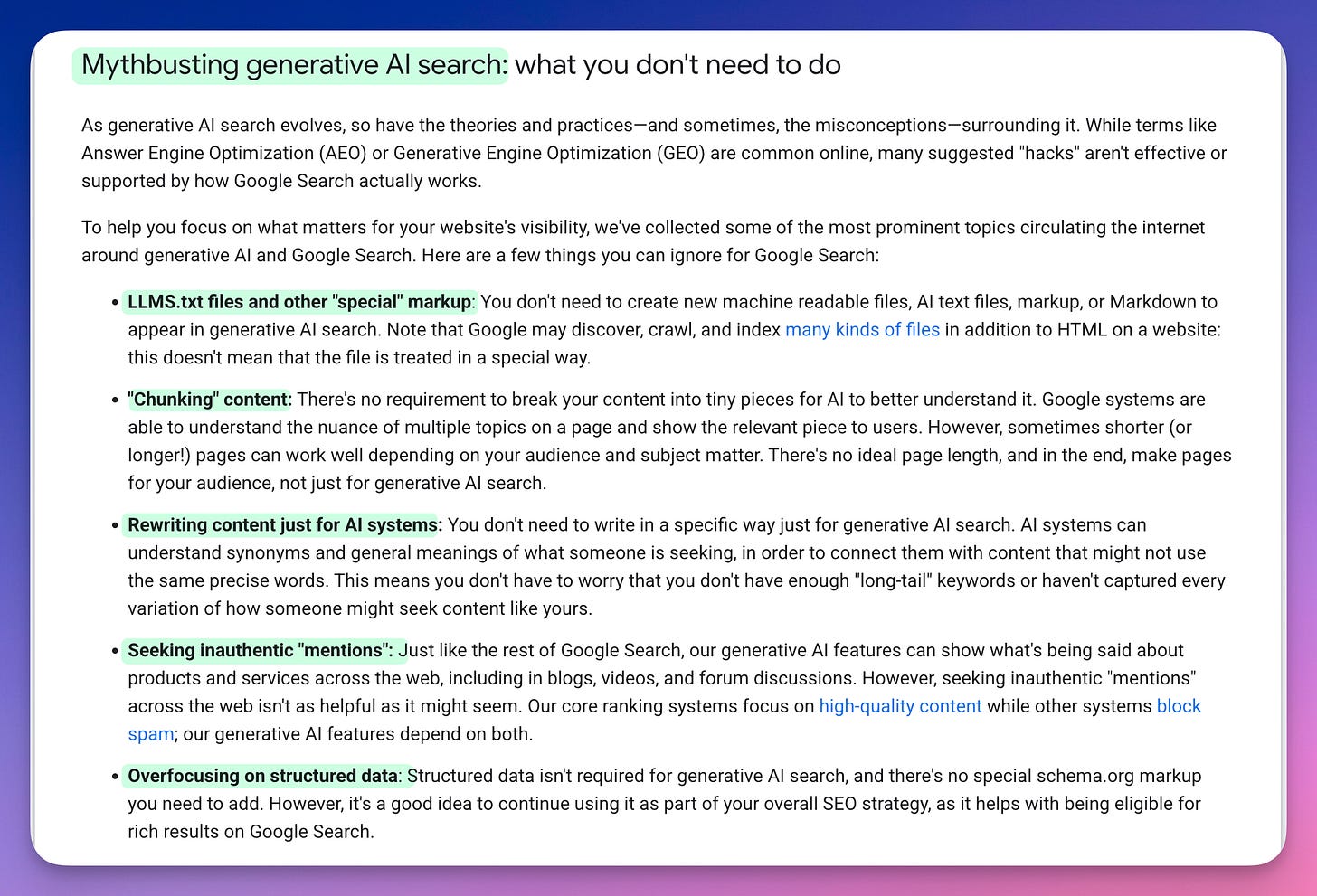
Image Credit: Pedro Dias

That is the search engine the consultants claim to be optimizing for, telling its own developer audience that the optimizations don’t work. From first principles, two weeks ago. From controlled measurement, last Monday. From Google itself, last Friday. Three independent sources of the same answer, all within a fortnight. All ignored by the people selling the opposite.

The Cost Of Asking

This is where the diagnosis stops being polite.

Confident claims compound on these platforms in a way that skeptical corrections don’t. The difference is in who pays. Posting a confident claim costs you nothing. It gets engagement, builds an audience, generates inbound, makes the slide deck look forward-looking. If it turns out to be wrong, nothing happens. By the time anyone notices, everyone’s moved on to the next acronym.

Posting the correction costs you. It picks a fight. It marks you as a contrarian, or worse, as somebody who doesn’t get it. On LinkedIn, where most of this happens, it works against your professional brand. The algorithm will not reward it. The original poster owns the comment section and can ignore your methodology question while engaging with the congratulatory replies. Your reply lives in a collapsed thread.

There’s a specific move worth naming here. Ask a GEO consultant to explain, in plain terms, what their methodology actually does, what mechanism it acts on, what would count as evidence, what would falsify it. The response escalates into jargon. “Vector-space alignment.” “T1 query optimisation.” “Chunk-level semantic retrieval.” Real terms from machine-learning research, glued into combinations that sound rigorous and resist plain-language verification. The pattern works because it can. Asking “what does that actually mean” looks naive, and observers without the specific technical knowledge can’t tell which combinations are real and which are improvised on the spot.

Read the comments on any high-engagement GEO post. Fifteen replies in, 12 are agreements or “here’s another skill to add to your list.” Two or three offer diplomatically-framed skepticisms: “I would love to see more data,” or “the list is right, but…” The author engages substantively with the philosophical objection because pushing back against “this is too technical” is easy. The methodological objection, that the prescribed skills produce confident speculation without a measurement layer underneath, gets the politest burial.

What this adds up to is gaslighting at industry scale. The people reading the technology correctly get positioned as the ones who haven’t caught up; the prescriptions that controlled tests just falsified get sold as forward-looking. GEO has worked out how to make calibration look like the deficiency.

A recent X experiment captured the dynamic outside SEO. Someone posted a Monet painting and claimed it was AI-generated, asking the replies to explain its inferiority to a real Monet. Hundreds responded, confidently cataloging the “AI tells.” Flat brushwork, soulless composition, no cohesion, no soul. They were analyzing a Monet. The frame determined what they saw.
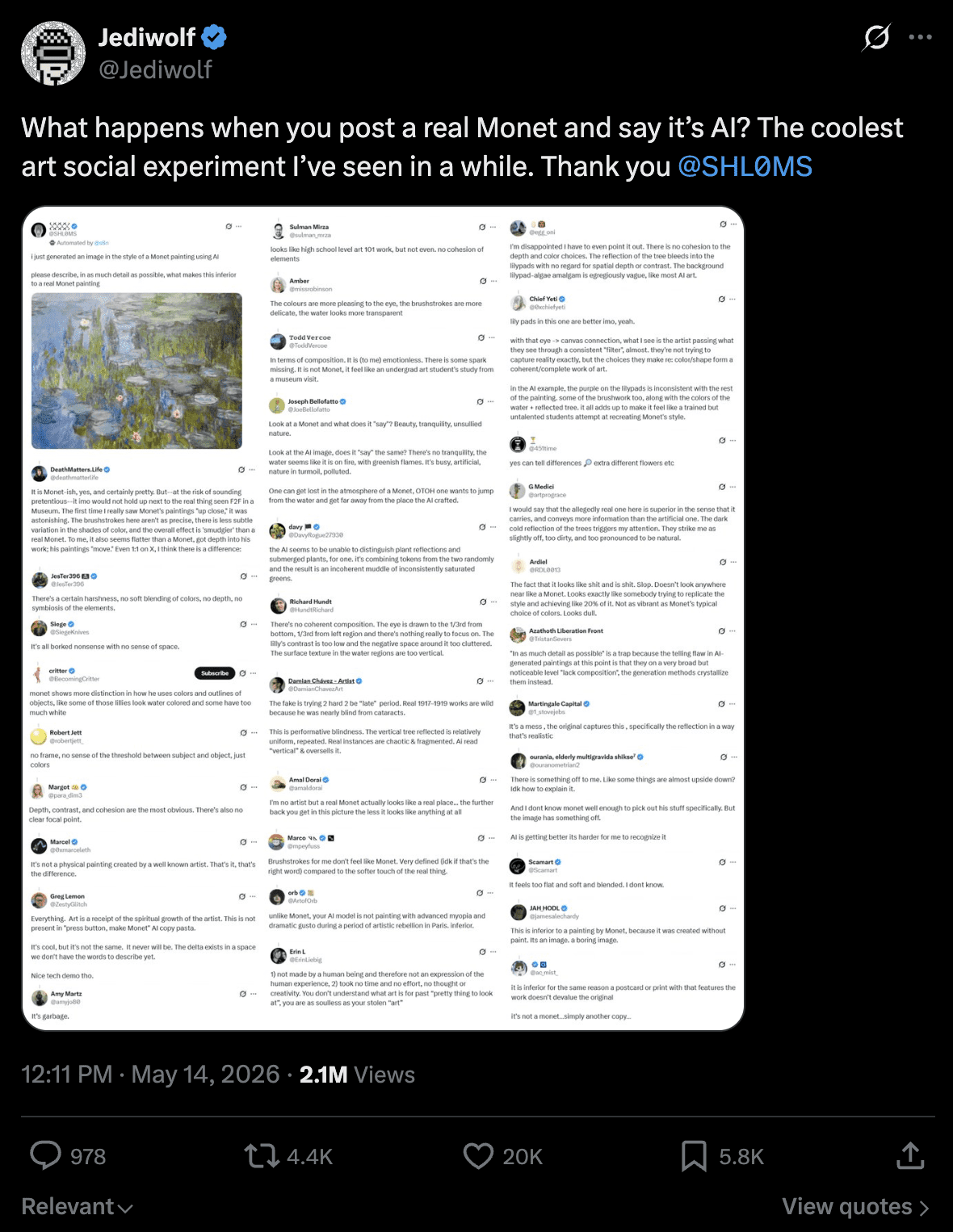
Screenshot from X, My 2026

The original post, where a lot of the initial replies have now been deleted.

Screenshot from X, May 2026

It’s the same trick. Vocabulary substitutes for substance; framing activates confirmation bias before any examination begins; the performance of analysis becomes what’s purchased rather than the analysis itself; “this is X” arrives before anyone checks whether it is. Once the frame is set, the analysis follows.

So the people most equipped to push back, the practitioners who’ve actually tried to test things, the technical SEOs who know what schema does and doesn’t do, the ones who can spot a fabricated lift number from across the room, stay quiet.

The result, on the timelines the C-suite reads, is a one-sided market.

The cost falls on the people who buy the claim. Clients pay for schema audits the Ahrefs study just falsified. Junior practitioners build careers on methodologies that won’t survive a controlled test. And the discipline burns credibility it will need later, when traditional search displaces further, and SEOs are expected to sit in rooms with engineering teams who’ve just spent two years watching the field confidently mis-call the technology.

Knowledge advances by trying to disprove your hypothesis, not confirm it. GEO does the opposite, runs studies designed to validate what it’s already selling. If the professionals claiming this expertise won’t even try to falsify themselves, who do we expect to believe us?

The Absence Is The Data

Strip the discourse, and what remains is the absence.

A serious technical field watches a controlled test contradict its dominant prescriptions, and the prescriptions keep selling. At that point, asking whether the prescriptions are wrong stops being the interesting question. That has been answered. The harder question is what’s wrong with a field that watches and doesn’t correct.

Same with the gradient. When the people who built the systems hedge and the people optimizing for those systems guarantee, asking who’s right stops being interesting. The researches and builders are right. Nobody who has worked on inference attribution thinks otherwise. The harder question is why the field lets the guarantees travel unchallenged.

The honest answer is that the incentives don’t pull toward correction. Confidence sells in ways caution can’t. The reportable framework wins the budget; the sensible assessment loses. And hedged language doesn’t fit on a pricing page where a guarantee fits perfectly.

None of this needs villains. The market for attention rewards confidence over calibration, every time.

You can keep watching the gradient run the wrong way. Or you can read what it actually is: an industry standing on Mt. Stupid, charging for the view.

More Resources:


This post was originally published on The Inference.


Featured Image: Roman Samborskyi/Shutterstock

Google Brings AI Content Verification To Search via @sejournal, @MattGSouthern

Google is expanding its SynthID verification tools to Search today, with Chrome support planned over the coming weeks. Users will be able to check the origin of images through Search features such as Lens, AI Mode, and Circle to Search.

The company is also launching an AI Content Detection API on Google Cloud, initially available to a group of trusted partners. Several companies are bringing SynthID watermarking to their AI-generated content, according to a blog post by Laurie Richardson, VP of Trust & Safety, and Pushmeet Kohli, Chief Scientist at Google Cloud and VP at Google DeepMind.

SynthID Verification In Search & Chrome

Google said it is expanding SynthID verification to Search today and plans to bring it to Chrome over the coming weeks.

Users can check whether an image was made with AI through features like Lens, AI Mode, and Circle to Search. You can ask questions like “Is this made with AI?” or “Is this AI generated?” to get verification results.

SynthID verification was already available in the Gemini app for images, video, and audio. It works by embedding imperceptible digital watermarks into AI-generated content.

C2PA Content Credentials

Google is also adding verification for C2PA Content Credentials, an industry standard for recording how media was created and modified.

The C2PA verification feature is rolling out in the Gemini app starting today and will roll out to Search and Chrome in the coming months.

AI Content Detection API

Google is launching a new AI Content Detection API on Google Cloud’s Gemini Enterprise Agent Platform, available to select partners. The API is a Google Cloud offering that Google says can detect AI-generated content made by Google and other popular models.

The API can help businesses evaluate and manage media across their platforms. Use cases include sorting feeds, preventing insurance fraud, fact-checking, and labeling synthetic media.

Initial partners include Shutterstock, Snap, Avid, Fox Sports, and Canva.

Industry Adoption Of SynthID

Companies including OpenAI, Kakao, and ElevenLabs are bringing SynthID technology to their AI-generated content. Google has open-sourced its SynthID text watermarking technology and partnered with NVIDIA to watermark AI-generated video from NVIDIA’s Cosmos models.

Meta, a fellow C2PA Steering Committee member, will start labeling camera-captured media with Content Credentials on Instagram. This means photos and videos shot on Pixel phones will be recognized and labeled on Instagram as camera-captured media.

Why This Matters

Google has been developing content-provenance tools since it first introduced SynthID in 2023. At that time, the technology was limited to select Google Cloud customers and was limited to images. The expansion to Search and Chrome moves verification from a specialized tool into surfaces where people encounter content every day.

The AI Content Detection API opens a different use case. Publishers and platforms that need to check whether content was made with AI will be able to access that capability through Google Cloud.

Searchers can already check image context through features like “About this image,” which Google expanded to Circle to Search and Lens in 2024. The SynthID verification adds a layer that checks for watermarks embedded at the point of creation, rather than relying on metadata that can be stripped.

The broader industry adoption of SynthID is worth watching. If more AI-generated media carries SynthID watermarks, Google’s verification tools have a wider base of content to check against. But SynthID only detects content watermarked with SynthID. Content from AI tools that don’t use it may not be identified through SynthID verification.

Looking Ahead

C2PA Content Credentials verification will come to Search and Chrome in the coming months. Google didn’t share specific timelines for broader availability of the AI Content Detection API beyond its initial partner group.


Featured Image: FOTOGRIN/Shutterstock

Inside AI Citation: Proven Strategies To Get Your Brand Cited via @sejournal, @lorenbaker

When customers ask AI a question, only a handful of sources get cited in the answer.

Which content signals does AI evaluate when selecting sources to cite?

Is your brand’s content structured to be one of them?

This is no longer a technology question; it is a brand and content strategy question. Find out exactly what earns AI citations.

Register above to watch the full on-demand session.

Learn How AI-powered Search Generates Answers

In this SEO webinar, Wayne Cichanski, VP of Search & Site Experience at iQuanti, unpacked how AI systems generate answers and what determines whether your brand’s content earns a place in them.

You’ll Learn:

  • How AI retrieval works: Understand the mechanics behind how AI-powered search selects and cites content, so you know exactly what you’re optimizing for.
  • AI citation signals: Identify the topical authority and brand trust signals that determine whether your content earns a place in AI-generated answers.
  • Practical content strategies that drive citation: Walk away with specific, practical tactics for creating and restructuring content that increases your brand’s AI visibility.

From topical authority to content structure and brand trust signals, you’ll learn the mechanics of AI retrieval into clear implications for performance marketers and digital leaders.

Register above to get actionable, practitioner-level strategies for building the topical authority and content structure that AI systems reward with citations.

👆 Register above to watch the recording on your schedule.

It Works Until It Doesn’t: AI Content Strategies That Backfire via @sejournal, @lilyraynyc

Over the past few years, I’ve watched AI content creation tools rapidly gain adoption across the SEO/GEO industry. These tools offer the promise of leveraging AI to automate content creation, reduce headcount, cut costs, and scale output.

As someone who has spent the last decade helping companies recover from Google algorithm updates, my spidey senses started tingling the minute I heard the pitches for many of these tools. Even before AI was part of the conversation, Google already had a long history of reducing the visibility of automated content in its search results.

Despite recent advancements in the quality of AI outputs, I’ve remained skeptical that publishing AI-generated or AI-assisted content at scale can drive sustained performance in Google’s search results. This is especially true now, given how Google updated its ranking systems in recent years specifically to demote overly optimized, SEO-driven content.

Over the past several months, I have been monitoring more than 220 websites that were publicly identified, either by themselves or by their AI content vendors, as customers of various AI content creation, automation, and scaling platforms. These tools fully write articles, assist with writing them, or use AI automations and workflows to support content creation. Many of these tools also now focus on driving visibility, mentions, and citations in AI search responses (AEO/GEO).

I wanted to analyze what happens after the claims of big wins.

A consistent pattern emerged across the 220+ sites I’ve been monitoring, and I believe it is concerning enough to be worth writing about: it works, until it doesn’t.

Below, I will share some of the trends I am observing, plus a variety of common SEO/GEO approaches I believe may be causing declines in organic search (and consequently, AI search) visibility. As a reminder, what is dangerous for SEO can also be dangerous for AI search, largely because of RAG.

The State of AEO/GEO Report Conductor 2026

Methodology & Disclaimers

Before we dive in, it’s important to set the stage with my approach and provide some important disclaimers.

This analysis is based on third-party SEO measurement data: organic traffic estimates and organic page count time series data from Ahrefs, corroborated against the Sistrix Visibility Index data to confirm broader visibility patterns. Top-traffic URLs were identified using Ahrefs’ top-pages export. Where I describe URL patterns or percentage changes, I am quoting directly from these third-party tools as of May 2026.

The dataset covers more than 220 client domains tracked across the publicly published customer-stories pages of over a dozen AI content platforms. For many of these sites, I narrowed the analysis to a specific subfolder where the AI-assisted content had been published, either identified directly in the case study itself or inferred from a sharp increase in new pages around the time of the case study’s publication.

The analysis, conclusions, and recommendations throughout this piece reflect my own professional opinions based on more than a decade of helping companies recover from Google algorithm updates. Other SEO/GEO practitioners may disagree with my findings and approaches, and individual sites and strategies will always have their own context.

3 Important Disclaimers About This Data:

First, these are third-party estimates, not first-party analytics. They are well-validated tools in the SEO industry, but they are not perfect measurements of organic search performance.

Second, the traffic declines described here could reflect many factors, including but not limited to algorithmic adjustments by Google, on-site changes by the site operators themselves, off-site competitive dynamics, brand changes, acquisitions, seasonality, and changes to internal site architecture. I am not asserting that any AI content tool directly caused any traffic outcome described in this piece. I am describing a correlation observed across many listed sites that share similar content patterns and organic traffic trajectories.

Third, vendors and specific domains are deliberately not named here. The pattern is the story, not the specific actors. Any resemblance to a specific company, vendor, or case study is incidental to the broader pattern described.

What The Data Shows: Rapid Growth Before A Steep Decline

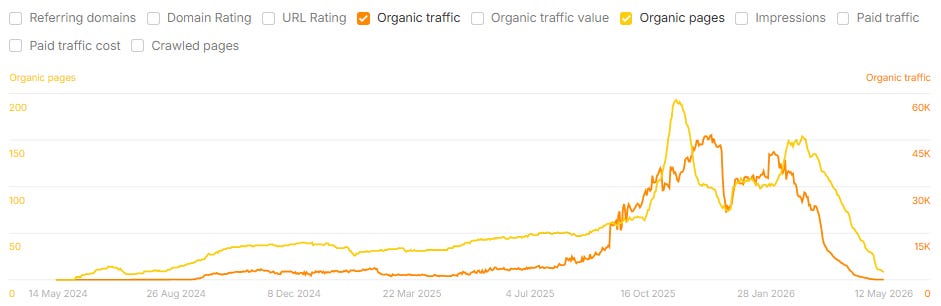
If there is one thing the data makes clear, it is this: scaling content production with AI is not a low-risk strategy for organic search. It can produce real short-term gains in both SEO and AI search (LLMs use search engines), but across this dataset, those gains have rarely held. In many cases, the eventual loss has exceeded the initial peak.

Across the group of 220+ sites and subfolders I analyzed:

  • 54% lost 30% or more of their peak organic traffic.
  • 39% lost 50% or more.
  • 22% lost 75% or more.

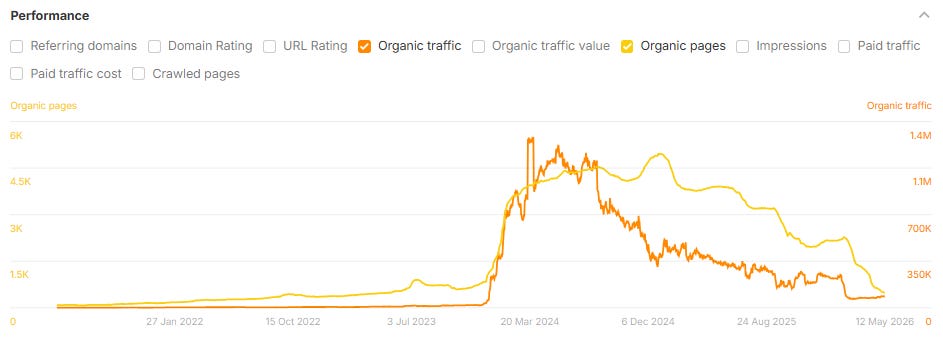
Within those declines, a recurring trajectory appears: a rapid growth in organic pages over six to 12 months; an organic traffic peak within roughly three to six months of the content peak; and then a steep decline in traffic that erases most of the gain (and frequently drops below the prior baseline) within the following year.

Image Credit: Lily Ray

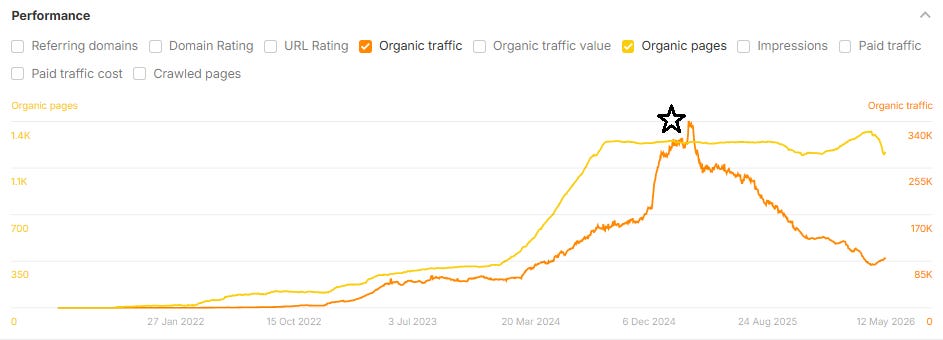
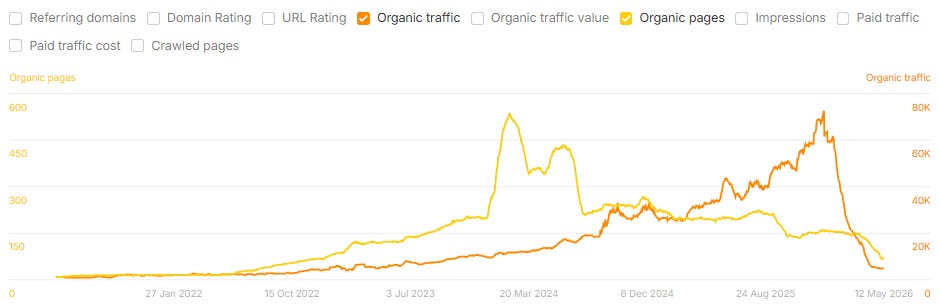
Most of these traffic drops took place after the case studies were published (which also makes me wonder whether the case studies themselves could be contributing to the declines). In the example below, the case study was published in January 2025, indicated by the the black star below:

Image Credit: Lily Ray

I am also continuously monitoring changes to organic page growth and organic traffic to these sites and subfolders over time. Looking at the updated data, a substantial number of these brands appear to have substantially reduced their content footprints in 2025 and 2026, often removing, redirecting, or 410’ing many of the same pages featured as success stories in published case studies. This could explain the recent drop in pages (yellow line) shown in the above screenshot (and potentially, the corresponding increase in organic search traffic).

In many cases, these case studies remain published to this day, but the pages they reference do not.

The Familiar Rank & Tank Playbook

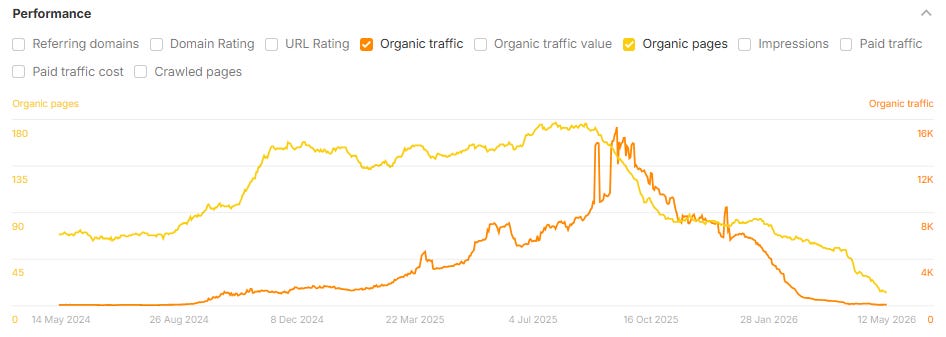
When a site starts seeing traffic drops due to sitewide content quality issues, it’s rarely a gentle decline. As Glenn Gabe refers to it, a better label would be “Mount AI”: steep growth, followed by a similarly shaped drop-off in organic traffic, once Google’s systems have gathered enough signals to identify what is going on.

Below are several examples of case study sites that used AI to scale content creation and saw massive drops in organic traffic after their case studies were published:

Image Credit: Lily Ray
This site’s decline started during the unconfirmed “self-promotional listicle Google update” in January 2026, which I also wrote about on my Substack (Image Credit: Lily Ray)

This pattern is consistent across industries, including cybersecurity, travel, marketing, SaaS, healthcare, B2B services, crypto, and consumer goods, and it shows up across vendors.

The shape of the line in the chart is similar to trajectories we have seen among many sites affected by Google’s algorithm updates in recent years. It is the same boom-bust cycle the SEO industry has watched repeatedly in different forms, accelerated this time by the speed at which AI tools have enabled site owners to scale content.

The SEO Industry Just Went Through This

What is hard to overstate is just how recently the SEO industry watched a near-identical cycle play out. Many SEOs and site owners are still licking their wounds from a brutal round of Google updates and new spam policies that obliterated many sites’ traffic a few years back.

In September 2023, Google launched the Helpful Content Update, the most aggressive crackdown it had done in years against content that, according to its announcement, “feels like it was created for search engines instead of people.”

Roughly six months later, in March 2024, it followed up with the longest core update in Google’s history, which Google states was designed to “reduce unhelpful, unoriginal content in search results by 45%.” Across two consecutive update cycles, Google’s stated target was the same thing: content produced at scale, regardless of whether the production method was human, AI, or a combination of both.

Alongside the March 2024 update, Google formalized a new spam policy called “Scaled Content Abuse,” explicitly naming the practice it was working to suppress: generating many pages to manipulate search rankings, regardless of authorship.

The SEO industry is still working through the collateral damage from those updates, including significant losses for many small publishers, some of whom were publishing original, human-written content but used excessive SEO frameworks that the updates likely flagged. The casualty list also included some publishers who had partnered with ad networks and other emerging tools offering AI content creation and scaling as a service.

Many sites affected by the HCU haven’t recovered to this day, despite their enormous efforts. I spent significant time in 2024 working and speaking with many site owners trying to dig themselves out of that hole.

Having spent hundreds of hours analyzing and presenting about those two major updates, I can say that the content I am seeing published with many of these new AI tools often looks and feels a lot like the exact type of content that was wiped off the map with these 2023 and 2024 Google updates.

8 Recurring Content Patterns That Are Risky For SEO And AI Search

So, what types of content am I seeing published by companies using AI tools to build articles that I believe are ultimately risky for SEO? I believe the answer lies in page templates that aim to influence SEO rankings, AI search responses, and/or citations in AI search, but are highly formulaic and easily repeatable by competitors.

What starts as a genuine approach to try to build helpful content (and score a mention/citation) ends up being an easily detectable footprint by Google when enough sites are publishing similar pages, and the index becomes flooded with tens or hundreds of thousands of these similar pages, which is easier than ever to do using AI.

This is exactly what Google means when it talks about writing for search engines, not humans.

Reviewing top-traffic URLs across the declining domains, eight distinct content templates appear repeatedly. Most sites seeing declines in the analysis use some combination of at least three or four. The most aggressive ones use all eight. Typically, affected sites also have hundreds or thousands of these articles, which amplifies the problem and generally leads to steeper traffic losses.

1. Comparison Pages At Scale

Pattern: /blog/[product-A]-vs-[product-B] published at scale across most reasonable head-to-head matchups in a category. Observed across the dataset for product-vs-product pairings, framework-vs-framework pairings, and, in at least one case, concept-vs-concept pairings unrelated to the publisher’s actual business.

2. The “What Is X” Glossary

Single-term, single-question pages designed to be cited by AI engines. Pattern: /resources/what-is-[term] or /glossary/[term]. Observed across the dataset, including programmatic glossaries scaled across multiple languages from a single source template. Scaling translations with AI and without human review can also frequently lead to sitewide content quality issues.

3. The “Best [X] For [Y]” Listicle

The most familiar AI-content template, with origins in the affiliate-content era. This pattern was observed across the dataset in both broad-category and narrow-niche variants.

4. The Self-Promotional Listicle

A variant of No. 3 in which the publisher is itself a competitor in the category being ranked, and frequently lists itself as the No. 1 best among competitors. These pages generally lack real evidence that the company genuinely tested all of the competitors in the list, which is recommended by Google for review pages.

I wrote about this “listicle” page template causing SEO/GEO issues in February 2026, when I found that many companies publishing dozens, hundreds, or even thousands of self-promotional listicles saw extreme traffic drops beginning on the same day (approximately Jan. 21, 2026). This pattern was observed across multiple sites in the dataset, most aggressively in B2B services.

5. The Competitor-Vs-Alternatives Page

Pattern: /blog/[competitor-brand]-alternatives, or, in the more programmatic form, dedicated landing pages built for every named competitor in a category. This approach was observed extensively across the dataset, including one case where the majority of a site’s top traffic pages were dedicated to individual competitor brand names.

6. Programmatic Location And Language Scaling

This is one of the oldest tricks in the SEO book, and one that I’ve seen sites get in trouble for with algorithm updates for at least 10 years. The approach: Use one template multiplied across every geography or language a search engine will index, with very little unique content per local landing page.

In many cases, the company publishing these pages often does not have real brick-and-mortar locations in each of the neighborhood/city/state pages they are targeting.

This page type was observed across the dataset including state-by-state content, country-by-country service pages, and the multilingual programmatic glossaries described above.

7. The FAQ Farm

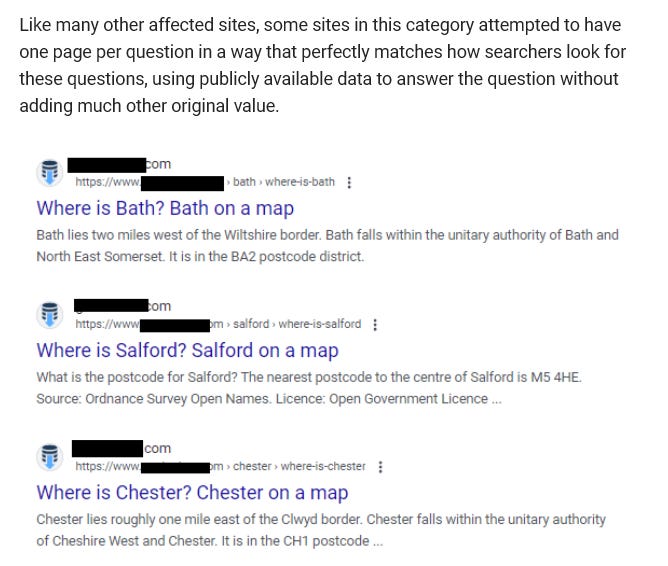
Each page answers exactly one question. Pattern: /faq/[full-question]. Designed for extraction by AI engines: a clear question in the URL, the answer in the first paragraph, bullet points in the body, schema markup at the bottom.

The problem? This approach creates a lot of low-quality content and baggage for the site when implemented at scale. Scaling FAQs was also observed extensively across the dataset, including in industries where the templated tone was a noticeable mismatch with the publisher’s brand context.

Here is a screenshot of my March 2024 Amsive article advising against the same exact thing:

Image Credit: Lily Ray

It’s also worth noting that just last week, Google announced it was deprecating FAQ Rich Results, which I believe might have something to do with this new influx of FAQ schema aimed at trying to earn citations and mentions in AI search.

8. Off-Topic Content Published At Scale

Publishing off-topic content, with no apparent connection to the publisher’s actual business, at high volumes, is one of the fastest ways to get in trouble with search engine algorithms. This was also a huge problem during the Helpful Content Update and March 2024 Core Updates, when many sites were experimenting with publishing off-topic content, like funny quotes, jokes, baby names, horoscopes, and other high-volume articles that weren’t actually topically relevant for the publisher.

This method was used across multiple sites in the dataset, including pieces on entertainment topics on a services platform, lists of names and jokes, social-media memes on B2B websites, and historical or biographical content on business-focused sites.

The Late January 2026 Unconfirmed Google Update

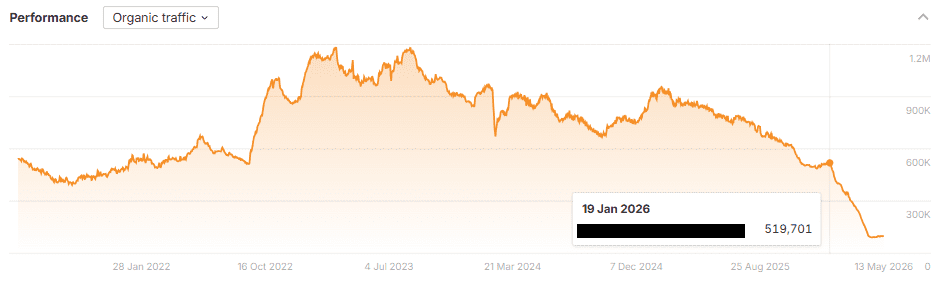
A secondary pattern appears in the data around late January 2026: a wave of sites with explicitly GEO-optimized, self-promotional listicles, plus other risky SEO/GEO approaches, saw organic traffic declines between 40% and 95% over the January-April 2026 window.

A large B2B company’s blog subfolder hit by the unconfirmed late-January 2026 Google update. (Image Credit: Lily Ray)

Google did not announce or confirm an update by name in January 2026, but at least 40 sites I identified saw a negative trend beginning around Jan. 20, 2026. In many cases, the impact was isolated to the company’s blog or other subfolder containing a lot of new SEO-driven content. My analysis found that some of these companies were scaling dozens, hundreds, or even thousands of these self-promoting listicles, in which they named their own company the No. 1 best when compared to competitors.

I suspect this adjustment on Google’s end was just the start of Google (and likely the LLM providers building on top of search) beginning to demote this type of content in search results, and it appears that the impact was greater than just the listicles themselves. For affected sites, the entire blog or subfolder containing these articles often also saw declines. In other cases, the impact was carried over across the full domain.

How To Use AI Content Tools Safely

I do believe there is a way to use AI content tools safely, and a way for these tools to support the creation of high-quality content. The tools themselves are not the problem, but the implementation can be. I believe these tools should be used and overseen by experienced SEO professionals who understand the landscape of content approaches that Google has grown extremely sophisticated at penalizing and demoting over the past 10+ years. The problem often stems from a “set it and forget it” approach, or when the goal is to scale as many pages as quickly as possible without human review.

Using AI content tools for research, organization, content briefs, pulling in proprietary company data and insights, and more can be invaluable for speeding up the content creation process. But when articles are simply published “for SEO/GEO” without consideration of the risks involved with search engine ranking systems, the well-intentioned content can actually backfire for both SEO and AI search.

To perform well, I recommend that any AI-assisted content should still demonstrate E-E-A-T, add original or unique information above and beyond what is offered by competing pages (information gain), and consider being transparent about the use of AI to create the content (which is recommended by Google).

The Bottom Line

If there is one takeaway from monitoring these 220+ sites over the past several months, it’s that the playbooks being sold as “AI-first SEO” or “GEO-optimized content at scale” look remarkably similar to the playbooks that got sites flattened by the Helpful Content Update and the March 2024 Core Update. The packaging is new, but the pattern is not.

Across the dataset, the brands still growing are generally the ones whose content does not match the eight templates above. Many brands that scaled into those templates are the ones now removing pages, redirecting subfolders, and taking other steps to try to mitigate recent losses in traffic.

If you’re currently evaluating an AI content vendor, or running a program in-house, here are a few practical questions I think are worth asking before publishing another page:

  • Does this page actually exist because a real customer or reader needs it, or because a search engine or LLM might cite it?
  • Could a competitor publish a near-identical version of this page tomorrow using the same prompt?
  • Would I be comfortable if Google, a journalist, or my own customers saw the full list of URLs in this subfolder?
  • Is the article inherently biased, and if so, is the page transparent with users about those biases?
  • Is there any first-party data, expertise, or original perspective on this page that isn’t available on the first ten results already ranking for the query?

None of this means AI content tools are unusable. They can be genuinely useful for research, briefs, internal data synthesis, and accelerating workflows where a human expert is still in the loop. The trouble starts when the goal becomes volume, or when the people closest to the content stop reviewing what is going out the door.

The SEO industry has already lived through this cycle once in the last few years. The sites that came out of it best were the ones that prioritized quality, originality, and topical focus over scale. I expect the same to be true of this cycle, and I’ll keep tracking the data as it plays out.

The State of AEO/GEO Report Conductor 2026

More Resources:


This post was originally published on Lily Ray NYC Substack.


Featured Image: Stokkete/Shutterstock

Anthropic’s Infrastructure Crisis – What It Means for Marketers & SEO Pros via @sejournal, @gregjarboe

On May 6, 2026, Anthropic CEO Dario Amodei walked out onto a stage at his company’s developer conference in San Francisco and said something you almost never hear from a tech CEO: Growth is the problem.

Anthropic had planned for a 10-fold expansion. What it got was 80-fold growth in Q1, on an annualized basis. Revenue has crossed $30 billion, up from $9 billion at the end of 2025. The company is weighing a funding round at a reported $900 billion valuation – which, if it closes at those terms, would likely surpass OpenAI’s most recent post-money valuation of $852 billion. And yet, as Amodei told the audience that day, “I hope that 80-times growth doesn’t continue because that’s just crazy and it’s too hard to handle.”

He wasn’t being falsely modest. Demand for Claude has already created what Anthropic described as “inevitable strain on our infrastructure,” hitting reliability and performance during peak hours. Hours before Amodei took the stage, the company announced a deal with SpaceX – which, earlier this year, merged with xAI, the company behind the Grok AI models, now rebranded SpaceXAI – to take over the entire compute capacity at the Colossus 1 data center in Memphis, giving it access to more than 300 megawatts of capacity and 220,000 Nvidia GPUs.

The detail worth noting: xAI and Anthropic are direct competitors at the model layer. The fact that Grok’s infrastructure is now running Claude’s workloads is the clearest signal yet of how constrained high-end compute capacity has become. That’s a bridge built under emergency conditions, not a planned expansion.

So, why should SEO professionals, content marketers, and entrepreneurs care about Anthropic’s infrastructure problems? Because this story is actually about something much bigger than one company scrambling for server capacity.

This Has Happened Before

In 2011, I read I’m Feeling Lucky: The Confessions of Google Employee Number 59 by Douglas Edwards, who was Google’s first director of marketing and brand management. That’s when I learned how close Google came to buckling under its own success in the early days.

In late 1999, Edwards wrote, “Google began accelerating its climb to market domination. The media started whispering about the first search engine that actually worked, and users began telling their friends to give Google a try. More users meant more queries, and that meant more machines.” Then the machines became impossible to get. A global shortage of RAM hit at the worst possible moment, and Google’s system, as Edwards put it, “started wheezing asthmatically.”

That infrastructure crisis drove decisions that shaped the web for the next two decades. Google started filtering duplicate content – even non-malicious versions like printer-friendly pages – because every redundant page required adding hardware without improving user experience. The constraint shaped the product. The product shaped SEO.

Anthropic’s compute crisis is the same dynamic, playing out 25 years later at a different scale. The question isn’t whether they’ll solve it. They will. The question is what decisions they’ll make under pressure, and how those decisions will reshape the products that millions of marketers depend on.

What The Data Actually Shows

When I went looking for what this growth moment means for practitioners, I found the headlines and the data pointing in surprisingly different directions.

Rand Fishkin recently shared findings from the Datos State of Search Q1 2026 report, which draws on clickstream data from tens of millions of real devices. His summary was pointed: AI is disrupting traditional search – no, the data doesn’t show that. AI tools are growing faster than traditional search in absolute terms – no, traditional search is still outpacing AI tool growth on an absolute basis. AI Mode in Google is huge – no, it’s still under 0.2% share, growing but still small. ChatGPT is pulling away from Claude – actually, no. Claude is closing the gap, Gemini holds the number two spot and is growing, and ChatGPT has plateaued since September 2025.

These are not the narratives that get clicks. They are, however, what the data says.

At the same time, I went to Think with Google and worked through its report, “The Rise of the Super-Empowered Consumer,” which tells a different part of the same story. Some of what’s in there deserves more attention than it’s getting. AI Overviews is used by over 2 billion people, and users report making decisions faster and with more confidence. AI Mode now has over 75 million daily active users, with nearly 1 in 6 queries using voice or images. Queries in AI Mode run three times longer than traditional searches, and sessions are becoming more conversational. Google Lens handles over 25 billion visual searches every month. Shoppers are 2.3 times more likely to use Google Search than ChatGPT for purchase decisions, and 40% of consumers who use Google AI Mode for shopping say they’re using ChatGPT less as a result.

Two different pictures of the same moment. Both accurate. Neither is complete on its own.

The Takeaway For Practitioners

The AI industry is generating a firehose of information, and most of it gets consumed at the headline level. A company announces 80-fold growth, and people read it as a story about AI winning. Fishkin publishes data showing traditional search still outpacing AI tools in absolute volume, and people read it as a story about AI losing. Google publishes a consumer report showing AI Overviews reaching 2 billion users, and people read it as confirmation that SEO is dead.

None of those readings are wrong. All of them are incomplete.

The strategic value isn’t in reading the news. It’s in following the thread further – downloading the Datos report, working through the Google consumer study, checking the CNBC article against the Cryptopolitan analysis of what the Anthropic-SpaceX deal actually signals about the infrastructure war playing out between the major AI companies.

Google’s early infrastructure crisis produced lasting decisions about duplicate content that practitioners are still navigating. Anthropic’s current one will produce decisions about rate limits, model availability, enterprise pricing, and compute allocation that will shape how Claude-powered tools perform for the marketers and developers using them. Those decisions are already being made.

The practitioners who understand the context those decisions come from will be better positioned than those who only read the headline.

More Resources:


Featured Image: Anton Vierietin/Shutterstock

Google-Agent: The Web’s New Visitor Just Got An Identity via @sejournal, @slobodanmanic

On March 20, 2026, Google quietly added a new entry to its official list of web fetchers. Not a crawler. Not a training bot. An agent.

Google-Agent is the user agent string for AI systems running on Google infrastructure that browse websites on behalf of users. When someone asks an AI assistant to research a product, fill out a form, or compare options across websites, Google-Agent is the thing that actually visits the page. Project Mariner, Google’s experimental AI browsing tool, is the first product using it.

This is not Googlebot. Googlebot crawls the web continuously, indexing pages for search. Google-Agent only shows up when a human asks it to. That distinction changes everything about how it operates.

Robots.txt Does Not Apply

Google classifies Google-Agent as a user-triggered fetcher. The category includes tools like Google Read Aloud (text-to-speech), NotebookLM (document analysis), and Feedfetcher (RSS). All of them share one property: a human initiated the request. Google’s position is that user-triggered fetchers “generally ignore robots.txt rules” because the fetch was requested by a person.

The logic: If you type a URL into Chrome, the browser fetches the page regardless of what robots.txt says. Google-Agent operates on the same principle. The agent is the user’s proxy, not an autonomous crawler.

This is a meaningful departure from how OpenAI and Anthropic handle similar traffic. ChatGPT-User and Claude-User both function as user-triggered fetchers, but they respect robots.txt directives. If you block ChatGPT-User in robots.txt, ChatGPT won’t fetch your page when a user asks it to browse. Google made a different call.

Website owners who relied on robots.txt as a universal access control mechanism now have a gap. If you need to restrict access from Google-Agent, you’ll need server-side authentication or access controls. The same tools you’d use to block a human visitor.

Cryptographic Identity: Web Bot Auth

The more significant development is buried in a single line of Google’s documentation: Google-Agent is experimenting with the web-bot-auth protocol using the identity https://agent.bot.goog.

Web Bot Auth is an IETF draft standard that works like a digital passport for bots. Each agent holds a private key, publishes its public key in a directory, and cryptographically signs every HTTP request. The website verifies the signature and knows, with cryptographic certainty, that the visitor is who it claims to be.

User agent strings can be spoofed by anyone. Web Bot Auth cannot. Google adopting this protocol, even experimentally, signals where agent identity is heading. Akamai, Cloudflare, and Amazon (AgentCore Browser) already support it. Google brings the critical mass.

This matters because the web is about to have an identity problem. As agent traffic increases, websites need to distinguish between legitimate AI agents acting on behalf of real users and scrapers pretending to be agents. IP verification helps, but cryptographic signatures scale better and are harder to fake.

What This Means For Your Website

Google-Agent creates a three-tier visitor model for the web:

  1. Human visitors browsing directly.
  2. Crawlers indexing content for search and training (Googlebot, GPTBot, Google-Extended).
  3. Agents acting on behalf of specific humans in real time (Google-Agent, ChatGPT-User, Claude-User).

Each tier has different access rules, different intentions, and different expectations. A crawler wants to index your content. An agent wants to complete a task. It might be reading a product page, comparing prices, filling out a contact form, or booking an appointment.

Here’s what to do now:

Monitor your logs. Google-Agent identifies itself with a user agent string containing compatible; Google-Agent. Google publishes IP ranges for verification. Start tracking how often agents visit, which pages they hit, and what they attempt to do.

Check your CDN and firewall rules. If your security tools aggressively block non-browser traffic, Google-Agent may be getting rejected before it reaches your server. Verify that Google’s published IP ranges are permitted.

Test your forms and flows. Google-Agent can submit forms and navigate multi-step processes. If your checkout, booking, or contact forms rely on JavaScript patterns that confuse automated systems, agent visitors will fail silently. Semantic HTML and clear labels remain the foundation.

Accept that robots.txt is no longer a complete access control tool. For content you genuinely need to restrict, use authentication. robots.txt was designed for crawlers. The agent era needs different boundaries.

The Hybrid Web Isn’t Coming. It’s Logged

A year ago, the idea that AI agents would browse websites alongside humans was a conference talk prediction. Today, it has a user agent string, published IP ranges, a cryptographic identity protocol, and an entry in Google’s official documentation.

The web didn’t split into human and machine. It merged. Every page you publish now serves both audiences simultaneously, and Google just made it possible to see exactly when the non-human audience shows up.

More Resources:


This post was originally published on No Hacks.


Featured Image: Summit Art Creations/Shutterstock

Stop Treating AI Visibility As One Problem. It’s Actually Three, On Three Different Layers via @sejournal, @DuaneForrester

When a brand stops appearing in ChatGPT, or when its share of voice in Perplexity drops by half over a quarter, the typical response from the marketing org is to write more content. Sometimes a lot more. The thinking goes that if AI systems aren’t surfacing the brand, the fix is to feed them more material to work with. That instinct is a misdiagnosis. It’s a retrieval-layer fix being applied to what is increasingly a different kind of problem entirely, and the cost shows up as wasted budget, missed quarters, and a creeping sense that the work isn’t connecting to the outcomes anymore.

The mistake is treating AI visibility as a single problem when it isn’t. There are three structurally different layers between your brand and the answer a user receives, each with its own failure modes, its own fixes, and increasingly its own organizational owner. Diagnose the wrong layer, and the fix doesn’t land.

Where Most Of The Conversation Has Been Living

The first layer is retrieval. This is where the AI search optimization conversation has spent most of the last two years. The mechanics are familiar in shape if not in detail. When a model needs to answer a question grounded in real-world content, it pulls relevant material from external sources and uses that material to construct the response. The technical name is retrieval-augmented generation, or RAG, and the layer it operates on is the gateway between your content and the model’s output.

This is where crawlability, parseability, and chunk-friendliness do their work. If your content can’t be retrieved cleanly, nothing downstream matters. The visibility tracking platforms most marketing teams have evaluated this year measure outcomes that depend on this layer functioning, which is why they tend to reward the same disciplines that produced good results in classical search: structured content, schema markup, self-contained answers, clean technical implementation.

But retrieval has a structural limit, and Microsoft Research has been unusually direct about it. Plain RAG, in their words, struggles to connect the dots. It retrieves chunks of text that look relevant to the question, but it cannot reason about how those chunks relate to each other. When the answer requires synthesizing information across multiple sources, or when the question is broad enough that the right answer depends on understanding patterns across an entire dataset, retrieval alone breaks down. The model gets the chunks and has to guess at the relationships, and guessing is where hallucinations enter.

The discipline question this layer asks is straightforward. Can the model retrieve our content at all, and is it retrieving the right content for the right query? Most marketing teams have some version of this work in flight already, even if the specific tactics have shifted from classical SEO. But retrieval is only the gateway. Even when a model retrieves your content correctly, what it does with it depends on whether you exist as a recognized thing in the layer above.

The State of AEO/GEO Report Conductor 2026

Where Entity Recognition Does The Real Work

The second layer is the relationship layer, and the dominant structure on it is the knowledge graph. The major search infrastructures all maintain one. Google’s Knowledge Graph, Microsoft’s Satori, and the open knowledge graph built on Wikidata and schema.org collectively define how your brand is represented as an entity, what category you sit in, and which other entities you’re connected to.

This is the layer that decides whether AI Overviews and large language model responses treat you as a recognized member of your category, or as one fuzzy candidate string among many. Brands that exist as clean, well-defined entities get cited consistently. Brands that exist as undifferentiated tokens scattered across the open web get pattern-matched against fifty other candidates and lose more often than they win.

Knowledge graphs have been around long enough that the discipline is reasonably mature. Schema markup on owned properties, consistent naming and identifiers across the open web, structured presence on the high-trust nodes like Wikidata entries and review platforms, and the slow accumulation of brand mentions in contexts that the graph treats as authoritative. This is where the unlinked brand mentions conversation lives, because consistent contextual mentions strengthen the entity even without a hyperlink attached. The fix at this layer is structural rather than volume-based. Writing more content does almost nothing if the entity definition underneath it is fuzzy.

The discipline question here is harder than the retrieval-layer question. Are we a clean, defensible entity in our category, or are we still being pattern-matched against fifty other candidate strings? A brand that can’t answer that question affirmatively is going to lose ground in AI search, regardless of how much content it produces, because the second layer is where the model decides what your content is actually about.

The knowledge graph tells the model what your brand is. But increasingly, your brand has to function inside a third layer that most marketing teams haven’t met yet, where the model isn’t just understanding you, it’s being asked to reason about you on behalf of someone making a decision.

The Layer Enterprise Companies Are Quietly Building Right Now

The third layer is the context graph, and this one needs a careful introduction because most of the marketing conversation hasn’t reached it yet.

A context graph has the same structural shape as a knowledge graph, with entities, relationships, and typed connections, but it’s grounded differently. A knowledge graph models the world. It tells you what things are and how they relate in general. A context graph models a specific organization’s data, decisions, policies, and operational reality. The cleanest framing I’ve seen calls a knowledge graph the library and a context graph the operating manual written by the people who actually run the place. The library tells you what exists. The operating manual tells you what’s relevant, what’s authorized, and what to do about it right now. The library is read-only semantic infrastructure. The operating manual is a living operational layer that grows every time a business process executes.

What separates a context graph from anything that came before it is that governance lives inside the graph rather than alongside it. Policies, permissions, validity windows, and authorization rules are nodes the graph itself queries, not external documentation applied at the edges. When an agent retrieves something from a context graph, the result has already been filtered through what’s currently authorized, currently valid, and currently applicable. The graph is also continuously evolving, so what it knows about you this week is not necessarily what it knew last quarter. That’s where the word “governed” comes from when people in this space talk about governed retrieval. It isn’t a frame, but rather the architecture.

That architecture used to be invisible to anyone outside the organization that built it, which is why marketers haven’t had to think about it. That changed at Google Cloud Next ’26, when Google introduced the Knowledge Catalog inside its new Agentic Data Cloud. Google’s own description of the product, written in their own first-party blog content, says the Knowledge Catalog constructs a unified, dynamic context graph of your entire business, enabling you to ground agents in all of your business data and semantics. That sentence is the moment the term left the data-engineering blogs and entered enterprise procurement vocabulary.

The reason this matters for marketing is that context graphs are what’s going to power the next generation of agents inside your enterprise customers. Gartner projects that 40% of enterprise applications will be integrated with task-specific AI agents by the end of 2026, up from less than 5% in 2025. Procurement agents, competitive intelligence agents, content strategy agents, vendor evaluation agents. These agents won’t be reasoning about your brand from the open web. They’ll be reasoning about your brand from inside their company’s context graph, and what that graph says about you depends on what got ingested into it.

That ingestion is where the work for marketing lives. The brand that arrives at the context graph fragmented arrives weak. If your category positioning is inconsistent across owned and earned media, the graph picks up the contradictions and represents you ambiguously. If your entity data is fuzzy on the second layer, it stays fuzzy when it gets pulled into the third. If your third-party signal is thin or contradictory, the graph has nothing solid to anchor to. The work is upstream of the graph, but the consequences land downstream of it, inside an agent’s reasoning process that you’ll never see directly.

I think of this discipline as governed visibility. The practice of making sure your brand arrives at the context graph in a state that holds up under governed retrieval. Clean entity definition, consistent third-party representation, reliable structured data, and a category position that doesn’t fall apart when an agent traverses the relationships around it. Governed visibility isn’t a new tactic stack. It’s the result of doing the second-layer work well enough that the third layer has something solid to ingest.

The discipline question at this layer is the one most marketing teams haven’t started asking yet. When an agent inside our customer’s company is reasoning about us, what does it find, and is the version of us it finds the version we’d want it to act on?

Three layers, three different problems, three different fixes. But also three different responsibility zones, and that’s where most teams are quietly losing ground.

The Reason Most Teams Will Lose This Even Though They’re Working Hard

Each layer maps to a different organizational responsibility, and most marketing teams only own one of the three cleanly.

  • The retrieval layer is shared with web, dev, and sometimes IT. Marketing influences what gets published, but the infrastructure that makes content retrievable sits in someone else’s domain.
  • The knowledge graph layer is genuinely marketing’s territory. Schema discipline, entity definition, third-party signal, brand consistency, the slow structural work that compounds over years.
  • The context graph layer is where IT owns the infrastructure inside the customer’s organization, but marketing has to influence what gets ingested. The work is upstream, and the consequences land downstream, often invisibly.

The teams that win in 2026 are the ones that figured out how to operate across all three responsibility zones rather than perfecting their work on just one. Most teams I see are still optimizing their owned content, which is the retrieval layer, while losing ground on entity definition, which is the knowledge graph layer, and remaining completely absent from the context graph conversation, which is the layer where some enterprise businesses are quietly standing up right now.

The work isn’t writing more content. The work is figuring out which layer the problem actually lives on, and building the disciplines to operate on all three. Governed visibility is the third-layer discipline that marketing is going to have to develop, whether or not the term sticks. The brands that build it now will look prepared in eighteen months. The brands that don’t will be wondering why their content investments stopped producing the visibility they used to.

If any of this lands or contradicts what you’re seeing inside your own teams, I want to hear about it. Drop a comment about which layer your work has been concentrated on, where you’re seeing the gaps, or where the responsibility zones break down inside your organization. The patterns are still forming, and the conversations in the comments tend to be fresher than anything else.

A lot of the measurement frameworks for this kind of work sit in The Machine Layer, which expands the original 12 KPIs for the GenAI era into something teams can actually run against.

The State of AEO/GEO Report Conductor 2026

More Resources:


This was originally published on Duane Forrester Decodes.


Featured Image: Master1305/Shutterstock; Paulo Bobita/Search Engine Journal

Lessons Learned From Adobe’s 2026 Q2 AI Traffic Report via @sejournal, @slobodanmanic

The sign on AI-referred traffic conversion flipped. I’m not sure if enough of us have noticed.

Twelve months ago, visitors arriving at U.S. retailers from AI assistants converted at roughly half the rate of visitors from other channels. In March 2026, they converted 42% better. Same channel. Same stores. Different year.

Adobe Analytics published the 2026 Q2 AI Traffic Report on April 16 (Adobe’s fiscal Q2 covers calendar Q1 2026). The growth numbers land first: AI-referred traffic to U.S. retailers grew 393% year-over-year in Q1 2026, peaking at 1,151% YoY in December. Engagement up 12%, time spent up 48%, pages per visit up 13%, revenue per visit up 37%. All measured against non-AI traffic in March 2026, using Adobe’s own analytics data from retailers running on the Adobe platform.

The real story is the conversion sign flip. The channel went from worst-performing in U.S. retail to best-performing. In 12 months.

If you run or optimize a website, this changes which number actually matters to you.

One caveat worth naming up front. Adobe publishes this report alongside Adobe LLM Optimizer, a product they sell for making websites more visible to AI assistants. The research and the product roll out together, and the link sits inside the report itself. The underlying numbers are Adobe’s own, self-reported from their analytics platform, and the kind of data that would be hard to fake and easy to challenge if it weren’t accurate. But the framing should be read knowing the vendor also sells the tool that addresses the problem the report describes. Thanks to Els Aerts for flagging this.

2026 Adobe Report Suggests AI Traffic Converts Better Than Non-AI Traffic

This is not something slowly getting better. This is something that’s gone from pretty much broken to kind of working.

Maturation would look like half the non-AI rate to 25% worse to 10% worse to break-even to slight edge. Three, four years of grind. Slow curve. Predictable report cycles. That’s what maturation normally looks like for a new channel. Paid search did that. Mobile did that. Social did that. AI-referred traffic is not doing that. Two measurement checkpoints twelve months apart, sign flipped. Different kind of event.

The playbooks calibrated to “AI traffic is early, optimize gradually, the channel isn’t mature yet” are calibrated to the wrong curve. Any agency, consultant, or vendor still saying “early stage” or “not ready” about AI retail traffic hasn’t read this month’s numbers. The tell is in the timeline they propose. If the pitch is “let’s learn what works over the next year,” they missed the flip.

They’re working from a brief that’s twelve months out of date.

Why AI Agents Fail To Parse Non-Readable Retail Websites

Adobe’s report dedicates an entire section to what they call Citation Readability: how well a page can be understood, parsed, and surfaced by AI systems. The gap between top and bottom performers is brutal. Homepages from top-AI-visit-share retailers score 62% higher than the bottom. Search results pages, 32% higher. Blog and editorial content, 30% higher.

Read that as an operator’s diagnostic. Adobe is telling you why the growth is uneven.

The 393% aggregate is what’s getting through despite readability gaps. Retailers whose pages AI models can actually parse and cite are pulling the average up. Retailers whose pages AI can’t read reliably are dragging it down.

Most website owners don’t even know their website isn’t entirely readable by machines.

Not “we know we’re behind on AI.” Not “we’re testing.” Website owners who run their analytics every morning, review conversion rates every week, argue about CRO every quarter, have no visibility into what a GPTBot, ClaudeBot, or PerplexityBot sees when it crawls their product page. Their dashboards don’t show when an AI indexer fetched a shell. Their session recordings don’t capture bots. Their attribution rarely tags AI referrals cleanly.

The real conversion lift on websites that are actually machine-readable is higher than the aggregate suggests. The average is being held down by everyone else.

Comparing Dell’s Internal Data Vs. Adobe’s AI Traffic Trends

Eight days before Adobe published this data, Dell’s head of global consumer revenue programs told Digital Commerce 360 that agentic shopping is delivering “nothing to the point that is earth-shaking” yet.

Both things are true at the same time.

There’s a chance Dell’s website is bad. It’s not that the entire industry of AI-assisted shopping is wrong. Dell was measuring one website. Adobe was measuring aggregate traffic across many retailers. Dell looked at their own conversion data, saw flat numbers, published the number. Adobe looked at the set of websites AI models can read and cite, saw a channel inversion, published that.

If your conversion numbers look like Dell’s, don’t wait for the channel to mature. Audit the website. Dell’s admission is a diagnostic about dell.com. Adobe’s data is about where the channel is going. Don’t confuse them.

How AI-Assisted Research Shortens The Purchase Funnel

Traffic growth the way we were trained to think about it in the last 30 years, that doesn’t matter at all anymore.

Impressions. Sessions. Unique visitors. Page views. The vocabulary that defined SEO and CRO practice from 1998 to 2024. All of it assumed traffic meant humans arriving to decide. You grew top-of-funnel, so more humans entered deliberation. You optimized the funnel so more of them converted. That was the arithmetic.

AI-referred traffic doesn’t work like that.

When someone clicks through from ChatGPT, Perplexity, or Gemini, they’ve already done their research inside the assistant. They compared options. They asked follow-up questions. They landed on a shortlist. The click to your website is the last step in a decision, not the first. Adobe’s numbers reflect this: 12% higher engagement, 48% longer time per visit, 37% higher revenue per visit. That’s not a better funnel. It’s a shorter funnel. Most of the consideration happened off your website.

If you’re optimizing for volume (more impressions, more sessions, more referrals), you’re optimizing for the old economy. The retailers winning this 393% growth are the ones the AI assistants actually cite, link to, and send pre-qualified buyers to. That’s a legibility problem, not a visibility one.

Technical Audit For AI Crawlers And JavaScript Readability

Two things you can verify this weekend, without tools, without a team, without budget.

Disable JavaScript. Fresh browser profile, JavaScript off, reload a product page. Is the price there in the HTML? The name? The stock status? The buy button? Most AI crawlers that index pages for citation don’t execute JavaScript, or execute it inconsistently. If the critical facts need JavaScript to render, the AI can’t cite what it can’t see, and your page won’t surface as a reference in the assistant’s answer.

Check the answer-first test. Does your product page lead with what the thing is, what it costs, and whether it’s available? Or does it lead with brand nav, hero imagery, lifestyle copy, and a carousel? AI models retrieving and summarizing your page pick up the first dense, structured facts they find. Humans tolerate brand theater. AI indexers don’t scroll past it to find the price.

If both check out, flat AI numbers are a distribution problem. You’re not being referred. Work on that separately. If either fails, it’s an architecture problem. The 393% is passing you by.

Legibility Vs. Optimization For AI Referral Traffic

AI-referred traffic doesn’t reward optimization. It rewards legibility. Those are not the same thing.

More Resources:


This post was originally published on No Hacks.


Featured Image: Thefirst7/Shutterstock

How To Measure SERP Visibility When Rankings Aren’t Enough [Webinar] via @sejournal, @lorenbaker

Rank #1 and still invisible?

It happens more than you’d think.

That’s why this SEO webinar is key.

Organic Visibility Isn’t What It Used to Be

SERP features, local packs, knowledge panels, featured snippets, shopping ads, now dominate significant portions of the page.

For certain intents and verticals, even the top organic result sits below the fold for most users. That means your rank doesn’t tell you whether searchers are actually seeing your brand.

STAT’s Sr. Search Scientist Tom Capper has been working through something genuinely different: pixel height data from a large-scale analysis of search results. Instead of asking “where do you rank,” he’s asking “how many pixels from the top of the SERP does your result appear — and what’s already taken up all the space above it?”

Join This SEO Webinar & Learn

About the Speaker

Tom Capper is Sr. Search Scientist at STAT, where he leads large-scale research into search result behavior and organic performance. His work is grounded in data analysis at a scale most SEO teams don’t have access to, and this session is a direct look at his findings.

Scaling AI Content Is The #1 Enterprise Priority: How Do You Scale Without Penalty? via @sejournal, @theshelleywalsh

Scaling AI content generation is the number one content strategy for enterprise organizations optimizing for AI search visibility. According to Conductor’s 2026 State of AEO/GEO CMO Investment Report, which surveyed over 250 executives and digital leaders across 12 industries, it ranked above structured data, above authoritative long-form guides, and above original research. Across every maturity level surveyed, from organizations venturing into AI visibility to those with enterprise-wide adoption, it was the top answer.

However, this may also be where the problem starts.

The State of AEO/GEO Report Conductor 2026

AI Content Scaling Is Failing

Inside the report, Aleyda Solis acknowledged the strategic intent but raised a concern: “Although it’s possible to leverage AI for content, a personalized editorial and optimization workflow is required to ensure quality, originality, and expertise by integrating unique brand insights and first-party data, which is exactly what AI platforms are likely to cite.”

Eli Schwartz predicted that the current AI content scaling trend “will change in 2026 as Google and other LLMs push back against low-quality content” with what he described as an AI version of Google’s Helpful Content Update. He also flagged that the leaders he speaks with are “somewhat skeptical about the effectiveness of mass amounts of AI content, but are afraid of being left behind if they don’t do this.”

Fear of missing out is not a basis for an effective content strategy.

Lily Ray, who is known for her in-depth analysis, said earlier this year: “Interesting, but not surprising, to see people on LinkedIn sharing their stories of losing all search visibility (sometimes overnight) after an aggressive AI content strategy.” She added: “Just because it’s easy doesn’t mean it’s a good idea.”

I strongly echo that if something is easy, it’s easy for everyone and not competitive.

Pedro Dias documented that in June 2025, Google began issuing manual actions specifically for scaled content abuse, targeting sites that had been mass-publishing AI-generated content. Sites across the UK, US, and EU received Search Console notifications citing “aggressive spam techniques, such as large-scale content abuse.”

Dan Taylor recently wrote about the mechanics of this failure in granular detail, sharing traffic graphs that illustrate what Glenn Gabe calls the “Mt. AI” effect, an initial spike when new content floods the index, followed by a cliff edge as Google’s quality threshold assessment kicks in. What Taylor identifies as the real problem isn’t AI content itself, but the absence of any genuine content strategy underneath it. “The real problem lies in the fact that scaling content production, regardless of the method, often introduces a raft of quality control issues,” he writes. The freshness boost that new URLs receive masks those issues temporarily. Then it doesn’t.

I write, read, and edit a lot of content, and I can clearly see when AI has been used to supplement writing. Some writers can do this well and have input enough of their expertise to get reasonable results. Others not so much, where they are leaning on AI to supplement their lack of knowledge or expertise. For myself, I can get astounding results from Claude when I input quality, unique research, but I do have to invest a huge amount of guidance to get anything worth publishing.

To be clear, I’m not anti-AI usage. Like Google, I’m focused on good quality content and writing.

That gap between what AI produces by default and what’s actually publishable is precisely where the opportunity still lives for writers who know their subject. Exceptional human-guided content isn’t a compromise. Right now, it’s the competitive advantage.

Google Is Consistent About AI Content

Google’s position on the use of AI content and quality content has been consistent.

Danny Sullivan spoke at the Google Search Central event in Toronto in April 2026 about the concept of commodity versus non-commodity content.

Commodity content is everything an AI can produce from publicly available information. Non-commodity content requires you to have actually done something, know something from direct experience, or hold an opinion grounded in genuine expertise. And this is what Google considers your competitive strength going into the AI era.

John Mueller framed AI content abuse in the context of Google’s Quality Rater Guidelines update, which now explicitly groups AI-generated content in a section about content created with little effort or originality. Quality raters are instructed to apply the lowest rating to pages where all or almost all of the content is auto- or AI-generated with little to no effort, originality, or added value, regardless of production method. Google’s guidelines are explicit that AI tools alone don’t determine the rating, effort, originality, and value do.

This all aligns with the foundations of what Google wants to surface – quality content that demonstrates first-hand experience.

We Have Seen This Before

Lily Ray ran a test by asking Perplexity for SEO news and received a confident report about the “September 2025 Perspective Core Algorithm Update,” a Google update that had never happened. The citations Perplexity provided pointed to AI-generated posts on SEO agency blogs. Sites that had run a content pipeline, hallucinated an update, and published it as reporting. Perplexity read this and treated it as source material, and served it back to her as fact.

There’s a historical parallel here that some older SEOs will recognize.

Early digital PR/link building efforts involved seeding stories or content into lower-tier publications because top-tier journalists used them as source material, and it generated implied credibility of multiple citations. Journalists then began to cite what was published by other sites, and published sites cited and referenced them in the same citation cycle.

Another example I saw recently involved several articles [incorrectly] reporting that Jeremy Clarkson and his partner Lisa Hogan (from the top Amazon UK show Clarkson’s Farm) were spending time apart and ending their relationship. What Clarkson had actually said was that they deliberately go their separate ways during the day so they have something interesting to talk about in the evening. This might be a low-stakes example, but it perfectly illustrates how quickly misinformation spirals.

Screenshot from search for [have jeremy clarkson and lisa hogan split up], Google UK, May 2026

Content Scale Is Strategy And Challenge

The highest-maturity organizations in the Conductor report (organizations where AEO/GEO is a core digital priority) have already arrived at the right conclusion, and they are the only group in the study that prioritized original research based on first-party data as a content strategy. They understand that first-party data and genuine research cannot be replicated by running an AI content operation and exclusivity is the point.

The Conductor report’s headline finding is that 94% of enterprise organizations plan to increase AEO/GEO investment in 2026, and that AEO/GEO has become the number one marketing priority, above paid media and paid search. The report also surfaces that generating AI-optimized content at scale is not only the top stated strategy, but also the top stated challenge. Brands know what they want to do, but they don’t know how to get there.

How Enterprise Brands Can Scale And Win

Industries that already operate on programmatic content models (travel, ecommerce, large product catalog sites) have been producing content at scale for years. A hotel comparison site generating location pages, a retailer producing thousands of product descriptions, a marketplace creating structured listings are all legitimate use cases where AI can effectively accelerate something that was already happening.

But, to have real brand differentiation, investing in a unique voice and approach to how they write these listings can set them apart and be a competitive advantage.

Alongside their programmatic content, enterprise brands should also be finding ways they can produce content that is genuinely difficult to replicate. Experience-driven, data-grounded, editorially considered, and specific in ways that only a real subject matter expert would know.

For an enterprise brand to win at scaling content, my recommendation is to wrap AI usage around subject-matter experts and editors. The power of AI is how it can turn experts into super producers and allow them to produce more. Enterprise brands should invest in finding these super producers and then use AI to exponentially scale their ability, not try and replace them.

AI Amplifies What’s Already There

The most useful frame for AI in content production is as an amplifier of whatever you bring to it. If you have genuine subject matter knowledge, proprietary data, and the editorial discipline to maintain quality, AI can meaningfully accelerate your output. It helps you produce more of what you’re already good at, faster.

But if you don’t have those things, AI produces more of what you don’t have, faster. The content output has structure, length, and the right vocabulary, but it contains nothing that an LLM can’t generate from publicly available information. Nothing that differentiates you from every other brand trying to scale with AI in the same way.

As I said earlier, I have produced in-depth content for years, and for me, AI is a creative amplifier and an exciting tool that augments what I know. It doesn’t replace me, and it certainly can’t do what I can by itself. On that basis, I see subject-expert editors as being the new information gatekeepers.

For enterprise brands who want to scale their content they should start with understanding that good content is not about including everything; it’s about knowing what not to include.

The State of AEO/GEO Report Conductor 2026

The full Conductor 2026 State of AEO/GEO CMO Investment Report is available here.

More Resources:


Featured Image: ImageFlow/Shutterstock