Google announced a new feature for Gemini AI called Gems that are pre-defined specialized experts to help users code, coach, create content, brainstorm and handle other tasks. Gems will soon roll out with premade experts and the ability for user to create their own experts to handle specific tasks.
What Is Gemini Gems?
Gemini Gems is a feature of Google’s Gemini AI platform that are created for specific narrowly defined tasks. Users can create their custom AI experts by providing specific instructions that will make the Gems an expert that can offer help in a highly defined role.
Real-World Practical Uses
I haven’t seen Gems yet but I wonder what would happen if you feed it Google’s quality raters guidelines, their SEO starter guide, and other documentation then set it loose on content to see if it could identify where it could be improved and why.
Google offered examples of how Gems can be used in business and professional settings.
Coding Assistance: Gems can be a coding assistant that can focus on a specific need like debugging code or making improvement suggestions.
Career Planning: A career planning professional can create a Gem to behave like a career coach that can offer advice and personalized career plans.
Content Gem can provide writers ideas, improve content and offer feedback like a writing expert.
An analogy of Gemini Gems, for example, can be like a bag of tools. Each tool specializes in something different like a drill, screwdriver and a hammer.
Impact Of Gems
Gems is a useful feature for Gemini users because they may no longer need to subscribe to a service that provides AI assistance in any given task. This may be bad news for SaaS businesses that offer AI content creation and other services but it’s good news for businesses because it will make users able to do more and do it better.
According to Google’s announcement:
“With Gems, you can create a team of experts to help you think through a challenging project, brainstorm ideas for an upcoming event, or write the perfect caption for a social media post. Your Gem can also remember a detailed set of instructions to help you save time on tedious, repetitive or difficult tasks.”
This new feature may very well make a subscription to Google Gemini something to give a try because it has the potential to make an impact in business and personal settings.
Google has announced changes to its consent management tools to address the challenges advertisers face with evolving privacy regulations.
According to Google’s Ads Liaison, Ginny Marvin, the new integrated Consent Management Platform (CMP) setup will roll out globally over the next few weeks.
⏩ Introducing: Tag Diagnostics + new Consent Management setup in Google Ads, Google Analytics, and Google Tag Manager.
1. Tag Diagnostics: This is where you’ll find notifications about potential measurement set up issues & how to fix them, such as: – If you need a conversion…
— AdsLiaison I’m Away until 9/3 (@adsliaison) August 28, 2024
Consent Management Update
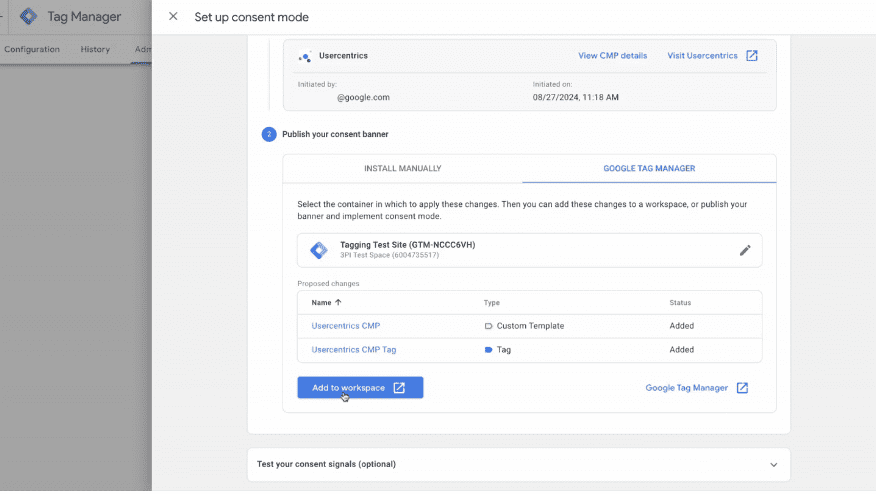
The update integrates with several of Google’s CMP partners within the Google Tag user interface across Google Ads, Google Analytics 4, and Google Tag Manager.
Screenshot from: support.google.com, August 2024.
This change affects how advertisers can manage consent banners and deploy consent mode.
Marvin stated:
“Working with one of Google’s CMP Partners is typically the easiest way to manage consent banner and consent mode deployment. Now the consent mode setup in the Google Tag UI integrates directly with many of these partners.”
Features Of The New Setup
The integrated CMP setup includes:
Guidance within the product interface
Integration with various CMP providers
Options for banner installation
Current CMP Partners
Four CMP providers are currently integrated with the new setup:
consentmanager
Cookiebot by Usercentrics
iubenda
Usercentrics
Broader Context
This update follows recent changes to digital privacy practices and regulations.
Earlier this year, Google updated its consent mode API with two new consent collection parameters.
In a blog post, Google noted,
“As privacy regulations evolve and technologies shift, we’ve continued to build tools that help advertisers succeed while respecting consumer choice.”
How This Can Benefit You
Google’s new integrated CMP setup could offer several advantages:
Easier Setup: Less technical hassle when implementing consent management.
Better Compliance: A streamlined process may help with GDPR adherence.
Data Accuracy: Aims to maintain measurement quality while respecting consent.
One-Stop Shop: Consent management directly in Google’s ad and analytics platforms.
Future-Proofing: Potentially quicker adaptation to evolving privacy rules.
The actual impact and effectiveness remain to be seen as they roll out to users.
Industry Outlook
As the digital advertising industry adapts to privacy concerns, these updates represent one approach to balancing advertiser needs with data protection requirements.
Advertisers must assess how these changes fit into their broader data strategies and compliance efforts.
Staying on top of these updates is key as the ad tech world navigates the privacy-first era.
Google published a video tutorial with seven tips for using Google Trends to research and share keyword and topic data. The tutorial shows how to find hidden filters and search tools in the Trends interface and explains how they help identify actionable data.
The seven ways to explore and share are:
Punctuation
By Language
Comparison Functions
Seasonality Discovery
Year Over Year Trends
Interest By Country
3 Ways To Export Or Share
1. Punctuation For Finding Hidden Insights
Omri Weisman, Google Trends Engineering Manager, shared how to use advanced search operators to dig deeper into the data and extract actionable user query insights.
He presented an overview of three advanced search operators:
A. Quotation marks
B. Plus operator (the + sign)
C. Minus operator (the – sign)
He started with the example of search a two-word keyword term without punctuation, explaining that the keyword query volume data is for both words in any order. He also pointed out that no misspellings, variations, or plural versions are included in the search volume data.
A. Quotation Marks
The first search operator he discussed was the quotation mark. The quotation marks shows data for the exact match phrase, including when embedded as part of a larger phrase, with words before or after the exact match search query.
B. Minus Sign
Adding a minus sign to a search phrase filters out the word that’s modified with the minus sign, like this:
Keyword -Phrase
In the above example the word ‘phrase” will not be included in the search query data. This is a great way to manipulate the data and extract more precise variations.
C. Plus Sign – Good Way To Research Topics
Searching with a plus sign and two keywords shows query volume for one or other keyword. As such, this way of searching provides the broadest keyword query amounts and represents an excellent way to research a topic. With a plus sign you can add in all the related phrases for a topic and then see all of them lumped together.
2. Segment By Language
…if you’re interested in a specific language, you might want to look only for that language. They use the example of identifying how many searches for cat are done in Japanese in the United States, which allows you to segment searches with greater granularity.
You can also combine two languages using the plus sign search operator to see the combined query volume.
They said:
“For example, if you enter the Japanese character for cat… You might miss the overall trends, since many people in the US, for example, search for cat in English.
To get the full picture. Compare searches for the Japanese character for Cat and English searches for cat using the plus operator.”
3. Use Filters To Identify More Actionable Data
Daniel Waisberg said that comparing keywords helps identify more meaningful trends. In order to do
He said:
“Getting the data you need is essential, but to understand what it means, you need a comparison point. For example, is the growth localized or global? Is the growth seasonal, and if so, how does this season compare to the previous one?
To create a meaningful comparison, you can use the filter capability inside the search term.”
The following screenshot shows where a three dot menu in a drop down to access the filters.
4. Seasonality Discovery
He next showed how to use the filters to discover seasonality.
He explained:
“First enter the term in the trends explore section and change the time frame to five years.
This will create an interesting chart showing that this term is highly seasonal. People search for boat trips significantly more in the UK summer than in the winter. “
5. How To Remove Seasonality Trends
Next he explained how to use the built-in filters to analyze year over year trends.
This is again accessed through the filters that are somewhat hidden in the Google Trends interface.
He showed how to do it:
“While it is interesting to know the time of the year when the term has a higher interest, you’ll need more information if you want to make decisions based on the data.
You can use a special filter to analyze trends year over year. This will help you neutralize the seasonality effect, making sure you’re comparing like for like.
Start by changing the date to past 12 months.
Add an identical term to the compare box and hover over the box.
Click the three dots menu and select Change Filters.
Here you see two options, location and time range. Click the time range and select the custom time range to choose the previous time period.
If you’re looking for full years, you can use the built in capability to choose the past five years. That would make your search quicker.
After these steps, you’ll end up with two lines in your chart, one for the past 12 months and a second for the previous 12 months.”
This comparison can be done with up to five searches, which has the effect of being able to see the general trends in comparison, without the noise introduced by seasonality.
6. Compare Interest By Countries
The comparison by country allows users to compare search query volumes by country, two or more countries together.
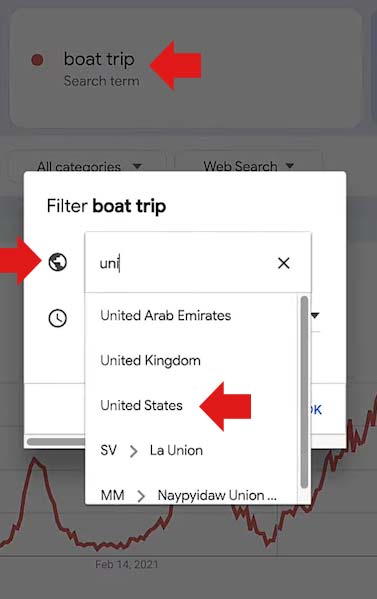
The way to do that is with the filters that are accessed by the three-dot menu located next to the search query being researched.
Screenshot Of Country Filter
7. Save Or Share Trend Results
Ori explained that there are three ways to save or share Google Trends results.
URL
Embedded
Export to spreadsheet
Share By URL
Sharing by URL is easy. Just copy the URL from the browser then share it.
Embed Trend Data
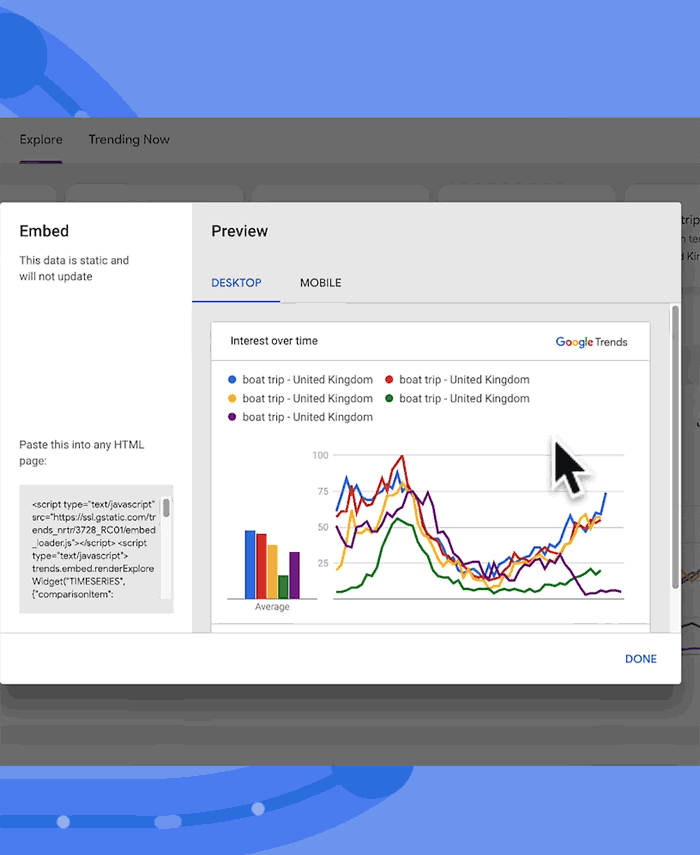
Embedding is a way to generate an embeddable card with the data that can be inserted into a web page, with bonus that the data is constantly updated.
“Another way to share a chart is to embed it on your website. You can generate an embeddable card to add to your website from almost any card on the page.”
Screenshot Of Embed User Interface
These cards will show up to date data and may also reproduce some in-product interactions.
Export The Data
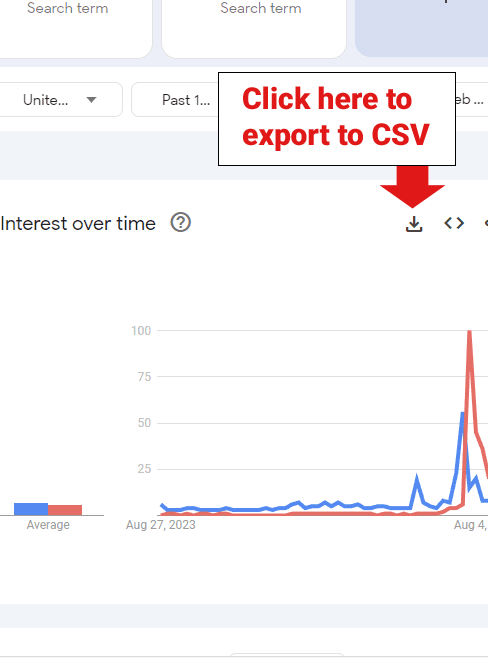
Clicking the export icon will provide the Google Trends data in the CSV format.
Screenshot Of Download Icon
Use Google Trends For Research
Google Trends is an excellent source of keyword and topic research and it’s completely free. Using these advanced methods will help get even more actionable data.
A WordPress plugin add-on for the popular Elementor page builder recently patched a vulnerability affecting over 200,000 installations. The exploit, found in the Jeg Elementor Kit plugin, allows authenticated attackers to upload malicious scripts.
Stored Cross-Site Scripting (Stored XSS)
The patch fixed an issue that could lead to a Stored Cross-Site Scripting exploit that allows an attacker to upload malicious files to a website server where it can be activated when a user visits the web page. This is different from a Reflected XSS which requires an admin or other user to be tricked into clicking a link that initiates the exploit. Both kinds of XSS can lead to a full-site takeover.
Insufficient Sanitization And Output Escaping
Wordfence posted an advisory that noted the source of the vulnerability is in lapse in a security practice known as sanitization which is a standard requiring a plugin to filter what a user can input into the website. So if an image or text is what’s expected then all other kinds of input are required to be blocked.
Another issue that was patched involved a security practice called Output Escaping which is a process similar to filtering that applies to what the plugin itself outputs, preventing it from outputting, for example, a malicious script. What it specifically does is to convert characters that could be interpreted as code, preventing a user’s browser from interpreting the output as code and executing a malicious script.
The Wordfence advisory explains:
“The Jeg Elementor Kit plugin for WordPress is vulnerable to Stored Cross-Site Scripting via SVG File uploads in all versions up to, and including, 2.6.7 due to insufficient input sanitization and output escaping. This makes it possible for authenticated attackers, with Author-level access and above, to inject arbitrary web scripts in pages that will execute whenever a user accesses the SVG file.”
Medium Level Threat
The vulnerability received a Medium Level threat score of 6.4 on a scale of 1 – 10. Users are recommended to update to Jeg Elementor Kit version 2.6.8 (or higher if available).
ChatGPT is experiencing a noticeable outage that is apparently reaching a critical point where it’s become highly noticeable. The current outage is a part of a series of outages that began on August 26th, becoming progressively serious with time.
Timeline Of ChatGPT Outage
August has seen numerous ChatGPT incidents, more than in July but so far the equaling the entire month of June. Some of the the incidents documented in July were related to the new GPT-4o language model.
In comparison, August has experienced elevated error rates, reaching a peak on August 28th where the amount of errors, Bad Gateway errors, were enough to cause a large blip on the Downdetector website.
Most of the reported problems involved ChatGPT and the website, while 4% of reported outages were on the ChatGPT app.
OpenAI Incident Reports
The official OpenAI status page has a notation indicating severe outage levels.
Elevated error rates for ChatGPT A fix has been implemented and we are monitoring the results. Aug 28, 08:19 PDT
Elevated error rates for gpt-4o-mini-2024-07-18 fine-tuned models This issue has now been resolved. Thank you for your patience. Aug 27, 12:27 – 14:14 PDT
Increased conversation latency in ChatGPT Today, between 12:51AM – 12:51PM PT, conversations on ChatGPT experienced increased latency. This issue is now resolved. Aug 26, 20:27 – 20:27 PD
A fix has apparently been deployed. If the outage is still ongoing for you then it may be something that has to propagate through datacenters or some other issue, perhaps related to the cloud gateway.
Google’s Martin Splitt answered a question about whether internal nofollow links and noindex meta robots directives send the wrong signal to Google that the website is low quality.
Nofollow Link Attribute
The nofollow link attribute came about as a standard created by Google, Yahoo and Microsoft that publishers can use to signal that a link can’t be trusted (such as links in user generated content) or for paid links. The idea is that the links can’t be trusted or used for ranking purposes or for whatever reason.
SEOs discovered that PageRank didn’t flow through links that had the nofollow attribute so naturally the self-identified “white hat” SEOs tried gaming Google by adding nofollow links to their privacy and about us pages in order to funnel the maximum amount of PageRank to the pages that mattered. This practice was called PageRank Sculpting and it shows that adding nofollows to internal links is longtime practice and that it’s never been a problem before.
For the record, PageRank sculpting doesn’t work because, in a highly simplified explanation, Google essentially counts the amount of links on a page, including links with nofollows and divides the amount of PageRank that flows as if all the links counted. That’s how it was explained many years ago and that may have changed over the years, we don’t really know.
Noindex Robots Meta tag
The noindex robots meta tag is a directive that crawlers like Googlebot are required to obey. It allows a publisher a way to block crawling at the page level.
There is nothing about the noindex value of the meta element that indicates whether the page is untrustworthy or anything like that. It’s just a way to control crawlers.
Google’s Martin Splitt narrated the question:
“Can a lot of internal links with nofollow tags or many pages with noindex tags signal to Google that the site has many low-quality pages?”
Martin answered:
“No, it doesn’t signal low-quality content to us, just that you have links you’re not willing to be associated with. That might have many reasons – you’re not sure where the link goes, because it is user-generated content (in which case consider using rel=ugc instead of rel=nofollow) or you don’t know what the site you’re linking to is going to do in a couple of years or so, so you mark them as rel=nofollow.”
Nofollow Is Not A Quality Signal
Martin confirmed that there is no signal indicating a value judgement about “quality” that’s associated with the use of a nofollow link attribute or the noindex robots meta tag. Using them on internal links or for preventing crawling is fine and have no effect on Google site quality judgements.
Listen to the podcast question and answer at the 1:17 minute mark:
Google’s John Mueller answered a question the question of how long it takes for SEO to work and what it means if rankings don’t change after a year. Sometimes best practices doesn’t work and John Mueller explains why this sometimes is the case.
What Is SEO?
There is no single definition of SEO. What constitutes good SEO is subjective and highly dependent on where one learned about SEO.
Some believe that SEO is adding keywords into content and building links.
Others don’t really bother with links and are more concerned with building content.
Some are highly focused on technical aspects like site performance metrics and structured data.
In some corners of the SEO community, there are those who passionately believe that SEO doesn’t matter because Google prioritizes ads, big brands, YouTube videos, more ads, and then leaves the crumbs of what’s left for small businesses.
So when someone asks why their SEO isn’t working, the answer can be a toss-up, and if ten SEOs agree, there’s a chance they haven’t identified the problem—they’ve only agreed on the most obvious reason. This was the situation John Mueller encountered when asked why a site wasn’t ranking despite following SEO best practices.
Hard To Answer Without Specifics
John Mueller narrated the question:
“I changed my website a year ago and did a lot of work on SEO. Should this be affecting my website’s traffic by now?”
It’s a hard question to answer when you don’t have the specifics of the webpage in front of you. So Mueller answered in a fairly general manner that ends with him recommending he ask someone else for advice in Google’s help forums.
The first part of Mueller’s response acknowledges the difficulty of answering the question.
He responded:
“It’s tricky to say much here. I don’t know what specifically you did to work on SEO, and I don’t know if that would have resulted in significant changes.”
Why SEO Doesn’t Work
Mueller’s right. Maybe the website has a great layout, fast page speed performance, spot on structured data and a logical site architecture that optimizes internal linking.
What could go wrong with a properly SEO’d website, right?
Well, the content could be incomplete.
The content could be too comprehensive.
The content might be unfocused, lacking a clear comprehension of the topic.
The content might be too focused on keywords and not focused enough on users.
The content might not match the topic suggested by the keywords in the title and the headings.
Maybe the content is aiming too high, trying to rank for a highly competitive search phrase.
No amount of SEO is going to save a website with the above listed problems… and that’s just a sample of what can go wrong.
Mueller addressed this shortcoming of SEO in situations where it has zero effect.
He continued his answer:
“There are many best practices which have minimal effect on the day-to-day performance of a website. For example, having a clean page structure helps search engines to better understand the content on a page, but it might not necessarily result in immediate search ranking or traffic changes.”
Ranking Criteria Is Different Across Topics
Another factor that Mueller touches on is that what’s important for SEO varies according to the topic. Some topics require fresh content, some content requires establishing signals of trustworthiness and authoritativeness, maybe even signals that communicate user brand preference and popularity, signals that indicate that users expect to see a specific brand for certain queries.
There could be a geographic component that prioritizes local signals. It could be an intent thing where a user just wants to read what a person wrote in a forum.
This may be what Mueller is talking about when he says that the best elements of SEO vary across websites.
He answered:
“The most effective elements of SEO will vary across websites, it takes a lot of experience to go from a long checklist of possible items to a short prioritized list of critical items.”
Experience Is Important
The last factor Mueller discussed is the role of experience in making one a better SEO. Here’s an example: I thought I was pretty good at creating content that ranks and then I wrote a couple thousand articles for Search Engine Journal and it opened up a whole new conception of content creation, I discovered levels of understanding that could only come from writing about a couple thousand articles.
Mentorship, is an option that can cut down the amount of time it takes to learn, but experience is still important.
John Mueller recommended experience as an important factor for understanding SEO.
He wrote:
“Your experience here will grow over time as you practice.
I recommend getting input from others, and practicing by helping with challenges that others post in help forums. Good luck!”
Google’s Martin Splitt answered a question in the SEO Office Hours podcast about whether reproducing YouTube video content into text on a web page would be seen as duplicate content and have a negative impact on the web page rankings.
Although duplicate content is not a negative ranking factor, content published on a more authoritative site can cause the content on the less authoritative site to be outranked. It’s a valid question to ask because content on an authoritative will outrank the same content on a less authoritative one.
Some in the search community refer to one piece of content usurping the rankings of another as ‘cannibalization’ of the webpage’s ranking potential. This is the concern of the person asking the question.
Google’s Martin Splitt narrated the submitted question:
“If I create a YouTube video and then take that exact text or content and place it on a web page, could Google flag that web page or site for duplicate content?”
Different Content Media Are Treated As Separate
Martin Splitt answered that the two forms of content are different and will not be treated as the same content, thus publishing text content extracted from a video will not be considered duplicate content.
This is his answer:
“No, one is a video and the other one is text content, and that would be unique content!”
Publishing Extracted Text From Video
Martin praised the idea of extracting text content from a video and republishing it as text, noting that some people prefer to consume content in text form rather than watching a video. Reversing the flow of content from text to audio or video is probably not a bad idea also because some people have trouble reading text content and may prefer listening to it from a video or a podcast format.
Martin commented on publishing video content in a textual version:
“It’s also not a bad idea, some users (like me) might prefer a text version and others might not be able to use a video version of the content in the first place due to bandwidth or visual constraints.”
Takeaways
The idea behind the question is repurposing content and it’s a good idea. Search is more than Google, it’s also YouTube and wherever people get their audio content, like Spotify. The fact that there is no cannibalization of the content between mediums makes repurposing a viable approach to extending your content reach.